


4930 Résultats
Niveau de description archivistique:
Projet
Projet
Numéro de référence:
AP178.S1.1990.PR09
Description:
The project series documents the Recuperação do Restaurante Pai Ramiro in Porto, Portugal. While the records were held in the office’s archives this project was assigned the number 19/90. The office assigned the dates 1990-1994 for this project. This project consists of a design for the restaurant Pai Ramiro in an existing eighteenth-century home. The restaurant was to have a capacity of 36 people, with a waiting bar, kitchen, storage spaces and a second-floor terrace. The building program proposed a bar area flooded in natural light from windows that revealed a backyard garden. The installation of air conditioning, a fire detection system and ventilation systems were also proposed. This project was not built. The project is recorded through drawings, photographic materials and some textual records dating from 1989-1995. The drawings include sketches, plans, elevations, sections, perspectives, details and framing drawings, while the photographic materials largely document the exisiting building. The textual records consist of correspondence, permit and supplier documentation, and the electrical program.
AP178.S1.1990.PR09
Description:
The project series documents the Recuperação do Restaurante Pai Ramiro in Porto, Portugal. While the records were held in the office’s archives this project was assigned the number 19/90. The office assigned the dates 1990-1994 for this project. This project consists of a design for the restaurant Pai Ramiro in an existing eighteenth-century home. The restaurant was to have a capacity of 36 people, with a waiting bar, kitchen, storage spaces and a second-floor terrace. The building program proposed a bar area flooded in natural light from windows that revealed a backyard garden. The installation of air conditioning, a fire detection system and ventilation systems were also proposed. This project was not built. The project is recorded through drawings, photographic materials and some textual records dating from 1989-1995. The drawings include sketches, plans, elevations, sections, perspectives, details and framing drawings, while the photographic materials largely document the exisiting building. The textual records consist of correspondence, permit and supplier documentation, and the electrical program.
Personnes et institutions:
Date:
1989-1995
1989-1995
Titre:
Recuperação do Restaurante Pai Ramiro [Pai Ramiro restaurant renovations], Porto, Portugal (1990-1994)
Actions:
AP178.S1.1990.PR09
Description:
The project series documents the Recuperação do Restaurante Pai Ramiro in Porto, Portugal. While the records were held in the office’s archives this project was assigned the number 19/90. The office assigned the dates 1990-1994 for this project. This project consists of a design for the restaurant Pai Ramiro in an existing eighteenth-century home. The restaurant was to have a capacity of 36 people, with a waiting bar, kitchen, storage spaces and a second-floor terrace. The building program proposed a bar area flooded in natural light from windows that revealed a backyard garden. The installation of air conditioning, a fire detection system and ventilation systems were also proposed. This project was not built. The project is recorded through drawings, photographic materials and some textual records dating from 1989-1995. The drawings include sketches, plans, elevations, sections, perspectives, details and framing drawings, while the photographic materials largely document the exisiting building. The textual records consist of correspondence, permit and supplier documentation, and the electrical program.
Recuperação do Restaurante Pai Ramiro [Pai Ramiro restaurant renovations], Porto, Portugal (1990-1994)
Actions:
AP178.S1.1990.PR09
Description:
The project series documents the Recuperação do Restaurante Pai Ramiro in Porto, Portugal. While the records were held in the office’s archives this project was assigned the number 19/90. The office assigned the dates 1990-1994 for this project. This project consists of a design for the restaurant Pai Ramiro in an existing eighteenth-century home. The restaurant was to have a capacity of 36 people, with a waiting bar, kitchen, storage spaces and a second-floor terrace. The building program proposed a bar area flooded in natural light from windows that revealed a backyard garden. The installation of air conditioning, a fire detection system and ventilation systems were also proposed. This project was not built. The project is recorded through drawings, photographic materials and some textual records dating from 1989-1995. The drawings include sketches, plans, elevations, sections, perspectives, details and framing drawings, while the photographic materials largely document the exisiting building. The textual records consist of correspondence, permit and supplier documentation, and the electrical program.
Niveau de description archivistique:
Project
Project
Date:
1989-1995
1989-1995
Personnes et institutions:
Classification:
dessins
Quantité:
19 working drawing(s)
dessins
Quantité:
19 working drawing(s)
Numéro de référence:
ARCH188122
Description:
footing and foundation plan, sectional details, ground floor plan, plan showing window openings and ground floor ceiling structure, upper floor plan, sections, elevations, wall sections, details of fireplace, windows and doors, washroom wall sections and living room reflected ceiling plan, elevation and details of wood screen, kitchen and miscellaneous details, stair details, balustrade, light baffle and door details
ARCH188122
Description:
footing and foundation plan, sectional details, ground floor plan, plan showing window openings and ground floor ceiling structure, upper floor plan, sections, elevations, wall sections, details of fireplace, windows and doors, washroom wall sections and living room reflected ceiling plan, elevation and details of wood screen, kitchen and miscellaneous details, stair details, balustrade, light baffle and door details
Personnes et institutions:
Titre:
Footing and foundation plan, sectional details, ground floor plan
Actions:
ARCH188122
Description:
footing and foundation plan, sectional details, ground floor plan, plan showing window openings and ground floor ceiling structure, upper floor plan, sections, elevations, wall sections, details of fireplace, windows and doors, washroom wall sections and living room reflected ceiling plan, elevation and details of wood screen, kitchen and miscellaneous details, stair details, balustrade, light baffle and door details
Footing and foundation plan, sectional details, ground floor plan
Actions:
ARCH188122
Description:
footing and foundation plan, sectional details, ground floor plan, plan showing window openings and ground floor ceiling structure, upper floor plan, sections, elevations, wall sections, details of fireplace, windows and doors, washroom wall sections and living room reflected ceiling plan, elevation and details of wood screen, kitchen and miscellaneous details, stair details, balustrade, light baffle and door details
Classification:
dessins
Quantité:
19 working drawing(s)
dessins
Quantité:
19 working drawing(s)
Personnes et institutions:
Classification:
documents textuels
documents textuels
Numéro de référence:
AP018.S2.005
Description:
This box contains folders of correspondence, memos, and agreements related to various projects including correpondence with Marathon Realty and correspondence related to the Toronto Sun, National Gallery, University of Ottawa, Caribbean Financial Services, and Art Gallery of Ontario. Also included is correspondence related to two withdrawals from Parkin Partnership and a folder on proposed light, air, view privacy standards for the City of Toronto Planning Board.
AP018.S2.005
Description:
This box contains folders of correspondence, memos, and agreements related to various projects including correpondence with Marathon Realty and correspondence related to the Toronto Sun, National Gallery, University of Ottawa, Caribbean Financial Services, and Art Gallery of Ontario. Also included is correspondence related to two withdrawals from Parkin Partnership and a folder on proposed light, air, view privacy standards for the City of Toronto Planning Board.
Personnes et institutions:
Date:
1977-1988
1977-1988
Titre:
Correspondence, memos, and agreements related to projects
Actions:
AP018.S2.005
Description:
This box contains folders of correspondence, memos, and agreements related to various projects including correpondence with Marathon Realty and correspondence related to the Toronto Sun, National Gallery, University of Ottawa, Caribbean Financial Services, and Art Gallery of Ontario. Also included is correspondence related to two withdrawals from Parkin Partnership and a folder on proposed light, air, view privacy standards for the City of Toronto Planning Board.
Correspondence, memos, and agreements related to projects
Actions:
AP018.S2.005
Description:
This box contains folders of correspondence, memos, and agreements related to various projects including correpondence with Marathon Realty and correspondence related to the Toronto Sun, National Gallery, University of Ottawa, Caribbean Financial Services, and Art Gallery of Ontario. Also included is correspondence related to two withdrawals from Parkin Partnership and a folder on proposed light, air, view privacy standards for the City of Toronto Planning Board.
Classification:
documents textuels
documents textuels
Date:
1977-1988
1977-1988
Personnes et institutions:
Classification:
dessins
Quantité:
29 working drawing(s)
dessins
Quantité:
29 working drawing(s)
Numéro de référence:
ARCH186020
Description:
Rectory - floor plans, elevations, cross section, main entrance details, window and door details, kitchen details, brick arch re-inforcing, acoustic tile and light fixture layouts, vestibule wall details, dining room cupboards, rear balcony, furniture layout, alternative entrance details, ground floor alterations, stair stringer details, revised kitchen cabinet arrangement, typical floor tile pattern, front door, shelving, counter unit, revised storage cupboards, partial floor plans
ARCH186020
Description:
Rectory - floor plans, elevations, cross section, main entrance details, window and door details, kitchen details, brick arch re-inforcing, acoustic tile and light fixture layouts, vestibule wall details, dining room cupboards, rear balcony, furniture layout, alternative entrance details, ground floor alterations, stair stringer details, revised kitchen cabinet arrangement, typical floor tile pattern, front door, shelving, counter unit, revised storage cupboards, partial floor plans
Personnes et institutions:
Titre:
Rectory - floor plans, elevations, cross section, details
Actions:
ARCH186020
Description:
Rectory - floor plans, elevations, cross section, main entrance details, window and door details, kitchen details, brick arch re-inforcing, acoustic tile and light fixture layouts, vestibule wall details, dining room cupboards, rear balcony, furniture layout, alternative entrance details, ground floor alterations, stair stringer details, revised kitchen cabinet arrangement, typical floor tile pattern, front door, shelving, counter unit, revised storage cupboards, partial floor plans
Rectory - floor plans, elevations, cross section, details
Actions:
ARCH186020
Description:
Rectory - floor plans, elevations, cross section, main entrance details, window and door details, kitchen details, brick arch re-inforcing, acoustic tile and light fixture layouts, vestibule wall details, dining room cupboards, rear balcony, furniture layout, alternative entrance details, ground floor alterations, stair stringer details, revised kitchen cabinet arrangement, typical floor tile pattern, front door, shelving, counter unit, revised storage cupboards, partial floor plans
Classification:
dessins
Quantité:
29 working drawing(s)
dessins
Quantité:
29 working drawing(s)
Personnes et institutions:
Classification:
livres, photographies
livres, photographies
Actions:
Numéro de référence:
PH1990:0330:001-008
Description:
- Contemporary binding consists of maroon cloth-covered boards and spine. There is a red leather label with a gold gilt inscription on the spine. Endpapers, pages and secondary supports are of light brownish white paper. The book is comprised of a title page, dedication page, prefatory note, list of photographs, 261 pages of text, including an appendix and index, a plan of the fair buildings and 8 photographs.
PH1990:0330:001-008
Description:
- Contemporary binding consists of maroon cloth-covered boards and spine. There is a red leather label with a gold gilt inscription on the spine. Endpapers, pages and secondary supports are of light brownish white paper. The book is comprised of a title page, dedication page, prefatory note, list of photographs, 261 pages of text, including an appendix and index, a plan of the fair buildings and 8 photographs.
Personnes et institutions:
Sujet:
architecture, portrait
architecture, portrait
Date:
published 1867
published 1867
Titre:
A Record of the Metropolitan Fair in Aid of the United States Sanitary Commission, Held at New York, in April, 1864
Actions:
PH1990:0330:001-008
Description:
- Contemporary binding consists of maroon cloth-covered boards and spine. There is a red leather label with a gold gilt inscription on the spine. Endpapers, pages and secondary supports are of light brownish white paper. The book is comprised of a title page, dedication page, prefatory note, list of photographs, 261 pages of text, including an appendix and index, a plan of the fair buildings and 8 photographs.
A Record of the Metropolitan Fair in Aid of the United States Sanitary Commission, Held at New York, in April, 1864
Actions:
PH1990:0330:001-008
Description:
- Contemporary binding consists of maroon cloth-covered boards and spine. There is a red leather label with a gold gilt inscription on the spine. Endpapers, pages and secondary supports are of light brownish white paper. The book is comprised of a title page, dedication page, prefatory note, list of photographs, 261 pages of text, including an appendix and index, a plan of the fair buildings and 8 photographs.
Classification:
livres, photographies
livres, photographies
Date:
published 1867
published 1867
Personnes et institutions:
Sujet:
architecture, portrait
architecture, portrait
Niveau de description archivistique:
Projet
Projet
Numéro de référence:
AP164.S1.1999.D6
Description:
The project series documents the commission, design, and construction of the Gordillo studio, neighbouring the client’s house (AP164.S1.1993.D2) on Castilla de Ponferrada Street, in Villanueva de la Cañada, Community of Madrid, Spain. The firm identified this project as number 119. “The Gordillo Studio is a prismatic, serrated volume that occupies the plot’s only available strip of land and minimizes its presence through the use of two materials, translucent polycarbonate and xerophilous plantings, which seek the best adaptation to the site, the program and the client. Using this system, a semi-buried interior is constructed in which the light has been modeled as a solid, expansive material, the aim being to satisfy not only the specific demands of the work space but also the creation of an agreeable atmosphere, as austere as it is sensual.” (ARCH270975) Abalos & Herreros worked with Ángel Jaramillo Sanchez, María Auxiliadora Gálvez, Renata Sentkiewicz, Juan Gómez, Fernando Valero and José Torras. In 2002, the project won the COAM 2000 prize. Documenting this project are conceptual, design development and working drawings, photographic and reference materials, correspondence, notes, budgets, reports, studies, forms, project descriptions, invoices, certifications and trade catalogues.
AP164.S1.1999.D6
Description:
The project series documents the commission, design, and construction of the Gordillo studio, neighbouring the client’s house (AP164.S1.1993.D2) on Castilla de Ponferrada Street, in Villanueva de la Cañada, Community of Madrid, Spain. The firm identified this project as number 119. “The Gordillo Studio is a prismatic, serrated volume that occupies the plot’s only available strip of land and minimizes its presence through the use of two materials, translucent polycarbonate and xerophilous plantings, which seek the best adaptation to the site, the program and the client. Using this system, a semi-buried interior is constructed in which the light has been modeled as a solid, expansive material, the aim being to satisfy not only the specific demands of the work space but also the creation of an agreeable atmosphere, as austere as it is sensual.” (ARCH270975) Abalos & Herreros worked with Ángel Jaramillo Sanchez, María Auxiliadora Gálvez, Renata Sentkiewicz, Juan Gómez, Fernando Valero and José Torras. In 2002, the project won the COAM 2000 prize. Documenting this project are conceptual, design development and working drawings, photographic and reference materials, correspondence, notes, budgets, reports, studies, forms, project descriptions, invoices, certifications and trade catalogues.
Personnes et institutions:
Date:
1978, 1992-2002, predominant 1999-2000
1978, 1992-2002, predominant 1999-2000
Titre:
Estudio Gordillo, Villanueva de la Cañada, Spain (1999)
Actions:
AP164.S1.1999.D6
Description:
The project series documents the commission, design, and construction of the Gordillo studio, neighbouring the client’s house (AP164.S1.1993.D2) on Castilla de Ponferrada Street, in Villanueva de la Cañada, Community of Madrid, Spain. The firm identified this project as number 119. “The Gordillo Studio is a prismatic, serrated volume that occupies the plot’s only available strip of land and minimizes its presence through the use of two materials, translucent polycarbonate and xerophilous plantings, which seek the best adaptation to the site, the program and the client. Using this system, a semi-buried interior is constructed in which the light has been modeled as a solid, expansive material, the aim being to satisfy not only the specific demands of the work space but also the creation of an agreeable atmosphere, as austere as it is sensual.” (ARCH270975) Abalos & Herreros worked with Ángel Jaramillo Sanchez, María Auxiliadora Gálvez, Renata Sentkiewicz, Juan Gómez, Fernando Valero and José Torras. In 2002, the project won the COAM 2000 prize. Documenting this project are conceptual, design development and working drawings, photographic and reference materials, correspondence, notes, budgets, reports, studies, forms, project descriptions, invoices, certifications and trade catalogues.
Estudio Gordillo, Villanueva de la Cañada, Spain (1999)
Actions:
AP164.S1.1999.D6
Description:
The project series documents the commission, design, and construction of the Gordillo studio, neighbouring the client’s house (AP164.S1.1993.D2) on Castilla de Ponferrada Street, in Villanueva de la Cañada, Community of Madrid, Spain. The firm identified this project as number 119. “The Gordillo Studio is a prismatic, serrated volume that occupies the plot’s only available strip of land and minimizes its presence through the use of two materials, translucent polycarbonate and xerophilous plantings, which seek the best adaptation to the site, the program and the client. Using this system, a semi-buried interior is constructed in which the light has been modeled as a solid, expansive material, the aim being to satisfy not only the specific demands of the work space but also the creation of an agreeable atmosphere, as austere as it is sensual.” (ARCH270975) Abalos & Herreros worked with Ángel Jaramillo Sanchez, María Auxiliadora Gálvez, Renata Sentkiewicz, Juan Gómez, Fernando Valero and José Torras. In 2002, the project won the COAM 2000 prize. Documenting this project are conceptual, design development and working drawings, photographic and reference materials, correspondence, notes, budgets, reports, studies, forms, project descriptions, invoices, certifications and trade catalogues.
Niveau de description archivistique:
Project
Project
Date:
1978, 1992-2002, predominant 1999-2000
1978, 1992-2002, predominant 1999-2000
Personnes et institutions:
Niveau de description archivistique:
Projet
Projet
Numéro de référence:
AP178.S1.1992.PR04
Description:
This project series documents the Helsinki Museum of Contemporary Art. While the records were held in the office’s archives this project was assigned the number 28/90. The office assigned the dates 1992-1993 to this project. For the 75th anniversary of the independence of the country, the Finnish government held a competition for the design of the Museum of Contemporary Art of Helsinki. The competition was exclusive to Scandinavian architects, with the exception of four invited architects, including Àlvaro Siza. Eduardo Souto de Moura collaborated with Siza on the design. The project site was located in the center of Helsinki, near the main post office and the Parliament. Siza decided to name the building Cometa. The proposal included exhibition spaces, teaching and public facilities, an auditorium, workrooms, workshops, storerooms, film studio, and spaces for the administration and archives. The showrooms were located on the first floor and most of the lighting was intended to come from natural light. The design proposed by Siza included the use of granite for the exterior of the building. Steven Holl was selected by the jury to built the museum. Documenting this project are floor plans, sections, elevations, and site plans. Textual material includes project documentation, competition documentation, and correspondence. Photographs and negatives document the project site.
AP178.S1.1992.PR04
Description:
This project series documents the Helsinki Museum of Contemporary Art. While the records were held in the office’s archives this project was assigned the number 28/90. The office assigned the dates 1992-1993 to this project. For the 75th anniversary of the independence of the country, the Finnish government held a competition for the design of the Museum of Contemporary Art of Helsinki. The competition was exclusive to Scandinavian architects, with the exception of four invited architects, including Àlvaro Siza. Eduardo Souto de Moura collaborated with Siza on the design. The project site was located in the center of Helsinki, near the main post office and the Parliament. Siza decided to name the building Cometa. The proposal included exhibition spaces, teaching and public facilities, an auditorium, workrooms, workshops, storerooms, film studio, and spaces for the administration and archives. The showrooms were located on the first floor and most of the lighting was intended to come from natural light. The design proposed by Siza included the use of granite for the exterior of the building. Steven Holl was selected by the jury to built the museum. Documenting this project are floor plans, sections, elevations, and site plans. Textual material includes project documentation, competition documentation, and correspondence. Photographs and negatives document the project site.
Personnes et institutions:
Date:
1992-1993
1992-1993
Titre:
Museu de Arte Contemporânea para Helsínquia [Helsinki Museum of Contemporary Art], Helsinki, Finland (1992-1993)
Actions:
AP178.S1.1992.PR04
Description:
This project series documents the Helsinki Museum of Contemporary Art. While the records were held in the office’s archives this project was assigned the number 28/90. The office assigned the dates 1992-1993 to this project. For the 75th anniversary of the independence of the country, the Finnish government held a competition for the design of the Museum of Contemporary Art of Helsinki. The competition was exclusive to Scandinavian architects, with the exception of four invited architects, including Àlvaro Siza. Eduardo Souto de Moura collaborated with Siza on the design. The project site was located in the center of Helsinki, near the main post office and the Parliament. Siza decided to name the building Cometa. The proposal included exhibition spaces, teaching and public facilities, an auditorium, workrooms, workshops, storerooms, film studio, and spaces for the administration and archives. The showrooms were located on the first floor and most of the lighting was intended to come from natural light. The design proposed by Siza included the use of granite for the exterior of the building. Steven Holl was selected by the jury to built the museum. Documenting this project are floor plans, sections, elevations, and site plans. Textual material includes project documentation, competition documentation, and correspondence. Photographs and negatives document the project site.
Museu de Arte Contemporânea para Helsínquia [Helsinki Museum of Contemporary Art], Helsinki, Finland (1992-1993)
Actions:
AP178.S1.1992.PR04
Description:
This project series documents the Helsinki Museum of Contemporary Art. While the records were held in the office’s archives this project was assigned the number 28/90. The office assigned the dates 1992-1993 to this project. For the 75th anniversary of the independence of the country, the Finnish government held a competition for the design of the Museum of Contemporary Art of Helsinki. The competition was exclusive to Scandinavian architects, with the exception of four invited architects, including Àlvaro Siza. Eduardo Souto de Moura collaborated with Siza on the design. The project site was located in the center of Helsinki, near the main post office and the Parliament. Siza decided to name the building Cometa. The proposal included exhibition spaces, teaching and public facilities, an auditorium, workrooms, workshops, storerooms, film studio, and spaces for the administration and archives. The showrooms were located on the first floor and most of the lighting was intended to come from natural light. The design proposed by Siza included the use of granite for the exterior of the building. Steven Holl was selected by the jury to built the museum. Documenting this project are floor plans, sections, elevations, and site plans. Textual material includes project documentation, competition documentation, and correspondence. Photographs and negatives document the project site.
Niveau de description archivistique:
Project
Project
Date:
1992-1993
1992-1993
Personnes et institutions:
Niveau de description archivistique:
Projet
Projet
Numéro de référence:
AP178.S1.1988.PR03
Description:
This project series documents the Centro Galego de Arte Contemporânea in Santiago de Compostela, Spain. While the records were held in the office’s archives this project was assigned the number 54/80. The office assigned the date 1988 for this project. This project was commissioned by the Xunta de Galicia for the autonomous community of Galicia in Spain. The building was located near the Galego Pobo Museum and the Convento de Santo Domingo de Bonaval. The museum was approximately 75,000 square feet and divided into two L-shaped structures. The building had four floors and included exhibition halls, a terrace, a cafeteria, administrative spaces, an auditorium, and a library. The exterior was principally made of granite panels. The exhibition spaces were very bright, principally due to the natural light that came from multiple openings in the building as well as the white walls. The floors of the public spaces and exhibition rooms were made of Greek marble. Siza also transformed the Convento de Santo Domingo de Bonaval garden into a public park. The park was understood as an extension of the museum. Documenting this project are sketches, studies, preliminary drawings, plans and working drawings. Textual materials include project documentation and correspondence. Photographic materials document the models, project site and built project.
AP178.S1.1988.PR03
Description:
This project series documents the Centro Galego de Arte Contemporânea in Santiago de Compostela, Spain. While the records were held in the office’s archives this project was assigned the number 54/80. The office assigned the date 1988 for this project. This project was commissioned by the Xunta de Galicia for the autonomous community of Galicia in Spain. The building was located near the Galego Pobo Museum and the Convento de Santo Domingo de Bonaval. The museum was approximately 75,000 square feet and divided into two L-shaped structures. The building had four floors and included exhibition halls, a terrace, a cafeteria, administrative spaces, an auditorium, and a library. The exterior was principally made of granite panels. The exhibition spaces were very bright, principally due to the natural light that came from multiple openings in the building as well as the white walls. The floors of the public spaces and exhibition rooms were made of Greek marble. Siza also transformed the Convento de Santo Domingo de Bonaval garden into a public park. The park was understood as an extension of the museum. Documenting this project are sketches, studies, preliminary drawings, plans and working drawings. Textual materials include project documentation and correspondence. Photographic materials document the models, project site and built project.
Personnes et institutions:
Date:
1988-1995
1988-1995
Titre:
Centro Galego de Arte Contemporânea [Galician Centre of Contemporary Art], Santiago de Compostela, Spain, 1988-1993
Actions:
AP178.S1.1988.PR03
Description:
This project series documents the Centro Galego de Arte Contemporânea in Santiago de Compostela, Spain. While the records were held in the office’s archives this project was assigned the number 54/80. The office assigned the date 1988 for this project. This project was commissioned by the Xunta de Galicia for the autonomous community of Galicia in Spain. The building was located near the Galego Pobo Museum and the Convento de Santo Domingo de Bonaval. The museum was approximately 75,000 square feet and divided into two L-shaped structures. The building had four floors and included exhibition halls, a terrace, a cafeteria, administrative spaces, an auditorium, and a library. The exterior was principally made of granite panels. The exhibition spaces were very bright, principally due to the natural light that came from multiple openings in the building as well as the white walls. The floors of the public spaces and exhibition rooms were made of Greek marble. Siza also transformed the Convento de Santo Domingo de Bonaval garden into a public park. The park was understood as an extension of the museum. Documenting this project are sketches, studies, preliminary drawings, plans and working drawings. Textual materials include project documentation and correspondence. Photographic materials document the models, project site and built project.
Centro Galego de Arte Contemporânea [Galician Centre of Contemporary Art], Santiago de Compostela, Spain, 1988-1993
Actions:
AP178.S1.1988.PR03
Description:
This project series documents the Centro Galego de Arte Contemporânea in Santiago de Compostela, Spain. While the records were held in the office’s archives this project was assigned the number 54/80. The office assigned the date 1988 for this project. This project was commissioned by the Xunta de Galicia for the autonomous community of Galicia in Spain. The building was located near the Galego Pobo Museum and the Convento de Santo Domingo de Bonaval. The museum was approximately 75,000 square feet and divided into two L-shaped structures. The building had four floors and included exhibition halls, a terrace, a cafeteria, administrative spaces, an auditorium, and a library. The exterior was principally made of granite panels. The exhibition spaces were very bright, principally due to the natural light that came from multiple openings in the building as well as the white walls. The floors of the public spaces and exhibition rooms were made of Greek marble. Siza also transformed the Convento de Santo Domingo de Bonaval garden into a public park. The park was understood as an extension of the museum. Documenting this project are sketches, studies, preliminary drawings, plans and working drawings. Textual materials include project documentation and correspondence. Photographic materials document the models, project site and built project.
Niveau de description archivistique:
Project
Project
Date:
1988-1995
1988-1995
Personnes et institutions:
Classification:
dessins
dessins
Titre:
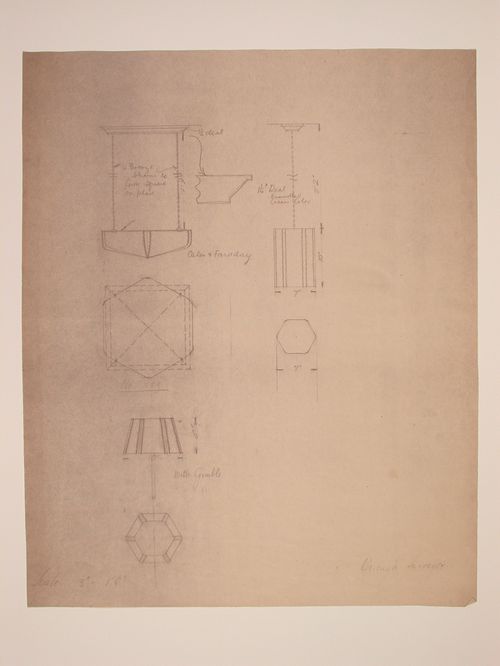
Elevations, plans and a section for three lamps, probably for Electric House, Battersea Borough
Elevations, plans and a section for three lamps, probably for Electric House, Battersea Borough
Actions:
Numéro de référence:
DR1988:0384
Description:
- This reprographic copy shows three lighting fixtures: one lamp and two pendant light fixtures suspended from the ceiling by bronze chains. The designs are probably for Electric House; the CCA collection contains similar designs for showroom light fixtures for Electric House, DR1988:0386 and DR1988:0396, which, like this print, are signed by the Borough Surveyor. - This work is part of an incomplete group of possibly working reprographic copies for Electric House, Battersea Borough, designed by the borough architect, Henry Hyams. The group also includes some reprographic copies which may have been used for publication purposes. - The style of many of these drawings and reprographic copies by Henry Hyams (DR1988:0332 - DR1988:0414) suggests that they were possibly for periodical illustrations. Hyams contributed articles to the periodicals 'The Builder' and 'The Architect'. Two objects in the CCA collections can be directly linked to an article published prior to 1926 in 'The Architect'; a reprographic copy (DR1988:0357) and a drawing (DR1988:0364) (Who's Who in Architecture, 161).
DR1988:0384
Description:
- This reprographic copy shows three lighting fixtures: one lamp and two pendant light fixtures suspended from the ceiling by bronze chains. The designs are probably for Electric House; the CCA collection contains similar designs for showroom light fixtures for Electric House, DR1988:0386 and DR1988:0396, which, like this print, are signed by the Borough Surveyor. - This work is part of an incomplete group of possibly working reprographic copies for Electric House, Battersea Borough, designed by the borough architect, Henry Hyams. The group also includes some reprographic copies which may have been used for publication purposes. - The style of many of these drawings and reprographic copies by Henry Hyams (DR1988:0332 - DR1988:0414) suggests that they were possibly for periodical illustrations. Hyams contributed articles to the periodicals 'The Builder' and 'The Architect'. Two objects in the CCA collections can be directly linked to an article published prior to 1926 in 'The Architect'; a reprographic copy (DR1988:0357) and a drawing (DR1988:0364) (Who's Who in Architecture, 161).
Personnes et institutions:
Sujet:
design d'intérieur
design d'intérieur
Date:
printed late 1926 or 1927
printed late 1926 or 1927
Titre:
Elevations, plans and a section for three lamps, probably for Electric House, Battersea Borough
Actions:
DR1988:0384
Description:
- This reprographic copy shows three lighting fixtures: one lamp and two pendant light fixtures suspended from the ceiling by bronze chains. The designs are probably for Electric House; the CCA collection contains similar designs for showroom light fixtures for Electric House, DR1988:0386 and DR1988:0396, which, like this print, are signed by the Borough Surveyor. - This work is part of an incomplete group of possibly working reprographic copies for Electric House, Battersea Borough, designed by the borough architect, Henry Hyams. The group also includes some reprographic copies which may have been used for publication purposes. - The style of many of these drawings and reprographic copies by Henry Hyams (DR1988:0332 - DR1988:0414) suggests that they were possibly for periodical illustrations. Hyams contributed articles to the periodicals 'The Builder' and 'The Architect'. Two objects in the CCA collections can be directly linked to an article published prior to 1926 in 'The Architect'; a reprographic copy (DR1988:0357) and a drawing (DR1988:0364) (Who's Who in Architecture, 161).
Elevations, plans and a section for three lamps, probably for Electric House, Battersea Borough
Actions:
DR1988:0384
Description:
- This reprographic copy shows three lighting fixtures: one lamp and two pendant light fixtures suspended from the ceiling by bronze chains. The designs are probably for Electric House; the CCA collection contains similar designs for showroom light fixtures for Electric House, DR1988:0386 and DR1988:0396, which, like this print, are signed by the Borough Surveyor. - This work is part of an incomplete group of possibly working reprographic copies for Electric House, Battersea Borough, designed by the borough architect, Henry Hyams. The group also includes some reprographic copies which may have been used for publication purposes. - The style of many of these drawings and reprographic copies by Henry Hyams (DR1988:0332 - DR1988:0414) suggests that they were possibly for periodical illustrations. Hyams contributed articles to the periodicals 'The Builder' and 'The Architect'. Two objects in the CCA collections can be directly linked to an article published prior to 1926 in 'The Architect'; a reprographic copy (DR1988:0357) and a drawing (DR1988:0364) (Who's Who in Architecture, 161).
Classification:
dessins
dessins
Date:
printed late 1926 or 1927
printed late 1926 or 1927
Personnes et institutions:
Sujet:
design d'intérieur
design d'intérieur
Niveau de description archivistique:
Projet
Projet
Numéro de référence:
AP166.S1.1990.PR2
Description:
This file documents the executed project for the Prospecta Toyama '92 Observatory Tower in Imizu, Toyama, Japan. Like the Galaxy Toyama Gymnasium, this project was designed in conjunction with the 1st Japan Expo Toyama in 1992. The 30 x 32 x 32 metre structure, built at the top of a 61,2 metre hill, serves as a platform to observe the surrounding landscape. The centre court is designed and equipped for the creation of a performance with sound, light and fog. The file is chiefly composed of design development and presentation drawings but includes some conceptual drawings and material related to theme development. There are also site plans and information about the 1st Japan Expo Toyama 1992. There is a small amount of correspondence in the form of facsimile transmissions. Working drawings include a set of structural drawings. Presentation material includes a model and bound copies and drafts of proposals. There are some digital prints of computer-generated perspectives, one in the form of a presentation panel. There is also some documentation for the development of the name and logo for the structure. A small album contains photographs of the built work. There is some promotional material for the tower and for the park in which it is situated. There are also clippings from published documents. Material in this file was produced between 1990 and 1993. .
AP166.S1.1990.PR2
Description:
This file documents the executed project for the Prospecta Toyama '92 Observatory Tower in Imizu, Toyama, Japan. Like the Galaxy Toyama Gymnasium, this project was designed in conjunction with the 1st Japan Expo Toyama in 1992. The 30 x 32 x 32 metre structure, built at the top of a 61,2 metre hill, serves as a platform to observe the surrounding landscape. The centre court is designed and equipped for the creation of a performance with sound, light and fog. The file is chiefly composed of design development and presentation drawings but includes some conceptual drawings and material related to theme development. There are also site plans and information about the 1st Japan Expo Toyama 1992. There is a small amount of correspondence in the form of facsimile transmissions. Working drawings include a set of structural drawings. Presentation material includes a model and bound copies and drafts of proposals. There are some digital prints of computer-generated perspectives, one in the form of a presentation panel. There is also some documentation for the development of the name and logo for the structure. A small album contains photographs of the built work. There is some promotional material for the tower and for the park in which it is situated. There are also clippings from published documents. Material in this file was produced between 1990 and 1993. .
Personnes et institutions:
Date:
1990-1993
1990-1993
Titre:
Prospecta Toyama '92 Observatory Tower, Imizu, Japan (1990-1993)
Actions:
AP166.S1.1990.PR2
Description:
This file documents the executed project for the Prospecta Toyama '92 Observatory Tower in Imizu, Toyama, Japan. Like the Galaxy Toyama Gymnasium, this project was designed in conjunction with the 1st Japan Expo Toyama in 1992. The 30 x 32 x 32 metre structure, built at the top of a 61,2 metre hill, serves as a platform to observe the surrounding landscape. The centre court is designed and equipped for the creation of a performance with sound, light and fog. The file is chiefly composed of design development and presentation drawings but includes some conceptual drawings and material related to theme development. There are also site plans and information about the 1st Japan Expo Toyama 1992. There is a small amount of correspondence in the form of facsimile transmissions. Working drawings include a set of structural drawings. Presentation material includes a model and bound copies and drafts of proposals. There are some digital prints of computer-generated perspectives, one in the form of a presentation panel. There is also some documentation for the development of the name and logo for the structure. A small album contains photographs of the built work. There is some promotional material for the tower and for the park in which it is situated. There are also clippings from published documents. Material in this file was produced between 1990 and 1993. .
Prospecta Toyama '92 Observatory Tower, Imizu, Japan (1990-1993)
Actions:
AP166.S1.1990.PR2
Description:
This file documents the executed project for the Prospecta Toyama '92 Observatory Tower in Imizu, Toyama, Japan. Like the Galaxy Toyama Gymnasium, this project was designed in conjunction with the 1st Japan Expo Toyama in 1992. The 30 x 32 x 32 metre structure, built at the top of a 61,2 metre hill, serves as a platform to observe the surrounding landscape. The centre court is designed and equipped for the creation of a performance with sound, light and fog. The file is chiefly composed of design development and presentation drawings but includes some conceptual drawings and material related to theme development. There are also site plans and information about the 1st Japan Expo Toyama 1992. There is a small amount of correspondence in the form of facsimile transmissions. Working drawings include a set of structural drawings. Presentation material includes a model and bound copies and drafts of proposals. There are some digital prints of computer-generated perspectives, one in the form of a presentation panel. There is also some documentation for the development of the name and logo for the structure. A small album contains photographs of the built work. There is some promotional material for the tower and for the park in which it is situated. There are also clippings from published documents. Material in this file was produced between 1990 and 1993. .
Niveau de description archivistique:
project
project
Date:
1990-1993
1990-1993
Personnes et institutions:


