


11504 Résultats
Classification:
documents textuels
documents textuels
Numéro de référence:
AP206.S2.027
Description:
File was originally housed in a binder along with content arranged in AP206.S2.024, AP206.S2.025, AP206.S2.026, AP206.S2.028 and AP206.S2.029. This file includes the following papers: "The spirit of Chandigarh" 1976 “Mediocrity,” 1976 “The Sector,” 1976 “Chandigarh,” 1976 “Housing,” 1976 “Greed,” 1976 “The Time,” 1976 “The Leisure Valley,” 1976 “The City Centre,” “The V2s,” “Shopping,” 1976 “The Educational Zone,” 1976 “The Capitol Complex” “The Lake” “The Spiritual Responsibility,” 1976
AP206.S2.027
Description:
File was originally housed in a binder along with content arranged in AP206.S2.024, AP206.S2.025, AP206.S2.026, AP206.S2.028 and AP206.S2.029. This file includes the following papers: "The spirit of Chandigarh" 1976 “Mediocrity,” 1976 “The Sector,” 1976 “Chandigarh,” 1976 “Housing,” 1976 “Greed,” 1976 “The Time,” 1976 “The Leisure Valley,” 1976 “The City Centre,” “The V2s,” “Shopping,” 1976 “The Educational Zone,” 1976 “The Capitol Complex” “The Lake” “The Spiritual Responsibility,” 1976
Personnes et institutions:
Date:
1972-1978
1972-1978
Titre:
Unpublished papers (folder 4 of 6)
Actions:
AP206.S2.027
Description:
File was originally housed in a binder along with content arranged in AP206.S2.024, AP206.S2.025, AP206.S2.026, AP206.S2.028 and AP206.S2.029. This file includes the following papers: "The spirit of Chandigarh" 1976 “Mediocrity,” 1976 “The Sector,” 1976 “Chandigarh,” 1976 “Housing,” 1976 “Greed,” 1976 “The Time,” 1976 “The Leisure Valley,” 1976 “The City Centre,” “The V2s,” “Shopping,” 1976 “The Educational Zone,” 1976 “The Capitol Complex” “The Lake” “The Spiritual Responsibility,” 1976
Unpublished papers (folder 4 of 6)
Actions:
AP206.S2.027
Description:
File was originally housed in a binder along with content arranged in AP206.S2.024, AP206.S2.025, AP206.S2.026, AP206.S2.028 and AP206.S2.029. This file includes the following papers: "The spirit of Chandigarh" 1976 “Mediocrity,” 1976 “The Sector,” 1976 “Chandigarh,” 1976 “Housing,” 1976 “Greed,” 1976 “The Time,” 1976 “The Leisure Valley,” 1976 “The City Centre,” “The V2s,” “Shopping,” 1976 “The Educational Zone,” 1976 “The Capitol Complex” “The Lake” “The Spiritual Responsibility,” 1976
Classification:
documents textuels
documents textuels
Date:
1972-1978
1972-1978
Personnes et institutions:
Classification:
photographies
photographies
Numéro de référence:
ARCH274434
Description:
Group consists of negatives (113 negatives) contact sheets (24 contact sheets) and photographs (24 photographs) of Chandigarh, India, including photographs of the Capitol Complex's buildings, the University's buildings, including the Ghandi Bhawan, government housing, the Bhakra Dam near Talwara and some models. There are also photographs of Chandigard's area before the construction. The group also includes photographs of Pierre Jeanneret, P. L. Varma, Nehru, Jane Drew, Jacqueline Jeanneret, Le Corbusier and others.
ARCH274434
Description:
Group consists of negatives (113 negatives) contact sheets (24 contact sheets) and photographs (24 photographs) of Chandigarh, India, including photographs of the Capitol Complex's buildings, the University's buildings, including the Ghandi Bhawan, government housing, the Bhakra Dam near Talwara and some models. There are also photographs of Chandigard's area before the construction. The group also includes photographs of Pierre Jeanneret, P. L. Varma, Nehru, Jane Drew, Jacqueline Jeanneret, Le Corbusier and others.
Personnes et institutions:
Date:
between 1951 and 1965
between 1951 and 1965
Titre:
Photographs of Chandigarh, India
Actions:
ARCH274434
Description:
Group consists of negatives (113 negatives) contact sheets (24 contact sheets) and photographs (24 photographs) of Chandigarh, India, including photographs of the Capitol Complex's buildings, the University's buildings, including the Ghandi Bhawan, government housing, the Bhakra Dam near Talwara and some models. There are also photographs of Chandigard's area before the construction. The group also includes photographs of Pierre Jeanneret, P. L. Varma, Nehru, Jane Drew, Jacqueline Jeanneret, Le Corbusier and others.
Photographs of Chandigarh, India
Actions:
ARCH274434
Description:
Group consists of negatives (113 negatives) contact sheets (24 contact sheets) and photographs (24 photographs) of Chandigarh, India, including photographs of the Capitol Complex's buildings, the University's buildings, including the Ghandi Bhawan, government housing, the Bhakra Dam near Talwara and some models. There are also photographs of Chandigard's area before the construction. The group also includes photographs of Pierre Jeanneret, P. L. Varma, Nehru, Jane Drew, Jacqueline Jeanneret, Le Corbusier and others.
Classification:
photographies
photographies
Date:
between 1951 and 1965
between 1951 and 1965
Personnes et institutions:
Classification:
archives
Niveau de description archivistique:
Collection
archives
Niveau de description archivistique:
Collection
Numéro de référence:
CI007
Résumé:
The Ludwig Mies van der Rohe and his students collection documents Mies's work as an architect, a designer and a consulting architect, between 1918 and 1981, as well as the work of his students at the Illinois Institute of Technology in Chicago, between 1938 and 1943. The collection is focussed on Mies's architectural projects and exhibition designs, mainly in Germany and in the United States.
CI007
Résumé:
The Ludwig Mies van der Rohe and his students collection documents Mies's work as an architect, a designer and a consulting architect, between 1918 and 1981, as well as the work of his students at the Illinois Institute of Technology in Chicago, between 1938 and 1943. The collection is focussed on Mies's architectural projects and exhibition designs, mainly in Germany and in the United States.
Personnes et institutions:
Date:
1918-2000
1918-2000
Titre:
Collection Ludwig Mies van der Rohe et ses étudiants
CI007
Résumé:
The Ludwig Mies van der Rohe and his students collection documents Mies's work as an architect, a designer and a consulting architect, between 1918 and 1981, as well as the work of his students at the Illinois Institute of Technology in Chicago, between 1938 and 1943. The collection is focussed on Mies's architectural projects and exhibition designs, mainly in Germany and in the United States.
Collection Ludwig Mies van der Rohe et ses étudiants
CI007
Résumé:
The Ludwig Mies van der Rohe and his students collection documents Mies's work as an architect, a designer and a consulting architect, between 1918 and 1981, as well as the work of his students at the Illinois Institute of Technology in Chicago, between 1938 and 1943. The collection is focussed on Mies's architectural projects and exhibition designs, mainly in Germany and in the United States.
Classification:
archives
Niveau de description archivistique:
Collection institutionnelle
archives
Niveau de description archivistique:
Collection institutionnelle
Date:
1918-2000
1918-2000
Personnes et institutions:
Classification:
photographies
photographies
Numéro de référence:
ARCH274424
Description:
Group consists of negatives (530 negatives) and contact sheets (45 contact sheets) of Chandigarh, India, including photographs of the government housing, the Capitol complex's buildings, school and the university, including the Ghandi Bhawan, sport installation, and administrative buildings. The group also includes photographs of the everyday life in Chandigarh, some photographs of India, other than Chandigarh and photographs of Pierre Jeanneret, Maxwell Fry, Jane Drew, Le Corbusier, Jawaharlal Nehru and others at Chandigarh.
ARCH274424
Description:
Group consists of negatives (530 negatives) and contact sheets (45 contact sheets) of Chandigarh, India, including photographs of the government housing, the Capitol complex's buildings, school and the university, including the Ghandi Bhawan, sport installation, and administrative buildings. The group also includes photographs of the everyday life in Chandigarh, some photographs of India, other than Chandigarh and photographs of Pierre Jeanneret, Maxwell Fry, Jane Drew, Le Corbusier, Jawaharlal Nehru and others at Chandigarh.
Personnes et institutions:
Date:
between 1951 and 1965
between 1951 and 1965
Titre:
Photographs of Chandigarh, India
Actions:
ARCH274424
Description:
Group consists of negatives (530 negatives) and contact sheets (45 contact sheets) of Chandigarh, India, including photographs of the government housing, the Capitol complex's buildings, school and the university, including the Ghandi Bhawan, sport installation, and administrative buildings. The group also includes photographs of the everyday life in Chandigarh, some photographs of India, other than Chandigarh and photographs of Pierre Jeanneret, Maxwell Fry, Jane Drew, Le Corbusier, Jawaharlal Nehru and others at Chandigarh.
Photographs of Chandigarh, India
Actions:
ARCH274424
Description:
Group consists of negatives (530 negatives) and contact sheets (45 contact sheets) of Chandigarh, India, including photographs of the government housing, the Capitol complex's buildings, school and the university, including the Ghandi Bhawan, sport installation, and administrative buildings. The group also includes photographs of the everyday life in Chandigarh, some photographs of India, other than Chandigarh and photographs of Pierre Jeanneret, Maxwell Fry, Jane Drew, Le Corbusier, Jawaharlal Nehru and others at Chandigarh.
Classification:
photographies
photographies
Date:
between 1951 and 1965
between 1951 and 1965
Personnes et institutions:
Classification:
photographies
photographies
Actions:
Numéro de référence:
PH1986:0638
PH1986:0638
Personnes et institutions:
Sujet:
architecture, sculpture
architecture, sculpture
Date:
1985
1985
Classification:
photographies
photographies
Date:
1985
1985
Personnes et institutions:
Sujet:
architecture, sculpture
architecture, sculpture
Niveau de description archivistique:
Sous-série
Sous-série
Numéro de référence:
AP058.S1.SS1
Description:
This subseries documents Blanche Lemco van Ginkel’s involvement in the Association of Collegiate Schools of Architecture Board (ACSA). During that period of activity with the ACSA, where Mrs. van Ginkel was a member and has occupied the positions of vice-president and president, she was involved in annual and board meetings, the Award Selection Committee, the Strategic Planning Committee, the Jubilee Committee for the “Journal of architectural education”, the conferences for the East Central, Northeast, West, and West Central regions, on task forces on the ACSA mission and on architectural education and practice, etc. Also documented is her attendance in several other meetings and conferences, among them the Five Presidents Meeting, the Administrators Conference, the Wingspread Presidents Meeting, the San Francisco Forum, the Chicago Forum, and the Fifth Technology Conference. The subseries documents as well correspondence between Mrs. van Ginkel, as president, and other institutions or associations, like the National Council of Architectural Registration Boards, the Royal Architecture Institute of Canada, and the Canadian Housing Design Council. The subseries contains correspondence, programmes and scheduled activities, brochures, information packages, notes, reports, minutes, budgets, lists of members, memorandum, posters, and a few ACSA publications, dating from 1977 to 1992.
AP058.S1.SS1
Description:
This subseries documents Blanche Lemco van Ginkel’s involvement in the Association of Collegiate Schools of Architecture Board (ACSA). During that period of activity with the ACSA, where Mrs. van Ginkel was a member and has occupied the positions of vice-president and president, she was involved in annual and board meetings, the Award Selection Committee, the Strategic Planning Committee, the Jubilee Committee for the “Journal of architectural education”, the conferences for the East Central, Northeast, West, and West Central regions, on task forces on the ACSA mission and on architectural education and practice, etc. Also documented is her attendance in several other meetings and conferences, among them the Five Presidents Meeting, the Administrators Conference, the Wingspread Presidents Meeting, the San Francisco Forum, the Chicago Forum, and the Fifth Technology Conference. The subseries documents as well correspondence between Mrs. van Ginkel, as president, and other institutions or associations, like the National Council of Architectural Registration Boards, the Royal Architecture Institute of Canada, and the Canadian Housing Design Council. The subseries contains correspondence, programmes and scheduled activities, brochures, information packages, notes, reports, minutes, budgets, lists of members, memorandum, posters, and a few ACSA publications, dating from 1977 to 1992.
Personnes et institutions:
Date:
1977-1992
1977-1992
Titre:
Association of Collegiate Schools of Architecture Board
Actions:
AP058.S1.SS1
Description:
This subseries documents Blanche Lemco van Ginkel’s involvement in the Association of Collegiate Schools of Architecture Board (ACSA). During that period of activity with the ACSA, where Mrs. van Ginkel was a member and has occupied the positions of vice-president and president, she was involved in annual and board meetings, the Award Selection Committee, the Strategic Planning Committee, the Jubilee Committee for the “Journal of architectural education”, the conferences for the East Central, Northeast, West, and West Central regions, on task forces on the ACSA mission and on architectural education and practice, etc. Also documented is her attendance in several other meetings and conferences, among them the Five Presidents Meeting, the Administrators Conference, the Wingspread Presidents Meeting, the San Francisco Forum, the Chicago Forum, and the Fifth Technology Conference. The subseries documents as well correspondence between Mrs. van Ginkel, as president, and other institutions or associations, like the National Council of Architectural Registration Boards, the Royal Architecture Institute of Canada, and the Canadian Housing Design Council. The subseries contains correspondence, programmes and scheduled activities, brochures, information packages, notes, reports, minutes, budgets, lists of members, memorandum, posters, and a few ACSA publications, dating from 1977 to 1992.
Association of Collegiate Schools of Architecture Board
Actions:
AP058.S1.SS1
Description:
This subseries documents Blanche Lemco van Ginkel’s involvement in the Association of Collegiate Schools of Architecture Board (ACSA). During that period of activity with the ACSA, where Mrs. van Ginkel was a member and has occupied the positions of vice-president and president, she was involved in annual and board meetings, the Award Selection Committee, the Strategic Planning Committee, the Jubilee Committee for the “Journal of architectural education”, the conferences for the East Central, Northeast, West, and West Central regions, on task forces on the ACSA mission and on architectural education and practice, etc. Also documented is her attendance in several other meetings and conferences, among them the Five Presidents Meeting, the Administrators Conference, the Wingspread Presidents Meeting, the San Francisco Forum, the Chicago Forum, and the Fifth Technology Conference. The subseries documents as well correspondence between Mrs. van Ginkel, as president, and other institutions or associations, like the National Council of Architectural Registration Boards, the Royal Architecture Institute of Canada, and the Canadian Housing Design Council. The subseries contains correspondence, programmes and scheduled activities, brochures, information packages, notes, reports, minutes, budgets, lists of members, memorandum, posters, and a few ACSA publications, dating from 1977 to 1992.
Niveau de description archivistique:
Subseries
Subseries
Date:
1977-1992
1977-1992
Personnes et institutions:
Classification:
dessins
dessins
Numéro de référence:
AP178.S2.1989.010
Description:
This sketchbook includes sketches for the reconstruction of Portal di Riquer in Alcoy, Spain, and for the reconstruction of the Chiado. It also contains sketches of a garden in Seville, people, and furniture, as well as notes for the Housing in Concepción Arenal in Cadiz, Guardiola house in Puerto de Santa Maria, Santo Domingo de Bonaval Park in Santiago de Compostela, Vilanova de Arousa Sport complex, and Olympic Village Meteorological Centre and MOPU delegation headquarters in Barcelona.
AP178.S2.1989.010
Description:
This sketchbook includes sketches for the reconstruction of Portal di Riquer in Alcoy, Spain, and for the reconstruction of the Chiado. It also contains sketches of a garden in Seville, people, and furniture, as well as notes for the Housing in Concepción Arenal in Cadiz, Guardiola house in Puerto de Santa Maria, Santo Domingo de Bonaval Park in Santiago de Compostela, Vilanova de Arousa Sport complex, and Olympic Village Meteorological Centre and MOPU delegation headquarters in Barcelona.
Personnes et institutions:
Date:
August 1989
August 1989
Titre:
Sketchbook 292: Texto Baixa - Fac. Arq.ra Jardins-Madrid- Museu Porto II-Cadiz I -Sevilha Jardim Sicilia-Alcoy
Actions:
AP178.S2.1989.010
Description:
This sketchbook includes sketches for the reconstruction of Portal di Riquer in Alcoy, Spain, and for the reconstruction of the Chiado. It also contains sketches of a garden in Seville, people, and furniture, as well as notes for the Housing in Concepción Arenal in Cadiz, Guardiola house in Puerto de Santa Maria, Santo Domingo de Bonaval Park in Santiago de Compostela, Vilanova de Arousa Sport complex, and Olympic Village Meteorological Centre and MOPU delegation headquarters in Barcelona.
Sketchbook 292: Texto Baixa - Fac. Arq.ra Jardins-Madrid- Museu Porto II-Cadiz I -Sevilha Jardim Sicilia-Alcoy
Actions:
AP178.S2.1989.010
Description:
This sketchbook includes sketches for the reconstruction of Portal di Riquer in Alcoy, Spain, and for the reconstruction of the Chiado. It also contains sketches of a garden in Seville, people, and furniture, as well as notes for the Housing in Concepción Arenal in Cadiz, Guardiola house in Puerto de Santa Maria, Santo Domingo de Bonaval Park in Santiago de Compostela, Vilanova de Arousa Sport complex, and Olympic Village Meteorological Centre and MOPU delegation headquarters in Barcelona.
Classification:
dessins
dessins
Date:
August 1989
August 1989
Personnes et institutions:
Classification:
documents textuels
documents textuels
Numéro de référence:
DR2012:0012:111:011
Description:
Assorted materials in French, including studies and reports (two of which are bound), related to the following municipal projects: - Housing developments in Montreal's Chinatown neighbourhood; - La place du 350ième anniversaire de Montréal; - Étude de faisabilité et de développement de l îlot St-Dominique/Charlotte sud; - Étude de faisabilité et de développement de l îlot du Marais/boulevard René-Lévesque. Items originally housed in a box labelled: VILLE DE MONTREAL / SHDU Faubourg St-Laurent 1990 (Box #2)
DR2012:0012:111:011
Description:
Assorted materials in French, including studies and reports (two of which are bound), related to the following municipal projects: - Housing developments in Montreal's Chinatown neighbourhood; - La place du 350ième anniversaire de Montréal; - Étude de faisabilité et de développement de l îlot St-Dominique/Charlotte sud; - Étude de faisabilité et de développement de l îlot du Marais/boulevard René-Lévesque. Items originally housed in a box labelled: VILLE DE MONTREAL / SHDU Faubourg St-Laurent 1990 (Box #2)
Personnes et institutions:
Date:
1989
1989
Titre:
Reference materials related to urban development in Montréal
Actions:
DR2012:0012:111:011
Description:
Assorted materials in French, including studies and reports (two of which are bound), related to the following municipal projects: - Housing developments in Montreal's Chinatown neighbourhood; - La place du 350ième anniversaire de Montréal; - Étude de faisabilité et de développement de l îlot St-Dominique/Charlotte sud; - Étude de faisabilité et de développement de l îlot du Marais/boulevard René-Lévesque. Items originally housed in a box labelled: VILLE DE MONTREAL / SHDU Faubourg St-Laurent 1990 (Box #2)
Reference materials related to urban development in Montréal
Actions:
DR2012:0012:111:011
Description:
Assorted materials in French, including studies and reports (two of which are bound), related to the following municipal projects: - Housing developments in Montreal's Chinatown neighbourhood; - La place du 350ième anniversaire de Montréal; - Étude de faisabilité et de développement de l îlot St-Dominique/Charlotte sud; - Étude de faisabilité et de développement de l îlot du Marais/boulevard René-Lévesque. Items originally housed in a box labelled: VILLE DE MONTREAL / SHDU Faubourg St-Laurent 1990 (Box #2)
Classification:
documents textuels
documents textuels
Date:
1989
1989
Personnes et institutions:
Classification:
archives
Niveau de description archivistique:
Fonds
archives
Niveau de description archivistique:
Fonds
Numéro de référence:
AP226
Résumé:
The Toyo Ito & Associates, Architects fonds, 1970 – 2011, documents the studio’s architectural work and involvement in selected exhibitions in the 1970s and 1980s. The records in this fonds represent 34 architectural projects, including built, unbuilt, and conceptual projects. The majority of the projects are located in Japan and are mostly documented through drawings as well as a limited number of videos, models, panels, textual records, and photographs. The fonds also contains records related to Toyo Ito & Associates, Architects’ participation in three exhibitions in the USA and the UK in 1978 and 1986.
AP226
Résumé:
The Toyo Ito & Associates, Architects fonds, 1970 – 2011, documents the studio’s architectural work and involvement in selected exhibitions in the 1970s and 1980s. The records in this fonds represent 34 architectural projects, including built, unbuilt, and conceptual projects. The majority of the projects are located in Japan and are mostly documented through drawings as well as a limited number of videos, models, panels, textual records, and photographs. The fonds also contains records related to Toyo Ito & Associates, Architects’ participation in three exhibitions in the USA and the UK in 1978 and 1986.
Personnes et institutions:
Date:
1970 - 2011
1970 - 2011
Titre:
Toyo Ito & Associates, Architects fonds
Actions:
AP226
Résumé:
The Toyo Ito & Associates, Architects fonds, 1970 – 2011, documents the studio’s architectural work and involvement in selected exhibitions in the 1970s and 1980s. The records in this fonds represent 34 architectural projects, including built, unbuilt, and conceptual projects. The majority of the projects are located in Japan and are mostly documented through drawings as well as a limited number of videos, models, panels, textual records, and photographs. The fonds also contains records related to Toyo Ito & Associates, Architects’ participation in three exhibitions in the USA and the UK in 1978 and 1986.
Toyo Ito & Associates, Architects fonds
Actions:
AP226
Résumé:
The Toyo Ito & Associates, Architects fonds, 1970 – 2011, documents the studio’s architectural work and involvement in selected exhibitions in the 1970s and 1980s. The records in this fonds represent 34 architectural projects, including built, unbuilt, and conceptual projects. The majority of the projects are located in Japan and are mostly documented through drawings as well as a limited number of videos, models, panels, textual records, and photographs. The fonds also contains records related to Toyo Ito & Associates, Architects’ participation in three exhibitions in the USA and the UK in 1978 and 1986.
Classification:
archives
Niveau de description archivistique:
Fonds
archives
Niveau de description archivistique:
Fonds
Date:
1970 - 2011
1970 - 2011
Personnes et institutions:
Classification:
documents textuels
documents textuels
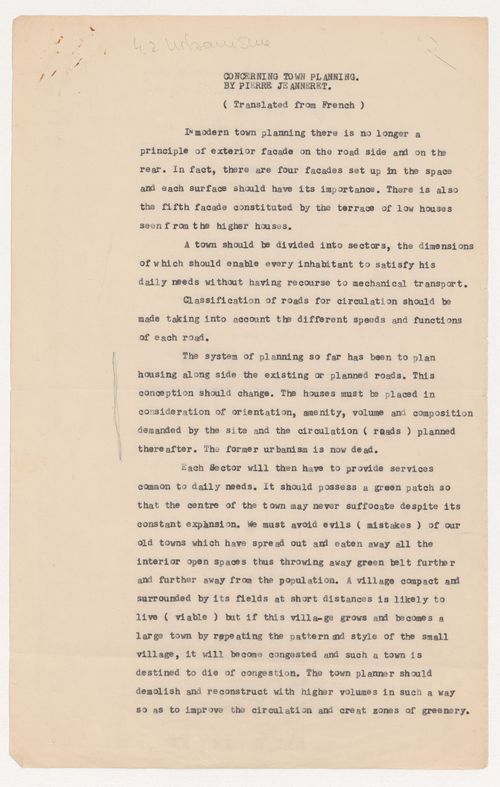
Numéro de référence:
ARCH264464
Description:
Le tapuscrit traite du développement de Chandigarh. Il contient, entre autres, de l'information sur la circulation, les logements, les espaces verts et la ceinture verte qui entoure la ville. Le texte a été écrit en français, puis a été traduit en anglais. This typescript is about the urban planning in Chandigarh. It deals, among other things, with information on road traffic, housing, green spaces, and the city green belt. The text was originally written in French and was translated into English.
ARCH264464
Description:
Le tapuscrit traite du développement de Chandigarh. Il contient, entre autres, de l'information sur la circulation, les logements, les espaces verts et la ceinture verte qui entoure la ville. Le texte a été écrit en français, puis a été traduit en anglais. This typescript is about the urban planning in Chandigarh. It deals, among other things, with information on road traffic, housing, green spaces, and the city green belt. The text was originally written in French and was translated into English.
Personnes et institutions:
Date:
between 1951 and 1967
between 1951 and 1967
Titre:
Text entitled "Concerning town planning"
Actions:
ARCH264464
Description:
Le tapuscrit traite du développement de Chandigarh. Il contient, entre autres, de l'information sur la circulation, les logements, les espaces verts et la ceinture verte qui entoure la ville. Le texte a été écrit en français, puis a été traduit en anglais. This typescript is about the urban planning in Chandigarh. It deals, among other things, with information on road traffic, housing, green spaces, and the city green belt. The text was originally written in French and was translated into English.
Text entitled "Concerning town planning"
Actions:
ARCH264464
Description:
Le tapuscrit traite du développement de Chandigarh. Il contient, entre autres, de l'information sur la circulation, les logements, les espaces verts et la ceinture verte qui entoure la ville. Le texte a été écrit en français, puis a été traduit en anglais. This typescript is about the urban planning in Chandigarh. It deals, among other things, with information on road traffic, housing, green spaces, and the city green belt. The text was originally written in French and was translated into English.
Classification:
documents textuels
documents textuels
Date:
between 1951 and 1967
between 1951 and 1967
Personnes et institutions:


