


4930 Résultats
Classification:
dessins, documents textuels, né numérique
dessins, documents textuels, né numérique
Numéro de référence:
AP181.S1.006
Description:
Original directory name: "05_Konsulenten". File contains records created and shared by COOP HIMMELB(L)AU and the various consultants on the project. These include PRO-Elektroplan GmbH, Bollinger+Grohmann, Dr. Pfeiler GmbH, Kersken + Kirchner GmbH., KBP Beratende Ingenieure GmbH, pbb planungsbüro balke, Ingenieurgemeinschaft BDP, a.g Licht, Realgruen Landschaftsarchitekten ,Lang + Burkhardt Verkehrsplanung und Städtebau, Emmer Pfenninger Partner AG, IB Rüdiger Schönenberg, Thomas A. Weisse + Partner. Bulk dates run from 2003-2006. Consultant expertise ranges from electricity, (electrical conveyor technology, Foerdertechnik) to structural physics (bauphysik), including open space planning (Freiflächenplanung), interior design (Inneneinrichtung), fire protection (Brandschutz), stage technology (Buehnentechnik), kitchen planning (Küchenplanung), facade engineering (Fassadentechnik), light design and planning (Lichtplaner), and solar panels for the roof. The records, largely plans, show the specific parts on which each of these consultants was working. The bulk of the records may be found under the “k_SSF_Ausführungsplanung/G_Pläne” directory which contains close to half of the records in this file. These are plans and views of the different areas and components of the BMW Welt building. These often include a CAD and a PDF version, some of which are annotated digitally or by hand prior to being digitized. CAD files include 2D drawings or 3D models, wireframes, screen captures, renderings, and plotter files. Records also include project management files, lists of the components of each room, engineering and analyses reports, many of which were digitized. Related to electrical and building engineering, there are a few databases in "c_PRO_Elektro_Foerdertechnik" and "b_KBP_Haustechnik". These contain information on the rooms and their technical requirements, such as equipment for plumbing, heat and ventilation, refrigeration systems, building automation, etc. Some database reports are also part of the records. Various sub-directories are named “quelldaten” (source data), which are typically zipped archives and often contain duplicate files. Duplicates were kept due to possible dependencies. Finally, the more than 7,000 plotter files across most directories suggest that printing physical copies of digital drawings for consultation was common practice. Early files (1997-2000) are AutoCAD Compiled Shape/Font File, AutoCAD Font Mapping Table, TrueType Font, and AutoCAD Colour-Dependant Plot Style Table. CAD files may depend on these to display drawings accurately. Most common file formats: Hewlett Packard Vector Graphic Plotter File, AutoCAD Drawing, Acrobat PDF 1.3 - Portable Document Format, Acrobat PDF 1.4 - Portable Document Format, ZIP Format
AP181.S1.006
Description:
Original directory name: "05_Konsulenten". File contains records created and shared by COOP HIMMELB(L)AU and the various consultants on the project. These include PRO-Elektroplan GmbH, Bollinger+Grohmann, Dr. Pfeiler GmbH, Kersken + Kirchner GmbH., KBP Beratende Ingenieure GmbH, pbb planungsbüro balke, Ingenieurgemeinschaft BDP, a.g Licht, Realgruen Landschaftsarchitekten ,Lang + Burkhardt Verkehrsplanung und Städtebau, Emmer Pfenninger Partner AG, IB Rüdiger Schönenberg, Thomas A. Weisse + Partner. Bulk dates run from 2003-2006. Consultant expertise ranges from electricity, (electrical conveyor technology, Foerdertechnik) to structural physics (bauphysik), including open space planning (Freiflächenplanung), interior design (Inneneinrichtung), fire protection (Brandschutz), stage technology (Buehnentechnik), kitchen planning (Küchenplanung), facade engineering (Fassadentechnik), light design and planning (Lichtplaner), and solar panels for the roof. The records, largely plans, show the specific parts on which each of these consultants was working. The bulk of the records may be found under the “k_SSF_Ausführungsplanung/G_Pläne” directory which contains close to half of the records in this file. These are plans and views of the different areas and components of the BMW Welt building. These often include a CAD and a PDF version, some of which are annotated digitally or by hand prior to being digitized. CAD files include 2D drawings or 3D models, wireframes, screen captures, renderings, and plotter files. Records also include project management files, lists of the components of each room, engineering and analyses reports, many of which were digitized. Related to electrical and building engineering, there are a few databases in "c_PRO_Elektro_Foerdertechnik" and "b_KBP_Haustechnik". These contain information on the rooms and their technical requirements, such as equipment for plumbing, heat and ventilation, refrigeration systems, building automation, etc. Some database reports are also part of the records. Various sub-directories are named “quelldaten” (source data), which are typically zipped archives and often contain duplicate files. Duplicates were kept due to possible dependencies. Finally, the more than 7,000 plotter files across most directories suggest that printing physical copies of digital drawings for consultation was common practice. Early files (1997-2000) are AutoCAD Compiled Shape/Font File, AutoCAD Font Mapping Table, TrueType Font, and AutoCAD Colour-Dependant Plot Style Table. CAD files may depend on these to display drawings accurately. Most common file formats: Hewlett Packard Vector Graphic Plotter File, AutoCAD Drawing, Acrobat PDF 1.3 - Portable Document Format, Acrobat PDF 1.4 - Portable Document Format, ZIP Format
Personnes et institutions:
Date:
1996-2008
1996-2008
Titre:
Consultants files for construction planning phase, BMW Welt, Munich
Actions:
AP181.S1.006
Description:
Original directory name: "05_Konsulenten". File contains records created and shared by COOP HIMMELB(L)AU and the various consultants on the project. These include PRO-Elektroplan GmbH, Bollinger+Grohmann, Dr. Pfeiler GmbH, Kersken + Kirchner GmbH., KBP Beratende Ingenieure GmbH, pbb planungsbüro balke, Ingenieurgemeinschaft BDP, a.g Licht, Realgruen Landschaftsarchitekten ,Lang + Burkhardt Verkehrsplanung und Städtebau, Emmer Pfenninger Partner AG, IB Rüdiger Schönenberg, Thomas A. Weisse + Partner. Bulk dates run from 2003-2006. Consultant expertise ranges from electricity, (electrical conveyor technology, Foerdertechnik) to structural physics (bauphysik), including open space planning (Freiflächenplanung), interior design (Inneneinrichtung), fire protection (Brandschutz), stage technology (Buehnentechnik), kitchen planning (Küchenplanung), facade engineering (Fassadentechnik), light design and planning (Lichtplaner), and solar panels for the roof. The records, largely plans, show the specific parts on which each of these consultants was working. The bulk of the records may be found under the “k_SSF_Ausführungsplanung/G_Pläne” directory which contains close to half of the records in this file. These are plans and views of the different areas and components of the BMW Welt building. These often include a CAD and a PDF version, some of which are annotated digitally or by hand prior to being digitized. CAD files include 2D drawings or 3D models, wireframes, screen captures, renderings, and plotter files. Records also include project management files, lists of the components of each room, engineering and analyses reports, many of which were digitized. Related to electrical and building engineering, there are a few databases in "c_PRO_Elektro_Foerdertechnik" and "b_KBP_Haustechnik". These contain information on the rooms and their technical requirements, such as equipment for plumbing, heat and ventilation, refrigeration systems, building automation, etc. Some database reports are also part of the records. Various sub-directories are named “quelldaten” (source data), which are typically zipped archives and often contain duplicate files. Duplicates were kept due to possible dependencies. Finally, the more than 7,000 plotter files across most directories suggest that printing physical copies of digital drawings for consultation was common practice. Early files (1997-2000) are AutoCAD Compiled Shape/Font File, AutoCAD Font Mapping Table, TrueType Font, and AutoCAD Colour-Dependant Plot Style Table. CAD files may depend on these to display drawings accurately. Most common file formats: Hewlett Packard Vector Graphic Plotter File, AutoCAD Drawing, Acrobat PDF 1.3 - Portable Document Format, Acrobat PDF 1.4 - Portable Document Format, ZIP Format
Consultants files for construction planning phase, BMW Welt, Munich
Actions:
AP181.S1.006
Description:
Original directory name: "05_Konsulenten". File contains records created and shared by COOP HIMMELB(L)AU and the various consultants on the project. These include PRO-Elektroplan GmbH, Bollinger+Grohmann, Dr. Pfeiler GmbH, Kersken + Kirchner GmbH., KBP Beratende Ingenieure GmbH, pbb planungsbüro balke, Ingenieurgemeinschaft BDP, a.g Licht, Realgruen Landschaftsarchitekten ,Lang + Burkhardt Verkehrsplanung und Städtebau, Emmer Pfenninger Partner AG, IB Rüdiger Schönenberg, Thomas A. Weisse + Partner. Bulk dates run from 2003-2006. Consultant expertise ranges from electricity, (electrical conveyor technology, Foerdertechnik) to structural physics (bauphysik), including open space planning (Freiflächenplanung), interior design (Inneneinrichtung), fire protection (Brandschutz), stage technology (Buehnentechnik), kitchen planning (Küchenplanung), facade engineering (Fassadentechnik), light design and planning (Lichtplaner), and solar panels for the roof. The records, largely plans, show the specific parts on which each of these consultants was working. The bulk of the records may be found under the “k_SSF_Ausführungsplanung/G_Pläne” directory which contains close to half of the records in this file. These are plans and views of the different areas and components of the BMW Welt building. These often include a CAD and a PDF version, some of which are annotated digitally or by hand prior to being digitized. CAD files include 2D drawings or 3D models, wireframes, screen captures, renderings, and plotter files. Records also include project management files, lists of the components of each room, engineering and analyses reports, many of which were digitized. Related to electrical and building engineering, there are a few databases in "c_PRO_Elektro_Foerdertechnik" and "b_KBP_Haustechnik". These contain information on the rooms and their technical requirements, such as equipment for plumbing, heat and ventilation, refrigeration systems, building automation, etc. Some database reports are also part of the records. Various sub-directories are named “quelldaten” (source data), which are typically zipped archives and often contain duplicate files. Duplicates were kept due to possible dependencies. Finally, the more than 7,000 plotter files across most directories suggest that printing physical copies of digital drawings for consultation was common practice. Early files (1997-2000) are AutoCAD Compiled Shape/Font File, AutoCAD Font Mapping Table, TrueType Font, and AutoCAD Colour-Dependant Plot Style Table. CAD files may depend on these to display drawings accurately. Most common file formats: Hewlett Packard Vector Graphic Plotter File, AutoCAD Drawing, Acrobat PDF 1.3 - Portable Document Format, Acrobat PDF 1.4 - Portable Document Format, ZIP Format
Classification:
dessins, documents textuels, né numérique
dessins, documents textuels, né numérique
Date:
1996-2008
1996-2008
Personnes et institutions:
Niveau de description archivistique:
Projet
Projet
Numéro de référence:
AP180.S1.1989.PR01
Description:
This project series documents the Piazza San Nazaro, a public square in Milan, Italy. This project was realized. Riva worked on this project from 1989-1993 in collaboration with Giacomo Borella, Paolo Froncillo, Giovanni Drugman, and Franscesca Riva. Umberto Riva also designed the outdoor furnishings of the piazza, including the street lights and the base of a statue. The project was commissioned by the Metropolitana Milanese and was shown in the exhibition "Umberto Riva, sistemazioni urbane" in 1993, at the Pinacoteca civica Franscesco Podesti in Ancona. The project series contains studies and design development drawings, including a site plan, elevations, sections, plans, and details for the street lamps, as well as a small description for the project.
AP180.S1.1989.PR01
Description:
This project series documents the Piazza San Nazaro, a public square in Milan, Italy. This project was realized. Riva worked on this project from 1989-1993 in collaboration with Giacomo Borella, Paolo Froncillo, Giovanni Drugman, and Franscesca Riva. Umberto Riva also designed the outdoor furnishings of the piazza, including the street lights and the base of a statue. The project was commissioned by the Metropolitana Milanese and was shown in the exhibition "Umberto Riva, sistemazioni urbane" in 1993, at the Pinacoteca civica Franscesco Podesti in Ancona. The project series contains studies and design development drawings, including a site plan, elevations, sections, plans, and details for the street lamps, as well as a small description for the project.
Personnes et institutions:
Date:
1991-1993
1991-1993
Titre:
Piazza San Nazaro, Milan, Italy (1989-1993)
Actions:
AP180.S1.1989.PR01
Description:
This project series documents the Piazza San Nazaro, a public square in Milan, Italy. This project was realized. Riva worked on this project from 1989-1993 in collaboration with Giacomo Borella, Paolo Froncillo, Giovanni Drugman, and Franscesca Riva. Umberto Riva also designed the outdoor furnishings of the piazza, including the street lights and the base of a statue. The project was commissioned by the Metropolitana Milanese and was shown in the exhibition "Umberto Riva, sistemazioni urbane" in 1993, at the Pinacoteca civica Franscesco Podesti in Ancona. The project series contains studies and design development drawings, including a site plan, elevations, sections, plans, and details for the street lamps, as well as a small description for the project.
Piazza San Nazaro, Milan, Italy (1989-1993)
Actions:
AP180.S1.1989.PR01
Description:
This project series documents the Piazza San Nazaro, a public square in Milan, Italy. This project was realized. Riva worked on this project from 1989-1993 in collaboration with Giacomo Borella, Paolo Froncillo, Giovanni Drugman, and Franscesca Riva. Umberto Riva also designed the outdoor furnishings of the piazza, including the street lights and the base of a statue. The project was commissioned by the Metropolitana Milanese and was shown in the exhibition "Umberto Riva, sistemazioni urbane" in 1993, at the Pinacoteca civica Franscesco Podesti in Ancona. The project series contains studies and design development drawings, including a site plan, elevations, sections, plans, and details for the street lamps, as well as a small description for the project.
Niveau de description archivistique:
Project
Project
Date:
1991-1993
1991-1993
Personnes et institutions:
Niveau de description archivistique:
Projet
Projet
Titre:
Chennai House
Chennai House
Numéro de référence:
AP182.S1.2013.D1
Description:
File documents a project for a private house in Chennai, India. The design takes the form of a rectangular pavilion surrounding an open-air courtyard. The site is a former cricket pitch surrounded by a tropical garden. The structure is in granite, a material commonly used in Chennai, paired with lighter materials such as brick and timber. To address the city's hot and humid climate, the house is conceived as a porous structure that allows free circulation of air and water. An integrated irrigation system carries water between the home's corrugated roof, its exterior walls, and a series of surrounding lotus ponds and gardens. This movement mimics the visual and cooling effects of a rain shower multiple times each day. File contains drawings, photographs, and models.
AP182.S1.2013.D1
Description:
File documents a project for a private house in Chennai, India. The design takes the form of a rectangular pavilion surrounding an open-air courtyard. The site is a former cricket pitch surrounded by a tropical garden. The structure is in granite, a material commonly used in Chennai, paired with lighter materials such as brick and timber. To address the city's hot and humid climate, the house is conceived as a porous structure that allows free circulation of air and water. An integrated irrigation system carries water between the home's corrugated roof, its exterior walls, and a series of surrounding lotus ponds and gardens. This movement mimics the visual and cooling effects of a rain shower multiple times each day. File contains drawings, photographs, and models.
Personnes et institutions:
Date:
2013-2014
2013-2014
Titre:
Chennai House
Actions:
AP182.S1.2013.D1
Description:
File documents a project for a private house in Chennai, India. The design takes the form of a rectangular pavilion surrounding an open-air courtyard. The site is a former cricket pitch surrounded by a tropical garden. The structure is in granite, a material commonly used in Chennai, paired with lighter materials such as brick and timber. To address the city's hot and humid climate, the house is conceived as a porous structure that allows free circulation of air and water. An integrated irrigation system carries water between the home's corrugated roof, its exterior walls, and a series of surrounding lotus ponds and gardens. This movement mimics the visual and cooling effects of a rain shower multiple times each day. File contains drawings, photographs, and models.
Chennai House
Actions:
AP182.S1.2013.D1
Description:
File documents a project for a private house in Chennai, India. The design takes the form of a rectangular pavilion surrounding an open-air courtyard. The site is a former cricket pitch surrounded by a tropical garden. The structure is in granite, a material commonly used in Chennai, paired with lighter materials such as brick and timber. To address the city's hot and humid climate, the house is conceived as a porous structure that allows free circulation of air and water. An integrated irrigation system carries water between the home's corrugated roof, its exterior walls, and a series of surrounding lotus ponds and gardens. This movement mimics the visual and cooling effects of a rain shower multiple times each day. File contains drawings, photographs, and models.
Niveau de description archivistique:
Project
Project
Date:
2013-2014
2013-2014
Personnes et institutions:
Niveau de description archivistique:
Projet
Projet
Numéro de référence:
AP207.S1.2009.PR02
Description:
The project series documents the installation "Forgiving Architecture" presented at the ReMap2, Athens Biennal, in 2009. The installation consists of strips of paper vertically hung across the facades of the building to be moved by the breeze. "The air of Athens, its constant breezes, suggest the extent to which nature can “forgive,” can find a poetic communication, like the foliage of a forest in the wind. Nothing can be lighter and more mobile than static architecture!" [1] The project series contains sketches, perspective drawings, visual instructions, and photographs of the installation, including digital photographs of the installation in Athens in 2009. Source: [1] Gianni Pettena website, https://www.giannipettena.it/italiano/opere-1/inst-forgiving-architecture-2009-1/ (last accessed 23 January 2020).
AP207.S1.2009.PR02
Description:
The project series documents the installation "Forgiving Architecture" presented at the ReMap2, Athens Biennal, in 2009. The installation consists of strips of paper vertically hung across the facades of the building to be moved by the breeze. "The air of Athens, its constant breezes, suggest the extent to which nature can “forgive,” can find a poetic communication, like the foliage of a forest in the wind. Nothing can be lighter and more mobile than static architecture!" [1] The project series contains sketches, perspective drawings, visual instructions, and photographs of the installation, including digital photographs of the installation in Athens in 2009. Source: [1] Gianni Pettena website, https://www.giannipettena.it/italiano/opere-1/inst-forgiving-architecture-2009-1/ (last accessed 23 January 2020).
Personnes et institutions:
Date:
2009-2015
2009-2015
Titre:
Forgiving Architecture (2009)
Actions:
AP207.S1.2009.PR02
Description:
The project series documents the installation "Forgiving Architecture" presented at the ReMap2, Athens Biennal, in 2009. The installation consists of strips of paper vertically hung across the facades of the building to be moved by the breeze. "The air of Athens, its constant breezes, suggest the extent to which nature can “forgive,” can find a poetic communication, like the foliage of a forest in the wind. Nothing can be lighter and more mobile than static architecture!" [1] The project series contains sketches, perspective drawings, visual instructions, and photographs of the installation, including digital photographs of the installation in Athens in 2009. Source: [1] Gianni Pettena website, https://www.giannipettena.it/italiano/opere-1/inst-forgiving-architecture-2009-1/ (last accessed 23 January 2020).
Forgiving Architecture (2009)
Actions:
AP207.S1.2009.PR02
Description:
The project series documents the installation "Forgiving Architecture" presented at the ReMap2, Athens Biennal, in 2009. The installation consists of strips of paper vertically hung across the facades of the building to be moved by the breeze. "The air of Athens, its constant breezes, suggest the extent to which nature can “forgive,” can find a poetic communication, like the foliage of a forest in the wind. Nothing can be lighter and more mobile than static architecture!" [1] The project series contains sketches, perspective drawings, visual instructions, and photographs of the installation, including digital photographs of the installation in Athens in 2009. Source: [1] Gianni Pettena website, https://www.giannipettena.it/italiano/opere-1/inst-forgiving-architecture-2009-1/ (last accessed 23 January 2020).
Niveau de description archivistique:
Project
Project
Date:
2009-2015
2009-2015
Personnes et institutions:
Niveau de description archivistique:
Projet
Projet
Numéro de référence:
AP207.S1.2012.PR02
Description:
The project series documents a series of photographs entitled "Progetti D'Architettura" by Pettena in 2012. The photographs series consists of a landscape photographs showing geological formations similar to the one seen from the city of Bolzano, Pettena's birthplace. This project is "reflections on architecture inspired by the mountains of his birthplace, symbol of a presence that conceptually, and often unconsciously, accompanies us in our aesthetic choices. Choices that are translated in architecture through the awareness of the transformation of spaces through time and of the effects of different lights and different perceptions." [1] The project series contains a photo montage of landscape photographs. Source: [1] Gianni Pettena website, https://www.giannipettena.it/italiano/opere-1/nat-architecture-projects-2012/ (last accessed 27 January 2020)
AP207.S1.2012.PR02
Description:
The project series documents a series of photographs entitled "Progetti D'Architettura" by Pettena in 2012. The photographs series consists of a landscape photographs showing geological formations similar to the one seen from the city of Bolzano, Pettena's birthplace. This project is "reflections on architecture inspired by the mountains of his birthplace, symbol of a presence that conceptually, and often unconsciously, accompanies us in our aesthetic choices. Choices that are translated in architecture through the awareness of the transformation of spaces through time and of the effects of different lights and different perceptions." [1] The project series contains a photo montage of landscape photographs. Source: [1] Gianni Pettena website, https://www.giannipettena.it/italiano/opere-1/nat-architecture-projects-2012/ (last accessed 27 January 2020)
Personnes et institutions:
Date:
2012-2015
2012-2015
Titre:
Progetti D'Architettura [Architecture Projects] (2012)
Actions:
AP207.S1.2012.PR02
Description:
The project series documents a series of photographs entitled "Progetti D'Architettura" by Pettena in 2012. The photographs series consists of a landscape photographs showing geological formations similar to the one seen from the city of Bolzano, Pettena's birthplace. This project is "reflections on architecture inspired by the mountains of his birthplace, symbol of a presence that conceptually, and often unconsciously, accompanies us in our aesthetic choices. Choices that are translated in architecture through the awareness of the transformation of spaces through time and of the effects of different lights and different perceptions." [1] The project series contains a photo montage of landscape photographs. Source: [1] Gianni Pettena website, https://www.giannipettena.it/italiano/opere-1/nat-architecture-projects-2012/ (last accessed 27 January 2020)
Progetti D'Architettura [Architecture Projects] (2012)
Actions:
AP207.S1.2012.PR02
Description:
The project series documents a series of photographs entitled "Progetti D'Architettura" by Pettena in 2012. The photographs series consists of a landscape photographs showing geological formations similar to the one seen from the city of Bolzano, Pettena's birthplace. This project is "reflections on architecture inspired by the mountains of his birthplace, symbol of a presence that conceptually, and often unconsciously, accompanies us in our aesthetic choices. Choices that are translated in architecture through the awareness of the transformation of spaces through time and of the effects of different lights and different perceptions." [1] The project series contains a photo montage of landscape photographs. Source: [1] Gianni Pettena website, https://www.giannipettena.it/italiano/opere-1/nat-architecture-projects-2012/ (last accessed 27 January 2020)
Niveau de description archivistique:
Project
Project
Date:
2012-2015
2012-2015
Personnes et institutions:
Niveau de description archivistique:
Projet
Projet
Numéro de référence:
AP148.S1.1967.PR01
Description:
This project series documents Poli's contribution to the competition entry for the restoration of a 16th century fort in Florence, the Fortezza da Bassa and its transformation into a National Centre for Arts and Crafts. This competition design was a Superstudio project led by Adolfo Natalini, reflecting the group's interest at the time in architecture on a "monumental' scale" (Lang and Menking, 2003, 100). Project material consists of study sketches in coloured pencil and graphite, many with annotations, and a page of typed notes, also with smaller sketches. Poli's sketches and notes seem to focus on designs for the entrance to the fort -- "ingresso alla Fortezza" -- and the movement of spectators into the fort. The typed notes and some sketches suggest the idea of a pinball machine with flippers and multi coloured lights lighting up a path.
AP148.S1.1967.PR01
Description:
This project series documents Poli's contribution to the competition entry for the restoration of a 16th century fort in Florence, the Fortezza da Bassa and its transformation into a National Centre for Arts and Crafts. This competition design was a Superstudio project led by Adolfo Natalini, reflecting the group's interest at the time in architecture on a "monumental' scale" (Lang and Menking, 2003, 100). Project material consists of study sketches in coloured pencil and graphite, many with annotations, and a page of typed notes, also with smaller sketches. Poli's sketches and notes seem to focus on designs for the entrance to the fort -- "ingresso alla Fortezza" -- and the movement of spectators into the fort. The typed notes and some sketches suggest the idea of a pinball machine with flippers and multi coloured lights lighting up a path.
Personnes et institutions:
Date:
1967-1968
1967-1968
Titre:
Competition Fortezza da Basso, National Centre for Arts and Crafts, Florence, Italy (1967)
Actions:
AP148.S1.1967.PR01
Description:
This project series documents Poli's contribution to the competition entry for the restoration of a 16th century fort in Florence, the Fortezza da Bassa and its transformation into a National Centre for Arts and Crafts. This competition design was a Superstudio project led by Adolfo Natalini, reflecting the group's interest at the time in architecture on a "monumental' scale" (Lang and Menking, 2003, 100). Project material consists of study sketches in coloured pencil and graphite, many with annotations, and a page of typed notes, also with smaller sketches. Poli's sketches and notes seem to focus on designs for the entrance to the fort -- "ingresso alla Fortezza" -- and the movement of spectators into the fort. The typed notes and some sketches suggest the idea of a pinball machine with flippers and multi coloured lights lighting up a path.
Competition Fortezza da Basso, National Centre for Arts and Crafts, Florence, Italy (1967)
Actions:
AP148.S1.1967.PR01
Description:
This project series documents Poli's contribution to the competition entry for the restoration of a 16th century fort in Florence, the Fortezza da Bassa and its transformation into a National Centre for Arts and Crafts. This competition design was a Superstudio project led by Adolfo Natalini, reflecting the group's interest at the time in architecture on a "monumental' scale" (Lang and Menking, 2003, 100). Project material consists of study sketches in coloured pencil and graphite, many with annotations, and a page of typed notes, also with smaller sketches. Poli's sketches and notes seem to focus on designs for the entrance to the fort -- "ingresso alla Fortezza" -- and the movement of spectators into the fort. The typed notes and some sketches suggest the idea of a pinball machine with flippers and multi coloured lights lighting up a path.
Niveau de description archivistique:
Project
Project
Date:
1967-1968
1967-1968
Personnes et institutions:
Niveau de description archivistique:
Projet
Projet
Numéro de référence:
AP207.S1.2017.PR03
Description:
The project series documents the installation "Energy FREE TREE" designed by Pettena and presented at Museion in Bozen, in 2017. The installation consists of a tower measuring eight meters high by four meters wide. The tower is built with parts, including doors, fenders, exhaust pipes, and lights, and is meant to represent a Christmas tree standing next to the museum entrance during Christmas. "The work was, in fact, meant to trigger ‘mental shortcircuits [sic]’ in order to obtain a reaction so as to introduce the subject of environmental awareness and the need of using recycled materials to reduce damages to the environment as much as possible." [1] The project series contains a video, photographs of the installation, and two drawings. Source: [1] Gianni Pettena website, https://www.giannipettena.it/italiano/opere-1/inst-energy-free-tree-2017-1/ (last accessed 28 January 2020)
AP207.S1.2017.PR03
Description:
The project series documents the installation "Energy FREE TREE" designed by Pettena and presented at Museion in Bozen, in 2017. The installation consists of a tower measuring eight meters high by four meters wide. The tower is built with parts, including doors, fenders, exhaust pipes, and lights, and is meant to represent a Christmas tree standing next to the museum entrance during Christmas. "The work was, in fact, meant to trigger ‘mental shortcircuits [sic]’ in order to obtain a reaction so as to introduce the subject of environmental awareness and the need of using recycled materials to reduce damages to the environment as much as possible." [1] The project series contains a video, photographs of the installation, and two drawings. Source: [1] Gianni Pettena website, https://www.giannipettena.it/italiano/opere-1/inst-energy-free-tree-2017-1/ (last accessed 28 January 2020)
Personnes et institutions:
Date:
2017-2018
2017-2018
Titre:
Energy FREE TREE (2017)
Actions:
AP207.S1.2017.PR03
Description:
The project series documents the installation "Energy FREE TREE" designed by Pettena and presented at Museion in Bozen, in 2017. The installation consists of a tower measuring eight meters high by four meters wide. The tower is built with parts, including doors, fenders, exhaust pipes, and lights, and is meant to represent a Christmas tree standing next to the museum entrance during Christmas. "The work was, in fact, meant to trigger ‘mental shortcircuits [sic]’ in order to obtain a reaction so as to introduce the subject of environmental awareness and the need of using recycled materials to reduce damages to the environment as much as possible." [1] The project series contains a video, photographs of the installation, and two drawings. Source: [1] Gianni Pettena website, https://www.giannipettena.it/italiano/opere-1/inst-energy-free-tree-2017-1/ (last accessed 28 January 2020)
Energy FREE TREE (2017)
Actions:
AP207.S1.2017.PR03
Description:
The project series documents the installation "Energy FREE TREE" designed by Pettena and presented at Museion in Bozen, in 2017. The installation consists of a tower measuring eight meters high by four meters wide. The tower is built with parts, including doors, fenders, exhaust pipes, and lights, and is meant to represent a Christmas tree standing next to the museum entrance during Christmas. "The work was, in fact, meant to trigger ‘mental shortcircuits [sic]’ in order to obtain a reaction so as to introduce the subject of environmental awareness and the need of using recycled materials to reduce damages to the environment as much as possible." [1] The project series contains a video, photographs of the installation, and two drawings. Source: [1] Gianni Pettena website, https://www.giannipettena.it/italiano/opere-1/inst-energy-free-tree-2017-1/ (last accessed 28 January 2020)
Niveau de description archivistique:
Project
Project
Date:
2017-2018
2017-2018
Personnes et institutions:
Niveau de description archivistique:
Projet
Projet
Titre:
Melmark
Melmark
Numéro de référence:
AP144.S2.D105
Description:
File documents a competition entry for a landmark to be located in the city centre of Melbourne, Australia. Price's project for a multi-use structure combined the idea of a "city-farm" with public access routes for harvesting, marketing, and purchasing produce. "[F]our multi-floored hydroponic farms" covered with faceted triangulated space frames rise from an expansive open deck structure which covered most of the site. Artificial lights and additional water collection and supply was integrated within the triangulated space frames. Conceptual sketches in pen and coloured pencil show the initial design. A presentation panel which is composed of text and drawings pasted onto a base sheet indicates the existing site conditions in plan, the open deck platform grids, the triangulated space frames, various views of the proposed landmark design, and future design developments. Material in this file was produced in 1979. File contains conceptual drawings and presentation panels.
AP144.S2.D105
Description:
File documents a competition entry for a landmark to be located in the city centre of Melbourne, Australia. Price's project for a multi-use structure combined the idea of a "city-farm" with public access routes for harvesting, marketing, and purchasing produce. "[F]our multi-floored hydroponic farms" covered with faceted triangulated space frames rise from an expansive open deck structure which covered most of the site. Artificial lights and additional water collection and supply was integrated within the triangulated space frames. Conceptual sketches in pen and coloured pencil show the initial design. A presentation panel which is composed of text and drawings pasted onto a base sheet indicates the existing site conditions in plan, the open deck platform grids, the triangulated space frames, various views of the proposed landmark design, and future design developments. Material in this file was produced in 1979. File contains conceptual drawings and presentation panels.
Personnes et institutions:
Date:
1979
1979
Titre:
Melmark
Actions:
AP144.S2.D105
Description:
File documents a competition entry for a landmark to be located in the city centre of Melbourne, Australia. Price's project for a multi-use structure combined the idea of a "city-farm" with public access routes for harvesting, marketing, and purchasing produce. "[F]our multi-floored hydroponic farms" covered with faceted triangulated space frames rise from an expansive open deck structure which covered most of the site. Artificial lights and additional water collection and supply was integrated within the triangulated space frames. Conceptual sketches in pen and coloured pencil show the initial design. A presentation panel which is composed of text and drawings pasted onto a base sheet indicates the existing site conditions in plan, the open deck platform grids, the triangulated space frames, various views of the proposed landmark design, and future design developments. Material in this file was produced in 1979. File contains conceptual drawings and presentation panels.
Melmark
Actions:
AP144.S2.D105
Description:
File documents a competition entry for a landmark to be located in the city centre of Melbourne, Australia. Price's project for a multi-use structure combined the idea of a "city-farm" with public access routes for harvesting, marketing, and purchasing produce. "[F]our multi-floored hydroponic farms" covered with faceted triangulated space frames rise from an expansive open deck structure which covered most of the site. Artificial lights and additional water collection and supply was integrated within the triangulated space frames. Conceptual sketches in pen and coloured pencil show the initial design. A presentation panel which is composed of text and drawings pasted onto a base sheet indicates the existing site conditions in plan, the open deck platform grids, the triangulated space frames, various views of the proposed landmark design, and future design developments. Material in this file was produced in 1979. File contains conceptual drawings and presentation panels.
Niveau de description archivistique:
File 105
File 105
Date:
1979
1979
Personnes et institutions:
Classification:
dessins
dessins
Actions:
Numéro de référence:
DR1990:0057
Description:
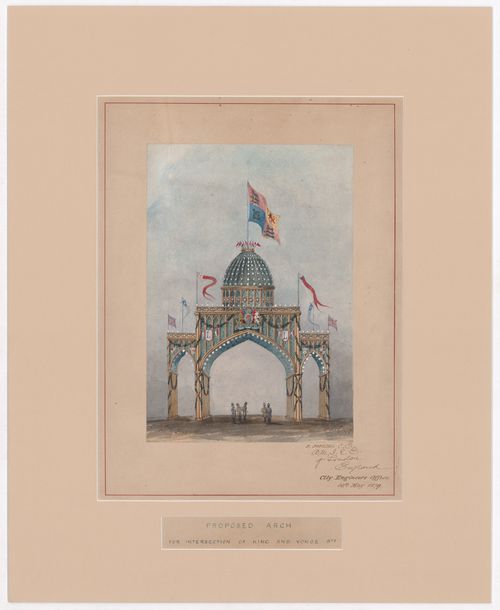
- This watercolour rendering depicts a welcome arch composed of a large central barrel vaulted archway which spans the street, with a lower parallel barrel vaulted archway over the sidewalks at each side. The central archway is surmounted by a dome on a drum and the entire structure is supported by four rows of columns. The arch is embellished with Gothic-inspired features such as blind tracery and pointed arches as well as shields, including two inscribed with the letter "L", flags, floral garlands, the British royal coat of arms, and possibly lights. Staffage indicates the large scale of the arch.
DR1990:0057
Description:
- This watercolour rendering depicts a welcome arch composed of a large central barrel vaulted archway which spans the street, with a lower parallel barrel vaulted archway over the sidewalks at each side. The central archway is surmounted by a dome on a drum and the entire structure is supported by four rows of columns. The arch is embellished with Gothic-inspired features such as blind tracery and pointed arches as well as shields, including two inscribed with the letter "L", flags, floral garlands, the British royal coat of arms, and possibly lights. Staffage indicates the large scale of the arch.
Personnes et institutions:
Sujet:
architecture temporaire
architecture temporaire
Date:
16 May 1879
16 May 1879
Titre:
Perspective for a temporary welcome arch at the intersection of King and Yonge Streets for the visit of the Marquess of Lorne and Princess Louise to Toronto, September 1879
Actions:
DR1990:0057
Description:
- This watercolour rendering depicts a welcome arch composed of a large central barrel vaulted archway which spans the street, with a lower parallel barrel vaulted archway over the sidewalks at each side. The central archway is surmounted by a dome on a drum and the entire structure is supported by four rows of columns. The arch is embellished with Gothic-inspired features such as blind tracery and pointed arches as well as shields, including two inscribed with the letter "L", flags, floral garlands, the British royal coat of arms, and possibly lights. Staffage indicates the large scale of the arch.
Perspective for a temporary welcome arch at the intersection of King and Yonge Streets for the visit of the Marquess of Lorne and Princess Louise to Toronto, September 1879
Actions:
DR1990:0057
Description:
- This watercolour rendering depicts a welcome arch composed of a large central barrel vaulted archway which spans the street, with a lower parallel barrel vaulted archway over the sidewalks at each side. The central archway is surmounted by a dome on a drum and the entire structure is supported by four rows of columns. The arch is embellished with Gothic-inspired features such as blind tracery and pointed arches as well as shields, including two inscribed with the letter "L", flags, floral garlands, the British royal coat of arms, and possibly lights. Staffage indicates the large scale of the arch.
Classification:
dessins
dessins
Date:
16 May 1879
16 May 1879
Personnes et institutions:
Sujet:
architecture temporaire
architecture temporaire
Classification:
photographies
photographies
Actions:
Numéro de référence:
PH1986:0431:001-050
Description:
- Album PH1986:0431:001-050 comprises 32 views of the United States, including: seven views of the Adirondack Mountains in New York; three views of the White Mountains in New Hampshire; seven views of Boston, Massachusetts; five views of Washington, D.C.; four views of Cambridge, Massachusetts; and two views of Philadelphia, Pennsylvania. There are 14 views of Canada, including seven views of Ottawa, Ontario, and seven views of Québec: three views of Québec City, Québec; three views of Beauport, Québec; and one view of Montréal, Québec. There are eight views of Niagara Falls: five views of the American side and two views of the Canadian side.
PH1986:0431:001-050
Description:
- Album PH1986:0431:001-050 comprises 32 views of the United States, including: seven views of the Adirondack Mountains in New York; three views of the White Mountains in New Hampshire; seven views of Boston, Massachusetts; five views of Washington, D.C.; four views of Cambridge, Massachusetts; and two views of Philadelphia, Pennsylvania. There are 14 views of Canada, including seven views of Ottawa, Ontario, and seven views of Québec: three views of Québec City, Québec; three views of Beauport, Québec; and one view of Montréal, Québec. There are eight views of Niagara Falls: five views of the American side and two views of the Canadian side.
Personnes et institutions:
Sujet:
architecture, ingénierie, militaire, topographique, urbanisme
architecture, ingénierie, militaire, topographique, urbanisme
Date:
1886
1886
Titre:
Album of views of major urban centres in Massachusetts, Washington, D.C., Pennsylvania, Ontario and Québec and scenic views of the Adirondack Mountains, the White Mountains, Niagara Falls, Montmorency Falls and Chaudière Falls, United States and Canada
Actions:
PH1986:0431:001-050
Description:
- Album PH1986:0431:001-050 comprises 32 views of the United States, including: seven views of the Adirondack Mountains in New York; three views of the White Mountains in New Hampshire; seven views of Boston, Massachusetts; five views of Washington, D.C.; four views of Cambridge, Massachusetts; and two views of Philadelphia, Pennsylvania. There are 14 views of Canada, including seven views of Ottawa, Ontario, and seven views of Québec: three views of Québec City, Québec; three views of Beauport, Québec; and one view of Montréal, Québec. There are eight views of Niagara Falls: five views of the American side and two views of the Canadian side.
Album of views of major urban centres in Massachusetts, Washington, D.C., Pennsylvania, Ontario and Québec and scenic views of the Adirondack Mountains, the White Mountains, Niagara Falls, Montmorency Falls and Chaudière Falls, United States and Canada
Actions:
PH1986:0431:001-050
Description:
- Album PH1986:0431:001-050 comprises 32 views of the United States, including: seven views of the Adirondack Mountains in New York; three views of the White Mountains in New Hampshire; seven views of Boston, Massachusetts; five views of Washington, D.C.; four views of Cambridge, Massachusetts; and two views of Philadelphia, Pennsylvania. There are 14 views of Canada, including seven views of Ottawa, Ontario, and seven views of Québec: three views of Québec City, Québec; three views of Beauport, Québec; and one view of Montréal, Québec. There are eight views of Niagara Falls: five views of the American side and two views of the Canadian side.
Classification:
photographies
photographies
Date:
1886
1886
Personnes et institutions:
Sujet:
architecture, ingénierie, militaire, topographique, urbanisme
architecture, ingénierie, militaire, topographique, urbanisme


