


3294 Résultats
Classification:
livres
livres
Titre:
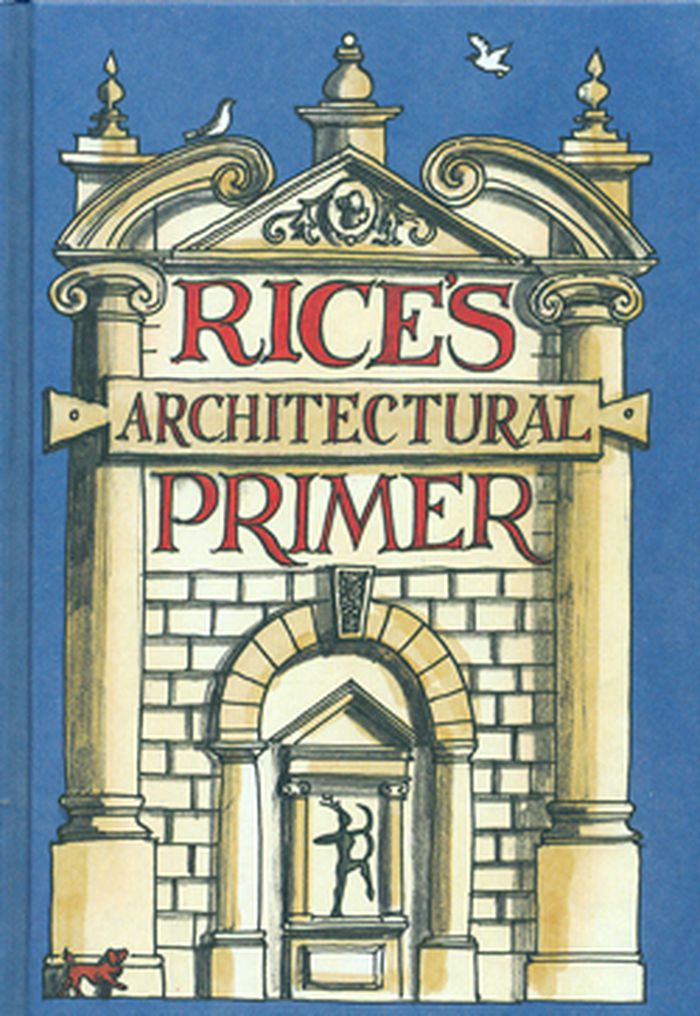
Rice's architectural primer
Rice's architectural primer
Actions:
Prix:
$32.00
(disponible sur commande)
Résumé:
A beautifully packaged, idiosyncratic introduction to British building styles, by the acclaimed illustrator and architectural enthusiast Matthew Rice. Covering the grammar and vocabulary of British buildings and the evolution of styles from Norman castles to Norman Foster, the aim is to enable the reader to recognise, understand and date any British building. As(...)
$32.00
(disponible sur commande)
Résumé:
A beautifully packaged, idiosyncratic introduction to British building styles, by the acclaimed illustrator and architectural enthusiast Matthew Rice. Covering the grammar and vocabulary of British buildings and the evolution of styles from Norman castles to Norman Foster, the aim is to enable the reader to recognise, understand and date any British building. As(...)
Titre:
Rice's architectural primer
Actions:
Prix:
$32.00
(disponible sur commande)
Résumé:
A beautifully packaged, idiosyncratic introduction to British building styles, by the acclaimed illustrator and architectural enthusiast Matthew Rice. Covering the grammar and vocabulary of British buildings and the evolution of styles from Norman castles to Norman Foster, the aim is to enable the reader to recognise, understand and date any British building. As Matthew Rice says, ‘Once you can speak any language, conversation can begin, but without it communications can only be brief and brutish. The same is the case with Architecture: an inability to describe the component parts of a building leaves one tongue-tied and unable to begin to discuss what is or is not exciting, dull or peculiar about it.’ With this book in your hand, pocket or car, buildings will break down beguilingly into their component parts, ready for inspection and discussion. There will be no more references to that curly bit on top of the thing with the square protrusions. Ungainly and inept descriptions will be a thing of the past and, fluent in the world of volutes, hood moulds, lobed architraves and bucrania, you will be able to leave a cathedral or country house with as much to talk about as a film or play.
Rice's architectural primer
Actions:
Prix:
$32.00
(disponible sur commande)
Résumé:
A beautifully packaged, idiosyncratic introduction to British building styles, by the acclaimed illustrator and architectural enthusiast Matthew Rice. Covering the grammar and vocabulary of British buildings and the evolution of styles from Norman castles to Norman Foster, the aim is to enable the reader to recognise, understand and date any British building. As Matthew Rice says, ‘Once you can speak any language, conversation can begin, but without it communications can only be brief and brutish. The same is the case with Architecture: an inability to describe the component parts of a building leaves one tongue-tied and unable to begin to discuss what is or is not exciting, dull or peculiar about it.’ With this book in your hand, pocket or car, buildings will break down beguilingly into their component parts, ready for inspection and discussion. There will be no more references to that curly bit on top of the thing with the square protrusions. Ungainly and inept descriptions will be a thing of the past and, fluent in the world of volutes, hood moulds, lobed architraves and bucrania, you will be able to leave a cathedral or country house with as much to talk about as a film or play.
Classification:
livres
livres
Publication:
septembre 2009
septembre 2009
Classification:
livres
livres
Titre:
A meaningful order: OK-RM
A meaningful order: OK-RM
Actions:
Prix:
$105.00
(disponible sur commande)
Résumé:
Across its 328 pages it holds a new history of the distributed realities of design. It depicts designed objects on their own terms to give an account of vision, material, and curiosity—representing a selection of the vast archive of more than 16 years of work from OK-RM through an orchestration of the lithographic process with a special set of colours. It is a site for(...)
$105.00
(disponible sur commande)
Résumé:
Across its 328 pages it holds a new history of the distributed realities of design. It depicts designed objects on their own terms to give an account of vision, material, and curiosity—representing a selection of the vast archive of more than 16 years of work from OK-RM through an orchestration of the lithographic process with a special set of colours. It is a site for(...)
Publication:
juillet 2025
juillet 2025
Titre:
A meaningful order: OK-RM
Actions:
Prix:
$105.00
(disponible sur commande)
Résumé:
Across its 328 pages it holds a new history of the distributed realities of design. It depicts designed objects on their own terms to give an account of vision, material, and curiosity—representing a selection of the vast archive of more than 16 years of work from OK-RM through an orchestration of the lithographic process with a special set of colours. It is a site for committed study and experimentation, away from the structures of academe. It generates examples, prototypes, and models. It stages a dialogue rendered in a designerly writing through 26 alphabetised chapters (A–Z). It is unashamedly performative in its play with language, direction, and story. It captures the ongoing, open-ended conversation between the editors, who are makers and thinkers of design, including a long form discussion in the form of an interview with long term collaborator Jack Self and is introduced by poet Lila Matsumoto. In this social arena, the book is considered as everyday object and object of art. It examines designed objects and their meanings, which emerge from the interplay of form and context. What does it do? Why does it do it? How does it do it? It lays out new ideas about how designed objects relate to the cultures that they are borne from and the cultures they can create. It strives for transparency, but not at the cost of transcendence.
A meaningful order: OK-RM
Actions:
Prix:
$105.00
(disponible sur commande)
Résumé:
Across its 328 pages it holds a new history of the distributed realities of design. It depicts designed objects on their own terms to give an account of vision, material, and curiosity—representing a selection of the vast archive of more than 16 years of work from OK-RM through an orchestration of the lithographic process with a special set of colours. It is a site for committed study and experimentation, away from the structures of academe. It generates examples, prototypes, and models. It stages a dialogue rendered in a designerly writing through 26 alphabetised chapters (A–Z). It is unashamedly performative in its play with language, direction, and story. It captures the ongoing, open-ended conversation between the editors, who are makers and thinkers of design, including a long form discussion in the form of an interview with long term collaborator Jack Self and is introduced by poet Lila Matsumoto. In this social arena, the book is considered as everyday object and object of art. It examines designed objects and their meanings, which emerge from the interplay of form and context. What does it do? Why does it do it? How does it do it? It lays out new ideas about how designed objects relate to the cultures that they are borne from and the cultures they can create. It strives for transparency, but not at the cost of transcendence.
Classification:
livres
livres
Publication:
juillet 2025
juillet 2025
Classification:
livres
livres
Titre:
Doris Salcedo
Doris Salcedo
Actions:
Prix:
$59.95
(disponible sur commande)
Résumé:
Colombian artist Doris Salcedo (b.1958) is one of today's most internationally respected South American sculptors. Inspired as much by poetry and philosophy as by the affecting material qualities of sculpture, Salcedo subtly and painstakingly transforms everyday household objects and garments - symbols of a vanished existence and of the human tragedies that are its(...)
$59.95
(disponible sur commande)
Résumé:
Colombian artist Doris Salcedo (b.1958) is one of today's most internationally respected South American sculptors. Inspired as much by poetry and philosophy as by the affecting material qualities of sculpture, Salcedo subtly and painstakingly transforms everyday household objects and garments - symbols of a vanished existence and of the human tragedies that are its(...)
Publication:
janvier 2000, London
janvier 2000, London
Titre:
Doris Salcedo
Actions:
Prix:
$59.95
(disponible sur commande)
Résumé:
Colombian artist Doris Salcedo (b.1958) is one of today's most internationally respected South American sculptors. Inspired as much by poetry and philosophy as by the affecting material qualities of sculpture, Salcedo subtly and painstakingly transforms everyday household objects and garments - symbols of a vanished existence and of the human tragedies that are its cause. In Atrabiliaros (1991-6) abandoned shoes of "disappeared" Colombian people, half-concealed behind membranes of animal fibre, become ghost-like symbols of mourning. In Salcedo's ongoing untitled works, wooden furnishings, worn by long use and filled with concrete, mutely evoke the lives they once served. American art critic Nancy Princenthal surveys Salcedo's work in terms of the universal themes it evokes, contextualized in discussion of contemporary scultural practice. New York-based poet and curator Carlos Basualdo discusses with the artist her formative influences, which range from the art of precedecessors such as Joseph Beuys to the writings of philosophers and poets. German literary critic Andreas Huyssen focuses on Salcedo's sculpture Unland: The Orphan's Tunic (1997). For the "Arist's Choice", Salcedo has selected two texts: an extract from "Otherwise than being" (1974) by philosopher Emmanuel Levinas, and poems by Paul Celan. The Doris Salcedo's observations on the human condition and its reflection in the work of poets, novelists and thinkers are discussed in conversation with art historian Charles Merewether.
Doris Salcedo
Actions:
Prix:
$59.95
(disponible sur commande)
Résumé:
Colombian artist Doris Salcedo (b.1958) is one of today's most internationally respected South American sculptors. Inspired as much by poetry and philosophy as by the affecting material qualities of sculpture, Salcedo subtly and painstakingly transforms everyday household objects and garments - symbols of a vanished existence and of the human tragedies that are its cause. In Atrabiliaros (1991-6) abandoned shoes of "disappeared" Colombian people, half-concealed behind membranes of animal fibre, become ghost-like symbols of mourning. In Salcedo's ongoing untitled works, wooden furnishings, worn by long use and filled with concrete, mutely evoke the lives they once served. American art critic Nancy Princenthal surveys Salcedo's work in terms of the universal themes it evokes, contextualized in discussion of contemporary scultural practice. New York-based poet and curator Carlos Basualdo discusses with the artist her formative influences, which range from the art of precedecessors such as Joseph Beuys to the writings of philosophers and poets. German literary critic Andreas Huyssen focuses on Salcedo's sculpture Unland: The Orphan's Tunic (1997). For the "Arist's Choice", Salcedo has selected two texts: an extract from "Otherwise than being" (1974) by philosopher Emmanuel Levinas, and poems by Paul Celan. The Doris Salcedo's observations on the human condition and its reflection in the work of poets, novelists and thinkers are discussed in conversation with art historian Charles Merewether.
Classification:
livres
livres
Publication:
janvier 2000, London
janvier 2000, London
Classification:
livres
livres
Actions:
Prix:
$22.00
(disponible sur commande)
Résumé:
"Visual cultures as time travel" makes a case for cultural, aesthetic, and historical research that is oriented toward the future, not the past, actively constructing new categories of assembly that don't yet exist. Ayesha Hameed considers the relationship between climate change and plantation economies, proposing a watery plantationocene that revolves around two islands:(...)
$22.00
(disponible sur commande)
Résumé:
"Visual cultures as time travel" makes a case for cultural, aesthetic, and historical research that is oriented toward the future, not the past, actively constructing new categories of assembly that don't yet exist. Ayesha Hameed considers the relationship between climate change and plantation economies, proposing a watery plantationocene that revolves around two islands:(...)
Titre:
Visual cultures as time travel
Actions:
Prix:
$22.00
(disponible sur commande)
Résumé:
"Visual cultures as time travel" makes a case for cultural, aesthetic, and historical research that is oriented toward the future, not the past, actively constructing new categories of assembly that don't yet exist. Ayesha Hameed considers the relationship between climate change and plantation economies, proposing a watery plantationocene that revolves around two islands: a former plantation in St. George's Parish in Barbados, and the port city of Port of Spain in Trinidad. It visits a marine research institute on a third island, Seili in Finland, to consider how notions of temporality and adaptation are produced in the climate emergency we face. Henriette Gunkel introduces the idea of time travel through notions of dizziness, freefall, and of being in vertigo as set out in Octavia Butler's novel Kindred and Kitso Lynn Lelliott's multimedia installation South Atlantic Hauntings, exploring what counts as technology, how it operates in relation to time, including deep space time, and how it interacts with the different types of bodies—human, machine, planetary, spectral, ancestral—that inhabit the terrestrial and extraterrestrial worlds. In conversation, Hameed and Gunkel propose a notion of time travel marked by possibility and loss—in the aftermath of transatlantic slavery and in the moment of mass illegalized migration, of blackness and time, of wildfires and floods, of lost and co-opted futures, of deep geological time, and of falling.
Visual cultures as time travel
Actions:
Prix:
$22.00
(disponible sur commande)
Résumé:
"Visual cultures as time travel" makes a case for cultural, aesthetic, and historical research that is oriented toward the future, not the past, actively constructing new categories of assembly that don't yet exist. Ayesha Hameed considers the relationship between climate change and plantation economies, proposing a watery plantationocene that revolves around two islands: a former plantation in St. George's Parish in Barbados, and the port city of Port of Spain in Trinidad. It visits a marine research institute on a third island, Seili in Finland, to consider how notions of temporality and adaptation are produced in the climate emergency we face. Henriette Gunkel introduces the idea of time travel through notions of dizziness, freefall, and of being in vertigo as set out in Octavia Butler's novel Kindred and Kitso Lynn Lelliott's multimedia installation South Atlantic Hauntings, exploring what counts as technology, how it operates in relation to time, including deep space time, and how it interacts with the different types of bodies—human, machine, planetary, spectral, ancestral—that inhabit the terrestrial and extraterrestrial worlds. In conversation, Hameed and Gunkel propose a notion of time travel marked by possibility and loss—in the aftermath of transatlantic slavery and in the moment of mass illegalized migration, of blackness and time, of wildfires and floods, of lost and co-opted futures, of deep geological time, and of falling.
Classification:
livres
livres
Publication:
septembre 2021
septembre 2021
Sujet:
Théorie/ philosophie
Théorie/ philosophie
Classification:
livres
livres
Titre:
London: Being in the library
London: Being in the library
Actions:
Prix:
$48.00
(disponible sur commande)
Résumé:
Daniela Keiser ranks among the most renowned contemporary artists in Switzerland. In 2017 she was awarded the Swiss national art prize Prix Meret Oppenheim as well as a studio grant from Landis & Gyr Stiftung that enabled her to embark on an extended stay in London’s East End. There she discovered the Idea Store, the public library on Whitechapel Road built by British(...)
$48.00
(disponible sur commande)
Résumé:
Daniela Keiser ranks among the most renowned contemporary artists in Switzerland. In 2017 she was awarded the Swiss national art prize Prix Meret Oppenheim as well as a studio grant from Landis & Gyr Stiftung that enabled her to embark on an extended stay in London’s East End. There she discovered the Idea Store, the public library on Whitechapel Road built by British(...)
Sujet:
Monographies photo
Monographies photo
Publication:
août 2021
août 2021
Titre:
London: Being in the library
Actions:
Prix:
$48.00
(disponible sur commande)
Résumé:
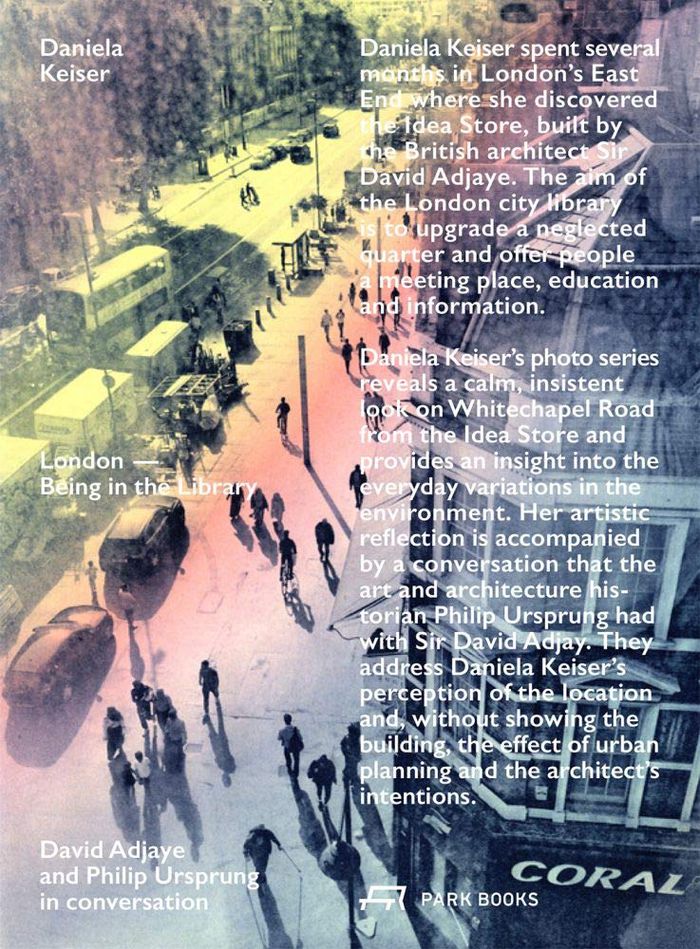
Daniela Keiser ranks among the most renowned contemporary artists in Switzerland. In 2017 she was awarded the Swiss national art prize Prix Meret Oppenheim as well as a studio grant from Landis & Gyr Stiftung that enabled her to embark on an extended stay in London’s East End. There she discovered the Idea Store, the public library on Whitechapel Road built by British architect David Adjaye. Upon its opening to the public, this institution quickly became a meeting place for a broad spectrum of society, including socially disadvantaged people. The goal of the Idea Stores—eight of them have been opened in various London boroughs since 2005— is to enhance formerly neglected neighborhoods and offer a low-threshold source of education and information. From that initial Idea Store on Whitechapel Road, Daniela Keiser began to take pictures of the goings-on in the street outside. Her "Library—Idea Store, 321 Whitechapel Rd, Shadwell, London E1 1BU series" reveals a calm, repetitive, but insistent image of the city and offers insight into the small everyday variations of the surrounding world. This book pairs her photographic reflections with a conversation between David Adjaye and art and architecture historian Philip Ursprung. They talk about Keiser’s perception of the site and—without actually showing the building—the impact of urban design and the architect’s intentions.
London: Being in the library
Actions:
Prix:
$48.00
(disponible sur commande)
Résumé:
Daniela Keiser ranks among the most renowned contemporary artists in Switzerland. In 2017 she was awarded the Swiss national art prize Prix Meret Oppenheim as well as a studio grant from Landis & Gyr Stiftung that enabled her to embark on an extended stay in London’s East End. There she discovered the Idea Store, the public library on Whitechapel Road built by British architect David Adjaye. Upon its opening to the public, this institution quickly became a meeting place for a broad spectrum of society, including socially disadvantaged people. The goal of the Idea Stores—eight of them have been opened in various London boroughs since 2005— is to enhance formerly neglected neighborhoods and offer a low-threshold source of education and information. From that initial Idea Store on Whitechapel Road, Daniela Keiser began to take pictures of the goings-on in the street outside. Her "Library—Idea Store, 321 Whitechapel Rd, Shadwell, London E1 1BU series" reveals a calm, repetitive, but insistent image of the city and offers insight into the small everyday variations of the surrounding world. This book pairs her photographic reflections with a conversation between David Adjaye and art and architecture historian Philip Ursprung. They talk about Keiser’s perception of the site and—without actually showing the building—the impact of urban design and the architect’s intentions.
Classification:
livres
livres
Publication:
août 2021
août 2021
Sujet:
Monographies photo
Monographies photo
Classification:
livres
livres
Titre:
Atelier Deshaus 2001-2020
Atelier Deshaus 2001-2020
Actions:
Prix:
$88.50
(disponible sur commande)
Résumé:
Shanghai-based Atelier Deshaus, founded in 2001 as one of the first private architectural firms in China, is also one of the country’s most distinguished and innovative design studios. The firm made its name worldwide in 2014 with the much-acclaimed West Bund site for Shanghai’s Long Museum, which has since been followed by a series of further museum and other art-related(...)
$88.50
(disponible sur commande)
Résumé:
Shanghai-based Atelier Deshaus, founded in 2001 as one of the first private architectural firms in China, is also one of the country’s most distinguished and innovative design studios. The firm made its name worldwide in 2014 with the much-acclaimed West Bund site for Shanghai’s Long Museum, which has since been followed by a series of further museum and other art-related(...)
Titre:
Atelier Deshaus 2001-2020
Actions:
Prix:
$88.50
(disponible sur commande)
Résumé:
Shanghai-based Atelier Deshaus, founded in 2001 as one of the first private architectural firms in China, is also one of the country’s most distinguished and innovative design studios. The firm made its name worldwide in 2014 with the much-acclaimed West Bund site for Shanghai’s Long Museum, which has since been followed by a series of further museum and other art-related projects. Such cultural and community buildings of various scales are the main focus of Atelier Deshaus, who deliberately eschew the usual commercial construction tasks in China. Their strong buildings are developed from reading the sites with special attention paid to the preservation of Shanghai’s industrial heritage after decades of a tabula rasa policy in the city’s urban development. At the core of this book are Atelier Deshaus’s twenty most important designs from 2001 to 2020. They are documented in detail through plans and images as well as concise explanatory texts by the architects. In an extensive conversation with Hubertus Adam, the firm’s principals Liu Yichun and Chen Yifeng offer insights into their way of thinking, their understanding of Chinese tradition, their relation to art, and the challenges of working as a nongovernmental office in China. Additional essays place Atelier Deshaus in the context of contemporary international architecture and discuss their key projects with regards to constructive qualities and atmosphere.
Atelier Deshaus 2001-2020
Actions:
Prix:
$88.50
(disponible sur commande)
Résumé:
Shanghai-based Atelier Deshaus, founded in 2001 as one of the first private architectural firms in China, is also one of the country’s most distinguished and innovative design studios. The firm made its name worldwide in 2014 with the much-acclaimed West Bund site for Shanghai’s Long Museum, which has since been followed by a series of further museum and other art-related projects. Such cultural and community buildings of various scales are the main focus of Atelier Deshaus, who deliberately eschew the usual commercial construction tasks in China. Their strong buildings are developed from reading the sites with special attention paid to the preservation of Shanghai’s industrial heritage after decades of a tabula rasa policy in the city’s urban development. At the core of this book are Atelier Deshaus’s twenty most important designs from 2001 to 2020. They are documented in detail through plans and images as well as concise explanatory texts by the architects. In an extensive conversation with Hubertus Adam, the firm’s principals Liu Yichun and Chen Yifeng offer insights into their way of thinking, their understanding of Chinese tradition, their relation to art, and the challenges of working as a nongovernmental office in China. Additional essays place Atelier Deshaus in the context of contemporary international architecture and discuss their key projects with regards to constructive qualities and atmosphere.
Classification:
livres
livres
Publication:
avril 2023
avril 2023
Sujet:
Architecture, monographies
Architecture, monographies
Classification:
livres
livres
Titre:
La Fábrica, Ricardo Bofill
La Fábrica, Ricardo Bofill
Actions:
Prix:
$81.00
(disponible sur commande)
Résumé:
La Fábrica is one of Ricardo Bofill’s most iconoclastic creations. A former cement factory on the outskirts of Barcelona, serendipitously discovered while driving, the building became the centre of the late Catalan architect’s life, serving both as his home and as the headquarters of his practice since 1973. Here, Ricardo created a world of his own, exposing the concrete(...)
$81.00
(disponible sur commande)
Résumé:
La Fábrica is one of Ricardo Bofill’s most iconoclastic creations. A former cement factory on the outskirts of Barcelona, serendipitously discovered while driving, the building became the centre of the late Catalan architect’s life, serving both as his home and as the headquarters of his practice since 1973. Here, Ricardo created a world of his own, exposing the concrete(...)
Titre:
La Fábrica, Ricardo Bofill
Actions:
Prix:
$81.00
(disponible sur commande)
Résumé:
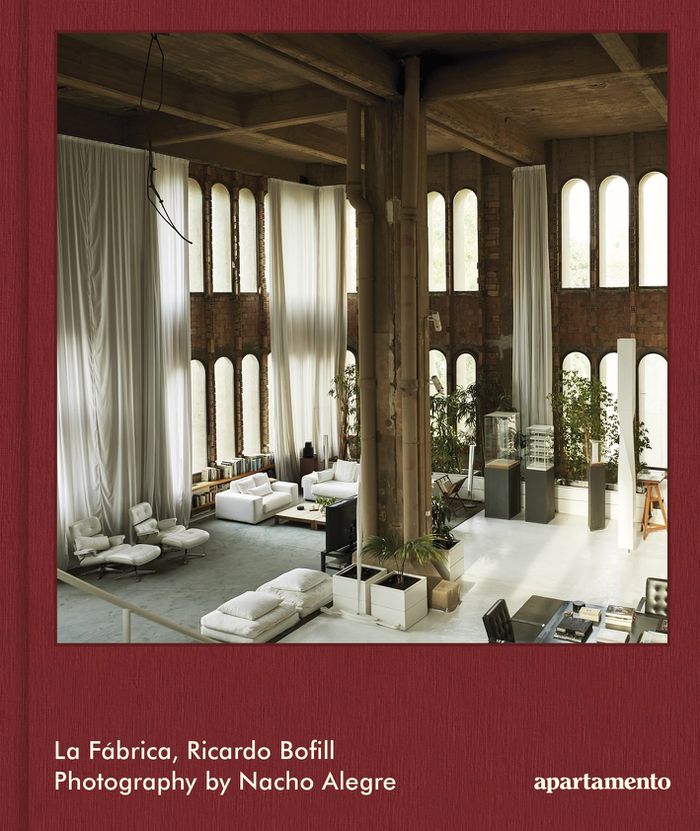
La Fábrica is one of Ricardo Bofill’s most iconoclastic creations. A former cement factory on the outskirts of Barcelona, serendipitously discovered while driving, the building became the centre of the late Catalan architect’s life, serving both as his home and as the headquarters of his practice since 1973. Here, Ricardo created a world of his own, exposing the concrete forms from beneath years of dust and smoke, encouraging nature back onto the structure, and fine-tuning the balance between its monumental scale and a delicate, human sensibility, in one of the earliest examples of the reuse of an industrial building—and it’s still changing. This new edition expands on the book originally published in 2018, featuring exclusive archival imagery courtesy of RBTA and an expansive selection of photographs taken by Nacho Alegre on his visits to La Fábrica over the last decade. He returned in November 2022 to document the building in its current state, closing the book with 32 pages of otherwise unseen images—a portrait of Ricardo’s most cherished work at a moment of profound transformation. With an introduction by Pablo Bofill, the book also features an interview with Ricardo himself by Barcelona-based architects Arquitectura-G and Guillermo López, an extended version of the conversation originally published in issue #11 of Apartamento magazine.
La Fábrica, Ricardo Bofill
Actions:
Prix:
$81.00
(disponible sur commande)
Résumé:
La Fábrica is one of Ricardo Bofill’s most iconoclastic creations. A former cement factory on the outskirts of Barcelona, serendipitously discovered while driving, the building became the centre of the late Catalan architect’s life, serving both as his home and as the headquarters of his practice since 1973. Here, Ricardo created a world of his own, exposing the concrete forms from beneath years of dust and smoke, encouraging nature back onto the structure, and fine-tuning the balance between its monumental scale and a delicate, human sensibility, in one of the earliest examples of the reuse of an industrial building—and it’s still changing. This new edition expands on the book originally published in 2018, featuring exclusive archival imagery courtesy of RBTA and an expansive selection of photographs taken by Nacho Alegre on his visits to La Fábrica over the last decade. He returned in November 2022 to document the building in its current state, closing the book with 32 pages of otherwise unseen images—a portrait of Ricardo’s most cherished work at a moment of profound transformation. With an introduction by Pablo Bofill, the book also features an interview with Ricardo himself by Barcelona-based architects Arquitectura-G and Guillermo López, an extended version of the conversation originally published in issue #11 of Apartamento magazine.
Classification:
livres
livres
Publication:
décembre 2022
décembre 2022
Sujet:
Architecture, monographies
Architecture, monographies
Classification:
livres
livres
Actions:
Prix:
$42.95
(disponible en magasin)
Résumé:
The enormous popular interest in the world of fungi and the mycelium testifies to its tremendous resonance as a metaphor for new ways of thinking, new systems and behaviors. Taking its inspiration from this world, ''Let's Become Fungal!'' looks at a range of Indigenous practices from Latin America, the Caribbean and Asia that are rooted in multispecies collaboration,(...)
$42.95
(disponible en magasin)
Résumé:
The enormous popular interest in the world of fungi and the mycelium testifies to its tremendous resonance as a metaphor for new ways of thinking, new systems and behaviors. Taking its inspiration from this world, ''Let's Become Fungal!'' looks at a range of Indigenous practices from Latin America, the Caribbean and Asia that are rooted in multispecies collaboration,(...)
Publication:
octobre 2023
octobre 2023
Titre:
Let's become fungal! Mycelium teachings and the arts: Based on conversations with indigenous wisdom keepers, artists, curators, feminists and mycologists
Actions:
Prix:
$42.95
(disponible en magasin)
Résumé:
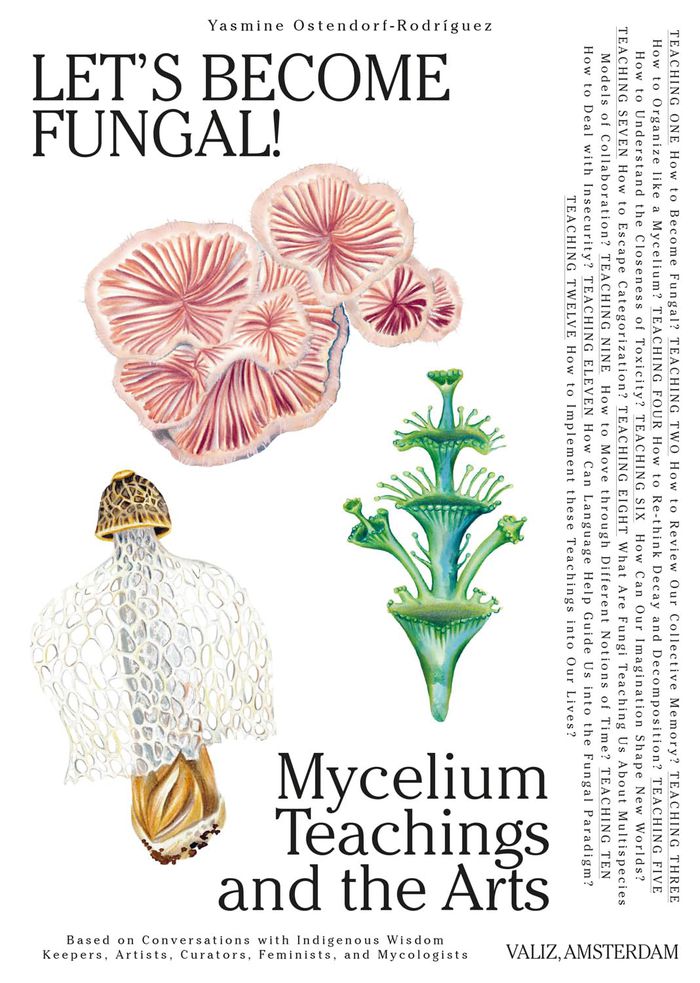
The enormous popular interest in the world of fungi and the mycelium testifies to its tremendous resonance as a metaphor for new ways of thinking, new systems and behaviors. Taking its inspiration from this world, ''Let's Become Fungal!'' looks at a range of Indigenous practices from Latin America, the Caribbean and Asia that are rooted in multispecies collaboration, symbiosis, alliances, non-monetary resource exchange, decentralization, bottom-up methods and mutual dependency--all suggestive of the behavior of the mycelium. Each of the book's 12 chapters offers teachings on collaboration, decoloniality, nonlinearity, toxicity, mobilization, biomimicry, death and being nonbinary, while also examining the world of fungi. ''Let's Become Fungal!'' shows how fungi can inspire artists, collectives, organizations, educators, policymakers, designers, scientists, anthropologists, curators, urbanists, activists, gardeners, community leaders, farmers and others to become more fungal in their ways of working and being.
Let's become fungal! Mycelium teachings and the arts: Based on conversations with indigenous wisdom keepers, artists, curators, feminists and mycologists
Actions:
Prix:
$42.95
(disponible en magasin)
Résumé:
The enormous popular interest in the world of fungi and the mycelium testifies to its tremendous resonance as a metaphor for new ways of thinking, new systems and behaviors. Taking its inspiration from this world, ''Let's Become Fungal!'' looks at a range of Indigenous practices from Latin America, the Caribbean and Asia that are rooted in multispecies collaboration, symbiosis, alliances, non-monetary resource exchange, decentralization, bottom-up methods and mutual dependency--all suggestive of the behavior of the mycelium. Each of the book's 12 chapters offers teachings on collaboration, decoloniality, nonlinearity, toxicity, mobilization, biomimicry, death and being nonbinary, while also examining the world of fungi. ''Let's Become Fungal!'' shows how fungi can inspire artists, collectives, organizations, educators, policymakers, designers, scientists, anthropologists, curators, urbanists, activists, gardeners, community leaders, farmers and others to become more fungal in their ways of working and being.
Classification:
livres
livres
Publication:
octobre 2023
octobre 2023
Classification:
périodiques
périodiques
Actions:
Prix:
$16.95
(disponible en magasin)
Résumé:
Au cours de l’été 2025, neuf États occidentaux ont officiellement reconnu l’État de Palestine. Cette reconnaissance par les États et la résurrection de la « solution à deux États » moribonde, s’accompagnent d’une criminalisation des appels à la libération de la Palestine « du Jourdain à la Mer ». Ce numéro pose la question suivante : la libération peut-elle prendre la(...)
$16.95
(disponible en magasin)
Résumé:
Au cours de l’été 2025, neuf États occidentaux ont officiellement reconnu l’État de Palestine. Cette reconnaissance par les États et la résurrection de la « solution à deux États » moribonde, s’accompagnent d’une criminalisation des appels à la libération de la Palestine « du Jourdain à la Mer ». Ce numéro pose la question suivante : la libération peut-elle prendre la(...)
Titre:
The Funambulist No. 64 FR : La solution sans état
Actions:
Prix:
$16.95
(disponible en magasin)
Résumé:
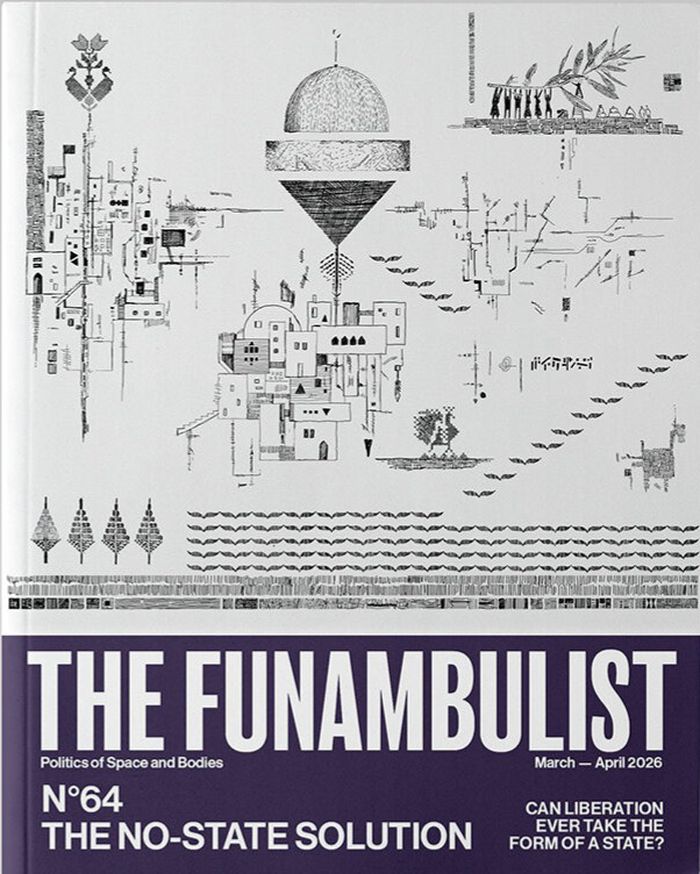
Au cours de l’été 2025, neuf États occidentaux ont officiellement reconnu l’État de Palestine. Cette reconnaissance par les États et la résurrection de la « solution à deux États » moribonde, s’accompagnent d’une criminalisation des appels à la libération de la Palestine « du Jourdain à la Mer ». Ce numéro pose la question suivante : la libération peut-elle prendre la forme d’un État ? Reprenant une expression que Sophia Azeb a utilisée à plusieurs reprises dans l’histoire du Funambulist (depuis notre première conversation en 2014), « La Solution Sans État » entend revisiter ce concept dans le contexte palestinien en remettant en question l’idée même de « solution » (Sophia Azeb & Rebecca Gross), mais aussi dans d’autres luttes de libération telles que celles des peuples kurdes (Havin Guneser) et des Zapatista (Linda Quiquivix). Il nous met en garde contre les rêves étatiques, tels que ceux mis en œuvre en Sierra Leone et au Liberia (ce que William C. Anderson appelle le « sionisme noir » dans sa contribution), et s’interroge sur les différences entre les formes de gouvernance étatiques et celles communautaires, en particulier en matière de santé, comme le montrent les exemples de Cuba et du Venezuela (Lisbeth Moya González). Enfin, il envisage ce à quoi pourrait ressembler des futurs sans frontières et sans États à Aotearoa-Nouvelle Zélande (Kai-rui Cheng) et en Kanaky (Florenda Nirikani). Quant à l’illustration de la couverture, il s’agit d’une création originale de Samir Harb.
The Funambulist No. 64 FR : La solution sans état
Actions:
Prix:
$16.95
(disponible en magasin)
Résumé:
Au cours de l’été 2025, neuf États occidentaux ont officiellement reconnu l’État de Palestine. Cette reconnaissance par les États et la résurrection de la « solution à deux États » moribonde, s’accompagnent d’une criminalisation des appels à la libération de la Palestine « du Jourdain à la Mer ». Ce numéro pose la question suivante : la libération peut-elle prendre la forme d’un État ? Reprenant une expression que Sophia Azeb a utilisée à plusieurs reprises dans l’histoire du Funambulist (depuis notre première conversation en 2014), « La Solution Sans État » entend revisiter ce concept dans le contexte palestinien en remettant en question l’idée même de « solution » (Sophia Azeb & Rebecca Gross), mais aussi dans d’autres luttes de libération telles que celles des peuples kurdes (Havin Guneser) et des Zapatista (Linda Quiquivix). Il nous met en garde contre les rêves étatiques, tels que ceux mis en œuvre en Sierra Leone et au Liberia (ce que William C. Anderson appelle le « sionisme noir » dans sa contribution), et s’interroge sur les différences entre les formes de gouvernance étatiques et celles communautaires, en particulier en matière de santé, comme le montrent les exemples de Cuba et du Venezuela (Lisbeth Moya González). Enfin, il envisage ce à quoi pourrait ressembler des futurs sans frontières et sans États à Aotearoa-Nouvelle Zélande (Kai-rui Cheng) et en Kanaky (Florenda Nirikani). Quant à l’illustration de la couverture, il s’agit d’une création originale de Samir Harb.
Classification:
périodiques
périodiques
Publication:
février 2026
février 2026
Sujet:
Revues
Revues
Classification:
livres
livres
Actions:
Prix:
$64.00
(disponible sur commande)
Résumé:
''Source Books in Architecture No.14: Rem Koolhaas / OMA + AMO Spaces for Prada'' is the most recent volume in the Source Books in Architecture series. Among the topics discussed in the book are the long-standing relationship with Prada and how the early objectives in that relationship have both maintained and shifted. An underlying theme to the conversations held with(...)
$64.00
(disponible sur commande)
Résumé:
''Source Books in Architecture No.14: Rem Koolhaas / OMA + AMO Spaces for Prada'' is the most recent volume in the Source Books in Architecture series. Among the topics discussed in the book are the long-standing relationship with Prada and how the early objectives in that relationship have both maintained and shifted. An underlying theme to the conversations held with(...)
Titre:
Rem Koolhaas, OMA + AMO / Spaces for Prada
Actions:
Prix:
$64.00
(disponible sur commande)
Résumé:
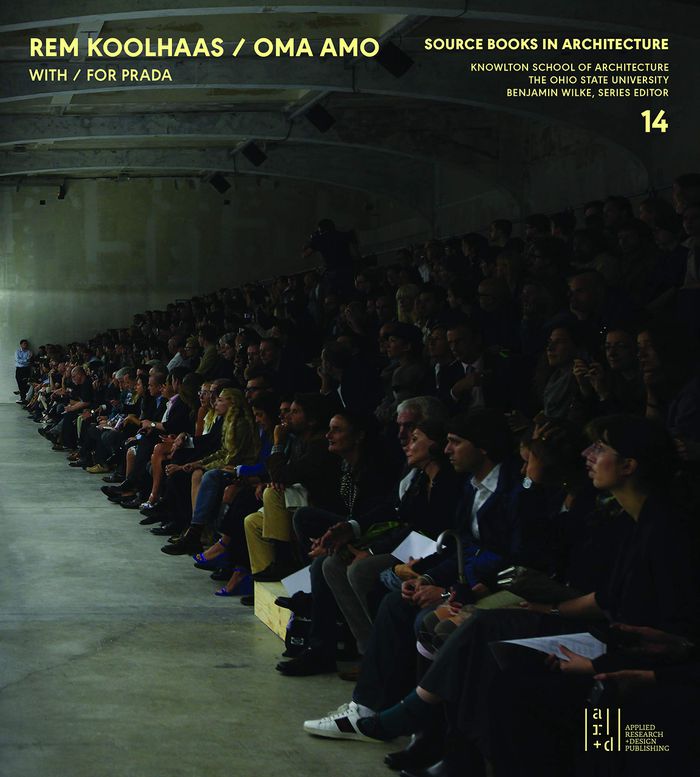
''Source Books in Architecture No.14: Rem Koolhaas / OMA + AMO Spaces for Prada'' is the most recent volume in the Source Books in Architecture series. Among the topics discussed in the book are the long-standing relationship with Prada and how the early objectives in that relationship have both maintained and shifted. An underlying theme to the conversations held with students and faculty of the Knowlton School community is the topic of architect-client relationships, their history, their problems, and how they have contributed to the discipline over time. Explicitly, a focus of the conversation is a number of projects that OMA has developed or completed with Prada, a large number of which are installation-scale environments that manifest in the form of runway shows and exhibitions. The challenge of such projects is to retain a commitment to the political and cultural agenda that OMA embeds in the larger and permanent buildings. Given the ephemerality and role of these environments as literal backgrounds to highlighted events, the projects are ideal scenarios in which to develop an architecture that lacks the permanence of buildings while still carrying potency and contributing to larger cultural discussions involving, for example, event, place, concept, product, staging, the crowd, lighting, and materiality. Source Books in Architecture No.14 contains project documentation from the OMA and Prada archives, transcripts from Koolhaas’ conversations with students at the Knowlton School at The Ohio State University, and commentary and critique from architects, critics, and theorists.
Rem Koolhaas, OMA + AMO / Spaces for Prada
Actions:
Prix:
$64.00
(disponible sur commande)
Résumé:
''Source Books in Architecture No.14: Rem Koolhaas / OMA + AMO Spaces for Prada'' is the most recent volume in the Source Books in Architecture series. Among the topics discussed in the book are the long-standing relationship with Prada and how the early objectives in that relationship have both maintained and shifted. An underlying theme to the conversations held with students and faculty of the Knowlton School community is the topic of architect-client relationships, their history, their problems, and how they have contributed to the discipline over time. Explicitly, a focus of the conversation is a number of projects that OMA has developed or completed with Prada, a large number of which are installation-scale environments that manifest in the form of runway shows and exhibitions. The challenge of such projects is to retain a commitment to the political and cultural agenda that OMA embeds in the larger and permanent buildings. Given the ephemerality and role of these environments as literal backgrounds to highlighted events, the projects are ideal scenarios in which to develop an architecture that lacks the permanence of buildings while still carrying potency and contributing to larger cultural discussions involving, for example, event, place, concept, product, staging, the crowd, lighting, and materiality. Source Books in Architecture No.14 contains project documentation from the OMA and Prada archives, transcripts from Koolhaas’ conversations with students at the Knowlton School at The Ohio State University, and commentary and critique from architects, critics, and theorists.
Classification:
livres
livres
Publication:
mars 2021
mars 2021
Sujet:
Architecture, monographies
Architecture, monographies


