


2056 Résultats
Classification:
archives
Niveau de description archivistique:
Fonds
archives
Niveau de description archivistique:
Fonds
Titre:
Fonds John Bird
Fonds John Bird
Numéro de référence:
AP108
Résumé:
The John Bird fonds documents the professional practice of the Westmount-based architect, and includes drawings and photographs of 24 architectural projects carried out in and around Montréal, Québec between 1954 and 1992. The fonds also contains a number of published articles that document John Bird's professional activities. Key projects that are represented include the Canadian Technical Tape Building, St. Laurent (1955-1963), Saint Gabriel's Church, Montréal (1959-1960), and Saint John Brebeuf Church, Lasalle (1962-1966). The fonds also includes numerous projects for Toronto-Dominion Bank buildings (1959-1992) as well as residential designs completed for the Central Mortgage and Housing Corporation (1956-1969).
AP108
Résumé:
The John Bird fonds documents the professional practice of the Westmount-based architect, and includes drawings and photographs of 24 architectural projects carried out in and around Montréal, Québec between 1954 and 1992. The fonds also contains a number of published articles that document John Bird's professional activities. Key projects that are represented include the Canadian Technical Tape Building, St. Laurent (1955-1963), Saint Gabriel's Church, Montréal (1959-1960), and Saint John Brebeuf Church, Lasalle (1962-1966). The fonds also includes numerous projects for Toronto-Dominion Bank buildings (1959-1992) as well as residential designs completed for the Central Mortgage and Housing Corporation (1956-1969).
Personnes et institutions:
Date:
1942 - 1992
1942 - 1992
Titre:
Fonds John Bird
Actions:
AP108
Résumé:
The John Bird fonds documents the professional practice of the Westmount-based architect, and includes drawings and photographs of 24 architectural projects carried out in and around Montréal, Québec between 1954 and 1992. The fonds also contains a number of published articles that document John Bird's professional activities. Key projects that are represented include the Canadian Technical Tape Building, St. Laurent (1955-1963), Saint Gabriel's Church, Montréal (1959-1960), and Saint John Brebeuf Church, Lasalle (1962-1966). The fonds also includes numerous projects for Toronto-Dominion Bank buildings (1959-1992) as well as residential designs completed for the Central Mortgage and Housing Corporation (1956-1969).
Fonds John Bird
Actions:
AP108
Résumé:
The John Bird fonds documents the professional practice of the Westmount-based architect, and includes drawings and photographs of 24 architectural projects carried out in and around Montréal, Québec between 1954 and 1992. The fonds also contains a number of published articles that document John Bird's professional activities. Key projects that are represented include the Canadian Technical Tape Building, St. Laurent (1955-1963), Saint Gabriel's Church, Montréal (1959-1960), and Saint John Brebeuf Church, Lasalle (1962-1966). The fonds also includes numerous projects for Toronto-Dominion Bank buildings (1959-1992) as well as residential designs completed for the Central Mortgage and Housing Corporation (1956-1969).
Classification:
archives
Niveau de description archivistique:
Fonds
archives
Niveau de description archivistique:
Fonds
Date:
1942 - 1992
1942 - 1992
Personnes et institutions:

Numéro de référence:
ARCH250582
Description:
- 1 caméra de type "chambre de campagne"; - 1 filtre Leika; - 1 filtre oranger; - 2 châssis; - 2 déclencheurs souples; - 1 table de pose "Diaphot Ica" dans son étui; 1 table de pose de marque "The Expodak Co., Charlottesville Virginia" - 1 lentille ? " Kodak Portrait Attachment" dans sa boîte; - 3 supports ? à film (film sheath) de marque Eastman Kodak; - 1 accessoire en bois et en métal d'usage inconnu; - 1 courroie en cuir; - 1 clé; dans un boîtier - 1 châssis à film; - 1 verre dépoli de caméra grand format (viseur);
ARCH250582
Description:
- 1 caméra de type "chambre de campagne"; - 1 filtre Leika; - 1 filtre oranger; - 2 châssis; - 2 déclencheurs souples; - 1 table de pose "Diaphot Ica" dans son étui; 1 table de pose de marque "The Expodak Co., Charlottesville Virginia" - 1 lentille ? " Kodak Portrait Attachment" dans sa boîte; - 3 supports ? à film (film sheath) de marque Eastman Kodak; - 1 accessoire en bois et en métal d'usage inconnu; - 1 courroie en cuir; - 1 clé; dans un boîtier - 1 châssis à film; - 1 verre dépoli de caméra grand format (viseur);
Personnes et institutions:
Titre:
Caméra de type "chambre de campagne" et équipement photographique dans un boîtier
Actions:
ARCH250582
Description:
- 1 caméra de type "chambre de campagne"; - 1 filtre Leika; - 1 filtre oranger; - 2 châssis; - 2 déclencheurs souples; - 1 table de pose "Diaphot Ica" dans son étui; 1 table de pose de marque "The Expodak Co., Charlottesville Virginia" - 1 lentille ? " Kodak Portrait Attachment" dans sa boîte; - 3 supports ? à film (film sheath) de marque Eastman Kodak; - 1 accessoire en bois et en métal d'usage inconnu; - 1 courroie en cuir; - 1 clé; dans un boîtier - 1 châssis à film; - 1 verre dépoli de caméra grand format (viseur);
Caméra de type "chambre de campagne" et équipement photographique dans un boîtier
Actions:
ARCH250582
Description:
- 1 caméra de type "chambre de campagne"; - 1 filtre Leika; - 1 filtre oranger; - 2 châssis; - 2 déclencheurs souples; - 1 table de pose "Diaphot Ica" dans son étui; 1 table de pose de marque "The Expodak Co., Charlottesville Virginia" - 1 lentille ? " Kodak Portrait Attachment" dans sa boîte; - 3 supports ? à film (film sheath) de marque Eastman Kodak; - 1 accessoire en bois et en métal d'usage inconnu; - 1 courroie en cuir; - 1 clé; dans un boîtier - 1 châssis à film; - 1 verre dépoli de caméra grand format (viseur);
Personnes et institutions:
Classification:
documents textuels, photographies
documents textuels, photographies
Numéro de référence:
DR2004:0140
Description:
photographs, correspondence, invoices, trade catalogues, brochures, publications, clippings, appendices from Draft for Development Air Supported Structures, and subscription forms
DR2004:0140
Description:
photographs, correspondence, invoices, trade catalogues, brochures, publications, clippings, appendices from Draft for Development Air Supported Structures, and subscription forms
Personnes et institutions:
Titre:
Photographs, correspondence, invoices, trade catalogues
Actions:
DR2004:0140
Description:
photographs, correspondence, invoices, trade catalogues, brochures, publications, clippings, appendices from Draft for Development Air Supported Structures, and subscription forms
Photographs, correspondence, invoices, trade catalogues
Actions:
DR2004:0140
Description:
photographs, correspondence, invoices, trade catalogues, brochures, publications, clippings, appendices from Draft for Development Air Supported Structures, and subscription forms
Classification:
documents textuels, photographies
documents textuels, photographies
Personnes et institutions:
Niveau de description archivistique:
Série(s)
Série(s)
Titre:
Une architecture des humeurs
Une architecture des humeurs
Numéro de référence:
AP193.S4
Description:
Series 4, Une architecture des humeurs, 2008-2011, documents the conception and the presentation of exhibition and project Une architecture des humeurs. Presented at Le laboratoire art gallery in Paris between January and May 2010, Une architecture des humeurs is a conceptual, unbuilt, residential urban structure based on a potential future in which contemporary science reads human physiology and chemical balance. The idea is to acquire a chemistry of the “humors”, or the moods and temperament, of future purchasers. Taken as input, the information generates a diversity of habitable morphologies and relationships between them. With this process, the project attempts to make palpable and graspable, through technologies, the emotions of the participants captured via the chemistry of their body. The goal is to gather information on their capacity of adaptation, their level of sympathy and empathy while confronted to a situation or an environment. This information is then analyzed by computational, mathematical, and machinist procedures. This leads to the design and production of an urban structure submitted to the improbable and uncertain protocols produced by emotions, also creating aggregations and layouts that rearticulate the links between the individual and the collective. These structures are calculated following simultaneously incremental and recursive structural optimization protocols resulting in the physicality and morphology of architecture. The layout of the residential units and the structural trajectories are conceived and developed as posterior to the constructs supporting social life and not as an a priori. The structure of each components of the urban structure is generated by a secretion and weaving machine called Viab02. The machine is the second prototype of VIAB which was developed with Robotics Research Lab of the University of Southern California and takes its name from the terms viability and variability. With a process similar to contour crafting, the machine produces bio-cement, a mix between cement and bio-resin, giving form to the adapted residential structures. The records consist largely of images detailing the creative process of the firm, photographs of the exhibition, and 3D models. It also contains animated renderings representing the machine in action and sequences of the construction of the building or the structure. The records include a video orienting the project into François Roche theoretical stance, research as speculation, that can be summarize as the use of technological tools to take a critical and political position through esthetic in order to open new lines of thoughts. AP193.S2 contains updated previous version of the VIAB machine
AP193.S4
Description:
Series 4, Une architecture des humeurs, 2008-2011, documents the conception and the presentation of exhibition and project Une architecture des humeurs. Presented at Le laboratoire art gallery in Paris between January and May 2010, Une architecture des humeurs is a conceptual, unbuilt, residential urban structure based on a potential future in which contemporary science reads human physiology and chemical balance. The idea is to acquire a chemistry of the “humors”, or the moods and temperament, of future purchasers. Taken as input, the information generates a diversity of habitable morphologies and relationships between them. With this process, the project attempts to make palpable and graspable, through technologies, the emotions of the participants captured via the chemistry of their body. The goal is to gather information on their capacity of adaptation, their level of sympathy and empathy while confronted to a situation or an environment. This information is then analyzed by computational, mathematical, and machinist procedures. This leads to the design and production of an urban structure submitted to the improbable and uncertain protocols produced by emotions, also creating aggregations and layouts that rearticulate the links between the individual and the collective. These structures are calculated following simultaneously incremental and recursive structural optimization protocols resulting in the physicality and morphology of architecture. The layout of the residential units and the structural trajectories are conceived and developed as posterior to the constructs supporting social life and not as an a priori. The structure of each components of the urban structure is generated by a secretion and weaving machine called Viab02. The machine is the second prototype of VIAB which was developed with Robotics Research Lab of the University of Southern California and takes its name from the terms viability and variability. With a process similar to contour crafting, the machine produces bio-cement, a mix between cement and bio-resin, giving form to the adapted residential structures. The records consist largely of images detailing the creative process of the firm, photographs of the exhibition, and 3D models. It also contains animated renderings representing the machine in action and sequences of the construction of the building or the structure. The records include a video orienting the project into François Roche theoretical stance, research as speculation, that can be summarize as the use of technological tools to take a critical and political position through esthetic in order to open new lines of thoughts. AP193.S2 contains updated previous version of the VIAB machine
Personnes et institutions:
Date:
2008-2011
2008-2011
Titre:
Une architecture des humeurs
Actions:
AP193.S4
Description:
Series 4, Une architecture des humeurs, 2008-2011, documents the conception and the presentation of exhibition and project Une architecture des humeurs. Presented at Le laboratoire art gallery in Paris between January and May 2010, Une architecture des humeurs is a conceptual, unbuilt, residential urban structure based on a potential future in which contemporary science reads human physiology and chemical balance. The idea is to acquire a chemistry of the “humors”, or the moods and temperament, of future purchasers. Taken as input, the information generates a diversity of habitable morphologies and relationships between them. With this process, the project attempts to make palpable and graspable, through technologies, the emotions of the participants captured via the chemistry of their body. The goal is to gather information on their capacity of adaptation, their level of sympathy and empathy while confronted to a situation or an environment. This information is then analyzed by computational, mathematical, and machinist procedures. This leads to the design and production of an urban structure submitted to the improbable and uncertain protocols produced by emotions, also creating aggregations and layouts that rearticulate the links between the individual and the collective. These structures are calculated following simultaneously incremental and recursive structural optimization protocols resulting in the physicality and morphology of architecture. The layout of the residential units and the structural trajectories are conceived and developed as posterior to the constructs supporting social life and not as an a priori. The structure of each components of the urban structure is generated by a secretion and weaving machine called Viab02. The machine is the second prototype of VIAB which was developed with Robotics Research Lab of the University of Southern California and takes its name from the terms viability and variability. With a process similar to contour crafting, the machine produces bio-cement, a mix between cement and bio-resin, giving form to the adapted residential structures. The records consist largely of images detailing the creative process of the firm, photographs of the exhibition, and 3D models. It also contains animated renderings representing the machine in action and sequences of the construction of the building or the structure. The records include a video orienting the project into François Roche theoretical stance, research as speculation, that can be summarize as the use of technological tools to take a critical and political position through esthetic in order to open new lines of thoughts. AP193.S2 contains updated previous version of the VIAB machine
Une architecture des humeurs
Actions:
AP193.S4
Description:
Series 4, Une architecture des humeurs, 2008-2011, documents the conception and the presentation of exhibition and project Une architecture des humeurs. Presented at Le laboratoire art gallery in Paris between January and May 2010, Une architecture des humeurs is a conceptual, unbuilt, residential urban structure based on a potential future in which contemporary science reads human physiology and chemical balance. The idea is to acquire a chemistry of the “humors”, or the moods and temperament, of future purchasers. Taken as input, the information generates a diversity of habitable morphologies and relationships between them. With this process, the project attempts to make palpable and graspable, through technologies, the emotions of the participants captured via the chemistry of their body. The goal is to gather information on their capacity of adaptation, their level of sympathy and empathy while confronted to a situation or an environment. This information is then analyzed by computational, mathematical, and machinist procedures. This leads to the design and production of an urban structure submitted to the improbable and uncertain protocols produced by emotions, also creating aggregations and layouts that rearticulate the links between the individual and the collective. These structures are calculated following simultaneously incremental and recursive structural optimization protocols resulting in the physicality and morphology of architecture. The layout of the residential units and the structural trajectories are conceived and developed as posterior to the constructs supporting social life and not as an a priori. The structure of each components of the urban structure is generated by a secretion and weaving machine called Viab02. The machine is the second prototype of VIAB which was developed with Robotics Research Lab of the University of Southern California and takes its name from the terms viability and variability. With a process similar to contour crafting, the machine produces bio-cement, a mix between cement and bio-resin, giving form to the adapted residential structures. The records consist largely of images detailing the creative process of the firm, photographs of the exhibition, and 3D models. It also contains animated renderings representing the machine in action and sequences of the construction of the building or the structure. The records include a video orienting the project into François Roche theoretical stance, research as speculation, that can be summarize as the use of technological tools to take a critical and political position through esthetic in order to open new lines of thoughts. AP193.S2 contains updated previous version of the VIAB machine
Niveau de description archivistique:
Series
Series
Date:
2008-2011
2008-2011
Personnes et institutions:
Classification:
dessins
dessins
Actions:
Numéro de référence:
PH1979:0603.02:045
Description:
- The buildings on the left are supported by stilts, overhanging a precipice, and were described by Thomson as presenting 'a very temporary and insecure appearance' (Thomson, vol. ii, n.p.)
PH1979:0603.02:045
Description:
- The buildings on the left are supported by stilts, overhanging a precipice, and were described by Thomson as presenting 'a very temporary and insecure appearance' (Thomson, vol. ii, n.p.)
Personnes et institutions:
Sujet:
architecture
architecture
Date:
published 1873
published 1873
Titre:
View of the Yuenfu Monastery Cave from below, Fukien (now Fujian) Province, China
Actions:
PH1979:0603.02:045
Description:
- The buildings on the left are supported by stilts, overhanging a precipice, and were described by Thomson as presenting 'a very temporary and insecure appearance' (Thomson, vol. ii, n.p.)
View of the Yuenfu Monastery Cave from below, Fukien (now Fujian) Province, China
Actions:
PH1979:0603.02:045
Description:
- The buildings on the left are supported by stilts, overhanging a precipice, and were described by Thomson as presenting 'a very temporary and insecure appearance' (Thomson, vol. ii, n.p.)
Classification:
dessins
dessins
Date:
published 1873
published 1873
Personnes et institutions:
Sujet:
architecture
architecture
Classification:
archives
Niveau de description archivistique:
Fonds
archives
Niveau de description archivistique:
Fonds
Numéro de référence:
AP195
Résumé:
The Zaha Hadid Architects Phaeno Science Centre project records, 1996-2015, consist of approximately 43,800 digital files that document the design and construction of an interactive science museum in Wolfsburg, Germany. Materials related to presentations, publications, events, and the press are also represented. Formats include chiefly CAD files, especially plotter files and AutoCAD drawings, though related text documents and images are also represented. The majority of the records date from 2000 to 2006.
AP195
Résumé:
The Zaha Hadid Architects Phaeno Science Centre project records, 1996-2015, consist of approximately 43,800 digital files that document the design and construction of an interactive science museum in Wolfsburg, Germany. Materials related to presentations, publications, events, and the press are also represented. Formats include chiefly CAD files, especially plotter files and AutoCAD drawings, though related text documents and images are also represented. The majority of the records date from 2000 to 2006.
Personnes et institutions:
Date:
1996 - 2015
1996 - 2015
Titre:
Documents d’archives de Zaha Hadid Architects pour le projet Phaeno Science Centre
Actions:
AP195
Résumé:
The Zaha Hadid Architects Phaeno Science Centre project records, 1996-2015, consist of approximately 43,800 digital files that document the design and construction of an interactive science museum in Wolfsburg, Germany. Materials related to presentations, publications, events, and the press are also represented. Formats include chiefly CAD files, especially plotter files and AutoCAD drawings, though related text documents and images are also represented. The majority of the records date from 2000 to 2006.
Documents d’archives de Zaha Hadid Architects pour le projet Phaeno Science Centre
Actions:
AP195
Résumé:
The Zaha Hadid Architects Phaeno Science Centre project records, 1996-2015, consist of approximately 43,800 digital files that document the design and construction of an interactive science museum in Wolfsburg, Germany. Materials related to presentations, publications, events, and the press are also represented. Formats include chiefly CAD files, especially plotter files and AutoCAD drawings, though related text documents and images are also represented. The majority of the records date from 2000 to 2006.
Classification:
archives
Niveau de description archivistique:
Fonds
archives
Niveau de description archivistique:
Fonds
Date:
1996 - 2015
1996 - 2015
Personnes et institutions:
Classification:
documents textuels
documents textuels
Numéro de référence:
DR2004:0109
Description:
sketch, photographs, trade catalogues, brochures, publication, clippings, notes, and draft consultant's report on 'Single-Skin Air-Supported Structures', possibly by Frank Newby
DR2004:0109
Description:
sketch, photographs, trade catalogues, brochures, publication, clippings, notes, and draft consultant's report on 'Single-Skin Air-Supported Structures', possibly by Frank Newby
Personnes et institutions:
Titre:
Sketch, photographs, trade catalogues, brochures, publication, clippings, notes, and draft consultant's report
Actions:
DR2004:0109
Description:
sketch, photographs, trade catalogues, brochures, publication, clippings, notes, and draft consultant's report on 'Single-Skin Air-Supported Structures', possibly by Frank Newby
Sketch, photographs, trade catalogues, brochures, publication, clippings, notes, and draft consultant's report
Actions:
DR2004:0109
Description:
sketch, photographs, trade catalogues, brochures, publication, clippings, notes, and draft consultant's report on 'Single-Skin Air-Supported Structures', possibly by Frank Newby
Classification:
documents textuels
documents textuels
Personnes et institutions:
Niveau de description archivistique:
Projet
Projet
Titre:
Inter-Action Centre
Inter-Action Centre
Numéro de référence:
AP144.S2.D82
Description:
File documents Inter-Action Centre, a completed project for a community centre commissioned by Ed Berman and the Inter-Action Trust, for a disused site at Talacre Public Open Space in Kentish Town, Camden, London. The construction was divided into two phases. Foundations, steel frame and trusses were constructed first and could be used for open-air community events while funds were being raised for the second phase. Phase II included cladding, fittings, finishes, services prefabricated units, and log cabins. The building was intended as a flexible short life-span building in which the interior spaces would be independent of the roof and exterior walls. Functional areas suggested by Cedric Price include: assembly halls, classrooms, rehearsal rooms, studios, areas for performance, media resources, lounging and dining, and a gym and a nursery. Cedric Price had been engaged by the concepts of flexible architecture, indeterminacy, impermanence, and the fusion of information technology, entertainment, and educational activities in earlier unrealized projects such as Fun Palace (AP144.S2.D46) and Oxford Corner House (AP144.S2.D59). Existing conditions drawings include photographs of the site; reprographic copies of electrical and drainage systems; ordinance surveys of Kentish Town; and landscape and playground layout. Conceptual drawings include sketches of overall massing; diagrammatic plans; drawings and diagrams of site conditions; notes for the structural framework; rendered interior elevations; plans showing impact of site context on building design; diagrammatic sketches of relationship between functional requirements and structural form. Schematic drawings include diagrammatic plans; sections of structural system and exterior wall; cladding details; and axonometric views of supports. Design development drawings and working drawings include plans, elevations, sections, details and axonometric views. Presentation drawings include watercolours and other renderings; reprographic copies, possibly for publication; and perspectives drawings. Some material from this file was published in "Inter-action Centre." 'RIBA Journal'. (November 1977), 458-465; "Intervista A Cedric Price: London Interaction Centre." 'Domus'. (April 1978), 17-21; "Kentish Town West Amalgam, London." 'Architectural Record'. (January 1973), 19; Lyall, Sutherland. 'The State of British Architecture'. (London: Architectural Press, 1980), 107-109; 130 and 'Cedric Price-Works II' (London: Architectural Press, 1984), 54, 62-63. Material in this file was produced between 1964 and 1992, but predominantly between 1970 and 1981. File contains technical drawings that are attributed to the following consultants, contractors, and manufacturers: Coseley Buildings Ltd; H.G. Deacon Ltd; Kayanson Engineers; H.J. Knights & Co. Ltd; Woodcemair; Metal Sections Ltd; Spaceway; Gascoigne, Gush & Dent (Engineering Ltd); UBM Engineering; J. Murphy & Sons Ltd; Maurice Pickering Associates, Architects & Landscape Consultants; David Lee Architect & Landscape Architect; J. Starkie Gardner Ltd; Dibben Structural Engineers; Zisman, Bowyer & Partners; Felix J. Samuely and Partners; Ruberoid Contracts Ltd; Whitbread London Limited; and Portakabin. Paul Hyett and Will Alsop were Cedric Price's main assistants for this project. 'Inter-Action Trust Limited', 'Inter-Action Centre', and 'Talacre Centre Limited' appear as the client(s) at various stages of this project. File contains cartographic materials, conceptual drawings, consultant drawings, design development drawings, models, panels, photographic materials, presentation drawings, an illustration, textual records, and working drawings.
AP144.S2.D82
Description:
File documents Inter-Action Centre, a completed project for a community centre commissioned by Ed Berman and the Inter-Action Trust, for a disused site at Talacre Public Open Space in Kentish Town, Camden, London. The construction was divided into two phases. Foundations, steel frame and trusses were constructed first and could be used for open-air community events while funds were being raised for the second phase. Phase II included cladding, fittings, finishes, services prefabricated units, and log cabins. The building was intended as a flexible short life-span building in which the interior spaces would be independent of the roof and exterior walls. Functional areas suggested by Cedric Price include: assembly halls, classrooms, rehearsal rooms, studios, areas for performance, media resources, lounging and dining, and a gym and a nursery. Cedric Price had been engaged by the concepts of flexible architecture, indeterminacy, impermanence, and the fusion of information technology, entertainment, and educational activities in earlier unrealized projects such as Fun Palace (AP144.S2.D46) and Oxford Corner House (AP144.S2.D59). Existing conditions drawings include photographs of the site; reprographic copies of electrical and drainage systems; ordinance surveys of Kentish Town; and landscape and playground layout. Conceptual drawings include sketches of overall massing; diagrammatic plans; drawings and diagrams of site conditions; notes for the structural framework; rendered interior elevations; plans showing impact of site context on building design; diagrammatic sketches of relationship between functional requirements and structural form. Schematic drawings include diagrammatic plans; sections of structural system and exterior wall; cladding details; and axonometric views of supports. Design development drawings and working drawings include plans, elevations, sections, details and axonometric views. Presentation drawings include watercolours and other renderings; reprographic copies, possibly for publication; and perspectives drawings. Some material from this file was published in "Inter-action Centre." 'RIBA Journal'. (November 1977), 458-465; "Intervista A Cedric Price: London Interaction Centre." 'Domus'. (April 1978), 17-21; "Kentish Town West Amalgam, London." 'Architectural Record'. (January 1973), 19; Lyall, Sutherland. 'The State of British Architecture'. (London: Architectural Press, 1980), 107-109; 130 and 'Cedric Price-Works II' (London: Architectural Press, 1984), 54, 62-63. Material in this file was produced between 1964 and 1992, but predominantly between 1970 and 1981. File contains technical drawings that are attributed to the following consultants, contractors, and manufacturers: Coseley Buildings Ltd; H.G. Deacon Ltd; Kayanson Engineers; H.J. Knights & Co. Ltd; Woodcemair; Metal Sections Ltd; Spaceway; Gascoigne, Gush & Dent (Engineering Ltd); UBM Engineering; J. Murphy & Sons Ltd; Maurice Pickering Associates, Architects & Landscape Consultants; David Lee Architect & Landscape Architect; J. Starkie Gardner Ltd; Dibben Structural Engineers; Zisman, Bowyer & Partners; Felix J. Samuely and Partners; Ruberoid Contracts Ltd; Whitbread London Limited; and Portakabin. Paul Hyett and Will Alsop were Cedric Price's main assistants for this project. 'Inter-Action Trust Limited', 'Inter-Action Centre', and 'Talacre Centre Limited' appear as the client(s) at various stages of this project. File contains cartographic materials, conceptual drawings, consultant drawings, design development drawings, models, panels, photographic materials, presentation drawings, an illustration, textual records, and working drawings.
Personnes et institutions:
Date:
1964-1992, predominant 1970-1981
1964-1992, predominant 1970-1981
Titre:
Inter-Action Centre
Actions:
AP144.S2.D82
Description:
File documents Inter-Action Centre, a completed project for a community centre commissioned by Ed Berman and the Inter-Action Trust, for a disused site at Talacre Public Open Space in Kentish Town, Camden, London. The construction was divided into two phases. Foundations, steel frame and trusses were constructed first and could be used for open-air community events while funds were being raised for the second phase. Phase II included cladding, fittings, finishes, services prefabricated units, and log cabins. The building was intended as a flexible short life-span building in which the interior spaces would be independent of the roof and exterior walls. Functional areas suggested by Cedric Price include: assembly halls, classrooms, rehearsal rooms, studios, areas for performance, media resources, lounging and dining, and a gym and a nursery. Cedric Price had been engaged by the concepts of flexible architecture, indeterminacy, impermanence, and the fusion of information technology, entertainment, and educational activities in earlier unrealized projects such as Fun Palace (AP144.S2.D46) and Oxford Corner House (AP144.S2.D59). Existing conditions drawings include photographs of the site; reprographic copies of electrical and drainage systems; ordinance surveys of Kentish Town; and landscape and playground layout. Conceptual drawings include sketches of overall massing; diagrammatic plans; drawings and diagrams of site conditions; notes for the structural framework; rendered interior elevations; plans showing impact of site context on building design; diagrammatic sketches of relationship between functional requirements and structural form. Schematic drawings include diagrammatic plans; sections of structural system and exterior wall; cladding details; and axonometric views of supports. Design development drawings and working drawings include plans, elevations, sections, details and axonometric views. Presentation drawings include watercolours and other renderings; reprographic copies, possibly for publication; and perspectives drawings. Some material from this file was published in "Inter-action Centre." 'RIBA Journal'. (November 1977), 458-465; "Intervista A Cedric Price: London Interaction Centre." 'Domus'. (April 1978), 17-21; "Kentish Town West Amalgam, London." 'Architectural Record'. (January 1973), 19; Lyall, Sutherland. 'The State of British Architecture'. (London: Architectural Press, 1980), 107-109; 130 and 'Cedric Price-Works II' (London: Architectural Press, 1984), 54, 62-63. Material in this file was produced between 1964 and 1992, but predominantly between 1970 and 1981. File contains technical drawings that are attributed to the following consultants, contractors, and manufacturers: Coseley Buildings Ltd; H.G. Deacon Ltd; Kayanson Engineers; H.J. Knights & Co. Ltd; Woodcemair; Metal Sections Ltd; Spaceway; Gascoigne, Gush & Dent (Engineering Ltd); UBM Engineering; J. Murphy & Sons Ltd; Maurice Pickering Associates, Architects & Landscape Consultants; David Lee Architect & Landscape Architect; J. Starkie Gardner Ltd; Dibben Structural Engineers; Zisman, Bowyer & Partners; Felix J. Samuely and Partners; Ruberoid Contracts Ltd; Whitbread London Limited; and Portakabin. Paul Hyett and Will Alsop were Cedric Price's main assistants for this project. 'Inter-Action Trust Limited', 'Inter-Action Centre', and 'Talacre Centre Limited' appear as the client(s) at various stages of this project. File contains cartographic materials, conceptual drawings, consultant drawings, design development drawings, models, panels, photographic materials, presentation drawings, an illustration, textual records, and working drawings.
Inter-Action Centre
Actions:
AP144.S2.D82
Description:
File documents Inter-Action Centre, a completed project for a community centre commissioned by Ed Berman and the Inter-Action Trust, for a disused site at Talacre Public Open Space in Kentish Town, Camden, London. The construction was divided into two phases. Foundations, steel frame and trusses were constructed first and could be used for open-air community events while funds were being raised for the second phase. Phase II included cladding, fittings, finishes, services prefabricated units, and log cabins. The building was intended as a flexible short life-span building in which the interior spaces would be independent of the roof and exterior walls. Functional areas suggested by Cedric Price include: assembly halls, classrooms, rehearsal rooms, studios, areas for performance, media resources, lounging and dining, and a gym and a nursery. Cedric Price had been engaged by the concepts of flexible architecture, indeterminacy, impermanence, and the fusion of information technology, entertainment, and educational activities in earlier unrealized projects such as Fun Palace (AP144.S2.D46) and Oxford Corner House (AP144.S2.D59). Existing conditions drawings include photographs of the site; reprographic copies of electrical and drainage systems; ordinance surveys of Kentish Town; and landscape and playground layout. Conceptual drawings include sketches of overall massing; diagrammatic plans; drawings and diagrams of site conditions; notes for the structural framework; rendered interior elevations; plans showing impact of site context on building design; diagrammatic sketches of relationship between functional requirements and structural form. Schematic drawings include diagrammatic plans; sections of structural system and exterior wall; cladding details; and axonometric views of supports. Design development drawings and working drawings include plans, elevations, sections, details and axonometric views. Presentation drawings include watercolours and other renderings; reprographic copies, possibly for publication; and perspectives drawings. Some material from this file was published in "Inter-action Centre." 'RIBA Journal'. (November 1977), 458-465; "Intervista A Cedric Price: London Interaction Centre." 'Domus'. (April 1978), 17-21; "Kentish Town West Amalgam, London." 'Architectural Record'. (January 1973), 19; Lyall, Sutherland. 'The State of British Architecture'. (London: Architectural Press, 1980), 107-109; 130 and 'Cedric Price-Works II' (London: Architectural Press, 1984), 54, 62-63. Material in this file was produced between 1964 and 1992, but predominantly between 1970 and 1981. File contains technical drawings that are attributed to the following consultants, contractors, and manufacturers: Coseley Buildings Ltd; H.G. Deacon Ltd; Kayanson Engineers; H.J. Knights & Co. Ltd; Woodcemair; Metal Sections Ltd; Spaceway; Gascoigne, Gush & Dent (Engineering Ltd); UBM Engineering; J. Murphy & Sons Ltd; Maurice Pickering Associates, Architects & Landscape Consultants; David Lee Architect & Landscape Architect; J. Starkie Gardner Ltd; Dibben Structural Engineers; Zisman, Bowyer & Partners; Felix J. Samuely and Partners; Ruberoid Contracts Ltd; Whitbread London Limited; and Portakabin. Paul Hyett and Will Alsop were Cedric Price's main assistants for this project. 'Inter-Action Trust Limited', 'Inter-Action Centre', and 'Talacre Centre Limited' appear as the client(s) at various stages of this project. File contains cartographic materials, conceptual drawings, consultant drawings, design development drawings, models, panels, photographic materials, presentation drawings, an illustration, textual records, and working drawings.
Niveau de description archivistique:
File 82
File 82
Date:
1964-1992, predominant 1970-1981
1964-1992, predominant 1970-1981
Personnes et institutions:
Classification:
oeuvres d'art
oeuvres d'art
Numéro de référence:
DR1988:0437:031
Description:
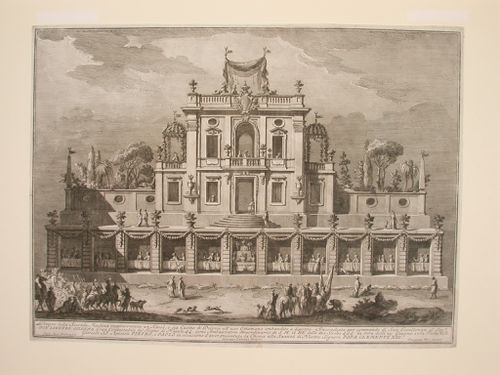
- This etching for a fireworks construction or macchina is in the form of a stepped three-storey pavilion representing an Ottoman casino. The lower level is a dining gallery supported by rusticated piers. The cresent is used as a decorative motif throughout the pavilion.
DR1988:0437:031
Description:
- This etching for a fireworks construction or macchina is in the form of a stepped three-storey pavilion representing an Ottoman casino. The lower level is a dining gallery supported by rusticated piers. The cresent is used as a decorative motif throughout the pavilion.
Personnes et institutions:
Sujet:
architecture temporaire
architecture temporaire
Date:
printed 1762
printed 1762
Titre:
Etching of Posi's design for the "seconda macchina" of 1762
Actions:
DR1988:0437:031
Description:
- This etching for a fireworks construction or macchina is in the form of a stepped three-storey pavilion representing an Ottoman casino. The lower level is a dining gallery supported by rusticated piers. The cresent is used as a decorative motif throughout the pavilion.
Etching of Posi's design for the "seconda macchina" of 1762
Actions:
DR1988:0437:031
Description:
- This etching for a fireworks construction or macchina is in the form of a stepped three-storey pavilion representing an Ottoman casino. The lower level is a dining gallery supported by rusticated piers. The cresent is used as a decorative motif throughout the pavilion.
Classification:
oeuvres d'art
oeuvres d'art
Date:
printed 1762
printed 1762
Personnes et institutions:
Sujet:
architecture temporaire
architecture temporaire
Classification:
dessins
dessins
Actions:
Numéro de référence:
DR1988:0053
Description:
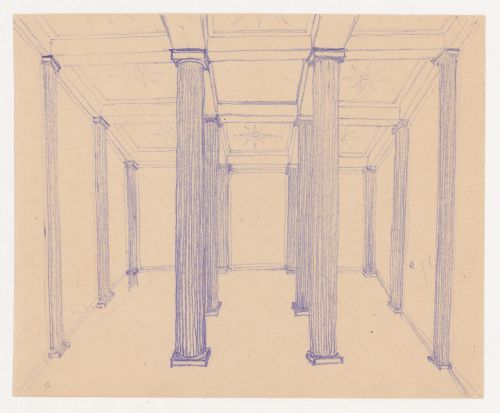
- Interior perspective view of a hall with fluted columns and pilasters supporting a coffered roof. The coffers are decorated with a star-shaped design, and the central section of the roof is open. This might be a depiction of a Roman atrium, although it lacks an impluvium.
DR1988:0053
Description:
- Interior perspective view of a hall with fluted columns and pilasters supporting a coffered roof. The coffers are decorated with a star-shaped design, and the central section of the roof is open. This might be a depiction of a Roman atrium, although it lacks an impluvium.
Personnes et institutions:
Sujet:
architecture, design d'intérieur
architecture, design d'intérieur
Date:
printed ca. 1921
printed ca. 1921
Titre:
Interior view, probably of an atrium
Actions:
DR1988:0053
Description:
- Interior perspective view of a hall with fluted columns and pilasters supporting a coffered roof. The coffers are decorated with a star-shaped design, and the central section of the roof is open. This might be a depiction of a Roman atrium, although it lacks an impluvium.
Interior view, probably of an atrium
Actions:
DR1988:0053
Description:
- Interior perspective view of a hall with fluted columns and pilasters supporting a coffered roof. The coffers are decorated with a star-shaped design, and the central section of the roof is open. This might be a depiction of a Roman atrium, although it lacks an impluvium.
Classification:
dessins
dessins
Date:
printed ca. 1921
printed ca. 1921
Personnes et institutions:
Sujet:
architecture, design d'intérieur
architecture, design d'intérieur


