


3820 Résultats
Classification:
livres
livres

Actions:
Prix:
$32.00
(disponible sur commande)
Résumé:
It is often said that we no longer have an addressee for our political demands. But that’s not true. We have each other. What we can no longer get from the state, the party, the union, the boss, we ask for from one another. And we provide. Lacan famously defined love as giving something you don’t have to someone who doesn’t want it. But love is more than a YouTube link or(...)
$32.00
(disponible sur commande)
Résumé:
It is often said that we no longer have an addressee for our political demands. But that’s not true. We have each other. What we can no longer get from the state, the party, the union, the boss, we ask for from one another. And we provide. Lacan famously defined love as giving something you don’t have to someone who doesn’t want it. But love is more than a YouTube link or(...)
Titre:
What's love (or care, intimacy, warmth, affection) got to do with it?
Actions:
Prix:
$32.00
(disponible sur commande)
Résumé:
It is often said that we no longer have an addressee for our political demands. But that’s not true. We have each other. What we can no longer get from the state, the party, the union, the boss, we ask for from one another. And we provide. Lacan famously defined love as giving something you don’t have to someone who doesn’t want it. But love is more than a YouTube link or a URL. Love’s joy is not to be found in fulfillment, it is to be found in recognition: even though I can never return what was taken away from you, I may be the only person alive who knows what it is. In our present times—post-human, post-reality, or maybe pre-internet, post-it, pre-collapse, pre-fabricated by algorithms—what does love have to do with it? Since 2009, need and care and desire and admiration have been cross-examined, called as witness, put on parole, and made the subject of caring inquiry by e-flux journal authors. These writings have now been collected to form this comprehensive volume.
What's love (or care, intimacy, warmth, affection) got to do with it?
Actions:
Prix:
$32.00
(disponible sur commande)
Résumé:
It is often said that we no longer have an addressee for our political demands. But that’s not true. We have each other. What we can no longer get from the state, the party, the union, the boss, we ask for from one another. And we provide. Lacan famously defined love as giving something you don’t have to someone who doesn’t want it. But love is more than a YouTube link or a URL. Love’s joy is not to be found in fulfillment, it is to be found in recognition: even though I can never return what was taken away from you, I may be the only person alive who knows what it is. In our present times—post-human, post-reality, or maybe pre-internet, post-it, pre-collapse, pre-fabricated by algorithms—what does love have to do with it? Since 2009, need and care and desire and admiration have been cross-examined, called as witness, put on parole, and made the subject of caring inquiry by e-flux journal authors. These writings have now been collected to form this comprehensive volume.
Classification:
livres
livres
Publication:
octobre 2017
octobre 2017
Sujet:
Social
Social
Classification:
livres
livres
Titre:
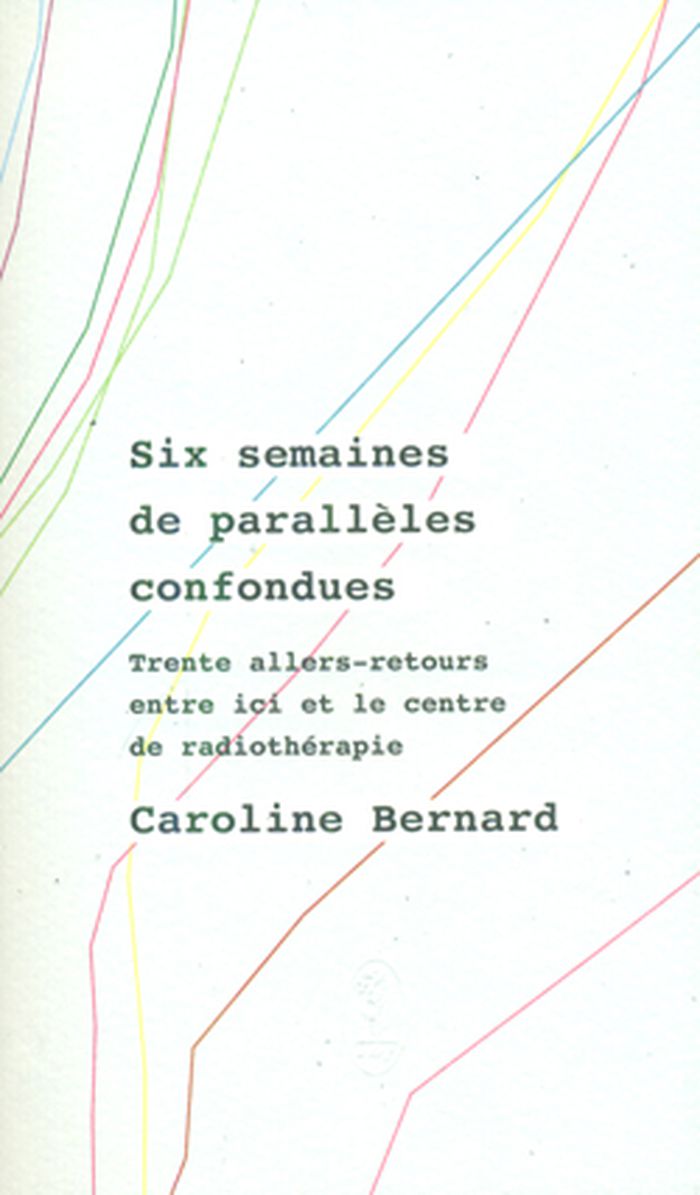
Six semaines de parallèles confondues: trente allers-retours entre ici et le centre radiothérapie
Six semaines de parallèles confondues: trente allers-retours entre ici et le centre radiothérapie
Actions:
Prix:
$23.95
(disponible sur commande)
Résumé:
Caroline Bernard aime les machines et enregistre scrupuleusement leur activité: voiture, calendrier, horloge, compteur, téléphone portable, GPS, à gauche, à droite, tout droit... Pendant trente jours, elle fait un aller-retour dans un centre de radiothérapie et prélève les enregistrements de toutes les machines embarquées dans les taxis qui la transportent, instaurant un(...)
$23.95
(disponible sur commande)
Résumé:
Caroline Bernard aime les machines et enregistre scrupuleusement leur activité: voiture, calendrier, horloge, compteur, téléphone portable, GPS, à gauche, à droite, tout droit... Pendant trente jours, elle fait un aller-retour dans un centre de radiothérapie et prélève les enregistrements de toutes les machines embarquées dans les taxis qui la transportent, instaurant un(...)
Publication:
mai 2012
mai 2012
Titre:
Six semaines de parallèles confondues: trente allers-retours entre ici et le centre radiothérapie
Actions:
Prix:
$23.95
(disponible sur commande)
Résumé:
Caroline Bernard aime les machines et enregistre scrupuleusement leur activité: voiture, calendrier, horloge, compteur, téléphone portable, GPS, à gauche, à droite, tout droit... Pendant trente jours, elle fait un aller-retour dans un centre de radiothérapie et prélève les enregistrements de toutes les machines embarquées dans les taxis qui la transportent, instaurant un rassurant protocole de répétition routinière et contrôlable: «Attendre que les journées se mécanisent. J’arrive, je repars sans voir vraiment. La machine accomplit sa tâche, et les machinistes orchestrent son déploiement.» Cette publication tient lieu de ces enregistrements. Pendant que le taxi va et vient sur la route qui mène à la machine, le sens – l’écriture — naît de la machine qui va et vient sur le corps cartographié. En ce sens, Six semaines de parallèles confondues n’est pas un livre que Caroline Bernard a écrit, mais un livre où Caroline Bernard organise et décrit le dispositif où elle est écrite. Le texte est accompagné d’une carte décrivant l’itinéraire avec des QR codes qui, scannés par un smartphone, permettent un accès via Internet aux images en ligne et à la vidéo du projet.
Six semaines de parallèles confondues: trente allers-retours entre ici et le centre radiothérapie
Actions:
Prix:
$23.95
(disponible sur commande)
Résumé:
Caroline Bernard aime les machines et enregistre scrupuleusement leur activité: voiture, calendrier, horloge, compteur, téléphone portable, GPS, à gauche, à droite, tout droit... Pendant trente jours, elle fait un aller-retour dans un centre de radiothérapie et prélève les enregistrements de toutes les machines embarquées dans les taxis qui la transportent, instaurant un rassurant protocole de répétition routinière et contrôlable: «Attendre que les journées se mécanisent. J’arrive, je repars sans voir vraiment. La machine accomplit sa tâche, et les machinistes orchestrent son déploiement.» Cette publication tient lieu de ces enregistrements. Pendant que le taxi va et vient sur la route qui mène à la machine, le sens – l’écriture — naît de la machine qui va et vient sur le corps cartographié. En ce sens, Six semaines de parallèles confondues n’est pas un livre que Caroline Bernard a écrit, mais un livre où Caroline Bernard organise et décrit le dispositif où elle est écrite. Le texte est accompagné d’une carte décrivant l’itinéraire avec des QR codes qui, scannés par un smartphone, permettent un accès via Internet aux images en ligne et à la vidéo du projet.
Classification:
livres
livres
Publication:
mai 2012
mai 2012
Classification:
livres
livres
Actions:
Prix:
$28.00
(disponible sur commande)
Résumé:
In a world increasingly dominated by the digital, the critical response to digital art generally ranges from hype to counterhype. Popular writing about specific artworks seldom goes beyond promoting a given piece and explaining how it operates, while scholars and critics remain unsure about how to interpret and evaluate them. This is where Roberto Simanowski intervenes,(...)
$28.00
(disponible sur commande)
Résumé:
In a world increasingly dominated by the digital, the critical response to digital art generally ranges from hype to counterhype. Popular writing about specific artworks seldom goes beyond promoting a given piece and explaining how it operates, while scholars and critics remain unsure about how to interpret and evaluate them. This is where Roberto Simanowski intervenes,(...)
Publication:
juillet 2011
juillet 2011
Titre:
Digital art and meaning: reading kinetic poetry, text machines, mapping art, and interactive installations
Actions:
Prix:
$28.00
(disponible sur commande)
Résumé:
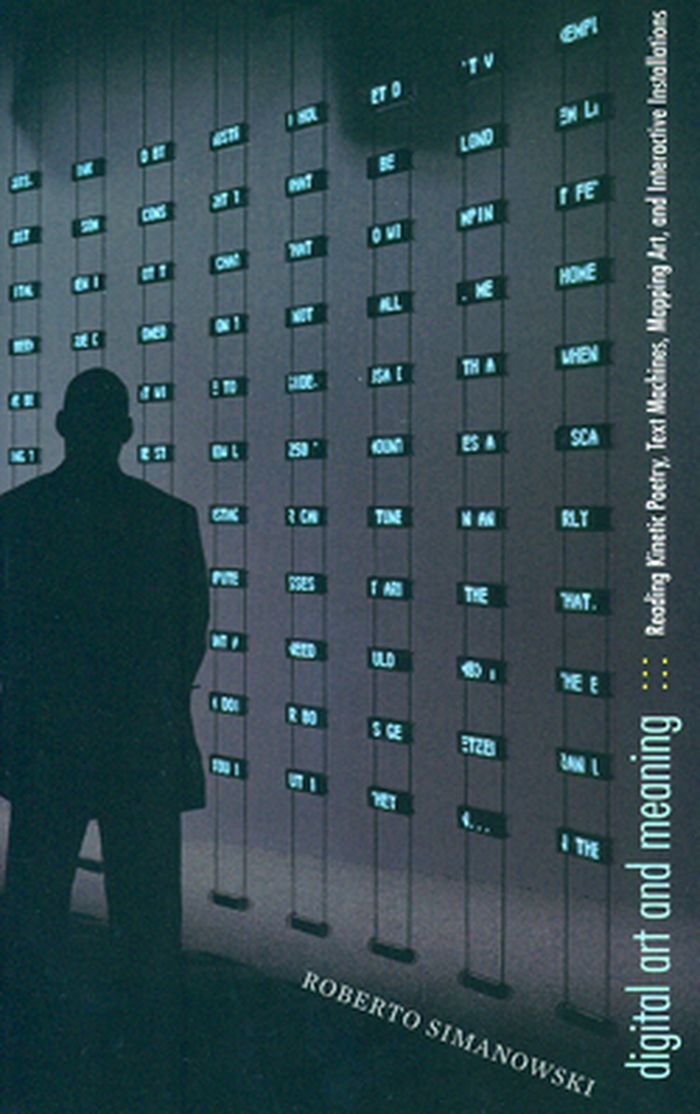
In a world increasingly dominated by the digital, the critical response to digital art generally ranges from hype to counterhype. Popular writing about specific artworks seldom goes beyond promoting a given piece and explaining how it operates, while scholars and critics remain unsure about how to interpret and evaluate them. This is where Roberto Simanowski intervenes, demonstrating how such critical work can be done. Digital Art and Meaning offers close readings of varied examples from genres of digital art such as kinetic concrete poetry, computer-generated text, interactive installation, mapping art, and information sculpture. For instance, Simanowski deciphers the complex meaning of words that not only form an image on a screen but also react to the viewer’s behavior; images that are progressively destroyed by the human gaze; text machines generating nonsense sentences out of a Kafka story; and a light show above Mexico City’s historic square, created by Internet users all over the world. Simanowski combines these illuminating explanations with a theoretical discussion that employs art philosophy and history to achieve a deeper understanding of each particular example of digital art and, ultimately, of the genre as a whole.
Digital art and meaning: reading kinetic poetry, text machines, mapping art, and interactive installations
Actions:
Prix:
$28.00
(disponible sur commande)
Résumé:
In a world increasingly dominated by the digital, the critical response to digital art generally ranges from hype to counterhype. Popular writing about specific artworks seldom goes beyond promoting a given piece and explaining how it operates, while scholars and critics remain unsure about how to interpret and evaluate them. This is where Roberto Simanowski intervenes, demonstrating how such critical work can be done. Digital Art and Meaning offers close readings of varied examples from genres of digital art such as kinetic concrete poetry, computer-generated text, interactive installation, mapping art, and information sculpture. For instance, Simanowski deciphers the complex meaning of words that not only form an image on a screen but also react to the viewer’s behavior; images that are progressively destroyed by the human gaze; text machines generating nonsense sentences out of a Kafka story; and a light show above Mexico City’s historic square, created by Internet users all over the world. Simanowski combines these illuminating explanations with a theoretical discussion that employs art philosophy and history to achieve a deeper understanding of each particular example of digital art and, ultimately, of the genre as a whole.
Classification:
livres
livres
Publication:
juillet 2011
juillet 2011
Classification:
livres
livres

Titre:
Dana Schutz
Dana Schutz
Actions:
Prix:
$22.95
(disponible sur commande)
Résumé:
Informed by early twentieth-century avantgardes, principally cubism and expressionism, Dana Schutz's art is an extraordinary and joyful mash-up where a multitude of references and allusions collide. The exhilarating results can be understood as a productive conversation with the history of painting and as a compelling testament to painting's complex and unending death(...)
$22.95
(disponible sur commande)
Résumé:
Informed by early twentieth-century avantgardes, principally cubism and expressionism, Dana Schutz's art is an extraordinary and joyful mash-up where a multitude of references and allusions collide. The exhilarating results can be understood as a productive conversation with the history of painting and as a compelling testament to painting's complex and unending death(...)
Publication:
août 2015
août 2015
Titre:
Dana Schutz
Actions:
Prix:
$22.95
(disponible sur commande)
Résumé:
Informed by early twentieth-century avantgardes, principally cubism and expressionism, Dana Schutz's art is an extraordinary and joyful mash-up where a multitude of references and allusions collide. The exhilarating results can be understood as a productive conversation with the history of painting and as a compelling testament to painting's complex and unending death throes. With its conflations of Gericault, horror films, Ensor, Picasso, Guston, porn, and pop culture, her work appears to counter and confront the imperious Internet information colossus, where everything is available at once. This bilingual publication accompanies an exhibition of new and recent work. Born in 1976, Dana Schutz is a New York based artist whose work over the past decade has had a notable influence on contemporary painting. She has had solo exhibitions at, notably, Miami Art Museum (2012); Denver Museum of Contemporary Art and Denver Art Museum (2012); and Hannover Kesterngesellschaft and Hepworth Wakefield (2013). Her work is found in numerous collections including the Solomon R. Guggenheim Museum, Los Angeles County Museum of Art, The Metropolitan Museum of Art, The Museum of Modern Art, The Museum of Contemporary Art Los Angeles, and Whitney Museum of American Art.
Dana Schutz
Actions:
Prix:
$22.95
(disponible sur commande)
Résumé:
Informed by early twentieth-century avantgardes, principally cubism and expressionism, Dana Schutz's art is an extraordinary and joyful mash-up where a multitude of references and allusions collide. The exhilarating results can be understood as a productive conversation with the history of painting and as a compelling testament to painting's complex and unending death throes. With its conflations of Gericault, horror films, Ensor, Picasso, Guston, porn, and pop culture, her work appears to counter and confront the imperious Internet information colossus, where everything is available at once. This bilingual publication accompanies an exhibition of new and recent work. Born in 1976, Dana Schutz is a New York based artist whose work over the past decade has had a notable influence on contemporary painting. She has had solo exhibitions at, notably, Miami Art Museum (2012); Denver Museum of Contemporary Art and Denver Art Museum (2012); and Hannover Kesterngesellschaft and Hepworth Wakefield (2013). Her work is found in numerous collections including the Solomon R. Guggenheim Museum, Los Angeles County Museum of Art, The Metropolitan Museum of Art, The Museum of Modern Art, The Museum of Contemporary Art Los Angeles, and Whitney Museum of American Art.
Classification:
livres
livres
Publication:
août 2015
août 2015
Classification:
livres
livres
Prix:
$32.95
(disponible sur commande)
Résumé:
Cell phones, automatic teller machines, and the Internet have incontrovertibly become part of our daily lives, indistinguishable from other components of our habitual everyday activity. Life does not seem to have been fundamentally changed by these hi-tech, information-giving tools of convenience--or has it? Have we, unawares, become accustomed to a new way of living? And(...)
$32.95
(disponible sur commande)
Résumé:
Cell phones, automatic teller machines, and the Internet have incontrovertibly become part of our daily lives, indistinguishable from other components of our habitual everyday activity. Life does not seem to have been fundamentally changed by these hi-tech, information-giving tools of convenience--or has it? Have we, unawares, become accustomed to a new way of living? And(...)
Sujet:
Théorie de l’architecture
Théorie de l’architecture
Publication:
septembre 2004, Berlin
septembre 2004, Berlin
Titre:
Dot city : relational urbanism and new media in the Bauhaus Kolleg
Actions:
Prix:
$32.95
(disponible sur commande)
Résumé:
Cell phones, automatic teller machines, and the Internet have incontrovertibly become part of our daily lives, indistinguishable from other components of our habitual everyday activity. Life does not seem to have been fundamentally changed by these hi-tech, information-giving tools of convenience--or has it? Have we, unawares, become accustomed to a new way of living? And how can designers make creative use of these new digital possibilities? This publication of the Fourth International Bauhaus Kolleg--a year-long thematic graduate session run by the Bauhaus Dessau Foundation--offers strategies for employing digital media to integrate the unpredictable and the unplanned into urban existence. "Dot.City" asks and answers many questions: Can the use of information and communication technology counteract the continuous processes of devaluation, the loss of urban identity, the lack of multifunctional networks? Can the activation and implementation of new social techniques of knowledge production compensate for missing economical impulses and functions? How do such processes generate new species of urban values? Is it possible to re-program local social resources using intelligent network technologies? What do urban action areas designed for this purpose look like? And how can urban information spheres and physical urban spaces penetrate each other?
Dot city : relational urbanism and new media in the Bauhaus Kolleg
Actions:
Prix:
$32.95
(disponible sur commande)
Résumé:
Cell phones, automatic teller machines, and the Internet have incontrovertibly become part of our daily lives, indistinguishable from other components of our habitual everyday activity. Life does not seem to have been fundamentally changed by these hi-tech, information-giving tools of convenience--or has it? Have we, unawares, become accustomed to a new way of living? And how can designers make creative use of these new digital possibilities? This publication of the Fourth International Bauhaus Kolleg--a year-long thematic graduate session run by the Bauhaus Dessau Foundation--offers strategies for employing digital media to integrate the unpredictable and the unplanned into urban existence. "Dot.City" asks and answers many questions: Can the use of information and communication technology counteract the continuous processes of devaluation, the loss of urban identity, the lack of multifunctional networks? Can the activation and implementation of new social techniques of knowledge production compensate for missing economical impulses and functions? How do such processes generate new species of urban values? Is it possible to re-program local social resources using intelligent network technologies? What do urban action areas designed for this purpose look like? And how can urban information spheres and physical urban spaces penetrate each other?
Classification:
livres
livres
Publication:
septembre 2004, Berlin
septembre 2004, Berlin
Sujet:
Théorie de l’architecture
Théorie de l’architecture
Classification:
livres
livres

Prix:
$27.95
(disponible sur commande)
Résumé:
Our culture is dominated by the visual. Yet most writing on design reflects a narrow preoccupation with products, biographies, and design influences. Maud Lavin approaches design from the broader field of visual culture criticism, asking challenging questions about about who really has a voice in the culture and what unseen influences affect the look of things designers(...)
$27.95
(disponible sur commande)
Résumé:
Our culture is dominated by the visual. Yet most writing on design reflects a narrow preoccupation with products, biographies, and design influences. Maud Lavin approaches design from the broader field of visual culture criticism, asking challenging questions about about who really has a voice in the culture and what unseen influences affect the look of things designers(...)
Publication:
octobre 2002, Cambridge, Massachusetts
octobre 2002, Cambridge, Massachusetts
Titre:
Clean new world : culture, politics, and graphic design
Actions:
Prix:
$27.95
(disponible sur commande)
Résumé:
Our culture is dominated by the visual. Yet most writing on design reflects a narrow preoccupation with products, biographies, and design influences. Maud Lavin approaches design from the broader field of visual culture criticism, asking challenging questions about about who really has a voice in the culture and what unseen influences affect the look of things designers produce. Lavin shows how design fits into larger questions of power, democracy, and communication. Many corporate clients instruct designers to convey order and clarity in order to give their companies the look of a clean new world. But since designers cannot clean up messy reality, Lavin shows, they often end up simply veiling it. Lacking the power to influence the content of their commercial work, many designers work simultaneously on other, more fulfilling projects. Lavin is especially interested in the graphic designer’s role in shaping cultural norms. She examines the anti-Nazi propaganda of John Heartfield, the modernist utopian design of Kurt Schwitters and the neue ring werbegestalter, the alternative images of women by studio ringl + pit, the activist work of such contemporary designers as Marlene McCarty and Sheila Levrant de Bretteville, and the Internet innovations of David Steuer and others. Throughout the book, Lavin asks how designers can expand the pleasure, democracy, and vitality of communication.
Clean new world : culture, politics, and graphic design
Actions:
Prix:
$27.95
(disponible sur commande)
Résumé:
Our culture is dominated by the visual. Yet most writing on design reflects a narrow preoccupation with products, biographies, and design influences. Maud Lavin approaches design from the broader field of visual culture criticism, asking challenging questions about about who really has a voice in the culture and what unseen influences affect the look of things designers produce. Lavin shows how design fits into larger questions of power, democracy, and communication. Many corporate clients instruct designers to convey order and clarity in order to give their companies the look of a clean new world. But since designers cannot clean up messy reality, Lavin shows, they often end up simply veiling it. Lacking the power to influence the content of their commercial work, many designers work simultaneously on other, more fulfilling projects. Lavin is especially interested in the graphic designer’s role in shaping cultural norms. She examines the anti-Nazi propaganda of John Heartfield, the modernist utopian design of Kurt Schwitters and the neue ring werbegestalter, the alternative images of women by studio ringl + pit, the activist work of such contemporary designers as Marlene McCarty and Sheila Levrant de Bretteville, and the Internet innovations of David Steuer and others. Throughout the book, Lavin asks how designers can expand the pleasure, democracy, and vitality of communication.
Classification:
livres
livres
Publication:
octobre 2002, Cambridge, Massachusetts
octobre 2002, Cambridge, Massachusetts
Classification:
livres
livres
Prix:
$44.95
(disponible sur commande)
Résumé:
Our culture is dominated by the visual. Yet most writing on design reflects a narrow preoccupation with products, biographies, and design influences. Maud Lavin approaches design from the broader field of visual culture criticism, asking challenging questions(...)
$44.95
(disponible sur commande)
Résumé:
Our culture is dominated by the visual. Yet most writing on design reflects a narrow preoccupation with products, biographies, and design influences. Maud Lavin approaches design from the broader field of visual culture criticism, asking challenging questions(...)
Titre:
Clean new world: culture, politics, and graphic design
Actions:
Prix:
$44.95
(disponible sur commande)
Résumé:
Our culture is dominated by the visual. Yet most writing on design reflects a narrow preoccupation with products, biographies, and design influences. Maud Lavin approaches design from the broader field of visual culture criticism, asking challenging questions about about who really has a voice in the culture and what unseen influences affect the look of things designers produce. Lavin shows how design fits into larger questions of power, democracy, and communication. Many corporate clients instruct designers to convey order and clarity in order to give their companies the look of a clean new world. But since designers cannot clean up messy reality, Lavin shows, they often end up simply veiling it. Lacking the power to influence the content of their commercial work, many designers work simultaneously on other, more fulfilling projects. Lavin is especially interested in the graphic designer’s role in shaping cultural norms. She examines the anti-Nazi propaganda of John Heartfield, the modernist utopian design of Kurt Schwitters and the neue ring werbegestalter, the alternative images of women by studio ringl + pit, the activist work of such contemporary designers as Marlene McCarty and Sheila Levrant de Bretteville, and the Internet innovations of David Steuer and others. Throughout the book, Lavin asks how designers can expand the pleasure, democracy, and vitality of communication.
Clean new world: culture, politics, and graphic design
Actions:
Prix:
$44.95
(disponible sur commande)
Résumé:
Our culture is dominated by the visual. Yet most writing on design reflects a narrow preoccupation with products, biographies, and design influences. Maud Lavin approaches design from the broader field of visual culture criticism, asking challenging questions about about who really has a voice in the culture and what unseen influences affect the look of things designers produce. Lavin shows how design fits into larger questions of power, democracy, and communication. Many corporate clients instruct designers to convey order and clarity in order to give their companies the look of a clean new world. But since designers cannot clean up messy reality, Lavin shows, they often end up simply veiling it. Lacking the power to influence the content of their commercial work, many designers work simultaneously on other, more fulfilling projects. Lavin is especially interested in the graphic designer’s role in shaping cultural norms. She examines the anti-Nazi propaganda of John Heartfield, the modernist utopian design of Kurt Schwitters and the neue ring werbegestalter, the alternative images of women by studio ringl + pit, the activist work of such contemporary designers as Marlene McCarty and Sheila Levrant de Bretteville, and the Internet innovations of David Steuer and others. Throughout the book, Lavin asks how designers can expand the pleasure, democracy, and vitality of communication.
Classification:
livres
livres
Publication:
mars 2001, Cambridge, Mass.
mars 2001, Cambridge, Mass.
Classification:
livres
livres
Actions:
Prix:
$56.00
(disponible en magasin)
Résumé:
''Collective Intelligence'' is an innovative monograph that documents the last ten years of Polish-born conceptual artist Agnieszka Kurant’s interdisciplinary practice. It includes newly commissioned texts by renowned thinkers in science, philosophy, art, technology, anthropology, and economics. Kurant’s experimental work investigates collective and nonhuman(...)
$56.00
(disponible en magasin)
Résumé:
''Collective Intelligence'' is an innovative monograph that documents the last ten years of Polish-born conceptual artist Agnieszka Kurant’s interdisciplinary practice. It includes newly commissioned texts by renowned thinkers in science, philosophy, art, technology, anthropology, and economics. Kurant’s experimental work investigates collective and nonhuman(...)
Publication:
décembre 2025
décembre 2025
Titre:
Agnieszka Kurant: Collective intelligence
Actions:
Prix:
$56.00
(disponible en magasin)
Résumé:
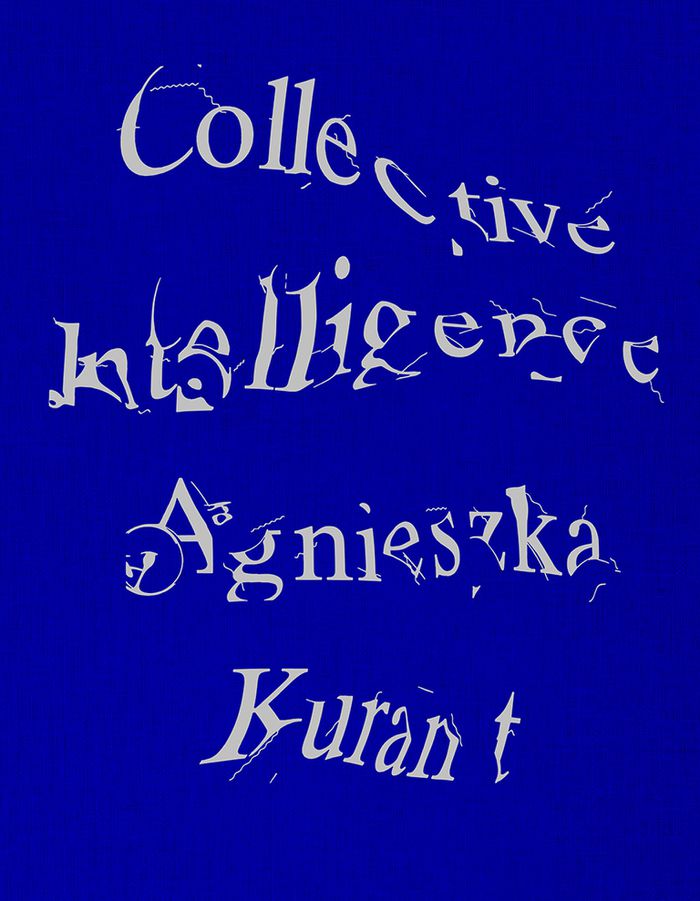
''Collective Intelligence'' is an innovative monograph that documents the last ten years of Polish-born conceptual artist Agnieszka Kurant’s interdisciplinary practice. It includes newly commissioned texts by renowned thinkers in science, philosophy, art, technology, anthropology, and economics. Kurant’s experimental work investigates collective and nonhuman intelligences and their impact on transformations of the human, the future of labor and creativity, and the exploitations within digital capitalism. Questioning the ideology of individualism, Kurant proposes that we rethink human and more-than-human worlds from a perspective of plural subjectivity, and, through this fundamental shift in perspective, posits the possibility of alternative political imaginaries. Her work probes the replacement of individual authorship with collective intelligence—a phenomenon observed in slime molds, termite colonies, social movements, cities, the internet, and inside our brains. In her collaborative practice, the artist investigates artificial intelligence, emergence, cybernetics, automation, artificial life, mining industries, and energy circuits to explore our collective evolution and the shifting status of objects in relation to agency, value, circulation, and redistribution. Through crowdsourcing the production of her artworks to thousands of humans and nonhumans, Kurant creates unstable, hybrid forms that constantly evolve. Her works, oscillating between biological, digital, and geological, embody the crumbling distinctions between what is natural and artificial, real and synthetic, and life and nonlife.
Agnieszka Kurant: Collective intelligence
Actions:
Prix:
$56.00
(disponible en magasin)
Résumé:
''Collective Intelligence'' is an innovative monograph that documents the last ten years of Polish-born conceptual artist Agnieszka Kurant’s interdisciplinary practice. It includes newly commissioned texts by renowned thinkers in science, philosophy, art, technology, anthropology, and economics. Kurant’s experimental work investigates collective and nonhuman intelligences and their impact on transformations of the human, the future of labor and creativity, and the exploitations within digital capitalism. Questioning the ideology of individualism, Kurant proposes that we rethink human and more-than-human worlds from a perspective of plural subjectivity, and, through this fundamental shift in perspective, posits the possibility of alternative political imaginaries. Her work probes the replacement of individual authorship with collective intelligence—a phenomenon observed in slime molds, termite colonies, social movements, cities, the internet, and inside our brains. In her collaborative practice, the artist investigates artificial intelligence, emergence, cybernetics, automation, artificial life, mining industries, and energy circuits to explore our collective evolution and the shifting status of objects in relation to agency, value, circulation, and redistribution. Through crowdsourcing the production of her artworks to thousands of humans and nonhumans, Kurant creates unstable, hybrid forms that constantly evolve. Her works, oscillating between biological, digital, and geological, embody the crumbling distinctions between what is natural and artificial, real and synthetic, and life and nonlife.
Classification:
livres
livres
Publication:
décembre 2025
décembre 2025
Classification:
livres
livres
Titre:
The network society
The network society
Actions:
Prix:
$28.99
(disponible sur commande)
Résumé:
In The Network Society, Darin Barney provides a compelling examination of the social, political and economic implications of network technologies and their application across a wide range of practices and institutions. Are we in the midst of a digital revolution? Have new information and communication technologies given birth to a new form of society, or do they(...)
$28.99
(disponible sur commande)
Résumé:
In The Network Society, Darin Barney provides a compelling examination of the social, political and economic implications of network technologies and their application across a wide range of practices and institutions. Are we in the midst of a digital revolution? Have new information and communication technologies given birth to a new form of society, or do they(...)
Titre:
The network society
Actions:
Prix:
$28.99
(disponible sur commande)
Résumé:
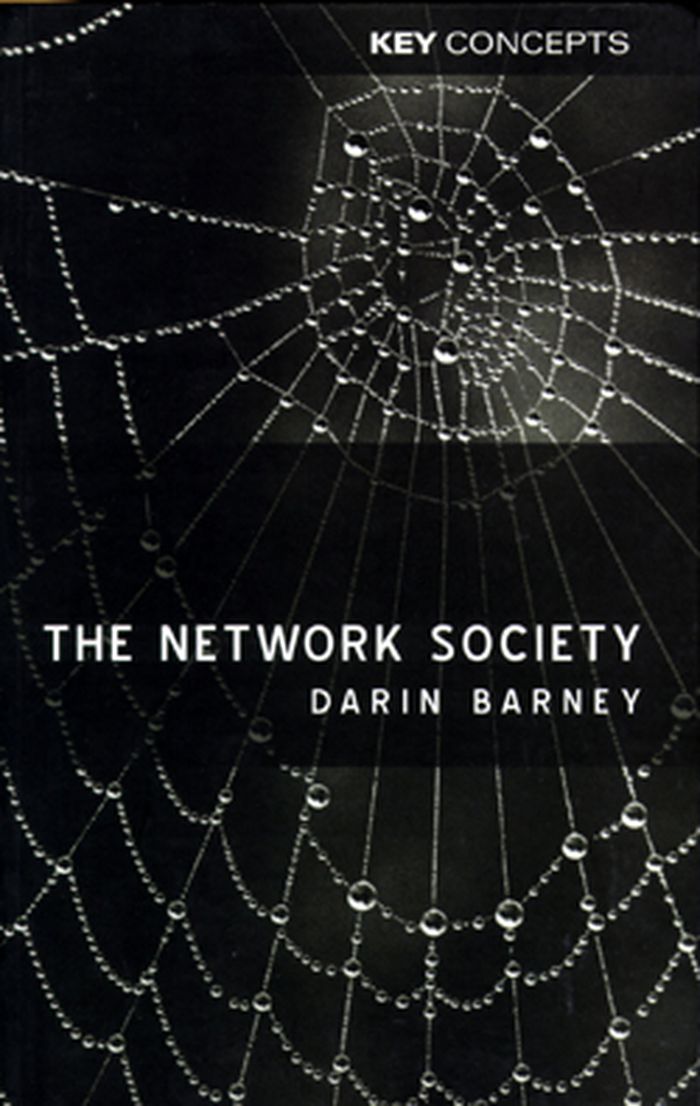
In The Network Society, Darin Barney provides a compelling examination of the social, political and economic implications of network technologies and their application across a wide range of practices and institutions. Are we in the midst of a digital revolution? Have new information and communication technologies given birth to a new form of society, or do they reinforce and extend existing patterns and relationships? This book provides a clear and engaging discussion of these and other questions. Using a sophisticated model of the relationship between technology and society, Barney investigates both what has changed, and what has remained the same, in the age of the Internet. Among the issues discussed are debates concerning the emergence of a 'knowledge economy'; digital restructuring of employment and work; globalization and the status of the nation-state; the prospects of digital democracy; the digital divide; new social movements; and culture, community and identity in the age of new media. This book provides an accessible resource for a thoughtful engagement with life in the network society. It will be essential reading for students in sociology and media and communication studies. This will be a valuable textbook for undergraduate students of sociology and media and communication studies.
The network society
Actions:
Prix:
$28.99
(disponible sur commande)
Résumé:
In The Network Society, Darin Barney provides a compelling examination of the social, political and economic implications of network technologies and their application across a wide range of practices and institutions. Are we in the midst of a digital revolution? Have new information and communication technologies given birth to a new form of society, or do they reinforce and extend existing patterns and relationships? This book provides a clear and engaging discussion of these and other questions. Using a sophisticated model of the relationship between technology and society, Barney investigates both what has changed, and what has remained the same, in the age of the Internet. Among the issues discussed are debates concerning the emergence of a 'knowledge economy'; digital restructuring of employment and work; globalization and the status of the nation-state; the prospects of digital democracy; the digital divide; new social movements; and culture, community and identity in the age of new media. This book provides an accessible resource for a thoughtful engagement with life in the network society. It will be essential reading for students in sociology and media and communication studies. This will be a valuable textbook for undergraduate students of sociology and media and communication studies.
Classification:
livres
livres
Publication:
septembre 2004, Cambridge
septembre 2004, Cambridge
Sujet:
Épistémologie et réseau
Épistémologie et réseau
Classification:
livres
livres
Prix:
$38.95
(disponible sur commande)
Résumé:
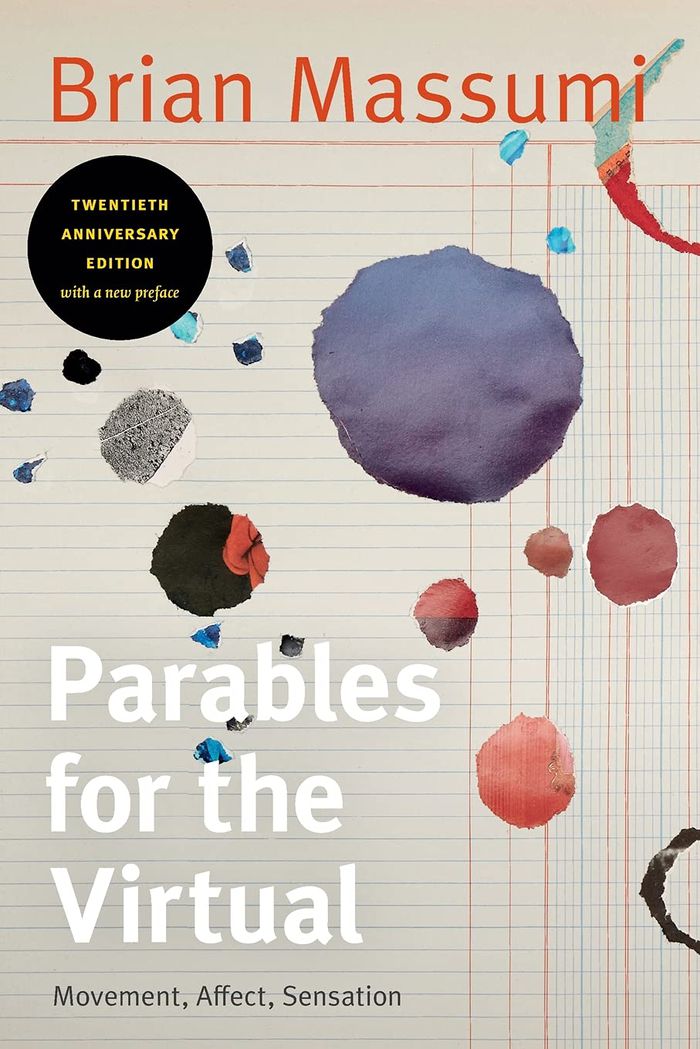
Since its publication twenty years ago, Brian Massumi's pioneering ''Parables for the virtual'' has become an essential text for interdisciplinary scholars across the humanities. Massumi views the body and media such as television, film, and the internet as cultural formations that operate on multiple registers of sensation. Renewing and assessing William James's radical(...)
$38.95
(disponible sur commande)
Résumé:
Since its publication twenty years ago, Brian Massumi's pioneering ''Parables for the virtual'' has become an essential text for interdisciplinary scholars across the humanities. Massumi views the body and media such as television, film, and the internet as cultural formations that operate on multiple registers of sensation. Renewing and assessing William James's radical(...)
Titre:
Parables for the virtual: movement, affect, sensation
Actions:
Prix:
$38.95
(disponible sur commande)
Résumé:
Since its publication twenty years ago, Brian Massumi's pioneering ''Parables for the virtual'' has become an essential text for interdisciplinary scholars across the humanities. Massumi views the body and media such as television, film, and the internet as cultural formations that operate on multiple registers of sensation. Renewing and assessing William James's radical empiricism and Henri Bergson's philosophy of perception through the filter of the postwar French philosophy of Deleuze, Guattari, and Foucault, Massumi links a cultural logic of variation to questions of movement, affect, and sensation. Replacing the traditional opposition of literal and figural with distinctions between stasis and motion and between actual and virtual, Massumi tackles related theoretical issues by applying them to cultural mediums as diverse as architecture, body art, the digital art of Stelarc, and Ronald Reagan's acting career. The result is an intriguing combination of cultural theory, science, and philosophy that asserts itself in a crystalline and multifaceted argument. This twentieth anniversary edition includes a new preface in which Massumi situates the book in relation to developments since its publication and outlines the evolution of its main concepts. It also includes two short texts, "Keywords for Affect" and "Missed Conceptions about Affect," in which Massumi explicates his approach to affect in ways that emphasize the book's political and philosophical stakes.
Parables for the virtual: movement, affect, sensation
Actions:
Prix:
$38.95
(disponible sur commande)
Résumé:
Since its publication twenty years ago, Brian Massumi's pioneering ''Parables for the virtual'' has become an essential text for interdisciplinary scholars across the humanities. Massumi views the body and media such as television, film, and the internet as cultural formations that operate on multiple registers of sensation. Renewing and assessing William James's radical empiricism and Henri Bergson's philosophy of perception through the filter of the postwar French philosophy of Deleuze, Guattari, and Foucault, Massumi links a cultural logic of variation to questions of movement, affect, and sensation. Replacing the traditional opposition of literal and figural with distinctions between stasis and motion and between actual and virtual, Massumi tackles related theoretical issues by applying them to cultural mediums as diverse as architecture, body art, the digital art of Stelarc, and Ronald Reagan's acting career. The result is an intriguing combination of cultural theory, science, and philosophy that asserts itself in a crystalline and multifaceted argument. This twentieth anniversary edition includes a new preface in which Massumi situates the book in relation to developments since its publication and outlines the evolution of its main concepts. It also includes two short texts, "Keywords for Affect" and "Missed Conceptions about Affect," in which Massumi explicates his approach to affect in ways that emphasize the book's political and philosophical stakes.
Classification:
livres
livres
Publication:
septembre 2021
septembre 2021
Sujet:
Théorie/ philosophie
Théorie/ philosophie


