


714 Résultats
Classification:
photographies
photographies
Actions:
Numéro de référence:
PH1997:0063
Description:
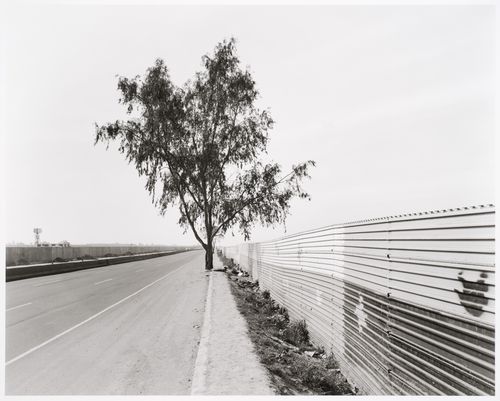
- The series "Running Fence 1997" focuses "on the first 14 miles of the border fence that separates the United States and Mexico, beginning at the Pacific Ocean and ending in the Otay Mountains.... [It] analyzes the "idea" of the border and explores its iconography, the border being a subject that is of extreme importance to the public as the world proceeds towards greater globalization. [Geoffrey] James has written of the project: "[The border fence] was built by the US Army Corps of Engineers in 1994, out of recycled metal landing strip - the most visible symbol of what is known as Operation Gatekeeper. Because the steel sheets are placed in the ground so that their ridges run horizontally, a man can hop over the fence with ease; and no Mexican child ever seems to be impeded from retrieving a soccer ball from US territory. The real barrier to illegal immigration from Mexico into the USA is less visible: hundreds of buried sensors linked to a central computer, nightscopes, helicopters and Border Patrol Agents in white Broncos."" (Evans).
PH1997:0063
Description:
- The series "Running Fence 1997" focuses "on the first 14 miles of the border fence that separates the United States and Mexico, beginning at the Pacific Ocean and ending in the Otay Mountains.... [It] analyzes the "idea" of the border and explores its iconography, the border being a subject that is of extreme importance to the public as the world proceeds towards greater globalization. [Geoffrey] James has written of the project: "[The border fence] was built by the US Army Corps of Engineers in 1994, out of recycled metal landing strip - the most visible symbol of what is known as Operation Gatekeeper. Because the steel sheets are placed in the ground so that their ridges run horizontally, a man can hop over the fence with ease; and no Mexican child ever seems to be impeded from retrieving a soccer ball from US territory. The real barrier to illegal immigration from Mexico into the USA is less visible: hundreds of buried sensors linked to a central computer, nightscopes, helicopters and Border Patrol Agents in white Broncos."" (Evans).
Personnes et institutions:
Sujet:
architecture, ingénierie
architecture, ingénierie
Date:
1997
1997
Titre:
View along a highway leading to the airport in Tijuana, Baja California, Mexico, showing a partial view of the United States-Mexico border fence
Actions:
PH1997:0063
Description:
- The series "Running Fence 1997" focuses "on the first 14 miles of the border fence that separates the United States and Mexico, beginning at the Pacific Ocean and ending in the Otay Mountains.... [It] analyzes the "idea" of the border and explores its iconography, the border being a subject that is of extreme importance to the public as the world proceeds towards greater globalization. [Geoffrey] James has written of the project: "[The border fence] was built by the US Army Corps of Engineers in 1994, out of recycled metal landing strip - the most visible symbol of what is known as Operation Gatekeeper. Because the steel sheets are placed in the ground so that their ridges run horizontally, a man can hop over the fence with ease; and no Mexican child ever seems to be impeded from retrieving a soccer ball from US territory. The real barrier to illegal immigration from Mexico into the USA is less visible: hundreds of buried sensors linked to a central computer, nightscopes, helicopters and Border Patrol Agents in white Broncos."" (Evans).
View along a highway leading to the airport in Tijuana, Baja California, Mexico, showing a partial view of the United States-Mexico border fence
Actions:
PH1997:0063
Description:
- The series "Running Fence 1997" focuses "on the first 14 miles of the border fence that separates the United States and Mexico, beginning at the Pacific Ocean and ending in the Otay Mountains.... [It] analyzes the "idea" of the border and explores its iconography, the border being a subject that is of extreme importance to the public as the world proceeds towards greater globalization. [Geoffrey] James has written of the project: "[The border fence] was built by the US Army Corps of Engineers in 1994, out of recycled metal landing strip - the most visible symbol of what is known as Operation Gatekeeper. Because the steel sheets are placed in the ground so that their ridges run horizontally, a man can hop over the fence with ease; and no Mexican child ever seems to be impeded from retrieving a soccer ball from US territory. The real barrier to illegal immigration from Mexico into the USA is less visible: hundreds of buried sensors linked to a central computer, nightscopes, helicopters and Border Patrol Agents in white Broncos."" (Evans).
Classification:
photographies
photographies
Date:
1997
1997
Personnes et institutions:
Sujet:
architecture, ingénierie
architecture, ingénierie
Niveau de description archivistique:
Projet
Projet
Numéro de référence:
AP143.S4.D14
Description:
File documents an executed project for House VI, a weekend/vacation house designed for Richard and Suzanne Frank for a six-acre lot at Great Hollow Road, Cornwall, Connecticut. The file also includes material for renovations to House VI undertaken in 1983, 1986, and 1989-1990. Material in this file was produced between 1971 and 1989. The 1,500 square foot plan of House VI comprises a kitchen, dining room, living room and study on the ground floor, and a bedroom and bathroom on the second floor. The most notable formal and compositional ambiguities of House VI are the two staircases, one green, and the other red and positioned on the ceiling. Documents include drawings by Eisenman concerning the geometric operations at the origin of House VI (DR1994:0134:055-067), conceptual drawings (DR1994:0134:001-068; DR1994:0134:086-130; DR1994:0134:131-160), numerous colour studies of the elevations (DR1994:0134:262-343), a presentation panel (DR1994:0134:521) notes (DR1994:0134:779-782), and a first set of working drawings and "check set," completed on 30 Aug. 1973, (DR1994:0134:667-689). Documents also include drawings for major revisions which occurred from 3 October 1973 through August 1974, photocopies of photographs of the house under construction (DR1994:0134:783-805), and a copy of the site survey (DR1994:0134:806). Planned and executed renovations to House VI began in 1983. Documents relating to unexecuted renovations and additions of 1983 includes drawings (DR1994:0134:604-615), a "bid set" and annotated copies (DR1994:0134:552 and DR1994:0134:554-570; copies: DR1994:0134:646-655), and a photocopy of the site plan indicating Eisenman's initial ideas (DR1994:0134:224). Documents relating to unexecuted renovations and additions of 1986 includes seven drawings (DR1994:0134:553 and DR1994:0134:628-633). House VI was extensively rebuilt between 1988 and 1990. The renovations included the replacement of the exterior plywood walls, the insertion of steel reinforcement, a new roof with skylights, the replacement of the original stucco by a coat of Finestone, the repainting of the interior, and the addition of a plexiglas barrier to the staircase. Documents relating to the renovations of 1988-90 include original and photocopied detail drawings, an interior paint schedule by Eisenman's office, correspondence, original and photocopied technical literature, an incomplete copy of the specifications, and a copy of the original survey map (identical to DR1994:0134:806). There are also numerous photographs of the building before, during and after renovation, one photograph of presentation axonometrics for House VI, and one photograph of Eisenman's office. Documents relating to a publication on House VI include: notes (DR1994:0134:807-853), the book mock-up (DR1994:0134:854-855), and fragments of the original coloured transformation diagrams (DR1994:0134:530-531). File contains conceptual drawings, including plans, axonometrics, and sections - many black felt-tip pen and/or coloured felt-tip pen on tracing paper; and reprographic copies - mostly photocopies on wove paper. Design development drawings include site plans, plans, elevations, sections, and axonometrics - some graphite and/or coloured pencil on tracing paper and some pen and black ink and/or graphite on tracing vellum; and reprographic copies - some photocopies on wove paper and some sepia prints on mylar. Schematic drawings include site plans, plans, elevations, and sections - all pen and black ink on mylar; and reprographic copies - many blackline prints on wove paper. Working drawings include site plans, plans, elevations, sections, electrical drawings, HVAC drawings, structural drawings, and detail drawings - some coloured pencil on blueline prints on wove paper; and reprographic copies - mostly blueline prints on wove paper. Presentation drawings include plans, elevations, and axonometrics - some pen and black ink and/or transparent coloured adhesive film on mylar and some translucent adhesive coloured film on cardboard; and reprographic copies - mostly photocopies on wove paper. Model includes one finished model - grey, white, and silver paint on wood and Fome-Cor with plastic sheets. Notes and documents include manuscripts - mostly black felt-tip pen on wove paper; reprographic copies - mostly photocopies on wove paper; and a land surveyor plan - one blueline print on wove paper. Book project includes layout drawings - some black felt-tip pen on ruled paper; reprographic copies - all photocopies on wove paper; manuscripts - mostly black felt-tip pen on wove or ruled paper; one sample piece of grey cardboard used as backing for some of the presentation drawings; and sets of drawings in the form of book dummies - mostly pen and coloured ink and/or black felt-tip pen on photocopies on wove paper. Detail drawings include elevations, sections, details - mostly graphite on tracing paper. The linear cm of documents includes sets, reprographic copies and manuscripts. Notes and documents include elevations, sections, and details - some graphite on photocopies on wove paper; two sets of drawing copies, some with changes - mostly photocopies on wove paper; reprographic copies - mostly photocopies on wove paper; manuscripts - many graphite on wove paper; ephemera includes trade pamphlets; and photographs include colour images of House X prior to and during one of the renovations.
AP143.S4.D14
Description:
File documents an executed project for House VI, a weekend/vacation house designed for Richard and Suzanne Frank for a six-acre lot at Great Hollow Road, Cornwall, Connecticut. The file also includes material for renovations to House VI undertaken in 1983, 1986, and 1989-1990. Material in this file was produced between 1971 and 1989. The 1,500 square foot plan of House VI comprises a kitchen, dining room, living room and study on the ground floor, and a bedroom and bathroom on the second floor. The most notable formal and compositional ambiguities of House VI are the two staircases, one green, and the other red and positioned on the ceiling. Documents include drawings by Eisenman concerning the geometric operations at the origin of House VI (DR1994:0134:055-067), conceptual drawings (DR1994:0134:001-068; DR1994:0134:086-130; DR1994:0134:131-160), numerous colour studies of the elevations (DR1994:0134:262-343), a presentation panel (DR1994:0134:521) notes (DR1994:0134:779-782), and a first set of working drawings and "check set," completed on 30 Aug. 1973, (DR1994:0134:667-689). Documents also include drawings for major revisions which occurred from 3 October 1973 through August 1974, photocopies of photographs of the house under construction (DR1994:0134:783-805), and a copy of the site survey (DR1994:0134:806). Planned and executed renovations to House VI began in 1983. Documents relating to unexecuted renovations and additions of 1983 includes drawings (DR1994:0134:604-615), a "bid set" and annotated copies (DR1994:0134:552 and DR1994:0134:554-570; copies: DR1994:0134:646-655), and a photocopy of the site plan indicating Eisenman's initial ideas (DR1994:0134:224). Documents relating to unexecuted renovations and additions of 1986 includes seven drawings (DR1994:0134:553 and DR1994:0134:628-633). House VI was extensively rebuilt between 1988 and 1990. The renovations included the replacement of the exterior plywood walls, the insertion of steel reinforcement, a new roof with skylights, the replacement of the original stucco by a coat of Finestone, the repainting of the interior, and the addition of a plexiglas barrier to the staircase. Documents relating to the renovations of 1988-90 include original and photocopied detail drawings, an interior paint schedule by Eisenman's office, correspondence, original and photocopied technical literature, an incomplete copy of the specifications, and a copy of the original survey map (identical to DR1994:0134:806). There are also numerous photographs of the building before, during and after renovation, one photograph of presentation axonometrics for House VI, and one photograph of Eisenman's office. Documents relating to a publication on House VI include: notes (DR1994:0134:807-853), the book mock-up (DR1994:0134:854-855), and fragments of the original coloured transformation diagrams (DR1994:0134:530-531). File contains conceptual drawings, including plans, axonometrics, and sections - many black felt-tip pen and/or coloured felt-tip pen on tracing paper; and reprographic copies - mostly photocopies on wove paper. Design development drawings include site plans, plans, elevations, sections, and axonometrics - some graphite and/or coloured pencil on tracing paper and some pen and black ink and/or graphite on tracing vellum; and reprographic copies - some photocopies on wove paper and some sepia prints on mylar. Schematic drawings include site plans, plans, elevations, and sections - all pen and black ink on mylar; and reprographic copies - many blackline prints on wove paper. Working drawings include site plans, plans, elevations, sections, electrical drawings, HVAC drawings, structural drawings, and detail drawings - some coloured pencil on blueline prints on wove paper; and reprographic copies - mostly blueline prints on wove paper. Presentation drawings include plans, elevations, and axonometrics - some pen and black ink and/or transparent coloured adhesive film on mylar and some translucent adhesive coloured film on cardboard; and reprographic copies - mostly photocopies on wove paper. Model includes one finished model - grey, white, and silver paint on wood and Fome-Cor with plastic sheets. Notes and documents include manuscripts - mostly black felt-tip pen on wove paper; reprographic copies - mostly photocopies on wove paper; and a land surveyor plan - one blueline print on wove paper. Book project includes layout drawings - some black felt-tip pen on ruled paper; reprographic copies - all photocopies on wove paper; manuscripts - mostly black felt-tip pen on wove or ruled paper; one sample piece of grey cardboard used as backing for some of the presentation drawings; and sets of drawings in the form of book dummies - mostly pen and coloured ink and/or black felt-tip pen on photocopies on wove paper. Detail drawings include elevations, sections, details - mostly graphite on tracing paper. The linear cm of documents includes sets, reprographic copies and manuscripts. Notes and documents include elevations, sections, and details - some graphite on photocopies on wove paper; two sets of drawing copies, some with changes - mostly photocopies on wove paper; reprographic copies - mostly photocopies on wove paper; manuscripts - many graphite on wove paper; ephemera includes trade pamphlets; and photographs include colour images of House X prior to and during one of the renovations.
Personnes et institutions:
Date:
1971-1989
1971-1989
Titre:
House VI, Cornwall, Connecticut
Actions:
AP143.S4.D14
Description:
File documents an executed project for House VI, a weekend/vacation house designed for Richard and Suzanne Frank for a six-acre lot at Great Hollow Road, Cornwall, Connecticut. The file also includes material for renovations to House VI undertaken in 1983, 1986, and 1989-1990. Material in this file was produced between 1971 and 1989. The 1,500 square foot plan of House VI comprises a kitchen, dining room, living room and study on the ground floor, and a bedroom and bathroom on the second floor. The most notable formal and compositional ambiguities of House VI are the two staircases, one green, and the other red and positioned on the ceiling. Documents include drawings by Eisenman concerning the geometric operations at the origin of House VI (DR1994:0134:055-067), conceptual drawings (DR1994:0134:001-068; DR1994:0134:086-130; DR1994:0134:131-160), numerous colour studies of the elevations (DR1994:0134:262-343), a presentation panel (DR1994:0134:521) notes (DR1994:0134:779-782), and a first set of working drawings and "check set," completed on 30 Aug. 1973, (DR1994:0134:667-689). Documents also include drawings for major revisions which occurred from 3 October 1973 through August 1974, photocopies of photographs of the house under construction (DR1994:0134:783-805), and a copy of the site survey (DR1994:0134:806). Planned and executed renovations to House VI began in 1983. Documents relating to unexecuted renovations and additions of 1983 includes drawings (DR1994:0134:604-615), a "bid set" and annotated copies (DR1994:0134:552 and DR1994:0134:554-570; copies: DR1994:0134:646-655), and a photocopy of the site plan indicating Eisenman's initial ideas (DR1994:0134:224). Documents relating to unexecuted renovations and additions of 1986 includes seven drawings (DR1994:0134:553 and DR1994:0134:628-633). House VI was extensively rebuilt between 1988 and 1990. The renovations included the replacement of the exterior plywood walls, the insertion of steel reinforcement, a new roof with skylights, the replacement of the original stucco by a coat of Finestone, the repainting of the interior, and the addition of a plexiglas barrier to the staircase. Documents relating to the renovations of 1988-90 include original and photocopied detail drawings, an interior paint schedule by Eisenman's office, correspondence, original and photocopied technical literature, an incomplete copy of the specifications, and a copy of the original survey map (identical to DR1994:0134:806). There are also numerous photographs of the building before, during and after renovation, one photograph of presentation axonometrics for House VI, and one photograph of Eisenman's office. Documents relating to a publication on House VI include: notes (DR1994:0134:807-853), the book mock-up (DR1994:0134:854-855), and fragments of the original coloured transformation diagrams (DR1994:0134:530-531). File contains conceptual drawings, including plans, axonometrics, and sections - many black felt-tip pen and/or coloured felt-tip pen on tracing paper; and reprographic copies - mostly photocopies on wove paper. Design development drawings include site plans, plans, elevations, sections, and axonometrics - some graphite and/or coloured pencil on tracing paper and some pen and black ink and/or graphite on tracing vellum; and reprographic copies - some photocopies on wove paper and some sepia prints on mylar. Schematic drawings include site plans, plans, elevations, and sections - all pen and black ink on mylar; and reprographic copies - many blackline prints on wove paper. Working drawings include site plans, plans, elevations, sections, electrical drawings, HVAC drawings, structural drawings, and detail drawings - some coloured pencil on blueline prints on wove paper; and reprographic copies - mostly blueline prints on wove paper. Presentation drawings include plans, elevations, and axonometrics - some pen and black ink and/or transparent coloured adhesive film on mylar and some translucent adhesive coloured film on cardboard; and reprographic copies - mostly photocopies on wove paper. Model includes one finished model - grey, white, and silver paint on wood and Fome-Cor with plastic sheets. Notes and documents include manuscripts - mostly black felt-tip pen on wove paper; reprographic copies - mostly photocopies on wove paper; and a land surveyor plan - one blueline print on wove paper. Book project includes layout drawings - some black felt-tip pen on ruled paper; reprographic copies - all photocopies on wove paper; manuscripts - mostly black felt-tip pen on wove or ruled paper; one sample piece of grey cardboard used as backing for some of the presentation drawings; and sets of drawings in the form of book dummies - mostly pen and coloured ink and/or black felt-tip pen on photocopies on wove paper. Detail drawings include elevations, sections, details - mostly graphite on tracing paper. The linear cm of documents includes sets, reprographic copies and manuscripts. Notes and documents include elevations, sections, and details - some graphite on photocopies on wove paper; two sets of drawing copies, some with changes - mostly photocopies on wove paper; reprographic copies - mostly photocopies on wove paper; manuscripts - many graphite on wove paper; ephemera includes trade pamphlets; and photographs include colour images of House X prior to and during one of the renovations.
House VI, Cornwall, Connecticut
Actions:
AP143.S4.D14
Description:
File documents an executed project for House VI, a weekend/vacation house designed for Richard and Suzanne Frank for a six-acre lot at Great Hollow Road, Cornwall, Connecticut. The file also includes material for renovations to House VI undertaken in 1983, 1986, and 1989-1990. Material in this file was produced between 1971 and 1989. The 1,500 square foot plan of House VI comprises a kitchen, dining room, living room and study on the ground floor, and a bedroom and bathroom on the second floor. The most notable formal and compositional ambiguities of House VI are the two staircases, one green, and the other red and positioned on the ceiling. Documents include drawings by Eisenman concerning the geometric operations at the origin of House VI (DR1994:0134:055-067), conceptual drawings (DR1994:0134:001-068; DR1994:0134:086-130; DR1994:0134:131-160), numerous colour studies of the elevations (DR1994:0134:262-343), a presentation panel (DR1994:0134:521) notes (DR1994:0134:779-782), and a first set of working drawings and "check set," completed on 30 Aug. 1973, (DR1994:0134:667-689). Documents also include drawings for major revisions which occurred from 3 October 1973 through August 1974, photocopies of photographs of the house under construction (DR1994:0134:783-805), and a copy of the site survey (DR1994:0134:806). Planned and executed renovations to House VI began in 1983. Documents relating to unexecuted renovations and additions of 1983 includes drawings (DR1994:0134:604-615), a "bid set" and annotated copies (DR1994:0134:552 and DR1994:0134:554-570; copies: DR1994:0134:646-655), and a photocopy of the site plan indicating Eisenman's initial ideas (DR1994:0134:224). Documents relating to unexecuted renovations and additions of 1986 includes seven drawings (DR1994:0134:553 and DR1994:0134:628-633). House VI was extensively rebuilt between 1988 and 1990. The renovations included the replacement of the exterior plywood walls, the insertion of steel reinforcement, a new roof with skylights, the replacement of the original stucco by a coat of Finestone, the repainting of the interior, and the addition of a plexiglas barrier to the staircase. Documents relating to the renovations of 1988-90 include original and photocopied detail drawings, an interior paint schedule by Eisenman's office, correspondence, original and photocopied technical literature, an incomplete copy of the specifications, and a copy of the original survey map (identical to DR1994:0134:806). There are also numerous photographs of the building before, during and after renovation, one photograph of presentation axonometrics for House VI, and one photograph of Eisenman's office. Documents relating to a publication on House VI include: notes (DR1994:0134:807-853), the book mock-up (DR1994:0134:854-855), and fragments of the original coloured transformation diagrams (DR1994:0134:530-531). File contains conceptual drawings, including plans, axonometrics, and sections - many black felt-tip pen and/or coloured felt-tip pen on tracing paper; and reprographic copies - mostly photocopies on wove paper. Design development drawings include site plans, plans, elevations, sections, and axonometrics - some graphite and/or coloured pencil on tracing paper and some pen and black ink and/or graphite on tracing vellum; and reprographic copies - some photocopies on wove paper and some sepia prints on mylar. Schematic drawings include site plans, plans, elevations, and sections - all pen and black ink on mylar; and reprographic copies - many blackline prints on wove paper. Working drawings include site plans, plans, elevations, sections, electrical drawings, HVAC drawings, structural drawings, and detail drawings - some coloured pencil on blueline prints on wove paper; and reprographic copies - mostly blueline prints on wove paper. Presentation drawings include plans, elevations, and axonometrics - some pen and black ink and/or transparent coloured adhesive film on mylar and some translucent adhesive coloured film on cardboard; and reprographic copies - mostly photocopies on wove paper. Model includes one finished model - grey, white, and silver paint on wood and Fome-Cor with plastic sheets. Notes and documents include manuscripts - mostly black felt-tip pen on wove paper; reprographic copies - mostly photocopies on wove paper; and a land surveyor plan - one blueline print on wove paper. Book project includes layout drawings - some black felt-tip pen on ruled paper; reprographic copies - all photocopies on wove paper; manuscripts - mostly black felt-tip pen on wove or ruled paper; one sample piece of grey cardboard used as backing for some of the presentation drawings; and sets of drawings in the form of book dummies - mostly pen and coloured ink and/or black felt-tip pen on photocopies on wove paper. Detail drawings include elevations, sections, details - mostly graphite on tracing paper. The linear cm of documents includes sets, reprographic copies and manuscripts. Notes and documents include elevations, sections, and details - some graphite on photocopies on wove paper; two sets of drawing copies, some with changes - mostly photocopies on wove paper; reprographic copies - mostly photocopies on wove paper; manuscripts - many graphite on wove paper; ephemera includes trade pamphlets; and photographs include colour images of House X prior to and during one of the renovations.
Niveau de description archivistique:
File 14
File 14
Date:
1971-1989
1971-1989
Personnes et institutions:
Niveau de description archivistique:
Projet
Projet
Numéro de référence:
AP207.S1.1989.PR01
Description:
The project series documents "Tappeto “Sprofondo”", a rug design by Pettena and produced by the Galleria Speciale in Bari, in 1989, for the "I tappeti della meditazione" project that aimed to "underline the importance of an object that [...] can stimulate other uses and behaviors apart from its simple decorative function." [1] Pettena designed a rug with a pattern creating a sinking illusion, to put emphasis on the feeling of dizziness and imbalance that could come with meditation, rather than serenity and contemplation. The project series contains various design studies for the pattern of the "Sprofondo" rug, a transparency of the final design, and photographs and a video of the rug. Source: [1] Gianni Pettena website, https://www.giannipettena.it/italiano/opere-1/design-sinking-1989/ (last accessed 11 December 2019).
AP207.S1.1989.PR01
Description:
The project series documents "Tappeto “Sprofondo”", a rug design by Pettena and produced by the Galleria Speciale in Bari, in 1989, for the "I tappeti della meditazione" project that aimed to "underline the importance of an object that [...] can stimulate other uses and behaviors apart from its simple decorative function." [1] Pettena designed a rug with a pattern creating a sinking illusion, to put emphasis on the feeling of dizziness and imbalance that could come with meditation, rather than serenity and contemplation. The project series contains various design studies for the pattern of the "Sprofondo" rug, a transparency of the final design, and photographs and a video of the rug. Source: [1] Gianni Pettena website, https://www.giannipettena.it/italiano/opere-1/design-sinking-1989/ (last accessed 11 December 2019).
Personnes et institutions:
Date:
circa 1989-2015
circa 1989-2015
Titre:
Tappeto “Sprofondo” [“Sinking” Carpet] (1989)
Actions:
AP207.S1.1989.PR01
Description:
The project series documents "Tappeto “Sprofondo”", a rug design by Pettena and produced by the Galleria Speciale in Bari, in 1989, for the "I tappeti della meditazione" project that aimed to "underline the importance of an object that [...] can stimulate other uses and behaviors apart from its simple decorative function." [1] Pettena designed a rug with a pattern creating a sinking illusion, to put emphasis on the feeling of dizziness and imbalance that could come with meditation, rather than serenity and contemplation. The project series contains various design studies for the pattern of the "Sprofondo" rug, a transparency of the final design, and photographs and a video of the rug. Source: [1] Gianni Pettena website, https://www.giannipettena.it/italiano/opere-1/design-sinking-1989/ (last accessed 11 December 2019).
Tappeto “Sprofondo” [“Sinking” Carpet] (1989)
Actions:
AP207.S1.1989.PR01
Description:
The project series documents "Tappeto “Sprofondo”", a rug design by Pettena and produced by the Galleria Speciale in Bari, in 1989, for the "I tappeti della meditazione" project that aimed to "underline the importance of an object that [...] can stimulate other uses and behaviors apart from its simple decorative function." [1] Pettena designed a rug with a pattern creating a sinking illusion, to put emphasis on the feeling of dizziness and imbalance that could come with meditation, rather than serenity and contemplation. The project series contains various design studies for the pattern of the "Sprofondo" rug, a transparency of the final design, and photographs and a video of the rug. Source: [1] Gianni Pettena website, https://www.giannipettena.it/italiano/opere-1/design-sinking-1989/ (last accessed 11 December 2019).
Niveau de description archivistique:
Project
Project
Date:
circa 1989-2015
circa 1989-2015
Personnes et institutions:
Niveau de description archivistique:
Projet
Projet
Numéro de référence:
AP207.S1.1985.PR03
Description:
The project series documents "Buon Compleanno", an installation that consists of a bed made up of a set of palanquins assembled together to "acquire significance only when assembled, when united according to an elementary scheme that could in theory be continued ad infinitum, creating a “place” of greater and greater intensity." [1] The installation was designed by Pettena at the invitation of the Galleria Special, in Bari, in 1985. The bed was produced by the gallery to present an interpretation of household furniture as ceremonial places. The project series contains sketches and photographs of the installation, a promotional card by the Galleria Special, and a gallery press release with a handwritten note by Pettena on the installation. Source: [1] Gianni Pettena website, https://www.giannipettena.it/italiano/opere-1/inst-happy-birthday-1985/ (last accessed 11 December 2019).
AP207.S1.1985.PR03
Description:
The project series documents "Buon Compleanno", an installation that consists of a bed made up of a set of palanquins assembled together to "acquire significance only when assembled, when united according to an elementary scheme that could in theory be continued ad infinitum, creating a “place” of greater and greater intensity." [1] The installation was designed by Pettena at the invitation of the Galleria Special, in Bari, in 1985. The bed was produced by the gallery to present an interpretation of household furniture as ceremonial places. The project series contains sketches and photographs of the installation, a promotional card by the Galleria Special, and a gallery press release with a handwritten note by Pettena on the installation. Source: [1] Gianni Pettena website, https://www.giannipettena.it/italiano/opere-1/inst-happy-birthday-1985/ (last accessed 11 December 2019).
Personnes et institutions:
Date:
circa 1985-2016
circa 1985-2016
Titre:
Buon Compleanno ["Happy Birthday” Bed] (1985)
Actions:
AP207.S1.1985.PR03
Description:
The project series documents "Buon Compleanno", an installation that consists of a bed made up of a set of palanquins assembled together to "acquire significance only when assembled, when united according to an elementary scheme that could in theory be continued ad infinitum, creating a “place” of greater and greater intensity." [1] The installation was designed by Pettena at the invitation of the Galleria Special, in Bari, in 1985. The bed was produced by the gallery to present an interpretation of household furniture as ceremonial places. The project series contains sketches and photographs of the installation, a promotional card by the Galleria Special, and a gallery press release with a handwritten note by Pettena on the installation. Source: [1] Gianni Pettena website, https://www.giannipettena.it/italiano/opere-1/inst-happy-birthday-1985/ (last accessed 11 December 2019).
Buon Compleanno ["Happy Birthday” Bed] (1985)
Actions:
AP207.S1.1985.PR03
Description:
The project series documents "Buon Compleanno", an installation that consists of a bed made up of a set of palanquins assembled together to "acquire significance only when assembled, when united according to an elementary scheme that could in theory be continued ad infinitum, creating a “place” of greater and greater intensity." [1] The installation was designed by Pettena at the invitation of the Galleria Special, in Bari, in 1985. The bed was produced by the gallery to present an interpretation of household furniture as ceremonial places. The project series contains sketches and photographs of the installation, a promotional card by the Galleria Special, and a gallery press release with a handwritten note by Pettena on the installation. Source: [1] Gianni Pettena website, https://www.giannipettena.it/italiano/opere-1/inst-happy-birthday-1985/ (last accessed 11 December 2019).
Niveau de description archivistique:
Project
Project
Date:
circa 1985-2016
circa 1985-2016
Personnes et institutions:
Niveau de description archivistique:
Projet
Projet
Numéro de référence:
AP207.S1.1985.PR01
Description:
The project series documents "Integrazioni" an installation by Pettena for the Expo Arte at the Galleria Megapoli in Bari in 1985. The installation consisted of a framed three dimensional 'picture' in which is placed two benches and a table, and perspective is added in with paint to give the impression of depth. "A picture that, for once, has a depth (so that you can enter it) is in fact a place, the place where names change, the place where natures change, the location of a shift between real and imaginary, a door opening onto a reality that is certainly imagined, but that you can pass through." [1] The project series contains sketches and photographs of the installation, and a leaflet from the Galleria Megapoli on the exhibition and the installations presented. Source: [1] Gianni Pettena website, https://www.giannipettena.it/italiano/opere-1/inst-integrations-1984/ (last accessed 11 December 2019).
AP207.S1.1985.PR01
Description:
The project series documents "Integrazioni" an installation by Pettena for the Expo Arte at the Galleria Megapoli in Bari in 1985. The installation consisted of a framed three dimensional 'picture' in which is placed two benches and a table, and perspective is added in with paint to give the impression of depth. "A picture that, for once, has a depth (so that you can enter it) is in fact a place, the place where names change, the place where natures change, the location of a shift between real and imaginary, a door opening onto a reality that is certainly imagined, but that you can pass through." [1] The project series contains sketches and photographs of the installation, and a leaflet from the Galleria Megapoli on the exhibition and the installations presented. Source: [1] Gianni Pettena website, https://www.giannipettena.it/italiano/opere-1/inst-integrations-1984/ (last accessed 11 December 2019).
Personnes et institutions:
Date:
circa 1985-2015
circa 1985-2015
Titre:
Integrazioni [Integrations] (1985)
Actions:
AP207.S1.1985.PR01
Description:
The project series documents "Integrazioni" an installation by Pettena for the Expo Arte at the Galleria Megapoli in Bari in 1985. The installation consisted of a framed three dimensional 'picture' in which is placed two benches and a table, and perspective is added in with paint to give the impression of depth. "A picture that, for once, has a depth (so that you can enter it) is in fact a place, the place where names change, the place where natures change, the location of a shift between real and imaginary, a door opening onto a reality that is certainly imagined, but that you can pass through." [1] The project series contains sketches and photographs of the installation, and a leaflet from the Galleria Megapoli on the exhibition and the installations presented. Source: [1] Gianni Pettena website, https://www.giannipettena.it/italiano/opere-1/inst-integrations-1984/ (last accessed 11 December 2019).
Integrazioni [Integrations] (1985)
Actions:
AP207.S1.1985.PR01
Description:
The project series documents "Integrazioni" an installation by Pettena for the Expo Arte at the Galleria Megapoli in Bari in 1985. The installation consisted of a framed three dimensional 'picture' in which is placed two benches and a table, and perspective is added in with paint to give the impression of depth. "A picture that, for once, has a depth (so that you can enter it) is in fact a place, the place where names change, the place where natures change, the location of a shift between real and imaginary, a door opening onto a reality that is certainly imagined, but that you can pass through." [1] The project series contains sketches and photographs of the installation, and a leaflet from the Galleria Megapoli on the exhibition and the installations presented. Source: [1] Gianni Pettena website, https://www.giannipettena.it/italiano/opere-1/inst-integrations-1984/ (last accessed 11 December 2019).
Niveau de description archivistique:
Project
Project
Date:
circa 1985-2015
circa 1985-2015
Personnes et institutions:
Niveau de description archivistique:
Projet
Projet
Numéro de référence:
AP207.S1.1986.PR01
Description:
The project series documents "Ombra", an installation presented for the first time at the Expo Arte of Galleria Speciale, in Bari, in 1986. It consists of an overcoat with flexible elements inserted in the lining of the fabric that form a structure to either create a seat for the wearer to sit on it or to stand on its own, if not worn. "So the multiplicity of roles, functions and subjects gives rise to an ambiguity, and a source of anxiety for he who, having conceived, made and “inhabited” it, perceives its more disquieting implications, those of an anomalous shadow, of another self that exists even in our absence." [1] The project series contains a sketch, photographs of the installation at the Galleria Speciale in 1986, a montage of film stills from Pettena's video explaining the installation, and digital versions of the installation film. Source: [1] Gianni Pettena website, https://www.giannipettena.it/italiano/opere-1/inst-armchair-1986/ (last accessed 11 December 2019).
AP207.S1.1986.PR01
Description:
The project series documents "Ombra", an installation presented for the first time at the Expo Arte of Galleria Speciale, in Bari, in 1986. It consists of an overcoat with flexible elements inserted in the lining of the fabric that form a structure to either create a seat for the wearer to sit on it or to stand on its own, if not worn. "So the multiplicity of roles, functions and subjects gives rise to an ambiguity, and a source of anxiety for he who, having conceived, made and “inhabited” it, perceives its more disquieting implications, those of an anomalous shadow, of another self that exists even in our absence." [1] The project series contains a sketch, photographs of the installation at the Galleria Speciale in 1986, a montage of film stills from Pettena's video explaining the installation, and digital versions of the installation film. Source: [1] Gianni Pettena website, https://www.giannipettena.it/italiano/opere-1/inst-armchair-1986/ (last accessed 11 December 2019).
Personnes et institutions:
Date:
circa 1985-2015
circa 1985-2015
Titre:
Ombra ["Shadow" Armchair] (1986)
Actions:
AP207.S1.1986.PR01
Description:
The project series documents "Ombra", an installation presented for the first time at the Expo Arte of Galleria Speciale, in Bari, in 1986. It consists of an overcoat with flexible elements inserted in the lining of the fabric that form a structure to either create a seat for the wearer to sit on it or to stand on its own, if not worn. "So the multiplicity of roles, functions and subjects gives rise to an ambiguity, and a source of anxiety for he who, having conceived, made and “inhabited” it, perceives its more disquieting implications, those of an anomalous shadow, of another self that exists even in our absence." [1] The project series contains a sketch, photographs of the installation at the Galleria Speciale in 1986, a montage of film stills from Pettena's video explaining the installation, and digital versions of the installation film. Source: [1] Gianni Pettena website, https://www.giannipettena.it/italiano/opere-1/inst-armchair-1986/ (last accessed 11 December 2019).
Ombra ["Shadow" Armchair] (1986)
Actions:
AP207.S1.1986.PR01
Description:
The project series documents "Ombra", an installation presented for the first time at the Expo Arte of Galleria Speciale, in Bari, in 1986. It consists of an overcoat with flexible elements inserted in the lining of the fabric that form a structure to either create a seat for the wearer to sit on it or to stand on its own, if not worn. "So the multiplicity of roles, functions and subjects gives rise to an ambiguity, and a source of anxiety for he who, having conceived, made and “inhabited” it, perceives its more disquieting implications, those of an anomalous shadow, of another self that exists even in our absence." [1] The project series contains a sketch, photographs of the installation at the Galleria Speciale in 1986, a montage of film stills from Pettena's video explaining the installation, and digital versions of the installation film. Source: [1] Gianni Pettena website, https://www.giannipettena.it/italiano/opere-1/inst-armchair-1986/ (last accessed 11 December 2019).
Niveau de description archivistique:
Project
Project
Date:
circa 1985-2015
circa 1985-2015
Personnes et institutions:
Classification:
archives
archives
Classification:
archives
archives
Sujet:
Classification:
livres
livres
Actions:
Exemplaires:
Description:
79 pages : illustrations ; 23 cm
Description:
79 pages : illustrations ; 23 cm
Auteur:
Sujet:
Publication:
New York : Whitney Library of Design, 1976.
New York : Whitney Library of Design, 1976.
Titre:
Building without barriers for the disabled / Sarah P. Harkness, James N. Groom, Jr.
Actions:
Exemplaires:
Description:
79 pages : illustrations ; 23 cm
Building without barriers for the disabled / Sarah P. Harkness, James N. Groom, Jr.
Actions:
Exemplaires:
Description:
79 pages : illustrations ; 23 cm
Classification:
livres
livres
Publication:
New York : Whitney Library of Design, 1976.
New York : Whitney Library of Design, 1976.
Auteur:
Sujet:
Classification:
livres
livres
Titre:
Sound barriers for windows.
Sound barriers for windows.
Actions:
Exemplaires:
Description:
11 pages : illustrations, charts, map, plan ; 28 cm.
Description:
11 pages : illustrations, charts, map, plan ; 28 cm.
Auteur:
Sujet:
Publication:
[Ottawa] : Canada Mortgage and Housing Corporation, ©1983.
[Ottawa] : Canada Mortgage and Housing Corporation, ©1983.
Titre:
Sound barriers for windows.
Actions:
Exemplaires:
Description:
11 pages : illustrations, charts, map, plan ; 28 cm.
Sound barriers for windows.
Actions:
Exemplaires:
Description:
11 pages : illustrations, charts, map, plan ; 28 cm.
Classification:
livres
livres
Publication:
[Ottawa] : Canada Mortgage and Housing Corporation, ©1983.
[Ottawa] : Canada Mortgage and Housing Corporation, ©1983.
Auteur:
Sujet:
Classification:
livres
livres
Actions:
Exemplaires:
Description:
11 pages : illustrations, map, plans ; 28 cm.
Description:
11 pages : illustrations, map, plans ; 28 cm.
Auteur:
Sujet:
Publication:
[Ottawa] : Canada Mortgage and Housing Corporation, ©1983.
[Ottawa] : Canada Mortgage and Housing Corporation, ©1983.
Titre:
Walls and floors as sound barriers.
Actions:
Exemplaires:
Description:
11 pages : illustrations, map, plans ; 28 cm.
Walls and floors as sound barriers.
Actions:
Exemplaires:
Description:
11 pages : illustrations, map, plans ; 28 cm.
Classification:
livres
livres
Publication:
[Ottawa] : Canada Mortgage and Housing Corporation, ©1983.
[Ottawa] : Canada Mortgage and Housing Corporation, ©1983.
Auteur:
Sujet:


