


418 Résultats
Classification:
livres
livres
Actions:
Prix:
$60.00
(disponible sur commande)
Résumé:
Garden design in the twentieth century ranges from Victorian-era examples to the age of Land Art. This span results in an extraordinarily varied survey—from Europe to South America, from Japan to the United States—including work by garden and landscape designers whose names are familiar to both lovers and scholars of the modern garden: Robinson, Jekyll, Jensen, Farrand,(...)
$60.00
(disponible sur commande)
Résumé:
Garden design in the twentieth century ranges from Victorian-era examples to the age of Land Art. This span results in an extraordinarily varied survey—from Europe to South America, from Japan to the United States—including work by garden and landscape designers whose names are familiar to both lovers and scholars of the modern garden: Robinson, Jekyll, Jensen, Farrand,(...)
Titre:
Modern garden design : innovation since 1900
Actions:
Prix:
$60.00
(disponible sur commande)
Résumé:
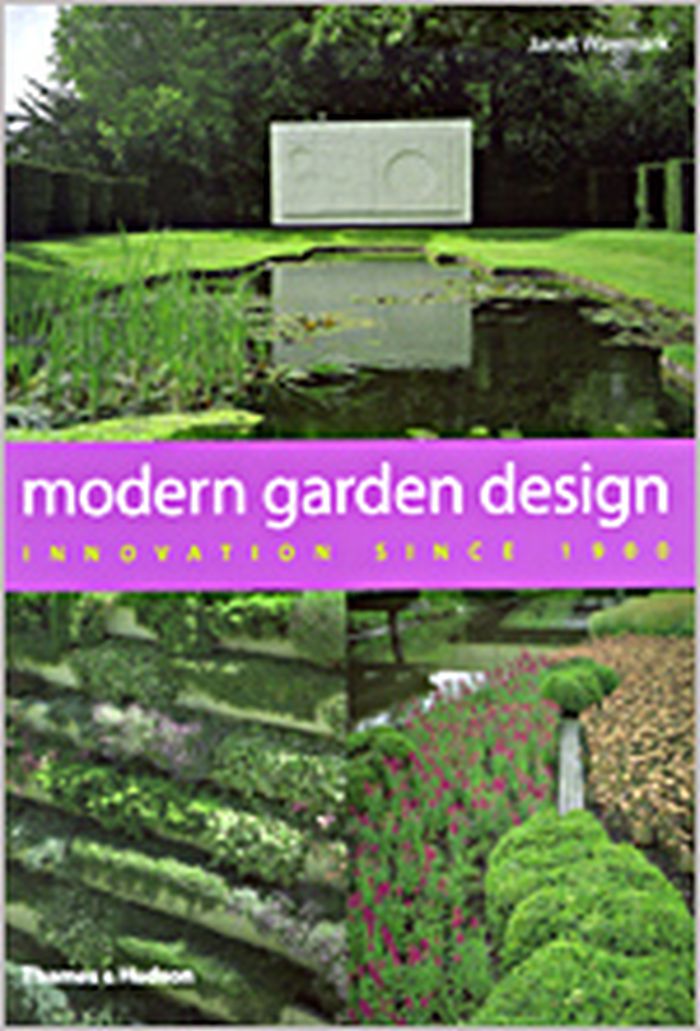
Garden design in the twentieth century ranges from Victorian-era examples to the age of Land Art. This span results in an extraordinarily varied survey—from Europe to South America, from Japan to the United States—including work by garden and landscape designers whose names are familiar to both lovers and scholars of the modern garden: Robinson, Jekyll, Jensen, Farrand, Sessions, Mawson, Church, Sørensen, and Jellicoe. Janet Waymark traces the revolutionary changes brought about in the postwar period by the Harvard Rebels—Eckbo, Rose, and Kiley—and examines the impact of Noguchi, Burle Marx, Barragán, and others, as well as the powerful international influence of Scandinavian landscape architects and designers. The garden city is also given close attention, from its beginnings in late Victorian Britain, through the Greenbelt Towns in the American Midwest, to the latest regeneration of urban centers worldwide. A long line of artists and architects of international renown have earned a place in the history of the modern garden: Monet, Le Corbusier, Mondrian, Wright, Mies van der Rohe, and Gaudí, among others. Land artists, such as Michael Heizer, Robert Smithson, Patricia Johanson, and Kathryn Gustafson in America and Richard Long, Andy Goldsworthy, and Ian Hamilton Finlay in the UK, have brought new ways of thinking about landscape and the garden into the twenty-first century.
Modern garden design : innovation since 1900
Actions:
Prix:
$60.00
(disponible sur commande)
Résumé:
Garden design in the twentieth century ranges from Victorian-era examples to the age of Land Art. This span results in an extraordinarily varied survey—from Europe to South America, from Japan to the United States—including work by garden and landscape designers whose names are familiar to both lovers and scholars of the modern garden: Robinson, Jekyll, Jensen, Farrand, Sessions, Mawson, Church, Sørensen, and Jellicoe. Janet Waymark traces the revolutionary changes brought about in the postwar period by the Harvard Rebels—Eckbo, Rose, and Kiley—and examines the impact of Noguchi, Burle Marx, Barragán, and others, as well as the powerful international influence of Scandinavian landscape architects and designers. The garden city is also given close attention, from its beginnings in late Victorian Britain, through the Greenbelt Towns in the American Midwest, to the latest regeneration of urban centers worldwide. A long line of artists and architects of international renown have earned a place in the history of the modern garden: Monet, Le Corbusier, Mondrian, Wright, Mies van der Rohe, and Gaudí, among others. Land artists, such as Michael Heizer, Robert Smithson, Patricia Johanson, and Kathryn Gustafson in America and Richard Long, Andy Goldsworthy, and Ian Hamilton Finlay in the UK, have brought new ways of thinking about landscape and the garden into the twenty-first century.
Classification:
livres
livres
Publication:
mai 2003, New York
mai 2003, New York
Sujet:
Jardins
Jardins
Classification:
livres
livres
Titre:
Mining photography
Mining photography
Actions:
Prix:
$63.00
(disponible sur commande)
Résumé:
Photography has always depended on the extraction and exploitation of so-called natural raw materials. Having started out using copper, coal, silver, and paper—the raw materials of analogue image production in the nineteenth and twentieth centuries—photography now relies, in the age of the smartphone, on rare earths and metals like coltan, cobalt, and europium. The(...)
$63.00
(disponible sur commande)
Résumé:
Photography has always depended on the extraction and exploitation of so-called natural raw materials. Having started out using copper, coal, silver, and paper—the raw materials of analogue image production in the nineteenth and twentieth centuries—photography now relies, in the age of the smartphone, on rare earths and metals like coltan, cobalt, and europium. The(...)
Publication:
mars 2023
mars 2023
Titre:
Mining photography
Actions:
Prix:
$63.00
(disponible sur commande)
Résumé:
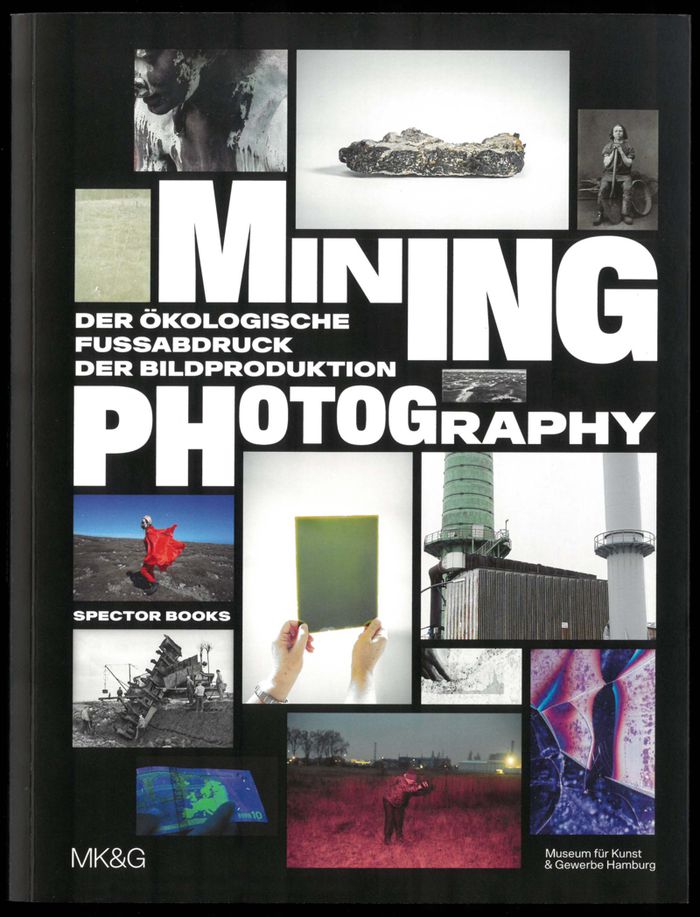
Photography has always depended on the extraction and exploitation of so-called natural raw materials. Having started out using copper, coal, silver, and paper—the raw materials of analogue image production in the nineteenth and twentieth centuries—photography now relies, in the age of the smartphone, on rare earths and metals like coltan, cobalt, and europium. The exhibition focuses on the history of key raw materials utilized in photography and establishes a connection between the history of their extraction, their disposal, and climate change. Looking at historical and contemporary works, it tells the story of photography as a history of industrial production and demonstrates that the medium is deeply implicated in human-induced changes to nature. The exhibition shows contemporary works by a range of photographers and artists, including Ignacio Acosta, Lisa Barnard, F Cartier, Susanne Kriemann, Mary Mattingly, Daphné Nan Le Sergent, Lisa Rave, Alison Rossiter, Metabolic Studio’s Optics Division, Robert Smithson, Simon Starling, Anaïs Tondeur, James Welling, Noa Yafe and Tobias Zielony, along with historical works by Eduard Christian Arning, Hermann Biow, Oscar and Theodor Hofmeister, Jürgen Friedrich Mahrt, Hermann Reichling, and others, and historical material from the Agfa Foto-Historama in Leverkusen, the Eastman Kodak Archive in Rochester and the FOMU Photo Museum in Antwerp as well as mineral samples collected by Alexander von Humboldt from the collection of the Museum für Naturkunde, Berlin.
Mining photography
Actions:
Prix:
$63.00
(disponible sur commande)
Résumé:
Photography has always depended on the extraction and exploitation of so-called natural raw materials. Having started out using copper, coal, silver, and paper—the raw materials of analogue image production in the nineteenth and twentieth centuries—photography now relies, in the age of the smartphone, on rare earths and metals like coltan, cobalt, and europium. The exhibition focuses on the history of key raw materials utilized in photography and establishes a connection between the history of their extraction, their disposal, and climate change. Looking at historical and contemporary works, it tells the story of photography as a history of industrial production and demonstrates that the medium is deeply implicated in human-induced changes to nature. The exhibition shows contemporary works by a range of photographers and artists, including Ignacio Acosta, Lisa Barnard, F Cartier, Susanne Kriemann, Mary Mattingly, Daphné Nan Le Sergent, Lisa Rave, Alison Rossiter, Metabolic Studio’s Optics Division, Robert Smithson, Simon Starling, Anaïs Tondeur, James Welling, Noa Yafe and Tobias Zielony, along with historical works by Eduard Christian Arning, Hermann Biow, Oscar and Theodor Hofmeister, Jürgen Friedrich Mahrt, Hermann Reichling, and others, and historical material from the Agfa Foto-Historama in Leverkusen, the Eastman Kodak Archive in Rochester and the FOMU Photo Museum in Antwerp as well as mineral samples collected by Alexander von Humboldt from the collection of the Museum für Naturkunde, Berlin.
Classification:
livres
livres
Publication:
mars 2023
mars 2023
Classification:
livres
livres

Titre:
The ethics of earth art
The ethics of earth art
Actions:
Prix:
$27.95
(disponible sur commande)
Résumé:
Since its inception in the 1960s, the earth art movement has sought to make visible the elusive presence of nature. Though most often associated with monumental land-based sculptures, earth art encompasses a wide range of media, from sculpture, body art performances, and installations to photographic interventions, public protest art, and community projects. In this(...)
$27.95
(disponible sur commande)
Résumé:
Since its inception in the 1960s, the earth art movement has sought to make visible the elusive presence of nature. Though most often associated with monumental land-based sculptures, earth art encompasses a wide range of media, from sculpture, body art performances, and installations to photographic interventions, public protest art, and community projects. In this(...)
Titre:
The ethics of earth art
Actions:
Prix:
$27.95
(disponible sur commande)
Résumé:
Since its inception in the 1960s, the earth art movement has sought to make visible the elusive presence of nature. Though most often associated with monumental land-based sculptures, earth art encompasses a wide range of media, from sculpture, body art performances, and installations to photographic interventions, public protest art, and community projects. In this book, Amanda Boetzkes analyzes the development of the earth art movement, arguing that such diverse artists as Robert Smithson, Ana Mendieta, James Turrell, Jackie Brookner, Olafur Eliasson, Basia Irland, and Ichi Ikeda are connected through their elucidation of the earth as a domain of ethical concern. Boetzkes contends that in basing their works’ relationship to the natural world on receptivity rather than representation, earth artists take an ethical stance that counters both the instrumental view that seeks to master nature and the Romantic view that posits a return to a mythical state of unencumbered continuity with nature. By incorporating receptive surfaces into their work—film footage of glaring sunlight, an aperture in a chamber that opens to the sky, or a porous armature on which vegetation grows—earth artists articulate the dilemma of representation that nature presents. Revealing the fundamental difference between the human world and the earth, Boetzkes shows that earth art mediates the sensations of nature while allowing nature itself to remain irreducible to human signification.
The ethics of earth art
Actions:
Prix:
$27.95
(disponible sur commande)
Résumé:
Since its inception in the 1960s, the earth art movement has sought to make visible the elusive presence of nature. Though most often associated with monumental land-based sculptures, earth art encompasses a wide range of media, from sculpture, body art performances, and installations to photographic interventions, public protest art, and community projects. In this book, Amanda Boetzkes analyzes the development of the earth art movement, arguing that such diverse artists as Robert Smithson, Ana Mendieta, James Turrell, Jackie Brookner, Olafur Eliasson, Basia Irland, and Ichi Ikeda are connected through their elucidation of the earth as a domain of ethical concern. Boetzkes contends that in basing their works’ relationship to the natural world on receptivity rather than representation, earth artists take an ethical stance that counters both the instrumental view that seeks to master nature and the Romantic view that posits a return to a mythical state of unencumbered continuity with nature. By incorporating receptive surfaces into their work—film footage of glaring sunlight, an aperture in a chamber that opens to the sky, or a porous armature on which vegetation grows—earth artists articulate the dilemma of representation that nature presents. Revealing the fundamental difference between the human world and the earth, Boetzkes shows that earth art mediates the sensations of nature while allowing nature itself to remain irreducible to human signification.
Classification:
livres
livres
Publication:
juillet 2010
juillet 2010
Sujet:
Land Art
Land Art
Classification:
livres
livres
Titre:
Jeff Wall: the crooked path
Jeff Wall: the crooked path
Actions:
Prix:
$55.00
(disponible sur commande)
Résumé:
The photography of Jeff Wall (born 1946) is consciously and profoundly saturated in the social: in the Vancouver art community from which he first emerged, fully formed, in the late 1970s; in the racial and gender politics of our times, which he analyses with marvelous clarity in his huge photographic light boxes that declare an equal status with painting through their(...)
$55.00
(disponible sur commande)
Résumé:
The photography of Jeff Wall (born 1946) is consciously and profoundly saturated in the social: in the Vancouver art community from which he first emerged, fully formed, in the late 1970s; in the racial and gender politics of our times, which he analyses with marvelous clarity in his huge photographic light boxes that declare an equal status with painting through their(...)
Titre:
Jeff Wall: the crooked path
Actions:
Prix:
$55.00
(disponible sur commande)
Résumé:
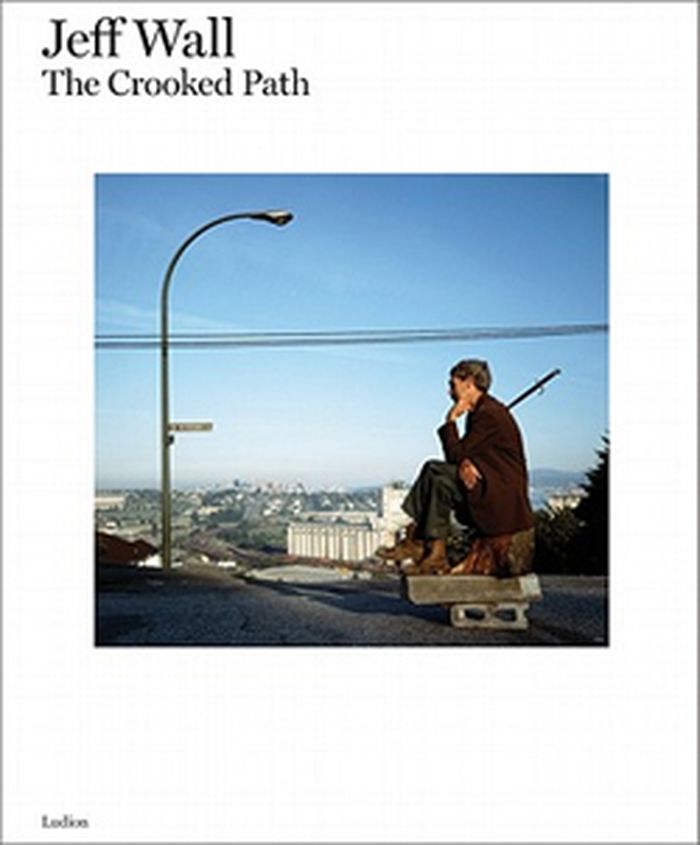
The photography of Jeff Wall (born 1946) is consciously and profoundly saturated in the social: in the Vancouver art community from which he first emerged, fully formed, in the late 1970s; in the racial and gender politics of our times, which he analyses with marvelous clarity in his huge photographic light boxes that declare an equal status with painting through their scale and their carefully plotted depth and grandeur; in the art history pantheon that informs his staged compositions, from Hokusai to Velásquez and Manet; and in his influence on at least two generations of photographers, most notably the Düsseldorf school (Andreas Gursky once cited Wall as “a great model for me” ). This publication examines the cultural context for Wall's tremendous achievement in photography. Wall himself has chosen 25 of his own photographs, taken between the late 1970s and the present, and has constellated them among the visionary company his work keeps, alongside reproductions of works by Marcel Duchamp, Diane Arbus, Eugene Atget, Wols, Andreas Gursky, David Claerbout, Thomas Struth, Frank Stella, Robert Smithson, Rodney Graham, Ian Wallace, Lawrence Wiener and R.W. Fassbinder. This book orients Wall's photography across ten themed chapters, each of which is prefaced with an interview with Wall by Hans De Wolf. Also included are testimonies and essays by fellow artists and art historians, such as Luc Tuymans, Lawrence Weiner, Michael Fried and David Campany.
Jeff Wall: the crooked path
Actions:
Prix:
$55.00
(disponible sur commande)
Résumé:
The photography of Jeff Wall (born 1946) is consciously and profoundly saturated in the social: in the Vancouver art community from which he first emerged, fully formed, in the late 1970s; in the racial and gender politics of our times, which he analyses with marvelous clarity in his huge photographic light boxes that declare an equal status with painting through their scale and their carefully plotted depth and grandeur; in the art history pantheon that informs his staged compositions, from Hokusai to Velásquez and Manet; and in his influence on at least two generations of photographers, most notably the Düsseldorf school (Andreas Gursky once cited Wall as “a great model for me” ). This publication examines the cultural context for Wall's tremendous achievement in photography. Wall himself has chosen 25 of his own photographs, taken between the late 1970s and the present, and has constellated them among the visionary company his work keeps, alongside reproductions of works by Marcel Duchamp, Diane Arbus, Eugene Atget, Wols, Andreas Gursky, David Claerbout, Thomas Struth, Frank Stella, Robert Smithson, Rodney Graham, Ian Wallace, Lawrence Wiener and R.W. Fassbinder. This book orients Wall's photography across ten themed chapters, each of which is prefaced with an interview with Wall by Hans De Wolf. Also included are testimonies and essays by fellow artists and art historians, such as Luc Tuymans, Lawrence Weiner, Michael Fried and David Campany.
Classification:
livres
livres
Publication:
septembre 2011
septembre 2011
Sujet:
Monographies photo
Monographies photo
Classification:
livres
livres
Titre:
John Divola : three acts
John Divola : three acts
Actions:
Prix:
$60.00
(disponible sur commande)
Résumé:
In 1973, artist John Divola began the first of three highly ambitious and original bodies of work that together form this publication. The Vandalism series comprises black-and-white photographs of interiors of abandoned houses. Entering illegally, Divola spray painted expressive markings in the forms of dots, lines, and grids, creating a series of conceptual gestures that(...)
$60.00
(disponible sur commande)
Résumé:
In 1973, artist John Divola began the first of three highly ambitious and original bodies of work that together form this publication. The Vandalism series comprises black-and-white photographs of interiors of abandoned houses. Entering illegally, Divola spray painted expressive markings in the forms of dots, lines, and grids, creating a series of conceptual gestures that(...)
Titre:
John Divola : three acts
Actions:
Prix:
$60.00
(disponible sur commande)
Résumé:
In 1973, artist John Divola began the first of three highly ambitious and original bodies of work that together form this publication. The Vandalism series comprises black-and-white photographs of interiors of abandoned houses. Entering illegally, Divola spray painted expressive markings in the forms of dots, lines, and grids, creating a series of conceptual gestures that referenced “action painting” as readily as the graffiti that was fast becoming a cultural phenomenon. The following year, Divola began the Los Angeles International Airport Noise Abatement series, photographing a condemned neighborhood bought out by the airport to serve as a noise buffer for new runways.An extensive catalog of break-ins, the photographs record the evidence of violent entries: shattered windows, doors torn from hinges, a crowbar resting in the jamb of a door pried open. The final installment in this book, the Zuma series, is the artist’s documentation of the destruction of an abandoned beachfront property. While employing similar strategies of painting and intervention, the Zuma images add variation and complexity to Divola’s established themes as they incorporate color, elements of nature, and meditation on change. These cyclical images skillfully juxtapose romantic skies and sunsets with a seaside structure that, frame by frame, deteriorates into ruin as it is vandalized by the artist and others who eventually set it on fire. Divola’s art practice shares a tradition with conceptual artists such as Bruce Nauman, whose photographs are considered to be performance or sculpture, and Robert Smithson, who used photography to investigate the built environment.
John Divola : three acts
Actions:
Prix:
$60.00
(disponible sur commande)
Résumé:
In 1973, artist John Divola began the first of three highly ambitious and original bodies of work that together form this publication. The Vandalism series comprises black-and-white photographs of interiors of abandoned houses. Entering illegally, Divola spray painted expressive markings in the forms of dots, lines, and grids, creating a series of conceptual gestures that referenced “action painting” as readily as the graffiti that was fast becoming a cultural phenomenon. The following year, Divola began the Los Angeles International Airport Noise Abatement series, photographing a condemned neighborhood bought out by the airport to serve as a noise buffer for new runways.An extensive catalog of break-ins, the photographs record the evidence of violent entries: shattered windows, doors torn from hinges, a crowbar resting in the jamb of a door pried open. The final installment in this book, the Zuma series, is the artist’s documentation of the destruction of an abandoned beachfront property. While employing similar strategies of painting and intervention, the Zuma images add variation and complexity to Divola’s established themes as they incorporate color, elements of nature, and meditation on change. These cyclical images skillfully juxtapose romantic skies and sunsets with a seaside structure that, frame by frame, deteriorates into ruin as it is vandalized by the artist and others who eventually set it on fire. Divola’s art practice shares a tradition with conceptual artists such as Bruce Nauman, whose photographs are considered to be performance or sculpture, and Robert Smithson, who used photography to investigate the built environment.
Classification:
livres
livres
Publication:
mai 2006, New York
mai 2006, New York
Sujet:
Monographies photo
Monographies photo
Classification:
livres
livres
Prix:
$43.95
(disponible sur commande)
Résumé:
Pioneering conceptual artist Vito Acconci began his career as a poet. In the 1960s, before beginning his work in performance and video art, Acconci studied at the Iowa Writers Workshop and published poems in journals and chapbooks. Almost all of this work remains unknown; much of it appeared in the self-produced magazines of the Lower East Side's mimeo revolution, and(...)
$43.95
(disponible sur commande)
Résumé:
Pioneering conceptual artist Vito Acconci began his career as a poet. In the 1960s, before beginning his work in performance and video art, Acconci studied at the Iowa Writers Workshop and published poems in journals and chapbooks. Almost all of this work remains unknown; much of it appeared in the self-produced magazines of the Lower East Side's mimeo revolution, and(...)
Publication:
mars 2006, Cambridge, Mass.
mars 2006, Cambridge, Mass.
Titre:
Languages to cover a page : the early writings of Vito Acconci
Actions:
Prix:
$43.95
(disponible sur commande)
Résumé:
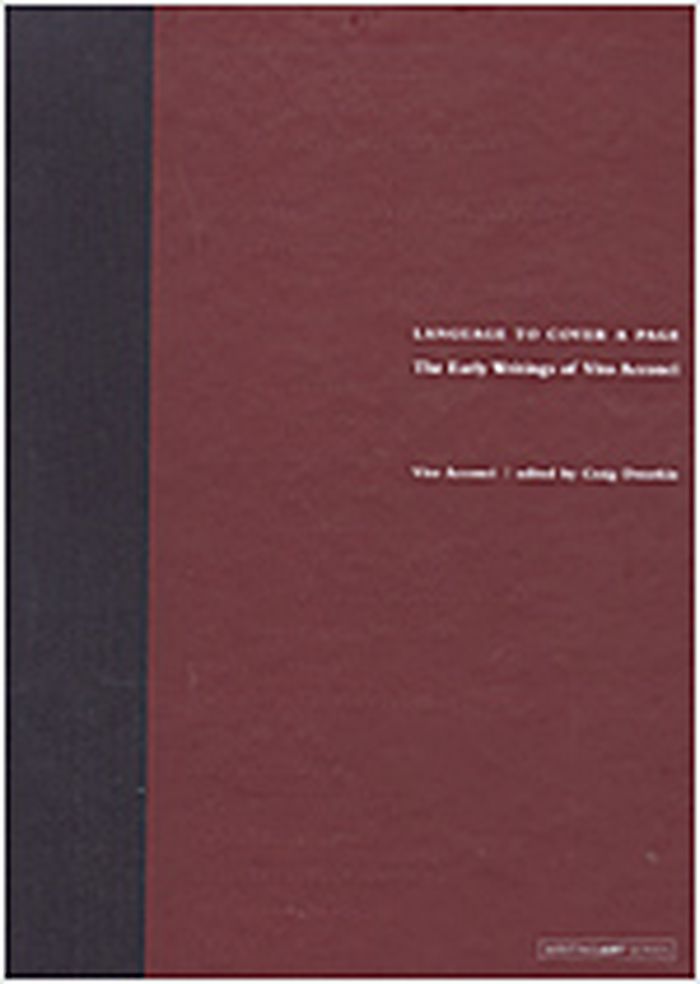
Pioneering conceptual artist Vito Acconci began his career as a poet. In the 1960s, before beginning his work in performance and video art, Acconci studied at the Iowa Writers Workshop and published poems in journals and chapbooks. Almost all of this work remains unknown; much of it appeared in the self-produced magazines of the Lower East Side's mimeo revolution, and many other pieces were never published. Language to Cover a Page collects these writings for the first time and not only shows Acconci to be an important experimental writer of the period, but demonstrates the continuity of his early writing with his later work in film, video, and performance. "Language to cover a page" documents a key moment in the unprecedented intersection of artists and poets in the late 1960s - as seen in the Dwan Gallery's series of "Language" shows (1967-1970) and in Acconci's own journal 0 to 9. Indeed, as Acconci moved from the poetry scene to the art world, his poetry became increasingly performative while his artwork was often structured and motivated by linguistic play. Acconci's early writing recalls the work of Samuel Beckett, the deadpan voice of the nouveau roman, and the jump cuts and fraught permutations of the nouvelle vague. Poems in "Language to cover a page" explore the materiality of language ("language as matter and not ideas," as Robert Smithson put it), the physical space of the page, and the physicality of source texts (phonebooks, thesauruses, dictionaries). Other poems take the space of the page as an analogue to performance space or implicate the poem in a network of activity (as in his "Dial-a-Poem" pieces).
Languages to cover a page : the early writings of Vito Acconci
Actions:
Prix:
$43.95
(disponible sur commande)
Résumé:
Pioneering conceptual artist Vito Acconci began his career as a poet. In the 1960s, before beginning his work in performance and video art, Acconci studied at the Iowa Writers Workshop and published poems in journals and chapbooks. Almost all of this work remains unknown; much of it appeared in the self-produced magazines of the Lower East Side's mimeo revolution, and many other pieces were never published. Language to Cover a Page collects these writings for the first time and not only shows Acconci to be an important experimental writer of the period, but demonstrates the continuity of his early writing with his later work in film, video, and performance. "Language to cover a page" documents a key moment in the unprecedented intersection of artists and poets in the late 1960s - as seen in the Dwan Gallery's series of "Language" shows (1967-1970) and in Acconci's own journal 0 to 9. Indeed, as Acconci moved from the poetry scene to the art world, his poetry became increasingly performative while his artwork was often structured and motivated by linguistic play. Acconci's early writing recalls the work of Samuel Beckett, the deadpan voice of the nouveau roman, and the jump cuts and fraught permutations of the nouvelle vague. Poems in "Language to cover a page" explore the materiality of language ("language as matter and not ideas," as Robert Smithson put it), the physical space of the page, and the physicality of source texts (phonebooks, thesauruses, dictionaries). Other poems take the space of the page as an analogue to performance space or implicate the poem in a network of activity (as in his "Dial-a-Poem" pieces).
Classification:
livres
livres
Publication:
mars 2006, Cambridge, Mass.
mars 2006, Cambridge, Mass.
Classification:
livres
livres
Actions:
Prix:
$90.00
(disponible sur commande)
Résumé:
Gordon Matta-Clark, scion and rebel, died at 35 in 1978 and has since become a cult figure of late-twentieth-century art. Born in New York and trained in architecture at Cornell, he went on to question the field's conventions in vivid projects that excised holes into existing buildings or assembled deeds to New York City alleys and curbs. As the son of the Chilean-born(...)
$90.00
(disponible sur commande)
Résumé:
Gordon Matta-Clark, scion and rebel, died at 35 in 1978 and has since become a cult figure of late-twentieth-century art. Born in New York and trained in architecture at Cornell, he went on to question the field's conventions in vivid projects that excised holes into existing buildings or assembled deeds to New York City alleys and curbs. As the son of the Chilean-born(...)
Titre:
Gordon Matta-Clark: works and collected writings
Actions:
Prix:
$90.00
(disponible sur commande)
Résumé:
Gordon Matta-Clark, scion and rebel, died at 35 in 1978 and has since become a cult figure of late-twentieth-century art. Born in New York and trained in architecture at Cornell, he went on to question the field's conventions in vivid projects that excised holes into existing buildings or assembled deeds to New York City alleys and curbs. As the son of the Chilean-born Surrealist painter Roberto Matta and Anne Clark, and godson of Marcel Duchamp, with whom he played a regular game of chess in the Village, Matta-Clark had grown up inside the art world, also working an as assistant to mavericks like Dennis Oppenheim and Robert Smithson. His work and words, while sophisticated enough to make him an "artist's artist," and colossal and outgoing enough to draw public attention and affection, were always also grounded in social or political convictions. He addressed not only space and real estate (in other words, housing), but the ultimate in necessity and nourishment, food. His "Pig Roast" under the Brooklyn Bridge offered passersby 500 pork sandwiches, and Food, the artist-staffed restaurant that he opened with dancer Caroline Goodden in SoHo, became a headquarters for that nascent neighborhood in the early 70s. He consistently broke the boundaries between sculpture and architecture, photography and film, performance and installation, and above all the permanent and the transitory. Once in a while he also broke the law. This book, published in celebration of the gradual opening of Matta-Clark's archives at the Canadian Centre for Architecture in Montreal, collects previously unavailable writings, including notecards and notebooks, along with interviews and more than 100 illustrations.
Gordon Matta-Clark: works and collected writings
Actions:
Prix:
$90.00
(disponible sur commande)
Résumé:
Gordon Matta-Clark, scion and rebel, died at 35 in 1978 and has since become a cult figure of late-twentieth-century art. Born in New York and trained in architecture at Cornell, he went on to question the field's conventions in vivid projects that excised holes into existing buildings or assembled deeds to New York City alleys and curbs. As the son of the Chilean-born Surrealist painter Roberto Matta and Anne Clark, and godson of Marcel Duchamp, with whom he played a regular game of chess in the Village, Matta-Clark had grown up inside the art world, also working an as assistant to mavericks like Dennis Oppenheim and Robert Smithson. His work and words, while sophisticated enough to make him an "artist's artist," and colossal and outgoing enough to draw public attention and affection, were always also grounded in social or political convictions. He addressed not only space and real estate (in other words, housing), but the ultimate in necessity and nourishment, food. His "Pig Roast" under the Brooklyn Bridge offered passersby 500 pork sandwiches, and Food, the artist-staffed restaurant that he opened with dancer Caroline Goodden in SoHo, became a headquarters for that nascent neighborhood in the early 70s. He consistently broke the boundaries between sculpture and architecture, photography and film, performance and installation, and above all the permanent and the transitory. Once in a while he also broke the law. This book, published in celebration of the gradual opening of Matta-Clark's archives at the Canadian Centre for Architecture in Montreal, collects previously unavailable writings, including notecards and notebooks, along with interviews and more than 100 illustrations.
Classification:
livres
livres
Publication:
octobre 2006
octobre 2006
Classification:
livres
livres
Titre:
Prosthetic gods
Prosthetic gods
Actions:
Prix:
$24.95
(disponible sur commande)
Résumé:
How to imagine not only a new art or architecture but a new self or subject equal to them? In "Prosthetic gods", Hal Foster explores this question through the works and writings of such key modernists as Gauguin and Picasso, F. T. Marinetti and Wyndham Lewis, Adolf Loos and Max Ernst. These diverse figures were all fascinated by fictions of origin, either primordial and(...)
$24.95
(disponible sur commande)
Résumé:
How to imagine not only a new art or architecture but a new self or subject equal to them? In "Prosthetic gods", Hal Foster explores this question through the works and writings of such key modernists as Gauguin and Picasso, F. T. Marinetti and Wyndham Lewis, Adolf Loos and Max Ernst. These diverse figures were all fascinated by fictions of origin, either primordial and(...)
Titre:
Prosthetic gods
Actions:
Prix:
$24.95
(disponible sur commande)
Résumé:
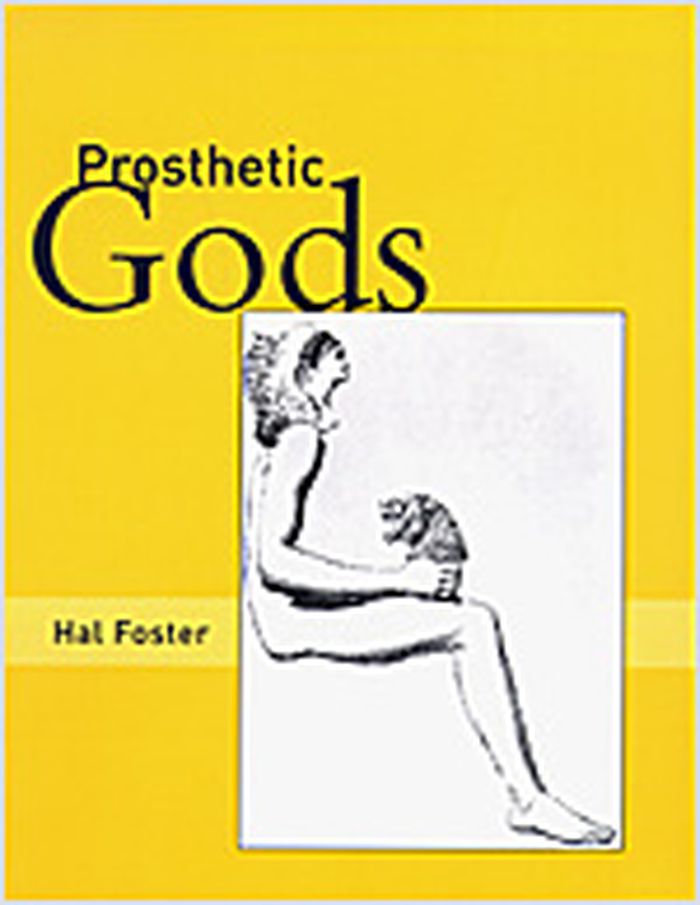
How to imagine not only a new art or architecture but a new self or subject equal to them? In "Prosthetic gods", Hal Foster explores this question through the works and writings of such key modernists as Gauguin and Picasso, F. T. Marinetti and Wyndham Lewis, Adolf Loos and Max Ernst. These diverse figures were all fascinated by fictions of origin, either primordial and tribal or futuristic and technological. In this way, Foster argues, two forms came to dominate modernist art above all others: the primitive and the machine. Foster begins with the primitivist fantasies of Gauguin and Picasso, which he examines through the Freudian lens of the primal scene. He then turns to the purist obsessions of the Viennese architect Loos, who abhorred all things primitive. Next Foster considers the technophilic subjects propounded by the futurist Marinetti and the vorticist Lewis. These "new egos" are further contrasted with the "bachelor machines" proposed by the dadaist Ernst. Foster also explores extrapolations from the art of the mentally ill in the aesthetic models of Ernst, Paul Klee, and Jean Dubuffet, as well as manipulations of the female body in the surrealist photography of Brassai, Man Ray, and Hans Bellmer. Finally, he examines the impulse to dissolve the conventions of art altogether in the drip paintings of Jackson Pollock, the scatter pieces of Robert Morris, and the earthworks of Robert Smithson, and traces the evocation of lost objects of desire in sculptural work from Marcel Duchamp and Alberto Giacometti to Robert Gober. Although its title is drawn from Freud, "Prosthetic gods" does not impose psychoanalytic theory on modernist art; rather, it sets the two into critical relation and scans the greater historical field that they share.
Prosthetic gods
Actions:
Prix:
$24.95
(disponible sur commande)
Résumé:
How to imagine not only a new art or architecture but a new self or subject equal to them? In "Prosthetic gods", Hal Foster explores this question through the works and writings of such key modernists as Gauguin and Picasso, F. T. Marinetti and Wyndham Lewis, Adolf Loos and Max Ernst. These diverse figures were all fascinated by fictions of origin, either primordial and tribal or futuristic and technological. In this way, Foster argues, two forms came to dominate modernist art above all others: the primitive and the machine. Foster begins with the primitivist fantasies of Gauguin and Picasso, which he examines through the Freudian lens of the primal scene. He then turns to the purist obsessions of the Viennese architect Loos, who abhorred all things primitive. Next Foster considers the technophilic subjects propounded by the futurist Marinetti and the vorticist Lewis. These "new egos" are further contrasted with the "bachelor machines" proposed by the dadaist Ernst. Foster also explores extrapolations from the art of the mentally ill in the aesthetic models of Ernst, Paul Klee, and Jean Dubuffet, as well as manipulations of the female body in the surrealist photography of Brassai, Man Ray, and Hans Bellmer. Finally, he examines the impulse to dissolve the conventions of art altogether in the drip paintings of Jackson Pollock, the scatter pieces of Robert Morris, and the earthworks of Robert Smithson, and traces the evocation of lost objects of desire in sculptural work from Marcel Duchamp and Alberto Giacometti to Robert Gober. Although its title is drawn from Freud, "Prosthetic gods" does not impose psychoanalytic theory on modernist art; rather, it sets the two into critical relation and scans the greater historical field that they share.
Classification:
livres
livres
Publication:
avril 2006, Cambridge (MA), London
avril 2006, Cambridge (MA), London
Sujet:
Théorie de l’architecture
Théorie de l’architecture


