


1294 Résultats
Classification:
archives
Niveau de description archivistique:
Fonds
archives
Niveau de description archivistique:
Fonds
Numéro de référence:
AP226
Résumé:
The Toyo Ito & Associates, Architects fonds, 1970 – 2011, documents the studio’s architectural work and involvement in selected exhibitions in the 1970s and 1980s. The records in this fonds represent 34 architectural projects, including built, unbuilt, and conceptual projects. The majority of the projects are located in Japan and are mostly documented through drawings as well as a limited number of videos, models, panels, textual records, and photographs. The fonds also contains records related to Toyo Ito & Associates, Architects’ participation in three exhibitions in the USA and the UK in 1978 and 1986.
AP226
Résumé:
The Toyo Ito & Associates, Architects fonds, 1970 – 2011, documents the studio’s architectural work and involvement in selected exhibitions in the 1970s and 1980s. The records in this fonds represent 34 architectural projects, including built, unbuilt, and conceptual projects. The majority of the projects are located in Japan and are mostly documented through drawings as well as a limited number of videos, models, panels, textual records, and photographs. The fonds also contains records related to Toyo Ito & Associates, Architects’ participation in three exhibitions in the USA and the UK in 1978 and 1986.
Personnes et institutions:
Date:
1970 - 2011
1970 - 2011
Titre:
Toyo Ito & Associates, Architects fonds
Actions:
AP226
Résumé:
The Toyo Ito & Associates, Architects fonds, 1970 – 2011, documents the studio’s architectural work and involvement in selected exhibitions in the 1970s and 1980s. The records in this fonds represent 34 architectural projects, including built, unbuilt, and conceptual projects. The majority of the projects are located in Japan and are mostly documented through drawings as well as a limited number of videos, models, panels, textual records, and photographs. The fonds also contains records related to Toyo Ito & Associates, Architects’ participation in three exhibitions in the USA and the UK in 1978 and 1986.
Toyo Ito & Associates, Architects fonds
Actions:
AP226
Résumé:
The Toyo Ito & Associates, Architects fonds, 1970 – 2011, documents the studio’s architectural work and involvement in selected exhibitions in the 1970s and 1980s. The records in this fonds represent 34 architectural projects, including built, unbuilt, and conceptual projects. The majority of the projects are located in Japan and are mostly documented through drawings as well as a limited number of videos, models, panels, textual records, and photographs. The fonds also contains records related to Toyo Ito & Associates, Architects’ participation in three exhibitions in the USA and the UK in 1978 and 1986.
Classification:
archives
Niveau de description archivistique:
Fonds
archives
Niveau de description archivistique:
Fonds
Date:
1970 - 2011
1970 - 2011
Personnes et institutions:
Classification:
documents textuels
documents textuels
Numéro de référence:
ARCH255581
Description:
20 publications including: Werner Sobek, The architecture of Peter and Mary Doyle 1970-1990; Representative projects of SOM March 1975; Nuove possibilita per le construzioni navali in cemento armato / Ing P.L. Nervi; Rassegna critica di architettura / Nervi 1954; World Trade CEnter: new headquarters for international business; Architecture Aug. 1962; Engineering News Record 10 Feb. 1972; The effect of steel and glass upon architectural design 1952; Dome structures, reprinted from Consulting Engineer Dec. 1959; Nuova Sede Pirelli in Milano; Technique and aesthetics in the design of tall buildings / Fazler Khan memorial session; L'architettura Aug. 1961; House Beautiful: your heritage from Frank Lloyd Wright Oct. 1959; Architectural Forum May 1958 and April 1965; Progressive Architecture Jan 1979; Kenchiku Bunka Oct. 1965; L'architettura Jan-Feb. 1956
ARCH255581
Description:
20 publications including: Werner Sobek, The architecture of Peter and Mary Doyle 1970-1990; Representative projects of SOM March 1975; Nuove possibilita per le construzioni navali in cemento armato / Ing P.L. Nervi; Rassegna critica di architettura / Nervi 1954; World Trade CEnter: new headquarters for international business; Architecture Aug. 1962; Engineering News Record 10 Feb. 1972; The effect of steel and glass upon architectural design 1952; Dome structures, reprinted from Consulting Engineer Dec. 1959; Nuova Sede Pirelli in Milano; Technique and aesthetics in the design of tall buildings / Fazler Khan memorial session; L'architettura Aug. 1961; House Beautiful: your heritage from Frank Lloyd Wright Oct. 1959; Architectural Forum May 1958 and April 1965; Progressive Architecture Jan 1979; Kenchiku Bunka Oct. 1965; L'architettura Jan-Feb. 1956
Personnes et institutions:
Date:
1954-1979
1954-1979
Titre:
Misc. publications and magazines of architecture
Actions:
ARCH255581
Description:
20 publications including: Werner Sobek, The architecture of Peter and Mary Doyle 1970-1990; Representative projects of SOM March 1975; Nuove possibilita per le construzioni navali in cemento armato / Ing P.L. Nervi; Rassegna critica di architettura / Nervi 1954; World Trade CEnter: new headquarters for international business; Architecture Aug. 1962; Engineering News Record 10 Feb. 1972; The effect of steel and glass upon architectural design 1952; Dome structures, reprinted from Consulting Engineer Dec. 1959; Nuova Sede Pirelli in Milano; Technique and aesthetics in the design of tall buildings / Fazler Khan memorial session; L'architettura Aug. 1961; House Beautiful: your heritage from Frank Lloyd Wright Oct. 1959; Architectural Forum May 1958 and April 1965; Progressive Architecture Jan 1979; Kenchiku Bunka Oct. 1965; L'architettura Jan-Feb. 1956
Misc. publications and magazines of architecture
Actions:
ARCH255581
Description:
20 publications including: Werner Sobek, The architecture of Peter and Mary Doyle 1970-1990; Representative projects of SOM March 1975; Nuove possibilita per le construzioni navali in cemento armato / Ing P.L. Nervi; Rassegna critica di architettura / Nervi 1954; World Trade CEnter: new headquarters for international business; Architecture Aug. 1962; Engineering News Record 10 Feb. 1972; The effect of steel and glass upon architectural design 1952; Dome structures, reprinted from Consulting Engineer Dec. 1959; Nuova Sede Pirelli in Milano; Technique and aesthetics in the design of tall buildings / Fazler Khan memorial session; L'architettura Aug. 1961; House Beautiful: your heritage from Frank Lloyd Wright Oct. 1959; Architectural Forum May 1958 and April 1965; Progressive Architecture Jan 1979; Kenchiku Bunka Oct. 1965; L'architettura Jan-Feb. 1956
Classification:
documents textuels
documents textuels
Date:
1954-1979
1954-1979
Personnes et institutions:
Classification:
documents textuels
documents textuels
Numéro de référence:
ARCH174239
Description:
Groupe comprend des esquisses, de la correspondance avec la Société du Vieux-Port de Montréal (S.V.P.M.), marché de services entre S.V.P.M. et Luc Laporte, architecte (12 nov. 1991 & 1er mars 1992), des documents de facturation à la S.V.P.M. & mesures de paiement, une résiliation du Marché de service (4 décembre 1991), des dessins et données techniques relatifs à la fabrication des lampadaires, de la correspondance avec l'agence de Cardinal & Hardy, des documents relatifs à la plate-forme du dôme, des exemples de mobiliers de parcs, dessins de précision du détail de parapet (20 nov. 1992) et estimation des coûts du travail d'architecture.
ARCH174239
Description:
Groupe comprend des esquisses, de la correspondance avec la Société du Vieux-Port de Montréal (S.V.P.M.), marché de services entre S.V.P.M. et Luc Laporte, architecte (12 nov. 1991 & 1er mars 1992), des documents de facturation à la S.V.P.M. & mesures de paiement, une résiliation du Marché de service (4 décembre 1991), des dessins et données techniques relatifs à la fabrication des lampadaires, de la correspondance avec l'agence de Cardinal & Hardy, des documents relatifs à la plate-forme du dôme, des exemples de mobiliers de parcs, dessins de précision du détail de parapet (20 nov. 1992) et estimation des coûts du travail d'architecture.
Personnes et institutions:
Date:
1991-1993
1991-1993
Titre:
Contrats, correspondance avec client et architectes, documents financiers, croquis et dessins pour les lampadaires, et documents de référence, Pavillon du Bassin Bonsecours, Montréal, Québec
Actions:
ARCH174239
Description:
Groupe comprend des esquisses, de la correspondance avec la Société du Vieux-Port de Montréal (S.V.P.M.), marché de services entre S.V.P.M. et Luc Laporte, architecte (12 nov. 1991 & 1er mars 1992), des documents de facturation à la S.V.P.M. & mesures de paiement, une résiliation du Marché de service (4 décembre 1991), des dessins et données techniques relatifs à la fabrication des lampadaires, de la correspondance avec l'agence de Cardinal & Hardy, des documents relatifs à la plate-forme du dôme, des exemples de mobiliers de parcs, dessins de précision du détail de parapet (20 nov. 1992) et estimation des coûts du travail d'architecture.
Contrats, correspondance avec client et architectes, documents financiers, croquis et dessins pour les lampadaires, et documents de référence, Pavillon du Bassin Bonsecours, Montréal, Québec
Actions:
ARCH174239
Description:
Groupe comprend des esquisses, de la correspondance avec la Société du Vieux-Port de Montréal (S.V.P.M.), marché de services entre S.V.P.M. et Luc Laporte, architecte (12 nov. 1991 & 1er mars 1992), des documents de facturation à la S.V.P.M. & mesures de paiement, une résiliation du Marché de service (4 décembre 1991), des dessins et données techniques relatifs à la fabrication des lampadaires, de la correspondance avec l'agence de Cardinal & Hardy, des documents relatifs à la plate-forme du dôme, des exemples de mobiliers de parcs, dessins de précision du détail de parapet (20 nov. 1992) et estimation des coûts du travail d'architecture.
Classification:
documents textuels
documents textuels
Date:
1991-1993
1991-1993
Personnes et institutions:
Classification:
oeuvres d'art
oeuvres d'art
Numéro de référence:
DR1988:0437:055
Description:
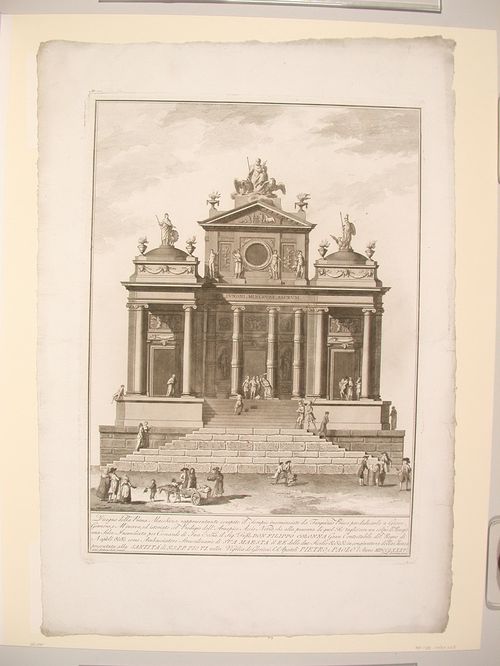
- This etching for a fireworks construction or macchina is in the form of a temple dedicated to Jove, Juno, and Minvera. The central bay of the temple is surmounted by an attic storey and a pediment, while the two side bays have projecting porticos and low domes. Statues of Juno, Jove, and Minverva crown each bay from left to right respectively.
DR1988:0437:055
Description:
- This etching for a fireworks construction or macchina is in the form of a temple dedicated to Jove, Juno, and Minvera. The central bay of the temple is surmounted by an attic storey and a pediment, while the two side bays have projecting porticos and low domes. Statues of Juno, Jove, and Minverva crown each bay from left to right respectively.
Personnes et institutions:
Sujet:
architecture temporaire
architecture temporaire
Date:
printed 1785
printed 1785
Titre:
Etching of Palazzi's design for the "prima macchina" of 1785
Actions:
DR1988:0437:055
Description:
- This etching for a fireworks construction or macchina is in the form of a temple dedicated to Jove, Juno, and Minvera. The central bay of the temple is surmounted by an attic storey and a pediment, while the two side bays have projecting porticos and low domes. Statues of Juno, Jove, and Minverva crown each bay from left to right respectively.
Etching of Palazzi's design for the "prima macchina" of 1785
Actions:
DR1988:0437:055
Description:
- This etching for a fireworks construction or macchina is in the form of a temple dedicated to Jove, Juno, and Minvera. The central bay of the temple is surmounted by an attic storey and a pediment, while the two side bays have projecting porticos and low domes. Statues of Juno, Jove, and Minverva crown each bay from left to right respectively.
Classification:
oeuvres d'art
oeuvres d'art
Date:
printed 1785
printed 1785
Personnes et institutions:
Sujet:
architecture temporaire
architecture temporaire
Classification:
dessins
dessins
Numéro de référence:
ARCH3131
Description:
Détails de la plate-forme pour les trois dômes de la salle des pas perdus, détail de l'appui de la fenêtre no 23 / Union Architectural Iron Works, Montréal et atelier non identifié.
ARCH3131
Description:
Détails de la plate-forme pour les trois dômes de la salle des pas perdus, détail de l'appui de la fenêtre no 23 / Union Architectural Iron Works, Montréal et atelier non identifié.
Personnes et institutions:
Date:
circa 1920
circa 1920
Titre:
Details de la salle des pas perdus et détails de fenêtres
Actions:
ARCH3131
Description:
Détails de la plate-forme pour les trois dômes de la salle des pas perdus, détail de l'appui de la fenêtre no 23 / Union Architectural Iron Works, Montréal et atelier non identifié.
Details de la salle des pas perdus et détails de fenêtres
Actions:
ARCH3131
Description:
Détails de la plate-forme pour les trois dômes de la salle des pas perdus, détail de l'appui de la fenêtre no 23 / Union Architectural Iron Works, Montréal et atelier non identifié.
Classification:
dessins
dessins
Date:
circa 1920
circa 1920
Personnes et institutions:
Actions:
Numéro de référence:
PH1979:0607
Description:
Album titled 'Vues de Paris prises au Daguerréotype. Daziaro 15 boulevart [sic] des Italiens'. The name Daziaro refers to the print merchant from Saint Petersburg, in Paris. The title page reads: 'Collection de vues de Paris prises au daguerréotype. Gravures en taille douce sur acier par Chamouin'. It shows 25 steel engravings for which daguerreotypes were used as references, of views of Paris (and one of Versailles). It is an example of an early use of photography to make iconographical illustrations. The monuments of Paris portrayed in this album are Place de la Concorde, Palais du Sénat, Hôtel de Ville, Fontaine de la Place Louvois, Château des Tuileries, Église St.-Germain l'Auxerrois, Palais royal, La Bourse, Pont Neuf, Arc de Triomphe, Église de la Madeleine, École militaire et Champ de Mars, Arc de Triomphe du Carrousel, Château de Versailles, Palais du Corps législatif et Ministère des Affaires Étrangères, Louvre, Église Notre-Dame, Fontaine Molière, Colonne de la Place Vendôme, Colonne de Juillet, Dôme des Invalides, Panthéon and Église Saint-Sulpice.
PH1979:0607
Description:
Album titled 'Vues de Paris prises au Daguerréotype. Daziaro 15 boulevart [sic] des Italiens'. The name Daziaro refers to the print merchant from Saint Petersburg, in Paris. The title page reads: 'Collection de vues de Paris prises au daguerréotype. Gravures en taille douce sur acier par Chamouin'. It shows 25 steel engravings for which daguerreotypes were used as references, of views of Paris (and one of Versailles). It is an example of an early use of photography to make iconographical illustrations. The monuments of Paris portrayed in this album are Place de la Concorde, Palais du Sénat, Hôtel de Ville, Fontaine de la Place Louvois, Château des Tuileries, Église St.-Germain l'Auxerrois, Palais royal, La Bourse, Pont Neuf, Arc de Triomphe, Église de la Madeleine, École militaire et Champ de Mars, Arc de Triomphe du Carrousel, Château de Versailles, Palais du Corps législatif et Ministère des Affaires Étrangères, Louvre, Église Notre-Dame, Fontaine Molière, Colonne de la Place Vendôme, Colonne de Juillet, Dôme des Invalides, Panthéon and Église Saint-Sulpice.
Personnes et institutions:
Sujet:
architecture
architecture
Date:
ca. 1855
ca. 1855
Titre:
Vues de Paris prises au Daguerréotype
Actions:
PH1979:0607
Description:
Album titled 'Vues de Paris prises au Daguerréotype. Daziaro 15 boulevart [sic] des Italiens'. The name Daziaro refers to the print merchant from Saint Petersburg, in Paris. The title page reads: 'Collection de vues de Paris prises au daguerréotype. Gravures en taille douce sur acier par Chamouin'. It shows 25 steel engravings for which daguerreotypes were used as references, of views of Paris (and one of Versailles). It is an example of an early use of photography to make iconographical illustrations. The monuments of Paris portrayed in this album are Place de la Concorde, Palais du Sénat, Hôtel de Ville, Fontaine de la Place Louvois, Château des Tuileries, Église St.-Germain l'Auxerrois, Palais royal, La Bourse, Pont Neuf, Arc de Triomphe, Église de la Madeleine, École militaire et Champ de Mars, Arc de Triomphe du Carrousel, Château de Versailles, Palais du Corps législatif et Ministère des Affaires Étrangères, Louvre, Église Notre-Dame, Fontaine Molière, Colonne de la Place Vendôme, Colonne de Juillet, Dôme des Invalides, Panthéon and Église Saint-Sulpice.
Vues de Paris prises au Daguerréotype
Actions:
PH1979:0607
Description:
Album titled 'Vues de Paris prises au Daguerréotype. Daziaro 15 boulevart [sic] des Italiens'. The name Daziaro refers to the print merchant from Saint Petersburg, in Paris. The title page reads: 'Collection de vues de Paris prises au daguerréotype. Gravures en taille douce sur acier par Chamouin'. It shows 25 steel engravings for which daguerreotypes were used as references, of views of Paris (and one of Versailles). It is an example of an early use of photography to make iconographical illustrations. The monuments of Paris portrayed in this album are Place de la Concorde, Palais du Sénat, Hôtel de Ville, Fontaine de la Place Louvois, Château des Tuileries, Église St.-Germain l'Auxerrois, Palais royal, La Bourse, Pont Neuf, Arc de Triomphe, Église de la Madeleine, École militaire et Champ de Mars, Arc de Triomphe du Carrousel, Château de Versailles, Palais du Corps législatif et Ministère des Affaires Étrangères, Louvre, Église Notre-Dame, Fontaine Molière, Colonne de la Place Vendôme, Colonne de Juillet, Dôme des Invalides, Panthéon and Église Saint-Sulpice.
Date:
ca. 1855
ca. 1855
Personnes et institutions:
Sujet:
architecture
architecture
Classification:
dessins
dessins
Actions:
Numéro de référence:
DR1962:0006
Description:
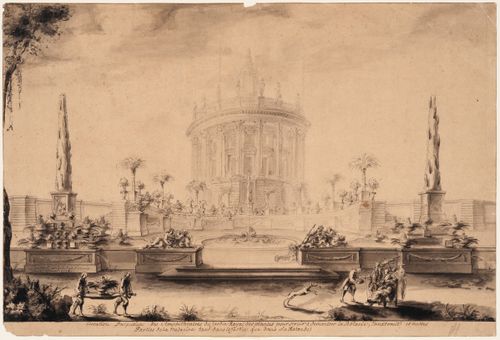
- DR1962:0006 shows a perspective view of a portion of a formal garden terrace laid out symmetrically before a three-storey circular structure. The terrace, which is approached on axis by two steps flanked by sculpted river allegories, is centred on a circular basin and backed by a wall surmounted by potted plants, mostly palm trees and pineapple plants; the middle section of the rear wall curves back concentric to the terrace basin. Beyond the terrace wall and on line with the steps and basin rises the circular structure. With its Corinthian peristyle, this structure has the form of an antique circular temple, such as the so-called "Temple of Vesta" at Tivoli (first century B.C.). Unlike such classical models, however, the columns of the peristyle are set on tall rusticated pedestals that flare outward as they descend to the ground, the entablature carries a balustrade topped by a series of sculpted figures, and the whole is crowned by a tall, slender lantern (although no dome is visible). Within the peristyle, the inner wall is opened regularly by two storeys of windows, each with its own frame and pediment. The overall effect of this structure is not dissimilar to that of James Gibb's Radcliffe Camera, Oxford (1739-49). - In the foreground of DR1962:0006 appear two groups of figures: that on the left consisting of two gardeners carrying a potted pineapple plant, and that on the right consisting of a seated woman attended by a man, a woman (the latter shading her mistress with a parasol), and a figure, apparently a physician, who offers the seated woman a bowl of fruit.
DR1962:0006
Description:
- DR1962:0006 shows a perspective view of a portion of a formal garden terrace laid out symmetrically before a three-storey circular structure. The terrace, which is approached on axis by two steps flanked by sculpted river allegories, is centred on a circular basin and backed by a wall surmounted by potted plants, mostly palm trees and pineapple plants; the middle section of the rear wall curves back concentric to the terrace basin. Beyond the terrace wall and on line with the steps and basin rises the circular structure. With its Corinthian peristyle, this structure has the form of an antique circular temple, such as the so-called "Temple of Vesta" at Tivoli (first century B.C.). Unlike such classical models, however, the columns of the peristyle are set on tall rusticated pedestals that flare outward as they descend to the ground, the entablature carries a balustrade topped by a series of sculpted figures, and the whole is crowned by a tall, slender lantern (although no dome is visible). Within the peristyle, the inner wall is opened regularly by two storeys of windows, each with its own frame and pediment. The overall effect of this structure is not dissimilar to that of James Gibb's Radcliffe Camera, Oxford (1739-49). - In the foreground of DR1962:0006 appear two groups of figures: that on the left consisting of two gardeners carrying a potted pineapple plant, and that on the right consisting of a seated woman attended by a man, a woman (the latter shading her mistress with a parasol), and a figure, apparently a physician, who offers the seated woman a bowl of fruit.
Personnes et institutions:
Sujet:
architecture, architecture de paysage
architecture, architecture de paysage
Date:
ca. 1744
ca. 1744
Titre:
Project for a medical amphitheatre in the Jardin royal des plantes, Paris
Actions:
DR1962:0006
Description:
- DR1962:0006 shows a perspective view of a portion of a formal garden terrace laid out symmetrically before a three-storey circular structure. The terrace, which is approached on axis by two steps flanked by sculpted river allegories, is centred on a circular basin and backed by a wall surmounted by potted plants, mostly palm trees and pineapple plants; the middle section of the rear wall curves back concentric to the terrace basin. Beyond the terrace wall and on line with the steps and basin rises the circular structure. With its Corinthian peristyle, this structure has the form of an antique circular temple, such as the so-called "Temple of Vesta" at Tivoli (first century B.C.). Unlike such classical models, however, the columns of the peristyle are set on tall rusticated pedestals that flare outward as they descend to the ground, the entablature carries a balustrade topped by a series of sculpted figures, and the whole is crowned by a tall, slender lantern (although no dome is visible). Within the peristyle, the inner wall is opened regularly by two storeys of windows, each with its own frame and pediment. The overall effect of this structure is not dissimilar to that of James Gibb's Radcliffe Camera, Oxford (1739-49). - In the foreground of DR1962:0006 appear two groups of figures: that on the left consisting of two gardeners carrying a potted pineapple plant, and that on the right consisting of a seated woman attended by a man, a woman (the latter shading her mistress with a parasol), and a figure, apparently a physician, who offers the seated woman a bowl of fruit.
Project for a medical amphitheatre in the Jardin royal des plantes, Paris
Actions:
DR1962:0006
Description:
- DR1962:0006 shows a perspective view of a portion of a formal garden terrace laid out symmetrically before a three-storey circular structure. The terrace, which is approached on axis by two steps flanked by sculpted river allegories, is centred on a circular basin and backed by a wall surmounted by potted plants, mostly palm trees and pineapple plants; the middle section of the rear wall curves back concentric to the terrace basin. Beyond the terrace wall and on line with the steps and basin rises the circular structure. With its Corinthian peristyle, this structure has the form of an antique circular temple, such as the so-called "Temple of Vesta" at Tivoli (first century B.C.). Unlike such classical models, however, the columns of the peristyle are set on tall rusticated pedestals that flare outward as they descend to the ground, the entablature carries a balustrade topped by a series of sculpted figures, and the whole is crowned by a tall, slender lantern (although no dome is visible). Within the peristyle, the inner wall is opened regularly by two storeys of windows, each with its own frame and pediment. The overall effect of this structure is not dissimilar to that of James Gibb's Radcliffe Camera, Oxford (1739-49). - In the foreground of DR1962:0006 appear two groups of figures: that on the left consisting of two gardeners carrying a potted pineapple plant, and that on the right consisting of a seated woman attended by a man, a woman (the latter shading her mistress with a parasol), and a figure, apparently a physician, who offers the seated woman a bowl of fruit.
Classification:
dessins
dessins
Date:
ca. 1744
ca. 1744
Personnes et institutions:
Sujet:
architecture, architecture de paysage
architecture, architecture de paysage
Classification:
archives
Niveau de description archivistique:
Fonds
archives
Niveau de description archivistique:
Fonds
Numéro de référence:
AP195
Résumé:
The Zaha Hadid Architects Phaeno Science Centre project records, 1996-2015, consist of approximately 43,800 digital files that document the design and construction of an interactive science museum in Wolfsburg, Germany. Materials related to presentations, publications, events, and the press are also represented. Formats include chiefly CAD files, especially plotter files and AutoCAD drawings, though related text documents and images are also represented. The majority of the records date from 2000 to 2006.
AP195
Résumé:
The Zaha Hadid Architects Phaeno Science Centre project records, 1996-2015, consist of approximately 43,800 digital files that document the design and construction of an interactive science museum in Wolfsburg, Germany. Materials related to presentations, publications, events, and the press are also represented. Formats include chiefly CAD files, especially plotter files and AutoCAD drawings, though related text documents and images are also represented. The majority of the records date from 2000 to 2006.
Personnes et institutions:
Date:
1996 - 2015
1996 - 2015
Titre:
Documents d’archives de Zaha Hadid Architects pour le projet Phaeno Science Centre
Actions:
AP195
Résumé:
The Zaha Hadid Architects Phaeno Science Centre project records, 1996-2015, consist of approximately 43,800 digital files that document the design and construction of an interactive science museum in Wolfsburg, Germany. Materials related to presentations, publications, events, and the press are also represented. Formats include chiefly CAD files, especially plotter files and AutoCAD drawings, though related text documents and images are also represented. The majority of the records date from 2000 to 2006.
Documents d’archives de Zaha Hadid Architects pour le projet Phaeno Science Centre
Actions:
AP195
Résumé:
The Zaha Hadid Architects Phaeno Science Centre project records, 1996-2015, consist of approximately 43,800 digital files that document the design and construction of an interactive science museum in Wolfsburg, Germany. Materials related to presentations, publications, events, and the press are also represented. Formats include chiefly CAD files, especially plotter files and AutoCAD drawings, though related text documents and images are also represented. The majority of the records date from 2000 to 2006.
Classification:
archives
Niveau de description archivistique:
Fonds
archives
Niveau de description archivistique:
Fonds
Date:
1996 - 2015
1996 - 2015
Personnes et institutions:
Classification:
dessins
dessins
Actions:
Numéro de référence:
DR1983:0859
Description:
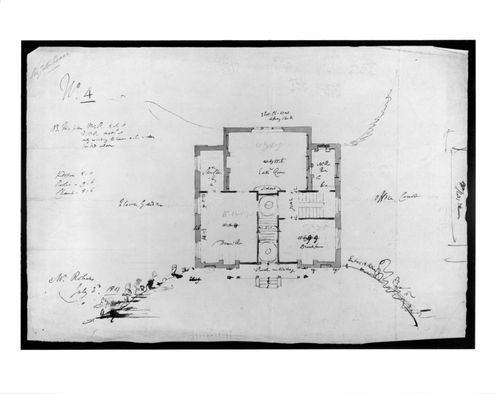
The plan of the building in pen and black ink and grey wash over graphite was executed by a draughtsman in Soane's office on the basis of pin-pricks transferring the design from another sheet. Soane's changes to this initial plan concern the addition of saucer domes in the main hall, and recesses in the "Eat. Room", which resulted in a change in the position of the fireplace in "Mr. Rs Room". The front porch was widened, presumably from the Doric version shown by Dorothy Stroud (1984, pl. 150) to one which includes "trelliage", showing a concern for setting this rural building in its landscape. This change, and its reflection in drawings in the Soane Museum (Drawer 4, set 4, Items 14-24) are discussed by Pierre du Prey (1986).
DR1983:0859
Description:
The plan of the building in pen and black ink and grey wash over graphite was executed by a draughtsman in Soane's office on the basis of pin-pricks transferring the design from another sheet. Soane's changes to this initial plan concern the addition of saucer domes in the main hall, and recesses in the "Eat. Room", which resulted in a change in the position of the fireplace in "Mr. Rs Room". The front porch was widened, presumably from the Doric version shown by Dorothy Stroud (1984, pl. 150) to one which includes "trelliage", showing a concern for setting this rural building in its landscape. This change, and its reflection in drawings in the Soane Museum (Drawer 4, set 4, Items 14-24) are discussed by Pierre du Prey (1986).
Personnes et institutions:
Sujet:
architecture
architecture
Date:
3 July 1801
3 July 1801
Titre:
Plan for a villa for Norwood Green, Middlesex
Actions:
DR1983:0859
Description:
The plan of the building in pen and black ink and grey wash over graphite was executed by a draughtsman in Soane's office on the basis of pin-pricks transferring the design from another sheet. Soane's changes to this initial plan concern the addition of saucer domes in the main hall, and recesses in the "Eat. Room", which resulted in a change in the position of the fireplace in "Mr. Rs Room". The front porch was widened, presumably from the Doric version shown by Dorothy Stroud (1984, pl. 150) to one which includes "trelliage", showing a concern for setting this rural building in its landscape. This change, and its reflection in drawings in the Soane Museum (Drawer 4, set 4, Items 14-24) are discussed by Pierre du Prey (1986).
Plan for a villa for Norwood Green, Middlesex
Actions:
DR1983:0859
Description:
The plan of the building in pen and black ink and grey wash over graphite was executed by a draughtsman in Soane's office on the basis of pin-pricks transferring the design from another sheet. Soane's changes to this initial plan concern the addition of saucer domes in the main hall, and recesses in the "Eat. Room", which resulted in a change in the position of the fireplace in "Mr. Rs Room". The front porch was widened, presumably from the Doric version shown by Dorothy Stroud (1984, pl. 150) to one which includes "trelliage", showing a concern for setting this rural building in its landscape. This change, and its reflection in drawings in the Soane Museum (Drawer 4, set 4, Items 14-24) are discussed by Pierre du Prey (1986).
Classification:
dessins
dessins
Date:
3 July 1801
3 July 1801
Personnes et institutions:
Sujet:
architecture
architecture
Classification:
archives
Niveau de description archivistique:
Fonds
archives
Niveau de description archivistique:
Fonds
Titre:
Fonds John Bird
Fonds John Bird
Numéro de référence:
AP108
Résumé:
The John Bird fonds documents the professional practice of the Westmount-based architect, and includes drawings and photographs of 24 architectural projects carried out in and around Montréal, Québec between 1954 and 1992. The fonds also contains a number of published articles that document John Bird's professional activities. Key projects that are represented include the Canadian Technical Tape Building, St. Laurent (1955-1963), Saint Gabriel's Church, Montréal (1959-1960), and Saint John Brebeuf Church, Lasalle (1962-1966). The fonds also includes numerous projects for Toronto-Dominion Bank buildings (1959-1992) as well as residential designs completed for the Central Mortgage and Housing Corporation (1956-1969).
AP108
Résumé:
The John Bird fonds documents the professional practice of the Westmount-based architect, and includes drawings and photographs of 24 architectural projects carried out in and around Montréal, Québec between 1954 and 1992. The fonds also contains a number of published articles that document John Bird's professional activities. Key projects that are represented include the Canadian Technical Tape Building, St. Laurent (1955-1963), Saint Gabriel's Church, Montréal (1959-1960), and Saint John Brebeuf Church, Lasalle (1962-1966). The fonds also includes numerous projects for Toronto-Dominion Bank buildings (1959-1992) as well as residential designs completed for the Central Mortgage and Housing Corporation (1956-1969).
Personnes et institutions:
Date:
1942 - 1992
1942 - 1992
Titre:
Fonds John Bird
Actions:
AP108
Résumé:
The John Bird fonds documents the professional practice of the Westmount-based architect, and includes drawings and photographs of 24 architectural projects carried out in and around Montréal, Québec between 1954 and 1992. The fonds also contains a number of published articles that document John Bird's professional activities. Key projects that are represented include the Canadian Technical Tape Building, St. Laurent (1955-1963), Saint Gabriel's Church, Montréal (1959-1960), and Saint John Brebeuf Church, Lasalle (1962-1966). The fonds also includes numerous projects for Toronto-Dominion Bank buildings (1959-1992) as well as residential designs completed for the Central Mortgage and Housing Corporation (1956-1969).
Fonds John Bird
Actions:
AP108
Résumé:
The John Bird fonds documents the professional practice of the Westmount-based architect, and includes drawings and photographs of 24 architectural projects carried out in and around Montréal, Québec between 1954 and 1992. The fonds also contains a number of published articles that document John Bird's professional activities. Key projects that are represented include the Canadian Technical Tape Building, St. Laurent (1955-1963), Saint Gabriel's Church, Montréal (1959-1960), and Saint John Brebeuf Church, Lasalle (1962-1966). The fonds also includes numerous projects for Toronto-Dominion Bank buildings (1959-1992) as well as residential designs completed for the Central Mortgage and Housing Corporation (1956-1969).
Classification:
archives
Niveau de description archivistique:
Fonds
archives
Niveau de description archivistique:
Fonds
Date:
1942 - 1992
1942 - 1992
Personnes et institutions:


