


480 Résultats
Classification:
livres
livres
Actions:
Prix:
$71.95
(disponible sur commande)
Résumé:
The built environment is a critical factor in the climate equation. Approximately 40 percent of global emissions derive from the construction, operation, and demolition of human settlements. The 21st century must be the century of re-entanglement, where quintessential functions (housing, work, culture, recreation, etc.) are reintegrated within urban spaces; where(...)
$71.95
(disponible sur commande)
Résumé:
The built environment is a critical factor in the climate equation. Approximately 40 percent of global emissions derive from the construction, operation, and demolition of human settlements. The 21st century must be the century of re-entanglement, where quintessential functions (housing, work, culture, recreation, etc.) are reintegrated within urban spaces; where(...)
Sujet:
Architecture écologique
Architecture écologique
Publication:
septembre 2023
septembre 2023
Titre:
Reconstructing the future: Cities as carbon sinks
Actions:
Prix:
$71.95
(disponible sur commande)
Résumé:
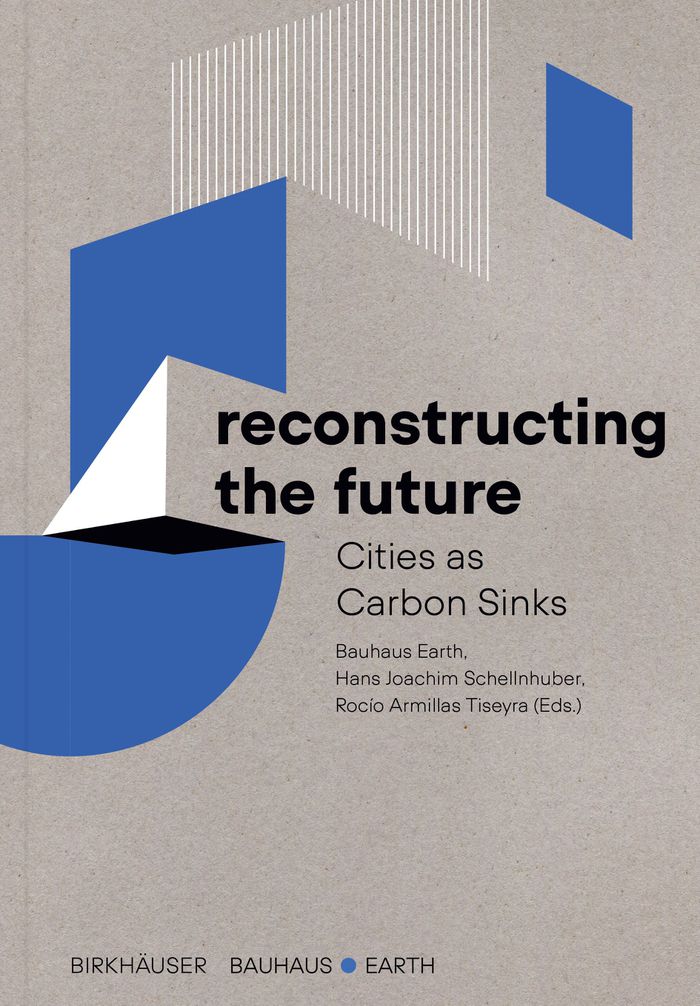
The built environment is a critical factor in the climate equation. Approximately 40 percent of global emissions derive from the construction, operation, and demolition of human settlements. The 21st century must be the century of re-entanglement, where quintessential functions (housing, work, culture, recreation, etc.) are reintegrated within urban spaces; where socioeconomic and ecological systems form a mutually supportive network of networks; and where past, present, and future are perceived as interwoven waves in the river of time. Fortunately, opportunities exist to transform the built environment from a carbon source to a carbon sink through, e.g. timber construction high-rise buildings, circular bioeconomy methods, AI-assisted design, smart recycling technology, multifunctional land use, integrated regional resource management, and community-based urban development, to name just a few. This volume compiles the papers presented by world-renowned scientists, architects, spatial planners, activists, and policy makers at the Reconstructing the Future for People and Planet conference, held at the Vatican in June 2022.
Reconstructing the future: Cities as carbon sinks
Actions:
Prix:
$71.95
(disponible sur commande)
Résumé:
The built environment is a critical factor in the climate equation. Approximately 40 percent of global emissions derive from the construction, operation, and demolition of human settlements. The 21st century must be the century of re-entanglement, where quintessential functions (housing, work, culture, recreation, etc.) are reintegrated within urban spaces; where socioeconomic and ecological systems form a mutually supportive network of networks; and where past, present, and future are perceived as interwoven waves in the river of time. Fortunately, opportunities exist to transform the built environment from a carbon source to a carbon sink through, e.g. timber construction high-rise buildings, circular bioeconomy methods, AI-assisted design, smart recycling technology, multifunctional land use, integrated regional resource management, and community-based urban development, to name just a few. This volume compiles the papers presented by world-renowned scientists, architects, spatial planners, activists, and policy makers at the Reconstructing the Future for People and Planet conference, held at the Vatican in June 2022.
Classification:
livres
livres
Publication:
septembre 2023
septembre 2023
Sujet:
Architecture écologique
Architecture écologique
Classification:
livres
livres

Titre:
Denis Wood: Everything sings
Denis Wood: Everything sings
Actions:
Prix:
$31.00
(disponible sur commande)
Résumé:
With artful wit and rigor, cartographer Denis Wood has written numerous books (including the influential bestseller The Power of Maps) that reorient his readers not only to our neighborhoods, homes and bodies, but also to our own very human instinct to understand where we live by mapmaking. At the heart of Wood's investigations is a near-legendary endeavor: the Boylan(...)
$31.00
(disponible sur commande)
Résumé:
With artful wit and rigor, cartographer Denis Wood has written numerous books (including the influential bestseller The Power of Maps) that reorient his readers not only to our neighborhoods, homes and bodies, but also to our own very human instinct to understand where we live by mapmaking. At the heart of Wood's investigations is a near-legendary endeavor: the Boylan(...)
Titre:
Denis Wood: Everything sings
Actions:
Prix:
$31.00
(disponible sur commande)
Résumé:
With artful wit and rigor, cartographer Denis Wood has written numerous books (including the influential bestseller The Power of Maps) that reorient his readers not only to our neighborhoods, homes and bodies, but also to our own very human instinct to understand where we live by mapmaking. At the heart of Wood's investigations is a near-legendary endeavor: the Boylan Heights maps, begun in 1982, and now published in Everything Sings. Surveying his century-old, half-square mile neighborhood Boylan Heights in Raleigh, North Carolina, Wood began by paring away the inessential "map crap" (scale, orientation, street grids) and, in searching for the revelatory in the unmapped and the unmappable, he ended up plotting such phenomena as radio waves permeating the air, the light cast by street lights and Halloween pumpkins on porches. Wood's maps accumulate into a multi-layered story about one neighborhood that tells the larger story of what constitutes the places we call home. With an introduction by Ira Glass.
Denis Wood: Everything sings
Actions:
Prix:
$31.00
(disponible sur commande)
Résumé:
With artful wit and rigor, cartographer Denis Wood has written numerous books (including the influential bestseller The Power of Maps) that reorient his readers not only to our neighborhoods, homes and bodies, but also to our own very human instinct to understand where we live by mapmaking. At the heart of Wood's investigations is a near-legendary endeavor: the Boylan Heights maps, begun in 1982, and now published in Everything Sings. Surveying his century-old, half-square mile neighborhood Boylan Heights in Raleigh, North Carolina, Wood began by paring away the inessential "map crap" (scale, orientation, street grids) and, in searching for the revelatory in the unmapped and the unmappable, he ended up plotting such phenomena as radio waves permeating the air, the light cast by street lights and Halloween pumpkins on porches. Wood's maps accumulate into a multi-layered story about one neighborhood that tells the larger story of what constitutes the places we call home. With an introduction by Ira Glass.
Classification:
livres
livres
Publication:
février 2011
février 2011
Classification:
livres
livres

Prix:
$47.50
(disponible sur commande)
Résumé:
Bucky Inc. offers a deep exploration of Richard Buckminster Fuller’s work and thought to shed new light on the questions raised by our increasingly electronic world. It shows that Fuller’s entire career was a multi-dimensional reflection on the architecture of radio. He always insisted that the real site of architecture is the electromagnetic spectrum. His buildings were(...)
$47.50
(disponible sur commande)
Résumé:
Bucky Inc. offers a deep exploration of Richard Buckminster Fuller’s work and thought to shed new light on the questions raised by our increasingly electronic world. It shows that Fuller’s entire career was a multi-dimensional reflection on the architecture of radio. He always insisted that the real site of architecture is the electromagnetic spectrum. His buildings were(...)
Titre:
Buckminster Fuller inc.: architecture in the age of radio
Actions:
Prix:
$47.50
(disponible sur commande)
Résumé:
Bucky Inc. offers a deep exploration of Richard Buckminster Fuller’s work and thought to shed new light on the questions raised by our increasingly electronic world. It shows that Fuller’s entire career was a multi-dimensional reflection on the architecture of radio. He always insisted that the real site of architecture is the electromagnetic spectrum. His buildings were delicate mobile instruments for accessing the invisible universe of overlapping signals. Every detail was understood as a way of tuning into hidden waves. Architecture was built in, with, for and as radio. Bucky Inc. rethinks the legacy of one of the key protagonists of the twentieth-century. It draws extensively on Fuller’s archive to follow his radical thinking from toilets to telepathy, plastic to prosthetics, and data to deep-space. It shows how the critical arguments and material techniques of arguably the single most exposed designer of the last century were overlooked at the time but have become urgently relevant today.
Buckminster Fuller inc.: architecture in the age of radio
Actions:
Prix:
$47.50
(disponible sur commande)
Résumé:
Bucky Inc. offers a deep exploration of Richard Buckminster Fuller’s work and thought to shed new light on the questions raised by our increasingly electronic world. It shows that Fuller’s entire career was a multi-dimensional reflection on the architecture of radio. He always insisted that the real site of architecture is the electromagnetic spectrum. His buildings were delicate mobile instruments for accessing the invisible universe of overlapping signals. Every detail was understood as a way of tuning into hidden waves. Architecture was built in, with, for and as radio. Bucky Inc. rethinks the legacy of one of the key protagonists of the twentieth-century. It draws extensively on Fuller’s archive to follow his radical thinking from toilets to telepathy, plastic to prosthetics, and data to deep-space. It shows how the critical arguments and material techniques of arguably the single most exposed designer of the last century were overlooked at the time but have become urgently relevant today.
Classification:
livres
livres
Publication:
septembre 2014
septembre 2014
Sujet:
Architecture, monographies
Architecture, monographies
Classification:
livres
livres
Actions:
Description:
1 online resource
Auteur:
- Linnet Taylor, Gargi Sharma, Aaron Martin, and Shazade Jameson -- Sean Martin McDonald -- Vidushi Marda -- Michael Veale -- Lilian Edwards -- Karen Yeung -- Os Keyes -- Dragana Kaurin -- Anonymous I -- Angela Daly -- Ramiro Alvarez Ugarte -- Fleur Johns -- Rafael Evangelista and Rodrigo Firmino -- Bianca Wylie -- Wayne W. Wang -- Helen Eenmaa-Dimitrieva, Eneken Tikk, and Mika Kerttunen -- Francesca Musiani -- Ben Wagner -- Smith Oduro-Marfo -- István Böröcz -- Rob Kitchin -- David Murakami Wood -- Raya Sharbain and Anonymous II -- Grace Mutung'u -- Arely Cruz-Santiago -- Naomi Appelman, Jill Toh, Ronan Ó Fathaigh, and Joris van Hoboken -- Marisa Duarte -- Kristin Bergtora Sandvik -- Vino Lucero,
- Taylor, Linnet,,
- Sharma, Gargi,,
- Martin, Aaron,,
- Jameson, Shazade,,
- Sutcliffe, David,,
- Romo-Melgar, Carlos,,
- Sage, John Philip,,
- Ugarte, Ramiro Alvarez,,
- Appelman, Naomi,,
- Moliner, Lilana Arroyo,,
- Böröcz, István,,
- Brewczyńska, Magda,,
- Chen, Julienne,,
- Cohen, Julie E.,,
- Cruz-Santiago, Arely,,
- Daly, Angela,,
- Duarte, Marisa,,
- Edwards, Lilian,,
- Eenmaa-Dimitrieva, Helen,,
- Evangelista, Rafael,,
- Fathaigh, Ronan Ó,,
- Firmino, Rodrigo,,
- Gillwald, Alison,,
- Hoboken, Joris van,,
- Johns, Fleur,,
- Kim, Hye Jung,,
- Kaurin, Dragana,,
- Kerttunen, Mika,,
- Keyes, Os,,
- Kitchin, Rob,,
- Kostic, Bojana,,
- Krivokapic, Danilo,,
- Lucero, Vino,,
- Luján, Enric,,
- Marda, Vidushi,,
- McDonald, Sean Martin,,
- Mollicchi, Silvia,,
- Wood, David Murakami,,
- Musiani, Francesca,,
- Mutung'u, Grace,,
- Mwesigwa, Daniel,,
- Oduro-Marfo, Smith,,
- Peppin, Aidan,,
- Perkov, Bojan,,
- Petrovski, Andrej,,
- Poorthuis, Ate,,
- Razzano, Gabriella,,
- Rens, Andrew,,
- Safak, Cansu,,
- Sandvik, Kristin Bergtora,,
- Sharbain, Raya,,
- Tikk, Eneken,,
- Toh, Jill,,
- Spuy, Anri van der,,
- Veale, Michael,,
- Wagner, Ben,,
- Walker, Tom,,
- Wylie, Bianca,,
- Yeung, Karen,,
- Yoon, Hye Shun,,
- Wayne W. Wang,,
- Anonymous,,
- Library Stack,
Sujet:
- Economics.,
- Electronic surveillance.,
- Political science.,
- Sociology.,
- Communicable diseases.,
- Communicable Diseases,
- Epidemics,
- Économie politique.,
- Sociologie.,
- Maladies infectieuses.,
- economics.,
- sociology.,
- Discursive works.,
- Collections,
- Anthologies.
Publication:
[Place of publication not identified] : Meatspace Press, 2020.
[Place of publication not identified] : Meatspace Press, 2020.
Classification:
livres
livres
Publication:
[Place of publication not identified] : Meatspace Press, 2020.
[Place of publication not identified] : Meatspace Press, 2020.
Auteur:
- Linnet Taylor, Gargi Sharma, Aaron Martin, and Shazade Jameson -- Sean Martin McDonald -- Vidushi Marda -- Michael Veale -- Lilian Edwards -- Karen Yeung -- Os Keyes -- Dragana Kaurin -- Anonymous I -- Angela Daly -- Ramiro Alvarez Ugarte -- Fleur Johns -- Rafael Evangelista and Rodrigo Firmino -- Bianca Wylie -- Wayne W. Wang -- Helen Eenmaa-Dimitrieva, Eneken Tikk, and Mika Kerttunen -- Francesca Musiani -- Ben Wagner -- Smith Oduro-Marfo -- István Böröcz -- Rob Kitchin -- David Murakami Wood -- Raya Sharbain and Anonymous II -- Grace Mutung'u -- Arely Cruz-Santiago -- Naomi Appelman, Jill Toh, Ronan Ó Fathaigh, and Joris van Hoboken -- Marisa Duarte -- Kristin Bergtora Sandvik -- Vino Lucero,
- Taylor, Linnet,,
- Sharma, Gargi,,
- Martin, Aaron,,
- Jameson, Shazade,,
- Sutcliffe, David,,
- Romo-Melgar, Carlos,,
- Sage, John Philip,,
- Ugarte, Ramiro Alvarez,,
- Appelman, Naomi,,
- Moliner, Lilana Arroyo,,
- Böröcz, István,,
- Brewczyńska, Magda,,
- Chen, Julienne,,
- Cohen, Julie E.,,
- Cruz-Santiago, Arely,,
- Daly, Angela,,
- Duarte, Marisa,,
- Edwards, Lilian,,
- Eenmaa-Dimitrieva, Helen,,
- Evangelista, Rafael,,
- Fathaigh, Ronan Ó,,
- Firmino, Rodrigo,,
- Gillwald, Alison,,
- Hoboken, Joris van,,
- Johns, Fleur,,
- Kim, Hye Jung,,
- Kaurin, Dragana,,
- Kerttunen, Mika,,
- Keyes, Os,,
- Kitchin, Rob,,
- Kostic, Bojana,,
- Krivokapic, Danilo,,
- Lucero, Vino,,
- Luján, Enric,,
- Marda, Vidushi,,
- McDonald, Sean Martin,,
- Mollicchi, Silvia,,
- Wood, David Murakami,,
- Musiani, Francesca,,
- Mutung'u, Grace,,
- Mwesigwa, Daniel,,
- Oduro-Marfo, Smith,,
- Peppin, Aidan,,
- Perkov, Bojan,,
- Petrovski, Andrej,,
- Poorthuis, Ate,,
- Razzano, Gabriella,,
- Rens, Andrew,,
- Safak, Cansu,,
- Sandvik, Kristin Bergtora,,
- Sharbain, Raya,,
- Tikk, Eneken,,
- Toh, Jill,,
- Spuy, Anri van der,,
- Veale, Michael,,
- Wagner, Ben,,
- Walker, Tom,,
- Wylie, Bianca,,
- Yeung, Karen,,
- Yoon, Hye Shun,,
- Wayne W. Wang,,
- Anonymous,,
- Library Stack,
Sujet:
- Economics.,
- Electronic surveillance.,
- Political science.,
- Sociology.,
- Communicable diseases.,
- Communicable Diseases,
- Epidemics,
- Économie politique.,
- Sociologie.,
- Maladies infectieuses.,
- economics.,
- sociology.,
- Discursive works.,
- Collections,
- Anthologies.
Classification:
livres
livres

Titre:
Pressing Matters 10
Pressing Matters 10
Actions:
Prix:
$54.00
(disponible sur commande)
Résumé:
Already number TEN, ''Pressing Matters X'' is a special issue reflecting a year of reflection and change, after several waves of the pandemic, Black Lives Matter protests and newly developed hybrid teaching methods. It follows last year’s ''Pressing Matters 9'' that was completely rethought with the aim to present an Open Source publication that shares the Department of(...)
$54.00
(disponible sur commande)
Résumé:
Already number TEN, ''Pressing Matters X'' is a special issue reflecting a year of reflection and change, after several waves of the pandemic, Black Lives Matter protests and newly developed hybrid teaching methods. It follows last year’s ''Pressing Matters 9'' that was completely rethought with the aim to present an Open Source publication that shares the Department of(...)
Publication:
juin 2022
juin 2022
Titre:
Pressing Matters 10
Actions:
Prix:
$54.00
(disponible sur commande)
Résumé:
Already number TEN, ''Pressing Matters X'' is a special issue reflecting a year of reflection and change, after several waves of the pandemic, Black Lives Matter protests and newly developed hybrid teaching methods. It follows last year’s ''Pressing Matters 9'' that was completely rethought with the aim to present an Open Source publication that shares the Department of Architecture’s concept of design-research, an integral approach of critical thinking, rigorous research, and design, representing a deep understanding of the complex layers of architecture. Together with Jonathan Jackson & team of WSDIA, a more integral design was developed, allowing input from research [ARI labs], students, faculty and Penn’s special events. This anniversary of ''Pressing Matters'' is celebrated by adding the ''decade'' color of silver to the usual recycled cardboard cover of Weitzman’s architecture publication. It also represents a year of new opportunities brought by a complete rethinking of education through the introduction of remote learning, zoom lectures and meetings. A much larger international group of diverse jurors, experts, and critics could be invited as travel was of no hindrance for attendance.
Pressing Matters 10
Actions:
Prix:
$54.00
(disponible sur commande)
Résumé:
Already number TEN, ''Pressing Matters X'' is a special issue reflecting a year of reflection and change, after several waves of the pandemic, Black Lives Matter protests and newly developed hybrid teaching methods. It follows last year’s ''Pressing Matters 9'' that was completely rethought with the aim to present an Open Source publication that shares the Department of Architecture’s concept of design-research, an integral approach of critical thinking, rigorous research, and design, representing a deep understanding of the complex layers of architecture. Together with Jonathan Jackson & team of WSDIA, a more integral design was developed, allowing input from research [ARI labs], students, faculty and Penn’s special events. This anniversary of ''Pressing Matters'' is celebrated by adding the ''decade'' color of silver to the usual recycled cardboard cover of Weitzman’s architecture publication. It also represents a year of new opportunities brought by a complete rethinking of education through the introduction of remote learning, zoom lectures and meetings. A much larger international group of diverse jurors, experts, and critics could be invited as travel was of no hindrance for attendance.
Classification:
livres
livres
Publication:
juin 2022
juin 2022
Classification:
livres
livres
Actions:
Exemplaires:
Description:
xxi, 385 pages : illustrations (some color), maps ; 27 cm.
Description:
xxi, 385 pages : illustrations (some color), maps ; 27 cm.
Auteur:
- Nancy S. Steinhardt -- David Van Zanten -- Jeffrey W. Cody -- Tony Atkin -- Gu Daqing -- K. Sizheng Fan -- Fu Chao-Ching -- Jeffrey W. Cody -- Xing Ruan.,
- Seng Kuan -- Zhao Chen -- Jeffrey W. Cody -- Rudolf G. Wagner -- Delin Lai -- Yung Ho Chang -- Peter J. Carroll -- Zhang Jie -- Joseph Rykwert.,
- Cody, Jeffrey W.,
- Steinhardt, Nancy Shatzman.,
- Atkin, Tony.
Sujet:
- Architecture China Western influences History 20th century Congresses.,
- Eclecticism in architecture China Congresses.,
- Éclectisme en architecture Chine Congrès.,
- Architecture Western influences,
- Eclecticism in architecture,
- Architecture China Western influences.,
- Eclecticism in architecture China.,
- China,
- Conference publications.,
- proceedings (reports),
- Conference papers and proceedings,
- History,
- Actes de congrès.
Publication:
Honolulu : University of Hawaiʻi Press, ©2011.
Honolulu : University of Hawaiʻi Press, ©2011.
Titre:
Chinese architecture and the Beaux-Arts / edited by Jeffrey W. Cody, Nancy S. Steinhardt, and Tony Atkin.
Actions:
Exemplaires:
Description:
xxi, 385 pages : illustrations (some color), maps ; 27 cm.
Chinese architecture and the Beaux-Arts / edited by Jeffrey W. Cody, Nancy S. Steinhardt, and Tony Atkin.
Actions:
Exemplaires:
Description:
xxi, 385 pages : illustrations (some color), maps ; 27 cm.
Classification:
livres
livres
Publication:
Honolulu : University of Hawaiʻi Press, ©2011.
Honolulu : University of Hawaiʻi Press, ©2011.
Auteur:
- Nancy S. Steinhardt -- David Van Zanten -- Jeffrey W. Cody -- Tony Atkin -- Gu Daqing -- K. Sizheng Fan -- Fu Chao-Ching -- Jeffrey W. Cody -- Xing Ruan.,
- Seng Kuan -- Zhao Chen -- Jeffrey W. Cody -- Rudolf G. Wagner -- Delin Lai -- Yung Ho Chang -- Peter J. Carroll -- Zhang Jie -- Joseph Rykwert.,
- Cody, Jeffrey W.,
- Steinhardt, Nancy Shatzman.,
- Atkin, Tony.
Sujet:
- Architecture China Western influences History 20th century Congresses.,
- Eclecticism in architecture China Congresses.,
- Éclectisme en architecture Chine Congrès.,
- Architecture Western influences,
- Eclecticism in architecture,
- Architecture China Western influences.,
- Eclecticism in architecture China.,
- China,
- Conference publications.,
- proceedings (reports),
- Conference papers and proceedings,
- History,
- Actes de congrès.
Classification:
livres
livres

Titre:
Inform Giuliana Michelotti
Inform Giuliana Michelotti
Actions:
Prix:
$46.00
(disponible sur commande)
Résumé:
For 20 years, Giuliana Michelotti has designed fashion, objects and jewelry of uncommon organic sensuality in collaboration with such leading firms as Valentino, Versace, Dolce & Gabbana and Christian Lacroix. Always a passionate and inquisitive traveler, Michelotti has been as influenced by the tribal and ethnic traditions of Asia and Africa as the contemporary trends of(...)
$46.00
(disponible sur commande)
Résumé:
For 20 years, Giuliana Michelotti has designed fashion, objects and jewelry of uncommon organic sensuality in collaboration with such leading firms as Valentino, Versace, Dolce & Gabbana and Christian Lacroix. Always a passionate and inquisitive traveler, Michelotti has been as influenced by the tribal and ethnic traditions of Asia and Africa as the contemporary trends of(...)
Titre:
Inform Giuliana Michelotti
Actions:
Prix:
$46.00
(disponible sur commande)
Résumé:
For 20 years, Giuliana Michelotti has designed fashion, objects and jewelry of uncommon organic sensuality in collaboration with such leading firms as Valentino, Versace, Dolce & Gabbana and Christian Lacroix. Always a passionate and inquisitive traveler, Michelotti has been as influenced by the tribal and ethnic traditions of Asia and Africa as the contemporary trends of her native Italy or current home, New York City. In 1995 Michelotti launched her own line of jewelry inspired by nature and the sea. All of the pieces in the GM collection are cast in silver using an ancient Indian “lost wax” technique. The stones are uncut and natural, worn by rain and sand. Shells and madrepores eroded by waves, corals ramified in infinite ways, sticks and small rocks--in Michelotti’s hands, these humble organic materials are transformed into necklaces, bracelets and earrings of such highly refined shape and physical lightness that one cannot mistake them for anyone else’s work. With an essay by The New York Times’ revered style editor, Stefano Tonchi, this volume features exquisite close-up photographs of Michelotti’s jewelry, and details the life and creative path of an artist who has achieved an extraordinarily sophisticated aesthetic synthesis
Inform Giuliana Michelotti
Actions:
Prix:
$46.00
(disponible sur commande)
Résumé:
For 20 years, Giuliana Michelotti has designed fashion, objects and jewelry of uncommon organic sensuality in collaboration with such leading firms as Valentino, Versace, Dolce & Gabbana and Christian Lacroix. Always a passionate and inquisitive traveler, Michelotti has been as influenced by the tribal and ethnic traditions of Asia and Africa as the contemporary trends of her native Italy or current home, New York City. In 1995 Michelotti launched her own line of jewelry inspired by nature and the sea. All of the pieces in the GM collection are cast in silver using an ancient Indian “lost wax” technique. The stones are uncut and natural, worn by rain and sand. Shells and madrepores eroded by waves, corals ramified in infinite ways, sticks and small rocks--in Michelotti’s hands, these humble organic materials are transformed into necklaces, bracelets and earrings of such highly refined shape and physical lightness that one cannot mistake them for anyone else’s work. With an essay by The New York Times’ revered style editor, Stefano Tonchi, this volume features exquisite close-up photographs of Michelotti’s jewelry, and details the life and creative path of an artist who has achieved an extraordinarily sophisticated aesthetic synthesis
Classification:
livres
livres
Publication:
février 2008, Milan
février 2008, Milan
Sujet:
Métiers d'art
Métiers d'art
Classification:
livres
livres

Titre:
The north end
The north end
Actions:
Prix:
$39.95
(disponible en magasin)
Résumé:
Award-winning documentary maker John Paskievich has made his name making films about places and people throughout the world. His films made for the National Film Board have chronicled groups as different as young Czechs trying to be North American Indians, the impoverished Roma community in Slovakia, and an isolated group of Orthodox Russians on the Canadian prairies. As(...)
$39.95
(disponible en magasin)
Résumé:
Award-winning documentary maker John Paskievich has made his name making films about places and people throughout the world. His films made for the National Film Board have chronicled groups as different as young Czechs trying to be North American Indians, the impoverished Roma community in Slovakia, and an isolated group of Orthodox Russians on the Canadian prairies. As(...)
Titre:
The north end
Actions:
Prix:
$39.95
(disponible en magasin)
Résumé:
Award-winning documentary maker John Paskievich has made his name making films about places and people throughout the world. His films made for the National Film Board have chronicled groups as different as young Czechs trying to be North American Indians, the impoverished Roma community in Slovakia, and an isolated group of Orthodox Russians on the Canadian prairies. As a filmmaker, his work has been shown at film festivals throughout North America and Europe, including the Cannes Film Festival and the Toronto Festival of Festivals. In "The North End", Paskievich returns to his first love, photography. His lyrical black and white photographs chronicle a community closer to home, the iconic Winnipeg neighbourhood in which he grew up. Winnipeg’s North End is the great Canadian melting pot, the place "north of the tracks" that welcomed waves of immigrants from central and eastern Europe at the turn of the last century. It is a place that spawned some of Canada’s greatest cultural events and personalities, from the Winnipeg General Strike to the Guess Who. Paskievich captures the vibrancy and conflicts of the North End and other urban spaces like it, places where history, poverty, and resilience come together.
The north end
Actions:
Prix:
$39.95
(disponible en magasin)
Résumé:
Award-winning documentary maker John Paskievich has made his name making films about places and people throughout the world. His films made for the National Film Board have chronicled groups as different as young Czechs trying to be North American Indians, the impoverished Roma community in Slovakia, and an isolated group of Orthodox Russians on the Canadian prairies. As a filmmaker, his work has been shown at film festivals throughout North America and Europe, including the Cannes Film Festival and the Toronto Festival of Festivals. In "The North End", Paskievich returns to his first love, photography. His lyrical black and white photographs chronicle a community closer to home, the iconic Winnipeg neighbourhood in which he grew up. Winnipeg’s North End is the great Canadian melting pot, the place "north of the tracks" that welcomed waves of immigrants from central and eastern Europe at the turn of the last century. It is a place that spawned some of Canada’s greatest cultural events and personalities, from the Winnipeg General Strike to the Guess Who. Paskievich captures the vibrancy and conflicts of the North End and other urban spaces like it, places where history, poverty, and resilience come together.
Classification:
livres
livres
Publication:
octobre 2007
octobre 2007
Sujet:
Monographies photo
Monographies photo
Classification:
livres
livres
Prix:
$62.95
(disponible en magasin)
Résumé:
Throughout the early twentieth century, waves of migration brought working-class people to the outskirts of Buenos Aires. This prompted a dilemma: Where should these restive populations be situated relative to the city’s spatial politics? Enter Antonio Bonet, a Catalan architect inspired by the transatlantic modernist and surrealist movements. Ana María León follows(...)
$62.95
(disponible en magasin)
Résumé:
Throughout the early twentieth century, waves of migration brought working-class people to the outskirts of Buenos Aires. This prompted a dilemma: Where should these restive populations be situated relative to the city’s spatial politics? Enter Antonio Bonet, a Catalan architect inspired by the transatlantic modernist and surrealist movements. Ana María León follows(...)
Titre:
Modernity for the masses: Antonio Bonet's Dreams for Buenos Aires
Actions:
Prix:
$62.95
(disponible en magasin)
Résumé:
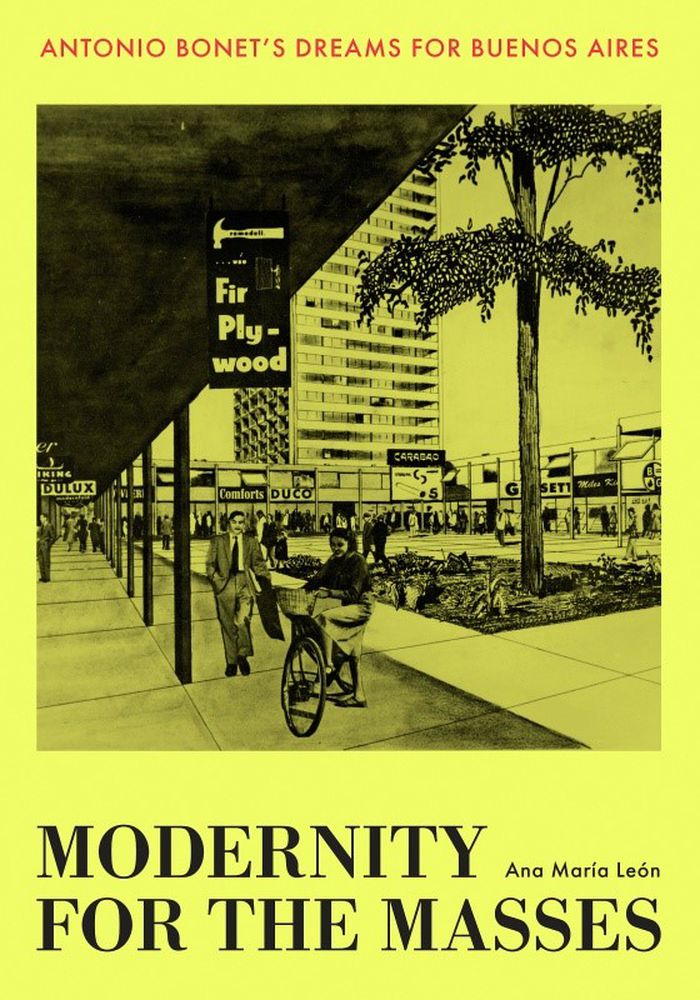
Throughout the early twentieth century, waves of migration brought working-class people to the outskirts of Buenos Aires. This prompted a dilemma: Where should these restive populations be situated relative to the city’s spatial politics? Enter Antonio Bonet, a Catalan architect inspired by the transatlantic modernist and surrealist movements. Ana María León follows Bonet's decades-long, state-backed quest to house Buenos Aires's diverse and fractious population. Working with totalitarian and populist regimes, Bonet developed three large-scale housing plans, each scuttled as a new government took over. Yet these incomplete plans—Bonet's dreams—teach us much about the relationship between modernism and state power. This volume finds in Bonet's projects the disconnect between modern architecture’s discourse of emancipation and the reality of its rationalizing control. Although he and his patrons constantly glorified the people and depicted them in housing plans, Bonet never consulted them. Instead he succumbed to official and elite fears of the people's latent political power. In careful readings of Bonet's work, León discovers the progressive erasure of surrealism's psychological sensitivity, replaced with an impulse, realized in modernist design, to contain the increasingly empowered population.
Modernity for the masses: Antonio Bonet's Dreams for Buenos Aires
Actions:
Prix:
$62.95
(disponible en magasin)
Résumé:
Throughout the early twentieth century, waves of migration brought working-class people to the outskirts of Buenos Aires. This prompted a dilemma: Where should these restive populations be situated relative to the city’s spatial politics? Enter Antonio Bonet, a Catalan architect inspired by the transatlantic modernist and surrealist movements. Ana María León follows Bonet's decades-long, state-backed quest to house Buenos Aires's diverse and fractious population. Working with totalitarian and populist regimes, Bonet developed three large-scale housing plans, each scuttled as a new government took over. Yet these incomplete plans—Bonet's dreams—teach us much about the relationship between modernism and state power. This volume finds in Bonet's projects the disconnect between modern architecture’s discourse of emancipation and the reality of its rationalizing control. Although he and his patrons constantly glorified the people and depicted them in housing plans, Bonet never consulted them. Instead he succumbed to official and elite fears of the people's latent political power. In careful readings of Bonet's work, León discovers the progressive erasure of surrealism's psychological sensitivity, replaced with an impulse, realized in modernist design, to contain the increasingly empowered population.
Classification:
livres
livres
Publication:
avril 2021
avril 2021
Sujet:
Théorie de l’urbanisme
Théorie de l’urbanisme
Classification:
livres
livres

Actions:
Prix:
$67.95
(disponible en magasin)
Résumé:
For a small country that generally keeps a low profile on the stage of world events, Denmark has played a disproportionately prominent role in the history of 20th Century architecture and design. Today in the early 21st Century, known for its anything-goes attitude towards design, Denmark also has its share of provocative architects surfing waves of fashionable trends,(...)
$67.95
(disponible en magasin)
Résumé:
For a small country that generally keeps a low profile on the stage of world events, Denmark has played a disproportionately prominent role in the history of 20th Century architecture and design. Today in the early 21st Century, known for its anything-goes attitude towards design, Denmark also has its share of provocative architects surfing waves of fashionable trends,(...)
Titre:
En levende tradition / A living tradition
Actions:
Prix:
$67.95
(disponible en magasin)
Résumé:
For a small country that generally keeps a low profile on the stage of world events, Denmark has played a disproportionately prominent role in the history of 20th Century architecture and design. Today in the early 21st Century, known for its anything-goes attitude towards design, Denmark also has its share of provocative architects surfing waves of fashionable trends, yet a few firms maintain a more grounded and centered approach to their work. Prominent among this group is KPF Architects (Kjelgaard, Pedersen & Fællestegnestuen), whose philosophy and work is a prime example of design rooted in a specific regional narrative while globally pursuing new ideas, new concepts and new materials that elevate their projects to the highest levels of architectural discourse, without sacrificing either usefulness or pleasure for the client. Even their most ordinary functional projects like banks, office buildings, and medical facilities embody a sensitivity that is uplifting. Kenneth Frampton states: One cannot help but be reminded of the tradition of Arne Jacobsen when looking at KPF Arkitekters work and thus of the commonsense functional, but ludic, character of the still vital Danish modern movement as it has consistently evolved over the past sixty years
En levende tradition / A living tradition
Actions:
Prix:
$67.95
(disponible en magasin)
Résumé:
For a small country that generally keeps a low profile on the stage of world events, Denmark has played a disproportionately prominent role in the history of 20th Century architecture and design. Today in the early 21st Century, known for its anything-goes attitude towards design, Denmark also has its share of provocative architects surfing waves of fashionable trends, yet a few firms maintain a more grounded and centered approach to their work. Prominent among this group is KPF Architects (Kjelgaard, Pedersen & Fællestegnestuen), whose philosophy and work is a prime example of design rooted in a specific regional narrative while globally pursuing new ideas, new concepts and new materials that elevate their projects to the highest levels of architectural discourse, without sacrificing either usefulness or pleasure for the client. Even their most ordinary functional projects like banks, office buildings, and medical facilities embody a sensitivity that is uplifting. Kenneth Frampton states: One cannot help but be reminded of the tradition of Arne Jacobsen when looking at KPF Arkitekters work and thus of the commonsense functional, but ludic, character of the still vital Danish modern movement as it has consistently evolved over the past sixty years
Classification:
livres
livres
Publication:
novembre 2013
novembre 2013
Sujet:
Architecture, monographies
Architecture, monographies


