


5690 Résultats
Classification:
livres
livres
Actions:
Prix:
$49.95
(disponible sur commande)
Résumé:
Descartes believed that his analytic model applied to all fields of research and that all branches of science lead to truth. His many analogies with literature and art notwithstanding, Descartes offers an entry into knowledge that fails nevertheless to take into account how in the seventeenth century Dutch painters such as Vermeer similarly order a view of the world by(...)
$49.95
(disponible sur commande)
Résumé:
Descartes believed that his analytic model applied to all fields of research and that all branches of science lead to truth. His many analogies with literature and art notwithstanding, Descartes offers an entry into knowledge that fails nevertheless to take into account how in the seventeenth century Dutch painters such as Vermeer similarly order a view of the world by(...)
Titre:
Tables of knowledge : Descartes in Vermeer's studio
Actions:
Prix:
$49.95
(disponible sur commande)
Résumé:
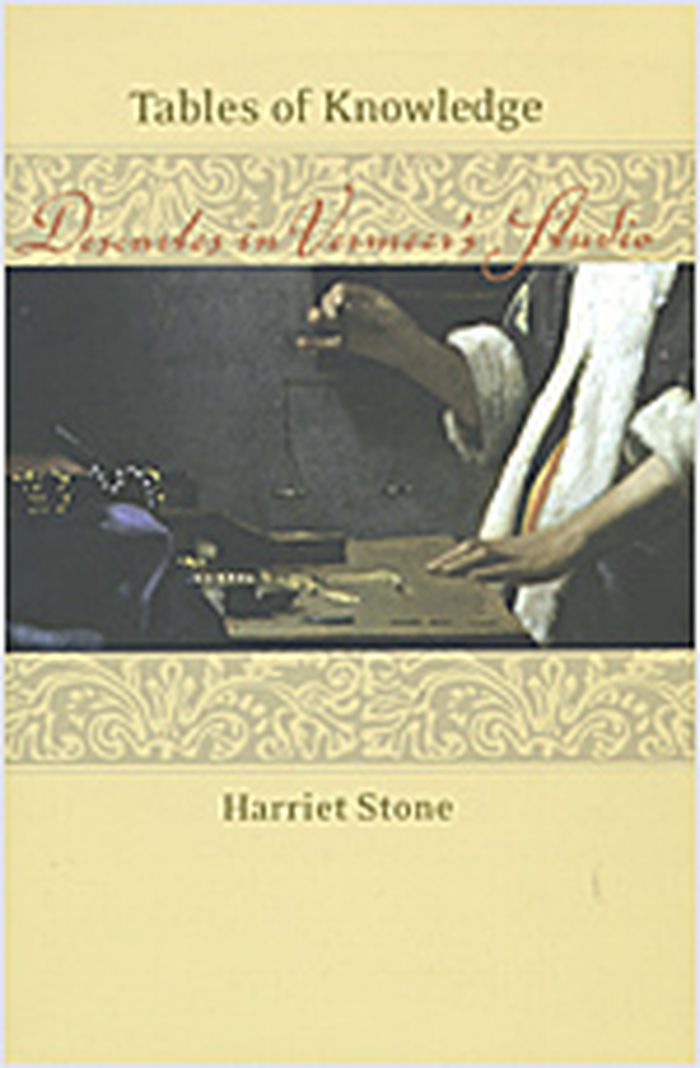
Descartes believed that his analytic model applied to all fields of research and that all branches of science lead to truth. His many analogies with literature and art notwithstanding, Descartes offers an entry into knowledge that fails nevertheless to take into account how in the seventeenth century Dutch painters such as Vermeer similarly order a view of the world by concentrating on the properties of individual objects. Descartes's celebrated scientific method offers a protocol for conducting experiments; Harriet Stone argues that this method can also serve as a guide for classifying the findings obtained from experiments. Tables of Knowledge shows that Dutch genre paintings and still lifes enact in visual form a process of recording information similar to that of science, with intriguing results. Stone investigates such diverse topics as seventeenth-century advances in optics and the attendant explosion of data about the natural world; the proliferation of material goods in prosperous Dutch homes; and the compelling realism of Golden Age paintings. Vermeer and his contemporaries, she contends, transform a potentially threatening consumerism into the viewer's aesthetic pleasure. The artists' depictions of rooms where framed images and maps adorn walls and where fruit, shimmering glassware, gold pieces, and other precious items are set out on tables constitute an inventory of middle-class life. Appealing to both the eye and the mind, Dutch paintings convey meaning by accentuating the luxury of objects displayed in all their specificity. While not without its voyeuristic, sensual, and even lascivious overtones, art offered the Dutch, who labored under the moral austerity of the Protestant Church, a way of bearing witness to ordinary experience that was unmistakably satisfying and surprisingly Cartesian.
Tables of knowledge : Descartes in Vermeer's studio
Actions:
Prix:
$49.95
(disponible sur commande)
Résumé:
Descartes believed that his analytic model applied to all fields of research and that all branches of science lead to truth. His many analogies with literature and art notwithstanding, Descartes offers an entry into knowledge that fails nevertheless to take into account how in the seventeenth century Dutch painters such as Vermeer similarly order a view of the world by concentrating on the properties of individual objects. Descartes's celebrated scientific method offers a protocol for conducting experiments; Harriet Stone argues that this method can also serve as a guide for classifying the findings obtained from experiments. Tables of Knowledge shows that Dutch genre paintings and still lifes enact in visual form a process of recording information similar to that of science, with intriguing results. Stone investigates such diverse topics as seventeenth-century advances in optics and the attendant explosion of data about the natural world; the proliferation of material goods in prosperous Dutch homes; and the compelling realism of Golden Age paintings. Vermeer and his contemporaries, she contends, transform a potentially threatening consumerism into the viewer's aesthetic pleasure. The artists' depictions of rooms where framed images and maps adorn walls and where fruit, shimmering glassware, gold pieces, and other precious items are set out on tables constitute an inventory of middle-class life. Appealing to both the eye and the mind, Dutch paintings convey meaning by accentuating the luxury of objects displayed in all their specificity. While not without its voyeuristic, sensual, and even lascivious overtones, art offered the Dutch, who labored under the moral austerity of the Protestant Church, a way of bearing witness to ordinary experience that was unmistakably satisfying and surprisingly Cartesian.
Classification:
livres
livres
Publication:
juillet 2006, Ithaca
juillet 2006, Ithaca
Sujet:
Théorie de l’architecture
Théorie de l’architecture
Classification:
livres
livres
Prix:
$62.50
(disponible sur commande)
Résumé:
The narrative of the artist's life and work is one of the oldest models in the Western literature of the visual arts. In "Art as existence", Gabriele Guercio investigates the metamorphosis of the artist's monograph, tracing its formal and conceptual trajectories from Vasari's sixteenth-century "Lives of the painters, sculptors, and architects" (which provided the model(...)
$62.50
(disponible sur commande)
Résumé:
The narrative of the artist's life and work is one of the oldest models in the Western literature of the visual arts. In "Art as existence", Gabriele Guercio investigates the metamorphosis of the artist's monograph, tracing its formal and conceptual trajectories from Vasari's sixteenth-century "Lives of the painters, sculptors, and architects" (which provided the model(...)
Titre:
Art as existence : the artist's monograph and its project
Actions:
Prix:
$62.50
(disponible sur commande)
Résumé:
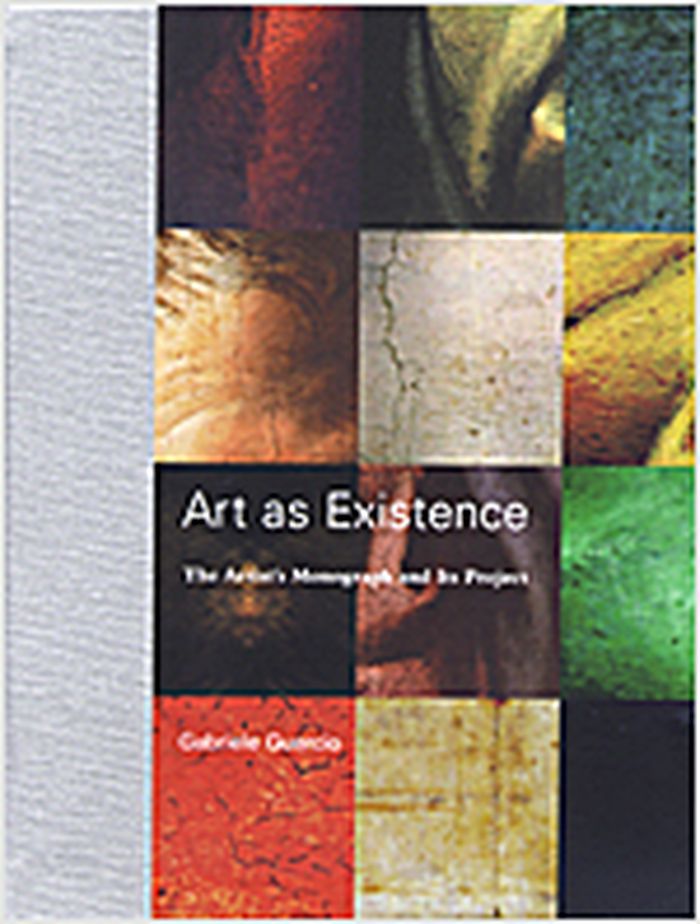
The narrative of the artist's life and work is one of the oldest models in the Western literature of the visual arts. In "Art as existence", Gabriele Guercio investigates the metamorphosis of the artist's monograph, tracing its formal and conceptual trajectories from Vasari's sixteenth-century "Lives of the painters, sculptors, and architects" (which provided the model and source for the genre) through its apogee in the nineteenth century and decline in the twentieth. He looks at the legacy of the life-and-work model and considers its prospects in an intellectual universe of deconstructionism, psychoanalysis, feminism, and postcolonialism. Since Vasari, the monograph has been notable for its fluidity and variety; it can be scrupulous and exact, probing and revelatory, poetic and imaginative, or any combination of these. In the nineteenth century, the monograph combined art-historical, biographical, and critical methods, and even added elements of fiction. Guercio explores some significant books that illustrate key phases in the model's evolution, including works by Gustav Friedrich Waagen, A. C. Quatremère de Quincy, Johann David Passavant, Bernard Berenson, and others. The hidden project of the artist's monograph, Guercio claims, comes from a utopian impulse; by commuting biography into art and art into biography, the life-and-work model equates art and existence, construing otherwise distinct works of an artist as chapters of a life story. Guercio calls for a contemporary reconsideration of the life-and-work model, arguing that the ultimate legacy of the artist's monograph does not lie in its established modes of writing but in its greater project and in the intimate portrait that we gain of the nature of creativity.
Art as existence : the artist's monograph and its project
Actions:
Prix:
$62.50
(disponible sur commande)
Résumé:
The narrative of the artist's life and work is one of the oldest models in the Western literature of the visual arts. In "Art as existence", Gabriele Guercio investigates the metamorphosis of the artist's monograph, tracing its formal and conceptual trajectories from Vasari's sixteenth-century "Lives of the painters, sculptors, and architects" (which provided the model and source for the genre) through its apogee in the nineteenth century and decline in the twentieth. He looks at the legacy of the life-and-work model and considers its prospects in an intellectual universe of deconstructionism, psychoanalysis, feminism, and postcolonialism. Since Vasari, the monograph has been notable for its fluidity and variety; it can be scrupulous and exact, probing and revelatory, poetic and imaginative, or any combination of these. In the nineteenth century, the monograph combined art-historical, biographical, and critical methods, and even added elements of fiction. Guercio explores some significant books that illustrate key phases in the model's evolution, including works by Gustav Friedrich Waagen, A. C. Quatremère de Quincy, Johann David Passavant, Bernard Berenson, and others. The hidden project of the artist's monograph, Guercio claims, comes from a utopian impulse; by commuting biography into art and art into biography, the life-and-work model equates art and existence, construing otherwise distinct works of an artist as chapters of a life story. Guercio calls for a contemporary reconsideration of the life-and-work model, arguing that the ultimate legacy of the artist's monograph does not lie in its established modes of writing but in its greater project and in the intimate portrait that we gain of the nature of creativity.
Classification:
livres
livres
Publication:
janvier 1900, Cambridge, London
janvier 1900, Cambridge, London
Sujet:
Théorie de l’art
Théorie de l’art
Classification:
livres
livres
Actions:
Prix:
$30.00
(disponible sur commande)
Résumé:
What is a designer proposes what design could be: there is no question mark in its title. Potter’s book is unusual in combining elevated ideas with down-to-earth advice. The first edition was published by Studio Vista in 1969. The second edition, published by Hyphen Press in 1980, was a very different work: completely reset and with new chapters that doubled the book in(...)
$30.00
(disponible sur commande)
Résumé:
What is a designer proposes what design could be: there is no question mark in its title. Potter’s book is unusual in combining elevated ideas with down-to-earth advice. The first edition was published by Studio Vista in 1969. The second edition, published by Hyphen Press in 1980, was a very different work: completely reset and with new chapters that doubled the book in(...)
Titre:
What is a designer : things, places, messages
Actions:
Prix:
$30.00
(disponible sur commande)
Résumé:
What is a designer proposes what design could be: there is no question mark in its title. Potter’s book is unusual in combining elevated ideas with down-to-earth advice. The first edition was published by Studio Vista in 1969. The second edition, published by Hyphen Press in 1980, was a very different work: completely reset and with new chapters that doubled the book in extent. A third edition (1989) incorporated revisions and updatings, and included a new introduction in which Norman Potter considered his own position in the light of the tremendous changes of the 1980s: some sharp blows were delivered at ‘designer culture’. Now, after the author’s death in 1995, the book is reissued in what must be a final edition: the outdated references again excised, to leave the enduring core of Potter’s arguments. The three parts of the book are signalled visibly by a change of paper colour. The first part contains a sequence of quite general essays. A number of central ideas are discussed here. Design is essentially a useful and modest art. The designer is at the service of the community. These principles should animate education. Potter casts a critical and sceptical eye over the realities of design education. In the reference section the book stands apart from other literature on design, in its discussions of the processes of getting work done. Finally there is a set of appendixes, prodding the reader into thought and action. The book has no visual illustrations. By this means it achieves a greater generality of reference and — true to its critical principles — avoids giving readers models for imitation. The book includes an afterword by Robin Kinross.
What is a designer : things, places, messages
Actions:
Prix:
$30.00
(disponible sur commande)
Résumé:
What is a designer proposes what design could be: there is no question mark in its title. Potter’s book is unusual in combining elevated ideas with down-to-earth advice. The first edition was published by Studio Vista in 1969. The second edition, published by Hyphen Press in 1980, was a very different work: completely reset and with new chapters that doubled the book in extent. A third edition (1989) incorporated revisions and updatings, and included a new introduction in which Norman Potter considered his own position in the light of the tremendous changes of the 1980s: some sharp blows were delivered at ‘designer culture’. Now, after the author’s death in 1995, the book is reissued in what must be a final edition: the outdated references again excised, to leave the enduring core of Potter’s arguments. The three parts of the book are signalled visibly by a change of paper colour. The first part contains a sequence of quite general essays. A number of central ideas are discussed here. Design is essentially a useful and modest art. The designer is at the service of the community. These principles should animate education. Potter casts a critical and sceptical eye over the realities of design education. In the reference section the book stands apart from other literature on design, in its discussions of the processes of getting work done. Finally there is a set of appendixes, prodding the reader into thought and action. The book has no visual illustrations. By this means it achieves a greater generality of reference and — true to its critical principles — avoids giving readers models for imitation. The book includes an afterword by Robin Kinross.
Classification:
livres
livres
Publication:
avril 2002, London
avril 2002, London
Classification:
livres
livres
Titre:
The city reader 4th edition
The city reader 4th edition
Actions:
Prix:
$83.95
(disponible sur commande)
Résumé:
The fourth edition of the highly successful The City Reader brings together the very best of publications on the city. Classic writings by such authors as Lewis Mumford, Ernest W. Burgess, LeCorbusier, Lewis Wirth, Jane Jacobs and Kevin Lynch meet the best contemporary writings of, among others, Sir Peter Hall, Richard Florida, Mike Davis, Michael Porter, Robert Putnam,(...)
$83.95
(disponible sur commande)
Résumé:
The fourth edition of the highly successful The City Reader brings together the very best of publications on the city. Classic writings by such authors as Lewis Mumford, Ernest W. Burgess, LeCorbusier, Lewis Wirth, Jane Jacobs and Kevin Lynch meet the best contemporary writings of, among others, Sir Peter Hall, Richard Florida, Mike Davis, Michael Porter, Robert Putnam,(...)
Sujet:
Théorie de l’urbanisme
Théorie de l’urbanisme
Publication:
août 2007, London New York
août 2007, London New York
Titre:
The city reader 4th edition
Actions:
Prix:
$83.95
(disponible sur commande)
Résumé:
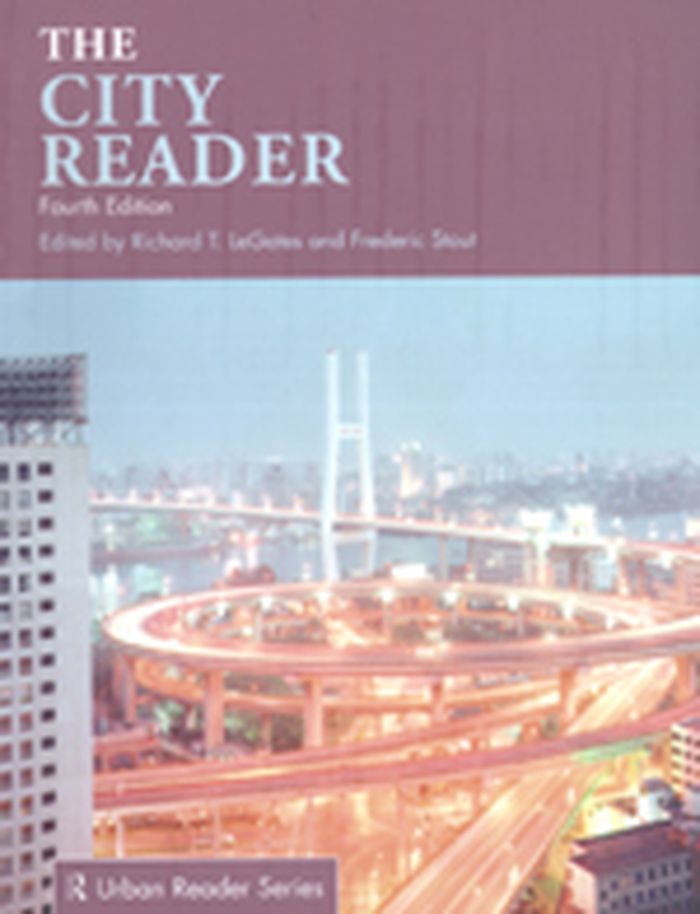
The fourth edition of the highly successful The City Reader brings together the very best of publications on the city. Classic writings by such authors as Lewis Mumford, Ernest W. Burgess, LeCorbusier, Lewis Wirth, Jane Jacobs and Kevin Lynch meet the best contemporary writings of, among others, Sir Peter Hall, Richard Florida, Mike Davis, Michael Porter, Robert Putnam, Andrus Duany, Saskia Sassen, and Manuel Castells. New to the fourth edition are important classic writings on urban economics by Wilbur Thomson and on bosses and machines by James Bryce, Jane Addams, and William L. Riordan, and new contemporary material on sustainable urban development , the creative class, metropolitics, occidentalism, Asian megacities, and urban futurism by The Bruntland Commission, Richard Florida, Myron Orfield, Ian Buruma and Avishai Margalit, Aprodicio Laquian, and Joel Kotkin. Fifty-seven generous selections are included: a combination of forty-six readings from the third edition and eleven entirely new selections. Structured to aid student understanding, the anthology features main and part Introductions, as well as individual introductions to the selected articles. Each selection is introduced with a brief intellectual biography and a review of the author s writings and related literature, an explanation of how the piece fits into the broader context of urban history and practice, competing ideological perspectives on the city, and the major current debates concerning race and gender, globalization, terrorism, the impact of information technology on cities, civic engagement, and postmodernism. The City Reader provides the comprehensive mapping of the terrain of Urban Studies, old and new. It is illustrated with over forty photographs and is essential reading for anyone interested in the city.
The city reader 4th edition
Actions:
Prix:
$83.95
(disponible sur commande)
Résumé:
The fourth edition of the highly successful The City Reader brings together the very best of publications on the city. Classic writings by such authors as Lewis Mumford, Ernest W. Burgess, LeCorbusier, Lewis Wirth, Jane Jacobs and Kevin Lynch meet the best contemporary writings of, among others, Sir Peter Hall, Richard Florida, Mike Davis, Michael Porter, Robert Putnam, Andrus Duany, Saskia Sassen, and Manuel Castells. New to the fourth edition are important classic writings on urban economics by Wilbur Thomson and on bosses and machines by James Bryce, Jane Addams, and William L. Riordan, and new contemporary material on sustainable urban development , the creative class, metropolitics, occidentalism, Asian megacities, and urban futurism by The Bruntland Commission, Richard Florida, Myron Orfield, Ian Buruma and Avishai Margalit, Aprodicio Laquian, and Joel Kotkin. Fifty-seven generous selections are included: a combination of forty-six readings from the third edition and eleven entirely new selections. Structured to aid student understanding, the anthology features main and part Introductions, as well as individual introductions to the selected articles. Each selection is introduced with a brief intellectual biography and a review of the author s writings and related literature, an explanation of how the piece fits into the broader context of urban history and practice, competing ideological perspectives on the city, and the major current debates concerning race and gender, globalization, terrorism, the impact of information technology on cities, civic engagement, and postmodernism. The City Reader provides the comprehensive mapping of the terrain of Urban Studies, old and new. It is illustrated with over forty photographs and is essential reading for anyone interested in the city.
Classification:
livres
livres
Publication:
août 2007, London New York
août 2007, London New York
Sujet:
Théorie de l’urbanisme
Théorie de l’urbanisme
Classification:
livres
livres
Titre:
Thirtyfour campgrounds
Thirtyfour campgrounds
Actions:
Prix:
$51.00
(disponible sur commande)
Résumé:
Camping can make us feel a powerful connection to nature and our rugged backwoods forebears. Campers once confronted the elemental facts of life, but now, the millions of Americans taking to the road on camping trips are more likely to drive to a campground, hook up service conduits, connect to WiFi, drop their awnings, and set out patio chairs. It is as if, Martin Hogue(...)
$51.00
(disponible sur commande)
Résumé:
Camping can make us feel a powerful connection to nature and our rugged backwoods forebears. Campers once confronted the elemental facts of life, but now, the millions of Americans taking to the road on camping trips are more likely to drive to a campground, hook up service conduits, connect to WiFi, drop their awnings, and set out patio chairs. It is as if, Martin Hogue(...)
Titre:
Thirtyfour campgrounds
Actions:
Prix:
$51.00
(disponible sur commande)
Résumé:
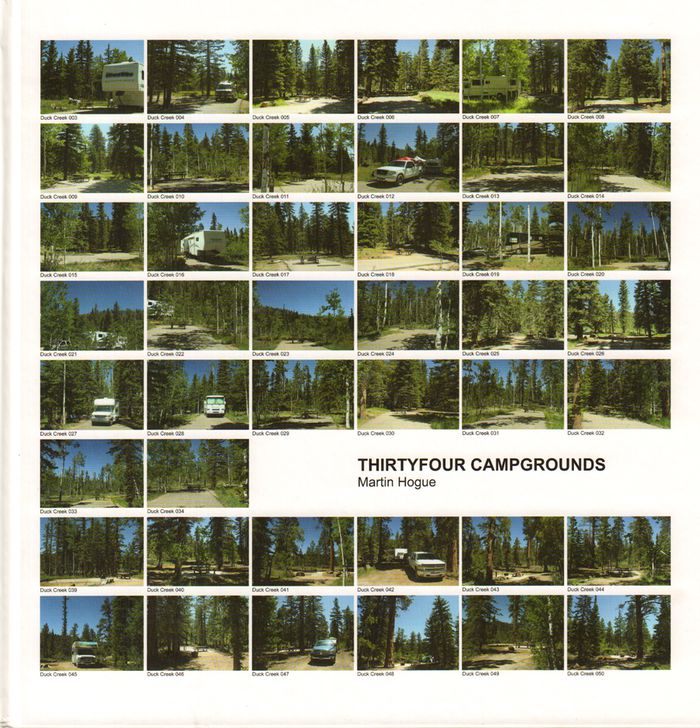
Camping can make us feel a powerful connection to nature and our rugged backwoods forebears. Campers once confronted the elemental facts of life, but now, the millions of Americans taking to the road on camping trips are more likely to drive to a campground, hook up service conduits, connect to WiFi, drop their awnings, and set out patio chairs. It is as if, Martin Hogue observes, each campsite functions as a stage upon which campers perform a series of ritualized activities (pitching the tent, building a fire, cooking over flames). In Thirtyfour Campgrounds, Hogue investigates these sites, individually and in multiples, offering a photographic and typological survey of nearly 6,500 American campsites, mapping subtle differences within the apparently identical. The central part of the book consists of color photographs of individual campsites, downloaded from such online reservation websites as reserveamerica.com and recreation.gov, organized by zip code, and arranged in grids across the pages. Hogue nods to artist Ed Ruscha's Thirtyfour Parking Lots for his title and its attitude, and to the work of Bernd and Hilla Becher for the serial arrangement of images in grids. The campsite pictures seem at first endlessly repetitious; but then the repetition makes way for difference. Time reveals itself in fading light and passing clouds, the weather changes between photographs of neighboring sites, leaves turn color and fall, in an unexpected kind of time-lapse photography. This is a book that was made so seriously that it must (not) be taken too seriously. More scientific than any campground literature, Thirtyfour Campgrounds calls the very nature of scientific survey, research, and publication into question.
Thirtyfour campgrounds
Actions:
Prix:
$51.00
(disponible sur commande)
Résumé:
Camping can make us feel a powerful connection to nature and our rugged backwoods forebears. Campers once confronted the elemental facts of life, but now, the millions of Americans taking to the road on camping trips are more likely to drive to a campground, hook up service conduits, connect to WiFi, drop their awnings, and set out patio chairs. It is as if, Martin Hogue observes, each campsite functions as a stage upon which campers perform a series of ritualized activities (pitching the tent, building a fire, cooking over flames). In Thirtyfour Campgrounds, Hogue investigates these sites, individually and in multiples, offering a photographic and typological survey of nearly 6,500 American campsites, mapping subtle differences within the apparently identical. The central part of the book consists of color photographs of individual campsites, downloaded from such online reservation websites as reserveamerica.com and recreation.gov, organized by zip code, and arranged in grids across the pages. Hogue nods to artist Ed Ruscha's Thirtyfour Parking Lots for his title and its attitude, and to the work of Bernd and Hilla Becher for the serial arrangement of images in grids. The campsite pictures seem at first endlessly repetitious; but then the repetition makes way for difference. Time reveals itself in fading light and passing clouds, the weather changes between photographs of neighboring sites, leaves turn color and fall, in an unexpected kind of time-lapse photography. This is a book that was made so seriously that it must (not) be taken too seriously. More scientific than any campground literature, Thirtyfour Campgrounds calls the very nature of scientific survey, research, and publication into question.
Classification:
livres
livres
Publication:
septembre 2016
septembre 2016
Sujet:
Théorie du paysage
Théorie du paysage
Classification:
livres
livres
Prix:
$29.95
(disponible sur commande)
Résumé:
Once considered a mere caretaker for collections, the curator is now widely viewed as a globally connected auteur. Over the last twenty-five years, as international group exhibitions and biennials have become the dominant mode of presenting contemporary art to the public, curatorship has begun to be perceived as a constellation of creative activities not unlike artistic(...)
$29.95
(disponible sur commande)
Résumé:
Once considered a mere caretaker for collections, the curator is now widely viewed as a globally connected auteur. Over the last twenty-five years, as international group exhibitions and biennials have become the dominant mode of presenting contemporary art to the public, curatorship has begun to be perceived as a constellation of creative activities not unlike artistic(...)
Titre:
The culture of curating and the curating of culture(s)
Actions:
Prix:
$29.95
(disponible sur commande)
Résumé:
Once considered a mere caretaker for collections, the curator is now widely viewed as a globally connected auteur. Over the last twenty-five years, as international group exhibitions and biennials have become the dominant mode of presenting contemporary art to the public, curatorship has begun to be perceived as a constellation of creative activities not unlike artistic praxis. The curator has gone from being a behind-the-scenes organizer and selector to a visible, centrally important cultural producer. In The Culture of Curating and the Curating of Culture(s), Paul O’Neill examines the emergence of independent curatorship and the discourse that helped to establish it. O’Neill describes how, by the 1980s, curated group exhibitions - large-scale, temporary projects with artworks cast as illustrative fragments - came to be understood as the creative work of curator-auteurs. The proliferation of new biennials and other large international exhibitions in the 1990s created a cohort of high-profile, globally mobile curators, moving from Venice to Paris to Kassel. In the 1990s, curatorial and artistic practice converged, blurring the distinction between artist and curator. O’Neill argues that this change in the understanding of curatorship was shaped by a curator-centered discourse that effectively advocated - and authorized - the new independent curatorial practice. Drawing on the extensive curatorial literature and his own interviews with leading curators, critics, art historians, and artists, O’Neill traces the development of the curator-as-artist model and the ways it has been contested. The Culture of Curating and the Curating of Culture(s) documents the many ways in which our perception of art has been transformed by curating and the discourses surrounding it.
The culture of curating and the curating of culture(s)
Actions:
Prix:
$29.95
(disponible sur commande)
Résumé:
Once considered a mere caretaker for collections, the curator is now widely viewed as a globally connected auteur. Over the last twenty-five years, as international group exhibitions and biennials have become the dominant mode of presenting contemporary art to the public, curatorship has begun to be perceived as a constellation of creative activities not unlike artistic praxis. The curator has gone from being a behind-the-scenes organizer and selector to a visible, centrally important cultural producer. In The Culture of Curating and the Curating of Culture(s), Paul O’Neill examines the emergence of independent curatorship and the discourse that helped to establish it. O’Neill describes how, by the 1980s, curated group exhibitions - large-scale, temporary projects with artworks cast as illustrative fragments - came to be understood as the creative work of curator-auteurs. The proliferation of new biennials and other large international exhibitions in the 1990s created a cohort of high-profile, globally mobile curators, moving from Venice to Paris to Kassel. In the 1990s, curatorial and artistic practice converged, blurring the distinction between artist and curator. O’Neill argues that this change in the understanding of curatorship was shaped by a curator-centered discourse that effectively advocated - and authorized - the new independent curatorial practice. Drawing on the extensive curatorial literature and his own interviews with leading curators, critics, art historians, and artists, O’Neill traces the development of the curator-as-artist model and the ways it has been contested. The Culture of Curating and the Curating of Culture(s) documents the many ways in which our perception of art has been transformed by curating and the discourses surrounding it.
Classification:
livres
livres
Publication:
septembre 2012
septembre 2012
Sujet:
Muséologie
Muséologie
Classification:
livres
livres
Actions:
Prix:
$26.95
(disponible sur commande)
Résumé:
Rapid urban growth and suburban sprawl have heightened concern in many quarters about sustainable development. Are economic growth and environmental health always mutually exclusive goals? Nearly everyone would choose to pursue both given the chance, but many believe that it would be overly optimistic — perhaps naïve — to expect both. "Green city" proponents, however, do(...)
$26.95
(disponible sur commande)
Résumé:
Rapid urban growth and suburban sprawl have heightened concern in many quarters about sustainable development. Are economic growth and environmental health always mutually exclusive goals? Nearly everyone would choose to pursue both given the chance, but many believe that it would be overly optimistic — perhaps naïve — to expect both. "Green city" proponents, however, do(...)
Titre:
Green cities : urban growth and the environment
Actions:
Prix:
$26.95
(disponible sur commande)
Résumé:
Rapid urban growth and suburban sprawl have heightened concern in many quarters about sustainable development. Are economic growth and environmental health always mutually exclusive goals? Nearly everyone would choose to pursue both given the chance, but many believe that it would be overly optimistic — perhaps naïve — to expect both. "Green city" proponents, however, do hope to realize both ambitions. What exactly is a green city? What does it mean to say that San Francisco is greener than Houston, or that Vancouver is a green city while Beijing is not? When does urban growth lower environmental quality, and when does it produce environmental gains? These are the questions that drive this smart and engaging book. In "Green cities", Matthew Kahn surveys the burgeoning economic literature on the environmental consequences of urban growth. He discusses the environmental Kuznets curve, which theorizes that the relationship between environmental quality and per capita income follows a bell-shaped curve. The heart of the book unpacks and expands this notion by tracing the environmental effects of economic growth, population growth, and suburban sprawl. Kahn considers how cities can deal with the environmental challenges produced by growth. His concluding chapter addresses the role of cities in promoting climate change and asks how cities in turn are likely to be affected by this trend. Kahn considers the evidence for and against rival perspectives throughout the book. Despite being labeled as purveyors of a "dismal science," economists are often quite optimistic about the relationship between urban development and the environment. In contrast, many ecologists remain wary of the environmental consequences of free-market growth. "Green cities" does not try to settle this dispute. Instead, it marshals data and arguments to convey the excitement of an ongoing debate, enabling readers to formulate well-informed opinions and priorities on this critically important issue.
Green cities : urban growth and the environment
Actions:
Prix:
$26.95
(disponible sur commande)
Résumé:
Rapid urban growth and suburban sprawl have heightened concern in many quarters about sustainable development. Are economic growth and environmental health always mutually exclusive goals? Nearly everyone would choose to pursue both given the chance, but many believe that it would be overly optimistic — perhaps naïve — to expect both. "Green city" proponents, however, do hope to realize both ambitions. What exactly is a green city? What does it mean to say that San Francisco is greener than Houston, or that Vancouver is a green city while Beijing is not? When does urban growth lower environmental quality, and when does it produce environmental gains? These are the questions that drive this smart and engaging book. In "Green cities", Matthew Kahn surveys the burgeoning economic literature on the environmental consequences of urban growth. He discusses the environmental Kuznets curve, which theorizes that the relationship between environmental quality and per capita income follows a bell-shaped curve. The heart of the book unpacks and expands this notion by tracing the environmental effects of economic growth, population growth, and suburban sprawl. Kahn considers how cities can deal with the environmental challenges produced by growth. His concluding chapter addresses the role of cities in promoting climate change and asks how cities in turn are likely to be affected by this trend. Kahn considers the evidence for and against rival perspectives throughout the book. Despite being labeled as purveyors of a "dismal science," economists are often quite optimistic about the relationship between urban development and the environment. In contrast, many ecologists remain wary of the environmental consequences of free-market growth. "Green cities" does not try to settle this dispute. Instead, it marshals data and arguments to convey the excitement of an ongoing debate, enabling readers to formulate well-informed opinions and priorities on this critically important issue.
Classification:
livres
livres
Publication:
août 2006, Washington, D.C.
août 2006, Washington, D.C.
Sujet:
Théorie de l’urbanisme
Théorie de l’urbanisme
Classification:
livres
livres
Titre:
Le Corbusier's hands
Le Corbusier's hands
Actions:
Prix:
$18.95
(disponible sur commande)
Résumé:
"Le Corbusier's Hands" offers a poetic and personal portrait of Le Corbusier-a nuanced portrayal that is in contrast to the popular image of Le Corbusier the aloof modernist. The author knew Le Corbusier intimately for thirty years, first as his draftsman and main assistant, later as his colleague and personal friend. In this book, written in the mid-1980s, Wogenscky(...)
$18.95
(disponible sur commande)
Résumé:
"Le Corbusier's Hands" offers a poetic and personal portrait of Le Corbusier-a nuanced portrayal that is in contrast to the popular image of Le Corbusier the aloof modernist. The author knew Le Corbusier intimately for thirty years, first as his draftsman and main assistant, later as his colleague and personal friend. In this book, written in the mid-1980s, Wogenscky(...)
Sujet:
Architecture, monographies
Architecture, monographies
Publication:
janvier 1900, Cambridge, Mass.
janvier 1900, Cambridge, Mass.
Titre:
Le Corbusier's hands
Actions:
Prix:
$18.95
(disponible sur commande)
Résumé:
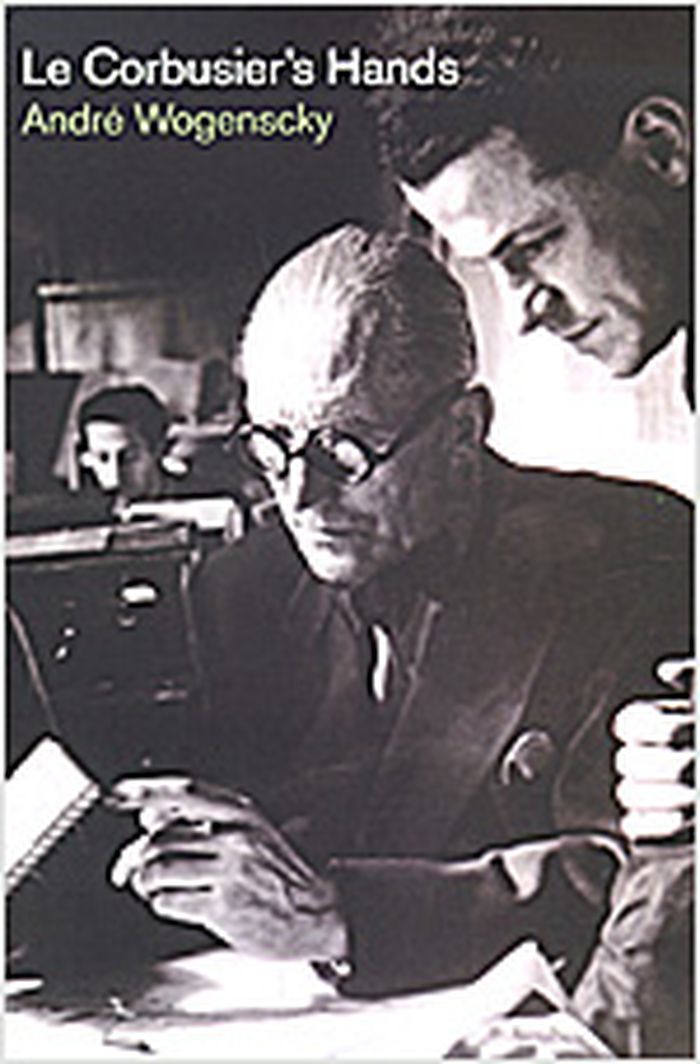
"Le Corbusier's Hands" offers a poetic and personal portrait of Le Corbusier-a nuanced portrayal that is in contrast to the popular image of Le Corbusier the aloof modernist. The author knew Le Corbusier intimately for thirty years, first as his draftsman and main assistant, later as his colleague and personal friend. In this book, written in the mid-1980s, Wogenscky remembers his mentor in a series of revealing personal statements and evocative reflections unlike anything that exists in the vast literature on Le Corbusier. Wogenscky draws a portrait in swift, deft strokes-50 short chapters, one leading to the next, one memory of Le Corbusier opening into another. Appearing and reappearing like a leitmotif are Le Corbusier's hands-touching, taking, drawing, offering, closing, opening, grasping, releasing: "It was his hands that revealed him. . . . They spoke all his feelings, all the vibrations of his inner life that his face tried to conceal." Wogenscky writes about Le Corbusier's work, including the famous design of the chapel at Ronchamp, his ideas for high-density Unités d'Habitation linked to the center of a "Radiant City," and his "Modulor" system for defining proportions-which Wogenscky compares to a piano tuner's finding the exact relation between sounds. He remembers the day Picasso spent with Le Corbusier at the Marseilles building site-"All day long they outdid one another in a show of modesty," he observes in amazement. He adds, speaking for himself and the others present, "We were inside a double energy field." And Wogenscky writes about Le Corbusier more personally. "I have spent years trying to understand what went on in his mind and in his hand," he tells us. With "Le Corbusier's hands", Wogenscky gives us a unique record of an enigmatic genius.
Le Corbusier's hands
Actions:
Prix:
$18.95
(disponible sur commande)
Résumé:
"Le Corbusier's Hands" offers a poetic and personal portrait of Le Corbusier-a nuanced portrayal that is in contrast to the popular image of Le Corbusier the aloof modernist. The author knew Le Corbusier intimately for thirty years, first as his draftsman and main assistant, later as his colleague and personal friend. In this book, written in the mid-1980s, Wogenscky remembers his mentor in a series of revealing personal statements and evocative reflections unlike anything that exists in the vast literature on Le Corbusier. Wogenscky draws a portrait in swift, deft strokes-50 short chapters, one leading to the next, one memory of Le Corbusier opening into another. Appearing and reappearing like a leitmotif are Le Corbusier's hands-touching, taking, drawing, offering, closing, opening, grasping, releasing: "It was his hands that revealed him. . . . They spoke all his feelings, all the vibrations of his inner life that his face tried to conceal." Wogenscky writes about Le Corbusier's work, including the famous design of the chapel at Ronchamp, his ideas for high-density Unités d'Habitation linked to the center of a "Radiant City," and his "Modulor" system for defining proportions-which Wogenscky compares to a piano tuner's finding the exact relation between sounds. He remembers the day Picasso spent with Le Corbusier at the Marseilles building site-"All day long they outdid one another in a show of modesty," he observes in amazement. He adds, speaking for himself and the others present, "We were inside a double energy field." And Wogenscky writes about Le Corbusier more personally. "I have spent years trying to understand what went on in his mind and in his hand," he tells us. With "Le Corbusier's hands", Wogenscky gives us a unique record of an enigmatic genius.
Classification:
livres
livres
Publication:
janvier 1900, Cambridge, Mass.
janvier 1900, Cambridge, Mass.
Sujet:
Architecture, monographies
Architecture, monographies
Classification:
livres
livres
Actions:
Prix:
$31.25
(disponible sur commande)
Résumé:
"Sowing Empire" identifies the cultivation and landscaping of colonies as one of the primary ways imperial nations justified their empires. Planting and transplanting, seeding and reshaping - the landscaping practices that emerged in the eighteenth century - are inextricable from the contested terrain of empire within which they operated. From the plantations of the(...)
$31.25
(disponible sur commande)
Résumé:
"Sowing Empire" identifies the cultivation and landscaping of colonies as one of the primary ways imperial nations justified their empires. Planting and transplanting, seeding and reshaping - the landscaping practices that emerged in the eighteenth century - are inextricable from the contested terrain of empire within which they operated. From the plantations of the(...)
Titre:
Sowing empire : landscape and colonization
Actions:
Prix:
$31.25
(disponible sur commande)
Résumé:
"Sowing Empire" identifies the cultivation and landscaping of colonies as one of the primary ways imperial nations justified their empires. Planting and transplanting, seeding and reshaping - the landscaping practices that emerged in the eighteenth century - are inextricable from the contested terrain of empire within which they operated. From the plantations of the “nabobs” to the island gardens of narrative fiction, from William Beckford’s estate at Fonthill to Marie Antoinette’s ornamented farm, "Sowing Empire" considers imperial relandscaping - its patriarchal organization, heterosexual reproduction, and slavery - and how it contributed to the construction of imperial power. At the same time, the book shows how these picturesque landscapes and sugar plantations contained within them the seeds of resistance - how, for instance, slave gardens and the Afro-Caribbean practice of Vodou threatened authority and created new possibilities for once again transforming the landscape. In an ambitious work of wide-ranging literary, visual, and historical allusion, Jill H. Casid examines how landscaping functioned in an imperial mode that defined and remade the “heartlands” of nations as well as the contact zones and colonial peripheries in the West and East Indies. Revealing the colonial landscape as far more than an agricultural system - as a means of regulating national, sexual, and gender identities - Casid also traces how the circulation of plants and hybridity influenced agriculture and landscaping on European soil and how colonial contacts materially shaped what we take as “European.” Utilizing a wide range of both visual and written sources - maps, literature, and travel writing - this book is interdisciplinary in its methodology and in its scope. Sowing Empire explores how postcolonial and queer studies can alter art history and visual studies and, in turn, what close attention to the visual may offer to both postcolonial theorizing and historically and materially based colonial cultural studies.
Sowing empire : landscape and colonization
Actions:
Prix:
$31.25
(disponible sur commande)
Résumé:
"Sowing Empire" identifies the cultivation and landscaping of colonies as one of the primary ways imperial nations justified their empires. Planting and transplanting, seeding and reshaping - the landscaping practices that emerged in the eighteenth century - are inextricable from the contested terrain of empire within which they operated. From the plantations of the “nabobs” to the island gardens of narrative fiction, from William Beckford’s estate at Fonthill to Marie Antoinette’s ornamented farm, "Sowing Empire" considers imperial relandscaping - its patriarchal organization, heterosexual reproduction, and slavery - and how it contributed to the construction of imperial power. At the same time, the book shows how these picturesque landscapes and sugar plantations contained within them the seeds of resistance - how, for instance, slave gardens and the Afro-Caribbean practice of Vodou threatened authority and created new possibilities for once again transforming the landscape. In an ambitious work of wide-ranging literary, visual, and historical allusion, Jill H. Casid examines how landscaping functioned in an imperial mode that defined and remade the “heartlands” of nations as well as the contact zones and colonial peripheries in the West and East Indies. Revealing the colonial landscape as far more than an agricultural system - as a means of regulating national, sexual, and gender identities - Casid also traces how the circulation of plants and hybridity influenced agriculture and landscaping on European soil and how colonial contacts materially shaped what we take as “European.” Utilizing a wide range of both visual and written sources - maps, literature, and travel writing - this book is interdisciplinary in its methodology and in its scope. Sowing Empire explores how postcolonial and queer studies can alter art history and visual studies and, in turn, what close attention to the visual may offer to both postcolonial theorizing and historically and materially based colonial cultural studies.
Classification:
livres
livres
Publication:
janvier 2005, Minneapolis
janvier 2005, Minneapolis
Sujet:
Théorie du paysage
Théorie du paysage
Classification:
livres
livres
Actions:
Prix:
$27.95
(disponible sur commande)
Résumé:
For Sherry Turkle, "We think with the objects we love; we love the objects we think with." In "Evocative objects", Turkle collects writings by scientists, humanists, artists, and designers that trace the power of everyday things. These essays reveal objects as emotional and intellectual companions that anchor memory, sustain relationships, and provoke new ideas. This(...)
$27.95
(disponible sur commande)
Résumé:
For Sherry Turkle, "We think with the objects we love; we love the objects we think with." In "Evocative objects", Turkle collects writings by scientists, humanists, artists, and designers that trace the power of everyday things. These essays reveal objects as emotional and intellectual companions that anchor memory, sustain relationships, and provoke new ideas. This(...)
Titre:
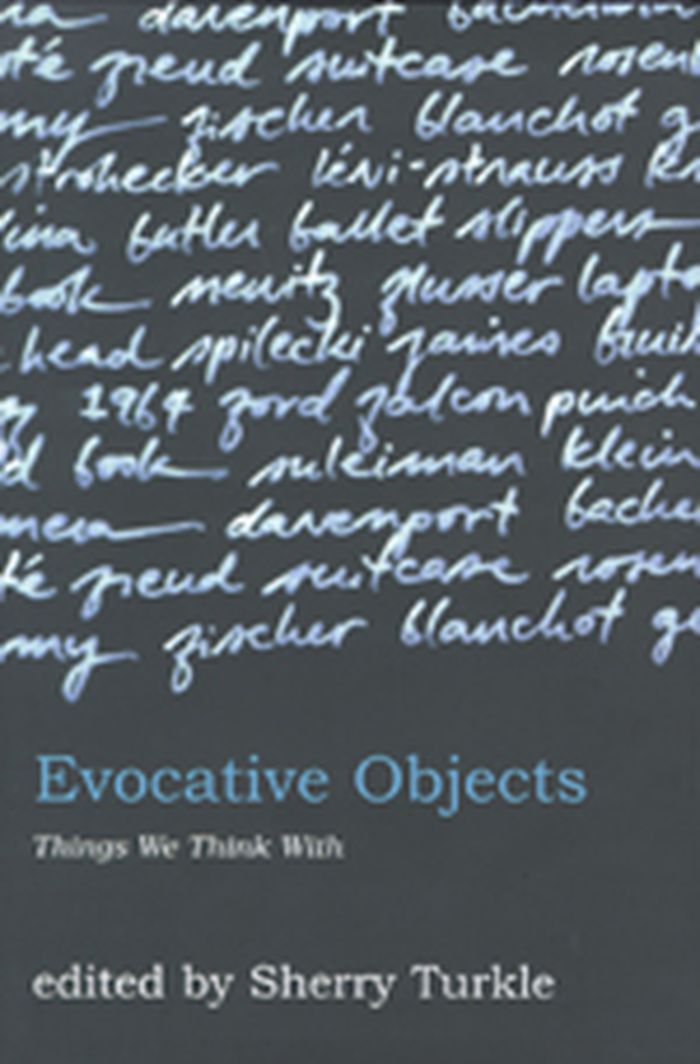
Evocative objects : things we think with
Actions:
Prix:
$27.95
(disponible sur commande)
Résumé:
For Sherry Turkle, "We think with the objects we love; we love the objects we think with." In "Evocative objects", Turkle collects writings by scientists, humanists, artists, and designers that trace the power of everyday things. These essays reveal objects as emotional and intellectual companions that anchor memory, sustain relationships, and provoke new ideas. This volume's special contribution is its focus on everyday riches: the simplest of objects - an apple, a datebook, a laptop computer - are shown to bring philosophy down to earth. The poet contends, "No ideas but in things." The notion of evocative objects goes further : objects carry both ideas and passions. In our relations to things, thought and feeling are inseparable. Whether it's a student's beloved 1964 Ford Falcon (left behind for a station wagon and motherhood), or a cello that inspires a meditation on fatherhood, the intimate objects in this collection are used to reflect on larger themes -the role of objects in design and play, discipline and desire, history and exchange, mourning and memory, transition and passage, meditation and new vision. In the interest of enriching these connections, Turkle pairs each autobiographical essay with a text from philosophy, history, literature, or theory, creating juxtapositions at once playful and profound. So we have Howard Gardner's keyboards and Lev Vygotsky's hobbyhorses; William Mitchell's Melbourne train and Roland Barthes' pleasures of text; Joseph Cevetello's glucometer and Donna Haraway's cyborgs. Each essay is framed by images that are themselves evocative. Essays by Turkle begin and end the collection, inviting us to look more closely at the everyday objects of our lives, the familiar objects that drive our routines, hold our affections, and open out our world in unexpected ways.
Evocative objects : things we think with
Actions:
Prix:
$27.95
(disponible sur commande)
Résumé:
For Sherry Turkle, "We think with the objects we love; we love the objects we think with." In "Evocative objects", Turkle collects writings by scientists, humanists, artists, and designers that trace the power of everyday things. These essays reveal objects as emotional and intellectual companions that anchor memory, sustain relationships, and provoke new ideas. This volume's special contribution is its focus on everyday riches: the simplest of objects - an apple, a datebook, a laptop computer - are shown to bring philosophy down to earth. The poet contends, "No ideas but in things." The notion of evocative objects goes further : objects carry both ideas and passions. In our relations to things, thought and feeling are inseparable. Whether it's a student's beloved 1964 Ford Falcon (left behind for a station wagon and motherhood), or a cello that inspires a meditation on fatherhood, the intimate objects in this collection are used to reflect on larger themes -the role of objects in design and play, discipline and desire, history and exchange, mourning and memory, transition and passage, meditation and new vision. In the interest of enriching these connections, Turkle pairs each autobiographical essay with a text from philosophy, history, literature, or theory, creating juxtapositions at once playful and profound. So we have Howard Gardner's keyboards and Lev Vygotsky's hobbyhorses; William Mitchell's Melbourne train and Roland Barthes' pleasures of text; Joseph Cevetello's glucometer and Donna Haraway's cyborgs. Each essay is framed by images that are themselves evocative. Essays by Turkle begin and end the collection, inviting us to look more closely at the everyday objects of our lives, the familiar objects that drive our routines, hold our affections, and open out our world in unexpected ways.
Classification:
livres
livres
Publication:
avril 2007, Cambridge (MA)
avril 2007, Cambridge (MA)
Sujet:
Théorie du design
Théorie du design


