


4858 Résultats
Classification:
livres
livres
Titre:
John Divola : three acts
John Divola : three acts
Actions:
Prix:
$60.00
(disponible sur commande)
Résumé:
In 1973, artist John Divola began the first of three highly ambitious and original bodies of work that together form this publication. The Vandalism series comprises black-and-white photographs of interiors of abandoned houses. Entering illegally, Divola spray painted expressive markings in the forms of dots, lines, and grids, creating a series of conceptual gestures that(...)
$60.00
(disponible sur commande)
Résumé:
In 1973, artist John Divola began the first of three highly ambitious and original bodies of work that together form this publication. The Vandalism series comprises black-and-white photographs of interiors of abandoned houses. Entering illegally, Divola spray painted expressive markings in the forms of dots, lines, and grids, creating a series of conceptual gestures that(...)
Titre:
John Divola : three acts
Actions:
Prix:
$60.00
(disponible sur commande)
Résumé:
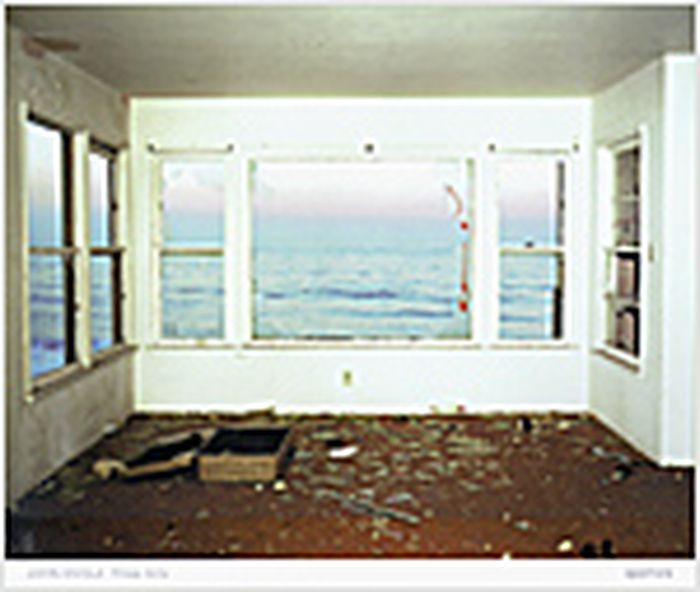
In 1973, artist John Divola began the first of three highly ambitious and original bodies of work that together form this publication. The Vandalism series comprises black-and-white photographs of interiors of abandoned houses. Entering illegally, Divola spray painted expressive markings in the forms of dots, lines, and grids, creating a series of conceptual gestures that referenced “action painting” as readily as the graffiti that was fast becoming a cultural phenomenon. The following year, Divola began the Los Angeles International Airport Noise Abatement series, photographing a condemned neighborhood bought out by the airport to serve as a noise buffer for new runways.An extensive catalog of break-ins, the photographs record the evidence of violent entries: shattered windows, doors torn from hinges, a crowbar resting in the jamb of a door pried open. The final installment in this book, the Zuma series, is the artist’s documentation of the destruction of an abandoned beachfront property. While employing similar strategies of painting and intervention, the Zuma images add variation and complexity to Divola’s established themes as they incorporate color, elements of nature, and meditation on change. These cyclical images skillfully juxtapose romantic skies and sunsets with a seaside structure that, frame by frame, deteriorates into ruin as it is vandalized by the artist and others who eventually set it on fire. Divola’s art practice shares a tradition with conceptual artists such as Bruce Nauman, whose photographs are considered to be performance or sculpture, and Robert Smithson, who used photography to investigate the built environment.
John Divola : three acts
Actions:
Prix:
$60.00
(disponible sur commande)
Résumé:
In 1973, artist John Divola began the first of three highly ambitious and original bodies of work that together form this publication. The Vandalism series comprises black-and-white photographs of interiors of abandoned houses. Entering illegally, Divola spray painted expressive markings in the forms of dots, lines, and grids, creating a series of conceptual gestures that referenced “action painting” as readily as the graffiti that was fast becoming a cultural phenomenon. The following year, Divola began the Los Angeles International Airport Noise Abatement series, photographing a condemned neighborhood bought out by the airport to serve as a noise buffer for new runways.An extensive catalog of break-ins, the photographs record the evidence of violent entries: shattered windows, doors torn from hinges, a crowbar resting in the jamb of a door pried open. The final installment in this book, the Zuma series, is the artist’s documentation of the destruction of an abandoned beachfront property. While employing similar strategies of painting and intervention, the Zuma images add variation and complexity to Divola’s established themes as they incorporate color, elements of nature, and meditation on change. These cyclical images skillfully juxtapose romantic skies and sunsets with a seaside structure that, frame by frame, deteriorates into ruin as it is vandalized by the artist and others who eventually set it on fire. Divola’s art practice shares a tradition with conceptual artists such as Bruce Nauman, whose photographs are considered to be performance or sculpture, and Robert Smithson, who used photography to investigate the built environment.
Classification:
livres
livres
Publication:
mai 2006, New York
mai 2006, New York
Sujet:
Monographies photo
Monographies photo
Classification:
livres
livres
Prix:
$63.95
(disponible sur commande)
Résumé:
Robert Smithson (1938–1973) produced his best-known work during the 1960s and early 1970s, a period in which the boundaries of the art world and the objectives of art-making were questioned perhaps more consistently and thoroughly than any time before or since. In "Robert Smithson", Ann Reynolds elucidates the complexity of Smithson’s work and thought by placing them in(...)
$63.95
(disponible sur commande)
Résumé:
Robert Smithson (1938–1973) produced his best-known work during the 1960s and early 1970s, a period in which the boundaries of the art world and the objectives of art-making were questioned perhaps more consistently and thoroughly than any time before or since. In "Robert Smithson", Ann Reynolds elucidates the complexity of Smithson’s work and thought by placing them in(...)
Publication:
novembre 2002, Cambridge, Mass.
novembre 2002, Cambridge, Mass.
Titre:
Robert Smithson : learning from New Jersey and elsewhere
Actions:
Prix:
$63.95
(disponible sur commande)
Résumé:
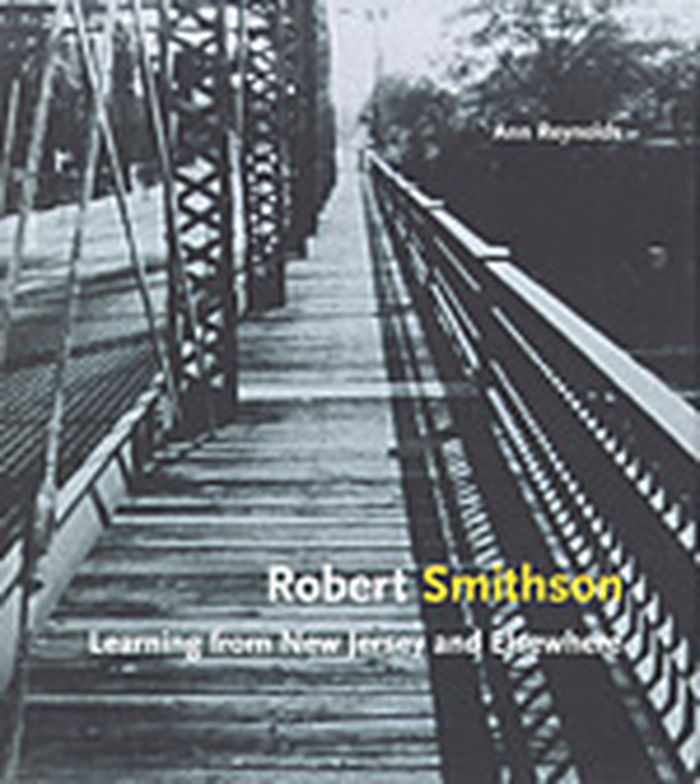
Robert Smithson (1938–1973) produced his best-known work during the 1960s and early 1970s, a period in which the boundaries of the art world and the objectives of art-making were questioned perhaps more consistently and thoroughly than any time before or since. In "Robert Smithson", Ann Reynolds elucidates the complexity of Smithson’s work and thought by placing them in their historical context, a context greatly enhanced by the vast archival materials that Smithson’s widow, Nancy Holt, donated to the Archives of American Art in 1987. The archive provides Reynolds with the remnants of Smithson’s working life--magazines, postcards from other artists, notebooks, and perhaps most important, his library--from which she reconstructs the physical and conceptual world that Smithson inhabited. Reynolds explores the relation of Smithson’s art-making, thinking about art-making, writing, and interaction with other artists to the articulated ideology and discreet assumptions that determined the parameters of artistic practice of the time. A central focus of Reynolds’s analysis is Smithson’s fascination with the blind spots at the center of established ways of seeing and thinking about culture. For Smithson, New Jersey was such a blind spot, and he returned there again and again, alone and with fellow artists, to make art that, through its location alone, undermined assumptions about what and, more important, where, art should be. For those who guarded the integrity of the established art world, New Jersey was "elsewhere"; but for Smithson, "elsewheres" were the defining, if often forgotten, locations on the map of contemporary culture.
Robert Smithson : learning from New Jersey and elsewhere
Actions:
Prix:
$63.95
(disponible sur commande)
Résumé:
Robert Smithson (1938–1973) produced his best-known work during the 1960s and early 1970s, a period in which the boundaries of the art world and the objectives of art-making were questioned perhaps more consistently and thoroughly than any time before or since. In "Robert Smithson", Ann Reynolds elucidates the complexity of Smithson’s work and thought by placing them in their historical context, a context greatly enhanced by the vast archival materials that Smithson’s widow, Nancy Holt, donated to the Archives of American Art in 1987. The archive provides Reynolds with the remnants of Smithson’s working life--magazines, postcards from other artists, notebooks, and perhaps most important, his library--from which she reconstructs the physical and conceptual world that Smithson inhabited. Reynolds explores the relation of Smithson’s art-making, thinking about art-making, writing, and interaction with other artists to the articulated ideology and discreet assumptions that determined the parameters of artistic practice of the time. A central focus of Reynolds’s analysis is Smithson’s fascination with the blind spots at the center of established ways of seeing and thinking about culture. For Smithson, New Jersey was such a blind spot, and he returned there again and again, alone and with fellow artists, to make art that, through its location alone, undermined assumptions about what and, more important, where, art should be. For those who guarded the integrity of the established art world, New Jersey was "elsewhere"; but for Smithson, "elsewheres" were the defining, if often forgotten, locations on the map of contemporary culture.
Classification:
livres
livres
Publication:
novembre 2002, Cambridge, Mass.
novembre 2002, Cambridge, Mass.
Classification:
livres
livres
Actions:
Prix:
$79.25
(disponible sur commande)
Résumé:
'More would be unnecessary, less impossible', is designer Bruno Ninaber van Eyben's principle. His work, for which he was the first to receive the Kho Liang Ie Award in 1979, is characterized by silent dialogues between form, function, technology and material. From a minimalist position Ninaber van Eyben searches for pragmatic solutions to make functional objects, always(...)
$79.25
(disponible sur commande)
Résumé:
'More would be unnecessary, less impossible', is designer Bruno Ninaber van Eyben's principle. His work, for which he was the first to receive the Kho Liang Ie Award in 1979, is characterized by silent dialogues between form, function, technology and material. From a minimalist position Ninaber van Eyben searches for pragmatic solutions to make functional objects, always(...)
Titre:
Bruno Ninaber van Eyben with compliments
Actions:
Prix:
$79.25
(disponible sur commande)
Résumé:
'More would be unnecessary, less impossible', is designer Bruno Ninaber van Eyben's principle. His work, for which he was the first to receive the Kho Liang Ie Award in 1979, is characterized by silent dialogues between form, function, technology and material. From a minimalist position Ninaber van Eyben searches for pragmatic solutions to make functional objects, always keeping in touch with the end product's poetic quality. Among other classics he gave the wristwatch (1973), the neck watch (1976) and the TL lamp (1977) to the world. His watches are still commercially successful. In 1980 Ninaber designed the Dutch coin series with the portrait of H.M. Queen Beatrix and eighteen years later his design won the competition for the Dutch side of the Euro coin. His products grace museum collections in the Netherlands and also abroad, notably at the Museum of Modern Art in New York. Together with Wolfram Peters and Peter Krouwel he founded the industrial design studio n|p|k in 1985. He was its co-director for twelve years. In 1997 he started a new office, Bruno Ninaber van Eyben design & production. It develops high-quality and sometimes more personal products independently and for a limited number of customers, such as the Prime Minister's national gift, the chairperson's gavel for Parliament and the new chain of office for the mayor of Papendrecht, a small town near Rotterdam. "With compliments" is not a traditional monograph. It is mainly a story in images, showing Ninaber's products and sources of inspiration. Short, strong statements underline the images and provide them with a context.
Bruno Ninaber van Eyben with compliments
Actions:
Prix:
$79.25
(disponible sur commande)
Résumé:
'More would be unnecessary, less impossible', is designer Bruno Ninaber van Eyben's principle. His work, for which he was the first to receive the Kho Liang Ie Award in 1979, is characterized by silent dialogues between form, function, technology and material. From a minimalist position Ninaber van Eyben searches for pragmatic solutions to make functional objects, always keeping in touch with the end product's poetic quality. Among other classics he gave the wristwatch (1973), the neck watch (1976) and the TL lamp (1977) to the world. His watches are still commercially successful. In 1980 Ninaber designed the Dutch coin series with the portrait of H.M. Queen Beatrix and eighteen years later his design won the competition for the Dutch side of the Euro coin. His products grace museum collections in the Netherlands and also abroad, notably at the Museum of Modern Art in New York. Together with Wolfram Peters and Peter Krouwel he founded the industrial design studio n|p|k in 1985. He was its co-director for twelve years. In 1997 he started a new office, Bruno Ninaber van Eyben design & production. It develops high-quality and sometimes more personal products independently and for a limited number of customers, such as the Prime Minister's national gift, the chairperson's gavel for Parliament and the new chain of office for the mayor of Papendrecht, a small town near Rotterdam. "With compliments" is not a traditional monograph. It is mainly a story in images, showing Ninaber's products and sources of inspiration. Short, strong statements underline the images and provide them with a context.
Classification:
livres
livres
Publication:
janvier 2002, Rotterdam
janvier 2002, Rotterdam
Sujet:
Design, monographies
Design, monographies
Classification:
périodiques
périodiques
Titre:
Asian perspectives.
Asian perspectives.
Actions:
Auteur:
Sujet:
Publication:
Honolulu : University of Hawaii Press
Honolulu : University of Hawaii Press
Classification:
périodiques
périodiques
Publication:
Honolulu : University of Hawaii Press
Honolulu : University of Hawaii Press
Auteur:
Sujet:
Classification:
périodiques
périodiques
Titre:
Sudan notes and records.
Sudan notes and records.
Actions:
Description:
1 online resource (volumes) illustrations
Auteur:
Sujet:
Publication:
Khartoum Sudan Notes and Records.
Khartoum Sudan Notes and Records.
Classification:
périodiques
périodiques
Publication:
Khartoum Sudan Notes and Records.
Khartoum Sudan Notes and Records.
Auteur:
Sujet:
Classification:
périodiques
périodiques
Titre:
Annals.
Annals.
Actions:
Description:
1 online resource (volumes) illustrations
Auteur:
Sujet:
Publication:
Poona [1919]-
Poona [1919]-
Classification:
périodiques
périodiques
Publication:
Poona [1919]-
Poona [1919]-
Auteur:
Sujet:
Classification:
livres
livres
Actions:
Prix:
$48.95
(disponible sur commande)
Résumé:
In 1973 the critic and curator Lucy R. Lippard published Six Years, a book with possibly the longest subtitle in the bibliography of art: The dematerialization of the art object from 1966 to 1972: a cross-reference book of information on some esthetic boundaries: consisting of a bibliography into which are inserted a fragmented text, art works, documents, interviews, and(...)
$48.95
(disponible sur commande)
Résumé:
In 1973 the critic and curator Lucy R. Lippard published Six Years, a book with possibly the longest subtitle in the bibliography of art: The dematerialization of the art object from 1966 to 1972: a cross-reference book of information on some esthetic boundaries: consisting of a bibliography into which are inserted a fragmented text, art works, documents, interviews, and(...)
Titre:
Materializing Six Years : Lucy R. Lippard and the emergence of Conceptual Art
Actions:
Prix:
$48.95
(disponible sur commande)
Résumé:
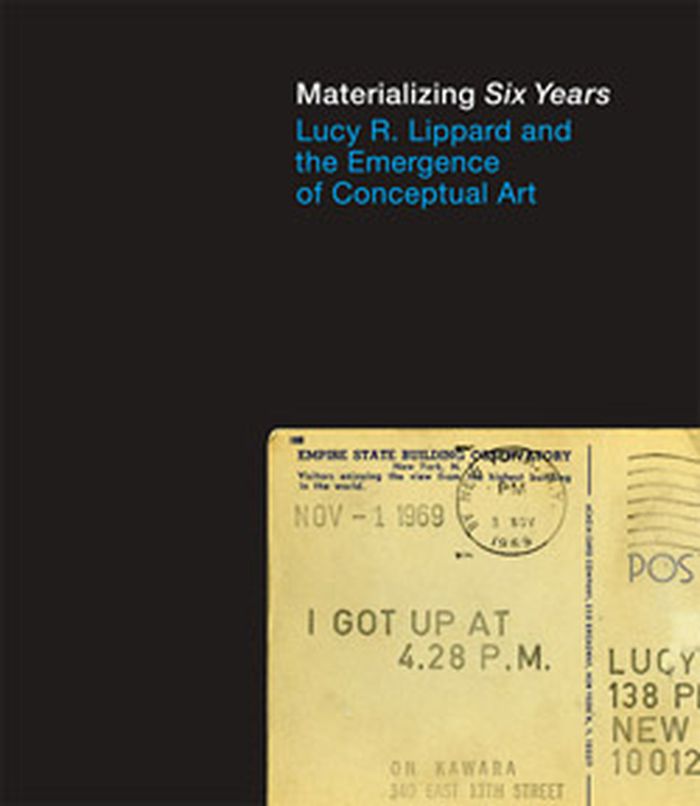
In 1973 the critic and curator Lucy R. Lippard published Six Years, a book with possibly the longest subtitle in the bibliography of art: The dematerialization of the art object from 1966 to 1972: a cross-reference book of information on some esthetic boundaries: consisting of a bibliography into which are inserted a fragmented text, art works, documents, interviews, and symposia, arranged chronologically and focused on so-called conceptual or information or idea art with mentions of such vaguely designated areas as minimal, anti-form, systems, earth, or process art, occurring now in the Americas, Europe, England, Australia, and Asia (with occasional political overtones) edited and annotated by Lucy R. Lippard. Six Years, sometimes referred to as a conceptual art object itself, not only described and embodied the new type of art-making that Lippard was intent on identifying and cataloging, it also exemplified a new way of criticizing and curating art. Nearly forty years later, the Brooklyn Museum takes Lippard’s celebrated experiment in curated concatenation as a template, turning a book that resembled an exhibition into an exhibition materializing the ideas in her book. The artworks and essays featured in this publication recall the thrill that was tangible in Lippard's original documentation, reminding us that during the late sixties and early seventies all possible social and material parameters of art (making) were played with, worked over, inverted, reduced, expanded, and rejected. By tracing Lippard’s own activities in those years, the book also documents the early blurring of boundaries among critical, curatorial, and artistic practices. With more than 200 images of work by dozens of artists (printed in color throughout), this book brings Lippard’s curatorial experiment full circle.
Materializing Six Years : Lucy R. Lippard and the emergence of Conceptual Art
Actions:
Prix:
$48.95
(disponible sur commande)
Résumé:
In 1973 the critic and curator Lucy R. Lippard published Six Years, a book with possibly the longest subtitle in the bibliography of art: The dematerialization of the art object from 1966 to 1972: a cross-reference book of information on some esthetic boundaries: consisting of a bibliography into which are inserted a fragmented text, art works, documents, interviews, and symposia, arranged chronologically and focused on so-called conceptual or information or idea art with mentions of such vaguely designated areas as minimal, anti-form, systems, earth, or process art, occurring now in the Americas, Europe, England, Australia, and Asia (with occasional political overtones) edited and annotated by Lucy R. Lippard. Six Years, sometimes referred to as a conceptual art object itself, not only described and embodied the new type of art-making that Lippard was intent on identifying and cataloging, it also exemplified a new way of criticizing and curating art. Nearly forty years later, the Brooklyn Museum takes Lippard’s celebrated experiment in curated concatenation as a template, turning a book that resembled an exhibition into an exhibition materializing the ideas in her book. The artworks and essays featured in this publication recall the thrill that was tangible in Lippard's original documentation, reminding us that during the late sixties and early seventies all possible social and material parameters of art (making) were played with, worked over, inverted, reduced, expanded, and rejected. By tracing Lippard’s own activities in those years, the book also documents the early blurring of boundaries among critical, curatorial, and artistic practices. With more than 200 images of work by dozens of artists (printed in color throughout), this book brings Lippard’s curatorial experiment full circle.
Classification:
livres
livres
Publication:
septembre 2012
septembre 2012
Sujet:
Théorie de l’art
Théorie de l’art
Classification:
périodiques
périodiques
Description:
1 online resource
Auteur:
Sujet:
Publication:
México : Universidad Nacional Autónoma de México, Instituto de Investigaciones Económicas, 1969-
México : Universidad Nacional Autónoma de México, Instituto de Investigaciones Económicas, 1969-
Titre:
Problemas del desarrollo : revista latinoamericana de economía.
Actions:
Description:
1 online resource
Problemas del desarrollo : revista latinoamericana de economía.
Actions:
Description:
1 online resource
Classification:
périodiques
périodiques
Publication:
México : Universidad Nacional Autónoma de México, Instituto de Investigaciones Económicas, 1969-
México : Universidad Nacional Autónoma de México, Instituto de Investigaciones Económicas, 1969-
Auteur:
Sujet:
Classification:
périodiques
périodiques
Description:
1 online resource (volumes) : illustrations
Auteur:
Sujet:
Publication:
Damas : Institut français de Damas, 1931-, Damas : Institut français du Proche-Orient
Damas : Institut français de Damas, 1931-, Damas : Institut français du Proche-Orient
Titre:
Bulletin d'études orientales / Institut français de Damas.
Actions:
Description:
1 online resource (volumes) : illustrations
Bulletin d'études orientales / Institut français de Damas.
Actions:
Description:
1 online resource (volumes) : illustrations
Classification:
périodiques
périodiques
Publication:
Damas : Institut français de Damas, 1931-, Damas : Institut français du Proche-Orient
Damas : Institut français de Damas, 1931-, Damas : Institut français du Proche-Orient
Auteur:
Sujet:
Classification:
livres
livres
Actions:
Exemplaires:
Description:
131, [5] pages illustrations, map 24 cm.
Description:
131, [5] pages illustrations, map 24 cm.
Auteur:
Sujet:
Publication:
[Paris] Arthaud [1970]
[Paris] Arthaud [1970]
Titre:
Le Mz̕ab; architecture ibadite en Algérie.
Actions:
Exemplaires:
Description:
131, [5] pages illustrations, map 24 cm.
Le Mz̕ab; architecture ibadite en Algérie.
Actions:
Exemplaires:
Description:
131, [5] pages illustrations, map 24 cm.
Classification:
livres
livres
Publication:
[Paris] Arthaud [1970]
[Paris] Arthaud [1970]
Auteur:
Sujet:


