


13794 Résultats
Classification:
livres
livres
Titre:
The Paul Virilio reader
The Paul Virilio reader
Actions:
Prix:
$31.95
(disponible sur commande)
Résumé:
If nothing else, the war in Iraq and the 1991 Gulf War have taught us much about media and technology as key players in how war is waged, packaged for public consumption, and exported in real time to the rest of the globe. A critic of the art of technology, Paul Virilio has keenly observed that media images quite often constitute a strategy of war and that accident is(...)
$31.95
(disponible sur commande)
Résumé:
If nothing else, the war in Iraq and the 1991 Gulf War have taught us much about media and technology as key players in how war is waged, packaged for public consumption, and exported in real time to the rest of the globe. A critic of the art of technology, Paul Virilio has keenly observed that media images quite often constitute a strategy of war and that accident is(...)
Titre:
The Paul Virilio reader
Actions:
Prix:
$31.95
(disponible sur commande)
Résumé:
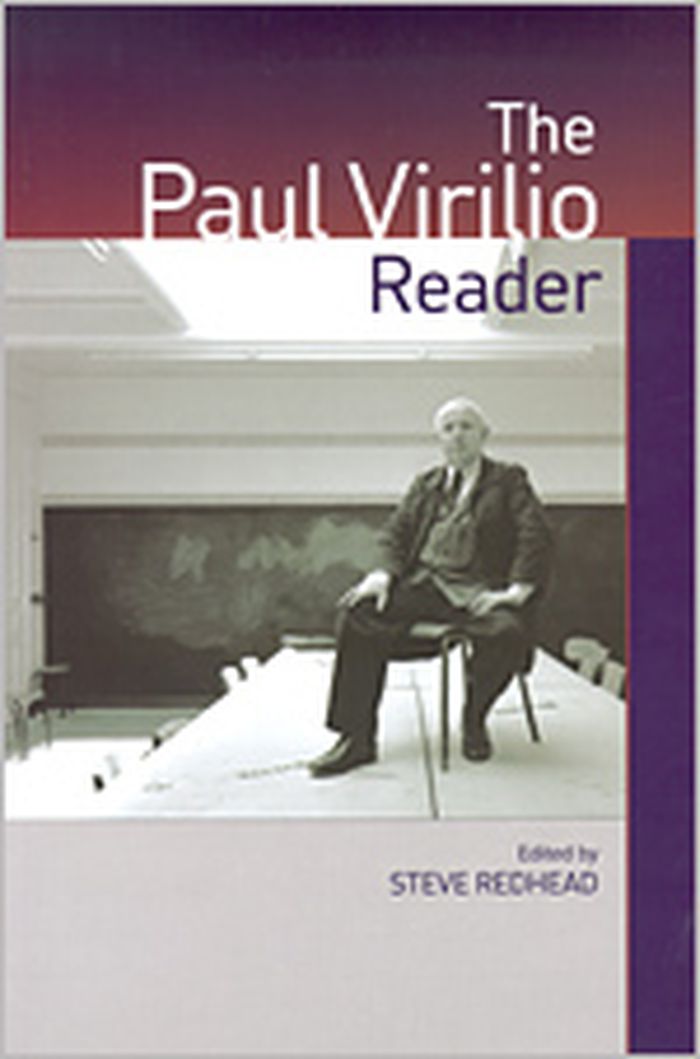
If nothing else, the war in Iraq and the 1991 Gulf War have taught us much about media and technology as key players in how war is waged, packaged for public consumption, and exported in real time to the rest of the globe. A critic of the art of technology, Paul Virilio has keenly observed that media images quite often constitute a strategy of war and that accident is becoming indistinguishable from attack. For more than fifty years Virilio has offered incisive and provocative criticism on technology and its moral, political, and cultural implications. Yet until now, much of his work, originally published in French, remains elusive in full English translation. "The Paul Virilio Reader" collects for the first time English extracts reflecting the entire range of Virilio’s diverse career. The book’s introduction demonstrates that Virilio has produced an important—if controversial—“theory at the speed of light” that uncannily illuminates the impact of new information and communications technologies in a world that collapses time and distance as never before. The inventor of “dromology,” which views speed as a defining concept for contemporary civilization, Virilio is noted for his proclamation that the logic of ever-increasing acceleration lies at the heart of the organization and transformation of the contemporary world. Arranged chronologically, "The Paul Virilio Reader" illustrates the development and interconnectedness of Virilio’s work. Each extract is prefaced by bibliographical and contextual commentary, and the book includes an innovative guide to reading Virilio.
The Paul Virilio reader
Actions:
Prix:
$31.95
(disponible sur commande)
Résumé:
If nothing else, the war in Iraq and the 1991 Gulf War have taught us much about media and technology as key players in how war is waged, packaged for public consumption, and exported in real time to the rest of the globe. A critic of the art of technology, Paul Virilio has keenly observed that media images quite often constitute a strategy of war and that accident is becoming indistinguishable from attack. For more than fifty years Virilio has offered incisive and provocative criticism on technology and its moral, political, and cultural implications. Yet until now, much of his work, originally published in French, remains elusive in full English translation. "The Paul Virilio Reader" collects for the first time English extracts reflecting the entire range of Virilio’s diverse career. The book’s introduction demonstrates that Virilio has produced an important—if controversial—“theory at the speed of light” that uncannily illuminates the impact of new information and communications technologies in a world that collapses time and distance as never before. The inventor of “dromology,” which views speed as a defining concept for contemporary civilization, Virilio is noted for his proclamation that the logic of ever-increasing acceleration lies at the heart of the organization and transformation of the contemporary world. Arranged chronologically, "The Paul Virilio Reader" illustrates the development and interconnectedness of Virilio’s work. Each extract is prefaced by bibliographical and contextual commentary, and the book includes an innovative guide to reading Virilio.
Classification:
livres
livres
Publication:
janvier 1900, New York
janvier 1900, New York
Sujet:
Théorie de l’architecture
Théorie de l’architecture
Classification:
livres
livres
![[Re] reading Perspecta : the first 50 years of the Yale Architectural Journal](/img-bookstore/U2zEypAg4vNoqdQ07aKvxPIdXbM=/700x919/MIG-13694.jpg)
Actions:
Prix:
$93.95
(disponible sur commande)
Résumé:
"Perspecta", the oldest and most respected student-edited architectural journal in the United States, marks its fiftieth anniversary with this selection of influential and provocative pieces published in its pages from the 1950s through the 1990s. The essays and portfolios in "[Re]Reading Perspecta" trace the development of architectural culture and discourse over the(...)
$93.95
(disponible sur commande)
Résumé:
"Perspecta", the oldest and most respected student-edited architectural journal in the United States, marks its fiftieth anniversary with this selection of influential and provocative pieces published in its pages from the 1950s through the 1990s. The essays and portfolios in "[Re]Reading Perspecta" trace the development of architectural culture and discourse over the(...)
Sujet:
Théorie de l’architecture
Théorie de l’architecture
Publication:
mai 2004, Cambridge, Massachusetts
mai 2004, Cambridge, Massachusetts
Titre:
[Re] reading Perspecta : the first 50 years of the Yale Architectural Journal
Actions:
Prix:
$93.95
(disponible sur commande)
Résumé:
"Perspecta", the oldest and most respected student-edited architectural journal in the United States, marks its fiftieth anniversary with this selection of influential and provocative pieces published in its pages from the 1950s through the 1990s. The essays and portfolios in "[Re]Reading Perspecta" trace the development of architectural culture and discourse over the past fifty years and bear witness to the influential role played by "Perspecta" in a time of crucial debate about the function and future of architecture. This collection (with over 800 pages and 900 images) presents engaging and stimulating essays published in "Perspecta", written by such well-known historians, theorists, and architects as Vincent Scully, Colin Rowe, Roland Barthes, Karsten Harries, K. Michael Hays, Allan Greenberg, Sibyl Moholy-Nagy, John Hejduk, Francesco Dal Co, Bernard Tschumi, and Mark Wigley. "[Re]Reading Perspecta" also assembles the best examples of the richly-illustrated portfolios of projects published over the years, including work by Paul Rudolph, Louis Kahn, Robert Venturi, Eero Saarinen, Charles Moore, Philip Johnson, Peter Eisenman, John Hejduk, Steven Holl, Thomas Leeser, Hani Rashid, and others. The editors introduce each section with essays that offer historical context and critical commentary. "[Re]Reading Perspecta" also includes essays by Kenneth Frampton, K. Michael Hays, Joan Ockman, and Sandy Isenstadt on the history of "Perspecta" and its role in architectural discourse. This selection of the best of "Perspecta" covers a broad and lively spectrum of American architectural design, history, theory, and criticism.
[Re] reading Perspecta : the first 50 years of the Yale Architectural Journal
Actions:
Prix:
$93.95
(disponible sur commande)
Résumé:
"Perspecta", the oldest and most respected student-edited architectural journal in the United States, marks its fiftieth anniversary with this selection of influential and provocative pieces published in its pages from the 1950s through the 1990s. The essays and portfolios in "[Re]Reading Perspecta" trace the development of architectural culture and discourse over the past fifty years and bear witness to the influential role played by "Perspecta" in a time of crucial debate about the function and future of architecture. This collection (with over 800 pages and 900 images) presents engaging and stimulating essays published in "Perspecta", written by such well-known historians, theorists, and architects as Vincent Scully, Colin Rowe, Roland Barthes, Karsten Harries, K. Michael Hays, Allan Greenberg, Sibyl Moholy-Nagy, John Hejduk, Francesco Dal Co, Bernard Tschumi, and Mark Wigley. "[Re]Reading Perspecta" also assembles the best examples of the richly-illustrated portfolios of projects published over the years, including work by Paul Rudolph, Louis Kahn, Robert Venturi, Eero Saarinen, Charles Moore, Philip Johnson, Peter Eisenman, John Hejduk, Steven Holl, Thomas Leeser, Hani Rashid, and others. The editors introduce each section with essays that offer historical context and critical commentary. "[Re]Reading Perspecta" also includes essays by Kenneth Frampton, K. Michael Hays, Joan Ockman, and Sandy Isenstadt on the history of "Perspecta" and its role in architectural discourse. This selection of the best of "Perspecta" covers a broad and lively spectrum of American architectural design, history, theory, and criticism.
Classification:
livres
livres
Publication:
mai 2004, Cambridge, Massachusetts
mai 2004, Cambridge, Massachusetts
Sujet:
Théorie de l’architecture
Théorie de l’architecture
Classification:
livres
livres
Actions:
Exemplaires:
Description:
352 pages : illustrations (some color) ; 30 cm.
Description:
352 pages : illustrations (some color) ; 30 cm.
Auteur:
Sujet:
Publication:
Roma : Gangemi, [1994]
Roma : Gangemi, [1994]
Titre:
Città giardino : cento anni di teorie, modelli, esperienze / a cura di Gabriele Tagliaventi = Garden city : a century of theories, models, experiences / edited by Gabriele Tagliaventi.
Actions:
Exemplaires:
Description:
352 pages : illustrations (some color) ; 30 cm.
Città giardino : cento anni di teorie, modelli, esperienze / a cura di Gabriele Tagliaventi = Garden city : a century of theories, models, experiences / edited by Gabriele Tagliaventi.
Actions:
Exemplaires:
Description:
352 pages : illustrations (some color) ; 30 cm.
Classification:
livres
livres
Publication:
Roma : Gangemi, [1994]
Roma : Gangemi, [1994]
Auteur:
Sujet:
Classification:
livres
livres
Actions:
Exemplaires:
Description:
xvii, 258 pages : illustrations ; 26 cm
Description:
xvii, 258 pages : illustrations ; 26 cm
Auteur:
Sujet:
Publication:
Cambridge ; New York : Cambridge University Press, 1994.
Cambridge ; New York : Cambridge University Press, 1994.
Titre:
Transformations in design : a formal approach to stylistic change and innovation in the visual arts / Terry W. Knight.
Actions:
Exemplaires:
Description:
xvii, 258 pages : illustrations ; 26 cm
Transformations in design : a formal approach to stylistic change and innovation in the visual arts / Terry W. Knight.
Actions:
Exemplaires:
Description:
xvii, 258 pages : illustrations ; 26 cm
Classification:
livres
livres
Publication:
Cambridge ; New York : Cambridge University Press, 1994.
Cambridge ; New York : Cambridge University Press, 1994.
Auteur:
Sujet:
Classification:
livres
livres
Titre:
Casa mondo: food
Casa mondo: food
Actions:
Prix:
$27.00
(disponible sur commande)
Résumé:
This publication is a narrative essay that discusses what food is and what it represents in the 21st century, suggesting a theory on the relationship between food-home and the new means of use, especially in light of the pandemic that has transformed our daily lives.
$27.00
(disponible sur commande)
Résumé:
This publication is a narrative essay that discusses what food is and what it represents in the 21st century, suggesting a theory on the relationship between food-home and the new means of use, especially in light of the pandemic that has transformed our daily lives.
Titre:
Casa mondo: food
Actions:
Prix:
$27.00
(disponible sur commande)
Résumé:
This publication is a narrative essay that discusses what food is and what it represents in the 21st century, suggesting a theory on the relationship between food-home and the new means of use, especially in light of the pandemic that has transformed our daily lives.
Casa mondo: food
Actions:
Prix:
$27.00
(disponible sur commande)
Résumé:
This publication is a narrative essay that discusses what food is and what it represents in the 21st century, suggesting a theory on the relationship between food-home and the new means of use, especially in light of the pandemic that has transformed our daily lives.
Classification:
livres
livres
Publication:
décembre 2021
décembre 2021
Sujet:
Bouffe
Bouffe
Classification:
livres
livres
Titre:
David Joselit : After art
David Joselit : After art
Actions:
Prix:
$34.95
(disponible sur commande)
Résumé:
Examining the work of architectural firms such as OMA, Reiser + Umemoto, and Foreign Office, as well as the art of Matthew Barney, Ai Weiwei, Sherrie Levine, and many others, After Art provides a compelling and original theory of art and architecture in the age of global networks.
$34.95
(disponible sur commande)
Résumé:
Examining the work of architectural firms such as OMA, Reiser + Umemoto, and Foreign Office, as well as the art of Matthew Barney, Ai Weiwei, Sherrie Levine, and many others, After Art provides a compelling and original theory of art and architecture in the age of global networks.
Publication:
novembre 2012
novembre 2012
Titre:
David Joselit : After art
Actions:
Prix:
$34.95
(disponible sur commande)
Résumé:
Examining the work of architectural firms such as OMA, Reiser + Umemoto, and Foreign Office, as well as the art of Matthew Barney, Ai Weiwei, Sherrie Levine, and many others, After Art provides a compelling and original theory of art and architecture in the age of global networks.
David Joselit : After art
Actions:
Prix:
$34.95
(disponible sur commande)
Résumé:
Examining the work of architectural firms such as OMA, Reiser + Umemoto, and Foreign Office, as well as the art of Matthew Barney, Ai Weiwei, Sherrie Levine, and many others, After Art provides a compelling and original theory of art and architecture in the age of global networks.
Classification:
livres
livres
Publication:
novembre 2012
novembre 2012
Classification:
livres
livres
Actions:
Exemplaires:
Description:
xiii, 342 pages : illustrations, facsimiles, plans ; 21 cm
Description:
xiii, 342 pages : illustrations, facsimiles, plans ; 21 cm
Auteur:
Sujet:
Publication:
Abingdon, Oxon ; New York, NY : Routledge, 2009.
Abingdon, Oxon ; New York, NY : Routledge, 2009.
Titre:
Cities design and evolution / Stephen Marshall.
Actions:
Exemplaires:
Description:
xiii, 342 pages : illustrations, facsimiles, plans ; 21 cm
Cities design and evolution / Stephen Marshall.
Actions:
Exemplaires:
Description:
xiii, 342 pages : illustrations, facsimiles, plans ; 21 cm
Classification:
livres
livres
Publication:
Abingdon, Oxon ; New York, NY : Routledge, 2009.
Abingdon, Oxon ; New York, NY : Routledge, 2009.
Auteur:
Sujet:
Classification:
livres
livres
Actions:
Exemplaires:
Description:
xvi, 304 pages : illustrations ; 27 cm
Description:
xvi, 304 pages : illustrations ; 27 cm
Auteur:
Sujet:
Publication:
New Haven : Yale University Press, [2014], ©2014
New Haven : Yale University Press, [2014], ©2014
Titre:
Origins of classical architecture : temples, orders and gifts to the gods in ancient Greece / Mark Wilson Jones.
Actions:
Exemplaires:
Description:
xvi, 304 pages : illustrations ; 27 cm
Origins of classical architecture : temples, orders and gifts to the gods in ancient Greece / Mark Wilson Jones.
Actions:
Exemplaires:
Description:
xvi, 304 pages : illustrations ; 27 cm
Classification:
livres
livres
Publication:
New Haven : Yale University Press, [2014], ©2014
New Haven : Yale University Press, [2014], ©2014
Auteur:
Sujet:
Classification:
livres
livres
Exemplaires:
Description:
267 pages : illustrations (some color) ; 22 cm
Description:
267 pages : illustrations (some color) ; 22 cm
Auteur:
Sujet:
Publication:
Barcelona : Actar, 2005.
Barcelona : Actar, 2005.
Titre:
Victor Gruen : from urban shop to new city / Alex Wall.
Actions:
Exemplaires:
Description:
267 pages : illustrations (some color) ; 22 cm
Victor Gruen : from urban shop to new city / Alex Wall.
Actions:
Exemplaires:
Description:
267 pages : illustrations (some color) ; 22 cm
Classification:
livres
livres
Publication:
Barcelona : Actar, 2005.
Barcelona : Actar, 2005.
Auteur:
Sujet:
Classification:
livres
livres
Actions:
Exemplaires:
Description:
137 pages : illustrations ; 22 cm.
Description:
137 pages : illustrations ; 22 cm.
Auteur:
Sujet:
Publication:
New York : Princeton Architectural Press, ©1999.
New York : Princeton Architectural Press, ©1999.
Titre:
ECO-TEC : architecture of the in-between / Amerigo Marras, editor.
Actions:
Exemplaires:
Description:
137 pages : illustrations ; 22 cm.
ECO-TEC : architecture of the in-between / Amerigo Marras, editor.
Actions:
Exemplaires:
Description:
137 pages : illustrations ; 22 cm.
Classification:
livres
livres
Publication:
New York : Princeton Architectural Press, ©1999.
New York : Princeton Architectural Press, ©1999.
Auteur:
Sujet:


