


6300 Résultats
Classification:
livres
livres

Actions:
Prix:
$37.95
(disponible sur commande)
Résumé:
This is not a book about sound. It is a study of sounds that aims to write the resonance and response they call for. John Mowitt seeks to critique existing models in the expanding field of sound studies and draw attention to sound as an object of study that solicits a humanistic approach encompassing many types of sounds, not just readily classified examples such as(...)
$37.95
(disponible sur commande)
Résumé:
This is not a book about sound. It is a study of sounds that aims to write the resonance and response they call for. John Mowitt seeks to critique existing models in the expanding field of sound studies and draw attention to sound as an object of study that solicits a humanistic approach encompassing many types of sounds, not just readily classified examples such as(...)
Titre:
Sounds: the ambient humanities
Actions:
Prix:
$37.95
(disponible sur commande)
Résumé:
This is not a book about sound. It is a study of sounds that aims to write the resonance and response they call for. John Mowitt seeks to critique existing models in the expanding field of sound studies and draw attention to sound as an object of study that solicits a humanistic approach encompassing many types of sounds, not just readily classified examples such as speech, music, industrial sounds, or codified signals. Mowitt is particularly interested in the fact that beyond hearing and listening we “audit” sounds and do so by drawing on paradigms of thought not easily accommodated within the concept of "sound studies." To draw attention to the ways in which sounds often are not perceived for the social and political functions they serve, each chapter presents a culturally resonant sound—including a whistle, an echo, a gasp, and silence—to show how sounds enable critical social and political concepts such as dialogue, privacy, memory, social order, and art-making. Sounds: The Ambient Humanities significantly engages, provokes, and contributes to the dynamic field and inquiry of sound studies.
Sounds: the ambient humanities
Actions:
Prix:
$37.95
(disponible sur commande)
Résumé:
This is not a book about sound. It is a study of sounds that aims to write the resonance and response they call for. John Mowitt seeks to critique existing models in the expanding field of sound studies and draw attention to sound as an object of study that solicits a humanistic approach encompassing many types of sounds, not just readily classified examples such as speech, music, industrial sounds, or codified signals. Mowitt is particularly interested in the fact that beyond hearing and listening we “audit” sounds and do so by drawing on paradigms of thought not easily accommodated within the concept of "sound studies." To draw attention to the ways in which sounds often are not perceived for the social and political functions they serve, each chapter presents a culturally resonant sound—including a whistle, an echo, a gasp, and silence—to show how sounds enable critical social and political concepts such as dialogue, privacy, memory, social order, and art-making. Sounds: The Ambient Humanities significantly engages, provokes, and contributes to the dynamic field and inquiry of sound studies.
Classification:
livres
livres
Publication:
juillet 2015
juillet 2015
Sujet:
Acoustique
Acoustique
Classification:
livres
livres
Titre:
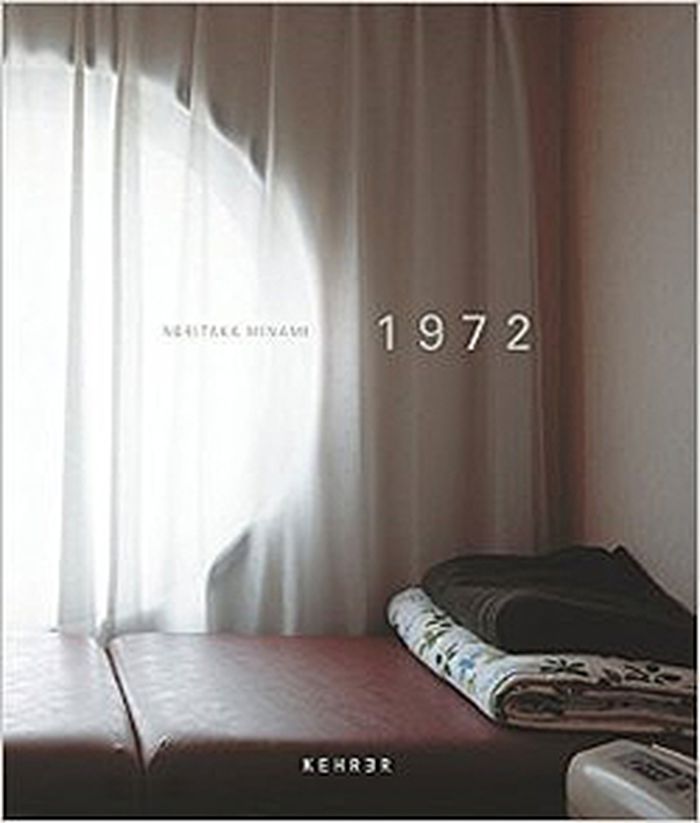
1972: Nakagin Capsule Tower
1972: Nakagin Capsule Tower
Actions:
Prix:
$66.50
(disponible sur commande)
Résumé:
In the city of Tokyo, a building stands as an anachronism in relation to the surrounding urban landscape. The building in question is the Nakagin Capsule Tower designed by Kisho Kurokawa (1934 – 2007), one of the founders of an influential architectural movement in the 1960s called Metabolism. The movement’s aim was to formulate flexible designs that facilitate continual(...)
$66.50
(disponible sur commande)
Résumé:
In the city of Tokyo, a building stands as an anachronism in relation to the surrounding urban landscape. The building in question is the Nakagin Capsule Tower designed by Kisho Kurokawa (1934 – 2007), one of the founders of an influential architectural movement in the 1960s called Metabolism. The movement’s aim was to formulate flexible designs that facilitate continual(...)
Titre:
1972: Nakagin Capsule Tower
Actions:
Prix:
$66.50
(disponible sur commande)
Résumé:
In the city of Tokyo, a building stands as an anachronism in relation to the surrounding urban landscape. The building in question is the Nakagin Capsule Tower designed by Kisho Kurokawa (1934 – 2007), one of the founders of an influential architectural movement in the 1960s called Metabolism. The movement’s aim was to formulate flexible designs that facilitate continual growth and renewal of architecture. As the first capsule apartment in history constructed for everyday use, the Nakagin Capsule Tower is considered the most ambitious attempt in implementing the principles of Metabolism. Kurokawa attached the building with 140 removable capsules to promote modifications to the structure over time, theoretically improving its capacity to adjust to the rapidly changing conditions of the post-industrial society. When the building first opened in March of 1972, it was advertised in the media to signal “the dawn of the capsule age.” At the time, Kurokawa had additional capsule projects planned in the coming years and predicted the mass production of these living unit. Noritaka Minami has been photographing the Nakagin Capsule Tower in Tokyo for the past four years.
1972: Nakagin Capsule Tower
Actions:
Prix:
$66.50
(disponible sur commande)
Résumé:
In the city of Tokyo, a building stands as an anachronism in relation to the surrounding urban landscape. The building in question is the Nakagin Capsule Tower designed by Kisho Kurokawa (1934 – 2007), one of the founders of an influential architectural movement in the 1960s called Metabolism. The movement’s aim was to formulate flexible designs that facilitate continual growth and renewal of architecture. As the first capsule apartment in history constructed for everyday use, the Nakagin Capsule Tower is considered the most ambitious attempt in implementing the principles of Metabolism. Kurokawa attached the building with 140 removable capsules to promote modifications to the structure over time, theoretically improving its capacity to adjust to the rapidly changing conditions of the post-industrial society. When the building first opened in March of 1972, it was advertised in the media to signal “the dawn of the capsule age.” At the time, Kurokawa had additional capsule projects planned in the coming years and predicted the mass production of these living unit. Noritaka Minami has been photographing the Nakagin Capsule Tower in Tokyo for the past four years.
Classification:
livres
livres
Publication:
août 2015
août 2015
Sujet:
Monographies photo
Monographies photo
Classification:
livres
livres
Actions:
Exemplaires:
Description:
175 pages : illustrations (chiefly color) ; 29 cm
Description:
175 pages : illustrations (chiefly color) ; 29 cm
Auteur:
Sujet:
Publication:
Antony : Éditions Le Moniteur, [2022]
Antony : Éditions Le Moniteur, [2022]
Titre:
Le Corbusier : cinq unités d'habitation / Vincent Bertaud du Chazaud ; Manuel Bougot.
Actions:
Exemplaires:
Description:
175 pages : illustrations (chiefly color) ; 29 cm
Le Corbusier : cinq unités d'habitation / Vincent Bertaud du Chazaud ; Manuel Bougot.
Actions:
Exemplaires:
Description:
175 pages : illustrations (chiefly color) ; 29 cm
Classification:
livres
livres
Publication:
Antony : Éditions Le Moniteur, [2022]
Antony : Éditions Le Moniteur, [2022]
Auteur:
Sujet:
Classification:
livres
livres
Titre:
Hella Jongerius
Hella Jongerius
Actions:
Prix:
$59.95
(disponible sur commande)
Résumé:
Hella Jongerius is a Dutch designer who first gained notoriety in 1993 as a member of the renowned Dutch group Droog Design. She now heads her own Rotterdam-based company, JongeriusLab, making a highly unique collection of products including ceramics, textiles, tableware, and furniture. Eschewing the slickness and perfectionism of much current industrial design, as well(...)
$59.95
(disponible sur commande)
Résumé:
Hella Jongerius is a Dutch designer who first gained notoriety in 1993 as a member of the renowned Dutch group Droog Design. She now heads her own Rotterdam-based company, JongeriusLab, making a highly unique collection of products including ceramics, textiles, tableware, and furniture. Eschewing the slickness and perfectionism of much current industrial design, as well(...)
Titre:
Hella Jongerius
Actions:
Prix:
$59.95
(disponible sur commande)
Résumé:
Hella Jongerius is a Dutch designer who first gained notoriety in 1993 as a member of the renowned Dutch group Droog Design. She now heads her own Rotterdam-based company, JongeriusLab, making a highly unique collection of products including ceramics, textiles, tableware, and furniture. Eschewing the slickness and perfectionism of much current industrial design, as well as the concurrent minimalist trend of the 1990s, Jongerius brings an emphasis on sensuous but simple forms, interesting textures, and organic and malleable materials that often retain traces of their origin and making. Her objects are sold by Cappellini, Donna Karen, Swarovski crystal, Maharam fabrics, and several companies in The Netherlands, and her work is in the collection of The Museum of Modern Art in New York, The San Francisco Museum of Modern Art, and several Dutch museums. This is the first book on Jongerius. Designed by Jongerius in collaboration with COMA, a Dutch graphic design team working in Amsterdam and Brooklyn, New York, it showcases her work of the past decade with specially commissioned photographs, accompanied by an interview text and two essays by Louise Shouwenberg, a frequent collaborator.
Hella Jongerius
Actions:
Prix:
$59.95
(disponible sur commande)
Résumé:
Hella Jongerius is a Dutch designer who first gained notoriety in 1993 as a member of the renowned Dutch group Droog Design. She now heads her own Rotterdam-based company, JongeriusLab, making a highly unique collection of products including ceramics, textiles, tableware, and furniture. Eschewing the slickness and perfectionism of much current industrial design, as well as the concurrent minimalist trend of the 1990s, Jongerius brings an emphasis on sensuous but simple forms, interesting textures, and organic and malleable materials that often retain traces of their origin and making. Her objects are sold by Cappellini, Donna Karen, Swarovski crystal, Maharam fabrics, and several companies in The Netherlands, and her work is in the collection of The Museum of Modern Art in New York, The San Francisco Museum of Modern Art, and several Dutch museums. This is the first book on Jongerius. Designed by Jongerius in collaboration with COMA, a Dutch graphic design team working in Amsterdam and Brooklyn, New York, it showcases her work of the past decade with specially commissioned photographs, accompanied by an interview text and two essays by Louise Shouwenberg, a frequent collaborator.
Classification:
livres
livres
Publication:
août 2003, London / New York
août 2003, London / New York
Sujet:
Design, monographies
Design, monographies
Classification:
livres
livres
Actions:
Exemplaires:
Description:
299 pages : illustrations (chiefly color), maps ; 27 cm.
Description:
299 pages : illustrations (chiefly color), maps ; 27 cm.
Auteur:
Sujet:
Publication:
Paris : Somogy éditions d'art, [2014]
Paris : Somogy éditions d'art, [2014]
Titre:
Architectures de brique en Île-de-France : 1850-1950 : Île-de-France / Antoine Le Bas ; sous la direction de Arlette Auduc ; photographies, Jean-Bernard Vialles, ainsi que Stéphane Asseline [and five others] ; plans et cartographie, Diane Betored, Sharareh Rezaï Amin.
Actions:
Exemplaires:
Description:
299 pages : illustrations (chiefly color), maps ; 27 cm.
Architectures de brique en Île-de-France : 1850-1950 : Île-de-France / Antoine Le Bas ; sous la direction de Arlette Auduc ; photographies, Jean-Bernard Vialles, ainsi que Stéphane Asseline [and five others] ; plans et cartographie, Diane Betored, Sharareh Rezaï Amin.
Actions:
Exemplaires:
Description:
299 pages : illustrations (chiefly color), maps ; 27 cm.
Classification:
livres
livres
Publication:
Paris : Somogy éditions d'art, [2014]
Paris : Somogy éditions d'art, [2014]
Auteur:
Sujet:
Classification:
vidéo
vidéo
Actions:
Exemplaires:
Description:
2 videodiscs (126 min.) : sound, black and white ; 4 3/4 in. + 1 booklet ([26] pages : illustrations ; 18 cm)
Description:
2 videodiscs (126 min.) : sound, black and white ; 4 3/4 in. + 1 booklet ([26] pages : illustrations ; 18 cm)
Auteur:
Sujet:
Publication:
[München] : Film & Kunst GmbH, [2014], ©2014
[München] : Film & Kunst GmbH, [2014], ©2014
Titre:
Шестая часть мира / Госкино ; автор-руководитель Дзига Вертов. Одиннадцатый / автор-руководитель Дзига Вертов. Shestai︠a︡ chastʹ mira / Goskino ; avtor-rukovoditelʹ Dziga Vertov. Odinnadt︠s︡atyĭ / avtor-rukovoditelʹ Dziga Vertov.
Actions:
Exemplaires:
Description:
2 videodiscs (126 min.) : sound, black and white ; 4 3/4 in. + 1 booklet ([26] pages : illustrations ; 18 cm)
Шестая часть мира / Госкино ; автор-руководитель Дзига Вертов. Одиннадцатый / автор-руководитель Дзига Вертов. Shestai︠a︡ chastʹ mira / Goskino ; avtor-rukovoditelʹ Dziga Vertov. Odinnadt︠s︡atyĭ / avtor-rukovoditelʹ Dziga Vertov.
Actions:
Exemplaires:
Description:
2 videodiscs (126 min.) : sound, black and white ; 4 3/4 in. + 1 booklet ([26] pages : illustrations ; 18 cm)
Classification:
vidéo
vidéo
Publication:
[München] : Film & Kunst GmbH, [2014], ©2014
[München] : Film & Kunst GmbH, [2014], ©2014
Auteur:
Sujet:
Classification:
livres
livres
Actions:
Prix:
$66.00
(disponible sur commande)
Résumé:
Between 1917 and 1945, a tide of hyperindustrialization washed over the United States and the Soviet Union. While the two countries remained ideologically opposed, the factories that amassed in Stalingrad, Moscow, Detroit, Buffalo, and Cleveland were strikingly similar, as were the new forms of modern work and urban and infrastructural development that supported this(...)
$66.00
(disponible sur commande)
Résumé:
Between 1917 and 1945, a tide of hyperindustrialization washed over the United States and the Soviet Union. While the two countries remained ideologically opposed, the factories that amassed in Stalingrad, Moscow, Detroit, Buffalo, and Cleveland were strikingly similar, as were the new forms of modern work and urban and infrastructural development that supported this(...)
Sujet:
Théorie de l’architecture
Théorie de l’architecture
Publication:
septembre 2023
septembre 2023
Titre:
Detroit-Moscow-Detroit: An architecture for industrialization, 1917-1945
Actions:
Prix:
$66.00
(disponible sur commande)
Résumé:
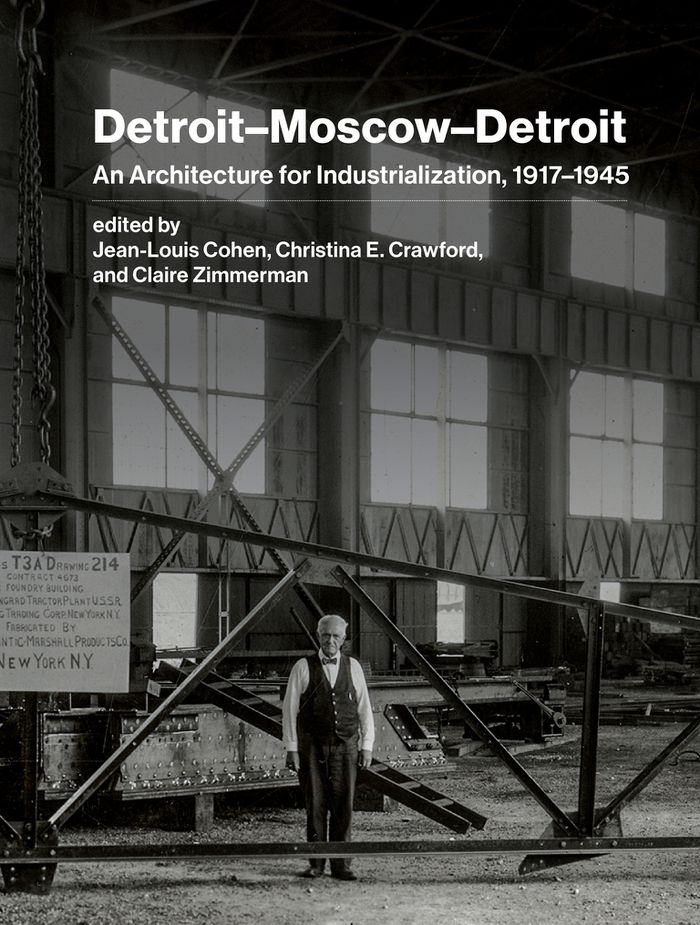
Between 1917 and 1945, a tide of hyperindustrialization washed over the United States and the Soviet Union. While the two countries remained ideologically opposed, the factories that amassed in Stalingrad, Moscow, Detroit, Buffalo, and Cleveland were strikingly similar, as were the new forms of modern work and urban and infrastructural development that supported this industrialization. Drawing on previously unknown archival materials and photographs, the essays in ''Detroit-Moscow-Detroit'' document a stunning two-way transfer of technical knowledge between the United States and the USSR that greatly influenced the built environment in both countries, upgrading each to major industrial power by the start of the Second World War. The innovative research presented here explores spatial development, manufacturing, mass production, and organizational planning across geopolitical lines to demonstrate that capitalist and communist built environments in the twentieth century were not diametrically opposed and were, on certain sites, coproduced in a period of intense technical exchange between the two world wars. A fresh account of the effects of industrialization and globalization on US and Soviet cultures, architecture, and urban history, ''Detroit-Moscow-Detroit'' will find wide readership among architects, urban designers, and scholars of architectural, urban, and twentieth-century history.
Detroit-Moscow-Detroit: An architecture for industrialization, 1917-1945
Actions:
Prix:
$66.00
(disponible sur commande)
Résumé:
Between 1917 and 1945, a tide of hyperindustrialization washed over the United States and the Soviet Union. While the two countries remained ideologically opposed, the factories that amassed in Stalingrad, Moscow, Detroit, Buffalo, and Cleveland were strikingly similar, as were the new forms of modern work and urban and infrastructural development that supported this industrialization. Drawing on previously unknown archival materials and photographs, the essays in ''Detroit-Moscow-Detroit'' document a stunning two-way transfer of technical knowledge between the United States and the USSR that greatly influenced the built environment in both countries, upgrading each to major industrial power by the start of the Second World War. The innovative research presented here explores spatial development, manufacturing, mass production, and organizational planning across geopolitical lines to demonstrate that capitalist and communist built environments in the twentieth century were not diametrically opposed and were, on certain sites, coproduced in a period of intense technical exchange between the two world wars. A fresh account of the effects of industrialization and globalization on US and Soviet cultures, architecture, and urban history, ''Detroit-Moscow-Detroit'' will find wide readership among architects, urban designers, and scholars of architectural, urban, and twentieth-century history.
Classification:
livres
livres
Publication:
septembre 2023
septembre 2023
Sujet:
Théorie de l’architecture
Théorie de l’architecture
Classification:
livres
livres
Titre:
The Gothic Revival
The Gothic Revival
Actions:
Prix:
$22.99
(disponible sur commande)
Résumé:
‘The Gothic Revival’, writes Michael Lewis, ‘is more than a fashion craze for pointed arches and pinnacles. During its years of greatest influence, it subjected every aspect of art, belief, society, and labour to intense intellectual scrutiny, using the Middle Ages as a platform from which to judge the modern world.’ It is the unique merit of "The Gothic Revival"(...)
$22.99
(disponible sur commande)
Résumé:
‘The Gothic Revival’, writes Michael Lewis, ‘is more than a fashion craze for pointed arches and pinnacles. During its years of greatest influence, it subjected every aspect of art, belief, society, and labour to intense intellectual scrutiny, using the Middle Ages as a platform from which to judge the modern world.’ It is the unique merit of "The Gothic Revival"(...)
Titre:
The Gothic Revival
Actions:
Prix:
$22.99
(disponible sur commande)
Résumé:
‘The Gothic Revival’, writes Michael Lewis, ‘is more than a fashion craze for pointed arches and pinnacles. During its years of greatest influence, it subjected every aspect of art, belief, society, and labour to intense intellectual scrutiny, using the Middle Ages as a platform from which to judge the modern world.’ It is the unique merit of "The Gothic Revival" that it gives as much attention to the ideas that gave Gothic architecture its emotional and intellectual power as it does to its great monuments. The eighteenth century admired the Gothic for its sense of decay and melancholy; the nineteenth century first cherished its religious piety, then its superb engineering. In the course of the Revival the Gothic was attached to social movements of every sort – from political liberalism to patriotic nationalism to labour reform. Like Marxism, which also drew lessons from medieval society, the Gothic Revival seemed to offer a comprehensive response to the dislocations and traumas of the Industrial Revolution. By the early twentieth century, the Gothic Revival had outlived its ideals. In recent years, however, the climate of opinion has changed, and we are ready to understand, appreciate and learn from it.
The Gothic Revival
Actions:
Prix:
$22.99
(disponible sur commande)
Résumé:
‘The Gothic Revival’, writes Michael Lewis, ‘is more than a fashion craze for pointed arches and pinnacles. During its years of greatest influence, it subjected every aspect of art, belief, society, and labour to intense intellectual scrutiny, using the Middle Ages as a platform from which to judge the modern world.’ It is the unique merit of "The Gothic Revival" that it gives as much attention to the ideas that gave Gothic architecture its emotional and intellectual power as it does to its great monuments. The eighteenth century admired the Gothic for its sense of decay and melancholy; the nineteenth century first cherished its religious piety, then its superb engineering. In the course of the Revival the Gothic was attached to social movements of every sort – from political liberalism to patriotic nationalism to labour reform. Like Marxism, which also drew lessons from medieval society, the Gothic Revival seemed to offer a comprehensive response to the dislocations and traumas of the Industrial Revolution. By the early twentieth century, the Gothic Revival had outlived its ideals. In recent years, however, the climate of opinion has changed, and we are ready to understand, appreciate and learn from it.
Classification:
livres
livres
Publication:
juin 2002, London
juin 2002, London
Sujet:
Histoire jusqu’à 1900
Histoire jusqu’à 1900
Classification:
livres
livres
Titre:
Don't build, rebuild
Don't build, rebuild
Actions:
Prix:
$43.95
(disponible sur commande)
Résumé:
As climate change has escalated into a crisis, the reuse of existing structures is the only way to even begin to preserve our wood, sand, silicon, and iron, let alone stop belching carbon monoxide into the air. Our housing crisis means that we need usable buildings now more than ever, but architect and critic Aaron Betsky shows that new construction—often seeking to(...)
$43.95
(disponible sur commande)
Résumé:
As climate change has escalated into a crisis, the reuse of existing structures is the only way to even begin to preserve our wood, sand, silicon, and iron, let alone stop belching carbon monoxide into the air. Our housing crisis means that we need usable buildings now more than ever, but architect and critic Aaron Betsky shows that new construction—often seeking to(...)
Titre:
Don't build, rebuild
Actions:
Prix:
$43.95
(disponible sur commande)
Résumé:
As climate change has escalated into a crisis, the reuse of existing structures is the only way to even begin to preserve our wood, sand, silicon, and iron, let alone stop belching carbon monoxide into the air. Our housing crisis means that we need usable buildings now more than ever, but architect and critic Aaron Betsky shows that new construction—often seeking to maximize profits rather than resources, often soulless in its feel—is not the answer. Whenever possible, it is better to repair, recycle, renovate, and reuse—not only from an environmental perspective, but culturally and artistically as well. Architectural reuse is as old as civilization itself. In the streets of Europe, you can find fragments from the Roman Empire. More recently, marginalized communities from New York to Detroit—queer people looking for places to gather or cruise, punks looking to make loud music, artists and displaced people looking for space to work and live—have taken over industrial spaces created then abandoned by capitalism, forging a unique style in the process. Their methods—from urban mining to dumpster diving—now inform architects transforming old structures today.
Don't build, rebuild
Actions:
Prix:
$43.95
(disponible sur commande)
Résumé:
As climate change has escalated into a crisis, the reuse of existing structures is the only way to even begin to preserve our wood, sand, silicon, and iron, let alone stop belching carbon monoxide into the air. Our housing crisis means that we need usable buildings now more than ever, but architect and critic Aaron Betsky shows that new construction—often seeking to maximize profits rather than resources, often soulless in its feel—is not the answer. Whenever possible, it is better to repair, recycle, renovate, and reuse—not only from an environmental perspective, but culturally and artistically as well. Architectural reuse is as old as civilization itself. In the streets of Europe, you can find fragments from the Roman Empire. More recently, marginalized communities from New York to Detroit—queer people looking for places to gather or cruise, punks looking to make loud music, artists and displaced people looking for space to work and live—have taken over industrial spaces created then abandoned by capitalism, forging a unique style in the process. Their methods—from urban mining to dumpster diving—now inform architects transforming old structures today.
Classification:
livres
livres
Publication:
novembre 2024
novembre 2024
Sujet:
Théorie de l’architecture
Théorie de l’architecture
Classification:
livres
livres
Prix:
$45.95
(disponible sur commande)
Résumé:
Cell phones and E-mail, home shopping and the Internet - "old" industrial societies have been turning into globally connected information societies on the sly. At the same time, the population is tending to retreat into its own four walls. Yet - or maybe for this reason - public urban spaces are becoming more and more important, having lost none of their significance as(...)
$45.95
(disponible sur commande)
Résumé:
Cell phones and E-mail, home shopping and the Internet - "old" industrial societies have been turning into globally connected information societies on the sly. At the same time, the population is tending to retreat into its own four walls. Yet - or maybe for this reason - public urban spaces are becoming more and more important, having lost none of their significance as(...)
Sujet:
Théorie de l’urbanisme
Théorie de l’urbanisme
Publication:
janvier 1900, Ostfildern-Ruit
janvier 1900, Ostfildern-Ruit
Titre:
No art = no city! : urban utopias in contemporary art
Actions:
Prix:
$45.95
(disponible sur commande)
Résumé:
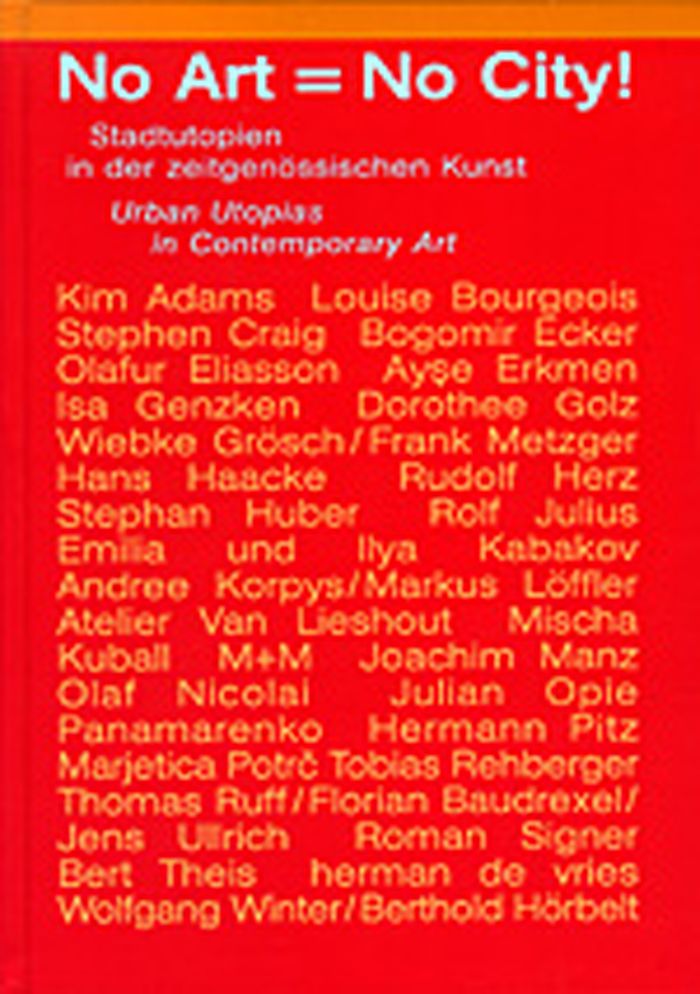
Cell phones and E-mail, home shopping and the Internet - "old" industrial societies have been turning into globally connected information societies on the sly. At the same time, the population is tending to retreat into its own four walls. Yet - or maybe for this reason - public urban spaces are becoming more and more important, having lost none of their significance as interfaces of human communication. This catalogue is published in conjunction with the thirtieth anniversary of the Bremen program for public art. It features over thirty artists who have confronted urban and social aspects of the city and developed their own personal visions, utopias and fantasies of a life in and with the city. Artists featured: Kim Adams, Louise Bourgeois, Stephen Craig, Bogomir Ecker, Olafur Eliasson, Ayse Erkmen, Isa Genzken, Dorothee Golz, Wiebke Grösch/Frank Metzger, Hans Haacke, Rudolf Herz, Stephan Huber, Rolf Julius, Emilia und Ilya Kabakov, Andree Korpys/Markus Löffler, Mischa Kuball, Atelier Van Lieshout, M+M, Joachim Manz, Olaf Nicolai, Julian Opie, Panamarenko, Hermann Pitz, Marjetica Potrc, Tobias Rehberger, Thomas Ruff/Florian Baudrexel/Jens Ullrich, Roman Signer, Bert Theis, herman de vries, Wolfgang Winter/Berthold Hörbelt
No art = no city! : urban utopias in contemporary art
Actions:
Prix:
$45.95
(disponible sur commande)
Résumé:
Cell phones and E-mail, home shopping and the Internet - "old" industrial societies have been turning into globally connected information societies on the sly. At the same time, the population is tending to retreat into its own four walls. Yet - or maybe for this reason - public urban spaces are becoming more and more important, having lost none of their significance as interfaces of human communication. This catalogue is published in conjunction with the thirtieth anniversary of the Bremen program for public art. It features over thirty artists who have confronted urban and social aspects of the city and developed their own personal visions, utopias and fantasies of a life in and with the city. Artists featured: Kim Adams, Louise Bourgeois, Stephen Craig, Bogomir Ecker, Olafur Eliasson, Ayse Erkmen, Isa Genzken, Dorothee Golz, Wiebke Grösch/Frank Metzger, Hans Haacke, Rudolf Herz, Stephan Huber, Rolf Julius, Emilia und Ilya Kabakov, Andree Korpys/Markus Löffler, Mischa Kuball, Atelier Van Lieshout, M+M, Joachim Manz, Olaf Nicolai, Julian Opie, Panamarenko, Hermann Pitz, Marjetica Potrc, Tobias Rehberger, Thomas Ruff/Florian Baudrexel/Jens Ullrich, Roman Signer, Bert Theis, herman de vries, Wolfgang Winter/Berthold Hörbelt
Classification:
livres
livres
Publication:
janvier 1900, Ostfildern-Ruit
janvier 1900, Ostfildern-Ruit
Sujet:
Théorie de l’urbanisme
Théorie de l’urbanisme


