


647 Résultats
Classification:
livres
livres
Actions:
Prix:
$69.95
(disponible sur commande)
Résumé:
In 1969 and 1970, Louis I. Kahn (1901–1974) participated in a series of interviews with a young German architectural historian, Heinrich Klotz, then a visiting professor at Yale University, and John W. Cook, who was teaching architecture at the Yale Divinity School. Louis I. Kahn in Conversation provides the first full edited transcript of these candid, illuminating(...)
$69.95
(disponible sur commande)
Résumé:
In 1969 and 1970, Louis I. Kahn (1901–1974) participated in a series of interviews with a young German architectural historian, Heinrich Klotz, then a visiting professor at Yale University, and John W. Cook, who was teaching architecture at the Yale Divinity School. Louis I. Kahn in Conversation provides the first full edited transcript of these candid, illuminating(...)
Sujet:
Théorie de l’architecture
Théorie de l’architecture
Publication:
novembre 2014
novembre 2014
Titre:
Louis I. Kahn in conversation: interviews with John W. Cook and Heinrich Klotz, 1969–70
Actions:
Prix:
$69.95
(disponible sur commande)
Résumé:
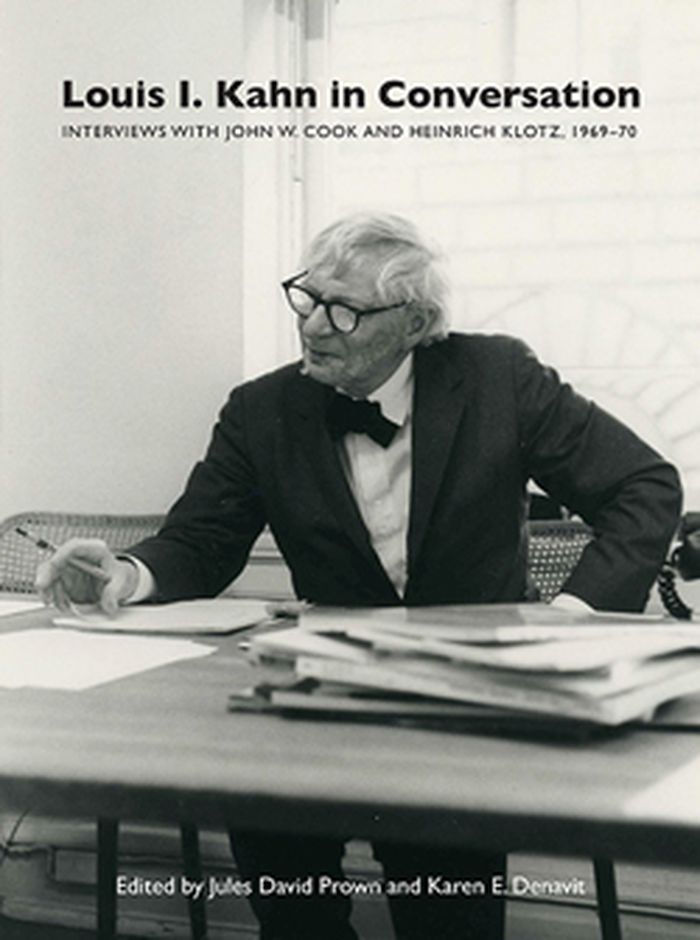
In 1969 and 1970, Louis I. Kahn (1901–1974) participated in a series of interviews with a young German architectural historian, Heinrich Klotz, then a visiting professor at Yale University, and John W. Cook, who was teaching architecture at the Yale Divinity School. Louis I. Kahn in Conversation provides the first full edited transcript of these candid, illuminating interviews, which provide insights into Kahn’s philosophy of architecture. The conversations touch on many of his iconic works, including the unbuilt City Tower Project for Philadelphia, the Yale University Art Gallery, the First Unitarian Church in Rochester, and major international projects then under construction, as well as the Yale Center for British Art, Kahn’s final building, on which he was beginning work at the time. Illustrated with dozens of plans, drawings, and photographs, the book also features an introduction by Jules David Prown, the first director of the Yale Center for British Art, who recommended Kahn as its architect.
Louis I. Kahn in conversation: interviews with John W. Cook and Heinrich Klotz, 1969–70
Actions:
Prix:
$69.95
(disponible sur commande)
Résumé:
In 1969 and 1970, Louis I. Kahn (1901–1974) participated in a series of interviews with a young German architectural historian, Heinrich Klotz, then a visiting professor at Yale University, and John W. Cook, who was teaching architecture at the Yale Divinity School. Louis I. Kahn in Conversation provides the first full edited transcript of these candid, illuminating interviews, which provide insights into Kahn’s philosophy of architecture. The conversations touch on many of his iconic works, including the unbuilt City Tower Project for Philadelphia, the Yale University Art Gallery, the First Unitarian Church in Rochester, and major international projects then under construction, as well as the Yale Center for British Art, Kahn’s final building, on which he was beginning work at the time. Illustrated with dozens of plans, drawings, and photographs, the book also features an introduction by Jules David Prown, the first director of the Yale Center for British Art, who recommended Kahn as its architect.
Classification:
livres
livres
Publication:
novembre 2014
novembre 2014
Sujet:
Théorie de l’architecture
Théorie de l’architecture
Classification:
livres
livres
Actions:
Prix:
$24.95
(disponible sur commande)
Résumé:
The Phaidon Atlas of Contemporary World Architecture: Travel Edition, presents all of the best works of architecture completed in the last five years in a convenient mini format. Each of the 1,052 projects from the comprehensive edition included a single image per building and a short text to describe it. The project entry gives the name of each building and its(...)
$24.95
(disponible sur commande)
Résumé:
The Phaidon Atlas of Contemporary World Architecture: Travel Edition, presents all of the best works of architecture completed in the last five years in a convenient mini format. Each of the 1,052 projects from the comprehensive edition included a single image per building and a short text to describe it. The project entry gives the name of each building and its(...)
Publication:
mai 2005, London
mai 2005, London
Titre:
The Phaidon atlas of contemporary world architecture : travel edition
Actions:
Prix:
$24.95
(disponible sur commande)
Résumé:
The Phaidon Atlas of Contemporary World Architecture: Travel Edition, presents all of the best works of architecture completed in the last five years in a convenient mini format. Each of the 1,052 projects from the comprehensive edition included a single image per building and a short text to describe it. The project entry gives the name of each building and its architect, the location, address and contact details, and potential visiting hours. There is also a system to indicate which projects are open to the public. In addition to the forty two regional maps from the comprehensive edition, there are 27 new city maps which locate the buildings in more built up areas. The book provides a unique opportunity to visit 1,052 works of contemporary architecture in all parts of the world, from the Arctic Circle to African deserts. The Phaidon Atlas of Contemporary World Architecture, Travel Edition is an essential companion on the travels of all those interested in gaining a first hand understanding of contemporary architecture around the world.
The Phaidon atlas of contemporary world architecture : travel edition
Actions:
Prix:
$24.95
(disponible sur commande)
Résumé:
The Phaidon Atlas of Contemporary World Architecture: Travel Edition, presents all of the best works of architecture completed in the last five years in a convenient mini format. Each of the 1,052 projects from the comprehensive edition included a single image per building and a short text to describe it. The project entry gives the name of each building and its architect, the location, address and contact details, and potential visiting hours. There is also a system to indicate which projects are open to the public. In addition to the forty two regional maps from the comprehensive edition, there are 27 new city maps which locate the buildings in more built up areas. The book provides a unique opportunity to visit 1,052 works of contemporary architecture in all parts of the world, from the Arctic Circle to African deserts. The Phaidon Atlas of Contemporary World Architecture, Travel Edition is an essential companion on the travels of all those interested in gaining a first hand understanding of contemporary architecture around the world.
Classification:
livres
livres
Publication:
mai 2005, London
mai 2005, London
Classification:
livres
livres
Actions:
Prix:
$18.50
(disponible sur commande)
Résumé:
Dark Places" explores the dim, claustrophobic interiors of haunted houses in horror movies, as well as the cinema auditorium itself, and their relation to the 'dark places' of the human pysche. Barry Curtis looks at the long, blood-soaked history of horror films: their fascination with re-animating the dead; the special effects, both sophisticated and crude, which have(...)
$18.50
(disponible sur commande)
Résumé:
Dark Places" explores the dim, claustrophobic interiors of haunted houses in horror movies, as well as the cinema auditorium itself, and their relation to the 'dark places' of the human pysche. Barry Curtis looks at the long, blood-soaked history of horror films: their fascination with re-animating the dead; the special effects, both sophisticated and crude, which have(...)
Titre:
Dark places: the haunted house in film
Actions:
Prix:
$18.50
(disponible sur commande)
Résumé:
Dark Places" explores the dim, claustrophobic interiors of haunted houses in horror movies, as well as the cinema auditorium itself, and their relation to the 'dark places' of the human pysche. Barry Curtis looks at the long, blood-soaked history of horror films: their fascination with re-animating the dead; the special effects, both sophisticated and crude, which have been contrived in order to bring spirits into the realm of the living; the structures, projections and architecture of horror movie sets; and the complex metaphorical life of 'ghosts' as harbingers of loss, amnesia, injustice and vengeance. A wide range of films is also discussed in which the 'haunted house' is reworked in new scenarios - the road, the apartment, the motel, the spaceship - and visually linked to the troubling archetypes of Gothic fictions. Barry Curtis is Emeritus Professor of Visual Culture at Middlesex University, Fellow of the London Consortium, and Visiting Tutor at the Royal College of Art. He has written widely on film, architecture, art and visual culture for magazines, newspapers and journals.
Dark places: the haunted house in film
Actions:
Prix:
$18.50
(disponible sur commande)
Résumé:
Dark Places" explores the dim, claustrophobic interiors of haunted houses in horror movies, as well as the cinema auditorium itself, and their relation to the 'dark places' of the human pysche. Barry Curtis looks at the long, blood-soaked history of horror films: their fascination with re-animating the dead; the special effects, both sophisticated and crude, which have been contrived in order to bring spirits into the realm of the living; the structures, projections and architecture of horror movie sets; and the complex metaphorical life of 'ghosts' as harbingers of loss, amnesia, injustice and vengeance. A wide range of films is also discussed in which the 'haunted house' is reworked in new scenarios - the road, the apartment, the motel, the spaceship - and visually linked to the troubling archetypes of Gothic fictions. Barry Curtis is Emeritus Professor of Visual Culture at Middlesex University, Fellow of the London Consortium, and Visiting Tutor at the Royal College of Art. He has written widely on film, architecture, art and visual culture for magazines, newspapers and journals.
Classification:
livres
livres
Publication:
janvier 2009, London
janvier 2009, London
Classification:
livres
livres
Actions:
Prix:
$39.00
(disponible sur commande)
Résumé:
Visiting the villas of Renaissance architect Andrea Palladio (1508-80), one inevitably asks oneself how people actually occupied them. Palladio conceived his villas as ''small towns'' (piccole città) that formed a single unit with adjacent service buildings and farm fields. Within their walls lived people of all ages, social backgrounds and skills. These buildings were(...)
$39.00
(disponible sur commande)
Résumé:
Visiting the villas of Renaissance architect Andrea Palladio (1508-80), one inevitably asks oneself how people actually occupied them. Palladio conceived his villas as ''small towns'' (piccole città) that formed a single unit with adjacent service buildings and farm fields. Within their walls lived people of all ages, social backgrounds and skills. These buildings were(...)
Titre:
Living with Palladio in the sixteenth century
Actions:
Prix:
$39.00
(disponible sur commande)
Résumé:
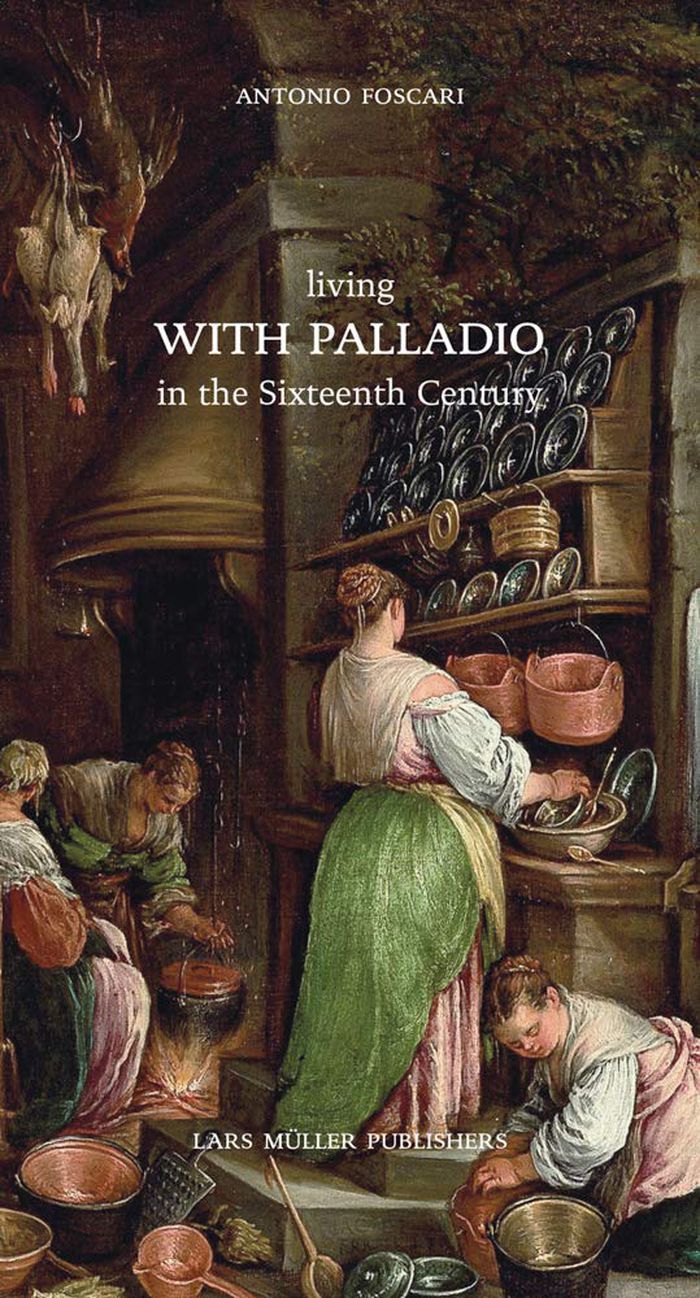
Visiting the villas of Renaissance architect Andrea Palladio (1508-80), one inevitably asks oneself how people actually occupied them. Palladio conceived his villas as ''small towns'' (piccole città) that formed a single unit with adjacent service buildings and farm fields. Within their walls lived people of all ages, social backgrounds and skills. These buildings were the venue for significant moments of public life, and the principles of hygiene, privacy and comfort, which we consider so defining and essential today, did not apply- in a sense furniture as such did not exist. ''Living with Palladio in the sixteenth century'' investigates how Palladio’s houses, their floors, rooms and measurements, were designed to structure the life of such a heterogeneous family of people. It analyses their hierarchical structure with the owner (padrone) at the top and everyone involved in the everyday running of the household (famiglia minuta) at the bottom. This book fills a decisive gap in research literature on the famous Italian architect by looking at how Palladio prioritized the domestic functions of his private buildings.
Living with Palladio in the sixteenth century
Actions:
Prix:
$39.00
(disponible sur commande)
Résumé:
Visiting the villas of Renaissance architect Andrea Palladio (1508-80), one inevitably asks oneself how people actually occupied them. Palladio conceived his villas as ''small towns'' (piccole città) that formed a single unit with adjacent service buildings and farm fields. Within their walls lived people of all ages, social backgrounds and skills. These buildings were the venue for significant moments of public life, and the principles of hygiene, privacy and comfort, which we consider so defining and essential today, did not apply- in a sense furniture as such did not exist. ''Living with Palladio in the sixteenth century'' investigates how Palladio’s houses, their floors, rooms and measurements, were designed to structure the life of such a heterogeneous family of people. It analyses their hierarchical structure with the owner (padrone) at the top and everyone involved in the everyday running of the household (famiglia minuta) at the bottom. This book fills a decisive gap in research literature on the famous Italian architect by looking at how Palladio prioritized the domestic functions of his private buildings.
Classification:
livres
livres
Publication:
juin 2020
juin 2020
Sujet:
Architecture, monographies
Architecture, monographies
Classification:
livres
livres
Actions:
Prix:
$49.00
(disponible sur commande)
Résumé:
The Anatomy of the Architectural Book examines the relationships between book culture and building culture, making visible the axes along which architectural knowledge circulates through books into buildings and back. Using five conceptual tools—texture, surface, rhythm, structure, and scale—Tavares analyzes the material qualities of a wide range of books in order to(...)
$49.00
(disponible sur commande)
Résumé:
The Anatomy of the Architectural Book examines the relationships between book culture and building culture, making visible the axes along which architectural knowledge circulates through books into buildings and back. Using five conceptual tools—texture, surface, rhythm, structure, and scale—Tavares analyzes the material qualities of a wide range of books in order to(...)
Publication:
mars 2016
mars 2016
Titre:
The anatomy of the architectural book
Actions:
Prix:
$49.00
(disponible sur commande)
Résumé:
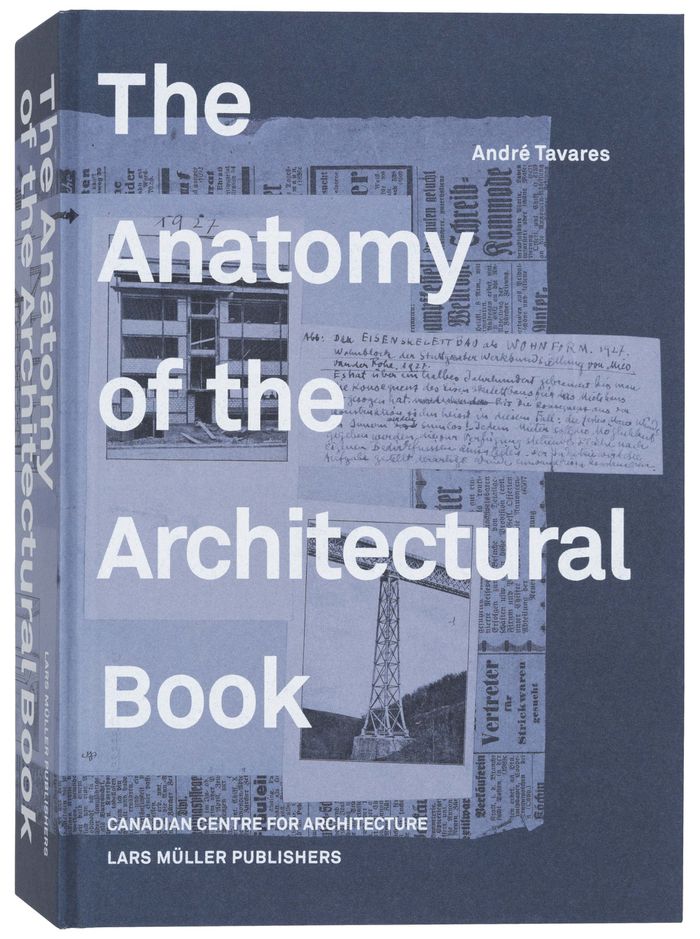
The Anatomy of the Architectural Book examines the relationships between book culture and building culture, making visible the axes along which architectural knowledge circulates through books into buildings and back. Using five conceptual tools—texture, surface, rhythm, structure, and scale—Tavares analyzes the material qualities of a wide range of books in order to assess these dynamics and intersections. This investigation confronts us with the rise of the industrialized book, and thus of the editor as an important intermediary between the author and the printer, as well as with the configuration of the book as a unique visual device (with the designer taking part in a progressively more complex chain of decision-making). Richly illustrated with samples from the CCA library, the volume discusses work by authors including William Morris, Gottfried Semper, El Lissitzky, Le Corbusier, and Frank Lloyd Wright, among others. A large portion of the research for the book was undertaken while Tavares was a Visiting Scholar at the CCA. It is co-published in English by Lars Müller Publishers and in Portuguese by Dafne Editora.
The anatomy of the architectural book
Actions:
Prix:
$49.00
(disponible sur commande)
Résumé:
The Anatomy of the Architectural Book examines the relationships between book culture and building culture, making visible the axes along which architectural knowledge circulates through books into buildings and back. Using five conceptual tools—texture, surface, rhythm, structure, and scale—Tavares analyzes the material qualities of a wide range of books in order to assess these dynamics and intersections. This investigation confronts us with the rise of the industrialized book, and thus of the editor as an important intermediary between the author and the printer, as well as with the configuration of the book as a unique visual device (with the designer taking part in a progressively more complex chain of decision-making). Richly illustrated with samples from the CCA library, the volume discusses work by authors including William Morris, Gottfried Semper, El Lissitzky, Le Corbusier, and Frank Lloyd Wright, among others. A large portion of the research for the book was undertaken while Tavares was a Visiting Scholar at the CCA. It is co-published in English by Lars Müller Publishers and in Portuguese by Dafne Editora.
Classification:
livres
livres
Publication:
mars 2016
mars 2016
Classification:
livres
livres
Titre:
The millenium house
The millenium house
Actions:
Prix:
$7.99
(disponible sur commande)
Résumé:
In the academic year 2000-2001, Yale professor and New York City based architect Peggy Deamer led two innovative courses: first, a focused seminar on the state of contemporary residential design; second, a creative studio offering house designs that drew on the discoveries of the seminar. This book, the second in a series documenting work at the Yale School of(...)
$7.99
(disponible sur commande)
Résumé:
In the academic year 2000-2001, Yale professor and New York City based architect Peggy Deamer led two innovative courses: first, a focused seminar on the state of contemporary residential design; second, a creative studio offering house designs that drew on the discoveries of the seminar. This book, the second in a series documenting work at the Yale School of(...)
Publication:
mai 2003, New York
mai 2003, New York
Titre:
The millenium house
Actions:
Prix:
$7.99
(disponible sur commande)
Résumé:
In the academic year 2000-2001, Yale professor and New York City based architect Peggy Deamer led two innovative courses: first, a focused seminar on the state of contemporary residential design; second, a creative studio offering house designs that drew on the discoveries of the seminar. This book, the second in a series documenting work at the Yale School of Architecture, combines work from both courses in a thoughtful and provocative study of the state of the house at the turn of the millennium. Deamer introduces the volume with an essay on three issues vital to a discussion of millennial design: newness, uniqueness, and design innovation. Designs of visiting seminar critics -- Steven Holl, Elizabeth Diller and Ricardo Scofidio, William McDonough, LOT/EK, Winy Maas, and Jacques Herzog -- are showcased along with descriptive and analytical texts. Work from the studio course is divided into various themes explored by the students: image, standardization and modularity, networks and diagrams. The hybrid quality of this volume -- designs by practicing architects and students; observation and interpretation -- reflects debates and issues at the heart of early-twenty-first-century architecture.
The millenium house
Actions:
Prix:
$7.99
(disponible sur commande)
Résumé:
In the academic year 2000-2001, Yale professor and New York City based architect Peggy Deamer led two innovative courses: first, a focused seminar on the state of contemporary residential design; second, a creative studio offering house designs that drew on the discoveries of the seminar. This book, the second in a series documenting work at the Yale School of Architecture, combines work from both courses in a thoughtful and provocative study of the state of the house at the turn of the millennium. Deamer introduces the volume with an essay on three issues vital to a discussion of millennial design: newness, uniqueness, and design innovation. Designs of visiting seminar critics -- Steven Holl, Elizabeth Diller and Ricardo Scofidio, William McDonough, LOT/EK, Winy Maas, and Jacques Herzog -- are showcased along with descriptive and analytical texts. Work from the studio course is divided into various themes explored by the students: image, standardization and modularity, networks and diagrams. The hybrid quality of this volume -- designs by practicing architects and students; observation and interpretation -- reflects debates and issues at the heart of early-twenty-first-century architecture.
Classification:
livres
livres
Publication:
mai 2003, New York
mai 2003, New York
Classification:
livres
livres
Titre:
Hansaviertel portraits
Hansaviertel portraits
Actions:
Prix:
$65.00
(disponible sur commande)
Résumé:
A former debris-strewn wasteland in the inner city—some 300 out of 343 residential buildings were destroyed during the Second World War—the Hansaviertel is one of the most defining architecture projects of the postwar period in Berlin. In 1952, an international ideas competition was held under the title die stadt von morgen (the city of tomorrow); more than fifty(...)
$65.00
(disponible sur commande)
Résumé:
A former debris-strewn wasteland in the inner city—some 300 out of 343 residential buildings were destroyed during the Second World War—the Hansaviertel is one of the most defining architecture projects of the postwar period in Berlin. In 1952, an international ideas competition was held under the title die stadt von morgen (the city of tomorrow); more than fifty(...)
Titre:
Hansaviertel portraits
Actions:
Prix:
$65.00
(disponible sur commande)
Résumé:
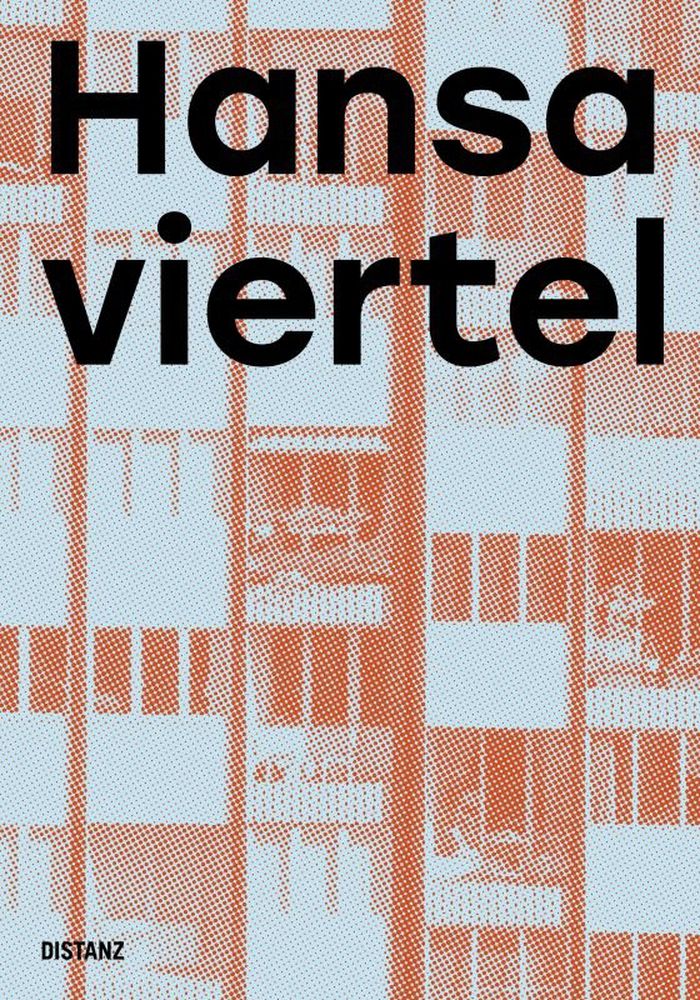
A former debris-strewn wasteland in the inner city—some 300 out of 343 residential buildings were destroyed during the Second World War—the Hansaviertel is one of the most defining architecture projects of the postwar period in Berlin. In 1952, an international ideas competition was held under the title die stadt von morgen (the city of tomorrow); more than fifty architects presented plans for the rebuilding of West Berlin, including leading practitioners of Western modernist architecture like Alvar Aalto, Werner Düttmann, Egon Eiermann, Walter Gropius, Arne Jacobsen, Oscar Niemeyer, and Max Taut. Construction based on their designs in the redevelopment area began in 1956. The result was a neighborhood designed for people and their needs—largely without predetermined paths, with lots of greenery, flexible floor plans, space for small businesses, and facilities for everyday needs. Visiting the area and its people today, one can still feel the designers’ visionary resolve to establish new ways of residential living. Locals are united by their fascination with architecture and design and their love for their neighborhood, which over the decades has developed an authentic patina and now stands as witness to a key chapter in the city’s more recent history.
Hansaviertel portraits
Actions:
Prix:
$65.00
(disponible sur commande)
Résumé:
A former debris-strewn wasteland in the inner city—some 300 out of 343 residential buildings were destroyed during the Second World War—the Hansaviertel is one of the most defining architecture projects of the postwar period in Berlin. In 1952, an international ideas competition was held under the title die stadt von morgen (the city of tomorrow); more than fifty architects presented plans for the rebuilding of West Berlin, including leading practitioners of Western modernist architecture like Alvar Aalto, Werner Düttmann, Egon Eiermann, Walter Gropius, Arne Jacobsen, Oscar Niemeyer, and Max Taut. Construction based on their designs in the redevelopment area began in 1956. The result was a neighborhood designed for people and their needs—largely without predetermined paths, with lots of greenery, flexible floor plans, space for small businesses, and facilities for everyday needs. Visiting the area and its people today, one can still feel the designers’ visionary resolve to establish new ways of residential living. Locals are united by their fascination with architecture and design and their love for their neighborhood, which over the decades has developed an authentic patina and now stands as witness to a key chapter in the city’s more recent history.
Classification:
livres
livres
Publication:
octobre 2024
octobre 2024
Classification:
livres
livres
Titre:
Benthem Crouwel : 1980-2000
Benthem Crouwel : 1980-2000
Actions:
Prix:
$95.95
(disponible en magasin)
Résumé:
The work of Benthem Crouwel Architects is sober, practical and functional - wholly in line with the Dutch tradition of soundness and reliability. At the same time there is wide-spread admiration for the expressive and aesthetic values of the designs, which achieve maximum effect with a minimum of means. This profusely (...)
$95.95
(disponible en magasin)
Résumé:
The work of Benthem Crouwel Architects is sober, practical and functional - wholly in line with the Dutch tradition of soundness and reliability. At the same time there is wide-spread admiration for the expressive and aesthetic values of the designs, which achieve maximum effect with a minimum of means. This profusely (...)
Sujet:
Architecture, monographies
Architecture, monographies
Publication:
octobre 1999, Rotterdam
octobre 1999, Rotterdam
Titre:
Benthem Crouwel : 1980-2000
Actions:
Prix:
$95.95
(disponible en magasin)
Résumé:
The work of Benthem Crouwel Architects is sober, practical and functional - wholly in line with the Dutch tradition of soundness and reliability. At the same time there is wide-spread admiration for the expressive and aesthetic values of the designs, which achieve maximum effect with a minimum of means. This profusely illustrated publication presents the complete oeuvre spanning twenty years on the basis of five themes. "Living" focuses on the private houses and apartment buildings such as those for Jager, Nieuwland and Soutelande. "Working" gives a picture of such diverse projects as the Amsterdam office for Wagons Lits, the Provincial Hall in Groningen, de Malie Tower in The Hague and the Mors factory in Opmeer. "Shopping" describes recent projects in Leidschendam, Amsterdam Zuid-Oost and Schiphol. "Travelling" likewise features various projects for Schiphol, supplemented with proposals for Amsterdam's North/South underground line and Lelystad airport. Finally in "Visiting" we encounter the firm's many recreational and museological projects such as the popcluster 013 in Tilburg, new major spaces for the RAI and Ahoy' complexes, the so-called cultural strip in Amstelveen, and the Anne Frank Museum in Amsterdam.
Benthem Crouwel : 1980-2000
Actions:
Prix:
$95.95
(disponible en magasin)
Résumé:
The work of Benthem Crouwel Architects is sober, practical and functional - wholly in line with the Dutch tradition of soundness and reliability. At the same time there is wide-spread admiration for the expressive and aesthetic values of the designs, which achieve maximum effect with a minimum of means. This profusely illustrated publication presents the complete oeuvre spanning twenty years on the basis of five themes. "Living" focuses on the private houses and apartment buildings such as those for Jager, Nieuwland and Soutelande. "Working" gives a picture of such diverse projects as the Amsterdam office for Wagons Lits, the Provincial Hall in Groningen, de Malie Tower in The Hague and the Mors factory in Opmeer. "Shopping" describes recent projects in Leidschendam, Amsterdam Zuid-Oost and Schiphol. "Travelling" likewise features various projects for Schiphol, supplemented with proposals for Amsterdam's North/South underground line and Lelystad airport. Finally in "Visiting" we encounter the firm's many recreational and museological projects such as the popcluster 013 in Tilburg, new major spaces for the RAI and Ahoy' complexes, the so-called cultural strip in Amstelveen, and the Anne Frank Museum in Amsterdam.
Classification:
livres
livres
Publication:
octobre 1999, Rotterdam
octobre 1999, Rotterdam
Sujet:
Architecture, monographies
Architecture, monographies
Classification:
livres
livres
Prix:
$47.95
(disponible sur commande)
Résumé:
The future is not as far away as it might seem. What seemed a problem of the next generation now has become a problem of tomorrow. We are accelerating towards a future that is evermore present, guided by political and economic forces that seem unintelligible. Is this quick-paced intangible progression, the role of the architect is at stake. How can architecture keep up(...)
$47.95
(disponible sur commande)
Résumé:
The future is not as far away as it might seem. What seemed a problem of the next generation now has become a problem of tomorrow. We are accelerating towards a future that is evermore present, guided by political and economic forces that seem unintelligible. Is this quick-paced intangible progression, the role of the architect is at stake. How can architecture keep up(...)
Sujet:
Théorie de l’architecture
Théorie de l’architecture
Publication:
juin 2018
juin 2018
Titre:
Future Real: Kersten Geers, Michael Young, David Erdman
Actions:
Prix:
$47.95
(disponible sur commande)
Résumé:
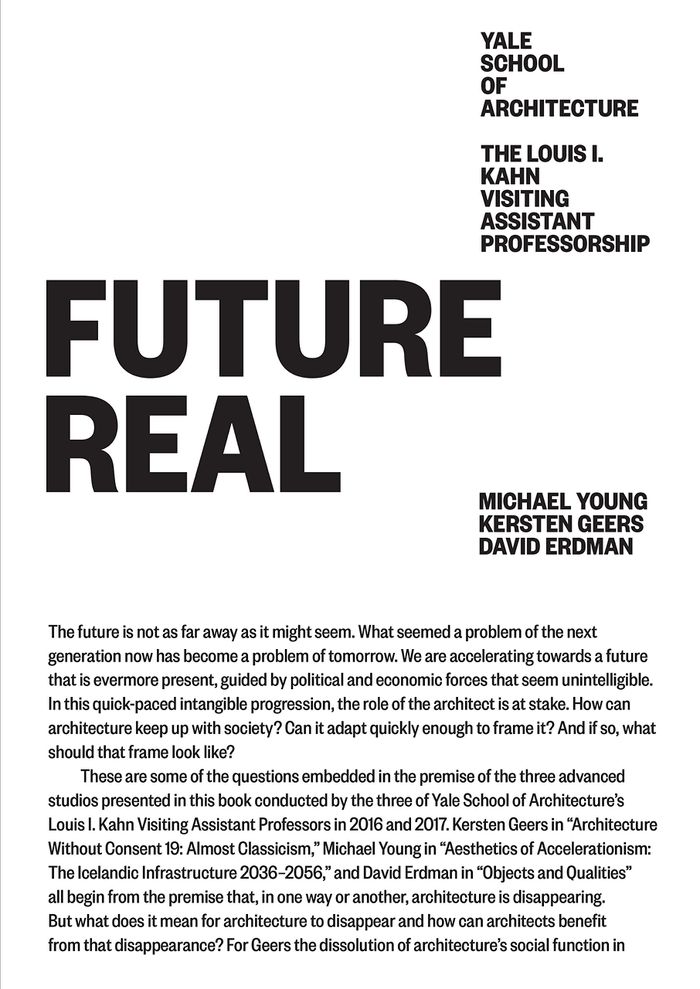
The future is not as far away as it might seem. What seemed a problem of the next generation now has become a problem of tomorrow. We are accelerating towards a future that is evermore present, guided by political and economic forces that seem unintelligible. Is this quick-paced intangible progression, the role of the architect is at stake. How can architecture keep up with society? Can it adapt quickly enough to frame it? And is so, what should that frame look like? These are some of the questions embedded in the premise of the three advanced studios presented in this book conducted by the three of Yale School of Architecture's Louis I. Kahn Visiting Assistant Professors in 2016 and 2017. Michael Young investigates the past from the future in "Aesthetics of Accelerationism: The Icelandic Infrastructure 2036-2056." Kersten Geers analyzes visions for agricultural ensembles for communal living in "Architecture Without Consent 19: Almost Classicism." And David Erdman looks to the potential of building on top of housing estates in Hong Kong in "Objects and Qualities." The book features interviews with the professors and essays on their specific studio topics.
Future Real: Kersten Geers, Michael Young, David Erdman
Actions:
Prix:
$47.95
(disponible sur commande)
Résumé:
The future is not as far away as it might seem. What seemed a problem of the next generation now has become a problem of tomorrow. We are accelerating towards a future that is evermore present, guided by political and economic forces that seem unintelligible. Is this quick-paced intangible progression, the role of the architect is at stake. How can architecture keep up with society? Can it adapt quickly enough to frame it? And is so, what should that frame look like? These are some of the questions embedded in the premise of the three advanced studios presented in this book conducted by the three of Yale School of Architecture's Louis I. Kahn Visiting Assistant Professors in 2016 and 2017. Michael Young investigates the past from the future in "Aesthetics of Accelerationism: The Icelandic Infrastructure 2036-2056." Kersten Geers analyzes visions for agricultural ensembles for communal living in "Architecture Without Consent 19: Almost Classicism." And David Erdman looks to the potential of building on top of housing estates in Hong Kong in "Objects and Qualities." The book features interviews with the professors and essays on their specific studio topics.
Classification:
livres
livres
Publication:
juin 2018
juin 2018
Sujet:
Théorie de l’architecture
Théorie de l’architecture
Classification:
livres
livres
Actions:
Prix:
$42.50
(disponible sur commande)
Résumé:
Visiting a Soviet sanatorium is like stepping back in time. Originally built in the 1920s, they afforded workers a place to holiday, courtesy of a state-funded voucher system. At their peak they were visited by millions of citizens across the USSR every year. A combination of medical institution and spa, the era’s sanatoriums are among the most innovative buildings of(...)
$42.50
(disponible sur commande)
Résumé:
Visiting a Soviet sanatorium is like stepping back in time. Originally built in the 1920s, they afforded workers a place to holiday, courtesy of a state-funded voucher system. At their peak they were visited by millions of citizens across the USSR every year. A combination of medical institution and spa, the era’s sanatoriums are among the most innovative buildings of(...)
Titre:
Holidays in soviet sanatoriums
Actions:
Prix:
$42.50
(disponible sur commande)
Résumé:
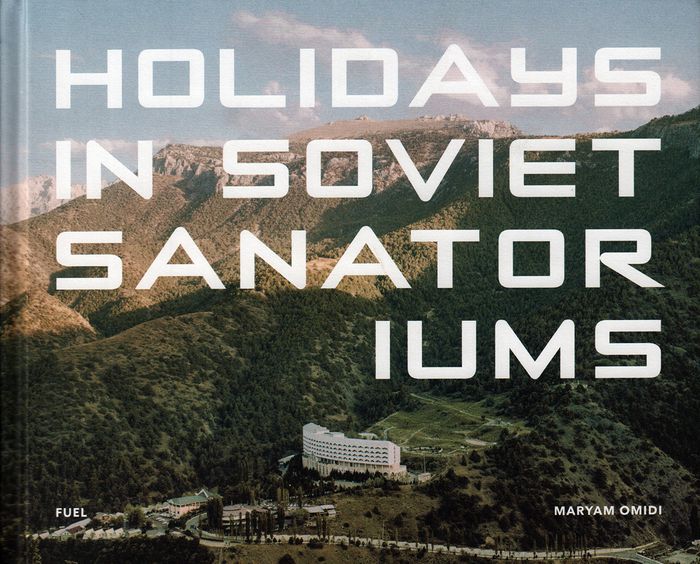
Visiting a Soviet sanatorium is like stepping back in time. Originally built in the 1920s, they afforded workers a place to holiday, courtesy of a state-funded voucher system. At their peak they were visited by millions of citizens across the USSR every year. A combination of medical institution and spa, the era’s sanatoriums are among the most innovative buildings of their time. Although aesthetically diverse, Soviet utopian values permeated every aspect of these structures; Western holidays were perceived as decadent. By contrast, sanatorium breaks were intended to edify and strengthen visitors: health professionals carefully monitored guests throughout their stay, so they could return to work with renewed vigor. Certain sanatoriums became known for their specialist treatments, such as crude-oil baths, radon water douches and stints in underground salt caves. While today some sanatoriums are in critical states of decline, many are still fully operational and continue to offer their Soviet-era treatments to visitors. Using specially commissioned photographs by leading photographers of the post-Soviet territories, and texts by sanatorium expert Maryam Omidi, this book documents over 45 sanatoriums and their unconventional treatments. From Armenia to Uzbekistan, it represents the most comprehensive survey to date of this fascinating and previously overlooked Soviet institution.
Holidays in soviet sanatoriums
Actions:
Prix:
$42.50
(disponible sur commande)
Résumé:
Visiting a Soviet sanatorium is like stepping back in time. Originally built in the 1920s, they afforded workers a place to holiday, courtesy of a state-funded voucher system. At their peak they were visited by millions of citizens across the USSR every year. A combination of medical institution and spa, the era’s sanatoriums are among the most innovative buildings of their time. Although aesthetically diverse, Soviet utopian values permeated every aspect of these structures; Western holidays were perceived as decadent. By contrast, sanatorium breaks were intended to edify and strengthen visitors: health professionals carefully monitored guests throughout their stay, so they could return to work with renewed vigor. Certain sanatoriums became known for their specialist treatments, such as crude-oil baths, radon water douches and stints in underground salt caves. While today some sanatoriums are in critical states of decline, many are still fully operational and continue to offer their Soviet-era treatments to visitors. Using specially commissioned photographs by leading photographers of the post-Soviet territories, and texts by sanatorium expert Maryam Omidi, this book documents over 45 sanatoriums and their unconventional treatments. From Armenia to Uzbekistan, it represents the most comprehensive survey to date of this fascinating and previously overlooked Soviet institution.
Classification:
livres
livres
Publication:
octobre 2017
octobre 2017
Sujet:
Monographies photo
Monographies photo


