


6378 Résultats
Classification:
livres
livres
Titre:
Hotel interior structures
Hotel interior structures
Actions:
Prix:
$53.99
(disponible sur commande)
Résumé:
The steep increases recently witnessed in both business and leisure travel have helped provoke a new variety in hotel interiors, and designers from various disciplines are now establishing a range of design solutions catering to the widely differing demands of each client type, giving new identities to hotels. From the boutique hotel to the airport atrium, the urban(...)
$53.99
(disponible sur commande)
Résumé:
The steep increases recently witnessed in both business and leisure travel have helped provoke a new variety in hotel interiors, and designers from various disciplines are now establishing a range of design solutions catering to the widely differing demands of each client type, giving new identities to hotels. From the boutique hotel to the airport atrium, the urban(...)
Publication:
mai 2003, Chichester
mai 2003, Chichester
Titre:
Hotel interior structures
Actions:
Prix:
$53.99
(disponible sur commande)
Résumé:
The steep increases recently witnessed in both business and leisure travel have helped provoke a new variety in hotel interiors, and designers from various disciplines are now establishing a range of design solutions catering to the widely differing demands of each client type, giving new identities to hotels. From the boutique hotel to the airport atrium, the urban retreat to the contemporary resort, the immensity of Vegas to the intimacy of Beirut, "Hotel Interior Structures" presents a wide range of these new design trends found in present-day hotel interiors. This volume aims to offer architects, interior designers and hotel owners - as well as those with a more general interest in the use of interior design detail to create a particular atmosphere or living experience - a valuable insight into the what, why and how of current design directions for hotels across the globe. Identifying ten hotel types that have been conceived within the last ten years, it features text, plans and detailed photography of a selection of hotels of each type, as well as interviews with some of the key figures involved. With examples of hotels in major cities and resorts worldwide - from London, Paris and New York to locations in Japan, Egypt and Lebanon - it gives a complete picture of the creativeness and imaginativeness of hotel interior design at the beginning of the 21st century.
Hotel interior structures
Actions:
Prix:
$53.99
(disponible sur commande)
Résumé:
The steep increases recently witnessed in both business and leisure travel have helped provoke a new variety in hotel interiors, and designers from various disciplines are now establishing a range of design solutions catering to the widely differing demands of each client type, giving new identities to hotels. From the boutique hotel to the airport atrium, the urban retreat to the contemporary resort, the immensity of Vegas to the intimacy of Beirut, "Hotel Interior Structures" presents a wide range of these new design trends found in present-day hotel interiors. This volume aims to offer architects, interior designers and hotel owners - as well as those with a more general interest in the use of interior design detail to create a particular atmosphere or living experience - a valuable insight into the what, why and how of current design directions for hotels across the globe. Identifying ten hotel types that have been conceived within the last ten years, it features text, plans and detailed photography of a selection of hotels of each type, as well as interviews with some of the key figures involved. With examples of hotels in major cities and resorts worldwide - from London, Paris and New York to locations in Japan, Egypt and Lebanon - it gives a complete picture of the creativeness and imaginativeness of hotel interior design at the beginning of the 21st century.
Classification:
livres
livres
Publication:
mai 2003, Chichester
mai 2003, Chichester
Classification:
livres
livres
Titre:
In a human voice
In a human voice
Actions:
Prix:
$17.95
(disponible sur commande)
Résumé:
Carol Gilligan’s landmark book ''In a different voice'' – the ''little book that started a revolution'' – brought women’s voices to the fore in work on the self and moral development, enabling women to be heard in their own right, and with their own integrity, for the first time. Forty years later, Gilligan returns to the subject matter of her classic book,(...)
$17.95
(disponible sur commande)
Résumé:
Carol Gilligan’s landmark book ''In a different voice'' – the ''little book that started a revolution'' – brought women’s voices to the fore in work on the self and moral development, enabling women to be heard in their own right, and with their own integrity, for the first time. Forty years later, Gilligan returns to the subject matter of her classic book,(...)
Titre:
In a human voice
Actions:
Prix:
$17.95
(disponible sur commande)
Résumé:
Carol Gilligan’s landmark book ''In a different voice'' – the ''little book that started a revolution'' – brought women’s voices to the fore in work on the self and moral development, enabling women to be heard in their own right, and with their own integrity, for the first time. Forty years later, Gilligan returns to the subject matter of her classic book, re-examining its central arguments and concerns from the vantage point of the present. Thanks to the work that she and others have done in recent decades, it is now possible to clarify and articulate what couldn’t quite be seen or said at the time of the original publication: that the ''different voice'' (of care ethics), although initially heard as a ''feminine'' voice, is in fact a human voice; that the voice it differs from is a patriarchal voice (bound to gender binaries and hierarchies); and that where patriarchy is in force or enforced, the human voice is a voice of resistance, and care ethics is an ethics of liberation. While gender is central to the story Gilligan tells, this is not a story about gender: it is a human story. With this clarification, it becomes evident why ''In a different voice'' continues to resonate strongly with people’s experience and, perhaps more crucially, why the different voice is a voice for the 21st century.
In a human voice
Actions:
Prix:
$17.95
(disponible sur commande)
Résumé:
Carol Gilligan’s landmark book ''In a different voice'' – the ''little book that started a revolution'' – brought women’s voices to the fore in work on the self and moral development, enabling women to be heard in their own right, and with their own integrity, for the first time. Forty years later, Gilligan returns to the subject matter of her classic book, re-examining its central arguments and concerns from the vantage point of the present. Thanks to the work that she and others have done in recent decades, it is now possible to clarify and articulate what couldn’t quite be seen or said at the time of the original publication: that the ''different voice'' (of care ethics), although initially heard as a ''feminine'' voice, is in fact a human voice; that the voice it differs from is a patriarchal voice (bound to gender binaries and hierarchies); and that where patriarchy is in force or enforced, the human voice is a voice of resistance, and care ethics is an ethics of liberation. While gender is central to the story Gilligan tells, this is not a story about gender: it is a human story. With this clarification, it becomes evident why ''In a different voice'' continues to resonate strongly with people’s experience and, perhaps more crucially, why the different voice is a voice for the 21st century.
Classification:
livres
livres
Publication:
septembre 2023
septembre 2023
Classification:
périodiques
périodiques
Titre:
Domus 962
Domus 962
Actions:
Prix:
$35.00
(disponible sur commande)
Résumé:
The October issue of Domus focuses on the theme of affordable housing, tackling the question of what "minimum subsistence dwelling" could mean in the 21st century. It builds on the investigation started at the Min to Max international architecture symposium in Berlin. Guest edited by Ilka and Andreas Ruby, it starts with Berlin-based architecture studio Something(...)
$35.00
(disponible sur commande)
Résumé:
The October issue of Domus focuses on the theme of affordable housing, tackling the question of what "minimum subsistence dwelling" could mean in the 21st century. It builds on the investigation started at the Min to Max international architecture symposium in Berlin. Guest edited by Ilka and Andreas Ruby, it starts with Berlin-based architecture studio Something(...)
Titre:
Domus 962
Actions:
Prix:
$35.00
(disponible sur commande)
Résumé:
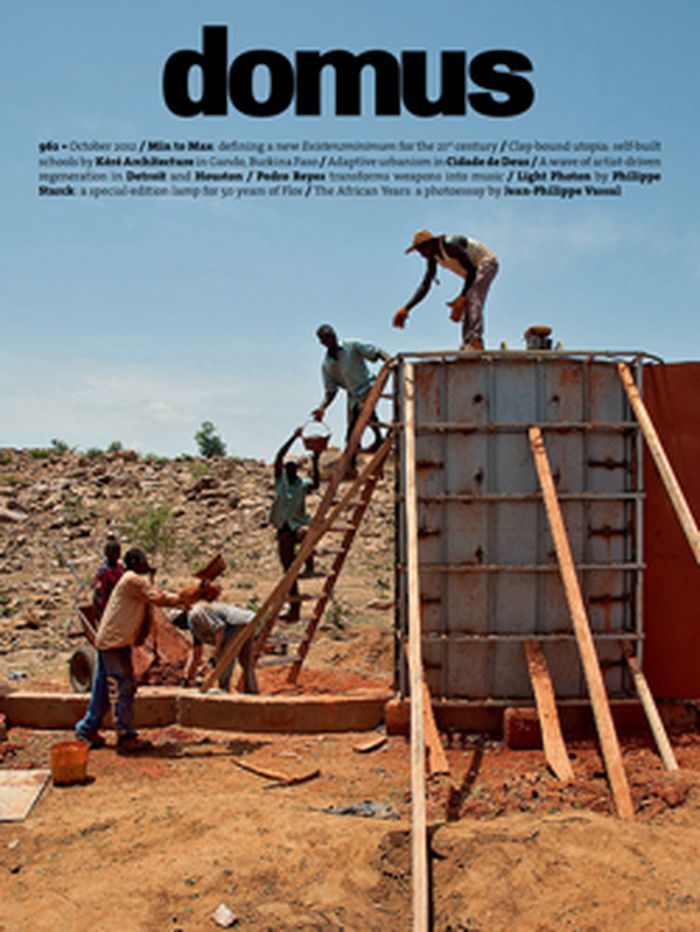
The October issue of Domus focuses on the theme of affordable housing, tackling the question of what "minimum subsistence dwelling" could mean in the 21st century. It builds on the investigation started at the Min to Max international architecture symposium in Berlin. Guest edited by Ilka and Andreas Ruby, it starts with Berlin-based architecture studio Something Fantastic's manifesto on the creative opportunities and innovation allowed by the world recession. Domus then surveys the globe in search of positive strategies where design is subjected to constant experimentation, from Burkina Faso — where, in Gando, Diébédo Francis Kéré runs his experimental architecture workshop —, to Athens — where a group of teachers and researchers finds in the typical Greek polykatoikia the possibility of generating a host of collective and shared spaces —, passing through Detroit, Houston, New York City, Berlin, and Rio de Janeiro. Fresh after the opening of the Venice Architecture Biennale, issue 962 presents Gabriele Basilico's photographic survey of the Biennale's national pavilions, empty and waiting for their annual occupation. Jean-Philippe Vassal's photo essay captures extraordinary moments in the production of everyday space in Africa, and, in Mexico, artist Pedro Reyes transforms agents of death into instruments of life: by converting half a tonne of confiscated weapons into musical instruments, Reyes challenges us to imagine a change for the better.
Domus 962
Actions:
Prix:
$35.00
(disponible sur commande)
Résumé:
The October issue of Domus focuses on the theme of affordable housing, tackling the question of what "minimum subsistence dwelling" could mean in the 21st century. It builds on the investigation started at the Min to Max international architecture symposium in Berlin. Guest edited by Ilka and Andreas Ruby, it starts with Berlin-based architecture studio Something Fantastic's manifesto on the creative opportunities and innovation allowed by the world recession. Domus then surveys the globe in search of positive strategies where design is subjected to constant experimentation, from Burkina Faso — where, in Gando, Diébédo Francis Kéré runs his experimental architecture workshop —, to Athens — where a group of teachers and researchers finds in the typical Greek polykatoikia the possibility of generating a host of collective and shared spaces —, passing through Detroit, Houston, New York City, Berlin, and Rio de Janeiro. Fresh after the opening of the Venice Architecture Biennale, issue 962 presents Gabriele Basilico's photographic survey of the Biennale's national pavilions, empty and waiting for their annual occupation. Jean-Philippe Vassal's photo essay captures extraordinary moments in the production of everyday space in Africa, and, in Mexico, artist Pedro Reyes transforms agents of death into instruments of life: by converting half a tonne of confiscated weapons into musical instruments, Reyes challenges us to imagine a change for the better.
Classification:
périodiques
périodiques
Publication:
novembre 2012
novembre 2012
Sujet:
Revues
Revues
Classification:
livres
livres
Actions:
Prix:
$100.95
(disponible en magasin)
Résumé:
Master builders have been granted membership of the Akademie der Künste since 1696, the year of its foundation. The earliest materials within the Archive documenting the art of architecture date back to the end of the 18th century and give testimony to the pursuits of tutors and pupils at the Akademie. It was not until the end of the 1950s under the post-war president of(...)
$100.95
(disponible en magasin)
Résumé:
Master builders have been granted membership of the Akademie der Künste since 1696, the year of its foundation. The earliest materials within the Archive documenting the art of architecture date back to the end of the 18th century and give testimony to the pursuits of tutors and pupils at the Akademie. It was not until the end of the 1950s under the post-war president of(...)
Publication:
janvier 2017
janvier 2017
Titre:
Architecture in archives: the collection of the Akademie der Künste, Berlin
Actions:
Prix:
$100.95
(disponible en magasin)
Résumé:
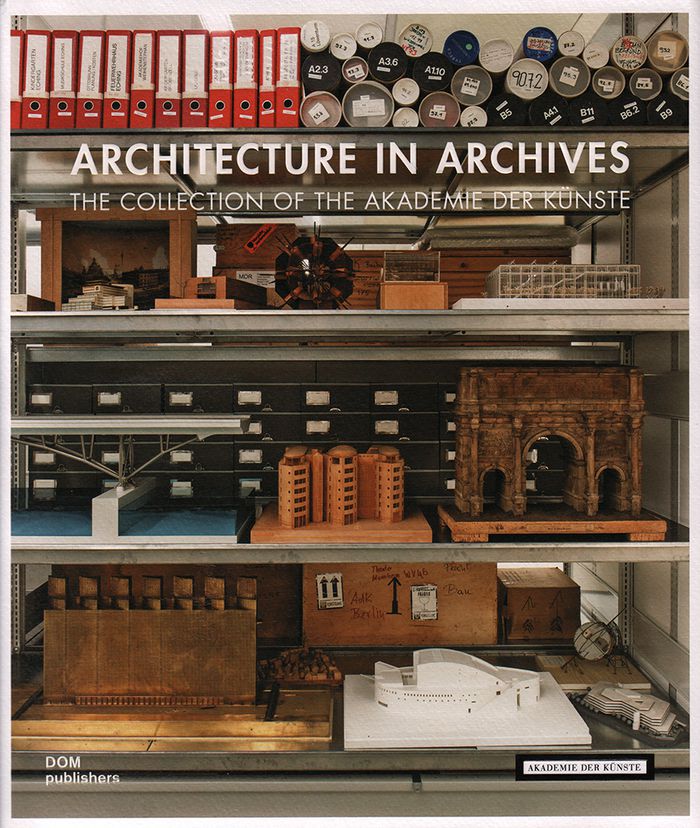
Master builders have been granted membership of the Akademie der Künste since 1696, the year of its foundation. The earliest materials within the Archive documenting the art of architecture date back to the end of the 18th century and give testimony to the pursuits of tutors and pupils at the Akademie. It was not until the end of the 1950s under the post-war president of the Akademie in West Berlin, the architect Hans Scharoun, that bequests from architects began to be received into the Archive. This publication offers for the first time a comprehensive overview of the archives of architects, engineers, landscape architects, architectural photographers and critics, all of which have been bequeathed to the Architectural Archive of the Akademie der Künste. All 71 archives and 80 collections are introduced with brief biographies of the original authors and descriptions denoting the nature and scope of the holdings. Friedrich Gilly from the Preußische Akademie der Künste is, among others, represented with drawings. A particular abundance of documentation reflects the era of Expressionism following the First World War with the works of Hugo Häring, Hans Scharoun, Bruno Taut, Hans and Wassili Luckhardt, Alfons Anker, Paul Goesch, Adolf Behne and Heinrich Lauterbach. The archives of Richard Ermisch, Paul Baumgarten and Thilo Schoder date back as far as the 1920s. Particular emphasis is laid upon those architects forced to emigrate after 1933, among their number Gabriel Epstein, Julius Posener, Konrad Wachsmann, Adolf Rading and Harry Rosenthal. The post-war period and the 1960s are represented by the archives of Max Taut, Walter Rossow, Dieter Oesterlen, Bernhard Pfau, Ludwig Leo, Bernhard Hermkes, Helmut Hentrich, Werner Hebebrand, Hermann Henselmann, Werner Düttmann, Friedrich Spengelin and Heinz Graffunder. Archives and collections extending into the 21st century emanate from Kurt Ackermann, Hans-Busso von Busse, Peter von Seidlein, Manfred Sack, Jörg Schlaich, Szyszkowitz + Kowalski, Haus-Rucker-Co, Valentien + Valentien and Arno Brandlhuber.
Architecture in archives: the collection of the Akademie der Künste, Berlin
Actions:
Prix:
$100.95
(disponible en magasin)
Résumé:
Master builders have been granted membership of the Akademie der Künste since 1696, the year of its foundation. The earliest materials within the Archive documenting the art of architecture date back to the end of the 18th century and give testimony to the pursuits of tutors and pupils at the Akademie. It was not until the end of the 1950s under the post-war president of the Akademie in West Berlin, the architect Hans Scharoun, that bequests from architects began to be received into the Archive. This publication offers for the first time a comprehensive overview of the archives of architects, engineers, landscape architects, architectural photographers and critics, all of which have been bequeathed to the Architectural Archive of the Akademie der Künste. All 71 archives and 80 collections are introduced with brief biographies of the original authors and descriptions denoting the nature and scope of the holdings. Friedrich Gilly from the Preußische Akademie der Künste is, among others, represented with drawings. A particular abundance of documentation reflects the era of Expressionism following the First World War with the works of Hugo Häring, Hans Scharoun, Bruno Taut, Hans and Wassili Luckhardt, Alfons Anker, Paul Goesch, Adolf Behne and Heinrich Lauterbach. The archives of Richard Ermisch, Paul Baumgarten and Thilo Schoder date back as far as the 1920s. Particular emphasis is laid upon those architects forced to emigrate after 1933, among their number Gabriel Epstein, Julius Posener, Konrad Wachsmann, Adolf Rading and Harry Rosenthal. The post-war period and the 1960s are represented by the archives of Max Taut, Walter Rossow, Dieter Oesterlen, Bernhard Pfau, Ludwig Leo, Bernhard Hermkes, Helmut Hentrich, Werner Hebebrand, Hermann Henselmann, Werner Düttmann, Friedrich Spengelin and Heinz Graffunder. Archives and collections extending into the 21st century emanate from Kurt Ackermann, Hans-Busso von Busse, Peter von Seidlein, Manfred Sack, Jörg Schlaich, Szyszkowitz + Kowalski, Haus-Rucker-Co, Valentien + Valentien and Arno Brandlhuber.
Classification:
livres
livres
Publication:
janvier 2017
janvier 2017
Classification:
livres
livres
Titre:
Architecture now! vol 2
Architecture now! vol 2
Actions:
Prix:
$54.95
(disponible sur commande)
Résumé:
The fine line between art and architecture is rapidly becoming harder to perceive. With the aid of sophisticated computer programs, today's most innovative architects are working on designs so conceptual they could not be realized in the physical world. Nevertheless, these sorts of forward-thinking projects are an important influence on the architectural climate. At(...)
$54.95
(disponible sur commande)
Résumé:
The fine line between art and architecture is rapidly becoming harder to perceive. With the aid of sophisticated computer programs, today's most innovative architects are working on designs so conceptual they could not be realized in the physical world. Nevertheless, these sorts of forward-thinking projects are an important influence on the architectural climate. At(...)
Titre:
Architecture now! vol 2
Actions:
Prix:
$54.95
(disponible sur commande)
Résumé:
The fine line between art and architecture is rapidly becoming harder to perceive. With the aid of sophisticated computer programs, today's most innovative architects are working on designs so conceptual they could not be realized in the physical world. Nevertheless, these sorts of forward-thinking projects are an important influence on the architectural climate. At the dawn of the 21st century, architecture is entering a paradigm shift; no longer can it be completely distinguished from art. Be they built from bytes or bricks, the projects in this book represent the imagination of the planet's most talented and creative architects. For all the latest and most important architectural projects and trends, look no further than this volume, the follow-up to our popular and groundbreaking book Architecture Now! Including: Allmann Sattler, Wappner, Tadao Ando, Shigeru Ban, Behnisch, Behnisch & Partner, Bolles & Wilson, Simeon Bruner/Cott & Associates, Santiago Calatrava, Alberto Campo Baeza, Coop Himmelb(l)au, Neil Denari, Diller & Scofidio, Winka Dubbeldam, Jean-Marie Duthilleul, Frank O. Gehry, Sean Godsell, Nicholas Grimshaw, Heikkinen-Komonen, John Hejduk, Steven Holl, Hans Hollein, Toyo Ito, Jakob + MacFarlane, Michael Jantzen, Jones, Partners, Rick Joy, Rei Kawakubo, Waro Kishi, Kohn Shnier Architects, Rem Koolhaas, Kengo Kuma, Lacaton & Vassal, Greg Lynn, Richard Meier, Samuel Mockbee + Rural Studio, Morphosis, Jean Nouvel, Marcos Novak, NOX, Manolo Nunez-Yanofsky, Oosterhuis.nl, Pei Partnership, Pugh + Scarpa, Michele Saee, Harry Seidler, Snøhetta Architects, Julie Snow, Jyrki Tasa, Bernard Tschumi, James Turrell, UN Studio, Ben van Berkel, Various Architects, Hendrik Vermoortel, Makoto Sei Watanabe, Wesley Wei, Williams + Tsien, Jean-Michel Wilmotte
Architecture now! vol 2
Actions:
Prix:
$54.95
(disponible sur commande)
Résumé:
The fine line between art and architecture is rapidly becoming harder to perceive. With the aid of sophisticated computer programs, today's most innovative architects are working on designs so conceptual they could not be realized in the physical world. Nevertheless, these sorts of forward-thinking projects are an important influence on the architectural climate. At the dawn of the 21st century, architecture is entering a paradigm shift; no longer can it be completely distinguished from art. Be they built from bytes or bricks, the projects in this book represent the imagination of the planet's most talented and creative architects. For all the latest and most important architectural projects and trends, look no further than this volume, the follow-up to our popular and groundbreaking book Architecture Now! Including: Allmann Sattler, Wappner, Tadao Ando, Shigeru Ban, Behnisch, Behnisch & Partner, Bolles & Wilson, Simeon Bruner/Cott & Associates, Santiago Calatrava, Alberto Campo Baeza, Coop Himmelb(l)au, Neil Denari, Diller & Scofidio, Winka Dubbeldam, Jean-Marie Duthilleul, Frank O. Gehry, Sean Godsell, Nicholas Grimshaw, Heikkinen-Komonen, John Hejduk, Steven Holl, Hans Hollein, Toyo Ito, Jakob + MacFarlane, Michael Jantzen, Jones, Partners, Rick Joy, Rei Kawakubo, Waro Kishi, Kohn Shnier Architects, Rem Koolhaas, Kengo Kuma, Lacaton & Vassal, Greg Lynn, Richard Meier, Samuel Mockbee + Rural Studio, Morphosis, Jean Nouvel, Marcos Novak, NOX, Manolo Nunez-Yanofsky, Oosterhuis.nl, Pei Partnership, Pugh + Scarpa, Michele Saee, Harry Seidler, Snøhetta Architects, Julie Snow, Jyrki Tasa, Bernard Tschumi, James Turrell, UN Studio, Ben van Berkel, Various Architects, Hendrik Vermoortel, Makoto Sei Watanabe, Wesley Wei, Williams + Tsien, Jean-Michel Wilmotte
Classification:
livres
livres
Publication:
novembre 2002, Cologne
novembre 2002, Cologne
Classification:
livres
livres
Actions:
Exemplaires:
Description:
504 pages : illustrations (chiefly color) ; 30 cm
Description:
504 pages : illustrations (chiefly color) ; 30 cm
Auteur:
Sujet:
Publication:
London : Thames & Hudson Ltd ; New York, New York : Thames & Hudson Inc., 2022., ©2022
London : Thames & Hudson Ltd ; New York, New York : Thames & Hudson Inc., 2022., ©2022
Titre:
A world history of women photographers / edited by Luce Lebart and Marie Robert ; [translated from the French Une histoire mondiale des femmes photographes by Ruth Taylor and Bethany Wright].
Actions:
Exemplaires:
Description:
504 pages : illustrations (chiefly color) ; 30 cm
A world history of women photographers / edited by Luce Lebart and Marie Robert ; [translated from the French Une histoire mondiale des femmes photographes by Ruth Taylor and Bethany Wright].
Actions:
Exemplaires:
Description:
504 pages : illustrations (chiefly color) ; 30 cm
Classification:
livres
livres
Publication:
London : Thames & Hudson Ltd ; New York, New York : Thames & Hudson Inc., 2022., ©2022
London : Thames & Hudson Ltd ; New York, New York : Thames & Hudson Inc., 2022., ©2022
Auteur:
Sujet:
Classification:
vidéo
vidéo
Titre:
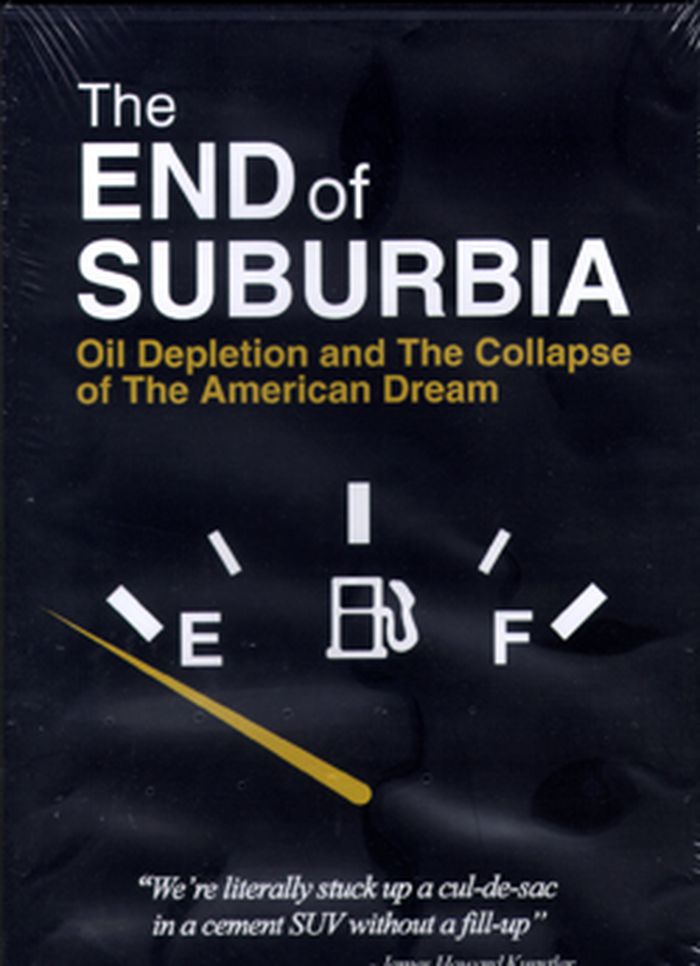
The end of suburbia
The end of suburbia
Actions:
Prix:
$25.00
(disponible sur commande)
Résumé:
Since World War II North Americans have invested much of their newfound wealth in suburbia. It has promised a sense of space, affordability, family life and upward mobility. As the population of suburban sprawl has exploded in the past 50 years, so too has the suburban way of life become embedded in the American consciousness. Suburbia, and all it promises, has become(...)
$25.00
(disponible sur commande)
Résumé:
Since World War II North Americans have invested much of their newfound wealth in suburbia. It has promised a sense of space, affordability, family life and upward mobility. As the population of suburban sprawl has exploded in the past 50 years, so too has the suburban way of life become embedded in the American consciousness. Suburbia, and all it promises, has become(...)
Titre:
The end of suburbia
Actions:
Prix:
$25.00
(disponible sur commande)
Résumé:
Since World War II North Americans have invested much of their newfound wealth in suburbia. It has promised a sense of space, affordability, family life and upward mobility. As the population of suburban sprawl has exploded in the past 50 years, so too has the suburban way of life become embedded in the American consciousness. Suburbia, and all it promises, has become the American Dream. But as we enter the 21st century, serious questions are beginning to emerge about the sustainability of this way of life. With brutal honesty and a touch of irony, "The End of Suburbia" explores the American Way of Life and its prospects as the planet approaches a critical era, as global demand for fossil fuels begins to outstrip supply. World Oil Peak and the inevitable decline of fossil fuels are upon us now, some scientists and policy makers argue in this documentary. The consequences of inaction in the face of this global crisis are enormous. What does Oil Peak mean for North America? As energy prices skyrocket in the coming years, how will the populations of suburbia react to the collapse of their dream? Are today's suburbs destined to become the slums of tomorrow? And what can be done NOW, individually and collectively, to avoid The End of Suburbia ? Hosted by Barrie Zwicker. Featuring James Howard Kunstler, Peter Calthorpe, Michael Klare, Richard Heinberg, Matthew Simmons, Michael C. Ruppert, Julian Darley, Colin Campbell, Kenneth Deffeyes, Ali Samsam Bakhtiari and Steve Andrews. Directed by Gregory Greene. Produced by Barry Silverthorn. Duration: 78 minutes DVD BONUS: Includes the vintage short films, "In the Suburbs" and "Destination Earth", and producer/director commentary.
The end of suburbia
Actions:
Prix:
$25.00
(disponible sur commande)
Résumé:
Since World War II North Americans have invested much of their newfound wealth in suburbia. It has promised a sense of space, affordability, family life and upward mobility. As the population of suburban sprawl has exploded in the past 50 years, so too has the suburban way of life become embedded in the American consciousness. Suburbia, and all it promises, has become the American Dream. But as we enter the 21st century, serious questions are beginning to emerge about the sustainability of this way of life. With brutal honesty and a touch of irony, "The End of Suburbia" explores the American Way of Life and its prospects as the planet approaches a critical era, as global demand for fossil fuels begins to outstrip supply. World Oil Peak and the inevitable decline of fossil fuels are upon us now, some scientists and policy makers argue in this documentary. The consequences of inaction in the face of this global crisis are enormous. What does Oil Peak mean for North America? As energy prices skyrocket in the coming years, how will the populations of suburbia react to the collapse of their dream? Are today's suburbs destined to become the slums of tomorrow? And what can be done NOW, individually and collectively, to avoid The End of Suburbia ? Hosted by Barrie Zwicker. Featuring James Howard Kunstler, Peter Calthorpe, Michael Klare, Richard Heinberg, Matthew Simmons, Michael C. Ruppert, Julian Darley, Colin Campbell, Kenneth Deffeyes, Ali Samsam Bakhtiari and Steve Andrews. Directed by Gregory Greene. Produced by Barry Silverthorn. Duration: 78 minutes DVD BONUS: Includes the vintage short films, "In the Suburbs" and "Destination Earth", and producer/director commentary.
Classification:
vidéo
vidéo
Publication:
novembre 2007, Toronto
novembre 2007, Toronto
Sujet:
DVD vidéo
DVD vidéo
Classification:
périodiques
périodiques
Actions:
Prix:
$71.50
(disponible sur commande)
Résumé:
A ‘Pacific’ century, an Asian century or a Chinese century? On the threshold between the 20th and the 21st century, the transit from the Atlantic to the Pacific is forecasted by all; the move from America to Asia is noticed by many; and the replacement of the United States by China is feared by some: the awakening of the dragon provokes both wonder and distrust. After the(...)
$71.50
(disponible sur commande)
Résumé:
A ‘Pacific’ century, an Asian century or a Chinese century? On the threshold between the 20th and the 21st century, the transit from the Atlantic to the Pacific is forecasted by all; the move from America to Asia is noticed by many; and the replacement of the United States by China is feared by some: the awakening of the dragon provokes both wonder and distrust. After the(...)
Titre:
AV Monografias / Monographs 109-110 (2004) : China boom, growth unlimited
Actions:
Prix:
$71.50
(disponible sur commande)
Résumé:
A ‘Pacific’ century, an Asian century or a Chinese century? On the threshold between the 20th and the 21st century, the transit from the Atlantic to the Pacific is forecasted by all; the move from America to Asia is noticed by many; and the replacement of the United States by China is feared by some: the awakening of the dragon provokes both wonder and distrust. After the reforms of Deng Xiaoping in 1978, in the last 25 years China has grown at a rate of 9 percent; in this period, its GNP has tripled, and the percentage of population living in cities has doubled, exceeding 40%. Fueled by exports, and backed by the postotalitarian protectionism of a single-party government, the stunning growth of China has not yet created global companies – the Sony or Hyundai that led the Japanese or Korean booms – but its large oil firms (PetroChina, Sinopec, CNOOC) try to find in several continents the energy needed by the world’s second importer; its technological companies (from Lenovo, that has purchased a division of IBM, to Huawei, that has created in Shenzhen a Silicon Valley-style campus, Doric Disney designs included) make up for scarce innovation with low labor costs; and its new breed of fancy millionaires, who build chateaux or buy French cosmetic brands, spearhead a large consumerist middle class, supplying a strong domestic demand that adds to the thrust of foreign markets. China’s unequal growth does not appear to be a large risk: the differences in income are similar to those of the US, and the contrast between the wealthy coast and the rural inland – where most upheavals have started, from Boxers to communists – is blurred as the development of Shanghai extends upriver along the Yangtze corridor, and as Hong Kong’s dynamism expands in concentric waves over the superregion of Guangdong, from that Pearl River Delta known as ‘the factory of the world’. More dangerous seem to be the weakness of the financial system, the persistence of administrative corruption and the scarcity of energy resources, the supply of which is being secured by heavy investments on the military, something that upsets its neighbors – Japan and Taiwan most of all, but also Korea and another awakening giant, India –, its competitors, and even the US, that urges its European allies to maintain the arms ban on China. On top of all this, in a country that has reached 1,300 million inhabitants in 2005, is the demographic scenario created by the single child policy and the accelerated ageing of the population, with an increasing number of 4+2+1 families, where now there are four grandparents and two parents satisfying the needs of a little emperor, but where in just 30 years a single adult will have to take care of six retirees. This huge economic and social transformation has expressed itself via an unprecedented urban explosion, shaped by titanic public works – large dams and suspended bridges, elevated highways and submarine tunnels – and with the foreseeable devastating impact on the environment and cultural heritage. The building frenzy that has attracted so many foreign architects to China – initially for technically complex or symbolically significant works, like some of the skyscrapers of Shanghai or the olympic projects in Beijing, but now more often for urban plans or conventional commercial developments – receives, according to The Economist, the added boost of a real-estate bubble that feeds on hot money placing its bets on the yuan’s revaluation. This process has turned some districts of Shanghai such as Pudong or Puxi into the most sought-after office areas in the world, and has caused in cities like Beijing an increasing decay of its architectural legacy, which barely respects World Heritage sites (The Great Wall, the Forbidden City, the Summer Palace, the Ming Imperial Tombs and the Temple of Heaven), besieged already by a unanimous tide of trivial constructions.
AV Monografias / Monographs 109-110 (2004) : China boom, growth unlimited
Actions:
Prix:
$71.50
(disponible sur commande)
Résumé:
A ‘Pacific’ century, an Asian century or a Chinese century? On the threshold between the 20th and the 21st century, the transit from the Atlantic to the Pacific is forecasted by all; the move from America to Asia is noticed by many; and the replacement of the United States by China is feared by some: the awakening of the dragon provokes both wonder and distrust. After the reforms of Deng Xiaoping in 1978, in the last 25 years China has grown at a rate of 9 percent; in this period, its GNP has tripled, and the percentage of population living in cities has doubled, exceeding 40%. Fueled by exports, and backed by the postotalitarian protectionism of a single-party government, the stunning growth of China has not yet created global companies – the Sony or Hyundai that led the Japanese or Korean booms – but its large oil firms (PetroChina, Sinopec, CNOOC) try to find in several continents the energy needed by the world’s second importer; its technological companies (from Lenovo, that has purchased a division of IBM, to Huawei, that has created in Shenzhen a Silicon Valley-style campus, Doric Disney designs included) make up for scarce innovation with low labor costs; and its new breed of fancy millionaires, who build chateaux or buy French cosmetic brands, spearhead a large consumerist middle class, supplying a strong domestic demand that adds to the thrust of foreign markets. China’s unequal growth does not appear to be a large risk: the differences in income are similar to those of the US, and the contrast between the wealthy coast and the rural inland – where most upheavals have started, from Boxers to communists – is blurred as the development of Shanghai extends upriver along the Yangtze corridor, and as Hong Kong’s dynamism expands in concentric waves over the superregion of Guangdong, from that Pearl River Delta known as ‘the factory of the world’. More dangerous seem to be the weakness of the financial system, the persistence of administrative corruption and the scarcity of energy resources, the supply of which is being secured by heavy investments on the military, something that upsets its neighbors – Japan and Taiwan most of all, but also Korea and another awakening giant, India –, its competitors, and even the US, that urges its European allies to maintain the arms ban on China. On top of all this, in a country that has reached 1,300 million inhabitants in 2005, is the demographic scenario created by the single child policy and the accelerated ageing of the population, with an increasing number of 4+2+1 families, where now there are four grandparents and two parents satisfying the needs of a little emperor, but where in just 30 years a single adult will have to take care of six retirees. This huge economic and social transformation has expressed itself via an unprecedented urban explosion, shaped by titanic public works – large dams and suspended bridges, elevated highways and submarine tunnels – and with the foreseeable devastating impact on the environment and cultural heritage. The building frenzy that has attracted so many foreign architects to China – initially for technically complex or symbolically significant works, like some of the skyscrapers of Shanghai or the olympic projects in Beijing, but now more often for urban plans or conventional commercial developments – receives, according to The Economist, the added boost of a real-estate bubble that feeds on hot money placing its bets on the yuan’s revaluation. This process has turned some districts of Shanghai such as Pudong or Puxi into the most sought-after office areas in the world, and has caused in cities like Beijing an increasing decay of its architectural legacy, which barely respects World Heritage sites (The Great Wall, the Forbidden City, the Summer Palace, the Ming Imperial Tombs and the Temple of Heaven), besieged already by a unanimous tide of trivial constructions.
Classification:
périodiques
périodiques
Publication:
août 2005, Madrid
août 2005, Madrid
Sujet:
Revues
Revues


