


7452 Résultats
Classification:
livres
livres
Prix:
$38.95
(disponible sur commande)
Résumé:
Since its publication twenty years ago, Brian Massumi's pioneering ''Parables for the virtual'' has become an essential text for interdisciplinary scholars across the humanities. Massumi views the body and media such as television, film, and the internet as cultural formations that operate on multiple registers of sensation. Renewing and assessing William James's radical(...)
$38.95
(disponible sur commande)
Résumé:
Since its publication twenty years ago, Brian Massumi's pioneering ''Parables for the virtual'' has become an essential text for interdisciplinary scholars across the humanities. Massumi views the body and media such as television, film, and the internet as cultural formations that operate on multiple registers of sensation. Renewing and assessing William James's radical(...)
Titre:
Parables for the virtual: movement, affect, sensation
Actions:
Prix:
$38.95
(disponible sur commande)
Résumé:
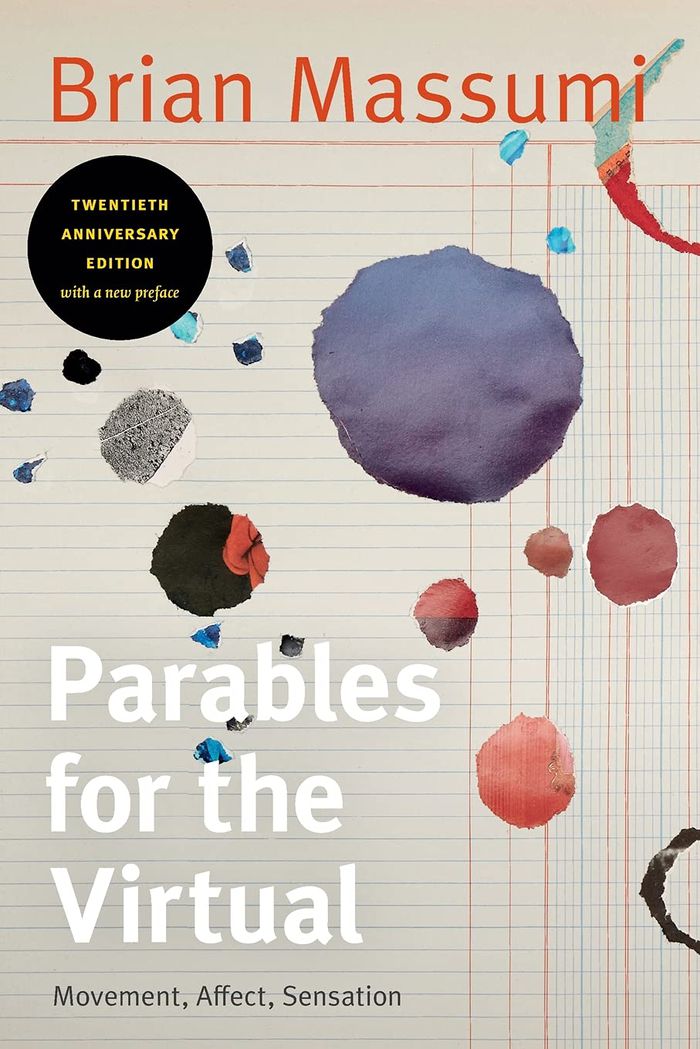
Since its publication twenty years ago, Brian Massumi's pioneering ''Parables for the virtual'' has become an essential text for interdisciplinary scholars across the humanities. Massumi views the body and media such as television, film, and the internet as cultural formations that operate on multiple registers of sensation. Renewing and assessing William James's radical empiricism and Henri Bergson's philosophy of perception through the filter of the postwar French philosophy of Deleuze, Guattari, and Foucault, Massumi links a cultural logic of variation to questions of movement, affect, and sensation. Replacing the traditional opposition of literal and figural with distinctions between stasis and motion and between actual and virtual, Massumi tackles related theoretical issues by applying them to cultural mediums as diverse as architecture, body art, the digital art of Stelarc, and Ronald Reagan's acting career. The result is an intriguing combination of cultural theory, science, and philosophy that asserts itself in a crystalline and multifaceted argument. This twentieth anniversary edition includes a new preface in which Massumi situates the book in relation to developments since its publication and outlines the evolution of its main concepts. It also includes two short texts, "Keywords for Affect" and "Missed Conceptions about Affect," in which Massumi explicates his approach to affect in ways that emphasize the book's political and philosophical stakes.
Parables for the virtual: movement, affect, sensation
Actions:
Prix:
$38.95
(disponible sur commande)
Résumé:
Since its publication twenty years ago, Brian Massumi's pioneering ''Parables for the virtual'' has become an essential text for interdisciplinary scholars across the humanities. Massumi views the body and media such as television, film, and the internet as cultural formations that operate on multiple registers of sensation. Renewing and assessing William James's radical empiricism and Henri Bergson's philosophy of perception through the filter of the postwar French philosophy of Deleuze, Guattari, and Foucault, Massumi links a cultural logic of variation to questions of movement, affect, and sensation. Replacing the traditional opposition of literal and figural with distinctions between stasis and motion and between actual and virtual, Massumi tackles related theoretical issues by applying them to cultural mediums as diverse as architecture, body art, the digital art of Stelarc, and Ronald Reagan's acting career. The result is an intriguing combination of cultural theory, science, and philosophy that asserts itself in a crystalline and multifaceted argument. This twentieth anniversary edition includes a new preface in which Massumi situates the book in relation to developments since its publication and outlines the evolution of its main concepts. It also includes two short texts, "Keywords for Affect" and "Missed Conceptions about Affect," in which Massumi explicates his approach to affect in ways that emphasize the book's political and philosophical stakes.
Classification:
livres
livres
Publication:
septembre 2021
septembre 2021
Sujet:
Théorie/ philosophie
Théorie/ philosophie
Classification:
livres
livres
Titre:
Miroslav Sasek
Miroslav Sasek
Actions:
Prix:
$39.95
(disponible sur commande)
Résumé:
Czech artist Miroslav Šašek (1916–1980) is celebrated for his pioneering approach to narrative nonfiction picture books, particularly his bestselling This Is series, which began with ''This is Paris'' in 1959 and eventually totaled eighteen books. With their distinct visual vocabulary, this witty collection of travel guides illustrating life and culture in a variety of(...)
$39.95
(disponible sur commande)
Résumé:
Czech artist Miroslav Šašek (1916–1980) is celebrated for his pioneering approach to narrative nonfiction picture books, particularly his bestselling This Is series, which began with ''This is Paris'' in 1959 and eventually totaled eighteen books. With their distinct visual vocabulary, this witty collection of travel guides illustrating life and culture in a variety of(...)
Titre:
Miroslav Sasek
Actions:
Prix:
$39.95
(disponible sur commande)
Résumé:
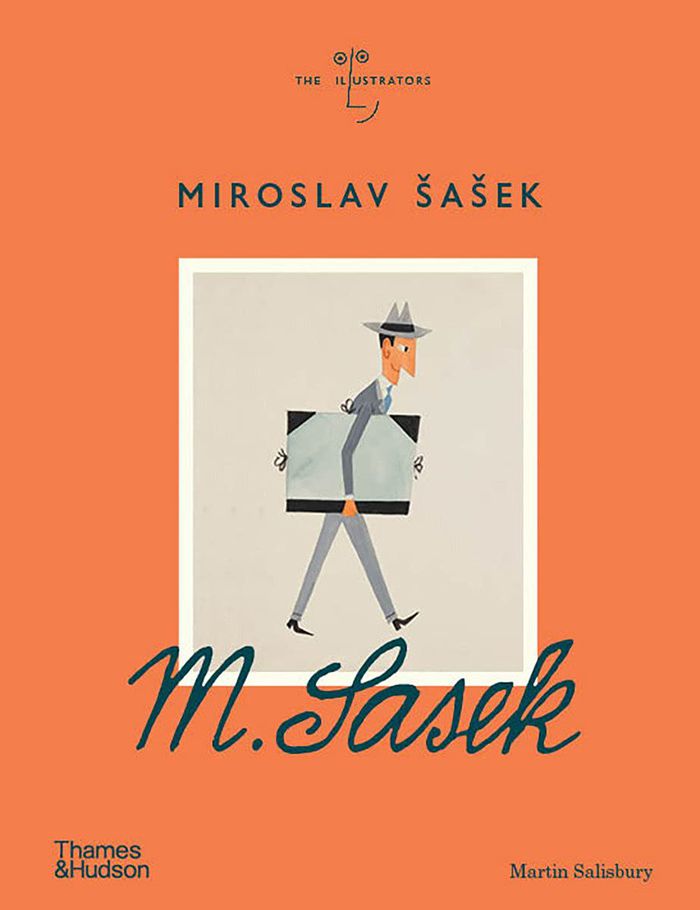
Czech artist Miroslav Šašek (1916–1980) is celebrated for his pioneering approach to narrative nonfiction picture books, particularly his bestselling This Is series, which began with ''This is Paris'' in 1959 and eventually totaled eighteen books. With their distinct visual vocabulary, this witty collection of travel guides illustrating life and culture in a variety of cities and countries around the world from a child’s perspective, became immensely popular and garnered many awards. The artist’s charming travelogues continue to appeal to adults and children alike, even in a digital age exploding with travel imagery. Acclaimed author Martin Salisbury analyzes Šašek’s techniques and how his work not only reflects his architectural training and the ideas of the midcentury European avant-garde, but also the influence of contemporaries such as Saul Steinberg. In this beautifully designed volume, illustrated with sketches and original artwork from the Šašek Foundation in Prague, with examples ranging from Greece to Hong Kong, Rome to San Francisco, Ireland to Israel, Paris to New York, and more, Šašek’s best-known works come alive alongside lesser-known aspects of his practice, such as oil painting. Full of insight into the life and work of a singular talent, ''Miroslav Šašek'' will appeal to illustrators and those interested in the midcentury modern period.
Miroslav Sasek
Actions:
Prix:
$39.95
(disponible sur commande)
Résumé:
Czech artist Miroslav Šašek (1916–1980) is celebrated for his pioneering approach to narrative nonfiction picture books, particularly his bestselling This Is series, which began with ''This is Paris'' in 1959 and eventually totaled eighteen books. With their distinct visual vocabulary, this witty collection of travel guides illustrating life and culture in a variety of cities and countries around the world from a child’s perspective, became immensely popular and garnered many awards. The artist’s charming travelogues continue to appeal to adults and children alike, even in a digital age exploding with travel imagery. Acclaimed author Martin Salisbury analyzes Šašek’s techniques and how his work not only reflects his architectural training and the ideas of the midcentury European avant-garde, but also the influence of contemporaries such as Saul Steinberg. In this beautifully designed volume, illustrated with sketches and original artwork from the Šašek Foundation in Prague, with examples ranging from Greece to Hong Kong, Rome to San Francisco, Ireland to Israel, Paris to New York, and more, Šašek’s best-known works come alive alongside lesser-known aspects of his practice, such as oil painting. Full of insight into the life and work of a singular talent, ''Miroslav Šašek'' will appeal to illustrators and those interested in the midcentury modern period.
Classification:
livres
livres
Publication:
octobre 2021
octobre 2021
Sujet:
Design, monographies
Design, monographies
Classification:
livres
livres
Actions:
Prix:
$19.95
(disponible sur commande)
Résumé:
Twenty-five years ago, kister scheithauer gross completed its first brick building, the Institute for Biology in Halle. The replicated used brick of the façade is situated in the city centre in a self-evident way, and stands there today, still untouched by time. This is the starting point for the exhibition, which presents earlier brick buildings by the firm anew, along(...)
$19.95
(disponible sur commande)
Résumé:
Twenty-five years ago, kister scheithauer gross completed its first brick building, the Institute for Biology in Halle. The replicated used brick of the façade is situated in the city centre in a self-evident way, and stands there today, still untouched by time. This is the starting point for the exhibition, which presents earlier brick buildings by the firm anew, along(...)
Titre:
Kister Scheithauer Gross. Working title : BRICK
Actions:
Prix:
$19.95
(disponible sur commande)
Résumé:
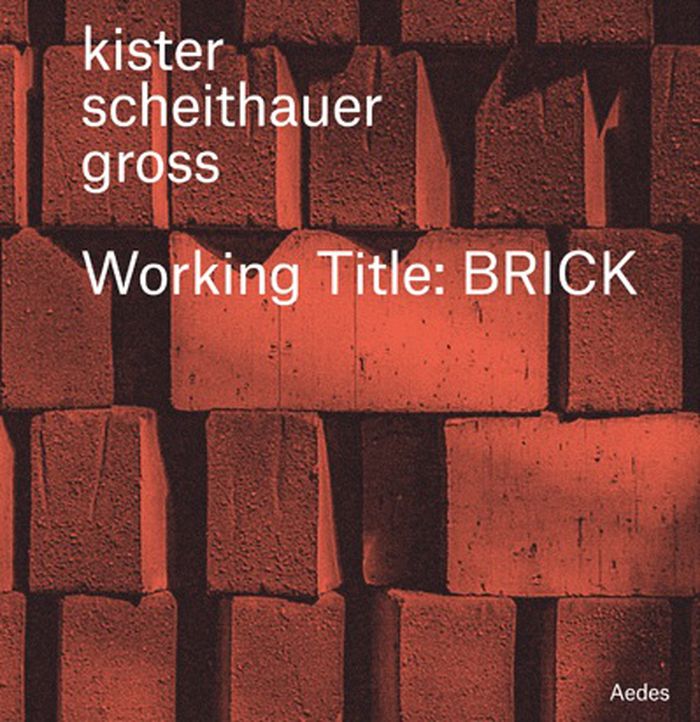
Twenty-five years ago, kister scheithauer gross completed its first brick building, the Institute for Biology in Halle. The replicated used brick of the façade is situated in the city centre in a self-evident way, and stands there today, still untouched by time. This is the starting point for the exhibition, which presents earlier brick buildings by the firm anew, along with current projects and buildings. Building in brick implies an ability to adapt to a location and its atmosphere as well as social structures. The regional identity and character of cities are often associated with a specific type of brick. At a time of digital production, brick factories today are almost anachronistic places, where elementary work processes with lots of manual work take place and the brick is given its specific sand-coloured, reddish-orange, or sometimes greenish shade through the firing of the minerals in the clay soil. Each stone is thus a unique specimen and as a haptically rich product also helps the architectural project tell its own story. On the basis of filigree paper models set on brick bases, the exhibition presents eight projects by kister scheithauer gross, which has been designing and working with the sustainable and sensual material for a quarter of a century.
Kister Scheithauer Gross. Working title : BRICK
Actions:
Prix:
$19.95
(disponible sur commande)
Résumé:
Twenty-five years ago, kister scheithauer gross completed its first brick building, the Institute for Biology in Halle. The replicated used brick of the façade is situated in the city centre in a self-evident way, and stands there today, still untouched by time. This is the starting point for the exhibition, which presents earlier brick buildings by the firm anew, along with current projects and buildings. Building in brick implies an ability to adapt to a location and its atmosphere as well as social structures. The regional identity and character of cities are often associated with a specific type of brick. At a time of digital production, brick factories today are almost anachronistic places, where elementary work processes with lots of manual work take place and the brick is given its specific sand-coloured, reddish-orange, or sometimes greenish shade through the firing of the minerals in the clay soil. Each stone is thus a unique specimen and as a haptically rich product also helps the architectural project tell its own story. On the basis of filigree paper models set on brick bases, the exhibition presents eight projects by kister scheithauer gross, which has been designing and working with the sustainable and sensual material for a quarter of a century.
Classification:
livres
livres
Publication:
septembre 2021
septembre 2021
Sujet:
Matériaux et éclairage
Matériaux et éclairage
Classification:
livres
livres

Actions:
Prix:
$61.00
(disponible sur commande)
Résumé:
Ernst Schwitters (1918-1996) began his career in photography in his teens, converting the family bathroom into a darkroom with the consent of his parents, Kurt and Helma Schwitters, at the age of 15 - by which time Ernst was already experimenting with photograms, following a visit from family friend Man Ray. His father encouraged him to undergo formal training in(...)
$61.00
(disponible sur commande)
Résumé:
Ernst Schwitters (1918-1996) began his career in photography in his teens, converting the family bathroom into a darkroom with the consent of his parents, Kurt and Helma Schwitters, at the age of 15 - by which time Ernst was already experimenting with photograms, following a visit from family friend Man Ray. His father encouraged him to undergo formal training in(...)
Titre:
The colors of Norway, 1943-1963
Actions:
Prix:
$61.00
(disponible sur commande)
Résumé:
Ernst Schwitters (1918-1996) began his career in photography in his teens, converting the family bathroom into a darkroom with the consent of his parents, Kurt and Helma Schwitters, at the age of 15 - by which time Ernst was already experimenting with photograms, following a visit from family friend Man Ray. His father encouraged him to undergo formal training in photography, but Ernst declined, preferring to teach himself, and by 1930 he was already participating in international exhibitions, having found his preferred subject matter in the landscapes of Norway and England. Having led the Schwitters family's migration from Nazi Germany to Norway, Ernst was to receive great acclaim there for both his landscape and architectural photography, and was also able to establish financial security through assignments for the Norwegian advertising agency SS-UNU-Foto. It is little known that Schwitters is one of color photography's pioneers: he began working with color film in 1943, and within two decades, he had created more than 10,000 slides, many of which have been digitally restored for this new volume. The only monograph on the photographer currently in print, the publication debuts Schwitters' vast oeuvre of color landscape photography, and also includes a fascinating account of the digital restoration process that allowed for their publication here.
The colors of Norway, 1943-1963
Actions:
Prix:
$61.00
(disponible sur commande)
Résumé:
Ernst Schwitters (1918-1996) began his career in photography in his teens, converting the family bathroom into a darkroom with the consent of his parents, Kurt and Helma Schwitters, at the age of 15 - by which time Ernst was already experimenting with photograms, following a visit from family friend Man Ray. His father encouraged him to undergo formal training in photography, but Ernst declined, preferring to teach himself, and by 1930 he was already participating in international exhibitions, having found his preferred subject matter in the landscapes of Norway and England. Having led the Schwitters family's migration from Nazi Germany to Norway, Ernst was to receive great acclaim there for both his landscape and architectural photography, and was also able to establish financial security through assignments for the Norwegian advertising agency SS-UNU-Foto. It is little known that Schwitters is one of color photography's pioneers: he began working with color film in 1943, and within two decades, he had created more than 10,000 slides, many of which have been digitally restored for this new volume. The only monograph on the photographer currently in print, the publication debuts Schwitters' vast oeuvre of color landscape photography, and also includes a fascinating account of the digital restoration process that allowed for their publication here.
Classification:
livres
livres
Publication:
août 2011
août 2011
Sujet:
Monographies photo
Monographies photo
Classification:
livres
livres
Titre:
Adam Bartos: darkroom
Adam Bartos: darkroom
Actions:
Prix:
$109.95
(disponible sur commande)
Résumé:
Darkroom charts the physical and psychic terrain of photographic printing rooms while conveying their transition from the realm of pure functionality into historical artifact. Indirect portraits of both producer and product, Bartos' work explores the physical space linking artist to artwork and linking the tools of the medium to the signs of their use. As more darkrooms(...)
$109.95
(disponible sur commande)
Résumé:
Darkroom charts the physical and psychic terrain of photographic printing rooms while conveying their transition from the realm of pure functionality into historical artifact. Indirect portraits of both producer and product, Bartos' work explores the physical space linking artist to artwork and linking the tools of the medium to the signs of their use. As more darkrooms(...)
Titre:
Adam Bartos: darkroom
Actions:
Prix:
$109.95
(disponible sur commande)
Résumé:
Darkroom charts the physical and psychic terrain of photographic printing rooms while conveying their transition from the realm of pure functionality into historical artifact. Indirect portraits of both producer and product, Bartos' work explores the physical space linking artist to artwork and linking the tools of the medium to the signs of their use. As more darkrooms switch to digital printing or close shop altogether, we become more aware that the tangible elements of darkroom printing may one day be lost. Bartos' recent large-format work documents and explores in equal measure the visual language and ethos of that analogue printing culture before it slips beyond our experience forever. The acrid odour of chemistry, an uncanny stillness hanging in damp air - Bartos records the descriptive aspects and spatial constraints of the darkroom but also visualizes the lab as a site of limitless creative potential, invested with as much aura as a photographic print. Heroic and humbling at the same time, these portraits speak to the individuality of the workspaces and their inhabitants but also to the shared architecture of all darkrooms. Bartos presents us with the perceptual tools to know the darkroom as it is today and to remember it one day as it will have been.
Adam Bartos: darkroom
Actions:
Prix:
$109.95
(disponible sur commande)
Résumé:
Darkroom charts the physical and psychic terrain of photographic printing rooms while conveying their transition from the realm of pure functionality into historical artifact. Indirect portraits of both producer and product, Bartos' work explores the physical space linking artist to artwork and linking the tools of the medium to the signs of their use. As more darkrooms switch to digital printing or close shop altogether, we become more aware that the tangible elements of darkroom printing may one day be lost. Bartos' recent large-format work documents and explores in equal measure the visual language and ethos of that analogue printing culture before it slips beyond our experience forever. The acrid odour of chemistry, an uncanny stillness hanging in damp air - Bartos records the descriptive aspects and spatial constraints of the darkroom but also visualizes the lab as a site of limitless creative potential, invested with as much aura as a photographic print. Heroic and humbling at the same time, these portraits speak to the individuality of the workspaces and their inhabitants but also to the shared architecture of all darkrooms. Bartos presents us with the perceptual tools to know the darkroom as it is today and to remember it one day as it will have been.
Classification:
livres
livres
Publication:
novembre 2011
novembre 2011
Sujet:
Monographies photo
Monographies photo
Classification:
livres
livres
Titre:
The Bauhaus: #itsalldesign
The Bauhaus: #itsalldesign
Actions:
Prix:
$95.00
(disponible sur commande)
Résumé:
This volume offers a comprehensive overview of the extended concept of design that was initiated at the Bauhaus. Alongside rare exhibits from design, architecture, art, film and photography--some of which have never previously been published--the book documents the development processes as well as the socio-political concepts behind the Bauhaus. To underline their(...)
$95.00
(disponible sur commande)
Résumé:
This volume offers a comprehensive overview of the extended concept of design that was initiated at the Bauhaus. Alongside rare exhibits from design, architecture, art, film and photography--some of which have never previously been published--the book documents the development processes as well as the socio-political concepts behind the Bauhaus. To underline their(...)
Titre:
The Bauhaus: #itsalldesign
Actions:
Prix:
$95.00
(disponible sur commande)
Résumé:
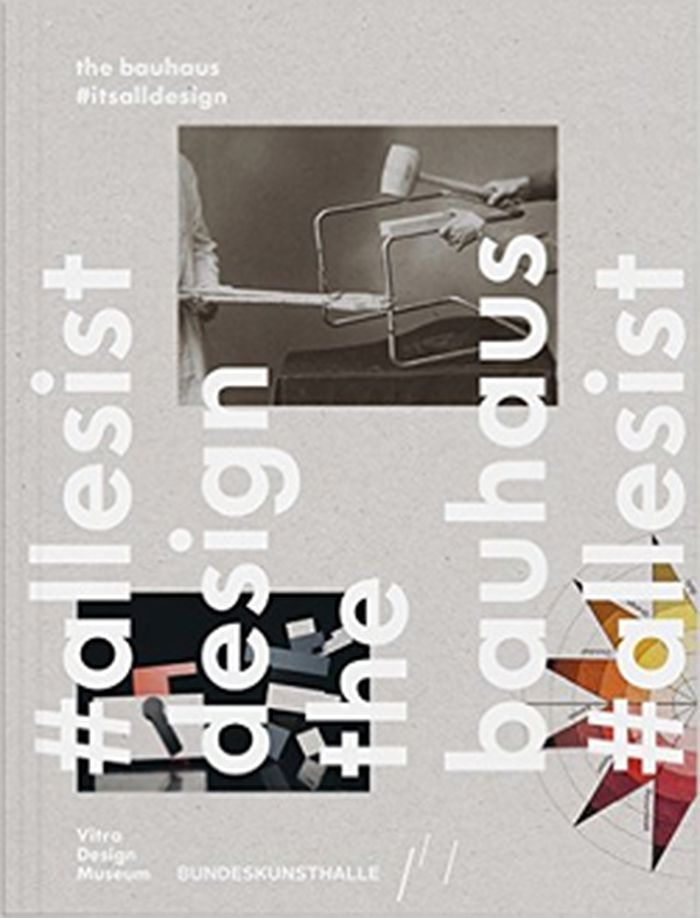
This volume offers a comprehensive overview of the extended concept of design that was initiated at the Bauhaus. Alongside rare exhibits from design, architecture, art, film and photography--some of which have never previously been published--the book documents the development processes as well as the socio-political concepts behind the Bauhaus. To underline their relevance for today's creative practice, these ideas are contrasted to current themes in design such as the digital revolution, and the works of numerous present-day artists and designers. The lavishly illustrated publication features essays by renowned authors such as Arthur Rüegg and Jan Boelen, a glossary of the basic ideas behind design at the Bauhaus, as well as a detailed catalogue section. Among others, Olaf Nicolai, Adrian Sauer, Wilfried Kühn and Joseph Grima have created artistic works on the topic especially for the exhibition. Numerous short articles by distinguished designers, artists and architects from all over the world, who, with their ideas, projects and theories reflect on the topicality of the Bauhaus and its influence on 21st-century design, form part of this new and contemporary look at the movement. With works by Josef Albers, Marcel Breuer, Walter Gropius, Marianne Brandt, Wassily Kandinsky, Ludwig Mies van der Rohe, Herbert Bayer and many others.
The Bauhaus: #itsalldesign
Actions:
Prix:
$95.00
(disponible sur commande)
Résumé:
This volume offers a comprehensive overview of the extended concept of design that was initiated at the Bauhaus. Alongside rare exhibits from design, architecture, art, film and photography--some of which have never previously been published--the book documents the development processes as well as the socio-political concepts behind the Bauhaus. To underline their relevance for today's creative practice, these ideas are contrasted to current themes in design such as the digital revolution, and the works of numerous present-day artists and designers. The lavishly illustrated publication features essays by renowned authors such as Arthur Rüegg and Jan Boelen, a glossary of the basic ideas behind design at the Bauhaus, as well as a detailed catalogue section. Among others, Olaf Nicolai, Adrian Sauer, Wilfried Kühn and Joseph Grima have created artistic works on the topic especially for the exhibition. Numerous short articles by distinguished designers, artists and architects from all over the world, who, with their ideas, projects and theories reflect on the topicality of the Bauhaus and its influence on 21st-century design, form part of this new and contemporary look at the movement. With works by Josef Albers, Marcel Breuer, Walter Gropius, Marianne Brandt, Wassily Kandinsky, Ludwig Mies van der Rohe, Herbert Bayer and many others.
Classification:
livres
livres
Publication:
octobre 2015
octobre 2015
Sujet:
Modernisme
Modernisme
Classification:
livres
livres
Actions:
Prix:
$50.00
(disponible sur commande)
Résumé:
In landscape architecture, representation has become the subject of contention and much discussion. While computer techniques have been a catalyst for change across the field of design as a whole, nowhere have the conventions of representation been called into question more than in landscape architecture – which in itself is undergoing a process of reinvention. With the(...)
$50.00
(disponible sur commande)
Résumé:
In landscape architecture, representation has become the subject of contention and much discussion. While computer techniques have been a catalyst for change across the field of design as a whole, nowhere have the conventions of representation been called into question more than in landscape architecture – which in itself is undergoing a process of reinvention. With the(...)
Titre:
Drawing and reinventing landscape
Actions:
Prix:
$50.00
(disponible sur commande)
Résumé:
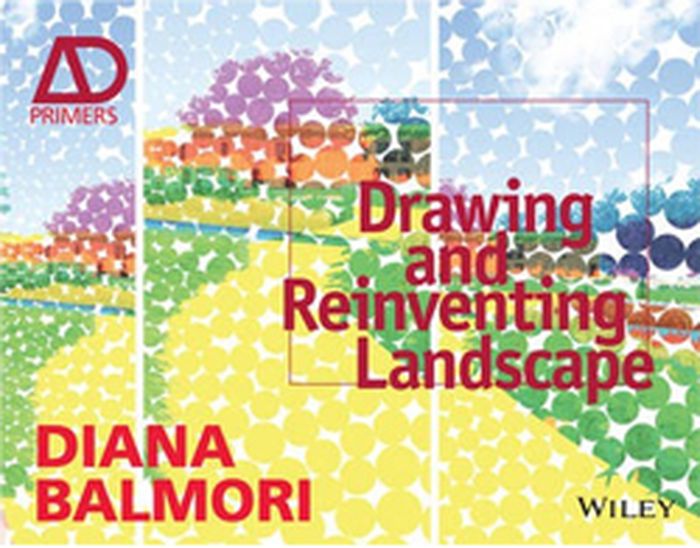
In landscape architecture, representation has become the subject of contention and much discussion. While computer techniques have been a catalyst for change across the field of design as a whole, nowhere have the conventions of representation been called into question more than in landscape architecture – which in itself is undergoing a process of reinvention. With the onset of rapid urbanisation and our shifting relationship with nature, landscape architecture has proved a potent lens for expressing a wider dialogue taking place in the world. It is, however, only through the introduction of innovative forms of representation – whether digital, analogue or hybrid – that one most vividly sees the emergence of the new. In this book, Diana Balmori explores notions of representation in the discipline at large and across time. She takes us back to landscape design’s roots in the seventeenth century in France and the eighteenth century in England, when it first grappled with questions of imagined exterior space. She explores the discipline’s relationship to painting and the influence of cartography with its bird's-eye views, topographic sections and perspectives. She highlights how new attempts at representation by modern landscape artists such as Patricia Johanson, Ian Hamilton Finlay and David Hockney continue to wrestle with the depiction of landscape.
Drawing and reinventing landscape
Actions:
Prix:
$50.00
(disponible sur commande)
Résumé:
In landscape architecture, representation has become the subject of contention and much discussion. While computer techniques have been a catalyst for change across the field of design as a whole, nowhere have the conventions of representation been called into question more than in landscape architecture – which in itself is undergoing a process of reinvention. With the onset of rapid urbanisation and our shifting relationship with nature, landscape architecture has proved a potent lens for expressing a wider dialogue taking place in the world. It is, however, only through the introduction of innovative forms of representation – whether digital, analogue or hybrid – that one most vividly sees the emergence of the new. In this book, Diana Balmori explores notions of representation in the discipline at large and across time. She takes us back to landscape design’s roots in the seventeenth century in France and the eighteenth century in England, when it first grappled with questions of imagined exterior space. She explores the discipline’s relationship to painting and the influence of cartography with its bird's-eye views, topographic sections and perspectives. She highlights how new attempts at representation by modern landscape artists such as Patricia Johanson, Ian Hamilton Finlay and David Hockney continue to wrestle with the depiction of landscape.
Classification:
livres
livres
Publication:
janvier 2015
janvier 2015
Sujet:
Théorie du paysage
Théorie du paysage
Classification:
périodiques
périodiques
Titre:
Flora neotropica.
Flora neotropica.
Actions:
Auteur:
Sujet:
Publication:
New York : Published for Organization for Flora Neotropica by Hafner Pub. Co., 1967-, New York : New York Botanical Garden for Organization Flora Neotropica, <2021-> : Cham, Switzerland : Springer Nature Switzerland AG
New York : Published for Organization for Flora Neotropica by Hafner Pub. Co., 1967-, New York : New York Botanical Garden for Organization Flora Neotropica, <2021-> : Cham, Switzerland : Springer Nature Switzerland AG
Classification:
périodiques
périodiques
Publication:
New York : Published for Organization for Flora Neotropica by Hafner Pub. Co., 1967-, New York : New York Botanical Garden for Organization Flora Neotropica, <2021-> : Cham, Switzerland : Springer Nature Switzerland AG
New York : Published for Organization for Flora Neotropica by Hafner Pub. Co., 1967-, New York : New York Botanical Garden for Organization Flora Neotropica, <2021-> : Cham, Switzerland : Springer Nature Switzerland AG
Auteur:
Sujet:
Classification:
livres
livres
Exemplaires:
Description:
174 pages ; 21 cm.
Description:
174 pages ; 21 cm.
Auteur:
Sujet:
Publication:
[Paris] : Gallimard, [2020]
[Paris] : Gallimard, [2020]
Titre:
Éloge du magasin : contre l'amazonisation / Vincent Chabault.
Actions:
Exemplaires:
Description:
174 pages ; 21 cm.
Éloge du magasin : contre l'amazonisation / Vincent Chabault.
Actions:
Exemplaires:
Description:
174 pages ; 21 cm.
Classification:
livres
livres
Publication:
[Paris] : Gallimard, [2020]
[Paris] : Gallimard, [2020]
Auteur:
Sujet:
Classification:
livres
livres
Actions:
Prix:
$63.95
(disponible sur commande)
Résumé:
This book investigates the state of panoptic art at a time when issues of security and civil liberties are on many people’s minds. Traditional imaging and tracking systems have given way to infinitely more powerful “dataveillance” technologies, as an evolving arsenal of surrogate eyes and ears in our society shifts its focus from military to domestic space. Taking as its(...)
$63.95
(disponible sur commande)
Résumé:
This book investigates the state of panoptic art at a time when issues of security and civil liberties are on many people’s minds. Traditional imaging and tracking systems have given way to infinitely more powerful “dataveillance” technologies, as an evolving arsenal of surrogate eyes and ears in our society shifts its focus from military to domestic space. Taking as its(...)
Publication:
mars 2002, Karlsruhe, Germany / Cambridge, Massachusett
mars 2002, Karlsruhe, Germany / Cambridge, Massachusett
Titre:
CTRL (space) : rhetorics of surveillance from Bentham to big brother
Actions:
Prix:
$63.95
(disponible sur commande)
Résumé:
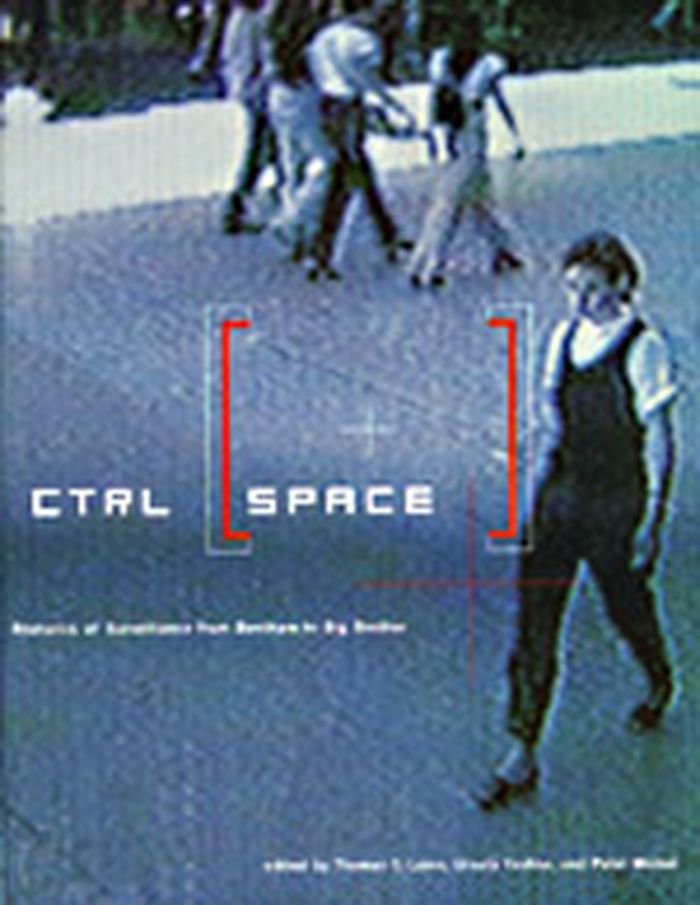
This book investigates the state of panoptic art at a time when issues of security and civil liberties are on many people’s minds. Traditional imaging and tracking systems have given way to infinitely more powerful “dataveillance” technologies, as an evolving arsenal of surrogate eyes and ears in our society shifts its focus from military to domestic space. Taking as its point of departure an architectural drawing by Jeremy Bentham that became the model for an entire social regime, CTRL [SPACE] looks at the shifting relationships between design and power, imaging and oppression, from the eighteenth to the twenty-first centuries. From the photographs taken with hidden cameras by Walker Evans and Paul Strand in the early twentieth century to the appropriation of military satellite technology by Marko Peljhan a hundred years later, the works of a wide range of artists have explored the dynamics of watching and being watched. The artists whose panoptical preoccupations are featured include, among others, Sophie Calle, Diller + Scofidio, Dan Graham, Pierre Huyghe, Michael Klier, Rem Koolhaas, Bruce Nauman, Yoko Ono, Thomas Ruff, Julia Scher, Andy Warhol, and Peter Weibel. This book, along with the exhibition it accompanies, is the first state-of-the-art survey of panopticism--in digital culture, architecture, television, video, cinema, painting, photography, conceptual art, installation work, robotics, and satellite imaging.
CTRL (space) : rhetorics of surveillance from Bentham to big brother
Actions:
Prix:
$63.95
(disponible sur commande)
Résumé:
This book investigates the state of panoptic art at a time when issues of security and civil liberties are on many people’s minds. Traditional imaging and tracking systems have given way to infinitely more powerful “dataveillance” technologies, as an evolving arsenal of surrogate eyes and ears in our society shifts its focus from military to domestic space. Taking as its point of departure an architectural drawing by Jeremy Bentham that became the model for an entire social regime, CTRL [SPACE] looks at the shifting relationships between design and power, imaging and oppression, from the eighteenth to the twenty-first centuries. From the photographs taken with hidden cameras by Walker Evans and Paul Strand in the early twentieth century to the appropriation of military satellite technology by Marko Peljhan a hundred years later, the works of a wide range of artists have explored the dynamics of watching and being watched. The artists whose panoptical preoccupations are featured include, among others, Sophie Calle, Diller + Scofidio, Dan Graham, Pierre Huyghe, Michael Klier, Rem Koolhaas, Bruce Nauman, Yoko Ono, Thomas Ruff, Julia Scher, Andy Warhol, and Peter Weibel. This book, along with the exhibition it accompanies, is the first state-of-the-art survey of panopticism--in digital culture, architecture, television, video, cinema, painting, photography, conceptual art, installation work, robotics, and satellite imaging.
Classification:
livres
livres
Publication:
mars 2002, Karlsruhe, Germany / Cambridge, Massachusett
mars 2002, Karlsruhe, Germany / Cambridge, Massachusett


