


7452 Résultats
Classification:
livres
livres
Actions:
Prix:
$81.50
(disponible en magasin)
Résumé:
This is the first "Oxford companion" to deal with the subject of photography. It appears at a watershed in the medium's history, as digital imaging increasingly dominates the global photography scene at both amateur and professional levels. In addition to a wide range of technical information, the book encapsulates in concise and readily accessible form the mass of recent(...)
$81.50
(disponible en magasin)
Résumé:
This is the first "Oxford companion" to deal with the subject of photography. It appears at a watershed in the medium's history, as digital imaging increasingly dominates the global photography scene at both amateur and professional levels. In addition to a wide range of technical information, the book encapsulates in concise and readily accessible form the mass of recent(...)
Titre:
The Oxford companion to the photograph
Actions:
Prix:
$81.50
(disponible en magasin)
Résumé:
This is the first "Oxford companion" to deal with the subject of photography. It appears at a watershed in the medium's history, as digital imaging increasingly dominates the global photography scene at both amateur and professional levels. In addition to a wide range of technical information, the book encapsulates in concise and readily accessible form the mass of recent scholarship on photography as a social and artistic practice, organized both thematically and geographically. There are over 800 biographical entries, both on photographers and on other individuals who have significantly influenced photographic culture from the early 19th century to the present. The book's scope is worldwide. The international team of contributors is made up of leading authorities in their fields, and include: Heather Angel, Sylvie Aubenas, Quentin Bajac, Marta Braun, Clement Cheroux, Elizabeth Edwards, John Falconer, Colin Ford, Ron Graham, Sarah Greenough, Mark Haworth-Booth, Roger Hicks, Paul Hill, Jens Jaeger, Jan-Erik Lundstrom, Naomi Rosenblum, Rolf Sachsse, Martha Sandweiss, Graham Saxby, Joan Schwartz, Sara Stevenson, Roger Taylor, Regine Thiriez, John Ward, Liz Wells, and Mike Ware. The book is extensively illustrated and includes many pictures never before published. The majority of the 1600-plus entries include suggestions for further reading. But the work's usefulness is further enhanced by the inclusion of an extensive bibliography, a chronology of photographic history, a list of important websites, and an index of people.
The Oxford companion to the photograph
Actions:
Prix:
$81.50
(disponible en magasin)
Résumé:
This is the first "Oxford companion" to deal with the subject of photography. It appears at a watershed in the medium's history, as digital imaging increasingly dominates the global photography scene at both amateur and professional levels. In addition to a wide range of technical information, the book encapsulates in concise and readily accessible form the mass of recent scholarship on photography as a social and artistic practice, organized both thematically and geographically. There are over 800 biographical entries, both on photographers and on other individuals who have significantly influenced photographic culture from the early 19th century to the present. The book's scope is worldwide. The international team of contributors is made up of leading authorities in their fields, and include: Heather Angel, Sylvie Aubenas, Quentin Bajac, Marta Braun, Clement Cheroux, Elizabeth Edwards, John Falconer, Colin Ford, Ron Graham, Sarah Greenough, Mark Haworth-Booth, Roger Hicks, Paul Hill, Jens Jaeger, Jan-Erik Lundstrom, Naomi Rosenblum, Rolf Sachsse, Martha Sandweiss, Graham Saxby, Joan Schwartz, Sara Stevenson, Roger Taylor, Regine Thiriez, John Ward, Liz Wells, and Mike Ware. The book is extensively illustrated and includes many pictures never before published. The majority of the 1600-plus entries include suggestions for further reading. But the work's usefulness is further enhanced by the inclusion of an extensive bibliography, a chronology of photographic history, a list of important websites, and an index of people.
Classification:
livres
livres
Publication:
janvier 2005, New York
janvier 2005, New York
Sujet:
Théorie de la photographie
Théorie de la photographie
Classification:
livres
livres
Actions:
Prix:
$79.00
(disponible sur commande)
Résumé:
The art of producing color in movies is a fascinating process with a long history. Many people don’t realize that, as early as the 1890s, much of silent cinema was in color. They also may not know that women were the main workforce behind the techniques that first produced these effects, a tradition that continued as the practice evolved. Breakthroughs in color technology(...)
$79.00
(disponible sur commande)
Résumé:
The art of producing color in movies is a fascinating process with a long history. Many people don’t realize that, as early as the 1890s, much of silent cinema was in color. They also may not know that women were the main workforce behind the techniques that first produced these effects, a tradition that continued as the practice evolved. Breakthroughs in color technology(...)
Publication:
octobre 2024
octobre 2024
Titre:
Color in motion: Chromatic explorations of cinema
Actions:
Prix:
$79.00
(disponible sur commande)
Résumé:
The art of producing color in movies is a fascinating process with a long history. Many people don’t realize that, as early as the 1890s, much of silent cinema was in color. They also may not know that women were the main workforce behind the techniques that first produced these effects, a tradition that continued as the practice evolved. Breakthroughs in color technology have created ongoing opportunities for filmmakers to experiment with new forms of narrative and emotional storytelling. Spectacular, psychological and sensory, color has become an integral part of the cinematic experience. From the earliest hand-painted films to Technicolor and today’s digital cinema, Color in Motion takes readers on a journey through the evolution and significance of color in film. Presenting insightful analysis, engaging case studies and inspiring conversations with scholars and experts in the field, with topics ranging from animation to the intersections of color and race in cinema, it traces the historical development of color technologies and their impact onscreen. Incorporating vivid images of color films throughout history—Serpentine Dance, The Cabinet of Dr. Caligari, Fantasia, The Red Shoes, Vertigo, West Side Story, 2001: A Space Odyssey, Moonlight and more, as well as new multispectral scans of rare silent-era film prints—this essential volume celebrates color’s enduring influence on the medium of film.
Color in motion: Chromatic explorations of cinema
Actions:
Prix:
$79.00
(disponible sur commande)
Résumé:
The art of producing color in movies is a fascinating process with a long history. Many people don’t realize that, as early as the 1890s, much of silent cinema was in color. They also may not know that women were the main workforce behind the techniques that first produced these effects, a tradition that continued as the practice evolved. Breakthroughs in color technology have created ongoing opportunities for filmmakers to experiment with new forms of narrative and emotional storytelling. Spectacular, psychological and sensory, color has become an integral part of the cinematic experience. From the earliest hand-painted films to Technicolor and today’s digital cinema, Color in Motion takes readers on a journey through the evolution and significance of color in film. Presenting insightful analysis, engaging case studies and inspiring conversations with scholars and experts in the field, with topics ranging from animation to the intersections of color and race in cinema, it traces the historical development of color technologies and their impact onscreen. Incorporating vivid images of color films throughout history—Serpentine Dance, The Cabinet of Dr. Caligari, Fantasia, The Red Shoes, Vertigo, West Side Story, 2001: A Space Odyssey, Moonlight and more, as well as new multispectral scans of rare silent-era film prints—this essential volume celebrates color’s enduring influence on the medium of film.
Classification:
livres
livres
Publication:
octobre 2024
octobre 2024
Classification:
livres
livres

Titre:
Mute magazine graphic design
Mute magazine graphic design
Actions:
Prix:
$37.00
(disponible sur commande)
Résumé:
In the early 1990s, long before the internet became an integral part of life, a handful of pioneering magazines took it upon themselves to imagine the web into existence. Using fiction, interviews, speculative theory and experimental graphic design, these titles helped create a lexicon and iconography every bit as powerful as the architecture of the World Wide Web.(...)
$37.00
(disponible sur commande)
Résumé:
In the early 1990s, long before the internet became an integral part of life, a handful of pioneering magazines took it upon themselves to imagine the web into existence. Using fiction, interviews, speculative theory and experimental graphic design, these titles helped create a lexicon and iconography every bit as powerful as the architecture of the World Wide Web.(...)
Publication:
août 2008, London
août 2008, London
Titre:
Mute magazine graphic design
Actions:
Prix:
$37.00
(disponible sur commande)
Résumé:
In the early 1990s, long before the internet became an integral part of life, a handful of pioneering magazines took it upon themselves to imagine the web into existence. Using fiction, interviews, speculative theory and experimental graphic design, these titles helped create a lexicon and iconography every bit as powerful as the architecture of the World Wide Web. London-based Mute occupied a central position here, wielding an influence vastly disproportionate to its size. The product of a period of intense creative ferment, Mute engaged boldly with allcomers. The magazine offered a platform to authors Bruce Sterling, Arthur Kroker, Mark Dery, Geert Lovink, Hari Kunzru, James Flint and Lev Manovich, just as it did to artists Keith Tyson, VNS Matrix and the Bureau of Inverse Technology. As new technologies forced a collapse of disciplinary boundaries and the intermingling of communities, Mute became part of a dynamic London scene, featuring many of the artists, writers and photographers who came to epitomise London’s status as a creative hotbed. The resulting collection of magazines defines an era, telling the fascinating tale of one publisher's relationship with the ‘digital revolution’ – the nineties’ very own Big Bang. This book presents a full overview of the magazine over a decade, showing its entire output – logos, covers and spreads. Using generous illustrations and in-depth captions, it details recurrent graphic themes and places Mute's evolution in perspective
Mute magazine graphic design
Actions:
Prix:
$37.00
(disponible sur commande)
Résumé:
In the early 1990s, long before the internet became an integral part of life, a handful of pioneering magazines took it upon themselves to imagine the web into existence. Using fiction, interviews, speculative theory and experimental graphic design, these titles helped create a lexicon and iconography every bit as powerful as the architecture of the World Wide Web. London-based Mute occupied a central position here, wielding an influence vastly disproportionate to its size. The product of a period of intense creative ferment, Mute engaged boldly with allcomers. The magazine offered a platform to authors Bruce Sterling, Arthur Kroker, Mark Dery, Geert Lovink, Hari Kunzru, James Flint and Lev Manovich, just as it did to artists Keith Tyson, VNS Matrix and the Bureau of Inverse Technology. As new technologies forced a collapse of disciplinary boundaries and the intermingling of communities, Mute became part of a dynamic London scene, featuring many of the artists, writers and photographers who came to epitomise London’s status as a creative hotbed. The resulting collection of magazines defines an era, telling the fascinating tale of one publisher's relationship with the ‘digital revolution’ – the nineties’ very own Big Bang. This book presents a full overview of the magazine over a decade, showing its entire output – logos, covers and spreads. Using generous illustrations and in-depth captions, it details recurrent graphic themes and places Mute's evolution in perspective
Classification:
livres
livres
Publication:
août 2008, London
août 2008, London
Classification:
livres
livres

Actions:
Prix:
$37.95
(disponible sur commande)
Résumé:
Profoundly intimate yet immediately giving onto distant spaces, both an ‘organ of fear’ and an echo chamber of anticipated pleasures, an uncontrollable flow subject to unconscious selection and augmentation, the subtlety, complexity, and variety of modes of hearing has meant that sound has rarely received the same philosophical attention as the visual. In "The order of(...)
$37.95
(disponible sur commande)
Résumé:
Profoundly intimate yet immediately giving onto distant spaces, both an ‘organ of fear’ and an echo chamber of anticipated pleasures, an uncontrollable flow subject to unconscious selection and augmentation, the subtlety, complexity, and variety of modes of hearing has meant that sound has rarely received the same philosophical attention as the visual. In "The order of(...)
Titre:
The order of sounds: a sonorous archipelago
Actions:
Prix:
$37.95
(disponible sur commande)
Résumé:
Profoundly intimate yet immediately giving onto distant spaces, both an ‘organ of fear’ and an echo chamber of anticipated pleasures, an uncontrollable flow subject to unconscious selection and augmentation, the subtlety, complexity, and variety of modes of hearing has meant that sound has rarely received the same philosophical attention as the visual. In "The order of sounds", François J. Bonnet makes a compelling case for the irreducible heterogeneity of ‘sound’, navigating between the physical models constructed by psychophysics and refined through recording technologies, and the synthetic production of what is heard. From primitive vigilance and sonic mythologies to digital sampling and sound installations, he examines the ways in which we make sound speak to us, in an analysis of listening as a plurivocal phenomenon drawing on Foucault, Deleuze and Guattari, Barthes, Nancy, Adorno, and de Certeau, and experimental pioneers such as Tesla, Bell, and Raudive. Stringent critiques of the ‘soundscape’ and ‘reduced listening’ demonstrate that univocal ontologies of sound are always partial and politicized; for listening is always a selective fetishism, a hallucination of sound filtered by desire and convention, territorialized by discourse and its authorities. Bonnet proposes neither a disciplined listening that targets sound ‘itself’, nor an ‘ocean of sound’ in which we might lose ourselves, but instead maps out a sonorous archipelago—a heterogeneous set of shifting sonic territories shaped and aggregated by the vicissitudes of desire and discourse.
The order of sounds: a sonorous archipelago
Actions:
Prix:
$37.95
(disponible sur commande)
Résumé:
Profoundly intimate yet immediately giving onto distant spaces, both an ‘organ of fear’ and an echo chamber of anticipated pleasures, an uncontrollable flow subject to unconscious selection and augmentation, the subtlety, complexity, and variety of modes of hearing has meant that sound has rarely received the same philosophical attention as the visual. In "The order of sounds", François J. Bonnet makes a compelling case for the irreducible heterogeneity of ‘sound’, navigating between the physical models constructed by psychophysics and refined through recording technologies, and the synthetic production of what is heard. From primitive vigilance and sonic mythologies to digital sampling and sound installations, he examines the ways in which we make sound speak to us, in an analysis of listening as a plurivocal phenomenon drawing on Foucault, Deleuze and Guattari, Barthes, Nancy, Adorno, and de Certeau, and experimental pioneers such as Tesla, Bell, and Raudive. Stringent critiques of the ‘soundscape’ and ‘reduced listening’ demonstrate that univocal ontologies of sound are always partial and politicized; for listening is always a selective fetishism, a hallucination of sound filtered by desire and convention, territorialized by discourse and its authorities. Bonnet proposes neither a disciplined listening that targets sound ‘itself’, nor an ‘ocean of sound’ in which we might lose ourselves, but instead maps out a sonorous archipelago—a heterogeneous set of shifting sonic territories shaped and aggregated by the vicissitudes of desire and discourse.
Classification:
livres
livres
Publication:
mai 2016
mai 2016
Sujet:
Acoustique
Acoustique
Classification:
livres
livres
Actions:
Prix:
$49.95
(disponible sur commande)
Résumé:
Over the past decade, a seismic shift in economic and political forces has transformed life in the second-largest city on the West Coast, situated at the most heavily trafficked international border crossing in the world. Tijuana’s newfound wealth and haphazard expansion have changed patterns of migration for the city’s many artists, who once routinely moved north to Los(...)
$49.95
(disponible sur commande)
Résumé:
Over the past decade, a seismic shift in economic and political forces has transformed life in the second-largest city on the West Coast, situated at the most heavily trafficked international border crossing in the world. Tijuana’s newfound wealth and haphazard expansion have changed patterns of migration for the city’s many artists, who once routinely moved north to Los(...)
Titre:
Strange new world : art and design from Tijuana
Actions:
Prix:
$49.95
(disponible sur commande)
Résumé:
Over the past decade, a seismic shift in economic and political forces has transformed life in the second-largest city on the West Coast, situated at the most heavily trafficked international border crossing in the world. Tijuana’s newfound wealth and haphazard expansion have changed patterns of migration for the city’s many artists, who once routinely moved north to Los Angeles but are now staying or returning, and being joined by friends from Mexico City and beyond. This flourishing, strengthening artistic community has responded to the city’s accelerated evolution with a broad range of work, from painting to conceptually driven installations; from street-level digital video to ambitious photo-documentation, filmmaking and political work; from architectural proposals to product design associated with the "Nortec" musical movement. The work gathered in "Strange new world" embraces Tijuana as a paradigm of a new postmodern form of urbanization shaped by the pressures of economic globalization and cultural transnationalism since 1994. It struggles to make sense of new realities changing the ways in which people live in cities around the globe. Like Aldous Huxley's Brave New World, it is part science fiction, part political commentary and part artistic revolution and cultural critique. Arranged around the concepts of the urban theorist Michael Smith, it features work by ERRE, Einar and Jamex de la Torre and Yvonne Venegas, among others.
Strange new world : art and design from Tijuana
Actions:
Prix:
$49.95
(disponible sur commande)
Résumé:
Over the past decade, a seismic shift in economic and political forces has transformed life in the second-largest city on the West Coast, situated at the most heavily trafficked international border crossing in the world. Tijuana’s newfound wealth and haphazard expansion have changed patterns of migration for the city’s many artists, who once routinely moved north to Los Angeles but are now staying or returning, and being joined by friends from Mexico City and beyond. This flourishing, strengthening artistic community has responded to the city’s accelerated evolution with a broad range of work, from painting to conceptually driven installations; from street-level digital video to ambitious photo-documentation, filmmaking and political work; from architectural proposals to product design associated with the "Nortec" musical movement. The work gathered in "Strange new world" embraces Tijuana as a paradigm of a new postmodern form of urbanization shaped by the pressures of economic globalization and cultural transnationalism since 1994. It struggles to make sense of new realities changing the ways in which people live in cities around the globe. Like Aldous Huxley's Brave New World, it is part science fiction, part political commentary and part artistic revolution and cultural critique. Arranged around the concepts of the urban theorist Michael Smith, it features work by ERRE, Einar and Jamex de la Torre and Yvonne Venegas, among others.
Classification:
livres
livres
Publication:
août 2006, La Jolla
août 2006, La Jolla
Classification:
livres
livres

Actions:
Prix:
$64.95
(disponible sur commande)
Résumé:
Cet ouvrage questionne une histoire récente du design où la notion d’ornement se donne au cœur de nouvelles logiques de conception et de production. Avec l’avènement du numérique et la redéfinition du rôle de l’ornement, la forme ornementale se donne à présent dans une dimension calculée de morphogenèse : sa dynamique s’ancre dans les processus de croissance de la nature.(...)
$64.95
(disponible sur commande)
Résumé:
Cet ouvrage questionne une histoire récente du design où la notion d’ornement se donne au cœur de nouvelles logiques de conception et de production. Avec l’avènement du numérique et la redéfinition du rôle de l’ornement, la forme ornementale se donne à présent dans une dimension calculée de morphogenèse : sa dynamique s’ancre dans les processus de croissance de la nature.(...)
Titre:
Design et merveilleux : de la nature de l'ornement / Design and the wondrous: on the nature of ornament
Actions:
Prix:
$64.95
(disponible sur commande)
Résumé:
Cet ouvrage questionne une histoire récente du design où la notion d’ornement se donne au cœur de nouvelles logiques de conception et de production. Avec l’avènement du numérique et la redéfinition du rôle de l’ornement, la forme ornementale se donne à présent dans une dimension calculée de morphogenèse : sa dynamique s’ancre dans les processus de croissance de la nature. Dans toutes ces réalisations, la dimension générative de la nature a conféré à l’ornement un rôle structurel nouveau. S'appuyant sur une sélection d'œuvres de plus de cinquante artistes, , quatre essais (Marie-Ange Brayer, Spyros Papapetros, Martine Dancer-Mourès et Sophie Fétro), nous donnent à lire et comprendre, l'évolution du design et de l'ornement, à l'ère du numérique. / This volume presents a new narrative of design, situated somewhere between plant life and ornament, nature and artifice. Through essays by several authors it explores the ornament’s role with respect to morphogenesis, by which the object is continually transformed through an evolving dynamic of forms. With the arrival of the digital age, the ornament’s role in design has been greatly modified. No longer a simple motif, it is used as an animated form. At the intersection of information sciences and biology, designers utilise 3D printing to create carefully calculated objects based on organic growth. With contributions by Spyros Papapetros, Marie-Ange Brayer, and others.
Design et merveilleux : de la nature de l'ornement / Design and the wondrous: on the nature of ornament
Actions:
Prix:
$64.95
(disponible sur commande)
Résumé:
Cet ouvrage questionne une histoire récente du design où la notion d’ornement se donne au cœur de nouvelles logiques de conception et de production. Avec l’avènement du numérique et la redéfinition du rôle de l’ornement, la forme ornementale se donne à présent dans une dimension calculée de morphogenèse : sa dynamique s’ancre dans les processus de croissance de la nature. Dans toutes ces réalisations, la dimension générative de la nature a conféré à l’ornement un rôle structurel nouveau. S'appuyant sur une sélection d'œuvres de plus de cinquante artistes, , quatre essais (Marie-Ange Brayer, Spyros Papapetros, Martine Dancer-Mourès et Sophie Fétro), nous donnent à lire et comprendre, l'évolution du design et de l'ornement, à l'ère du numérique. / This volume presents a new narrative of design, situated somewhere between plant life and ornament, nature and artifice. Through essays by several authors it explores the ornament’s role with respect to morphogenesis, by which the object is continually transformed through an evolving dynamic of forms. With the arrival of the digital age, the ornament’s role in design has been greatly modified. No longer a simple motif, it is used as an animated form. At the intersection of information sciences and biology, designers utilise 3D printing to create carefully calculated objects based on organic growth. With contributions by Spyros Papapetros, Marie-Ange Brayer, and others.
Classification:
livres
livres
Publication:
mai 2019
mai 2019
Sujet:
Théorie du design
Théorie du design
Classification:
livres
livres
Actions:
Prix:
$44.00
(disponible sur commande)
Résumé:
"A mathematician, like a painter or poet, is a maker of patterns," wrote the British mathematician G. H. Hardy. In "Do not erase," photographer Jessica Wynne presents remarkable examples of this idea through images of mathematicians’ chalkboards. While other fields have replaced chalkboards with whiteboards and digital presentations, mathematicians remain loyal to chalk(...)
$44.00
(disponible sur commande)
Résumé:
"A mathematician, like a painter or poet, is a maker of patterns," wrote the British mathematician G. H. Hardy. In "Do not erase," photographer Jessica Wynne presents remarkable examples of this idea through images of mathematicians’ chalkboards. While other fields have replaced chalkboards with whiteboards and digital presentations, mathematicians remain loyal to chalk(...)
Titre:
Do not erase: mathematicians and their chalkboards
Actions:
Prix:
$44.00
(disponible sur commande)
Résumé:
"A mathematician, like a painter or poet, is a maker of patterns," wrote the British mathematician G. H. Hardy. In "Do not erase," photographer Jessica Wynne presents remarkable examples of this idea through images of mathematicians’ chalkboards. While other fields have replaced chalkboards with whiteboards and digital presentations, mathematicians remain loyal to chalk for puzzling out their ideas and communicating their research. Wynne offers more than one hundred photographs of these chalkboards, gathered from a diverse group of mathematicians around the world. The photographs are accompanied by essays from each mathematician, reflecting on their work and processes. Together, pictures and words provide an illuminating meditation on the unique relationships among mathematics, art, and creativity. The mathematicians featured in this collection comprise exciting new voices alongside established figures, including Sun-Yung Alice Chang, Alain Connes, Misha Gromov, Andre Neves, Kasso Okoudjou, Peter Shor, Christina Sormani, Terence Tao, Claire Voisin, and many others. The companion essays give insights into how the chalkboard serves as a special medium for mathematical expression. The volume also includes an introduction by the author, an afterword by New Yorker writer Alec Wilkinson, and biographical information for each contributor. "Do not erase" is a testament to the myriad ways that mathematicians use their chalkboards to reveal the conceptual and visual beauty of their discipline- shapes, figures, formulas, and conjectures created through imagination, argument, and speculation.
Do not erase: mathematicians and their chalkboards
Actions:
Prix:
$44.00
(disponible sur commande)
Résumé:
"A mathematician, like a painter or poet, is a maker of patterns," wrote the British mathematician G. H. Hardy. In "Do not erase," photographer Jessica Wynne presents remarkable examples of this idea through images of mathematicians’ chalkboards. While other fields have replaced chalkboards with whiteboards and digital presentations, mathematicians remain loyal to chalk for puzzling out their ideas and communicating their research. Wynne offers more than one hundred photographs of these chalkboards, gathered from a diverse group of mathematicians around the world. The photographs are accompanied by essays from each mathematician, reflecting on their work and processes. Together, pictures and words provide an illuminating meditation on the unique relationships among mathematics, art, and creativity. The mathematicians featured in this collection comprise exciting new voices alongside established figures, including Sun-Yung Alice Chang, Alain Connes, Misha Gromov, Andre Neves, Kasso Okoudjou, Peter Shor, Christina Sormani, Terence Tao, Claire Voisin, and many others. The companion essays give insights into how the chalkboard serves as a special medium for mathematical expression. The volume also includes an introduction by the author, an afterword by New Yorker writer Alec Wilkinson, and biographical information for each contributor. "Do not erase" is a testament to the myriad ways that mathematicians use their chalkboards to reveal the conceptual and visual beauty of their discipline- shapes, figures, formulas, and conjectures created through imagination, argument, and speculation.
Classification:
livres
livres
Publication:
juin 2021
juin 2021
Sujet:
Monographies photo
Monographies photo
Classification:
livres
livres

Titre:
Books: a living history
Books: a living history
Actions:
Prix:
$35.95
(disponible sur commande)
Résumé:
From the first scribbling on papyrus to the emergence of the e-book, this wide-ranging overview of the history of the book provides a fascinating look at one of the most efficient, versatile, and enduring technologies ever developed. The author traces the evolution of the book from the rarefied world of the hand-copied and illuminated volume in ancient and medieval times,(...)
$35.95
(disponible sur commande)
Résumé:
From the first scribbling on papyrus to the emergence of the e-book, this wide-ranging overview of the history of the book provides a fascinating look at one of the most efficient, versatile, and enduring technologies ever developed. The author traces the evolution of the book from the rarefied world of the hand-copied and illuminated volume in ancient and medieval times,(...)
Titre:
Books: a living history
Actions:
Prix:
$35.95
(disponible sur commande)
Résumé:
From the first scribbling on papyrus to the emergence of the e-book, this wide-ranging overview of the history of the book provides a fascinating look at one of the most efficient, versatile, and enduring technologies ever developed. The author traces the evolution of the book from the rarefied world of the hand-copied and illuminated volume in ancient and medieval times, through the revolutionary impact of Gutenberg’s invention of the printing press, to the rise of a publishing culture in the nineteenth and twentieth centuries, and the subsequent impact of new technologies on this culture. Many of the great individual titles of the past two millennia are discussed as well as the range of book types and formats that have emerged in the last few hundred years, from serial and dime novels to paperbacks, children’s books, and Japanese manga. The volume ends with a discussion of the digital revolution in book production and distribution and the ramifications for book lovers, who can’t help but wonder whether the book will thrive—or even survive—in a form they recognize. Martyn Lyons is professor of history at the University of New South Wales in Sydney, Australia, and the author of A History of Reading and Writing in the Western World (Palgrave Macmillan, 2009) and Reading Culture and Writing Practices in Nineteenth-Century France (University of Toronto Press, 2008).
Books: a living history
Actions:
Prix:
$35.95
(disponible sur commande)
Résumé:
From the first scribbling on papyrus to the emergence of the e-book, this wide-ranging overview of the history of the book provides a fascinating look at one of the most efficient, versatile, and enduring technologies ever developed. The author traces the evolution of the book from the rarefied world of the hand-copied and illuminated volume in ancient and medieval times, through the revolutionary impact of Gutenberg’s invention of the printing press, to the rise of a publishing culture in the nineteenth and twentieth centuries, and the subsequent impact of new technologies on this culture. Many of the great individual titles of the past two millennia are discussed as well as the range of book types and formats that have emerged in the last few hundred years, from serial and dime novels to paperbacks, children’s books, and Japanese manga. The volume ends with a discussion of the digital revolution in book production and distribution and the ramifications for book lovers, who can’t help but wonder whether the book will thrive—or even survive—in a form they recognize. Martyn Lyons is professor of history at the University of New South Wales in Sydney, Australia, and the author of A History of Reading and Writing in the Western World (Palgrave Macmillan, 2009) and Reading Culture and Writing Practices in Nineteenth-Century France (University of Toronto Press, 2008).
Classification:
livres
livres
Publication:
octobre 2011
octobre 2011
Classification:
livres
livres
Actions:
Exemplaires:
Description:
107 pages : illustrations (chiefly color) ; 34 cm
Description:
107 pages : illustrations (chiefly color) ; 34 cm
Auteur:
Sujet:
Publication:
Lima : UAP, Universidad Alas Peruanas, 2013.
Lima : UAP, Universidad Alas Peruanas, 2013.
Titre:
Machu Picchu : Schatz der Inka-Architektur / Federico Kauffmann Doig.
Actions:
Exemplaires:
Description:
107 pages : illustrations (chiefly color) ; 34 cm
Machu Picchu : Schatz der Inka-Architektur / Federico Kauffmann Doig.
Actions:
Exemplaires:
Description:
107 pages : illustrations (chiefly color) ; 34 cm
Classification:
livres
livres
Publication:
Lima : UAP, Universidad Alas Peruanas, 2013.
Lima : UAP, Universidad Alas Peruanas, 2013.
Auteur:
Sujet:
Classification:
livres
livres
Titre:
Shaping things
Shaping things
Actions:
Prix:
$27.50
(disponible sur commande)
Résumé:
Sterling offers a brilliant, often hilarious history of shaped things. We have moved from an age of artefacts, made by hand, through complex machines, to the current era of "gizmos." New forms of design and manufacture are appearing that lack historical precedent, he writes; but the production methods, using archaic forms of energy and materials that are finite and toxic,(...)
$27.50
(disponible sur commande)
Résumé:
Sterling offers a brilliant, often hilarious history of shaped things. We have moved from an age of artefacts, made by hand, through complex machines, to the current era of "gizmos." New forms of design and manufacture are appearing that lack historical precedent, he writes; but the production methods, using archaic forms of energy and materials that are finite and toxic,(...)
Sujet:
Théorie du design
Théorie du design
Publication:
septembre 2005, Cambridge, Massachusetts
septembre 2005, Cambridge, Massachusetts
Titre:
Shaping things
Actions:
Prix:
$27.50
(disponible sur commande)
Résumé:
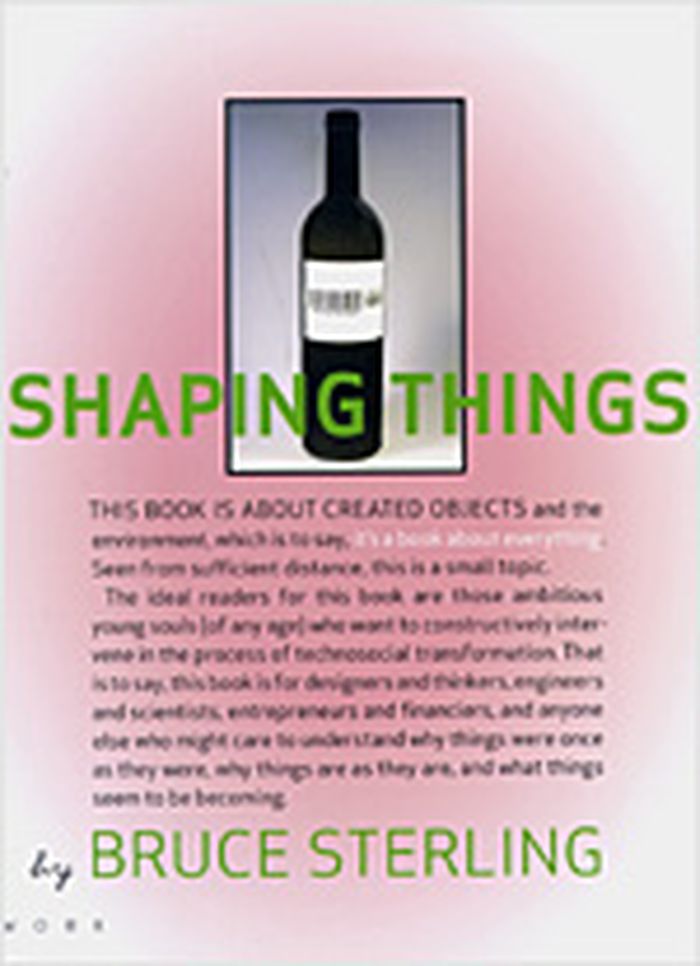
Sterling offers a brilliant, often hilarious history of shaped things. We have moved from an age of artefacts, made by hand, through complex machines, to the current era of "gizmos." New forms of design and manufacture are appearing that lack historical precedent, he writes; but the production methods, using archaic forms of energy and materials that are finite and toxic, are not sustainable. The future will see a new kind of object - we have the primitive forms of them now in our pockets and briefcases: user-alterable, baroquely multi-featured, and programmable - that will be sustainable, enhanceable, and uniquely identifiable. Sterling coins the term "spime" for them, these future manufactured objects with informational support so extensive and rich that they are regarded as material instantiations of an immaterial system. Spimes are designed on screens, fabricated by digital means, and precisely tracked through space and time. They are made of substances that can be folded back into the production stream of future spimes, challenging all of us to become involved in their production. Spimes are coming, says Sterling. We will need these objects in order to live; we won't be able to surrender their advantages without awful consequences. The vision of ‘Shaping Things’ is given material form by the intricate design of Lorraine Wild. ‘Shaping Things’ is for designers and thinkers, engineers and scientists, entrepreneurs and financiers - and anyone who wants to understand and be part of the process of techno-social transformation.
Shaping things
Actions:
Prix:
$27.50
(disponible sur commande)
Résumé:
Sterling offers a brilliant, often hilarious history of shaped things. We have moved from an age of artefacts, made by hand, through complex machines, to the current era of "gizmos." New forms of design and manufacture are appearing that lack historical precedent, he writes; but the production methods, using archaic forms of energy and materials that are finite and toxic, are not sustainable. The future will see a new kind of object - we have the primitive forms of them now in our pockets and briefcases: user-alterable, baroquely multi-featured, and programmable - that will be sustainable, enhanceable, and uniquely identifiable. Sterling coins the term "spime" for them, these future manufactured objects with informational support so extensive and rich that they are regarded as material instantiations of an immaterial system. Spimes are designed on screens, fabricated by digital means, and precisely tracked through space and time. They are made of substances that can be folded back into the production stream of future spimes, challenging all of us to become involved in their production. Spimes are coming, says Sterling. We will need these objects in order to live; we won't be able to surrender their advantages without awful consequences. The vision of ‘Shaping Things’ is given material form by the intricate design of Lorraine Wild. ‘Shaping Things’ is for designers and thinkers, engineers and scientists, entrepreneurs and financiers - and anyone who wants to understand and be part of the process of techno-social transformation.
Classification:
livres
livres
Publication:
septembre 2005, Cambridge, Massachusetts
septembre 2005, Cambridge, Massachusetts
Sujet:
Théorie du design
Théorie du design


