


9192 Résultats
Classification:
documents textuels
documents textuels
Numéro de référence:
ARCH257641
Description:
4 files (concerning exit stairs, lobby and furniture, guard rails, dry wall problems), notes, sketches, memos, transmittals, correspondence, The Vancouver Museums report (1965), Engineering report on acoustics, Fort Camp Feasibility Study report (1971), 5 binders of notes and miscellaneous information, Storm Darinage Requirements report (1963), Soil Conditions report (1970), Museum of Man Functional Program (1972)
ARCH257641
Description:
4 files (concerning exit stairs, lobby and furniture, guard rails, dry wall problems), notes, sketches, memos, transmittals, correspondence, The Vancouver Museums report (1965), Engineering report on acoustics, Fort Camp Feasibility Study report (1971), 5 binders of notes and miscellaneous information, Storm Darinage Requirements report (1963), Soil Conditions report (1970), Museum of Man Functional Program (1972)
Personnes et institutions:
Date:
1973-1976
1973-1976
Titre:
Notes, sketches, memos, transmittals, correspondence
Actions:
ARCH257641
Description:
4 files (concerning exit stairs, lobby and furniture, guard rails, dry wall problems), notes, sketches, memos, transmittals, correspondence, The Vancouver Museums report (1965), Engineering report on acoustics, Fort Camp Feasibility Study report (1971), 5 binders of notes and miscellaneous information, Storm Darinage Requirements report (1963), Soil Conditions report (1970), Museum of Man Functional Program (1972)
Notes, sketches, memos, transmittals, correspondence
Actions:
ARCH257641
Description:
4 files (concerning exit stairs, lobby and furniture, guard rails, dry wall problems), notes, sketches, memos, transmittals, correspondence, The Vancouver Museums report (1965), Engineering report on acoustics, Fort Camp Feasibility Study report (1971), 5 binders of notes and miscellaneous information, Storm Darinage Requirements report (1963), Soil Conditions report (1970), Museum of Man Functional Program (1972)
Classification:
documents textuels
documents textuels
Date:
1973-1976
1973-1976
Personnes et institutions:
Classification:
photographies
photographies
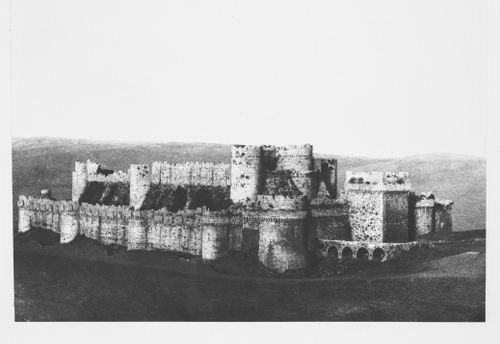
Titre:
Distant view of the Krak of the Knights Castle from the southwest, Ottoman Empire (now in Syria)
Distant view of the Krak of the Knights Castle from the southwest, Ottoman Empire (now in Syria)
Actions:
Numéro de référence:
PH1980:0048.02:017
Description:
- Suzanne K. Williamson indicates that this photograph shows western side "L" and southern side "R" of the Krak de Chevaliers Castle, Ottoman Empire (now Syria) (Oct. 1985). Further research should include verification of this information and identification of the source(s) from which it was obtained. The cardinal point indicated in the title, also provided by Williamson, is presumed to be correct.
PH1980:0048.02:017
Description:
- Suzanne K. Williamson indicates that this photograph shows western side "L" and southern side "R" of the Krak de Chevaliers Castle, Ottoman Empire (now Syria) (Oct. 1985). Further research should include verification of this information and identification of the source(s) from which it was obtained. The cardinal point indicated in the title, also provided by Williamson, is presumed to be correct.
Personnes et institutions:
Sujet:
architecture
architecture
Date:
1859-1860
1859-1860
Titre:
Distant view of the Krak of the Knights Castle from the southwest, Ottoman Empire (now in Syria)
Actions:
PH1980:0048.02:017
Description:
- Suzanne K. Williamson indicates that this photograph shows western side "L" and southern side "R" of the Krak de Chevaliers Castle, Ottoman Empire (now Syria) (Oct. 1985). Further research should include verification of this information and identification of the source(s) from which it was obtained. The cardinal point indicated in the title, also provided by Williamson, is presumed to be correct.
Distant view of the Krak of the Knights Castle from the southwest, Ottoman Empire (now in Syria)
Actions:
PH1980:0048.02:017
Description:
- Suzanne K. Williamson indicates that this photograph shows western side "L" and southern side "R" of the Krak de Chevaliers Castle, Ottoman Empire (now Syria) (Oct. 1985). Further research should include verification of this information and identification of the source(s) from which it was obtained. The cardinal point indicated in the title, also provided by Williamson, is presumed to be correct.
Classification:
photographies
photographies
Date:
1859-1860
1859-1860
Personnes et institutions:
Sujet:
architecture
architecture
Classification:
né numérique
né numérique
Numéro de référence:
AP167.S1.SS3.007
Description:
This directory chiefly contains JPEGs and Photoshop files created to be used by the NSA Muscle computer interface. It also contains licensing information for an unidentified software, possibly related to the NSA Muscle computer interface. Original directory name: "MUSCLE interface". Most common file formats: JPEG File Interchange Format, Unidentified, Adobe Photoshop, Plain Text File, RAR Archive.
AP167.S1.SS3.007
Description:
This directory chiefly contains JPEGs and Photoshop files created to be used by the NSA Muscle computer interface. It also contains licensing information for an unidentified software, possibly related to the NSA Muscle computer interface. Original directory name: "MUSCLE interface". Most common file formats: JPEG File Interchange Format, Unidentified, Adobe Photoshop, Plain Text File, RAR Archive.
Personnes et institutions:
Date:
25 January 2002 - 8 December 2003
25 January 2002 - 8 December 2003
Titre:
Computer interface design for the NSA Muscle (2 of 2)
Actions:
AP167.S1.SS3.007
Description:
This directory chiefly contains JPEGs and Photoshop files created to be used by the NSA Muscle computer interface. It also contains licensing information for an unidentified software, possibly related to the NSA Muscle computer interface. Original directory name: "MUSCLE interface". Most common file formats: JPEG File Interchange Format, Unidentified, Adobe Photoshop, Plain Text File, RAR Archive.
Computer interface design for the NSA Muscle (2 of 2)
Actions:
AP167.S1.SS3.007
Description:
This directory chiefly contains JPEGs and Photoshop files created to be used by the NSA Muscle computer interface. It also contains licensing information for an unidentified software, possibly related to the NSA Muscle computer interface. Original directory name: "MUSCLE interface". Most common file formats: JPEG File Interchange Format, Unidentified, Adobe Photoshop, Plain Text File, RAR Archive.
Classification:
né numérique
né numérique
Date:
25 January 2002 - 8 December 2003
25 January 2002 - 8 December 2003
Personnes et institutions:
Niveau de description archivistique:
Série(s)
Série(s)
Numéro de référence:
AP193.S2
Description:
Series 2, I’ve heard about and Hypnosis chamber, 2004-2006, relates to the conception of the urban structure “I’ve heard about”. The records contain algorithmically-generated images, renderings, pictures of models and exhibitions. There are also photographs of the contour crafting process, 3D models and animated renderings illustrating the construction process of the structure. The project is a conceptual, unbuilt project that is meant to be a habitable organism, an adaptive landscape in a constant state of evolution. By means of transitory scenarios in which the operational mode is entropy and uncertainty, it develops open algorithms based on growth scripts permeable not only to human expressions, but also to the most discrete data such as the chemical emissions (for example due to stress or anxiety) of those who inhabit it. The chemical information is harvested through nanoreceptors feeding the VIAB machine with information. This biostructure becomes the visible part of human contingencies and their negotiation in real time. The structure is conceptualized to be in constant construction through the VIAB machine which is also a constituent of the structure itself. It secretes fiber cement, shaping the landscape where it is located and through which it moves. It generates the reticular structure using a process modelled on contour crafting. The VIAB machine was developed with Robotics Research Lab of the University of Southern California and takes its name from the terms viability and variability. R&Sie(n) considers that due to its mode of emergence “I’ve heard about” fabrication is not subjugated to any political power. Hypnosis chamber is a component of “I’ve heard about”. It consists of an indoor chamber, which was realized as a full-scale sample constructed through automated machinery. The chamber is situated as a part of the whole urban structure presented by “I’ve heard about,” and its goal is to immerse the audience into the project, into a fictional environment only reachable by hypnosis. In this context, hypnosis is a way to help citizens escape from their social condition and experience the new condition of citizenship imagined in “I’ve heard about”, where democracy is re-evaluated as a process of self-determination. Both parts of the projects were shown in contemporary art museums. First at Musée d’art de la ville de Paris in Paris (2005), the Hypnotic chamber is permanently on view at Towada Art Center in Towanda, Japan. AP193.S4 contains a video orienting the project into François Roche theoretical stance, research as speculation, that can be summarize as the use of technological tools to take a critical and political position through esthetic in order to open new lines of thoughts. AP193.S4 contains an updated version of the VIAB machine
AP193.S2
Description:
Series 2, I’ve heard about and Hypnosis chamber, 2004-2006, relates to the conception of the urban structure “I’ve heard about”. The records contain algorithmically-generated images, renderings, pictures of models and exhibitions. There are also photographs of the contour crafting process, 3D models and animated renderings illustrating the construction process of the structure. The project is a conceptual, unbuilt project that is meant to be a habitable organism, an adaptive landscape in a constant state of evolution. By means of transitory scenarios in which the operational mode is entropy and uncertainty, it develops open algorithms based on growth scripts permeable not only to human expressions, but also to the most discrete data such as the chemical emissions (for example due to stress or anxiety) of those who inhabit it. The chemical information is harvested through nanoreceptors feeding the VIAB machine with information. This biostructure becomes the visible part of human contingencies and their negotiation in real time. The structure is conceptualized to be in constant construction through the VIAB machine which is also a constituent of the structure itself. It secretes fiber cement, shaping the landscape where it is located and through which it moves. It generates the reticular structure using a process modelled on contour crafting. The VIAB machine was developed with Robotics Research Lab of the University of Southern California and takes its name from the terms viability and variability. R&Sie(n) considers that due to its mode of emergence “I’ve heard about” fabrication is not subjugated to any political power. Hypnosis chamber is a component of “I’ve heard about”. It consists of an indoor chamber, which was realized as a full-scale sample constructed through automated machinery. The chamber is situated as a part of the whole urban structure presented by “I’ve heard about,” and its goal is to immerse the audience into the project, into a fictional environment only reachable by hypnosis. In this context, hypnosis is a way to help citizens escape from their social condition and experience the new condition of citizenship imagined in “I’ve heard about”, where democracy is re-evaluated as a process of self-determination. Both parts of the projects were shown in contemporary art museums. First at Musée d’art de la ville de Paris in Paris (2005), the Hypnotic chamber is permanently on view at Towada Art Center in Towanda, Japan. AP193.S4 contains a video orienting the project into François Roche theoretical stance, research as speculation, that can be summarize as the use of technological tools to take a critical and political position through esthetic in order to open new lines of thoughts. AP193.S4 contains an updated version of the VIAB machine
Personnes et institutions:
Date:
2004-2006
2004-2006
Titre:
I’ve heard about and Hypnosis chamber
Actions:
AP193.S2
Description:
Series 2, I’ve heard about and Hypnosis chamber, 2004-2006, relates to the conception of the urban structure “I’ve heard about”. The records contain algorithmically-generated images, renderings, pictures of models and exhibitions. There are also photographs of the contour crafting process, 3D models and animated renderings illustrating the construction process of the structure. The project is a conceptual, unbuilt project that is meant to be a habitable organism, an adaptive landscape in a constant state of evolution. By means of transitory scenarios in which the operational mode is entropy and uncertainty, it develops open algorithms based on growth scripts permeable not only to human expressions, but also to the most discrete data such as the chemical emissions (for example due to stress or anxiety) of those who inhabit it. The chemical information is harvested through nanoreceptors feeding the VIAB machine with information. This biostructure becomes the visible part of human contingencies and their negotiation in real time. The structure is conceptualized to be in constant construction through the VIAB machine which is also a constituent of the structure itself. It secretes fiber cement, shaping the landscape where it is located and through which it moves. It generates the reticular structure using a process modelled on contour crafting. The VIAB machine was developed with Robotics Research Lab of the University of Southern California and takes its name from the terms viability and variability. R&Sie(n) considers that due to its mode of emergence “I’ve heard about” fabrication is not subjugated to any political power. Hypnosis chamber is a component of “I’ve heard about”. It consists of an indoor chamber, which was realized as a full-scale sample constructed through automated machinery. The chamber is situated as a part of the whole urban structure presented by “I’ve heard about,” and its goal is to immerse the audience into the project, into a fictional environment only reachable by hypnosis. In this context, hypnosis is a way to help citizens escape from their social condition and experience the new condition of citizenship imagined in “I’ve heard about”, where democracy is re-evaluated as a process of self-determination. Both parts of the projects were shown in contemporary art museums. First at Musée d’art de la ville de Paris in Paris (2005), the Hypnotic chamber is permanently on view at Towada Art Center in Towanda, Japan. AP193.S4 contains a video orienting the project into François Roche theoretical stance, research as speculation, that can be summarize as the use of technological tools to take a critical and political position through esthetic in order to open new lines of thoughts. AP193.S4 contains an updated version of the VIAB machine
I’ve heard about and Hypnosis chamber
Actions:
AP193.S2
Description:
Series 2, I’ve heard about and Hypnosis chamber, 2004-2006, relates to the conception of the urban structure “I’ve heard about”. The records contain algorithmically-generated images, renderings, pictures of models and exhibitions. There are also photographs of the contour crafting process, 3D models and animated renderings illustrating the construction process of the structure. The project is a conceptual, unbuilt project that is meant to be a habitable organism, an adaptive landscape in a constant state of evolution. By means of transitory scenarios in which the operational mode is entropy and uncertainty, it develops open algorithms based on growth scripts permeable not only to human expressions, but also to the most discrete data such as the chemical emissions (for example due to stress or anxiety) of those who inhabit it. The chemical information is harvested through nanoreceptors feeding the VIAB machine with information. This biostructure becomes the visible part of human contingencies and their negotiation in real time. The structure is conceptualized to be in constant construction through the VIAB machine which is also a constituent of the structure itself. It secretes fiber cement, shaping the landscape where it is located and through which it moves. It generates the reticular structure using a process modelled on contour crafting. The VIAB machine was developed with Robotics Research Lab of the University of Southern California and takes its name from the terms viability and variability. R&Sie(n) considers that due to its mode of emergence “I’ve heard about” fabrication is not subjugated to any political power. Hypnosis chamber is a component of “I’ve heard about”. It consists of an indoor chamber, which was realized as a full-scale sample constructed through automated machinery. The chamber is situated as a part of the whole urban structure presented by “I’ve heard about,” and its goal is to immerse the audience into the project, into a fictional environment only reachable by hypnosis. In this context, hypnosis is a way to help citizens escape from their social condition and experience the new condition of citizenship imagined in “I’ve heard about”, where democracy is re-evaluated as a process of self-determination. Both parts of the projects were shown in contemporary art museums. First at Musée d’art de la ville de Paris in Paris (2005), the Hypnotic chamber is permanently on view at Towada Art Center in Towanda, Japan. AP193.S4 contains a video orienting the project into François Roche theoretical stance, research as speculation, that can be summarize as the use of technological tools to take a critical and political position through esthetic in order to open new lines of thoughts. AP193.S4 contains an updated version of the VIAB machine
Niveau de description archivistique:
Series
Series
Date:
2004-2006
2004-2006
Personnes et institutions:
Numéro de référence:
PHCON2002:0016:021:003
Description:
Address book documents the addresses of friends and colleagues of Gordon Matta-Clark from the period of his activity as an artist/architect. Much of the information is duplicated from his large black address book (PHCON2002:0016:021:002), suggesting perhaps that this smaller book was used on trips outside New York City, New York. Address book is arranged alphabetically.
PHCON2002:0016:021:003
Description:
Address book documents the addresses of friends and colleagues of Gordon Matta-Clark from the period of his activity as an artist/architect. Much of the information is duplicated from his large black address book (PHCON2002:0016:021:002), suggesting perhaps that this smaller book was used on trips outside New York City, New York. Address book is arranged alphabetically.
Personnes et institutions:
Date:
1970-1978
1970-1978
Titre:
Small black address book
Actions:
PHCON2002:0016:021:003
Description:
Address book documents the addresses of friends and colleagues of Gordon Matta-Clark from the period of his activity as an artist/architect. Much of the information is duplicated from his large black address book (PHCON2002:0016:021:002), suggesting perhaps that this smaller book was used on trips outside New York City, New York. Address book is arranged alphabetically.
Small black address book
Actions:
PHCON2002:0016:021:003
Description:
Address book documents the addresses of friends and colleagues of Gordon Matta-Clark from the period of his activity as an artist/architect. Much of the information is duplicated from his large black address book (PHCON2002:0016:021:002), suggesting perhaps that this smaller book was used on trips outside New York City, New York. Address book is arranged alphabetically.
Date:
1970-1978
1970-1978
Personnes et institutions:
Classification:
photographies
photographies
Actions:
Numéro de référence:
PH1980:0048.02:005
Description:
- Suzanne K. Williamson indicates that this photograph shows the southwestern enclosure and tower "M" of the Crusader Castle in Beaufort, Ottoman Empire (now Lebanon) (Oct. 1986). Further research should include verification of this information and identification of the source(s) from which it was obtained. The cardinal point indicated in the title, also provided by Williamson, is presumed to be correct.
PH1980:0048.02:005
Description:
- Suzanne K. Williamson indicates that this photograph shows the southwestern enclosure and tower "M" of the Crusader Castle in Beaufort, Ottoman Empire (now Lebanon) (Oct. 1986). Further research should include verification of this information and identification of the source(s) from which it was obtained. The cardinal point indicated in the title, also provided by Williamson, is presumed to be correct.
Personnes et institutions:
Sujet:
architecture, militaire
architecture, militaire
Date:
1859-1860
1859-1860
Titre:
View of the Crusader Castle showing the southwestern enclosure, Beaufort, Ottoman Empire (now in Lebanon)
Actions:
PH1980:0048.02:005
Description:
- Suzanne K. Williamson indicates that this photograph shows the southwestern enclosure and tower "M" of the Crusader Castle in Beaufort, Ottoman Empire (now Lebanon) (Oct. 1986). Further research should include verification of this information and identification of the source(s) from which it was obtained. The cardinal point indicated in the title, also provided by Williamson, is presumed to be correct.
View of the Crusader Castle showing the southwestern enclosure, Beaufort, Ottoman Empire (now in Lebanon)
Actions:
PH1980:0048.02:005
Description:
- Suzanne K. Williamson indicates that this photograph shows the southwestern enclosure and tower "M" of the Crusader Castle in Beaufort, Ottoman Empire (now Lebanon) (Oct. 1986). Further research should include verification of this information and identification of the source(s) from which it was obtained. The cardinal point indicated in the title, also provided by Williamson, is presumed to be correct.
Classification:
photographies
photographies
Date:
1859-1860
1859-1860
Personnes et institutions:
Sujet:
architecture, militaire
architecture, militaire
Classification:
documents textuels, photographies
documents textuels, photographies
Numéro de référence:
ARCH273984
Description:
4 project binders- includes model photographs, sketches, notes, meetings with client, correspondence with George F. Russell, construction costs and budgets and contracts, including the Agreement between Owner and Architect (signed), plans (blueprints of main level, lower level and roof framing plan), project contact list, consultants information, lanscaping notes. interior design, materials, site inspections and project schedules.
ARCH273984
Description:
4 project binders- includes model photographs, sketches, notes, meetings with client, correspondence with George F. Russell, construction costs and budgets and contracts, including the Agreement between Owner and Architect (signed), plans (blueprints of main level, lower level and roof framing plan), project contact list, consultants information, lanscaping notes. interior design, materials, site inspections and project schedules.
Personnes et institutions:
Date:
1983-1984
1983-1984
Titre:
Model photographs, sketches, notes, meetings with client, correspondence with George F. Russell, construction costs and budgets and contracts
Actions:
ARCH273984
Description:
4 project binders- includes model photographs, sketches, notes, meetings with client, correspondence with George F. Russell, construction costs and budgets and contracts, including the Agreement between Owner and Architect (signed), plans (blueprints of main level, lower level and roof framing plan), project contact list, consultants information, lanscaping notes. interior design, materials, site inspections and project schedules.
Model photographs, sketches, notes, meetings with client, correspondence with George F. Russell, construction costs and budgets and contracts
Actions:
ARCH273984
Description:
4 project binders- includes model photographs, sketches, notes, meetings with client, correspondence with George F. Russell, construction costs and budgets and contracts, including the Agreement between Owner and Architect (signed), plans (blueprints of main level, lower level and roof framing plan), project contact list, consultants information, lanscaping notes. interior design, materials, site inspections and project schedules.
Classification:
documents textuels, photographies
documents textuels, photographies
Date:
1983-1984
1983-1984
Personnes et institutions:
Niveau de description archivistique:
Projet
Projet
Numéro de référence:
AP004.S1.D4
Description:
*CONTENT WARNING* This project series documents the Caughnawaga United Church in Kahnawá:ke, Quebec, Canada, which ran the school Caughnawaga Mission (or Caughnawaga Methodist Mission School), recognized as part of the Federal Indian Day School system by the Federal Government of Canada.[1] Please take care in consulting these records and seek help when needed. For more information about the Day School system, please visit https://indiandayschools.com. Note that Kahnawá:ke was previously known as Caughnawaga and the name has been maintained in the project title to preserve the project's historical context. The church was built in 1928 to replace the existing building, which was becoming too small for the congregation. The stained glass of the church was done by Canadian artist Charles William Kelsey. The one-storey building was made from quarried stone, which congregation members moved from quarry to site on horse and buggy.[2] [1] Federal Indian Day School Class Action “Schedule K – List of Federal Indian Day Schools.” https://indiandayschools.com/en/wp-content/uploads/schedule-k.pdf [2] Kahnawake United Church “Kahnawake United Church - Voices of our Elders.” YouTube Video, 23:37, February 8, 2023, https://www.youtube.com/watch?v=xPLYQIJ4c98
AP004.S1.D4
Description:
*CONTENT WARNING* This project series documents the Caughnawaga United Church in Kahnawá:ke, Quebec, Canada, which ran the school Caughnawaga Mission (or Caughnawaga Methodist Mission School), recognized as part of the Federal Indian Day School system by the Federal Government of Canada.[1] Please take care in consulting these records and seek help when needed. For more information about the Day School system, please visit https://indiandayschools.com. Note that Kahnawá:ke was previously known as Caughnawaga and the name has been maintained in the project title to preserve the project's historical context. The church was built in 1928 to replace the existing building, which was becoming too small for the congregation. The stained glass of the church was done by Canadian artist Charles William Kelsey. The one-storey building was made from quarried stone, which congregation members moved from quarry to site on horse and buggy.[2] [1] Federal Indian Day School Class Action “Schedule K – List of Federal Indian Day Schools.” https://indiandayschools.com/en/wp-content/uploads/schedule-k.pdf [2] Kahnawake United Church “Kahnawake United Church - Voices of our Elders.” YouTube Video, 23:37, February 8, 2023, https://www.youtube.com/watch?v=xPLYQIJ4c98
Personnes et institutions:
Date:
1928
1928
Titre:
Caughnawaga United Church, Kahnawá:ke, Québec, Canada
Actions:
AP004.S1.D4
Description:
*CONTENT WARNING* This project series documents the Caughnawaga United Church in Kahnawá:ke, Quebec, Canada, which ran the school Caughnawaga Mission (or Caughnawaga Methodist Mission School), recognized as part of the Federal Indian Day School system by the Federal Government of Canada.[1] Please take care in consulting these records and seek help when needed. For more information about the Day School system, please visit https://indiandayschools.com. Note that Kahnawá:ke was previously known as Caughnawaga and the name has been maintained in the project title to preserve the project's historical context. The church was built in 1928 to replace the existing building, which was becoming too small for the congregation. The stained glass of the church was done by Canadian artist Charles William Kelsey. The one-storey building was made from quarried stone, which congregation members moved from quarry to site on horse and buggy.[2] [1] Federal Indian Day School Class Action “Schedule K – List of Federal Indian Day Schools.” https://indiandayschools.com/en/wp-content/uploads/schedule-k.pdf [2] Kahnawake United Church “Kahnawake United Church - Voices of our Elders.” YouTube Video, 23:37, February 8, 2023, https://www.youtube.com/watch?v=xPLYQIJ4c98
Caughnawaga United Church, Kahnawá:ke, Québec, Canada
Actions:
AP004.S1.D4
Description:
*CONTENT WARNING* This project series documents the Caughnawaga United Church in Kahnawá:ke, Quebec, Canada, which ran the school Caughnawaga Mission (or Caughnawaga Methodist Mission School), recognized as part of the Federal Indian Day School system by the Federal Government of Canada.[1] Please take care in consulting these records and seek help when needed. For more information about the Day School system, please visit https://indiandayschools.com. Note that Kahnawá:ke was previously known as Caughnawaga and the name has been maintained in the project title to preserve the project's historical context. The church was built in 1928 to replace the existing building, which was becoming too small for the congregation. The stained glass of the church was done by Canadian artist Charles William Kelsey. The one-storey building was made from quarried stone, which congregation members moved from quarry to site on horse and buggy.[2] [1] Federal Indian Day School Class Action “Schedule K – List of Federal Indian Day Schools.” https://indiandayschools.com/en/wp-content/uploads/schedule-k.pdf [2] Kahnawake United Church “Kahnawake United Church - Voices of our Elders.” YouTube Video, 23:37, February 8, 2023, https://www.youtube.com/watch?v=xPLYQIJ4c98
Niveau de description archivistique:
Project
Project
Date:
1928
1928
Personnes et institutions:
Classification:
photographies
photographies
Numéro de référence:
ARCH275849
Description:
2 binders- photographic documentation for projects filed under, "Recreation and Resort." Includes: Whistler Village Ski Condominiums, Arrowhead Resort and Hotel, Kanata Recreation Plan, King Ranch Health Resort and Spa, Garmisch Resort and Hotel, Cowan Point Resort, Fitzsimmons Creek Lodge. Contains project information sheets, views of sites, interiors and exteriors, models, plans and renderings. Also includes magazine clippings and reprints.
ARCH275849
Description:
2 binders- photographic documentation for projects filed under, "Recreation and Resort." Includes: Whistler Village Ski Condominiums, Arrowhead Resort and Hotel, Kanata Recreation Plan, King Ranch Health Resort and Spa, Garmisch Resort and Hotel, Cowan Point Resort, Fitzsimmons Creek Lodge. Contains project information sheets, views of sites, interiors and exteriors, models, plans and renderings. Also includes magazine clippings and reprints.
Personnes et institutions:
Date:
1990
1990
Titre:
Photographic documentation for various projects
Actions:
ARCH275849
Description:
2 binders- photographic documentation for projects filed under, "Recreation and Resort." Includes: Whistler Village Ski Condominiums, Arrowhead Resort and Hotel, Kanata Recreation Plan, King Ranch Health Resort and Spa, Garmisch Resort and Hotel, Cowan Point Resort, Fitzsimmons Creek Lodge. Contains project information sheets, views of sites, interiors and exteriors, models, plans and renderings. Also includes magazine clippings and reprints.
Photographic documentation for various projects
Actions:
ARCH275849
Description:
2 binders- photographic documentation for projects filed under, "Recreation and Resort." Includes: Whistler Village Ski Condominiums, Arrowhead Resort and Hotel, Kanata Recreation Plan, King Ranch Health Resort and Spa, Garmisch Resort and Hotel, Cowan Point Resort, Fitzsimmons Creek Lodge. Contains project information sheets, views of sites, interiors and exteriors, models, plans and renderings. Also includes magazine clippings and reprints.
Classification:
photographies
photographies
Date:
1990
1990
Personnes et institutions:
Classification:
photographies
photographies
Titre:
View of the ruins of the Crusader Castle from the south, Beaufort, Ottoman Empire (now in Lebanon)
View of the ruins of the Crusader Castle from the south, Beaufort, Ottoman Empire (now in Lebanon)
Actions:
Numéro de référence:
PH1980:0048.02:004
Description:
- Suzanne K. Williamson indicates that this photograph shows the Crusader Castle in Beaufort, Ottoman Empire (now Lebanon) from the south from tower "G" to tower "B" (Oct. 1986). Further research should include verification of this information and identification of the source(s) from which it was obtained. The cardinal point indicated in the title, also provided by Williamson, is presumed to be correct.
PH1980:0048.02:004
Description:
- Suzanne K. Williamson indicates that this photograph shows the Crusader Castle in Beaufort, Ottoman Empire (now Lebanon) from the south from tower "G" to tower "B" (Oct. 1986). Further research should include verification of this information and identification of the source(s) from which it was obtained. The cardinal point indicated in the title, also provided by Williamson, is presumed to be correct.
Personnes et institutions:
Sujet:
architecture, militaire
architecture, militaire
Date:
1859-1860
1859-1860
Titre:
View of the ruins of the Crusader Castle from the south, Beaufort, Ottoman Empire (now in Lebanon)
Actions:
PH1980:0048.02:004
Description:
- Suzanne K. Williamson indicates that this photograph shows the Crusader Castle in Beaufort, Ottoman Empire (now Lebanon) from the south from tower "G" to tower "B" (Oct. 1986). Further research should include verification of this information and identification of the source(s) from which it was obtained. The cardinal point indicated in the title, also provided by Williamson, is presumed to be correct.
View of the ruins of the Crusader Castle from the south, Beaufort, Ottoman Empire (now in Lebanon)
Actions:
PH1980:0048.02:004
Description:
- Suzanne K. Williamson indicates that this photograph shows the Crusader Castle in Beaufort, Ottoman Empire (now Lebanon) from the south from tower "G" to tower "B" (Oct. 1986). Further research should include verification of this information and identification of the source(s) from which it was obtained. The cardinal point indicated in the title, also provided by Williamson, is presumed to be correct.
Classification:
photographies
photographies
Date:
1859-1860
1859-1860
Personnes et institutions:
Sujet:
architecture, militaire
architecture, militaire


