


929 Résultats
Classification:
livres
livres
Titre:
Le futur de la diversité
Le futur de la diversité
Actions:
Prix:
$45.00
(disponible en magasin)
Résumé:
Ce livre offre de nouvelles perspectives sur le concept de la diversité et le rôle que la diversité peut jouer dans le monde du travail de demain. Des universitaires et des praticiens et praticiennes de diverses disciplines et origines réfléchissent aux interventions les plus appropriées pour créer un marché du travail plus inclusif pour tout le monde. Ils explorent les(...)
$45.00
(disponible en magasin)
Résumé:
Ce livre offre de nouvelles perspectives sur le concept de la diversité et le rôle que la diversité peut jouer dans le monde du travail de demain. Des universitaires et des praticiens et praticiennes de diverses disciplines et origines réfléchissent aux interventions les plus appropriées pour créer un marché du travail plus inclusif pour tout le monde. Ils explorent les(...)
Titre:
Le futur de la diversité
Actions:
Prix:
$45.00
(disponible en magasin)
Résumé:
Ce livre offre de nouvelles perspectives sur le concept de la diversité et le rôle que la diversité peut jouer dans le monde du travail de demain. Des universitaires et des praticiens et praticiennes de diverses disciplines et origines réfléchissent aux interventions les plus appropriées pour créer un marché du travail plus inclusif pour tout le monde. Ils explorent les arguments économiques en faveur de la diversité et des stratégies de gestion de la diversité, en constatant que la diversité et l'inclusion sont indissociables. Les auteurs et autrices montrent que les préjugés et les stéréotypes qui conduisent à la discrimination et à la violence constituent un obstacle majeur à la diversité. Toutefois, le changement culturel sur le lieu de travail ne peut être obtenu par des politiques ponctuelles et l'efficacité des initiatives en faveur de la diversité peut dépendre de variables extérieures au marché du travail. L'ouvrage met également en lumière le dilemme politique entre le respect des individus avec toutes leurs particularités et la lutte contre les inégalités structurelles, qui nécessite souvent une catégorisation en groupes.
Le futur de la diversité
Actions:
Prix:
$45.00
(disponible en magasin)
Résumé:
Ce livre offre de nouvelles perspectives sur le concept de la diversité et le rôle que la diversité peut jouer dans le monde du travail de demain. Des universitaires et des praticiens et praticiennes de diverses disciplines et origines réfléchissent aux interventions les plus appropriées pour créer un marché du travail plus inclusif pour tout le monde. Ils explorent les arguments économiques en faveur de la diversité et des stratégies de gestion de la diversité, en constatant que la diversité et l'inclusion sont indissociables. Les auteurs et autrices montrent que les préjugés et les stéréotypes qui conduisent à la discrimination et à la violence constituent un obstacle majeur à la diversité. Toutefois, le changement culturel sur le lieu de travail ne peut être obtenu par des politiques ponctuelles et l'efficacité des initiatives en faveur de la diversité peut dépendre de variables extérieures au marché du travail. L'ouvrage met également en lumière le dilemme politique entre le respect des individus avec toutes leurs particularités et la lutte contre les inégalités structurelles, qui nécessite souvent une catégorisation en groupes.
Classification:
livres
livres
Publication:
février 2023
février 2023
Sujet:
Social
Social
Classification:
livres
livres

Prix:
$37.50
(disponible sur commande)
Résumé:
The Body at Risk: Photography of Disorder, Illness, and Healing is the first book to explore the ways that photojournalists and social documentarians have conceptualized the human subject as a site of both good and ill health. The volume looks at photographs depicting child laborers; Depression-era health programs; general medical care in the southern United States at(...)
$37.50
(disponible sur commande)
Résumé:
The Body at Risk: Photography of Disorder, Illness, and Healing is the first book to explore the ways that photojournalists and social documentarians have conceptualized the human subject as a site of both good and ill health. The volume looks at photographs depicting child laborers; Depression-era health programs; general medical care in the southern United States at(...)
Titre:
The body at risk : photography of disorder, illness and healing
Actions:
Prix:
$37.50
(disponible sur commande)
Résumé:
The Body at Risk: Photography of Disorder, Illness, and Healing is the first book to explore the ways that photojournalists and social documentarians have conceptualized the human subject as a site of both good and ill health. The volume looks at photographs depicting child laborers; Depression-era health programs; general medical care in the southern United States at mid-century; people with HIV, AIDS, and polio, along with their caretakers and the health workers who advocate for them; environmental pollution; physical and psychological injuries received during warfare; domestic violence; and emergency care in the modern urban hospital. It brings together ten significant bodies of photographs made over the past one hundred years to show how human health topics have been represented for the general public and how the emphasis on health has shifted; how photography has been used to present and promote certain points of view about health and the social circumstances that affect it, both positively and negatively; and how photography has helped shape public knowledge of and opinion about health care and some of the events and circumstances that engender it.
The body at risk : photography of disorder, illness and healing
Actions:
Prix:
$37.50
(disponible sur commande)
Résumé:
The Body at Risk: Photography of Disorder, Illness, and Healing is the first book to explore the ways that photojournalists and social documentarians have conceptualized the human subject as a site of both good and ill health. The volume looks at photographs depicting child laborers; Depression-era health programs; general medical care in the southern United States at mid-century; people with HIV, AIDS, and polio, along with their caretakers and the health workers who advocate for them; environmental pollution; physical and psychological injuries received during warfare; domestic violence; and emergency care in the modern urban hospital. It brings together ten significant bodies of photographs made over the past one hundred years to show how human health topics have been represented for the general public and how the emphasis on health has shifted; how photography has been used to present and promote certain points of view about health and the social circumstances that affect it, both positively and negatively; and how photography has helped shape public knowledge of and opinion about health care and some of the events and circumstances that engender it.
Classification:
livres
livres
Publication:
décembre 2005, New York
décembre 2005, New York
Sujet:
Théorie de la photographie
Théorie de la photographie
Classification:
livres
livres

Actions:
Prix:
$25.00
(disponible sur commande)
Résumé:
The body of the seafarer is a fulcrum upon which global systems of power, longstanding maritime traditions, and gendered and racialised pressures all rest. In this vital new essay, scholar Laleh Khalili draws on her ongoing research and experiences of travelling on cargo ships to explore the embodied life of these labourers. She investigates an experience riddled with(...)
$25.00
(disponible sur commande)
Résumé:
The body of the seafarer is a fulcrum upon which global systems of power, longstanding maritime traditions, and gendered and racialised pressures all rest. In this vital new essay, scholar Laleh Khalili draws on her ongoing research and experiences of travelling on cargo ships to explore the embodied life of these labourers. She investigates an experience riddled with(...)
Titre:
The corporeal life of seafaring
Actions:
Prix:
$25.00
(disponible sur commande)
Résumé:
The body of the seafarer is a fulcrum upon which global systems of power, longstanding maritime traditions, and gendered and racialised pressures all rest. In this vital new essay, scholar Laleh Khalili draws on her ongoing research and experiences of travelling on cargo ships to explore the embodied life of these labourers. She investigates an experience riddled with adversities – loneliness, loss, and violence, stolen wages and exploitative shipowners – as well as ephemeral moments of joy and solidarity. In the unique arena of the ship, Khalili traces the many forms of corporeality involved in work at sea and the ways the body is engaged by the institutions that engulf seafarers’ lives and work. Illustrated throughout with the author’s own photographs, this book takes in both scholarly and literary accounts to describe with care and imagination the material and physical realities of contemporary commerce at sea. Drawing on the insights of feminists and scholars of racial capitalism, it centres the lives of those so often forgotten or dismissed in enterprises of capital accumulation and the raced and gendered hierarchies that shape them.
The corporeal life of seafaring
Actions:
Prix:
$25.00
(disponible sur commande)
Résumé:
The body of the seafarer is a fulcrum upon which global systems of power, longstanding maritime traditions, and gendered and racialised pressures all rest. In this vital new essay, scholar Laleh Khalili draws on her ongoing research and experiences of travelling on cargo ships to explore the embodied life of these labourers. She investigates an experience riddled with adversities – loneliness, loss, and violence, stolen wages and exploitative shipowners – as well as ephemeral moments of joy and solidarity. In the unique arena of the ship, Khalili traces the many forms of corporeality involved in work at sea and the ways the body is engaged by the institutions that engulf seafarers’ lives and work. Illustrated throughout with the author’s own photographs, this book takes in both scholarly and literary accounts to describe with care and imagination the material and physical realities of contemporary commerce at sea. Drawing on the insights of feminists and scholars of racial capitalism, it centres the lives of those so often forgotten or dismissed in enterprises of capital accumulation and the raced and gendered hierarchies that shape them.
Classification:
livres
livres
Publication:
février 2024
février 2024
Classification:
livres
livres
Actions:
Prix:
$25.00
(disponible en magasin)
Résumé:
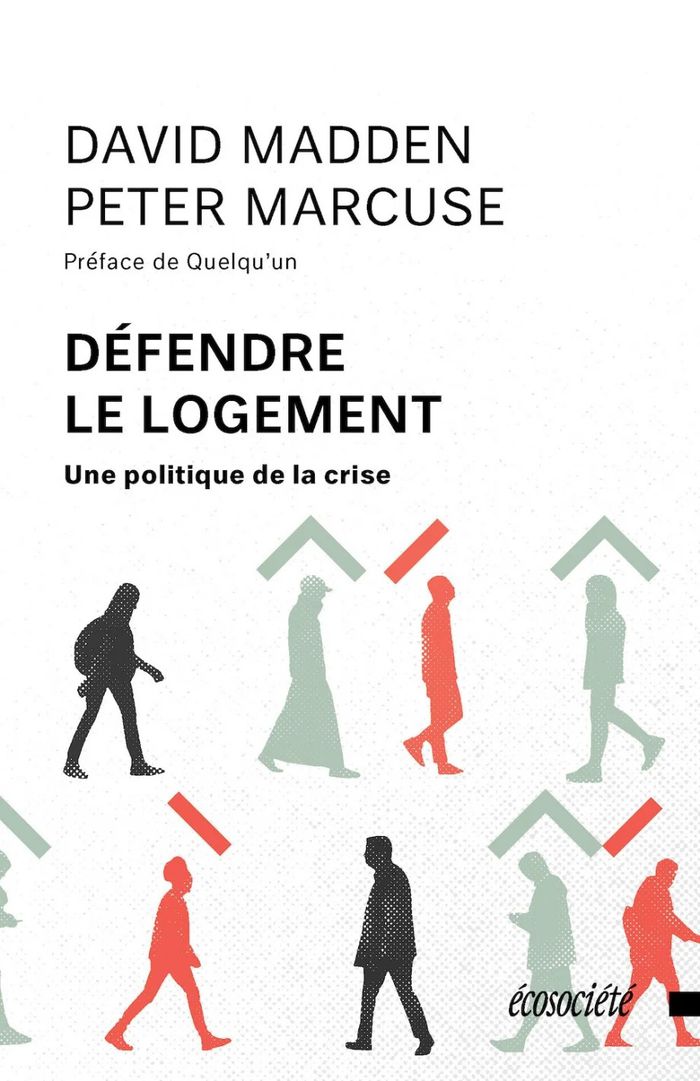
Contrairement à ce que l’on pourrait croire, la crise du logement n’est pas causée par le manque d’unités locatives, des taux d’intérêt élevés ou une conjoncture économique défavorable. C’est l’état normal du marché immobilier en régime capitaliste. Telle est l’idée que défendent l’urbaniste Peter Marcuse et le sociologue David Madden, dans cet ouvrage essentiel qui met(...)
$25.00
(disponible en magasin)
Résumé:
Contrairement à ce que l’on pourrait croire, la crise du logement n’est pas causée par le manque d’unités locatives, des taux d’intérêt élevés ou une conjoncture économique défavorable. C’est l’état normal du marché immobilier en régime capitaliste. Telle est l’idée que défendent l’urbaniste Peter Marcuse et le sociologue David Madden, dans cet ouvrage essentiel qui met(...)
Titre:
Défendre le logement : Nos foyers, leurs profits
Actions:
Prix:
$25.00
(disponible en magasin)
Résumé:
Contrairement à ce que l’on pourrait croire, la crise du logement n’est pas causée par le manque d’unités locatives, des taux d’intérêt élevés ou une conjoncture économique défavorable. C’est l’état normal du marché immobilier en régime capitaliste. Telle est l’idée que défendent l’urbaniste Peter Marcuse et le sociologue David Madden, dans cet ouvrage essentiel qui met en évidence le conflit entre le logement en tant que foyer et l’immobilier à but lucratif. « Défendre le logement » met le doigt sur les processus de marchandisation du logement qui, au cours des dernières années, ont atteint des sommets inégalés, notamment avec l’essor des plateformes comme Airbnb et l’utilisation de l’immobilier comme instrument d’accumulation financière. Une situation qui ne fait que creuser davantage les inégalités dans la ville : quand le profit prend le pas sur le droit de se loger, les loyers augmentent et leur qualité diminue, et les communautés sont confrontées à la violence des déplacements et de la gentrification. Or, le logement est un droit fondamental et ne devrait pas être considéré comme un bien marchand.
Défendre le logement : Nos foyers, leurs profits
Actions:
Prix:
$25.00
(disponible en magasin)
Résumé:
Contrairement à ce que l’on pourrait croire, la crise du logement n’est pas causée par le manque d’unités locatives, des taux d’intérêt élevés ou une conjoncture économique défavorable. C’est l’état normal du marché immobilier en régime capitaliste. Telle est l’idée que défendent l’urbaniste Peter Marcuse et le sociologue David Madden, dans cet ouvrage essentiel qui met en évidence le conflit entre le logement en tant que foyer et l’immobilier à but lucratif. « Défendre le logement » met le doigt sur les processus de marchandisation du logement qui, au cours des dernières années, ont atteint des sommets inégalés, notamment avec l’essor des plateformes comme Airbnb et l’utilisation de l’immobilier comme instrument d’accumulation financière. Une situation qui ne fait que creuser davantage les inégalités dans la ville : quand le profit prend le pas sur le droit de se loger, les loyers augmentent et leur qualité diminue, et les communautés sont confrontées à la violence des déplacements et de la gentrification. Or, le logement est un droit fondamental et ne devrait pas être considéré comme un bien marchand.
Classification:
livres
livres
Publication:
juin 2024
juin 2024
Sujet:
L'humain et la ville
L'humain et la ville
Classification:
livres
livres

Prix:
$24.95
(disponible sur commande)
Résumé:
Thousands of newcomers are pouring into Alberta from around the globe, bringing unexpected gifts. Many are writers and storytellers. What pulls them to Canada? What happens to them on the journey? What experiences have they deliberately left behind? What treasures do they bring? How do they describe their emerging sense of place and their creative aspirations in a new(...)
$24.95
(disponible sur commande)
Résumé:
Thousands of newcomers are pouring into Alberta from around the globe, bringing unexpected gifts. Many are writers and storytellers. What pulls them to Canada? What happens to them on the journey? What experiences have they deliberately left behind? What treasures do they bring? How do they describe their emerging sense of place and their creative aspirations in a new(...)
Titre:
The story that brought me here: to Alberta from everywhere
Actions:
Prix:
$24.95
(disponible sur commande)
Résumé:
Thousands of newcomers are pouring into Alberta from around the globe, bringing unexpected gifts. Many are writers and storytellers. What pulls them to Canada? What happens to them on the journey? What experiences have they deliberately left behind? What treasures do they bring? How do they describe their emerging sense of place and their creative aspirations in a new home? In this moving collection of stories and poems, writers from around the world share their thoughts on creating a life in Alberta. Expressed with beauty and clarity, and sometimes translated from the writer's native tongue, these very personal accounts of joy and sadness, regret and humour, homesickness and exuberance, describe the defining moments of a departure and an arrival. Linda Goyette is an Edmonton writer and journalist with an interest in giving voice to a new Canadian dialogue. Her previous books include Rocky Mountain Kids, Kidmonton: True Stories of River City Kids; Edmonton in Our Own Words, which won the Grant MacEwan Authors Award in 2005; Standing Together: Women Speak Out About Violence and Abuse and Second Opinion.
The story that brought me here: to Alberta from everywhere
Actions:
Prix:
$24.95
(disponible sur commande)
Résumé:
Thousands of newcomers are pouring into Alberta from around the globe, bringing unexpected gifts. Many are writers and storytellers. What pulls them to Canada? What happens to them on the journey? What experiences have they deliberately left behind? What treasures do they bring? How do they describe their emerging sense of place and their creative aspirations in a new home? In this moving collection of stories and poems, writers from around the world share their thoughts on creating a life in Alberta. Expressed with beauty and clarity, and sometimes translated from the writer's native tongue, these very personal accounts of joy and sadness, regret and humour, homesickness and exuberance, describe the defining moments of a departure and an arrival. Linda Goyette is an Edmonton writer and journalist with an interest in giving voice to a new Canadian dialogue. Her previous books include Rocky Mountain Kids, Kidmonton: True Stories of River City Kids; Edmonton in Our Own Words, which won the Grant MacEwan Authors Award in 2005; Standing Together: Women Speak Out About Violence and Abuse and Second Opinion.
Classification:
livres
livres
Publication:
septembre 2008, Edmonton
septembre 2008, Edmonton
Sujet:
Architecture du Canada
Architecture du Canada
Classification:
livres
livres

Actions:
Prix:
$28.95
(disponible sur commande)
Résumé:
Duffy illuminates speed as a logic and genuine pleasure of modernity. He plunges full-throttle into speed's 'adrenaline aesthetics,' offering deft readings of works ranging from F. Scott Fitzgerald's "The Great Gatsby", through J. G. Ballard's "Crash", to the cautionary consumerism of Ralph Nader. He describes how speed changed understandings of space, distance, chance,(...)
$28.95
(disponible sur commande)
Résumé:
Duffy illuminates speed as a logic and genuine pleasure of modernity. He plunges full-throttle into speed's 'adrenaline aesthetics,' offering deft readings of works ranging from F. Scott Fitzgerald's "The Great Gatsby", through J. G. Ballard's "Crash", to the cautionary consumerism of Ralph Nader. He describes how speed changed understandings of space, distance, chance,(...)
Titre:
The speed handbook: velocity, pleasure, modernism
Actions:
Prix:
$28.95
(disponible sur commande)
Résumé:
Duffy illuminates speed as a logic and genuine pleasure of modernity. He plunges full-throttle into speed's 'adrenaline aesthetics,' offering deft readings of works ranging from F. Scott Fitzgerald's "The Great Gatsby", through J. G. Ballard's "Crash", to the cautionary consumerism of Ralph Nader. He describes how speed changed understandings of space, distance, chance, and violence; how the experience of speed was commodified in the dawning era of mass consumption; and how people were incited to abhor slowness and desire speed. He examines how they were trained by new media such as the cinema to see, hear, and sense speed, and how speed, demanded of the efficient assembly-line worker, was given back to that worker as the chief thrill of leisure. Assessing speed's political implications, Duffy considers how speed pleasure was offered to citizens based on criteria including their ability to pay and their gender, and how speed quickly became something to be patrolled by governments. Drawing on novels, news reports, photography, advertising, and much more, Duffy provides a breakneck tour through the cultural dynamics of speed.
The speed handbook: velocity, pleasure, modernism
Actions:
Prix:
$28.95
(disponible sur commande)
Résumé:
Duffy illuminates speed as a logic and genuine pleasure of modernity. He plunges full-throttle into speed's 'adrenaline aesthetics,' offering deft readings of works ranging from F. Scott Fitzgerald's "The Great Gatsby", through J. G. Ballard's "Crash", to the cautionary consumerism of Ralph Nader. He describes how speed changed understandings of space, distance, chance, and violence; how the experience of speed was commodified in the dawning era of mass consumption; and how people were incited to abhor slowness and desire speed. He examines how they were trained by new media such as the cinema to see, hear, and sense speed, and how speed, demanded of the efficient assembly-line worker, was given back to that worker as the chief thrill of leisure. Assessing speed's political implications, Duffy considers how speed pleasure was offered to citizens based on criteria including their ability to pay and their gender, and how speed quickly became something to be patrolled by governments. Drawing on novels, news reports, photography, advertising, and much more, Duffy provides a breakneck tour through the cultural dynamics of speed.
Classification:
livres
livres
Publication:
août 2009
août 2009
Sujet:
Théorie/ philosophie
Théorie/ philosophie
Classification:
livres
livres

Titre:
The phantom scientist
The phantom scientist
Actions:
Prix:
$33.95
(disponible sur commande)
Résumé:
An isolated institute laid out in a Fibonacci sequence, hidden deep in the forest. Twenty-four labs. Twenty-four researchers. Until one of them disappears . . . When physicist Stéphane Douasy arrives to occupy the vacant twenty-fourth lab at the Institute for the Study of Complex and Dynamic Systems, an ominous problem rises in his wake: what has happened to his(...)
$33.95
(disponible sur commande)
Résumé:
An isolated institute laid out in a Fibonacci sequence, hidden deep in the forest. Twenty-four labs. Twenty-four researchers. Until one of them disappears . . . When physicist Stéphane Douasy arrives to occupy the vacant twenty-fourth lab at the Institute for the Study of Complex and Dynamic Systems, an ominous problem rises in his wake: what has happened to his(...)
Titre:
The phantom scientist
Actions:
Prix:
$33.95
(disponible sur commande)
Résumé:
An isolated institute laid out in a Fibonacci sequence, hidden deep in the forest. Twenty-four labs. Twenty-four researchers. Until one of them disappears . . . When physicist Stéphane Douasy arrives to occupy the vacant twenty-fourth lab at the Institute for the Study of Complex and Dynamic Systems, an ominous problem rises in his wake: what has happened to his missing neighbor in Building F? When Stéphane’s neighbors, a discouraged linguist and a computer scientist bent on predicting the future, discover that the missing researcher may have solved the P versus NP problem—a coup in computer science with revolutionary implications for everything from mathematics to philosophy—before vanishing, things turn stranger still, and even more menacing. Solving the mystery of the Institute and its devolution into mayhem and violence every seventh year quickly shifts from being an intellectual exercise to a matter of life and death. ''The phantom scientist'' is part thriller, part mystery, part systems theory—and all enthralling. The tale slyly draws together linguistics, biology, astrophysics, and robotics in a mind-bending puzzle that will thrill and inform readers.
The phantom scientist
Actions:
Prix:
$33.95
(disponible sur commande)
Résumé:
An isolated institute laid out in a Fibonacci sequence, hidden deep in the forest. Twenty-four labs. Twenty-four researchers. Until one of them disappears . . . When physicist Stéphane Douasy arrives to occupy the vacant twenty-fourth lab at the Institute for the Study of Complex and Dynamic Systems, an ominous problem rises in his wake: what has happened to his missing neighbor in Building F? When Stéphane’s neighbors, a discouraged linguist and a computer scientist bent on predicting the future, discover that the missing researcher may have solved the P versus NP problem—a coup in computer science with revolutionary implications for everything from mathematics to philosophy—before vanishing, things turn stranger still, and even more menacing. Solving the mystery of the Institute and its devolution into mayhem and violence every seventh year quickly shifts from being an intellectual exercise to a matter of life and death. ''The phantom scientist'' is part thriller, part mystery, part systems theory—and all enthralling. The tale slyly draws together linguistics, biology, astrophysics, and robotics in a mind-bending puzzle that will thrill and inform readers.
Classification:
livres
livres
Publication:
février 2023
février 2023
Sujet:
Illustration
Illustration
Classification:
livres
livres

Titre:
The Black geographic
The Black geographic
Actions:
Prix:
$38.95
(disponible sur commande)
Résumé:
The contributors to ''The Black geographic'' explore the theoretical innovations of Black Geographies scholarship and how it approaches Blackness as historically and spatially situated. In studies that span from Oakland to the Alabama Black Belt to Senegal to Brazil, the contributors draw on ethnography, archival records, digital humanities, literary criticism, and art to(...)
$38.95
(disponible sur commande)
Résumé:
The contributors to ''The Black geographic'' explore the theoretical innovations of Black Geographies scholarship and how it approaches Blackness as historically and spatially situated. In studies that span from Oakland to the Alabama Black Belt to Senegal to Brazil, the contributors draw on ethnography, archival records, digital humanities, literary criticism, and art to(...)
Titre:
The Black geographic
Actions:
Prix:
$38.95
(disponible sur commande)
Résumé:
The contributors to ''The Black geographic'' explore the theoretical innovations of Black Geographies scholarship and how it approaches Blackness as historically and spatially situated. In studies that span from Oakland to the Alabama Black Belt to Senegal to Brazil, the contributors draw on ethnography, archival records, digital humanities, literary criticism, and art to show how understanding the spatial dimensions of Black life contributes to a broader understanding of race and space. They examine key sites of inquiry: Black spatial imaginaries, resistance to racial violence, the geographies of racial capitalism, and struggles over urban space. Throughout, the contributors demonstrate that Blackness is itself a situating and place-making force, even as it is shaped by spatial processes and diasporic routes. Whether discussing eighteenth- and nineteenth-century abolitionist print records or migration and surveillance in Niger, this volume demonstrates that Black Geographies is a mode of analyzing Blackness that fundamentally challenges the very foundations of the field of geography and its historical entwinement with colonialism, enslavement, and imperialism. In short, it marks a new step in the evolution of the field.
The Black geographic
Actions:
Prix:
$38.95
(disponible sur commande)
Résumé:
The contributors to ''The Black geographic'' explore the theoretical innovations of Black Geographies scholarship and how it approaches Blackness as historically and spatially situated. In studies that span from Oakland to the Alabama Black Belt to Senegal to Brazil, the contributors draw on ethnography, archival records, digital humanities, literary criticism, and art to show how understanding the spatial dimensions of Black life contributes to a broader understanding of race and space. They examine key sites of inquiry: Black spatial imaginaries, resistance to racial violence, the geographies of racial capitalism, and struggles over urban space. Throughout, the contributors demonstrate that Blackness is itself a situating and place-making force, even as it is shaped by spatial processes and diasporic routes. Whether discussing eighteenth- and nineteenth-century abolitionist print records or migration and surveillance in Niger, this volume demonstrates that Black Geographies is a mode of analyzing Blackness that fundamentally challenges the very foundations of the field of geography and its historical entwinement with colonialism, enslavement, and imperialism. In short, it marks a new step in the evolution of the field.
Classification:
livres
livres
Publication:
octobre 2023
octobre 2023
Sujet:
Social
Social
Classification:
livres
livres

Prix:
$36.95
(disponible sur commande)
Résumé:
In "Fugitive time", Matthew Omelsky theorizes the embodied experience of time in twentieth- and twenty-first-century black artforms from across the world. Through the lens of time, he charts the sensations and coursing thoughts that accompany desires for freedom as they appear in the work of artists as varied as Toni Morrison, Yvonne Vera, Aimé Césaire, and Issa Samb.(...)
$36.95
(disponible sur commande)
Résumé:
In "Fugitive time", Matthew Omelsky theorizes the embodied experience of time in twentieth- and twenty-first-century black artforms from across the world. Through the lens of time, he charts the sensations and coursing thoughts that accompany desires for freedom as they appear in the work of artists as varied as Toni Morrison, Yvonne Vera, Aimé Césaire, and Issa Samb.(...)
Titre:
Fugitive time: Global aesthetics and the black beyond
Actions:
Prix:
$36.95
(disponible sur commande)
Résumé:
In "Fugitive time", Matthew Omelsky theorizes the embodied experience of time in twentieth- and twenty-first-century black artforms from across the world. Through the lens of time, he charts the sensations and coursing thoughts that accompany desires for freedom as they appear in the work of artists as varied as Toni Morrison, Yvonne Vera, Aimé Césaire, and Issa Samb. "Fugitive time" names a distinct utopian desire directed at the anticipated moment when the body and mind have been unburdened of the violence that has consumed black life globally for centuries, bringing with it a new form of being. Omelsky shows how fugitive time is not about attaining this transcendent release but is instead about sustaining the idea of it as an ecstatic social gathering. From the desire for ethereal queer worlds in the Black Audio Film Collective's "Twilight City" to Sun Ra's transformation of nineteenth-century scientific racism into an insurgent fugitive aesthetic, Omelsky shows how fugitive time evolves and how it remains a dominant form of imagining freedom in global black cultural expression.
Fugitive time: Global aesthetics and the black beyond
Actions:
Prix:
$36.95
(disponible sur commande)
Résumé:
In "Fugitive time", Matthew Omelsky theorizes the embodied experience of time in twentieth- and twenty-first-century black artforms from across the world. Through the lens of time, he charts the sensations and coursing thoughts that accompany desires for freedom as they appear in the work of artists as varied as Toni Morrison, Yvonne Vera, Aimé Césaire, and Issa Samb. "Fugitive time" names a distinct utopian desire directed at the anticipated moment when the body and mind have been unburdened of the violence that has consumed black life globally for centuries, bringing with it a new form of being. Omelsky shows how fugitive time is not about attaining this transcendent release but is instead about sustaining the idea of it as an ecstatic social gathering. From the desire for ethereal queer worlds in the Black Audio Film Collective's "Twilight City" to Sun Ra's transformation of nineteenth-century scientific racism into an insurgent fugitive aesthetic, Omelsky shows how fugitive time evolves and how it remains a dominant form of imagining freedom in global black cultural expression.
Classification:
livres
livres
Publication:
décembre 2023
décembre 2023
Sujet:
Théorie de l’art
Théorie de l’art
Classification:
livres
livres

Actions:
Prix:
$41.99
(disponible sur commande)
Résumé:
In Nairobi’s underserved neighborhoods, “hustle” has emerged as both a vital survival strategy and a way of life for youth. Exploring the multiple meanings and manifestations of the hustle economy across different scenarios of provisioning, distribution, exchange, learning, and mobilizing, ''Hustle Urbanism'' draws on more than a decade of ethnographic engagement to(...)
$41.99
(disponible sur commande)
Résumé:
In Nairobi’s underserved neighborhoods, “hustle” has emerged as both a vital survival strategy and a way of life for youth. Exploring the multiple meanings and manifestations of the hustle economy across different scenarios of provisioning, distribution, exchange, learning, and mobilizing, ''Hustle Urbanism'' draws on more than a decade of ethnographic engagement to(...)
Titre:
Hustle urbanism: Making life work in Nairobi
Actions:
Prix:
$41.99
(disponible sur commande)
Résumé:
In Nairobi’s underserved neighborhoods, “hustle” has emerged as both a vital survival strategy and a way of life for youth. Exploring the multiple meanings and manifestations of the hustle economy across different scenarios of provisioning, distribution, exchange, learning, and mobilizing, ''Hustle Urbanism'' draws on more than a decade of ethnographic engagement to center the logics, perspectives, and inventive strategies of a group of youth who constantly navigate job scarcity, inadequate basic services, and climate-induced harms. Tatiana Thieme shows how young people develop tools of resistance against the legacies of colonial violence and uneven urban development while carving out spaces of opportunity for themselves and their peers. The stories she includes bring thick ethnographic detail and longitudinal perspective to the lives and livelihoods of youth whose diverse skill sets and knowledges span from circular economies and eco-activism to hip hop and local leadership. Filling a significant gap in both existing scholarship and popular discussion, ''Hustle Urbanism'' offers critical theorization of precarious urban environments and the affirmative modes of making life work in the city against the odds.
Hustle urbanism: Making life work in Nairobi
Actions:
Prix:
$41.99
(disponible sur commande)
Résumé:
In Nairobi’s underserved neighborhoods, “hustle” has emerged as both a vital survival strategy and a way of life for youth. Exploring the multiple meanings and manifestations of the hustle economy across different scenarios of provisioning, distribution, exchange, learning, and mobilizing, ''Hustle Urbanism'' draws on more than a decade of ethnographic engagement to center the logics, perspectives, and inventive strategies of a group of youth who constantly navigate job scarcity, inadequate basic services, and climate-induced harms. Tatiana Thieme shows how young people develop tools of resistance against the legacies of colonial violence and uneven urban development while carving out spaces of opportunity for themselves and their peers. The stories she includes bring thick ethnographic detail and longitudinal perspective to the lives and livelihoods of youth whose diverse skill sets and knowledges span from circular economies and eco-activism to hip hop and local leadership. Filling a significant gap in both existing scholarship and popular discussion, ''Hustle Urbanism'' offers critical theorization of precarious urban environments and the affirmative modes of making life work in the city against the odds.
Classification:
livres
livres
Publication:
juin 2025
juin 2025
Sujet:
Théorie de l’urbanisme
Théorie de l’urbanisme


