


3241 Résultats
Classification:
documents textuels
documents textuels
Numéro de référence:
PHCON2002:0016:003:135
PHCON2002:0016:003:135
Personnes et institutions:
Date:
24 September 1975
24 September 1975
Classification:
documents textuels
documents textuels
Date:
24 September 1975
24 September 1975
Personnes et institutions:
Niveau de description archivistique:
Projet
Projet
Numéro de référence:
AP178.S1.1980.PR02
Description:
The project series documents Block 121, better known as Bonjour Tristesse. While the records were held in the office’s archives this project was assigned the number 2/80. This project was one of several projects Siza submitted to the International Architectural Exhibition Berlin competition (International Bauaustellung, IBA, circa 1979-1987), and was Siza’s first international built project. The IBA was an urban renewal strategy for West Berlin and received submissions from several international architects. The IBA divided West Berlin into two parts: IBA Neubau ('new building'), led by Josef Paul Kleihues and IBA Altbau ('old building') led by Hardt-Walherr Hämer. IBA Nuebau's focus was to build new buildings while IBA Altbau's was to renovate existing buildings. The project site for Block 121 was in the district of Kreuzberg, a district on the eastern side of then West Berlin. Due to low rents, there was an influx of immigrants and students to Kreuzberg in the late 1970s. Bonjour Tristesse would serve as a residential complex for a predominantly Turkish immigrant population. In 1980, Hämer invited Siza to submit an entry for this complex to be built on the east side of Kreuzberg beside the Schlesisches Tor train station. Hämer encouraged the participatory model which Siza had become known for from his work with the Servicio Ambulatorio de Apoio Local (SAAL) in Portugal. This project series is arranged in four subseries: AP178.S1.1980.PR02.SS1, Competition, Block 121 (identified as 2/80); AP178.S1.1980.PR02.SS2, Bonjour Tristesse (identified as 2/80 A); AP178.S1.1980.PR02.SS3, Kita [Kindergarten] (identified as 2/80 B); and AP178.S1.1980.PR02.SS4, Senior Club Anziani [Senior citizens’ clubhouse] (identified as 2/80 C). The office’s archivist assigned the number 2/80 to materials related to the competition phase of this project; letters (A, B, and C) were then assigned to each subsequent portion of the project following the competition. All documentation for this project series, including the project subseries, has been kept together to maintain the order of the office’s arrangement.
AP178.S1.1980.PR02
Description:
The project series documents Block 121, better known as Bonjour Tristesse. While the records were held in the office’s archives this project was assigned the number 2/80. This project was one of several projects Siza submitted to the International Architectural Exhibition Berlin competition (International Bauaustellung, IBA, circa 1979-1987), and was Siza’s first international built project. The IBA was an urban renewal strategy for West Berlin and received submissions from several international architects. The IBA divided West Berlin into two parts: IBA Neubau ('new building'), led by Josef Paul Kleihues and IBA Altbau ('old building') led by Hardt-Walherr Hämer. IBA Nuebau's focus was to build new buildings while IBA Altbau's was to renovate existing buildings. The project site for Block 121 was in the district of Kreuzberg, a district on the eastern side of then West Berlin. Due to low rents, there was an influx of immigrants and students to Kreuzberg in the late 1970s. Bonjour Tristesse would serve as a residential complex for a predominantly Turkish immigrant population. In 1980, Hämer invited Siza to submit an entry for this complex to be built on the east side of Kreuzberg beside the Schlesisches Tor train station. Hämer encouraged the participatory model which Siza had become known for from his work with the Servicio Ambulatorio de Apoio Local (SAAL) in Portugal. This project series is arranged in four subseries: AP178.S1.1980.PR02.SS1, Competition, Block 121 (identified as 2/80); AP178.S1.1980.PR02.SS2, Bonjour Tristesse (identified as 2/80 A); AP178.S1.1980.PR02.SS3, Kita [Kindergarten] (identified as 2/80 B); and AP178.S1.1980.PR02.SS4, Senior Club Anziani [Senior citizens’ clubhouse] (identified as 2/80 C). The office’s archivist assigned the number 2/80 to materials related to the competition phase of this project; letters (A, B, and C) were then assigned to each subsequent portion of the project following the competition. All documentation for this project series, including the project subseries, has been kept together to maintain the order of the office’s arrangement.
Personnes et institutions:
Date:
circa 1980-1990
circa 1980-1990
Titre:
Block 121, Schlesisches Tor [Block 121, Schlesisches Tor residential complex], Berlin, Germany (1980-1990)
Actions:
AP178.S1.1980.PR02
Description:
The project series documents Block 121, better known as Bonjour Tristesse. While the records were held in the office’s archives this project was assigned the number 2/80. This project was one of several projects Siza submitted to the International Architectural Exhibition Berlin competition (International Bauaustellung, IBA, circa 1979-1987), and was Siza’s first international built project. The IBA was an urban renewal strategy for West Berlin and received submissions from several international architects. The IBA divided West Berlin into two parts: IBA Neubau ('new building'), led by Josef Paul Kleihues and IBA Altbau ('old building') led by Hardt-Walherr Hämer. IBA Nuebau's focus was to build new buildings while IBA Altbau's was to renovate existing buildings. The project site for Block 121 was in the district of Kreuzberg, a district on the eastern side of then West Berlin. Due to low rents, there was an influx of immigrants and students to Kreuzberg in the late 1970s. Bonjour Tristesse would serve as a residential complex for a predominantly Turkish immigrant population. In 1980, Hämer invited Siza to submit an entry for this complex to be built on the east side of Kreuzberg beside the Schlesisches Tor train station. Hämer encouraged the participatory model which Siza had become known for from his work with the Servicio Ambulatorio de Apoio Local (SAAL) in Portugal. This project series is arranged in four subseries: AP178.S1.1980.PR02.SS1, Competition, Block 121 (identified as 2/80); AP178.S1.1980.PR02.SS2, Bonjour Tristesse (identified as 2/80 A); AP178.S1.1980.PR02.SS3, Kita [Kindergarten] (identified as 2/80 B); and AP178.S1.1980.PR02.SS4, Senior Club Anziani [Senior citizens’ clubhouse] (identified as 2/80 C). The office’s archivist assigned the number 2/80 to materials related to the competition phase of this project; letters (A, B, and C) were then assigned to each subsequent portion of the project following the competition. All documentation for this project series, including the project subseries, has been kept together to maintain the order of the office’s arrangement.
Block 121, Schlesisches Tor [Block 121, Schlesisches Tor residential complex], Berlin, Germany (1980-1990)
Actions:
AP178.S1.1980.PR02
Description:
The project series documents Block 121, better known as Bonjour Tristesse. While the records were held in the office’s archives this project was assigned the number 2/80. This project was one of several projects Siza submitted to the International Architectural Exhibition Berlin competition (International Bauaustellung, IBA, circa 1979-1987), and was Siza’s first international built project. The IBA was an urban renewal strategy for West Berlin and received submissions from several international architects. The IBA divided West Berlin into two parts: IBA Neubau ('new building'), led by Josef Paul Kleihues and IBA Altbau ('old building') led by Hardt-Walherr Hämer. IBA Nuebau's focus was to build new buildings while IBA Altbau's was to renovate existing buildings. The project site for Block 121 was in the district of Kreuzberg, a district on the eastern side of then West Berlin. Due to low rents, there was an influx of immigrants and students to Kreuzberg in the late 1970s. Bonjour Tristesse would serve as a residential complex for a predominantly Turkish immigrant population. In 1980, Hämer invited Siza to submit an entry for this complex to be built on the east side of Kreuzberg beside the Schlesisches Tor train station. Hämer encouraged the participatory model which Siza had become known for from his work with the Servicio Ambulatorio de Apoio Local (SAAL) in Portugal. This project series is arranged in four subseries: AP178.S1.1980.PR02.SS1, Competition, Block 121 (identified as 2/80); AP178.S1.1980.PR02.SS2, Bonjour Tristesse (identified as 2/80 A); AP178.S1.1980.PR02.SS3, Kita [Kindergarten] (identified as 2/80 B); and AP178.S1.1980.PR02.SS4, Senior Club Anziani [Senior citizens’ clubhouse] (identified as 2/80 C). The office’s archivist assigned the number 2/80 to materials related to the competition phase of this project; letters (A, B, and C) were then assigned to each subsequent portion of the project following the competition. All documentation for this project series, including the project subseries, has been kept together to maintain the order of the office’s arrangement.
Niveau de description archivistique:
Project
Project
Date:
circa 1980-1990
circa 1980-1990
Personnes et institutions:
Niveau de description archivistique:
Sous-série
Sous-série
Numéro de référence:
AP115.S3.D2
Description:
Cette sous-série porte sur le travail de documentation photographique de Robert Duchesnay du dôme géodésique Climatron dome à St. Louis, Missouri, aux États-Unis. Conçu en 1960 par les architectes Murphy et Mackey de St. Louis en utilisant le système conçu par Buckminter Fuller, il abrite la serre et le pavillon principal du Missouri Botanical Garden. Le Climatron est la première serre complètement climatisée au monde. Son diamètre est de 175 pieds. Le pavillon sera fermé en 1988 pour un vaste projet de rénovations qui dureront jusqu'en 1990. Le bâtiment est toujours en activité. La sous-série contient cinq photographies, de l'extérieur et de l'intérieur du dôme, prises par Robert Duchesnay en 1990 après sa réouverture à la suite des rénovations. Source: Duchesnay, Robert. "Other domes by Buckminster Fuller". https://robertduchesnay.com/en/other-domes-by-buckminster-fuller/ (page consultée 24 février 2023).
AP115.S3.D2
Description:
Cette sous-série porte sur le travail de documentation photographique de Robert Duchesnay du dôme géodésique Climatron dome à St. Louis, Missouri, aux États-Unis. Conçu en 1960 par les architectes Murphy et Mackey de St. Louis en utilisant le système conçu par Buckminter Fuller, il abrite la serre et le pavillon principal du Missouri Botanical Garden. Le Climatron est la première serre complètement climatisée au monde. Son diamètre est de 175 pieds. Le pavillon sera fermé en 1988 pour un vaste projet de rénovations qui dureront jusqu'en 1990. Le bâtiment est toujours en activité. La sous-série contient cinq photographies, de l'extérieur et de l'intérieur du dôme, prises par Robert Duchesnay en 1990 après sa réouverture à la suite des rénovations. Source: Duchesnay, Robert. "Other domes by Buckminster Fuller". https://robertduchesnay.com/en/other-domes-by-buckminster-fuller/ (page consultée 24 février 2023).
Personnes et institutions:
Date:
1990
1990
Titre:
Climatron, Saint Louis, Missouri
Actions:
AP115.S3.D2
Description:
Cette sous-série porte sur le travail de documentation photographique de Robert Duchesnay du dôme géodésique Climatron dome à St. Louis, Missouri, aux États-Unis. Conçu en 1960 par les architectes Murphy et Mackey de St. Louis en utilisant le système conçu par Buckminter Fuller, il abrite la serre et le pavillon principal du Missouri Botanical Garden. Le Climatron est la première serre complètement climatisée au monde. Son diamètre est de 175 pieds. Le pavillon sera fermé en 1988 pour un vaste projet de rénovations qui dureront jusqu'en 1990. Le bâtiment est toujours en activité. La sous-série contient cinq photographies, de l'extérieur et de l'intérieur du dôme, prises par Robert Duchesnay en 1990 après sa réouverture à la suite des rénovations. Source: Duchesnay, Robert. "Other domes by Buckminster Fuller". https://robertduchesnay.com/en/other-domes-by-buckminster-fuller/ (page consultée 24 février 2023).
Climatron, Saint Louis, Missouri
Actions:
AP115.S3.D2
Description:
Cette sous-série porte sur le travail de documentation photographique de Robert Duchesnay du dôme géodésique Climatron dome à St. Louis, Missouri, aux États-Unis. Conçu en 1960 par les architectes Murphy et Mackey de St. Louis en utilisant le système conçu par Buckminter Fuller, il abrite la serre et le pavillon principal du Missouri Botanical Garden. Le Climatron est la première serre complètement climatisée au monde. Son diamètre est de 175 pieds. Le pavillon sera fermé en 1988 pour un vaste projet de rénovations qui dureront jusqu'en 1990. Le bâtiment est toujours en activité. La sous-série contient cinq photographies, de l'extérieur et de l'intérieur du dôme, prises par Robert Duchesnay en 1990 après sa réouverture à la suite des rénovations. Source: Duchesnay, Robert. "Other domes by Buckminster Fuller". https://robertduchesnay.com/en/other-domes-by-buckminster-fuller/ (page consultée 24 février 2023).
Niveau de description archivistique:
Dossier 2
Dossier 2
Date:
1990
1990
Personnes et institutions:
Classification:
dessins
dessins
Actions:
Numéro de référence:
DR1974:0002:035:001-034
Description:
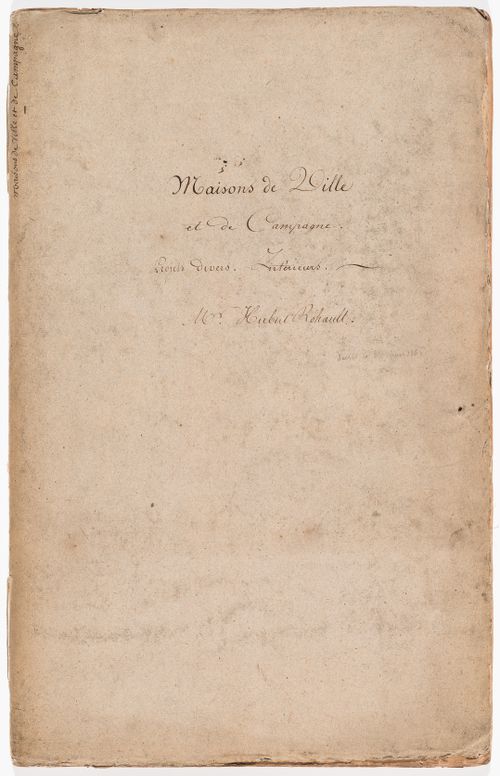
- This album consists primarily of preliminary and design development drawings for diverse projects - mostly domestic - from the early years of Hubert Rohault de Fleury's career. Some of the fifteen more finished drawings in wash and watercolour are probably presentation drawings. Many of the drawings are inscribed with illegible or partially legible notations concerning the project's location, client, date and other particulars. There are seven drawings for a house on rue d'Aguesseau, Paris, probably the Rohault de Fleury family residence (DR1974:0002:035:002 - DR1974:OOO2:035:006 R/V) and several drawings for a house for Rohault de Fleury's uncle on rue Saint-Romain, Paris (DR1974:0002:035:012 V). Several drawings are after plates published in Durand's "Précis des Leçons d'architecture données à l'école Royale Polytechnique (1802-1805)": plans on drawings DR1974:0002:035:011 V, DR1974:0002:035:012 R are adapted from plate 25 and combined with façades designed by Rohault de Fleury, and drawing DR1974:0002:035:013 R is based on an engraving by Charles-Pierre-Joseph Normand (pl. 23) of Hôtel Lathuille in Paris which was designed by Jean-Nicolas-Louis Durand (1788). Perspective sketches and plans are included for the restoration of a château in Rocheux [?] for M. le Trône (DR1974:0002:035:017 R) and for the renovation for the house at Domaine de la Vallée (DR1974:0002:035:020). The drawing for a country villa was executed in 1804, while Rohault de Fleury was in Rome studying at the French Academy (DR1974:0002:035:021 R). The conceptual drawing of a small "orchestre" and the elevations of a gallery and portico gate are inscribed "Jardin du Frascati", and are perhaps travel sketches or projects executed while Rohault de Fleury was in Rome (DR1974:0002:035:032 V, DR1974:002:035:033 R, and DR1974:0002:035:034). Also included in the album are two plans for part of the Passage du saumon in Paris (DR1974:0002:035:014 R), a plan, elevation and section for a rustic pavilion for M. Abrial (DR1974:0002:035:024 V), a plan for a shepherd's house in St. Cueufin [?] (DR1974:0002:035:021 V), a house for M. Quitton in Paris (DR1974:0002:035:026 - DR1974:0002:035:027), a section, elevation and plan for a sheepfold (DR1974:0002:035:033 V) and a perspective for a rustic cabin (DR1974:0002:035:034). The album also contains a number of drawings for Empire-style interior design projects: interior wall elevations, furniture drawings, and plans, elevations and perspectives for a bed alcove.
DR1974:0002:035:001-034
Description:
- This album consists primarily of preliminary and design development drawings for diverse projects - mostly domestic - from the early years of Hubert Rohault de Fleury's career. Some of the fifteen more finished drawings in wash and watercolour are probably presentation drawings. Many of the drawings are inscribed with illegible or partially legible notations concerning the project's location, client, date and other particulars. There are seven drawings for a house on rue d'Aguesseau, Paris, probably the Rohault de Fleury family residence (DR1974:0002:035:002 - DR1974:OOO2:035:006 R/V) and several drawings for a house for Rohault de Fleury's uncle on rue Saint-Romain, Paris (DR1974:0002:035:012 V). Several drawings are after plates published in Durand's "Précis des Leçons d'architecture données à l'école Royale Polytechnique (1802-1805)": plans on drawings DR1974:0002:035:011 V, DR1974:0002:035:012 R are adapted from plate 25 and combined with façades designed by Rohault de Fleury, and drawing DR1974:0002:035:013 R is based on an engraving by Charles-Pierre-Joseph Normand (pl. 23) of Hôtel Lathuille in Paris which was designed by Jean-Nicolas-Louis Durand (1788). Perspective sketches and plans are included for the restoration of a château in Rocheux [?] for M. le Trône (DR1974:0002:035:017 R) and for the renovation for the house at Domaine de la Vallée (DR1974:0002:035:020). The drawing for a country villa was executed in 1804, while Rohault de Fleury was in Rome studying at the French Academy (DR1974:0002:035:021 R). The conceptual drawing of a small "orchestre" and the elevations of a gallery and portico gate are inscribed "Jardin du Frascati", and are perhaps travel sketches or projects executed while Rohault de Fleury was in Rome (DR1974:0002:035:032 V, DR1974:002:035:033 R, and DR1974:0002:035:034). Also included in the album are two plans for part of the Passage du saumon in Paris (DR1974:0002:035:014 R), a plan, elevation and section for a rustic pavilion for M. Abrial (DR1974:0002:035:024 V), a plan for a shepherd's house in St. Cueufin [?] (DR1974:0002:035:021 V), a house for M. Quitton in Paris (DR1974:0002:035:026 - DR1974:0002:035:027), a section, elevation and plan for a sheepfold (DR1974:0002:035:033 V) and a perspective for a rustic cabin (DR1974:0002:035:034). The album also contains a number of drawings for Empire-style interior design projects: interior wall elevations, furniture drawings, and plans, elevations and perspectives for a bed alcove.
Personnes et institutions:
Sujet:
architecture, architecture de paysage, design d'intérieur
architecture, architecture de paysage, design d'intérieur
Date:
early 19th century
early 19th century
Titre:
Album of drawings, mostly for French town and country houses, including some drawings for interiors and furniture, and one drawing for the Passage du saumon, Paris
Actions:
DR1974:0002:035:001-034
Description:
- This album consists primarily of preliminary and design development drawings for diverse projects - mostly domestic - from the early years of Hubert Rohault de Fleury's career. Some of the fifteen more finished drawings in wash and watercolour are probably presentation drawings. Many of the drawings are inscribed with illegible or partially legible notations concerning the project's location, client, date and other particulars. There are seven drawings for a house on rue d'Aguesseau, Paris, probably the Rohault de Fleury family residence (DR1974:0002:035:002 - DR1974:OOO2:035:006 R/V) and several drawings for a house for Rohault de Fleury's uncle on rue Saint-Romain, Paris (DR1974:0002:035:012 V). Several drawings are after plates published in Durand's "Précis des Leçons d'architecture données à l'école Royale Polytechnique (1802-1805)": plans on drawings DR1974:0002:035:011 V, DR1974:0002:035:012 R are adapted from plate 25 and combined with façades designed by Rohault de Fleury, and drawing DR1974:0002:035:013 R is based on an engraving by Charles-Pierre-Joseph Normand (pl. 23) of Hôtel Lathuille in Paris which was designed by Jean-Nicolas-Louis Durand (1788). Perspective sketches and plans are included for the restoration of a château in Rocheux [?] for M. le Trône (DR1974:0002:035:017 R) and for the renovation for the house at Domaine de la Vallée (DR1974:0002:035:020). The drawing for a country villa was executed in 1804, while Rohault de Fleury was in Rome studying at the French Academy (DR1974:0002:035:021 R). The conceptual drawing of a small "orchestre" and the elevations of a gallery and portico gate are inscribed "Jardin du Frascati", and are perhaps travel sketches or projects executed while Rohault de Fleury was in Rome (DR1974:0002:035:032 V, DR1974:002:035:033 R, and DR1974:0002:035:034). Also included in the album are two plans for part of the Passage du saumon in Paris (DR1974:0002:035:014 R), a plan, elevation and section for a rustic pavilion for M. Abrial (DR1974:0002:035:024 V), a plan for a shepherd's house in St. Cueufin [?] (DR1974:0002:035:021 V), a house for M. Quitton in Paris (DR1974:0002:035:026 - DR1974:0002:035:027), a section, elevation and plan for a sheepfold (DR1974:0002:035:033 V) and a perspective for a rustic cabin (DR1974:0002:035:034). The album also contains a number of drawings for Empire-style interior design projects: interior wall elevations, furniture drawings, and plans, elevations and perspectives for a bed alcove.
Album of drawings, mostly for French town and country houses, including some drawings for interiors and furniture, and one drawing for the Passage du saumon, Paris
Actions:
DR1974:0002:035:001-034
Description:
- This album consists primarily of preliminary and design development drawings for diverse projects - mostly domestic - from the early years of Hubert Rohault de Fleury's career. Some of the fifteen more finished drawings in wash and watercolour are probably presentation drawings. Many of the drawings are inscribed with illegible or partially legible notations concerning the project's location, client, date and other particulars. There are seven drawings for a house on rue d'Aguesseau, Paris, probably the Rohault de Fleury family residence (DR1974:0002:035:002 - DR1974:OOO2:035:006 R/V) and several drawings for a house for Rohault de Fleury's uncle on rue Saint-Romain, Paris (DR1974:0002:035:012 V). Several drawings are after plates published in Durand's "Précis des Leçons d'architecture données à l'école Royale Polytechnique (1802-1805)": plans on drawings DR1974:0002:035:011 V, DR1974:0002:035:012 R are adapted from plate 25 and combined with façades designed by Rohault de Fleury, and drawing DR1974:0002:035:013 R is based on an engraving by Charles-Pierre-Joseph Normand (pl. 23) of Hôtel Lathuille in Paris which was designed by Jean-Nicolas-Louis Durand (1788). Perspective sketches and plans are included for the restoration of a château in Rocheux [?] for M. le Trône (DR1974:0002:035:017 R) and for the renovation for the house at Domaine de la Vallée (DR1974:0002:035:020). The drawing for a country villa was executed in 1804, while Rohault de Fleury was in Rome studying at the French Academy (DR1974:0002:035:021 R). The conceptual drawing of a small "orchestre" and the elevations of a gallery and portico gate are inscribed "Jardin du Frascati", and are perhaps travel sketches or projects executed while Rohault de Fleury was in Rome (DR1974:0002:035:032 V, DR1974:002:035:033 R, and DR1974:0002:035:034). Also included in the album are two plans for part of the Passage du saumon in Paris (DR1974:0002:035:014 R), a plan, elevation and section for a rustic pavilion for M. Abrial (DR1974:0002:035:024 V), a plan for a shepherd's house in St. Cueufin [?] (DR1974:0002:035:021 V), a house for M. Quitton in Paris (DR1974:0002:035:026 - DR1974:0002:035:027), a section, elevation and plan for a sheepfold (DR1974:0002:035:033 V) and a perspective for a rustic cabin (DR1974:0002:035:034). The album also contains a number of drawings for Empire-style interior design projects: interior wall elevations, furniture drawings, and plans, elevations and perspectives for a bed alcove.
Classification:
dessins
dessins
Date:
early 19th century
early 19th century
Personnes et institutions:
Sujet:
architecture, architecture de paysage, design d'intérieur
architecture, architecture de paysage, design d'intérieur
Niveau de description archivistique:
Projet
Projet
Numéro de référence:
AP178.S1.1979.PR06
Description:
The project series documents the 1979 design entry for Block 70 and 89, also known as the Fränkelufer residential complex. While the records were held in the office’s archives this project was assigned the number 55/70. The office assigned the date 1979 for this project. This project was submitted to the International Architectural Exhibition Berlin competition (International Bauaustellung, IBA, circa 1979-1987), an urban renewal strategy for West Berlin, Germany. Six months prior to submitting the design for Block 70 and 89 Siza submitted a design for the Görlitzer Bad swimming pool, which did not win the competition but received a special prize. Siza later submitted proposals to the IBA for Bonjour Tristesse (Block 121), Monument to Gestapo victims Prinz-Albrecht-Palais, Block 11-12 (Kottbusser Damm), and the Kulturforum, all of which are documented in this fonds. The IBA divided West Berlin into two parts: IBA Neubau ('new building'), led by Josef Paul Kleihues, and IBA Altbau ('old building') led by Hardt-Walherr Hämer. IBA Nuebau's focus was to build new structures while IBA Altbau's was to renovate existing buildings. The competition site for Block 70 and 89 was located on the west side of Kreuzberg, a district on the eastern edge of West Berlin. Although this project was part of the Altbau section, it nonetheless required building new housing complexes, which was generally under the purview of the Neubau section (Mota, "An archaeology of the ordinary" 299). Siza won second prize in the competition for his design of Block 70 and 89. This design proposal is said to have prepared Siza's ideas for his first international built project, Block 121 (Mathur, "The migrant's time"). The project series contains sketches and studies, which include notes. Several of the project sketches also include sketches of people. Documenting the design proposal are site plans, elevations, interior elevations, and floor plans. Photographs, negatives, contact sheets, and slides depict the project site and surrounding area as well as the model and drawings. Additionally there are panoramic photomontages of the project site. Please note that documentation for this project series is housed with documentation on Block 11-12 in file AP178.S1.1980.PR03.008, in the order it was kept by the office. Documentation for Block 70 and 89 includes an invitation to the competition, recommendations from the IBA advisory council, and other information regarding the competition.
AP178.S1.1979.PR06
Description:
The project series documents the 1979 design entry for Block 70 and 89, also known as the Fränkelufer residential complex. While the records were held in the office’s archives this project was assigned the number 55/70. The office assigned the date 1979 for this project. This project was submitted to the International Architectural Exhibition Berlin competition (International Bauaustellung, IBA, circa 1979-1987), an urban renewal strategy for West Berlin, Germany. Six months prior to submitting the design for Block 70 and 89 Siza submitted a design for the Görlitzer Bad swimming pool, which did not win the competition but received a special prize. Siza later submitted proposals to the IBA for Bonjour Tristesse (Block 121), Monument to Gestapo victims Prinz-Albrecht-Palais, Block 11-12 (Kottbusser Damm), and the Kulturforum, all of which are documented in this fonds. The IBA divided West Berlin into two parts: IBA Neubau ('new building'), led by Josef Paul Kleihues, and IBA Altbau ('old building') led by Hardt-Walherr Hämer. IBA Nuebau's focus was to build new structures while IBA Altbau's was to renovate existing buildings. The competition site for Block 70 and 89 was located on the west side of Kreuzberg, a district on the eastern edge of West Berlin. Although this project was part of the Altbau section, it nonetheless required building new housing complexes, which was generally under the purview of the Neubau section (Mota, "An archaeology of the ordinary" 299). Siza won second prize in the competition for his design of Block 70 and 89. This design proposal is said to have prepared Siza's ideas for his first international built project, Block 121 (Mathur, "The migrant's time"). The project series contains sketches and studies, which include notes. Several of the project sketches also include sketches of people. Documenting the design proposal are site plans, elevations, interior elevations, and floor plans. Photographs, negatives, contact sheets, and slides depict the project site and surrounding area as well as the model and drawings. Additionally there are panoramic photomontages of the project site. Please note that documentation for this project series is housed with documentation on Block 11-12 in file AP178.S1.1980.PR03.008, in the order it was kept by the office. Documentation for Block 70 and 89 includes an invitation to the competition, recommendations from the IBA advisory council, and other information regarding the competition.
Personnes et institutions:
Date:
1976-1982
1976-1982
Titre:
Blocke 70 und 89, Kreuzberg, Fränkelufer [Fränkelufer residential complex], Berlin, Germany (1976-1982)
Actions:
AP178.S1.1979.PR06
Description:
The project series documents the 1979 design entry for Block 70 and 89, also known as the Fränkelufer residential complex. While the records were held in the office’s archives this project was assigned the number 55/70. The office assigned the date 1979 for this project. This project was submitted to the International Architectural Exhibition Berlin competition (International Bauaustellung, IBA, circa 1979-1987), an urban renewal strategy for West Berlin, Germany. Six months prior to submitting the design for Block 70 and 89 Siza submitted a design for the Görlitzer Bad swimming pool, which did not win the competition but received a special prize. Siza later submitted proposals to the IBA for Bonjour Tristesse (Block 121), Monument to Gestapo victims Prinz-Albrecht-Palais, Block 11-12 (Kottbusser Damm), and the Kulturforum, all of which are documented in this fonds. The IBA divided West Berlin into two parts: IBA Neubau ('new building'), led by Josef Paul Kleihues, and IBA Altbau ('old building') led by Hardt-Walherr Hämer. IBA Nuebau's focus was to build new structures while IBA Altbau's was to renovate existing buildings. The competition site for Block 70 and 89 was located on the west side of Kreuzberg, a district on the eastern edge of West Berlin. Although this project was part of the Altbau section, it nonetheless required building new housing complexes, which was generally under the purview of the Neubau section (Mota, "An archaeology of the ordinary" 299). Siza won second prize in the competition for his design of Block 70 and 89. This design proposal is said to have prepared Siza's ideas for his first international built project, Block 121 (Mathur, "The migrant's time"). The project series contains sketches and studies, which include notes. Several of the project sketches also include sketches of people. Documenting the design proposal are site plans, elevations, interior elevations, and floor plans. Photographs, negatives, contact sheets, and slides depict the project site and surrounding area as well as the model and drawings. Additionally there are panoramic photomontages of the project site. Please note that documentation for this project series is housed with documentation on Block 11-12 in file AP178.S1.1980.PR03.008, in the order it was kept by the office. Documentation for Block 70 and 89 includes an invitation to the competition, recommendations from the IBA advisory council, and other information regarding the competition.
Blocke 70 und 89, Kreuzberg, Fränkelufer [Fränkelufer residential complex], Berlin, Germany (1976-1982)
Actions:
AP178.S1.1979.PR06
Description:
The project series documents the 1979 design entry for Block 70 and 89, also known as the Fränkelufer residential complex. While the records were held in the office’s archives this project was assigned the number 55/70. The office assigned the date 1979 for this project. This project was submitted to the International Architectural Exhibition Berlin competition (International Bauaustellung, IBA, circa 1979-1987), an urban renewal strategy for West Berlin, Germany. Six months prior to submitting the design for Block 70 and 89 Siza submitted a design for the Görlitzer Bad swimming pool, which did not win the competition but received a special prize. Siza later submitted proposals to the IBA for Bonjour Tristesse (Block 121), Monument to Gestapo victims Prinz-Albrecht-Palais, Block 11-12 (Kottbusser Damm), and the Kulturforum, all of which are documented in this fonds. The IBA divided West Berlin into two parts: IBA Neubau ('new building'), led by Josef Paul Kleihues, and IBA Altbau ('old building') led by Hardt-Walherr Hämer. IBA Nuebau's focus was to build new structures while IBA Altbau's was to renovate existing buildings. The competition site for Block 70 and 89 was located on the west side of Kreuzberg, a district on the eastern edge of West Berlin. Although this project was part of the Altbau section, it nonetheless required building new housing complexes, which was generally under the purview of the Neubau section (Mota, "An archaeology of the ordinary" 299). Siza won second prize in the competition for his design of Block 70 and 89. This design proposal is said to have prepared Siza's ideas for his first international built project, Block 121 (Mathur, "The migrant's time"). The project series contains sketches and studies, which include notes. Several of the project sketches also include sketches of people. Documenting the design proposal are site plans, elevations, interior elevations, and floor plans. Photographs, negatives, contact sheets, and slides depict the project site and surrounding area as well as the model and drawings. Additionally there are panoramic photomontages of the project site. Please note that documentation for this project series is housed with documentation on Block 11-12 in file AP178.S1.1980.PR03.008, in the order it was kept by the office. Documentation for Block 70 and 89 includes an invitation to the competition, recommendations from the IBA advisory council, and other information regarding the competition.
Niveau de description archivistique:
Project
Project
Date:
1976-1982
1976-1982
Personnes et institutions:
Classification:
dessins, documents textuels, oeuvres d'art
dessins, documents textuels, oeuvres d'art
Actions:
Numéro de référence:
DR1974:0002:011:001-089
Description:
- This album contains mostly design development and presentation drawings for the conversion or renovation of several Parisan hôtel particuliers by Hubert Rohault de Fleury, and for the Rohault de Fleury family house, 12-14 rue d'Aguesseau, Paris. Also included are four prints of British country seats. The drawings - mostly plans - for hôtel particuliers include: alterations to the Hôtel du ministère de la Guerre, perhaps the initial conversion of the Hôtel du Maine into government offices (DR1974:0002:011:003 - DR1974:0002:011:005); alterations to Hôtel de Rothelin-Charolais (Hôtel de Conti) as offices for the Ministère de l'intérieur (DR1974:0002:011:006 - DR1974:0002:011:009); the conversion of Hôtel de Soyécourt into gendarmerie barracks (DR1974:0002:011:017 - DR1974:0002:011:027 and DR1974:0002:011:089); and the alterations to Hôtel de la Colonnade (Grand and Petit Hôtels de Wagram) as offices for the Ministère des affaires étrangères (DR1974:0002:011:028 - DR1974:0002:011:042). Letter DR1974:0002:011:037 R/V apparently concerns the alterations to Hôtel de la Colonnade. The album contains drawings for several other hôtels - Hôtel de Lorge, Petit hôtel de Nivernais, Hôtel de Bouillon, and an hôtel on rue des Quatre-Fils. The purpose of these drawings has not been determined. Drawings for the Rohault de Fleury family house include: 22 graphite design development drawings with dimensions, calculations and notes - mostly plans and elevations; seven finished watercolour presentation drawings - plans, sections and elevations; two interior perspectives; and one drawing for the roof structures (DR1974:0002:011:050 - DR1974:0002:011:083). The coloured sections and the interior perspective drawings show the Empire style interior decoration, including furnishings (DR1974:0002:011:080 - DR1974:0002:011:082 R and DR1974:0002:011:083 R). The four prints are part of a series of views of English country seats by William Henry Toms after Thomas Badeslade and William Winstanley printed during the mid 18th century: Hawarden Castle and the adjacent Broadlane Hall, Wales, seat of Sir John Glynne; Erddig (house), Wales, seat of Simon Yorke; Hather Thorpe (house), Lincolnshire, England, seat of Sir Michael Newton; and Rushton Hall, Northamptonshire, England, seat of Viscount Cullen (DR1974:0002:011:085 - DR1974:0002:011:088). The album also includes: three drawings for a château for M. le marquis de la Sainte-Aulaire, designed by Perrot, the first of which is possibly for proposed additions by Hubert Rohault de Fleury (DR1974:0002:011:013); an elevation for a temporary altar; a cost estimate for a country cottage; six drawings for an unidentified country house; and a site plan of the village [?] and vicinity of Chailly, France for Mr. Pierre Jacques Le Roy.
DR1974:0002:011:001-089
Description:
- This album contains mostly design development and presentation drawings for the conversion or renovation of several Parisan hôtel particuliers by Hubert Rohault de Fleury, and for the Rohault de Fleury family house, 12-14 rue d'Aguesseau, Paris. Also included are four prints of British country seats. The drawings - mostly plans - for hôtel particuliers include: alterations to the Hôtel du ministère de la Guerre, perhaps the initial conversion of the Hôtel du Maine into government offices (DR1974:0002:011:003 - DR1974:0002:011:005); alterations to Hôtel de Rothelin-Charolais (Hôtel de Conti) as offices for the Ministère de l'intérieur (DR1974:0002:011:006 - DR1974:0002:011:009); the conversion of Hôtel de Soyécourt into gendarmerie barracks (DR1974:0002:011:017 - DR1974:0002:011:027 and DR1974:0002:011:089); and the alterations to Hôtel de la Colonnade (Grand and Petit Hôtels de Wagram) as offices for the Ministère des affaires étrangères (DR1974:0002:011:028 - DR1974:0002:011:042). Letter DR1974:0002:011:037 R/V apparently concerns the alterations to Hôtel de la Colonnade. The album contains drawings for several other hôtels - Hôtel de Lorge, Petit hôtel de Nivernais, Hôtel de Bouillon, and an hôtel on rue des Quatre-Fils. The purpose of these drawings has not been determined. Drawings for the Rohault de Fleury family house include: 22 graphite design development drawings with dimensions, calculations and notes - mostly plans and elevations; seven finished watercolour presentation drawings - plans, sections and elevations; two interior perspectives; and one drawing for the roof structures (DR1974:0002:011:050 - DR1974:0002:011:083). The coloured sections and the interior perspective drawings show the Empire style interior decoration, including furnishings (DR1974:0002:011:080 - DR1974:0002:011:082 R and DR1974:0002:011:083 R). The four prints are part of a series of views of English country seats by William Henry Toms after Thomas Badeslade and William Winstanley printed during the mid 18th century: Hawarden Castle and the adjacent Broadlane Hall, Wales, seat of Sir John Glynne; Erddig (house), Wales, seat of Simon Yorke; Hather Thorpe (house), Lincolnshire, England, seat of Sir Michael Newton; and Rushton Hall, Northamptonshire, England, seat of Viscount Cullen (DR1974:0002:011:085 - DR1974:0002:011:088). The album also includes: three drawings for a château for M. le marquis de la Sainte-Aulaire, designed by Perrot, the first of which is possibly for proposed additions by Hubert Rohault de Fleury (DR1974:0002:011:013); an elevation for a temporary altar; a cost estimate for a country cottage; six drawings for an unidentified country house; and a site plan of the village [?] and vicinity of Chailly, France for Mr. Pierre Jacques Le Roy.
Personnes et institutions:
Sujet:
architecture, architecture de paysage, architecture temporaire, design d'intérieur, militaire, topographique
architecture, architecture de paysage, architecture temporaire, design d'intérieur, militaire, topographique
Date:
1755-1849, manuscripts written between 1792-1849, printed between ca. 1740-1849
1755-1849, manuscripts written between 1792-1849, printed between ca. 1740-1849
Titre:
Album of drawings for alterations to several Parisian hôtel particuliers and the Rohault de Fleury family house, rue d'Aguesseau, Paris, and of prints of English country seats
Actions:
DR1974:0002:011:001-089
Description:
- This album contains mostly design development and presentation drawings for the conversion or renovation of several Parisan hôtel particuliers by Hubert Rohault de Fleury, and for the Rohault de Fleury family house, 12-14 rue d'Aguesseau, Paris. Also included are four prints of British country seats. The drawings - mostly plans - for hôtel particuliers include: alterations to the Hôtel du ministère de la Guerre, perhaps the initial conversion of the Hôtel du Maine into government offices (DR1974:0002:011:003 - DR1974:0002:011:005); alterations to Hôtel de Rothelin-Charolais (Hôtel de Conti) as offices for the Ministère de l'intérieur (DR1974:0002:011:006 - DR1974:0002:011:009); the conversion of Hôtel de Soyécourt into gendarmerie barracks (DR1974:0002:011:017 - DR1974:0002:011:027 and DR1974:0002:011:089); and the alterations to Hôtel de la Colonnade (Grand and Petit Hôtels de Wagram) as offices for the Ministère des affaires étrangères (DR1974:0002:011:028 - DR1974:0002:011:042). Letter DR1974:0002:011:037 R/V apparently concerns the alterations to Hôtel de la Colonnade. The album contains drawings for several other hôtels - Hôtel de Lorge, Petit hôtel de Nivernais, Hôtel de Bouillon, and an hôtel on rue des Quatre-Fils. The purpose of these drawings has not been determined. Drawings for the Rohault de Fleury family house include: 22 graphite design development drawings with dimensions, calculations and notes - mostly plans and elevations; seven finished watercolour presentation drawings - plans, sections and elevations; two interior perspectives; and one drawing for the roof structures (DR1974:0002:011:050 - DR1974:0002:011:083). The coloured sections and the interior perspective drawings show the Empire style interior decoration, including furnishings (DR1974:0002:011:080 - DR1974:0002:011:082 R and DR1974:0002:011:083 R). The four prints are part of a series of views of English country seats by William Henry Toms after Thomas Badeslade and William Winstanley printed during the mid 18th century: Hawarden Castle and the adjacent Broadlane Hall, Wales, seat of Sir John Glynne; Erddig (house), Wales, seat of Simon Yorke; Hather Thorpe (house), Lincolnshire, England, seat of Sir Michael Newton; and Rushton Hall, Northamptonshire, England, seat of Viscount Cullen (DR1974:0002:011:085 - DR1974:0002:011:088). The album also includes: three drawings for a château for M. le marquis de la Sainte-Aulaire, designed by Perrot, the first of which is possibly for proposed additions by Hubert Rohault de Fleury (DR1974:0002:011:013); an elevation for a temporary altar; a cost estimate for a country cottage; six drawings for an unidentified country house; and a site plan of the village [?] and vicinity of Chailly, France for Mr. Pierre Jacques Le Roy.
Album of drawings for alterations to several Parisian hôtel particuliers and the Rohault de Fleury family house, rue d'Aguesseau, Paris, and of prints of English country seats
Actions:
DR1974:0002:011:001-089
Description:
- This album contains mostly design development and presentation drawings for the conversion or renovation of several Parisan hôtel particuliers by Hubert Rohault de Fleury, and for the Rohault de Fleury family house, 12-14 rue d'Aguesseau, Paris. Also included are four prints of British country seats. The drawings - mostly plans - for hôtel particuliers include: alterations to the Hôtel du ministère de la Guerre, perhaps the initial conversion of the Hôtel du Maine into government offices (DR1974:0002:011:003 - DR1974:0002:011:005); alterations to Hôtel de Rothelin-Charolais (Hôtel de Conti) as offices for the Ministère de l'intérieur (DR1974:0002:011:006 - DR1974:0002:011:009); the conversion of Hôtel de Soyécourt into gendarmerie barracks (DR1974:0002:011:017 - DR1974:0002:011:027 and DR1974:0002:011:089); and the alterations to Hôtel de la Colonnade (Grand and Petit Hôtels de Wagram) as offices for the Ministère des affaires étrangères (DR1974:0002:011:028 - DR1974:0002:011:042). Letter DR1974:0002:011:037 R/V apparently concerns the alterations to Hôtel de la Colonnade. The album contains drawings for several other hôtels - Hôtel de Lorge, Petit hôtel de Nivernais, Hôtel de Bouillon, and an hôtel on rue des Quatre-Fils. The purpose of these drawings has not been determined. Drawings for the Rohault de Fleury family house include: 22 graphite design development drawings with dimensions, calculations and notes - mostly plans and elevations; seven finished watercolour presentation drawings - plans, sections and elevations; two interior perspectives; and one drawing for the roof structures (DR1974:0002:011:050 - DR1974:0002:011:083). The coloured sections and the interior perspective drawings show the Empire style interior decoration, including furnishings (DR1974:0002:011:080 - DR1974:0002:011:082 R and DR1974:0002:011:083 R). The four prints are part of a series of views of English country seats by William Henry Toms after Thomas Badeslade and William Winstanley printed during the mid 18th century: Hawarden Castle and the adjacent Broadlane Hall, Wales, seat of Sir John Glynne; Erddig (house), Wales, seat of Simon Yorke; Hather Thorpe (house), Lincolnshire, England, seat of Sir Michael Newton; and Rushton Hall, Northamptonshire, England, seat of Viscount Cullen (DR1974:0002:011:085 - DR1974:0002:011:088). The album also includes: three drawings for a château for M. le marquis de la Sainte-Aulaire, designed by Perrot, the first of which is possibly for proposed additions by Hubert Rohault de Fleury (DR1974:0002:011:013); an elevation for a temporary altar; a cost estimate for a country cottage; six drawings for an unidentified country house; and a site plan of the village [?] and vicinity of Chailly, France for Mr. Pierre Jacques Le Roy.
Classification:
dessins, documents textuels, oeuvres d'art
dessins, documents textuels, oeuvres d'art
Date:
1755-1849, manuscripts written between 1792-1849, printed between ca. 1740-1849
1755-1849, manuscripts written between 1792-1849, printed between ca. 1740-1849
Personnes et institutions:
Sujet:
architecture, architecture de paysage, architecture temporaire, design d'intérieur, militaire, topographique
architecture, architecture de paysage, architecture temporaire, design d'intérieur, militaire, topographique
Niveau de description archivistique:
Projet
Projet
Numéro de référence:
AP056.S1.1987.PR02
Description:
This project series documents a competition entry for the design of Ottawa City Hall in Ottawa, Ontario from 1987-1988. The office identified the project number as 8711. This competition for Ottawa's new city hall called for a contemporary building that would integrate the old city hall, originally built in the 1950s and located on Green Island in the Rideau Canal. Set between Sussex Drive and Union Street, this project consisted of 1 building with 6 distinct parts: the old office building, the new office building, the City Room, the Council Chamber, the podium, and the daycare centre. The old office building was the original modernist-style city hall that would now serve as office spaces for civic workers. It would be renovated to create better circulation with the new extension. The new office building, serving a similar function, would sit behind the old one to create an L-shape on half of the perimeter. It had a large civic tower on one end that would serve as an observation deck. The City Room, a three-storey element in the centre of the structure, had a distinctive roof made up of more than a dozen small pyramids. Whitton Hall would be used as a ceremonial space, the building's lobby, a major central assembly hall, and meeting rooms. The council chambers were located in a self-contained rotunda, which also had press offices on the ground floor. The daycare centre consisted of a rectangular pavilion, set on a diagonal axis from the rest of City Hall. All of these elements sat on a raised podium that had landscaped terraces and gardens around the building's exterior. The terrace offered stunning views of the Ottawa cityscape across the canal. The podium contained one level of parking, with two additional levels below ground. This project was conceptualized to have two distinct fronts, one with its formal address on Sussex Drive that had a ceremonial entrance called the Plaza of Nations, and one off Union Street beneath the podium and underneath the Peace Bell. KPMB's entry proposed a building that would integrate with the existing system of green parks and walkways already present on the island. However, this was not the winning design for the competition and the project was eventually realized by architect Moshe Safdie. This project is recorded through drawings, photographs, a model and watercolour paintings dating from 1987-1988. The drawings are mostly originals and include sketches, surveys and site plans, floor plans, elevations, sections, perspectives and axonometrics of the design. There are also a number of presentation panels that show the final competition submission with short texts about the design intention and construction phasing. The watercolours present the building's exterior and photographs show different views of the project model.
AP056.S1.1987.PR02
Description:
This project series documents a competition entry for the design of Ottawa City Hall in Ottawa, Ontario from 1987-1988. The office identified the project number as 8711. This competition for Ottawa's new city hall called for a contemporary building that would integrate the old city hall, originally built in the 1950s and located on Green Island in the Rideau Canal. Set between Sussex Drive and Union Street, this project consisted of 1 building with 6 distinct parts: the old office building, the new office building, the City Room, the Council Chamber, the podium, and the daycare centre. The old office building was the original modernist-style city hall that would now serve as office spaces for civic workers. It would be renovated to create better circulation with the new extension. The new office building, serving a similar function, would sit behind the old one to create an L-shape on half of the perimeter. It had a large civic tower on one end that would serve as an observation deck. The City Room, a three-storey element in the centre of the structure, had a distinctive roof made up of more than a dozen small pyramids. Whitton Hall would be used as a ceremonial space, the building's lobby, a major central assembly hall, and meeting rooms. The council chambers were located in a self-contained rotunda, which also had press offices on the ground floor. The daycare centre consisted of a rectangular pavilion, set on a diagonal axis from the rest of City Hall. All of these elements sat on a raised podium that had landscaped terraces and gardens around the building's exterior. The terrace offered stunning views of the Ottawa cityscape across the canal. The podium contained one level of parking, with two additional levels below ground. This project was conceptualized to have two distinct fronts, one with its formal address on Sussex Drive that had a ceremonial entrance called the Plaza of Nations, and one off Union Street beneath the podium and underneath the Peace Bell. KPMB's entry proposed a building that would integrate with the existing system of green parks and walkways already present on the island. However, this was not the winning design for the competition and the project was eventually realized by architect Moshe Safdie. This project is recorded through drawings, photographs, a model and watercolour paintings dating from 1987-1988. The drawings are mostly originals and include sketches, surveys and site plans, floor plans, elevations, sections, perspectives and axonometrics of the design. There are also a number of presentation panels that show the final competition submission with short texts about the design intention and construction phasing. The watercolours present the building's exterior and photographs show different views of the project model.
Personnes et institutions:
Date:
1987-1988
1987-1988
Titre:
Ottawa City Hall Competition, Ontario (1987-1988)
Actions:
AP056.S1.1987.PR02
Description:
This project series documents a competition entry for the design of Ottawa City Hall in Ottawa, Ontario from 1987-1988. The office identified the project number as 8711. This competition for Ottawa's new city hall called for a contemporary building that would integrate the old city hall, originally built in the 1950s and located on Green Island in the Rideau Canal. Set between Sussex Drive and Union Street, this project consisted of 1 building with 6 distinct parts: the old office building, the new office building, the City Room, the Council Chamber, the podium, and the daycare centre. The old office building was the original modernist-style city hall that would now serve as office spaces for civic workers. It would be renovated to create better circulation with the new extension. The new office building, serving a similar function, would sit behind the old one to create an L-shape on half of the perimeter. It had a large civic tower on one end that would serve as an observation deck. The City Room, a three-storey element in the centre of the structure, had a distinctive roof made up of more than a dozen small pyramids. Whitton Hall would be used as a ceremonial space, the building's lobby, a major central assembly hall, and meeting rooms. The council chambers were located in a self-contained rotunda, which also had press offices on the ground floor. The daycare centre consisted of a rectangular pavilion, set on a diagonal axis from the rest of City Hall. All of these elements sat on a raised podium that had landscaped terraces and gardens around the building's exterior. The terrace offered stunning views of the Ottawa cityscape across the canal. The podium contained one level of parking, with two additional levels below ground. This project was conceptualized to have two distinct fronts, one with its formal address on Sussex Drive that had a ceremonial entrance called the Plaza of Nations, and one off Union Street beneath the podium and underneath the Peace Bell. KPMB's entry proposed a building that would integrate with the existing system of green parks and walkways already present on the island. However, this was not the winning design for the competition and the project was eventually realized by architect Moshe Safdie. This project is recorded through drawings, photographs, a model and watercolour paintings dating from 1987-1988. The drawings are mostly originals and include sketches, surveys and site plans, floor plans, elevations, sections, perspectives and axonometrics of the design. There are also a number of presentation panels that show the final competition submission with short texts about the design intention and construction phasing. The watercolours present the building's exterior and photographs show different views of the project model.
Ottawa City Hall Competition, Ontario (1987-1988)
Actions:
AP056.S1.1987.PR02
Description:
This project series documents a competition entry for the design of Ottawa City Hall in Ottawa, Ontario from 1987-1988. The office identified the project number as 8711. This competition for Ottawa's new city hall called for a contemporary building that would integrate the old city hall, originally built in the 1950s and located on Green Island in the Rideau Canal. Set between Sussex Drive and Union Street, this project consisted of 1 building with 6 distinct parts: the old office building, the new office building, the City Room, the Council Chamber, the podium, and the daycare centre. The old office building was the original modernist-style city hall that would now serve as office spaces for civic workers. It would be renovated to create better circulation with the new extension. The new office building, serving a similar function, would sit behind the old one to create an L-shape on half of the perimeter. It had a large civic tower on one end that would serve as an observation deck. The City Room, a three-storey element in the centre of the structure, had a distinctive roof made up of more than a dozen small pyramids. Whitton Hall would be used as a ceremonial space, the building's lobby, a major central assembly hall, and meeting rooms. The council chambers were located in a self-contained rotunda, which also had press offices on the ground floor. The daycare centre consisted of a rectangular pavilion, set on a diagonal axis from the rest of City Hall. All of these elements sat on a raised podium that had landscaped terraces and gardens around the building's exterior. The terrace offered stunning views of the Ottawa cityscape across the canal. The podium contained one level of parking, with two additional levels below ground. This project was conceptualized to have two distinct fronts, one with its formal address on Sussex Drive that had a ceremonial entrance called the Plaza of Nations, and one off Union Street beneath the podium and underneath the Peace Bell. KPMB's entry proposed a building that would integrate with the existing system of green parks and walkways already present on the island. However, this was not the winning design for the competition and the project was eventually realized by architect Moshe Safdie. This project is recorded through drawings, photographs, a model and watercolour paintings dating from 1987-1988. The drawings are mostly originals and include sketches, surveys and site plans, floor plans, elevations, sections, perspectives and axonometrics of the design. There are also a number of presentation panels that show the final competition submission with short texts about the design intention and construction phasing. The watercolours present the building's exterior and photographs show different views of the project model.
Niveau de description archivistique:
Project
Project
Date:
1987-1988
1987-1988
Personnes et institutions:
Titre:
Cambridge
Cambridge
Actions:
Numéro de référence:
PH1979:0600.01:001-036
Description:
This album comprises 28 albumen silver prints of monuments of Cambridge and the following description of views of Cambridge could apply to this album: "These views of Cambrige focus primarily on the University's great medieval colleges untouched by the additions, renovations and accretions of the twentieth century, but also document the uncluttered nature of the city itself in the third quarter of the nineteenth century. Sprouting gargoyles vie for attention with gothic pinnacles, graceful bridges reflect themselves in the River Cam, and top-hatted gentlemen stroll through the snowy lanes of winter while labourers, messengers and apprentices confront the camera's gaze." (Cambridge Book and Print Gallery). The monuments depicted are the following: Jesus College. New Buildings; Cambridge Divinity Schools; Queen's College Entrance Gate; St. John's Chapel, from Trinity Backs (Summer); St. John's Chapel, from Trinity Backs (Winter); St. John's College. Bridge of Sighs; Queen's Bridge; Queen's Gardens; Pembroke College; Catherine's College; Emanuel College; Magdelen College; St. Peters College; Dowing College; Cains College. Old Gateway; Sidney College; Trinity Hall; The Round Church; Senate House and Library; and Fitzwilliam Museum.
PH1979:0600.01:001-036
Description:
This album comprises 28 albumen silver prints of monuments of Cambridge and the following description of views of Cambridge could apply to this album: "These views of Cambrige focus primarily on the University's great medieval colleges untouched by the additions, renovations and accretions of the twentieth century, but also document the uncluttered nature of the city itself in the third quarter of the nineteenth century. Sprouting gargoyles vie for attention with gothic pinnacles, graceful bridges reflect themselves in the River Cam, and top-hatted gentlemen stroll through the snowy lanes of winter while labourers, messengers and apprentices confront the camera's gaze." (Cambridge Book and Print Gallery). The monuments depicted are the following: Jesus College. New Buildings; Cambridge Divinity Schools; Queen's College Entrance Gate; St. John's Chapel, from Trinity Backs (Summer); St. John's Chapel, from Trinity Backs (Winter); St. John's College. Bridge of Sighs; Queen's Bridge; Queen's Gardens; Pembroke College; Catherine's College; Emanuel College; Magdelen College; St. Peters College; Dowing College; Cains College. Old Gateway; Sidney College; Trinity Hall; The Round Church; Senate House and Library; and Fitzwilliam Museum.
Personnes et institutions:
Sujet:
architecture
architecture
Date:
ca. 1880
ca. 1880
Titre:
Cambridge
Actions:
PH1979:0600.01:001-036
Description:
This album comprises 28 albumen silver prints of monuments of Cambridge and the following description of views of Cambridge could apply to this album: "These views of Cambrige focus primarily on the University's great medieval colleges untouched by the additions, renovations and accretions of the twentieth century, but also document the uncluttered nature of the city itself in the third quarter of the nineteenth century. Sprouting gargoyles vie for attention with gothic pinnacles, graceful bridges reflect themselves in the River Cam, and top-hatted gentlemen stroll through the snowy lanes of winter while labourers, messengers and apprentices confront the camera's gaze." (Cambridge Book and Print Gallery). The monuments depicted are the following: Jesus College. New Buildings; Cambridge Divinity Schools; Queen's College Entrance Gate; St. John's Chapel, from Trinity Backs (Summer); St. John's Chapel, from Trinity Backs (Winter); St. John's College. Bridge of Sighs; Queen's Bridge; Queen's Gardens; Pembroke College; Catherine's College; Emanuel College; Magdelen College; St. Peters College; Dowing College; Cains College. Old Gateway; Sidney College; Trinity Hall; The Round Church; Senate House and Library; and Fitzwilliam Museum.
Cambridge
Actions:
PH1979:0600.01:001-036
Description:
This album comprises 28 albumen silver prints of monuments of Cambridge and the following description of views of Cambridge could apply to this album: "These views of Cambrige focus primarily on the University's great medieval colleges untouched by the additions, renovations and accretions of the twentieth century, but also document the uncluttered nature of the city itself in the third quarter of the nineteenth century. Sprouting gargoyles vie for attention with gothic pinnacles, graceful bridges reflect themselves in the River Cam, and top-hatted gentlemen stroll through the snowy lanes of winter while labourers, messengers and apprentices confront the camera's gaze." (Cambridge Book and Print Gallery). The monuments depicted are the following: Jesus College. New Buildings; Cambridge Divinity Schools; Queen's College Entrance Gate; St. John's Chapel, from Trinity Backs (Summer); St. John's Chapel, from Trinity Backs (Winter); St. John's College. Bridge of Sighs; Queen's Bridge; Queen's Gardens; Pembroke College; Catherine's College; Emanuel College; Magdelen College; St. Peters College; Dowing College; Cains College. Old Gateway; Sidney College; Trinity Hall; The Round Church; Senate House and Library; and Fitzwilliam Museum.
Date:
ca. 1880
ca. 1880
Personnes et institutions:
Sujet:
architecture
architecture
Niveau de description archivistique:
Sous-série
Sous-série
Numéro de référence:
CI001.S1.D3
Description:
The urban and public architecture of Hubert Rohault de Fleury is insightful concerning both the stylistic directions of utilitarian architecture in France and the structure and role of the government architectural services (1) in the Empire and the Restoration. The drawings in the CCA collection depict built and unbuilt projects undertaken in the context of Hubert's positions in the government architectural services as well as private commissions. Hubert's principal official positions related to three branches of the French government: the Préfecture de la police, the Conseil général des hospices and the Conseil des Bâtiments Civils, a "division" of the Ministère de l'interieur. Hubert's work for the Préfecture de la police (which was also responsible for the gendarmerie and the sapeurs-pompiers barracks) is represented in the CCA collection by projects for four gendarmerie barracks (1821-1830) and alterations to the Préfecture de la Police (1833 ?) and nearby prison in Paris (1819)(DR1974:0002:016:001-070 / DR1974:0002:011:001-089 and DR1974:0002: 015:001-070). The drawings in these albums emphasize the planning (or re-arrangement) of the interior spaces. The album for the Préfecture de la police also includes record drawings for prisons in England and France as background material for Hubert's work and/or related to reports for the Conseil des Bâtiments Civils, which had an active role in the design of prisons throughout France during the early years of the nineteenth century (2). Although the CCA collection has no drawings directly related to Hubert's position as the architecte des hospices (3), drawings and prints are included for his earlier ideal hospitals (ca. 1810) (DR1974:0002:008:001-077). These projects continue the late 17th and 18th century tradition of monumental geometrically laid-out ideal hospitals. This album also contains prints and drawings of medical buildings by other architects (probably reference material), and drawings of Hubert's unexecuted proposal for the re-development of the École de médecine (Paris) and the surrounding buildings and urban spaces. Hubert was the architecte de l'École de medicine (4); a position that probably related to his work for the Ministère d'Interieur, which would have been responsible for this building. In general, Hubert's role and responsibilities within the Ministère de l'interieur and the associated Conseil de Bâtiment Civils (especially prior to his appointment to the position of inspecteur gènèral in 1830) are the least clear of his government positions. In addition to the École de medicine album, two other albums contain projects relating to the Ministère de l'Interieur: two proposals for Place Louis XV commissioned by the Ministre de l'interieur, Duc Decazes in 1821 (DR1974:0002:037:001-031), and drawings for the conversion or renovation of several Parisian hôtel particuliers (probably between 1810 and ca. 1820) including those used by the Ministère de l'interieur, Ministère de la Guerre and the Ministère des affaires étrangères (DR1974:0002;011:001-089). On other government commission of significance is represented in the CCA collection. In 1819, Hubert Rohault de Fleury in collaboration with Etienne Hyppolite Godde was commissioned to direct the restoration of the Thermes de Julien located under the Hôtel de Cluny. The CCA collection includes several letters and drawings, and a report related to this commission (DR1974:0002 :037:001-031). Hubert's private urban projects, mostly commissioned by private entrepreneurs or societies, were concerned with the expansion of the infrastructure of Paris and the surrounding communities as well as, to some extent, larger issues of urban development. One album contains projects dating from between 1819 and 1836 related horses - an essential part of 19th century urban life (5): a stud-farm (Haras de Madrid, Bois de Boulogne), an auction house and an infirmary (Clos St. Charles, Clos d'équarrissage, fôret de Bondy) and three slaughterhouses (Plaine de Grenelle, an unnamed project and La Villete (6))(DR1974:0002:014:001-104). These album also includes developmental studies for a new quartier of Paris - Nouveau Quartier Poissonière (the site of today's 10e arrondissement). A second album (ca. 1825) includes designs for a "maison de blanchisseur", an "entrepot de vins" with adjacent "guingette" and designs for structures at Parc de Clichy - a reservoir, a washhouse and a manège (DR1974:0002:009:001-079) (7). The drawings in these albums are particularly informative regarding the materials, structures and mechanical systems utilized. As with most of his government commissions, for these buildings, Hubert adopted a sparse architectural syntax of pared-down classical motifs and regimented plans grounded in the ideas of Durand and commonly used in utilitarian buildings during the 19th century. (1) These are discussed in some detail in Chapter 2 of David Van Zanten, 'Building Paris' (Cambridge: Cambridge University Press, 1994). (2) Van Zanten, 'Building Paris', 51-52. (3) The Cabinet des Estampes at the Musée Carnavalet in Paris has drawings related to Hubert's work for the Conseil général des hospices. (4) Evidence of this position is based on inscriptions on drawings in album, DR1974:0002:008:001-77. (5) Bergdoll, 4. (6) The La Villete slaughterhouse was designed by Charles Rohault de Fleury. (7) The source(s) of these commissions is unknown.
CI001.S1.D3
Description:
The urban and public architecture of Hubert Rohault de Fleury is insightful concerning both the stylistic directions of utilitarian architecture in France and the structure and role of the government architectural services (1) in the Empire and the Restoration. The drawings in the CCA collection depict built and unbuilt projects undertaken in the context of Hubert's positions in the government architectural services as well as private commissions. Hubert's principal official positions related to three branches of the French government: the Préfecture de la police, the Conseil général des hospices and the Conseil des Bâtiments Civils, a "division" of the Ministère de l'interieur. Hubert's work for the Préfecture de la police (which was also responsible for the gendarmerie and the sapeurs-pompiers barracks) is represented in the CCA collection by projects for four gendarmerie barracks (1821-1830) and alterations to the Préfecture de la Police (1833 ?) and nearby prison in Paris (1819)(DR1974:0002:016:001-070 / DR1974:0002:011:001-089 and DR1974:0002: 015:001-070). The drawings in these albums emphasize the planning (or re-arrangement) of the interior spaces. The album for the Préfecture de la police also includes record drawings for prisons in England and France as background material for Hubert's work and/or related to reports for the Conseil des Bâtiments Civils, which had an active role in the design of prisons throughout France during the early years of the nineteenth century (2). Although the CCA collection has no drawings directly related to Hubert's position as the architecte des hospices (3), drawings and prints are included for his earlier ideal hospitals (ca. 1810) (DR1974:0002:008:001-077). These projects continue the late 17th and 18th century tradition of monumental geometrically laid-out ideal hospitals. This album also contains prints and drawings of medical buildings by other architects (probably reference material), and drawings of Hubert's unexecuted proposal for the re-development of the École de médecine (Paris) and the surrounding buildings and urban spaces. Hubert was the architecte de l'École de medicine (4); a position that probably related to his work for the Ministère d'Interieur, which would have been responsible for this building. In general, Hubert's role and responsibilities within the Ministère de l'interieur and the associated Conseil de Bâtiment Civils (especially prior to his appointment to the position of inspecteur gènèral in 1830) are the least clear of his government positions. In addition to the École de medicine album, two other albums contain projects relating to the Ministère de l'Interieur: two proposals for Place Louis XV commissioned by the Ministre de l'interieur, Duc Decazes in 1821 (DR1974:0002:037:001-031), and drawings for the conversion or renovation of several Parisian hôtel particuliers (probably between 1810 and ca. 1820) including those used by the Ministère de l'interieur, Ministère de la Guerre and the Ministère des affaires étrangères (DR1974:0002;011:001-089). On other government commission of significance is represented in the CCA collection. In 1819, Hubert Rohault de Fleury in collaboration with Etienne Hyppolite Godde was commissioned to direct the restoration of the Thermes de Julien located under the Hôtel de Cluny. The CCA collection includes several letters and drawings, and a report related to this commission (DR1974:0002 :037:001-031). Hubert's private urban projects, mostly commissioned by private entrepreneurs or societies, were concerned with the expansion of the infrastructure of Paris and the surrounding communities as well as, to some extent, larger issues of urban development. One album contains projects dating from between 1819 and 1836 related horses - an essential part of 19th century urban life (5): a stud-farm (Haras de Madrid, Bois de Boulogne), an auction house and an infirmary (Clos St. Charles, Clos d'équarrissage, fôret de Bondy) and three slaughterhouses (Plaine de Grenelle, an unnamed project and La Villete (6))(DR1974:0002:014:001-104). These album also includes developmental studies for a new quartier of Paris - Nouveau Quartier Poissonière (the site of today's 10e arrondissement). A second album (ca. 1825) includes designs for a "maison de blanchisseur", an "entrepot de vins" with adjacent "guingette" and designs for structures at Parc de Clichy - a reservoir, a washhouse and a manège (DR1974:0002:009:001-079) (7). The drawings in these albums are particularly informative regarding the materials, structures and mechanical systems utilized. As with most of his government commissions, for these buildings, Hubert adopted a sparse architectural syntax of pared-down classical motifs and regimented plans grounded in the ideas of Durand and commonly used in utilitarian buildings during the 19th century. (1) These are discussed in some detail in Chapter 2 of David Van Zanten, 'Building Paris' (Cambridge: Cambridge University Press, 1994). (2) Van Zanten, 'Building Paris', 51-52. (3) The Cabinet des Estampes at the Musée Carnavalet in Paris has drawings related to Hubert's work for the Conseil général des hospices. (4) Evidence of this position is based on inscriptions on drawings in album, DR1974:0002:008:001-77. (5) Bergdoll, 4. (6) The La Villete slaughterhouse was designed by Charles Rohault de Fleury. (7) The source(s) of these commissions is unknown.
Personnes et institutions:
Date:
1754-1875
1754-1875
Titre:
Public and Urban architecture
CI001.S1.D3
Description:
The urban and public architecture of Hubert Rohault de Fleury is insightful concerning both the stylistic directions of utilitarian architecture in France and the structure and role of the government architectural services (1) in the Empire and the Restoration. The drawings in the CCA collection depict built and unbuilt projects undertaken in the context of Hubert's positions in the government architectural services as well as private commissions. Hubert's principal official positions related to three branches of the French government: the Préfecture de la police, the Conseil général des hospices and the Conseil des Bâtiments Civils, a "division" of the Ministère de l'interieur. Hubert's work for the Préfecture de la police (which was also responsible for the gendarmerie and the sapeurs-pompiers barracks) is represented in the CCA collection by projects for four gendarmerie barracks (1821-1830) and alterations to the Préfecture de la Police (1833 ?) and nearby prison in Paris (1819)(DR1974:0002:016:001-070 / DR1974:0002:011:001-089 and DR1974:0002: 015:001-070). The drawings in these albums emphasize the planning (or re-arrangement) of the interior spaces. The album for the Préfecture de la police also includes record drawings for prisons in England and France as background material for Hubert's work and/or related to reports for the Conseil des Bâtiments Civils, which had an active role in the design of prisons throughout France during the early years of the nineteenth century (2). Although the CCA collection has no drawings directly related to Hubert's position as the architecte des hospices (3), drawings and prints are included for his earlier ideal hospitals (ca. 1810) (DR1974:0002:008:001-077). These projects continue the late 17th and 18th century tradition of monumental geometrically laid-out ideal hospitals. This album also contains prints and drawings of medical buildings by other architects (probably reference material), and drawings of Hubert's unexecuted proposal for the re-development of the École de médecine (Paris) and the surrounding buildings and urban spaces. Hubert was the architecte de l'École de medicine (4); a position that probably related to his work for the Ministère d'Interieur, which would have been responsible for this building. In general, Hubert's role and responsibilities within the Ministère de l'interieur and the associated Conseil de Bâtiment Civils (especially prior to his appointment to the position of inspecteur gènèral in 1830) are the least clear of his government positions. In addition to the École de medicine album, two other albums contain projects relating to the Ministère de l'Interieur: two proposals for Place Louis XV commissioned by the Ministre de l'interieur, Duc Decazes in 1821 (DR1974:0002:037:001-031), and drawings for the conversion or renovation of several Parisian hôtel particuliers (probably between 1810 and ca. 1820) including those used by the Ministère de l'interieur, Ministère de la Guerre and the Ministère des affaires étrangères (DR1974:0002;011:001-089). On other government commission of significance is represented in the CCA collection. In 1819, Hubert Rohault de Fleury in collaboration with Etienne Hyppolite Godde was commissioned to direct the restoration of the Thermes de Julien located under the Hôtel de Cluny. The CCA collection includes several letters and drawings, and a report related to this commission (DR1974:0002 :037:001-031). Hubert's private urban projects, mostly commissioned by private entrepreneurs or societies, were concerned with the expansion of the infrastructure of Paris and the surrounding communities as well as, to some extent, larger issues of urban development. One album contains projects dating from between 1819 and 1836 related horses - an essential part of 19th century urban life (5): a stud-farm (Haras de Madrid, Bois de Boulogne), an auction house and an infirmary (Clos St. Charles, Clos d'équarrissage, fôret de Bondy) and three slaughterhouses (Plaine de Grenelle, an unnamed project and La Villete (6))(DR1974:0002:014:001-104). These album also includes developmental studies for a new quartier of Paris - Nouveau Quartier Poissonière (the site of today's 10e arrondissement). A second album (ca. 1825) includes designs for a "maison de blanchisseur", an "entrepot de vins" with adjacent "guingette" and designs for structures at Parc de Clichy - a reservoir, a washhouse and a manège (DR1974:0002:009:001-079) (7). The drawings in these albums are particularly informative regarding the materials, structures and mechanical systems utilized. As with most of his government commissions, for these buildings, Hubert adopted a sparse architectural syntax of pared-down classical motifs and regimented plans grounded in the ideas of Durand and commonly used in utilitarian buildings during the 19th century. (1) These are discussed in some detail in Chapter 2 of David Van Zanten, 'Building Paris' (Cambridge: Cambridge University Press, 1994). (2) Van Zanten, 'Building Paris', 51-52. (3) The Cabinet des Estampes at the Musée Carnavalet in Paris has drawings related to Hubert's work for the Conseil général des hospices. (4) Evidence of this position is based on inscriptions on drawings in album, DR1974:0002:008:001-77. (5) Bergdoll, 4. (6) The La Villete slaughterhouse was designed by Charles Rohault de Fleury. (7) The source(s) of these commissions is unknown.
Public and Urban architecture
CI001.S1.D3
Description:
The urban and public architecture of Hubert Rohault de Fleury is insightful concerning both the stylistic directions of utilitarian architecture in France and the structure and role of the government architectural services (1) in the Empire and the Restoration. The drawings in the CCA collection depict built and unbuilt projects undertaken in the context of Hubert's positions in the government architectural services as well as private commissions. Hubert's principal official positions related to three branches of the French government: the Préfecture de la police, the Conseil général des hospices and the Conseil des Bâtiments Civils, a "division" of the Ministère de l'interieur. Hubert's work for the Préfecture de la police (which was also responsible for the gendarmerie and the sapeurs-pompiers barracks) is represented in the CCA collection by projects for four gendarmerie barracks (1821-1830) and alterations to the Préfecture de la Police (1833 ?) and nearby prison in Paris (1819)(DR1974:0002:016:001-070 / DR1974:0002:011:001-089 and DR1974:0002: 015:001-070). The drawings in these albums emphasize the planning (or re-arrangement) of the interior spaces. The album for the Préfecture de la police also includes record drawings for prisons in England and France as background material for Hubert's work and/or related to reports for the Conseil des Bâtiments Civils, which had an active role in the design of prisons throughout France during the early years of the nineteenth century (2). Although the CCA collection has no drawings directly related to Hubert's position as the architecte des hospices (3), drawings and prints are included for his earlier ideal hospitals (ca. 1810) (DR1974:0002:008:001-077). These projects continue the late 17th and 18th century tradition of monumental geometrically laid-out ideal hospitals. This album also contains prints and drawings of medical buildings by other architects (probably reference material), and drawings of Hubert's unexecuted proposal for the re-development of the École de médecine (Paris) and the surrounding buildings and urban spaces. Hubert was the architecte de l'École de medicine (4); a position that probably related to his work for the Ministère d'Interieur, which would have been responsible for this building. In general, Hubert's role and responsibilities within the Ministère de l'interieur and the associated Conseil de Bâtiment Civils (especially prior to his appointment to the position of inspecteur gènèral in 1830) are the least clear of his government positions. In addition to the École de medicine album, two other albums contain projects relating to the Ministère de l'Interieur: two proposals for Place Louis XV commissioned by the Ministre de l'interieur, Duc Decazes in 1821 (DR1974:0002:037:001-031), and drawings for the conversion or renovation of several Parisian hôtel particuliers (probably between 1810 and ca. 1820) including those used by the Ministère de l'interieur, Ministère de la Guerre and the Ministère des affaires étrangères (DR1974:0002;011:001-089). On other government commission of significance is represented in the CCA collection. In 1819, Hubert Rohault de Fleury in collaboration with Etienne Hyppolite Godde was commissioned to direct the restoration of the Thermes de Julien located under the Hôtel de Cluny. The CCA collection includes several letters and drawings, and a report related to this commission (DR1974:0002 :037:001-031). Hubert's private urban projects, mostly commissioned by private entrepreneurs or societies, were concerned with the expansion of the infrastructure of Paris and the surrounding communities as well as, to some extent, larger issues of urban development. One album contains projects dating from between 1819 and 1836 related horses - an essential part of 19th century urban life (5): a stud-farm (Haras de Madrid, Bois de Boulogne), an auction house and an infirmary (Clos St. Charles, Clos d'équarrissage, fôret de Bondy) and three slaughterhouses (Plaine de Grenelle, an unnamed project and La Villete (6))(DR1974:0002:014:001-104). These album also includes developmental studies for a new quartier of Paris - Nouveau Quartier Poissonière (the site of today's 10e arrondissement). A second album (ca. 1825) includes designs for a "maison de blanchisseur", an "entrepot de vins" with adjacent "guingette" and designs for structures at Parc de Clichy - a reservoir, a washhouse and a manège (DR1974:0002:009:001-079) (7). The drawings in these albums are particularly informative regarding the materials, structures and mechanical systems utilized. As with most of his government commissions, for these buildings, Hubert adopted a sparse architectural syntax of pared-down classical motifs and regimented plans grounded in the ideas of Durand and commonly used in utilitarian buildings during the 19th century. (1) These are discussed in some detail in Chapter 2 of David Van Zanten, 'Building Paris' (Cambridge: Cambridge University Press, 1994). (2) Van Zanten, 'Building Paris', 51-52. (3) The Cabinet des Estampes at the Musée Carnavalet in Paris has drawings related to Hubert's work for the Conseil général des hospices. (4) Evidence of this position is based on inscriptions on drawings in album, DR1974:0002:008:001-77. (5) Bergdoll, 4. (6) The La Villete slaughterhouse was designed by Charles Rohault de Fleury. (7) The source(s) of these commissions is unknown.
Niveau de description archivistique:
File 3
File 3
Date:
1754-1875
1754-1875
Personnes et institutions:
Classification:
documents textuels
documents textuels
Numéro de référence:
DR2012:0012:111:012
Description:
File containing materials in English and French, including newspaper clippings, project proposals, and reports related to the following municipal development projects: - Habitations Jeanne-Mance; - redevelopment of Saint Catherine St.; - Project to renovate a defective residential zone and to build low-rental dwellings (1954). Also includes one copy of Le monument national, published by Sauvons Montreal. Items originally housed in a box labelled: VILLE DE MONTREAL / SHDU Faubourg St-Laurent 1990 (Box #2)
DR2012:0012:111:012
Description:
File containing materials in English and French, including newspaper clippings, project proposals, and reports related to the following municipal development projects: - Habitations Jeanne-Mance; - redevelopment of Saint Catherine St.; - Project to renovate a defective residential zone and to build low-rental dwellings (1954). Also includes one copy of Le monument national, published by Sauvons Montreal. Items originally housed in a box labelled: VILLE DE MONTREAL / SHDU Faubourg St-Laurent 1990 (Box #2)
Personnes et institutions:
Date:
1954, 1975-1976, 1988-1990
1954, 1975-1976, 1988-1990
Titre:
Reference materials related to municipal development projects
Actions:
DR2012:0012:111:012
Description:
File containing materials in English and French, including newspaper clippings, project proposals, and reports related to the following municipal development projects: - Habitations Jeanne-Mance; - redevelopment of Saint Catherine St.; - Project to renovate a defective residential zone and to build low-rental dwellings (1954). Also includes one copy of Le monument national, published by Sauvons Montreal. Items originally housed in a box labelled: VILLE DE MONTREAL / SHDU Faubourg St-Laurent 1990 (Box #2)
Reference materials related to municipal development projects
Actions:
DR2012:0012:111:012
Description:
File containing materials in English and French, including newspaper clippings, project proposals, and reports related to the following municipal development projects: - Habitations Jeanne-Mance; - redevelopment of Saint Catherine St.; - Project to renovate a defective residential zone and to build low-rental dwellings (1954). Also includes one copy of Le monument national, published by Sauvons Montreal. Items originally housed in a box labelled: VILLE DE MONTREAL / SHDU Faubourg St-Laurent 1990 (Box #2)
Classification:
documents textuels
documents textuels
Date:
1954, 1975-1976, 1988-1990
1954, 1975-1976, 1988-1990
Personnes et institutions:


