


36154 Résultats
Classification:
livres
livres

Titre:
Cyberfeminism index
Cyberfeminism index
Actions:
Prix:
$62.00
(disponible sur commande)
Résumé:
When learning about internet history, we are taught to focus on engineering, the military-industrial complex and the grandfathers who created the architecture and protocol, but the internet is not only a network of cables, servers and computers. It is an environment that shapes and is shaped by its inhabitants and their use.The creation and use of this Index is a social(...)
$62.00
(disponible sur commande)
Résumé:
When learning about internet history, we are taught to focus on engineering, the military-industrial complex and the grandfathers who created the architecture and protocol, but the internet is not only a network of cables, servers and computers. It is an environment that shapes and is shaped by its inhabitants and their use.The creation and use of this Index is a social(...)
Titre:
Cyberfeminism index
Actions:
Prix:
$62.00
(disponible sur commande)
Résumé:
When learning about internet history, we are taught to focus on engineering, the military-industrial complex and the grandfathers who created the architecture and protocol, but the internet is not only a network of cables, servers and computers. It is an environment that shapes and is shaped by its inhabitants and their use.The creation and use of this Index is a social and political act. It takes the name cyberfeminism as an umbrella, complicates it and pushes it into plain sight. Edited by designer, professor and researcher Mindy Seu (who began the project during a fellowship at the Harvard Law School’s Berkman Klein Center for the Internet & Society, later presenting it at the New Museum), it includes more than 1,000 short entries of radical techno-critical activism in a variety of media, including excerpts from academic articles and scholarly texts; descriptions of hackerspaces, digital rights activist groups, bio-hacktivism; and depictions of feminist net art and new media art.
Cyberfeminism index
Actions:
Prix:
$62.00
(disponible sur commande)
Résumé:
When learning about internet history, we are taught to focus on engineering, the military-industrial complex and the grandfathers who created the architecture and protocol, but the internet is not only a network of cables, servers and computers. It is an environment that shapes and is shaped by its inhabitants and their use.The creation and use of this Index is a social and political act. It takes the name cyberfeminism as an umbrella, complicates it and pushes it into plain sight. Edited by designer, professor and researcher Mindy Seu (who began the project during a fellowship at the Harvard Law School’s Berkman Klein Center for the Internet & Society, later presenting it at the New Museum), it includes more than 1,000 short entries of radical techno-critical activism in a variety of media, including excerpts from academic articles and scholarly texts; descriptions of hackerspaces, digital rights activist groups, bio-hacktivism; and depictions of feminist net art and new media art.
Classification:
livres
livres
Publication:
octobre 2022
octobre 2022
Classification:
livres
livres
Actions:
Prix:
$63.00
(disponible sur commande)
Résumé:
This publication is the brainchild of Viviane Sassen and Emanuele Coccia. The photographer and the philosopher—both leading figures in their fields—weaved together images and words, engaging in a fruitful dialogue deeply rooted in the Champagne terroir and the inspiring relationship Maison Perrier-Jouët entertains with art and nature. A series of 80 photographs and an(...)
$63.00
(disponible sur commande)
Résumé:
This publication is the brainchild of Viviane Sassen and Emanuele Coccia. The photographer and the philosopher—both leading figures in their fields—weaved together images and words, engaging in a fruitful dialogue deeply rooted in the Champagne terroir and the inspiring relationship Maison Perrier-Jouët entertains with art and nature. A series of 80 photographs and an(...)
Titre:
Viviane Sassen & Emanuele Coccia: Modern Alchemy
Actions:
Prix:
$63.00
(disponible sur commande)
Résumé:
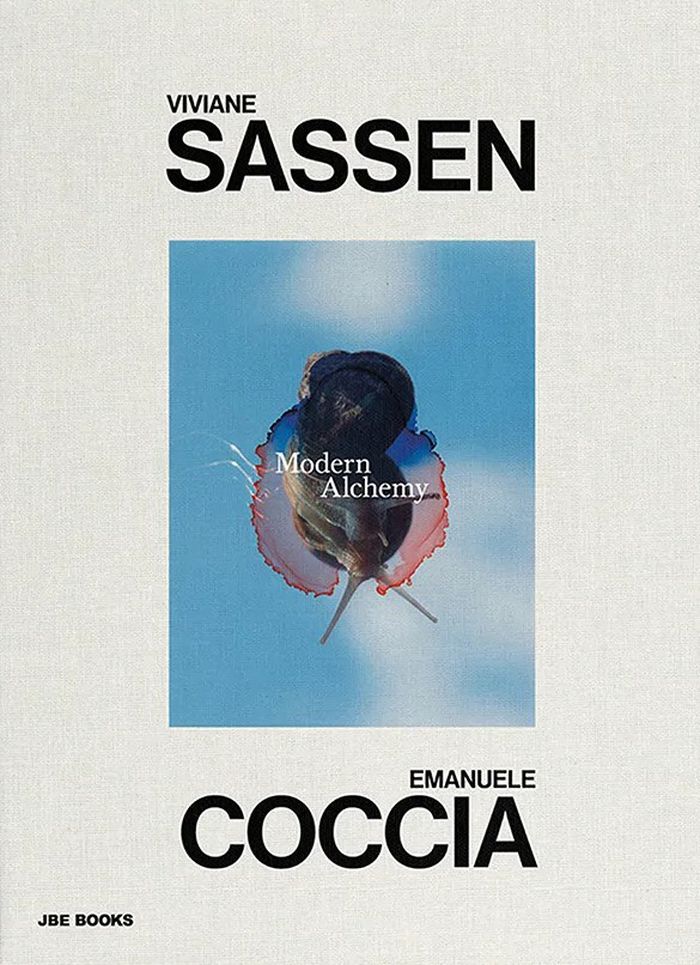
This publication is the brainchild of Viviane Sassen and Emanuele Coccia. The photographer and the philosopher—both leading figures in their fields—weaved together images and words, engaging in a fruitful dialogue deeply rooted in the Champagne terroir and the inspiring relationship Maison Perrier-Jouët entertains with art and nature. A series of 80 photographs and an essay intersect and collide, creating a space where the creativity of matter throughout all living things can be marveled at anew. Pictures mix and match with ideas, the history of planet Earth encounters that of artistic creation, and matter joins hands with the mind—producing an infinitely manifold work of art and establishing a modern alchemy where both vision and thought can be upended and renewed.
Viviane Sassen & Emanuele Coccia: Modern Alchemy
Actions:
Prix:
$63.00
(disponible sur commande)
Résumé:
This publication is the brainchild of Viviane Sassen and Emanuele Coccia. The photographer and the philosopher—both leading figures in their fields—weaved together images and words, engaging in a fruitful dialogue deeply rooted in the Champagne terroir and the inspiring relationship Maison Perrier-Jouët entertains with art and nature. A series of 80 photographs and an essay intersect and collide, creating a space where the creativity of matter throughout all living things can be marveled at anew. Pictures mix and match with ideas, the history of planet Earth encounters that of artistic creation, and matter joins hands with the mind—producing an infinitely manifold work of art and establishing a modern alchemy where both vision and thought can be upended and renewed.
Classification:
livres
livres
Publication:
octobre 2022
octobre 2022
Sujet:
Monographies photo
Monographies photo
Classification:
livres
livres

Titre:
Villa d'Este in Tivoli
Villa d'Este in Tivoli
Actions:
Prix:
$68.95
(disponible sur commande)
Résumé:
The Villa d'Este is a 16th-century villa in Tivoli, near Rome, internationally renowned for its terraced hillside Italian Renaissance garden containing an outstanding array of fountains, nymphaea, grottoes, water features and atmospheric sound effects. Named a UNESCO World Heritage Site in 2001, the garden is widely considered to be one of the finest examples of Italian(...)
$68.95
(disponible sur commande)
Résumé:
The Villa d'Este is a 16th-century villa in Tivoli, near Rome, internationally renowned for its terraced hillside Italian Renaissance garden containing an outstanding array of fountains, nymphaea, grottoes, water features and atmospheric sound effects. Named a UNESCO World Heritage Site in 2001, the garden is widely considered to be one of the finest examples of Italian(...)
Titre:
Villa d'Este in Tivoli
Actions:
Prix:
$68.95
(disponible sur commande)
Résumé:
The Villa d'Este is a 16th-century villa in Tivoli, near Rome, internationally renowned for its terraced hillside Italian Renaissance garden containing an outstanding array of fountains, nymphaea, grottoes, water features and atmospheric sound effects. Named a UNESCO World Heritage Site in 2001, the garden is widely considered to be one of the finest examples of Italian Renaissance gardens in Europe. Villa d’Este was first conceived of in 1550 by the governor of Tivoli, Cardinal Ippolito II d’Este, who had long envisioned a garden built on the slopes of the valley known as Valle Gaudente. But it was only after 1560 that the villa’s architectural and iconological blueprint was defined by painter-archaeologist-architect Pirro Ligorio and executed by court architect Alberto Galvani. When Ippolito d’Este died in 1572, the project was nearly complete.
Villa d'Este in Tivoli
Actions:
Prix:
$68.95
(disponible sur commande)
Résumé:
The Villa d'Este is a 16th-century villa in Tivoli, near Rome, internationally renowned for its terraced hillside Italian Renaissance garden containing an outstanding array of fountains, nymphaea, grottoes, water features and atmospheric sound effects. Named a UNESCO World Heritage Site in 2001, the garden is widely considered to be one of the finest examples of Italian Renaissance gardens in Europe. Villa d’Este was first conceived of in 1550 by the governor of Tivoli, Cardinal Ippolito II d’Este, who had long envisioned a garden built on the slopes of the valley known as Valle Gaudente. But it was only after 1560 that the villa’s architectural and iconological blueprint was defined by painter-archaeologist-architect Pirro Ligorio and executed by court architect Alberto Galvani. When Ippolito d’Este died in 1572, the project was nearly complete.
Classification:
livres
livres
Publication:
octobre 2022
octobre 2022
Sujet:
Jardins
Jardins
Classification:
livres
livres
Actions:
Prix:
$84.00
(disponible sur commande)
Résumé:
Otto Neurath’s famous "Modern man in the making," first published by Alfred A. Knopf in 1939, captures and describes the state of the world in the 1930s by using text and figurative illustrations. From 1925 on, Neurath and his team had worked on a new visual language termed "Isotype" (International System of Typographic Picture Education). At a time that saw new mass(...)
$84.00
(disponible sur commande)
Résumé:
Otto Neurath’s famous "Modern man in the making," first published by Alfred A. Knopf in 1939, captures and describes the state of the world in the 1930s by using text and figurative illustrations. From 1925 on, Neurath and his team had worked on a new visual language termed "Isotype" (International System of Typographic Picture Education). At a time that saw new mass(...)
Titre:
Modern man in the making. Facsimile
Actions:
Prix:
$84.00
(disponible sur commande)
Résumé:
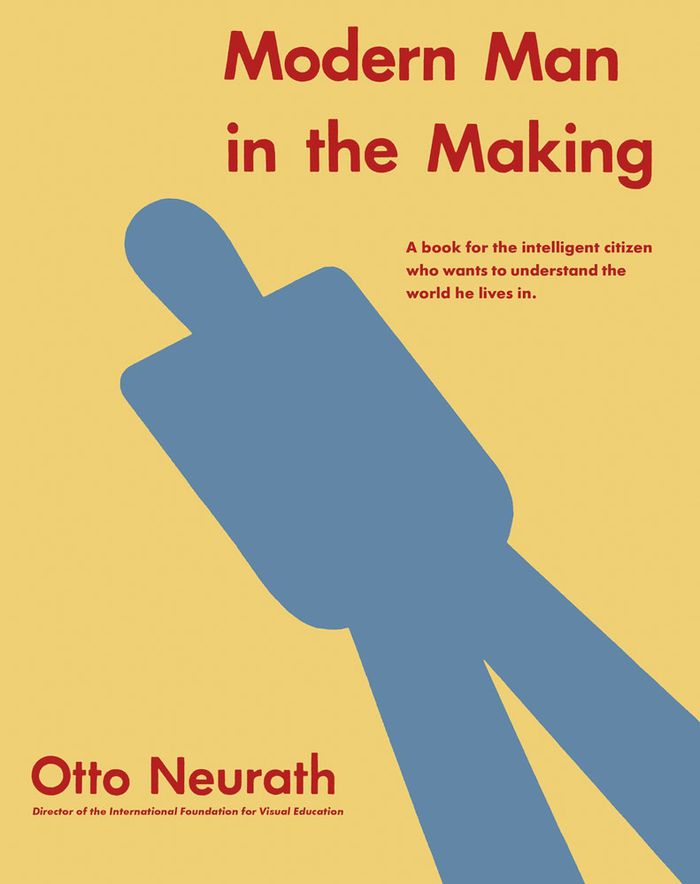
Otto Neurath’s famous "Modern man in the making," first published by Alfred A. Knopf in 1939, captures and describes the state of the world in the 1930s by using text and figurative illustrations. From 1925 on, Neurath and his team had worked on a new visual language termed "Isotype" (International System of Typographic Picture Education). At a time that saw new mass media making hitherto unthinkable amounts of information available, Neurath felt the need for a systematic visualization explaining facts, statistical data and comparative numbers in simple ways. The book can be seen as one of the most influential predecessors of today’s infographics. In the visuals, each symbol and color represents a certain group of objects or people, often compared repetitively over a certain time span. The topics covered in the book include diverse social issues of the time like mortality, health, employment, trade, education, mobility, migration and demographics. "Modern man in the making" shows Neurath’s democratic endeavor to make knowledge intelligible and available to all. It is a reminder of graphic art’s ability to inform and create context instead of presenting aesthetic qualities only. The book has inspired generations of designers and has led to sometimes peculiar imitations and further developments.
Modern man in the making. Facsimile
Actions:
Prix:
$84.00
(disponible sur commande)
Résumé:
Otto Neurath’s famous "Modern man in the making," first published by Alfred A. Knopf in 1939, captures and describes the state of the world in the 1930s by using text and figurative illustrations. From 1925 on, Neurath and his team had worked on a new visual language termed "Isotype" (International System of Typographic Picture Education). At a time that saw new mass media making hitherto unthinkable amounts of information available, Neurath felt the need for a systematic visualization explaining facts, statistical data and comparative numbers in simple ways. The book can be seen as one of the most influential predecessors of today’s infographics. In the visuals, each symbol and color represents a certain group of objects or people, often compared repetitively over a certain time span. The topics covered in the book include diverse social issues of the time like mortality, health, employment, trade, education, mobility, migration and demographics. "Modern man in the making" shows Neurath’s democratic endeavor to make knowledge intelligible and available to all. It is a reminder of graphic art’s ability to inform and create context instead of presenting aesthetic qualities only. The book has inspired generations of designers and has led to sometimes peculiar imitations and further developments.
Classification:
livres
livres
Publication:
avril 2024
avril 2024
Classification:
livres
livres
Titre:
Mitch Epstein: Recreation
Mitch Epstein: Recreation
Actions:
Prix:
$117.00
(disponible sur commande)
Résumé:
Between the 1970s and ’90s, Mitch Epstein photographed the rituals of excess and alienation, jubilance and desire that defined late twentieth-century America. These pictures marked the beginning of his photographic inquiry into the American psyche and landscape that has now lasted half a century. This publication captures the vitality of modern America in a(...)
$117.00
(disponible sur commande)
Résumé:
Between the 1970s and ’90s, Mitch Epstein photographed the rituals of excess and alienation, jubilance and desire that defined late twentieth-century America. These pictures marked the beginning of his photographic inquiry into the American psyche and landscape that has now lasted half a century. This publication captures the vitality of modern America in a(...)
Titre:
Mitch Epstein: Recreation
Actions:
Prix:
$117.00
(disponible sur commande)
Résumé:
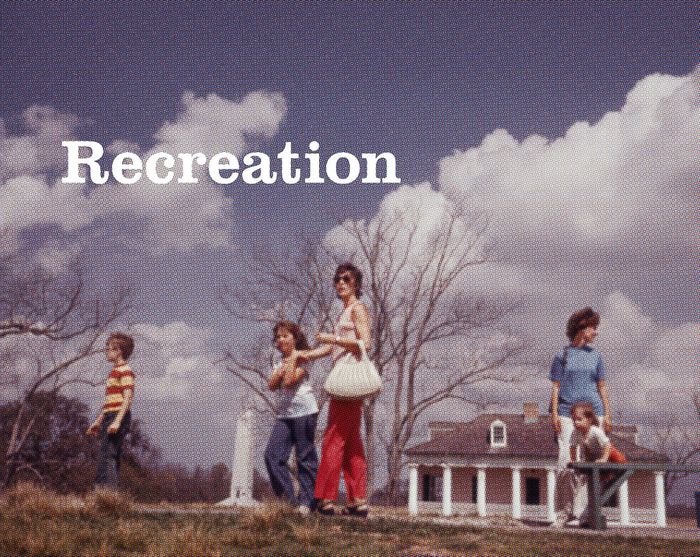
Between the 1970s and ’90s, Mitch Epstein photographed the rituals of excess and alienation, jubilance and desire that defined late twentieth-century America. These pictures marked the beginning of his photographic inquiry into the American psyche and landscape that has now lasted half a century. This publication captures the vitality of modern America in a pre-smartphone, less self-conscious time. In these early works, Epstein’s wit reigns, along with his singular way of making the mundane startle and the extraordinary appear to perfectly fit in.
Mitch Epstein: Recreation
Actions:
Prix:
$117.00
(disponible sur commande)
Résumé:
Between the 1970s and ’90s, Mitch Epstein photographed the rituals of excess and alienation, jubilance and desire that defined late twentieth-century America. These pictures marked the beginning of his photographic inquiry into the American psyche and landscape that has now lasted half a century. This publication captures the vitality of modern America in a pre-smartphone, less self-conscious time. In these early works, Epstein’s wit reigns, along with his singular way of making the mundane startle and the extraordinary appear to perfectly fit in.
Classification:
livres
livres
Publication:
juillet 2022
juillet 2022
Sujet:
Monographies photo
Monographies photo
Classification:
livres
livres
Actions:
Prix:
$110.00
(disponible en magasin)
Résumé:
Between 1973 and ’76, Mitch Epstein (born 1952) photographed in American cities- New York, Los Angeles and New Orleans, among others. He was initially shooting in black and white as a student of Garry Winogrand, when he asked his teacher, ''Why not color?'' With Winogrand’s blessing, Epstein shot his first rolls of Kodachrome. ''Silver + Chrome'' is a chronicle of his(...)
$110.00
(disponible en magasin)
Résumé:
Between 1973 and ’76, Mitch Epstein (born 1952) photographed in American cities- New York, Los Angeles and New Orleans, among others. He was initially shooting in black and white as a student of Garry Winogrand, when he asked his teacher, ''Why not color?'' With Winogrand’s blessing, Epstein shot his first rolls of Kodachrome. ''Silver + Chrome'' is a chronicle of his(...)
Titre:
Mitch Epstein: Silver + Chrome
Actions:
Prix:
$110.00
(disponible en magasin)
Résumé:
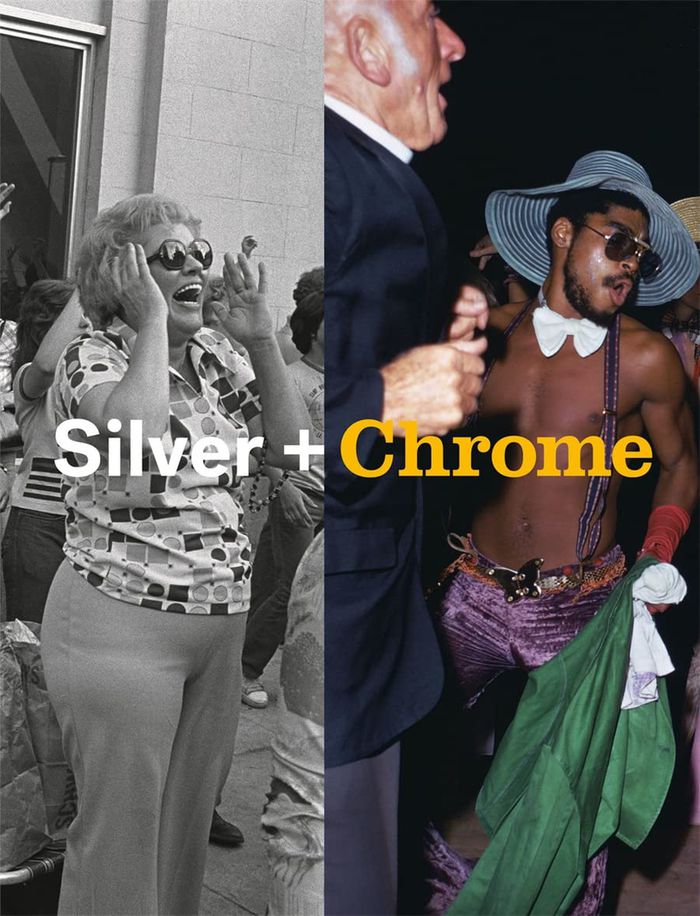
Between 1973 and ’76, Mitch Epstein (born 1952) photographed in American cities- New York, Los Angeles and New Orleans, among others. He was initially shooting in black and white as a student of Garry Winogrand, when he asked his teacher, ''Why not color?'' With Winogrand’s blessing, Epstein shot his first rolls of Kodachrome. ''Silver + Chrome'' is a chronicle of his three years alternating between color and black and white, before eventually committing to color. This book contains Epstein’s earliest work, virtually none of which has been seen before. In these kinetic tableaux, the artist’s exuberance is tamed, just barely, by his formal intelligence. He depicts American city life as it undergoes taboo-shattering sexual liberation, economic crises and the repercussions of a boondoggle war in Vietnam, immersing us in the urban chaos of this complicated time.
Mitch Epstein: Silver + Chrome
Actions:
Prix:
$110.00
(disponible en magasin)
Résumé:
Between 1973 and ’76, Mitch Epstein (born 1952) photographed in American cities- New York, Los Angeles and New Orleans, among others. He was initially shooting in black and white as a student of Garry Winogrand, when he asked his teacher, ''Why not color?'' With Winogrand’s blessing, Epstein shot his first rolls of Kodachrome. ''Silver + Chrome'' is a chronicle of his three years alternating between color and black and white, before eventually committing to color. This book contains Epstein’s earliest work, virtually none of which has been seen before. In these kinetic tableaux, the artist’s exuberance is tamed, just barely, by his formal intelligence. He depicts American city life as it undergoes taboo-shattering sexual liberation, economic crises and the repercussions of a boondoggle war in Vietnam, immersing us in the urban chaos of this complicated time.
Classification:
livres
livres
Publication:
août 2022
août 2022
Sujet:
Monographies photo
Monographies photo
Classification:
livres
livres

Titre:
George Byrne: Post truth
George Byrne: Post truth
Actions:
Prix:
$98.00
(disponible sur commande)
Résumé:
Turning the spatial flotsam of the Anthropocene, or what architect Rem Koolhaas famously referred to as ''junkspace,'' into candy-colored dreamscapes, photographer George Byrne depicts the gritty urbanism of Los Angeles in sublime otherworldliness. Arriving a decade ago, the Australian artist was immediately enthralled by the sprawling cityscape, mesmerized by the way the(...)
$98.00
(disponible sur commande)
Résumé:
Turning the spatial flotsam of the Anthropocene, or what architect Rem Koolhaas famously referred to as ''junkspace,'' into candy-colored dreamscapes, photographer George Byrne depicts the gritty urbanism of Los Angeles in sublime otherworldliness. Arriving a decade ago, the Australian artist was immediately enthralled by the sprawling cityscape, mesmerized by the way the(...)
Titre:
George Byrne: Post truth
Actions:
Prix:
$98.00
(disponible sur commande)
Résumé:
Turning the spatial flotsam of the Anthropocene, or what architect Rem Koolhaas famously referred to as ''junkspace,'' into candy-colored dreamscapes, photographer George Byrne depicts the gritty urbanism of Los Angeles in sublime otherworldliness. Arriving a decade ago, the Australian artist was immediately enthralled by the sprawling cityscape, mesmerized by the way the sunlight transformed it into two-dimensional, almost painterly abstractions. In his Post Truth series (2015–20), Byrne reassembles his photos of the urban landscape into striking, ascetic collages of color and geometric fragments, creating postmodernist oases in the metropolis. By masterfully harnessing the malleability of the photographic medium, the photographer situates his work in the space between real and imagined. Byrne’s compositions evoke associations with Miami Beach’s Art Deco, the Memphis Group’s designs, as well as the painting of David Hockney or Ed Ruscha, and at the same time tap into the aesthetics of today’s visual culture played out on Instagram.
George Byrne: Post truth
Actions:
Prix:
$98.00
(disponible sur commande)
Résumé:
Turning the spatial flotsam of the Anthropocene, or what architect Rem Koolhaas famously referred to as ''junkspace,'' into candy-colored dreamscapes, photographer George Byrne depicts the gritty urbanism of Los Angeles in sublime otherworldliness. Arriving a decade ago, the Australian artist was immediately enthralled by the sprawling cityscape, mesmerized by the way the sunlight transformed it into two-dimensional, almost painterly abstractions. In his Post Truth series (2015–20), Byrne reassembles his photos of the urban landscape into striking, ascetic collages of color and geometric fragments, creating postmodernist oases in the metropolis. By masterfully harnessing the malleability of the photographic medium, the photographer situates his work in the space between real and imagined. Byrne’s compositions evoke associations with Miami Beach’s Art Deco, the Memphis Group’s designs, as well as the painting of David Hockney or Ed Ruscha, and at the same time tap into the aesthetics of today’s visual culture played out on Instagram.
Classification:
livres
livres
Publication:
juillet 2022
juillet 2022
Sujet:
Monographies photo
Monographies photo
Classification:
livres
livres
Prix:
$39.00
(disponible sur commande)
Résumé:
The author of ''The future of the museum'' talks with architects from David Adjaye to Sou Fujimoto about the future of museum architecture. The conclusion of Szántó’s previous publication was that the conceptual structure of art museums has evolved; it follows that the physical structure of the art museum must also change. The author's conversations with architects survey(...)
$39.00
(disponible sur commande)
Résumé:
The author of ''The future of the museum'' talks with architects from David Adjaye to Sou Fujimoto about the future of museum architecture. The conclusion of Szántó’s previous publication was that the conceptual structure of art museums has evolved; it follows that the physical structure of the art museum must also change. The author's conversations with architects survey(...)
Titre:
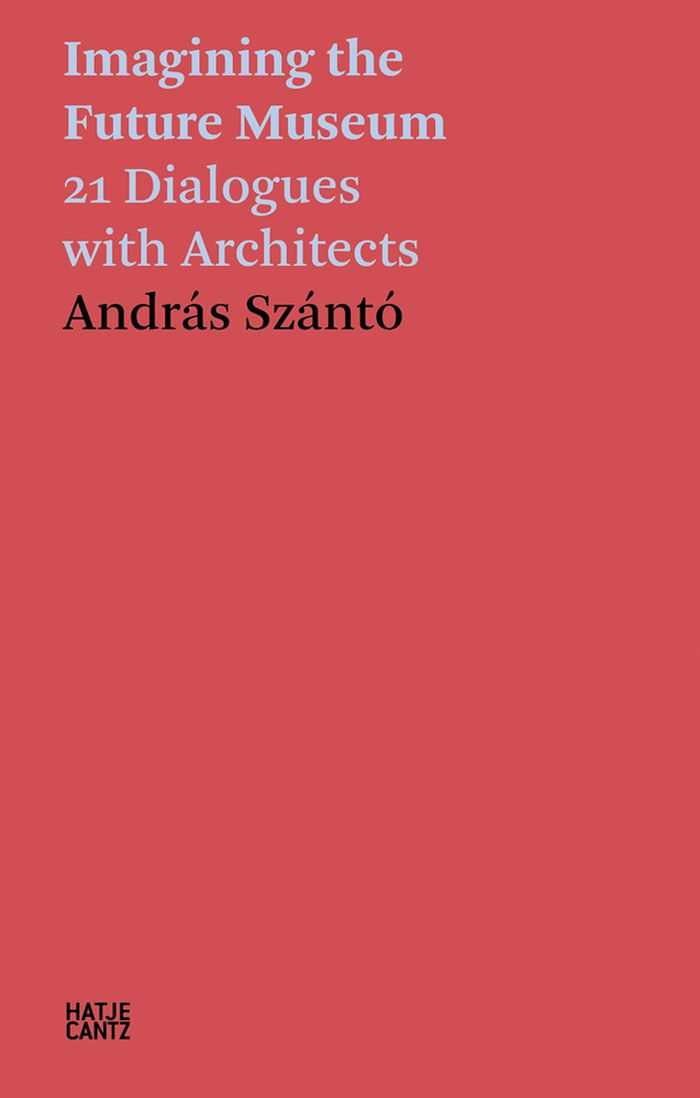
Imagining the future museum: 24 dialogues with architects
Actions:
Prix:
$39.00
(disponible sur commande)
Résumé:
The author of ''The future of the museum'' talks with architects from David Adjaye to Sou Fujimoto about the future of museum architecture. The conclusion of Szántó’s previous publication was that the conceptual structure of art museums has evolved; it follows that the physical structure of the art museum must also change. The author's conversations with architects survey the thinking in the field, engaging architects who have built some of the world’s most iconic institutions and an emerging global generation that is destined to leave its mark on the museum of the future.
Imagining the future museum: 24 dialogues with architects
Actions:
Prix:
$39.00
(disponible sur commande)
Résumé:
The author of ''The future of the museum'' talks with architects from David Adjaye to Sou Fujimoto about the future of museum architecture. The conclusion of Szántó’s previous publication was that the conceptual structure of art museums has evolved; it follows that the physical structure of the art museum must also change. The author's conversations with architects survey the thinking in the field, engaging architects who have built some of the world’s most iconic institutions and an emerging global generation that is destined to leave its mark on the museum of the future.
Classification:
livres
livres
Publication:
janvier 2023
janvier 2023
Sujet:
Muséologie
Muséologie
Classification:
livres
livres

Prix:
$34.95
(disponible sur commande)
Résumé:
From the advent of early colonial photography in the 19th century to contemporary 'white savior' social-media images, photography continues to play an integral role in the maintenance of white sovereignty. As various scholars have shown, the technology of the camera is not innocent, and neither are the images it produces. The invention and continuation of the 'white(...)
$34.95
(disponible sur commande)
Résumé:
From the advent of early colonial photography in the 19th century to contemporary 'white savior' social-media images, photography continues to play an integral role in the maintenance of white sovereignty. As various scholars have shown, the technology of the camera is not innocent, and neither are the images it produces. The invention and continuation of the 'white(...)
Titre:
The image of whiteness: Contemporary photography and racialization
Actions:
Prix:
$34.95
(disponible sur commande)
Résumé:
From the advent of early colonial photography in the 19th century to contemporary 'white savior' social-media images, photography continues to play an integral role in the maintenance of white sovereignty. As various scholars have shown, the technology of the camera is not innocent, and neither are the images it produces. The invention and continuation of the 'white race' is not just a political, social and legal phenomenon; it is also a complexly visual one. What does whiteness look like, and how might we begin to trace an antiracist history of artistic resistance that works against it? ''The image of whiteness'' seeks to introduce its reader to some important extracts from the troubling story of whiteness, to describe its falsehoods, its paradoxes and its oppressive nature, and to highlight some of the crucial work photographic artists have done to subvert and critique its image.
The image of whiteness: Contemporary photography and racialization
Actions:
Prix:
$34.95
(disponible sur commande)
Résumé:
From the advent of early colonial photography in the 19th century to contemporary 'white savior' social-media images, photography continues to play an integral role in the maintenance of white sovereignty. As various scholars have shown, the technology of the camera is not innocent, and neither are the images it produces. The invention and continuation of the 'white race' is not just a political, social and legal phenomenon; it is also a complexly visual one. What does whiteness look like, and how might we begin to trace an antiracist history of artistic resistance that works against it? ''The image of whiteness'' seeks to introduce its reader to some important extracts from the troubling story of whiteness, to describe its falsehoods, its paradoxes and its oppressive nature, and to highlight some of the crucial work photographic artists have done to subvert and critique its image.
Classification:
livres
livres
Publication:
juillet 2022
juillet 2022
Sujet:
Théorie de la photographie
Théorie de la photographie
Classification:
livres
livres
Actions:
Prix:
$34.95
(disponible en magasin)
Résumé:
Muni de pastels gras, de feuilles blanches et d’une prose tranchante, Antoine Larocque manifeste son ras-le-bol face au milieu des arts visuels au Québec. Ses réflexions impulsives jouent à la fois sur les paradoxes de la figure d’artiste et sur la critique institutionnelle dans une mise à nu totale. Par sa verve revendicatrice, ce livre est une ode à l’indiscipline et au(...)
$34.95
(disponible en magasin)
Résumé:
Muni de pastels gras, de feuilles blanches et d’une prose tranchante, Antoine Larocque manifeste son ras-le-bol face au milieu des arts visuels au Québec. Ses réflexions impulsives jouent à la fois sur les paradoxes de la figure d’artiste et sur la critique institutionnelle dans une mise à nu totale. Par sa verve revendicatrice, ce livre est une ode à l’indiscipline et au(...)
Publication:
juillet 2022
juillet 2022
Titre:
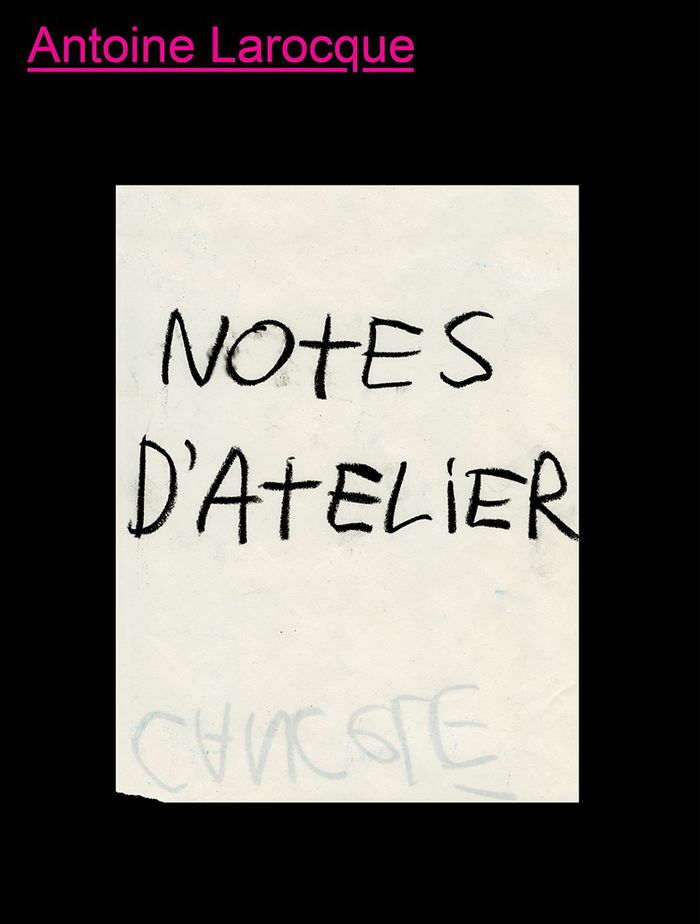
Antoine Larocque : Notes d'atelier
Actions:
Prix:
$34.95
(disponible en magasin)
Résumé:
Muni de pastels gras, de feuilles blanches et d’une prose tranchante, Antoine Larocque manifeste son ras-le-bol face au milieu des arts visuels au Québec. Ses réflexions impulsives jouent à la fois sur les paradoxes de la figure d’artiste et sur la critique institutionnelle dans une mise à nu totale. Par sa verve revendicatrice, ce livre est une ode à l’indiscipline et au franc-parler des artistes.
Antoine Larocque : Notes d'atelier
Actions:
Prix:
$34.95
(disponible en magasin)
Résumé:
Muni de pastels gras, de feuilles blanches et d’une prose tranchante, Antoine Larocque manifeste son ras-le-bol face au milieu des arts visuels au Québec. Ses réflexions impulsives jouent à la fois sur les paradoxes de la figure d’artiste et sur la critique institutionnelle dans une mise à nu totale. Par sa verve revendicatrice, ce livre est une ode à l’indiscipline et au franc-parler des artistes.
Classification:
livres
livres
Publication:
juillet 2022
juillet 2022


