Ecosystems, Building Materials, and Building Cultures
Nzinga B. Mboup discusses non-standard building materials with Stephanie Idongesit Ete, Jingru (Cyan) Cheng, and George Massoud
The following text is an excerpt from the CCA c/o Dakar event: Ecosystems, Building Materials, and Building Cultures. The event took place at the Africa Center in London on 6 November 2025 and features Nzinga B. Mboup in conversation with Stephanie Idongesit Ete, Neba Sere, Jingru (Cyan) Cheng, and George Massoud.
- Nzinga B. Mboup
- From the outset, it was very clear to me that CCA c/o Dakar gives us a framework to gain a better understanding of Senegalese architectural traditions; to bring to the forefront the rich material heritage and diverse constructive practices that is absent from contemporary practice. As a young practitioner, this research has generated a lot of knowledge and allowed me to connect with an ecosystem of architects—both from the African continent and internationally—that share an interest in non-extractive practices, and are crafting material alternatives embedded in culture, landscape, and people. The event today has been thought of as a workshop to give us an opportunity to learn from each other and know collectively what questions to ask. Stephanie, we met when you were doing research on your exhibition project The Dakar–Lagos Corridor: Material Culture.
- Stephanie Idongesit Ete
- That research started with a fascination and a desire to be more connected with architecture and landscape in West Africa. I’ve always been fascinated with how our buildings come together: the textures, the social histories, and the building techniques. Architecture is a material culture, but when we talk about material culture and architecture, we’re thinking about how material is sourced? What’s the social context, the historical context, the environmental context? What stories and narratives are tied to architecture and what can we learn from them? These are some of the questions that I was fascinated by as I was looking at the different materialities [in West Africa].
I found this example of reinforced concrete in Gorée, which is a small island of Dakar. What I found distinct about it was the way concrete was made at that time; it was made using seashell with stone aggregates and seashell as the lime agent to create the concrete. It’s very specific to that location.
I could also make comparisons when I went to other countries. When I went to Ghana, I came across a lady who would collect crafts from the seaside on the coast and she would see that people were decorating their buildings with shell, inspiring her to implement the technique on her own shop in the center of Accra. The method is tied to the coastal setting, but it’s also being practiced by different people [across the region]. It’s a study of material, but also the stories that are tied to material.
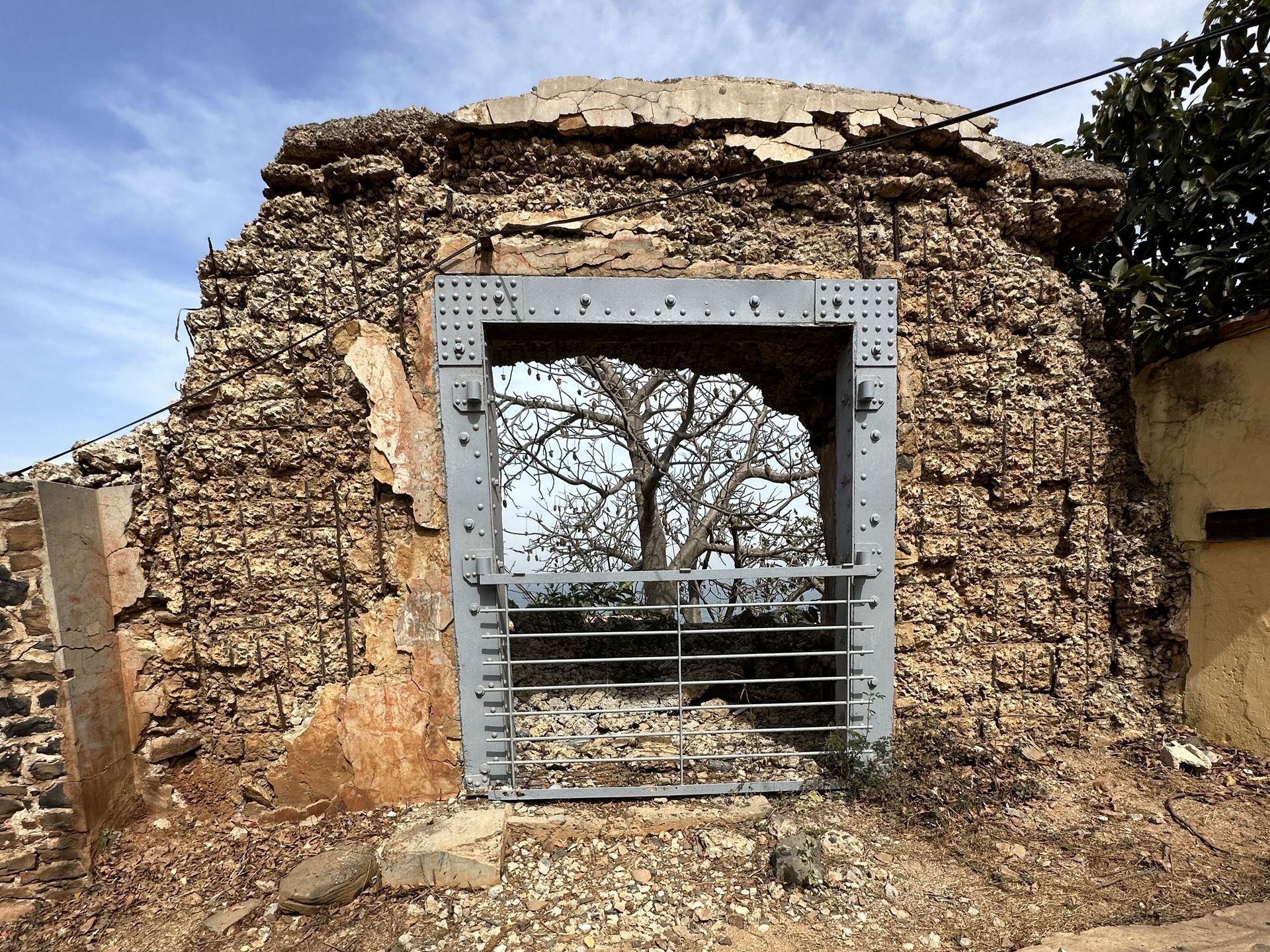
Stephanie Idongesit Ete, Exposed concrete aggregate made of stone and seashell, Gorée, Senegal, 2023. Digital Photography. © Stephanie Idongesit Ete
- NBM
- Working with non-standard materials forces you to be involved in the ecosystem—to know where you’re going to source the materials, how you’re going to transform them, and how they’re going to perform over time. My outlook on this rich history is looking at the past, and the present to better understand the sort of ties between the various materials and ecologies that are associated with them. The type of materiality that you can find in Dakar—once you start to pay attention—goes beyond the now very common glass, aluminum, and steel indistinct architecture that is being produced nowadays. Throughout our history, we’ve always had a diversity of materiality and constructive techniques.
Although concrete is not the main material that I work with, I’m interested in better understanding it and diving deeper into its history, because it is so ubiquitous. Everybody calls concrete a traditional building material, but it does have a history which is also tied to the colonial past as the main cement company emerged in the last 70 years. Before that, cement was imported into Senegal.
With each material, there’s a different question related to its ecology. I find limestone very interesting because it’s association with French colonial architecture in the region. It’s still used today as a cladding or for paving but no longer as a main material to erect load-bearing walls. One of the connections that I made is how the introduction of cement reduced the use of quarried limestone blocks for building because now it goes straight into concrete one way or another; either to produce cement clinker or as an aggregate in concrete.
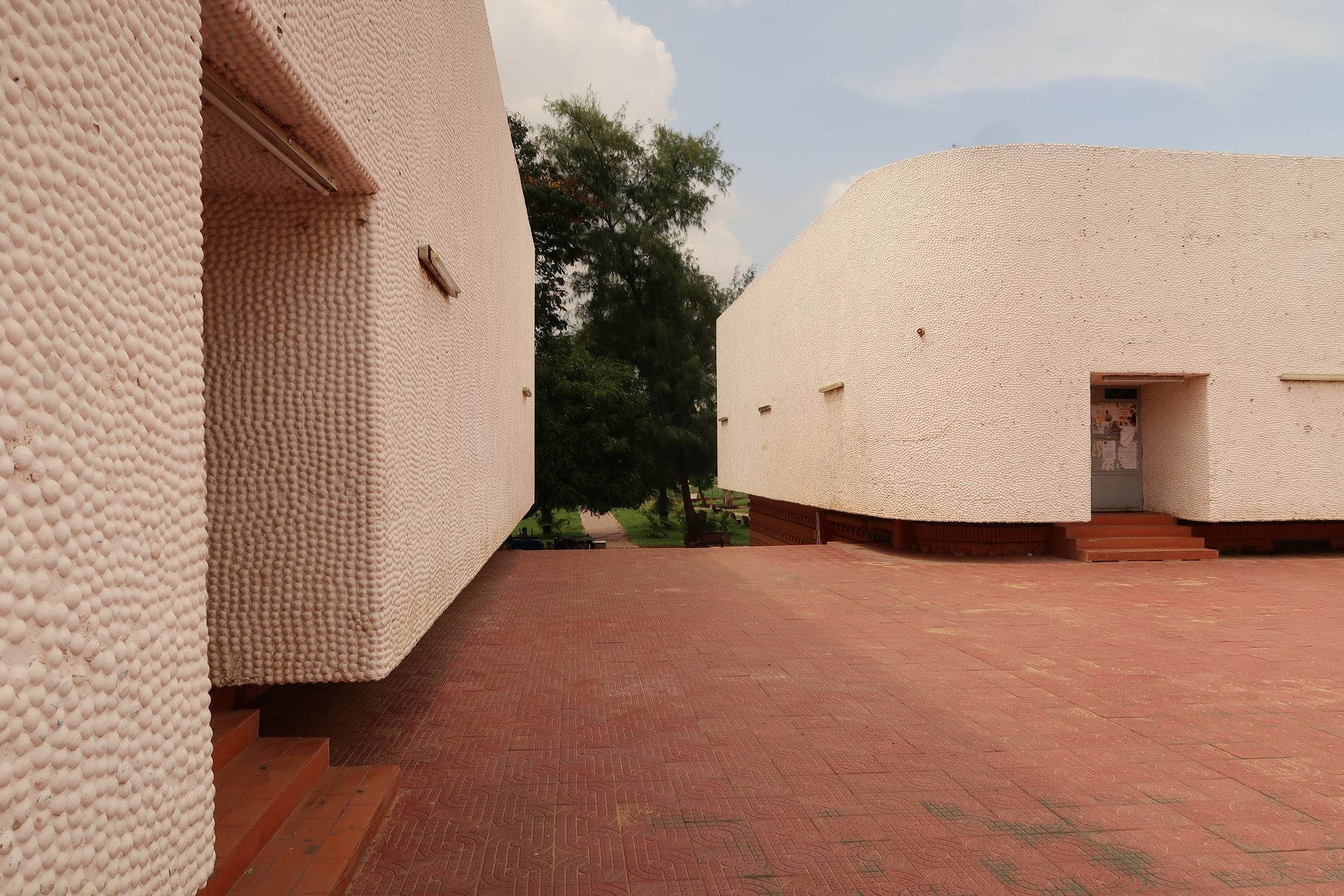
Chomette Melot Depret, architects (Bureau d’études Henri Chomette), Auditoria, Université Cheikh-Anta-Diop (UCAD), Dakar, 1972–1976. Photograph by Nzinga B. Mboup, 2025, © Worofila
- NBM
- The production of cement generates a geography of extraction made possible by the various permits that the government grants to cement companies to mine the sand, clay, and limestone. There is an obvious concern about the impact that it has on the territory, but also on the people. Behind the machine you have a whole human ecology that is in contact with these toxic and polluting materials and the architecture of concrete that it generates results in thermal discomfort in the hot climates of our region.
As Stephanie mentioned, shells are a very big part of our architecture. It’s not commonly used anymore, but there are traces of it in traditional architecture from pre-colonial times where concrete aggregates were made up of shells, especially in the region of the Saloum delta. I recently spoke to the architect Thierry Melot, key figure of the regional modernist movement of the 1970s who told me that his inspiration for the shell-cladded auditoria of the University Cheikh Anta Diop came from the decoration of flowerpots which he’s always seen the women sell on the roadside are often decorated with these shells. He told a very interesting story about the construction site, and the workers were competing amongst each other to see who could install the most shells on the facade of the university auditoria and how they applied them with white cement. Tying these architectural stories to local craftsmanship is key. Unless we’re able to revisit and better understand our material’s ecology and endogenous know-hows, their application and translation in contemporary architectural production will be limited. Additionally, we must remain critical in making material choices by rooting them in the realities of their ecosystem nowadays.
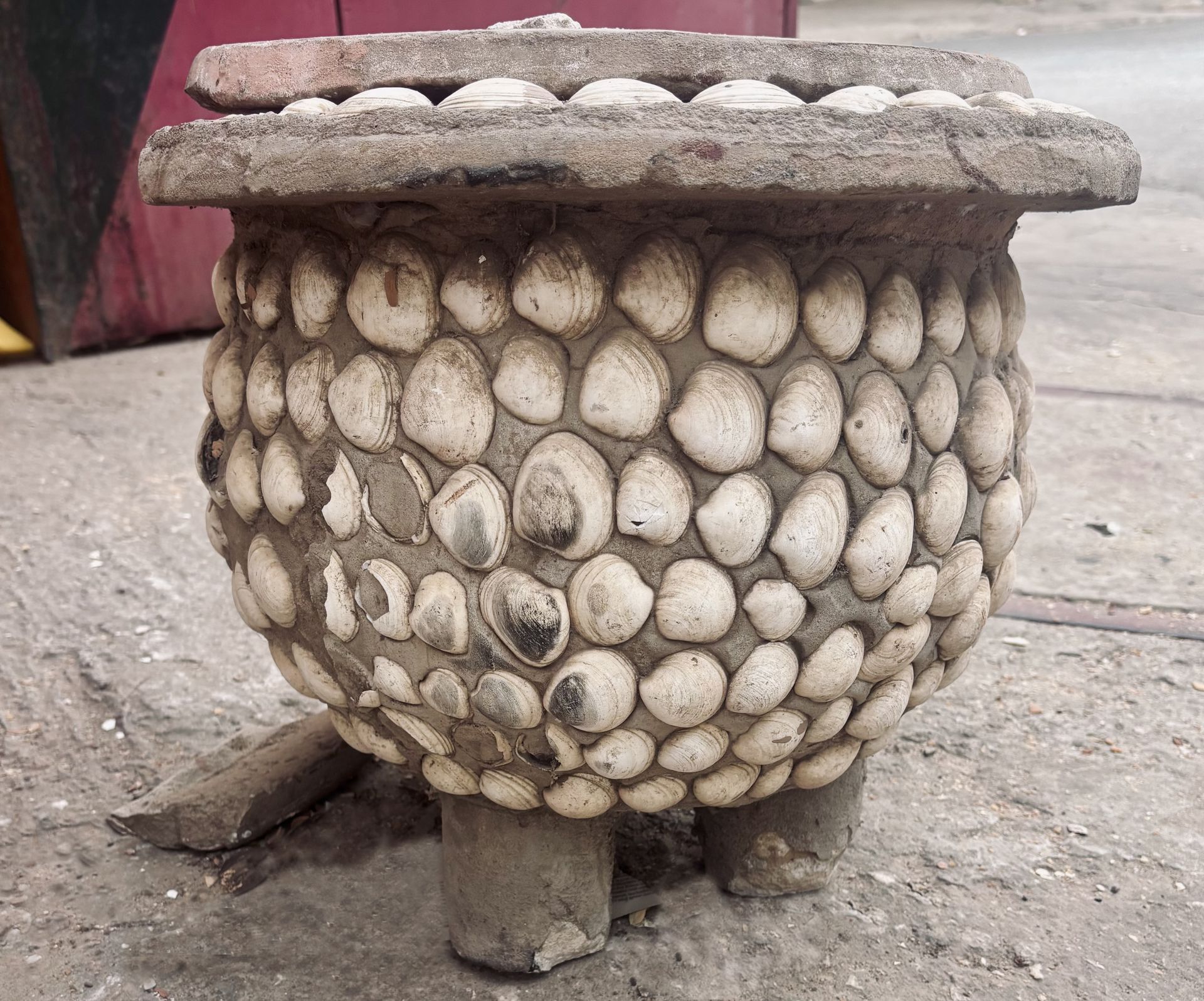
Nzinga B. Mboup, Image of a pot decorated with seashells, Dakar, Senegal, 2026. Digital Photography. © Nzinga B. Mboup
- Jingru (Cyan) Cheng
- We’ve been working with a Chinese village, Shigushan, for about 10 years. Shigushan is a site of both resource and labour extraction. The village supplies stone for the Chinese construction industry, as well as migrant labourers. China has almost 300 million rural workers who migrate from these villages to urban centers, often leaving their families behind in the process. Over the years we learned that the most meaningful thing we could give back was spending time with them. Genuine attention and appreciation are rare, so we keep going back year after year. We documented their daily lives as well as all kinds of improvisation and then we screened this back to them. On the screening day, the whole village came out, and they loved seeing themselves on the big screen. When we had the opportunity to bring this story to London last year, we activated another set of relations through dry stone
Dry stone is a shared material register. In Shigushan, foundations are often built from dry stones salvaged from demolished structures, frequently with dry stone wallers working alongside excavators. Foundations remain provisional; they host uncertain futures, oscillating between potential homes and ruins depending on family circumstances. While waiting—sometimes for years—they function as kitchen gardens or children’s playgrounds. Walling here is neither permanent nor terminal, but an open-ended negotiation with time.
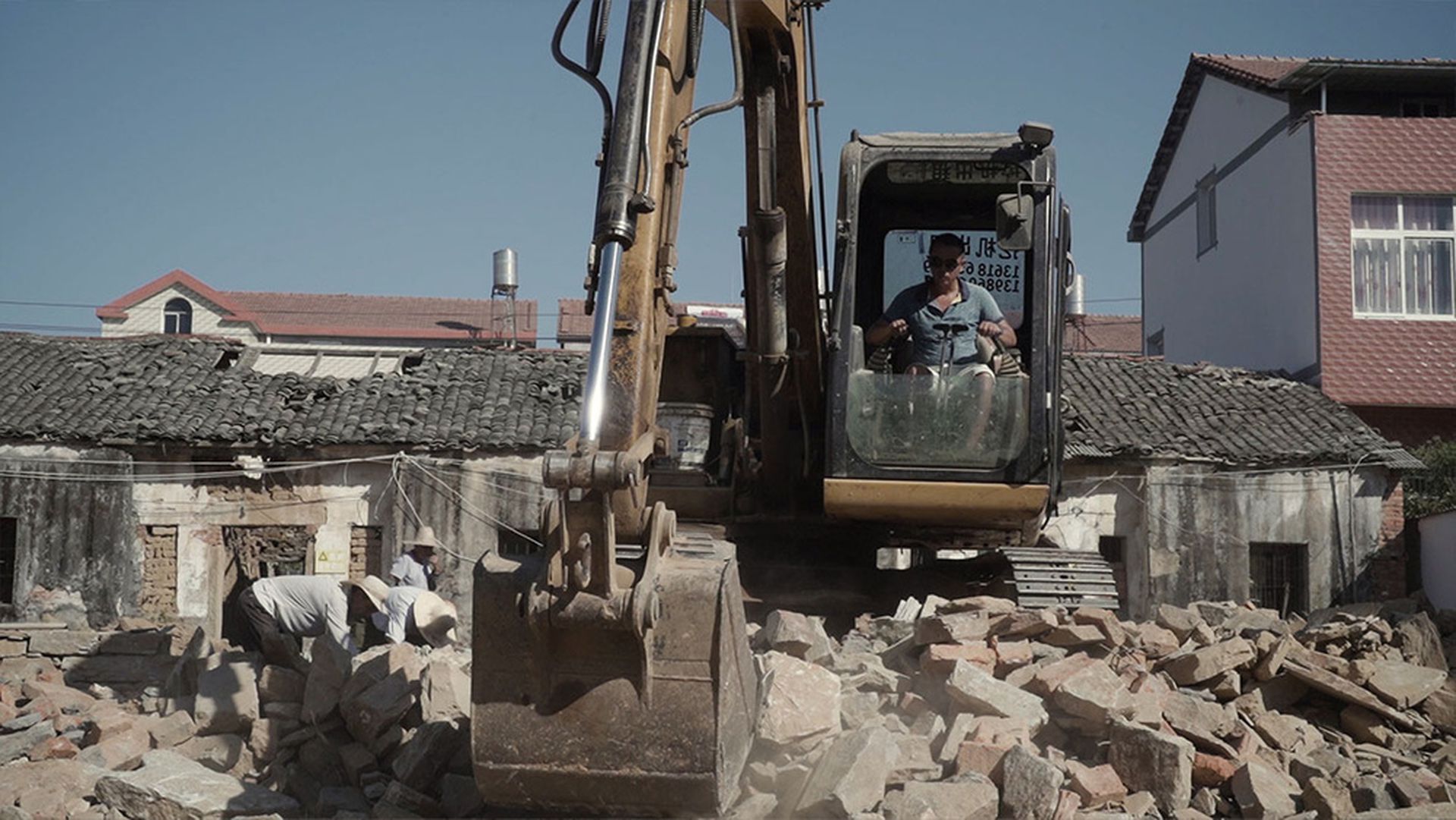
Chen Zhan, Dry stone wallers working alongside an excavator during simultaneous demolition and reconstruction process in Shigushan village, China, 2023. Digital Photography. © field-0
- JCC
- Dry stone walling is a traditional practice both in Shigushan, but also here in the British countryside. We built this one-to-one scale foundation of a village house on Bedford Square in London as a critique of privately owned public spaces in London. To build dry stone walls in London invokes the British history of enclosure, during which common land was transformed into privately owned parcels. Dry stone walls served as the physical inscription that made land legible, divisible, and governable. In this sense, the domestic foundation superimposed onto a privately owned public space unsettled entrenched distinctions between public and private that enclosure helped consolidate in Britain.
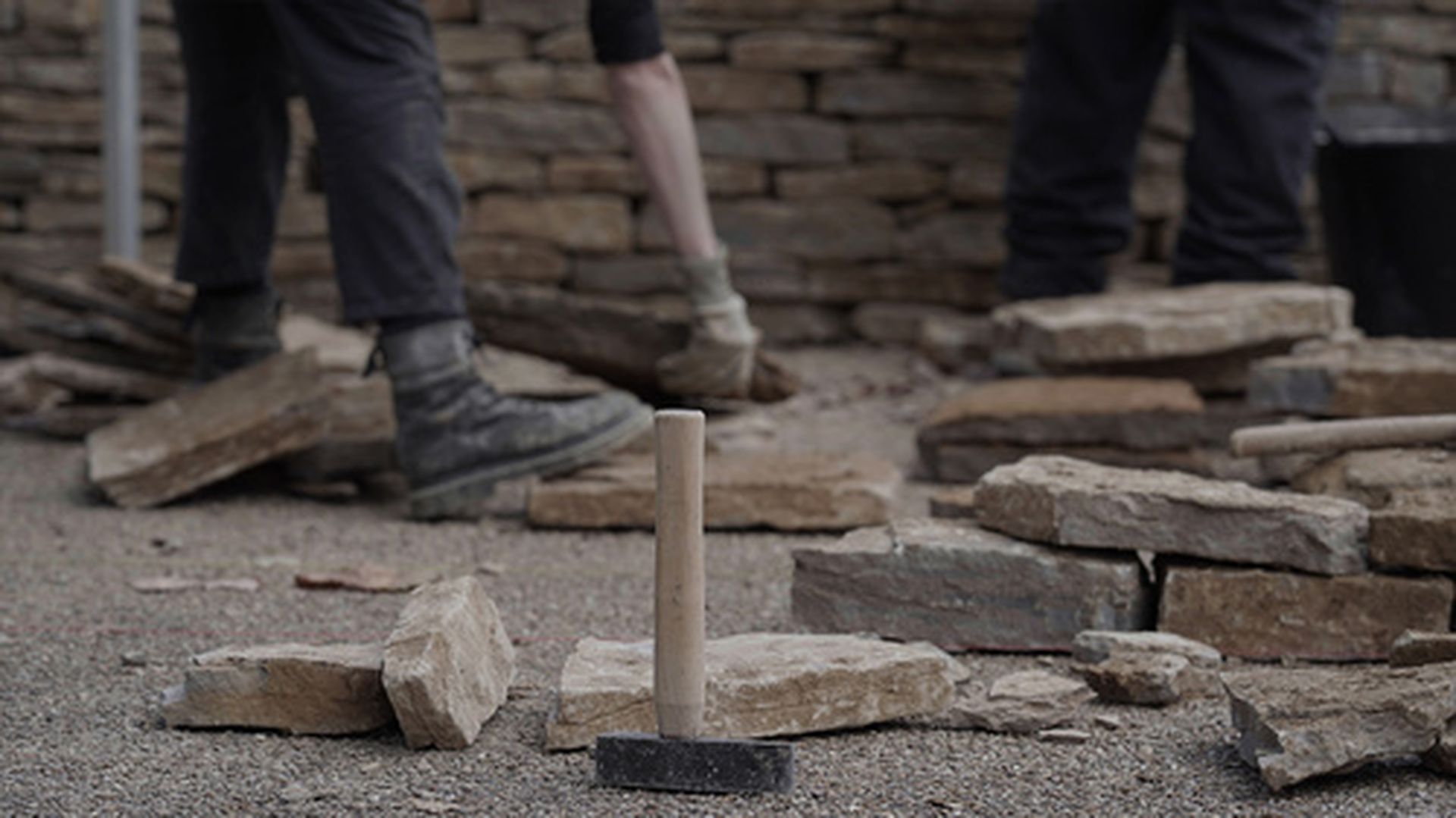
Chen Zhan, Close up of a dry stone foundation under construction and deconstruction, Bedford Square, London, 2024. Digital Photography. © field-0
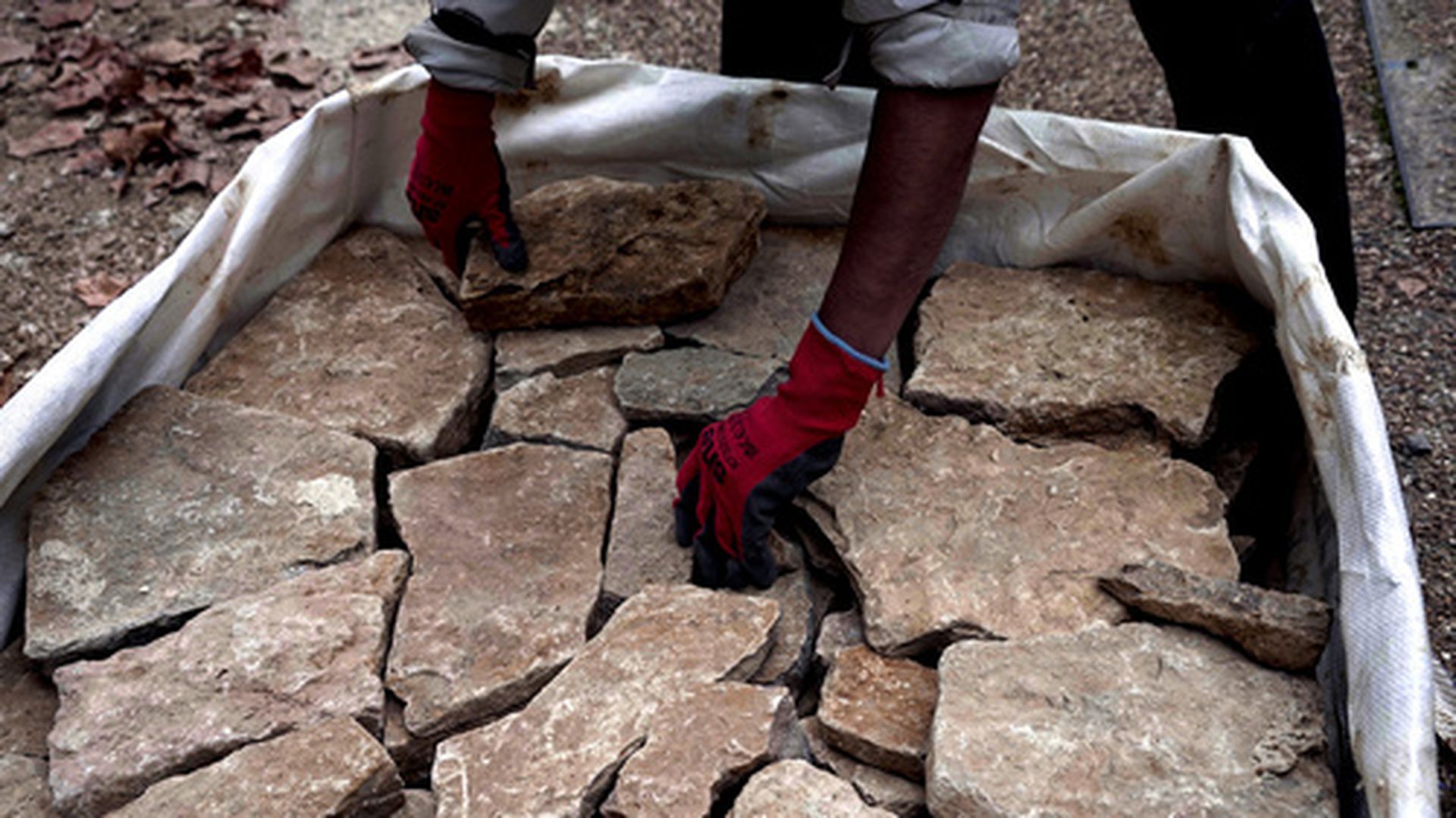
Chen Zhan, Close up of a dry stone foundation under construction and deconstruction, Bedford Square, London, 2024. Digital Photography. © field-0
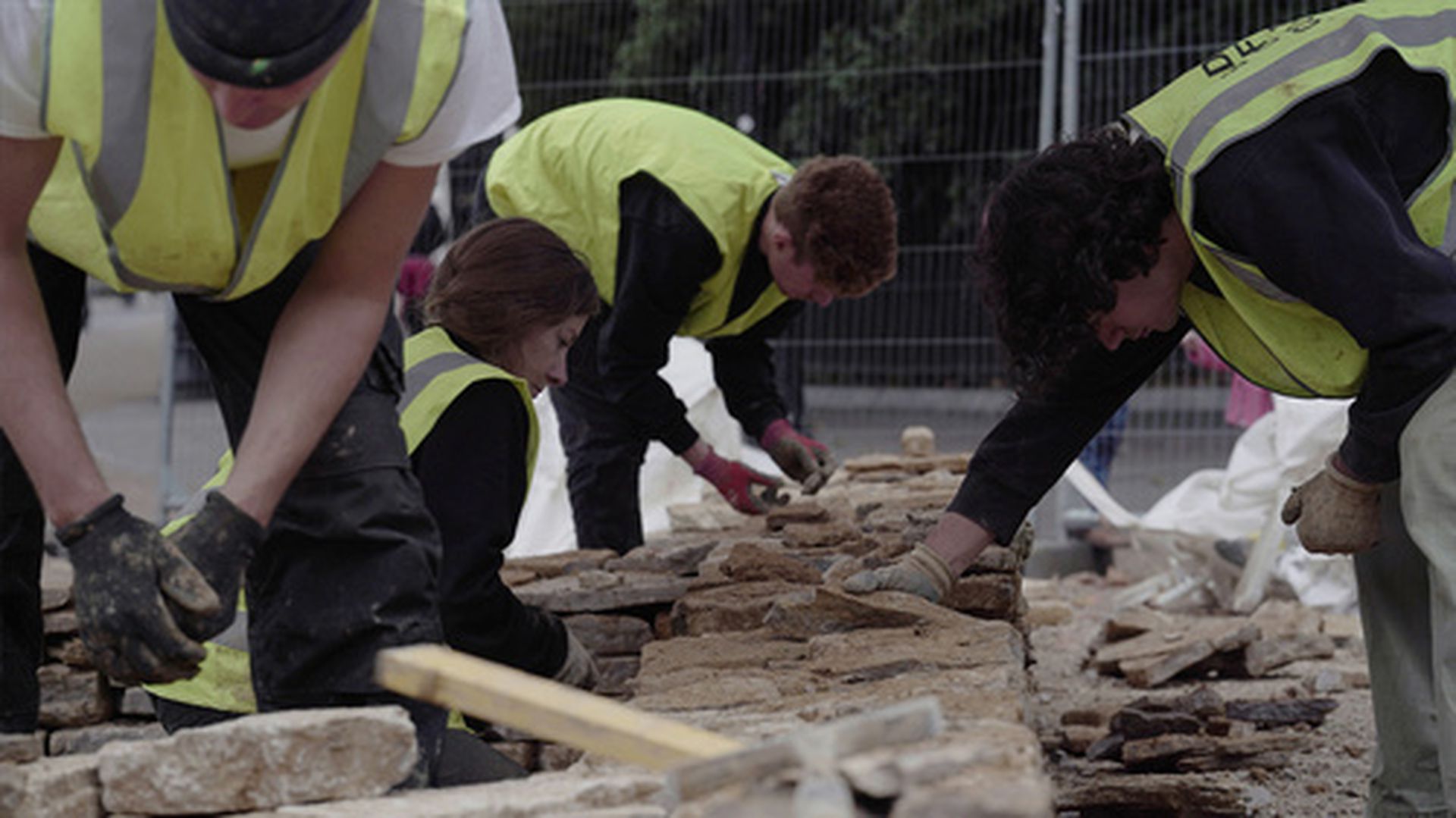
Chen Zhan, Close up of a dry stone foundation under construction and deconstruction, Bedford Square, London, 2024. Digital Photography. © field-0


- JCC
- This dry stone foundation is a temporary assemblage of materials coming from the earth. Purbeck stones, sand, soil, wood chips, recycled glass aggregates, hemp blocks and herbal plants. After the installation, all the materials had a second life: either back to the quarry, to communal gardens, or to the next building site. The site operated as an evolving common. It was a lunch spot for students and workers, a playground for children in the afternoon, and a nighttime habitat for foxes, while the breathing spaces between stones accommodated insects and small fauna.
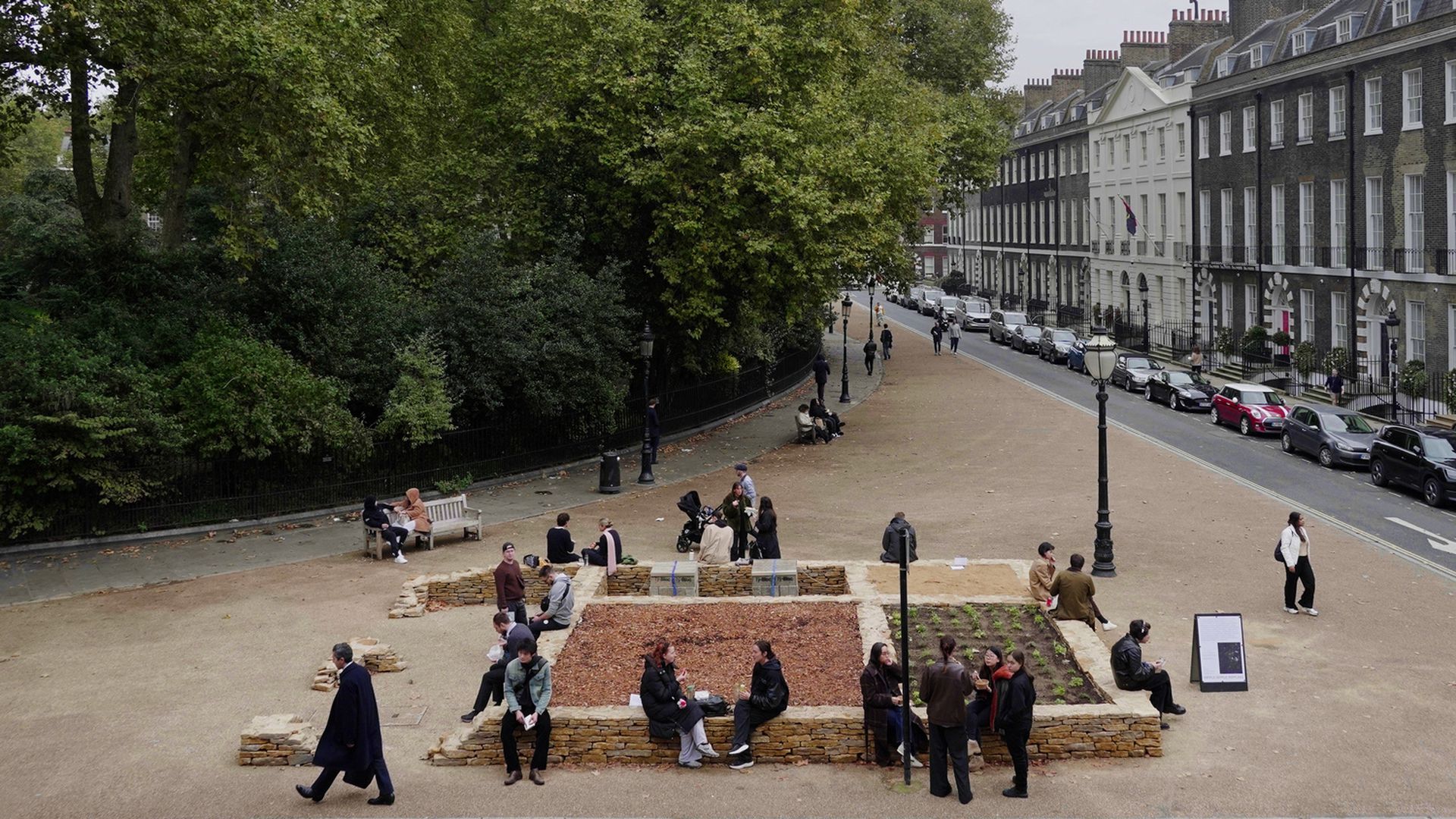
Chen Zhan, Dry stone house foundation in use, Bedford Square, London, 2024. Digital Photography. © field-0
- NBM
- These techniques like dry stone walling—which is remarkable because it uses no mortar—are found in various vernacular constructions around the world and have demonstrated the durability of natural construction. I think this is a great segway to invite George Massoud from Material Cultures to join us.
- George Massoud
- We’re a mission-led organization working towards bioregional construction based here in London, but we work across the country. Through our work we argue for the reintegration of architecture with agriculture because we believe that buildings are linked to their landscapes of extraction.
It’s important for us that design is reflective of a culture and the people and organizations that make it. Participation is a key part of our design process. A lot of the research questions are around how we can move towards a circular economy but also more regenerative land management practices. Through understanding how resources are managed, by tracing supply chains, and understanding what bioregions are, how we can work within those constraints becomes an integral part of the design process. This multidisciplinary approach often means that we are connecting many different kinds of expertise that are not always speaking to each other; from forestry, to policy, to activism, to architecture.
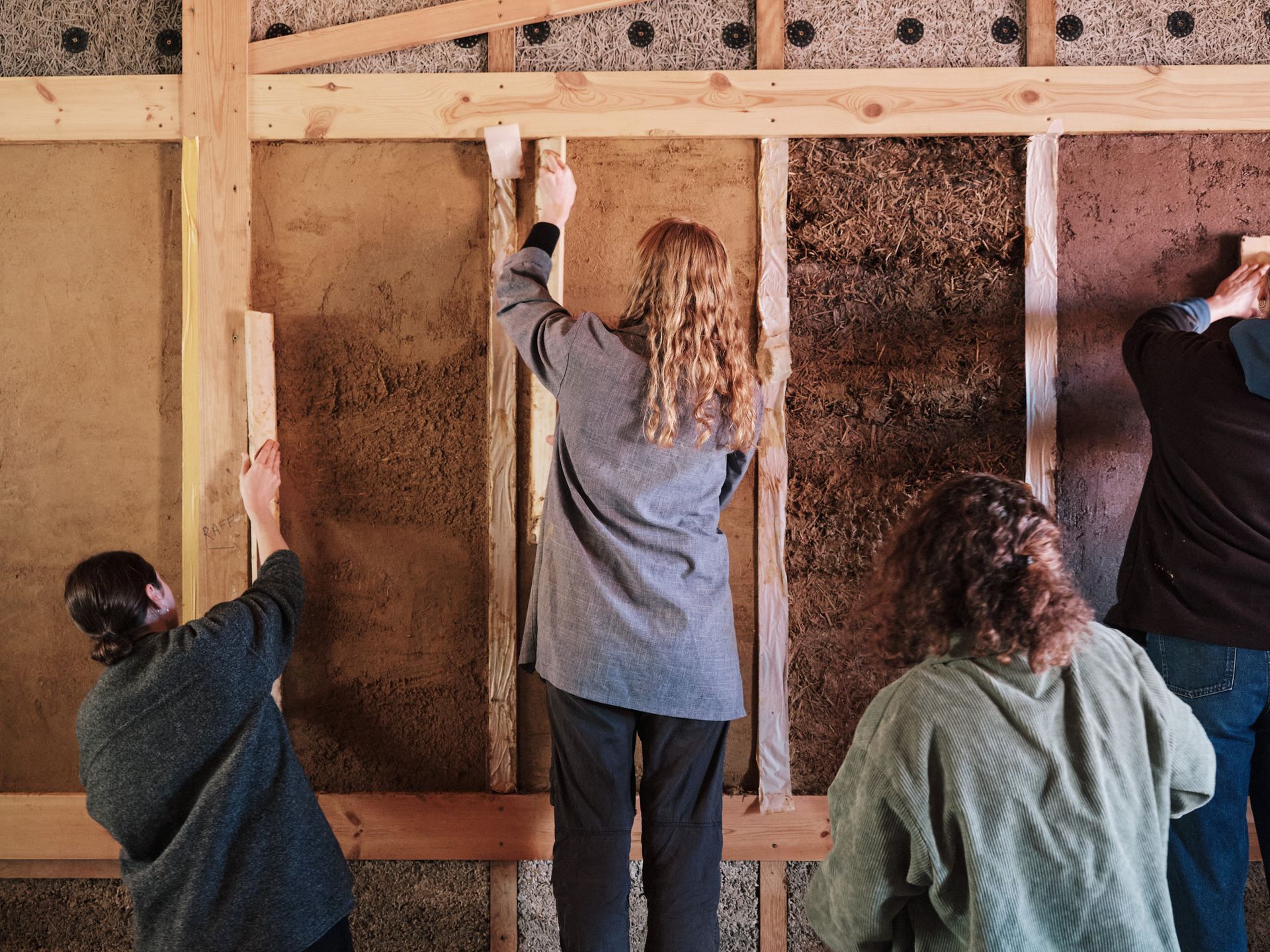
Material Cultures, MAKE Learning Platform, London, 2026. Digital Photography. © Henry Woide
- GM
- It’s very challenging working with natural materials. We face a lot of issues, especially when it comes to cost and supply chains. We like to work as locally as possible and there’s a cost associated with that. We often try to work with very simple building systems because when you are trying to integrate a participatory process in the build itself, it’s important that the knowledge can be transferred in an accessible way.
Working with natural materials means that you have to slow down, which is often against the tide. Everybody wants things done yesterday and sometimes it just takes a long time to dry a hempcrete wall in the winter. You become a lot more attuned to the seasons, and it forces you to work in a slightly different way.
- NBM
- There’s also a search for autonomy in being able to localize where the materials are from and making sure that people can easily access them. In the context of West Africa, the material of empowerment in construction is cement because of how ubiquitous it is. It’s sold in every hardware store and is easy to manipulate, allowing any layman to produce masonry blocks, easily molded in situ by adding sand and water.
- GM
- It’s interesting to think about what that material represents. Cement, concrete, and glass represent power, longevity, and permanence. With natural materials, we have been socialized to see them in a very primal way, and I think there is an opportunity for unlearning and relearning there.

Material Cultures, Wall assembly mockup for ETH Materials Hub, Zurich, 2024. Digital Photography. © Material Cultures
- SIE
- When I was meeting different architects and learning about how they practice, in one of the conversations it was said that concrete is a local material because of how easily you can find cement. In certain cities, you’ll find bags of cement on every corner, allowing anyone to build. In a sense, it is very democratic to provide people the ability to build for themselves. To tell people to build with earth is a mentality that’s hard to return to. They feel like they’ve moved past it, but there is potential.
- NBM
- This conversation is still evolving for all of us but as I get deeper into this research, there are many stories of monopoly, of sabotage, and of exploitation that are embedded in these materials. Knowing the history reveals that it’s no accident how we ended up with these material cultures that we have nowadays. As this research progresses, I think people find it empowering to be able to move forward with different considerations (technical, cultural, human, ecological, etc.) for material choices. The goal we all share here is to be able to contribute to building a fairer world and celebrating the best of what each of our geographies and cultures have to offer.
The Legacy of the École d’Architecture et d’Urbanisme de Dakar, 1973–1991
Nzinga B. Mboup in discussion with Abib Djenne, Seynabou Diouf, Thiao Kandji, and Birahim Niang
The CCA c/o Dakar program was launched in the form of a round table discussion that looked at the legacy that the École d’Architecture et d’Urbanisme de Dakar (E.A.U.), in operation from 1973 to 1991, had on the concept of modern Senegalese architecture. Several key themes emerged over the course of these discussions, namely the political will to provide a national education in architecture that, at its core, defines an African architecture that is not only rooted in its context, but that can also respond the socio-economic challenges and realities of Senegal. The unearthing of a thesis by one of Senegal’s first architects Pierre Goudiaby (Atepa)—who graduated with a diploma in architecture in Massachusetts in1973—excerpts of which are published in Fugitive Archives: A Sourcebook for Centring Africa in Histories of Architecture, inspired the re-examination of other thesis projects by the first generation of Senegalese-trained architects as a way to understand how their process fits into the social, cultural, political, and historical context of their architectural projects, and to give these archives a new life.
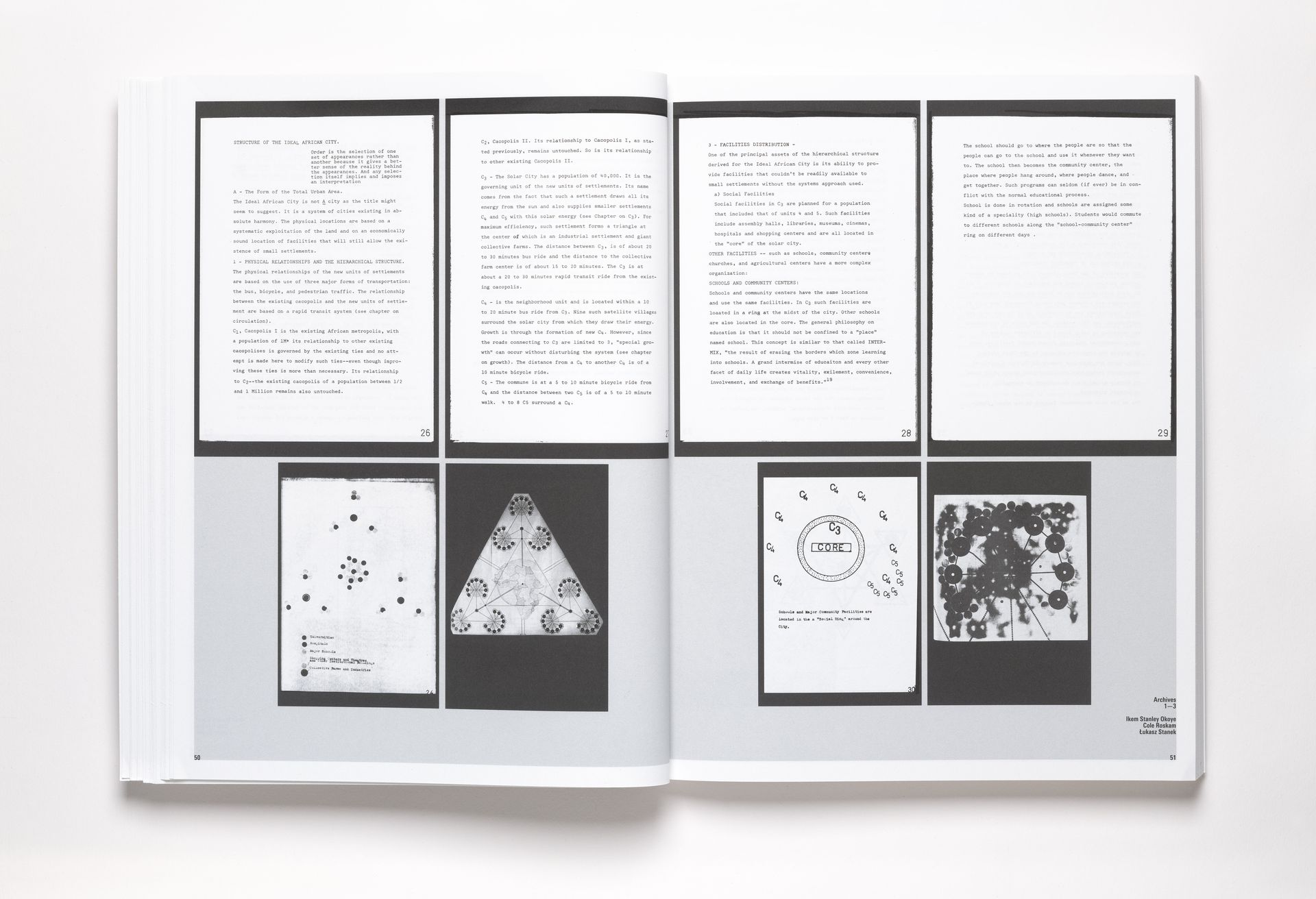
Pierre Goudiaby (Atepa), “The Ideal African City” (master’s thesis, Rensselaer Polytechnic Institute, May 1973). Published in © Pierre Goudiaby. Published in Fugitive Archives: A Sourcebook for Centring Africa in Histories of Architecture, p. 50–51. © Pierre Goudiaby
The event was marked by the presence of the E.A.U.’s first graduates, Abib Djenne and Nicolas Cissé (1979), Birahim Niang (1980), and the school’s final cohort represented by Seynabou Diouf and Thiao Kandji (1990), their professors Jacques Trouvé (in charge of the “Volumes and Visual Arts” course), Jean-Charles Tall (acoustics), and other peers such as Annie Jouga (1979), and Mbacké Niang (1980) who, although they studied in France, helped develop ideas and campaigned for a modern Senegalese architecture. Presentations by various speakers traced the foundation and legacy of the school, from which Senegal’s current architectural pedagogy can be reconsidered.
“We had a struggle in the early 1970s. The president of the Republic, Léopold Sédar Senghor, said that we needed a national architecture for a new nation. And being a great poet, Senghor was actually sensitive to the definition of architecture, the initial definition of architecture from the time of Vitruvius. He brought together French architects of the day, who were in Dakar, to tell them, ‘I want a Senegalese architecture, I want a Senegalese school. Because the rhythm expressed by Vitruvius is in our architecture.” Birahim Niang
History and structure of the school
The E.A.U. grew out of the political will of Senegal’s first post-independence president, Léopold Sédar Senghor, a man of letters who was committed to promoting art and culture. After the École des Arts opened in 1960 to provide training in the fine arts, it was dissolved in 1972 to become the Institut National des Arts, which included a conservatory, a school of fine arts, and the École d’Architecture et d’Urbanisme. The latter had two divisions: one for training architectural assistants, the other for training architects. Senghor sought to promote the emergence of new forms of art, including architecture, that would draw from the country’s ancestral heritage while harmonizing with contemporary artistic and Westernized methodologies, and that would highlight Senegalese cultural identity and Black African heritage.1
Senghor’s vision is very present in the accounts of the first generation of architects and was an ongoing mission throughout their academic years and first realized projects. This vision also formed the pedagogical foundation of their curriculum.
-
Adama Djigo, “Patrimoine culturel et identité nationale : construction historique d’une notion au Sénégal,” Journal des africanistes, 85-1/2 | 2015, 312–357. ↩
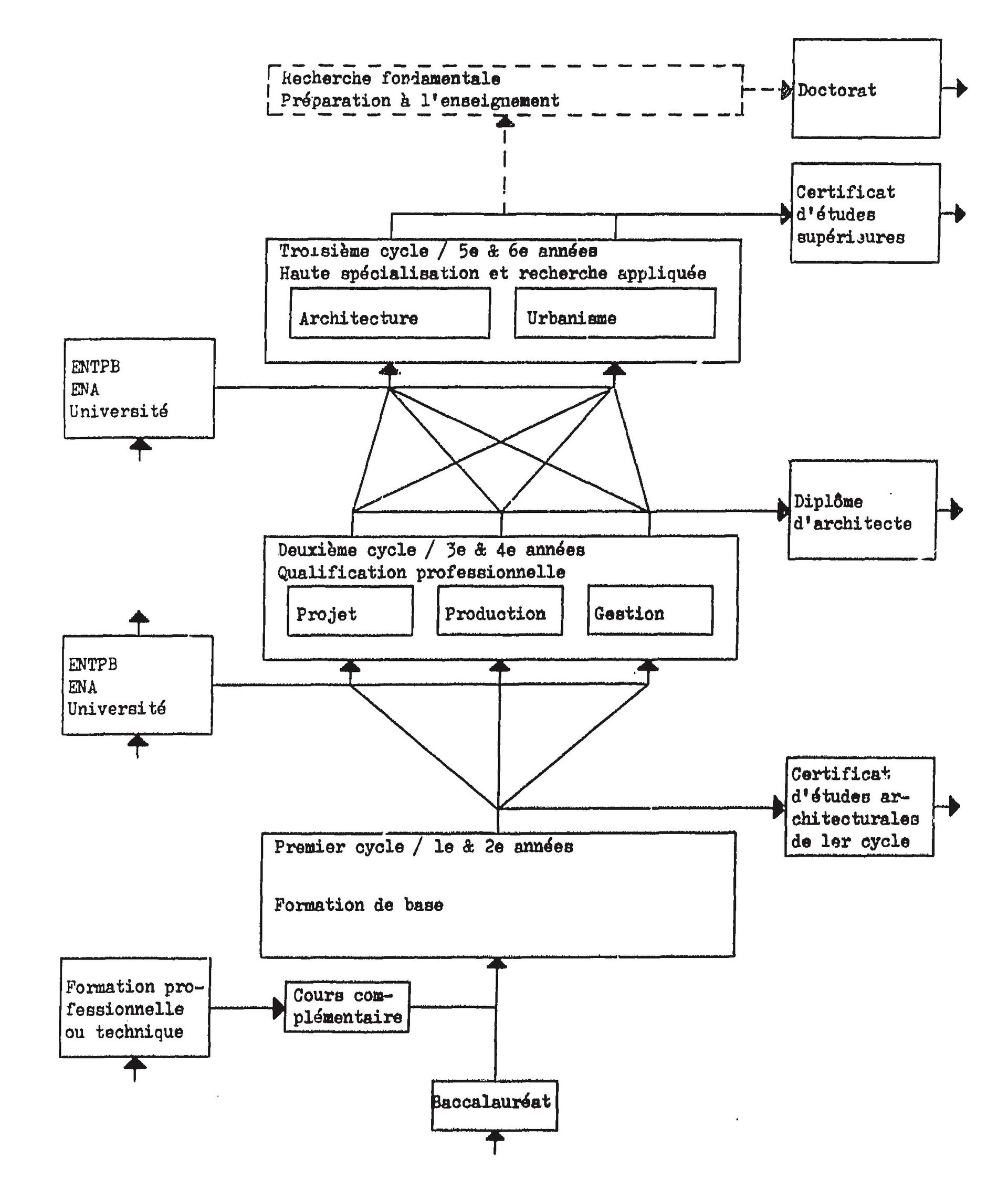
Organization chart by Claude Schnaidt of the course curriculum for Architecture and Urbanism, E.A.U., 1973
The curriculum was divided into three levels; the first two-year level formed part of the bachelor’s degree and offered introductory courses providing basic scientific and technological elements, leading to a certificate in architectural studies. The second two-year level focused on professional qualifications and led to a diploma in architecture (housing, amenities, tourism, industrial construction, rural) or in urban studies (urban planning, rural, regional, physical landscape planning). Six years after the foundation of the E.A.U. and its curriculum,1 Senghor’s gamble paid off, and the first generation of students completed their third level in 1979, with Abib Djenne graduating at the top of his class with his thesis project “Restructuring the Village of Hann-Pecheurs.”
-
Abdou Sylla , “L’architecture sénégalaise contemporaine,” Sociétés africaines et diaspora collection, 1 November 2000 ↩
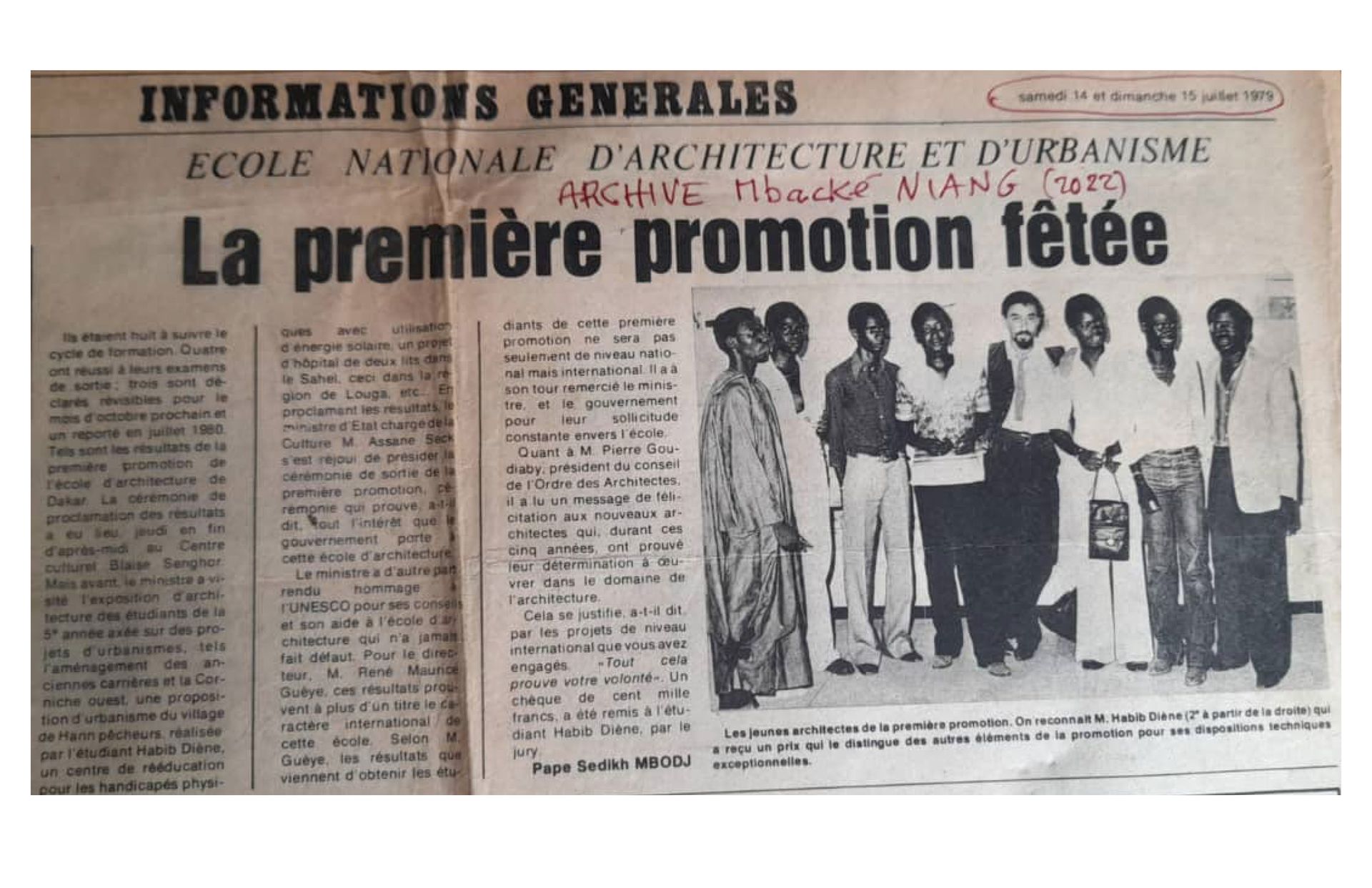
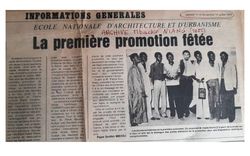
“École nationale d’Architecture et d’Urbanisme, La première promotion fêtée”, Le Soleil, 14–15 July 1979. Abib Djenne (second from the right) received a prize “for his exceptional technical aptitude.”
Learning from, and improving, the vernacular condition
Abib Djenne’s thesis proposed ways to improve housing in the village of Hann-Pecheurs, a nucleus of the Léboue community, the Indigenous people of the Dakar peninsula. As a native of this community himself, although he grew up in Gueule Tapée/Medina, Djenne opted for an ethnographic and sociological approach that would provide insight into the population’s lifestyle and the urban morphology of their neighbourhood, before proposing an architectural response.
Many of the courses offered by the E.A.U. fed into this approach. In second year, the sociology course set out to gather ethno- and psycho-sociological data by analysing the rural and urban inhabitants’ way of life. In third year, the module “Housing, family, and society” studied traditional housing and the socio-spatial organisation of neighbourhoods to understand how they operate and to assess the needs of their inhabitants.
One E.A.U. professor who promoted an ethnographic approach was Patrick Durarric, who organized student field trips throughout Senegal in order to chart the different types of rural housing. Their findings were consolidated in the publication Maisons sénégalaises.1
-
Publication accessible online: https://condor.depaul.edu/mdelance/images/Pdfs/Dujarric - Maisons Senegalaises.pdf ↩
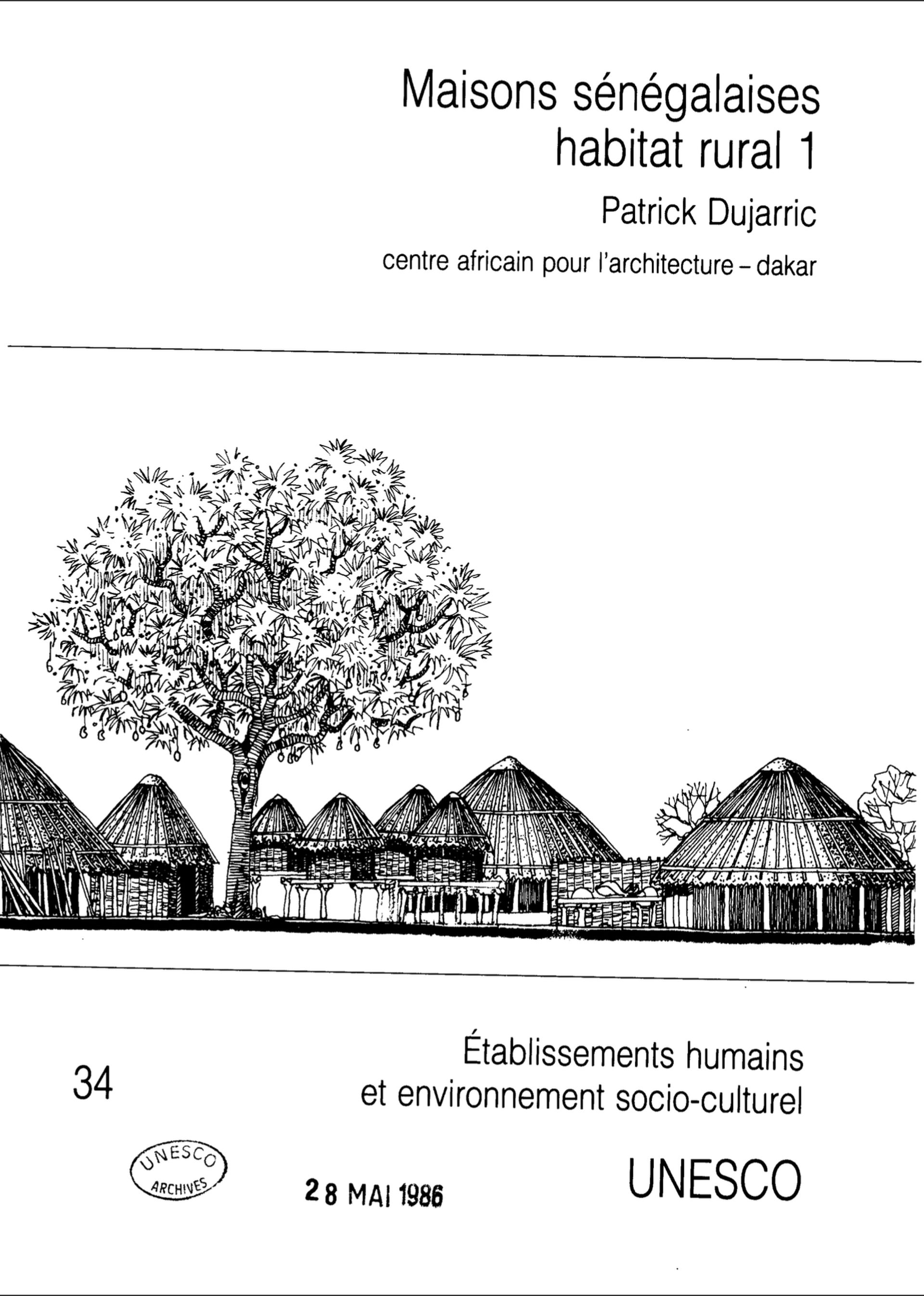
Patrick Dujarric, Maisons sénégalaises : habitat rural 1, 1984. © UNESCO
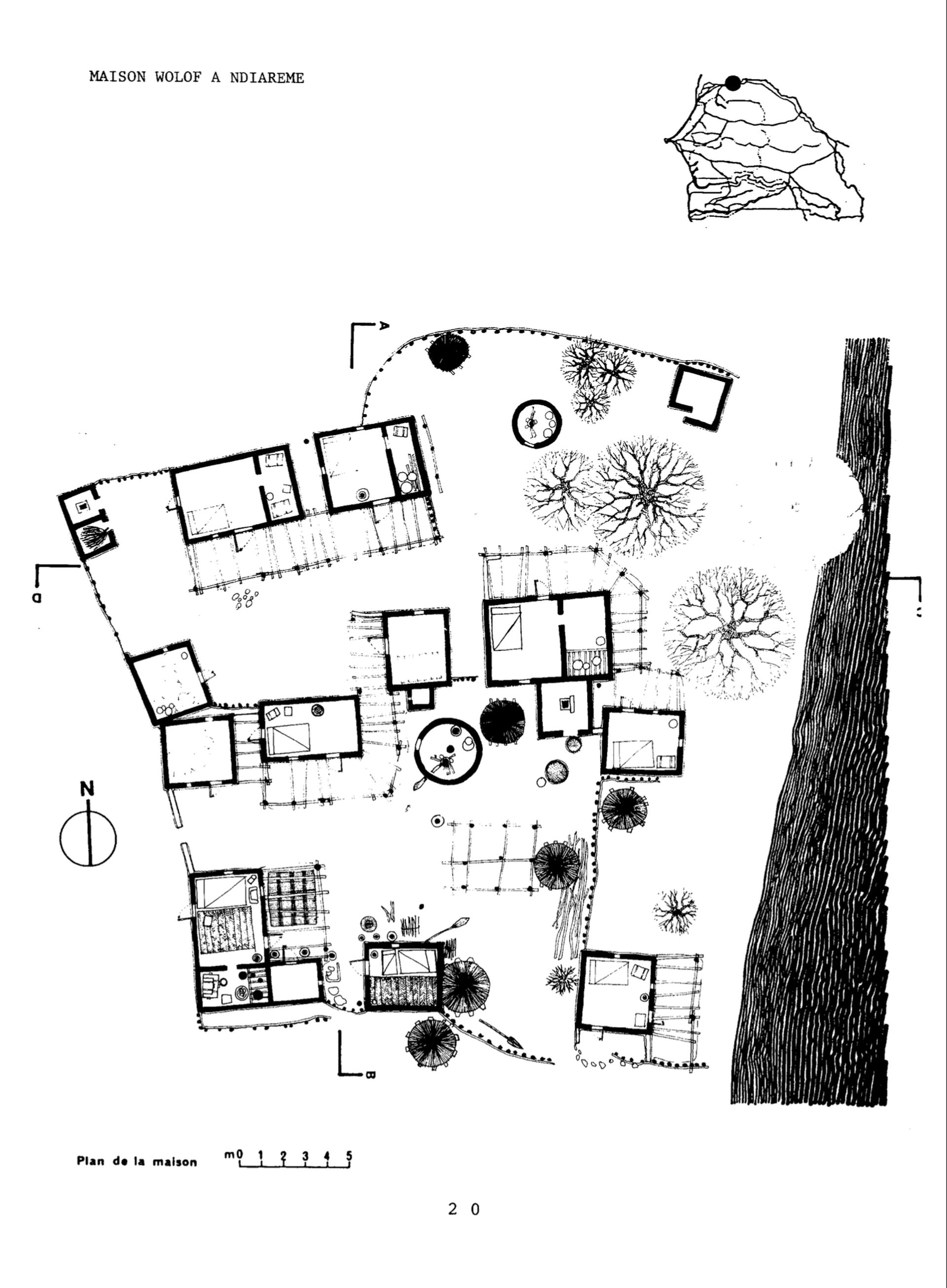
Patrick Dujarric, Maisons sénégalaises : habitat rural 1, 1984. © UNESCO
“I spent twelve weeks in Hann as an on-site resident… I took stock of the village, I studied there, I studied the housing from a distance, how people lived, I did it house by house, plot by plot. Then I looked at the different neighbourhoods, I looked at the population, how it’s constituted. There were X number of Wolofs, X number of Diolas. I realized that it was beginning to be a metropolis, a city with a variety of contributors. First, I did a lot of urban planning. After that, I designed a neighbourhood. With more analysis, I understood the needs of the neighbourhood.” Abib Djenne
Having been part of these field trips and inheriting the pedagogy of the E.A.U., Abib Djenne also studied the village of Hann-Pêcheur through an ethnographic lens by mapping the distribution of its population and the occupations of its inhabitants. His meticulous study and charting of the area, the distribution of spaces and materials used, and his analysis of public amenities led to an urban redevelopment proposal to create illuminated roads for increased safety, and improved housing that not only provided shelter, but also space for individuals to pursue their artisanal activities. Both of Djenne’s proposed housing typologies were destined for fishing families, with a work area for the women to dry and sell fish caught by members of their families. The distribution of domestic spaces followed the logic of traditional plots, which provides private space for everyone, plus a shared communal yard where most of the domestic activities take place.
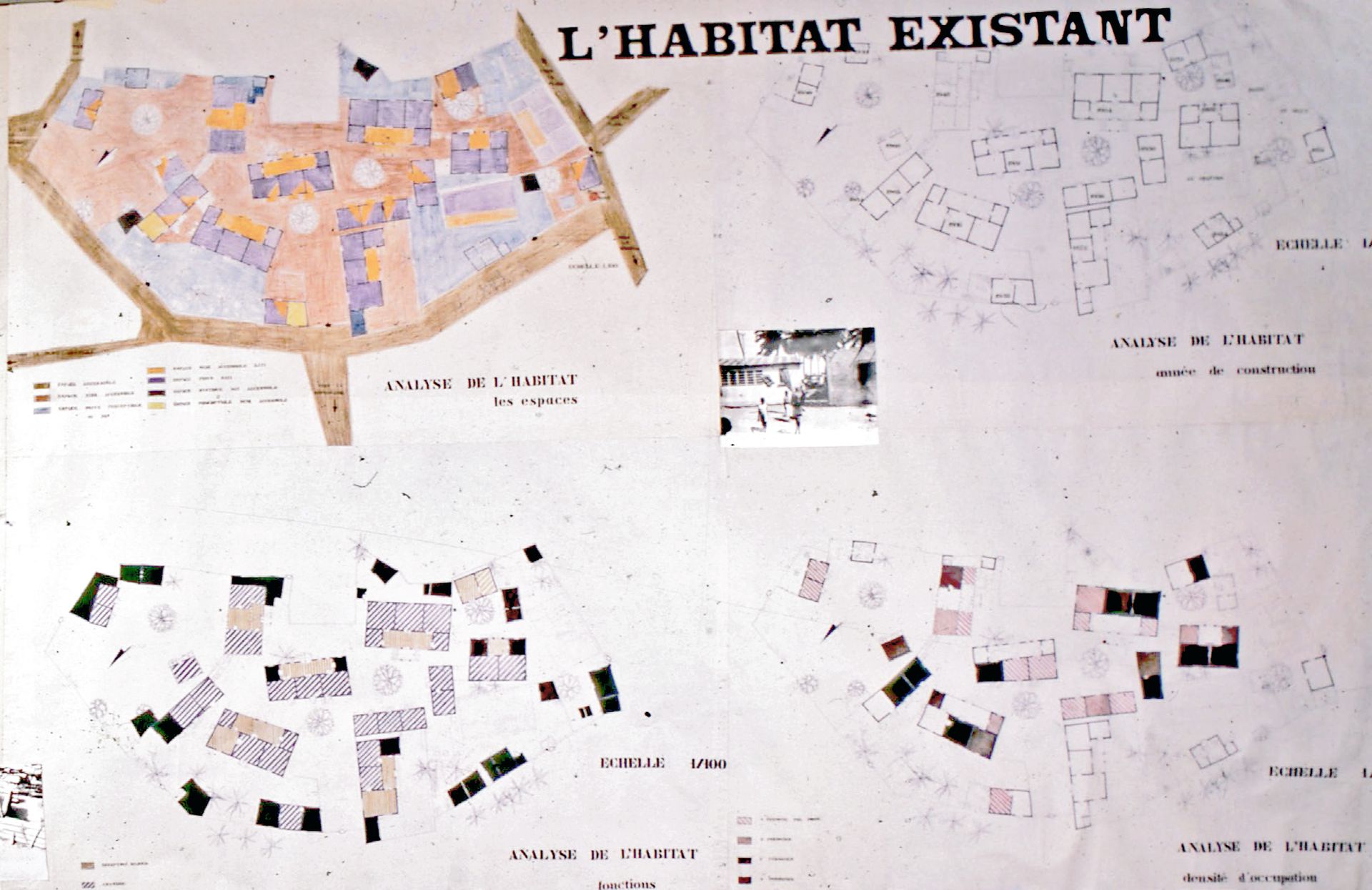
Excerpts from Abib Djenne’s thesis, 1979. © Abib Djenne
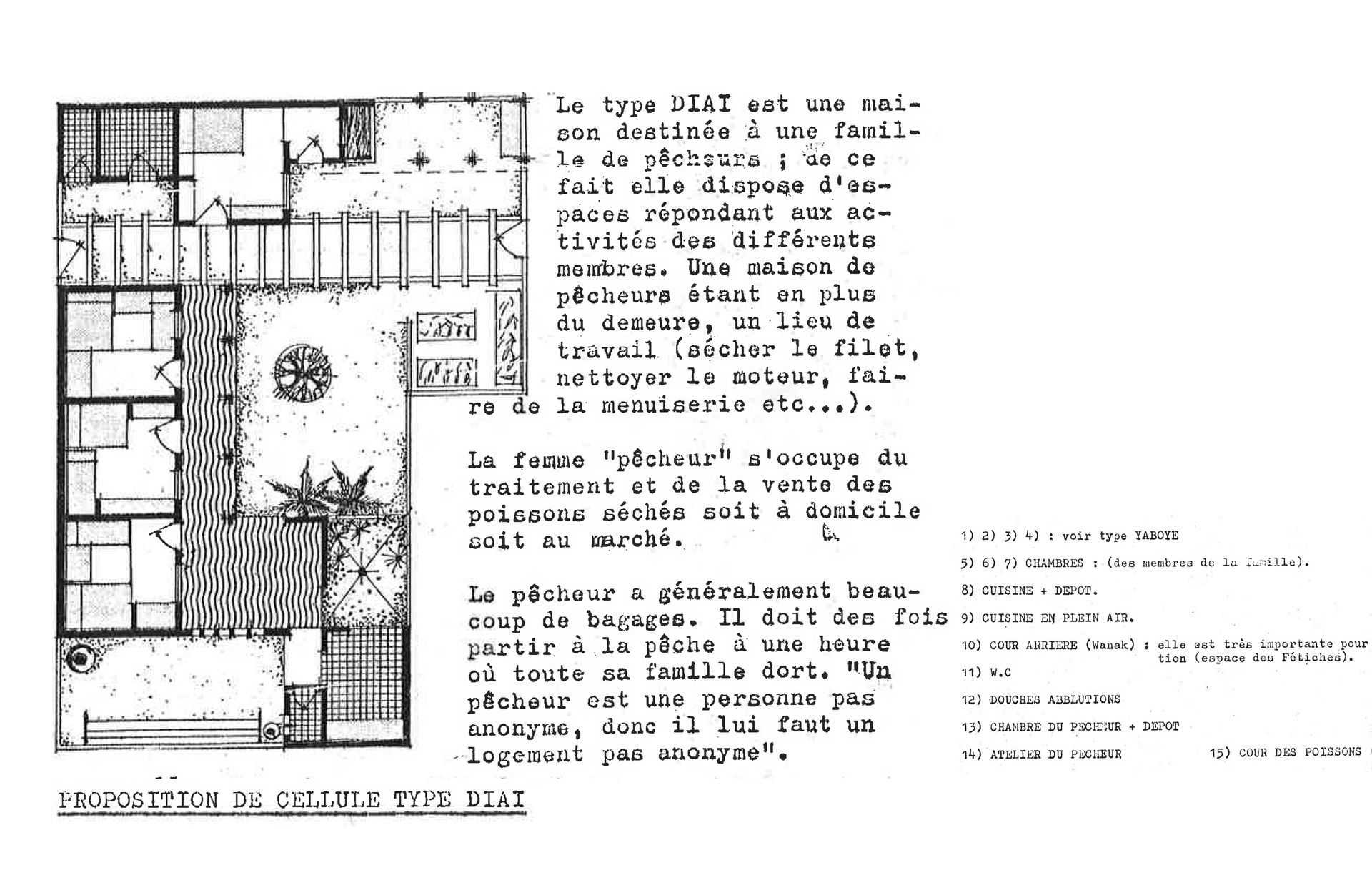
Excerpts from Abib Djenne’s thesis, 1979. © Abib Djenne
Other E.A.U. students adopted a similar approach, often working in rural areas. This was the case with Daouda Ndiaye and Moustapha Fall, whose thesis project proposed a restructuring of the village of Soninké de Mouderi by studying the specificities of rural housing. Their thesis even went a bit further by proposing building systems inspired by traditional housing, with arches and domes made with cast dirt bricks, a traditional technique from the Senegal River valley.
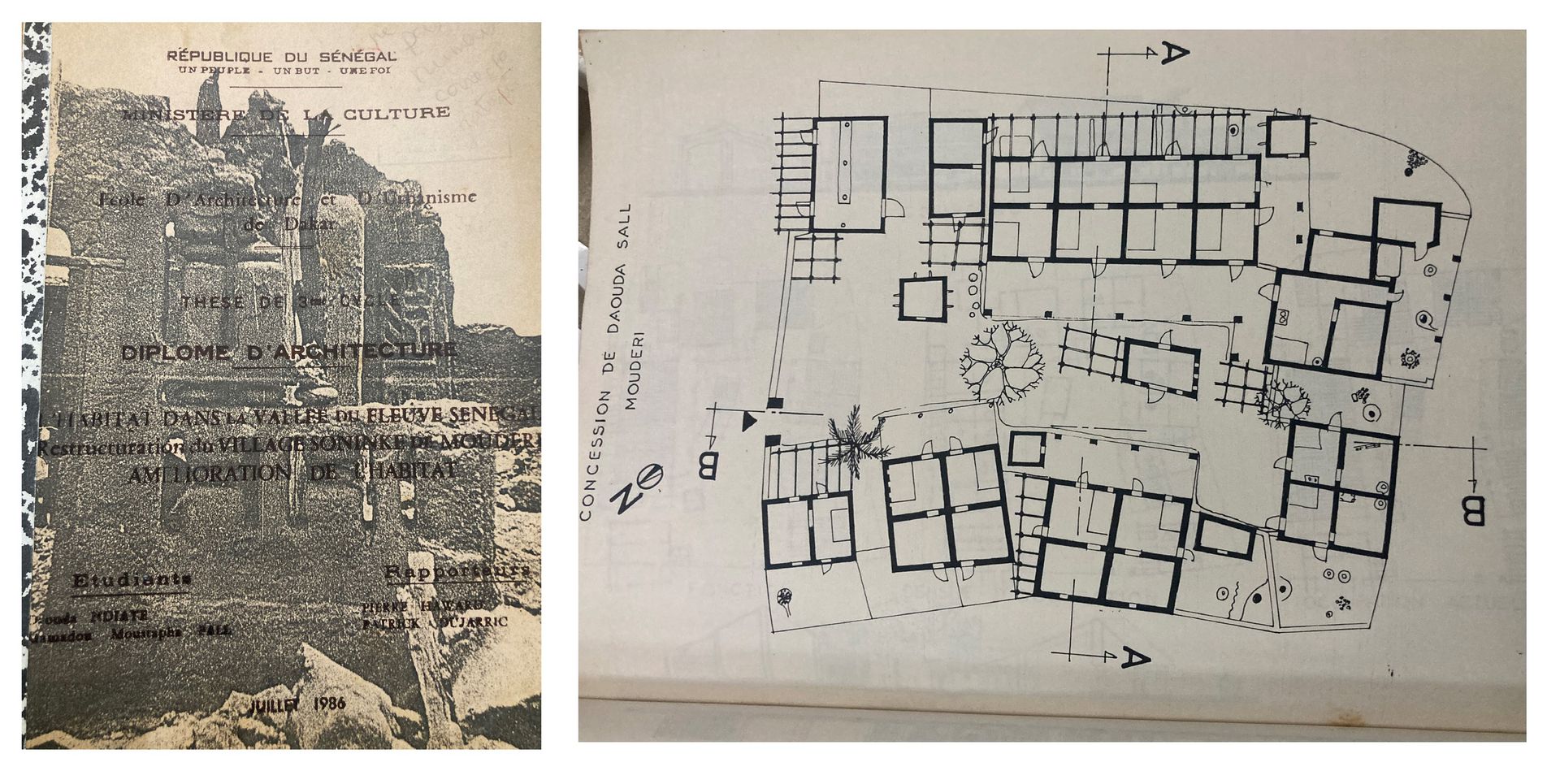
Daouda Ndiaye and Moustapha Fall. “Housing in the valley of the Senegal River: the village of Soninké, Mouderi, improvement of housing conditions,” 1986
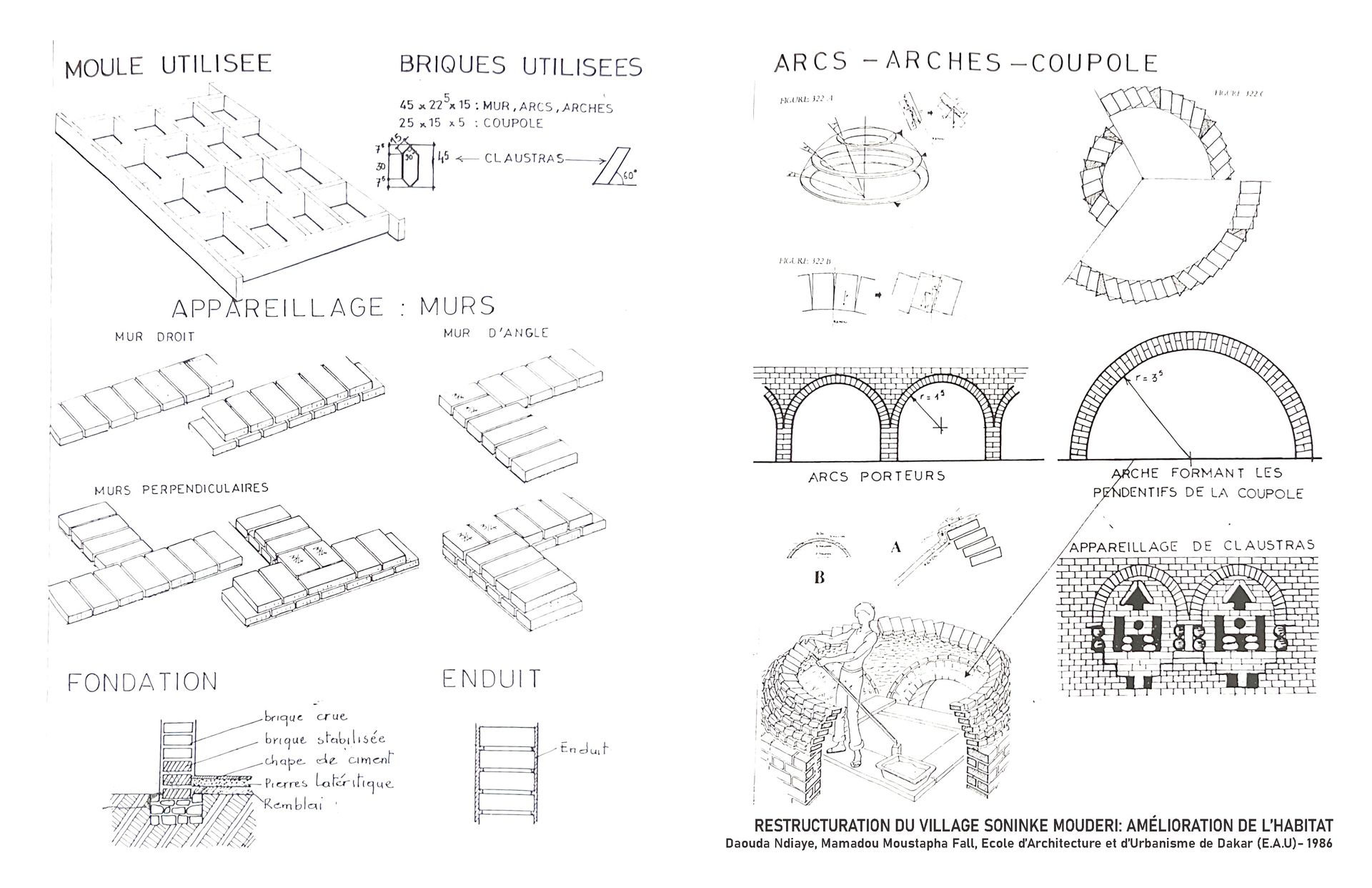
Daouda Ndiaye and Moustapha Fall. “Housing in the valley of the Senegal River: the village of Soninké, Mouderi, improvement of housing conditions,” 1986
This attention to building systems was shared by Seynabou Diouf in her thesis project, which proposed a series of modular prototypes with a variety of building systems in improved natural materials that enabled any community to build their own early childhood education space.
Responses to the bioclimatic context and approach
“I chose this subject because I was very interested in childhood education. Children become adults, so it was important for me to see how I could really improve spaces for children, from the very onset of their education… I focused on a few kindergarten schools where I conducted surveys to see how children evolved there. I found several factors that really weren’t working at all, namely rooms that were too small, bathrooms that weren’t adapted to children, and problematic lighting and ventilation. In addition, I had to propose a flexible layout adapted to where the children would develop… I concluded that our module had to be flexible, and that we had to define a space that was truly useful for the child, knowing that the classrooms couldn’t be designed for 15 or 20 children, which would have been ideal. In reality, there would be at least 35 to 40 children per class. So I designed a flexible module that was 60 m2 with a layout that could be adapted to different environments.” Seynabou Diouf

Excerpts from Seynabou Diouf’s thesis, 1990. © Seynabou Diouf
When Seynabou Diouf zeroed in on the issue of early childhood education spaces, she began by studying a series of kindergartens in Dakar to understand how they operated and quickly discovered certain shortcomings. With the right to education for every Senegalese child as her guiding principle, she first developed a system of spatial modules, followed by constructive modules that would accommodate the phased construction of kindergarten classes in both urban and rural communities. The result was a series of classroom prototypes with single-slope roofs that could be oriented to provide good light and ventilation inside the classroom while also ventilating the roof. All of this was designed to limit the amount of direct sunlight entering the building to avoid overheating, which makes learning difficult, especially in parts of Senegal where it is very hot. A metallic structure ensured quick assembly, while the roof and infill wall construction varied depending on the availability of materials in a given area. In the end, her project demonstrated that it was just as feasible to build a prototype with cinderblock walls and a sheet metal roof as it was to build one with clay bricks and a straw roof.
The passive cooling strategies illustrated in this project and the use of bio-sourced materials were often at the core of the E.A.U. student’s projects, which include drawings that demonstrate their understanding of wind currents and sunlight, and strategies for achieving physical comfort without resorting to air conditioning.
Building a National Infrastructure
“The idea came to him from a speech by president Léopold Sédar Senghor. Then he chose Kocc Barma, who was one of these historic icons, but there was also Lat Dior, who we all know from Cayor, and Chiekh Anta Diop, who was a brilliant man, and Aline Sitoe Diatta, who was the Lady of the Casamance.” Galass Kandji speaking on behalf of his father, Thiao Kandji
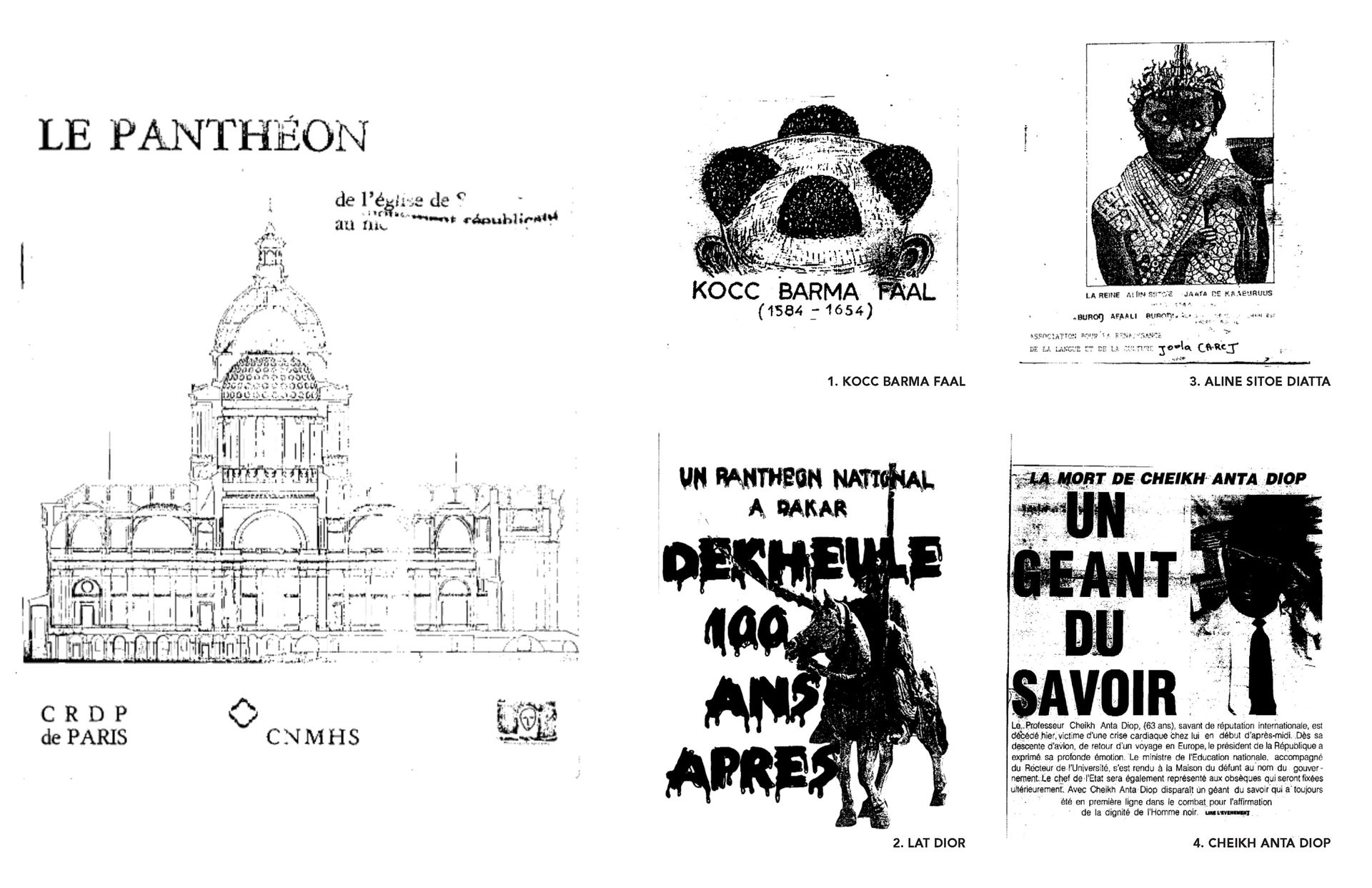
Excerpts from Thiao Kandji’s thesis “Study and design of the Panthéon National in Dakar”, 1990. © Thiao Kandji
The research project for the Panthéon National, designed by Thiao Kandji, illustrates Senghor’s policy of cultural consideration and the establishment of institutions and buildings that promote Senegalese culture. The first consideration is based on choosing national heroes, in this case the scientist Cheikh Anta Diop, the Casamance member of the resistance Aline Sitoe Diatta, the king and member of the resistance Lat Dior, and the philosopher Cayorien Kocc Brama Fall, who transcends time and exemplifies the different virtues of Senegalese culture. But the pantheon’s program doesn’t simply glorify historical figures or create a “national tomb,” it differentiates itself from Parisian or Roman pantheon models by also offering cultural programming and an event space.
Its chosen site is the Place de la Nation, marked by an obelisk and a surrounding circular building. A geological study of the site was conducted as part of the research. The resulting building is as monumental as its programming, with a very distinct volumetric composition and a very solid exterior façade with very few windows, offering protection from the wind and sun.
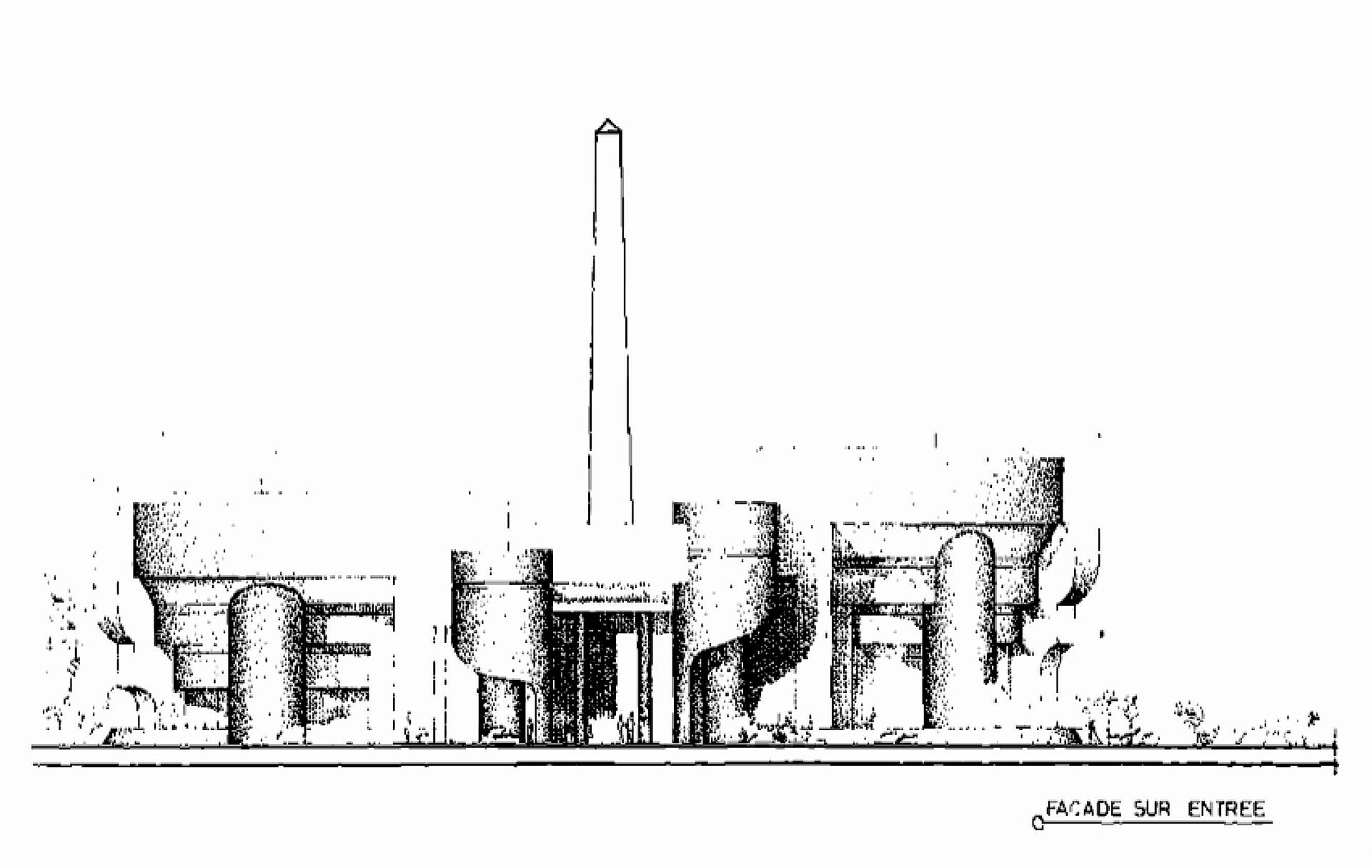
Excerpts from Thiao Kandji’s thesis “Study and design of the Panthéon National in Dakar”, 1990. © Thiao Kandji
Other E.A.U. student projects proposed to build national institutions by examining Western architecture and drawing from the diversity of local cultures. Such is the case for the Study and Design of a National Language Institute in Dakar, a 1990 project by Youssoupha Leye, who was in the same class as Thiao Kandji. This project is the material expression of Senghor’s policy of codifying national languages in education. From the 1989 class, Babacar Clédor Wade proposed a project for a National Museum in Dakar. In both instances, students demonstrate a desire for an identity-based building that is locally rooted and promotes immaterial heritage (memory, languages, etc.) while responding to the requirements of contemporary society and Dakar’s urban context.
While many of these thesis projects remain theoretical, by revisiting them, the three architects expressed a great sense of pride at the rigor of their work, their investment in the issues at hand, and the sense of optimism that their project would bring real solutions to the challenges facing Senegalese society. The projects’ cultural anchoring was expressed in their programmatic and urban response, using materials without copying or imitating traditional architecture, which they had thoroughly studied. The architect Birahim Niang, who graduated at the top of his class in 1980, then joined ADAUA (Association for the Development of Traditional African Urbanism and Architecture) and went on to realize a project that won the Aga Khan Award for Architecture, had this to say about his time at E.A.U.:
“While we were in architecture school, we understood that we had to meet with locals before we could begin building. To know who we were building for, and where we would build… I was trained in a school that took us all around Senegal, we covered the entire typology of Senegal’s 24 ethnic groups. So when you graduate from this program, normally you are a Senegalese architect… We went to Kaédi, where there was no concrete, no iron. We built a hospital with new forms. We used ribs, domes, and Pascal’s sphere, which weren’t part of our geometry at the time, but which we included in our design and they still hold up to this day.” Birahim Niang
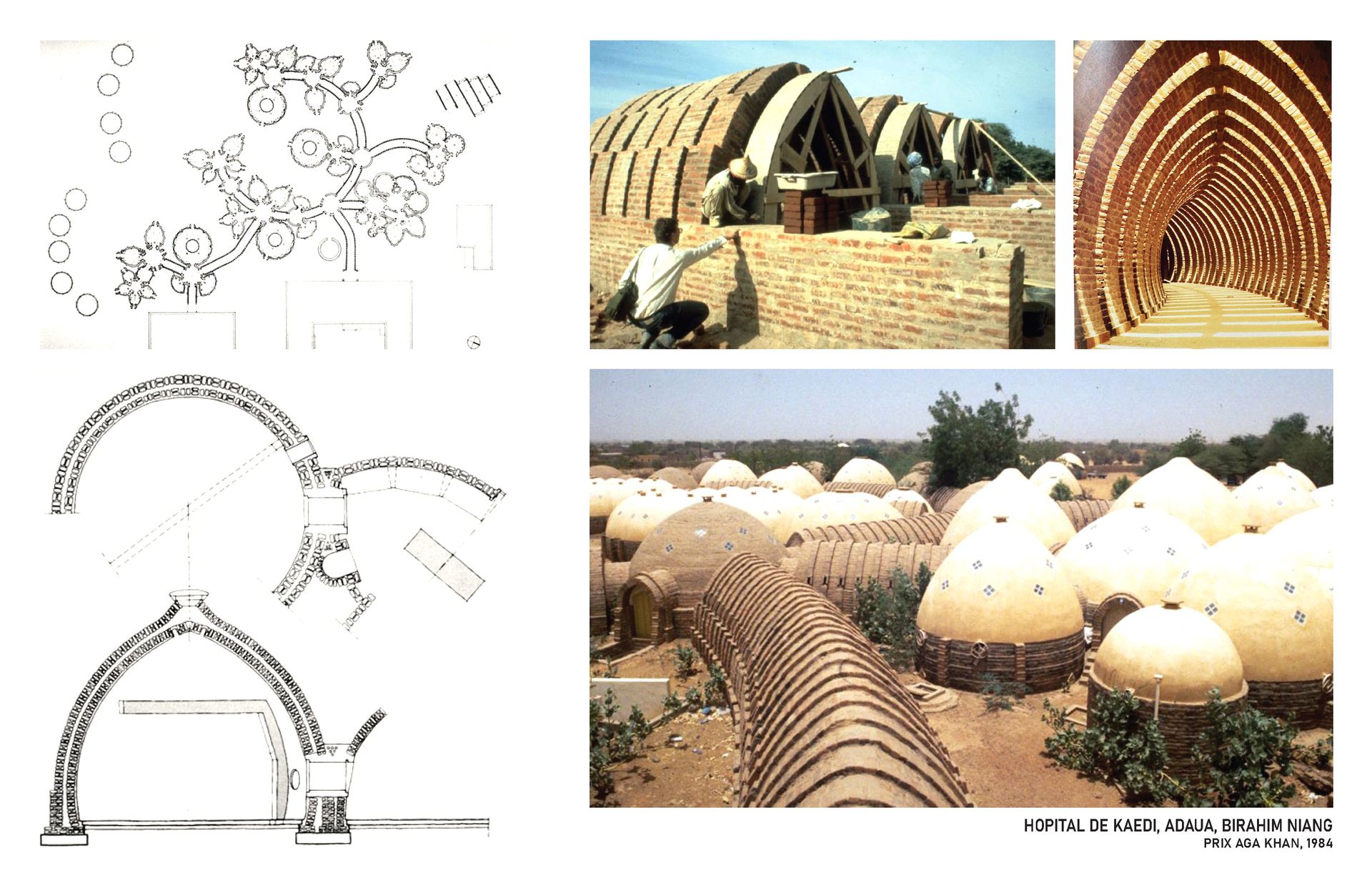
Birahim Niang. Kaedi Regional Hospital, 1983 (recipient of the Aga Khan Award for Architecture in 1996 - Birahim Niang, Fabrizio Carola, and all of ADAUA team shared the prize together.)
After nearly 20 years of existence and the emergence of a new generation of architects trained in Senegal, thanks to the political will for a national architecture, the E.A.U. closed its doors in 1991, by ministerial decree, due to government budget shortfalls. The E.A.U. also welcomed many non-local students from the subregion, and aside from the EAMAU in Lome (Togo), it was the leading school in French-speaking Black Africa. The repercussions of this closure left the country with no architecture-based educational institutions for more than 15 years, forcing Senegalese architects to train abroad in France, the US, Morocco, Turkey, Togo, or elsewhere.
The Question of Archives
“The problem with archives is a problem of memory. Archives must stay put, they must live somewhere. And that’s the big challenge. I mean that we, at the time… I have almost no trace of my earliest projects because I made things as I went along. We were in an environment where we didn’t really question this. I mean, unlike today, when, even a breath, you’re going to digitize it and photograph it and so on… I think that, indeed, this is the moment.” Annie Jouga
Today, the E.A.U.’s academic program seems utopian, given the richness of its curriculum and how it invested in its students and future architects in the building of their country. Now, more than ever, it’s important to draw from this memory, to recenter a political vision in accordance with current challenges to establish academic and cultural institutions that enable us to train Senegalese architects now and into the future.
Heritage, Between Education and Practice
Nzinga B. Mboup identifies the value of Senegal’s architectural heritage with Jean-Augustin Carvalho, Fodé Diop, Andrée Diop-Depret, and Xavier Ricou
The second public event of the CCA c/o Dakar program, held on 17 August 2024, brought together four Senegalese architects whose work, both as students and in practice, stimulated a discussion about the definition and recognition of Senegal’s built heritage. While Xavier Ricou studied in Paris, graduating with a thesis project on Gorée Island, the other three architects graduated from the École d’Architecture et d’Urbanisme de Dakar (E.A.U.): Andrée Diop-Depret, was the first woman to graduate from the E.A.U. and her office GA2D has refurbished or renovated many historic monuments in Senegal; Jean-Augustin Carvalho, chose to work on the refurbishment of the Sandaga Market for his graduation project; and Fodé Diop, chose instead to work on the restructuring of the Island of Saint-Louis. Through sharing these diverse experiences, the public audience learned about strategies that can be adopted to identify and recognize the value of our heritage, learning from past successes and mistakes while shedding light on the challenges we are facing in the context of widespread destruction of the built heritage.
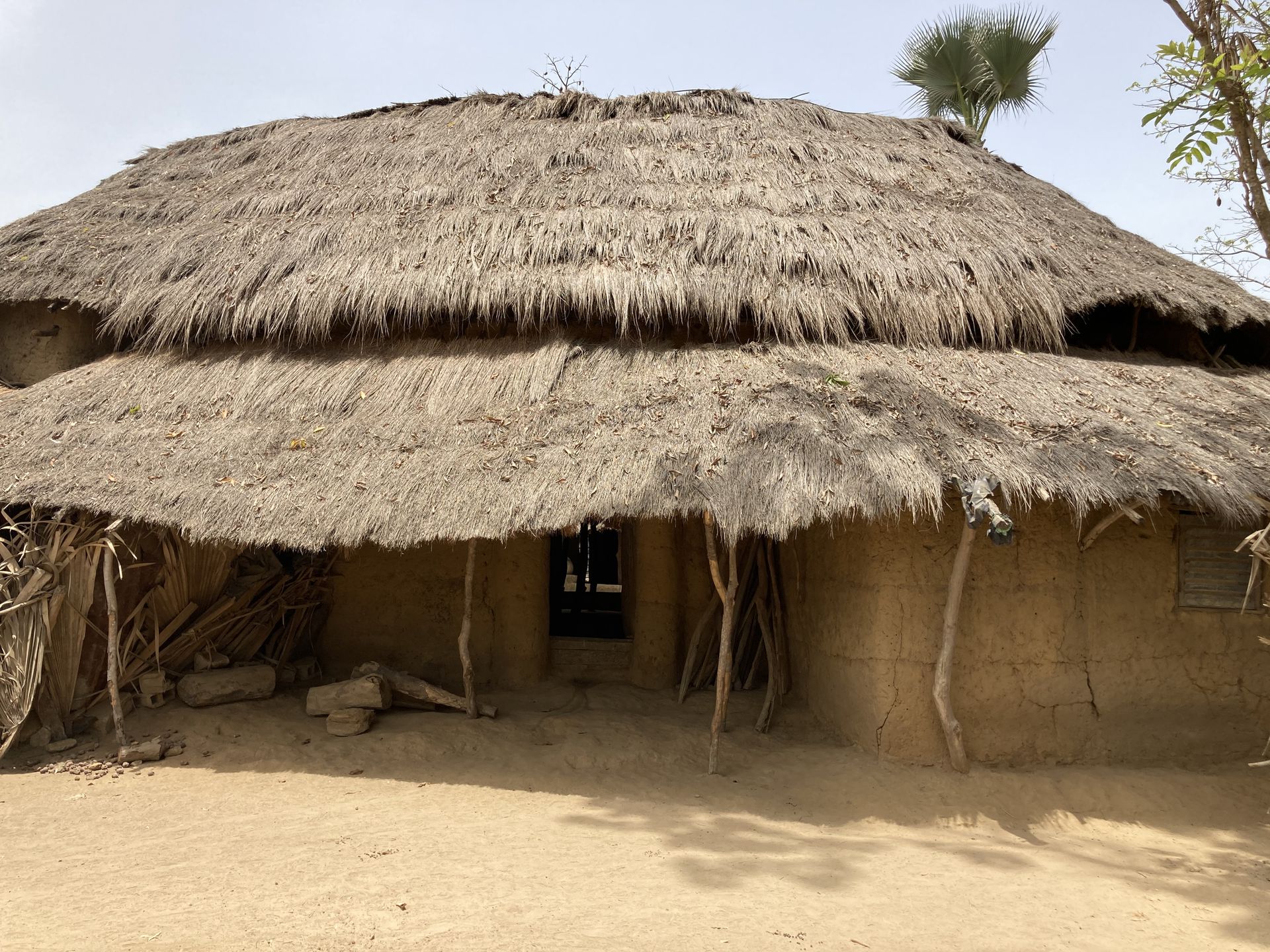
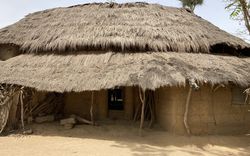
An impluvium hut, Casamance. Source: Worofila
The importance of preserving the history and memory of a community or culture was a recurring topic during the discussion, reflecting a consensus regarding the need to acknowledge the history inscribed in the buildings that preceded our era, with a diversity of styles that manifests the endogenous cultures and the multiple exogenous influences that we have experienced.
The four architects who presented at the event developed their appreciation of heritage out of their family histories—as for Xavier Ricou with Gorée Island—or their life experiences—Fodé Diop went to secondary school in Saint-Louis. The courses at the E.A.U. also raised awareness of the built heritage among generations of students under the guidance of Professor Patrick Dujarric, travelling around Senegal and mapping the traditional architecture of various regions.
Listing heritage
“Not only does a Negro culture and civilisation exist, but they also assert their anteriority in relation to the culture and civilisation of the West, since they have, in more than one way, influenced, even conditioned, the culture and civilisation of the West, at least in their original form. So it is only right that Senegal should think about legally safeguarding—through classification, conservation and protection—monuments of a prehistoric, protohistoric and historical nature, dynamic witnesses of ancient times.”
“The aim is to learn more about our past, and to demonstrate the cultural, artistic and scientific development that has taken place in our country. We must make an inventory of all the elements that bear witness to our history and preserve them in the best possible conditions.”
Excerpts from the Loi sur les monuments historiques (Historic Monuments Bill) of 13 April 19711
-
See https://www.dri.gouv.sn/sites/default/files/LOI/1971/Commission-loi-decentralisation-et-travail/LOI-N-71-12-DU-06-AVRIL-1971.pdf. Original French text: “Non seulement une culture et une civilisation nègres existent, mais encore, elles affirment leur antériorité par rapport à la culture et à la civilisation de l’Occident, puisqu’elles ont, par plus d’un côté, influencé, voire conditionné, la culture et la civilisation de l’Occident, du moins dans ce que celles-ci ont d’originel. Aussi n’est-il que très légitime qu’au Sénégal l’on pense à sauvegarder juridiquement, par la classification, la conservation et la protection, les monuments à caractère préhistorique, protohistorique et historique, témoins dynamiques des temps anciens.” “Il s’agit de mieux connaître notre passé, d’apporter chaque fois la preuve du développement culturel, artistique et scientifique dont notre pays a été le théâtre. Il faut recenser tous les éléments témoins de notre histoire, les conserver dans les conditions les meilleures.” ↩
When the law was enacted, only Gorée Island and Cap Manuel were subject to legal protection. Today, the list of historic monuments in Senegal has grown to include hundreds of sites throughout the country.1
In order to understand the value of built heritage and protect it, we first need to list it, study it, and identify its features. This is what Xavier Ricou and Fodé Diop did for the islands of Gorée and Saint-Louis, respectively, with their graduation projects. They described and analyzed their geographical contexts, the urban morphology, the building types, and above all the living configurations and the technical elements (materials, types of roofing, balconies) that define the architecture of these islands. The poor state of conservation of the buildings was also a central concern in their mappings, proposing technical solutions to improve it such as the treatment of capillary damp.
Although these graduation projects were theoretical and not intended for practical application, they bore fruit in Ricou and Diop’s careers, which were largely focused on protecting the islands. Diop chose the subject of his thesis thinking about its “usefulness” or applicability, and in 2000, he was able to revisit it and update it to serve as a basis for the classification of the Island of Saint-Louis as a UNESCO World Heritage Site. Xavier Ricou then took on the task of setting up the conservation plan.

Saint-Louis Island, two-storey houses with pitched roofs (type ME1). Excerpt from the thesis Contribution à la réhabilitation du patrimoine architectural : Cas de l’Île de Saint-Louis, Fodé Diop, 1986

Saint-Louis Island, two-storey houses with roof terraces (type ME2). Excerpt from the thesis Contribution à la réhabilitation du patrimoine architectural : Cas de l’Île de Saint-Louis, Fodé Diop, 1986

Inventory of buildings on Île Saint-Louis showing the location of types ME1 and ME2. Excerpt from the thesis Contribution à la réhabilitation du patrimoine architectural : Cas de l’Île de Saint-Louis, Fodé Diop, 1986
Jean-Augustin Carvalho turned to more recent forms of heritage for his graduation project, namely the Sandaga market. The building, with its Sudanese-Sahelian architecture1 dating from the 1930s, was still one of Dakar’s leading commercial hubs during his studies in the 1980s, but had already been swallowed up by a proliferation of stalls spreading into the surrounding streets. Carvalho’s project focused not on the building itself, but on its function as a market in Dakar and the expansion of its functions across the urban block. The analysis of the different programs, the foodstuffs and objects sold, the layout of the stalls, and the spatio-temporal flows informed the restructuring proposal for the alleys emanating from Sandaga to form a new shopping centre. This research project was supported by the Dakar City Council, to whom Carvalho offered the project to serve as a basis for the discussions about the future of a market that was seen as embodying the soul of Dakar.
-
The Sudanese-Sahelian style, coined by President Senghor in reference to French Sudan—the French colonial denomination of what became the state of Mali, with which Senegal formed a federation—and the larger African context. The building’s architecture anchored the building in its urban environment. ↩
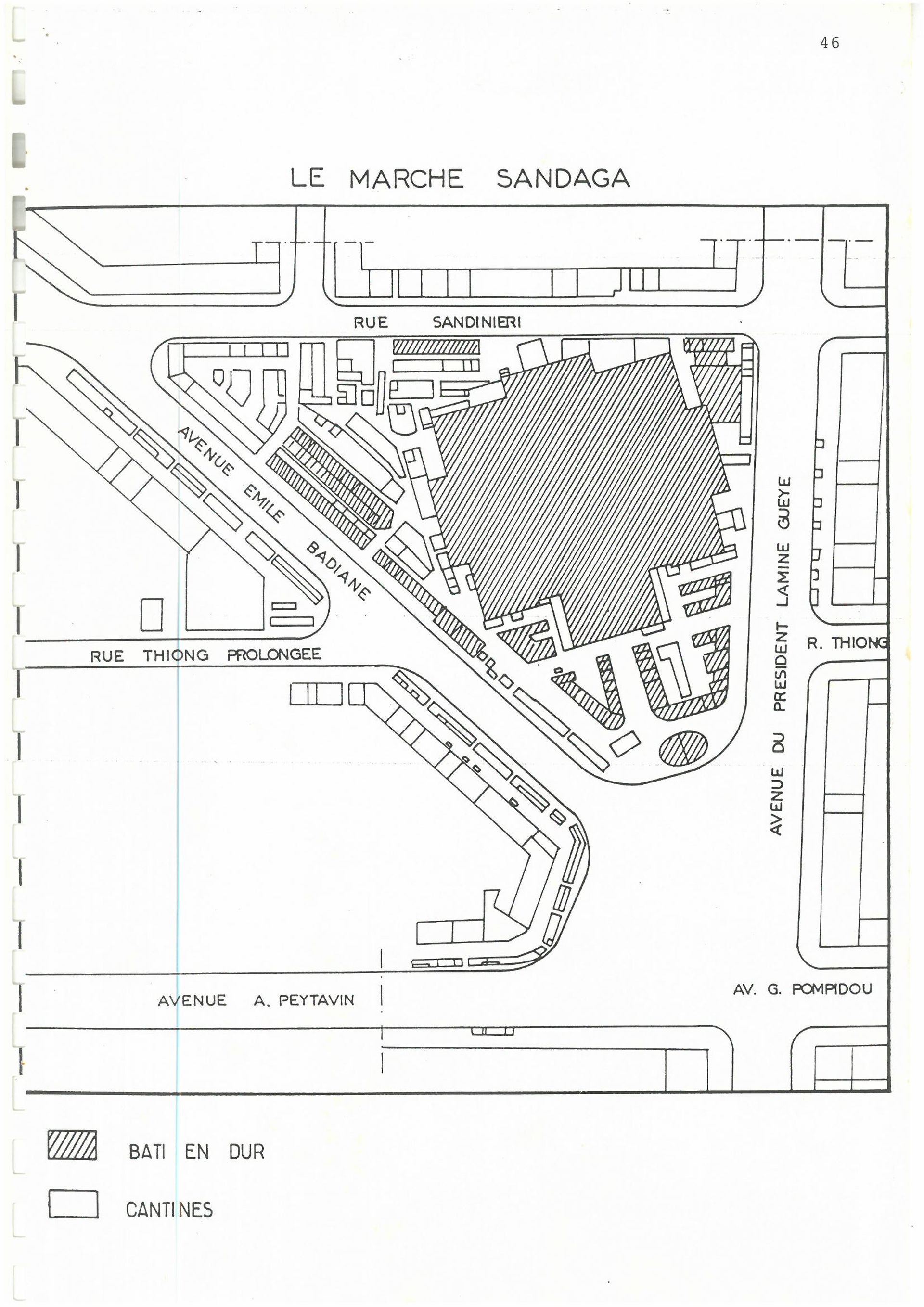
Jean-Augustin Carvalho. Excerpt from the thesis Conception d’un centre commercial : Contribution à l’Etude de Restructuration du Marché Sandaga, 1988
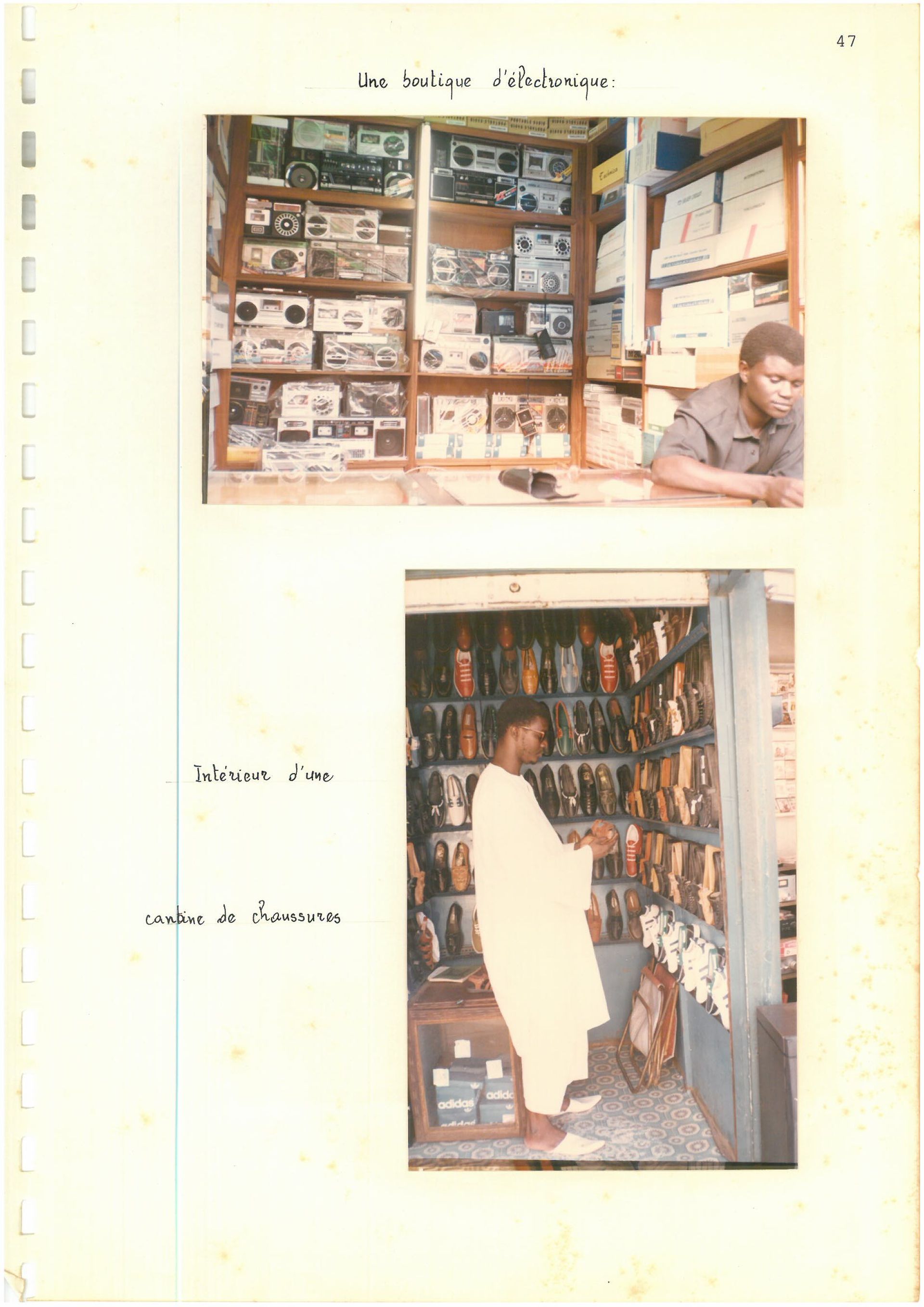
Jean-Augustin Carvalho. Excerpt from the thesis Conception d’un centre commercial : Contribution à l’Etude de Restructuration du Marché Sandaga, 1988
In 2013, the market was tragically damaged in a fire and subsequently demolished in 2021. This fuelled a new debate on the value and preservation of heritage, and led to legal battles, technical studies, and designs. An unrealized project by Andrée Diop-Depret and her firm GA2D aimed to restore the building’s original envelope and functions by reinforcing the structural elements damaged by the fire. One of the functions that Diop-Depret wanted to restore, long forgotten by young people in Dakar, was the market terrace, which had hosted balls and rehearsals by dancers from the Daniel Soprano theatre, and could have been used for other cultural events in the city.
The contributions of the four architects at the discussion highlighted a cross-disciplinary understanding of the historical, socio-cultural, material, and urban considerations of the built heritage, based on research, cataloguing, and mapping that not only seek the preservation of the buildings but also bringing them to life in the contemporary context.
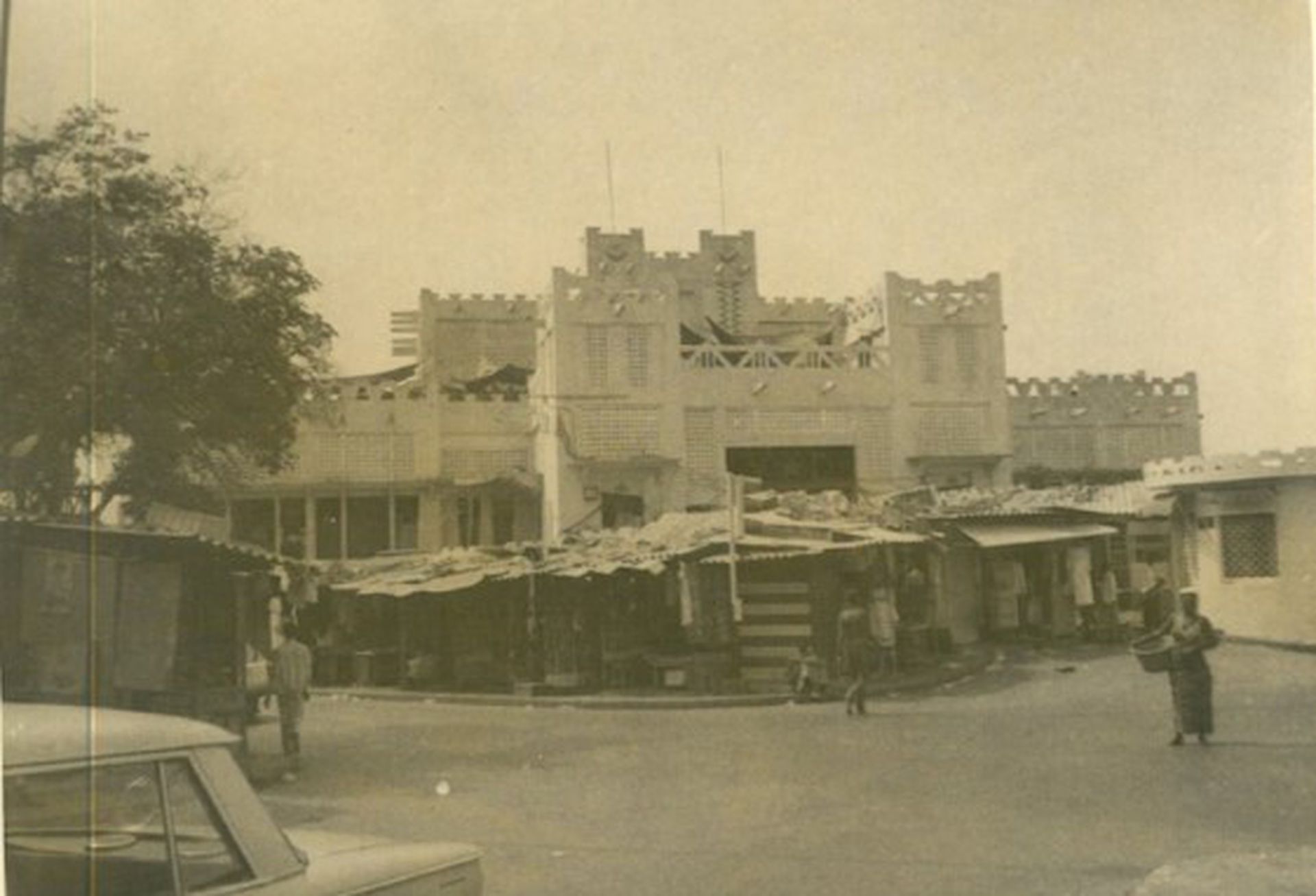
The Sandaga market in 1975. Excerpt from the presentation by Jean-Augustin Carvalho, 17 August 2024
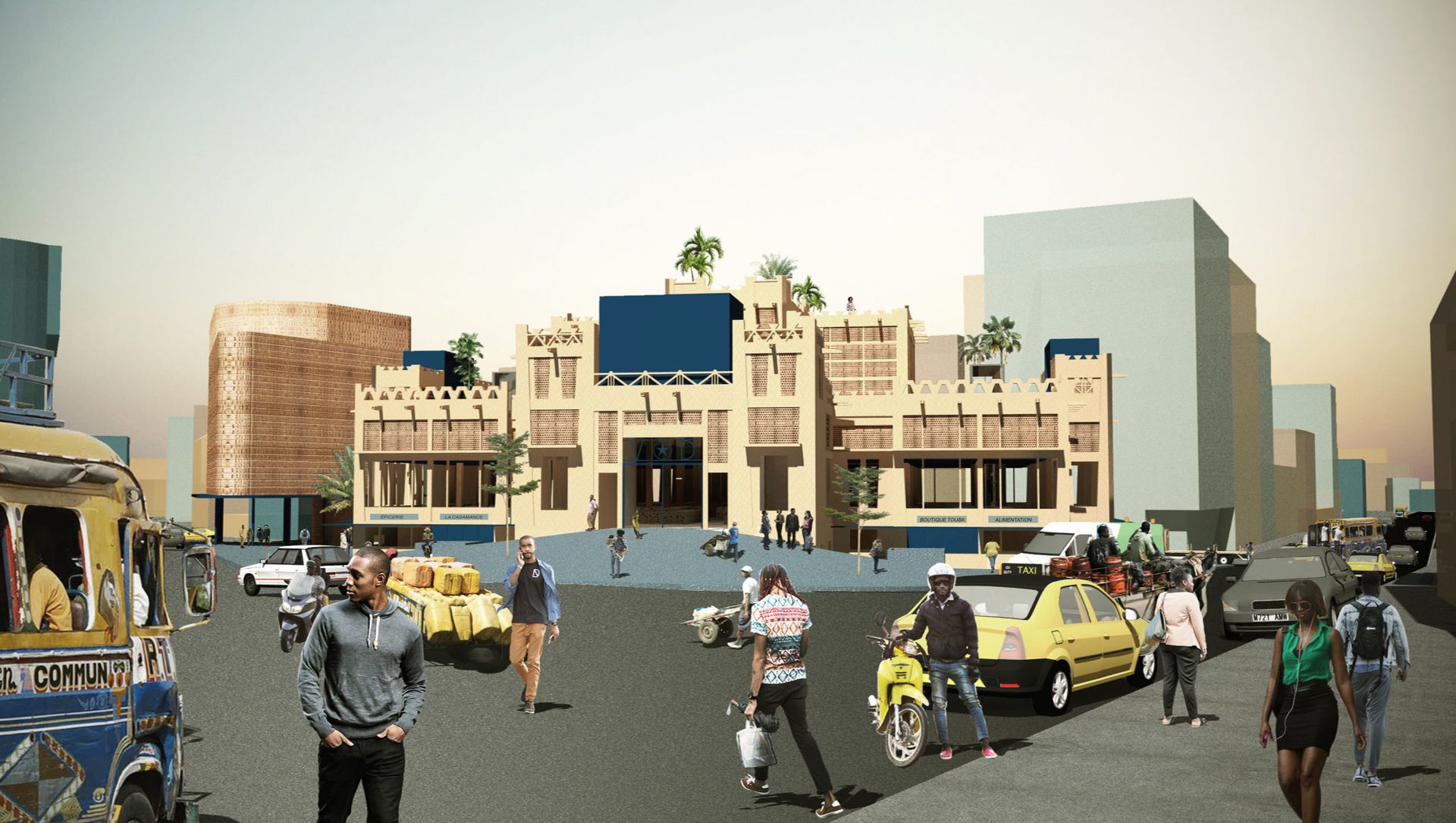
GA2D, renovation project for Sandaga market. Excerpt from the presentation by Jean-Augustin Carvalho, 17 August 2024
Preserving architectural heritage
In addition to the unfinished Sandaga market project, Andrée Diop-Depret presented a number of restoration, refurbishment, and renovation projects for listed buildings designed by GA2D over the years.1 The implementation strategy for these projects is based on knowledge of history, materials, and construction processes, echoing the research and mapping work of Xavier Ricou.
-
Andrée Diop-Depret elucidated the distinction between these three terms. Restoration involves restoring the building to its original state, strictly. Here again, the aim is to preserve the building’s historical heritage, even more strictly than in the case of renovation. Refurbishment consists of redeveloping a building while preserving its exterior appearance and improving its interior comfort. Thus, refurbishment presupposes respect for the architectural character of the buildings. Renovation can lead to a change of use for the building. The aim of renovation is to make the building as good as new. ↩
“The built heritage has continued to deteriorate. The building materials are ageing prematurely and the lack of maintenance means that even old walls end up collapsing. There’s also a loss of know-how, which means that when an old wall is repaired, it’s done in the style of the twentieth or twenty-first century, and not the way it used to be done in the past, with layers of stone one on top of the other.” Xavier Ricou
“In Gorée, the lintels were made of wood and to support the lintel, to give it a little more strength to hold the balconies, stone arches were put up, made of bricks… These arches were found on the gallery and restored. The plinths and posts were also made using the same system of basalt rubble bonded with lime.” Andrée Diop-Depret
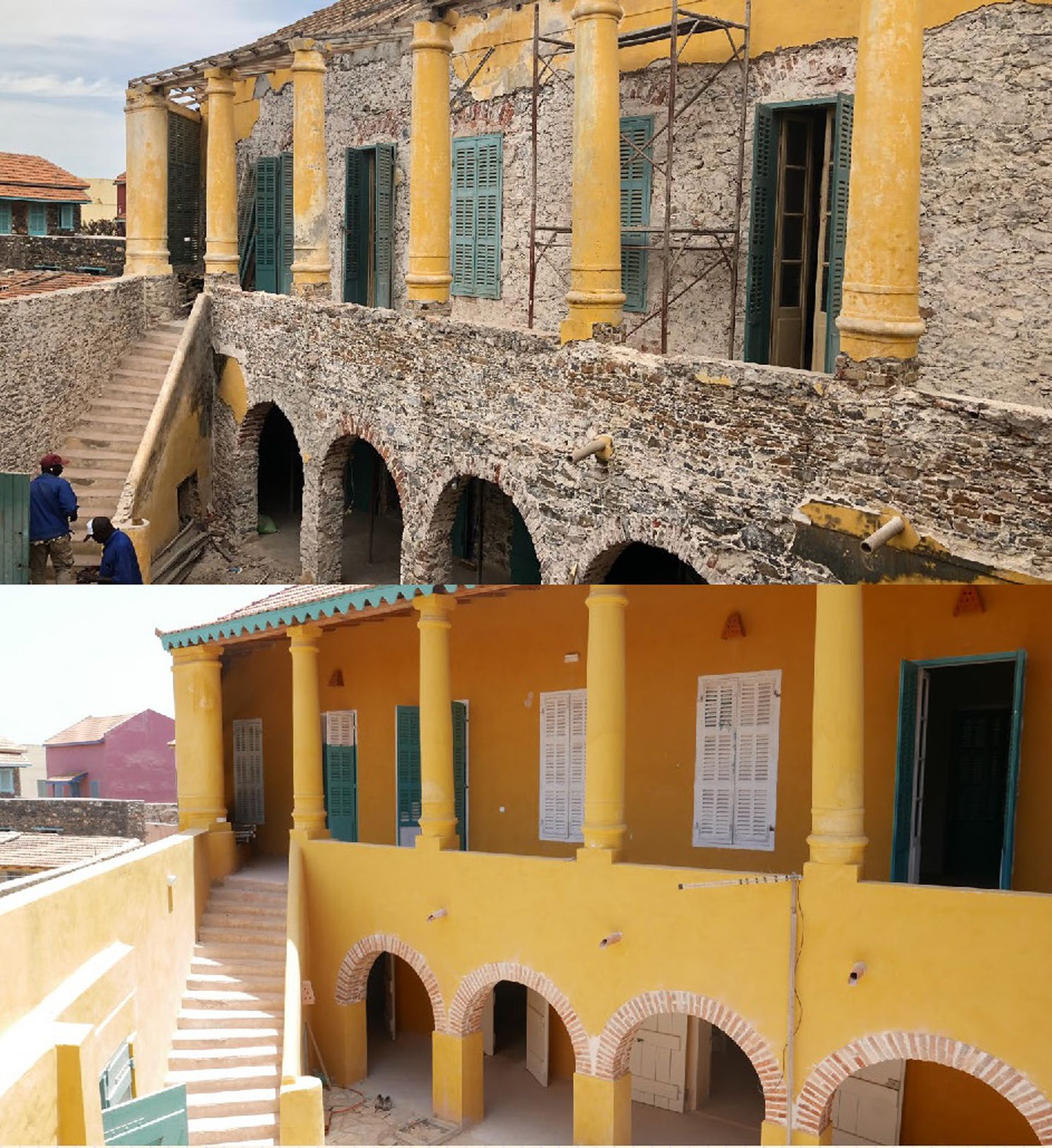
The Maison Victoria Albis in Gorée before and after its refurbishment. Excerpt from the presentation by Andrée Diop-Depret, 17 August 2024
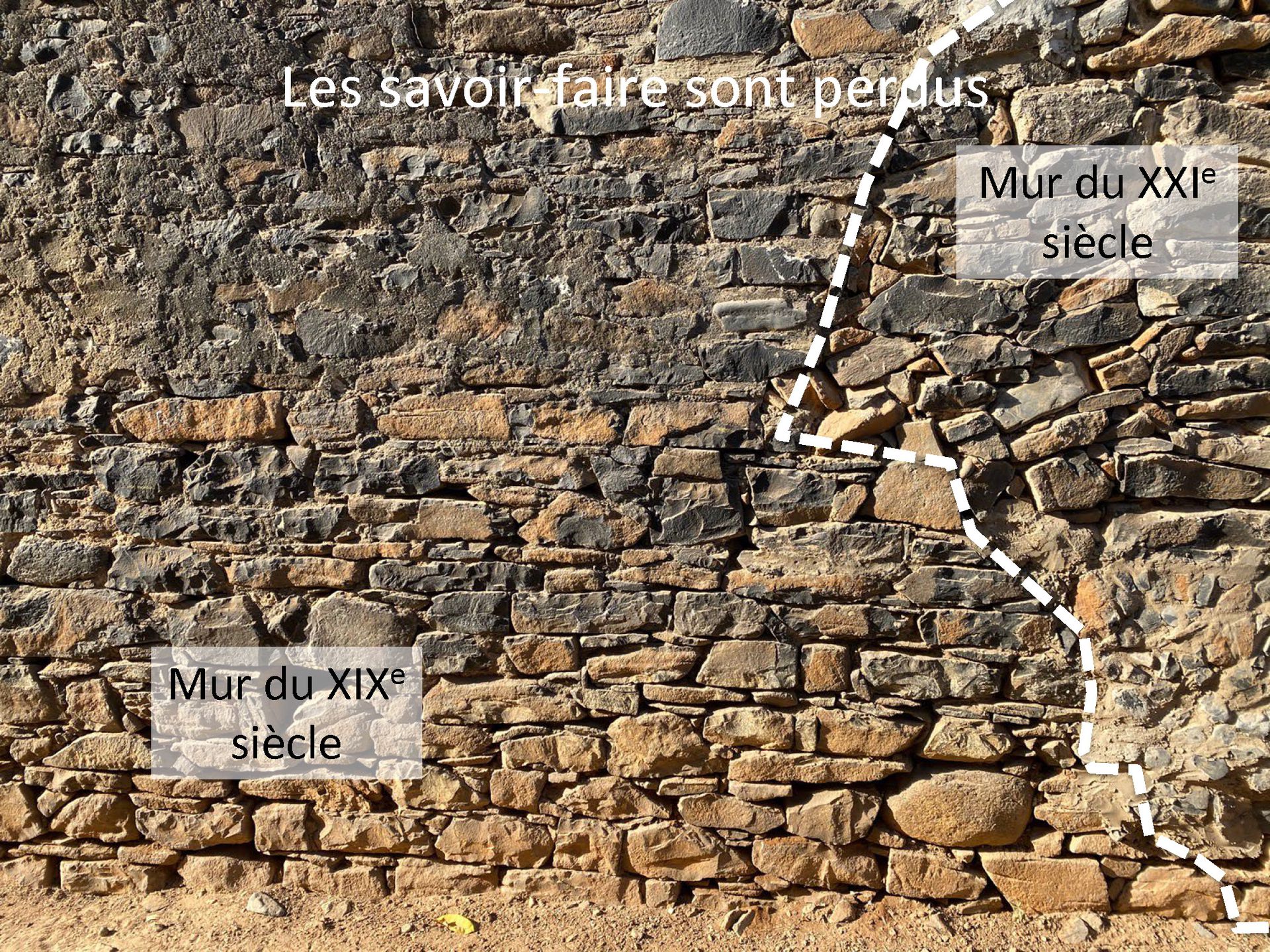
A basalt wall badly restored at the Maison Victoria Albis in Gorée. Excerpt from the presentation by Xavier Ricou, 17 August 2024
The restoration projects by Diop-Depret / GA2D and Ricou for the Maison des Esclaves (House of Slaves) and the Maison Victoria Albis in Gorée began with surveys that made an inventory of the modifications made to the buildings over time. The analysis also made it possible to study the composition of the walls made of basalt rubble assembled with lime and shell mortar, to which cement-block walls were added in the twentieth century. The restoration preserved the visual aspect of the buildings on several fronts: On the façades, arrow slits and blocked windows were identified and brought back to their original state. To keep with the materiality of the buildings and the site, GA2D sourced stones from Popenguine to restore the steps of the central staircase.
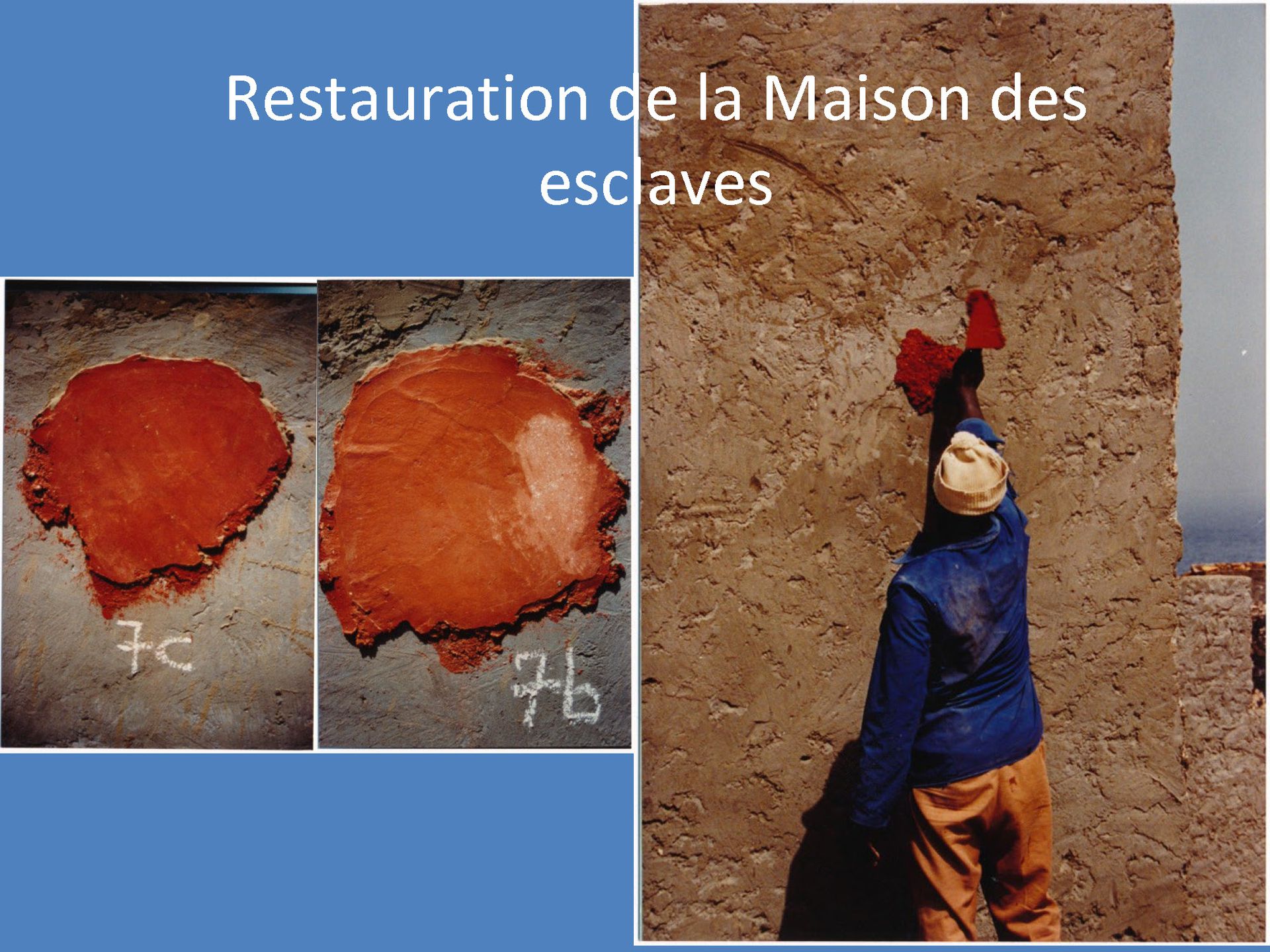
Restoration of the Maison des Esclaves in Gorée. Excerpt of the presentation by Xavier Ricou, 17 August 2024
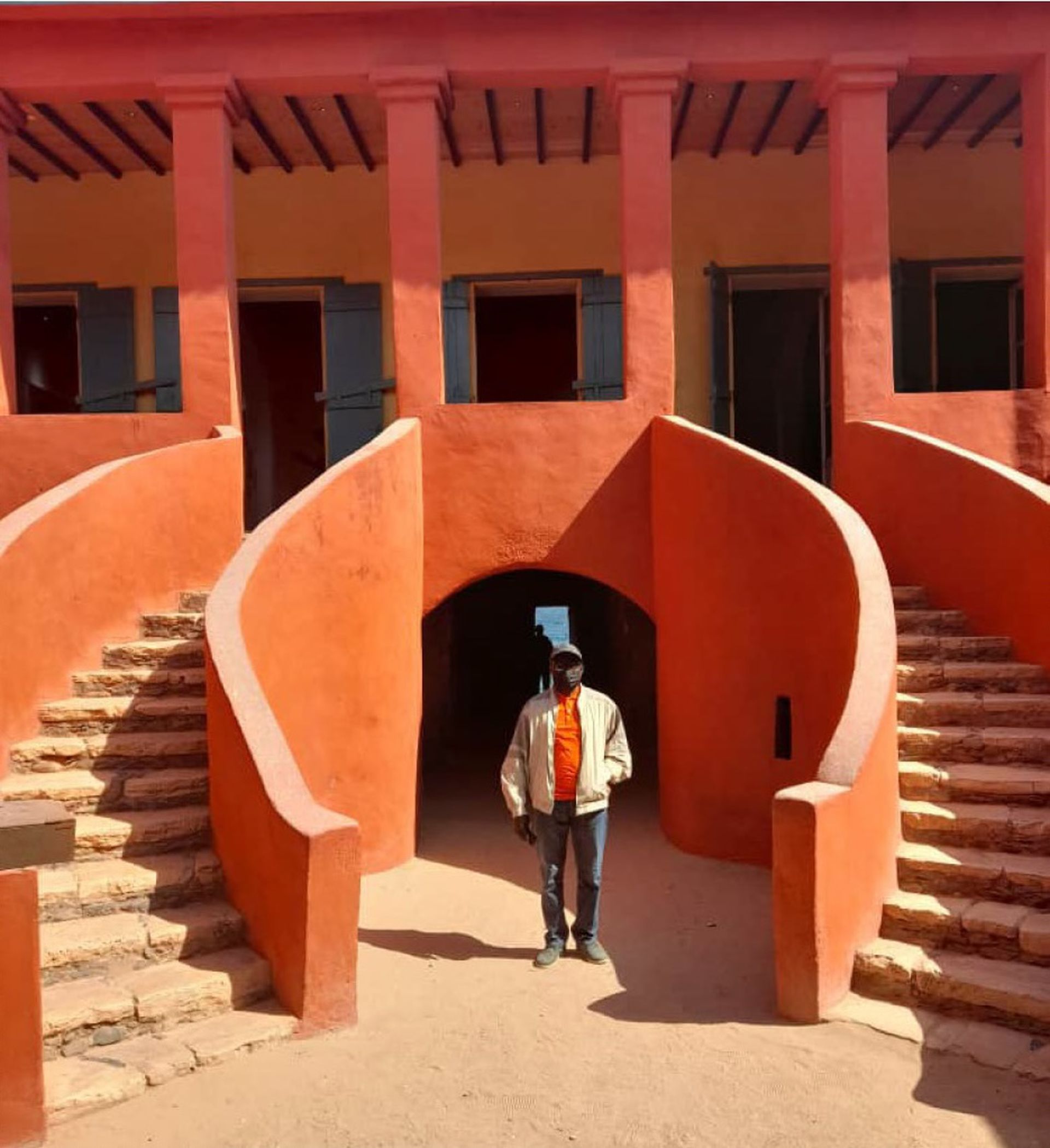
Restoration of the Maison des Esclaves in Gorée. Excerpt of the presentation by Andrée Diop-Depret, 17 August 2024
“At the Maison des Esclaves, all the galleries were lined with wood, with beams made of palmyra palm… These palms can’t be cut anymore in Senegal, but we managed to obtain a special permit to allow the company to do it so that we could replace certain elements.” Andrée Diop-Depret
For the renovation and extension project of the Dakar railway station, GA2D’s approach was to retain the terracotta brick façade and the original metal structure, while reorganizing the interior spaces to meet the needs of the new regional express train (TER). The metal structure was reinforced by a parallel reinforced concrete structure on the inside, and the attic space was used as a technical area for the new mechanical ventilation system. The floors were redone using the traditional granito or terrazzo technique, using marble from the Kédougou region in eastern Senegal. The ceramics on the main facade were redone in collaboration with Dakar ceramist Mauro Petroni, to match the originals. The metal and brick extension extends the original station’s palette of materials, making this renovation an example of how an old infrastructure can be updated to serve the country’s current and future needs. These projects by GA2D demonstrate how the architect’s knowledge of history, materials, and techniques is crucial to the enhancement of heritage, so as to preserve infrastructure and memory while bringing old buildings into the present with contemporary functions.
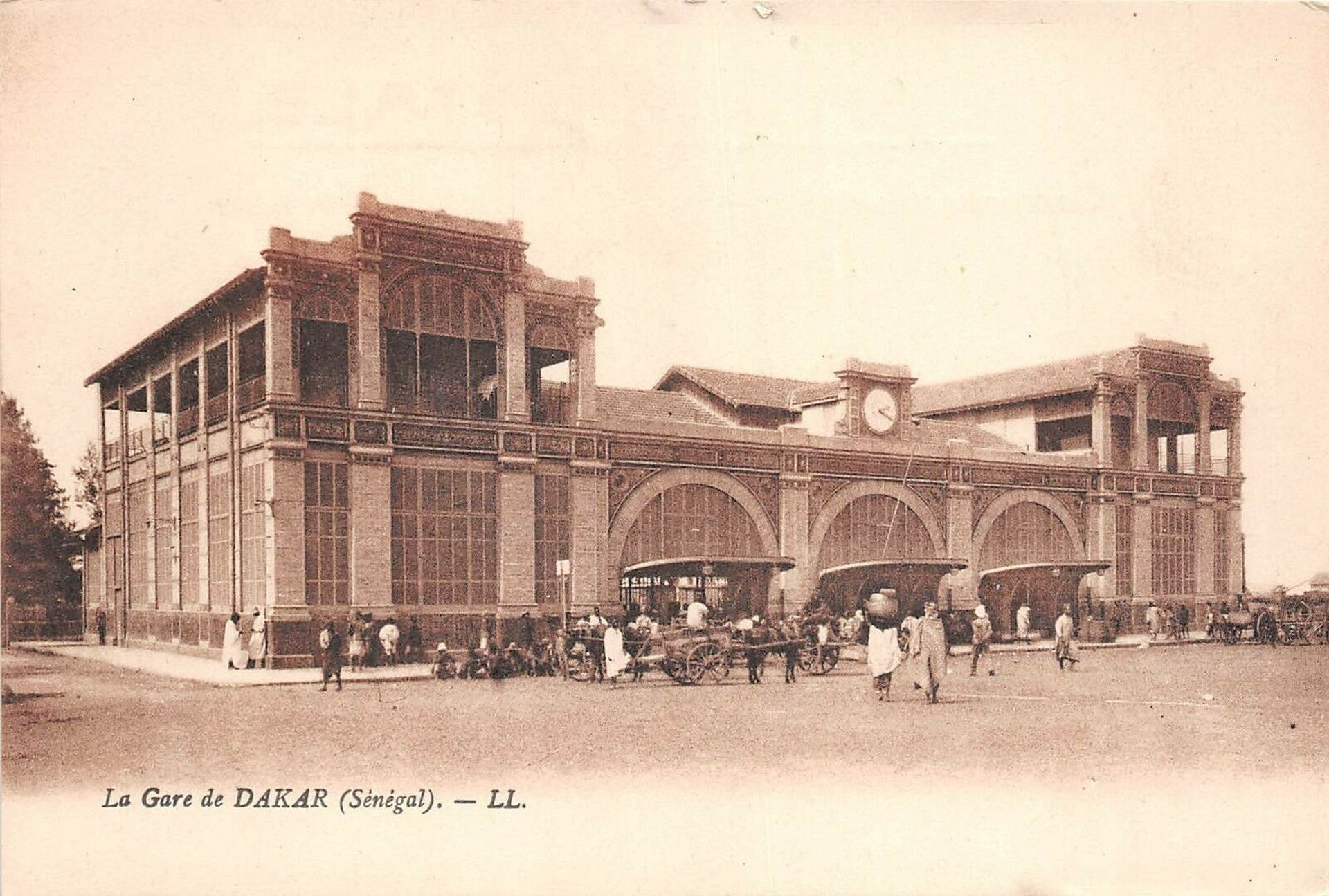
Unknown photographer. Dakar railway station, early 20th century. Postcard
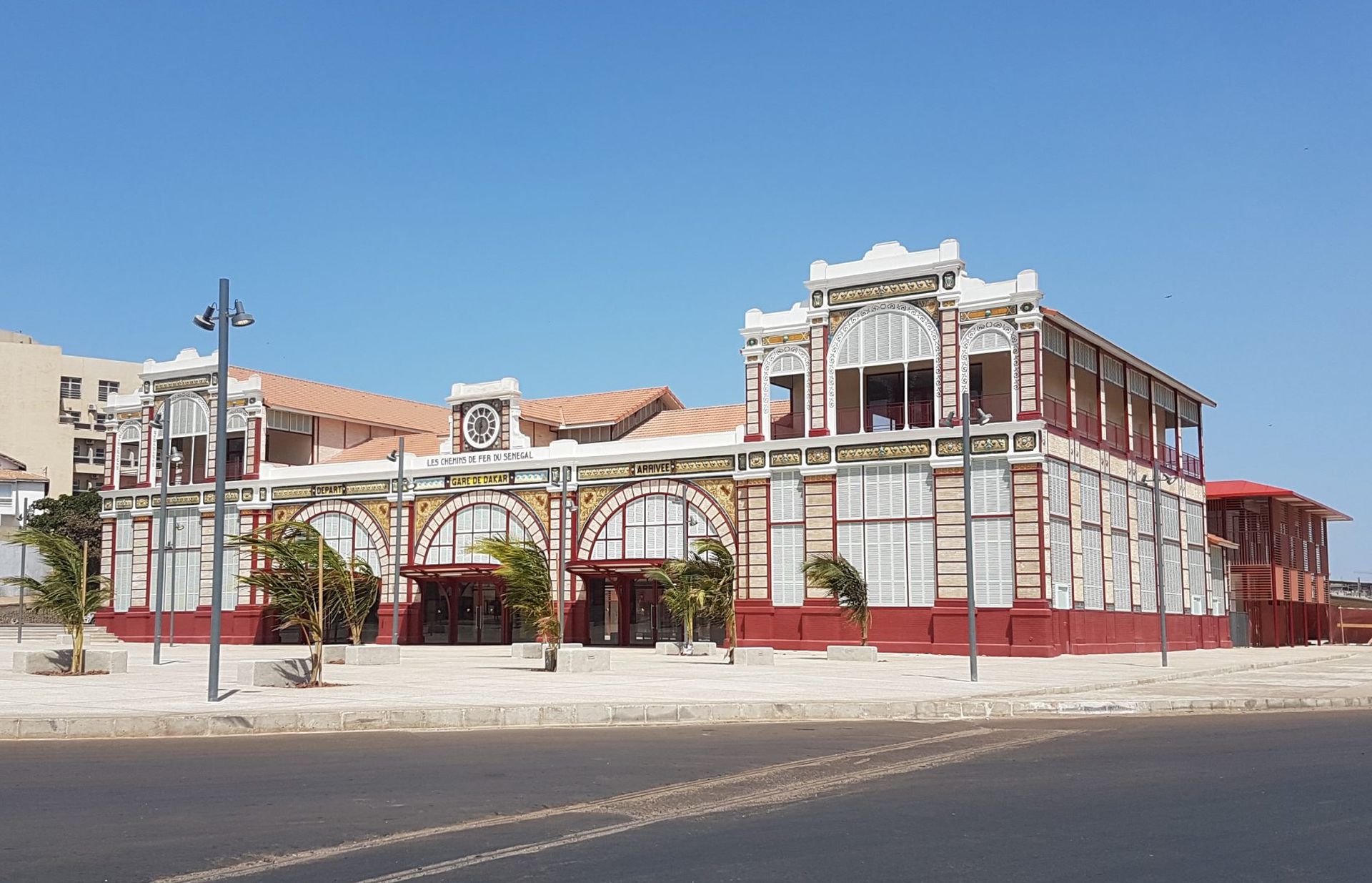
The Dakar railway station today, following the refurbishment project by GA2D
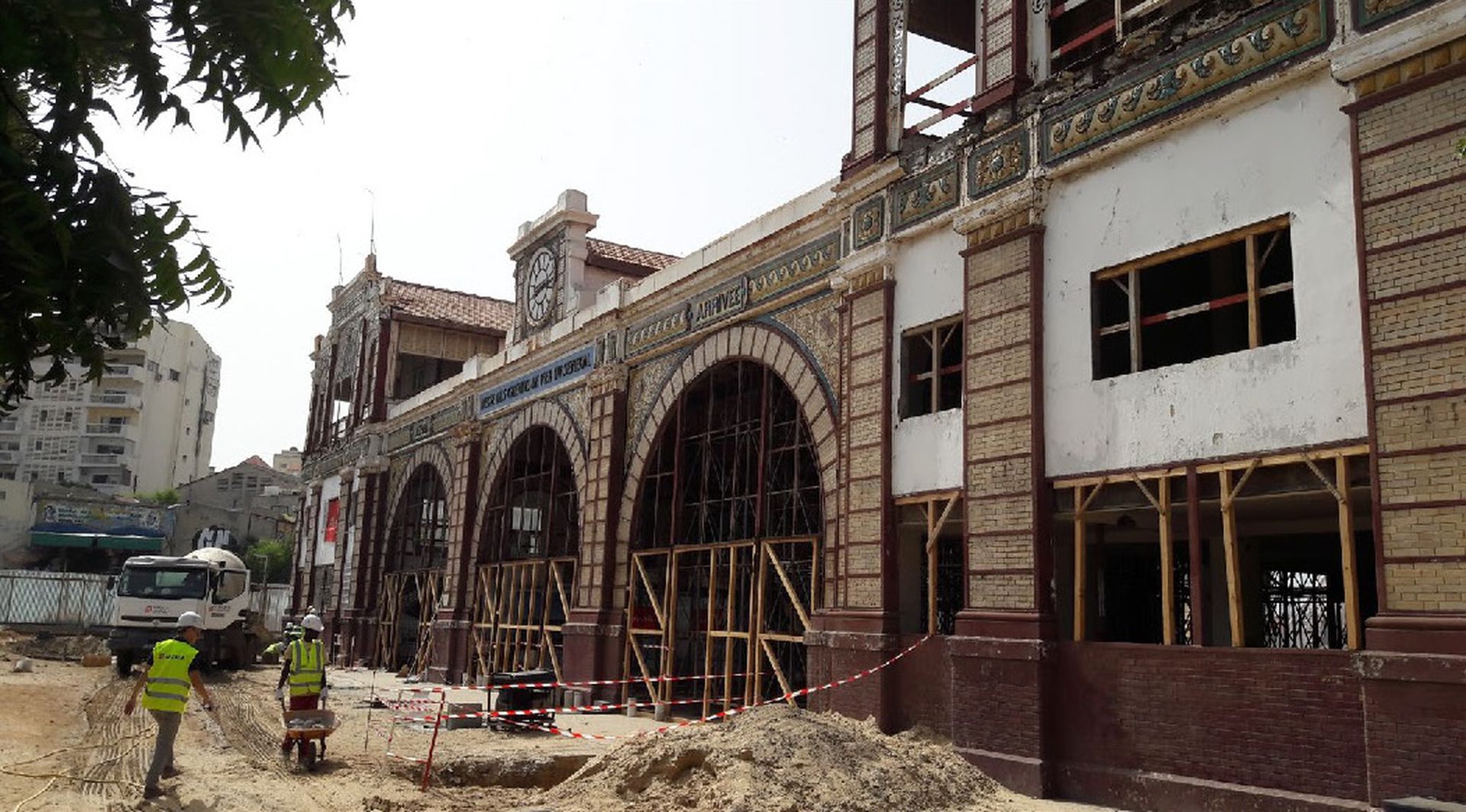
The Dakar railway station during restoration work of the structure. Excerpt from the presentation by Andrée Diop-Depret, 17 August 2024

The Dakar railway station during restoration work of the structure. Excerpt from the presentation by Andrée Diop-Depret, 17 August 2024
Traditional built heritage can also inspire architects in their contemporary designs, as in the case of the Saint-Maur market in Ziguinchor. This project enabled architect Jean-Augustin Carvalho to pursue his interest in the central function of markets by drawing inspiration from traditional Diola architecture, in particular the impluvium huts, organized around a central atrium that brings light into all the spaces.
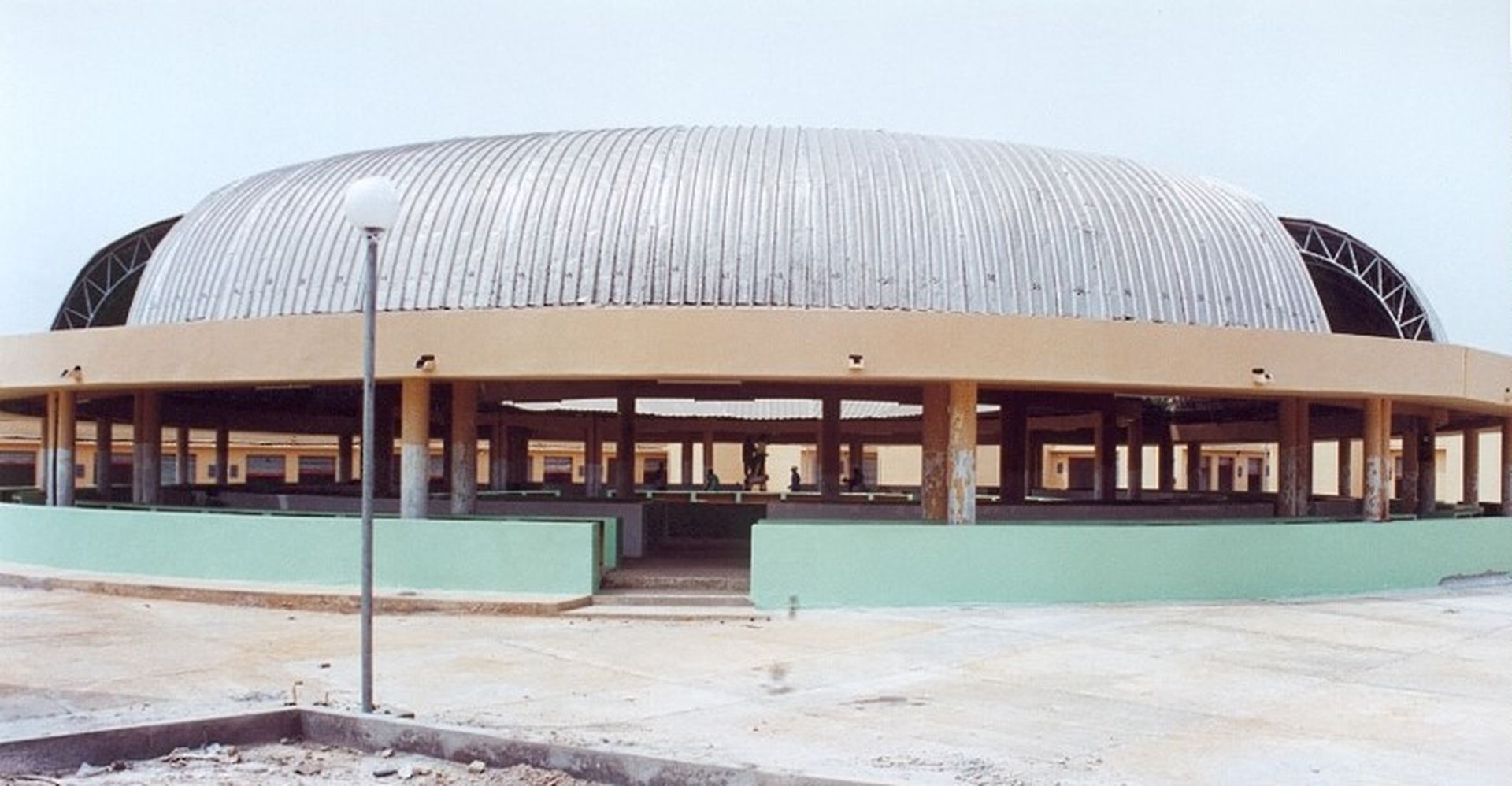
Jean-Augustin Carvalho. Saint-Maur market in Ziguinchor. Excerpt of the presentation by the author, 17 August 2024
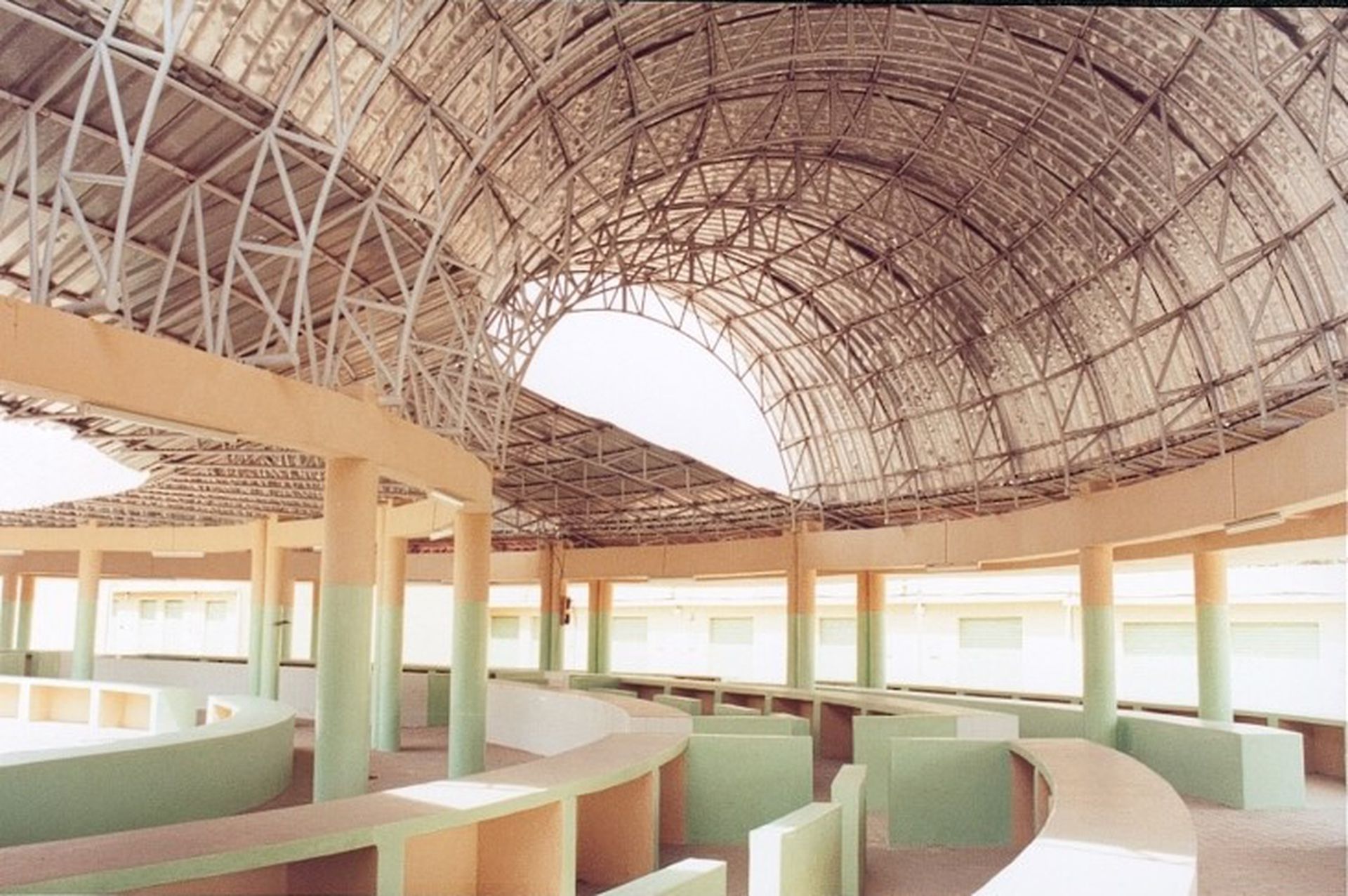
Jean-Augustin Carvalho. Saint-Maur market in Ziguinchor. Excerpt of the presentation by the author, 17 August 2024
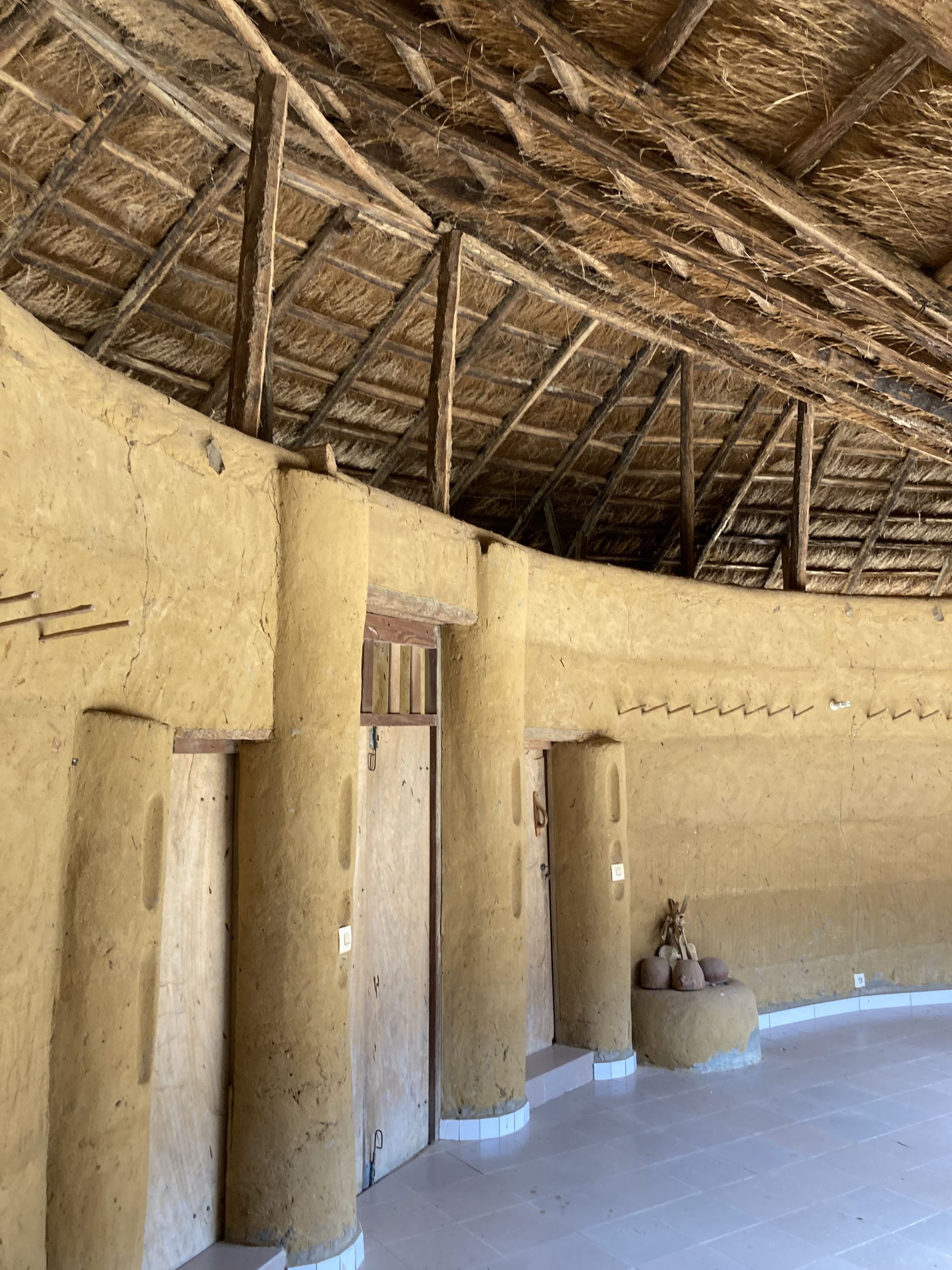
An impluvium hut in Casamance. Source: Worofila
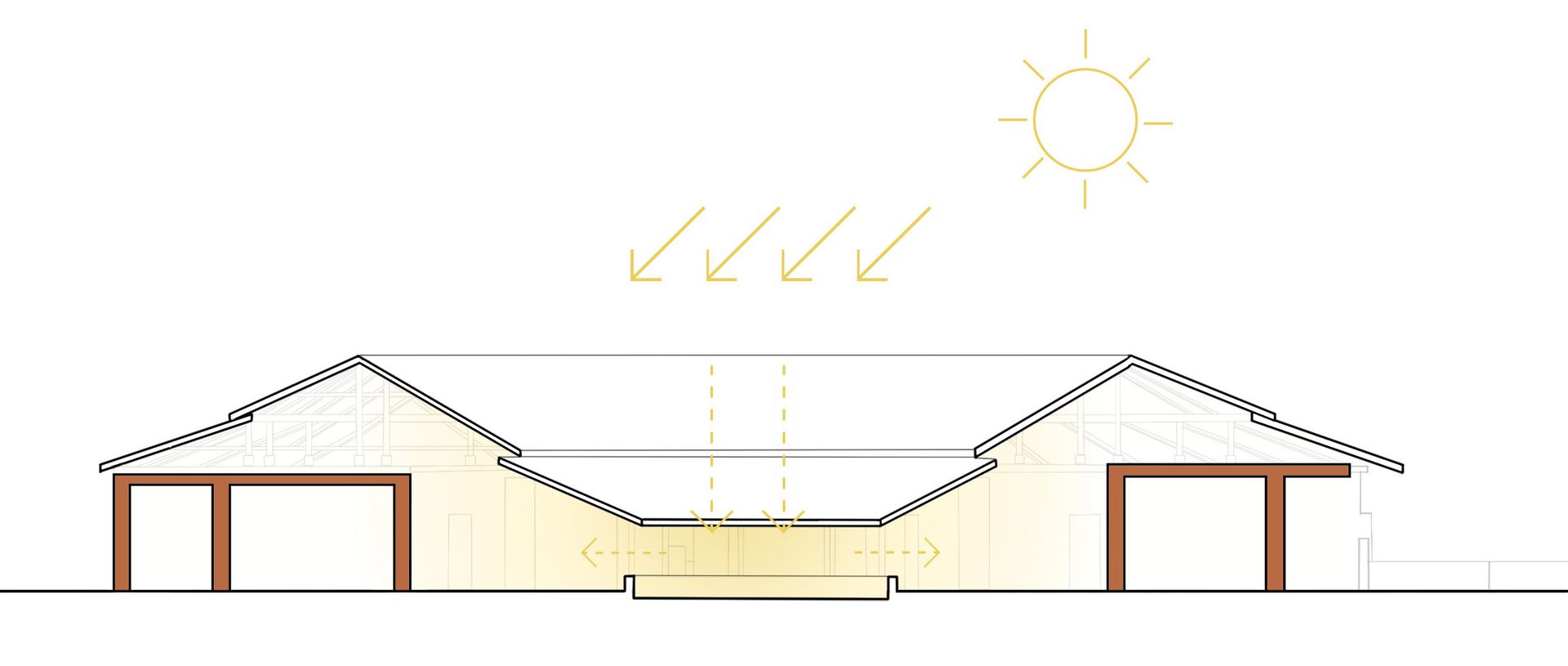
Strategy for daylight control in an impluvium hut in Casamance. Source: Worofila
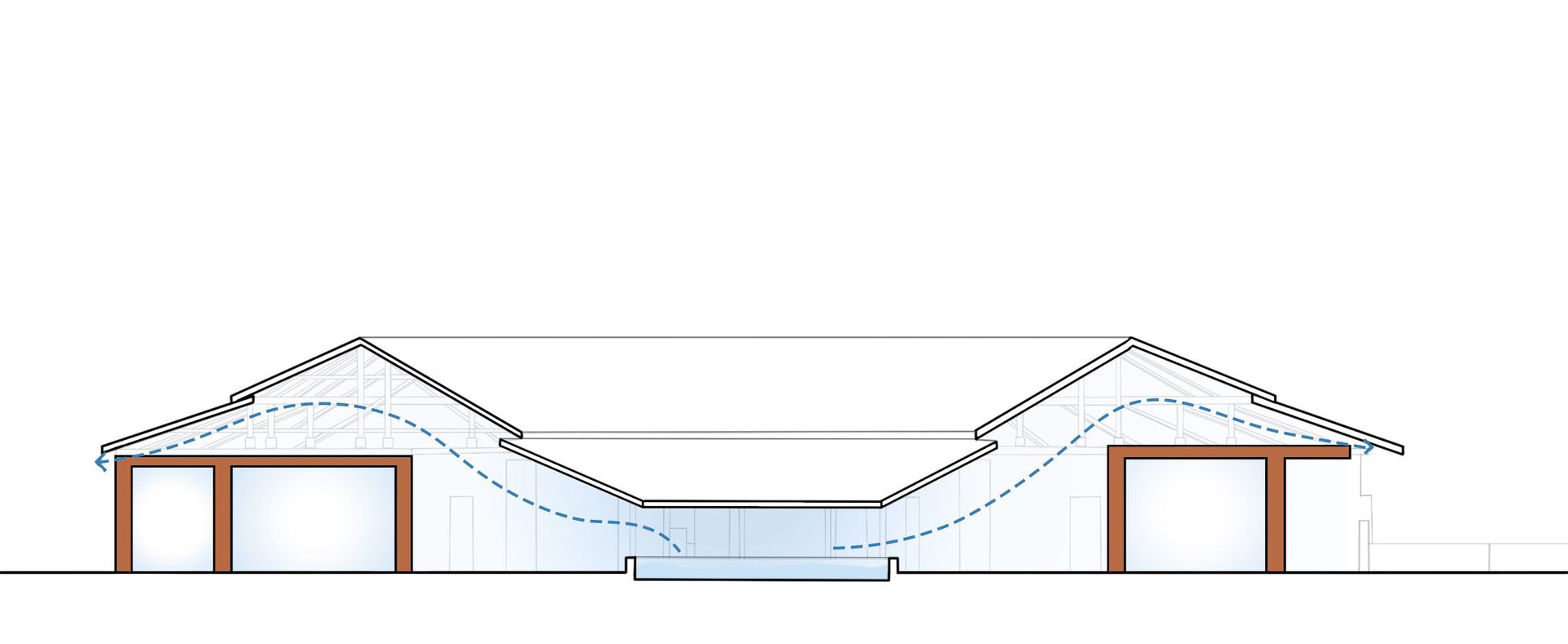
Strategy for natural ventilation in an impluvium hut in Casamance. Source: Worofila
What tools and challenges?
Traditional architecture offers a wealth of lessons on passive strategies for thermal comfort, as well as on the use of local resources to construct buildings rooted in their context. The Casamance impluvium hut, for example, embodies the principles of natural lighting, rainwater collection with naturally ventilated thatched roofs, and the constructive know-how of earthen walls. The colonial period saw the introduction of construction techniques using basalt or limestone (Rufisque stone) and, later on, the use of terracotta buildings, which are characteristic of Saint-Louis. Even after independence, the modernist architects of the 1970s, such as BEHC (Bureau d’Études Henri Chomette) and Birahim Niang with ADAUA (Association for the Development of Traditional African Urbanism and Architecture) in the 1980s, also adopted a natural architectural approach, using locally-produced terracotta.
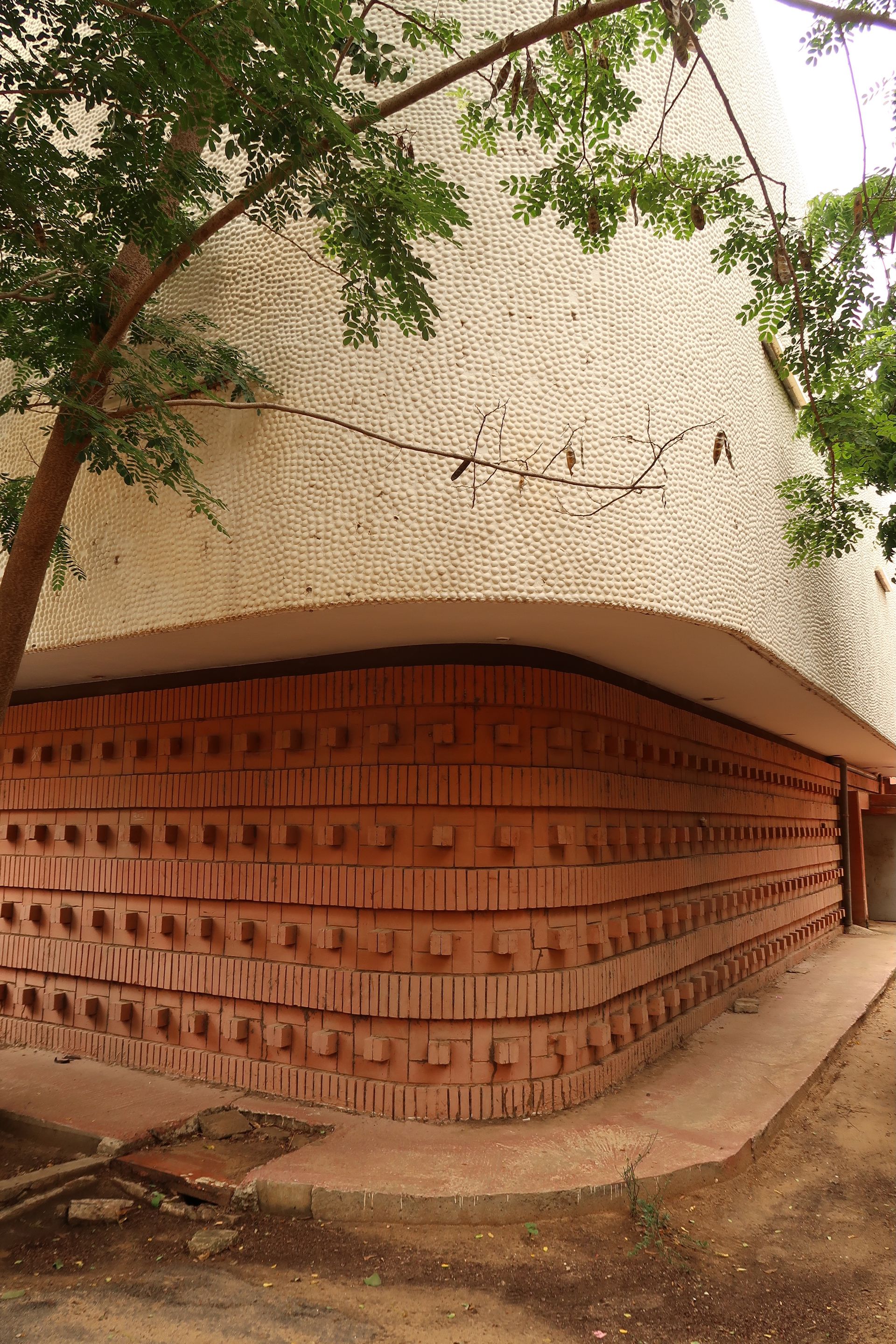
BEHC. Building with shell façade (Faculty of Science and Technology, Dakar). Photograph: Worofila
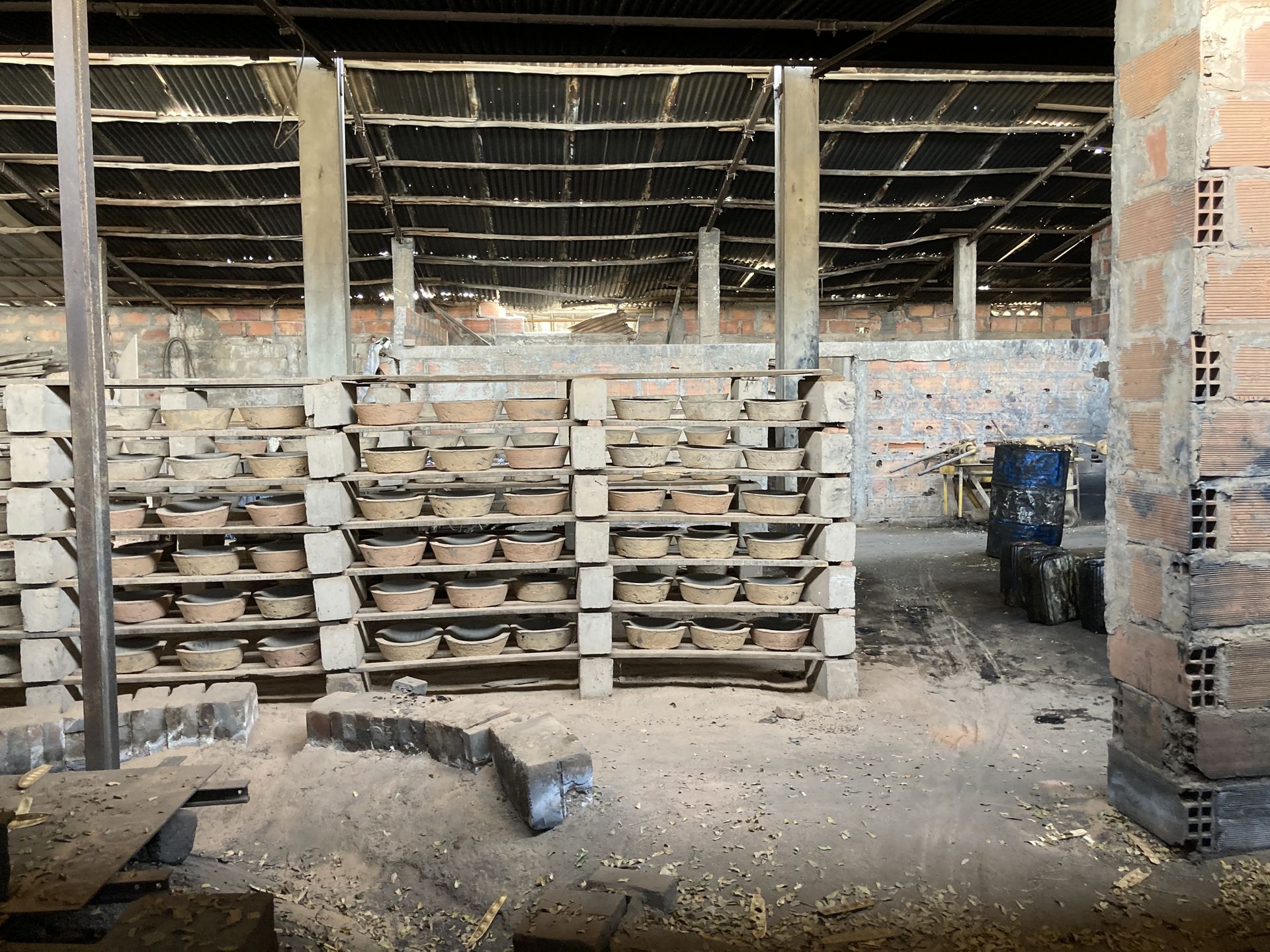
The only brick manufacturing company remaining in Sébikhotane. Photograph: Worofila
The conservation of built heritage relies on specific know-how: knowledge of materials and construction techniques other than reinforced concrete, concrete blocks, glass, or aluminium, materials that dominate the current construction industry in Senegal. The loss of knowledge is impoverishing architectural culture and the built environment, which is increasingly dependent on imported materials (tiles, steel, and aluminium), and existing buildings are becoming more and more difficult to renovate or restore.
“We made recommendations for the creation of a heritage training centre in Saint-Louis, which would enable people to relearn the skills involved in safeguarding and refurbishing heritage.... To push the building codes and Senegalese authorities to invest in a manufacturing unit for roof tiles, clay bricks, etc. so that the components used in the restoration of heritage buildings could be produced on site, with a training centre next door that could use these components (joinery, carpentry, and all that) to make the work on the ground more effective.” Fodé Diop
The importance of transmitting knowledge about built heritage and the places where this knowledge is passed on is a social endeavour that will enable us to take a critical look at our history while equipping us with the tools to enhance our different cultures and develop our economy. This foundational knowledge is necessary if we are to make informed choices about the transformation or preservation of our heritage, and if we are to serve the interests of our societies today. Forgetting is certainly a strategy that allows us to demolish and rebuild, at the cost of losing heritage wealth, natural resources, and ancestral know-how in favour of political and industrial interests seeking to gain a monopoly on markets.
The Architectural Production of Senegalese Architects
Nzinga B. Mboup looks to multiple approaches to, and definitions of, architectural identity
The first two public events in the c/o Dakar program provided an opportunity to look back at the architectural heritages of Senegal’s contemporary history by revisiting the pedagogy of the École d’Architecture et d’Urbanisme de Dakar (E.A.U.) and the work of Senegalese architects focused on highlighting those heritages. During the Dakar Biennale, a third public program focused on Senegalese architects and their projects was organized, with a particular focus on buildings designed by the first generation of Senegalese architects—notably those by Cheikh Ngom and Cheikh Ndiaye, who were among the first to open their architecture firms in the 1970s after having studied in France, and Abdoulaye Emile Diouf, an architect who graduated from the E.A.U. in 1979.
More than ten buildings designed by these architects were presented by them, their children, and their collaborators. Emphasis was placed on architectural approach and methodology, choice of materials, and integration of the building within the urban fabric. The goal was to begin to define the different variations of modern Senegalese architecture by situating these buildings within a broader context of ideological and material production. This article offers a selection of highlights from this third event and underscores some of the work produced by this first generation of Senegalese architects.
The BCEAO Tower and the Fayçal Building by Cheikh Ngom: A rational, functional, and ambitious architecture
When Senegal became independent in 1960, there was no architecture school in the country. Most of the architects working in Senegal at the time were French. Michel Chesneau, of Chesneau et Vérola; Henri Chomette and Thierry Melot, of BEHC; and Jean-Paul Castanet and Fernand Bonamy were among the first to open architecture firms in Dakar and to register as architects with the Ordre des Architectes (founded in 1970).
Cheikh Ngom was part of the first generation of Senegalese architects, all of them trained abroad (France and the United States) in the late 1960s and early 1970s. The other architects in this generation who were prolific in terms of architectural production were Pierre Goudiaby Atepa, who joined the Ordre in 1974; Moussa Fall, who joined in 1975; and Cheikh Ndiaye, who joined in 1979. It was only in 1974 that Cheikh Ngom, an engineer who had become an architect after studying at the Ecole spéciale d’architecture in Paris between 1970 and 1973, became the first Senegalese architect to open an architecture and urban planning firm in Dakar.
In 1975, with support from President Léopold Sédar Senghor, Cheikh Ngom, with his young colleague Pierre Goudiaby, won the competition to design the head office of the Banque Centrale des États de l’Afrique de l’Ouest (BCEAO), solidifying his role in the architectural evolution of the country and the continent. The BCEAO Tower project, inaugurated in 1979, marked a turning point in the construction sector in Senegal; at twenty floors, it was at the time the tallest building in the Senegalese capital.
“I did ten years of graduate studies in Paris. Then I returned to open my own firm, with Senghor’s authorization. There were French firms but there were no Senegalese firms, and his plan was to have Senegalese architects. Like all architects with a particular interest, I decided to be independent. I was able to open my own firm because I had a background with the necessary technical knowledge, and after a year of work there was the competition for the head office of the central bank.”
- Cheikh Ngom in conversation with Nzinga Mboup, Ziguinchor, May 2021

Site plan of the BCEAO complex. © Archives Cheikh Ngom
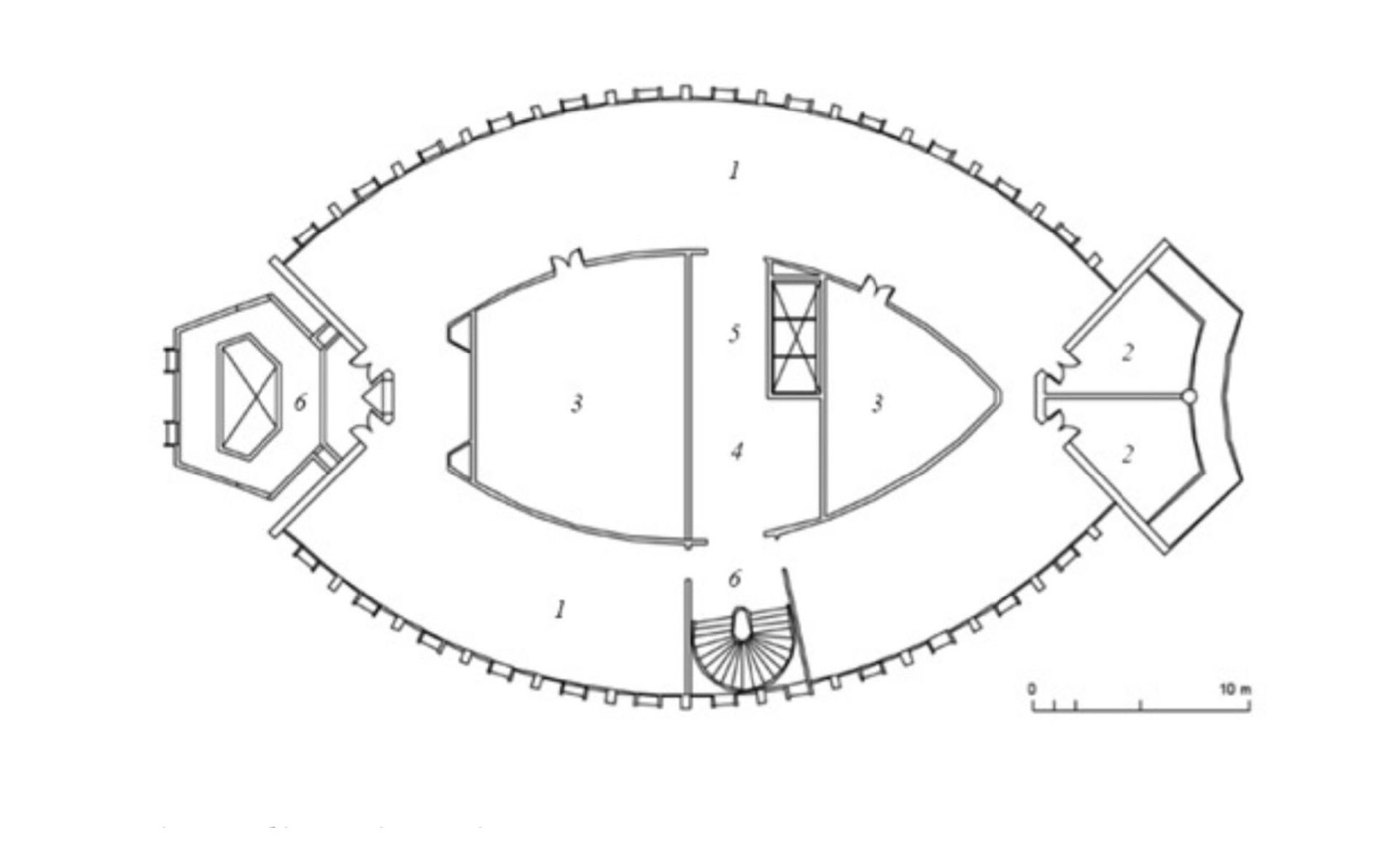
Floor plan of the BCEAO tower © Atepa Group
The bank’s head office complex is composed of five buildings around a park and is situated at the end of Avenue Albert Sarraut, one of the major downtown axes leading from La Place de l’Indépendance. The most visible part of the complex is the oval-shaped tower, inspired by the kapok tree native to Casamance. The cylindrical building is marked by arteries that originate in the ground, like roots, and extend up to its top. The tower is structured around a central core covered with what Cheikh Ngom calls the “skirt,” composed of the façade marked by the vertical arteries. The buildings’ façades are cladded with local marble in natural tones. At the foot of the building, a pool shaped like a map of Africa underscores the balance between African heritage and modernity.
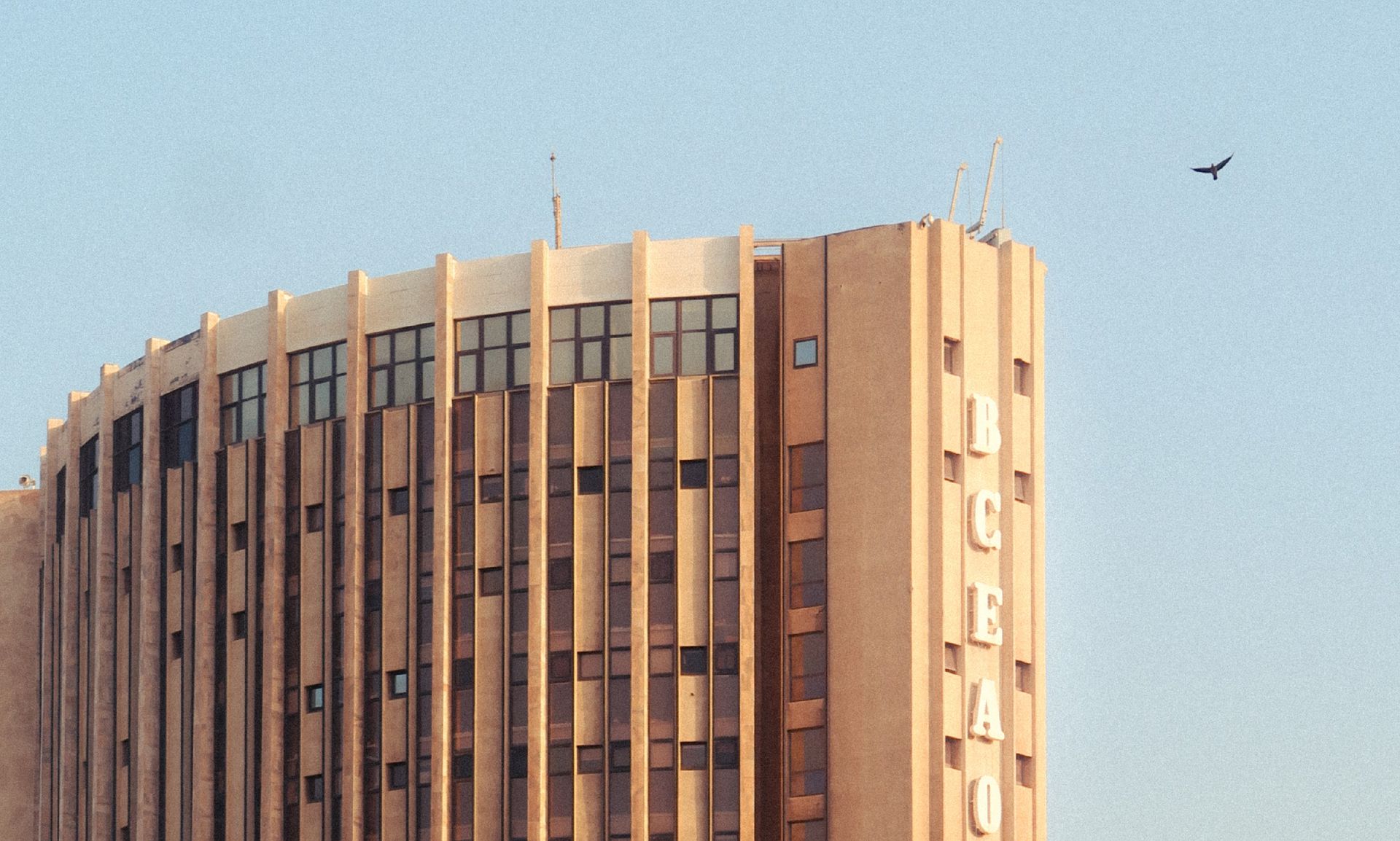
The BCEAO Tower by Cheikh Ngom and Pierre Goudiaby (1975). Photograph by Ismael Sow © Ismael Sow
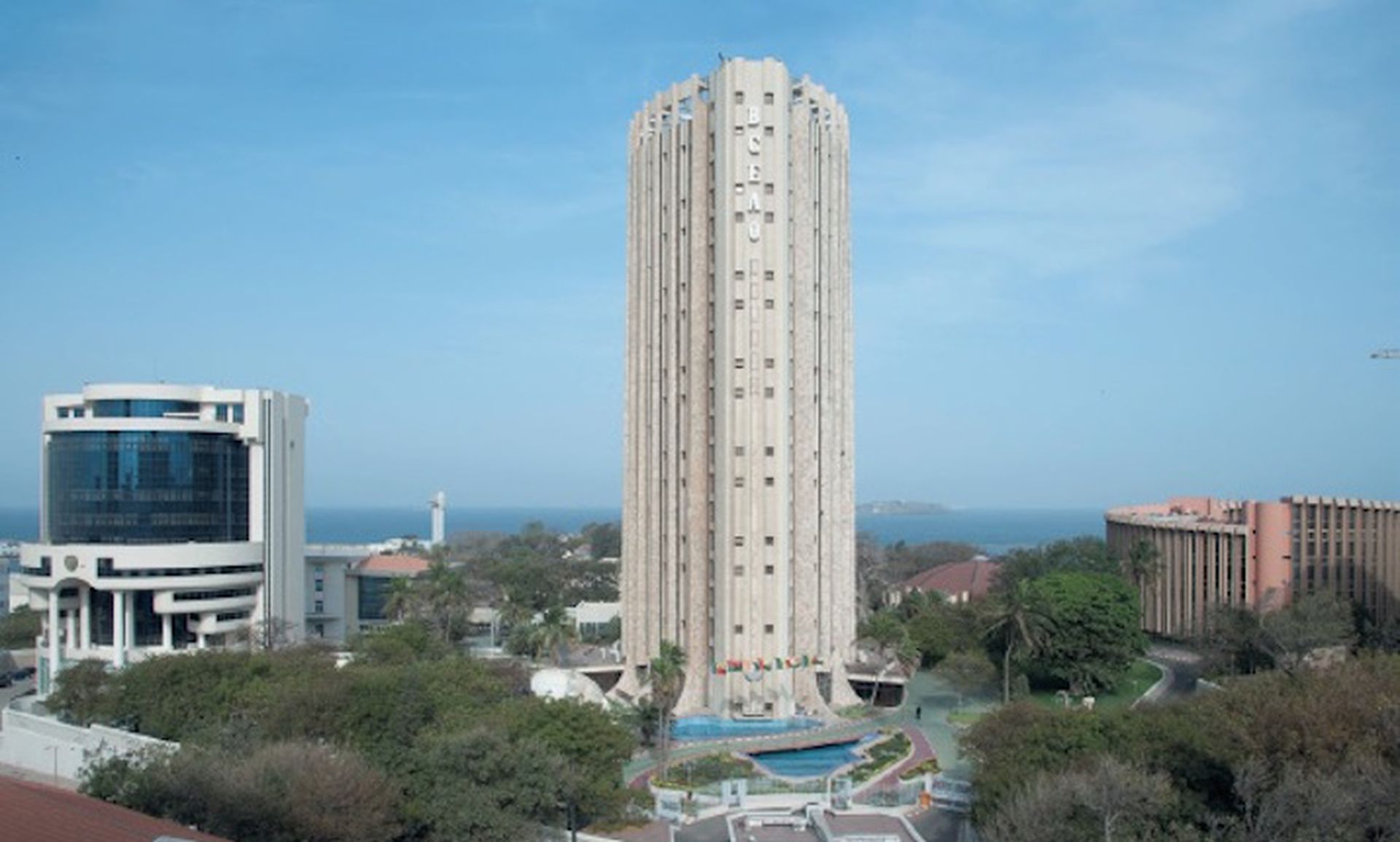
BCEAO tower © Atepa Group
“Before, there was the international, vertical European style. We brought a bit of change in the design of the façades and the shape [of the buildings]. We used rational logic with a bit of ornamentation—we had to do something a bit different in relation to what was being done.”
- Cheikh Ngom in conversation with Nzinga Mboup, Ziguinchor, May 2021
Cheikh Ngom then designed a number of residential buildings in Dakar; among the best known are the Fayçal Building (1984) and the Fahd Building (1992), both near the BCEAO Tower. The Fayçal residential tower, one of the tallest buildings in Dakar, stands out for its bold structure and raw concrete façade. Situated on a hill in the Plateau district, it combines a wide pyramidal base, balconies protruding from the first five floors, and a slender rectangular tower above. The use of reinforced concrete, iron, and an abundance of glass creates an interplay of geometric shapes and light.
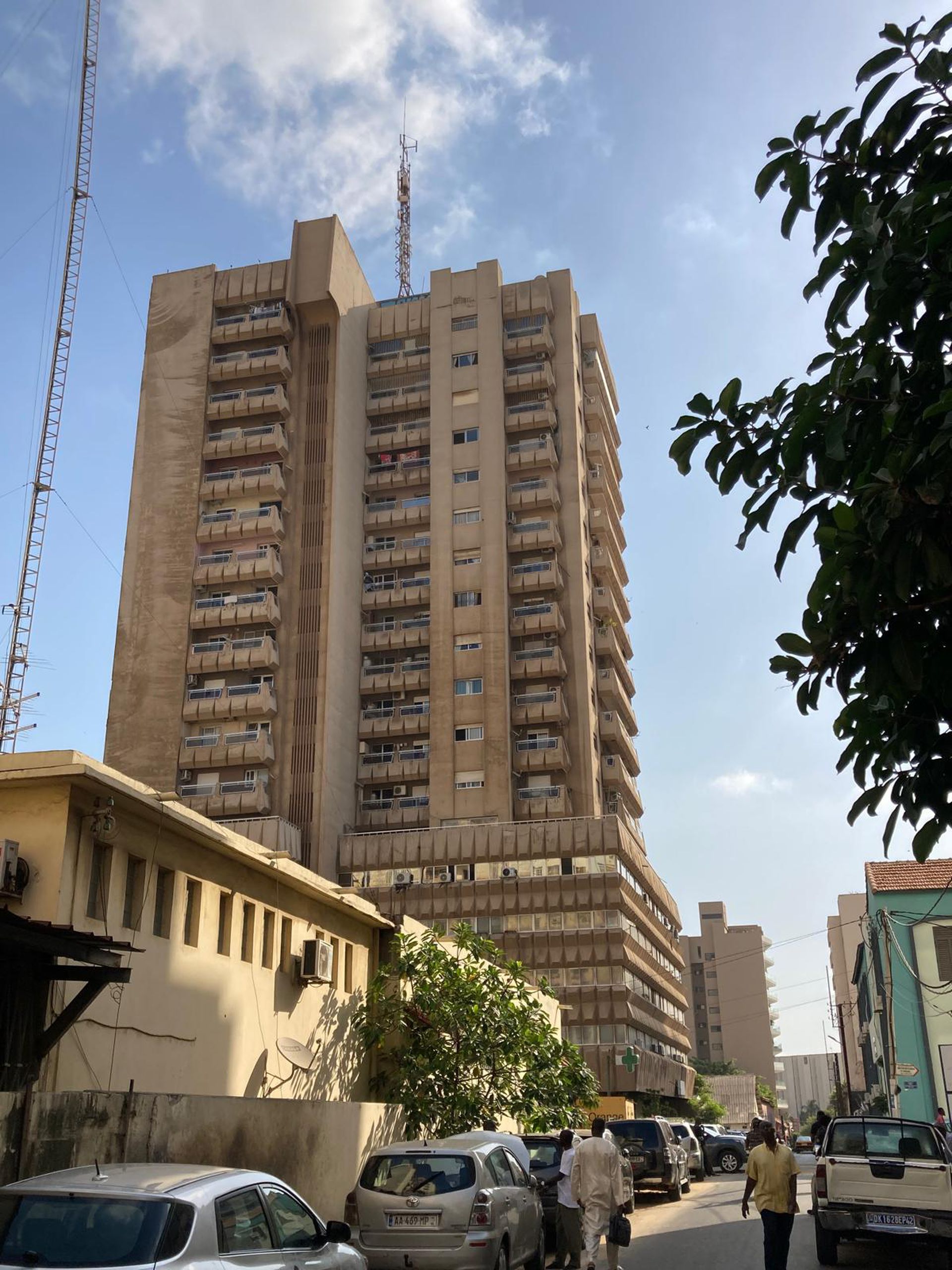
The Fayçal Building by Cheikh Ngom. Photograph by Nzinga Mboup © Nzinga Mboup
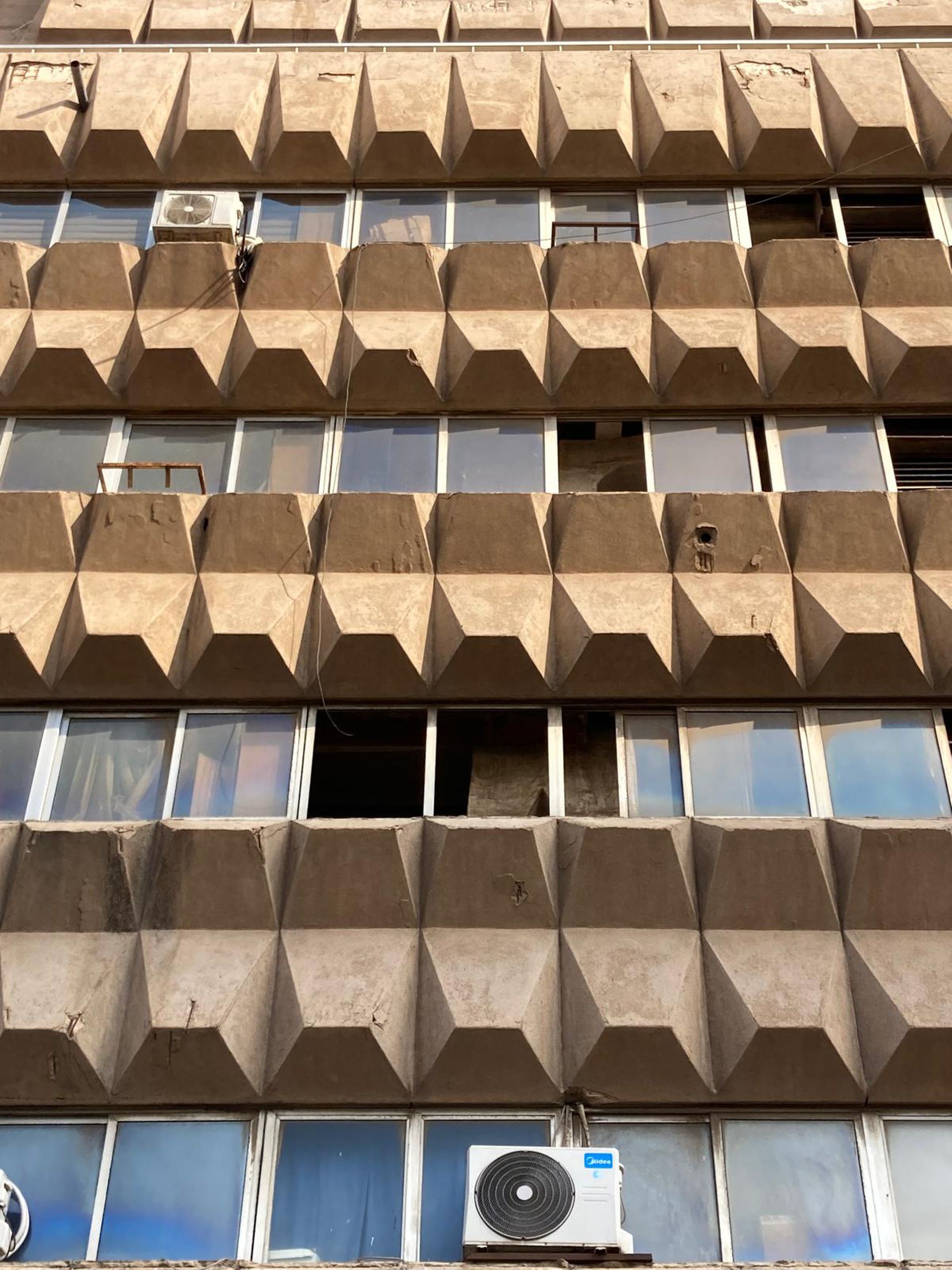
The “scales” on the Fayçal Building’s façade. Photograph by Nzinga Mboup © Nzinga Mboup
Cheikh Ngom’s unique-looking towers are still architectural icons in the Dakar landscape. They exemplify his approach based on a “rational logic” that combines functionality and aesthetics. He responded to the expectations for an African architectural identity with a pragmatic vision, integrating varied modular motifs rather than a purely decorative style. The linear modules that adorn the “skirt” of the BCEAO Tower and the “scales” on the Fayçal building also function as solar protection. For Cheikh Ngom, rational logic also involved adapting to the climate and creating facades that contribute to thermal comfort inside the building.
“Here, the Harmattan wind carries a considerable amount of sand and covers all buildings with a fine layer of orange dust. Of course, none of this is by chance. The building’s orientation takes account of the sunlight. What allows people to live well in the project is having solar protection. The façade and the orientation make comfort possible. Each façade is a project; when you’re in front of it, you feel something, you feel that it’s not ordinary. With an ordinary, smooth façade, you’d be forced to put in curtains and air conditioning.”
- Cheikh Ngom in conversation with Guillaume Ramillien, in Ziguinchor, April 2023
Aesthetics and architectural expression emerge as the product of rationality and technical mastery, with which every architect should be equipped in order to make a building functional and solid and before adding “ornaments” that must remain within a logic of economy and sustainability. Concrete was often Cheikh Ngom’s primary material—a choice that reflected a concern with durability. The façade material, whether raw unformed concrete or marble cladding, had to be easy to maintain over time.
Le Contrôle Financier and the Office du Baccalauréat by Cheikh Ndiaye: Refined architecture with local materials
Cheikh Ndiaye, with his contributions to the overall heritage in Dakar and Senegal, stands among the leaders of the first generation of Senegalese architects. After studying at the École Nationale Supérieure des Beaux-Arts in Paris, from which he graduated in 1979, he quickly returned to Senegal to found his own eponymous firm. His emblematic projects have played a key role in the development of modern architecture in Senegal.
Cheikh Ndiaye’s background training in fine arts gave him a vision of architecture as the first of the arts, and he saw no dichotomy between human being and architect in his love of the discipline. His methodology can be summarized in the precision and simplicity seen in his designs. Concerned with integrating buildings with their environments, he wanted façades to be simple to read, and he opted for clear, clean lines. The functional quality of the interior spaces was no less important, and he emphasized light and natural ventilation intentionally integrated with the structure. As he was one of the first Senegalese architects, Cheikh Ndiaye’s designs found a territorial anchoring in his use of local materials such as stone and shells, inspired by his repeated stays at Toubab Dialaw, a fishing village an hour away from Dakar.
“He spoke quite often of functionality and aesthetics: circulation, how the building was oriented, the distributions, how the interior of the building was designed. Functionality and aesthetics were very important for him but had to be linked to the façade, because he liked clean lines that are easy to read and appreciate. He spoke of façades stripped of ornamentation. He often said that ornaments did not allow for an easy reading of the façade, and he said that architecture had to be simple and beautiful.”
- Lamine Ndiaye, engineer and son of Cheikh Ndiaye, 9 November 2024
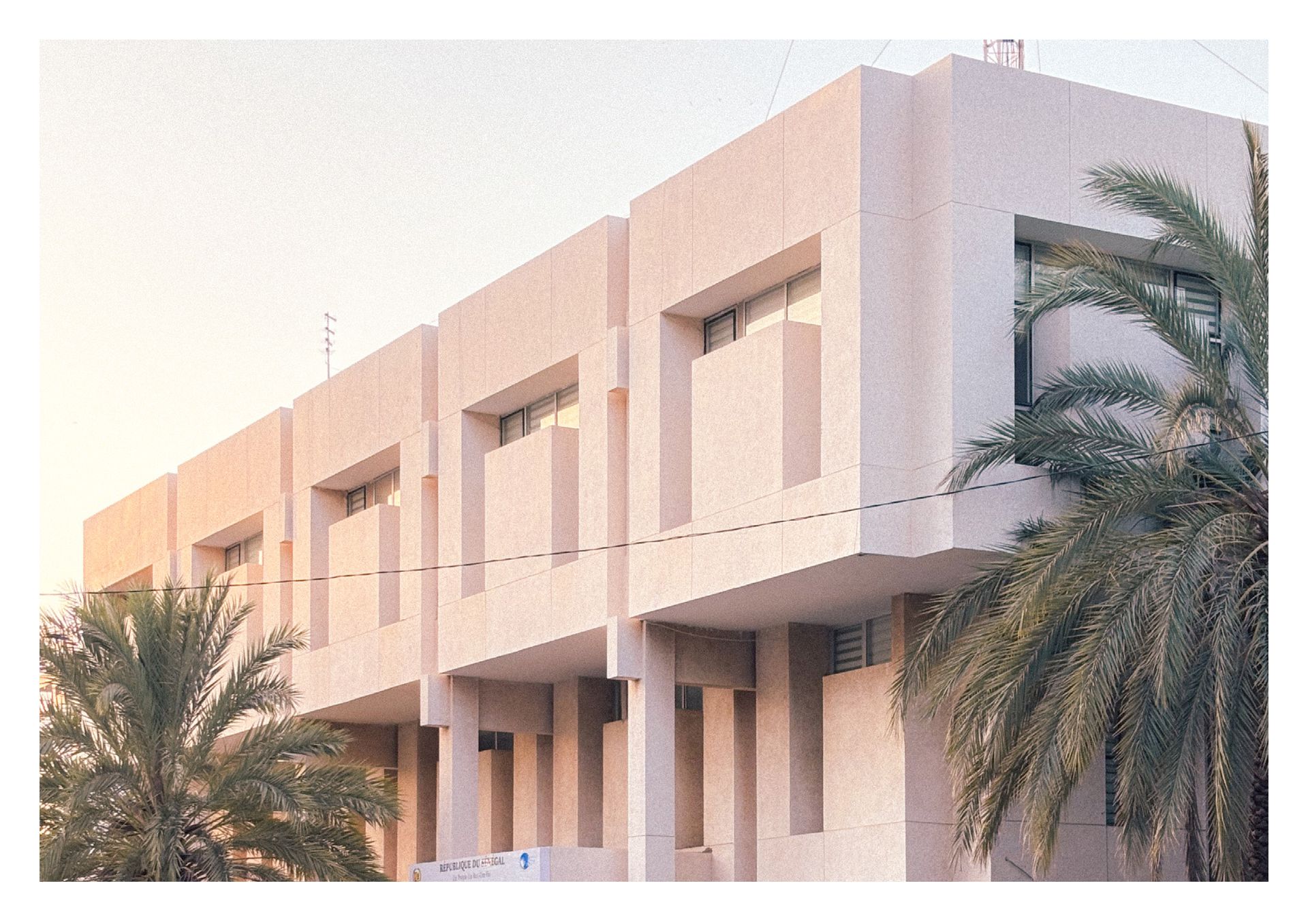
The Contrôle Financier building. Photograph by Ismael Sow © Ismael Sow

Perspective drawing of the Contrôle Financier building. © Archives Cheikh Ndiaye
The Contrôle Financier was Cheikh Ndiaye’s first project, a commission he earned by winning a competition in 1981. The building, situated facing the presidential palace, subsequently housed the prime minister’s office. The L-shaped administrative building is articulated around three levels and is integrated into the urban context, occupying the corner of the street and enclosing an inner courtyard. This inaugural building exemplified Cheikh Ndiaye’s methodology, notably the intentional integration of the structure with the architecture, as can be seen in the intersections of beams and posts deliberately visible on the façade and in the successive overhangs achieved through a rational structural framework.
The building and its façade, with their clean lines, reflect the architect’s modernist style, and the choice of fine, off-white shell cladding further emphasizes the purity of the cubic volumes. In addition to being locally sourced and drawing its origins from coastal landscapes, shell rock is also very durable and limits the need for maintenance in Dakar, where sea spray can be aggressive and damage paintwork or even concrete.
“He was someone who highlighted local materials: stone from Ndayanne, shells from Toubab Dialaw … these were things that he worked with and loved to implement in his buildings.”
- Lamine Ndiaye, engineer and son of Cheikh Ndiaye, 9 November 2024

Facade detail of the limestone used as cladding on the Office du Baccalauréat. Photograph by Nzinga Mboup © Nzinga Mboup

Façade of the Office du Baccalauréat. Photograph by Nzinga Mboup © Nzinga Mboup

Façade of the SONACOS head office. Photograph by Ismael Sow © Ismael Sow
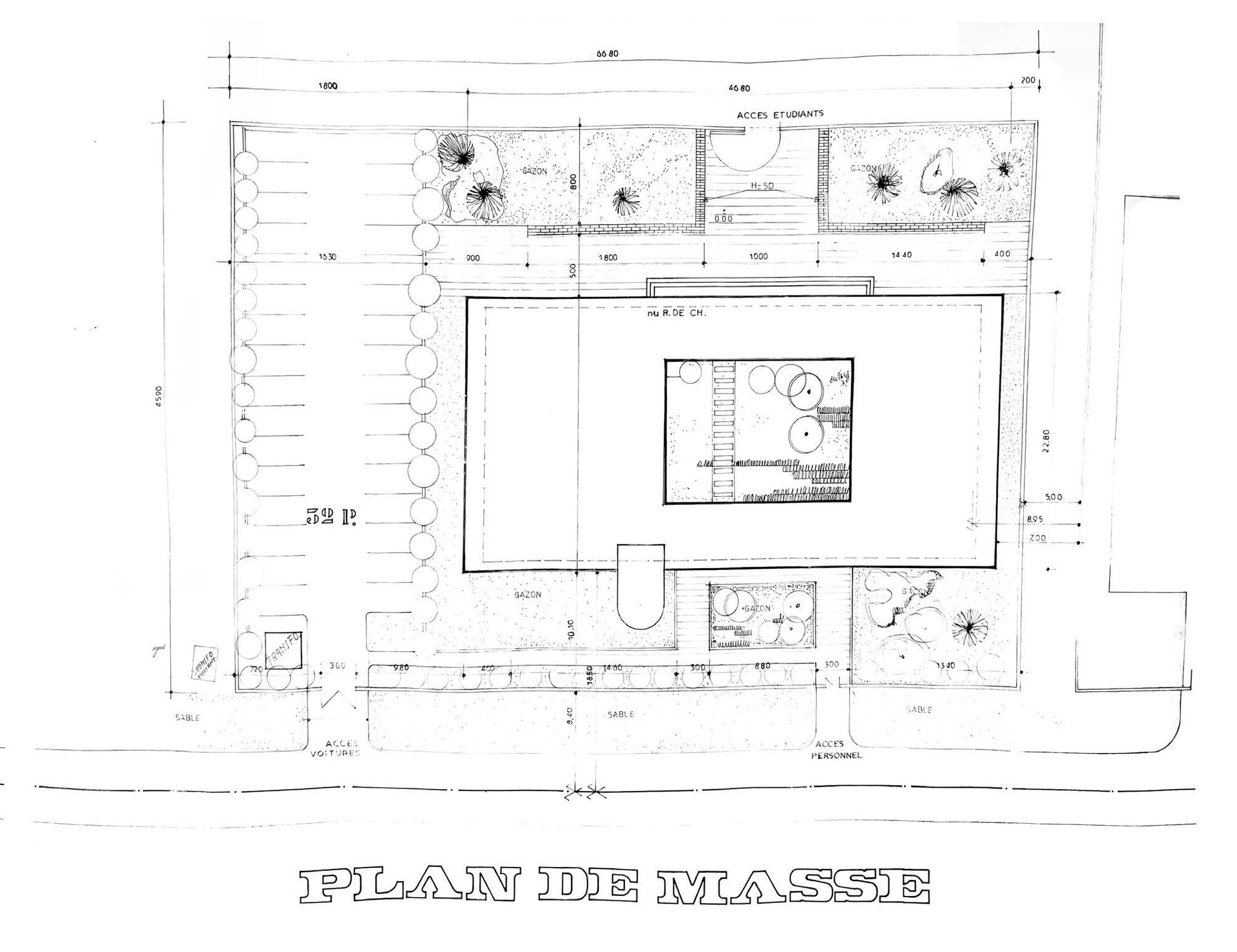
Ground floor plan of the Office du Baccalauréat. Courtesy of the family of Cheikh Ndiaye © Archives Cheikh Ndiaye
Simple lines and local materials are found in another of Cheikh Ndiaye’s projects, the Office du Baccalauréat. Initiated in 1989, this building was part of a larger renovation project for the University of Dakar, in collaboration with the company EGCAP. The project stands out for its radical volumetry and a central patio that allows the building to breathe. The ground floor is deliberately designed to be left largely free, and the administrative functions are concentrated on the upper floors. This composition facilitates the circulation of students and offers ample waiting areas sheltered from the sun under the lush vegetation in and around the patio. The ground-floor beams and pillars are cladded with limestone, and the exterior walls of the upper floors are cladded with beige shells. Once more, the façade, with its continuous horizontal lines and the structural framework in the background, is easily read. The simplicity of these architectural lines would remain one of the key trademarks of Cheikh Ndiaye’s architectural designs; it is also found in another of his well-known buildings in Dakar, the SONACOS head office.
“Cheikh Ndiaye was our elder, and what we retained from him is the great simplicity that defines the academy. In his architectural design there was a certain simplicity of lines, either horizontal or vertical, but the simplest and most beautiful.”
- Nicolas Cissé, architect (DPLG-S), 9 November 2024
The CITAMIL building, the IPRES head office, and Universités USSEIN by Abdoulaye Emile Diouf: Architectural expression reflecting Senegalese architectural heritage
Abdoulaye Emile Diouf is a Senegalese architect and co-founder of the firm Oscare Afrique, which he opened in 1987 after earning his degree. After he enrolled at the École d’Architecture et d’Urbanisme in Dakar in 1979–80, he came across an iconic Senegalese architecture project, the residence of President Senghor, nicknamed “Teeth of the Sea,” designed by Fernand Bonamy. He had an opportunity to visit the project in 1981, when it was under construction, and he met with Senghor. This encounter allowed him to immerse himself in Senghor’s intellectual thought and his promotion of a modern architecture inspired by Sudano-Sahelian tradition, as illustrated by his house with its oblique walls referring to the buttresses of monumental Sahelian earthen architecture.
“The asymmetrical parallelism, the aesthetic that we learned, was instilled in us by Senghor. We had historical and cultural references to Sudano-Sahelian architecture. It’s our culture and our experience. It’s a phase of assimilation of our culture that enriches us, beyond what we learned about functionality and climatology—Jean-Charles Tall was our professor of thermal control. Beyond what we were applying in relation to the exact sciences, we were applying cultural references all of which involved our sociology.”
- Abdoulaye Emile Diouf, architect DPLG-S, 9 November 2024

USAID head office. © Abdoulaye Emile, DIOUF Architecte / Oscare Afrique

USAID head office. © Abdoulaye Emile, DIOUF Architecte / Oscare Afrique

Senghor House, 2018. Photograph by Nzinga Mboup © Nzinga Mboup
One of Emile Diouf’s earliest projects, the USAID head office in Hann, adopted the vertical and oblique elements inspired by the Senghor House and were also used in the design for the CITAMIL building with more explicit references to Senegalese traditional architecture.
The CITAMIL building is situated near Université Cheikh Anta Diop (UCAD). Initially named “Cité Radieuse” (Radiant City), the objective was to create a building that would live up to its name. The project took the constraints of the site into account, including its proximity to the university. The vertical and triangular elements dividing the façade are a metaphor for buttresses, protecting the building from thrown stones, and assert a strong architectural identity, symbolizing Senegalese architecture by referring to the walls of the Senghor House that accentuate the verticality of the project.
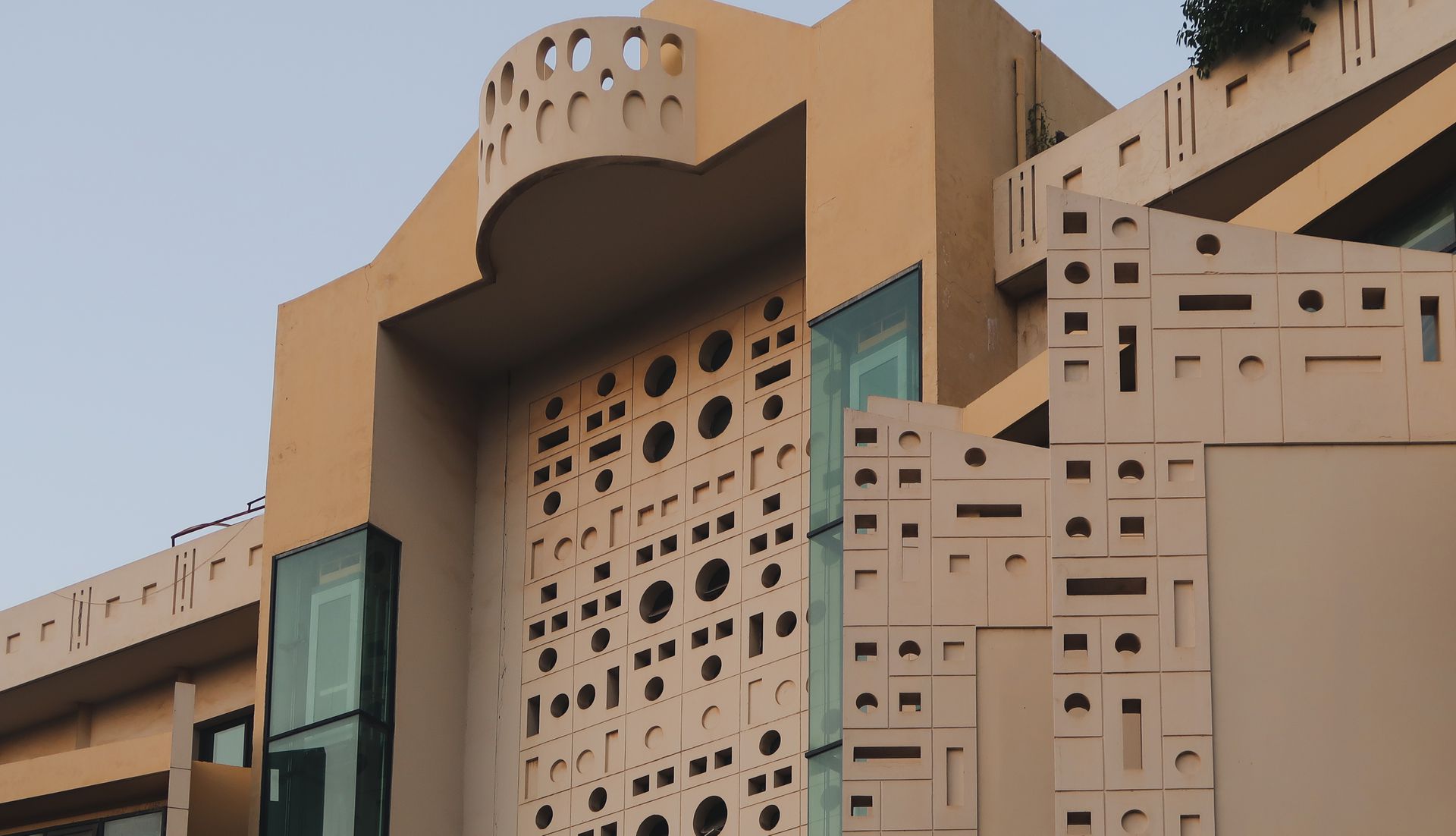
Façade of the CITAMIL building. Photograph by Ismael Sow © Ismael Sow
The openings on the façade are also inspired by a Sudano-Sahelian tradition, and the architecture of the Soninké, a people living in northeastern Senegal on the border with Mali and Mauritania, whose earthen architecture is known for its small geometric openings in the façades to ventilate living quarters.
“For the CITAMIL building, we used openings in reference to Soninké architecture. You see the same openings, but inverted, on the Contrôle Financier building. My references are the same ones as Cheikh Ndiaye’s.”
- Abdoulaye Emile Diouf, architect (DPLG-S), 9 November 2024
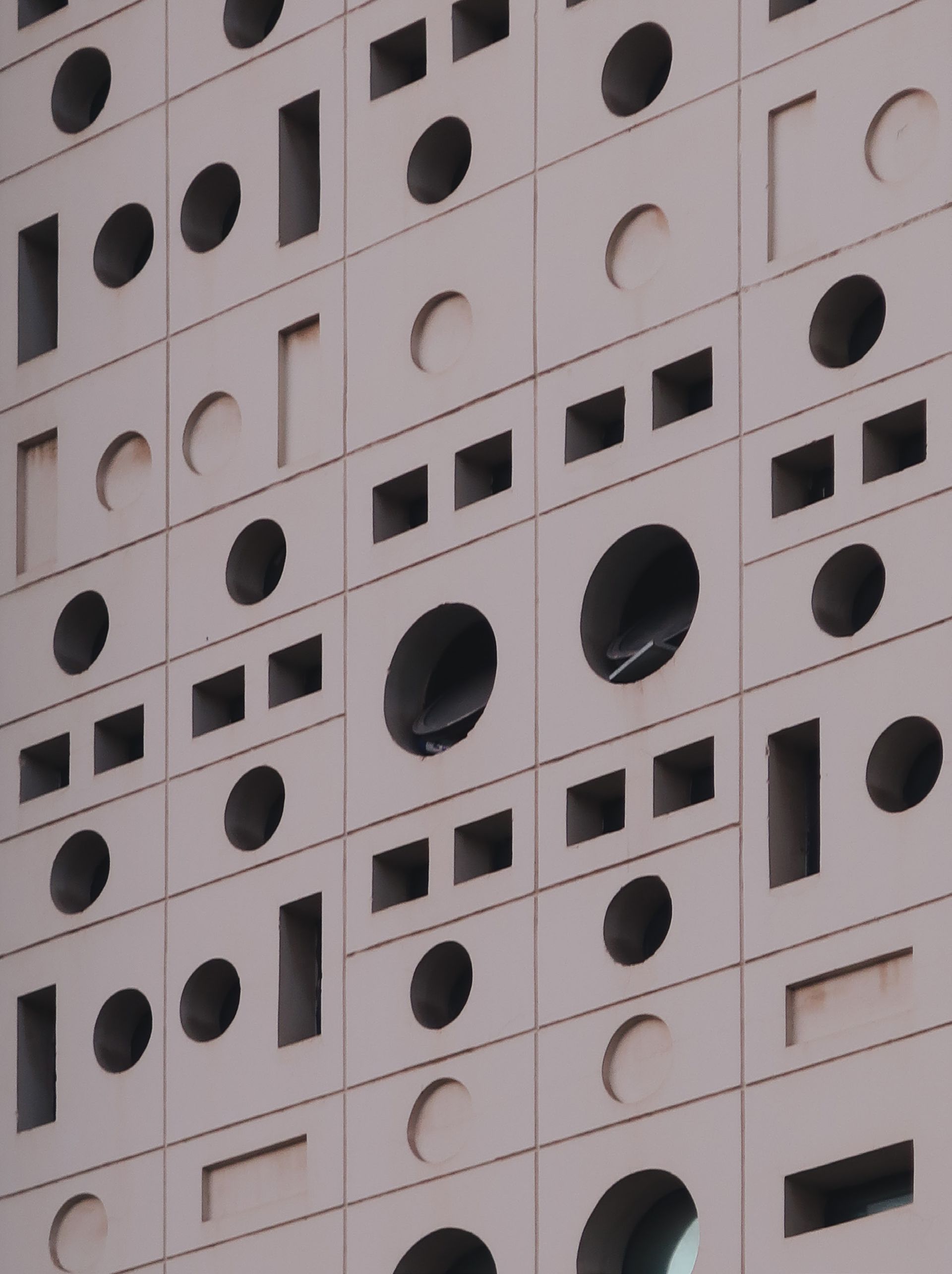
Façade of the CITAMIL building. Photograph by Ismael Sow © Ismael Sow
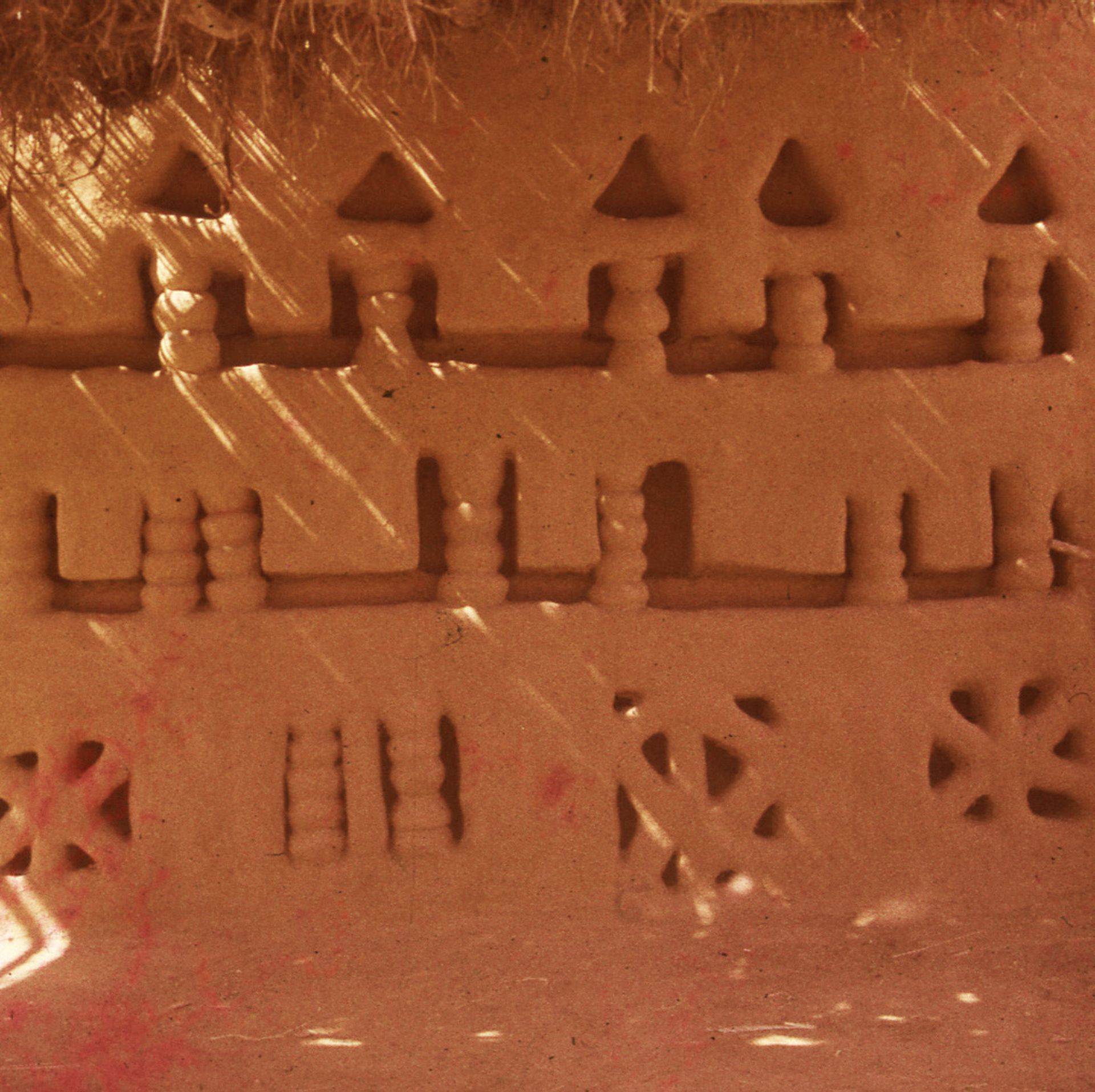
Detail of a Soninké house in Hassi Chegar. Courtesy of Jacques Trouvé © Jacques Trouvé
Another influence that Emile Diouf cites is the course in thermal design given by his elder at the Prytanée militaire, Jean-Charles Tall, who taught acoustics and building physics at the E.A.U. beginning in 1984. The concern with thermal comfort, especially through the use of solar production mechanisms such as a double skin, returned often in Abdoulaye Emile Diouf’s architecture. In another of his projects, the IPRES headquarters, we see an example of this second façade with the vertical columns that serve as solar protection by supporting passageways, which, in turn, offer outdoor circulation and protect the interior rooms from direct sunlight.

IPRES headquarters in Dakar. © Abdoulaye Emile, DIOUF Architecte / Oscare Afrique

IPRES headquarters in Dakar. © Abdoulaye Emile, DIOUF Architecte / Oscare Afrique
Although Abdoulaye Emile Diouf’s career has been marked by a series of international projects that feature double skins and solar protection mechanisms, today he is more concerned with steering his architectural practice towards reconnecting with a materiality anchored in the territory.
One of his most recent major projects is USSEIN, a university complex in Sine Saloum that extends over five sites, all characterized by similar vegetation and flora. The design, resulting from an in-depth study of local materials, is inspired by Sudano-Sahelian architecture, with materials, colours, and motifs that reflect its traditions. This project highlights the richness of Senegalese heritage and also underscores the need to develop a local materials industry based on this tradition.
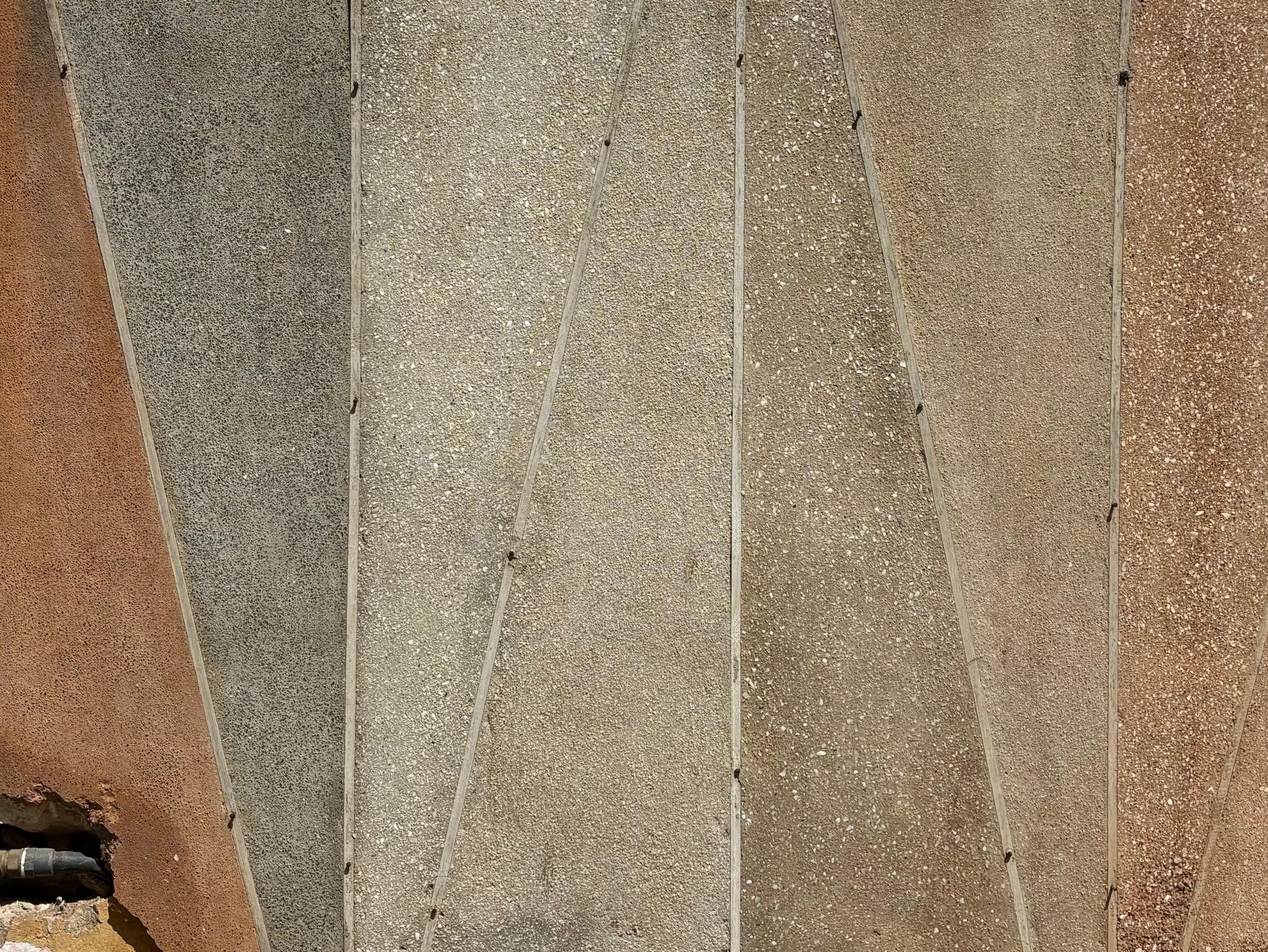
Samples of plaster with different types of sand and shells for USSEIN. Photograph by Nzinga Mboup © Nzinga Mboup

USSEIN university complex. © Abdoulaye Emile, DIOUF Architecte / Oscare Afrique
“The richness—that is, the materials—that we can find on site can be used to contribute to local development and industrialization while avoiding indiscriminate importation. We have a wealth in the sand, with shells and granulometry, and we have our expertise. So, we have created a project that provides solutions in relation to its environment.”
- Abou Emile Diouf, architect (DPLG-S), 9 November 2024
In looking back at these key projects, it is clear how much the architectural pioneers, such as Cheikh and Ngom Cheikh Ndiaye (and Pierre Goudiaby Atepa), have influenced the architects who graduated from the E.A.U. This is exemplified by Abdoulaye Emile Diouf, who has also shared several of his projects that are integrated into a modern Senegalese architectural tradition.
Senegalese architect Cheikh Ngom, born in Ziguinchor in 1935, studied for three years at the École Fédérale des travaux publics in Bamako between 1955 and 1958, then spent ten years in Paris, from 1963 à 1973. He studied at the École d’application des Ingénieurs des TPE in Paris and then at the urban planning institute at the Université de Paris from 1968 to 1970. Finally, from 1970 to 1973 he was enrolled at the Ecole Spéciale d’architecture in Paris, from which he graduated in 1973 with a final project on urban planning in the Ziguinchor city hall district.
Born in Coki in 1946, Cheikh Ndiaye is an eminent Senegalese architect. He began his studies in France in the mid-1970s at the École Nationale Supérieure des Beaux-Arts in Paris, graduating in 1979. During the same period, he gained his first professional experience as an architect in various internships. He worked at the Le Couteur and Maurice Lafont agencies from 1975 to 1978 and at the Arsen Henry brothers’ agency from 1976 to 1979. With this experience on his résumé, he returned to Senegal, where he founded his own eponymous firm. He then undertook various projects in the Senegalese architectural landscape, including Le Contrôle Financier, Le Palais de Justice, the Office du Baccalauréat, the Piscine Olympique, and the CHU Fann Dakar.
Abdoulaye Emile Diouf is a Senegalese architect, born in Dakar in 1959. He studied at the Prytanée militaire de Saint Louis before enrolling in the École d’Architecture et d’Urbanisme in Dakar in 1979–80, graduating in 1987. As a student, he interned several times with the firm ATEPA, and he assisted Abib Diene with the start-up of his firm, BEAD, in 1986. In 1987, he founded the firm Oscare Afrique and went to Canada to receive training in computer-assisted design in Quebec City and Montreal. He returned to Senegal in 1988 and began his professional activities with the architect Djouga Sylla Diouf, whose offices were on Boulevard Général de Gaulle and then moved to Point E in 1996. Oscare Afrique has offices in thirteen countries in West and Central Africa. Among its achievements are the IPRES headquarters in Diourbel, the head office of the Caisse de Sécurité Sociale, the head office of the Ministère de la Santé in Fann, the extension of the UCAD library, the CITAMIL/GIABA complex, the head office of SONATEL, and the future universities in Sine Saloum (El Hadj Ibrahima Niasse). Abdoulaye Emile Diouf is also an avid art collector and co-founder, with the architects Abib Diene, Cherif Diattara, Boubacar Seck, and Cheikh Sadibou Diop, of the École d’Architecture Urbanisme et Beaux-Arts ARUBA, which opened in November 2024.
Text translated from French by Käthe Roth.