


Listening to Vancouver, Playing Montréal
Clara Rummer revisits the work of R. Murray Schafer and Douglas Moffat
The following text traces the work of R. Murray Schafer and Douglas Moffat which is featured in our Hall Cases exhibition Audible Archives, running from 18 December 2025 to 18 October 2026.
From the early 1970s until today, artists have been expanding our perception of the environment by recording its sounds. Both the seemingly discreet field recordings of The Vancouver Soundscape and the carefully constructed sounds of landscapes featured in Montréal Phonographe, have been shaped as much by their authors as the places they document. By investigating the processes behind their production, we will reveal the agency of the artists that shaped the aural memory of these two Canadian cities.
Vancouver, 1973
From an aerial view, the cover of The Vancouver Soundscape captures the wide scenery of the coastal Canadian city framed by the mountains, all dipped in blue. Superimposed on the mountainous topography, another landscape appears: a waveform, visualizing the soundscape within. It traces the sounds of “a concert of frogs, interrupted by a noisy automobile,” as the composer R. Murray Schafer explains in the liner notes.1 After the car succeeded in silencing the frogs for a while, they re-enter the sonic scene.
-
World Soundscape Project, The Vancouver Soundscape, Simon Fraser University, 1973, liner notes, [https://www.sfu.ca/sonic-studio-webdav/WSP_Doc/Booklets/Vanscape73CD.pdf[(https://www.sfu.ca/sonic-studio-webdav/WSP_Doc/Booklets/Vanscape73CD.pdf). ↩
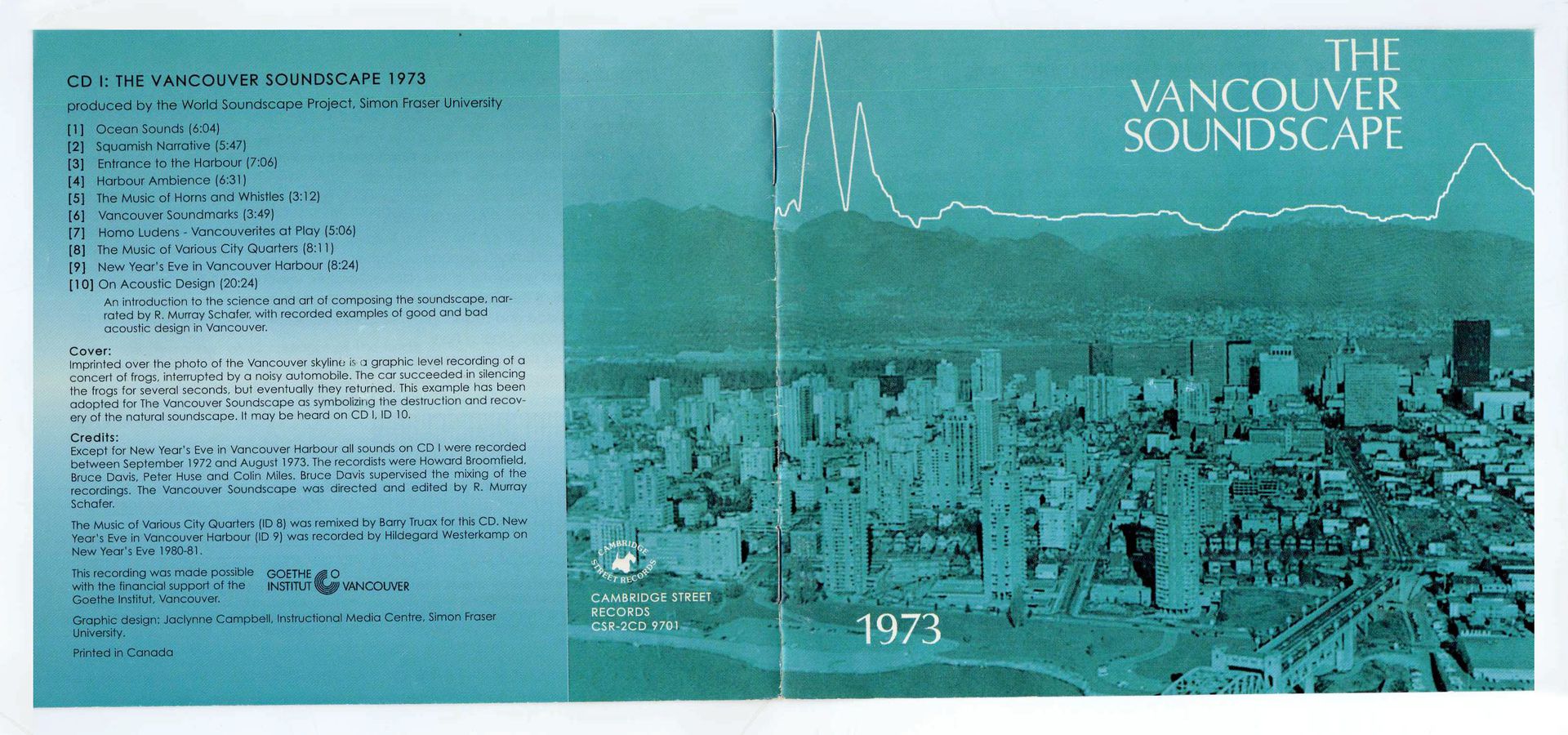
Jaclynne Campbell, Front and back covers of the CD I booklet, The Vancouver Soundscape 1973, 1997. Used with permission of the World Soundscape Project, Simon Fraser University.
Schafer popularized the term soundscape in 1969 which borrows the suffix from land-scape, expanding the concept of the environment to include the sonic realm. Ranging from aesthetic object to physical environment, it fits into the larger study of acoustic ecology, which investigates “the effects of the acoustic environment or soundscape on the physical responses or behavioural characteristics of creatures living within it.”1
Schafer and his students investigated this field during his time teaching at Simon Fraser University, where he initiated the World Soundscape Project (WSP).2 The first album produced in this context was The Vancouver Soundscape. Between September 1972 and August 1973, students explored the sounds of the city and generated a large body of field recordings, capturing sounds such as children playing, the hum of car engines, and a symphony of boat horns. Schafer later edited these recordings into a cohesive album, structuring recurring elements such as music and soundmarks into ten seamless tracks.3
-
R. Murray Schafer, The Soundscape: Our Sonic Environment and the Tuning of the World (Destiny Books, 1994), 271, https://monoskop.org/images/d/d4/Schafer_R_Murray_ The_Soundscape_Our_Sonic_Environment_and_the_Tuning_of_the_World_1994.pdf. ↩
-
World Soundscape Project, Vancouver Soundscape, liner notes. ↩
-
World Soundscape Project, Vancouver Soundscape, liner notes. ↩
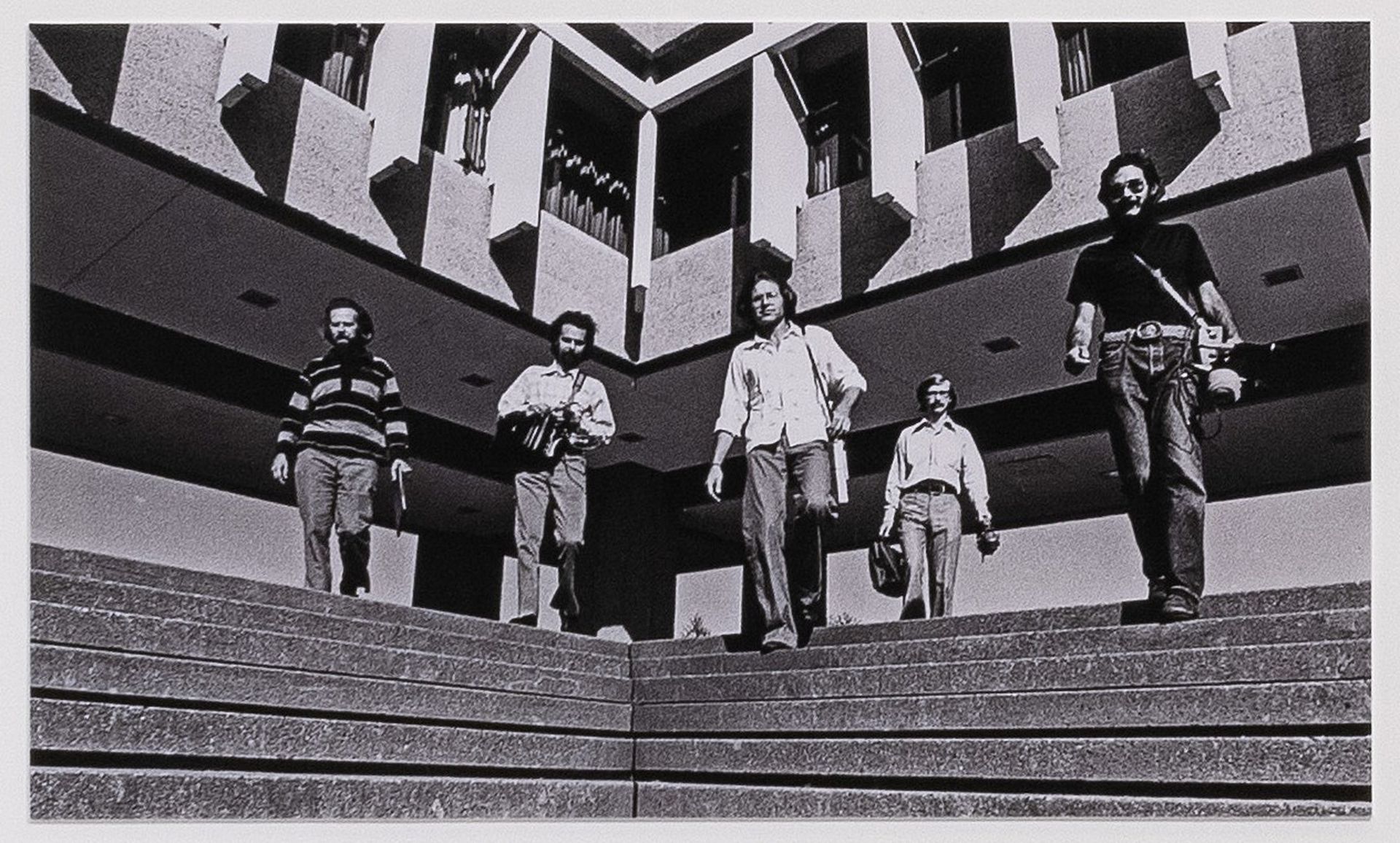
Hildegard Westerkamp, World Soundscape Project team (R. Murray Schafer, Bruce Davis, Peter Huse, Barry Truax, Howard Broomfield) at Simon Fraser University, 1973. Used with permission of the World Soundscape Project, Simon Fraser University.
By documenting the distinct character of the harbour city, Schafer aimed to preserve Vancouver’s acoustic ecology and draw attention to its rapid transformation caused by technological advancements during the 1960s.1 He interpreted the resulting sounds as noise, deeming them undesirable. In The Book of Noise, he argues that “noise is the wrong sound in the wrong place,” emphasizing that context, not frequency, is the key factor.2 To demonstrate how these changes are reflected in the city’s soundscapes, the WSP reissued the album in 1996 as a double CD set featuring new recordings.3
-
R. Murray Schafer, The Music of the Environment (Universal Edition, 1973), 3, https://www.sfu.ca/sonic-studio-webdav/WSP_Doc/Booklets/MOTE.pdf. ↩
-
R. Murray Schafer, The Book of Noise (Arcana Editions, 1998), 4, https://www.sfu.ca/sonic-studio-webdav/WSP_Doc/Booklets/BookOfNoise.pdf. ↩
-
Barry Truax, “The World Soundscape Project,” Simon Fraser University, https://www.sfu.ca/~truax/wsp.html. ↩
Montréal, 2012
Decades later, Douglas Moffat took on the task of recording Montréal, driven not by political urgency, but by a wish for “sonic daydreaming.”1 As a landscape architect who actively shapes environments, Moffat understood Montréal as a constructed terrain rather than an inhabited city. He wondered what it would sound like if you could play the city like a record. The result was Montréal Phonographe.
-
Douglas Moffat, Montréal Phonographe, The Dim Coast / Oral, 2012, label description, Bandcamp, https://thedimcoast.bandcamp.com/album/montr-al-phonographe. ↩
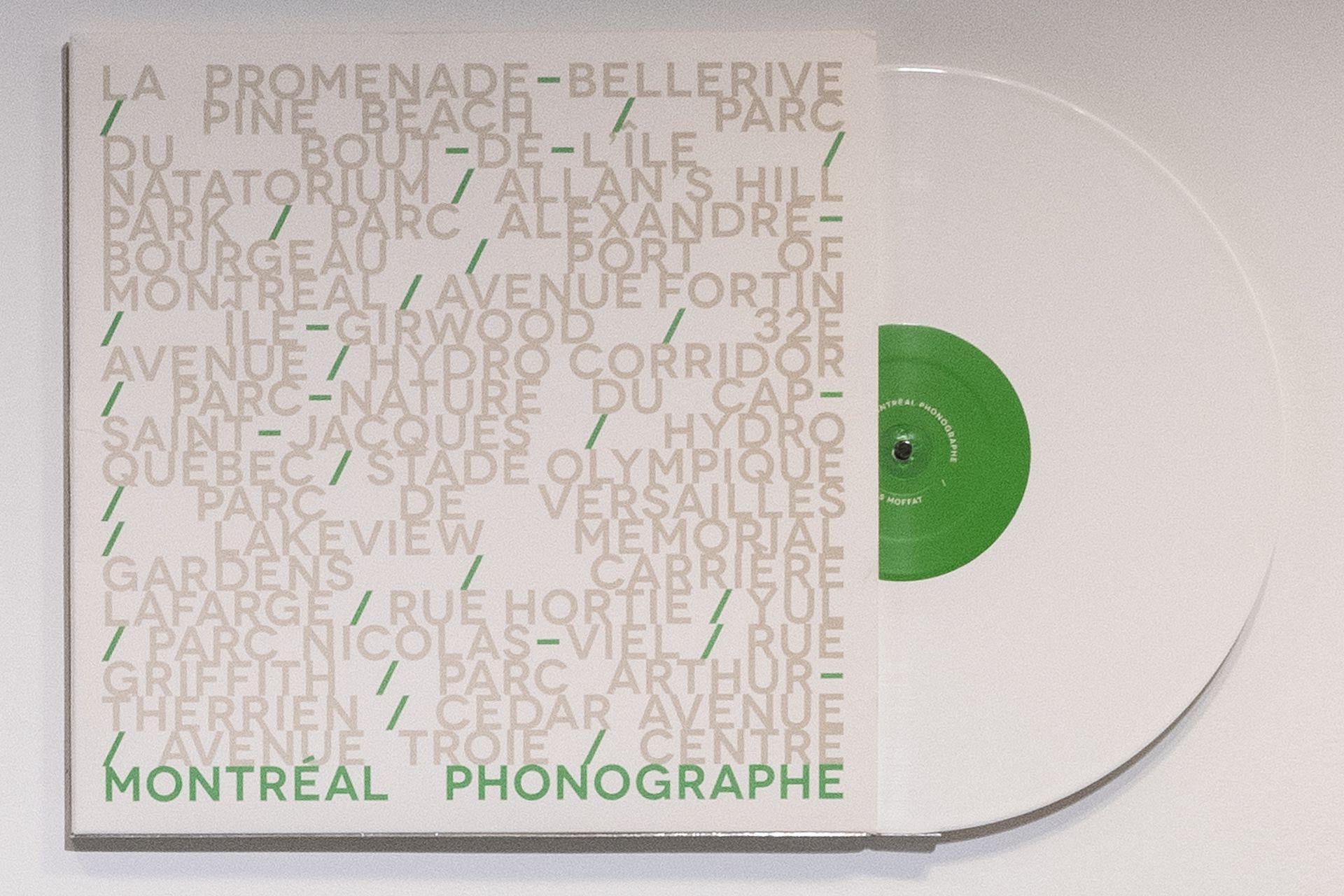
Douglas Moffat, Montréal Phonographe album cover and centre label designed by black sheep design, 2012. CCA
To make the surface of the city sing, Moffat constructed his very own recording device. Built on a handcart, he attached a jointed stylus made of balsa wood planks and equipped it with microphones.1 This became his tool for cutting cross-sections through the landscape, actively altering the surface of the ground. To emphasize the significance of this performance, the album is accompanied by video recordings and photos documenting the process. Rather than simply placing the island on a turntable, Moffat plays it like a DJ: controlling the tracks, the speed, and direction of the needle. Still, the result is never fully anticipated; the same action never repeatable.2
-
Douglas Moffat, liner notes for Montréal Phonographe, project website, http://oktaproject.ca/Montréalphonographe.ca/. ↩
-
Moffat’s use of the stylus is comparable to the way in which the German painter Gerhard Richter uses the squeegee. Here, the artist actively shapes the paintings, choosing the colours and directing the tool with their body. The shapes created on his paintings are shaped by chance. ↩
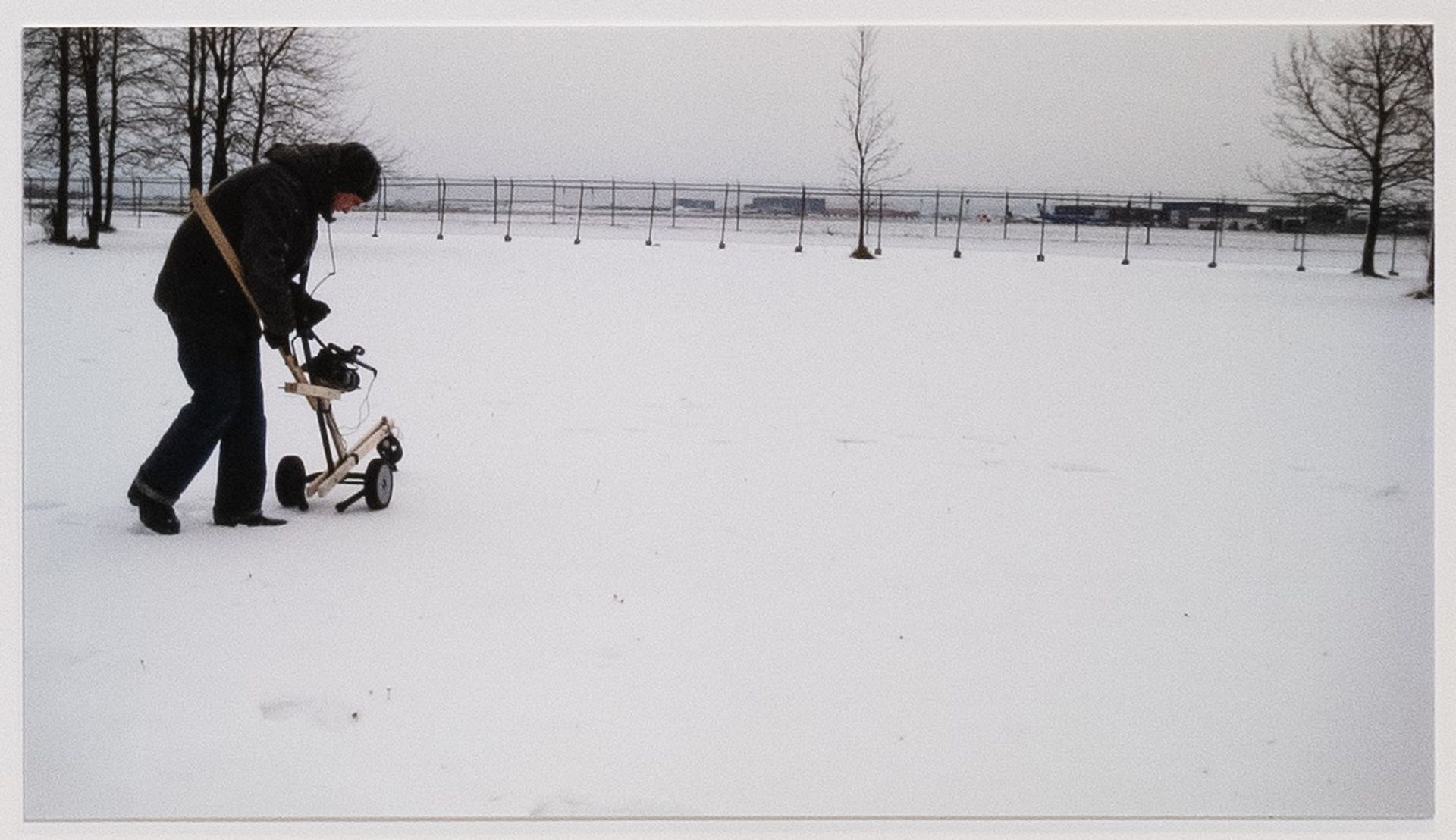
Meredith Carruthers, Douglas Moffat field recording with a custom-made, all-terrain stylus fitted with contact microphones, 2012. exhibition print. Courtesy of the artist
For Montréal Phonographe, he chose a set of twenty-five recording locations across the island, visible as a track list on the album cover. A circular drawing by the artist maps these sites onto the outline of the island, overlaid with concentric circles that evoke the spiralling grooves of a vinyl record. The sequence traces Moffat’s path from the shoreline inward towards the centre of Parc Mont-Royal, mimicking the path of the needle on the vinyl.1
-
Moffat, Montréal Phonographe, label description. ↩
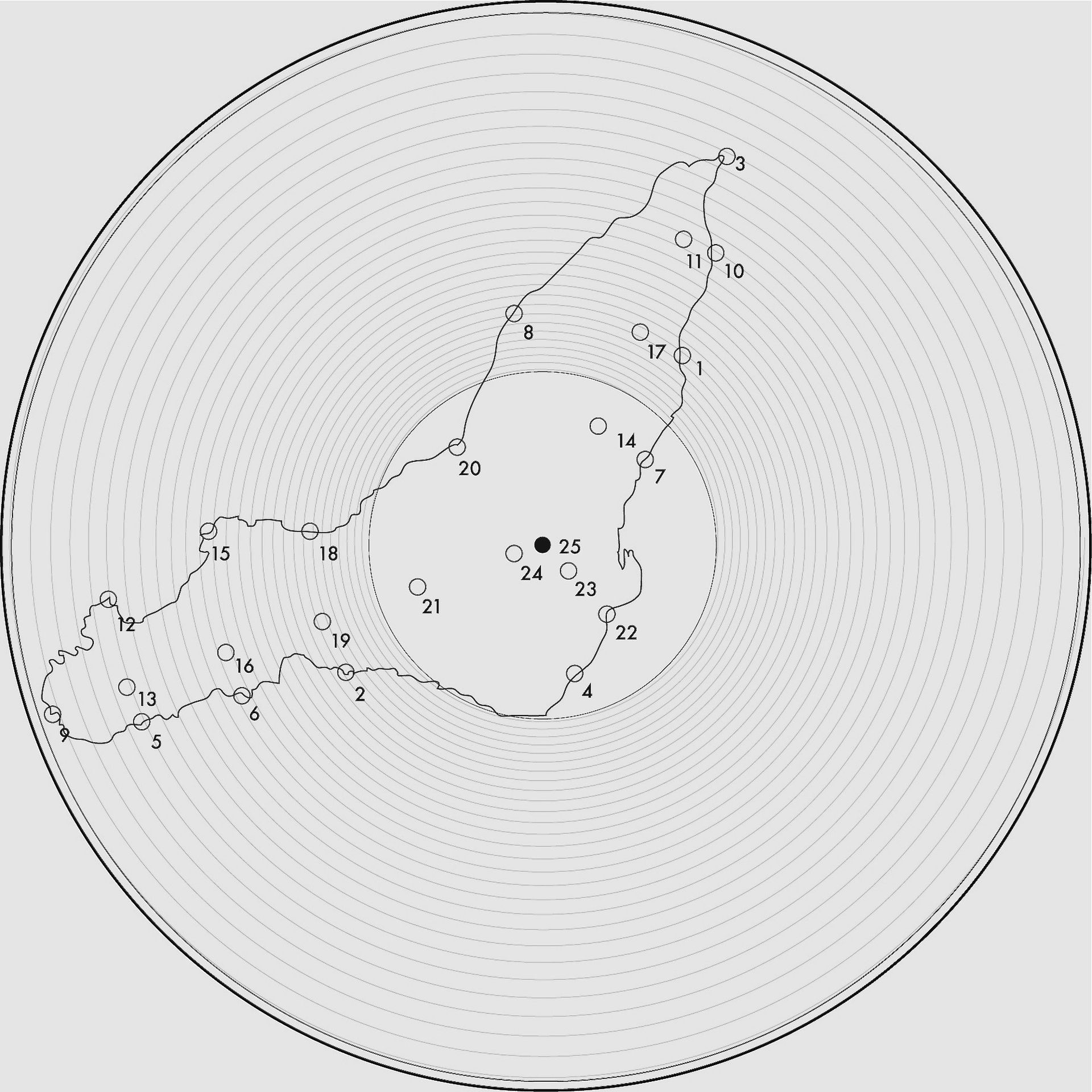
Douglas Moffat, Drawing that displays the recording locations of Montréal Phonographe, 2012. © Douglas Moffat
While the turntable needle traces a continuous line, the route we listen to is disconnected as one-minute recordings jump from place to place. The relationship between the record and stylus is reversed. The earth lies still as the stylus moves across it: a slow drag through snow, speeding over icy acres, crossing-country. Listening becomes a bodily experience. We lend our ears to the sounds of the stylus scratching (sometimes brutally) across the earth’s crust. The landscape is not tangible but deeply felt.1
Pressing Record
In both projects, a strong human presence is legible in the process of documenting the city through sound, which raises questions about the neutrality the format suggests. Moffat’s agency is evident in Montréal Phonographe through his direct physical interaction with the island. His body becomes a central subject in interplay with the environment. He deliberately imposed strict formal rules that are audible in the final piece. From the spiral arrangement of the recording locations to the limits of the track length, he carefully constructed the underlying framework of the record, determining the rhythm of the piece. His approach is reminiscent of a scientific experiment in pursuit of objectivity. The lightly edited sound fragments are the result of a repetitive methodology in which the variables were the conditions at each selected site. Yet, by acknowledging his role in the piece, he is not pretending to be scientifically neutral; he is simply applying the aesthetic of the methodology.
-
Moffat, Montréal Phonographe, label description. ↩


Douglas Moffat, ABC : MTL Douglas Moffat, 2013. CCA © CCA
Schafer’s The Vancouver Soundscape, by contrast, is based on the argument that the city is being increasingly overwhelmed by noise, and he attempts to provide evidence. However, the neutrality of environmental recordings is subject to fiction. The selection of recording locations in Vancouver appears to have been largely influenced by the random exploration of the student group. The team tried to remain in the background, but their large 1970s recording equipment inevitably disturbed the environments they were documenting. Although their collective authorship initially dilutes any individual voice, Schafer’s hand resurfaces in his heavy edits. He carefully curated, overlaid, and mixed the tracks, disguising his agency with a scientific setup.
There is an irony in Schafer’s media translation. In The Music of the Environment, he describes what happens when electroacoustic technology splits a sound from its source: “Originally all sounds were originals. They occurred at one time and in one place only. Sounds were then indissolubly tied to the mechanisms which produced them.”1 By producing a commercial album, Schafer reproduces the very displacement he critiques, allowing the sounds of Vancouver’s harbour horns to drift into living rooms elsewhere. The original sound cannot be preserved; only its echo remains in the archive.
-
Schafer, Music of the Environment, 15. ↩
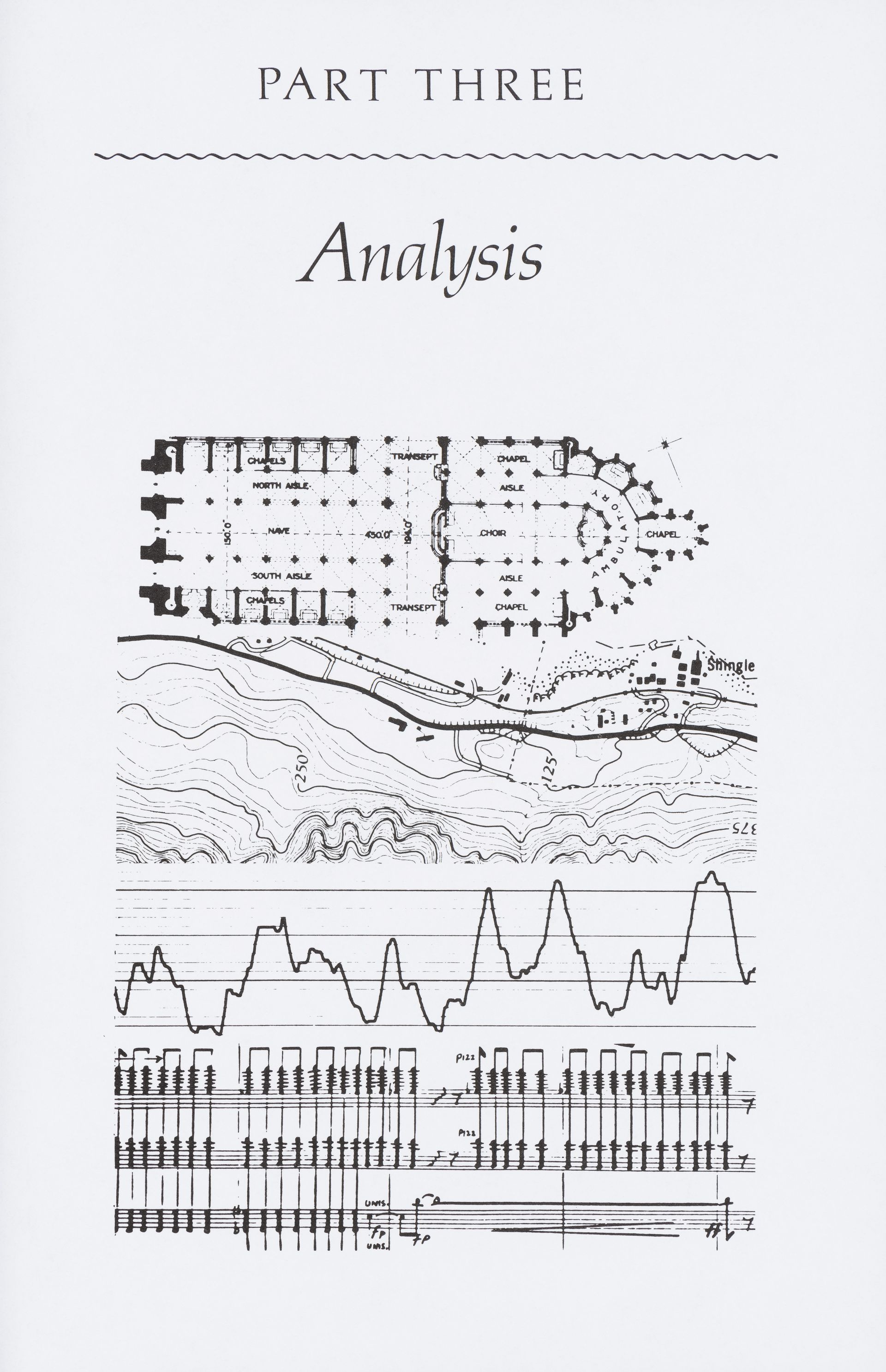
R. Murray Schafer, The soundscape: our sonic environment and the tuning of the world. Rochester, Vt.: Destiny Books; United States: Distributed to the book trade in the United States by American International Distribution Corp., c1994, p. 21. CCA Library. BIB 171309


Both artists incorporate scientific and documentary elements yet present deeply personal portrayals of their cities. This is no coincidence. The term soundscape is etymologically linked to definitions of landscape in the 1960s, as detached entities framed by a human perspective.1 The memories of Vancouver and Montréal preserved in the records have thereby been shaped by a mediative act between the sonic environments and the artists who made them sing.
-
Élise Geisler, “Soundscape Revisited,” trans. Oliver Waine, Metropolitics, January 8, 2014, https://metropolitics.org/Soundscape-revisited.html. ↩


