


American Interiority and its Subjects
Andy Lu Lee surfaces the influence of image production on the construction of the American landscape
The following text was produced in the context of our exhibition Reframing the American Landscape, running from 1 October 2026 to 3 January 2027 in our Octagonal Gallery, curated by Andy Lu Lee.
“The myth has become a reality far greater than the dream!”1
-
Arizona and Its Natural Resources (Washington, DC: US Department of the Interior, Bureau of Mines, 1955), 16mm film, Local Identifier 70.178A, NAID 12494, Records of the Bureau of Mines, Record Group 70, National Archives at College Park, MD. ↩
In its role overseeing agencies such as the National Parks Service, Bureau of Land Management, and the United States Geological Survey, the United States Department of the Interior has long administered the US’s domestic natural resources and public lands through the prodigious production of images. Held in the US National Archives and Records Administration, the Interior’s archive asserts a scientific neutrality and rationality that naturalizes a settler claim to territory, reframing it as the American landscape.
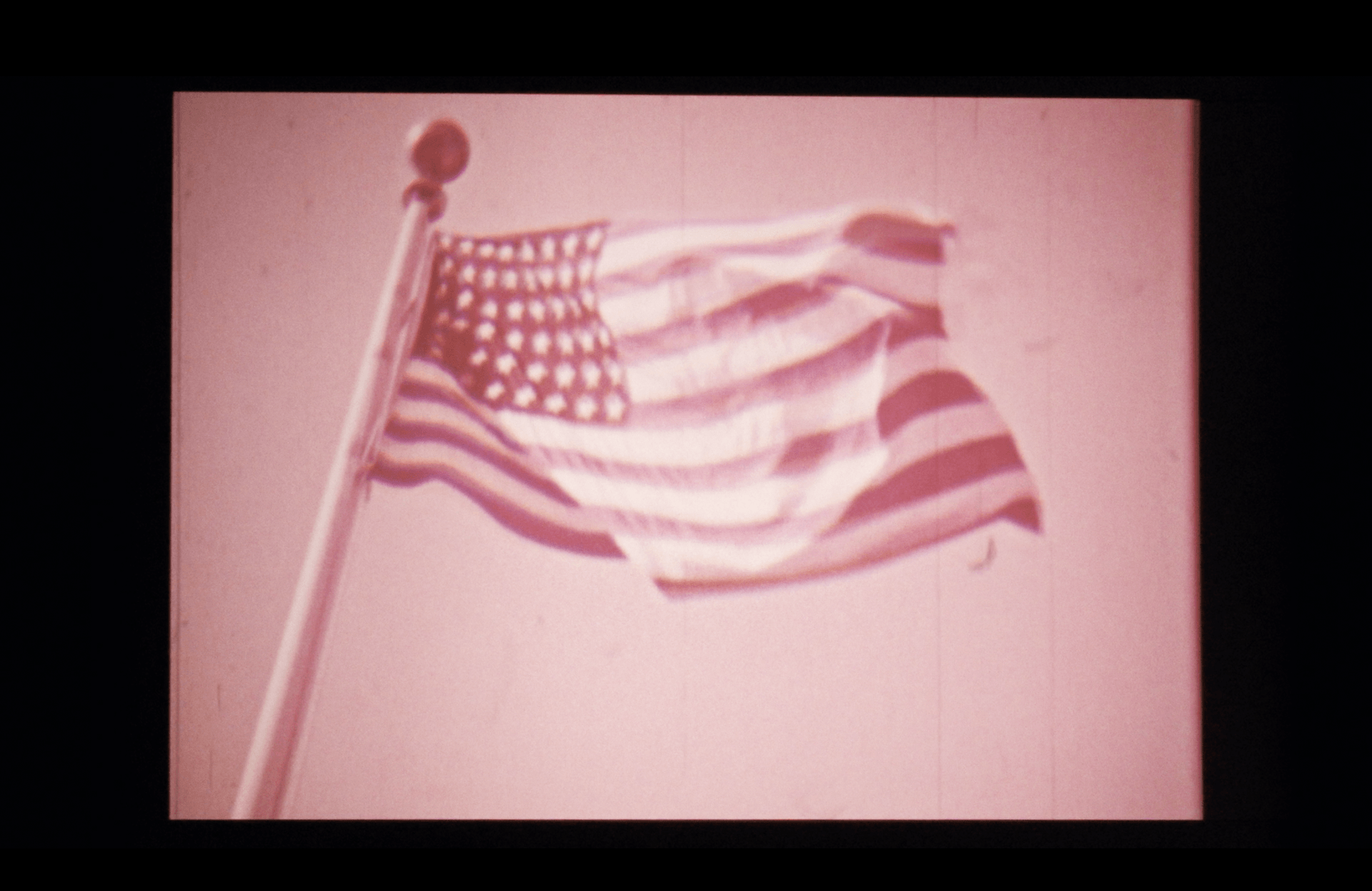
US Department of the Interior, Bureau of Mines, Still from Arizona and Its Natural Resources, 1955. Courtesy of the National Archives and Records Administration (NARA)
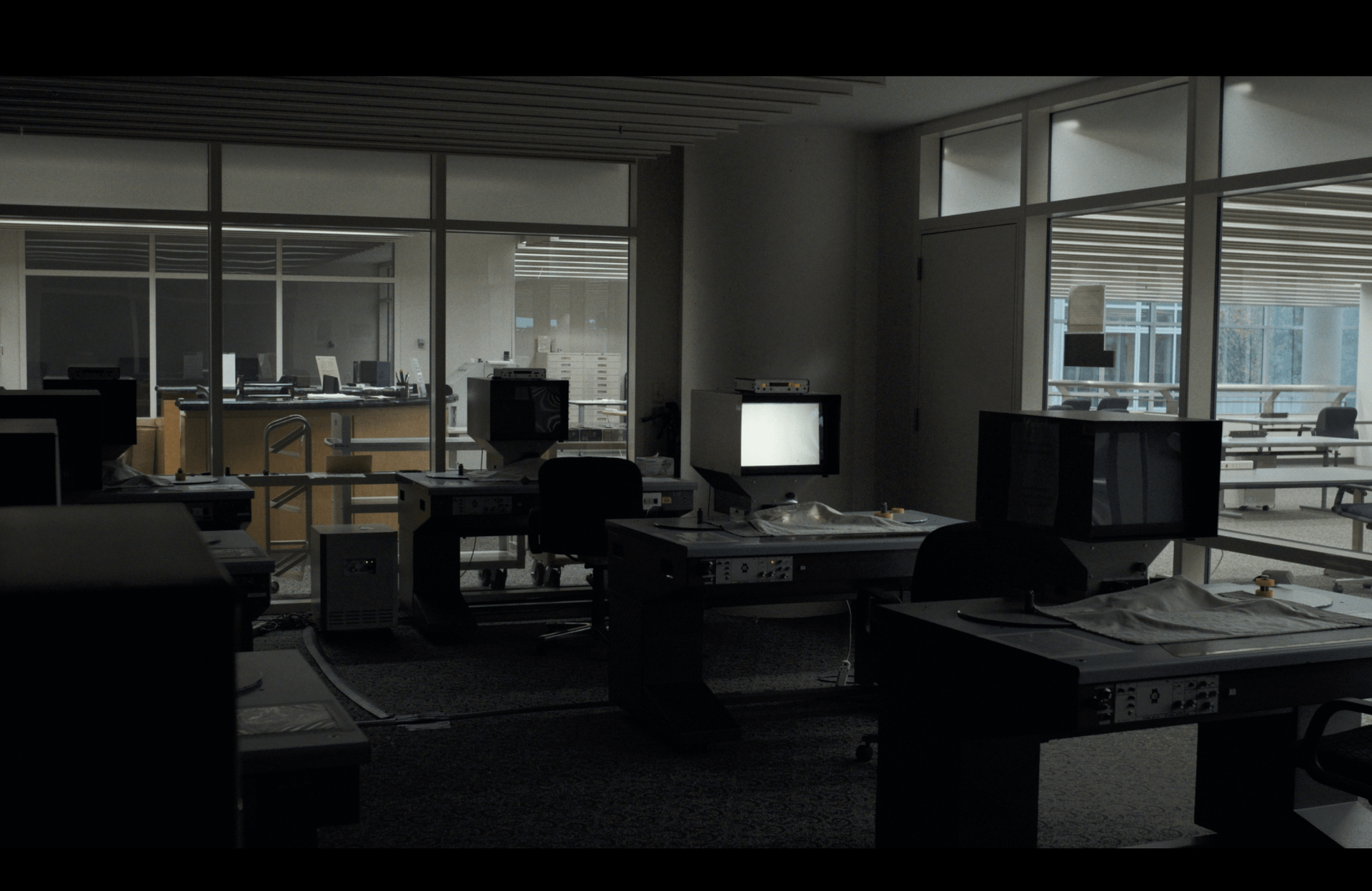
Still from “Archive III”, as part of Reframing the American Landscape by Andy Lu Lee, 2026. CCA © Andy Lu Lee
Ordered as an archive of images, the American landscape effaces its own constructed-ness, passing itself off as simply there, immanent, and given. Survey maps, planetary imaging, and film documentaries stake their claim on the representation of certainty; a simple record of what is out there. Yet, the very tools of construction—such as the standards, scales, grids, and consistent legends and table formats of its images—indexed not just the heuristics by which territory was to be represented, but the infinite reproducibility of its representational claims across an isotropic expanse of land. As an archive of images, the American landscape is universalized beyond political borders: it is not just a representation of land and territory but an apparatus of infinite imaging.
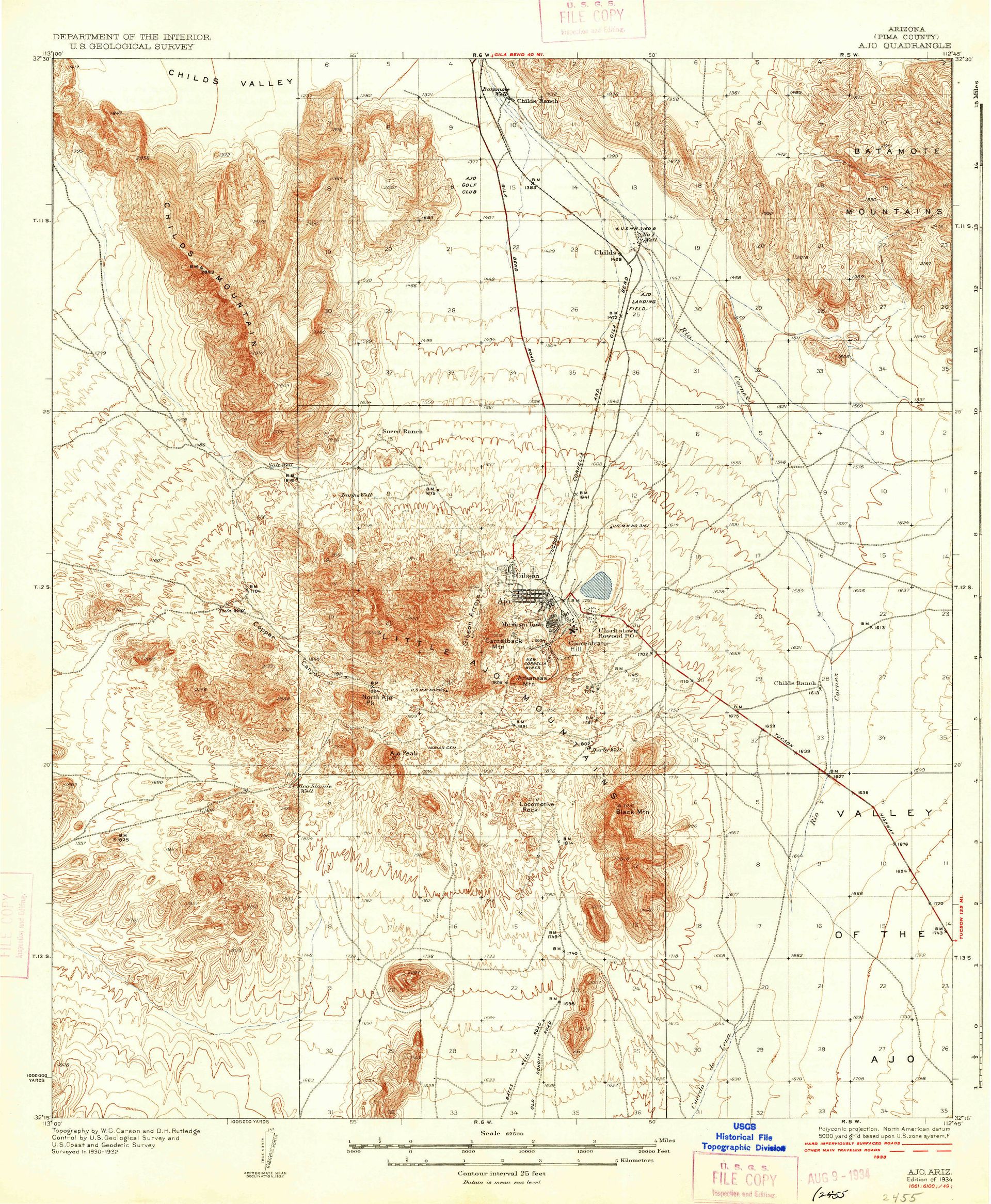
US Geological Survey, Ajo Quadrangle, Arizona, 1:62500, 1934. USGS Historical Topographic Map Collection
The Department of the Interior’s imaging apparatus dramatically expanded its archive during the Cold War. In 1949, President Harry Truman, in some ways proclaiming the opening of the Cold War, declares in his inaugural address:
“The United States is pre-eminent among nations in the development of industrial and scientific techniques. […] our imponderable resources in technical knowledge are constantly growing and are inexhaustible. I believe that we should make available to peace-loving peoples the benefits of our store of technical knowledge in order to help them realize their aspirations for a better life.”
His address kicks off Point Four, the United States’ first articulation of an international civilian aid program, which sent thousands of US technicians across the Global South under the newly created Technical Cooperation Administration—a precursor to USAID. Many of these technicians cut their teeth working on New Deal transformations of US territory administered by the Department of the Interior and carried their experiences abroad, ostensibly to aid in the modernization of a global, rural hinterland.
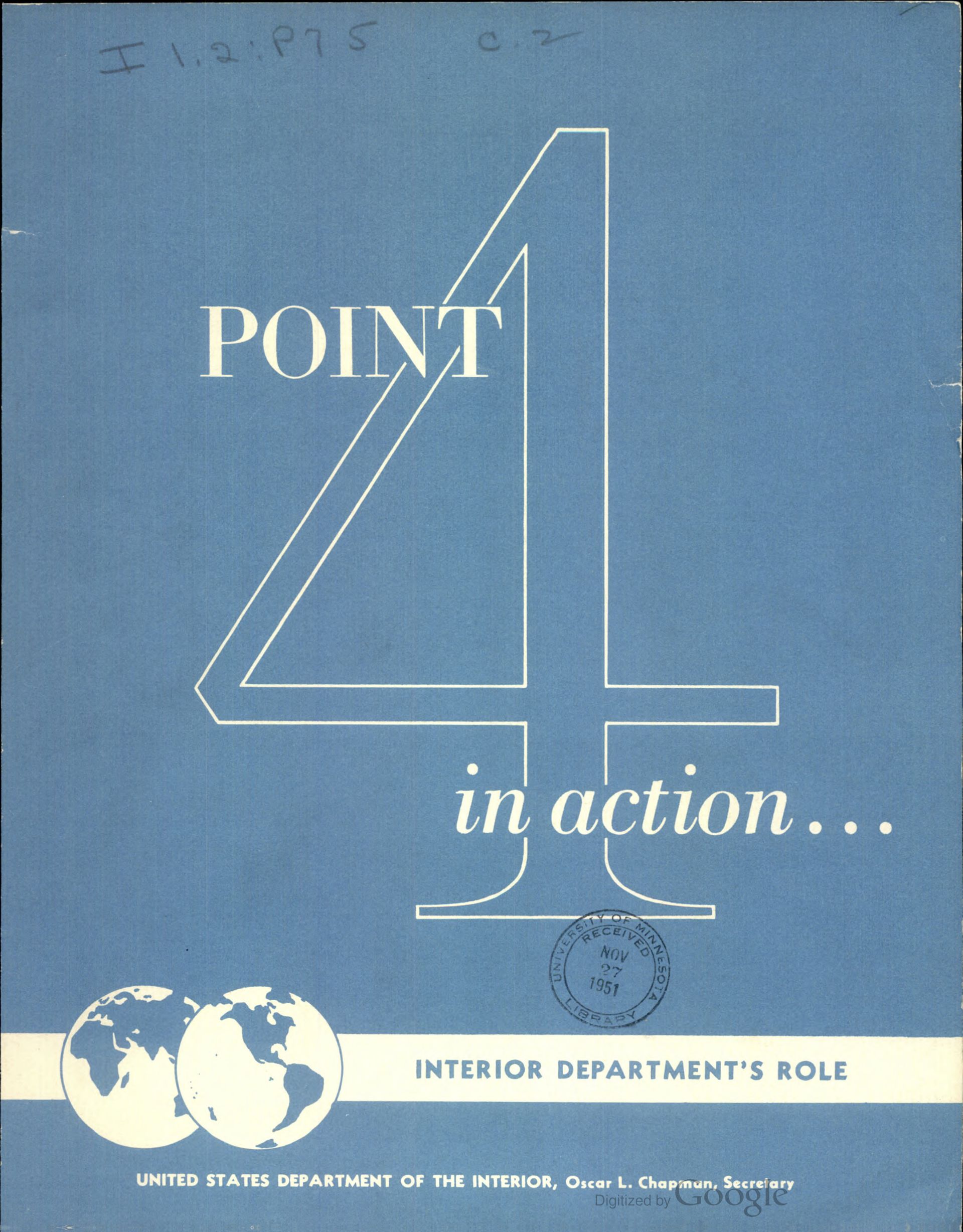
US Department of the Interior, cover of Point 4 in Action: Interior Department’s Role, 1951
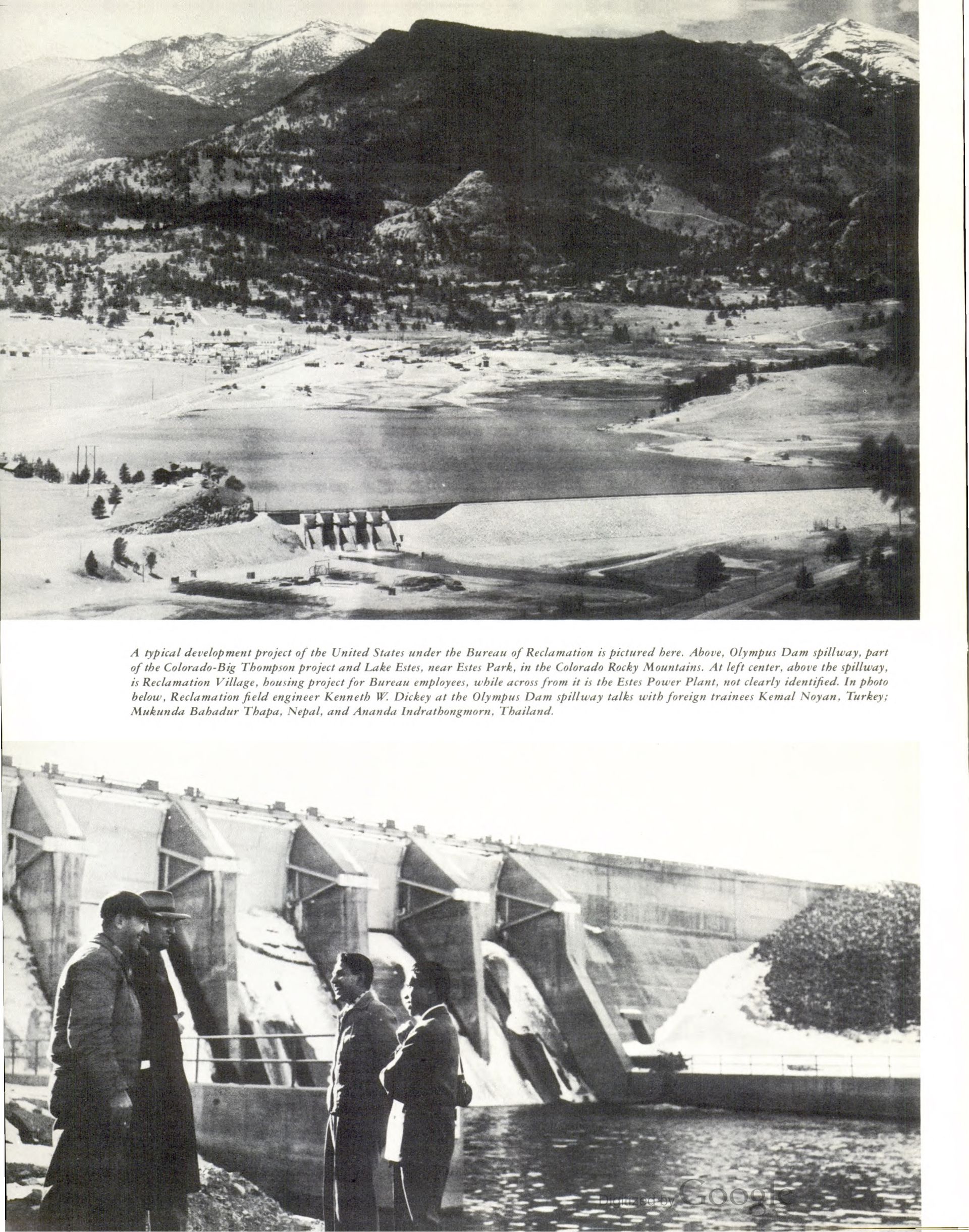
US Department of the Interior, page 32 from Point 4 in Action: Interior Department’s Role showing the Olympus Dam spillway and Lake Estes, and the Colorado-Big Thompson project, with Reclamation engineer Kenneth W. Dickey and trainees from Turkey, Nepal, and Thailand, 1951. US Department of the Interior
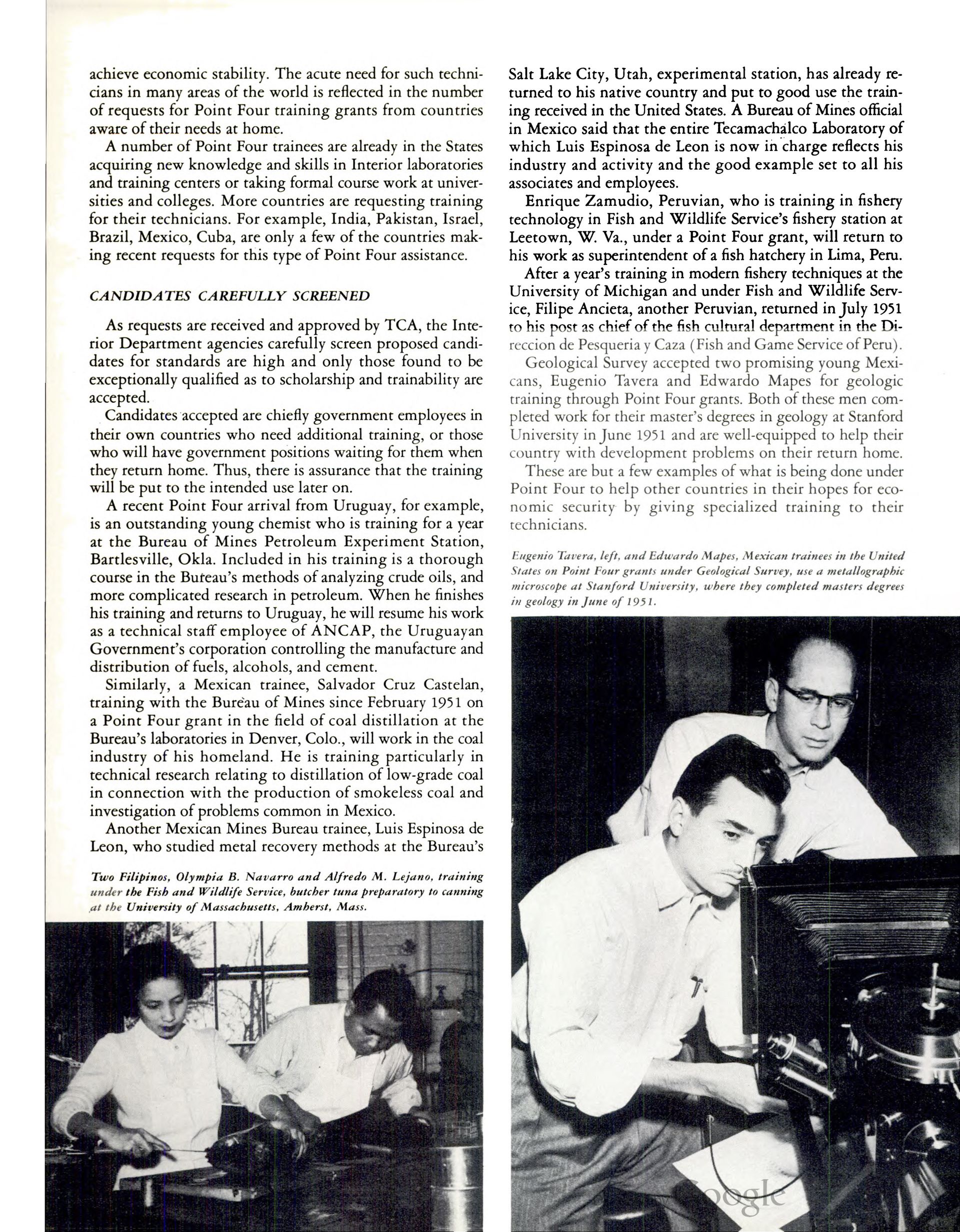
US Department of the Interior, page 23 of Point 4 in Action: Interior Department’s Role showing Mexican Point Four trainees Eugenio Tavera and Edwardo Mapes at a metallographic microscope at Stanford University, 1951. US Department of the Interior


Outside the ethical concerns outlined by Truman in his address, the Interior Department helmed the pursuit of strategic minerals as a core mission of Point Four. Commissioned in 1950 by President Truman and headed by industrial representatives, the President’s Materials Policy Commission had forecasted shortages in minerals that the Point Four program could make up for; a coordinated effort that would expand their footprint across a decolonizing—yet still unstable—postwar world.1 In making the benefits of technical knowledge available to “peace-loving peoples,” Interior technicians were given the explicit mandate to facilitate foreign investment by US corporations, using aid dollars as an incentive for governments to revise their local regulations. The Interior Department only needed to extend an existing apparatus by which extractive interests were universalized and rationalized.
The development of a “communications complex” for “underdeveloped nations” was a key part of Point Four and further enabled the liberalizing interests of US Cold war ambitions. A 1956 report to the State Department reads:
-
President’s Materials Policy Commission, Resources for Freedom: A Report to the President, 5 vols. (Washington, DC: Government Printing Office, 1952). ↩
“[…] it is pertinent to note that the development of a communications complex strengthens the democratic fabric of society by creating person-to-person and private arrangements and institutions, instead of centering everything in a government.”1
-
Robert L. Woodcock, Assistant Director of Economics Research, Stanford Research Institute, memorandum to Dr. Joseph M. Stokes, Acting Deputy Director for Technical Services, International Cooperation Administration, July 9, 1956, 3, Box 68, 1949–1959, Records of US Foreign Assistance Agencies, 1948–1961, Record Group 469, National Archives at College Park, MD. ↩
During this time, the Interior Department funded, produced, and widely distributed several 16mm colour films worldwide, namely a series of documentaries of New Deal transformations of US states, many of which were remakes of educational technical aids produced during the New Deal era. These new films were underwritten and sponsored by the major plastics, mining, and fossil fuel corporations of the time, and operationalized a global network of reproductions, mobile projection units, theaters, and advertisers.1 Major Hollywood producers and media executives were not just happy collaborators in the state communications project, but crucial cosigners in US mineral interests.
The Interior’s most popular film, Arizona and Its Natural Resources, screened to more than 66 million people in 1955 alone.2 It was also during this time in which the department began initiating Landsat, the earth-imaging satellite program that sought to further expand the territory that fell under its representational apparatus, bringing resource rich territories of the Third World into interior circulation.3
-
In his letter to Osgood Nichols, Allan Sherman, Chief of the Office of Mineral Reports at the US Bureau of Mines, summarizes the Bureau’s motion pictures program and outlines several sponsors for their films, which include Phelps Dodge, now Freeport-McMoRan, Richfield Oil and Sinclair, now a part of BP, and Dow Chemical. Allan Sherman to Osgood Nichols, November 8, 1955, 2, General Files 1954, 084.8–087.4, box 7242, Records of the Bureau of Mines, Record Group 70, National Archives at College Park, MD. ↩
-
US Department of the Interior, Annual Report of the Secretary of the Interior for the Fiscal Year Ended June 30, 1956 (Washington, DC: Government Printing Office, 1957), 174. For comparison, The Ten Commandments (dir. Cecil B. DeMille, Paramount, 1956), the most successful Hollywood release of 1956, is estimated to have sold about 131 million tickets in the United States over its entire theatrical life, including reissues. See Box Office Mojo, “Top Lifetime Adjusted Grosses,” accessed September 21, 2026, https://www.boxofficemojo.com/chart/top_lifetime_gross_adjusted/?adjust_gross_to=2022. The film premiered in November 1956, after the fiscal year covered by the Interior report. ↩
-
A note on terminology: this essay uses the anachronistic term “Third World.” I follow diplomatic historian Jason C. Parker, who treats the term in relation to efforts by both western powers and Global South countries to shape foreign public opinion in the service of national strategic interest during the Cold War. As Parker outlines, defining qualities around the “Third World” were “a stance of Cold War nonalignment, a need for economic development to overcome the poverty that imperial rule had left behind; and an often implicit, vaguely romantic sense of nonwhite solidarity.” Any use of the term refers specifically to a “Third World” identity coalesced both through US and Soviet public diplomacy and through Global South actors themselves. Where possible, the essay uses “Global South” instead. For more on the idea of the “Third World” in relation to Cold War public diplomacy, see Jason C. Parker, “Introduction: In the Beginning Was the Word,” in Hearts, Minds, Voices: US Cold War Public Diplomacy and the Formation of the Third World (New York: Oxford University Press, 2016), 1–15. For more on the Interior Department’s extension into outer space and its role in initiating the Landsat program, see Megan Black, “Prospecting the Final Frontier,” in The Global Interior: Mineral Frontiers and American Power (Cambridge, MA: Harvard University Press, 2018), 183–213. ↩
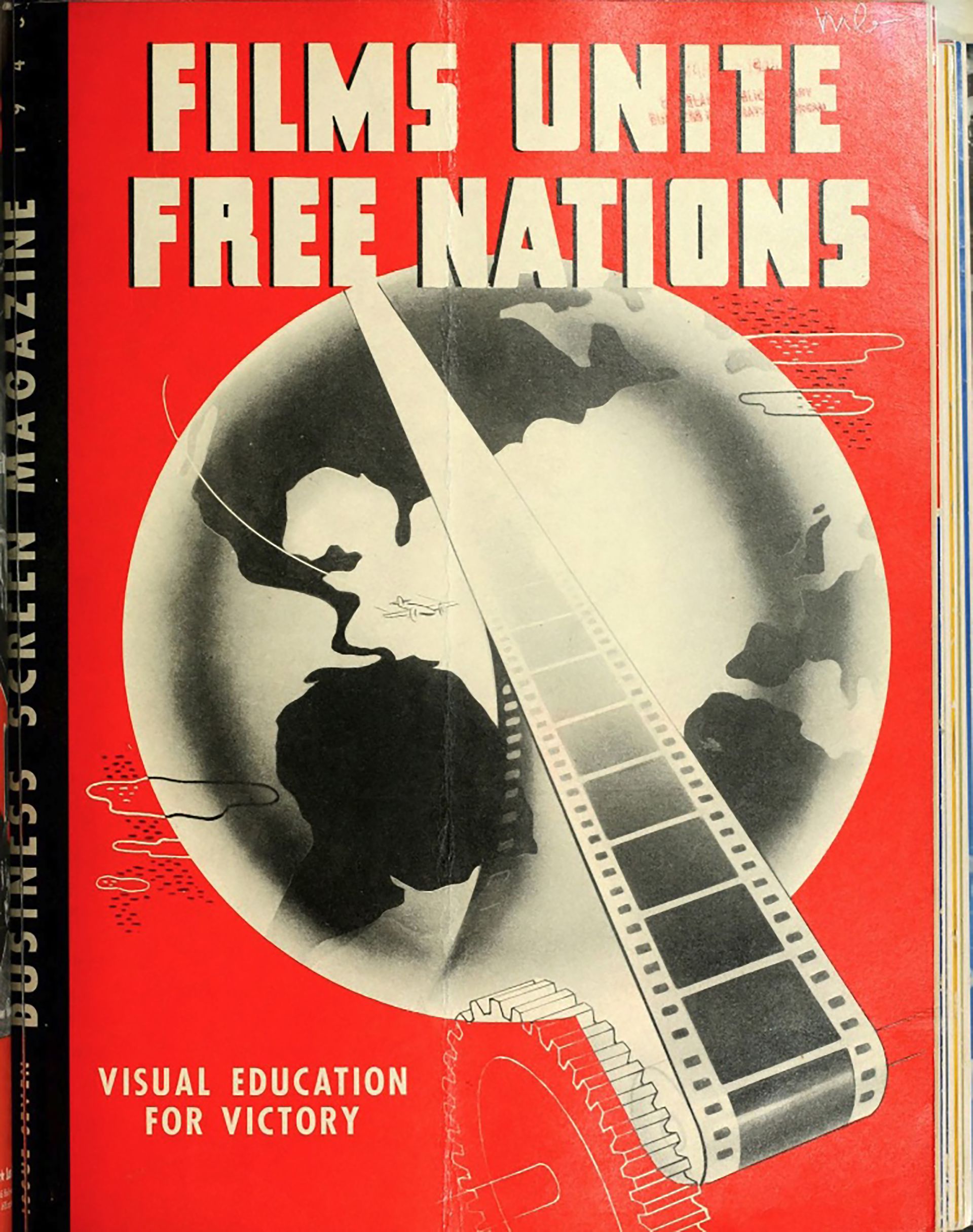
Business Screen Magazine, Cover of Business Screen Magazine “Films Unite Free Nations,” 1943. Hagley Museum Library, Courtesy of Hagley Museum
The Interior, as such, played a double role: it projected the American landscape outward while enfolding territories into its interior through a planetary expansion of its imaging ambitions. It enabled the mass mobilization of plastics and metals by US corporations that the production of image media, from film reels to earth-imaging satellites, were contingent upon. Local communications complexes increasingly relied on materials and other inputs that were being supplied by US companies whose monopolizing presence was eased by the spadework of the Interior.
The films, as with much of the image output of the Interior, rested on the representational certainty of American universality. Arizona constructed a moving pictorial archive of a demographically diverse set of subjects. In the film’s climaxing final montage of ethnically diverse portraits, it notes that through the unique stewardship of the US government, “a land of varied cultures, Mexican, Indian, Spanish, all Americans now, working together with the magic of water.”1
-
Arizona and Its Natural Resources, 1955. ↩
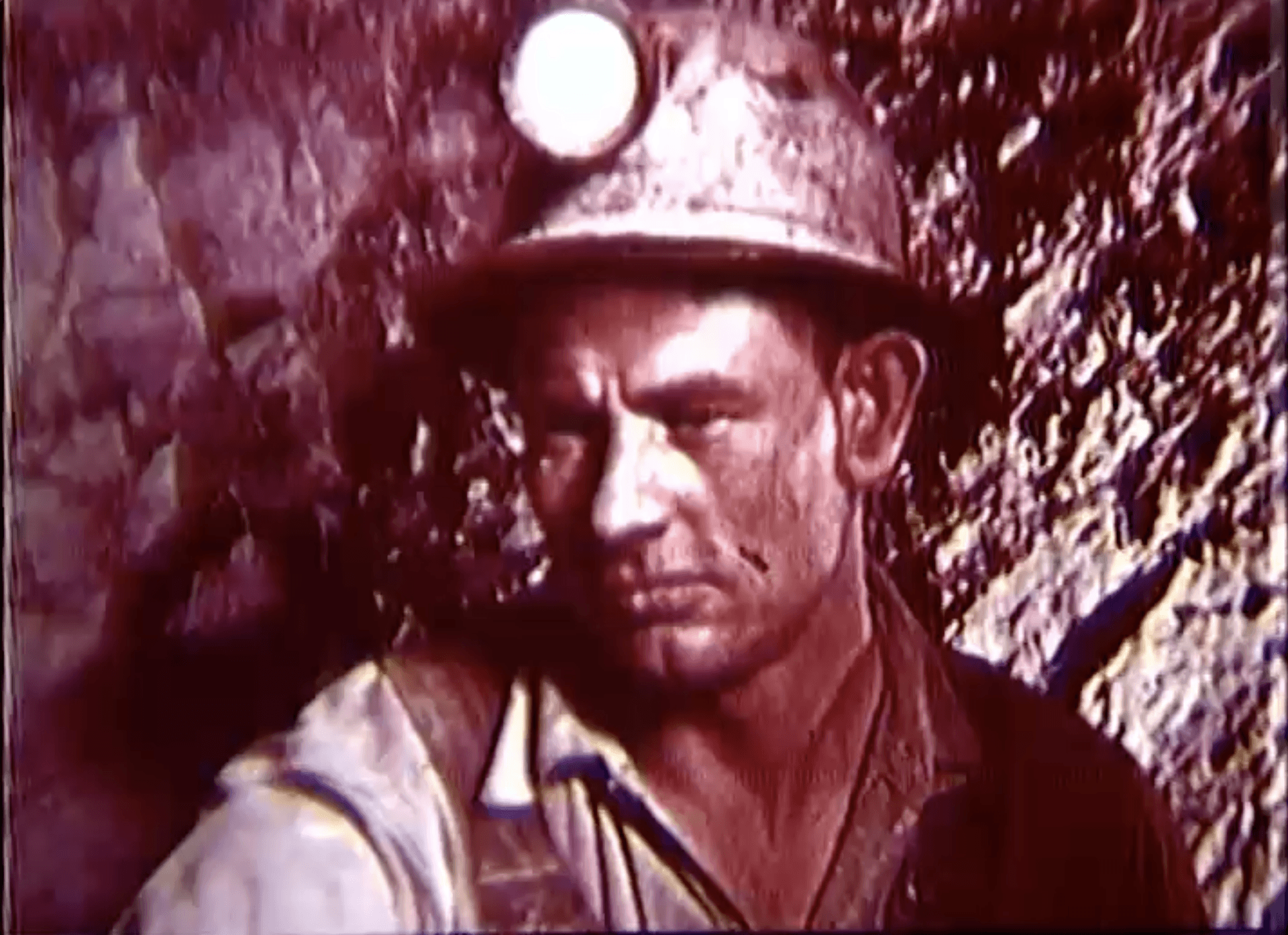
US Department of the Interior, Bureau of Mines, film still from Arizona and its Natural Resources, 1955. Courtesy of the National Archives and Records Administration (NARA)
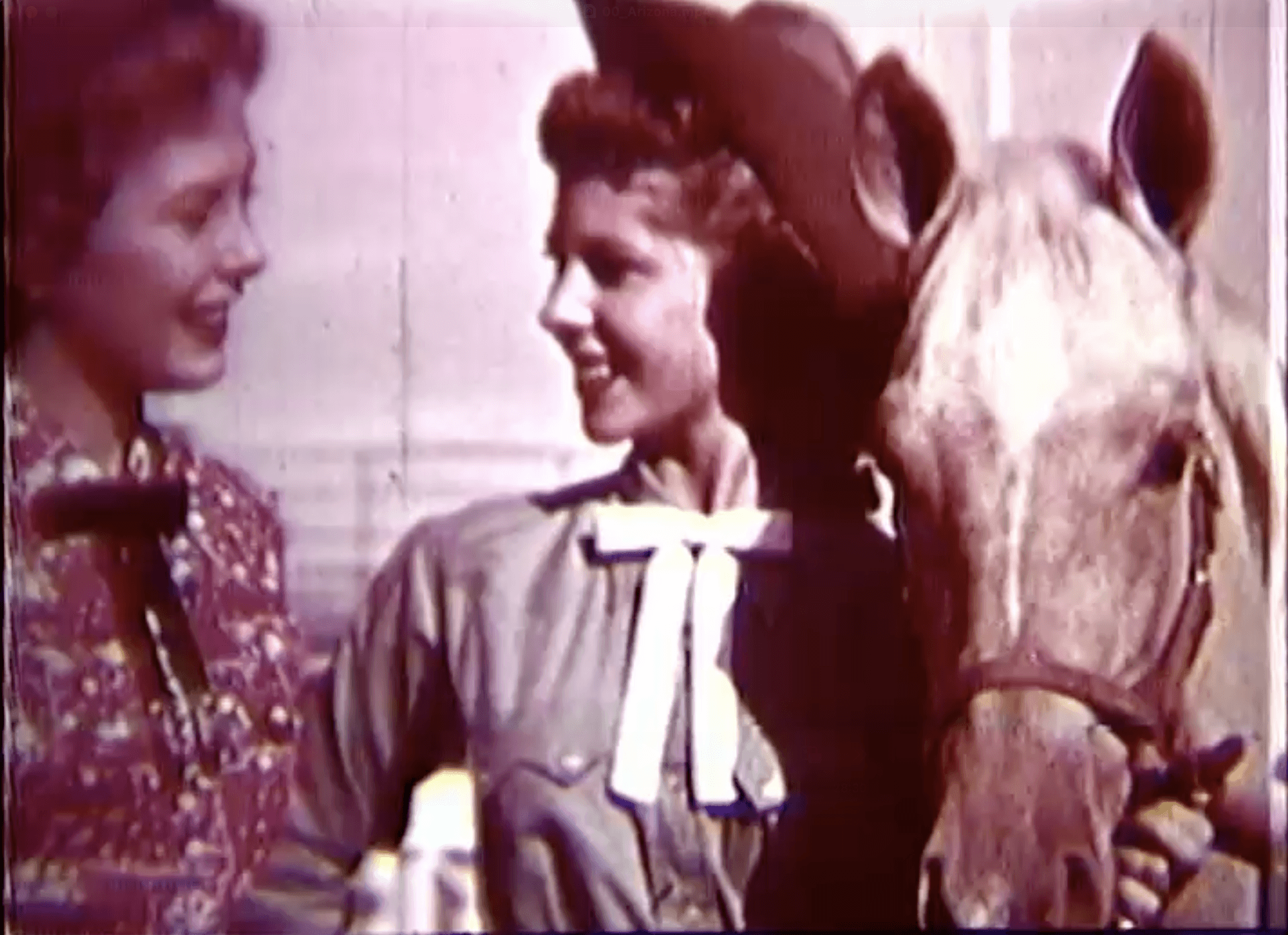
US Department of the Interior, Bureau of Mines, film still from Arizona and its Natural Resources, 1955. Courtesy of the National Archives and Records Administration (NARA)

US Department of the Interior, Bureau of Mines, film still from Arizona and its Natural Resources, 1955. Courtesy of the National Archives and Records Administration (NARA)

US Department of the Interior, Bureau of Mines, film still from Arizona and its Natural Resources, 1955. Courtesy of the National Archives and Records Administration (NARA)
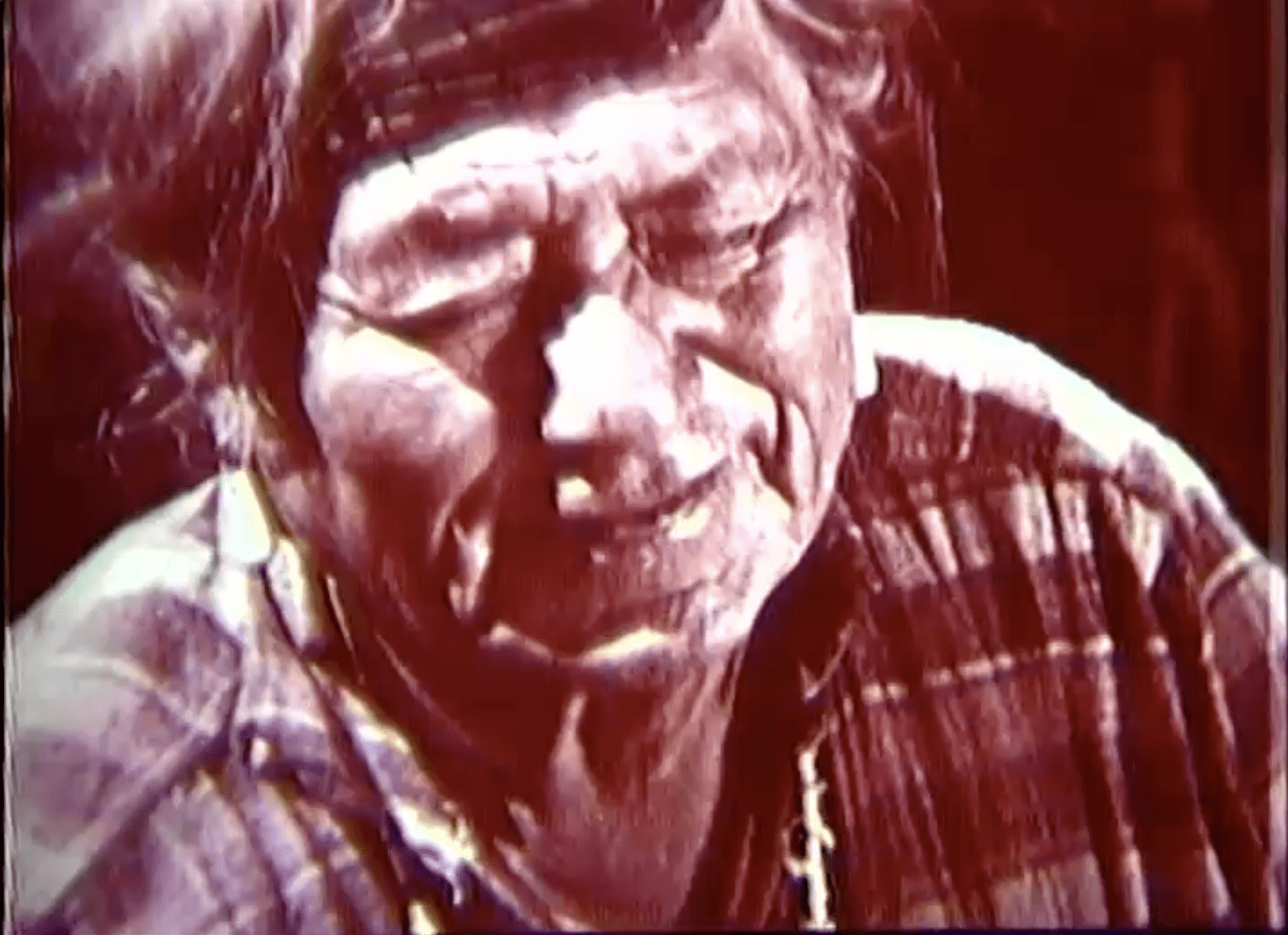
US Department of the Interior, Bureau of Mines, film still from Arizona and its Natural Resources, 1955. Courtesy of the National Archives and Records Administration (NARA)
Major Hollywood producers, eager to increase sales and market share globally, cooperated with Point Four programs to globalize their image archive, greatly increasing the representation of Latin American peoples and topics in their media production and distribution.1 Subsequent decades of Point Four policies—via processes of extraction, hydrological engineering, and large-scale agricultural mechanization—displaced countless rural peoples from their ancestral lands, pushing many into wage labour in the Global North and major metropolises.2 Despite the construction of an American landscape through the screen of representational diversity, its migrant subjects are continuously framed outside the field of political representation and subjected somewhere between a global surveillance imaging network and exploitation by US corporations.
The United States—an apparatus joining political and industrial interests—conceived of its Cold War communications complex not simply as a set of infrastructural networks but as a constantly amassing media archive, one whose dispersion gives US corporate interests a synthetic, plastic power. The representational machine shifts its subject in service of a dominant social relation, a repository of exchangeable images completely reliant on its dispersion and beyond representation. This dispersion ultimately helped reproduced the structures by which US corporate interests fortified their own investments.
-
For more on the United States’ reliance on decentralized discursive dispersal in its public diplomacy, see Gisela Cramer and Ursula Prutsch, eds., ¡Américas Unidas! Nelson A. Rockefeller’s Office of Inter-American Affairs (1940–46) (Madrid: Iberoamericana; Frankfurt am Main: Vervuert, 2012). The volume covers the Office of Inter-American Affairs (OIAA), the wartime precursor to Point Four, where many of the programs and policies later associated with Point Four were first tried out in Latin America under Nelson Rockefeller’s direction. ↩
-
Tore Olsson covers the radical transformation and enclosure of the Mexican countryside through US technical assistance during the Cold War. Tore C. Olsson, Agrarian Crossings: Reformers and the Remaking of the US and Mexican Countryside (Princeton, NJ: Princeton University Press, 2017). ↩
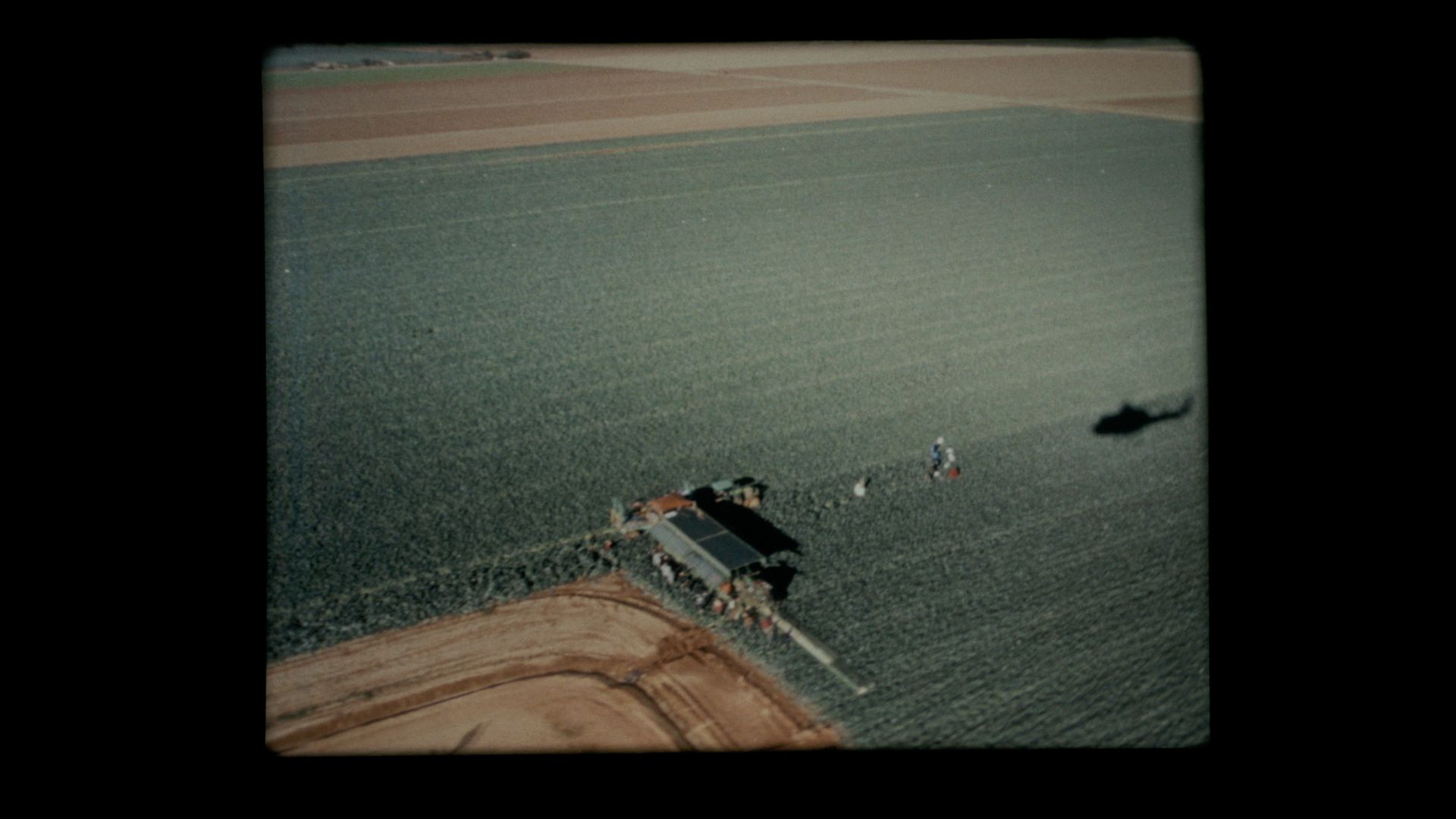
Still from “Archive III”, as part of Reframing the American Landscape by Andy Lu Lee, 2026. CCA © Andy Lu Lee
The Cold War Interior archive outlined the liberalizing potential of a global, decentralized archive of images and its ability to facilitate financial and corporate interests on which a new US-centric economic order could emerge. While the US has greatly shifted away from its previously well-funded apparatus of advocacy since the closing of the Cold War, the post-9/11 transformation of a global communications complex operated and financialized by government-based US corporations—many of which have also transformed themselves into media companies—maintains a trend forged in Cold War soft power aid programs from the US Department of the Interior.
In a moment in which state institutions like the National Archives are being cannibalized, these archival documents can no longer be conceived of as inert objects that await researcher interest, but as a part of a constantly reformatting archival whole beyond the watertight bulkheads of the state archive.1 President Trump, in famously hoarding a select portion of the archive at his Mar-a-Lago residence, and to which he referred to as his “Beautiful Mind boxes,” understands this. The now infamous, endlessly circulating photos of those boxes in his residence raise relevant questions about the role of the American archive today in the synthetic production of power in spite of its subjects.
-
I borrow here from Allan Sekula’s description of the archive, “with its presumably watertight bulkheads between iconic categories,” as “a space of vicarious liquid immersion, dry-land two-dimensional thalassa therapy.” Allan Sekula, “Between the Net and the Deep Blue Sea (Rethinking the Traffic in Photographs),” October 102 (Fall 2002): 12. ↩


