


Synthetic
Jonas Danen and Ruoqi Yu
The following text introduces the final two articles produced by participants in the 2025 Toolkit for Today: Computation is the New Optics. Through two case studies, Jonas Danen and Ruoqi Yu operationalize the friction between synthetic knowledge and lived experience, treating them as co-constructive forces.
Collective Statement
Through confrontations with archival and classificatory structures in and around Montréal during the week-long seminar Toolkit for Today: Computation is the New Optics, we repeatedly encountered a shared problem: that knowledge emerges differently when built under conditions of constraint.1 From the power of absence in algorithmic design to the ways synthetic data, modelling, and classification produce knowledge under conditions of constraint, and to the different ways understanding emerges through bodies shaped by history, precarity, and social context, this week made clear that what systems treat as noise or irregularity is often where meaning actually resides.2
Yet, the tension between systems of ordering and the meanings they produce long predates computation. Studies of photographs and archives have traced how institutional structures organize meaning, while also revealing the fluidity and alternative histories that can emerge with them.3 What kinds of knowledge depend on control, and what kinds emerge when control is no longer a precondition for legibility? Synthetic data offers a particularly clear expression of this problem: it produces representations through modelling and controlled variation, making assumptions about what a world might contain to render it computationally legible. We define “synthetic” not strictly in computational terms, but rather as any form of input produced through modelling, standardization, or abstraction. Such systems do not simply organize existing information; the categories and distinctions they establish help determine what can be recognized as knowledge. By contrast, (lived) “experience” is embodied, contextual, and deeply relational. It attends to what synthetic systems suppress—material textures, personal histories, and political resonance.
In the following texts, we operationalize the friction between synthetic and experiential knowledge in two case studies. Each site reveals how synthetic models impose coherence and how lived experience disrupts it. These texts do not choose between synthetic and experiential knowledge, instead, they treat them as co-constructive forces. Experience provides the situated material, while representational frameworks shape how it becomes communicable as knowledge. In an era dominated by generative technologies, this method helps us examine what control affords us—and what it obscures.
-
Especially the conversations with Romi Ron Morrison and Rodrigo Ochigame helped to bring these reflections forward. ↩
-
Kara Keeling, “Queer OS,” Cinema Journal 53, no. 2 (2014): 152–57; Jihan Sherman, Romi Ron Morrison, Lauren Klein, and Daniele Rosner, “The Power of Absence: Thinking with Archival Theory in Algorithmic Design,” paper presented at ACM Conference on Designing Interactive Systems 2024, Copenhagen, 1–5 July, 2024 (accessed 27 August, 2025); “TRANSCRIPT: Octavia Butler and Samuel Delany, 1998,” MIT Black History: https://blackhistory.mit.edu/archive/transcript-octavia-butler-and-samuel-delany-1998 (accessed 1 July, 2025). ↩
-
Allan Sekula, “The Body and the Archive,” October 39 (1986): 3–64; Elizabeth Edwards, Raw Histories: Photographs, Anthropology and Museums (Berg, 2001), 1–26. ↩
Jonas Danen: Enclosed Worlds; Decoding a Garden Binding from 1664
“G Z G 1664”—the inscription stands in the middle of a yellowish, faded sheet of vellum made from calfskin stretched stiffly over wooden boards; its surface bearing the tension of an animal material forced into rectilinear form. A stamped rosette anchors the monogram, while a sequence of rectangular panel borders—geometric, floral, and curvilinear—frames the composition. Each was made with a roll tool, its repeated impressions creating the illusion of seamless order. At the four corners, bouquets rise from heart-shaped vases, and between the borders, a row of alternating praying putti and floral motifs establishes a rhythm of devotion and ornament.1 The binding is most likely from southern Germany, characteristic of the decorative aesthetic popular in areas such as Bavaria and Swabia in the late seventeenth century.2
“G Z G” likely owned or commissioned the binding in 1664. The cover’s ornate surface does not explicitly give away the manuscript’s content. However, after marbled endpapers and two blank folios, the book’s purpose is revealed: it is an early pattern book, with sketches of knot gardens, labyrinths, and trellises rendered in delicate brown-ink lines. These forms—rigid in symmetry, elaborate in geometry—were among the most fashionable features of early modern European garden design.
-
A sketchbook of designs for knot gardens, maze gardens and trellises (1664) DR1987:0832:001–110, CCA, Montréal. The English-language title of the manuscript comes from the CCA catalogue; it is not written in or on the object. Many thanks to Sven Kuttner and Marion Liebherr from the University Library of LMU Munich for assisting me with some analyses of the object. See also Douglas Cockerell, “The Binding of Books,” Journal of the Royal Society of Arts 87, no. 4513 (1939): 691–92; “Judging a Book by Its Cover: Decorative Bookbinding Styles,” online exhibition, Armagh Robinson Library, July 2024–February 2025, https://armaghrobinsonlibrary.co.uk/decorative-bookbinding-styles/. ↩
-
See, for example, the (digitized) collection of “Patterns for Bookbinding Stamps” from Johann Georg Schwertfeger (Nuremberg, 1697), E.352(–365)–1911, Victoria and Albert Museum, London. ↩
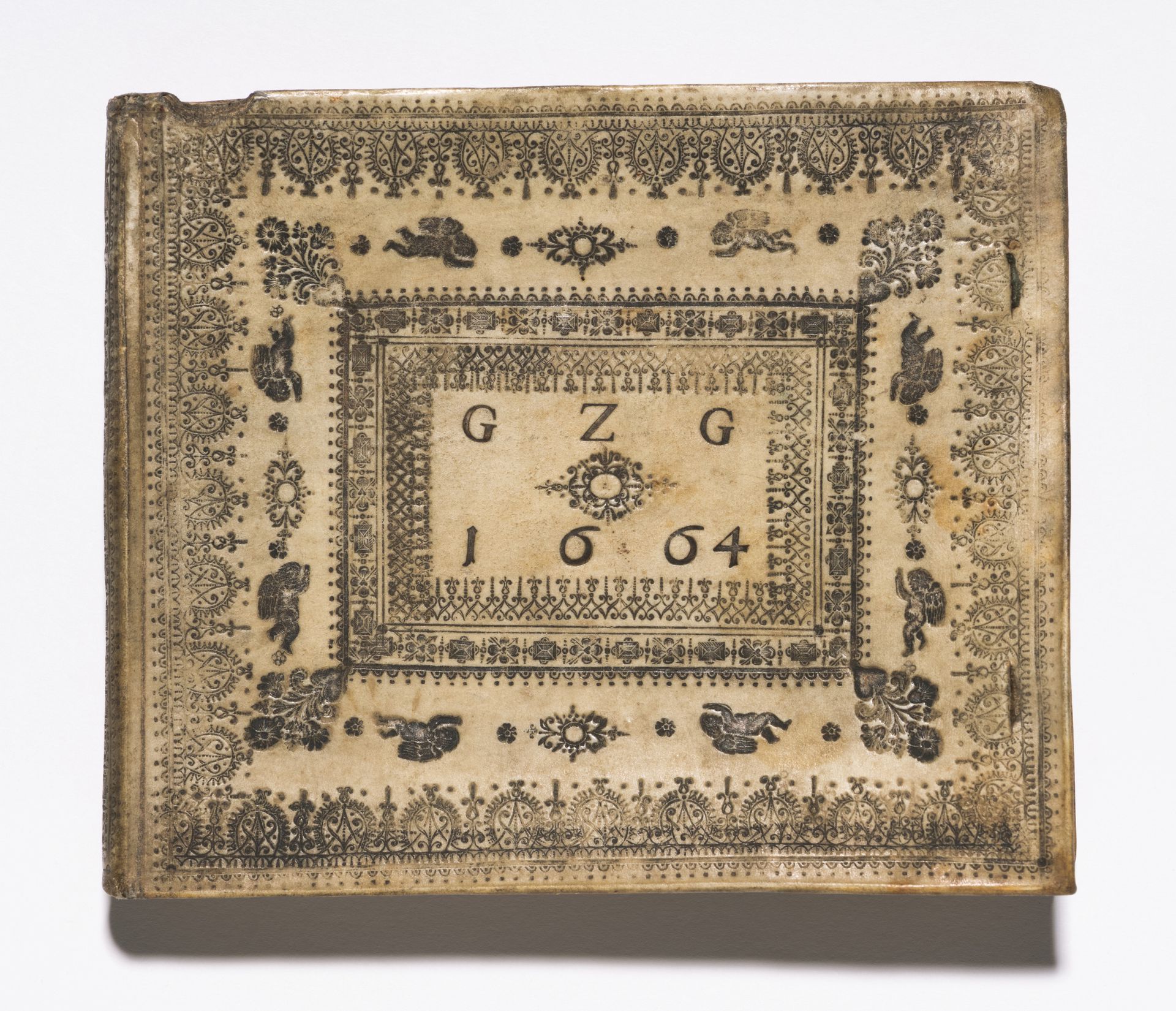
Max Lauer, cover of “G Z G 1664,” a sketchbook of designs for knot gardens, maze gardens, and trellises, 1664. DR1987:0832:001-110, CCA
Seen in this context, the cover’s stamped design begins to take on a different meaning. The floral motifs are apparent enough, but the nested rectangular borders start to resemble layers of fencing or enclosure; miniature architectures of containment. Taken together, they evoke the hortus conclusus—the enclosed garden, a symbolic space central to Christian iconography. It was an apt symbol for the Virgin Mary and the birth of Christ.1 The praying putti reinforce this reading: they are witnesses, attendants, and guardians of purity.
The hortus conclusus illuminates the intertwined logics of gardens and women in medieval and early modern thought. Both were imagined as potent sites of generative, natural forces, yet were believed to require shaping, training, and containment to realize their ideal form. Enclosure was not merely a physical boundary but a moral, aesthetic, and theological one. Perfection emerged from constraint.2
-
Johanna Bauman, “Verbal Representations,” in A Cultural History of Gardens in the Medieval Age, ed. Michael Leslie (Bloomsbury, 2016), 120–21. ↩
-
Bauman, “Verbal Representations,” 121; Stephen Bending, “Introduction,” in A Cultural History of Gardens in the Age of Enlightenment, ed. Stephen Bending (Bloomsbury, 2016), 21–24. ↩
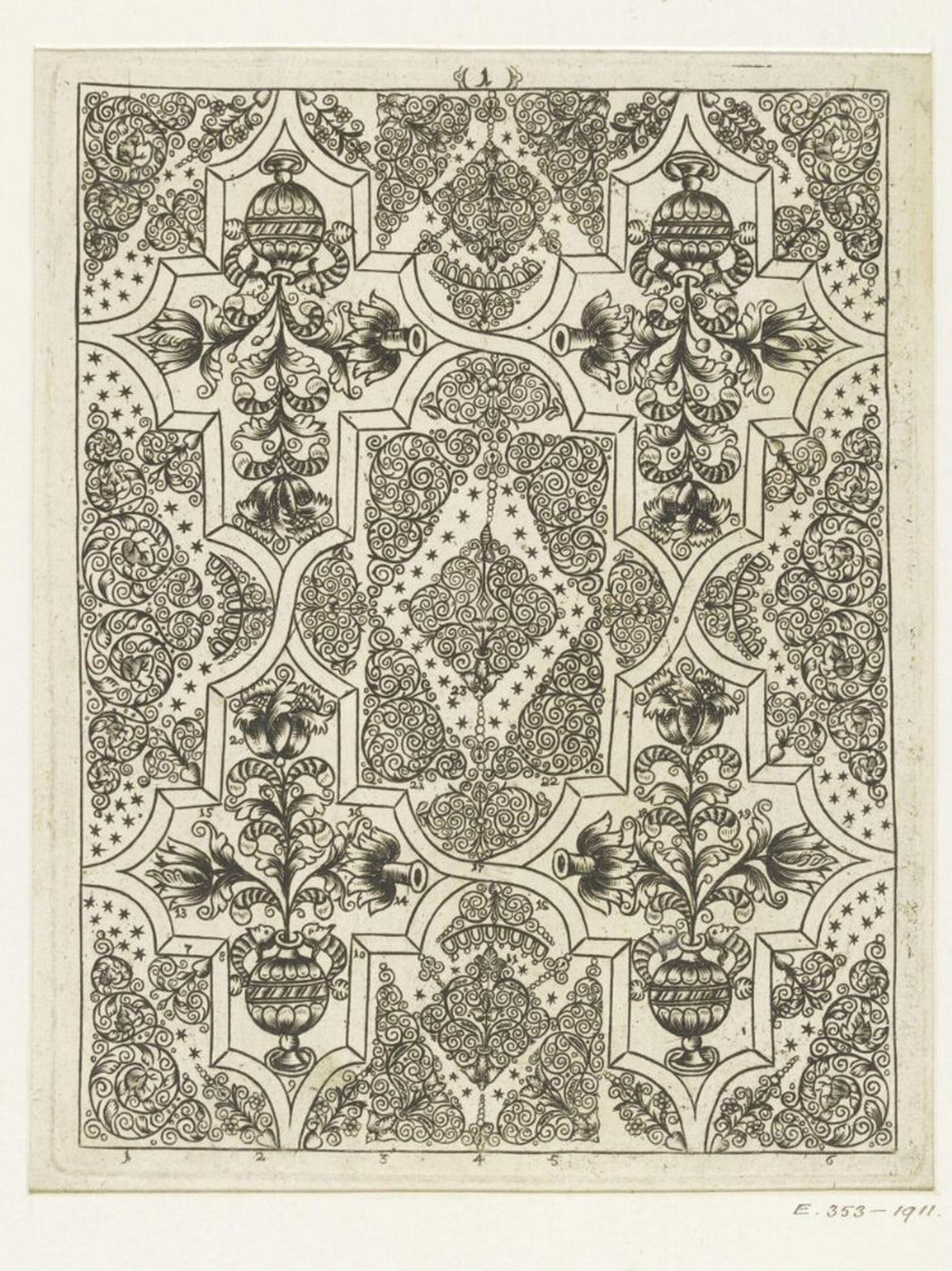
Johann Georg Schwertfeger, page from “Patterns for Bookbinding Stamps,” 1697. E.353–1911, Prints, Drawings, & Paintings Collections, Victoria and Albert Museum
Yet even as the hortus conclusus idealizes a controlled nature, gardens actually resisted such containment. Plants form communities through networks of roots and fungi below the soil and pollen in the air, quietly eroding the garden’s apparent borders. And the sensory experience of a garden—shifting smells, bird calls, insect buzzes, the wind-borne movement of foliage—extends far beyond what can be traced on a ground plan. Sound and scent travel freely, slipping past walls and hedges long after sight has been obstructed.1 Even the vellum binding itself performs this resistance: it shrinks, discolours, and warps over time, its materiality asserting itself against the ideal order stamped onto its surface.
Early modern European gardens, in this sense, rested on the conviction that nature could—and should—be modelled, disciplined, and rendered legible through the application of technologies.2 They were abstract designs mapped onto living material, experiments in creating a controlled environment where variation could be minimized or managed. Gardening, thus, produced a kind of synthetic nature: a simulation of order generated through geometry, measurement, and precedent. Like the pattern stamped onto the vellum, though, this order was never entirely separable from the material onto which it was imposed.
-
Dede Fairchild Ruggles, “Introduction: A World of Senses,” in Sound and Scent in the Garden, ed. Dede Fairchild Ruggles, Dumbarton Oaks Colloquium on the History of Landscape Architecture XXXVIII (Dumbarton Oaks Research Library and Collection, 2017), 5–6. ↩
-
Clarence Glacken, Traces on the Rhodian Shore: Nature and Culture in Western Thought from Ancient Times to the End of the Eighteenth Century (University of California Press, 1967), 482. ↩
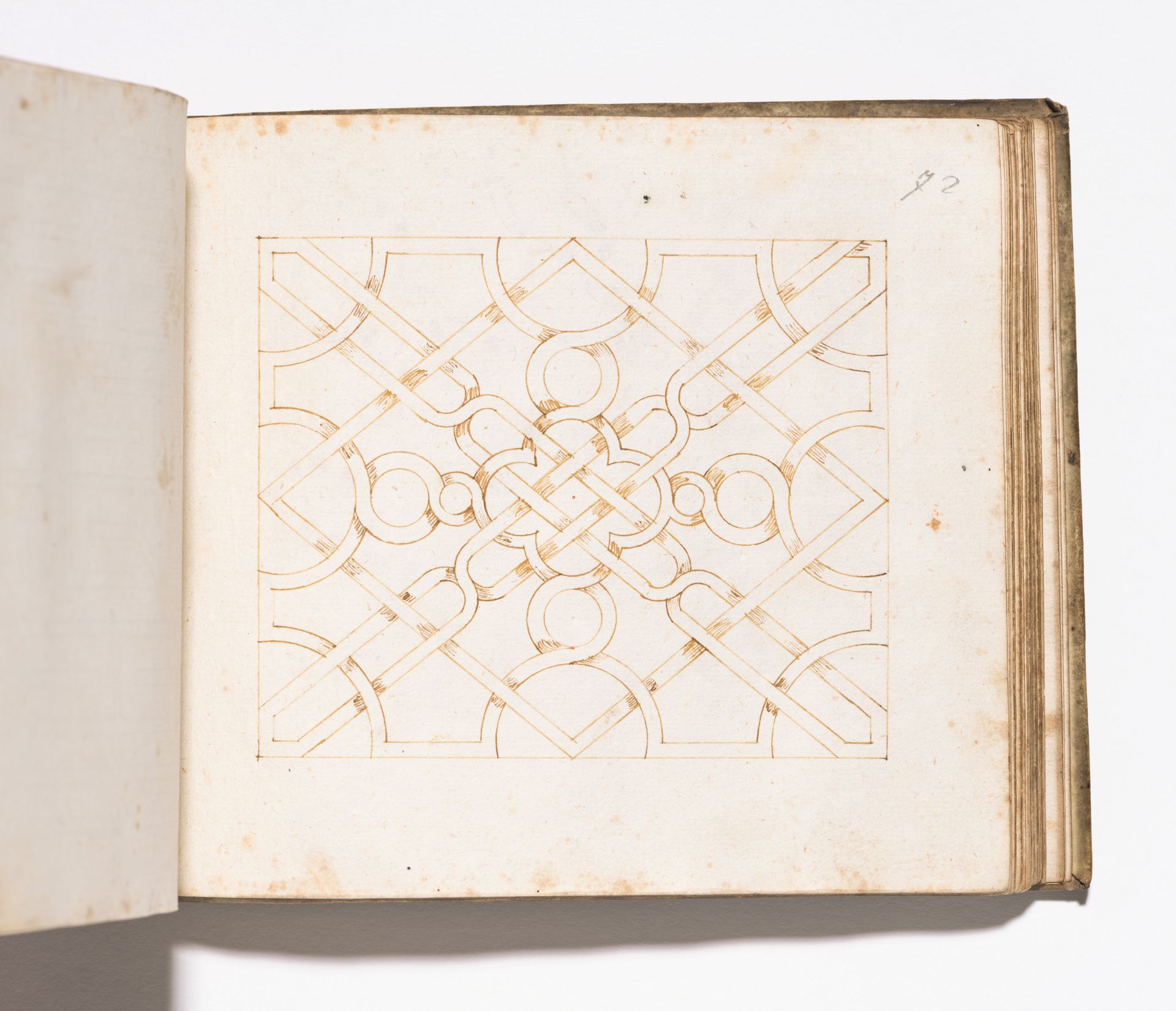
Max Lauer, fol. 72r of “G Z G 1664,” a sketchbook of designs for knot gardens, maze gardens, and trellises, 1664. DR1987:0832:072, CCA
Just as synthetic datasets are produced under controlled conditions to generate predictable outputs, the early modern garden design relied on geometric protocols and inherited aesthetic ideals to impose coherence on the “wilderness” of the landscape. The garden plan functioned like a dataset: stable, regulated, and repeatable. However, the garden’s lived experience always exceeded the design, reminding its maker that the world resists total modelling.
This is where the vellum binding becomes unexpectedly contemporary. It stages the same tension that defines debates about synthetic data and generative technologies today: the friction between simulated order and lived complexity, between the desire for a controllable model, and the unruly material world it purports to represent.1
Studying this object asks us to reflect on what it means to know the world through mediated forms. Whether through a seventeenth-century garden plan or a twenty-first-century algorithm, knowledge is never neutral or objective. It is shaped by the contexts, bodies, and assumptions. To engage with this binding is therefore to confront a broader question: how much of the world can be shaped by design, and how much must be understood through experience?
-
E.g., Matthew Hutson, “Can Computers Learn Common Sense?,” New Yorker, 5 April, 2022, https://www.newyorker.com/tech/annals-of-technology/can-computers-learn-common-sense; Robin Wall Kimmerer, Braiding Sweetgrass: Indigenous Wisdom, Scientific Knowledge and the Teaching of Plants (Penguin Random House, 2020; 2013); Tiffany Lethabo King, The Black Shoals: Offshore Formations of Black and Native Studies (Duke University Press, 2019); James C. Scott, In Praise of Floods: The Untamed River and the Life It Brings (Yale University Press, 2025); Sherman et al., “The Power of Absence.” ↩
Ruoqi Yu: Assembling Views; Photography and Landscape in Nineteenth-Century China
From the mid-nineteenth century, travellers, missionaries, diplomats, and photographers increasingly came to China and produced a body of visual material about the country. Rather than simply record what they saw, these visitors transformed lived, situated encounters into scenes of Chinese religious and social life. Photographs and accompanying texts selected and framed local people, natural landscapes, and the built environment for viewers who had never visited China. These nineteenth-century photographic representations of China reveal how synthetic operations and forms of representational control were already at work in the production of visual knowledge. Focusing on Amoy (now Xiamen) in two photographically illustrated publications, Illustrations of China and Its People (1873-1874) and Pictures of Southern China (1897), this piece reveals how the selection of subjects, the use of Western visual conventions, and the anticipation of audience expectations worked together to shape how the city was seen and understood.
With the daguerreotype becoming widely accessible to the French public in 1839, European travellers carried this new photographic technology across the globe, documenting people and places in what they had labelled the Far East. Photographic practitioners and technologies circulated in mid-nineteenth-century China chiefly through imperial and diplomatic encounters. These field agents created a range of “investigative modalities” by surveying, classifying, cataloguing, and visualizing to produce an “imperial archive.”1 The earliest documented use of the daguerreotype camera in China was by two British officers during the final stages of the First Opium War in 1842, as recorded by a student interpreter aboard the British warships; however, none of their photographic images or reproductions have survived.2
In the decades that followed, European travellers increasingly drew on typological methods from ethnography and natural history, which classified plants, animals, and peoples into distinct types.3 John Thomson, a Scottish photographer and travel writer who documented China in the nineteenth century, explicitly described the sitters in a series of portraits in Illustrations of China and Its People as “fair types of the aged labourers of China.”4 His caption presents the subjects not simply as individuals but as examples of a broader social type through which Chinese society could be observed and classified. These photographs, which were produced using long exposure times and carefully staged poses, make clear that “type” images were never neutral records. This typification does not stop at the body but also shapes his views of the landscape. The harbour was a repeatable composition, with water in the foreground, ships in the mid-ground, foreign architecture or the bund in the background, and hills or sky beyond.
-
James L. Hevia, English Lessons: The Pedagogy of Imperialism in Nineteenth-Century China (Duke University Press, 2003), 123. ↩
-
TTerry Bennett, Anthony Payne, and Lindsey Stewart, History of Photography in China: Chinese Photographers, 1844–1879 (Quaritch, 2013), 2. ↩
-
Frank Spencer, “Some Notes on the Attempt to Apply Photography to Anthropometry during the Second Half of the Nineteenth Century,” in Anthropology and Photography, 1860–1920, ed. Elizabeth Edwards (Yale University Press, in association with the Royal Anthropological Institute, 1992), 99–101. ↩
-
John Thomson, “Four Heads, Types of the Labouring Class,” in Illustrations of China and Its People, vol. 1 (Sampson Low, Marston, Low, and Searle, 1873–74). ↩
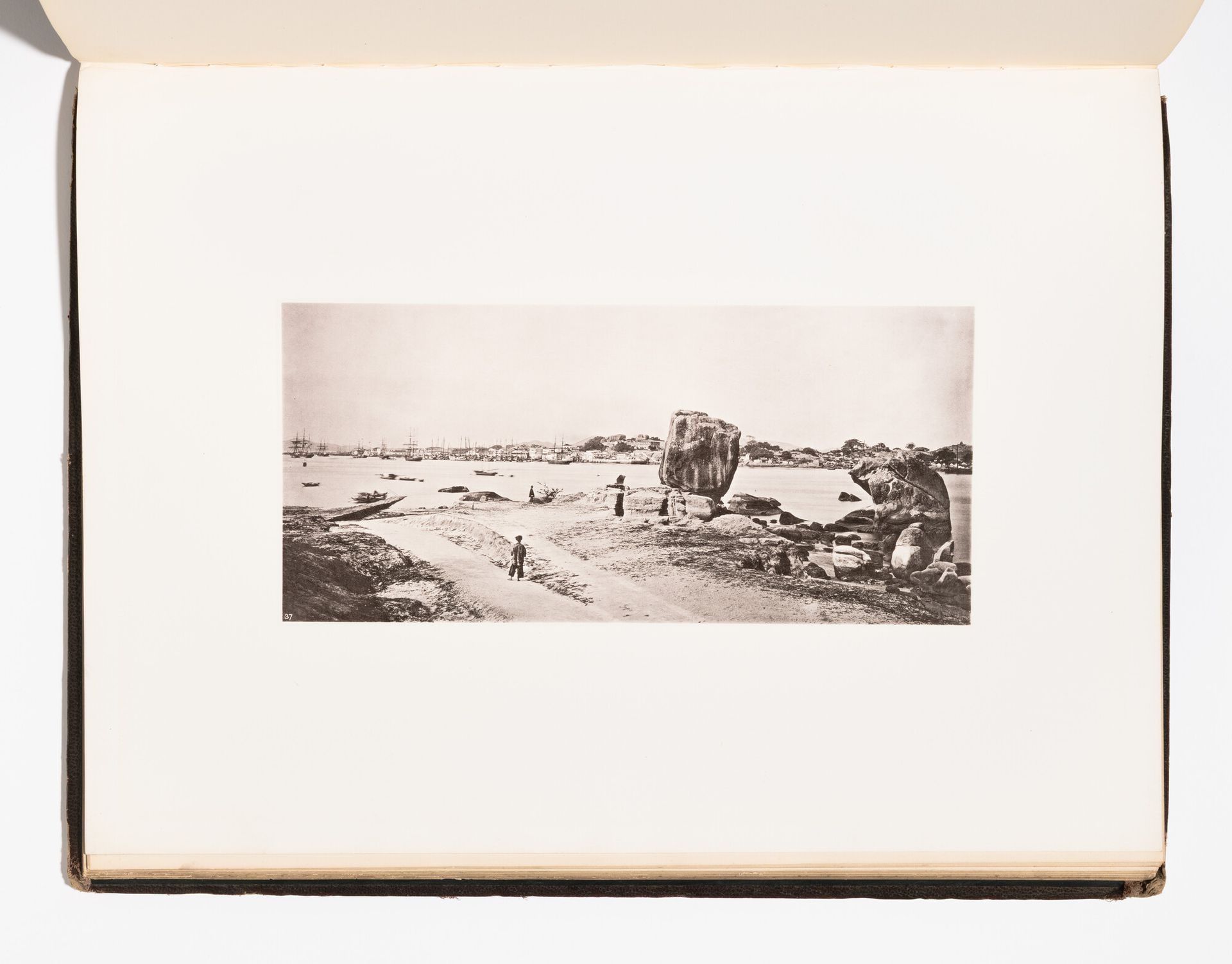
John Thomson, View of “Six-Mile Rock” and the Harbour of Amoy (now Xiamen Island), Fukien (now Fujian) Province, China, 1873. PH1979:0603.02:038, CCA
Photographs of landscapes and urban spaces show how visual conventions also shaped the representation of places. These images draw on established picturesque conventions, while variations in natural features, built structures, and the arrangement of people introduce local specificities. Together, these subjects contribute to a visual construction of China. Thomson photographed Amoy harbour and noted that it “shows that part of the native town of Amoy where the offices of foreign merchants have been built, the town itself stands on the west of the island from which it takes its name.”1 Instead of using an elevated panoramic vantage point, he took the photographs from eye level and placed a bald rock, known to Europeans as “Six-mile Rock” and to Chinese as the “Sail Windlass Rock,” at the visual centre of the harbour scene.2 The harbour, boats and dense settlement extend horizontally across the background. In his travel writing, he records:
“To this pinnacle of stone, popular superstition is attached, for the natives look upon it as a kind of guardian genius who has control of the fates of Amoy. When this rock falls (say the credulous) Amoy will fall too. So year by year additional props are planted beneath its gradually diminishing base.”1
-
Thomson, “Amoy Harbour.” ↩
Although the rock is not architectural, Thomson positions it in the same register as temples, pagodas, and tombs—as one of the landmarks where local communities bind landscape to fate. Attending to these different sites together allows him to move from singular scenes to more general claims about Chinese religious life. The connection between rocks, landscape, and human fate also appears in Pictures of Southern China by John MacGowan, a missionary with the London Missionary Society. MacGowan describes the local system of geomancy, which he calls “Fung-shuy,” as “a positive curse to the whole nation.”1 The integrity of the ground was closely associated with the well-being of the community—as disturbing the dragon believed to have inhabited the landscape was thought to bring fevers, epidemics, and decline in trade.2 As a consequence, the people left the local rocks untouched and travelled many miles to obtain stone from districts where experience had shown that quarrying did no harm.
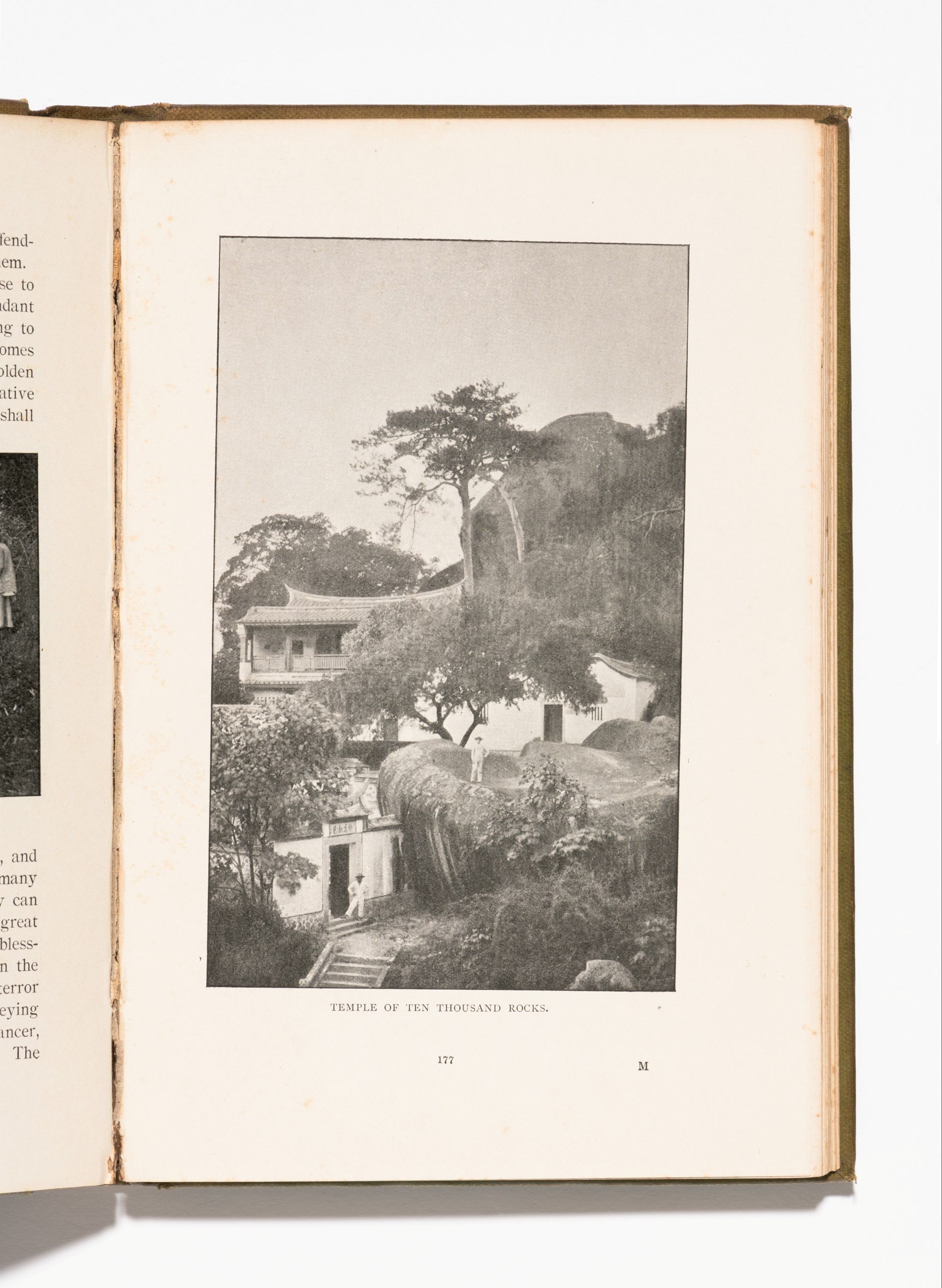
John McGowan, View of “Temple of Ten Thousand Rocks” in Pictures of Southern China, 1897. LIB_2784295-256240, CCA
The distinction between “stone” as a construction material and “rock” as part of the existing landscape also emerges visually in MacGowan’s “Temple of Ten Thousand Rocks.”1 This photograph presents a temple complex situated among massive exposed rocks. A stairway enters from the foreground and leads upward into the complex, while the buildings seem to occupy and adapt to the spaces afforded by the existing landscape. Small figures standing on the rocks and near the temple entrance provide a sense of scale, accentuating the visual prominence of the surrounding rocks, trees, and vegetation. These natural features make the terrain central to a religious landscape shaped by how local people engage with the ground.
Depending on the representational framework, a rock can appear as a picturesque object, a religious symbol, a geological feature, or evidence of “Fung-shuy.” Yet, these rocks were also embedded in specific relationships between landscape, belief, health, and everyday life that resist such generalization. But those encounters only become communicable knowledge in the publications through selection and mediation. The picturesque, therefore, operates as one framework through which Thomson and MacGowan translate a local landscape into a form legible to European audiences. Their work complicates any distinction between a world shaped through design and one understood through experience, showing instead how situated encounters and representational frameworks work together to produce knowledge. Such representational control makes them legible to distant audiences while potentially obscuring the specificity and complexity of local relationships with landscapes.
-
Xue Qifeng, comp., Lujiang zhi [Gazetteer of Lujiang] (1766–69; repr., Lujiang chubanshe, 1998), 61. ↩


