


12622 Results
Form:
drawings
drawings
Actions:
Reference number:
DR1988:0410
Description:
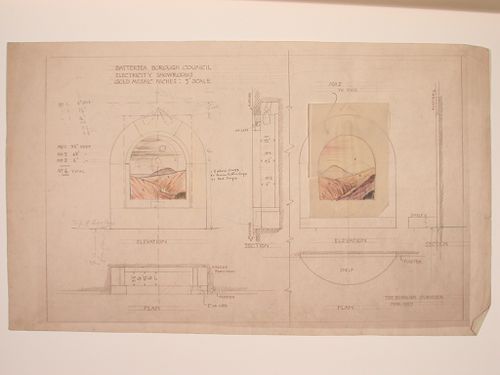
- This reprographic copy shows two elevations for onyx mosaics designed to be backlit. The onyx landscapes are rendered in coloured pencil. - This work is part of an incomplete group of possibly working reprographic copies for Electric House, Battersea Borough, designed by the borough architect, Henry Hyams. The group also includes some reprographic copies which may have been used for publication purposes. - The style of many of these drawings and reprographic copies by Henry Hyams (DR1988:0332 - DR1988:0414) suggests that they were possibly for periodical illustrations. Hyams contributed articles to the periodicals 'The Builder' and 'The Architect'. Two objects in the CCA collections can be directly linked to an article published prior to 1926 in 'The Architect'; a reprographic copy (DR1988:0357) and a drawing (DR1988:0364) (Who's Who in Architecture, 161).
DR1988:0410
Description:
- This reprographic copy shows two elevations for onyx mosaics designed to be backlit. The onyx landscapes are rendered in coloured pencil. - This work is part of an incomplete group of possibly working reprographic copies for Electric House, Battersea Borough, designed by the borough architect, Henry Hyams. The group also includes some reprographic copies which may have been used for publication purposes. - The style of many of these drawings and reprographic copies by Henry Hyams (DR1988:0332 - DR1988:0414) suggests that they were possibly for periodical illustrations. Hyams contributed articles to the periodicals 'The Builder' and 'The Architect'. Two objects in the CCA collections can be directly linked to an article published prior to 1926 in 'The Architect'; a reprographic copy (DR1988:0357) and a drawing (DR1988:0364) (Who's Who in Architecture, 161).
People:
Subject:
interior design
interior design
Date:
printed March 1927
printed March 1927
Title:
Elevations for onyx niches for showrooms, Electric House, Battersea Borough
Actions:
DR1988:0410
Description:
- This reprographic copy shows two elevations for onyx mosaics designed to be backlit. The onyx landscapes are rendered in coloured pencil. - This work is part of an incomplete group of possibly working reprographic copies for Electric House, Battersea Borough, designed by the borough architect, Henry Hyams. The group also includes some reprographic copies which may have been used for publication purposes. - The style of many of these drawings and reprographic copies by Henry Hyams (DR1988:0332 - DR1988:0414) suggests that they were possibly for periodical illustrations. Hyams contributed articles to the periodicals 'The Builder' and 'The Architect'. Two objects in the CCA collections can be directly linked to an article published prior to 1926 in 'The Architect'; a reprographic copy (DR1988:0357) and a drawing (DR1988:0364) (Who's Who in Architecture, 161).
Elevations for onyx niches for showrooms, Electric House, Battersea Borough
Actions:
DR1988:0410
Description:
- This reprographic copy shows two elevations for onyx mosaics designed to be backlit. The onyx landscapes are rendered in coloured pencil. - This work is part of an incomplete group of possibly working reprographic copies for Electric House, Battersea Borough, designed by the borough architect, Henry Hyams. The group also includes some reprographic copies which may have been used for publication purposes. - The style of many of these drawings and reprographic copies by Henry Hyams (DR1988:0332 - DR1988:0414) suggests that they were possibly for periodical illustrations. Hyams contributed articles to the periodicals 'The Builder' and 'The Architect'. Two objects in the CCA collections can be directly linked to an article published prior to 1926 in 'The Architect'; a reprographic copy (DR1988:0357) and a drawing (DR1988:0364) (Who's Who in Architecture, 161).
Form:
drawings
drawings
Date:
printed March 1927
printed March 1927
People:
Subject:
interior design
interior design
Form:
archives
Level of archival description:
Fonds
archives
Level of archival description:
Fonds
Reference number:
AP181
Synopsis:
The COOP HIMMELB(L)AU BMW Welt project records, 1994-2007, document the design of the firm’s BMW Welt project, also known as BMW World, in Munich, Germany. The archive consists of approximately 52, 400 born-digital files representing the greater part of the digital archive of the project, as well as 52 of the study models made in the earlier stages of the project.
AP181
Synopsis:
The COOP HIMMELB(L)AU BMW Welt project records, 1994-2007, document the design of the firm’s BMW Welt project, also known as BMW World, in Munich, Germany. The archive consists of approximately 52, 400 born-digital files representing the greater part of the digital archive of the project, as well as 52 of the study models made in the earlier stages of the project.
People:
Date:
1994-2015
1994-2015
Title:
COOP HIMMELB(L)AU BMW Welt project records
Actions:
AP181
Synopsis:
The COOP HIMMELB(L)AU BMW Welt project records, 1994-2007, document the design of the firm’s BMW Welt project, also known as BMW World, in Munich, Germany. The archive consists of approximately 52, 400 born-digital files representing the greater part of the digital archive of the project, as well as 52 of the study models made in the earlier stages of the project.
COOP HIMMELB(L)AU BMW Welt project records
Actions:
AP181
Synopsis:
The COOP HIMMELB(L)AU BMW Welt project records, 1994-2007, document the design of the firm’s BMW Welt project, also known as BMW World, in Munich, Germany. The archive consists of approximately 52, 400 born-digital files representing the greater part of the digital archive of the project, as well as 52 of the study models made in the earlier stages of the project.
Form:
archives
Level of archival description:
Fonds
archives
Level of archival description:
Fonds
Date:
1994-2015
1994-2015
People:
Form:
drawings
drawings
Actions:
Reference number:
DR1988:0386
Description:
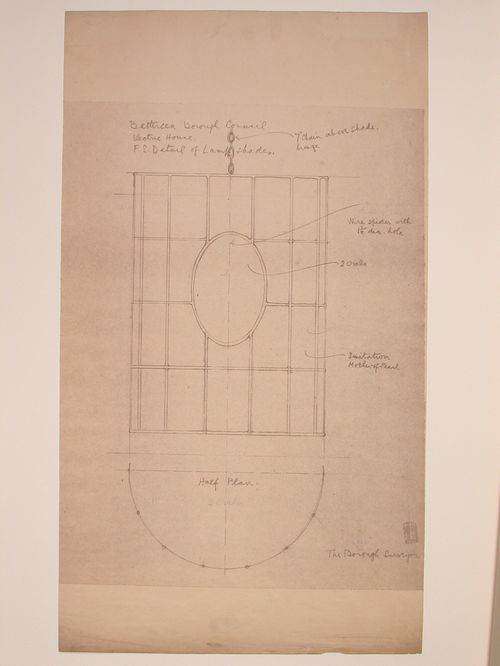
- This reprographic copy shows an imitation mother-of-pearl lamp shade to be suspended by a bronze chain. There is a thumbnail sketch of the design in the lower right corner. - This work is part of an incomplete group of possibly working reprographic copies for Electric House, Battersea Borough, designed by the borough architect, Henry Hyams. The group also includes some reprographic copies which may have been used for publication purposes. - The style of many of these drawings and reprographic copies by Henry Hyams (DR1988:0332 - DR1988:0414) suggests that they were possibly for periodical illustrations. Hyams contributed articles to the periodicals 'The Builder' and 'The Architect'. Two objects in the CCA collections can be directly linked to an article published prior to 1926 in 'The Architect'; a reprographic copy (DR1988:0357) and a drawing (DR1988:0364) (Who's Who in Architecture, 161).
DR1988:0386
Description:
- This reprographic copy shows an imitation mother-of-pearl lamp shade to be suspended by a bronze chain. There is a thumbnail sketch of the design in the lower right corner. - This work is part of an incomplete group of possibly working reprographic copies for Electric House, Battersea Borough, designed by the borough architect, Henry Hyams. The group also includes some reprographic copies which may have been used for publication purposes. - The style of many of these drawings and reprographic copies by Henry Hyams (DR1988:0332 - DR1988:0414) suggests that they were possibly for periodical illustrations. Hyams contributed articles to the periodicals 'The Builder' and 'The Architect'. Two objects in the CCA collections can be directly linked to an article published prior to 1926 in 'The Architect'; a reprographic copy (DR1988:0357) and a drawing (DR1988:0364) (Who's Who in Architecture, 161).
People:
Subject:
interior design
interior design
Date:
printed late 1926 or 1927
printed late 1926 or 1927
Title:
Elevation and half plan for a lamp shade for Electric House, Battersea Borough
Actions:
DR1988:0386
Description:
- This reprographic copy shows an imitation mother-of-pearl lamp shade to be suspended by a bronze chain. There is a thumbnail sketch of the design in the lower right corner. - This work is part of an incomplete group of possibly working reprographic copies for Electric House, Battersea Borough, designed by the borough architect, Henry Hyams. The group also includes some reprographic copies which may have been used for publication purposes. - The style of many of these drawings and reprographic copies by Henry Hyams (DR1988:0332 - DR1988:0414) suggests that they were possibly for periodical illustrations. Hyams contributed articles to the periodicals 'The Builder' and 'The Architect'. Two objects in the CCA collections can be directly linked to an article published prior to 1926 in 'The Architect'; a reprographic copy (DR1988:0357) and a drawing (DR1988:0364) (Who's Who in Architecture, 161).
Elevation and half plan for a lamp shade for Electric House, Battersea Borough
Actions:
DR1988:0386
Description:
- This reprographic copy shows an imitation mother-of-pearl lamp shade to be suspended by a bronze chain. There is a thumbnail sketch of the design in the lower right corner. - This work is part of an incomplete group of possibly working reprographic copies for Electric House, Battersea Borough, designed by the borough architect, Henry Hyams. The group also includes some reprographic copies which may have been used for publication purposes. - The style of many of these drawings and reprographic copies by Henry Hyams (DR1988:0332 - DR1988:0414) suggests that they were possibly for periodical illustrations. Hyams contributed articles to the periodicals 'The Builder' and 'The Architect'. Two objects in the CCA collections can be directly linked to an article published prior to 1926 in 'The Architect'; a reprographic copy (DR1988:0357) and a drawing (DR1988:0364) (Who's Who in Architecture, 161).
Form:
drawings
drawings
Date:
printed late 1926 or 1927
printed late 1926 or 1927
People:
Subject:
interior design
interior design
Form:
drawings
drawings
Actions:
Reference number:
DR1988:0401
Description:
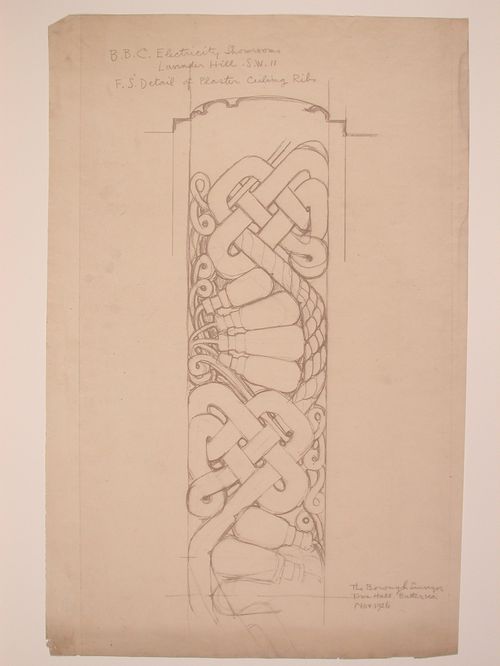
- This reprographic copy shows a design for a plaster frieze for the ceiling ribs in the showrooms of Electric House, Battersea Borough. The design includes lightbulbs, electrical cords, and swags. - This work is part of an incomplete group of possibly working reprographic copies for Electric House, Battersea Borough, designed by the borough architect, Henry Hyams. The group also includes some reprographic copies which may have been used for publication purposes. - The style of many of these drawings and reprographic copies by Henry Hyams (DR1988:0332 - DR1988:0414) suggests that they were possibly for periodical illustrations. Hyams contributed articles to the periodicals 'The Builder' and 'The Architect'. Two objects in the CCA collections can be directly linked to an article published prior to 1926 in 'The Architect'; a reprographic copy (DR1988:0357) and a drawing (DR1988:0364) (Who's Who in Architecture, 161).
DR1988:0401
Description:
- This reprographic copy shows a design for a plaster frieze for the ceiling ribs in the showrooms of Electric House, Battersea Borough. The design includes lightbulbs, electrical cords, and swags. - This work is part of an incomplete group of possibly working reprographic copies for Electric House, Battersea Borough, designed by the borough architect, Henry Hyams. The group also includes some reprographic copies which may have been used for publication purposes. - The style of many of these drawings and reprographic copies by Henry Hyams (DR1988:0332 - DR1988:0414) suggests that they were possibly for periodical illustrations. Hyams contributed articles to the periodicals 'The Builder' and 'The Architect'. Two objects in the CCA collections can be directly linked to an article published prior to 1926 in 'The Architect'; a reprographic copy (DR1988:0357) and a drawing (DR1988:0364) (Who's Who in Architecture, 161).
People:
Subject:
interior design
interior design
Date:
printed November 1926
printed November 1926
Title:
Detail for the plaster frieze on showroom ceiling ribs, Electric House, Battersea Borough
Actions:
DR1988:0401
Description:
- This reprographic copy shows a design for a plaster frieze for the ceiling ribs in the showrooms of Electric House, Battersea Borough. The design includes lightbulbs, electrical cords, and swags. - This work is part of an incomplete group of possibly working reprographic copies for Electric House, Battersea Borough, designed by the borough architect, Henry Hyams. The group also includes some reprographic copies which may have been used for publication purposes. - The style of many of these drawings and reprographic copies by Henry Hyams (DR1988:0332 - DR1988:0414) suggests that they were possibly for periodical illustrations. Hyams contributed articles to the periodicals 'The Builder' and 'The Architect'. Two objects in the CCA collections can be directly linked to an article published prior to 1926 in 'The Architect'; a reprographic copy (DR1988:0357) and a drawing (DR1988:0364) (Who's Who in Architecture, 161).
Detail for the plaster frieze on showroom ceiling ribs, Electric House, Battersea Borough
Actions:
DR1988:0401
Description:
- This reprographic copy shows a design for a plaster frieze for the ceiling ribs in the showrooms of Electric House, Battersea Borough. The design includes lightbulbs, electrical cords, and swags. - This work is part of an incomplete group of possibly working reprographic copies for Electric House, Battersea Borough, designed by the borough architect, Henry Hyams. The group also includes some reprographic copies which may have been used for publication purposes. - The style of many of these drawings and reprographic copies by Henry Hyams (DR1988:0332 - DR1988:0414) suggests that they were possibly for periodical illustrations. Hyams contributed articles to the periodicals 'The Builder' and 'The Architect'. Two objects in the CCA collections can be directly linked to an article published prior to 1926 in 'The Architect'; a reprographic copy (DR1988:0357) and a drawing (DR1988:0364) (Who's Who in Architecture, 161).
Form:
drawings
drawings
Date:
printed November 1926
printed November 1926
People:
Subject:
interior design
interior design
Form:
exhibitions
exhibitions
Title:
Starting From... Travel
Starting From... Travel
Actions:
Description:
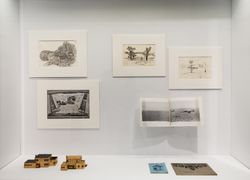
Interpreting the subject of travel to distant places, the exhibition charts an expanded notion of travel that spans imaginary journeys, strange sites, vanishing points, floating and portable houses, endless caves, swirling diamond domes, tombs, crypts and catacombs, tunnel adventures, formal studies, technical innovation, cultural imagination, and experimental(...)
Interpreting the subject of travel to distant places, the exhibition charts an expanded notion of travel that spans imaginary journeys, strange sites, vanishing points, floating and portable houses, endless caves, swirling diamond domes, tombs, crypts and catacombs, tunnel adventures, formal studies, technical innovation, cultural imagination, and experimental(...)
Location:
Hall cases
Hall cases
Date:
3 December 2008 to 1 May 2009
3 December 2008 to 1 May 2009
Title:
Starting From... Travel
Actions:
Description:
Interpreting the subject of travel to distant places, the exhibition charts an expanded notion of travel that spans imaginary journeys, strange sites, vanishing points, floating and portable houses, endless caves, swirling diamond domes, tombs, crypts and catacombs, tunnel adventures, formal studies, technical innovation, cultural imagination, and experimental(...)
Starting From... Travel
Actions:
Description:
Interpreting the subject of travel to distant places, the exhibition charts an expanded notion of travel that spans imaginary journeys, strange sites, vanishing points, floating and portable houses, endless caves, swirling diamond domes, tombs, crypts and catacombs, tunnel adventures, formal studies, technical innovation, cultural imagination, and experimental(...)
Form:
exhibitions
exhibitions
Date:
3 December 2008 to
1 May 2009
3 December 2008 to
1 May 2009
Location:
Hall cases
Hall cases
Level of archival description:
Series
Series
Title:
Housings
Housings
Actions:
Reference number:
AP185.S1
Description:
This project, 1998-2000, documents the conception and design of Housings, mass-customized prefabricated residences, by the architecture firm KOL/MAC. KOL/MAC began by digitally blending a typical 3 bedroom, 2.5 bathroom colonial house with a range of other objects or use cases. The result was six related houses that explored the relationship between customization and mass prefabrication. Housings relates to KOL/MAC’s exploration of what they call chimerical projects, where form and function are combined to create uniquely hybridized structures. The project records are largely in CAD formats, including Alias Wire, Maya, and IGES files; there are a number of raster image formats, including TIF, Alias pix, Mac Pict images, and JPEG. The materials include renderings, wireframe drawings, and still images of the various Housings structures. There is also a body of material from and related to the concrete manufacturer, YTONG, as well as a small amount of video material, which is only partially accessible due to format obsolescence. Source: “Kolatan / MacDonald Studio.” Archilab. Published in 2000. Accessed 21 November 2017. http://www.archilab.org/public/2000/catalog/kolata/kolataen.htm.
AP185.S1
Description:
This project, 1998-2000, documents the conception and design of Housings, mass-customized prefabricated residences, by the architecture firm KOL/MAC. KOL/MAC began by digitally blending a typical 3 bedroom, 2.5 bathroom colonial house with a range of other objects or use cases. The result was six related houses that explored the relationship between customization and mass prefabrication. Housings relates to KOL/MAC’s exploration of what they call chimerical projects, where form and function are combined to create uniquely hybridized structures. The project records are largely in CAD formats, including Alias Wire, Maya, and IGES files; there are a number of raster image formats, including TIF, Alias pix, Mac Pict images, and JPEG. The materials include renderings, wireframe drawings, and still images of the various Housings structures. There is also a body of material from and related to the concrete manufacturer, YTONG, as well as a small amount of video material, which is only partially accessible due to format obsolescence. Source: “Kolatan / MacDonald Studio.” Archilab. Published in 2000. Accessed 21 November 2017. http://www.archilab.org/public/2000/catalog/kolata/kolataen.htm.
People:
Date:
1998-2000
1998-2000
Title:
Housings
Actions:
AP185.S1
Description:
This project, 1998-2000, documents the conception and design of Housings, mass-customized prefabricated residences, by the architecture firm KOL/MAC. KOL/MAC began by digitally blending a typical 3 bedroom, 2.5 bathroom colonial house with a range of other objects or use cases. The result was six related houses that explored the relationship between customization and mass prefabrication. Housings relates to KOL/MAC’s exploration of what they call chimerical projects, where form and function are combined to create uniquely hybridized structures. The project records are largely in CAD formats, including Alias Wire, Maya, and IGES files; there are a number of raster image formats, including TIF, Alias pix, Mac Pict images, and JPEG. The materials include renderings, wireframe drawings, and still images of the various Housings structures. There is also a body of material from and related to the concrete manufacturer, YTONG, as well as a small amount of video material, which is only partially accessible due to format obsolescence. Source: “Kolatan / MacDonald Studio.” Archilab. Published in 2000. Accessed 21 November 2017. http://www.archilab.org/public/2000/catalog/kolata/kolataen.htm.
Housings
Actions:
AP185.S1
Description:
This project, 1998-2000, documents the conception and design of Housings, mass-customized prefabricated residences, by the architecture firm KOL/MAC. KOL/MAC began by digitally blending a typical 3 bedroom, 2.5 bathroom colonial house with a range of other objects or use cases. The result was six related houses that explored the relationship between customization and mass prefabrication. Housings relates to KOL/MAC’s exploration of what they call chimerical projects, where form and function are combined to create uniquely hybridized structures. The project records are largely in CAD formats, including Alias Wire, Maya, and IGES files; there are a number of raster image formats, including TIF, Alias pix, Mac Pict images, and JPEG. The materials include renderings, wireframe drawings, and still images of the various Housings structures. There is also a body of material from and related to the concrete manufacturer, YTONG, as well as a small amount of video material, which is only partially accessible due to format obsolescence. Source: “Kolatan / MacDonald Studio.” Archilab. Published in 2000. Accessed 21 November 2017. http://www.archilab.org/public/2000/catalog/kolata/kolataen.htm.
Level of archival description:
Series
Series
Date:
1998-2000
1998-2000
People:
Level of archival description:
Series
Series
Actions:
Reference number:
CD041.S5
Description:
This series documents nine projects by the firm Vecsei Architects. In 1984, Eva Hollo Vecsei and André Vecsei opened a joint practice, Vecsei Architects. Both architects retired in 2005. Together they worked on several major planning studies, such as Les Hautières du Mont-Royal, Montréal, Québec (circa 1983-1988) and the Genome Centre and the Lorne M. Trottier Building, Montréal (1999-2000), documented in this series. Les Hautières du Mont-Royal was a residential complex adjacent to Montréal's Golden Square Mile, on Cedar Avenue. The project consisted of nine staggering buildings (29 villas) around a landscaped European-style courtyard on a sloping site facing Mount Royal while also preserving a turn of the century landmark situated within the Mount Royal Heritage Site . The project is also known as "Projet Cours Cedar". Through the Genome Centre, McGill University sought to fill a need for a modern and cross-disciplinary research space in genomics and proteomics. Vecsei Architects submitted a joint proposal with Dupuis, Le Tourneaux, architects, and NFOE et associés architectes. Ultimately, KPMB Architects and Fichten Soiferman et Associés, Architectes' proposal was chosen and built. The Lorne M. Trottier Building is a building for popular electrical engineering, computer science and telecommunications programs at McGill University. Vecsei Architects submitted a joint proposal for this project with Julian Jacobs Architectes and Architectes Lemay et associés. Jodoin Lamarre Pratte architectes and Marosi Troy's proposal was chosen and built. Also documented in this series are the following projects: Elementary school for College Marie de France, Montréal, Québec (circa 1984-1986); High-rise office tower, underground commercial centre tied to Montréal’s underground mall and subway network, Christ Church Cathedral, Montréal, Québec (circa 1987-1988); Seniors condominium, Manoir Montefiore, Côte-Saint-Luc, Québec (1988); Ark and artworks for the Beth Zion Synagogue, Côte-Saint-Luc, Québec (1989); Municipal library, Dollard-des-Ormeaux, Québec (circa 1990), Cultural Centre and extension of sport centre, Dollard-des-Ormeaux, Québec (circa 2001-2003); Renovation and new elevation for Schneider house, Montréal, Québec (2002). Collection material in this series was produced between 1983 and 2006. Documents include architectural records, such as presentation, conceptual, and design development drawings, and as well as photographs of facades and interior views. This series also includes digital material (mainly photographs), and a few project proposals and publications. The level of documentation varies greatly from project to project, from a single presentation drawing to complete project proposal.
CD041.S5
Description:
This series documents nine projects by the firm Vecsei Architects. In 1984, Eva Hollo Vecsei and André Vecsei opened a joint practice, Vecsei Architects. Both architects retired in 2005. Together they worked on several major planning studies, such as Les Hautières du Mont-Royal, Montréal, Québec (circa 1983-1988) and the Genome Centre and the Lorne M. Trottier Building, Montréal (1999-2000), documented in this series. Les Hautières du Mont-Royal was a residential complex adjacent to Montréal's Golden Square Mile, on Cedar Avenue. The project consisted of nine staggering buildings (29 villas) around a landscaped European-style courtyard on a sloping site facing Mount Royal while also preserving a turn of the century landmark situated within the Mount Royal Heritage Site . The project is also known as "Projet Cours Cedar". Through the Genome Centre, McGill University sought to fill a need for a modern and cross-disciplinary research space in genomics and proteomics. Vecsei Architects submitted a joint proposal with Dupuis, Le Tourneaux, architects, and NFOE et associés architectes. Ultimately, KPMB Architects and Fichten Soiferman et Associés, Architectes' proposal was chosen and built. The Lorne M. Trottier Building is a building for popular electrical engineering, computer science and telecommunications programs at McGill University. Vecsei Architects submitted a joint proposal for this project with Julian Jacobs Architectes and Architectes Lemay et associés. Jodoin Lamarre Pratte architectes and Marosi Troy's proposal was chosen and built. Also documented in this series are the following projects: Elementary school for College Marie de France, Montréal, Québec (circa 1984-1986); High-rise office tower, underground commercial centre tied to Montréal’s underground mall and subway network, Christ Church Cathedral, Montréal, Québec (circa 1987-1988); Seniors condominium, Manoir Montefiore, Côte-Saint-Luc, Québec (1988); Ark and artworks for the Beth Zion Synagogue, Côte-Saint-Luc, Québec (1989); Municipal library, Dollard-des-Ormeaux, Québec (circa 1990), Cultural Centre and extension of sport centre, Dollard-des-Ormeaux, Québec (circa 2001-2003); Renovation and new elevation for Schneider house, Montréal, Québec (2002). Collection material in this series was produced between 1983 and 2006. Documents include architectural records, such as presentation, conceptual, and design development drawings, and as well as photographs of facades and interior views. This series also includes digital material (mainly photographs), and a few project proposals and publications. The level of documentation varies greatly from project to project, from a single presentation drawing to complete project proposal.
People:
Date:
1983-2006
1983-2006
Title:
Vecsei Architects (1984-2005)
Actions:
CD041.S5
Description:
This series documents nine projects by the firm Vecsei Architects. In 1984, Eva Hollo Vecsei and André Vecsei opened a joint practice, Vecsei Architects. Both architects retired in 2005. Together they worked on several major planning studies, such as Les Hautières du Mont-Royal, Montréal, Québec (circa 1983-1988) and the Genome Centre and the Lorne M. Trottier Building, Montréal (1999-2000), documented in this series. Les Hautières du Mont-Royal was a residential complex adjacent to Montréal's Golden Square Mile, on Cedar Avenue. The project consisted of nine staggering buildings (29 villas) around a landscaped European-style courtyard on a sloping site facing Mount Royal while also preserving a turn of the century landmark situated within the Mount Royal Heritage Site . The project is also known as "Projet Cours Cedar". Through the Genome Centre, McGill University sought to fill a need for a modern and cross-disciplinary research space in genomics and proteomics. Vecsei Architects submitted a joint proposal with Dupuis, Le Tourneaux, architects, and NFOE et associés architectes. Ultimately, KPMB Architects and Fichten Soiferman et Associés, Architectes' proposal was chosen and built. The Lorne M. Trottier Building is a building for popular electrical engineering, computer science and telecommunications programs at McGill University. Vecsei Architects submitted a joint proposal for this project with Julian Jacobs Architectes and Architectes Lemay et associés. Jodoin Lamarre Pratte architectes and Marosi Troy's proposal was chosen and built. Also documented in this series are the following projects: Elementary school for College Marie de France, Montréal, Québec (circa 1984-1986); High-rise office tower, underground commercial centre tied to Montréal’s underground mall and subway network, Christ Church Cathedral, Montréal, Québec (circa 1987-1988); Seniors condominium, Manoir Montefiore, Côte-Saint-Luc, Québec (1988); Ark and artworks for the Beth Zion Synagogue, Côte-Saint-Luc, Québec (1989); Municipal library, Dollard-des-Ormeaux, Québec (circa 1990), Cultural Centre and extension of sport centre, Dollard-des-Ormeaux, Québec (circa 2001-2003); Renovation and new elevation for Schneider house, Montréal, Québec (2002). Collection material in this series was produced between 1983 and 2006. Documents include architectural records, such as presentation, conceptual, and design development drawings, and as well as photographs of facades and interior views. This series also includes digital material (mainly photographs), and a few project proposals and publications. The level of documentation varies greatly from project to project, from a single presentation drawing to complete project proposal.
Vecsei Architects (1984-2005)
Actions:
CD041.S5
Description:
This series documents nine projects by the firm Vecsei Architects. In 1984, Eva Hollo Vecsei and André Vecsei opened a joint practice, Vecsei Architects. Both architects retired in 2005. Together they worked on several major planning studies, such as Les Hautières du Mont-Royal, Montréal, Québec (circa 1983-1988) and the Genome Centre and the Lorne M. Trottier Building, Montréal (1999-2000), documented in this series. Les Hautières du Mont-Royal was a residential complex adjacent to Montréal's Golden Square Mile, on Cedar Avenue. The project consisted of nine staggering buildings (29 villas) around a landscaped European-style courtyard on a sloping site facing Mount Royal while also preserving a turn of the century landmark situated within the Mount Royal Heritage Site . The project is also known as "Projet Cours Cedar". Through the Genome Centre, McGill University sought to fill a need for a modern and cross-disciplinary research space in genomics and proteomics. Vecsei Architects submitted a joint proposal with Dupuis, Le Tourneaux, architects, and NFOE et associés architectes. Ultimately, KPMB Architects and Fichten Soiferman et Associés, Architectes' proposal was chosen and built. The Lorne M. Trottier Building is a building for popular electrical engineering, computer science and telecommunications programs at McGill University. Vecsei Architects submitted a joint proposal for this project with Julian Jacobs Architectes and Architectes Lemay et associés. Jodoin Lamarre Pratte architectes and Marosi Troy's proposal was chosen and built. Also documented in this series are the following projects: Elementary school for College Marie de France, Montréal, Québec (circa 1984-1986); High-rise office tower, underground commercial centre tied to Montréal’s underground mall and subway network, Christ Church Cathedral, Montréal, Québec (circa 1987-1988); Seniors condominium, Manoir Montefiore, Côte-Saint-Luc, Québec (1988); Ark and artworks for the Beth Zion Synagogue, Côte-Saint-Luc, Québec (1989); Municipal library, Dollard-des-Ormeaux, Québec (circa 1990), Cultural Centre and extension of sport centre, Dollard-des-Ormeaux, Québec (circa 2001-2003); Renovation and new elevation for Schneider house, Montréal, Québec (2002). Collection material in this series was produced between 1983 and 2006. Documents include architectural records, such as presentation, conceptual, and design development drawings, and as well as photographs of facades and interior views. This series also includes digital material (mainly photographs), and a few project proposals and publications. The level of documentation varies greatly from project to project, from a single presentation drawing to complete project proposal.
Level of archival description:
Series
Series
Date:
1983-2006
1983-2006
People:
Form:
textual records
textual records
Actions:
Reference number:
DR2001:0029
Description:
documents include correspondence to colleagues and universities for 1991-1992: Coop Himmelblau, UMRISS - Coop Himmelblauk Stephanie Dudek, Kurt Forster, Frank O. Gehry & Assoc., Fabio Ghersi (architect), David Goldblatt - Journal of Aesthetics and Art Criticism, Zaha Hadid, Philip Johnson, Philip Johnson 85th Birthday Invoices, Libeskind, Daniel and Nina, Macklowe - CMRI (drawings for exhibition), Rick Mandell, Edith Miller, David Neuman, Peter Noever - Architecture in Transition, John Rajchman, Renato Rizzi, Zoran Sladoljev, Antoine Predock, Antonia Soulez, Mark Taylor, Massimo Vignelli and Faruk Yorgancioglu. University Publications: University of California - Riverside, The Cooper Union, Cornell University, The Chicago Institute (for Architecture and Urbanism), Columbia High School, Columbia University, Universitat Hanover, Harvard Graduate school of Design, The University of Illinois at Chicago, Oberlin (College), Ohio State University, Pratt Institute, Princeton University, Rice School of Architecture, College of William and Mary and Richard Bland College.
DR2001:0029
Description:
documents include correspondence to colleagues and universities for 1991-1992: Coop Himmelblau, UMRISS - Coop Himmelblauk Stephanie Dudek, Kurt Forster, Frank O. Gehry & Assoc., Fabio Ghersi (architect), David Goldblatt - Journal of Aesthetics and Art Criticism, Zaha Hadid, Philip Johnson, Philip Johnson 85th Birthday Invoices, Libeskind, Daniel and Nina, Macklowe - CMRI (drawings for exhibition), Rick Mandell, Edith Miller, David Neuman, Peter Noever - Architecture in Transition, John Rajchman, Renato Rizzi, Zoran Sladoljev, Antoine Predock, Antonia Soulez, Mark Taylor, Massimo Vignelli and Faruk Yorgancioglu. University Publications: University of California - Riverside, The Cooper Union, Cornell University, The Chicago Institute (for Architecture and Urbanism), Columbia High School, Columbia University, Universitat Hanover, Harvard Graduate school of Design, The University of Illinois at Chicago, Oberlin (College), Ohio State University, Pratt Institute, Princeton University, Rice School of Architecture, College of William and Mary and Richard Bland College.
People:
Title:
Correspondence to colleagues and universities
Actions:
DR2001:0029
Description:
documents include correspondence to colleagues and universities for 1991-1992: Coop Himmelblau, UMRISS - Coop Himmelblauk Stephanie Dudek, Kurt Forster, Frank O. Gehry & Assoc., Fabio Ghersi (architect), David Goldblatt - Journal of Aesthetics and Art Criticism, Zaha Hadid, Philip Johnson, Philip Johnson 85th Birthday Invoices, Libeskind, Daniel and Nina, Macklowe - CMRI (drawings for exhibition), Rick Mandell, Edith Miller, David Neuman, Peter Noever - Architecture in Transition, John Rajchman, Renato Rizzi, Zoran Sladoljev, Antoine Predock, Antonia Soulez, Mark Taylor, Massimo Vignelli and Faruk Yorgancioglu. University Publications: University of California - Riverside, The Cooper Union, Cornell University, The Chicago Institute (for Architecture and Urbanism), Columbia High School, Columbia University, Universitat Hanover, Harvard Graduate school of Design, The University of Illinois at Chicago, Oberlin (College), Ohio State University, Pratt Institute, Princeton University, Rice School of Architecture, College of William and Mary and Richard Bland College.
Correspondence to colleagues and universities
Actions:
DR2001:0029
Description:
documents include correspondence to colleagues and universities for 1991-1992: Coop Himmelblau, UMRISS - Coop Himmelblauk Stephanie Dudek, Kurt Forster, Frank O. Gehry & Assoc., Fabio Ghersi (architect), David Goldblatt - Journal of Aesthetics and Art Criticism, Zaha Hadid, Philip Johnson, Philip Johnson 85th Birthday Invoices, Libeskind, Daniel and Nina, Macklowe - CMRI (drawings for exhibition), Rick Mandell, Edith Miller, David Neuman, Peter Noever - Architecture in Transition, John Rajchman, Renato Rizzi, Zoran Sladoljev, Antoine Predock, Antonia Soulez, Mark Taylor, Massimo Vignelli and Faruk Yorgancioglu. University Publications: University of California - Riverside, The Cooper Union, Cornell University, The Chicago Institute (for Architecture and Urbanism), Columbia High School, Columbia University, Universitat Hanover, Harvard Graduate school of Design, The University of Illinois at Chicago, Oberlin (College), Ohio State University, Pratt Institute, Princeton University, Rice School of Architecture, College of William and Mary and Richard Bland College.
Form:
textual records
textual records
People:
Form:
drawings
drawings
Actions:
Reference number:
DR1966:0001:003
Description:
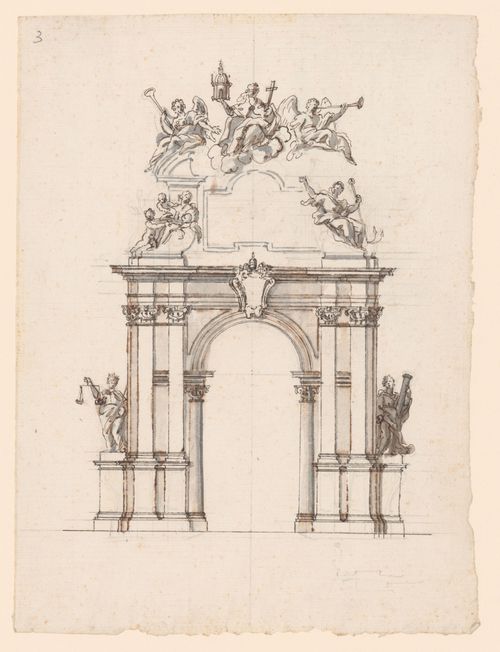
- This project is for a temporary construction or macchina in the form of a triumphal arch. An empty shield carrying papal regalia hangs in front of the cornice. The architecture and sculpture of the upper story were left incomplete and there is a cursory sketch plan at the l.r. The drawing includes some lightly sketched graphite changes.
DR1966:0001:003
Description:
- This project is for a temporary construction or macchina in the form of a triumphal arch. An empty shield carrying papal regalia hangs in front of the cornice. The architecture and sculpture of the upper story were left incomplete and there is a cursory sketch plan at the l.r. The drawing includes some lightly sketched graphite changes.
People:
Subject:
temporary architecture
temporary architecture
Date:
1721
1721
Title:
Incomplete elevation for a triumphal arch for the possesso of Innocent XIII, Rome
Actions:
DR1966:0001:003
Description:
- This project is for a temporary construction or macchina in the form of a triumphal arch. An empty shield carrying papal regalia hangs in front of the cornice. The architecture and sculpture of the upper story were left incomplete and there is a cursory sketch plan at the l.r. The drawing includes some lightly sketched graphite changes.
Incomplete elevation for a triumphal arch for the possesso of Innocent XIII, Rome
Actions:
DR1966:0001:003
Description:
- This project is for a temporary construction or macchina in the form of a triumphal arch. An empty shield carrying papal regalia hangs in front of the cornice. The architecture and sculpture of the upper story were left incomplete and there is a cursory sketch plan at the l.r. The drawing includes some lightly sketched graphite changes.
Form:
drawings
drawings
Date:
1721
1721
People:
Subject:
temporary architecture
temporary architecture
Level of archival description:
Project
Project
Actions:
Reference number:
AP154.S1.1979.PR01
Description:
Project series AP154.S1.1979.PR01, George & Annette Murphy Center at Asphalt Green, New York, N.Y. (1979), documents an executed project to recycle a municipal asphalt plant into a youth sports and arts center. Clients for the project were the New York City Department of General Services and the Neighborhood Committee for the Asphalt Green, chaired by Dr. George Murphy. The asphalt plant was a parabolic structure built in the 1940s by the firm Kahn and Jacobs. Pasanella + Klein worked on the adaptive reuse project with HOK, successors to Kahn and Jacobs. The transformed interior includes two gymnasia of different sizes, a running track, art and photography studios, offices, lockers, showers and a theatre. The design includes an on-site total energy plant. The project series consists of presentation drawings. References: Kerr, Laurie. "Back to the future", Oculus, v. 64, no. 7/8 (March/April 2002), p. 7-8. Dixon, John Morris. "25-year watch", Oculus, v. 71, issue 1 (spring 2009) Doubilet, Susan. "Arch support", Progressive architecture, v. 66, no. 11 (Nov. 1985), p. 101 Architektur + Wettbewerbe, 127 (Sept. 1986), p. 16-17
AP154.S1.1979.PR01
Description:
Project series AP154.S1.1979.PR01, George & Annette Murphy Center at Asphalt Green, New York, N.Y. (1979), documents an executed project to recycle a municipal asphalt plant into a youth sports and arts center. Clients for the project were the New York City Department of General Services and the Neighborhood Committee for the Asphalt Green, chaired by Dr. George Murphy. The asphalt plant was a parabolic structure built in the 1940s by the firm Kahn and Jacobs. Pasanella + Klein worked on the adaptive reuse project with HOK, successors to Kahn and Jacobs. The transformed interior includes two gymnasia of different sizes, a running track, art and photography studios, offices, lockers, showers and a theatre. The design includes an on-site total energy plant. The project series consists of presentation drawings. References: Kerr, Laurie. "Back to the future", Oculus, v. 64, no. 7/8 (March/April 2002), p. 7-8. Dixon, John Morris. "25-year watch", Oculus, v. 71, issue 1 (spring 2009) Doubilet, Susan. "Arch support", Progressive architecture, v. 66, no. 11 (Nov. 1985), p. 101 Architektur + Wettbewerbe, 127 (Sept. 1986), p. 16-17
People:
Date:
between 1979 and 1984?
between 1979 and 1984?
Title:
George & Annette Murphy Center at Asphalt Green, New York, N.Y. (1979)
Actions:
AP154.S1.1979.PR01
Description:
Project series AP154.S1.1979.PR01, George & Annette Murphy Center at Asphalt Green, New York, N.Y. (1979), documents an executed project to recycle a municipal asphalt plant into a youth sports and arts center. Clients for the project were the New York City Department of General Services and the Neighborhood Committee for the Asphalt Green, chaired by Dr. George Murphy. The asphalt plant was a parabolic structure built in the 1940s by the firm Kahn and Jacobs. Pasanella + Klein worked on the adaptive reuse project with HOK, successors to Kahn and Jacobs. The transformed interior includes two gymnasia of different sizes, a running track, art and photography studios, offices, lockers, showers and a theatre. The design includes an on-site total energy plant. The project series consists of presentation drawings. References: Kerr, Laurie. "Back to the future", Oculus, v. 64, no. 7/8 (March/April 2002), p. 7-8. Dixon, John Morris. "25-year watch", Oculus, v. 71, issue 1 (spring 2009) Doubilet, Susan. "Arch support", Progressive architecture, v. 66, no. 11 (Nov. 1985), p. 101 Architektur + Wettbewerbe, 127 (Sept. 1986), p. 16-17
George & Annette Murphy Center at Asphalt Green, New York, N.Y. (1979)
Actions:
AP154.S1.1979.PR01
Description:
Project series AP154.S1.1979.PR01, George & Annette Murphy Center at Asphalt Green, New York, N.Y. (1979), documents an executed project to recycle a municipal asphalt plant into a youth sports and arts center. Clients for the project were the New York City Department of General Services and the Neighborhood Committee for the Asphalt Green, chaired by Dr. George Murphy. The asphalt plant was a parabolic structure built in the 1940s by the firm Kahn and Jacobs. Pasanella + Klein worked on the adaptive reuse project with HOK, successors to Kahn and Jacobs. The transformed interior includes two gymnasia of different sizes, a running track, art and photography studios, offices, lockers, showers and a theatre. The design includes an on-site total energy plant. The project series consists of presentation drawings. References: Kerr, Laurie. "Back to the future", Oculus, v. 64, no. 7/8 (March/April 2002), p. 7-8. Dixon, John Morris. "25-year watch", Oculus, v. 71, issue 1 (spring 2009) Doubilet, Susan. "Arch support", Progressive architecture, v. 66, no. 11 (Nov. 1985), p. 101 Architektur + Wettbewerbe, 127 (Sept. 1986), p. 16-17
Level of archival description:
Project
Project
Date:
between 1979 and 1984?
between 1979 and 1984?
People:


