


2056 Results
Level of archival description:
Project
Project
Actions:
Reference number:
AP056.S1.1988.PR10
Description:
This project series documents the design and construction of the Reisman-Jenkinson residence and studio located at 92 Westwood Lane in Richmond Hill, Ontario from 1988-1991. The office identified the project number as 8813. This project consisted of a house and an attached studio with split-face concrete block exteriors for sculptor Stephen Jenkinson and writer Dolly Reisman. The house was divided into four wings, referred to in the documentation as Building A, Building B, Building C, and Building D. Building A was the studio at the front of the property, which had a distinctive marquis roof made of metal that fanned into a skylight. Building B, the main living area, was a loft-style building that included the kitchen, dining room, living room and conservatory on the ground floor and an office and storage spaces in the basement. This building was marked by large glass walls at the front of the property and a pyramid-shaped skylight above the kitchen. Building C extended towards the back of the property and was considered the sleeping wing, housing bedrooms at the ground floor and a playroom in the basement. Finally, Building D, which sat on the back corner of Building C, was the master bedroom and included a gym at the basement level. Buildings B, C, and D created a semi circle whose interior contained an exterior courtyard and gardens. Multiple schemes were investigated for this project, including different layouts of the basements and the ground floor of Building C. The project is recorded through original drawings, textual records and photographs dating from 1988-1991. The drawings document the design and construction of the home and include plans, sections, elevations, axonometric drawings and perspectives of interiors, exteriors and furnishings. Also present are structural, electrical and mechanical drawings issued for construction. Textual records are included to support the drawings. The photographs show the completed home.
AP056.S1.1988.PR10
Description:
This project series documents the design and construction of the Reisman-Jenkinson residence and studio located at 92 Westwood Lane in Richmond Hill, Ontario from 1988-1991. The office identified the project number as 8813. This project consisted of a house and an attached studio with split-face concrete block exteriors for sculptor Stephen Jenkinson and writer Dolly Reisman. The house was divided into four wings, referred to in the documentation as Building A, Building B, Building C, and Building D. Building A was the studio at the front of the property, which had a distinctive marquis roof made of metal that fanned into a skylight. Building B, the main living area, was a loft-style building that included the kitchen, dining room, living room and conservatory on the ground floor and an office and storage spaces in the basement. This building was marked by large glass walls at the front of the property and a pyramid-shaped skylight above the kitchen. Building C extended towards the back of the property and was considered the sleeping wing, housing bedrooms at the ground floor and a playroom in the basement. Finally, Building D, which sat on the back corner of Building C, was the master bedroom and included a gym at the basement level. Buildings B, C, and D created a semi circle whose interior contained an exterior courtyard and gardens. Multiple schemes were investigated for this project, including different layouts of the basements and the ground floor of Building C. The project is recorded through original drawings, textual records and photographs dating from 1988-1991. The drawings document the design and construction of the home and include plans, sections, elevations, axonometric drawings and perspectives of interiors, exteriors and furnishings. Also present are structural, electrical and mechanical drawings issued for construction. Textual records are included to support the drawings. The photographs show the completed home.
People:
Date:
1988-1991
1988-1991
Title:
Reisman-Jenkinson House, Richmond Hill, Ontario (1988-1991)
Actions:
AP056.S1.1988.PR10
Description:
This project series documents the design and construction of the Reisman-Jenkinson residence and studio located at 92 Westwood Lane in Richmond Hill, Ontario from 1988-1991. The office identified the project number as 8813. This project consisted of a house and an attached studio with split-face concrete block exteriors for sculptor Stephen Jenkinson and writer Dolly Reisman. The house was divided into four wings, referred to in the documentation as Building A, Building B, Building C, and Building D. Building A was the studio at the front of the property, which had a distinctive marquis roof made of metal that fanned into a skylight. Building B, the main living area, was a loft-style building that included the kitchen, dining room, living room and conservatory on the ground floor and an office and storage spaces in the basement. This building was marked by large glass walls at the front of the property and a pyramid-shaped skylight above the kitchen. Building C extended towards the back of the property and was considered the sleeping wing, housing bedrooms at the ground floor and a playroom in the basement. Finally, Building D, which sat on the back corner of Building C, was the master bedroom and included a gym at the basement level. Buildings B, C, and D created a semi circle whose interior contained an exterior courtyard and gardens. Multiple schemes were investigated for this project, including different layouts of the basements and the ground floor of Building C. The project is recorded through original drawings, textual records and photographs dating from 1988-1991. The drawings document the design and construction of the home and include plans, sections, elevations, axonometric drawings and perspectives of interiors, exteriors and furnishings. Also present are structural, electrical and mechanical drawings issued for construction. Textual records are included to support the drawings. The photographs show the completed home.
Reisman-Jenkinson House, Richmond Hill, Ontario (1988-1991)
Actions:
AP056.S1.1988.PR10
Description:
This project series documents the design and construction of the Reisman-Jenkinson residence and studio located at 92 Westwood Lane in Richmond Hill, Ontario from 1988-1991. The office identified the project number as 8813. This project consisted of a house and an attached studio with split-face concrete block exteriors for sculptor Stephen Jenkinson and writer Dolly Reisman. The house was divided into four wings, referred to in the documentation as Building A, Building B, Building C, and Building D. Building A was the studio at the front of the property, which had a distinctive marquis roof made of metal that fanned into a skylight. Building B, the main living area, was a loft-style building that included the kitchen, dining room, living room and conservatory on the ground floor and an office and storage spaces in the basement. This building was marked by large glass walls at the front of the property and a pyramid-shaped skylight above the kitchen. Building C extended towards the back of the property and was considered the sleeping wing, housing bedrooms at the ground floor and a playroom in the basement. Finally, Building D, which sat on the back corner of Building C, was the master bedroom and included a gym at the basement level. Buildings B, C, and D created a semi circle whose interior contained an exterior courtyard and gardens. Multiple schemes were investigated for this project, including different layouts of the basements and the ground floor of Building C. The project is recorded through original drawings, textual records and photographs dating from 1988-1991. The drawings document the design and construction of the home and include plans, sections, elevations, axonometric drawings and perspectives of interiors, exteriors and furnishings. Also present are structural, electrical and mechanical drawings issued for construction. Textual records are included to support the drawings. The photographs show the completed home.
Level of archival description:
Project
Project
Date:
1988-1991
1988-1991
People:
Form:
textual records
textual records
Title:
Diverses publications
Diverses publications
Actions:
Reference number:
ARCH257361
Description:
Divers sujets et publications : « The Arts and Culture of Québec » (émission avec Arthur Lismer, Emile Vaillancourt, et John Fisher. Cormier est mentionné); « Canadian Unity and Québec » (interview avec Emile Vaillancourt, John Humphrey, et Hugh MacLennan); extraits des Evangiles de saint Matthieu et Saint Jean; « The Basis of Peace » par Brooke Claxton; « Canada's Support of the Army Overseas » par W.L. Mackenzie King (émission); cours d'aéronautique de Pierre Franck; « Sur la langue Araméenne » (extraits par Robert Aron); des textes médicaux divers par Albéric Marin; une page de notes sur Eric Satie par Cormier; 2 photos de Henri Laugier, physiologiste.
ARCH257361
Description:
Divers sujets et publications : « The Arts and Culture of Québec » (émission avec Arthur Lismer, Emile Vaillancourt, et John Fisher. Cormier est mentionné); « Canadian Unity and Québec » (interview avec Emile Vaillancourt, John Humphrey, et Hugh MacLennan); extraits des Evangiles de saint Matthieu et Saint Jean; « The Basis of Peace » par Brooke Claxton; « Canada's Support of the Army Overseas » par W.L. Mackenzie King (émission); cours d'aéronautique de Pierre Franck; « Sur la langue Araméenne » (extraits par Robert Aron); des textes médicaux divers par Albéric Marin; une page de notes sur Eric Satie par Cormier; 2 photos de Henri Laugier, physiologiste.
People:
Date:
entre 1929 et 1946
entre 1929 et 1946
Title:
Diverses publications
Actions:
ARCH257361
Description:
Divers sujets et publications : « The Arts and Culture of Québec » (émission avec Arthur Lismer, Emile Vaillancourt, et John Fisher. Cormier est mentionné); « Canadian Unity and Québec » (interview avec Emile Vaillancourt, John Humphrey, et Hugh MacLennan); extraits des Evangiles de saint Matthieu et Saint Jean; « The Basis of Peace » par Brooke Claxton; « Canada's Support of the Army Overseas » par W.L. Mackenzie King (émission); cours d'aéronautique de Pierre Franck; « Sur la langue Araméenne » (extraits par Robert Aron); des textes médicaux divers par Albéric Marin; une page de notes sur Eric Satie par Cormier; 2 photos de Henri Laugier, physiologiste.
Diverses publications
Actions:
ARCH257361
Description:
Divers sujets et publications : « The Arts and Culture of Québec » (émission avec Arthur Lismer, Emile Vaillancourt, et John Fisher. Cormier est mentionné); « Canadian Unity and Québec » (interview avec Emile Vaillancourt, John Humphrey, et Hugh MacLennan); extraits des Evangiles de saint Matthieu et Saint Jean; « The Basis of Peace » par Brooke Claxton; « Canada's Support of the Army Overseas » par W.L. Mackenzie King (émission); cours d'aéronautique de Pierre Franck; « Sur la langue Araméenne » (extraits par Robert Aron); des textes médicaux divers par Albéric Marin; une page de notes sur Eric Satie par Cormier; 2 photos de Henri Laugier, physiologiste.
Form:
textual records
textual records
Date:
entre 1929 et 1946
entre 1929 et 1946
People:
Level of archival description:
Project
Project
Reference number:
AP018.S1.1958.PR04
Description:
This project series documents the control tower at the Toronto International Airport in Mississauga from 1958-1964. The office identified the project number as 5872. This project consisted of a 100 foot high control tower built onto a single storey building totalling 30,600 square feet in size. The reinforced concrete tower was hexagonal in shape with a steel frame and reinforced concrete slab floor. A transparent skydome forms the ceiling of the central lobby, providing a view of the floor and supporting shafts of the tower. This project won a Silver Massey Medal for Architecture in 1964 and recognition from Canadian Architect magazine and the Beautify Toronto Campaign for its significance. The project is recorded through a presentation board of a photo of the skydome dating from around 1964.
AP018.S1.1958.PR04
Description:
This project series documents the control tower at the Toronto International Airport in Mississauga from 1958-1964. The office identified the project number as 5872. This project consisted of a 100 foot high control tower built onto a single storey building totalling 30,600 square feet in size. The reinforced concrete tower was hexagonal in shape with a steel frame and reinforced concrete slab floor. A transparent skydome forms the ceiling of the central lobby, providing a view of the floor and supporting shafts of the tower. This project won a Silver Massey Medal for Architecture in 1964 and recognition from Canadian Architect magazine and the Beautify Toronto Campaign for its significance. The project is recorded through a presentation board of a photo of the skydome dating from around 1964.
People:
Date:
circa 1964
circa 1964
Title:
Control Tower, Toronto International Airport, Mississauga, Ontario (1958-1964)
Actions:
AP018.S1.1958.PR04
Description:
This project series documents the control tower at the Toronto International Airport in Mississauga from 1958-1964. The office identified the project number as 5872. This project consisted of a 100 foot high control tower built onto a single storey building totalling 30,600 square feet in size. The reinforced concrete tower was hexagonal in shape with a steel frame and reinforced concrete slab floor. A transparent skydome forms the ceiling of the central lobby, providing a view of the floor and supporting shafts of the tower. This project won a Silver Massey Medal for Architecture in 1964 and recognition from Canadian Architect magazine and the Beautify Toronto Campaign for its significance. The project is recorded through a presentation board of a photo of the skydome dating from around 1964.
Control Tower, Toronto International Airport, Mississauga, Ontario (1958-1964)
Actions:
AP018.S1.1958.PR04
Description:
This project series documents the control tower at the Toronto International Airport in Mississauga from 1958-1964. The office identified the project number as 5872. This project consisted of a 100 foot high control tower built onto a single storey building totalling 30,600 square feet in size. The reinforced concrete tower was hexagonal in shape with a steel frame and reinforced concrete slab floor. A transparent skydome forms the ceiling of the central lobby, providing a view of the floor and supporting shafts of the tower. This project won a Silver Massey Medal for Architecture in 1964 and recognition from Canadian Architect magazine and the Beautify Toronto Campaign for its significance. The project is recorded through a presentation board of a photo of the skydome dating from around 1964.
Level of archival description:
Project
Project
Date:
circa 1964
circa 1964
People:
Form:
archives
Level of archival description:
Fonds
archives
Level of archival description:
Fonds
Actions:
Reference number:
AP225
Synopsis:
The Roderick Robbie Katimavik project records describe Robbie's collaboration with his architectural partners at the Toronto-based firm Ashworth Robbie Vaughan and Williams to create Katimavik, an entry for the competition for the design of the Canadian Government’s pavilion at Expo 67. The records in this fonds relate to the project's design process, the reception of the completed structure in Canadian and international architectural discourse, reporting on the project to the Canadian government, and Expo 67 memerobilia.
AP225
Synopsis:
The Roderick Robbie Katimavik project records describe Robbie's collaboration with his architectural partners at the Toronto-based firm Ashworth Robbie Vaughan and Williams to create Katimavik, an entry for the competition for the design of the Canadian Government’s pavilion at Expo 67. The records in this fonds relate to the project's design process, the reception of the completed structure in Canadian and international architectural discourse, reporting on the project to the Canadian government, and Expo 67 memerobilia.
People:
Date:
1966-2017
1966-2017
Title:
Roderick Robbie Katimavik project records
Actions:
AP225
Synopsis:
The Roderick Robbie Katimavik project records describe Robbie's collaboration with his architectural partners at the Toronto-based firm Ashworth Robbie Vaughan and Williams to create Katimavik, an entry for the competition for the design of the Canadian Government’s pavilion at Expo 67. The records in this fonds relate to the project's design process, the reception of the completed structure in Canadian and international architectural discourse, reporting on the project to the Canadian government, and Expo 67 memerobilia.
Roderick Robbie Katimavik project records
Actions:
AP225
Synopsis:
The Roderick Robbie Katimavik project records describe Robbie's collaboration with his architectural partners at the Toronto-based firm Ashworth Robbie Vaughan and Williams to create Katimavik, an entry for the competition for the design of the Canadian Government’s pavilion at Expo 67. The records in this fonds relate to the project's design process, the reception of the completed structure in Canadian and international architectural discourse, reporting on the project to the Canadian government, and Expo 67 memerobilia.
Form:
archives
Level of archival description:
Fonds
archives
Level of archival description:
Fonds
Date:
1966-2017
1966-2017
People:
Form:
archives
Level of archival description:
Fonds
archives
Level of archival description:
Fonds
Reference number:
AP056
Synopsis:
The Kuwabara Payne McKenna Blumberg fonds documents the architectural projects of the firm from 1984-2003. 125 projects are recorded through drawings, photographs, models, textual records, periodicals and paintings. These projects include built work, proposals and competition entries.
AP056
Synopsis:
The Kuwabara Payne McKenna Blumberg fonds documents the architectural projects of the firm from 1984-2003. 125 projects are recorded through drawings, photographs, models, textual records, periodicals and paintings. These projects include built work, proposals and competition entries.
People:
Date:
1984-2003
1984-2003
Title:
Kuwabara Payne Mckenna Blumberg fonds
Actions:
AP056
Synopsis:
The Kuwabara Payne McKenna Blumberg fonds documents the architectural projects of the firm from 1984-2003. 125 projects are recorded through drawings, photographs, models, textual records, periodicals and paintings. These projects include built work, proposals and competition entries.
Kuwabara Payne Mckenna Blumberg fonds
Actions:
AP056
Synopsis:
The Kuwabara Payne McKenna Blumberg fonds documents the architectural projects of the firm from 1984-2003. 125 projects are recorded through drawings, photographs, models, textual records, periodicals and paintings. These projects include built work, proposals and competition entries.
Form:
archives
Level of archival description:
Fonds
archives
Level of archival description:
Fonds
Date:
1984-2003
1984-2003
People:
Form:
events
events
Actions:
Description:
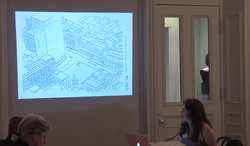
Michela Rosso, 2013 Support Grant Recipient, presents her research from Peter Carter’s archive on the Mansion House square scheme (1962–1985) and shows the different facets of the controversy over Mies van der Rohe’s unbuilt tower in the heart of the City of London. Rosso holds a doctorate from the Politecnico di Torino, where since 2003 she has been Associate professor(...)
Michela Rosso, 2013 Support Grant Recipient, presents her research from Peter Carter’s archive on the Mansion House square scheme (1962–1985) and shows the different facets of the controversy over Mies van der Rohe’s unbuilt tower in the heart of the City of London. Rosso holds a doctorate from the Politecnico di Torino, where since 2003 she has been Associate professor(...)
Location:
Shaughnessy House
Shaughnessy House
Date:
30 May 2013, 6pm
30 May 2013, 6pm
Title:
Friends and Enemies of Mies’s Mansion House Square
Actions:
Description:
Michela Rosso, 2013 Support Grant Recipient, presents her research from Peter Carter’s archive on the Mansion House square scheme (1962–1985) and shows the different facets of the controversy over Mies van der Rohe’s unbuilt tower in the heart of the City of London. Rosso holds a doctorate from the Politecnico di Torino, where since 2003 she has been Associate professor(...)
Friends and Enemies of Mies’s Mansion House Square
Actions:
Description:
Michela Rosso, 2013 Support Grant Recipient, presents her research from Peter Carter’s archive on the Mansion House square scheme (1962–1985) and shows the different facets of the controversy over Mies van der Rohe’s unbuilt tower in the heart of the City of London. Rosso holds a doctorate from the Politecnico di Torino, where since 2003 she has been Associate professor(...)
Form:
events
events
Date:
30 May 2013
6pm
30 May 2013
6pm
Location:
Shaughnessy House
Shaughnessy House
Form:
drawings
drawings
Actions:
Reference number:
AP046.S1.1983.PR01.297
Description:
This file includes parts list for frames and doors by D'Acier Anjou Inc., joint and louver details by Construction Specialties Limited, and supports by Classic Metal Inc.
AP046.S1.1983.PR01.297
Description:
This file includes parts list for frames and doors by D'Acier Anjou Inc., joint and louver details by Construction Specialties Limited, and supports by Classic Metal Inc.
People:
Date:
1987
1987
Title:
Technical drawings, Canadian Centre for Architecture, Montréal, Québec
Actions:
AP046.S1.1983.PR01.297
Description:
This file includes parts list for frames and doors by D'Acier Anjou Inc., joint and louver details by Construction Specialties Limited, and supports by Classic Metal Inc.
Technical drawings, Canadian Centre for Architecture, Montréal, Québec
Actions:
AP046.S1.1983.PR01.297
Description:
This file includes parts list for frames and doors by D'Acier Anjou Inc., joint and louver details by Construction Specialties Limited, and supports by Classic Metal Inc.
Form:
drawings
drawings
Date:
1987
1987
People:
Form:
drawings, photographs
drawings, photographs
Actions:
Reference number:
ARCH172497
Description:
Photographies du site, d'installations et d'œuvres graphiques de Jacques Rousseau, dessins (plans, rendus) sur divers supports (films, acétates, papier, bristol), catalogue de l'exposition "Architecture du Musée", 1984
ARCH172497
Description:
Photographies du site, d'installations et d'œuvres graphiques de Jacques Rousseau, dessins (plans, rendus) sur divers supports (films, acétates, papier, bristol), catalogue de l'exposition "Architecture du Musée", 1984
People:
Title:
Photographies du site, d'installations et d'œuvres graphiques de Jacques Rousseau, dessins
Actions:
ARCH172497
Description:
Photographies du site, d'installations et d'œuvres graphiques de Jacques Rousseau, dessins (plans, rendus) sur divers supports (films, acétates, papier, bristol), catalogue de l'exposition "Architecture du Musée", 1984
Photographies du site, d'installations et d'œuvres graphiques de Jacques Rousseau, dessins
Actions:
ARCH172497
Description:
Photographies du site, d'installations et d'œuvres graphiques de Jacques Rousseau, dessins (plans, rendus) sur divers supports (films, acétates, papier, bristol), catalogue de l'exposition "Architecture du Musée", 1984
Form:
drawings, photographs
drawings, photographs
People:
Form:
drawings
drawings
Actions:
Reference number:
DR1987:0061
Description:
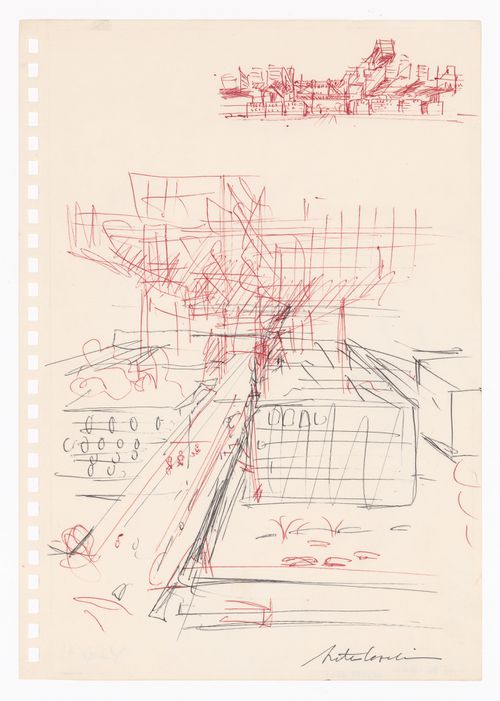
- This drawing is one of four drawings by Arata Isozaki for the "City in the Air" schemes of 1960-1963. Three of these drawings are studies for the "Clusters in the Air" project of 1960-1962: a sketch showing a general view of the project, DR1987:0117, a more finished version of the same view, DR1987:0062, and a three-stage sketch showing trees becoming a forest, DR1987:0116. The sketch of trees demonstrates the principal idea behind the "Clusters in the Air" project; enormous supports (trunks) support passageways (branches) to which living units (leaves) are gradually added. The trees develope side by side, with branches of different trees joining up, creating a "forest" (Isozaki 1992, 20-23, 29). The subject of this drawing is unclear although it is possibly a conceptual drawing for the Marunouchi Project of 1963, a proposal for a "City in the Air" in the central business district of Tokyo (Isozaki 1992, 27, 29). All four drawings are executed on sheets perforated with square holes for insertion into a spiral notebook.
DR1987:0061
Description:
- This drawing is one of four drawings by Arata Isozaki for the "City in the Air" schemes of 1960-1963. Three of these drawings are studies for the "Clusters in the Air" project of 1960-1962: a sketch showing a general view of the project, DR1987:0117, a more finished version of the same view, DR1987:0062, and a three-stage sketch showing trees becoming a forest, DR1987:0116. The sketch of trees demonstrates the principal idea behind the "Clusters in the Air" project; enormous supports (trunks) support passageways (branches) to which living units (leaves) are gradually added. The trees develope side by side, with branches of different trees joining up, creating a "forest" (Isozaki 1992, 20-23, 29). The subject of this drawing is unclear although it is possibly a conceptual drawing for the Marunouchi Project of 1963, a proposal for a "City in the Air" in the central business district of Tokyo (Isozaki 1992, 27, 29). All four drawings are executed on sheets perforated with square holes for insertion into a spiral notebook.
People:
Subject:
architecture
architecture
Date:
ca. 1960-1963
ca. 1960-1963
Title:
Sketch for an urban structure raised on pylons, possibly for the Marunouchi Project, Tokyo
Actions:
DR1987:0061
Description:
- This drawing is one of four drawings by Arata Isozaki for the "City in the Air" schemes of 1960-1963. Three of these drawings are studies for the "Clusters in the Air" project of 1960-1962: a sketch showing a general view of the project, DR1987:0117, a more finished version of the same view, DR1987:0062, and a three-stage sketch showing trees becoming a forest, DR1987:0116. The sketch of trees demonstrates the principal idea behind the "Clusters in the Air" project; enormous supports (trunks) support passageways (branches) to which living units (leaves) are gradually added. The trees develope side by side, with branches of different trees joining up, creating a "forest" (Isozaki 1992, 20-23, 29). The subject of this drawing is unclear although it is possibly a conceptual drawing for the Marunouchi Project of 1963, a proposal for a "City in the Air" in the central business district of Tokyo (Isozaki 1992, 27, 29). All four drawings are executed on sheets perforated with square holes for insertion into a spiral notebook.
Sketch for an urban structure raised on pylons, possibly for the Marunouchi Project, Tokyo
Actions:
DR1987:0061
Description:
- This drawing is one of four drawings by Arata Isozaki for the "City in the Air" schemes of 1960-1963. Three of these drawings are studies for the "Clusters in the Air" project of 1960-1962: a sketch showing a general view of the project, DR1987:0117, a more finished version of the same view, DR1987:0062, and a three-stage sketch showing trees becoming a forest, DR1987:0116. The sketch of trees demonstrates the principal idea behind the "Clusters in the Air" project; enormous supports (trunks) support passageways (branches) to which living units (leaves) are gradually added. The trees develope side by side, with branches of different trees joining up, creating a "forest" (Isozaki 1992, 20-23, 29). The subject of this drawing is unclear although it is possibly a conceptual drawing for the Marunouchi Project of 1963, a proposal for a "City in the Air" in the central business district of Tokyo (Isozaki 1992, 27, 29). All four drawings are executed on sheets perforated with square holes for insertion into a spiral notebook.
Form:
drawings
drawings
Date:
ca. 1960-1963
ca. 1960-1963
People:
Subject:
architecture
architecture
Level of archival description:
Project
Project
Reference number:
CI005.S1.1946.PR1
Description:
In order to better coordinate numerous war memorial committees, the Dutch national government instituted a Central Commission for War and Peace Memorials. The commission initiated a national monument project in 1946 with the direction of J. Henrick Muller, who chose Dam Square, Amsterdam, for its site. The existing plan drew on an existing municipal Amsterdam memorial. Sculptor John Raedecker designed a sculpture group supported by an obelisk and Oud was enlisted by Raedecker to create the memorial's spatial design for the sculptures and urns. Oud chose the memorial site opposite the palace in Dam Square. Despite pressure to change the site position, the committee submitted Oud's design and it was approved in 1950. The sculptures and monument were completed in 1956 with an opening ceremony held in May (Taverne et al. 2001, 457-460). Project series includes partial sections and plans showing sculptures by Raedecker.
CI005.S1.1946.PR1
Description:
In order to better coordinate numerous war memorial committees, the Dutch national government instituted a Central Commission for War and Peace Memorials. The commission initiated a national monument project in 1946 with the direction of J. Henrick Muller, who chose Dam Square, Amsterdam, for its site. The existing plan drew on an existing municipal Amsterdam memorial. Sculptor John Raedecker designed a sculpture group supported by an obelisk and Oud was enlisted by Raedecker to create the memorial's spatial design for the sculptures and urns. Oud chose the memorial site opposite the palace in Dam Square. Despite pressure to change the site position, the committee submitted Oud's design and it was approved in 1950. The sculptures and monument were completed in 1956 with an opening ceremony held in May (Taverne et al. 2001, 457-460). Project series includes partial sections and plans showing sculptures by Raedecker.
People:
Date:
1946-1956
1946-1956
Title:
National Monument, Dam Square, Amsterdam, Netherlands (1946-1956)
Actions:
CI005.S1.1946.PR1
Description:
In order to better coordinate numerous war memorial committees, the Dutch national government instituted a Central Commission for War and Peace Memorials. The commission initiated a national monument project in 1946 with the direction of J. Henrick Muller, who chose Dam Square, Amsterdam, for its site. The existing plan drew on an existing municipal Amsterdam memorial. Sculptor John Raedecker designed a sculpture group supported by an obelisk and Oud was enlisted by Raedecker to create the memorial's spatial design for the sculptures and urns. Oud chose the memorial site opposite the palace in Dam Square. Despite pressure to change the site position, the committee submitted Oud's design and it was approved in 1950. The sculptures and monument were completed in 1956 with an opening ceremony held in May (Taverne et al. 2001, 457-460). Project series includes partial sections and plans showing sculptures by Raedecker.
National Monument, Dam Square, Amsterdam, Netherlands (1946-1956)
Actions:
CI005.S1.1946.PR1
Description:
In order to better coordinate numerous war memorial committees, the Dutch national government instituted a Central Commission for War and Peace Memorials. The commission initiated a national monument project in 1946 with the direction of J. Henrick Muller, who chose Dam Square, Amsterdam, for its site. The existing plan drew on an existing municipal Amsterdam memorial. Sculptor John Raedecker designed a sculpture group supported by an obelisk and Oud was enlisted by Raedecker to create the memorial's spatial design for the sculptures and urns. Oud chose the memorial site opposite the palace in Dam Square. Despite pressure to change the site position, the committee submitted Oud's design and it was approved in 1950. The sculptures and monument were completed in 1956 with an opening ceremony held in May (Taverne et al. 2001, 457-460). Project series includes partial sections and plans showing sculptures by Raedecker.
Level of archival description:
project
project
Date:
1946-1956
1946-1956
People:


