


3141 Results
Form:
drawings
Quantity:
9 drawing(s)
drawings
Quantity:
9 drawing(s)
Reference number:
ARCH221141
Description:
sketches, notes and a draft letter to Albert Kahn
ARCH221141
Description:
sketches, notes and a draft letter to Albert Kahn
People:
Date:
1942
1942
Title:
Peterhaus, Trip to Taliesin, Williamsburg, 1942
Actions:
ARCH221141
Description:
sketches, notes and a draft letter to Albert Kahn
Peterhaus, Trip to Taliesin, Williamsburg, 1942
Actions:
ARCH221141
Description:
sketches, notes and a draft letter to Albert Kahn
Form:
drawings
Quantity:
9 drawing(s)
drawings
Quantity:
9 drawing(s)
Date:
1942
1942
People:
Level of archival description:
Sub-series
Sub-series
Title:
Domestic Commissions
Domestic Commissions
Reference number:
CI001.S1.D2
Description:
Hubert and Charles Rohault de Fleury received domestic commissions for both urban housing -hôtel particuliers and apartment houses- and rural dwellings -châteaux, country houses and estates. Hubert also executed designs for furniture and garden pavilions. Hubert' work is characterized by restrained classical exteriors and luxurious Empire style interiors; both Charles' exteriors and interiors, especially those for Hôtels Sauvage and Soltykoff, reflect the exuberance of the Second Empire. The CCA albums include drawings from all stages of the design process but with an emphasis on design development drawings. Hubert's albums contain cost calculations and estimates, notes and letters. In general, the drawings by Charles are from a more developed phase of design than Hubert's; Hubert's commissions are more varied than Charles'. The austere classicism of Hubert's domestic work reflects the prevailing taste of the day and reveals the strong influence of his teacher, Jean Nicholas Louis Durand. The compostional effect of the houses' façades relies on the shape and rhythm of the fenestration and the geometric division by string courses and occasionally, pilasters. Columns are used infrequently as is decorative stonework. The plans are symmetrical and modular. This approach to design is especially evident in the series of proposals for a country house for comte Treilhard (DR1974:0002:034:001-082) and in a group of unidentified designs for houses (DR1974:0002:035:001-034), all of which illustrate an emphasis on plan in the design process and a distinct approach to the composition of the elevations, both derived from Durand. Hubert's domestic work was also influenced by Palladio (see especially DR1974:0002:038:001-029). The interiors and furniture designed by Hubert are typical of the Empire style (1). The drawings in the CCA collection illustrate the materials, palette and ornamental motifs of the period. The garden structures in Hubert's albums are more fanciful than his houses and are either Rustic, Chinoiserie or classical in style (2). His garden designs follow the contemporary French trend for "jardins anglais" with winding paths and naturalistic placement of the vegetation, sometimes in combination with more formal French gardens (3). One of the most comprehensively documented domestic project by Hubert is the Rohault de Fleury House (12-14 rue d'Aguesseau; 1824). The CCA collection contains an interesting series of preliminary drawings for alternate proposals for this house, a number of highly finished wash drawings (including the interior decorative scheme) for the final scheme (DR1974:0002:011:001-08) and several earlier (ca. 1806) proposals (DR1974:0002:035:001-034). The Domaine de la Vallée album (DR1974:0002:025:001-059) is notable for the range of subject matter included as well as for the insights into the character of a working country estate in the nineteenth century. The proposed modifications encompassed both functional (a bridge, a levee, granaries and stables) and aesthetic improvements, such as ornamental garden temples. The renovation of the house also exhibits both functional and aesthetic improvements. (1) Examples of Hubert's interiors and furniture can be found in albums, DR1974:0002:007:001-068, DR1974:0002:011:001-089, DR1974:0002:025:001-059, DR1974:0002:030:001-065 and DR1974:0002:035:001-034. (2) The best examples of his pavilions are found in album, DR1974:0002:038:001-029 with other examples in albums, DR1974:0002:025:001-059, DR1974:0002:030:001-065 and DR1974:0002:035:001-034. (3) Examples are found in albums, DR1974:0002:035:001-034 and DR1974:0002 :025:001-059. Also of note are drawings, DR1974:0002:007:007 and DR1974:0002:007:068.
CI001.S1.D2
Description:
Hubert and Charles Rohault de Fleury received domestic commissions for both urban housing -hôtel particuliers and apartment houses- and rural dwellings -châteaux, country houses and estates. Hubert also executed designs for furniture and garden pavilions. Hubert' work is characterized by restrained classical exteriors and luxurious Empire style interiors; both Charles' exteriors and interiors, especially those for Hôtels Sauvage and Soltykoff, reflect the exuberance of the Second Empire. The CCA albums include drawings from all stages of the design process but with an emphasis on design development drawings. Hubert's albums contain cost calculations and estimates, notes and letters. In general, the drawings by Charles are from a more developed phase of design than Hubert's; Hubert's commissions are more varied than Charles'. The austere classicism of Hubert's domestic work reflects the prevailing taste of the day and reveals the strong influence of his teacher, Jean Nicholas Louis Durand. The compostional effect of the houses' façades relies on the shape and rhythm of the fenestration and the geometric division by string courses and occasionally, pilasters. Columns are used infrequently as is decorative stonework. The plans are symmetrical and modular. This approach to design is especially evident in the series of proposals for a country house for comte Treilhard (DR1974:0002:034:001-082) and in a group of unidentified designs for houses (DR1974:0002:035:001-034), all of which illustrate an emphasis on plan in the design process and a distinct approach to the composition of the elevations, both derived from Durand. Hubert's domestic work was also influenced by Palladio (see especially DR1974:0002:038:001-029). The interiors and furniture designed by Hubert are typical of the Empire style (1). The drawings in the CCA collection illustrate the materials, palette and ornamental motifs of the period. The garden structures in Hubert's albums are more fanciful than his houses and are either Rustic, Chinoiserie or classical in style (2). His garden designs follow the contemporary French trend for "jardins anglais" with winding paths and naturalistic placement of the vegetation, sometimes in combination with more formal French gardens (3). One of the most comprehensively documented domestic project by Hubert is the Rohault de Fleury House (12-14 rue d'Aguesseau; 1824). The CCA collection contains an interesting series of preliminary drawings for alternate proposals for this house, a number of highly finished wash drawings (including the interior decorative scheme) for the final scheme (DR1974:0002:011:001-08) and several earlier (ca. 1806) proposals (DR1974:0002:035:001-034). The Domaine de la Vallée album (DR1974:0002:025:001-059) is notable for the range of subject matter included as well as for the insights into the character of a working country estate in the nineteenth century. The proposed modifications encompassed both functional (a bridge, a levee, granaries and stables) and aesthetic improvements, such as ornamental garden temples. The renovation of the house also exhibits both functional and aesthetic improvements. (1) Examples of Hubert's interiors and furniture can be found in albums, DR1974:0002:007:001-068, DR1974:0002:011:001-089, DR1974:0002:025:001-059, DR1974:0002:030:001-065 and DR1974:0002:035:001-034. (2) The best examples of his pavilions are found in album, DR1974:0002:038:001-029 with other examples in albums, DR1974:0002:025:001-059, DR1974:0002:030:001-065 and DR1974:0002:035:001-034. (3) Examples are found in albums, DR1974:0002:035:001-034 and DR1974:0002 :025:001-059. Also of note are drawings, DR1974:0002:007:007 and DR1974:0002:007:068.
People:
Date:
1802-[1840]
1802-[1840]
Title:
Domestic Commissions
CI001.S1.D2
Description:
Hubert and Charles Rohault de Fleury received domestic commissions for both urban housing -hôtel particuliers and apartment houses- and rural dwellings -châteaux, country houses and estates. Hubert also executed designs for furniture and garden pavilions. Hubert' work is characterized by restrained classical exteriors and luxurious Empire style interiors; both Charles' exteriors and interiors, especially those for Hôtels Sauvage and Soltykoff, reflect the exuberance of the Second Empire. The CCA albums include drawings from all stages of the design process but with an emphasis on design development drawings. Hubert's albums contain cost calculations and estimates, notes and letters. In general, the drawings by Charles are from a more developed phase of design than Hubert's; Hubert's commissions are more varied than Charles'. The austere classicism of Hubert's domestic work reflects the prevailing taste of the day and reveals the strong influence of his teacher, Jean Nicholas Louis Durand. The compostional effect of the houses' façades relies on the shape and rhythm of the fenestration and the geometric division by string courses and occasionally, pilasters. Columns are used infrequently as is decorative stonework. The plans are symmetrical and modular. This approach to design is especially evident in the series of proposals for a country house for comte Treilhard (DR1974:0002:034:001-082) and in a group of unidentified designs for houses (DR1974:0002:035:001-034), all of which illustrate an emphasis on plan in the design process and a distinct approach to the composition of the elevations, both derived from Durand. Hubert's domestic work was also influenced by Palladio (see especially DR1974:0002:038:001-029). The interiors and furniture designed by Hubert are typical of the Empire style (1). The drawings in the CCA collection illustrate the materials, palette and ornamental motifs of the period. The garden structures in Hubert's albums are more fanciful than his houses and are either Rustic, Chinoiserie or classical in style (2). His garden designs follow the contemporary French trend for "jardins anglais" with winding paths and naturalistic placement of the vegetation, sometimes in combination with more formal French gardens (3). One of the most comprehensively documented domestic project by Hubert is the Rohault de Fleury House (12-14 rue d'Aguesseau; 1824). The CCA collection contains an interesting series of preliminary drawings for alternate proposals for this house, a number of highly finished wash drawings (including the interior decorative scheme) for the final scheme (DR1974:0002:011:001-08) and several earlier (ca. 1806) proposals (DR1974:0002:035:001-034). The Domaine de la Vallée album (DR1974:0002:025:001-059) is notable for the range of subject matter included as well as for the insights into the character of a working country estate in the nineteenth century. The proposed modifications encompassed both functional (a bridge, a levee, granaries and stables) and aesthetic improvements, such as ornamental garden temples. The renovation of the house also exhibits both functional and aesthetic improvements. (1) Examples of Hubert's interiors and furniture can be found in albums, DR1974:0002:007:001-068, DR1974:0002:011:001-089, DR1974:0002:025:001-059, DR1974:0002:030:001-065 and DR1974:0002:035:001-034. (2) The best examples of his pavilions are found in album, DR1974:0002:038:001-029 with other examples in albums, DR1974:0002:025:001-059, DR1974:0002:030:001-065 and DR1974:0002:035:001-034. (3) Examples are found in albums, DR1974:0002:035:001-034 and DR1974:0002 :025:001-059. Also of note are drawings, DR1974:0002:007:007 and DR1974:0002:007:068.
Domestic Commissions
CI001.S1.D2
Description:
Hubert and Charles Rohault de Fleury received domestic commissions for both urban housing -hôtel particuliers and apartment houses- and rural dwellings -châteaux, country houses and estates. Hubert also executed designs for furniture and garden pavilions. Hubert' work is characterized by restrained classical exteriors and luxurious Empire style interiors; both Charles' exteriors and interiors, especially those for Hôtels Sauvage and Soltykoff, reflect the exuberance of the Second Empire. The CCA albums include drawings from all stages of the design process but with an emphasis on design development drawings. Hubert's albums contain cost calculations and estimates, notes and letters. In general, the drawings by Charles are from a more developed phase of design than Hubert's; Hubert's commissions are more varied than Charles'. The austere classicism of Hubert's domestic work reflects the prevailing taste of the day and reveals the strong influence of his teacher, Jean Nicholas Louis Durand. The compostional effect of the houses' façades relies on the shape and rhythm of the fenestration and the geometric division by string courses and occasionally, pilasters. Columns are used infrequently as is decorative stonework. The plans are symmetrical and modular. This approach to design is especially evident in the series of proposals for a country house for comte Treilhard (DR1974:0002:034:001-082) and in a group of unidentified designs for houses (DR1974:0002:035:001-034), all of which illustrate an emphasis on plan in the design process and a distinct approach to the composition of the elevations, both derived from Durand. Hubert's domestic work was also influenced by Palladio (see especially DR1974:0002:038:001-029). The interiors and furniture designed by Hubert are typical of the Empire style (1). The drawings in the CCA collection illustrate the materials, palette and ornamental motifs of the period. The garden structures in Hubert's albums are more fanciful than his houses and are either Rustic, Chinoiserie or classical in style (2). His garden designs follow the contemporary French trend for "jardins anglais" with winding paths and naturalistic placement of the vegetation, sometimes in combination with more formal French gardens (3). One of the most comprehensively documented domestic project by Hubert is the Rohault de Fleury House (12-14 rue d'Aguesseau; 1824). The CCA collection contains an interesting series of preliminary drawings for alternate proposals for this house, a number of highly finished wash drawings (including the interior decorative scheme) for the final scheme (DR1974:0002:011:001-08) and several earlier (ca. 1806) proposals (DR1974:0002:035:001-034). The Domaine de la Vallée album (DR1974:0002:025:001-059) is notable for the range of subject matter included as well as for the insights into the character of a working country estate in the nineteenth century. The proposed modifications encompassed both functional (a bridge, a levee, granaries and stables) and aesthetic improvements, such as ornamental garden temples. The renovation of the house also exhibits both functional and aesthetic improvements. (1) Examples of Hubert's interiors and furniture can be found in albums, DR1974:0002:007:001-068, DR1974:0002:011:001-089, DR1974:0002:025:001-059, DR1974:0002:030:001-065 and DR1974:0002:035:001-034. (2) The best examples of his pavilions are found in album, DR1974:0002:038:001-029 with other examples in albums, DR1974:0002:025:001-059, DR1974:0002:030:001-065 and DR1974:0002:035:001-034. (3) Examples are found in albums, DR1974:0002:035:001-034 and DR1974:0002 :025:001-059. Also of note are drawings, DR1974:0002:007:007 and DR1974:0002:007:068.
Level of archival description:
File 2
File 2
Date:
1802-[1840]
1802-[1840]
People:
Form:
textual records
textual records
Actions:
Reference number:
DR1995:0188:755
Description:
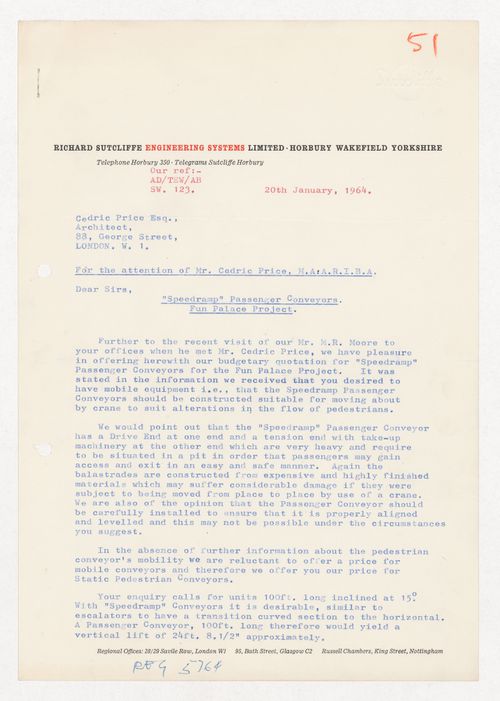
Letter is about "speedramp" passenger conveyors for the Fun Palace Project.
DR1995:0188:755
Description:
Letter is about "speedramp" passenger conveyors for the Fun Palace Project.
People:
Date:
20 January 1964
20 January 1964
Title:
Letter from Richard Sutcliffe Engineering Systems Limited to Cedric Price
Actions:
DR1995:0188:755
Description:
Letter is about "speedramp" passenger conveyors for the Fun Palace Project.
Letter from Richard Sutcliffe Engineering Systems Limited to Cedric Price
Actions:
DR1995:0188:755
Description:
Letter is about "speedramp" passenger conveyors for the Fun Palace Project.
Form:
textual records
textual records
Date:
20 January 1964
20 January 1964
People:
Form:
textual records
textual records
Actions:
Reference number:
ARCH268154
Description:
Letter, note, and plan concerning an unsanitary area (“Ilot insalubre”) in the 5th arrondissement of Paris. The Letter and note are addressed to “Woog.” The signature on the note is unclear, but it appears to read “M.S.” and the letter is signed by Architect Paul-Albert Pocheron. The letter and note are dated 30 January 1937 and 2 February 1937, respectively. The plan is undated.
ARCH268154
Description:
Letter, note, and plan concerning an unsanitary area (“Ilot insalubre”) in the 5th arrondissement of Paris. The Letter and note are addressed to “Woog.” The signature on the note is unclear, but it appears to read “M.S.” and the letter is signed by Architect Paul-Albert Pocheron. The letter and note are dated 30 January 1937 and 2 February 1937, respectively. The plan is undated.
People:
Title:
Letter, note, and plan concerning an unsanitary area (“Ilot insalubre”) in the 5th arrondissement of Paris
Actions:
ARCH268154
Description:
Letter, note, and plan concerning an unsanitary area (“Ilot insalubre”) in the 5th arrondissement of Paris. The Letter and note are addressed to “Woog.” The signature on the note is unclear, but it appears to read “M.S.” and the letter is signed by Architect Paul-Albert Pocheron. The letter and note are dated 30 January 1937 and 2 February 1937, respectively. The plan is undated.
Letter, note, and plan concerning an unsanitary area (“Ilot insalubre”) in the 5th arrondissement of Paris
Actions:
ARCH268154
Description:
Letter, note, and plan concerning an unsanitary area (“Ilot insalubre”) in the 5th arrondissement of Paris. The Letter and note are addressed to “Woog.” The signature on the note is unclear, but it appears to read “M.S.” and the letter is signed by Architect Paul-Albert Pocheron. The letter and note are dated 30 January 1937 and 2 February 1937, respectively. The plan is undated.
Form:
textual records
textual records
People:
Form:
textual records, photographs
textual records, photographs
Reference number:
ARCH253920
Description:
notes, letter of agreement, black-and-white photographs and negatives
ARCH253920
Description:
notes, letter of agreement, black-and-white photographs and negatives
People:
Date:
1971
1971
Title:
Jamaica Airport Development - Program Palisades
Actions:
ARCH253920
Description:
notes, letter of agreement, black-and-white photographs and negatives
Jamaica Airport Development - Program Palisades
Actions:
ARCH253920
Description:
notes, letter of agreement, black-and-white photographs and negatives
Form:
textual records, photographs
textual records, photographs
Date:
1971
1971
People:
Form:
textual records
textual records
Actions:
Reference number:
PH2006:0299:039
Description:
This letter was received by Carol Goodden on 3 December 1975.
PH2006:0299:039
Description:
This letter was received by Carol Goodden on 3 December 1975.
People:
Date:
10 November 1975
10 November 1975
Title:
Letter from Gordon Matta-Clark to Carol Goodden, from Milan, Italy
Actions:
PH2006:0299:039
Description:
This letter was received by Carol Goodden on 3 December 1975.
Letter from Gordon Matta-Clark to Carol Goodden, from Milan, Italy
Actions:
PH2006:0299:039
Description:
This letter was received by Carol Goodden on 3 December 1975.
Form:
textual records
textual records
Date:
10 November 1975
10 November 1975
People:
Form:
textual records
textual records
Actions:
Reference number:
DR1995:0188:747
Description:
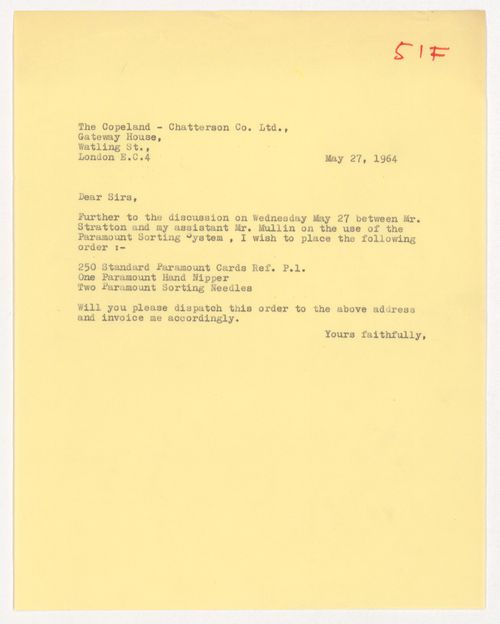
The letter is not signed, but it mentions the assistant Mullin. Cedric Price had an assistant named Stephen Mullin from 1964 to 1969. So the letter is presumably written by Cedric Price.
DR1995:0188:747
Description:
The letter is not signed, but it mentions the assistant Mullin. Cedric Price had an assistant named Stephen Mullin from 1964 to 1969. So the letter is presumably written by Cedric Price.
People:
Date:
27 May 1964
27 May 1964
Title:
Letter, possibly from Cedric Price, to Copeland-Chatterson Co. Ltd. regarding the use of the Paramount Sorting System
Actions:
DR1995:0188:747
Description:
The letter is not signed, but it mentions the assistant Mullin. Cedric Price had an assistant named Stephen Mullin from 1964 to 1969. So the letter is presumably written by Cedric Price.
Letter, possibly from Cedric Price, to Copeland-Chatterson Co. Ltd. regarding the use of the Paramount Sorting System
Actions:
DR1995:0188:747
Description:
The letter is not signed, but it mentions the assistant Mullin. Cedric Price had an assistant named Stephen Mullin from 1964 to 1969. So the letter is presumably written by Cedric Price.
Form:
textual records
textual records
Date:
27 May 1964
27 May 1964
People:
Form:
textual records
textual records
Actions:
Reference number:
AP197.S3.011
Description:
The box is comprised of correspondence for the years of 2002-2014, organized in chronological order. The box documents Frampton’s career as Ware professor at the Graduate School of Architecture, Planning and Preservation, Columbia University and his related professional activities. Correspondence in this box includes: offers of teaching positions; requests to write articles, reviews, books and recommendation letters; invitations to teach, present, or attend at lectures/symposiums/conferences; and requests to serve on juries. Throughout this period, Frampton corresponded with various universities, architects, professors, publishers, and editors of various publications such as: Alvaro Siza; Mario Botta; Glenn Murcutt; Angelo Bucci; Kengo Kuma; Charles Correa; Rafael Moneo; Raj Rewal; Harry Wolf; Tadao Ando; and David Chipperfield. Correspondence relates to Frampton participation/involvement in: writing Richard Meier and Steven Holl essays for Electa Architecture and the Labor, Work and Architecture publication; in the Chinese translation of Studies in Tectonic Culture; in the International Committee for Documentation and Conservation of Buildings, Sites and Neighbourhoods of the Modern Movement’s (do.co,mo.mo) "The Challenge of the Modern Movement;" lecturing at the Bard Graduate Center; providing the keynote address at the Architectural Association of Ireland Symposium; acting as a jury member for the Museum of the History of Polish Jews.
AP197.S3.011
Description:
The box is comprised of correspondence for the years of 2002-2014, organized in chronological order. The box documents Frampton’s career as Ware professor at the Graduate School of Architecture, Planning and Preservation, Columbia University and his related professional activities. Correspondence in this box includes: offers of teaching positions; requests to write articles, reviews, books and recommendation letters; invitations to teach, present, or attend at lectures/symposiums/conferences; and requests to serve on juries. Throughout this period, Frampton corresponded with various universities, architects, professors, publishers, and editors of various publications such as: Alvaro Siza; Mario Botta; Glenn Murcutt; Angelo Bucci; Kengo Kuma; Charles Correa; Rafael Moneo; Raj Rewal; Harry Wolf; Tadao Ando; and David Chipperfield. Correspondence relates to Frampton participation/involvement in: writing Richard Meier and Steven Holl essays for Electa Architecture and the Labor, Work and Architecture publication; in the Chinese translation of Studies in Tectonic Culture; in the International Committee for Documentation and Conservation of Buildings, Sites and Neighbourhoods of the Modern Movement’s (do.co,mo.mo) "The Challenge of the Modern Movement;" lecturing at the Bard Graduate Center; providing the keynote address at the Architectural Association of Ireland Symposium; acting as a jury member for the Museum of the History of Polish Jews.
People:
Date:
2002-2014
2002-2014
Title:
Personal and professional correspondence from 2002-2014
Actions:
AP197.S3.011
Description:
The box is comprised of correspondence for the years of 2002-2014, organized in chronological order. The box documents Frampton’s career as Ware professor at the Graduate School of Architecture, Planning and Preservation, Columbia University and his related professional activities. Correspondence in this box includes: offers of teaching positions; requests to write articles, reviews, books and recommendation letters; invitations to teach, present, or attend at lectures/symposiums/conferences; and requests to serve on juries. Throughout this period, Frampton corresponded with various universities, architects, professors, publishers, and editors of various publications such as: Alvaro Siza; Mario Botta; Glenn Murcutt; Angelo Bucci; Kengo Kuma; Charles Correa; Rafael Moneo; Raj Rewal; Harry Wolf; Tadao Ando; and David Chipperfield. Correspondence relates to Frampton participation/involvement in: writing Richard Meier and Steven Holl essays for Electa Architecture and the Labor, Work and Architecture publication; in the Chinese translation of Studies in Tectonic Culture; in the International Committee for Documentation and Conservation of Buildings, Sites and Neighbourhoods of the Modern Movement’s (do.co,mo.mo) "The Challenge of the Modern Movement;" lecturing at the Bard Graduate Center; providing the keynote address at the Architectural Association of Ireland Symposium; acting as a jury member for the Museum of the History of Polish Jews.
Personal and professional correspondence from 2002-2014
Actions:
AP197.S3.011
Description:
The box is comprised of correspondence for the years of 2002-2014, organized in chronological order. The box documents Frampton’s career as Ware professor at the Graduate School of Architecture, Planning and Preservation, Columbia University and his related professional activities. Correspondence in this box includes: offers of teaching positions; requests to write articles, reviews, books and recommendation letters; invitations to teach, present, or attend at lectures/symposiums/conferences; and requests to serve on juries. Throughout this period, Frampton corresponded with various universities, architects, professors, publishers, and editors of various publications such as: Alvaro Siza; Mario Botta; Glenn Murcutt; Angelo Bucci; Kengo Kuma; Charles Correa; Rafael Moneo; Raj Rewal; Harry Wolf; Tadao Ando; and David Chipperfield. Correspondence relates to Frampton participation/involvement in: writing Richard Meier and Steven Holl essays for Electa Architecture and the Labor, Work and Architecture publication; in the Chinese translation of Studies in Tectonic Culture; in the International Committee for Documentation and Conservation of Buildings, Sites and Neighbourhoods of the Modern Movement’s (do.co,mo.mo) "The Challenge of the Modern Movement;" lecturing at the Bard Graduate Center; providing the keynote address at the Architectural Association of Ireland Symposium; acting as a jury member for the Museum of the History of Polish Jews.
Form:
textual records
textual records
Date:
2002-2014
2002-2014
People:
Form:
textual records
textual records
Actions:
Reference number:
PHCON2002:0016:003:075
Description:
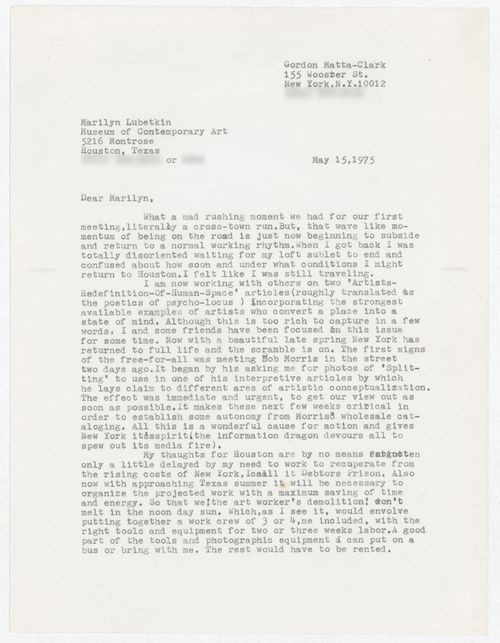
Letter contains a diagram for the project "six houses in a row".
PHCON2002:0016:003:075
Description:
Letter contains a diagram for the project "six houses in a row".
People:
Date:
15 May 1975
15 May 1975
Title:
Letter from Gordon Matta-Clark to Marilyn Lubetkin
Actions:
PHCON2002:0016:003:075
Description:
Letter contains a diagram for the project "six houses in a row".
Letter from Gordon Matta-Clark to Marilyn Lubetkin
Actions:
PHCON2002:0016:003:075
Description:
Letter contains a diagram for the project "six houses in a row".
Form:
textual records
textual records
Date:
15 May 1975
15 May 1975
People:
Reference number:
PHCON2002:0016:002:063:002
Description:
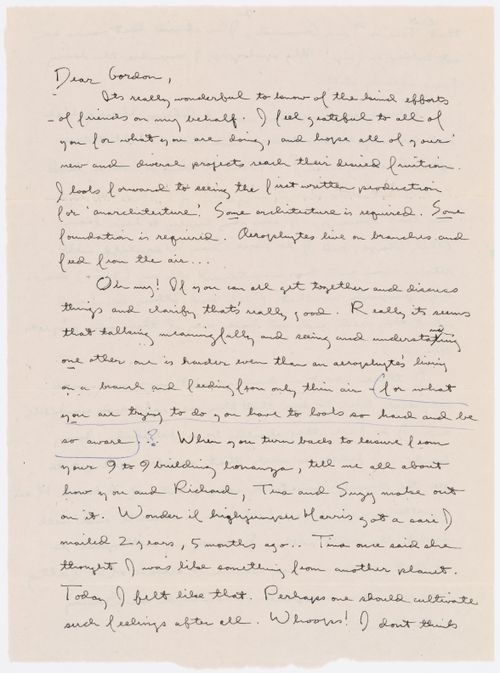
Thanks him for his letter and asks for more information about Anarchitecture.
PHCON2002:0016:002:063:002
Description:
Thanks him for his letter and asks for more information about Anarchitecture.
People:
Date:
18 July 1973
18 July 1973
Title:
Letter from Alan Saret to Gordon Matta-Clark
Actions:
PHCON2002:0016:002:063:002
Description:
Thanks him for his letter and asks for more information about Anarchitecture.
Letter from Alan Saret to Gordon Matta-Clark
Actions:
PHCON2002:0016:002:063:002
Description:
Thanks him for his letter and asks for more information about Anarchitecture.
Date:
18 July 1973
18 July 1973
People:


