


7452 Results
Level of archival description:
Project
Project
Reference number:
AP164.S1.1999.D2
Description:
The project series documents an open competition. Abalos & Herreros, in collaboration with Queca Ortiz and Empty, S.L., won second place for their design. The firm identified this project as number 115. The intention of their entry was to “[…] answer to the task with an authentic installation, a mellowed and independent equipment independent of the container, which absolutely never provokes a conflict or pretends to improve it, which accepts the value of its configuration and extracts the maximum possibilities of the spatial qualities that the intervention has pretended to enhance. Therefore, it is pretended to develop a program which adds an offer of pedagogic-cultural piece of the town to the basic spaces of the museum. The challenge is to make people live together with the scientific aspects, which interests the cultivated popular-pedagogy visitor, connoisseurs of, and which acts with the intention of excinting, surprising and attracting attention of a mostly youthful and infantile audience. […] The museum’s basic program is completed with temporary exhibition halls, library, lecture room and didactic workshops, assembly hall, café, gift shop and offices.” (ARCH270975) Documenting this project are digital and reference materials, project descriptions, and specifications.
AP164.S1.1999.D2
Description:
The project series documents an open competition. Abalos & Herreros, in collaboration with Queca Ortiz and Empty, S.L., won second place for their design. The firm identified this project as number 115. The intention of their entry was to “[…] answer to the task with an authentic installation, a mellowed and independent equipment independent of the container, which absolutely never provokes a conflict or pretends to improve it, which accepts the value of its configuration and extracts the maximum possibilities of the spatial qualities that the intervention has pretended to enhance. Therefore, it is pretended to develop a program which adds an offer of pedagogic-cultural piece of the town to the basic spaces of the museum. The challenge is to make people live together with the scientific aspects, which interests the cultivated popular-pedagogy visitor, connoisseurs of, and which acts with the intention of excinting, surprising and attracting attention of a mostly youthful and infantile audience. […] The museum’s basic program is completed with temporary exhibition halls, library, lecture room and didactic workshops, assembly hall, café, gift shop and offices.” (ARCH270975) Documenting this project are digital and reference materials, project descriptions, and specifications.
People:
Date:
1996-2009, predominant 1999
1996-2009, predominant 1999
Title:
Museo arqueológico Alicante, Spain (1999)
Actions:
AP164.S1.1999.D2
Description:
The project series documents an open competition. Abalos & Herreros, in collaboration with Queca Ortiz and Empty, S.L., won second place for their design. The firm identified this project as number 115. The intention of their entry was to “[…] answer to the task with an authentic installation, a mellowed and independent equipment independent of the container, which absolutely never provokes a conflict or pretends to improve it, which accepts the value of its configuration and extracts the maximum possibilities of the spatial qualities that the intervention has pretended to enhance. Therefore, it is pretended to develop a program which adds an offer of pedagogic-cultural piece of the town to the basic spaces of the museum. The challenge is to make people live together with the scientific aspects, which interests the cultivated popular-pedagogy visitor, connoisseurs of, and which acts with the intention of excinting, surprising and attracting attention of a mostly youthful and infantile audience. […] The museum’s basic program is completed with temporary exhibition halls, library, lecture room and didactic workshops, assembly hall, café, gift shop and offices.” (ARCH270975) Documenting this project are digital and reference materials, project descriptions, and specifications.
Museo arqueológico Alicante, Spain (1999)
Actions:
AP164.S1.1999.D2
Description:
The project series documents an open competition. Abalos & Herreros, in collaboration with Queca Ortiz and Empty, S.L., won second place for their design. The firm identified this project as number 115. The intention of their entry was to “[…] answer to the task with an authentic installation, a mellowed and independent equipment independent of the container, which absolutely never provokes a conflict or pretends to improve it, which accepts the value of its configuration and extracts the maximum possibilities of the spatial qualities that the intervention has pretended to enhance. Therefore, it is pretended to develop a program which adds an offer of pedagogic-cultural piece of the town to the basic spaces of the museum. The challenge is to make people live together with the scientific aspects, which interests the cultivated popular-pedagogy visitor, connoisseurs of, and which acts with the intention of excinting, surprising and attracting attention of a mostly youthful and infantile audience. […] The museum’s basic program is completed with temporary exhibition halls, library, lecture room and didactic workshops, assembly hall, café, gift shop and offices.” (ARCH270975) Documenting this project are digital and reference materials, project descriptions, and specifications.
Level of archival description:
Project
Project
Date:
1996-2009, predominant 1999
1996-2009, predominant 1999
People:
Form:
archives
Level of archival description:
Collection
archives
Level of archival description:
Collection
Title:
Futurecasting collection
Futurecasting collection
Actions:
Reference number:
CD048
Synopsis:
This collection documents the activities of the “Futurecasting: Indigenous-led Architecture and Design in the Arctic” group formed by Jenni Hakovirta, Naomi Ratte, Nicole Luke, Magnus Antaris Tuolja, Andrea McIntosh, Robyn Adams, Berit Kristine Andersen Guvsám, Laila Susanna Kuhmunen, Johanna Minde, and Reanna Merasty. It contains materials related to the planning of seminars and workshops, and the creative process and projects created by its participants in 2022-2023 that were later presented in the Canadian Centre for Architecture’s exhibition and related publication “ᐊᖏᕐᕋᒧᑦ / Ruovttu Guvlui / Towards home” (2022-2023).
CD048
Synopsis:
This collection documents the activities of the “Futurecasting: Indigenous-led Architecture and Design in the Arctic” group formed by Jenni Hakovirta, Naomi Ratte, Nicole Luke, Magnus Antaris Tuolja, Andrea McIntosh, Robyn Adams, Berit Kristine Andersen Guvsám, Laila Susanna Kuhmunen, Johanna Minde, and Reanna Merasty. It contains materials related to the planning of seminars and workshops, and the creative process and projects created by its participants in 2022-2023 that were later presented in the Canadian Centre for Architecture’s exhibition and related publication “ᐊᖏᕐᕋᒧᑦ / Ruovttu Guvlui / Towards home” (2022-2023).
People:
Date:
2008-2023
2008-2023
Title:
Futurecasting collection
Actions:
CD048
Synopsis:
This collection documents the activities of the “Futurecasting: Indigenous-led Architecture and Design in the Arctic” group formed by Jenni Hakovirta, Naomi Ratte, Nicole Luke, Magnus Antaris Tuolja, Andrea McIntosh, Robyn Adams, Berit Kristine Andersen Guvsám, Laila Susanna Kuhmunen, Johanna Minde, and Reanna Merasty. It contains materials related to the planning of seminars and workshops, and the creative process and projects created by its participants in 2022-2023 that were later presented in the Canadian Centre for Architecture’s exhibition and related publication “ᐊᖏᕐᕋᒧᑦ / Ruovttu Guvlui / Towards home” (2022-2023).
Futurecasting collection
Actions:
CD048
Synopsis:
This collection documents the activities of the “Futurecasting: Indigenous-led Architecture and Design in the Arctic” group formed by Jenni Hakovirta, Naomi Ratte, Nicole Luke, Magnus Antaris Tuolja, Andrea McIntosh, Robyn Adams, Berit Kristine Andersen Guvsám, Laila Susanna Kuhmunen, Johanna Minde, and Reanna Merasty. It contains materials related to the planning of seminars and workshops, and the creative process and projects created by its participants in 2022-2023 that were later presented in the Canadian Centre for Architecture’s exhibition and related publication “ᐊᖏᕐᕋᒧᑦ / Ruovttu Guvlui / Towards home” (2022-2023).
Form:
archives
Level of archival description:
Collection
archives
Level of archival description:
Collection
Date:
2008-2023
2008-2023
People:
Level of archival description:
Project
Project
Title:
Colina artificial, International Architecture Biennale Rotterdam, Leeuwarden, Netherlands (2005)
Colina artificial, International Architecture Biennale Rotterdam, Leeuwarden, Netherlands (2005)
Actions:
Reference number:
AP164.S1.2005.D3
Description:
The project series documents the design for an artificial hill and serves as the finish-line for the “Elfstedentocht”, Leeuwarden, Netherlands, at the International Architecture Biennale Rotterdam 2005. The firm identified this project as number 201. "The finish of the great race of the Elfstedentocht should be accompanied by a three-dimensial event which signals the site in the memory of the citizen. If from there, furthermore, the last part of the race is dominated we will be able to imagine that this three-dimensional event is a hybrid between a tribune and a landscaping milestone. […] If towards the South and East it disposes of a slope consisting of artificial lawn with solarium and tribunes above the canal and a scating [sic] park, then towards the North it could house the sport installations with tribunes and a climbing zone with the result that this minimum architectural organization could give life to the site during all year basing on the small sports center, solarium and skating track. A shelter structure crowns the artificial hill composing a lookout spot from where one dominates the whole city and the surrounding landscape." (ARCH270975) Documenting the project are conceptual and presentation drawings, digital, graphic and reference materials, correspondence, publications, competition documents, and agreements.
AP164.S1.2005.D3
Description:
The project series documents the design for an artificial hill and serves as the finish-line for the “Elfstedentocht”, Leeuwarden, Netherlands, at the International Architecture Biennale Rotterdam 2005. The firm identified this project as number 201. "The finish of the great race of the Elfstedentocht should be accompanied by a three-dimensial event which signals the site in the memory of the citizen. If from there, furthermore, the last part of the race is dominated we will be able to imagine that this three-dimensional event is a hybrid between a tribune and a landscaping milestone. […] If towards the South and East it disposes of a slope consisting of artificial lawn with solarium and tribunes above the canal and a scating [sic] park, then towards the North it could house the sport installations with tribunes and a climbing zone with the result that this minimum architectural organization could give life to the site during all year basing on the small sports center, solarium and skating track. A shelter structure crowns the artificial hill composing a lookout spot from where one dominates the whole city and the surrounding landscape." (ARCH270975) Documenting the project are conceptual and presentation drawings, digital, graphic and reference materials, correspondence, publications, competition documents, and agreements.
People:
Date:
1982, 2005, predominant 2005
1982, 2005, predominant 2005
Title:
Colina artificial, International Architecture Biennale Rotterdam, Leeuwarden, Netherlands (2005)
Actions:
AP164.S1.2005.D3
Description:
The project series documents the design for an artificial hill and serves as the finish-line for the “Elfstedentocht”, Leeuwarden, Netherlands, at the International Architecture Biennale Rotterdam 2005. The firm identified this project as number 201. "The finish of the great race of the Elfstedentocht should be accompanied by a three-dimensial event which signals the site in the memory of the citizen. If from there, furthermore, the last part of the race is dominated we will be able to imagine that this three-dimensional event is a hybrid between a tribune and a landscaping milestone. […] If towards the South and East it disposes of a slope consisting of artificial lawn with solarium and tribunes above the canal and a scating [sic] park, then towards the North it could house the sport installations with tribunes and a climbing zone with the result that this minimum architectural organization could give life to the site during all year basing on the small sports center, solarium and skating track. A shelter structure crowns the artificial hill composing a lookout spot from where one dominates the whole city and the surrounding landscape." (ARCH270975) Documenting the project are conceptual and presentation drawings, digital, graphic and reference materials, correspondence, publications, competition documents, and agreements.
Colina artificial, International Architecture Biennale Rotterdam, Leeuwarden, Netherlands (2005)
Actions:
AP164.S1.2005.D3
Description:
The project series documents the design for an artificial hill and serves as the finish-line for the “Elfstedentocht”, Leeuwarden, Netherlands, at the International Architecture Biennale Rotterdam 2005. The firm identified this project as number 201. "The finish of the great race of the Elfstedentocht should be accompanied by a three-dimensial event which signals the site in the memory of the citizen. If from there, furthermore, the last part of the race is dominated we will be able to imagine that this three-dimensional event is a hybrid between a tribune and a landscaping milestone. […] If towards the South and East it disposes of a slope consisting of artificial lawn with solarium and tribunes above the canal and a scating [sic] park, then towards the North it could house the sport installations with tribunes and a climbing zone with the result that this minimum architectural organization could give life to the site during all year basing on the small sports center, solarium and skating track. A shelter structure crowns the artificial hill composing a lookout spot from where one dominates the whole city and the surrounding landscape." (ARCH270975) Documenting the project are conceptual and presentation drawings, digital, graphic and reference materials, correspondence, publications, competition documents, and agreements.
Level of archival description:
Project
Project
Date:
1982, 2005, predominant 2005
1982, 2005, predominant 2005
People:
Level of archival description:
Sub-series
Sub-series
Actions:
Reference number:
AP075.S2.SS4
Description:
This sub-series documents an exhibition held at the Smith College in Northampton, Massachusetts on Cornelia Hahn Oberlander and a selection of her landscape project in 2003. Oberlander's projects exhibited included Robson Square Provincial Government Complex (1974-1982), Museum of Anthropology (1975-1977), National Gallery of Canada (1983-1990), Canadian Chancery (1983-1990), Library Square (1992-1995), Liu Centre for Global Studies (1992), C. K. Choi Institute of Asian Research, University of British Columbia (1993-1996), Jim Everett Memorial Park (2000-2001), New York Times Building (2001), and Wellesley Central Health Corporation Neighbourhood Project (2003). Each projects were divided under five themes: Nature, Science, Space, Art and the Future. The sub-series also includes some documents related to the application for another exhibition at the Smith College in 2005 entitled "Designed Landscape: A Smith College Alumnae Exhibit". The sub-series contains correspondence, draft exhibition texts, proof of the presentation panels, including digital versions, and some installation plans. Document related to the 2005 exhibition project includes correspondence with Smith College and application form.
AP075.S2.SS4
Description:
This sub-series documents an exhibition held at the Smith College in Northampton, Massachusetts on Cornelia Hahn Oberlander and a selection of her landscape project in 2003. Oberlander's projects exhibited included Robson Square Provincial Government Complex (1974-1982), Museum of Anthropology (1975-1977), National Gallery of Canada (1983-1990), Canadian Chancery (1983-1990), Library Square (1992-1995), Liu Centre for Global Studies (1992), C. K. Choi Institute of Asian Research, University of British Columbia (1993-1996), Jim Everett Memorial Park (2000-2001), New York Times Building (2001), and Wellesley Central Health Corporation Neighbourhood Project (2003). Each projects were divided under five themes: Nature, Science, Space, Art and the Future. The sub-series also includes some documents related to the application for another exhibition at the Smith College in 2005 entitled "Designed Landscape: A Smith College Alumnae Exhibit". The sub-series contains correspondence, draft exhibition texts, proof of the presentation panels, including digital versions, and some installation plans. Document related to the 2005 exhibition project includes correspondence with Smith College and application form.
People:
Date:
2003-2005
2003-2005
Title:
Exhibition at the Smith College, Northampton, Massachusetts (circa 2003)
Actions:
AP075.S2.SS4
Description:
This sub-series documents an exhibition held at the Smith College in Northampton, Massachusetts on Cornelia Hahn Oberlander and a selection of her landscape project in 2003. Oberlander's projects exhibited included Robson Square Provincial Government Complex (1974-1982), Museum of Anthropology (1975-1977), National Gallery of Canada (1983-1990), Canadian Chancery (1983-1990), Library Square (1992-1995), Liu Centre for Global Studies (1992), C. K. Choi Institute of Asian Research, University of British Columbia (1993-1996), Jim Everett Memorial Park (2000-2001), New York Times Building (2001), and Wellesley Central Health Corporation Neighbourhood Project (2003). Each projects were divided under five themes: Nature, Science, Space, Art and the Future. The sub-series also includes some documents related to the application for another exhibition at the Smith College in 2005 entitled "Designed Landscape: A Smith College Alumnae Exhibit". The sub-series contains correspondence, draft exhibition texts, proof of the presentation panels, including digital versions, and some installation plans. Document related to the 2005 exhibition project includes correspondence with Smith College and application form.
Exhibition at the Smith College, Northampton, Massachusetts (circa 2003)
Actions:
AP075.S2.SS4
Description:
This sub-series documents an exhibition held at the Smith College in Northampton, Massachusetts on Cornelia Hahn Oberlander and a selection of her landscape project in 2003. Oberlander's projects exhibited included Robson Square Provincial Government Complex (1974-1982), Museum of Anthropology (1975-1977), National Gallery of Canada (1983-1990), Canadian Chancery (1983-1990), Library Square (1992-1995), Liu Centre for Global Studies (1992), C. K. Choi Institute of Asian Research, University of British Columbia (1993-1996), Jim Everett Memorial Park (2000-2001), New York Times Building (2001), and Wellesley Central Health Corporation Neighbourhood Project (2003). Each projects were divided under five themes: Nature, Science, Space, Art and the Future. The sub-series also includes some documents related to the application for another exhibition at the Smith College in 2005 entitled "Designed Landscape: A Smith College Alumnae Exhibit". The sub-series contains correspondence, draft exhibition texts, proof of the presentation panels, including digital versions, and some installation plans. Document related to the 2005 exhibition project includes correspondence with Smith College and application form.
Level of archival description:
Sub-series
Sub-series
Date:
2003-2005
2003-2005
People:
Level of archival description:
Series
Series
Title:
Academic works
Academic works
Actions:
Reference number:
AP169.S3
Description:
Series 3, Academic works, 1995 - 2011, relates to Bernard Cache’s work as a scholar and author. This series includes born-digital material and chiefly dates from 1999 to 2007. Cache pursued and academic career, teaching and lecturing at many universities while also publishing books and articles. His area of interest revolves around computational architecture, geometrics, history of geometric, stereotomy, engineering and philosophy. These records depict his investment in the study of the relation between ancient theory and the field of computational architecture drawings with CAD or BIM software. His work concentrates on prominent figures such as Greek mathematician Euclid to Roman architect Vitruvius and German painter and theorist Albrecht Dürer. Materials in this series reflect Bernard Cache’s work as a scholar. This includes notes for his articles and lectures as well as drafts for different lectures and texts. It also contains syllabi and planning materials for classes given by Cache on Non-Standard Design and Production in Architecture. The series holds a significant amount of images used for presentation or as examples during those lectures and classes (in JPEG and BMP formats). Those images are for the most part derived from CAD original drawings in TopSolid.
AP169.S3
Description:
Series 3, Academic works, 1995 - 2011, relates to Bernard Cache’s work as a scholar and author. This series includes born-digital material and chiefly dates from 1999 to 2007. Cache pursued and academic career, teaching and lecturing at many universities while also publishing books and articles. His area of interest revolves around computational architecture, geometrics, history of geometric, stereotomy, engineering and philosophy. These records depict his investment in the study of the relation between ancient theory and the field of computational architecture drawings with CAD or BIM software. His work concentrates on prominent figures such as Greek mathematician Euclid to Roman architect Vitruvius and German painter and theorist Albrecht Dürer. Materials in this series reflect Bernard Cache’s work as a scholar. This includes notes for his articles and lectures as well as drafts for different lectures and texts. It also contains syllabi and planning materials for classes given by Cache on Non-Standard Design and Production in Architecture. The series holds a significant amount of images used for presentation or as examples during those lectures and classes (in JPEG and BMP formats). Those images are for the most part derived from CAD original drawings in TopSolid.
People:
Date:
1995-2011
1995-2011
Title:
Academic works
Actions:
AP169.S3
Description:
Series 3, Academic works, 1995 - 2011, relates to Bernard Cache’s work as a scholar and author. This series includes born-digital material and chiefly dates from 1999 to 2007. Cache pursued and academic career, teaching and lecturing at many universities while also publishing books and articles. His area of interest revolves around computational architecture, geometrics, history of geometric, stereotomy, engineering and philosophy. These records depict his investment in the study of the relation between ancient theory and the field of computational architecture drawings with CAD or BIM software. His work concentrates on prominent figures such as Greek mathematician Euclid to Roman architect Vitruvius and German painter and theorist Albrecht Dürer. Materials in this series reflect Bernard Cache’s work as a scholar. This includes notes for his articles and lectures as well as drafts for different lectures and texts. It also contains syllabi and planning materials for classes given by Cache on Non-Standard Design and Production in Architecture. The series holds a significant amount of images used for presentation or as examples during those lectures and classes (in JPEG and BMP formats). Those images are for the most part derived from CAD original drawings in TopSolid.
Academic works
Actions:
AP169.S3
Description:
Series 3, Academic works, 1995 - 2011, relates to Bernard Cache’s work as a scholar and author. This series includes born-digital material and chiefly dates from 1999 to 2007. Cache pursued and academic career, teaching and lecturing at many universities while also publishing books and articles. His area of interest revolves around computational architecture, geometrics, history of geometric, stereotomy, engineering and philosophy. These records depict his investment in the study of the relation between ancient theory and the field of computational architecture drawings with CAD or BIM software. His work concentrates on prominent figures such as Greek mathematician Euclid to Roman architect Vitruvius and German painter and theorist Albrecht Dürer. Materials in this series reflect Bernard Cache’s work as a scholar. This includes notes for his articles and lectures as well as drafts for different lectures and texts. It also contains syllabi and planning materials for classes given by Cache on Non-Standard Design and Production in Architecture. The series holds a significant amount of images used for presentation or as examples during those lectures and classes (in JPEG and BMP formats). Those images are for the most part derived from CAD original drawings in TopSolid.
Level of archival description:
Series
Series
Date:
1995-2011
1995-2011
People:
Level of archival description:
Sub-series
Sub-series
Title:
Parque de Vidago Moradias Turísticas [Parque de Vidago vacation homes], Vidago, Portugal (2002)
Parque de Vidago Moradias Turísticas [Parque de Vidago vacation homes], Vidago, Portugal (2002)
Actions:
Reference number:
AP178.S1.2002.PR05.SS2
Description:
This project subseries documents the Parque de Vidago Moradias Turísticas. While the records were held in the office’s archives this project was assigned the number 49/00. The office assigned the date 2002 to this project. The project consisted of the modification of rural buildings into vacation homes and artist residences. The building program outlined the recovery of 4 rural buildings with the intention to keep the existing stone walls and wooden roofs. The documentation also highlights the use of the homes as a place for visting artists to stay. This may have been proposed in conjunction with the desire to modify the existing garage into an art exhibition space. These residences are refered to as "Nùcleo Rural" in the documentation. The project was not realized. This project subseries is documented through drawings, photographic materials and textual records dating from 2005-2009. The drawings are mostly printed reprographic copies of CAD drawings, many of which have annotations. These include plans, details and structural, electrical and mechanical drawings. The photographic materials, which are printed digital photos, show the existing buildings and surrounding site. The textual records include technical documentation and specifications, supplier catalogues, building permit documentation, building programs and budgets.
AP178.S1.2002.PR05.SS2
Description:
This project subseries documents the Parque de Vidago Moradias Turísticas. While the records were held in the office’s archives this project was assigned the number 49/00. The office assigned the date 2002 to this project. The project consisted of the modification of rural buildings into vacation homes and artist residences. The building program outlined the recovery of 4 rural buildings with the intention to keep the existing stone walls and wooden roofs. The documentation also highlights the use of the homes as a place for visting artists to stay. This may have been proposed in conjunction with the desire to modify the existing garage into an art exhibition space. These residences are refered to as "Nùcleo Rural" in the documentation. The project was not realized. This project subseries is documented through drawings, photographic materials and textual records dating from 2005-2009. The drawings are mostly printed reprographic copies of CAD drawings, many of which have annotations. These include plans, details and structural, electrical and mechanical drawings. The photographic materials, which are printed digital photos, show the existing buildings and surrounding site. The textual records include technical documentation and specifications, supplier catalogues, building permit documentation, building programs and budgets.
People:
Date:
2005-2009
2005-2009
Title:
Parque de Vidago Moradias Turísticas [Parque de Vidago vacation homes], Vidago, Portugal (2002)
Actions:
AP178.S1.2002.PR05.SS2
Description:
This project subseries documents the Parque de Vidago Moradias Turísticas. While the records were held in the office’s archives this project was assigned the number 49/00. The office assigned the date 2002 to this project. The project consisted of the modification of rural buildings into vacation homes and artist residences. The building program outlined the recovery of 4 rural buildings with the intention to keep the existing stone walls and wooden roofs. The documentation also highlights the use of the homes as a place for visting artists to stay. This may have been proposed in conjunction with the desire to modify the existing garage into an art exhibition space. These residences are refered to as "Nùcleo Rural" in the documentation. The project was not realized. This project subseries is documented through drawings, photographic materials and textual records dating from 2005-2009. The drawings are mostly printed reprographic copies of CAD drawings, many of which have annotations. These include plans, details and structural, electrical and mechanical drawings. The photographic materials, which are printed digital photos, show the existing buildings and surrounding site. The textual records include technical documentation and specifications, supplier catalogues, building permit documentation, building programs and budgets.
Parque de Vidago Moradias Turísticas [Parque de Vidago vacation homes], Vidago, Portugal (2002)
Actions:
AP178.S1.2002.PR05.SS2
Description:
This project subseries documents the Parque de Vidago Moradias Turísticas. While the records were held in the office’s archives this project was assigned the number 49/00. The office assigned the date 2002 to this project. The project consisted of the modification of rural buildings into vacation homes and artist residences. The building program outlined the recovery of 4 rural buildings with the intention to keep the existing stone walls and wooden roofs. The documentation also highlights the use of the homes as a place for visting artists to stay. This may have been proposed in conjunction with the desire to modify the existing garage into an art exhibition space. These residences are refered to as "Nùcleo Rural" in the documentation. The project was not realized. This project subseries is documented through drawings, photographic materials and textual records dating from 2005-2009. The drawings are mostly printed reprographic copies of CAD drawings, many of which have annotations. These include plans, details and structural, electrical and mechanical drawings. The photographic materials, which are printed digital photos, show the existing buildings and surrounding site. The textual records include technical documentation and specifications, supplier catalogues, building permit documentation, building programs and budgets.
Level of archival description:
Subseries
Subseries
Date:
2005-2009
2005-2009
People:
Level of archival description:
Project
Project
Actions:
Reference number:
AP056.S1.2000.PR05
Description:
This project series documents the James Stewart Centre for Mathematics at McMaster University in Hamilton, Ontario from 2000-2003. The office identified the project number as 2000-22. This project consisted of the complete interior renovation of Hamilton Hall, originally built in 1929, for use as a mathematics school at the University. An insulated envelope was added to the historic building in order to preserve its gothic exteriors, which were juxtaposed against new modern and abstract interior spaces. Transparent blue glass was used throughout the four-storey building for walls, ceilings and railings to draw sunlight deep into its interiors. A mix of enclosed rooms and open, interactive spaces were created and slate chalkboards were added throughout the building to inspire spontaneous thought and collaborative work.[1] This project was awarded a Governor General's Medal in Architecture in 2004. The project is recorded through drawings dating from around 2000 to around 2002, which include sketches, plans, elevations, sections, perspectives, details, presentation drawings and digital renderings. A large part of the sketches are drawings for custom furniture. [1]"James Stewart Centre for Mathematics, McMaster University." KPMB. Accessed April 12, 2019. http://www.kpmb.com/project/james-stewart-centre-for-mathematics/
AP056.S1.2000.PR05
Description:
This project series documents the James Stewart Centre for Mathematics at McMaster University in Hamilton, Ontario from 2000-2003. The office identified the project number as 2000-22. This project consisted of the complete interior renovation of Hamilton Hall, originally built in 1929, for use as a mathematics school at the University. An insulated envelope was added to the historic building in order to preserve its gothic exteriors, which were juxtaposed against new modern and abstract interior spaces. Transparent blue glass was used throughout the four-storey building for walls, ceilings and railings to draw sunlight deep into its interiors. A mix of enclosed rooms and open, interactive spaces were created and slate chalkboards were added throughout the building to inspire spontaneous thought and collaborative work.[1] This project was awarded a Governor General's Medal in Architecture in 2004. The project is recorded through drawings dating from around 2000 to around 2002, which include sketches, plans, elevations, sections, perspectives, details, presentation drawings and digital renderings. A large part of the sketches are drawings for custom furniture. [1]"James Stewart Centre for Mathematics, McMaster University." KPMB. Accessed April 12, 2019. http://www.kpmb.com/project/james-stewart-centre-for-mathematics/
People:
Date:
circa 2000-2002
circa 2000-2002
Title:
James Stewart Centre for Mathematics, McMaster University, Hamilton, Ontario (2000-2003)
Actions:
AP056.S1.2000.PR05
Description:
This project series documents the James Stewart Centre for Mathematics at McMaster University in Hamilton, Ontario from 2000-2003. The office identified the project number as 2000-22. This project consisted of the complete interior renovation of Hamilton Hall, originally built in 1929, for use as a mathematics school at the University. An insulated envelope was added to the historic building in order to preserve its gothic exteriors, which were juxtaposed against new modern and abstract interior spaces. Transparent blue glass was used throughout the four-storey building for walls, ceilings and railings to draw sunlight deep into its interiors. A mix of enclosed rooms and open, interactive spaces were created and slate chalkboards were added throughout the building to inspire spontaneous thought and collaborative work.[1] This project was awarded a Governor General's Medal in Architecture in 2004. The project is recorded through drawings dating from around 2000 to around 2002, which include sketches, plans, elevations, sections, perspectives, details, presentation drawings and digital renderings. A large part of the sketches are drawings for custom furniture. [1]"James Stewart Centre for Mathematics, McMaster University." KPMB. Accessed April 12, 2019. http://www.kpmb.com/project/james-stewart-centre-for-mathematics/
James Stewart Centre for Mathematics, McMaster University, Hamilton, Ontario (2000-2003)
Actions:
AP056.S1.2000.PR05
Description:
This project series documents the James Stewart Centre for Mathematics at McMaster University in Hamilton, Ontario from 2000-2003. The office identified the project number as 2000-22. This project consisted of the complete interior renovation of Hamilton Hall, originally built in 1929, for use as a mathematics school at the University. An insulated envelope was added to the historic building in order to preserve its gothic exteriors, which were juxtaposed against new modern and abstract interior spaces. Transparent blue glass was used throughout the four-storey building for walls, ceilings and railings to draw sunlight deep into its interiors. A mix of enclosed rooms and open, interactive spaces were created and slate chalkboards were added throughout the building to inspire spontaneous thought and collaborative work.[1] This project was awarded a Governor General's Medal in Architecture in 2004. The project is recorded through drawings dating from around 2000 to around 2002, which include sketches, plans, elevations, sections, perspectives, details, presentation drawings and digital renderings. A large part of the sketches are drawings for custom furniture. [1]"James Stewart Centre for Mathematics, McMaster University." KPMB. Accessed April 12, 2019. http://www.kpmb.com/project/james-stewart-centre-for-mathematics/
Level of archival description:
project
project
Date:
circa 2000-2002
circa 2000-2002
People:
Level of archival description:
Project
Project
Reference number:
AP075.S1.2000.PR04
Description:
Project series documents Cornelia Hahn Oberlander's landscape project for the redesign of low-income housing development New Holly Park III in South Beacon Hill, outside Seattle, Washington. Oberlander was hired by Daniel Solomon ETC Artchitects to work on the landscape. She worked on this project in the early 2000s. The housing development was original called Holly Park. The project in the redesign of the existing housing development built in the 1940s and adding 219 rentals and 121 owned properties. For the landscaping, Oberlander "planned not only central market park but also numerous pocket parks and a greenhouse" [1]. The project series contains design development drawings, presentation drawings and working drawings, such as site plans, landscape plans, planting plans, and irrigations plans. The drawings also includes housing construction plans used as reference. The project is also documented through correspondence with client, architect, consultant and contractors, specifications, contract, financial documents, plant selection and documentation. The project series also includes photographs of the project and digital photographs of a site visit by Oberlander. Sources: [1] Herrington, Susan. Cornelia Hahn Oberlander: Making the Modern Landscape, University of Virginia Press, 2014, 304 pages, p. 69.
AP075.S1.2000.PR04
Description:
Project series documents Cornelia Hahn Oberlander's landscape project for the redesign of low-income housing development New Holly Park III in South Beacon Hill, outside Seattle, Washington. Oberlander was hired by Daniel Solomon ETC Artchitects to work on the landscape. She worked on this project in the early 2000s. The housing development was original called Holly Park. The project in the redesign of the existing housing development built in the 1940s and adding 219 rentals and 121 owned properties. For the landscaping, Oberlander "planned not only central market park but also numerous pocket parks and a greenhouse" [1]. The project series contains design development drawings, presentation drawings and working drawings, such as site plans, landscape plans, planting plans, and irrigations plans. The drawings also includes housing construction plans used as reference. The project is also documented through correspondence with client, architect, consultant and contractors, specifications, contract, financial documents, plant selection and documentation. The project series also includes photographs of the project and digital photographs of a site visit by Oberlander. Sources: [1] Herrington, Susan. Cornelia Hahn Oberlander: Making the Modern Landscape, University of Virginia Press, 2014, 304 pages, p. 69.
People:
Date:
2000-2005
2000-2005
Title:
New Holly Park III, Seattle, Washington (2000)
Actions:
AP075.S1.2000.PR04
Description:
Project series documents Cornelia Hahn Oberlander's landscape project for the redesign of low-income housing development New Holly Park III in South Beacon Hill, outside Seattle, Washington. Oberlander was hired by Daniel Solomon ETC Artchitects to work on the landscape. She worked on this project in the early 2000s. The housing development was original called Holly Park. The project in the redesign of the existing housing development built in the 1940s and adding 219 rentals and 121 owned properties. For the landscaping, Oberlander "planned not only central market park but also numerous pocket parks and a greenhouse" [1]. The project series contains design development drawings, presentation drawings and working drawings, such as site plans, landscape plans, planting plans, and irrigations plans. The drawings also includes housing construction plans used as reference. The project is also documented through correspondence with client, architect, consultant and contractors, specifications, contract, financial documents, plant selection and documentation. The project series also includes photographs of the project and digital photographs of a site visit by Oberlander. Sources: [1] Herrington, Susan. Cornelia Hahn Oberlander: Making the Modern Landscape, University of Virginia Press, 2014, 304 pages, p. 69.
New Holly Park III, Seattle, Washington (2000)
Actions:
AP075.S1.2000.PR04
Description:
Project series documents Cornelia Hahn Oberlander's landscape project for the redesign of low-income housing development New Holly Park III in South Beacon Hill, outside Seattle, Washington. Oberlander was hired by Daniel Solomon ETC Artchitects to work on the landscape. She worked on this project in the early 2000s. The housing development was original called Holly Park. The project in the redesign of the existing housing development built in the 1940s and adding 219 rentals and 121 owned properties. For the landscaping, Oberlander "planned not only central market park but also numerous pocket parks and a greenhouse" [1]. The project series contains design development drawings, presentation drawings and working drawings, such as site plans, landscape plans, planting plans, and irrigations plans. The drawings also includes housing construction plans used as reference. The project is also documented through correspondence with client, architect, consultant and contractors, specifications, contract, financial documents, plant selection and documentation. The project series also includes photographs of the project and digital photographs of a site visit by Oberlander. Sources: [1] Herrington, Susan. Cornelia Hahn Oberlander: Making the Modern Landscape, University of Virginia Press, 2014, 304 pages, p. 69.
Level of archival description:
Project
Project
Date:
2000-2005
2000-2005
People:
Level of archival description:
Sub-series
Sub-series
Title:
Drawings and scripts
Drawings and scripts
Actions:
Reference number:
AP165.S7.SS1
Description:
The Drawings and scripts sub-series, 1980 – 2000, consists of 2538 digital files (2 GB) that document Hoberman’s work in AutoCAD to create his patented transformable designs. The majority of records are AutoCAD drawing files and AutoLISP scripts, dating from the mid to late 1990s. Drawings in the sub-series comprise a variety of Hoberman’s expanding installations, toy products and architectural structures, as well as a series of industrial patents and production drawings that detail the manufacturing and assembly of parts. AutoLISP scripts included in the sub-series were written and used by Hoberman for customized command within the AutoCAD environment as the in-program language. These scripts allowed Hoberman to solve the complex mathematical and geometrical calculations necessary to control the design and engineering of each component of his structures. Notable projects include: Iris Dome at Expo 2000 World's Fair, Hanover (2000); Expanding Hypar at California Science Center, Los Angeles (1998); Expanding Helicoid at Inventor's Hall of Fame, Akron (1998); Expanding Fabric Dome at Centre Georges Pompidou, Paris (1997); Iris Dome at Museum of Modern Art, New York (1994); Geodesic Sphere at Technorama der Shweiz, Winterthur (1993); and Expanding Sphere at Liberty Science Center, Jersey City (1991).
AP165.S7.SS1
Description:
The Drawings and scripts sub-series, 1980 – 2000, consists of 2538 digital files (2 GB) that document Hoberman’s work in AutoCAD to create his patented transformable designs. The majority of records are AutoCAD drawing files and AutoLISP scripts, dating from the mid to late 1990s. Drawings in the sub-series comprise a variety of Hoberman’s expanding installations, toy products and architectural structures, as well as a series of industrial patents and production drawings that detail the manufacturing and assembly of parts. AutoLISP scripts included in the sub-series were written and used by Hoberman for customized command within the AutoCAD environment as the in-program language. These scripts allowed Hoberman to solve the complex mathematical and geometrical calculations necessary to control the design and engineering of each component of his structures. Notable projects include: Iris Dome at Expo 2000 World's Fair, Hanover (2000); Expanding Hypar at California Science Center, Los Angeles (1998); Expanding Helicoid at Inventor's Hall of Fame, Akron (1998); Expanding Fabric Dome at Centre Georges Pompidou, Paris (1997); Iris Dome at Museum of Modern Art, New York (1994); Geodesic Sphere at Technorama der Shweiz, Winterthur (1993); and Expanding Sphere at Liberty Science Center, Jersey City (1991).
People:
Date:
1980 - 2000
1980 - 2000
Title:
Drawings and scripts
Actions:
AP165.S7.SS1
Description:
The Drawings and scripts sub-series, 1980 – 2000, consists of 2538 digital files (2 GB) that document Hoberman’s work in AutoCAD to create his patented transformable designs. The majority of records are AutoCAD drawing files and AutoLISP scripts, dating from the mid to late 1990s. Drawings in the sub-series comprise a variety of Hoberman’s expanding installations, toy products and architectural structures, as well as a series of industrial patents and production drawings that detail the manufacturing and assembly of parts. AutoLISP scripts included in the sub-series were written and used by Hoberman for customized command within the AutoCAD environment as the in-program language. These scripts allowed Hoberman to solve the complex mathematical and geometrical calculations necessary to control the design and engineering of each component of his structures. Notable projects include: Iris Dome at Expo 2000 World's Fair, Hanover (2000); Expanding Hypar at California Science Center, Los Angeles (1998); Expanding Helicoid at Inventor's Hall of Fame, Akron (1998); Expanding Fabric Dome at Centre Georges Pompidou, Paris (1997); Iris Dome at Museum of Modern Art, New York (1994); Geodesic Sphere at Technorama der Shweiz, Winterthur (1993); and Expanding Sphere at Liberty Science Center, Jersey City (1991).
Drawings and scripts
Actions:
AP165.S7.SS1
Description:
The Drawings and scripts sub-series, 1980 – 2000, consists of 2538 digital files (2 GB) that document Hoberman’s work in AutoCAD to create his patented transformable designs. The majority of records are AutoCAD drawing files and AutoLISP scripts, dating from the mid to late 1990s. Drawings in the sub-series comprise a variety of Hoberman’s expanding installations, toy products and architectural structures, as well as a series of industrial patents and production drawings that detail the manufacturing and assembly of parts. AutoLISP scripts included in the sub-series were written and used by Hoberman for customized command within the AutoCAD environment as the in-program language. These scripts allowed Hoberman to solve the complex mathematical and geometrical calculations necessary to control the design and engineering of each component of his structures. Notable projects include: Iris Dome at Expo 2000 World's Fair, Hanover (2000); Expanding Hypar at California Science Center, Los Angeles (1998); Expanding Helicoid at Inventor's Hall of Fame, Akron (1998); Expanding Fabric Dome at Centre Georges Pompidou, Paris (1997); Iris Dome at Museum of Modern Art, New York (1994); Geodesic Sphere at Technorama der Shweiz, Winterthur (1993); and Expanding Sphere at Liberty Science Center, Jersey City (1991).
Level of archival description:
Sub-series 1
Sub-series 1
Date:
1980 - 2000
1980 - 2000
People:
Form:
exhibitions
exhibitions
Actions:
Description:
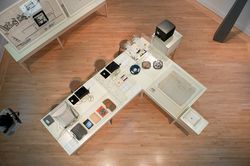
The internet was invented as the ultimate standard; it is literally made of rules. Online content abides by some intentional and unintentional rules, and texture, smell, weight, flavour, and time are flattened together for the screen. Computers appear to instantaneously transform objects into images and meaning into information. 404 ERROR: The object is not online brings(...)
The internet was invented as the ultimate standard; it is literally made of rules. Online content abides by some intentional and unintentional rules, and texture, smell, weight, flavour, and time are flattened together for the screen. Computers appear to instantaneously transform objects into images and meaning into information. 404 ERROR: The object is not online brings(...)
Location:
Octagonal gallery
Octagonal gallery
Date:
11 November 2010 to 6 February 2011
11 November 2010 to 6 February 2011
Title:
404 ERROR: The object is not online
Actions:
Description:
The internet was invented as the ultimate standard; it is literally made of rules. Online content abides by some intentional and unintentional rules, and texture, smell, weight, flavour, and time are flattened together for the screen. Computers appear to instantaneously transform objects into images and meaning into information. 404 ERROR: The object is not online brings(...)
404 ERROR: The object is not online
Actions:
Description:
The internet was invented as the ultimate standard; it is literally made of rules. Online content abides by some intentional and unintentional rules, and texture, smell, weight, flavour, and time are flattened together for the screen. Computers appear to instantaneously transform objects into images and meaning into information. 404 ERROR: The object is not online brings(...)
Form:
exhibitions
exhibitions
Date:
11 November 2010 to
6 February 2011
11 November 2010 to
6 February 2011
Location:
Octagonal gallery
Octagonal gallery


