


4841 Results
Form:
events
events
Description:
Individuals act as their own historians, suppressing some stories and emphasizing others. But at the scale of nations and cultures, and especially in this age of ubiquitous digital memory, it has become more difficult to forget. Building on questions about history and its uses, raised by exhibitions like Educating Architects: Four Courses by Kenneth Frampton and Besides,(...)
Individuals act as their own historians, suppressing some stories and emphasizing others. But at the scale of nations and cultures, and especially in this age of ubiquitous digital memory, it has become more difficult to forget. Building on questions about history and its uses, raised by exhibitions like Educating Architects: Four Courses by Kenneth Frampton and Besides,(...)
Keyword(s):
Johannes Grenzfurthner
Johannes Grenzfurthner
Date:
12 April 2018
12 April 2018
Title:
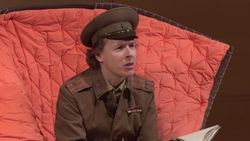
Come and Forget the Counterculture, with Johannes Grenzfurthner
Actions:
Description:
Individuals act as their own historians, suppressing some stories and emphasizing others. But at the scale of nations and cultures, and especially in this age of ubiquitous digital memory, it has become more difficult to forget. Building on questions about history and its uses, raised by exhibitions like Educating Architects: Four Courses by Kenneth Frampton and Besides,(...)
Come and Forget the Counterculture, with Johannes Grenzfurthner
Actions:
Description:
Individuals act as their own historians, suppressing some stories and emphasizing others. But at the scale of nations and cultures, and especially in this age of ubiquitous digital memory, it has become more difficult to forget. Building on questions about history and its uses, raised by exhibitions like Educating Architects: Four Courses by Kenneth Frampton and Besides,(...)
Form:
events
events
Date:
12 April 2018
12 April 2018
Keyword(s):
Johannes Grenzfurthner
Johannes Grenzfurthner
Form:
events
events
Title:
The Unschool
The Unschool
Actions:
Description:
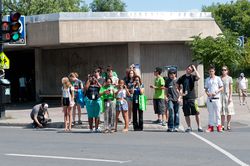
What could a school be? For a week over summer 2012, students of The Unschool explored the spaces in and around schools and pushed the limits of the camera as a social instrument with guest curator Monica Nouwens. Participants compared how people live in schools and cities, and how design can encourage and limit behaviours, relationships, and activities. “Could(...)
What could a school be? For a week over summer 2012, students of The Unschool explored the spaces in and around schools and pushed the limits of the camera as a social instrument with guest curator Monica Nouwens. Participants compared how people live in schools and cities, and how design can encourage and limit behaviours, relationships, and activities. “Could(...)
Date:
30 July 2012 to 3 August 2012
30 July 2012 to 3 August 2012
Title:
The Unschool
Actions:
Description:
What could a school be? For a week over summer 2012, students of The Unschool explored the spaces in and around schools and pushed the limits of the camera as a social instrument with guest curator Monica Nouwens. Participants compared how people live in schools and cities, and how design can encourage and limit behaviours, relationships, and activities. “Could(...)
The Unschool
Actions:
Description:
What could a school be? For a week over summer 2012, students of The Unschool explored the spaces in and around schools and pushed the limits of the camera as a social instrument with guest curator Monica Nouwens. Participants compared how people live in schools and cities, and how design can encourage and limit behaviours, relationships, and activities. “Could(...)
Form:
events
events
Date:
30 July 2012 to
3 August 2012
30 July 2012 to
3 August 2012
Form:
events
events
Title:
Environmental Histories
Environmental Histories
Actions:
Description:
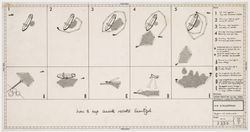
To kick off “Architecture and/for the Environment” —the CCA’s third Multidisciplinary Research Project funded by the Andrew W. Mellon Foundation—Daniel Abramson and Imre Szeman will present two key concepts that reconceive the environment in the history of architecture. Daniel Abramson, an architectural historian, will discuss how the idea of architectural “obsolescence”(...)
To kick off “Architecture and/for the Environment” —the CCA’s third Multidisciplinary Research Project funded by the Andrew W. Mellon Foundation—Daniel Abramson and Imre Szeman will present two key concepts that reconceive the environment in the history of architecture. Daniel Abramson, an architectural historian, will discuss how the idea of architectural “obsolescence”(...)
Location:
Paul Desmarais Theatre
Paul Desmarais Theatre
Date:
15 December 2016, 6pm
15 December 2016, 6pm
Title:
Environmental Histories
Actions:
Description:
To kick off “Architecture and/for the Environment” —the CCA’s third Multidisciplinary Research Project funded by the Andrew W. Mellon Foundation—Daniel Abramson and Imre Szeman will present two key concepts that reconceive the environment in the history of architecture. Daniel Abramson, an architectural historian, will discuss how the idea of architectural “obsolescence”(...)
Environmental Histories
Actions:
Description:
To kick off “Architecture and/for the Environment” —the CCA’s third Multidisciplinary Research Project funded by the Andrew W. Mellon Foundation—Daniel Abramson and Imre Szeman will present two key concepts that reconceive the environment in the history of architecture. Daniel Abramson, an architectural historian, will discuss how the idea of architectural “obsolescence”(...)
Form:
events
events
Date:
15 December 2016
6pm
15 December 2016
6pm
Location:
Paul Desmarais Theatre
Paul Desmarais Theatre
Form:
photographs
photographs
Actions:
Reference number:
PH1993:0212
Description:
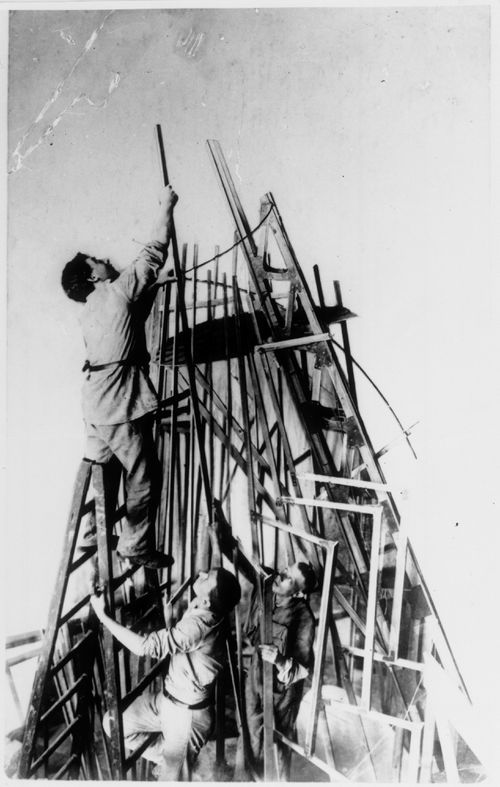
- This photograph shows Vladimir Tatlin (1885-1953) (bottom right) with two assistants from the "creative collective" which was organized so that he could continue work on the Monument to the Third International design while the model was being constructed (the model was completed for the third anniversary of the October Revolution, 7 November 1920). The assistants are (top to bottom): Iosif Aizikovich Meerzon (1900-1941), and Tevel' Markovich Shapiro (1898-1984 or later).
PH1993:0212
Description:
- This photograph shows Vladimir Tatlin (1885-1953) (bottom right) with two assistants from the "creative collective" which was organized so that he could continue work on the Monument to the Third International design while the model was being constructed (the model was completed for the third anniversary of the October Revolution, 7 November 1920). The assistants are (top to bottom): Iosif Aizikovich Meerzon (1900-1941), and Tevel' Markovich Shapiro (1898-1984 or later).
People:
Subject:
architecture, portrait
architecture, portrait
Date:
between March and 7 November 1920
between March and 7 November 1920
Title:
Vladimir Tatlin and his assistants I.A. Meerzon and T.M. Shapiro constructing the first model for the monument to the Third International, Petrograd, Soviet Union (now Saint Petersburg, Russia)
Actions:
PH1993:0212
Description:
- This photograph shows Vladimir Tatlin (1885-1953) (bottom right) with two assistants from the "creative collective" which was organized so that he could continue work on the Monument to the Third International design while the model was being constructed (the model was completed for the third anniversary of the October Revolution, 7 November 1920). The assistants are (top to bottom): Iosif Aizikovich Meerzon (1900-1941), and Tevel' Markovich Shapiro (1898-1984 or later).
Vladimir Tatlin and his assistants I.A. Meerzon and T.M. Shapiro constructing the first model for the monument to the Third International, Petrograd, Soviet Union (now Saint Petersburg, Russia)
Actions:
PH1993:0212
Description:
- This photograph shows Vladimir Tatlin (1885-1953) (bottom right) with two assistants from the "creative collective" which was organized so that he could continue work on the Monument to the Third International design while the model was being constructed (the model was completed for the third anniversary of the October Revolution, 7 November 1920). The assistants are (top to bottom): Iosif Aizikovich Meerzon (1900-1941), and Tevel' Markovich Shapiro (1898-1984 or later).
Form:
photographs
photographs
Date:
between March and 7 November 1920
between March and 7 November 1920
People:
Subject:
architecture, portrait
architecture, portrait
Form:
archives
Level of archival description:
Fonds
archives
Level of archival description:
Fonds
Title:
Jean-Louis Cohen fonds
Jean-Louis Cohen fonds
Actions:
Reference number:
AP210
Synopsis:
The Jean-Louis Cohen fonds, 1968 – 2023, documents the projects and activities of historian, curator, professor, and architect Jean-Louis Cohen (1949 – 2023). Cohen’s research focus was largely modern architecture and transnational architectural exchange, particularly between and among the United States, Europe, and the former Soviet Union in the 20th century. Through physical and digital records, this fonds documents his academic, publishing, and curatorial work along with his professional activities within architectural research and heritage organizations, as well as his architectural practice.
AP210
Synopsis:
The Jean-Louis Cohen fonds, 1968 – 2023, documents the projects and activities of historian, curator, professor, and architect Jean-Louis Cohen (1949 – 2023). Cohen’s research focus was largely modern architecture and transnational architectural exchange, particularly between and among the United States, Europe, and the former Soviet Union in the 20th century. Through physical and digital records, this fonds documents his academic, publishing, and curatorial work along with his professional activities within architectural research and heritage organizations, as well as his architectural practice.
People:
Date:
1968 - 2023
1968 - 2023
Title:
Jean-Louis Cohen fonds
Actions:
AP210
Synopsis:
The Jean-Louis Cohen fonds, 1968 – 2023, documents the projects and activities of historian, curator, professor, and architect Jean-Louis Cohen (1949 – 2023). Cohen’s research focus was largely modern architecture and transnational architectural exchange, particularly between and among the United States, Europe, and the former Soviet Union in the 20th century. Through physical and digital records, this fonds documents his academic, publishing, and curatorial work along with his professional activities within architectural research and heritage organizations, as well as his architectural practice.
Jean-Louis Cohen fonds
Actions:
AP210
Synopsis:
The Jean-Louis Cohen fonds, 1968 – 2023, documents the projects and activities of historian, curator, professor, and architect Jean-Louis Cohen (1949 – 2023). Cohen’s research focus was largely modern architecture and transnational architectural exchange, particularly between and among the United States, Europe, and the former Soviet Union in the 20th century. Through physical and digital records, this fonds documents his academic, publishing, and curatorial work along with his professional activities within architectural research and heritage organizations, as well as his architectural practice.
Form:
archives
Level of archival description:
Fonds
archives
Level of archival description:
Fonds
Date:
1968 - 2023
1968 - 2023
People:
Form:
photographs
photographs
Actions:
Reference number:
PH1993:0211
Description:
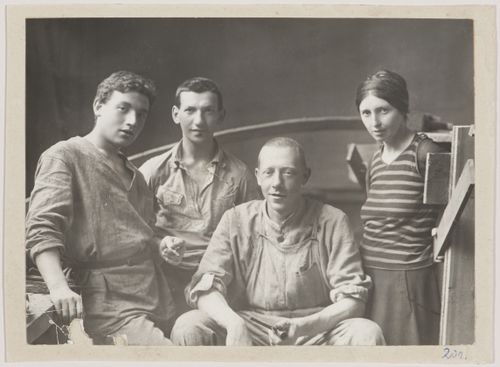
- This photograph shows Vladimir Tatlin (1885-1953) with three assistants from the "creative collective" which was organized so that he could continue work on the Monument to the Third International design while the model was being constructed (the model was completed for the third anniversary of the October Revolution, 7 November 1920). The assistants are (left to right): Iosif Aizikovich Meerzon (1900-1941), Tevel' Markovich Shapiro (1898-1984 or later), and Sofia Isaakovna Dymshits-Tolstaia (1888-1963).
PH1993:0211
Description:
- This photograph shows Vladimir Tatlin (1885-1953) with three assistants from the "creative collective" which was organized so that he could continue work on the Monument to the Third International design while the model was being constructed (the model was completed for the third anniversary of the October Revolution, 7 November 1920). The assistants are (left to right): Iosif Aizikovich Meerzon (1900-1941), Tevel' Markovich Shapiro (1898-1984 or later), and Sofia Isaakovna Dymshits-Tolstaia (1888-1963).
People:
Subject:
architecture, portrait
architecture, portrait
Date:
between March and 7 November 1920
between March and 7 November 1920
Title:
Group portrait of Vladimir Tatlin and his assistants I.A. Meerzon, T.M. Shapiro and S. Dymshits-Tolstaia at the time of the construction of the model for the Monument to the Third International, Petrograd (now Saint Petersburg)
Actions:
PH1993:0211
Description:
- This photograph shows Vladimir Tatlin (1885-1953) with three assistants from the "creative collective" which was organized so that he could continue work on the Monument to the Third International design while the model was being constructed (the model was completed for the third anniversary of the October Revolution, 7 November 1920). The assistants are (left to right): Iosif Aizikovich Meerzon (1900-1941), Tevel' Markovich Shapiro (1898-1984 or later), and Sofia Isaakovna Dymshits-Tolstaia (1888-1963).
Group portrait of Vladimir Tatlin and his assistants I.A. Meerzon, T.M. Shapiro and S. Dymshits-Tolstaia at the time of the construction of the model for the Monument to the Third International, Petrograd (now Saint Petersburg)
Actions:
PH1993:0211
Description:
- This photograph shows Vladimir Tatlin (1885-1953) with three assistants from the "creative collective" which was organized so that he could continue work on the Monument to the Third International design while the model was being constructed (the model was completed for the third anniversary of the October Revolution, 7 November 1920). The assistants are (left to right): Iosif Aizikovich Meerzon (1900-1941), Tevel' Markovich Shapiro (1898-1984 or later), and Sofia Isaakovna Dymshits-Tolstaia (1888-1963).
Form:
photographs
photographs
Date:
between March and 7 November 1920
between March and 7 November 1920
People:
Subject:
architecture, portrait
architecture, portrait
Form:
photographs
photographs
Actions:
Reference number:
PH1993:0213
Description:
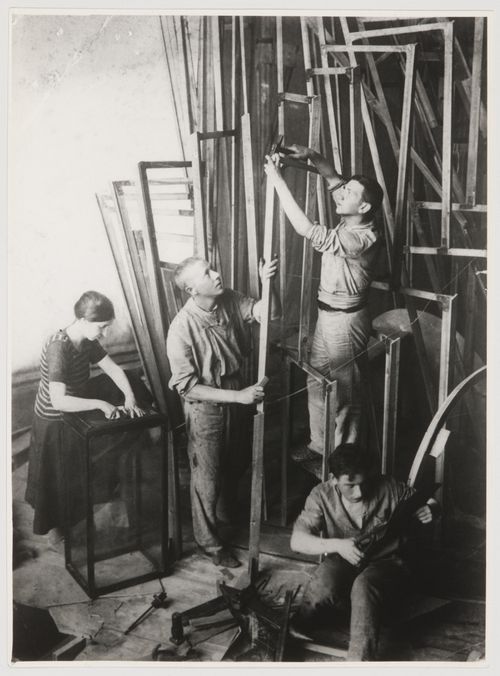
- This photograph shows Vladimir Tatlin (1885-1953) with three assistants from the "creative collective" which was organized so that he could continue work on the Monument to the Third International design while the model was being constructed (the model was completed for the third anniversary of the October Revolution, 7 November 1920). The assistants are (left to right): Sofia Isaakovna Dymshits-Tolstaia (1888-1963), [Tatlin], Tevel' Markovich Shapiro (1898-1984 or later), and Iosif Aizikovich Meerzon (1900-1941).
PH1993:0213
Description:
- This photograph shows Vladimir Tatlin (1885-1953) with three assistants from the "creative collective" which was organized so that he could continue work on the Monument to the Third International design while the model was being constructed (the model was completed for the third anniversary of the October Revolution, 7 November 1920). The assistants are (left to right): Sofia Isaakovna Dymshits-Tolstaia (1888-1963), [Tatlin], Tevel' Markovich Shapiro (1898-1984 or later), and Iosif Aizikovich Meerzon (1900-1941).
People:
Subject:
architecture, portrait
architecture, portrait
Date:
between March and 7 November 1920
between March and 7 November 1920
Title:
Vladimir Tatlin and his assistants S. Dymshits-Tolstaia, T.M. Shapiro and I.A. Meerzon constructing the first model for the monument to the Third International, Petrograd (now Saint Petersburg)
Actions:
PH1993:0213
Description:
- This photograph shows Vladimir Tatlin (1885-1953) with three assistants from the "creative collective" which was organized so that he could continue work on the Monument to the Third International design while the model was being constructed (the model was completed for the third anniversary of the October Revolution, 7 November 1920). The assistants are (left to right): Sofia Isaakovna Dymshits-Tolstaia (1888-1963), [Tatlin], Tevel' Markovich Shapiro (1898-1984 or later), and Iosif Aizikovich Meerzon (1900-1941).
Vladimir Tatlin and his assistants S. Dymshits-Tolstaia, T.M. Shapiro and I.A. Meerzon constructing the first model for the monument to the Third International, Petrograd (now Saint Petersburg)
Actions:
PH1993:0213
Description:
- This photograph shows Vladimir Tatlin (1885-1953) with three assistants from the "creative collective" which was organized so that he could continue work on the Monument to the Third International design while the model was being constructed (the model was completed for the third anniversary of the October Revolution, 7 November 1920). The assistants are (left to right): Sofia Isaakovna Dymshits-Tolstaia (1888-1963), [Tatlin], Tevel' Markovich Shapiro (1898-1984 or later), and Iosif Aizikovich Meerzon (1900-1941).
Form:
photographs
photographs
Date:
between March and 7 November 1920
between March and 7 November 1920
People:
Subject:
architecture, portrait
architecture, portrait
Form:
events
events
Actions:
Description:
Visiting Scholar Susanne Bauer presents her research: The theoretical debates which took place in American architecture circles—predominantly those on the east coast—as of the early 1960s were often concerned with questions of formal analysis of architectural space and, more broadly, with the present state of architecture and the disciplines future. Some of these debates(...)
Visiting Scholar Susanne Bauer presents her research: The theoretical debates which took place in American architecture circles—predominantly those on the east coast—as of the early 1960s were often concerned with questions of formal analysis of architectural space and, more broadly, with the present state of architecture and the disciplines future. Some of these debates(...)
Location:
Shaughnessy House
Shaughnessy House
Date:
21 July 2016, 6pm
21 July 2016, 6pm
Title:
Visiting Scholar Seminar: Susanne Bauer
Actions:
Description:
Visiting Scholar Susanne Bauer presents her research: The theoretical debates which took place in American architecture circles—predominantly those on the east coast—as of the early 1960s were often concerned with questions of formal analysis of architectural space and, more broadly, with the present state of architecture and the disciplines future. Some of these debates(...)
Visiting Scholar Seminar: Susanne Bauer
Actions:
Description:
Visiting Scholar Susanne Bauer presents her research: The theoretical debates which took place in American architecture circles—predominantly those on the east coast—as of the early 1960s were often concerned with questions of formal analysis of architectural space and, more broadly, with the present state of architecture and the disciplines future. Some of these debates(...)
Form:
events
events
Date:
21 July 2016
6pm
21 July 2016
6pm
Location:
Shaughnessy House
Shaughnessy House
Form:
events
events
Actions:
Description:
American artist Amie Siegel’s moving image work Provenance (2013) follows the global trade of furniture from Chandigarh in reverse: from the homes of collectors in Europe and North America to sale at auction, restoration, through overseas transport and finally back to India. Originally designed by Le Corbusier and Pierre Jeanneret, the Chandigarh furniture now sells(...)
American artist Amie Siegel’s moving image work Provenance (2013) follows the global trade of furniture from Chandigarh in reverse: from the homes of collectors in Europe and North America to sale at auction, restoration, through overseas transport and finally back to India. Originally designed by Le Corbusier and Pierre Jeanneret, the Chandigarh furniture now sells(...)
Date:
24 April 2014 , 6pm
24 April 2014 , 6pm
Title:
Artist’s Talk: Amie Siegel, Provenance
Actions:
Description:
American artist Amie Siegel’s moving image work Provenance (2013) follows the global trade of furniture from Chandigarh in reverse: from the homes of collectors in Europe and North America to sale at auction, restoration, through overseas transport and finally back to India. Originally designed by Le Corbusier and Pierre Jeanneret, the Chandigarh furniture now sells(...)
Artist’s Talk: Amie Siegel, Provenance
Actions:
Description:
American artist Amie Siegel’s moving image work Provenance (2013) follows the global trade of furniture from Chandigarh in reverse: from the homes of collectors in Europe and North America to sale at auction, restoration, through overseas transport and finally back to India. Originally designed by Le Corbusier and Pierre Jeanneret, the Chandigarh furniture now sells(...)
Form:
events
events
Date:
24 April 2014
6pm
24 April 2014
6pm
Form:
exhibitions
exhibitions
Actions:
Description:
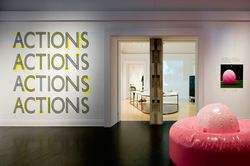
Seemingly common activities such as walking, playing, recycling, and gardening are pushed beyond their usual definition by the international architects, artists, and collectives featured in the exhibition. Their actions push against accepted norms of behaviour in cities, at times even challenging legal limitations. The individuals and groups employ a range of approaches(...)
Seemingly common activities such as walking, playing, recycling, and gardening are pushed beyond their usual definition by the international architects, artists, and collectives featured in the exhibition. Their actions push against accepted norms of behaviour in cities, at times even challenging legal limitations. The individuals and groups employ a range of approaches(...)
Location:
Main galleries
Main galleries
Date:
26 November 2008 to 19 April 2009
26 November 2008 to 19 April 2009
Title:
Actions: What You Can Do With the City
Actions:
Description:
Seemingly common activities such as walking, playing, recycling, and gardening are pushed beyond their usual definition by the international architects, artists, and collectives featured in the exhibition. Their actions push against accepted norms of behaviour in cities, at times even challenging legal limitations. The individuals and groups employ a range of approaches(...)
Actions: What You Can Do With the City
Actions:
Description:
Seemingly common activities such as walking, playing, recycling, and gardening are pushed beyond their usual definition by the international architects, artists, and collectives featured in the exhibition. Their actions push against accepted norms of behaviour in cities, at times even challenging legal limitations. The individuals and groups employ a range of approaches(...)
Form:
exhibitions
exhibitions
Date:
26 November 2008 to
19 April 2009
26 November 2008 to
19 April 2009
Location:
Main galleries
Main galleries


