


6046 Results
Level of archival description:
Project
Project
Actions:
Reference number:
AP198.S1.1997.PR02
Description:
Project records document the design process for OCEAN North’s competition entry for the Jyväskylä Music and Arts Centre in 1997. The project was titled Terra Cultura by OCEAN North. The international competition called to create a multi-usage space that would include a venue for the symphonic orchestra, a music school, exhibition spaces, and the possibility to host a variety of small cultural events in the Finnish city of Jyväskylä. The proposed site is in the center of the town, across the street from the Jyväskylä city church and its park, and nearby buildings designed by Alvar Aalto. OCEAN North’s concept presents a topological surface as an extension of the surrounding urban scape with two masses that would host the formal functions of the building (concert hall, music school, exhibition halls). The two volumes, or raised blocks, are divided along a diagonal elevated space, which is the extension of the ground’s topological surface filled and dubbed “Liquid Flow Space” by the design team. In their interview with Greg Lynn, Johan Bettum and Kivi Sotamaa mentioned that the idea for Jyväskylä was that it was a cloud. Digital files, in particular, show the process to achieve the projected design. Drawings provide views of streamed particles and of resulting peels. They also include plans, elevations and axonometric views of the structure. Most files are raster or vector images, likely saved from CAD software. A few files are in CAD formats such as Microstation, 3D Studio and form*Z. Digital files also present sine wave analysis and resulting charts for each component of the program. The analysis and charts present the relationships between various components of the building’s program such as the Art Museum, the Concert Halls, the technical space, and the Common facilities. These files are raster images and spreadsheets. Photographs of the site in Jyväskylä and of models built by OCEAN North were digitized and are included with the digital working files. Physical drawings are chiefly floor plans for the building, but also include sections and sketches. Finally, project files include photographic prints of two built models. One of these models, a small model of the conceptual masses of the building structure, is itself in the archive. Photographs show the model in the context of a city scape model. The second model, not part of the archive at CCA, was built at a bigger scale and was an intricate cardboard and wooden stick structure. Sources: Softspace: from a representation of form to a simulation of space, Edited by Sean Lally and Jessica Young. London, New York: Routledge, 2007. Greg Lynn, ed. Archaeology of the Digital 17: OCEAN North, Jyväskylä Music and Arts Centre, Montréal: Canadian Centre for Architecture, 2017. ePub.
AP198.S1.1997.PR02
Description:
Project records document the design process for OCEAN North’s competition entry for the Jyväskylä Music and Arts Centre in 1997. The project was titled Terra Cultura by OCEAN North. The international competition called to create a multi-usage space that would include a venue for the symphonic orchestra, a music school, exhibition spaces, and the possibility to host a variety of small cultural events in the Finnish city of Jyväskylä. The proposed site is in the center of the town, across the street from the Jyväskylä city church and its park, and nearby buildings designed by Alvar Aalto. OCEAN North’s concept presents a topological surface as an extension of the surrounding urban scape with two masses that would host the formal functions of the building (concert hall, music school, exhibition halls). The two volumes, or raised blocks, are divided along a diagonal elevated space, which is the extension of the ground’s topological surface filled and dubbed “Liquid Flow Space” by the design team. In their interview with Greg Lynn, Johan Bettum and Kivi Sotamaa mentioned that the idea for Jyväskylä was that it was a cloud. Digital files, in particular, show the process to achieve the projected design. Drawings provide views of streamed particles and of resulting peels. They also include plans, elevations and axonometric views of the structure. Most files are raster or vector images, likely saved from CAD software. A few files are in CAD formats such as Microstation, 3D Studio and form*Z. Digital files also present sine wave analysis and resulting charts for each component of the program. The analysis and charts present the relationships between various components of the building’s program such as the Art Museum, the Concert Halls, the technical space, and the Common facilities. These files are raster images and spreadsheets. Photographs of the site in Jyväskylä and of models built by OCEAN North were digitized and are included with the digital working files. Physical drawings are chiefly floor plans for the building, but also include sections and sketches. Finally, project files include photographic prints of two built models. One of these models, a small model of the conceptual masses of the building structure, is itself in the archive. Photographs show the model in the context of a city scape model. The second model, not part of the archive at CCA, was built at a bigger scale and was an intricate cardboard and wooden stick structure. Sources: Softspace: from a representation of form to a simulation of space, Edited by Sean Lally and Jessica Young. London, New York: Routledge, 2007. Greg Lynn, ed. Archaeology of the Digital 17: OCEAN North, Jyväskylä Music and Arts Centre, Montréal: Canadian Centre for Architecture, 2017. ePub.
People:
Date:
1997
1997
Title:
Terra Cultura – Jyväskylä Music and Arts Centre, international competition entry
Actions:
AP198.S1.1997.PR02
Description:
Project records document the design process for OCEAN North’s competition entry for the Jyväskylä Music and Arts Centre in 1997. The project was titled Terra Cultura by OCEAN North. The international competition called to create a multi-usage space that would include a venue for the symphonic orchestra, a music school, exhibition spaces, and the possibility to host a variety of small cultural events in the Finnish city of Jyväskylä. The proposed site is in the center of the town, across the street from the Jyväskylä city church and its park, and nearby buildings designed by Alvar Aalto. OCEAN North’s concept presents a topological surface as an extension of the surrounding urban scape with two masses that would host the formal functions of the building (concert hall, music school, exhibition halls). The two volumes, or raised blocks, are divided along a diagonal elevated space, which is the extension of the ground’s topological surface filled and dubbed “Liquid Flow Space” by the design team. In their interview with Greg Lynn, Johan Bettum and Kivi Sotamaa mentioned that the idea for Jyväskylä was that it was a cloud. Digital files, in particular, show the process to achieve the projected design. Drawings provide views of streamed particles and of resulting peels. They also include plans, elevations and axonometric views of the structure. Most files are raster or vector images, likely saved from CAD software. A few files are in CAD formats such as Microstation, 3D Studio and form*Z. Digital files also present sine wave analysis and resulting charts for each component of the program. The analysis and charts present the relationships between various components of the building’s program such as the Art Museum, the Concert Halls, the technical space, and the Common facilities. These files are raster images and spreadsheets. Photographs of the site in Jyväskylä and of models built by OCEAN North were digitized and are included with the digital working files. Physical drawings are chiefly floor plans for the building, but also include sections and sketches. Finally, project files include photographic prints of two built models. One of these models, a small model of the conceptual masses of the building structure, is itself in the archive. Photographs show the model in the context of a city scape model. The second model, not part of the archive at CCA, was built at a bigger scale and was an intricate cardboard and wooden stick structure. Sources: Softspace: from a representation of form to a simulation of space, Edited by Sean Lally and Jessica Young. London, New York: Routledge, 2007. Greg Lynn, ed. Archaeology of the Digital 17: OCEAN North, Jyväskylä Music and Arts Centre, Montréal: Canadian Centre for Architecture, 2017. ePub.
Terra Cultura – Jyväskylä Music and Arts Centre, international competition entry
Actions:
AP198.S1.1997.PR02
Description:
Project records document the design process for OCEAN North’s competition entry for the Jyväskylä Music and Arts Centre in 1997. The project was titled Terra Cultura by OCEAN North. The international competition called to create a multi-usage space that would include a venue for the symphonic orchestra, a music school, exhibition spaces, and the possibility to host a variety of small cultural events in the Finnish city of Jyväskylä. The proposed site is in the center of the town, across the street from the Jyväskylä city church and its park, and nearby buildings designed by Alvar Aalto. OCEAN North’s concept presents a topological surface as an extension of the surrounding urban scape with two masses that would host the formal functions of the building (concert hall, music school, exhibition halls). The two volumes, or raised blocks, are divided along a diagonal elevated space, which is the extension of the ground’s topological surface filled and dubbed “Liquid Flow Space” by the design team. In their interview with Greg Lynn, Johan Bettum and Kivi Sotamaa mentioned that the idea for Jyväskylä was that it was a cloud. Digital files, in particular, show the process to achieve the projected design. Drawings provide views of streamed particles and of resulting peels. They also include plans, elevations and axonometric views of the structure. Most files are raster or vector images, likely saved from CAD software. A few files are in CAD formats such as Microstation, 3D Studio and form*Z. Digital files also present sine wave analysis and resulting charts for each component of the program. The analysis and charts present the relationships between various components of the building’s program such as the Art Museum, the Concert Halls, the technical space, and the Common facilities. These files are raster images and spreadsheets. Photographs of the site in Jyväskylä and of models built by OCEAN North were digitized and are included with the digital working files. Physical drawings are chiefly floor plans for the building, but also include sections and sketches. Finally, project files include photographic prints of two built models. One of these models, a small model of the conceptual masses of the building structure, is itself in the archive. Photographs show the model in the context of a city scape model. The second model, not part of the archive at CCA, was built at a bigger scale and was an intricate cardboard and wooden stick structure. Sources: Softspace: from a representation of form to a simulation of space, Edited by Sean Lally and Jessica Young. London, New York: Routledge, 2007. Greg Lynn, ed. Archaeology of the Digital 17: OCEAN North, Jyväskylä Music and Arts Centre, Montréal: Canadian Centre for Architecture, 2017. ePub.
Level of archival description:
Project
Project
Date:
1997
1997
People:
Form:
textual records
textual records
Actions:
Reference number:
DR2004:1323
Description:
empty folders for 'Nouveau Musee de l'air et de l'espace' competition, and sketches and annotations regarding possible lectures in Norway (1999) and at the Photographers' Gallery (1998)
DR2004:1323
Description:
empty folders for 'Nouveau Musee de l'air et de l'espace' competition, and sketches and annotations regarding possible lectures in Norway (1999) and at the Photographers' Gallery (1998)
People:
Title:
Empty folders for 'Nouveau Musee de l'air et de l'espace' competition
Actions:
DR2004:1323
Description:
empty folders for 'Nouveau Musee de l'air et de l'espace' competition, and sketches and annotations regarding possible lectures in Norway (1999) and at the Photographers' Gallery (1998)
Empty folders for 'Nouveau Musee de l'air et de l'espace' competition
Actions:
DR2004:1323
Description:
empty folders for 'Nouveau Musee de l'air et de l'espace' competition, and sketches and annotations regarding possible lectures in Norway (1999) and at the Photographers' Gallery (1998)
Form:
textual records
textual records
People:
Form:
photographs
photographs
![Photograph of a plan for a competition [?] for a Palace of Soviets, Moscow](/img-collection/5co0Bl8JX6VaStMW6HY-u3coBXk=/500x539/9551.jpg)
Actions:
Reference number:
PH1998:0024:044
PH1998:0024:044
People:
Subject:
architecture
architecture
Date:
after 1931
after 1931
Title:
Photograph of a plan for a competition [?] for a Palace of Soviets, Moscow
Actions:
PH1998:0024:044
Photograph of a plan for a competition [?] for a Palace of Soviets, Moscow
Actions:
PH1998:0024:044
Form:
photographs
photographs
Date:
after 1931
after 1931
People:
Subject:
architecture
architecture
Form:
photographs
photographs
Actions:
Reference number:
DR1988:0289
Description:
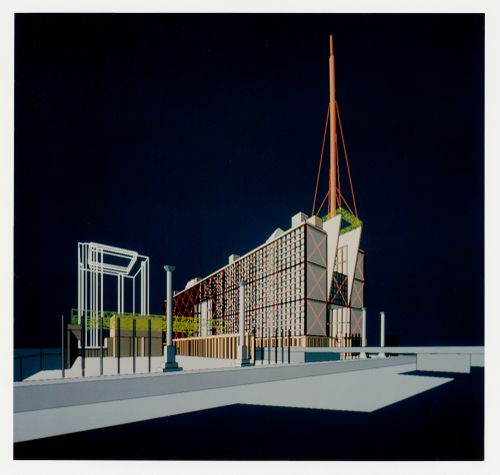
- DR1988:0288 - DR1988:0290 are photographs of a CAD-generated image shown on a colour computer monitor. The CCA photographs are a duplicate set of that submitted to the Tokyo City Hall Competition.
DR1988:0289
Description:
- DR1988:0288 - DR1988:0290 are photographs of a CAD-generated image shown on a colour computer monitor. The CCA photographs are a duplicate set of that submitted to the Tokyo City Hall Competition.
People:
Subject:
architecture
architecture
Date:
negative exposed 1988
negative exposed 1988
Title:
Exterior view from the northwest for the Tokyo City Hall competition entry
Actions:
DR1988:0289
Description:
- DR1988:0288 - DR1988:0290 are photographs of a CAD-generated image shown on a colour computer monitor. The CCA photographs are a duplicate set of that submitted to the Tokyo City Hall Competition.
Exterior view from the northwest for the Tokyo City Hall competition entry
Actions:
DR1988:0289
Description:
- DR1988:0288 - DR1988:0290 are photographs of a CAD-generated image shown on a colour computer monitor. The CCA photographs are a duplicate set of that submitted to the Tokyo City Hall Competition.
Form:
photographs
photographs
Date:
negative exposed 1988
negative exposed 1988
People:
Subject:
architecture
architecture
Form:
textual records
textual records
Actions:
Reference number:
DR1999:0200:003
DR1999:0200:003
People:
Date:
1985
1985
Form:
textual records
textual records
Date:
1985
1985
People:
Form:
drawings
drawings
Actions:
Reference number:
DR1987:0381
Description:
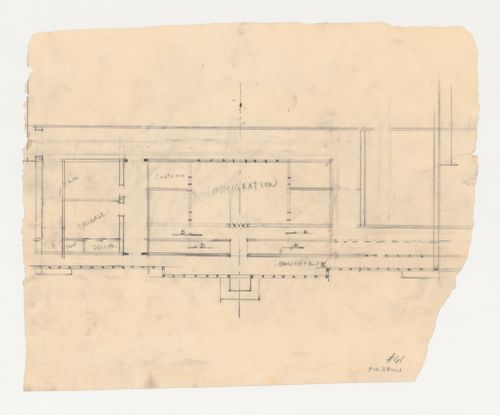
- This drawing was made using a ruler. There are extensive erasures. Although this version appears to have been discarded early, a number of elements remain in the submitted panel: the central axis running through the entrance bay which extends below and the ramps leading up to and down from the upper floor (indicated by "D" on this sheet).
DR1987:0381
Description:
- This drawing was made using a ruler. There are extensive erasures. Although this version appears to have been discarded early, a number of elements remain in the submitted panel: the central axis running through the entrance bay which extends below and the ramps leading up to and down from the upper floor (indicated by "D" on this sheet).
People:
Subject:
architecture
architecture
Date:
1929
1929
Title:
Lehigh Airports Competition Entry: Preliminary ground plan for the station
Actions:
DR1987:0381
Description:
- This drawing was made using a ruler. There are extensive erasures. Although this version appears to have been discarded early, a number of elements remain in the submitted panel: the central axis running through the entrance bay which extends below and the ramps leading up to and down from the upper floor (indicated by "D" on this sheet).
Lehigh Airports Competition Entry: Preliminary ground plan for the station
Actions:
DR1987:0381
Description:
- This drawing was made using a ruler. There are extensive erasures. Although this version appears to have been discarded early, a number of elements remain in the submitted panel: the central axis running through the entrance bay which extends below and the ramps leading up to and down from the upper floor (indicated by "D" on this sheet).
Form:
drawings
drawings
Date:
1929
1929
People:
Subject:
architecture
architecture
Form:
drawings
drawings
Actions:
Reference number:
DR1984:1730
Description:
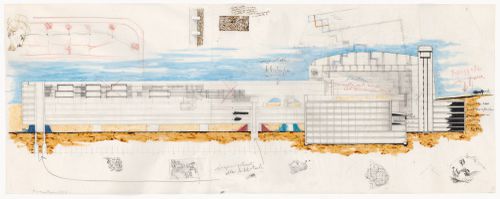
- One of approximately thirty-five studies and presentations drawings for this project, see 'The First Five Years...', p. 99, pl. 77.
DR1984:1730
Description:
- One of approximately thirty-five studies and presentations drawings for this project, see 'The First Five Years...', p. 99, pl. 77.
People:
Date:
1977
1977
Title:
Section with sketches for Pahlavi National Library Competition, Tehran, Iran
Actions:
DR1984:1730
Description:
- One of approximately thirty-five studies and presentations drawings for this project, see 'The First Five Years...', p. 99, pl. 77.
Section with sketches for Pahlavi National Library Competition, Tehran, Iran
Actions:
DR1984:1730
Description:
- One of approximately thirty-five studies and presentations drawings for this project, see 'The First Five Years...', p. 99, pl. 77.
Form:
drawings
drawings
Date:
1977
1977
People:
Form:
drawings
drawings
Actions:
Reference number:
DR1987:0174
DR1987:0174
People:
Date:
15 September 1985
15 September 1985
Title:
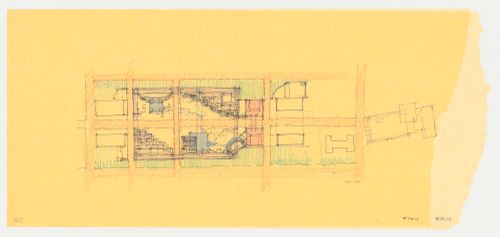
Sketch site plan for the Phoenix Municipal Government Center Competition
Actions:
DR1987:0174
Sketch site plan for the Phoenix Municipal Government Center Competition
Actions:
DR1987:0174
Form:
drawings
drawings
Date:
15 September 1985
15 September 1985
People:
Form:
drawings
drawings
Actions:
Reference number:
DR1987:0175
DR1987:0175
People:
Subject:
architecture
architecture
Date:
1985
1985
Title:
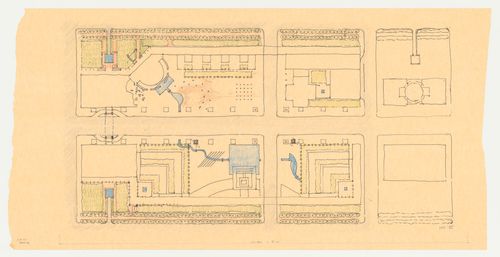
Sketch site plan for the Phoenix Municipal Government Center Competition
Actions:
DR1987:0175
Sketch site plan for the Phoenix Municipal Government Center Competition
Actions:
DR1987:0175
Form:
drawings
drawings
Date:
1985
1985
People:
Subject:
architecture
architecture
Form:
textual records
textual records
Actions:
Reference number:
ARCH400066
ARCH400066
People:
Date:
1969-1970
1969-1970
Form:
textual records
textual records
Date:
1969-1970
1969-1970
People:


