


35831 Results
Form:
works of art
works of art
Reference number:
DR1988:0437:047
Description:
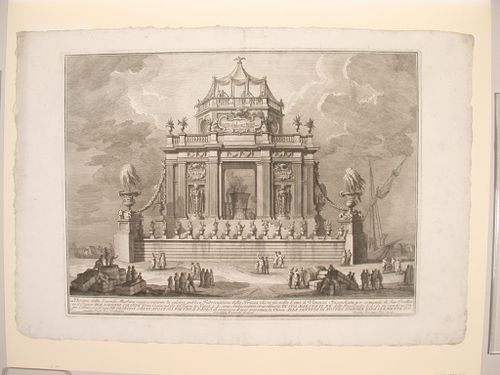
- This etching of a fireworks construction or macchina represents a public celebration of the making of a poison antidote "che si fà nella Città di Venezia" (as it is done in Venice). The macchina consists of a pavilion raised on a base. The pavilion appears to be square, with a central opening a large smoking vat of theriaca. The top storey appears to be octagonal and is crowned by a tent. The relief on the front of the octagon shows a view of the Piazza San Marco and the Doge's Palace from the Molo.
DR1988:0437:047
Description:
- This etching of a fireworks construction or macchina represents a public celebration of the making of a poison antidote "che si fà nella Città di Venezia" (as it is done in Venice). The macchina consists of a pavilion raised on a base. The pavilion appears to be square, with a central opening a large smoking vat of theriaca. The top storey appears to be octagonal and is crowned by a tent. The relief on the front of the octagon shows a view of the Piazza San Marco and the Doge's Palace from the Molo.
People:
Subject:
temporary architecture
temporary architecture
Date:
printed 1773
printed 1773
Title:
Etching of Posi's design for the "seconda macchina" of 1773
Actions:
DR1988:0437:047
Description:
- This etching of a fireworks construction or macchina represents a public celebration of the making of a poison antidote "che si fà nella Città di Venezia" (as it is done in Venice). The macchina consists of a pavilion raised on a base. The pavilion appears to be square, with a central opening a large smoking vat of theriaca. The top storey appears to be octagonal and is crowned by a tent. The relief on the front of the octagon shows a view of the Piazza San Marco and the Doge's Palace from the Molo.
Etching of Posi's design for the "seconda macchina" of 1773
Actions:
DR1988:0437:047
Description:
- This etching of a fireworks construction or macchina represents a public celebration of the making of a poison antidote "che si fà nella Città di Venezia" (as it is done in Venice). The macchina consists of a pavilion raised on a base. The pavilion appears to be square, with a central opening a large smoking vat of theriaca. The top storey appears to be octagonal and is crowned by a tent. The relief on the front of the octagon shows a view of the Piazza San Marco and the Doge's Palace from the Molo.
Form:
works of art
works of art
Date:
printed 1773
printed 1773
People:
Subject:
temporary architecture
temporary architecture
Level of archival description:
Series
Series
Title:
Hans Scharoun
Hans Scharoun
Reference number:
AP162.S7
Description:
Series documents the contribution of architect Hans Scharoun to the correspondence circle of Die gläserne Kette, with Scharoun writing under the pseudonym Hannes. Born in 1893 in Bremen, Germany, Scharoun studied archictecture at the Technische Hochschule at Berlin-Charlottenburg between 1912 and 1914. From 1915 to 1918 he worked on a military commission for the rebuilding of East Prussia. In 1919, he joined the Arbeitsrat für Kunst led by Bruno Taut. From 1919 to 1925 he worked independently, taking on private and public commissions as well as architectural projects for exhibitions. He taught at the Akademie für Kunst und Gewerbe in Breslau from 1925 to 1932, and at the Technische Universität Berlin as a town planning professor from 1946 to 1958. In 1956, he won the first prize of the competition for the Philharmonie concert hall in West Berlin. He died in Berlin in 1972. (Source: Ian Boyd Whyte, Bruno Taut and the Architecture of Activism. Cambridge: Cambridge University Press, 1982) The series comprises part of the correspondence of Hans Scharoun to the Die gläserne Kette circle and related drawings.
AP162.S7
Description:
Series documents the contribution of architect Hans Scharoun to the correspondence circle of Die gläserne Kette, with Scharoun writing under the pseudonym Hannes. Born in 1893 in Bremen, Germany, Scharoun studied archictecture at the Technische Hochschule at Berlin-Charlottenburg between 1912 and 1914. From 1915 to 1918 he worked on a military commission for the rebuilding of East Prussia. In 1919, he joined the Arbeitsrat für Kunst led by Bruno Taut. From 1919 to 1925 he worked independently, taking on private and public commissions as well as architectural projects for exhibitions. He taught at the Akademie für Kunst und Gewerbe in Breslau from 1925 to 1932, and at the Technische Universität Berlin as a town planning professor from 1946 to 1958. In 1956, he won the first prize of the competition for the Philharmonie concert hall in West Berlin. He died in Berlin in 1972. (Source: Ian Boyd Whyte, Bruno Taut and the Architecture of Activism. Cambridge: Cambridge University Press, 1982) The series comprises part of the correspondence of Hans Scharoun to the Die gläserne Kette circle and related drawings.
People:
Date:
between 1919 and 1920
between 1919 and 1920
Title:
Hans Scharoun
Actions:
AP162.S7
Description:
Series documents the contribution of architect Hans Scharoun to the correspondence circle of Die gläserne Kette, with Scharoun writing under the pseudonym Hannes. Born in 1893 in Bremen, Germany, Scharoun studied archictecture at the Technische Hochschule at Berlin-Charlottenburg between 1912 and 1914. From 1915 to 1918 he worked on a military commission for the rebuilding of East Prussia. In 1919, he joined the Arbeitsrat für Kunst led by Bruno Taut. From 1919 to 1925 he worked independently, taking on private and public commissions as well as architectural projects for exhibitions. He taught at the Akademie für Kunst und Gewerbe in Breslau from 1925 to 1932, and at the Technische Universität Berlin as a town planning professor from 1946 to 1958. In 1956, he won the first prize of the competition for the Philharmonie concert hall in West Berlin. He died in Berlin in 1972. (Source: Ian Boyd Whyte, Bruno Taut and the Architecture of Activism. Cambridge: Cambridge University Press, 1982) The series comprises part of the correspondence of Hans Scharoun to the Die gläserne Kette circle and related drawings.
Hans Scharoun
Actions:
AP162.S7
Description:
Series documents the contribution of architect Hans Scharoun to the correspondence circle of Die gläserne Kette, with Scharoun writing under the pseudonym Hannes. Born in 1893 in Bremen, Germany, Scharoun studied archictecture at the Technische Hochschule at Berlin-Charlottenburg between 1912 and 1914. From 1915 to 1918 he worked on a military commission for the rebuilding of East Prussia. In 1919, he joined the Arbeitsrat für Kunst led by Bruno Taut. From 1919 to 1925 he worked independently, taking on private and public commissions as well as architectural projects for exhibitions. He taught at the Akademie für Kunst und Gewerbe in Breslau from 1925 to 1932, and at the Technische Universität Berlin as a town planning professor from 1946 to 1958. In 1956, he won the first prize of the competition for the Philharmonie concert hall in West Berlin. He died in Berlin in 1972. (Source: Ian Boyd Whyte, Bruno Taut and the Architecture of Activism. Cambridge: Cambridge University Press, 1982) The series comprises part of the correspondence of Hans Scharoun to the Die gläserne Kette circle and related drawings.
Level of archival description:
series
series
Date:
between 1919 and 1920
between 1919 and 1920
People:
Form:
events
events
Title:
T pour Typographie
T pour Typographie
Actions:
Description:
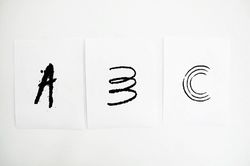
Feed is an independent graphic design studio founded in 1999 by Anouk Pennel and Raphaël Daudelin that specializes in branding, publishing and typeface design. In conjunction with the graphic design they created for the exhibition ABC: MTL, the studio invites university students to a typography drawing workshop. Each student will be assigned a letter of the alphabet and(...)
Feed is an independent graphic design studio founded in 1999 by Anouk Pennel and Raphaël Daudelin that specializes in branding, publishing and typeface design. In conjunction with the graphic design they created for the exhibition ABC: MTL, the studio invites university students to a typography drawing workshop. Each student will be assigned a letter of the alphabet and(...)
Location:
Shaughnessy House
Shaughnessy House
Date:
21 February 2013, 3pm - 5pm
21 February 2013, 3pm - 5pm
Title:
T pour Typographie
Actions:
Description:
Feed is an independent graphic design studio founded in 1999 by Anouk Pennel and Raphaël Daudelin that specializes in branding, publishing and typeface design. In conjunction with the graphic design they created for the exhibition ABC: MTL, the studio invites university students to a typography drawing workshop. Each student will be assigned a letter of the alphabet and(...)
T pour Typographie
Actions:
Description:
Feed is an independent graphic design studio founded in 1999 by Anouk Pennel and Raphaël Daudelin that specializes in branding, publishing and typeface design. In conjunction with the graphic design they created for the exhibition ABC: MTL, the studio invites university students to a typography drawing workshop. Each student will be assigned a letter of the alphabet and(...)
Form:
events
events
Date:
21 February 2013
3pm - 5pm
21 February 2013
3pm - 5pm
Location:
Shaughnessy House
Shaughnessy House
Level of archival description:
Project
Project
Reference number:
AP178.S1.2001.PR04
Description:
This project series documents the Casa em Palma de Maiorca in Palma de Maiorca, Spain. While the records were held in the office’s archives this project was assigned the number 28/00. The office assigned the date 2001 to this project. The project site is located in Palma, a Spanish island in the Mediterranean sea. The summer house is divided into three blocks, each divided into smaller parts. The two-story house was built on sloping land and completed in 2008. Collaborators on this project were Atsushi Ueno, Fafel Moranta, and Miquel Capllonch. The eastern wing includes the master bedroom and guest bedroom. The western wing has three bedrooms and a living room. The western block connects the northeast and eastern wings. The northeast block, with two rooms and a living room, hosts the housekeeper. The private spaces are all located on the upper section and the public sections are on the ground level. Documenting this project are sketches, studies, preliminary drawings, plans, working drawings, and technical drawings. Textual material includes project documentation and correspondence. Photographic material documents construction work and the built project.
AP178.S1.2001.PR04
Description:
This project series documents the Casa em Palma de Maiorca in Palma de Maiorca, Spain. While the records were held in the office’s archives this project was assigned the number 28/00. The office assigned the date 2001 to this project. The project site is located in Palma, a Spanish island in the Mediterranean sea. The summer house is divided into three blocks, each divided into smaller parts. The two-story house was built on sloping land and completed in 2008. Collaborators on this project were Atsushi Ueno, Fafel Moranta, and Miquel Capllonch. The eastern wing includes the master bedroom and guest bedroom. The western wing has three bedrooms and a living room. The western block connects the northeast and eastern wings. The northeast block, with two rooms and a living room, hosts the housekeeper. The private spaces are all located on the upper section and the public sections are on the ground level. Documenting this project are sketches, studies, preliminary drawings, plans, working drawings, and technical drawings. Textual material includes project documentation and correspondence. Photographic material documents construction work and the built project.
People:
Date:
2001-2008
2001-2008
Title:
Casa em Palma de Maiorca [House in Palma de Maiorca], Palma de Mallorca, Spain (2001)
Actions:
AP178.S1.2001.PR04
Description:
This project series documents the Casa em Palma de Maiorca in Palma de Maiorca, Spain. While the records were held in the office’s archives this project was assigned the number 28/00. The office assigned the date 2001 to this project. The project site is located in Palma, a Spanish island in the Mediterranean sea. The summer house is divided into three blocks, each divided into smaller parts. The two-story house was built on sloping land and completed in 2008. Collaborators on this project were Atsushi Ueno, Fafel Moranta, and Miquel Capllonch. The eastern wing includes the master bedroom and guest bedroom. The western wing has three bedrooms and a living room. The western block connects the northeast and eastern wings. The northeast block, with two rooms and a living room, hosts the housekeeper. The private spaces are all located on the upper section and the public sections are on the ground level. Documenting this project are sketches, studies, preliminary drawings, plans, working drawings, and technical drawings. Textual material includes project documentation and correspondence. Photographic material documents construction work and the built project.
Casa em Palma de Maiorca [House in Palma de Maiorca], Palma de Mallorca, Spain (2001)
Actions:
AP178.S1.2001.PR04
Description:
This project series documents the Casa em Palma de Maiorca in Palma de Maiorca, Spain. While the records were held in the office’s archives this project was assigned the number 28/00. The office assigned the date 2001 to this project. The project site is located in Palma, a Spanish island in the Mediterranean sea. The summer house is divided into three blocks, each divided into smaller parts. The two-story house was built on sloping land and completed in 2008. Collaborators on this project were Atsushi Ueno, Fafel Moranta, and Miquel Capllonch. The eastern wing includes the master bedroom and guest bedroom. The western wing has three bedrooms and a living room. The western block connects the northeast and eastern wings. The northeast block, with two rooms and a living room, hosts the housekeeper. The private spaces are all located on the upper section and the public sections are on the ground level. Documenting this project are sketches, studies, preliminary drawings, plans, working drawings, and technical drawings. Textual material includes project documentation and correspondence. Photographic material documents construction work and the built project.
Level of archival description:
Project
Project
Date:
2001-2008
2001-2008
People:
Form:
drawings
Quantity:
8 reprographic copy(ies)
drawings
Quantity:
8 reprographic copy(ies)
Actions:
Reference number:
DR1995:0169:001-008
Description:
This project for a guest house, Gachsaran, Iran, was possibly intended for foreign employees of an Iranian oil, exploration, and producing company. The guest house is divided into three sections: a two-storey wing containing the guest rooms; the entrance area where public facilities such as the dining room, lounge, bar, and terraces are located; and a servant's wing with servants' rooms surrounding a service yard. The guest rooms are approximately 200 sq. ft. each and include a full walk-in closet and private bathroom.
DR1995:0169:001-008
Description:
This project for a guest house, Gachsaran, Iran, was possibly intended for foreign employees of an Iranian oil, exploration, and producing company. The guest house is divided into three sections: a two-storey wing containing the guest rooms; the entrance area where public facilities such as the dining room, lounge, bar, and terraces are located; and a servant's wing with servants' rooms surrounding a service yard. The guest rooms are approximately 200 sq. ft. each and include a full walk-in closet and private bathroom.
People:
Date:
1957-1958
1957-1958
Title:
Guest house Gachsaran, Iran: Construction prints and details
Actions:
DR1995:0169:001-008
Description:
This project for a guest house, Gachsaran, Iran, was possibly intended for foreign employees of an Iranian oil, exploration, and producing company. The guest house is divided into three sections: a two-storey wing containing the guest rooms; the entrance area where public facilities such as the dining room, lounge, bar, and terraces are located; and a servant's wing with servants' rooms surrounding a service yard. The guest rooms are approximately 200 sq. ft. each and include a full walk-in closet and private bathroom.
Guest house Gachsaran, Iran: Construction prints and details
Actions:
DR1995:0169:001-008
Description:
This project for a guest house, Gachsaran, Iran, was possibly intended for foreign employees of an Iranian oil, exploration, and producing company. The guest house is divided into three sections: a two-storey wing containing the guest rooms; the entrance area where public facilities such as the dining room, lounge, bar, and terraces are located; and a servant's wing with servants' rooms surrounding a service yard. The guest rooms are approximately 200 sq. ft. each and include a full walk-in closet and private bathroom.
Form:
drawings
Quantity:
8 reprographic copy(ies)
drawings
Quantity:
8 reprographic copy(ies)
Date:
1957-1958
1957-1958
People:
Form:
archives
Level of archival description:
Fonds
archives
Level of archival description:
Fonds
Title:
Douglas C. Simpson fonds
Douglas C. Simpson fonds
Reference number:
AP076
Synopsis:
The Douglas C. Simpson fonds documents Simpson's 1938 graduation thesis project, residential projects from early in his career in Ottawa, furniture projects, and residential and commercial projects in British Columbia including those by the firm Semmens, Simpson. The fonds is composed primarily of drawings and photographs dating from 1938-1992, with the bulk of the documents ranging from ca. 1940 to ca. 1960.
AP076
Synopsis:
The Douglas C. Simpson fonds documents Simpson's 1938 graduation thesis project, residential projects from early in his career in Ottawa, furniture projects, and residential and commercial projects in British Columbia including those by the firm Semmens, Simpson. The fonds is composed primarily of drawings and photographs dating from 1938-1992, with the bulk of the documents ranging from ca. 1940 to ca. 1960.
People:
Date:
1938-1992, [predominant ca. 1940-ca. 1960]
1938-1992, [predominant ca. 1940-ca. 1960]
Title:
Douglas C. Simpson fonds
Actions:
AP076
Synopsis:
The Douglas C. Simpson fonds documents Simpson's 1938 graduation thesis project, residential projects from early in his career in Ottawa, furniture projects, and residential and commercial projects in British Columbia including those by the firm Semmens, Simpson. The fonds is composed primarily of drawings and photographs dating from 1938-1992, with the bulk of the documents ranging from ca. 1940 to ca. 1960.
Douglas C. Simpson fonds
Actions:
AP076
Synopsis:
The Douglas C. Simpson fonds documents Simpson's 1938 graduation thesis project, residential projects from early in his career in Ottawa, furniture projects, and residential and commercial projects in British Columbia including those by the firm Semmens, Simpson. The fonds is composed primarily of drawings and photographs dating from 1938-1992, with the bulk of the documents ranging from ca. 1940 to ca. 1960.
Form:
archives
Level of archival description:
Fonds
archives
Level of archival description:
Fonds
Date:
1938-1992, [predominant ca. 1940-ca. 1960]
1938-1992, [predominant ca. 1940-ca. 1960]
People:
Form:
archives
Level of archival description:
Fonds
archives
Level of archival description:
Fonds
Actions:
Reference number:
AP183
Synopsis:
The Ulrich Königs Chemnitz Stadium project records, 1995-1996, document the competition entry and design for an innovative stadium in Chemnitz, Germany. The project was a collaboration between Peter Kulka, Ulrich Königs, Cecil Balmond, and Arup Group, Ltd. The design was primarily driven by the theoretical and methodological processes made possible by computer-aided design, rather than aesthetics. The project records have both digital and physical components, which chiefly include renderings, wireframe drawings, digital 3D models, photographs, slides, video, and a booklet.
AP183
Synopsis:
The Ulrich Königs Chemnitz Stadium project records, 1995-1996, document the competition entry and design for an innovative stadium in Chemnitz, Germany. The project was a collaboration between Peter Kulka, Ulrich Königs, Cecil Balmond, and Arup Group, Ltd. The design was primarily driven by the theoretical and methodological processes made possible by computer-aided design, rather than aesthetics. The project records have both digital and physical components, which chiefly include renderings, wireframe drawings, digital 3D models, photographs, slides, video, and a booklet.
People:
Date:
1995-1996
1995-1996
Title:
Ulrich Königs Chemnitz Stadium project records
Actions:
AP183
Synopsis:
The Ulrich Königs Chemnitz Stadium project records, 1995-1996, document the competition entry and design for an innovative stadium in Chemnitz, Germany. The project was a collaboration between Peter Kulka, Ulrich Königs, Cecil Balmond, and Arup Group, Ltd. The design was primarily driven by the theoretical and methodological processes made possible by computer-aided design, rather than aesthetics. The project records have both digital and physical components, which chiefly include renderings, wireframe drawings, digital 3D models, photographs, slides, video, and a booklet.
Ulrich Königs Chemnitz Stadium project records
Actions:
AP183
Synopsis:
The Ulrich Königs Chemnitz Stadium project records, 1995-1996, document the competition entry and design for an innovative stadium in Chemnitz, Germany. The project was a collaboration between Peter Kulka, Ulrich Königs, Cecil Balmond, and Arup Group, Ltd. The design was primarily driven by the theoretical and methodological processes made possible by computer-aided design, rather than aesthetics. The project records have both digital and physical components, which chiefly include renderings, wireframe drawings, digital 3D models, photographs, slides, video, and a booklet.
Form:
archives
Level of archival description:
Fonds
archives
Level of archival description:
Fonds
Date:
1995-1996
1995-1996
People:
Level of archival description:
Project
Project
Actions:
Reference number:
AP013.S1.D335
Description:
File documents an executed project for a government office building in Ottawa, Ontario. Material in this file was produced between 1949 and 1954. File contains index cards, survey drawings, preliminary drawings, preliminary and design development drawings, working drawings, detail drawings, structural drawings, structural and detail drawings, mechanical drawings, electrical drawings, consultant drawings, and textual documents.
AP013.S1.D335
Description:
File documents an executed project for a government office building in Ottawa, Ontario. Material in this file was produced between 1949 and 1954. File contains index cards, survey drawings, preliminary drawings, preliminary and design development drawings, working drawings, detail drawings, structural drawings, structural and detail drawings, mechanical drawings, electrical drawings, consultant drawings, and textual documents.
People:
Date:
1949-1954
1949-1954
Title:
Dominion Bureau of Statistics Building
Actions:
AP013.S1.D335
Description:
File documents an executed project for a government office building in Ottawa, Ontario. Material in this file was produced between 1949 and 1954. File contains index cards, survey drawings, preliminary drawings, preliminary and design development drawings, working drawings, detail drawings, structural drawings, structural and detail drawings, mechanical drawings, electrical drawings, consultant drawings, and textual documents.
Dominion Bureau of Statistics Building
Actions:
AP013.S1.D335
Description:
File documents an executed project for a government office building in Ottawa, Ontario. Material in this file was produced between 1949 and 1954. File contains index cards, survey drawings, preliminary drawings, preliminary and design development drawings, working drawings, detail drawings, structural drawings, structural and detail drawings, mechanical drawings, electrical drawings, consultant drawings, and textual documents.
Level of archival description:
Project
Project
Date:
1949-1954
1949-1954
People:
Level of archival description:
Project
Project
Actions:
Reference number:
AP013.S1.D336
Description:
File documents an executed project for a powerhouse in Ottawa, Ontario. Material in this file was produced between 1949 and 1951. File contains a survey drawing, preliminary and design development drawings, working drawings, detail drawings, mechanical drawings, consultant drawings, and textual documents.
AP013.S1.D336
Description:
File documents an executed project for a powerhouse in Ottawa, Ontario. Material in this file was produced between 1949 and 1951. File contains a survey drawing, preliminary and design development drawings, working drawings, detail drawings, mechanical drawings, consultant drawings, and textual documents.
People:
Date:
1949-1951
1949-1951
Title:
Power Plant for the Dominion Bureau of Statistics Building
Actions:
AP013.S1.D336
Description:
File documents an executed project for a powerhouse in Ottawa, Ontario. Material in this file was produced between 1949 and 1951. File contains a survey drawing, preliminary and design development drawings, working drawings, detail drawings, mechanical drawings, consultant drawings, and textual documents.
Power Plant for the Dominion Bureau of Statistics Building
Actions:
AP013.S1.D336
Description:
File documents an executed project for a powerhouse in Ottawa, Ontario. Material in this file was produced between 1949 and 1951. File contains a survey drawing, preliminary and design development drawings, working drawings, detail drawings, mechanical drawings, consultant drawings, and textual documents.
Level of archival description:
Project
Project
Date:
1949-1951
1949-1951
People:
Level of archival description:
Series
Series
Title:
Architectural projects
Architectural projects
Reference number:
CI005.S1
Description:
The Projects series, 1911-1973, consists of Oud's work on 67 projects, mainly within The Netherlands, as well as within Germany, Czechoslovakia and the United States. The Projects Series includes Oud's early conceptual drawings, such as sketches, as well as design development drawings, such as elevations and plans. The series includes photographs of Oud’s realized buildings as well as photographs of Oud's designs. The Projects Series is particularly strong in Oud's work on social housing projects while he served as municipal architect for the Rotterdam Housing Authority from 1918-1933, including his works on standardization and mass produced housing estates for low income residents. The series is also strong in Oud's designs for major public buildings and post-World War Two reconstruction, such as the Hofplein design. The series includes Oud's designs for private residences, World War Two memorials and competitions. The series also includes photographs taken of Oud exhibit models and his interior designs. Taverne, Ed, Martien De. Vletter, and Cor Wagenaar. J.J.P. Oud, Poetic Functionalist: The Complete Works, 1890-1963. Rotterdam: NAi Publishers, 2001.
CI005.S1
Description:
The Projects series, 1911-1973, consists of Oud's work on 67 projects, mainly within The Netherlands, as well as within Germany, Czechoslovakia and the United States. The Projects Series includes Oud's early conceptual drawings, such as sketches, as well as design development drawings, such as elevations and plans. The series includes photographs of Oud’s realized buildings as well as photographs of Oud's designs. The Projects Series is particularly strong in Oud's work on social housing projects while he served as municipal architect for the Rotterdam Housing Authority from 1918-1933, including his works on standardization and mass produced housing estates for low income residents. The series is also strong in Oud's designs for major public buildings and post-World War Two reconstruction, such as the Hofplein design. The series includes Oud's designs for private residences, World War Two memorials and competitions. The series also includes photographs taken of Oud exhibit models and his interior designs. Taverne, Ed, Martien De. Vletter, and Cor Wagenaar. J.J.P. Oud, Poetic Functionalist: The Complete Works, 1890-1963. Rotterdam: NAi Publishers, 2001.
People:
Date:
1908-1963 (1911-1963 predominant)
1908-1963 (1911-1963 predominant)
Title:
Architectural projects
CI005.S1
Description:
The Projects series, 1911-1973, consists of Oud's work on 67 projects, mainly within The Netherlands, as well as within Germany, Czechoslovakia and the United States. The Projects Series includes Oud's early conceptual drawings, such as sketches, as well as design development drawings, such as elevations and plans. The series includes photographs of Oud’s realized buildings as well as photographs of Oud's designs. The Projects Series is particularly strong in Oud's work on social housing projects while he served as municipal architect for the Rotterdam Housing Authority from 1918-1933, including his works on standardization and mass produced housing estates for low income residents. The series is also strong in Oud's designs for major public buildings and post-World War Two reconstruction, such as the Hofplein design. The series includes Oud's designs for private residences, World War Two memorials and competitions. The series also includes photographs taken of Oud exhibit models and his interior designs. Taverne, Ed, Martien De. Vletter, and Cor Wagenaar. J.J.P. Oud, Poetic Functionalist: The Complete Works, 1890-1963. Rotterdam: NAi Publishers, 2001.
Architectural projects
CI005.S1
Description:
The Projects series, 1911-1973, consists of Oud's work on 67 projects, mainly within The Netherlands, as well as within Germany, Czechoslovakia and the United States. The Projects Series includes Oud's early conceptual drawings, such as sketches, as well as design development drawings, such as elevations and plans. The series includes photographs of Oud’s realized buildings as well as photographs of Oud's designs. The Projects Series is particularly strong in Oud's work on social housing projects while he served as municipal architect for the Rotterdam Housing Authority from 1918-1933, including his works on standardization and mass produced housing estates for low income residents. The series is also strong in Oud's designs for major public buildings and post-World War Two reconstruction, such as the Hofplein design. The series includes Oud's designs for private residences, World War Two memorials and competitions. The series also includes photographs taken of Oud exhibit models and his interior designs. Taverne, Ed, Martien De. Vletter, and Cor Wagenaar. J.J.P. Oud, Poetic Functionalist: The Complete Works, 1890-1963. Rotterdam: NAi Publishers, 2001.
Level of archival description:
series
series
Date:
1908-1963 (1911-1963 predominant)
1908-1963 (1911-1963 predominant)
People:


