


13 Résultats
Classification:
livres
livres

Titre:
Paris, capital of modernity
Paris, capital of modernity
Actions:
Prix:
$45.00
(disponible sur commande)
Résumé:
Collecting David Harvey's finest work on Paris during the second empire, ''Paris,capital of Modernity'' offers insights ranging from the birth of spectacle on the Parisian boulevards, the visions of Balzac, Baudelaire and Zola, and the cultural politics of the Sacre Coeur. The book is illustrated and includes a number drawings, portraits and cartoons(...)
Titre:
Paris, capital of modernity
Actions:
Prix:
$45.00
(disponible sur commande)
Résumé:
Collecting David Harvey's finest work on Paris during the second empire, ''Paris,capital of Modernity'' offers insights ranging from the birth of spectacle on the Parisian boulevards, the visions of Balzac, Baudelaire and Zola, and the cultural politics of the Sacre Coeur. The book is illustrated and includes a number drawings, portraits and cartoons by Daumier, one of the greatest political caricaturists of the nineteenth century.
Classification:
livres
livres
Publication:
octobre 2003, New York / London
octobre 2003, New York / London
Sujet:
Histoire jusqu’à 1900
Histoire jusqu’à 1900
Classification:
livres
livres
Actions:
Prix:
$38.95
(disponible sur commande)
Résumé:
This book seeks to determine what is meant by the term "postmodern" in its different contexts and to identify how accurate and useful it is as a description of contemporary experience.
$38.95
(disponible sur commande)
Résumé:
This book seeks to determine what is meant by the term "postmodern" in its different contexts and to identify how accurate and useful it is as a description of contemporary experience.
Titre:
The condition of postmodernity
Actions:
Prix:
$38.95
(disponible sur commande)
Résumé:
This book seeks to determine what is meant by the term "postmodern" in its different contexts and to identify how accurate and useful it is as a description of contemporary experience.
The condition of postmodernity
Actions:
Prix:
$38.95
(disponible sur commande)
Résumé:
This book seeks to determine what is meant by the term "postmodern" in its different contexts and to identify how accurate and useful it is as a description of contemporary experience.
Classification:
livres
livres
Publication:
janvier 1900, Oxford
janvier 1900, Oxford
Sujet:
Théorie de l’architecture
Théorie de l’architecture
Classification:
livres
livres
Titre:
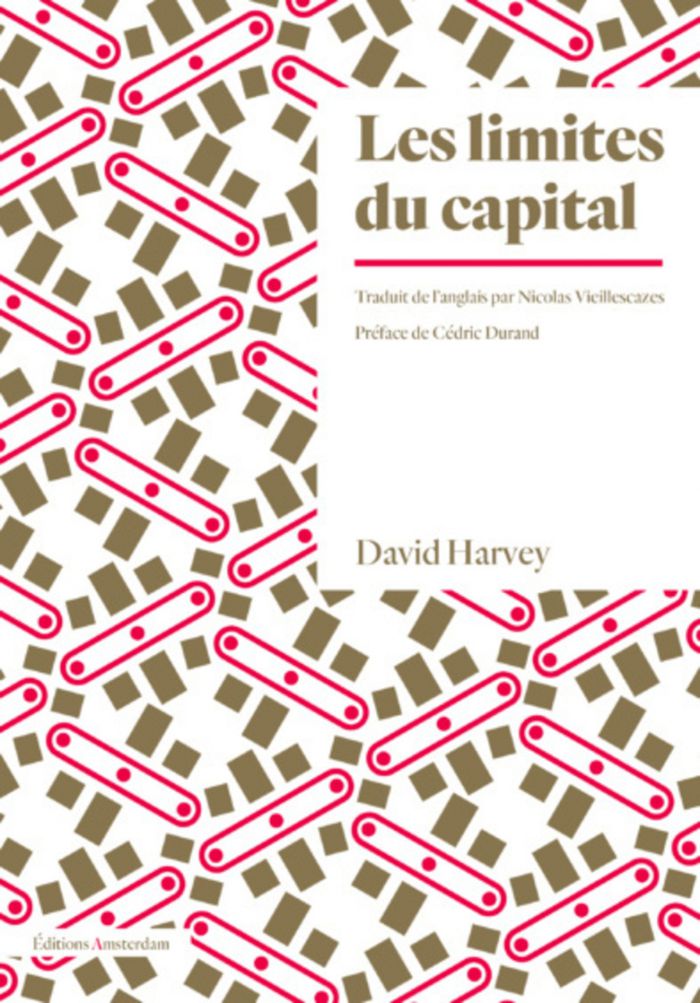
Les limites du capital
Les limites du capital
Actions:
Prix:
$52.95
(disponible en magasin)
Résumé:
Produit d'une dizaine d'années de recherches et de réflexions de l'auteur, géographe, cet ouvrage propose une reconstruction historico-géographique de l'analyse du capitalisme développée par Karl Marx. Selon lui, le capitalisme est un système socio-économique qui se développe et résout ses crises d'accumulation en créant et en détruisant des territoires.
Titre:
Les limites du capital
Actions:
Prix:
$52.95
(disponible en magasin)
Résumé:
Produit d'une dizaine d'années de recherches et de réflexions de l'auteur, géographe, cet ouvrage propose une reconstruction historico-géographique de l'analyse du capitalisme développée par Karl Marx. Selon lui, le capitalisme est un système socio-économique qui se développe et résout ses crises d'accumulation en créant et en détruisant des territoires.
Classification:
livres
livres
Publication:
janvier 2021
janvier 2021
Sujet:
Théorie/ philosophie
Théorie/ philosophie


