


2 Résultats
Classification:
livres
livres
Actions:
Prix:
$54.00
(disponible en magasin)
Résumé:
''The Trembling City'' is a gripping account of cities that shudder under the vibrational force of occupation, siege, and war. From the persistent drone noise of Gaza to turbulent skies above Beirut, Gascia Ouzounian uncovers the insidious role of sound and vibration as instruments of violence that shape urban life. She introduces two interlinked concepts: ''vibrational(...)
Titre:
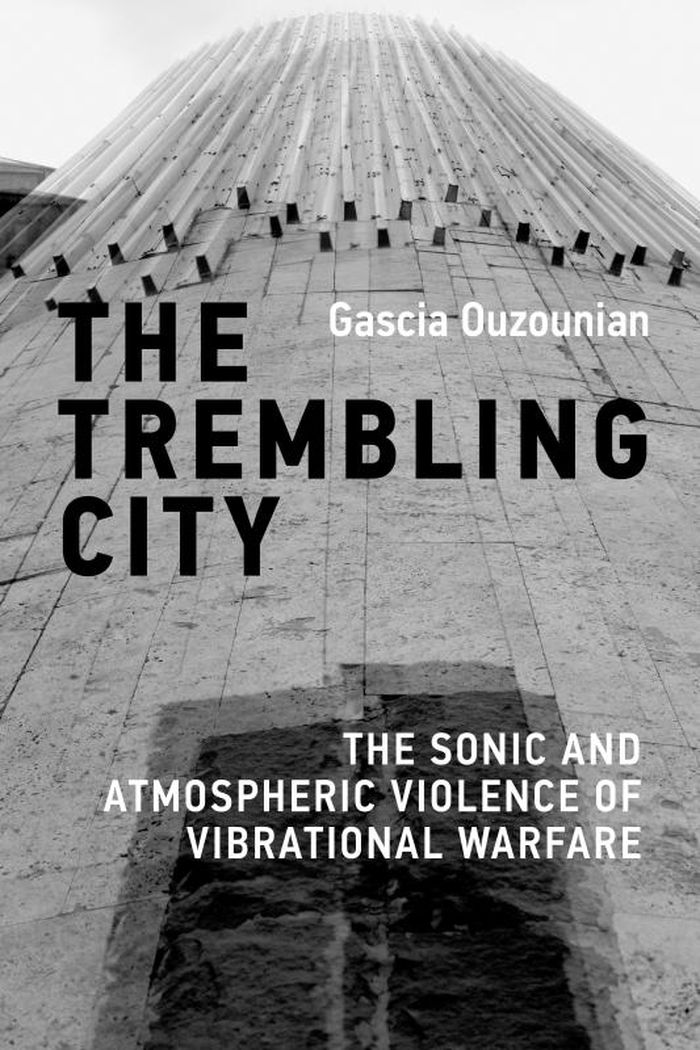
The trembling city: The sonic and atmospheric violence of vibrational warfare
Actions:
Prix:
$54.00
(disponible en magasin)
Résumé:
''The Trembling City'' is a gripping account of cities that shudder under the vibrational force of occupation, siege, and war. From the persistent drone noise of Gaza to turbulent skies above Beirut, Gascia Ouzounian uncovers the insidious role of sound and vibration as instruments of violence that shape urban life. She introduces two interlinked concepts: ''vibrational warfare'', a covert violence enacted through waves; and ''atmospheric occupation'', the seizure of a city’s airs to unsettle, dominate, and control. Together, these frameworks reveal how cities themselves become instruments of war: amplifying sonic shock, conducting energy through bodies, air, and buildings, and saturating everyday life with violence. Moving beyond accounts of sonic violence that focus on overt forms—sound cannons, sonic booms—Ouzounian traces more elusive but equally devastating forms: turbulent airs, residual sounds, and sonic erasures. Drawing on earwitness testimony, clandestine forensic analysis, and illicit archives, ''The Trembling City'' proposes new ways of hearing what states work to conceal: counterlistening as resistance, and a negative acoustics attuned to what cannot—or must not—be heard. Urgent and unflinching, the book reimagines cities as vibrational territories and listening as both a site of injury and a practice of endurance, survival, and critique.
Classification:
livres
livres
Publication:
octobre 2026
octobre 2026
Sujet:
Théorie de l’architecture
Théorie de l’architecture
Classification:
livres
livres

Prix:
$54.00
(disponible sur commande)
Résumé:
The relationship between sound and space has become central to both creative practices in music and sound art and contemporary scholarship on sound. Entire subfields have emerged in connection to the spatial aspects of sound, from spatial audio and sound installation to acoustic ecology and soundscape studies. But how did our understanding of sound become spatial? In(...)
Titre:
Stereophonica: Sound and space in science, technology and the arts
Actions:
Prix:
$54.00
(disponible sur commande)
Résumé:
The relationship between sound and space has become central to both creative practices in music and sound art and contemporary scholarship on sound. Entire subfields have emerged in connection to the spatial aspects of sound, from spatial audio and sound installation to acoustic ecology and soundscape studies. But how did our understanding of sound become spatial? In ''Stereophonica,'' Gascia Ouzounian examines a series of historical episodes that transformed ideas of sound and space, from the advent of stereo technologies in the nineteenth century to visual representations of sonic environments today. Developing a uniquely interdisciplinary perspective, Ouzounian draws on both the history of science and technology and the history of music and sound art. She investigates the binaural apparatus that allowed nineteenth-century listeners to observe sound in three dimensions; examines the development of military technologies for sound location during World War I; revisits experiments in stereo sound at Bell Telephone Laboratories in the 1930s; and considers the creation of "optimized acoustical environments" for theaters and factories. She explores the development of multichannel "spatial music" in the 1950s and sound installation art in the 1960s; analyzes the mapping of soundscapes; and investigates contemporary approaches to sonic urbanism, sonic practices that reimagine urban environments through sound.
Classification:
livres
livres
Publication:
février 2021
février 2021
Sujet:
Acoustique
Acoustique


