


137 Résultats
Classification:
livres
livres

Titre:
World brain
World brain
Actions:
Prix:
$33.95
(disponible sur commande)
Résumé:
In a series of talks and essays in 1937, H. G. Wells proselytized for what he called a "World Brain," as manifested in a World Encyclopedia--a repository of scientifically established knowledge--that would spread enlightenment around the world and lead to world peace. Wells, known to readers today as the author of "The War of the Worlds" and other science fiction(...)
$33.95
(disponible sur commande)
Résumé:
In a series of talks and essays in 1937, H. G. Wells proselytized for what he called a "World Brain," as manifested in a World Encyclopedia--a repository of scientifically established knowledge--that would spread enlightenment around the world and lead to world peace. Wells, known to readers today as the author of "The War of the Worlds" and other science fiction(...)
Titre:
World brain
Actions:
Prix:
$33.95
(disponible sur commande)
Résumé:
In a series of talks and essays in 1937, H. G. Wells proselytized for what he called a "World Brain," as manifested in a World Encyclopedia--a repository of scientifically established knowledge--that would spread enlightenment around the world and lead to world peace. Wells, known to readers today as the author of "The War of the Worlds" and other science fiction classics, was imagining something like a predigital Wikipedia. The World Encyclopedia would provide a summary of verified reality (in about forty volumes); it would be widely available, free of copyright, and utilize the latest technology. Of course, as Bruce Sterling points out in the foreword to this edition of Wells's work, the World Brain didn't happen; the internet did. And yet, Wells anticipated aspects of the internet, envisioning the World Brain as a technical system of networked knowledge (in Sterling's words, a "hypothetical super-gadget"). Wells's optimism about the power of information might strike readers today as naïvely utopian, but possibly also inspirational.
World brain
Actions:
Prix:
$33.95
(disponible sur commande)
Résumé:
In a series of talks and essays in 1937, H. G. Wells proselytized for what he called a "World Brain," as manifested in a World Encyclopedia--a repository of scientifically established knowledge--that would spread enlightenment around the world and lead to world peace. Wells, known to readers today as the author of "The War of the Worlds" and other science fiction classics, was imagining something like a predigital Wikipedia. The World Encyclopedia would provide a summary of verified reality (in about forty volumes); it would be widely available, free of copyright, and utilize the latest technology. Of course, as Bruce Sterling points out in the foreword to this edition of Wells's work, the World Brain didn't happen; the internet did. And yet, Wells anticipated aspects of the internet, envisioning the World Brain as a technical system of networked knowledge (in Sterling's words, a "hypothetical super-gadget"). Wells's optimism about the power of information might strike readers today as naïvely utopian, but possibly also inspirational.
Classification:
livres
livres
Publication:
août 2021
août 2021
Classification:
livres
livres

Titre:
Database network interface
Database network interface
Actions:
Prix:
$59.95
(disponible en magasin)
Résumé:
Throughout human history, the library, the archive and the museum have embodied knowledge, information and collective culture to such an extent that it is possible to compare systems of information organisation with spatial and architectural typologies. The publication, conceived in the occasion of the exhibition at Archizoom (EPFL), dives into the relationship between(...)
$59.95
(disponible en magasin)
Résumé:
Throughout human history, the library, the archive and the museum have embodied knowledge, information and collective culture to such an extent that it is possible to compare systems of information organisation with spatial and architectural typologies. The publication, conceived in the occasion of the exhibition at Archizoom (EPFL), dives into the relationship between(...)
Publication:
octobre 2021
octobre 2021
Titre:
Database network interface
Actions:
Prix:
$59.95
(disponible en magasin)
Résumé:
Throughout human history, the library, the archive and the museum have embodied knowledge, information and collective culture to such an extent that it is possible to compare systems of information organisation with spatial and architectural typologies. The publication, conceived in the occasion of the exhibition at Archizoom (EPFL), dives into the relationship between architectural and digital culture beyond the pure rhetoric of the digital turn and the digital as architectural style. The hypothesis is that the notions of "database", "network" and "interface"—common in the field of information technology—could be related to architectural issues of a formal, compositional or symbolic nature, of which spatial arrangements, plans or façades are the expression. In this sense, the publication presents a selection of case studies highlighting the possible links between digital and non-digital cultural projects and their architectural counterparts.
Database network interface
Actions:
Prix:
$59.95
(disponible en magasin)
Résumé:
Throughout human history, the library, the archive and the museum have embodied knowledge, information and collective culture to such an extent that it is possible to compare systems of information organisation with spatial and architectural typologies. The publication, conceived in the occasion of the exhibition at Archizoom (EPFL), dives into the relationship between architectural and digital culture beyond the pure rhetoric of the digital turn and the digital as architectural style. The hypothesis is that the notions of "database", "network" and "interface"—common in the field of information technology—could be related to architectural issues of a formal, compositional or symbolic nature, of which spatial arrangements, plans or façades are the expression. In this sense, the publication presents a selection of case studies highlighting the possible links between digital and non-digital cultural projects and their architectural counterparts.
Classification:
livres
livres
Publication:
octobre 2021
octobre 2021
Classification:
livres
livres

Titre:
Data feminism
Data feminism
Actions:
Prix:
$39.95
(disponible sur commande)
Résumé:
Today, data science is a form of power. It has been used to expose injustice, improve health outcomes, and topple governments. But it has also been used to discriminate, police, and surveil. This potential for good, on the one hand, and harm, on the other, makes it essential to ask: Data science by whom? Data science for whom? Data science with whose interests in mind?(...)
$39.95
(disponible sur commande)
Résumé:
Today, data science is a form of power. It has been used to expose injustice, improve health outcomes, and topple governments. But it has also been used to discriminate, police, and surveil. This potential for good, on the one hand, and harm, on the other, makes it essential to ask: Data science by whom? Data science for whom? Data science with whose interests in mind?(...)
Publication:
mars 2020
mars 2020
Titre:
Data feminism
Actions:
Prix:
$39.95
(disponible sur commande)
Résumé:
Today, data science is a form of power. It has been used to expose injustice, improve health outcomes, and topple governments. But it has also been used to discriminate, police, and surveil. This potential for good, on the one hand, and harm, on the other, makes it essential to ask: Data science by whom? Data science for whom? Data science with whose interests in mind? The narratives around big data and data science are overwhelmingly white, male, and techno-heroic. In ''Data feminism,'' Catherine D'Ignazio and Lauren Klein present a new way of thinking about data science and data ethics—one that is informed by intersectional feminist thought. Illustrating data feminism in action, D'Ignazio and Klein show how challenges to the male/female binary can help challenge other hierarchical (and empirically wrong) classification systems. They explain how, for example, an understanding of emotion can expand our ideas about effective data visualization, and how the concept of invisible labor can expose the significant human efforts required by our automated systems. And they show why the data never, ever ''speak for themselves.'' ''Data feminism'' offers strategies for data scientists seeking to learn how feminism can help them work toward justice, and for feminists who want to focus their efforts on the growing field of data science. But ''Data feminism'' is about much more than gender. It is about power, about who has it and who doesn't, and about how those differentials of power can be challenged and changed.
Data feminism
Actions:
Prix:
$39.95
(disponible sur commande)
Résumé:
Today, data science is a form of power. It has been used to expose injustice, improve health outcomes, and topple governments. But it has also been used to discriminate, police, and surveil. This potential for good, on the one hand, and harm, on the other, makes it essential to ask: Data science by whom? Data science for whom? Data science with whose interests in mind? The narratives around big data and data science are overwhelmingly white, male, and techno-heroic. In ''Data feminism,'' Catherine D'Ignazio and Lauren Klein present a new way of thinking about data science and data ethics—one that is informed by intersectional feminist thought. Illustrating data feminism in action, D'Ignazio and Klein show how challenges to the male/female binary can help challenge other hierarchical (and empirically wrong) classification systems. They explain how, for example, an understanding of emotion can expand our ideas about effective data visualization, and how the concept of invisible labor can expose the significant human efforts required by our automated systems. And they show why the data never, ever ''speak for themselves.'' ''Data feminism'' offers strategies for data scientists seeking to learn how feminism can help them work toward justice, and for feminists who want to focus their efforts on the growing field of data science. But ''Data feminism'' is about much more than gender. It is about power, about who has it and who doesn't, and about how those differentials of power can be challenged and changed.
Classification:
livres
livres
Publication:
mars 2020
mars 2020
Classification:
livres
livres

Prix:
$20.00
(disponible en magasin)
Résumé:
Ce sont les nouveaux grands seigneurs de notre temps. Les GAFAM (Google, Apple, Facebook, Amazon, Microsoft) et autres plateformes (Airbnb, Uber et Netflix) règnent sans partage sur un empire numérique qui transcende les frontières nationales, au mépris de la souveraineté des États et de leurs législations. Épidémie de fausses nouvelles, polarisation des débats, contrôle(...)
$20.00
(disponible en magasin)
Résumé:
Ce sont les nouveaux grands seigneurs de notre temps. Les GAFAM (Google, Apple, Facebook, Amazon, Microsoft) et autres plateformes (Airbnb, Uber et Netflix) règnent sans partage sur un empire numérique qui transcende les frontières nationales, au mépris de la souveraineté des États et de leurs législations. Épidémie de fausses nouvelles, polarisation des débats, contrôle(...)
Publication:
avril 2022
avril 2022
Titre:
Les barbares numériques : Résister à l'invasion des GAFAM
Actions:
Prix:
$20.00
(disponible en magasin)
Résumé:
Ce sont les nouveaux grands seigneurs de notre temps. Les GAFAM (Google, Apple, Facebook, Amazon, Microsoft) et autres plateformes (Airbnb, Uber et Netflix) règnent sans partage sur un empire numérique qui transcende les frontières nationales, au mépris de la souveraineté des États et de leurs législations. Épidémie de fausses nouvelles, polarisation des débats, contrôle des données personnelles, surconsommation énergétique et pollution atmosphérique… Ces barbares numériques représentent une véritable menace pour la démocratie. Devant la passivité de nos gouvernements, à Québec comme à Ottawa, Alain Saulnier lance un appel à la résistance. Pour l’ancien directeur de l’information de Radio-Canada, il est urgent d’établir l’équité fiscale, de protéger les droits d’auteur et de moderniser tout l’écosystème numérique. Il en va de la survie de nos médias, de notre langue et de notre culture françaises en Amérique du Nord.
Les barbares numériques : Résister à l'invasion des GAFAM
Actions:
Prix:
$20.00
(disponible en magasin)
Résumé:
Ce sont les nouveaux grands seigneurs de notre temps. Les GAFAM (Google, Apple, Facebook, Amazon, Microsoft) et autres plateformes (Airbnb, Uber et Netflix) règnent sans partage sur un empire numérique qui transcende les frontières nationales, au mépris de la souveraineté des États et de leurs législations. Épidémie de fausses nouvelles, polarisation des débats, contrôle des données personnelles, surconsommation énergétique et pollution atmosphérique… Ces barbares numériques représentent une véritable menace pour la démocratie. Devant la passivité de nos gouvernements, à Québec comme à Ottawa, Alain Saulnier lance un appel à la résistance. Pour l’ancien directeur de l’information de Radio-Canada, il est urgent d’établir l’équité fiscale, de protéger les droits d’auteur et de moderniser tout l’écosystème numérique. Il en va de la survie de nos médias, de notre langue et de notre culture françaises en Amérique du Nord.
Classification:
livres
livres
Publication:
avril 2022
avril 2022
Classification:
livres
livres
Titre:
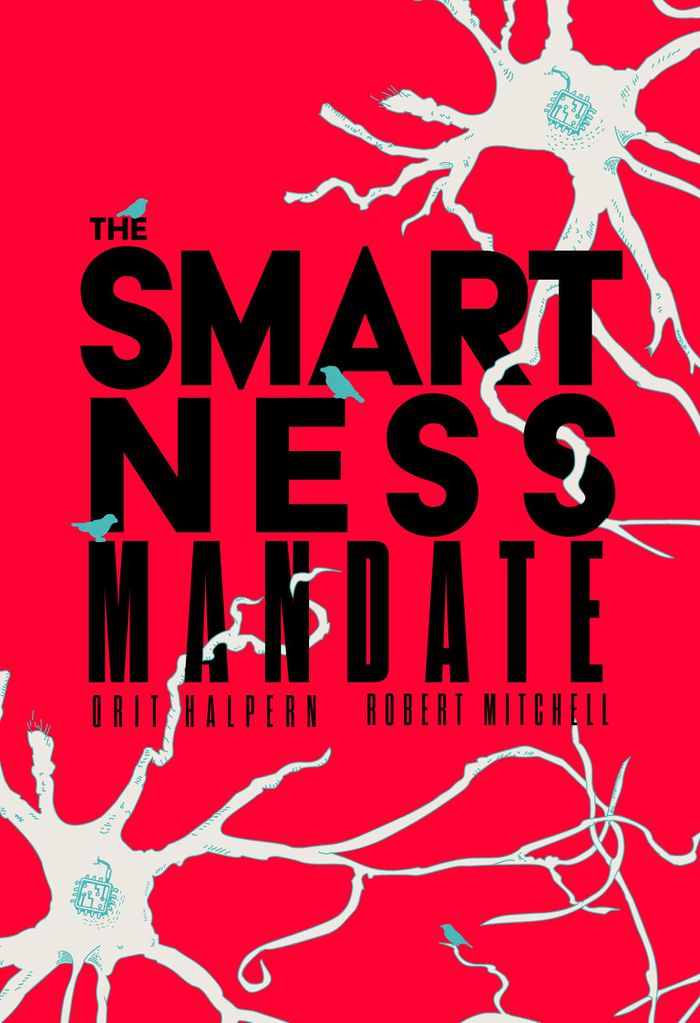
The smartness mandate
The smartness mandate
Actions:
Prix:
$47.00
(disponible sur commande)
Résumé:
In this book, the authors suggest that "smartness" is not primarily a technology, but rather an epistemology. Through this lens, they offer a critical exploration of the practices, technologies, and subjects that such an understanding relies upon—above all, artificial intelligence and machine learning. They approach these not simply as techniques for solving problems of(...)
$47.00
(disponible sur commande)
Résumé:
In this book, the authors suggest that "smartness" is not primarily a technology, but rather an epistemology. Through this lens, they offer a critical exploration of the practices, technologies, and subjects that such an understanding relies upon—above all, artificial intelligence and machine learning. They approach these not simply as techniques for solving problems of(...)
Publication:
décembre 2022
décembre 2022
Titre:
The smartness mandate
Actions:
Prix:
$47.00
(disponible sur commande)
Résumé:
In this book, the authors suggest that "smartness" is not primarily a technology, but rather an epistemology. Through this lens, they offer a critical exploration of the practices, technologies, and subjects that such an understanding relies upon—above all, artificial intelligence and machine learning. They approach these not simply as techniques for solving problems of calculations, but rather as modes of managing life (human and other) in terms of neo-Darwinian evolution, distributed intelligences, and "resilience," all of which have serious implications for society, politics, and the environment.
The smartness mandate
Actions:
Prix:
$47.00
(disponible sur commande)
Résumé:
In this book, the authors suggest that "smartness" is not primarily a technology, but rather an epistemology. Through this lens, they offer a critical exploration of the practices, technologies, and subjects that such an understanding relies upon—above all, artificial intelligence and machine learning. They approach these not simply as techniques for solving problems of calculations, but rather as modes of managing life (human and other) in terms of neo-Darwinian evolution, distributed intelligences, and "resilience," all of which have serious implications for society, politics, and the environment.
Classification:
livres
livres
Publication:
décembre 2022
décembre 2022
Classification:
livres
livres

Actions:
Prix:
$47.00
(disponible sur commande)
Résumé:
The only way to handle data responsibly, says Melanie Feinberg in this incisive work, is to take into account its human character. Though the data she discusses may seem familiar, close scrutiny shows it to be ambiguous, complicated, and uncertain: unruly. Drawing on the tools of information science, she uses everyday events to demonstrate a practical, critical, and(...)
$47.00
(disponible sur commande)
Résumé:
The only way to handle data responsibly, says Melanie Feinberg in this incisive work, is to take into account its human character. Though the data she discusses may seem familiar, close scrutiny shows it to be ambiguous, complicated, and uncertain: unruly. Drawing on the tools of information science, she uses everyday events to demonstrate a practical, critical, and(...)
Titre:
Everyday adventures with unruly data
Actions:
Prix:
$47.00
(disponible sur commande)
Résumé:
The only way to handle data responsibly, says Melanie Feinberg in this incisive work, is to take into account its human character. Though the data she discusses may seem familiar, close scrutiny shows it to be ambiguous, complicated, and uncertain: unruly. Drawing on the tools of information science, she uses everyday events to demonstrate a practical, critical, and generative mode of thinking about data: its creation, management, aggregation, and use. As she reflects on the implications of commonplace events, Feinberg explicates fundamental concepts of data that reveal the many tiny design decisions—which may not even seem like design at all—that shape how data comes to be. Through the themes of serendipity, objectivity, equivalence, interoperability, taxonomy, labels, and locality, she illuminates the surprisingly pervasive role of data in our daily thoughts and lives.
Everyday adventures with unruly data
Actions:
Prix:
$47.00
(disponible sur commande)
Résumé:
The only way to handle data responsibly, says Melanie Feinberg in this incisive work, is to take into account its human character. Though the data she discusses may seem familiar, close scrutiny shows it to be ambiguous, complicated, and uncertain: unruly. Drawing on the tools of information science, she uses everyday events to demonstrate a practical, critical, and generative mode of thinking about data: its creation, management, aggregation, and use. As she reflects on the implications of commonplace events, Feinberg explicates fundamental concepts of data that reveal the many tiny design decisions—which may not even seem like design at all—that shape how data comes to be. Through the themes of serendipity, objectivity, equivalence, interoperability, taxonomy, labels, and locality, she illuminates the surprisingly pervasive role of data in our daily thoughts and lives.
Classification:
livres
livres
Publication:
octobre 2022
octobre 2022
Classification:
livres
livres

Actions:
Prix:
$41.99
(disponible en magasin)
Résumé:
Digital and social media have transformed how much and how fast we communicate, but they have also altered the palette of expressive strategies: the cultural forms that shape how citizens, activists, and artists speak and interact. Most familiar among these strategies are storytelling and representation. In A Theory of Assembly, Kyle Parry argues that one of the most(...)
$41.99
(disponible en magasin)
Résumé:
Digital and social media have transformed how much and how fast we communicate, but they have also altered the palette of expressive strategies: the cultural forms that shape how citizens, activists, and artists speak and interact. Most familiar among these strategies are storytelling and representation. In A Theory of Assembly, Kyle Parry argues that one of the most(...)
Publication:
janvier 2023
janvier 2023
Titre:
A theory of assembly: From museums to memes
Actions:
Prix:
$41.99
(disponible en magasin)
Résumé:
Digital and social media have transformed how much and how fast we communicate, but they have also altered the palette of expressive strategies: the cultural forms that shape how citizens, activists, and artists speak and interact. Most familiar among these strategies are storytelling and representation. In A Theory of Assembly, Kyle Parry argues that one of the most powerful and pervasive cultural forms in the digital era is assembly. Whether as subtle photographic sequences, satirical Venn diagrams, or networked archives, projects based in assembly do not so much narrate or represent the world as rearrange it. This work of rearranging can take place at any scale, from a simple pairing of images, undertaken by one person, to the entire history of internet memes, undertaken by millions. With examples ranging from GIFs and paintings to museum exhibitions and social movement hashtags, Parry shows how, in the internet age, assembly has come to equal narrative and representation in its reach and influence, particularly as a response to ecological and social violence. He also emphasizes the ambivalence of assembly—the way it can be both emancipatory and antidemocratic.
A theory of assembly: From museums to memes
Actions:
Prix:
$41.99
(disponible en magasin)
Résumé:
Digital and social media have transformed how much and how fast we communicate, but they have also altered the palette of expressive strategies: the cultural forms that shape how citizens, activists, and artists speak and interact. Most familiar among these strategies are storytelling and representation. In A Theory of Assembly, Kyle Parry argues that one of the most powerful and pervasive cultural forms in the digital era is assembly. Whether as subtle photographic sequences, satirical Venn diagrams, or networked archives, projects based in assembly do not so much narrate or represent the world as rearrange it. This work of rearranging can take place at any scale, from a simple pairing of images, undertaken by one person, to the entire history of internet memes, undertaken by millions. With examples ranging from GIFs and paintings to museum exhibitions and social movement hashtags, Parry shows how, in the internet age, assembly has come to equal narrative and representation in its reach and influence, particularly as a response to ecological and social violence. He also emphasizes the ambivalence of assembly—the way it can be both emancipatory and antidemocratic.
Classification:
livres
livres
Publication:
janvier 2023
janvier 2023
Classification:
livres
livres

Titre:
DNA 14: Archives and Utopia
DNA 14: Archives and Utopia
Actions:
Prix:
$21.00
(disponible en magasin)
Résumé:
Traditional archivism runs the risk of perpetuating hegemonic ways of thinking by anticipating what will be of importance in the future through the framework of present-day realities and power structures. These genre-busting ruminations gather new methods for designing views of potential worlds and forms of archival activism.
$21.00
(disponible en magasin)
Résumé:
Traditional archivism runs the risk of perpetuating hegemonic ways of thinking by anticipating what will be of importance in the future through the framework of present-day realities and power structures. These genre-busting ruminations gather new methods for designing views of potential worlds and forms of archival activism.
Publication:
décembre 2022
décembre 2022
Titre:
DNA 14: Archives and Utopia
Actions:
Prix:
$21.00
(disponible en magasin)
Résumé:
Traditional archivism runs the risk of perpetuating hegemonic ways of thinking by anticipating what will be of importance in the future through the framework of present-day realities and power structures. These genre-busting ruminations gather new methods for designing views of potential worlds and forms of archival activism.
DNA 14: Archives and Utopia
Actions:
Prix:
$21.00
(disponible en magasin)
Résumé:
Traditional archivism runs the risk of perpetuating hegemonic ways of thinking by anticipating what will be of importance in the future through the framework of present-day realities and power structures. These genre-busting ruminations gather new methods for designing views of potential worlds and forms of archival activism.
Classification:
livres
livres
Publication:
décembre 2022
décembre 2022
Classification:
livres
livres

Actions:
Prix:
$38.99
(disponible en magasin)
Résumé:
Digital Memory and the Archive, the first English-language collection of the German media theorist’s work, brings together essays that present Wolfgang Ernst’s controversial materialist approach to media theory and history. His insights are central to the emerging field of media archaeology, which uncovers the role of specific technologies and mechanisms, rather than(...)
$38.99
(disponible en magasin)
Résumé:
Digital Memory and the Archive, the first English-language collection of the German media theorist’s work, brings together essays that present Wolfgang Ernst’s controversial materialist approach to media theory and history. His insights are central to the emerging field of media archaeology, which uncovers the role of specific technologies and mechanisms, rather than(...)
Titre:
Digital memory and the archive
Actions:
Prix:
$38.99
(disponible en magasin)
Résumé:
Digital Memory and the Archive, the first English-language collection of the German media theorist’s work, brings together essays that present Wolfgang Ernst’s controversial materialist approach to media theory and history. His insights are central to the emerging field of media archaeology, which uncovers the role of specific technologies and mechanisms, rather than content, in shaping contemporary culture and society.
Digital memory and the archive
Actions:
Prix:
$38.99
(disponible en magasin)
Résumé:
Digital Memory and the Archive, the first English-language collection of the German media theorist’s work, brings together essays that present Wolfgang Ernst’s controversial materialist approach to media theory and history. His insights are central to the emerging field of media archaeology, which uncovers the role of specific technologies and mechanisms, rather than content, in shaping contemporary culture and society.
Classification:
livres
livres
Publication:
décembre 2012
décembre 2012
Classification:
livres
livres

Titre:
Digital cultures
Digital cultures
Actions:
Prix:
$26.00
(disponible sur commande)
Résumé:
Writing accessibly about the underlying technology, Doueihi explores the multidimensional question of what it means to participate in online culture—from literacy and citizenship to texts, archiving, and storage. By bringing together topics explored separately elsewhere—such as copyright, digital subjectivity, and social networks—Digital Cultures offers a comprehensive(...)
$26.00
(disponible sur commande)
Résumé:
Writing accessibly about the underlying technology, Doueihi explores the multidimensional question of what it means to participate in online culture—from literacy and citizenship to texts, archiving, and storage. By bringing together topics explored separately elsewhere—such as copyright, digital subjectivity, and social networks—Digital Cultures offers a comprehensive(...)
Titre:
Digital cultures
Actions:
Prix:
$26.00
(disponible sur commande)
Résumé:
Writing accessibly about the underlying technology, Doueihi explores the multidimensional question of what it means to participate in online culture—from literacy and citizenship to texts, archiving, and storage. By bringing together topics explored separately elsewhere—such as copyright, digital subjectivity, and social networks—Digital Cultures offers a comprehensive view of the emerging digital space.
Digital cultures
Actions:
Prix:
$26.00
(disponible sur commande)
Résumé:
Writing accessibly about the underlying technology, Doueihi explores the multidimensional question of what it means to participate in online culture—from literacy and citizenship to texts, archiving, and storage. By bringing together topics explored separately elsewhere—such as copyright, digital subjectivity, and social networks—Digital Cultures offers a comprehensive view of the emerging digital space.
Classification:
livres
livres
Publication:
mars 2011
mars 2011


