


885 Résultats
Classification:
livres
livres

Prix:
$33.50
(disponible sur commande)
Résumé:
L'auteur présente ici le bilan d'une accélération de l'Histoire qui débouche non seulement sur l'épuisement de la géo-diversité du visible, mais aussi sur l'extinction progressive de la chrono-diversité du sensible. Nanomètre, nanoseconde, avec les nanotechnologies, c'est en effet la question des nano-chronologies qui se pose. Passé, présent ou futur, que reste-t-il(...)
Titre:
Le Futurisme de l'instant, Stop-Eject : la propagande du progrès
Actions:
Prix:
$33.50
(disponible sur commande)
Résumé:
L'auteur présente ici le bilan d'une accélération de l'Histoire qui débouche non seulement sur l'épuisement de la géo-diversité du visible, mais aussi sur l'extinction progressive de la chrono-diversité du sensible. Nanomètre, nanoseconde, avec les nanotechnologies, c'est en effet la question des nano-chronologies qui se pose. Passé, présent ou futur, que reste-t-il désormais des longues durées de l'histoire générale ou des courtes durées de l'histoire événementielle, sinon l'ébauche désastreuse d'une histoire purement accidentelle ?
Classification:
livres
livres
Publication:
juillet 2009
juillet 2009
Sujet:
Théorie/ philosophie
Théorie/ philosophie
Classification:
livres
livres

Titre:
Commonwealth
Commonwealth
Actions:
Prix:
$39.95
(disponible sur commande)
Résumé:
Drawing on scenarios from around the globe and elucidating the themes that unite them, Hardt and Negri focus on the logic of institutions and the models of governance adequate to our understanding of a global commonwealth. They argue for the idea of the “common” to replace the opposition of private and public and the politics predicated on that opposition. Ultimately,(...)
Titre:
Commonwealth
Actions:
Prix:
$39.95
(disponible sur commande)
Résumé:
Drawing on scenarios from around the globe and elucidating the themes that unite them, Hardt and Negri focus on the logic of institutions and the models of governance adequate to our understanding of a global commonwealth. They argue for the idea of the “common” to replace the opposition of private and public and the politics predicated on that opposition. Ultimately, they articulate the theoretical bases for what they call “governing the revolution.” Though this book functions as an extension and a completion of a sustained line of Hardt and Negri’s thought, it also stands alone and is entirely accessible to readers who are not familiar with the previous works. It is certain to appeal to, challenge, and enrich the thinking of anyone interested in questions of politics and globalization.
Classification:
livres
livres
Publication:
octobre 2009
octobre 2009
Sujet:
Théorie/ philosophie
Théorie/ philosophie
Classification:
livres
livres

Titre:
The German issue
The German issue
Actions:
Prix:
$34.95
(disponible sur commande)
Résumé:
Like a time capsule, The German Issue brings together all the major "issues" that were being debated on both sides of the Atlantic—which eventually found their abrupt resolution in 1989 with the fall of the Berlin Wall. It involved the most important voices of the period—from writers and filmmakers to anthropologists, activists and poets, terrorists and philosophers:(...)
Titre:
The German issue
Actions:
Prix:
$34.95
(disponible sur commande)
Résumé:
Like a time capsule, The German Issue brings together all the major "issues" that were being debated on both sides of the Atlantic—which eventually found their abrupt resolution in 1989 with the fall of the Berlin Wall. It involved the most important voices of the period—from writers and filmmakers to anthropologists, activists and poets, terrorists and philosophers: Joseph Beuys, Michel Foucault, Christo, Christa Wolf, Walter Abish, Alexander Kluge, Paul Virilio, Ulrilke Meinhof, William Burroughs, Jean Baudrillard, Hans Magnus Enzenberger, Maurice Blanchot, Hans Jürgen Syberberg, Heidegger, André Gorz, Helke Sander. Opening with Christo's "Wrapping Up of Germany" and the celebrated dialogue between East German dramaturge Heiner Müller and Sylvère Lotringer on the Wall ("Mauer"), since published in many languages, The German Issue offers a first-hand account of the Western world on the threshold of a major global mutation. It also embodies at its best Semiotext(e)'s tenacious effort to establish a creative bridge between art and intellect, culture and politics, Europe and America.
Classification:
livres
livres
Publication:
octobre 2009
octobre 2009
Sujet:
Théorie/ philosophie
Théorie/ philosophie
Classification:
livres
livres
Actions:
Prix:
$27.99
(disponible sur commande)
Résumé:
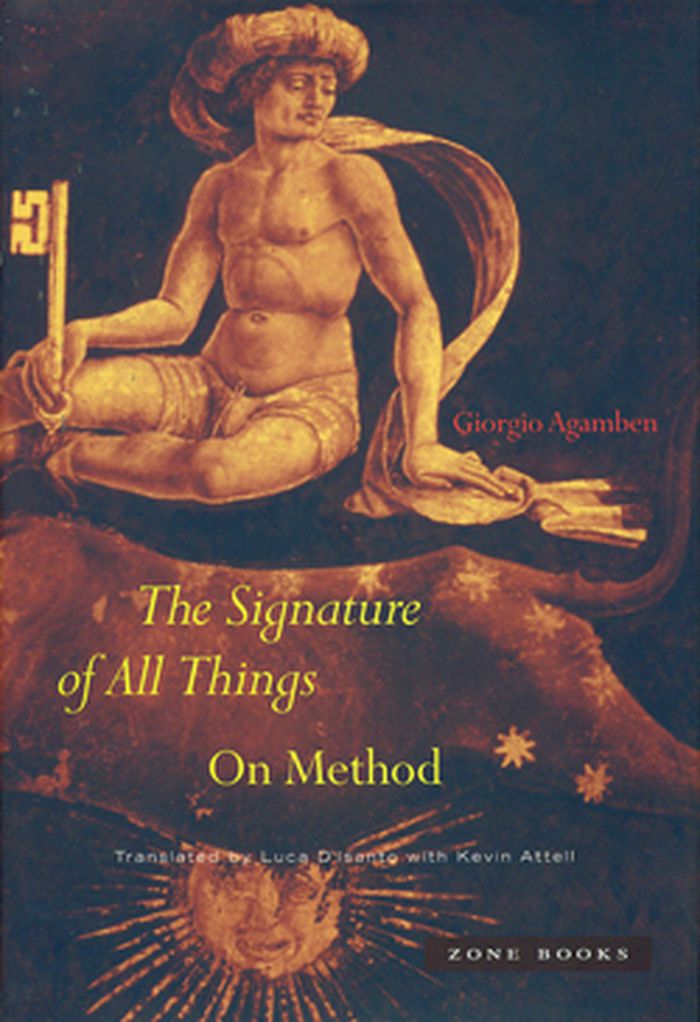
Three conceptual figures organize Agamben's argument and the advent of his new method: the paradigm, the signature, and archaeology. Each chapter is devoted to an investigation of one of these concepts and Agamben carefully constructs its genealogy transhistorically and from an interdisciplinary perspective. And at each moment of the text, Agamben pays tribute to Michel(...)
Titre:
The signature of all things: on method
Actions:
Prix:
$27.99
(disponible sur commande)
Résumé:
Three conceptual figures organize Agamben's argument and the advent of his new method: the paradigm, the signature, and archaeology. Each chapter is devoted to an investigation of one of these concepts and Agamben carefully constructs its genealogy transhistorically and from an interdisciplinary perspective. And at each moment of the text, Agamben pays tribute to Michel Foucault, whose methods he rethinks and effectively uses to reformulate the logic of the concepts he isolates.
Classification:
livres
livres
Publication:
décembre 2009
décembre 2009
Sujet:
Théorie/ philosophie
Théorie/ philosophie
Classification:
livres
livres
Titre:
The system of objects
The system of objects
Actions:
Prix:
$23.95
(disponible sur commande)
Résumé:
A cultural critique of the commodity in consumer society, The System of Objects is a tour de force—a theoretical letter-in-a-bottle tossed into the ocean in 1968, which brilliantly communicates to us all the live ideas of the day.
$23.95
(disponible sur commande)
Résumé:
A cultural critique of the commodity in consumer society, The System of Objects is a tour de force—a theoretical letter-in-a-bottle tossed into the ocean in 1968, which brilliantly communicates to us all the live ideas of the day.
Titre:
The system of objects
Actions:
Prix:
$23.95
(disponible sur commande)
Résumé:
A cultural critique of the commodity in consumer society, The System of Objects is a tour de force—a theoretical letter-in-a-bottle tossed into the ocean in 1968, which brilliantly communicates to us all the live ideas of the day.
Classification:
livres
livres
Publication:
août 2006
août 2006
Sujet:
Théorie/ philosophie
Théorie/ philosophie
Classification:
livres
livres
Actions:
Prix:
$57.95
(disponible sur commande)
Résumé:
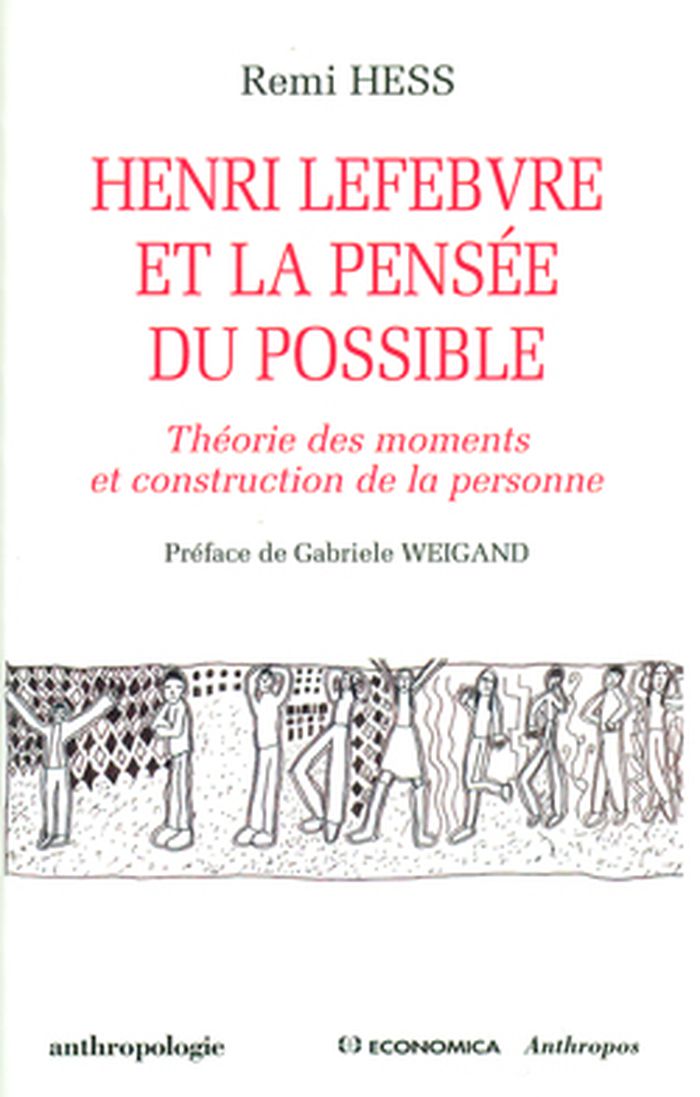
Remi Hess rencontre Henri Lefebvre en 1967 à Nanterre. Depuis, il n'a cessé de lire, de commenter et de prolonger l'oeuvre de ce philosophe, sociologue, historien que fut Henri Lefebvre. Ici, R. Hess propose avec H. Lefebvre de construire une pensée du possible. Que peut-on percevoir comme possible ? L'impossible aujourd'hui ne sera-t-il pas le possible de demain ? R.(...)
Titre:
Henri Lefebvre et la pensée du possible : Théorie des moments et construction de la personne
Actions:
Prix:
$57.95
(disponible sur commande)
Résumé:
Remi Hess rencontre Henri Lefebvre en 1967 à Nanterre. Depuis, il n'a cessé de lire, de commenter et de prolonger l'oeuvre de ce philosophe, sociologue, historien que fut Henri Lefebvre. Ici, R. Hess propose avec H. Lefebvre de construire une pensée du possible. Que peut-on percevoir comme possible ? L'impossible aujourd'hui ne sera-t-il pas le possible de demain ? R. Hess reprend la théorie des moments, proposée par Lefebvre, en y voyant un outil de construction de la personne. L'originalité de Henri Lefebvre et la pensée du possible est de proposer une méthode pour expliciter ses moments : l'écriture de journaux. Le journal des moments apparaît ainsi comme une technique de construction de la personne. Cet ouvrage, qui peut apparaître volumineux, est en fait un recueil de petits ouvrages à lire au bon moment. Certains sont théoriques, d'autres sont biographiques. Ce livre, de facture lefebvrienne, est le produit d'une dialectique entre le perçu, le vécu et le conçu.
Classification:
livres
livres
Publication:
août 2009
août 2009
Sujet:
Théorie/ philosophie
Théorie/ philosophie
Classification:
livres
livres

Actions:
Prix:
$29.99
(disponible sur commande)
Résumé:
In this collection, leading scholars in the fields of philosophy, literary theory, and cultural criticism engage Rancière’s work, illuminating its originality, breadth, and rigor, as well as its place in current debates. They also explore the relationships between Rancière and the various authors and artists he has analyzed, ranging from Plato and Aristotle to Flaubert,(...)
Sujet:
Théorie/ philosophie
Théorie/ philosophie
Publication:
septembre 2009
septembre 2009
Titre:
Jacques Rancière : history, politics, aesthetics
Actions:
Prix:
$29.99
(disponible sur commande)
Résumé:
In this collection, leading scholars in the fields of philosophy, literary theory, and cultural criticism engage Rancière’s work, illuminating its originality, breadth, and rigor, as well as its place in current debates. They also explore the relationships between Rancière and the various authors and artists he has analyzed, ranging from Plato and Aristotle to Flaubert, Rossellini, Auerbach, Bourdieu, and Deleuze.
Classification:
livres
livres
Publication:
septembre 2009
septembre 2009
Sujet:
Théorie/ philosophie
Théorie/ philosophie
Classification:
livres
livres

Titre:
Utopies nomades
Utopies nomades
Actions:
Prix:
$29.95
(disponible en magasin)
Résumé:
En 1996, cet essai prenait pour sous-titre En attendant 2002. Voici que la première décennie du XXIe siècle s'écoule sans que les questions soulevées par notre besoin d'utopie aient perdu de leur actualité ; sans que l'exigence d'un changement de société, de système, ait perdu de son urgence. Plus que jamais, au contraire, pour sortir de la crise, de l'impasse, tant(...)
Sujet:
Théorie/ philosophie
Théorie/ philosophie
Publication:
octobre 2009
octobre 2009
Titre:
Utopies nomades
Actions:
Prix:
$29.95
(disponible en magasin)
Résumé:
En 1996, cet essai prenait pour sous-titre En attendant 2002. Voici que la première décennie du XXIe siècle s'écoule sans que les questions soulevées par notre besoin d'utopie aient perdu de leur actualité ; sans que l'exigence d'un changement de société, de système, ait perdu de son urgence. Plus que jamais, au contraire, pour sortir de la crise, de l'impasse, tant économique que sociale, qu'écologique, que spirituelle, l'esprit d'utopie nous est nécessaire. Il ne s'agit pas d'entendre, par là, la conception abstraite d'une société idéale rêvée, mais, à la manière d'Ernst Bloch, la plus précise, la plus sincère attention au réel, ou, dans le langage de Charles Fourier, aux passions incoercibles. L'utopie d'aujourd'hui est, à la fois, rationnelle et passionnelle. Surtout, elle n'occupe plus une île, elle n'a pas qu'un seul modèle, elle est multiple ; et les utopies qui se proposent dans tous les domaines de la vie, sont dispersées, «nomades». En leur centre toutefois, une préoccupation majeure est celle de l'habitation enfin humaine de la planète, grâce à une hospitalité universelle permettant à chacun, en tout point de la Terre, de se sentir chez soi.
Classification:
livres
livres
Publication:
octobre 2009
octobre 2009
Sujet:
Théorie/ philosophie
Théorie/ philosophie
Classification:
livres
livres
Titre:
The poetics of space
The poetics of space
Actions:
Prix:
$25.99
(disponible en magasin)
Résumé:
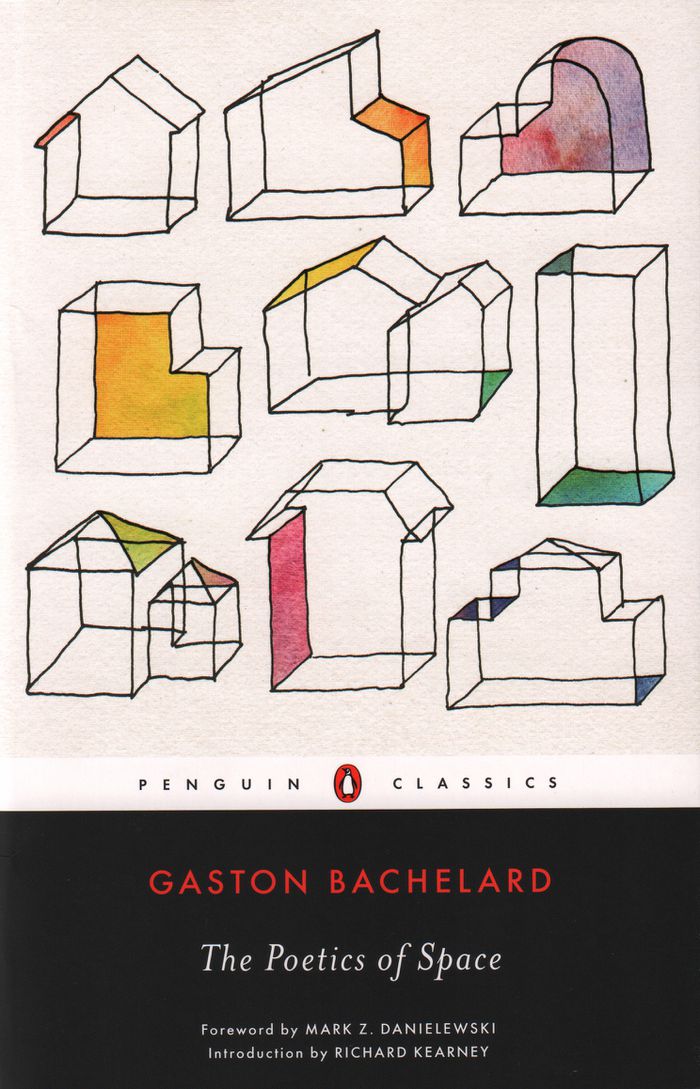
Since its initial publication in 1958, The Poetics of Space has been a muse to philosophers, architects, writers, psychologists, critics, and readers alike. The rare work of irresistibly inviting philosophy, Bachelard’s seminal work brims with quiet revelations and stirring, mysterious imagery. This lyrical journey takes as its premise the emergence of the poetic image(...)
Titre:
The poetics of space
Actions:
Prix:
$25.99
(disponible en magasin)
Résumé:
Since its initial publication in 1958, The Poetics of Space has been a muse to philosophers, architects, writers, psychologists, critics, and readers alike. The rare work of irresistibly inviting philosophy, Bachelard’s seminal work brims with quiet revelations and stirring, mysterious imagery. This lyrical journey takes as its premise the emergence of the poetic image and finds an ideal metaphor in the intimate spaces of our homes. Guiding us through a stream of meditations on poetry, art, and the blooming of consciousness itself, Bachelard examines the domestic places that shape and hold our dreams and memories. Houses and rooms; cellars and attics; drawers, chests, and wardrobes; nests and shells; nooks and corners: No space is too vast or too small to be filled by our thoughts and our reveries. In Bachelard’s enchanting spaces, “We are never real historians, but always near poets, and our emotion is perhaps nothing but an expression of a poetry that was lost.”
Classification:
livres
livres
Publication:
décembre 2014
décembre 2014
Sujet:
Théorie/ philosophie
Théorie/ philosophie
Classification:
livres
livres
Actions:
Prix:
$26.00
(disponible sur commande)
Résumé:
A fresh interpretation of Jeremy Bentham, finding that his “radical foolery” embodied a social ethics that was revolutionary for its time. Jeremy Bentham (1748–1832) is best remembered today as the founder of utilitarianism (a philosophy infamously abused by the Victorians) and the conceiver of the Panopticon, the circular prison house in which all prisoners could be(...)
Titre:
The radical fool of capitalism: on Jeremy Bentham, the Panopticon, and the auto-icon
Actions:
Prix:
$26.00
(disponible sur commande)
Résumé:
A fresh interpretation of Jeremy Bentham, finding that his “radical foolery” embodied a social ethics that was revolutionary for its time. Jeremy Bentham (1748–1832) is best remembered today as the founder of utilitarianism (a philosophy infamously abused by the Victorians) and the conceiver of the Panopticon, the circular prison house in which all prisoners could be seen by an unseen observer—later seized upon by Michel Foucault as the apotheosis of the neoliberal control society. In this volume in the Untimely Meditation series, Christian Welzbacher offers a new interpretation of Bentham, arguing that his “radical foolery” (paraphrasing Goethe's characterization of Bentham) actually embodied a social ethics that was new for its time and demands proper historical contextualization rather than retroactive analysis from the vantage point of late capitalism. Welzbacher provides just such an analysis, offering an account of the two great utilitarian projects that occupied Bentham all his life: the Panopticon and the Auto-Icon.
Classification:
livres
livres
Publication:
avril 2018
avril 2018
Sujet:
Théorie/ philosophie
Théorie/ philosophie


