


187 Résultats
Classification:
livres
livres
Actions:
Prix:
$27.95
(disponible sur commande)
Résumé:
This book examines Dutch commemorative coins which will continue to be minted, despite the introduction of the Euro. In a lyrical article, Gert Staal explores the sentimental and symbolical significance of coins. The results of a workshop ‘Design by the mm3’, in which eleven artist/designers took part, is discussed in an article by Lilet Breddels and presented in numerous(...)
$27.95
(disponible sur commande)
Résumé:
This book examines Dutch commemorative coins which will continue to be minted, despite the introduction of the Euro. In a lyrical article, Gert Staal explores the sentimental and symbolical significance of coins. The results of a workshop ‘Design by the mm3’, in which eleven artist/designers took part, is discussed in an article by Lilet Breddels and presented in numerous(...)
Sujet:
Design industriel
Design industriel
Publication:
janvier 2002,
janvier 2002,
Titre:
Design by the mm3 munt : picturing coins
Actions:
Prix:
$27.95
(disponible sur commande)
Résumé:
This book examines Dutch commemorative coins which will continue to be minted, despite the introduction of the Euro. In a lyrical article, Gert Staal explores the sentimental and symbolical significance of coins. The results of a workshop ‘Design by the mm3’, in which eleven artist/designers took part, is discussed in an article by Lilet Breddels and presented in numerous illustrations. Gerard Unger subverts his own specialization in typography by arguing that artists are perfectly capable of creating their own lettering for coin designs. Hans Jacobi, keeper of the Koninklijke Penningen Kabinet (Royal Coins Cabinet) in Leiden, throws light on the vicissitudes of Dutch coin design during the last twenty years. In an epilogue, Janwillem Schrofer, a member of the Advisory Commission for New Coinage and the president of the Rijksakademie, Amsterdam, presents his outlook on the importance of good coin design.
Design by the mm3 munt : picturing coins
Actions:
Prix:
$27.95
(disponible sur commande)
Résumé:
This book examines Dutch commemorative coins which will continue to be minted, despite the introduction of the Euro. In a lyrical article, Gert Staal explores the sentimental and symbolical significance of coins. The results of a workshop ‘Design by the mm3’, in which eleven artist/designers took part, is discussed in an article by Lilet Breddels and presented in numerous illustrations. Gerard Unger subverts his own specialization in typography by arguing that artists are perfectly capable of creating their own lettering for coin designs. Hans Jacobi, keeper of the Koninklijke Penningen Kabinet (Royal Coins Cabinet) in Leiden, throws light on the vicissitudes of Dutch coin design during the last twenty years. In an epilogue, Janwillem Schrofer, a member of the Advisory Commission for New Coinage and the president of the Rijksakademie, Amsterdam, presents his outlook on the importance of good coin design.
Classification:
livres
livres
Publication:
janvier 2002,
janvier 2002,
Sujet:
Design industriel
Design industriel
Classification:
livres
livres

Titre:
To object
To object
Actions:
Prix:
$43.00
(disponible sur commande)
Résumé:
This volume documents MVRDV`s project for the competition for the Musee des Arts et Civilisations in Paris, and includes all aspects of the design: visual as well as written. This book asks such urgent design questions as the meaning of a museum for non-Western art at a time when worldwide mobility is making the ideas of "Western" and "non-Western" meaningless. How does(...)
$43.00
(disponible sur commande)
Résumé:
This volume documents MVRDV`s project for the competition for the Musee des Arts et Civilisations in Paris, and includes all aspects of the design: visual as well as written. This book asks such urgent design questions as the meaning of a museum for non-Western art at a time when worldwide mobility is making the ideas of "Western" and "non-Western" meaningless. How does(...)
Titre:
To object
Actions:
Prix:
$43.00
(disponible sur commande)
Résumé:
This volume documents MVRDV`s project for the competition for the Musee des Arts et Civilisations in Paris, and includes all aspects of the design: visual as well as written. This book asks such urgent design questions as the meaning of a museum for non-Western art at a time when worldwide mobility is making the ideas of "Western" and "non-Western" meaningless. How does one represent authenticity in this context? Designed by MVRDV, this book allows the reader inside the design process to the original ideas conceived and problems faced by an architect.
To object
Actions:
Prix:
$43.00
(disponible sur commande)
Résumé:
This volume documents MVRDV`s project for the competition for the Musee des Arts et Civilisations in Paris, and includes all aspects of the design: visual as well as written. This book asks such urgent design questions as the meaning of a museum for non-Western art at a time when worldwide mobility is making the ideas of "Western" and "non-Western" meaningless. How does one represent authenticity in this context? Designed by MVRDV, this book allows the reader inside the design process to the original ideas conceived and problems faced by an architect.
Classification:
livres
livres
Publication:
janvier 2001, Barcelona
janvier 2001, Barcelona
Sujet:
Design industriel
Design industriel
Classification:
livres
livres
Actions:
Prix:
$60.00
(disponible sur commande)
Résumé:
Interest in Belgian design-be it furniture, fashion, graphics or products has exploded in the last five years. "Label-design.be, design in Belgium after 2000" presents the recent work of some 130 jury-selected designers and showcases at least four designs from each, making it the most comprehensive overview of design in Belgium today. Included in the book are also(...)
$60.00
(disponible sur commande)
Résumé:
Interest in Belgian design-be it furniture, fashion, graphics or products has exploded in the last five years. "Label-design.be, design in Belgium after 2000" presents the recent work of some 130 jury-selected designers and showcases at least four designs from each, making it the most comprehensive overview of design in Belgium today. Included in the book are also(...)
Titre:
Label - design.be : design in Belgium after 2000
Actions:
Prix:
$60.00
(disponible sur commande)
Résumé:
Interest in Belgian design-be it furniture, fashion, graphics or products has exploded in the last five years. "Label-design.be, design in Belgium after 2000" presents the recent work of some 130 jury-selected designers and showcases at least four designs from each, making it the most comprehensive overview of design in Belgium today. Included in the book are also designs of furniture, cars, trains, and bathrooms. Preceding this overview are essays by Lise Coirer, Johan Valcke, and Francis Smets. Designers featured here include Claire Bataille & Paul Ibens, Colombo, Jo Crepain, Dark, Durlet, Extremis, Xavier Lust, Maximal Design, Modular, Quinze & Milan, Annick Schotte, Piet Stockmans, Vincent Van Duysen, Maarten Van Severen, and many others.
Label - design.be : design in Belgium after 2000
Actions:
Prix:
$60.00
(disponible sur commande)
Résumé:
Interest in Belgian design-be it furniture, fashion, graphics or products has exploded in the last five years. "Label-design.be, design in Belgium after 2000" presents the recent work of some 130 jury-selected designers and showcases at least four designs from each, making it the most comprehensive overview of design in Belgium today. Included in the book are also designs of furniture, cars, trains, and bathrooms. Preceding this overview are essays by Lise Coirer, Johan Valcke, and Francis Smets. Designers featured here include Claire Bataille & Paul Ibens, Colombo, Jo Crepain, Dark, Durlet, Extremis, Xavier Lust, Maximal Design, Modular, Quinze & Milan, Annick Schotte, Piet Stockmans, Vincent Van Duysen, Maarten Van Severen, and many others.
Classification:
livres
livres
Publication:
janvier 2006, Oostkamp
janvier 2006, Oostkamp
Sujet:
Design industriel
Design industriel
Classification:
livres
livres

Actions:
Prix:
$55.00
(disponible sur commande)
Résumé:
In Sweden, the Facit brand is as well known as IBM or Olivetti. Based in Atvidaberg, the company produced mechanical calculators, typewriters and office furniture between 1922 and 1998. By the 1970s, the company had grown from a local family business into one of the world’s leading manufacturers. The company-sponsored football team AFF was playing in the first division.(...)
$55.00
(disponible sur commande)
Résumé:
In Sweden, the Facit brand is as well known as IBM or Olivetti. Based in Atvidaberg, the company produced mechanical calculators, typewriters and office furniture between 1922 and 1998. By the 1970s, the company had grown from a local family business into one of the world’s leading manufacturers. The company-sponsored football team AFF was playing in the first division.(...)
Titre:
The Facit Model: Globalism, Localism, Identity
Actions:
Prix:
$55.00
(disponible sur commande)
Résumé:
In Sweden, the Facit brand is as well known as IBM or Olivetti. Based in Atvidaberg, the company produced mechanical calculators, typewriters and office furniture between 1922 and 1998. By the 1970s, the company had grown from a local family business into one of the world’s leading manufacturers. The company-sponsored football team AFF was playing in the first division. But a few years later the Facit organization had disappeared—worn down by global capitalism. ''The Facit Model: Globalism, Localism, Identity'' looks at this peculiar example of corporate modernism through the printed matter produced in Facit’s in-house print shops, culled from FACIT’s archives. Type specimens, manuals, advertising leaflets and product catalogs bear witness to a culture which feels increasingly distant, and yet helped to define many of the codes and forms familiar to us from today’s world of work.
The Facit Model: Globalism, Localism, Identity
Actions:
Prix:
$55.00
(disponible sur commande)
Résumé:
In Sweden, the Facit brand is as well known as IBM or Olivetti. Based in Atvidaberg, the company produced mechanical calculators, typewriters and office furniture between 1922 and 1998. By the 1970s, the company had grown from a local family business into one of the world’s leading manufacturers. The company-sponsored football team AFF was playing in the first division. But a few years later the Facit organization had disappeared—worn down by global capitalism. ''The Facit Model: Globalism, Localism, Identity'' looks at this peculiar example of corporate modernism through the printed matter produced in Facit’s in-house print shops, culled from FACIT’s archives. Type specimens, manuals, advertising leaflets and product catalogs bear witness to a culture which feels increasingly distant, and yet helped to define many of the codes and forms familiar to us from today’s world of work.
Classification:
livres
livres
Publication:
mai 2025
mai 2025
Sujet:
Design industriel
Design industriel
Classification:
livres
livres
Actions:
Prix:
$33.95
(disponible sur commande)
Résumé:
"Electric Dreams" charts the seismic shifts that transformed the monochrome product world of 1980's consumer electronics into a 21st century landscape full of shape, colour and variety. It considers the economic and technological imperatives which brought design to the heart of electronic innovation and marketing culture.
$33.95
(disponible sur commande)
Résumé:
"Electric Dreams" charts the seismic shifts that transformed the monochrome product world of 1980's consumer electronics into a 21st century landscape full of shape, colour and variety. It considers the economic and technological imperatives which brought design to the heart of electronic innovation and marketing culture.
Titre:
Electric dreams : designing for the digital age
Actions:
Prix:
$33.95
(disponible sur commande)
Résumé:
"Electric Dreams" charts the seismic shifts that transformed the monochrome product world of 1980's consumer electronics into a 21st century landscape full of shape, colour and variety. It considers the economic and technological imperatives which brought design to the heart of electronic innovation and marketing culture.
Electric dreams : designing for the digital age
Actions:
Prix:
$33.95
(disponible sur commande)
Résumé:
"Electric Dreams" charts the seismic shifts that transformed the monochrome product world of 1980's consumer electronics into a 21st century landscape full of shape, colour and variety. It considers the economic and technological imperatives which brought design to the heart of electronic innovation and marketing culture.
Classification:
livres
livres
Publication:
avril 2004, London
avril 2004, London
Sujet:
Design industriel
Design industriel
Classification:
livres
livres
Actions:
Prix:
$52.95
(disponible en magasin)
Résumé:
"Ulm design" is synonymous for clear, functional design of superior quality. On the occasion of the fiftieth anniversary of the founding of the Hochschule für Gestaltung in Ulm, this book issued by the Ulmer Museum and the HfG-Archiv pays tribute to the school's pioneering accomplishments. Just in time for the fiftieth anniversary of the founding of the Hochschule für(...)
$52.95
(disponible en magasin)
Résumé:
"Ulm design" is synonymous for clear, functional design of superior quality. On the occasion of the fiftieth anniversary of the founding of the Hochschule für Gestaltung in Ulm, this book issued by the Ulmer Museum and the HfG-Archiv pays tribute to the school's pioneering accomplishments. Just in time for the fiftieth anniversary of the founding of the Hochschule für(...)
Sujet:
Design industriel
Design industriel
Publication:
septembre 2003, Ostfildern
septembre 2003, Ostfildern
Titre:
Ulm School of Design 1953-1968
Actions:
Prix:
$52.95
(disponible en magasin)
Résumé:
"Ulm design" is synonymous for clear, functional design of superior quality. On the occasion of the fiftieth anniversary of the founding of the Hochschule für Gestaltung in Ulm, this book issued by the Ulmer Museum and the HfG-Archiv pays tribute to the school's pioneering accomplishments. Just in time for the fiftieth anniversary of the founding of the Hochschule für Gestaltung (School of Design, known as the HfG) in Ulm in 1953, this publication honors the pioneering work of its founding members Inge Scholl, Otl Aicher, and Max Bill. Founded on an antifascist impulse, the HfG encouraged the development of a democratic consciousness which was to influence design in general. Products were meant to be as long lived and functional as possible, acceptable with respect to social and ecological criteria, and to take into account changing political conditions and production technologies. The school's pedagogical concept, the so-called Ulm model, was characterized by a new system- oriented design methodology and the encouragement of interdisciplinary teamwork. The Ulm School of Design played a decisive role in establishing the idea of the professional "designer" in the form still valid today, and many designers who graduated from the HfG before its closure in 1968 are still teaching design-related subjects, thus carrying on the specific fundamental principles that empowered the HfG. Examples from design schools in Asia, North and South America, and India illustrate the effects of the design methods developed at Ulm.
Ulm School of Design 1953-1968
Actions:
Prix:
$52.95
(disponible en magasin)
Résumé:
"Ulm design" is synonymous for clear, functional design of superior quality. On the occasion of the fiftieth anniversary of the founding of the Hochschule für Gestaltung in Ulm, this book issued by the Ulmer Museum and the HfG-Archiv pays tribute to the school's pioneering accomplishments. Just in time for the fiftieth anniversary of the founding of the Hochschule für Gestaltung (School of Design, known as the HfG) in Ulm in 1953, this publication honors the pioneering work of its founding members Inge Scholl, Otl Aicher, and Max Bill. Founded on an antifascist impulse, the HfG encouraged the development of a democratic consciousness which was to influence design in general. Products were meant to be as long lived and functional as possible, acceptable with respect to social and ecological criteria, and to take into account changing political conditions and production technologies. The school's pedagogical concept, the so-called Ulm model, was characterized by a new system- oriented design methodology and the encouragement of interdisciplinary teamwork. The Ulm School of Design played a decisive role in establishing the idea of the professional "designer" in the form still valid today, and many designers who graduated from the HfG before its closure in 1968 are still teaching design-related subjects, thus carrying on the specific fundamental principles that empowered the HfG. Examples from design schools in Asia, North and South America, and India illustrate the effects of the design methods developed at Ulm.
Classification:
livres
livres
Publication:
septembre 2003, Ostfildern
septembre 2003, Ostfildern
Sujet:
Design industriel
Design industriel
Classification:
livres
livres

Titre:
Creative asia
Creative asia
Actions:
Prix:
$18.00
(disponible sur commande)
Résumé:
Singapore has always plugged itself firmly into the rest of the world, as decreed by its political edict. This closeness to global trends may be the reason Singapore design is the most international of among the Southeast Asian countries. Some would even say it is devoid of local flavours.
$18.00
(disponible sur commande)
Résumé:
Singapore has always plugged itself firmly into the rest of the world, as decreed by its political edict. This closeness to global trends may be the reason Singapore design is the most international of among the Southeast Asian countries. Some would even say it is devoid of local flavours.
Titre:
Creative asia
Actions:
Prix:
$18.00
(disponible sur commande)
Résumé:
Singapore has always plugged itself firmly into the rest of the world, as decreed by its political edict. This closeness to global trends may be the reason Singapore design is the most international of among the Southeast Asian countries. Some would even say it is devoid of local flavours.
Creative asia
Actions:
Prix:
$18.00
(disponible sur commande)
Résumé:
Singapore has always plugged itself firmly into the rest of the world, as decreed by its political edict. This closeness to global trends may be the reason Singapore design is the most international of among the Southeast Asian countries. Some would even say it is devoid of local flavours.
Classification:
livres
livres
Publication:
octobre 2007, Taiwan
octobre 2007, Taiwan
Sujet:
Design industriel
Design industriel
Classification:
livres
livres
Titre:
Karsten Bott. One of each
Karsten Bott. One of each
Actions:
Prix:
$58.00
(disponible sur commande)
Résumé:
Since 1988, Frankfurt-based artist Karsten Bott has been collecting everyday objects--often discarded--and cataloguing them. Currently, his archive contains an unbelievable 500,000 objects. Bott is interested in making an archaeological inventory of things people need, noting how they use them and how these objects are related to one another. For One of Each, which is(...)
$58.00
(disponible sur commande)
Résumé:
Since 1988, Frankfurt-based artist Karsten Bott has been collecting everyday objects--often discarded--and cataloguing them. Currently, his archive contains an unbelievable 500,000 objects. Bott is interested in making an archaeological inventory of things people need, noting how they use them and how these objects are related to one another. For One of Each, which is(...)
Titre:
Karsten Bott. One of each
Actions:
Prix:
$58.00
(disponible sur commande)
Résumé:
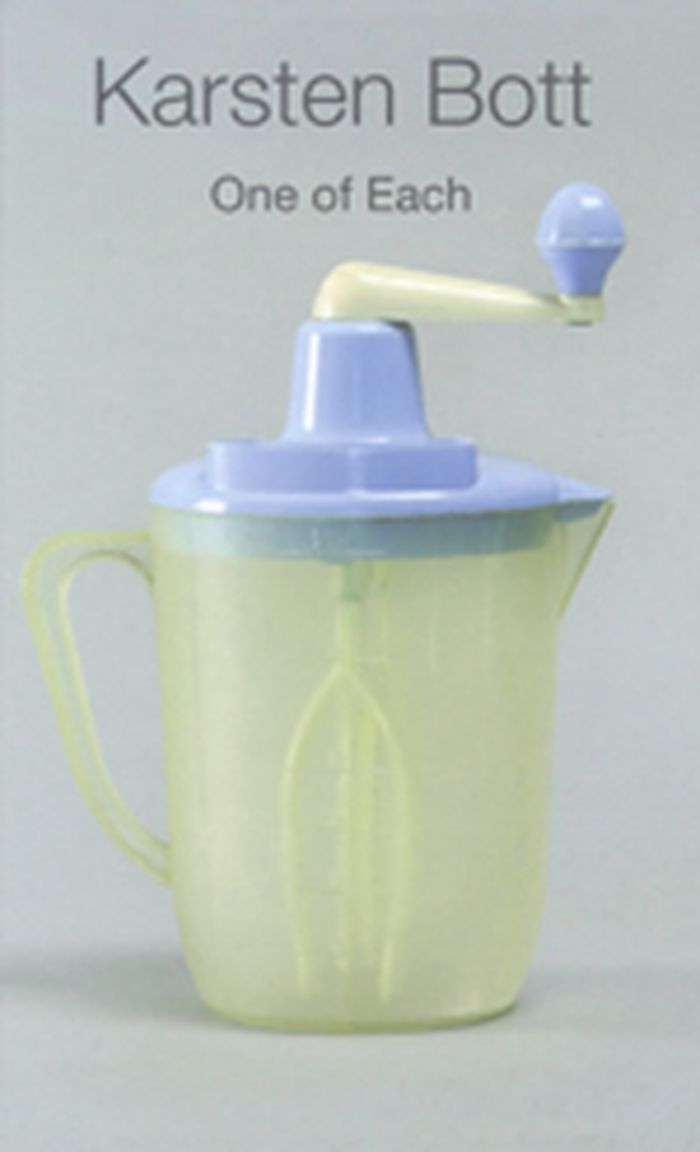
Since 1988, Frankfurt-based artist Karsten Bott has been collecting everyday objects--often discarded--and cataloguing them. Currently, his archive contains an unbelievable 500,000 objects. Bott is interested in making an archaeological inventory of things people need, noting how they use them and how these objects are related to one another. For One of Each, which is designed like a small dictionary or encyclopedia, he photographed more than 2,000 objects in his collection, which were carefully measured and alphabetically organized according to subjects such as "Bedroom", "Jewelry", "Sex" and "War". Within the "Film" category, for example, one might find a photograph of an Oscar award reproduction, as well as an old popcorn bucket. The photographs of the objects are taken in an unbiased, straightforward manner on a grey background, with dimensions and labels listed below.
Karsten Bott. One of each
Actions:
Prix:
$58.00
(disponible sur commande)
Résumé:
Since 1988, Frankfurt-based artist Karsten Bott has been collecting everyday objects--often discarded--and cataloguing them. Currently, his archive contains an unbelievable 500,000 objects. Bott is interested in making an archaeological inventory of things people need, noting how they use them and how these objects are related to one another. For One of Each, which is designed like a small dictionary or encyclopedia, he photographed more than 2,000 objects in his collection, which were carefully measured and alphabetically organized according to subjects such as "Bedroom", "Jewelry", "Sex" and "War". Within the "Film" category, for example, one might find a photograph of an Oscar award reproduction, as well as an old popcorn bucket. The photographs of the objects are taken in an unbiased, straightforward manner on a grey background, with dimensions and labels listed below.
Classification:
livres
livres
Publication:
décembre 2008, Cologne
décembre 2008, Cologne
Sujet:
Design industriel
Design industriel
Classification:
livres
livres

Titre:
Net'n'nest workspirit 10
Net'n'nest workspirit 10
Actions:
Prix:
$26.50
(disponible sur commande)
Résumé:
Furniture for cutting-edge offices designed by the Bouroullec brothers, Citterio, Bellini, Meda, Van Severen, Morrison, Arad, Starck and others.
$26.50
(disponible sur commande)
Résumé:
Furniture for cutting-edge offices designed by the Bouroullec brothers, Citterio, Bellini, Meda, Van Severen, Morrison, Arad, Starck and others.
Titre:
Net'n'nest workspirit 10
Actions:
Prix:
$26.50
(disponible sur commande)
Résumé:
Furniture for cutting-edge offices designed by the Bouroullec brothers, Citterio, Bellini, Meda, Van Severen, Morrison, Arad, Starck and others.
Net'n'nest workspirit 10
Actions:
Prix:
$26.50
(disponible sur commande)
Résumé:
Furniture for cutting-edge offices designed by the Bouroullec brothers, Citterio, Bellini, Meda, Van Severen, Morrison, Arad, Starck and others.
Classification:
livres
livres
Publication:
juin 2007
juin 2007
Sujet:
Design industriel
Design industriel
Classification:
livres
livres
Titre:
Vitra- Arrange
Vitra- Arrange
Actions:
Prix:
$42.00
(disponible sur commande)
Résumé:
Finally, a book that shows iconic modern furniture in real (read: lived-in) home environments, rather than sterile, I-don’t-believe- someone-actually-lives-here situations! This catalog from design giant Vitra Inc. is used as a marketing tool for furniture sales, and it’s beautifully persuasive, proving that these classic pieces of design can work in the real world. Put(...)
$42.00
(disponible sur commande)
Résumé:
Finally, a book that shows iconic modern furniture in real (read: lived-in) home environments, rather than sterile, I-don’t-believe- someone-actually-lives-here situations! This catalog from design giant Vitra Inc. is used as a marketing tool for furniture sales, and it’s beautifully persuasive, proving that these classic pieces of design can work in the real world. Put(...)
Sujet:
Design industriel
Design industriel
Publication:
juin 2007
juin 2007
Titre:
Vitra- Arrange
Actions:
Prix:
$42.00
(disponible sur commande)
Résumé:
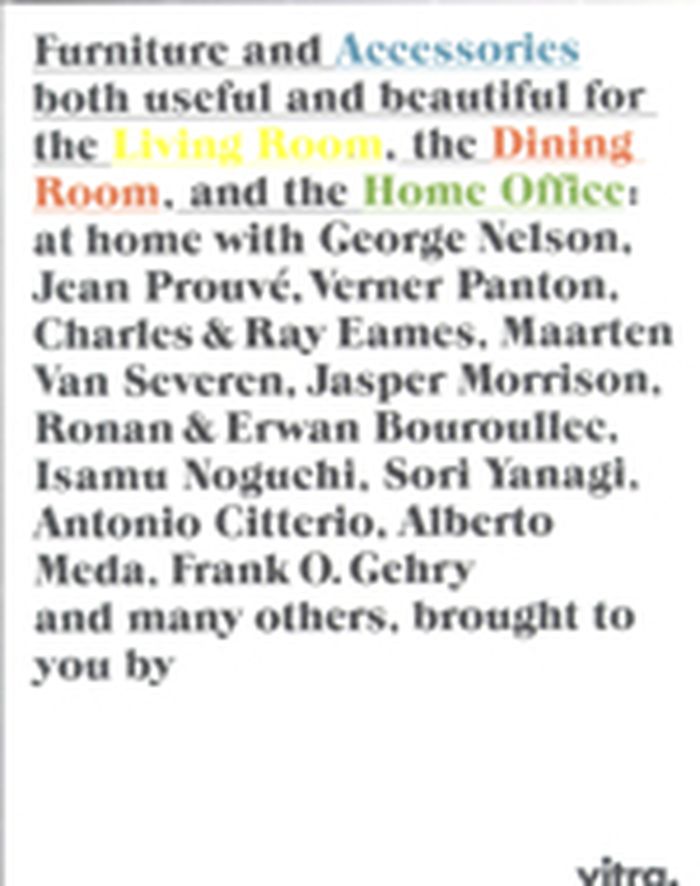
Finally, a book that shows iconic modern furniture in real (read: lived-in) home environments, rather than sterile, I-don’t-believe- someone-actually-lives-here situations! This catalog from design giant Vitra Inc. is used as a marketing tool for furniture sales, and it’s beautifully persuasive, proving that these classic pieces of design can work in the real world. Put an Eames lounge chair in front of a disheveled pile of records, a Nelson sunburst clock over a platter of leeks and carrots, or a Panton plastic chair at the bottom of a swimming pool with enthusiastic children using it for a diving platform – you’ll understand that fine design works anywhere. Just ask the black and white kitty curled up in the Nelson Coconut Chair. A handsome full-color volume.
Vitra- Arrange
Actions:
Prix:
$42.00
(disponible sur commande)
Résumé:
Finally, a book that shows iconic modern furniture in real (read: lived-in) home environments, rather than sterile, I-don’t-believe- someone-actually-lives-here situations! This catalog from design giant Vitra Inc. is used as a marketing tool for furniture sales, and it’s beautifully persuasive, proving that these classic pieces of design can work in the real world. Put an Eames lounge chair in front of a disheveled pile of records, a Nelson sunburst clock over a platter of leeks and carrots, or a Panton plastic chair at the bottom of a swimming pool with enthusiastic children using it for a diving platform – you’ll understand that fine design works anywhere. Just ask the black and white kitty curled up in the Nelson Coconut Chair. A handsome full-color volume.
Classification:
livres
livres
Publication:
juin 2007
juin 2007
Sujet:
Design industriel
Design industriel


