


2221 Résultats
Classification:
livres
livres
Titre:
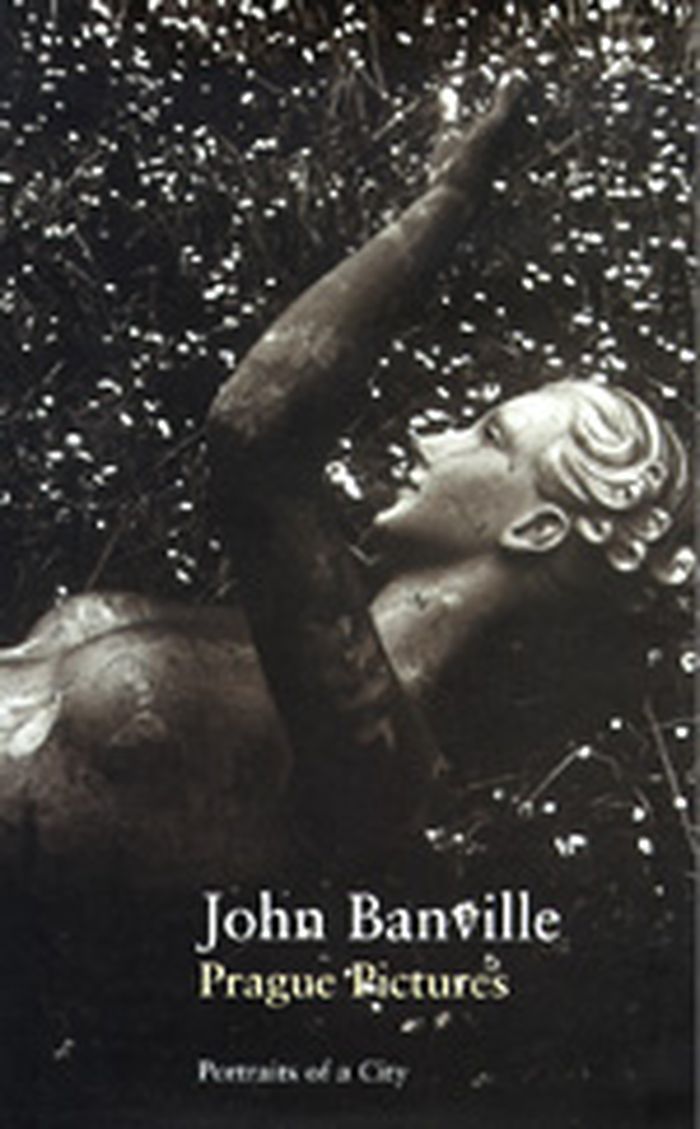
Prague pictures
Prague pictures
Actions:
Prix:
$23.95
(disponible sur commande)
Résumé:
John Banville traces Prague’s often tragic history and portrays the people who made it, the emperors and princes, geniuses and charlatans, heroes and scoundrels, and paints a portrait of the Prague of today, revelling in its newfound freedoms, eager to join the European Community and at the same time suspicious of what many Praguers see as yet another totalitarian(...)
$23.95
(disponible sur commande)
Résumé:
John Banville traces Prague’s often tragic history and portrays the people who made it, the emperors and princes, geniuses and charlatans, heroes and scoundrels, and paints a portrait of the Prague of today, revelling in its newfound freedoms, eager to join the European Community and at the same time suspicious of what many Praguers see as yet another totalitarian(...)
Titre:
Prague pictures
Actions:
Prix:
$23.95
(disponible sur commande)
Résumé:
John Banville traces Prague’s often tragic history and portrays the people who made it, the emperors and princes, geniuses and charlatans, heroes and scoundrels, and paints a portrait of the Prague of today, revelling in its newfound freedoms, eager to join the European Community and at the same time suspicious of what many Praguers see as yet another totalitarian takeover. He writes of his first visit to the city, in the depths of the cold War, when he engaged in a spot of art smuggling, and of subsequent trips there, of the people he met, the friends he made, the places he came to know.
Prague pictures
Actions:
Prix:
$23.95
(disponible sur commande)
Résumé:
John Banville traces Prague’s often tragic history and portrays the people who made it, the emperors and princes, geniuses and charlatans, heroes and scoundrels, and paints a portrait of the Prague of today, revelling in its newfound freedoms, eager to join the European Community and at the same time suspicious of what many Praguers see as yet another totalitarian takeover. He writes of his first visit to the city, in the depths of the cold War, when he engaged in a spot of art smuggling, and of subsequent trips there, of the people he met, the friends he made, the places he came to know.
Classification:
livres
livres
Publication:
octobre 2003, London
octobre 2003, London
Sujet:
Théorie de l’architecture
Théorie de l’architecture
Classification:
livres
livres
Actions:
Prix:
$95.00
(disponible sur commande)
Résumé:
The Valparaíso School, as it became known, acquired an international reputation for its radical stance and its commitment to dialogue between architects and other disciplines. Since 1970 the Valparaíso School has focused much of its research and design activity on the open city (ciudad abierta) project, created by a group of architects, artists, poets, and engineers(...)
$95.00
(disponible sur commande)
Résumé:
The Valparaíso School, as it became known, acquired an international reputation for its radical stance and its commitment to dialogue between architects and other disciplines. Since 1970 the Valparaíso School has focused much of its research and design activity on the open city (ciudad abierta) project, created by a group of architects, artists, poets, and engineers(...)
Sujet:
Théorie de l’architecture
Théorie de l’architecture
Publication:
août 2003, Montreal / Kingston
août 2003, Montreal / Kingston
Titre:
Valparaiso School : open city group
Actions:
Prix:
$95.00
(disponible sur commande)
Résumé:
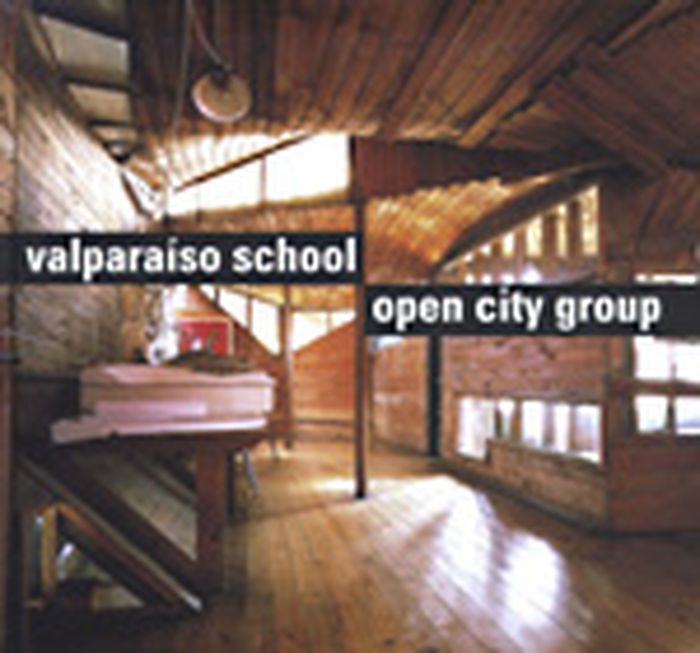
The Valparaíso School, as it became known, acquired an international reputation for its radical stance and its commitment to dialogue between architects and other disciplines. Since 1970 the Valparaíso School has focused much of its research and design activity on the open city (ciudad abierta) project, created by a group of architects, artists, poets, and engineers with a vision of a city with "no master plan, no imposed ordering devices, and no hierarchical networks of infrastructure." Originally set up as a laboratory-type environment, this alternative community has since become the place of residence and work for many people. "Valparaíso School: open city group" provides insight into this radical experiment in urban development through a series of essays and photographs.
Valparaiso School : open city group
Actions:
Prix:
$95.00
(disponible sur commande)
Résumé:
The Valparaíso School, as it became known, acquired an international reputation for its radical stance and its commitment to dialogue between architects and other disciplines. Since 1970 the Valparaíso School has focused much of its research and design activity on the open city (ciudad abierta) project, created by a group of architects, artists, poets, and engineers with a vision of a city with "no master plan, no imposed ordering devices, and no hierarchical networks of infrastructure." Originally set up as a laboratory-type environment, this alternative community has since become the place of residence and work for many people. "Valparaíso School: open city group" provides insight into this radical experiment in urban development through a series of essays and photographs.
Classification:
livres
livres
Publication:
août 2003, Montreal / Kingston
août 2003, Montreal / Kingston
Sujet:
Théorie de l’architecture
Théorie de l’architecture
Classification:
livres
livres
Actions:
Prix:
$51.50
(disponible sur commande)
Résumé:
This book takes a fresh approach to positioning the role of the computer in contemporary architectural theory and discourse, but of greater significance, Susannah Hagan also positions the computer in terms of making a significant contribution to revolving major environmental and social problems.
$51.50
(disponible sur commande)
Résumé:
This book takes a fresh approach to positioning the role of the computer in contemporary architectural theory and discourse, but of greater significance, Susannah Hagan also positions the computer in terms of making a significant contribution to revolving major environmental and social problems.
Titre:
Digitalia: architecture and the digital, the environmental and the avant-garde
Actions:
Prix:
$51.50
(disponible sur commande)
Résumé:
This book takes a fresh approach to positioning the role of the computer in contemporary architectural theory and discourse, but of greater significance, Susannah Hagan also positions the computer in terms of making a significant contribution to revolving major environmental and social problems.
Digitalia: architecture and the digital, the environmental and the avant-garde
Actions:
Prix:
$51.50
(disponible sur commande)
Résumé:
This book takes a fresh approach to positioning the role of the computer in contemporary architectural theory and discourse, but of greater significance, Susannah Hagan also positions the computer in terms of making a significant contribution to revolving major environmental and social problems.
Classification:
livres
livres
Publication:
mars 2008, London, New York
mars 2008, London, New York
Sujet:
Théorie de l’architecture
Théorie de l’architecture
Classification:
livres
livres
Actions:
Prix:
$11.50
(disponible sur commande)
Résumé:
On March 28th, 2007, the Forum For Urban Design assembled four distinguished architecture critics, Karrie Jacobs and Philip Nobel from New York, and Jeremy Melvin and Rowan Moore from London, to discuss today's Age of Starchitecture, and their complicity in creating it. The second annual Temko Critics Panel was moderated by Joseph Grima, director of the Storefront for Art(...)
$11.50
(disponible sur commande)
Résumé:
On March 28th, 2007, the Forum For Urban Design assembled four distinguished architecture critics, Karrie Jacobs and Philip Nobel from New York, and Jeremy Melvin and Rowan Moore from London, to discuss today's Age of Starchitecture, and their complicity in creating it. The second annual Temko Critics Panel was moderated by Joseph Grima, director of the Storefront for Art(...)
Titre:
A critical situation: What to make of Starchitecture (and who to blame for it)
Actions:
Prix:
$11.50
(disponible sur commande)
Résumé:
On March 28th, 2007, the Forum For Urban Design assembled four distinguished architecture critics, Karrie Jacobs and Philip Nobel from New York, and Jeremy Melvin and Rowan Moore from London, to discuss today's Age of Starchitecture, and their complicity in creating it. The second annual Temko Critics Panel was moderated by Joseph Grima, director of the Storefront for Art and Architecture.
A critical situation: What to make of Starchitecture (and who to blame for it)
Actions:
Prix:
$11.50
(disponible sur commande)
Résumé:
On March 28th, 2007, the Forum For Urban Design assembled four distinguished architecture critics, Karrie Jacobs and Philip Nobel from New York, and Jeremy Melvin and Rowan Moore from London, to discuss today's Age of Starchitecture, and their complicity in creating it. The second annual Temko Critics Panel was moderated by Joseph Grima, director of the Storefront for Art and Architecture.
Classification:
livres
livres
Publication:
mars 2007, New York
mars 2007, New York
Sujet:
Théorie de l’architecture
Théorie de l’architecture
Classification:
livres
livres
Actions:
Prix:
$31.95
(disponible sur commande)
Résumé:
In this book art critic and historian Sven Lutticken takes philosopher Theodor Adorno's critique of popular arts and culture a step further. Adorno criticized the manipulation of taste in official cultures and the pretense of individualism; Lutticken looks at the tension between fundamentalism and individualism in the context of the current religious-political image wars.(...)
$31.95
(disponible sur commande)
Résumé:
In this book art critic and historian Sven Lutticken takes philosopher Theodor Adorno's critique of popular arts and culture a step further. Adorno criticized the manipulation of taste in official cultures and the pretense of individualism; Lutticken looks at the tension between fundamentalism and individualism in the context of the current religious-political image wars.(...)
Titre:
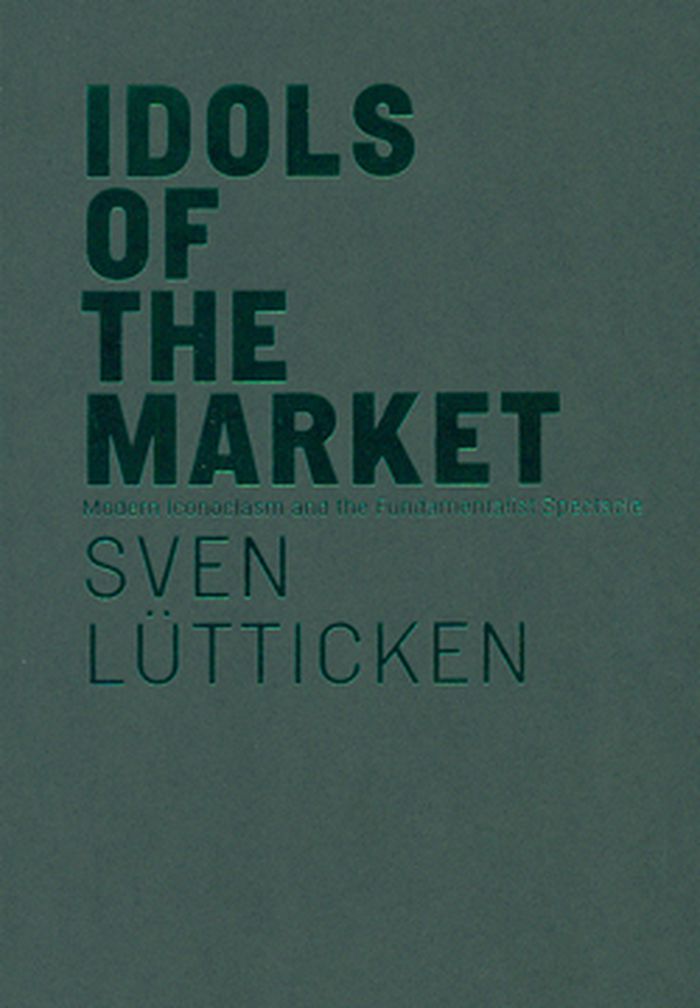
Idols of the market: modern iconoclasm and the Fundamentalist spectacle
Actions:
Prix:
$31.95
(disponible sur commande)
Résumé:
In this book art critic and historian Sven Lutticken takes philosopher Theodor Adorno's critique of popular arts and culture a step further. Adorno criticized the manipulation of taste in official cultures and the pretense of individualism; Lutticken looks at the tension between fundamentalism and individualism in the context of the current religious-political image wars. This book examines both the afterlife of religious elements in modern culture and possible responses to the current religious re-appropriation of Adorno's critique of modern capitalist culture by both Christian fundamentalists and radical Islamists.
Idols of the market: modern iconoclasm and the Fundamentalist spectacle
Actions:
Prix:
$31.95
(disponible sur commande)
Résumé:
In this book art critic and historian Sven Lutticken takes philosopher Theodor Adorno's critique of popular arts and culture a step further. Adorno criticized the manipulation of taste in official cultures and the pretense of individualism; Lutticken looks at the tension between fundamentalism and individualism in the context of the current religious-political image wars. This book examines both the afterlife of religious elements in modern culture and possible responses to the current religious re-appropriation of Adorno's critique of modern capitalist culture by both Christian fundamentalists and radical Islamists.
Classification:
livres
livres
Publication:
octobre 2009
octobre 2009
Sujet:
Théorie de l’architecture
Théorie de l’architecture
Classification:
livres
livres
Actions:
Prix:
$42.95
(disponible sur commande)
Résumé:
Is Europe a place, a space, or a temporary community of shared interests? As a political space, Europe is as conflictual as its debated constitution. It is a construct that must be continuously negotiated, and its longing for an architecture of strategic encounters parallels an increasing economical power of the private sector, while the sovereignty of European nation(...)
$42.95
(disponible sur commande)
Résumé:
Is Europe a place, a space, or a temporary community of shared interests? As a political space, Europe is as conflictual as its debated constitution. It is a construct that must be continuously negotiated, and its longing for an architecture of strategic encounters parallels an increasing economical power of the private sector, while the sovereignty of European nation(...)
Titre:
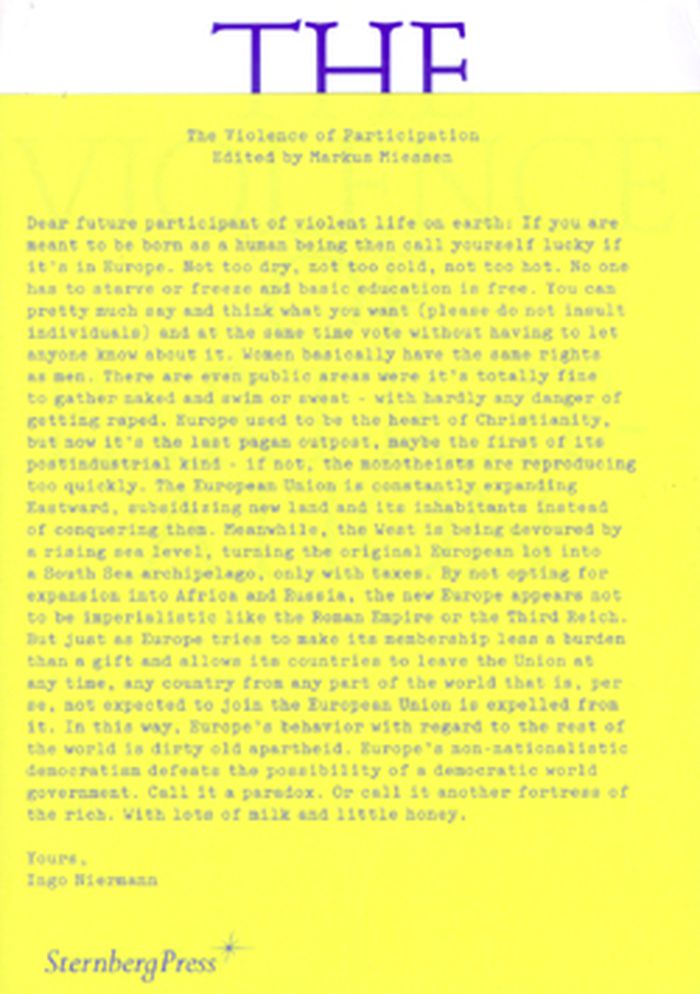
The violence of participation
Actions:
Prix:
$42.95
(disponible sur commande)
Résumé:
Is Europe a place, a space, or a temporary community of shared interests? As a political space, Europe is as conflictual as its debated constitution. It is a construct that must be continuously negotiated, and its longing for an architecture of strategic encounters parallels an increasing economical power of the private sector, while the sovereignty of European nation states attenuate. This book, edited by London-based architect and author Markus Miessen, marks an extension of the discursive space he has produced as contribution to the 2007 Lyon Biennial. He has pulled together a heterogeneous group of interlocutors to lead conversations on alternative notions of participation, the inconsistence between democratic concepts, and what it means to live in Europe today.
The violence of participation
Actions:
Prix:
$42.95
(disponible sur commande)
Résumé:
Is Europe a place, a space, or a temporary community of shared interests? As a political space, Europe is as conflictual as its debated constitution. It is a construct that must be continuously negotiated, and its longing for an architecture of strategic encounters parallels an increasing economical power of the private sector, while the sovereignty of European nation states attenuate. This book, edited by London-based architect and author Markus Miessen, marks an extension of the discursive space he has produced as contribution to the 2007 Lyon Biennial. He has pulled together a heterogeneous group of interlocutors to lead conversations on alternative notions of participation, the inconsistence between democratic concepts, and what it means to live in Europe today.
Classification:
livres
livres
Publication:
décembre 2007, Lyon
décembre 2007, Lyon
Sujet:
Théorie de l’architecture
Théorie de l’architecture
Classification:
livres
livres
Actions:
Prix:
$42.00
(disponible sur commande)
Résumé:
A compendium of lectures from the international architecture conference in 2005, Architecture + Art: New Visions, New Strategies looks at the fertile overlap between two competing (and complementary) disciplines. Published by the Alvar Aalto Academy, the essays explore the history of the border between art and architecture, from Aalto to Gordon Matta-Clark. What role did(...)
$42.00
(disponible sur commande)
Résumé:
A compendium of lectures from the international architecture conference in 2005, Architecture + Art: New Visions, New Strategies looks at the fertile overlap between two competing (and complementary) disciplines. Published by the Alvar Aalto Academy, the essays explore the history of the border between art and architecture, from Aalto to Gordon Matta-Clark. What role did(...)
Sujet:
Théorie de l’architecture
Théorie de l’architecture
Publication:
janvier 1900, Helsinki
janvier 1900, Helsinki
Titre:
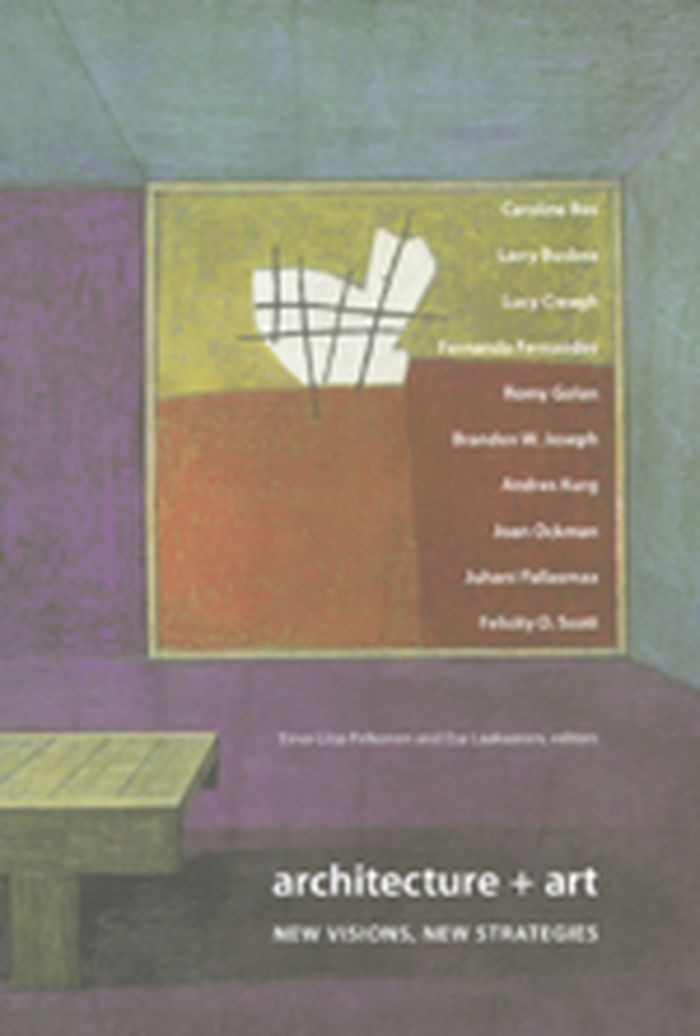
Architecture and art: New visions, new strategies
Actions:
Prix:
$42.00
(disponible sur commande)
Résumé:
A compendium of lectures from the international architecture conference in 2005, Architecture + Art: New Visions, New Strategies looks at the fertile overlap between two competing (and complementary) disciplines. Published by the Alvar Aalto Academy, the essays explore the history of the border between art and architecture, from Aalto to Gordon Matta-Clark. What role did art play in the history of modern architecture? How did architecture influence art? What’s the current state of the balance between the two fields? Illustrated with color photographs and black and white reproductions, with a foreward by Aalto Academy Professor Eeva-Lisa Pelkonen, the thought-provoking essays strive to illuminate the mystery of overlap, from Le Corbusier to Donald Judd. In a world where Frank Gehry claims architecture is art against Richard Serra’s wishes, it’s refreshing to learn there’s more than one viewpoint at the table. The most recent publication from the Academy’s forward-thinking conferences held every summer in Finland.
Architecture and art: New visions, new strategies
Actions:
Prix:
$42.00
(disponible sur commande)
Résumé:
A compendium of lectures from the international architecture conference in 2005, Architecture + Art: New Visions, New Strategies looks at the fertile overlap between two competing (and complementary) disciplines. Published by the Alvar Aalto Academy, the essays explore the history of the border between art and architecture, from Aalto to Gordon Matta-Clark. What role did art play in the history of modern architecture? How did architecture influence art? What’s the current state of the balance between the two fields? Illustrated with color photographs and black and white reproductions, with a foreward by Aalto Academy Professor Eeva-Lisa Pelkonen, the thought-provoking essays strive to illuminate the mystery of overlap, from Le Corbusier to Donald Judd. In a world where Frank Gehry claims architecture is art against Richard Serra’s wishes, it’s refreshing to learn there’s more than one viewpoint at the table. The most recent publication from the Academy’s forward-thinking conferences held every summer in Finland.
Classification:
livres
livres
Publication:
janvier 1900, Helsinki
janvier 1900, Helsinki
Sujet:
Théorie de l’architecture
Théorie de l’architecture
Classification:
livres
livres
Actions:
Prix:
$32.00
(disponible sur commande)
Résumé:
Leading architects from two contries, Switzerland and the United States, were brought together in five interviews to discuss research and the role it plays in the building process. 5 x 2 documents their international exchange (five interviews, two contries) revealing salient issues in contemporary practice.
$32.00
(disponible sur commande)
Résumé:
Leading architects from two contries, Switzerland and the United States, were brought together in five interviews to discuss research and the role it plays in the building process. 5 x 2 documents their international exchange (five interviews, two contries) revealing salient issues in contemporary practice.
Titre:
5 x 2 research and the making of architecture
Actions:
Prix:
$32.00
(disponible sur commande)
Résumé:
Leading architects from two contries, Switzerland and the United States, were brought together in five interviews to discuss research and the role it plays in the building process. 5 x 2 documents their international exchange (five interviews, two contries) revealing salient issues in contemporary practice.
5 x 2 research and the making of architecture
Actions:
Prix:
$32.00
(disponible sur commande)
Résumé:
Leading architects from two contries, Switzerland and the United States, were brought together in five interviews to discuss research and the role it plays in the building process. 5 x 2 documents their international exchange (five interviews, two contries) revealing salient issues in contemporary practice.
Classification:
livres
livres
Publication:
février 2007, Berkeley
février 2007, Berkeley
Sujet:
Théorie de l’architecture
Théorie de l’architecture
Classification:
livres
livres
Actions:
Prix:
$17.00
(disponible sur commande)
Résumé:
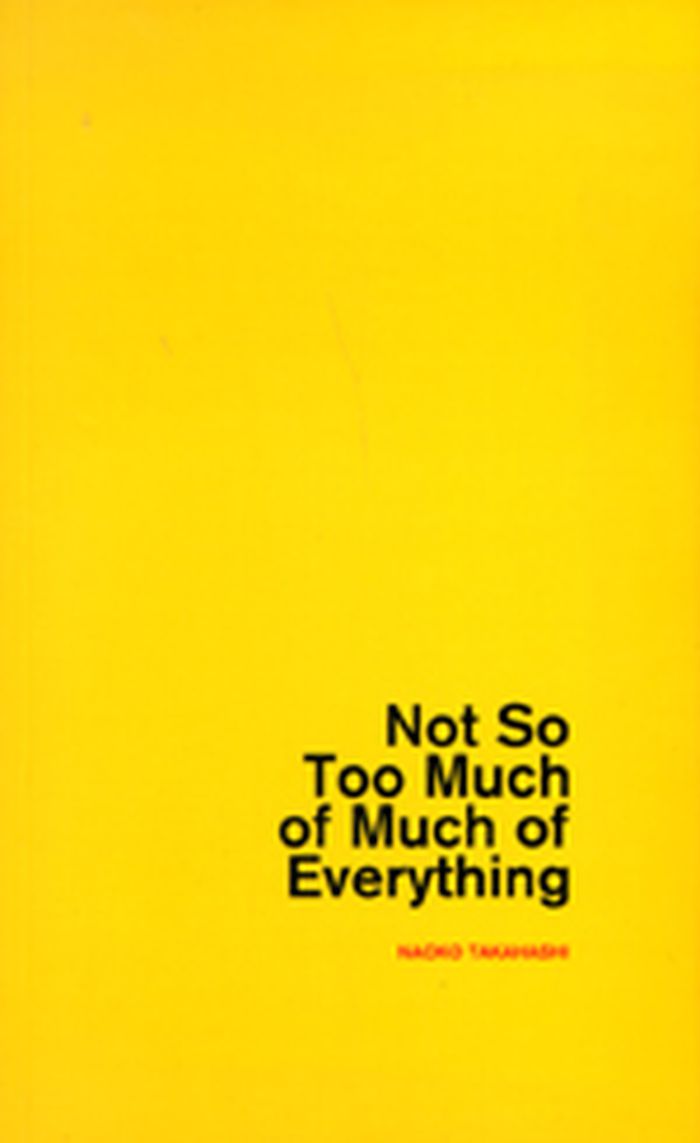
During a three-month residency in Sharjah, United Arab Emirates, Japanese-born, London-based artist and filmmaker Naoko Takahashi confronted the issues of dislocation, mistranslation and gender politics in the Arab world. In this chapbook, written in the style of a factual report, she takes the reader on a breathless journey through the air-conditioned rooms and arid(...)
$17.00
(disponible sur commande)
Résumé:
During a three-month residency in Sharjah, United Arab Emirates, Japanese-born, London-based artist and filmmaker Naoko Takahashi confronted the issues of dislocation, mistranslation and gender politics in the Arab world. In this chapbook, written in the style of a factual report, she takes the reader on a breathless journey through the air-conditioned rooms and arid(...)
Titre:
Not so too much of everything
Actions:
Prix:
$17.00
(disponible sur commande)
Résumé:
During a three-month residency in Sharjah, United Arab Emirates, Japanese-born, London-based artist and filmmaker Naoko Takahashi confronted the issues of dislocation, mistranslation and gender politics in the Arab world. In this chapbook, written in the style of a factual report, she takes the reader on a breathless journey through the air-conditioned rooms and arid streets of the modern Arab metropolis, where she feels that every move she makes is misread and that her identity is repeatedly forced upon her and manipulated in ways she cannot control. Takahashi’s work highlights the ambiguities and confusions of identities as played out through language in a multi-cultural, multi-lingual society. Moving from confusion and isolation to anger in the course of the book, she casts her experiences as a modern allegory of alienation. Part of Book Works Chapbook Series.
Not so too much of everything
Actions:
Prix:
$17.00
(disponible sur commande)
Résumé:
During a three-month residency in Sharjah, United Arab Emirates, Japanese-born, London-based artist and filmmaker Naoko Takahashi confronted the issues of dislocation, mistranslation and gender politics in the Arab world. In this chapbook, written in the style of a factual report, she takes the reader on a breathless journey through the air-conditioned rooms and arid streets of the modern Arab metropolis, where she feels that every move she makes is misread and that her identity is repeatedly forced upon her and manipulated in ways she cannot control. Takahashi’s work highlights the ambiguities and confusions of identities as played out through language in a multi-cultural, multi-lingual society. Moving from confusion and isolation to anger in the course of the book, she casts her experiences as a modern allegory of alienation. Part of Book Works Chapbook Series.
Classification:
livres
livres
Publication:
janvier 1900, London
janvier 1900, London
Sujet:
Théorie de l’architecture
Théorie de l’architecture
Classification:
livres
livres
Prix:
$50.95
(disponible en magasin)
Résumé:
Has Man A Function In Universe? is part of an ongoing project to develop forty projects related to forty questions written by R. Buckminster Fuller. Each project is an artwork or a combination of artworks, developed in response to one of the questions. Of all the questions ‘Has Man A Function In Universe?’ may be the key that binds and directs all of the other questions.(...)
$50.95
(disponible en magasin)
Résumé:
Has Man A Function In Universe? is part of an ongoing project to develop forty projects related to forty questions written by R. Buckminster Fuller. Each project is an artwork or a combination of artworks, developed in response to one of the questions. Of all the questions ‘Has Man A Function In Universe?’ may be the key that binds and directs all of the other questions.(...)
Titre:
Strategic questions #2: Has man a function in the universe?
Actions:
Prix:
$50.95
(disponible en magasin)
Résumé:
Has Man A Function In Universe? is part of an ongoing project to develop forty projects related to forty questions written by R. Buckminster Fuller. Each project is an artwork or a combination of artworks, developed in response to one of the questions. Of all the questions ‘Has Man A Function In Universe?’ may be the key that binds and directs all of the other questions. Gavin Wade has commissioned artists and writers to respond to this question using a combination of text and image. The publication will reflect the process of the project—an ‘exquisite corpse’ involving collaboration, dissemination and the combining of works. Contributions from: Neil Chapman, Shezad Dawood, Per Hüttner, Juneau Projects, Karin Kihlberg & Reuben Henry, Kerry James Marshall, Jessica Spanyol, Lisa Strömbeck, Mark Titchner, Sue Tompkins, Hayley Tompkins, Gavin Wade and Carey Young.
Strategic questions #2: Has man a function in the universe?
Actions:
Prix:
$50.95
(disponible en magasin)
Résumé:
Has Man A Function In Universe? is part of an ongoing project to develop forty projects related to forty questions written by R. Buckminster Fuller. Each project is an artwork or a combination of artworks, developed in response to one of the questions. Of all the questions ‘Has Man A Function In Universe?’ may be the key that binds and directs all of the other questions. Gavin Wade has commissioned artists and writers to respond to this question using a combination of text and image. The publication will reflect the process of the project—an ‘exquisite corpse’ involving collaboration, dissemination and the combining of works. Contributions from: Neil Chapman, Shezad Dawood, Per Hüttner, Juneau Projects, Karin Kihlberg & Reuben Henry, Kerry James Marshall, Jessica Spanyol, Lisa Strömbeck, Mark Titchner, Sue Tompkins, Hayley Tompkins, Gavin Wade and Carey Young.
Classification:
livres
livres
Publication:
mars 2008
mars 2008
Sujet:
Théorie de l’architecture
Théorie de l’architecture


