


146 Résultats
Classification:
livres
livres
Actions:
Exemplaires:
Description:
approximately 200 pages : color illustrations, color maps ; 28 cm
Description:
approximately 200 pages : color illustrations, color maps ; 28 cm
Auteur:
Sujet:
Publication:
London : I.B. Tauris & Co Ltd, 2007.
London : I.B. Tauris & Co Ltd, 2007.
Titre:
Intervention architecture : building for change.
Actions:
Exemplaires:
Description:
approximately 200 pages : color illustrations, color maps ; 28 cm
Intervention architecture : building for change.
Actions:
Exemplaires:
Description:
approximately 200 pages : color illustrations, color maps ; 28 cm
Classification:
livres
livres
Publication:
London : I.B. Tauris & Co Ltd, 2007.
London : I.B. Tauris & Co Ltd, 2007.
Auteur:
Sujet:
Classification:
livres
livres
Actions:
Exemplaires:
Description:
63 pages : illustrations ; 30 cm
Description:
63 pages : illustrations ; 30 cm
Auteur:
Sujet:
Publication:
Bratislava : TeMPo, 1991.
Bratislava : TeMPo, 1991.
Titre:
Piety Slovenska, Marec-Máj 1991, Bratislavský Hrad = Vesperbilder in der Slowakei, März-Mai 1991, Bratislavaer Burg / vydané pod záštitou Ministra kultúry slovenskej republiky, Ladislava Snopka = Herausgestellt unter der Schirmherrschaft des Ministers für Kultur der slowakischen Republik, Ladislav Snopko.
Actions:
Exemplaires:
Description:
63 pages : illustrations ; 30 cm
Piety Slovenska, Marec-Máj 1991, Bratislavský Hrad = Vesperbilder in der Slowakei, März-Mai 1991, Bratislavaer Burg / vydané pod záštitou Ministra kultúry slovenskej republiky, Ladislava Snopka = Herausgestellt unter der Schirmherrschaft des Ministers für Kultur der slowakischen Republik, Ladislav Snopko.
Actions:
Exemplaires:
Description:
63 pages : illustrations ; 30 cm
Classification:
livres
livres
Publication:
Bratislava : TeMPo, 1991.
Bratislava : TeMPo, 1991.
Auteur:
Sujet:
Classification:
livres
livres
Actions:
Exemplaires:
Description:
117 : chiefly illustrations, maps, plans ; 21 cm
Description:
117 : chiefly illustrations, maps, plans ; 21 cm
Auteur:
Sujet:
Publication:
[Brno] : [publisher not identified], [1933]
[Brno] : [publisher not identified], [1933]
Titre:
Katalog výstavy stavebnictví a bydlení / redakce, B. Fuchs, J. Oplt, Z. Rossmann.
Actions:
Exemplaires:
Description:
117 : chiefly illustrations, maps, plans ; 21 cm
Katalog výstavy stavebnictví a bydlení / redakce, B. Fuchs, J. Oplt, Z. Rossmann.
Actions:
Exemplaires:
Description:
117 : chiefly illustrations, maps, plans ; 21 cm
Classification:
livres
livres
Publication:
[Brno] : [publisher not identified], [1933]
[Brno] : [publisher not identified], [1933]
Auteur:
Sujet:
Classification:
livres
livres
Actions:
Exemplaires:
Description:
159 pages : color illustrations ; 25 cm
Description:
159 pages : color illustrations ; 25 cm
Auteur:
Sujet:
Publication:
Munich : Prestel Verlag, [2013], ©2013
Munich : Prestel Verlag, [2013], ©2013
Titre:
The style of coworking : contemporary shared workspaces / Alice Davies & Kathryn Tollervey.
Actions:
Exemplaires:
Description:
159 pages : color illustrations ; 25 cm
The style of coworking : contemporary shared workspaces / Alice Davies & Kathryn Tollervey.
Actions:
Exemplaires:
Description:
159 pages : color illustrations ; 25 cm
Classification:
livres
livres
Publication:
Munich : Prestel Verlag, [2013], ©2013
Munich : Prestel Verlag, [2013], ©2013
Auteur:
Sujet:
Classification:
périodiques
périodiques
Titre:
Stolica.
Stolica.
Actions:
Exemplaires:
Description:
volumes : illustrations (some color) ; 29-43 cm
Description:
volumes : illustrations (some color) ; 29-43 cm
Auteur:
Sujet:
Publication:
Warszawa : Naczelna Rada Odbudowy Warszawy, [1946]-, Warszawa : EKBIN
Warszawa : Naczelna Rada Odbudowy Warszawy, [1946]-, Warszawa : EKBIN
Classification:
périodiques
périodiques
Publication:
Warszawa : Naczelna Rada Odbudowy Warszawy, [1946]-, Warszawa : EKBIN
Warszawa : Naczelna Rada Odbudowy Warszawy, [1946]-, Warszawa : EKBIN
Auteur:
Sujet:
Classification:
livres
livres
Actions:
Exemplaires:
Description:
28 pages : color illustrations ; 17 x 24 cm
Description:
28 pages : color illustrations ; 17 x 24 cm
Auteur:
Sujet:
Publication:
[Warsaw] : [SARP], ©2009.
[Warsaw] : [SARP], ©2009.
Titre:
Polska polityka architektoniczna : polityka jakości krajobrazu, przestrzeni publicznej, architektury, 6 maja 2009.
Actions:
Exemplaires:
Description:
28 pages : color illustrations ; 17 x 24 cm
Polska polityka architektoniczna : polityka jakości krajobrazu, przestrzeni publicznej, architektury, 6 maja 2009.
Actions:
Exemplaires:
Description:
28 pages : color illustrations ; 17 x 24 cm
Classification:
livres
livres
Publication:
[Warsaw] : [SARP], ©2009.
[Warsaw] : [SARP], ©2009.
Auteur:
Sujet:
Classification:
livres
livres
Actions:
Exemplaires:
Description:
183 pages : illustrations ; 29 cm
Description:
183 pages : illustrations ; 29 cm
Auteur:
Sujet:
Publication:
Kharkiv : Kharkivsʹkyĭ okruz︠h︡nyĭ vykonavchyĭ komitet : Misʹka rada : Komitet spryi︠a︡nni︠a︡ budivnyt︠s︡tvu, 1930.
Kharkiv : Kharkivsʹkyĭ okruz︠h︡nyĭ vykonavchyĭ komitet : Misʹka rada : Komitet spryi︠a︡nni︠a︡ budivnyt︠s︡tvu, 1930.
Titre:
Prohrama Miz︠h︡narodnʹoho konkursu na proi︠e︡kt Derz︠h︡avnoho ukraïnsʹkoho teatru masovoho muzychnoho diĭstva na 4.000 cholovika, v m. Kharkovi.
Actions:
Exemplaires:
Description:
183 pages : illustrations ; 29 cm
Prohrama Miz︠h︡narodnʹoho konkursu na proi︠e︡kt Derz︠h︡avnoho ukraïnsʹkoho teatru masovoho muzychnoho diĭstva na 4.000 cholovika, v m. Kharkovi.
Actions:
Exemplaires:
Description:
183 pages : illustrations ; 29 cm
Classification:
livres
livres
Publication:
Kharkiv : Kharkivsʹkyĭ okruz︠h︡nyĭ vykonavchyĭ komitet : Misʹka rada : Komitet spryi︠a︡nni︠a︡ budivnyt︠s︡tvu, 1930.
Kharkiv : Kharkivsʹkyĭ okruz︠h︡nyĭ vykonavchyĭ komitet : Misʹka rada : Komitet spryi︠a︡nni︠a︡ budivnyt︠s︡tvu, 1930.
Auteur:
Sujet:
Classification:
livres
livres
Titre:
Lincoln/MITRE.
Lincoln/MITRE.
Actions:
Description:
1 online resource
Auteur:
Sujet:
Publication:
[Place of publication not identified] : David Bennewith, 2016.
[Place of publication not identified] : David Bennewith, 2016.
Classification:
livres
livres
Publication:
[Place of publication not identified] : David Bennewith, 2016.
[Place of publication not identified] : David Bennewith, 2016.
Auteur:
Sujet:
Classification:
périodiques
périodiques
Titre:
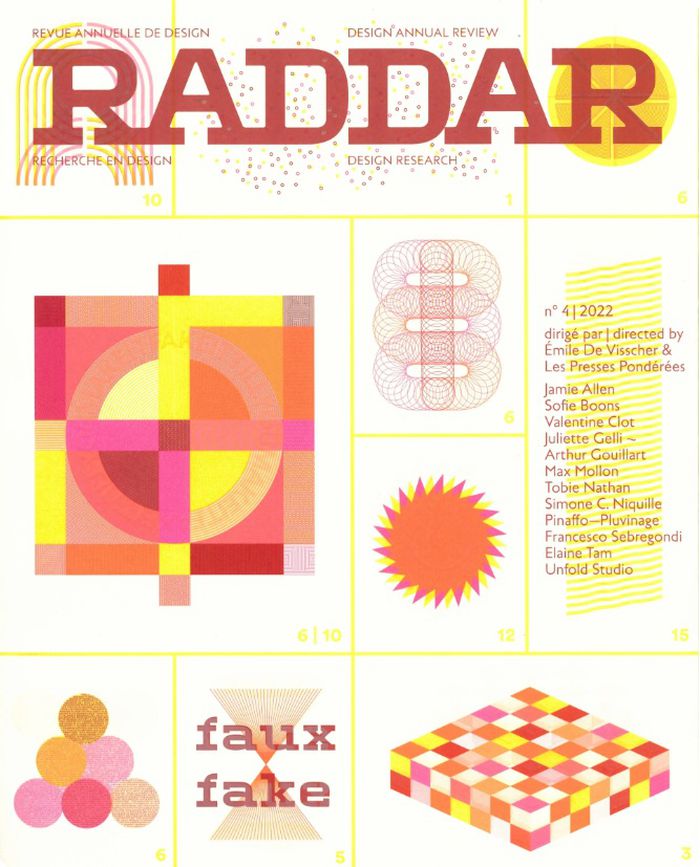
Raddar 4: Faux/Fake
Raddar 4: Faux/Fake
Actions:
Prix:
$46.95
(disponible en magasin)
Résumé:
Underpinning this edition of ''Raddar'' is a contemplation of design and the consequences of the will and power of creation. Design has long played with the notions or variations of fake – questions of falsification, touching on issues of manipulation and broader social concerns. All the articles are written by designers or researchers for whom the concept of fake had to(...)
$46.95
(disponible en magasin)
Résumé:
Underpinning this edition of ''Raddar'' is a contemplation of design and the consequences of the will and power of creation. Design has long played with the notions or variations of fake – questions of falsification, touching on issues of manipulation and broader social concerns. All the articles are written by designers or researchers for whom the concept of fake had to(...)
Titre:
Raddar 4: Faux/Fake
Actions:
Prix:
$46.95
(disponible en magasin)
Résumé:
Underpinning this edition of ''Raddar'' is a contemplation of design and the consequences of the will and power of creation. Design has long played with the notions or variations of fake – questions of falsification, touching on issues of manipulation and broader social concerns. All the articles are written by designers or researchers for whom the concept of fake had to be re-invoked. This is because the increasingly ambiguous link between our societies with deceptive techniques, reconstructions, post-truths, alternative facts, fact-checking, etc., necessarily repositions their practices in new relationships with the tools, projects, or observations of the realms where they act and operate.
Raddar 4: Faux/Fake
Actions:
Prix:
$46.95
(disponible en magasin)
Résumé:
Underpinning this edition of ''Raddar'' is a contemplation of design and the consequences of the will and power of creation. Design has long played with the notions or variations of fake – questions of falsification, touching on issues of manipulation and broader social concerns. All the articles are written by designers or researchers for whom the concept of fake had to be re-invoked. This is because the increasingly ambiguous link between our societies with deceptive techniques, reconstructions, post-truths, alternative facts, fact-checking, etc., necessarily repositions their practices in new relationships with the tools, projects, or observations of the realms where they act and operate.
Classification:
périodiques
périodiques
Publication:
août 2022
août 2022
Sujet:
Revues
Revues
Classification:
périodiques
périodiques
Actions:
Prix:
$46.95
(disponible en magasin)
Résumé:
The COVID-19 pandemic has forced a re-examination of the architecture and design of our interiors from a wide range of perspectives. As containment measures were imposed, the private dwelling became central to the lives of many people worldwide; no longer a simple accumulation of furniture and objects, the interior is an intimate, socio-cultural construction anchored in a(...)
$46.95
(disponible en magasin)
Résumé:
The COVID-19 pandemic has forced a re-examination of the architecture and design of our interiors from a wide range of perspectives. As containment measures were imposed, the private dwelling became central to the lives of many people worldwide; no longer a simple accumulation of furniture and objects, the interior is an intimate, socio-cultural construction anchored in a(...)
Titre:
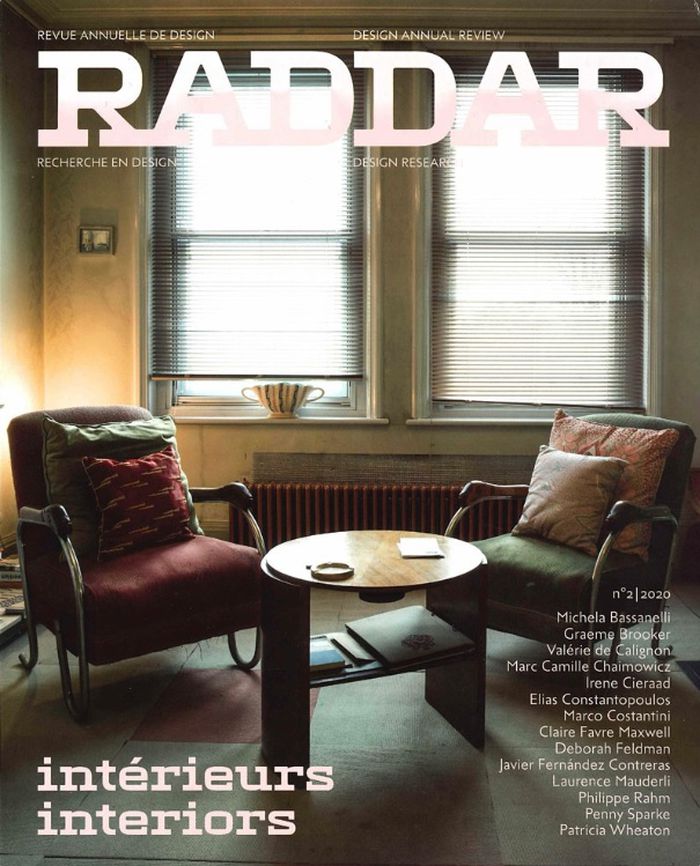
Raddar 2: intérieures / interiors
Actions:
Prix:
$46.95
(disponible en magasin)
Résumé:
The COVID-19 pandemic has forced a re-examination of the architecture and design of our interiors from a wide range of perspectives. As containment measures were imposed, the private dwelling became central to the lives of many people worldwide; no longer a simple accumulation of furniture and objects, the interior is an intimate, socio-cultural construction anchored in a precise moment of space and time. A text by Swiss architect Philippe Rahm, who has long worked on climate phenomena and is now looking at its relationship with the pandemic, is among the ten articles by international contributors in this issue, guest edited by design historian Penny Sparke.
Raddar 2: intérieures / interiors
Actions:
Prix:
$46.95
(disponible en magasin)
Résumé:
The COVID-19 pandemic has forced a re-examination of the architecture and design of our interiors from a wide range of perspectives. As containment measures were imposed, the private dwelling became central to the lives of many people worldwide; no longer a simple accumulation of furniture and objects, the interior is an intimate, socio-cultural construction anchored in a precise moment of space and time. A text by Swiss architect Philippe Rahm, who has long worked on climate phenomena and is now looking at its relationship with the pandemic, is among the ten articles by international contributors in this issue, guest edited by design historian Penny Sparke.
Classification:
périodiques
périodiques
Publication:
octobre 2020
octobre 2020
Sujet:
Revues
Revues


