


4204 Résultats
Classification:
documents textuels
documents textuels

Numéro de référence:
ARCH280507
ARCH280507
Personnes et institutions:
Date:
May 1974
May 1974
Classification:
documents textuels
documents textuels
Date:
May 1974
May 1974
Personnes et institutions:
Classification:
dessins
dessins
Numéro de référence:
AP075.S1.1993.PR01.041
AP075.S1.1993.PR01.041
Personnes et institutions:
Date:
1994
1994
Classification:
dessins
dessins
Date:
1994
1994
Personnes et institutions:
Classification:
documents textuels
documents textuels
Numéro de référence:
AP075.S1.1979.PR04.003
Description:
Original folder entitled "DISCOVERY PARKS / DOUGLAS FIR + / GRAND FIRS FROM UBC Forest Genetic / 1981-1985 / CORRESPONDENCE + COST ESTIMATES".
AP075.S1.1979.PR04.003
Description:
Original folder entitled "DISCOVERY PARKS / DOUGLAS FIR + / GRAND FIRS FROM UBC Forest Genetic / 1981-1985 / CORRESPONDENCE + COST ESTIMATES".
Personnes et institutions:
Date:
1980-1982
1980-1982
Titre:
Correspondence about plants selection, British Columbia Institute of Technology Multi-Tenant Facility, Discovery Parks, Willingdon Site, Burnaby, British Columbia
Actions:
AP075.S1.1979.PR04.003
Description:
Original folder entitled "DISCOVERY PARKS / DOUGLAS FIR + / GRAND FIRS FROM UBC Forest Genetic / 1981-1985 / CORRESPONDENCE + COST ESTIMATES".
Correspondence about plants selection, British Columbia Institute of Technology Multi-Tenant Facility, Discovery Parks, Willingdon Site, Burnaby, British Columbia
Actions:
AP075.S1.1979.PR04.003
Description:
Original folder entitled "DISCOVERY PARKS / DOUGLAS FIR + / GRAND FIRS FROM UBC Forest Genetic / 1981-1985 / CORRESPONDENCE + COST ESTIMATES".
Classification:
documents textuels
documents textuels
Date:
1980-1982
1980-1982
Personnes et institutions:
Classification:
photographies
photographies
Actions:
Numéro de référence:
PH1981:0620:065
Description:
- A hand-written table of contents accompanies album PH1981:0620:001-081.
PH1981:0620:065
Description:
- A hand-written table of contents accompanies album PH1981:0620:001-081.
Personnes et institutions:
Sujet:
topographique
topographique
Date:
between 1855 and 1877
between 1855 and 1877
Titre:
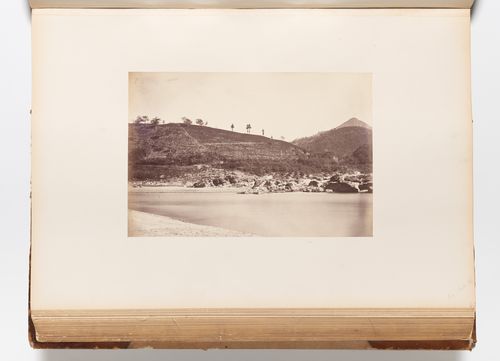
View of a hill planted with tea showing the Pearl River (also known as the Canton River, now Zhujiang) in the foreground, near Canton (now Guangzhou), China
Actions:
PH1981:0620:065
Description:
- A hand-written table of contents accompanies album PH1981:0620:001-081.
View of a hill planted with tea showing the Pearl River (also known as the Canton River, now Zhujiang) in the foreground, near Canton (now Guangzhou), China
Actions:
PH1981:0620:065
Description:
- A hand-written table of contents accompanies album PH1981:0620:001-081.
Classification:
photographies
photographies
Date:
between 1855 and 1877
between 1855 and 1877
Personnes et institutions:
Sujet:
topographique
topographique
Classification:
dessins
dessins
Numéro de référence:
DR1987:0627
DR1987:0627
Personnes et institutions:
Sujet:
architecture
architecture
Date:
printed after 2 December 1955
printed after 2 December 1955
Classification:
dessins
dessins
Date:
printed after 2 December 1955
printed after 2 December 1955
Personnes et institutions:
Sujet:
architecture
architecture
Classification:
photographies
photographies
![Interior view of the Palmengarten Schauhaus Nord [Palm Garden North Agricultural House [?]] showing tropical plants, Siesmayerstrasse 36, Frankfurt am Main, Germany](/img-collection/oga2LQmH6G_t67h1P0e77_vINjA=/500x390/361543.jpg)
Actions:
Numéro de référence:
PH1985:0274
PH1985:0274
Personnes et institutions:
Sujet:
architecture
architecture
Date:
1984
1984
Classification:
photographies
photographies
Date:
1984
1984
Personnes et institutions:
Sujet:
architecture
architecture
Classification:
dessins
dessins
Numéro de référence:
ARCH280738
ARCH280738
Personnes et institutions:
Date:
1994
1994
Classification:
dessins
dessins
Date:
1994
1994
Personnes et institutions:
Classification:
dessins
dessins
Numéro de référence:
AP075.S1.1993.PR01.042
AP075.S1.1993.PR01.042
Personnes et institutions:
Date:
1993
1993
Classification:
dessins
dessins
Date:
1993
1993
Personnes et institutions:
Classification:
photographies
photographies

Actions:
Numéro de référence:
PH1997:0055
Description:
- The series "Running Fence 1997" focuses "on the first 14 miles of the border fence that separates the United States and Mexico, beginning at the Pacific Ocean and ending in the Otay Mountains.... [It] analyzes the "idea" of the border and explores its iconography, the border being a subject that is of extreme importance to the public as the world proceeds towards greater globalization. [Geoffrey] James has written of the project: "[The border fence] was built by the US Army Corps of Engineers in 1994, out of recycled metal landing strip - the most visible symbol of what is known as Operation Gatekeeper. Because the steel sheets are placed in the ground so that their ridges run horizontally, a man can hop over the fence with ease; and no Mexican child ever seems to be impeded from retrieving a soccer ball from US territory. The real barrier to illegal immigration from Mexico into the USA is less visible: hundreds of buried sensors linked to a central computer, nightscopes, helicopters and Border Patrol Agents in white Broncos."" (Evans).
PH1997:0055
Description:
- The series "Running Fence 1997" focuses "on the first 14 miles of the border fence that separates the United States and Mexico, beginning at the Pacific Ocean and ending in the Otay Mountains.... [It] analyzes the "idea" of the border and explores its iconography, the border being a subject that is of extreme importance to the public as the world proceeds towards greater globalization. [Geoffrey] James has written of the project: "[The border fence] was built by the US Army Corps of Engineers in 1994, out of recycled metal landing strip - the most visible symbol of what is known as Operation Gatekeeper. Because the steel sheets are placed in the ground so that their ridges run horizontally, a man can hop over the fence with ease; and no Mexican child ever seems to be impeded from retrieving a soccer ball from US territory. The real barrier to illegal immigration from Mexico into the USA is less visible: hundreds of buried sensors linked to a central computer, nightscopes, helicopters and Border Patrol Agents in white Broncos."" (Evans).
Personnes et institutions:
Sujet:
architecture, ingénierie, topographique
architecture, ingénierie, topographique
Date:
1997
1997
Titre:
Partial view of the United States-Mexico border fence with plants in the foreground, San Diego County, California, United States, and Colonia Libertad, Tijuana, Baja California, Mexico
Actions:
PH1997:0055
Description:
- The series "Running Fence 1997" focuses "on the first 14 miles of the border fence that separates the United States and Mexico, beginning at the Pacific Ocean and ending in the Otay Mountains.... [It] analyzes the "idea" of the border and explores its iconography, the border being a subject that is of extreme importance to the public as the world proceeds towards greater globalization. [Geoffrey] James has written of the project: "[The border fence] was built by the US Army Corps of Engineers in 1994, out of recycled metal landing strip - the most visible symbol of what is known as Operation Gatekeeper. Because the steel sheets are placed in the ground so that their ridges run horizontally, a man can hop over the fence with ease; and no Mexican child ever seems to be impeded from retrieving a soccer ball from US territory. The real barrier to illegal immigration from Mexico into the USA is less visible: hundreds of buried sensors linked to a central computer, nightscopes, helicopters and Border Patrol Agents in white Broncos."" (Evans).
Partial view of the United States-Mexico border fence with plants in the foreground, San Diego County, California, United States, and Colonia Libertad, Tijuana, Baja California, Mexico
Actions:
PH1997:0055
Description:
- The series "Running Fence 1997" focuses "on the first 14 miles of the border fence that separates the United States and Mexico, beginning at the Pacific Ocean and ending in the Otay Mountains.... [It] analyzes the "idea" of the border and explores its iconography, the border being a subject that is of extreme importance to the public as the world proceeds towards greater globalization. [Geoffrey] James has written of the project: "[The border fence] was built by the US Army Corps of Engineers in 1994, out of recycled metal landing strip - the most visible symbol of what is known as Operation Gatekeeper. Because the steel sheets are placed in the ground so that their ridges run horizontally, a man can hop over the fence with ease; and no Mexican child ever seems to be impeded from retrieving a soccer ball from US territory. The real barrier to illegal immigration from Mexico into the USA is less visible: hundreds of buried sensors linked to a central computer, nightscopes, helicopters and Border Patrol Agents in white Broncos."" (Evans).
Classification:
photographies
photographies
Date:
1997
1997
Personnes et institutions:
Sujet:
architecture, ingénierie, topographique
architecture, ingénierie, topographique
Classification:
photographies
photographies
Actions:
Numéro de référence:
PH1986:0168
Description:
- Photographs PH1986:0148 - PH1986:0283 form a sequence of views. Accession numbers follow an order established by the photographer that is based on the temporal experience of walking through the grounds of Katsura Rikyu (also known as Katsura Imperial Villa) (see acquisition file). - Yasuhiro Ishimoto returned to Katsura Rikyu (also known as Katsura Imperial Villa) in 1982 and took another series of photographs, this time with many in colour, often using the same or very similar views to those of his 1953 photographs at the same location (Ishimoto, p. 266).
PH1986:0168
Description:
- Photographs PH1986:0148 - PH1986:0283 form a sequence of views. Accession numbers follow an order established by the photographer that is based on the temporal experience of walking through the grounds of Katsura Rikyu (also known as Katsura Imperial Villa) (see acquisition file). - Yasuhiro Ishimoto returned to Katsura Rikyu (also known as Katsura Imperial Villa) in 1982 and took another series of photographs, this time with many in colour, often using the same or very similar views to those of his 1953 photographs at the same location (Ishimoto, p. 266).
Personnes et institutions:
Sujet:
architecture de paysage
architecture de paysage
Date:
1953
1953
Titre:
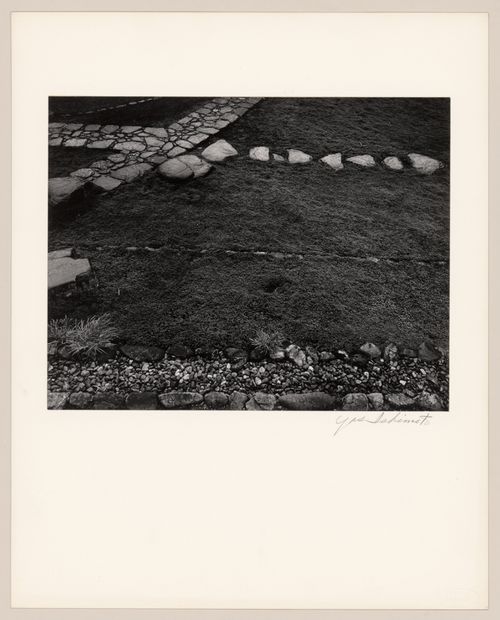
View of paving stones, stepping-stones, plants and moss in front of the broad veranda of the Old Shoin, Katsura Rikyu (also known as Katsura Imperial Villa), Kyoto, Japan
Actions:
PH1986:0168
Description:
- Photographs PH1986:0148 - PH1986:0283 form a sequence of views. Accession numbers follow an order established by the photographer that is based on the temporal experience of walking through the grounds of Katsura Rikyu (also known as Katsura Imperial Villa) (see acquisition file). - Yasuhiro Ishimoto returned to Katsura Rikyu (also known as Katsura Imperial Villa) in 1982 and took another series of photographs, this time with many in colour, often using the same or very similar views to those of his 1953 photographs at the same location (Ishimoto, p. 266).
View of paving stones, stepping-stones, plants and moss in front of the broad veranda of the Old Shoin, Katsura Rikyu (also known as Katsura Imperial Villa), Kyoto, Japan
Actions:
PH1986:0168
Description:
- Photographs PH1986:0148 - PH1986:0283 form a sequence of views. Accession numbers follow an order established by the photographer that is based on the temporal experience of walking through the grounds of Katsura Rikyu (also known as Katsura Imperial Villa) (see acquisition file). - Yasuhiro Ishimoto returned to Katsura Rikyu (also known as Katsura Imperial Villa) in 1982 and took another series of photographs, this time with many in colour, often using the same or very similar views to those of his 1953 photographs at the same location (Ishimoto, p. 266).
Classification:
photographies
photographies
Date:
1953
1953
Personnes et institutions:
Sujet:
architecture de paysage
architecture de paysage


