


12622 Résultats
Classification:
expositions
expositions
Description:
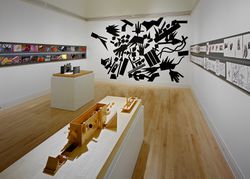
Autres résonances : oeuvres choisies de John Hejduk, 1954-1997, la première rétrospective majeure consacrée à l’architecte, explore les thèmes qui ont préoccupé Hejduk tout au long de sa carrière : l’architecture en tant qu’acte social, le mur, la maison, l’église, le passage et la transformation, l’expérience de la ville. L’importance de la place occupée par John Hejduk(...)
Autres résonances : oeuvres choisies de John Hejduk, 1954-1997, la première rétrospective majeure consacrée à l’architecte, explore les thèmes qui ont préoccupé Hejduk tout au long de sa carrière : l’architecture en tant qu’acte social, le mur, la maison, l’église, le passage et la transformation, l’expérience de la ville. L’importance de la place occupée par John Hejduk(...)
Localisation:
Salles principales
Salles principales
Date:
22 octobre 1997 au 15 février 1998
22 octobre 1997 au 15 février 1998
Titre:
Autres résonances : oeuvres choisies de John Hejduk, 1954-1997
Actions:
Description:
Autres résonances : oeuvres choisies de John Hejduk, 1954-1997, la première rétrospective majeure consacrée à l’architecte, explore les thèmes qui ont préoccupé Hejduk tout au long de sa carrière : l’architecture en tant qu’acte social, le mur, la maison, l’église, le passage et la transformation, l’expérience de la ville. L’importance de la place occupée par John Hejduk(...)
Autres résonances : oeuvres choisies de John Hejduk, 1954-1997
Actions:
Description:
Autres résonances : oeuvres choisies de John Hejduk, 1954-1997, la première rétrospective majeure consacrée à l’architecte, explore les thèmes qui ont préoccupé Hejduk tout au long de sa carrière : l’architecture en tant qu’acte social, le mur, la maison, l’église, le passage et la transformation, l’expérience de la ville. L’importance de la place occupée par John Hejduk(...)
Classification:
expositions
expositions
Date:
22 octobre 1997 au
15 février 1998
22 octobre 1997 au
15 février 1998
Localisation:
Salles principales
Salles principales
Classification:
dessins
dessins
Actions:
Numéro de référence:
DR1988:0342
Description:
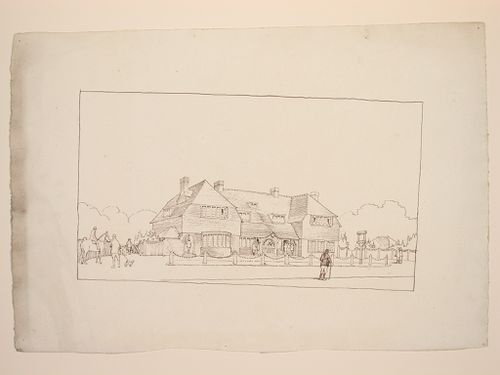
- This reprographic copy shows a large building set in the countryside, possibly a clubhouse. The illustration shows the building in use; there are groups of people at three different entrances and several groups in front of the building, including a man riding a horse and another walking a dog. - The style of many of these drawings and reprographic copies by Henry Hyams (DR1988:0332 - DR1988:0414) suggests that they were possibly for periodical illustrations. Hyams contributed articles to the periodicals 'The Builder' and 'The Architect'. Two objects in the CCA collections can be linked to the article "Music in Stone" published prior to 1926 in 'The Architect'; a reprographic copy (DR1988:0357) and a drawing (DR1988:0364) (Who's Who in Architecture, 161).
DR1988:0342
Description:
- This reprographic copy shows a large building set in the countryside, possibly a clubhouse. The illustration shows the building in use; there are groups of people at three different entrances and several groups in front of the building, including a man riding a horse and another walking a dog. - The style of many of these drawings and reprographic copies by Henry Hyams (DR1988:0332 - DR1988:0414) suggests that they were possibly for periodical illustrations. Hyams contributed articles to the periodicals 'The Builder' and 'The Architect'. Two objects in the CCA collections can be linked to the article "Music in Stone" published prior to 1926 in 'The Architect'; a reprographic copy (DR1988:0357) and a drawing (DR1988:0364) (Who's Who in Architecture, 161).
Personnes et institutions:
Sujet:
architecture
architecture
Date:
printed in the 1920s or 1930s
printed in the 1920s or 1930s
Titre:
Perspectival view showing a large building set in the countryside, possibly a clubhouse
Actions:
DR1988:0342
Description:
- This reprographic copy shows a large building set in the countryside, possibly a clubhouse. The illustration shows the building in use; there are groups of people at three different entrances and several groups in front of the building, including a man riding a horse and another walking a dog. - The style of many of these drawings and reprographic copies by Henry Hyams (DR1988:0332 - DR1988:0414) suggests that they were possibly for periodical illustrations. Hyams contributed articles to the periodicals 'The Builder' and 'The Architect'. Two objects in the CCA collections can be linked to the article "Music in Stone" published prior to 1926 in 'The Architect'; a reprographic copy (DR1988:0357) and a drawing (DR1988:0364) (Who's Who in Architecture, 161).
Perspectival view showing a large building set in the countryside, possibly a clubhouse
Actions:
DR1988:0342
Description:
- This reprographic copy shows a large building set in the countryside, possibly a clubhouse. The illustration shows the building in use; there are groups of people at three different entrances and several groups in front of the building, including a man riding a horse and another walking a dog. - The style of many of these drawings and reprographic copies by Henry Hyams (DR1988:0332 - DR1988:0414) suggests that they were possibly for periodical illustrations. Hyams contributed articles to the periodicals 'The Builder' and 'The Architect'. Two objects in the CCA collections can be linked to the article "Music in Stone" published prior to 1926 in 'The Architect'; a reprographic copy (DR1988:0357) and a drawing (DR1988:0364) (Who's Who in Architecture, 161).
Classification:
dessins
dessins
Date:
printed in the 1920s or 1930s
printed in the 1920s or 1930s
Personnes et institutions:
Sujet:
architecture
architecture
Classification:
dessins
dessins
Actions:
Numéro de référence:
DR1988:0343
Description:
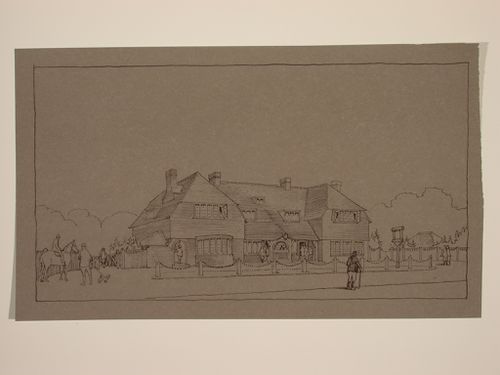
- This reprographic copy shows a large building set in the countryside, possibly a clubhouse. The illustration shows the building in use; there are groups of people at three different entrances and several groups in front of the building, including a man riding a horse and another walking a dog. - The style of many of these drawings and reprographic copies by Henry Hyams (DR1988:0332 - DR1988:0414) suggests that they were possibly for periodical illustrations. Hyams contributed articles to the periodicals 'The Builder' and 'The Architect'. Two objects in the CCA collections can be linked to the article "Music in Stone" published prior to 1926 in 'The Architect'; a reprographic copy (DR1988:0357) and a drawing (DR1988:0364) (Who's Who in Architecture, 161).
DR1988:0343
Description:
- This reprographic copy shows a large building set in the countryside, possibly a clubhouse. The illustration shows the building in use; there are groups of people at three different entrances and several groups in front of the building, including a man riding a horse and another walking a dog. - The style of many of these drawings and reprographic copies by Henry Hyams (DR1988:0332 - DR1988:0414) suggests that they were possibly for periodical illustrations. Hyams contributed articles to the periodicals 'The Builder' and 'The Architect'. Two objects in the CCA collections can be linked to the article "Music in Stone" published prior to 1926 in 'The Architect'; a reprographic copy (DR1988:0357) and a drawing (DR1988:0364) (Who's Who in Architecture, 161).
Personnes et institutions:
Sujet:
architecture
architecture
Date:
printed in the 1920s or 1930s
printed in the 1920s or 1930s
Titre:
Perspectival view showing a large building set in the countryside, possibly a clubhouse
Actions:
DR1988:0343
Description:
- This reprographic copy shows a large building set in the countryside, possibly a clubhouse. The illustration shows the building in use; there are groups of people at three different entrances and several groups in front of the building, including a man riding a horse and another walking a dog. - The style of many of these drawings and reprographic copies by Henry Hyams (DR1988:0332 - DR1988:0414) suggests that they were possibly for periodical illustrations. Hyams contributed articles to the periodicals 'The Builder' and 'The Architect'. Two objects in the CCA collections can be linked to the article "Music in Stone" published prior to 1926 in 'The Architect'; a reprographic copy (DR1988:0357) and a drawing (DR1988:0364) (Who's Who in Architecture, 161).
Perspectival view showing a large building set in the countryside, possibly a clubhouse
Actions:
DR1988:0343
Description:
- This reprographic copy shows a large building set in the countryside, possibly a clubhouse. The illustration shows the building in use; there are groups of people at three different entrances and several groups in front of the building, including a man riding a horse and another walking a dog. - The style of many of these drawings and reprographic copies by Henry Hyams (DR1988:0332 - DR1988:0414) suggests that they were possibly for periodical illustrations. Hyams contributed articles to the periodicals 'The Builder' and 'The Architect'. Two objects in the CCA collections can be linked to the article "Music in Stone" published prior to 1926 in 'The Architect'; a reprographic copy (DR1988:0357) and a drawing (DR1988:0364) (Who's Who in Architecture, 161).
Classification:
dessins
dessins
Date:
printed in the 1920s or 1930s
printed in the 1920s or 1930s
Personnes et institutions:
Sujet:
architecture
architecture
Classification:
dessins
dessins
Actions:
Numéro de référence:
DR1988:0351
Description:
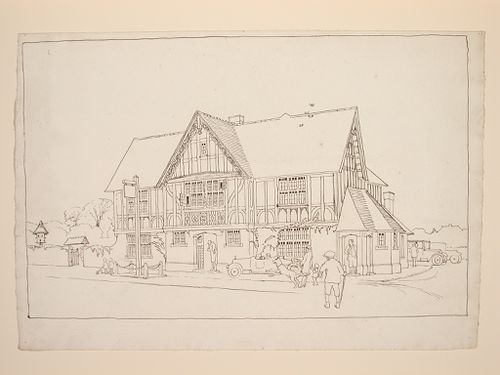
- This reprographic copy shows a three storey Tudor Revival building with a sign at the front which reads "SPRING / COTTAGE". There is a parking lot visible behind the building, and there are several people - men, women, and children - standing in front of and at the entrance to the building. - The style of many of these drawings and reprographic copies by Henry Hyams (DR1988:0332 - DR1988:0414) suggests that they were possibly for periodical illustrations. Hyams contributed articles to the periodicals 'The Builder' and 'The Architect'. Two objects in the CCA collections can be linked to the article "Music in Stone" published prior to 1926 in 'The Architect'; a reprographic copy (DR1988:0357) and a drawing (DR1988:0364) (Who's Who in Architecture, 161).
DR1988:0351
Description:
- This reprographic copy shows a three storey Tudor Revival building with a sign at the front which reads "SPRING / COTTAGE". There is a parking lot visible behind the building, and there are several people - men, women, and children - standing in front of and at the entrance to the building. - The style of many of these drawings and reprographic copies by Henry Hyams (DR1988:0332 - DR1988:0414) suggests that they were possibly for periodical illustrations. Hyams contributed articles to the periodicals 'The Builder' and 'The Architect'. Two objects in the CCA collections can be linked to the article "Music in Stone" published prior to 1926 in 'The Architect'; a reprographic copy (DR1988:0357) and a drawing (DR1988:0364) (Who's Who in Architecture, 161).
Personnes et institutions:
Sujet:
architecture
architecture
Date:
printed in the 1920s or 1930s
printed in the 1920s or 1930s
Titre:
Perspectival view showing Spring Cottage, England
Actions:
DR1988:0351
Description:
- This reprographic copy shows a three storey Tudor Revival building with a sign at the front which reads "SPRING / COTTAGE". There is a parking lot visible behind the building, and there are several people - men, women, and children - standing in front of and at the entrance to the building. - The style of many of these drawings and reprographic copies by Henry Hyams (DR1988:0332 - DR1988:0414) suggests that they were possibly for periodical illustrations. Hyams contributed articles to the periodicals 'The Builder' and 'The Architect'. Two objects in the CCA collections can be linked to the article "Music in Stone" published prior to 1926 in 'The Architect'; a reprographic copy (DR1988:0357) and a drawing (DR1988:0364) (Who's Who in Architecture, 161).
Perspectival view showing Spring Cottage, England
Actions:
DR1988:0351
Description:
- This reprographic copy shows a three storey Tudor Revival building with a sign at the front which reads "SPRING / COTTAGE". There is a parking lot visible behind the building, and there are several people - men, women, and children - standing in front of and at the entrance to the building. - The style of many of these drawings and reprographic copies by Henry Hyams (DR1988:0332 - DR1988:0414) suggests that they were possibly for periodical illustrations. Hyams contributed articles to the periodicals 'The Builder' and 'The Architect'. Two objects in the CCA collections can be linked to the article "Music in Stone" published prior to 1926 in 'The Architect'; a reprographic copy (DR1988:0357) and a drawing (DR1988:0364) (Who's Who in Architecture, 161).
Classification:
dessins
dessins
Date:
printed in the 1920s or 1930s
printed in the 1920s or 1930s
Personnes et institutions:
Sujet:
architecture
architecture
Classification:
dessins
dessins
Actions:
Numéro de référence:
DR1988:0383
Description:
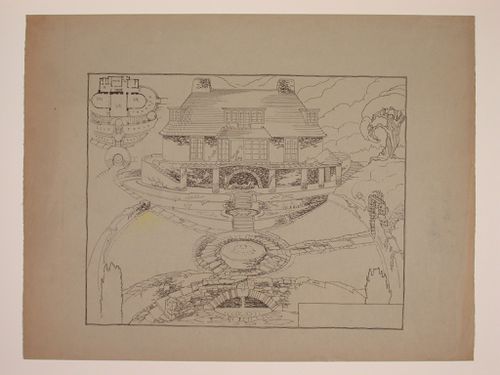
- This reprographic copy shows a small country house, with a series of ponds and fountains descending down from the main terrace. There is a small sketch plan at the upper left, which shows the layout of the rooms on the main floor and the levels of the garden terraces. - The style of many of these drawings and reprographic copies by Henry Hyams (DR1988:0332 - DR1988:0414) suggests that they were possibly for periodical illustrations. Hyams contributed articles to the periodicals 'The Builder' and 'The Architect'. Two objects in the CCA collections can be linked to the article "Music in Stone" published prior to 1926 in 'The Architect'; a reprographic copy (DR1988:0357) and a drawing (DR1988:0364) (Who's Who in Architecture, 161).
DR1988:0383
Description:
- This reprographic copy shows a small country house, with a series of ponds and fountains descending down from the main terrace. There is a small sketch plan at the upper left, which shows the layout of the rooms on the main floor and the levels of the garden terraces. - The style of many of these drawings and reprographic copies by Henry Hyams (DR1988:0332 - DR1988:0414) suggests that they were possibly for periodical illustrations. Hyams contributed articles to the periodicals 'The Builder' and 'The Architect'. Two objects in the CCA collections can be linked to the article "Music in Stone" published prior to 1926 in 'The Architect'; a reprographic copy (DR1988:0357) and a drawing (DR1988:0364) (Who's Who in Architecture, 161).
Personnes et institutions:
Sujet:
architecture, architecture de paysage
architecture, architecture de paysage
Date:
printed in the 1920s or 1930s
printed in the 1920s or 1930s
Titre:
Perspectival view and plan showing a small country house and garden
Actions:
DR1988:0383
Description:
- This reprographic copy shows a small country house, with a series of ponds and fountains descending down from the main terrace. There is a small sketch plan at the upper left, which shows the layout of the rooms on the main floor and the levels of the garden terraces. - The style of many of these drawings and reprographic copies by Henry Hyams (DR1988:0332 - DR1988:0414) suggests that they were possibly for periodical illustrations. Hyams contributed articles to the periodicals 'The Builder' and 'The Architect'. Two objects in the CCA collections can be linked to the article "Music in Stone" published prior to 1926 in 'The Architect'; a reprographic copy (DR1988:0357) and a drawing (DR1988:0364) (Who's Who in Architecture, 161).
Perspectival view and plan showing a small country house and garden
Actions:
DR1988:0383
Description:
- This reprographic copy shows a small country house, with a series of ponds and fountains descending down from the main terrace. There is a small sketch plan at the upper left, which shows the layout of the rooms on the main floor and the levels of the garden terraces. - The style of many of these drawings and reprographic copies by Henry Hyams (DR1988:0332 - DR1988:0414) suggests that they were possibly for periodical illustrations. Hyams contributed articles to the periodicals 'The Builder' and 'The Architect'. Two objects in the CCA collections can be linked to the article "Music in Stone" published prior to 1926 in 'The Architect'; a reprographic copy (DR1988:0357) and a drawing (DR1988:0364) (Who's Who in Architecture, 161).
Classification:
dessins
dessins
Date:
printed in the 1920s or 1930s
printed in the 1920s or 1930s
Personnes et institutions:
Sujet:
architecture, architecture de paysage
architecture, architecture de paysage
Niveau de description archivistique:
Projet
Projet
Numéro de référence:
AP018.S1.1960.PR02
Description:
This project series documents the Imperial Oil Ontario region office in North York, Ontario from 1960-1962. The office identified the project number as 6049. This project consisted of a three-storey, 110,000 square foot building located at the corner of Don Mills Road and Eglington Avenue. The front entrance was accessed from a circular driveway off Wynford Drive, with parking lots on either side that held 330 vehicles. The basement level had storage rooms, machine and boiler rooms, a telephone switch gear room and shipping areas. The first floor included food service areas, offices, locker rooms, and a doctor's office complete with x-ray rooms, treatment areas and a quiet room for female employees, among others. The second floor contained administrative areas for accounting, data control and banking, while the third floor contained more offices. The building's frame consisted of a rectangular steel skeleton faced with concrete panels. The ground level was recessed 20 feet to allow for sidewalks around the building. Concrete columns at this level supported the upper two storeys. The landscaped surroundings include long, fountain-spotted reflecting pools. This project won the silver Massey Medal for Architecture in 1964, as well as an honourable distinction at the International Exhibition of Architects VIII Biennial of São Paula in 1965. The project is recorded through drawings, textual records and a photograph dating from 1961-1970. The drawings are mostly reprographic copies that include plans, sections, elevations, details, schedules and electrical, mechanical and structural drawings. The textual records consist of specifications originally arranged with the drawings. The photograph shows the finished buillding.
AP018.S1.1960.PR02
Description:
This project series documents the Imperial Oil Ontario region office in North York, Ontario from 1960-1962. The office identified the project number as 6049. This project consisted of a three-storey, 110,000 square foot building located at the corner of Don Mills Road and Eglington Avenue. The front entrance was accessed from a circular driveway off Wynford Drive, with parking lots on either side that held 330 vehicles. The basement level had storage rooms, machine and boiler rooms, a telephone switch gear room and shipping areas. The first floor included food service areas, offices, locker rooms, and a doctor's office complete with x-ray rooms, treatment areas and a quiet room for female employees, among others. The second floor contained administrative areas for accounting, data control and banking, while the third floor contained more offices. The building's frame consisted of a rectangular steel skeleton faced with concrete panels. The ground level was recessed 20 feet to allow for sidewalks around the building. Concrete columns at this level supported the upper two storeys. The landscaped surroundings include long, fountain-spotted reflecting pools. This project won the silver Massey Medal for Architecture in 1964, as well as an honourable distinction at the International Exhibition of Architects VIII Biennial of São Paula in 1965. The project is recorded through drawings, textual records and a photograph dating from 1961-1970. The drawings are mostly reprographic copies that include plans, sections, elevations, details, schedules and electrical, mechanical and structural drawings. The textual records consist of specifications originally arranged with the drawings. The photograph shows the finished buillding.
Personnes et institutions:
Date:
1961 - 1970
1961 - 1970
Titre:
Imperial Oil Limited, Ontario Region Office Building, North York (1960-1962)
Actions:
AP018.S1.1960.PR02
Description:
This project series documents the Imperial Oil Ontario region office in North York, Ontario from 1960-1962. The office identified the project number as 6049. This project consisted of a three-storey, 110,000 square foot building located at the corner of Don Mills Road and Eglington Avenue. The front entrance was accessed from a circular driveway off Wynford Drive, with parking lots on either side that held 330 vehicles. The basement level had storage rooms, machine and boiler rooms, a telephone switch gear room and shipping areas. The first floor included food service areas, offices, locker rooms, and a doctor's office complete with x-ray rooms, treatment areas and a quiet room for female employees, among others. The second floor contained administrative areas for accounting, data control and banking, while the third floor contained more offices. The building's frame consisted of a rectangular steel skeleton faced with concrete panels. The ground level was recessed 20 feet to allow for sidewalks around the building. Concrete columns at this level supported the upper two storeys. The landscaped surroundings include long, fountain-spotted reflecting pools. This project won the silver Massey Medal for Architecture in 1964, as well as an honourable distinction at the International Exhibition of Architects VIII Biennial of São Paula in 1965. The project is recorded through drawings, textual records and a photograph dating from 1961-1970. The drawings are mostly reprographic copies that include plans, sections, elevations, details, schedules and electrical, mechanical and structural drawings. The textual records consist of specifications originally arranged with the drawings. The photograph shows the finished buillding.
Imperial Oil Limited, Ontario Region Office Building, North York (1960-1962)
Actions:
AP018.S1.1960.PR02
Description:
This project series documents the Imperial Oil Ontario region office in North York, Ontario from 1960-1962. The office identified the project number as 6049. This project consisted of a three-storey, 110,000 square foot building located at the corner of Don Mills Road and Eglington Avenue. The front entrance was accessed from a circular driveway off Wynford Drive, with parking lots on either side that held 330 vehicles. The basement level had storage rooms, machine and boiler rooms, a telephone switch gear room and shipping areas. The first floor included food service areas, offices, locker rooms, and a doctor's office complete with x-ray rooms, treatment areas and a quiet room for female employees, among others. The second floor contained administrative areas for accounting, data control and banking, while the third floor contained more offices. The building's frame consisted of a rectangular steel skeleton faced with concrete panels. The ground level was recessed 20 feet to allow for sidewalks around the building. Concrete columns at this level supported the upper two storeys. The landscaped surroundings include long, fountain-spotted reflecting pools. This project won the silver Massey Medal for Architecture in 1964, as well as an honourable distinction at the International Exhibition of Architects VIII Biennial of São Paula in 1965. The project is recorded through drawings, textual records and a photograph dating from 1961-1970. The drawings are mostly reprographic copies that include plans, sections, elevations, details, schedules and electrical, mechanical and structural drawings. The textual records consist of specifications originally arranged with the drawings. The photograph shows the finished buillding.
Niveau de description archivistique:
Project
Project
Date:
1961 - 1970
1961 - 1970
Personnes et institutions:
Niveau de description archivistique:
Projet
Projet
Numéro de référence:
AP056.S1.1995.PR02
Description:
This project series documents the Providence Healthcare Centre in Scarborough, Ontario from 1995-2000. The office identified the project number as 9504. This project, headed by Marianne McKenna in joint-venture with Montgomery and Sisam Architects, consisted of a long-term care facility on the Healthcare Centre campus located at the corner of St. Clair East and Warden Avenues. The facility diverged from the traditional institutional model to house 288 residents in a more residential setting. Bay windows, porches and chimneys were borrowed from residential architecture to contribute to this effect. The "houses," accommodating 18 residents each, were four-storeys high and arranged in two L-shaped wings with landscaped gardens in their interior courtyards. A double-height Great Hall joined the two volumes at the building's centre, which was built to house a variety of social and recreational activities for the residents. A chapel, hair salon, café and general store were also included. The project was also known as the Cardinal Ambrozic Houses of Providence. The project is recorded through drawings and presentation watercolour paintings dating from 1995-1999. The drawings are mostly originals and include a large number of sketches along with presentation renderings, plans, elevations, sections, perspectives and details.
AP056.S1.1995.PR02
Description:
This project series documents the Providence Healthcare Centre in Scarborough, Ontario from 1995-2000. The office identified the project number as 9504. This project, headed by Marianne McKenna in joint-venture with Montgomery and Sisam Architects, consisted of a long-term care facility on the Healthcare Centre campus located at the corner of St. Clair East and Warden Avenues. The facility diverged from the traditional institutional model to house 288 residents in a more residential setting. Bay windows, porches and chimneys were borrowed from residential architecture to contribute to this effect. The "houses," accommodating 18 residents each, were four-storeys high and arranged in two L-shaped wings with landscaped gardens in their interior courtyards. A double-height Great Hall joined the two volumes at the building's centre, which was built to house a variety of social and recreational activities for the residents. A chapel, hair salon, café and general store were also included. The project was also known as the Cardinal Ambrozic Houses of Providence. The project is recorded through drawings and presentation watercolour paintings dating from 1995-1999. The drawings are mostly originals and include a large number of sketches along with presentation renderings, plans, elevations, sections, perspectives and details.
Personnes et institutions:
Titre:
Providence Healthcare Centre, Scarborough, Ontario (1995-2000)
Actions:
AP056.S1.1995.PR02
Description:
This project series documents the Providence Healthcare Centre in Scarborough, Ontario from 1995-2000. The office identified the project number as 9504. This project, headed by Marianne McKenna in joint-venture with Montgomery and Sisam Architects, consisted of a long-term care facility on the Healthcare Centre campus located at the corner of St. Clair East and Warden Avenues. The facility diverged from the traditional institutional model to house 288 residents in a more residential setting. Bay windows, porches and chimneys were borrowed from residential architecture to contribute to this effect. The "houses," accommodating 18 residents each, were four-storeys high and arranged in two L-shaped wings with landscaped gardens in their interior courtyards. A double-height Great Hall joined the two volumes at the building's centre, which was built to house a variety of social and recreational activities for the residents. A chapel, hair salon, café and general store were also included. The project was also known as the Cardinal Ambrozic Houses of Providence. The project is recorded through drawings and presentation watercolour paintings dating from 1995-1999. The drawings are mostly originals and include a large number of sketches along with presentation renderings, plans, elevations, sections, perspectives and details.
Providence Healthcare Centre, Scarborough, Ontario (1995-2000)
Actions:
AP056.S1.1995.PR02
Description:
This project series documents the Providence Healthcare Centre in Scarborough, Ontario from 1995-2000. The office identified the project number as 9504. This project, headed by Marianne McKenna in joint-venture with Montgomery and Sisam Architects, consisted of a long-term care facility on the Healthcare Centre campus located at the corner of St. Clair East and Warden Avenues. The facility diverged from the traditional institutional model to house 288 residents in a more residential setting. Bay windows, porches and chimneys were borrowed from residential architecture to contribute to this effect. The "houses," accommodating 18 residents each, were four-storeys high and arranged in two L-shaped wings with landscaped gardens in their interior courtyards. A double-height Great Hall joined the two volumes at the building's centre, which was built to house a variety of social and recreational activities for the residents. A chapel, hair salon, café and general store were also included. The project was also known as the Cardinal Ambrozic Houses of Providence. The project is recorded through drawings and presentation watercolour paintings dating from 1995-1999. The drawings are mostly originals and include a large number of sketches along with presentation renderings, plans, elevations, sections, perspectives and details.
Niveau de description archivistique:
Project
Project
Personnes et institutions:
Niveau de description archivistique:
Série(s)
Série(s)
Numéro de référence:
AP144.S2
Description:
Series documents Cedric Price's projects from his early work in the late 1950s to work dating from the time he founded his own practice in 1960 until 2000. Material includes numerous competition entries, planning and building projects, transportation-related projects, exhibitions, conceptual projects, furniture and interior designs, and monuments, follies, and decorations. Some projects also reflect his teaching, research, lecture and publication activities. Price also worked on several competition juries (see projects Musique, Elephant). Many of Cedric Price's projects in the series are unexecuted. Significant unrealized projects from the 1960s and 1970s include Fun Palace (1961-1974), Potteries Thinkbelt (1963-1967), Oxford Corner House (1965-1966), and Generator (1976-1980). Significant built projects from the same period include the New Aviary (1960-1966), his first major realized project (with Lord Snowdon and Frank Newby), and Inter-Action Centre (1971-1979). Other realized projects include an office building (BTDB Computer, 1968-1973) and restaurant (Blackpool Project, 1971-1975). Planning projects from the 1960s and 1970s include Potteries Thinkbelt, Detroit Think Grid (1969-1971) and Rice University's design charette, Atom (1967). In the 1980s and 1990s, Cedric Price worked on several building proposals including greenhouses (Serre, Serre (2)), museums, galleries, and pavilions (Trafalgar, Pertpavs, Snake), a railway station (Strate (2)), a cultural centre (Tiff), houses (Perthut, Castel), a bus station (Walsall), an aviary (CP Aviary) and office buildings (Domain, Berlin). Planning projects from the same time include parks and cultural complexes, (Parc, South Bank), urban areas, (Strate, Stratton, IFPRI, Haven, Mills), university campuses (Frankfurt, Unibad, Bedford), and rural areas (Stark, Arkage). Transportation-related projects include railways (Strate, Control, Rink), roadways (Stratton) and pedestrian links (Magnet, Halmag, South Bank). Only a few of his projects from that period were executed and those include the renovation projects Congress and SAS 29; a mobile market stall design for Westminster City Council (Westal) for which prototypes were built; a coffee cup design (Crowbar); and building conversion projects Gatard and Juke. Exhibition projects in the series include some devoted to Cedric Price's works (AA Exhibition, Aedes, AFX, Afella), some designed by him (Strike, Food for the Future, Topolski/Waterloo, Ashmole, Mean, AFX), as well as projects designed for exhibition (Citlin, Castel). The series also contains self-financed research and client-less projects, which form a significant part of Cedric Price's practice. Undertaken in anticipation of future clients or new planning needs, they include research into air structures and lightweight enclosures as well as integrated construction and transportation solutions (Trucksafe Air Portable Dock Ahoy), and housing research. South Bank, Magnet, and Duck Land represent a few of the client-less projects. The material in this series documents Cedric Price's work in the United Kingdom, in particular England (the Greater London area, and other areas) and Scotland, Germany, France, Austria, Australia, Japan, the United Arab Emirates, and the United States and other locations such as Canada, Nigeria, and Norway. Major clients include J. Lyons & Co. (Oxford Corner House), David Keddie (Two Tree Island, Southend Roof), Howard Gilman (Generator), British Railways (Strate and Strate (2), and others), the McAlpine family , particularly Alistair McAlpine, and their company Sir Robert McAlpine & Sons Ltd. (McAppy, Perthut, Trafalgar, Pertpavs, Ashmole, Perth, Obeliq, McVance); Établissement Public du Parc de la Villette (Parc, Serre, Serre (2), Musique) and the Canadian Centre for Architecture (IFPRI, Mean). He collaborated with several architects and engineers during the course of his career, his closest association being with engineer Frank Newby and quantity surveyor Douglas Smith. Some of his other collaborators include engineer Max Fordham (Strate (2), Tiff, Berlin), engineering firms Scott Wilson Kirkpatrick and Partners (Stratton, Rink, Control), and Sir Frederick Snow & Partners (South Bank), cybernetician Gordon Pask (Kawasaki/Japnet), architectural firm YRM/Yorke Rosenberg Mardall (Unibad), and architect Richard Rogers (Marman). He also collaborated with members of Archigram on the Trondheim Competition, (1972-1974), and with John and Julia Frazer who provided the computer modelling for Generator. David Price, Cedric Price's brother was the model maker for several projects. The series contains conceptual drawings, design development drawings, reference drawings and maps, presentation drawings (particularly for competitions), and working drawings. A significant amount of textual records are included, especially for projects involving a large amount of research or publicity (Air Structures, Lightweight Enclosures, South Bank, CP Aviary, Stratton), for executed projects, and for the larger unrealized projects like Fun Palace and Generator. Also includes photographic materials of project sites and models. Some models included in the series are made from durable materials (wood, metal, plastic), while others are in-office constructions made out of paper, cardboard and Fome-Cor (TM). Of particular note are the 11 models for Magnet, and a full-size prototype of a market stall for Westal. Series also contains publication layouts, including material for the "Cedric Price Supplement", 'Architectural Design' vols. 40- 42 (1970-1972). Changes in office practice are noted around 1971, evident in the Blackpool Project and later, including the adoption of the metric system, and the creation of working and detail drawings on A4 size paper and filed with textual records (e.g. approximately 300 such drawings are included in the textual records for Blackpool Project). At the same time fewer preamble drawings that relate to site sensing, progress and life-cycle graphs and tables are created for the projects (a common feature from the 1960s), although project progress tables are still used. Of particular interest is material in the Early Work and Miscellaneous Records file (AP144.S2.D1) that relates to office work methods and programmes.
AP144.S2
Description:
Series documents Cedric Price's projects from his early work in the late 1950s to work dating from the time he founded his own practice in 1960 until 2000. Material includes numerous competition entries, planning and building projects, transportation-related projects, exhibitions, conceptual projects, furniture and interior designs, and monuments, follies, and decorations. Some projects also reflect his teaching, research, lecture and publication activities. Price also worked on several competition juries (see projects Musique, Elephant). Many of Cedric Price's projects in the series are unexecuted. Significant unrealized projects from the 1960s and 1970s include Fun Palace (1961-1974), Potteries Thinkbelt (1963-1967), Oxford Corner House (1965-1966), and Generator (1976-1980). Significant built projects from the same period include the New Aviary (1960-1966), his first major realized project (with Lord Snowdon and Frank Newby), and Inter-Action Centre (1971-1979). Other realized projects include an office building (BTDB Computer, 1968-1973) and restaurant (Blackpool Project, 1971-1975). Planning projects from the 1960s and 1970s include Potteries Thinkbelt, Detroit Think Grid (1969-1971) and Rice University's design charette, Atom (1967). In the 1980s and 1990s, Cedric Price worked on several building proposals including greenhouses (Serre, Serre (2)), museums, galleries, and pavilions (Trafalgar, Pertpavs, Snake), a railway station (Strate (2)), a cultural centre (Tiff), houses (Perthut, Castel), a bus station (Walsall), an aviary (CP Aviary) and office buildings (Domain, Berlin). Planning projects from the same time include parks and cultural complexes, (Parc, South Bank), urban areas, (Strate, Stratton, IFPRI, Haven, Mills), university campuses (Frankfurt, Unibad, Bedford), and rural areas (Stark, Arkage). Transportation-related projects include railways (Strate, Control, Rink), roadways (Stratton) and pedestrian links (Magnet, Halmag, South Bank). Only a few of his projects from that period were executed and those include the renovation projects Congress and SAS 29; a mobile market stall design for Westminster City Council (Westal) for which prototypes were built; a coffee cup design (Crowbar); and building conversion projects Gatard and Juke. Exhibition projects in the series include some devoted to Cedric Price's works (AA Exhibition, Aedes, AFX, Afella), some designed by him (Strike, Food for the Future, Topolski/Waterloo, Ashmole, Mean, AFX), as well as projects designed for exhibition (Citlin, Castel). The series also contains self-financed research and client-less projects, which form a significant part of Cedric Price's practice. Undertaken in anticipation of future clients or new planning needs, they include research into air structures and lightweight enclosures as well as integrated construction and transportation solutions (Trucksafe Air Portable Dock Ahoy), and housing research. South Bank, Magnet, and Duck Land represent a few of the client-less projects. The material in this series documents Cedric Price's work in the United Kingdom, in particular England (the Greater London area, and other areas) and Scotland, Germany, France, Austria, Australia, Japan, the United Arab Emirates, and the United States and other locations such as Canada, Nigeria, and Norway. Major clients include J. Lyons & Co. (Oxford Corner House), David Keddie (Two Tree Island, Southend Roof), Howard Gilman (Generator), British Railways (Strate and Strate (2), and others), the McAlpine family , particularly Alistair McAlpine, and their company Sir Robert McAlpine & Sons Ltd. (McAppy, Perthut, Trafalgar, Pertpavs, Ashmole, Perth, Obeliq, McVance); Établissement Public du Parc de la Villette (Parc, Serre, Serre (2), Musique) and the Canadian Centre for Architecture (IFPRI, Mean). He collaborated with several architects and engineers during the course of his career, his closest association being with engineer Frank Newby and quantity surveyor Douglas Smith. Some of his other collaborators include engineer Max Fordham (Strate (2), Tiff, Berlin), engineering firms Scott Wilson Kirkpatrick and Partners (Stratton, Rink, Control), and Sir Frederick Snow & Partners (South Bank), cybernetician Gordon Pask (Kawasaki/Japnet), architectural firm YRM/Yorke Rosenberg Mardall (Unibad), and architect Richard Rogers (Marman). He also collaborated with members of Archigram on the Trondheim Competition, (1972-1974), and with John and Julia Frazer who provided the computer modelling for Generator. David Price, Cedric Price's brother was the model maker for several projects. The series contains conceptual drawings, design development drawings, reference drawings and maps, presentation drawings (particularly for competitions), and working drawings. A significant amount of textual records are included, especially for projects involving a large amount of research or publicity (Air Structures, Lightweight Enclosures, South Bank, CP Aviary, Stratton), for executed projects, and for the larger unrealized projects like Fun Palace and Generator. Also includes photographic materials of project sites and models. Some models included in the series are made from durable materials (wood, metal, plastic), while others are in-office constructions made out of paper, cardboard and Fome-Cor (TM). Of particular note are the 11 models for Magnet, and a full-size prototype of a market stall for Westal. Series also contains publication layouts, including material for the "Cedric Price Supplement", 'Architectural Design' vols. 40- 42 (1970-1972). Changes in office practice are noted around 1971, evident in the Blackpool Project and later, including the adoption of the metric system, and the creation of working and detail drawings on A4 size paper and filed with textual records (e.g. approximately 300 such drawings are included in the textual records for Blackpool Project). At the same time fewer preamble drawings that relate to site sensing, progress and life-cycle graphs and tables are created for the projects (a common feature from the 1960s), although project progress tables are still used. Of particular interest is material in the Early Work and Miscellaneous Records file (AP144.S2.D1) that relates to office work methods and programmes.
Personnes et institutions:
Date:
1903-2003, predominant 1960-2000
1903-2003, predominant 1960-2000
Titre:
Projects
Actions:
AP144.S2
Description:
Series documents Cedric Price's projects from his early work in the late 1950s to work dating from the time he founded his own practice in 1960 until 2000. Material includes numerous competition entries, planning and building projects, transportation-related projects, exhibitions, conceptual projects, furniture and interior designs, and monuments, follies, and decorations. Some projects also reflect his teaching, research, lecture and publication activities. Price also worked on several competition juries (see projects Musique, Elephant). Many of Cedric Price's projects in the series are unexecuted. Significant unrealized projects from the 1960s and 1970s include Fun Palace (1961-1974), Potteries Thinkbelt (1963-1967), Oxford Corner House (1965-1966), and Generator (1976-1980). Significant built projects from the same period include the New Aviary (1960-1966), his first major realized project (with Lord Snowdon and Frank Newby), and Inter-Action Centre (1971-1979). Other realized projects include an office building (BTDB Computer, 1968-1973) and restaurant (Blackpool Project, 1971-1975). Planning projects from the 1960s and 1970s include Potteries Thinkbelt, Detroit Think Grid (1969-1971) and Rice University's design charette, Atom (1967). In the 1980s and 1990s, Cedric Price worked on several building proposals including greenhouses (Serre, Serre (2)), museums, galleries, and pavilions (Trafalgar, Pertpavs, Snake), a railway station (Strate (2)), a cultural centre (Tiff), houses (Perthut, Castel), a bus station (Walsall), an aviary (CP Aviary) and office buildings (Domain, Berlin). Planning projects from the same time include parks and cultural complexes, (Parc, South Bank), urban areas, (Strate, Stratton, IFPRI, Haven, Mills), university campuses (Frankfurt, Unibad, Bedford), and rural areas (Stark, Arkage). Transportation-related projects include railways (Strate, Control, Rink), roadways (Stratton) and pedestrian links (Magnet, Halmag, South Bank). Only a few of his projects from that period were executed and those include the renovation projects Congress and SAS 29; a mobile market stall design for Westminster City Council (Westal) for which prototypes were built; a coffee cup design (Crowbar); and building conversion projects Gatard and Juke. Exhibition projects in the series include some devoted to Cedric Price's works (AA Exhibition, Aedes, AFX, Afella), some designed by him (Strike, Food for the Future, Topolski/Waterloo, Ashmole, Mean, AFX), as well as projects designed for exhibition (Citlin, Castel). The series also contains self-financed research and client-less projects, which form a significant part of Cedric Price's practice. Undertaken in anticipation of future clients or new planning needs, they include research into air structures and lightweight enclosures as well as integrated construction and transportation solutions (Trucksafe Air Portable Dock Ahoy), and housing research. South Bank, Magnet, and Duck Land represent a few of the client-less projects. The material in this series documents Cedric Price's work in the United Kingdom, in particular England (the Greater London area, and other areas) and Scotland, Germany, France, Austria, Australia, Japan, the United Arab Emirates, and the United States and other locations such as Canada, Nigeria, and Norway. Major clients include J. Lyons & Co. (Oxford Corner House), David Keddie (Two Tree Island, Southend Roof), Howard Gilman (Generator), British Railways (Strate and Strate (2), and others), the McAlpine family , particularly Alistair McAlpine, and their company Sir Robert McAlpine & Sons Ltd. (McAppy, Perthut, Trafalgar, Pertpavs, Ashmole, Perth, Obeliq, McVance); Établissement Public du Parc de la Villette (Parc, Serre, Serre (2), Musique) and the Canadian Centre for Architecture (IFPRI, Mean). He collaborated with several architects and engineers during the course of his career, his closest association being with engineer Frank Newby and quantity surveyor Douglas Smith. Some of his other collaborators include engineer Max Fordham (Strate (2), Tiff, Berlin), engineering firms Scott Wilson Kirkpatrick and Partners (Stratton, Rink, Control), and Sir Frederick Snow & Partners (South Bank), cybernetician Gordon Pask (Kawasaki/Japnet), architectural firm YRM/Yorke Rosenberg Mardall (Unibad), and architect Richard Rogers (Marman). He also collaborated with members of Archigram on the Trondheim Competition, (1972-1974), and with John and Julia Frazer who provided the computer modelling for Generator. David Price, Cedric Price's brother was the model maker for several projects. The series contains conceptual drawings, design development drawings, reference drawings and maps, presentation drawings (particularly for competitions), and working drawings. A significant amount of textual records are included, especially for projects involving a large amount of research or publicity (Air Structures, Lightweight Enclosures, South Bank, CP Aviary, Stratton), for executed projects, and for the larger unrealized projects like Fun Palace and Generator. Also includes photographic materials of project sites and models. Some models included in the series are made from durable materials (wood, metal, plastic), while others are in-office constructions made out of paper, cardboard and Fome-Cor (TM). Of particular note are the 11 models for Magnet, and a full-size prototype of a market stall for Westal. Series also contains publication layouts, including material for the "Cedric Price Supplement", 'Architectural Design' vols. 40- 42 (1970-1972). Changes in office practice are noted around 1971, evident in the Blackpool Project and later, including the adoption of the metric system, and the creation of working and detail drawings on A4 size paper and filed with textual records (e.g. approximately 300 such drawings are included in the textual records for Blackpool Project). At the same time fewer preamble drawings that relate to site sensing, progress and life-cycle graphs and tables are created for the projects (a common feature from the 1960s), although project progress tables are still used. Of particular interest is material in the Early Work and Miscellaneous Records file (AP144.S2.D1) that relates to office work methods and programmes.
Projects
Actions:
AP144.S2
Description:
Series documents Cedric Price's projects from his early work in the late 1950s to work dating from the time he founded his own practice in 1960 until 2000. Material includes numerous competition entries, planning and building projects, transportation-related projects, exhibitions, conceptual projects, furniture and interior designs, and monuments, follies, and decorations. Some projects also reflect his teaching, research, lecture and publication activities. Price also worked on several competition juries (see projects Musique, Elephant). Many of Cedric Price's projects in the series are unexecuted. Significant unrealized projects from the 1960s and 1970s include Fun Palace (1961-1974), Potteries Thinkbelt (1963-1967), Oxford Corner House (1965-1966), and Generator (1976-1980). Significant built projects from the same period include the New Aviary (1960-1966), his first major realized project (with Lord Snowdon and Frank Newby), and Inter-Action Centre (1971-1979). Other realized projects include an office building (BTDB Computer, 1968-1973) and restaurant (Blackpool Project, 1971-1975). Planning projects from the 1960s and 1970s include Potteries Thinkbelt, Detroit Think Grid (1969-1971) and Rice University's design charette, Atom (1967). In the 1980s and 1990s, Cedric Price worked on several building proposals including greenhouses (Serre, Serre (2)), museums, galleries, and pavilions (Trafalgar, Pertpavs, Snake), a railway station (Strate (2)), a cultural centre (Tiff), houses (Perthut, Castel), a bus station (Walsall), an aviary (CP Aviary) and office buildings (Domain, Berlin). Planning projects from the same time include parks and cultural complexes, (Parc, South Bank), urban areas, (Strate, Stratton, IFPRI, Haven, Mills), university campuses (Frankfurt, Unibad, Bedford), and rural areas (Stark, Arkage). Transportation-related projects include railways (Strate, Control, Rink), roadways (Stratton) and pedestrian links (Magnet, Halmag, South Bank). Only a few of his projects from that period were executed and those include the renovation projects Congress and SAS 29; a mobile market stall design for Westminster City Council (Westal) for which prototypes were built; a coffee cup design (Crowbar); and building conversion projects Gatard and Juke. Exhibition projects in the series include some devoted to Cedric Price's works (AA Exhibition, Aedes, AFX, Afella), some designed by him (Strike, Food for the Future, Topolski/Waterloo, Ashmole, Mean, AFX), as well as projects designed for exhibition (Citlin, Castel). The series also contains self-financed research and client-less projects, which form a significant part of Cedric Price's practice. Undertaken in anticipation of future clients or new planning needs, they include research into air structures and lightweight enclosures as well as integrated construction and transportation solutions (Trucksafe Air Portable Dock Ahoy), and housing research. South Bank, Magnet, and Duck Land represent a few of the client-less projects. The material in this series documents Cedric Price's work in the United Kingdom, in particular England (the Greater London area, and other areas) and Scotland, Germany, France, Austria, Australia, Japan, the United Arab Emirates, and the United States and other locations such as Canada, Nigeria, and Norway. Major clients include J. Lyons & Co. (Oxford Corner House), David Keddie (Two Tree Island, Southend Roof), Howard Gilman (Generator), British Railways (Strate and Strate (2), and others), the McAlpine family , particularly Alistair McAlpine, and their company Sir Robert McAlpine & Sons Ltd. (McAppy, Perthut, Trafalgar, Pertpavs, Ashmole, Perth, Obeliq, McVance); Établissement Public du Parc de la Villette (Parc, Serre, Serre (2), Musique) and the Canadian Centre for Architecture (IFPRI, Mean). He collaborated with several architects and engineers during the course of his career, his closest association being with engineer Frank Newby and quantity surveyor Douglas Smith. Some of his other collaborators include engineer Max Fordham (Strate (2), Tiff, Berlin), engineering firms Scott Wilson Kirkpatrick and Partners (Stratton, Rink, Control), and Sir Frederick Snow & Partners (South Bank), cybernetician Gordon Pask (Kawasaki/Japnet), architectural firm YRM/Yorke Rosenberg Mardall (Unibad), and architect Richard Rogers (Marman). He also collaborated with members of Archigram on the Trondheim Competition, (1972-1974), and with John and Julia Frazer who provided the computer modelling for Generator. David Price, Cedric Price's brother was the model maker for several projects. The series contains conceptual drawings, design development drawings, reference drawings and maps, presentation drawings (particularly for competitions), and working drawings. A significant amount of textual records are included, especially for projects involving a large amount of research or publicity (Air Structures, Lightweight Enclosures, South Bank, CP Aviary, Stratton), for executed projects, and for the larger unrealized projects like Fun Palace and Generator. Also includes photographic materials of project sites and models. Some models included in the series are made from durable materials (wood, metal, plastic), while others are in-office constructions made out of paper, cardboard and Fome-Cor (TM). Of particular note are the 11 models for Magnet, and a full-size prototype of a market stall for Westal. Series also contains publication layouts, including material for the "Cedric Price Supplement", 'Architectural Design' vols. 40- 42 (1970-1972). Changes in office practice are noted around 1971, evident in the Blackpool Project and later, including the adoption of the metric system, and the creation of working and detail drawings on A4 size paper and filed with textual records (e.g. approximately 300 such drawings are included in the textual records for Blackpool Project). At the same time fewer preamble drawings that relate to site sensing, progress and life-cycle graphs and tables are created for the projects (a common feature from the 1960s), although project progress tables are still used. Of particular interest is material in the Early Work and Miscellaneous Records file (AP144.S2.D1) that relates to office work methods and programmes.
Niveau de description archivistique:
Series
Series
Date:
1903-2003, predominant 1960-2000
1903-2003, predominant 1960-2000
Personnes et institutions:
Niveau de description archivistique:
Projet
Projet
Titre:
Red Line (1972)
Red Line (1972)
Numéro de référence:
AP207.S1.1972.PR04
Description:
The project series documents "Red Line", a performance that consisted in tracing a red line in the middle of the road with paint sprayer and compressor loaded on the back of a truck. The red line stretched across forty-five kilometres of road and traced the limits of the municipality of Salt Lake City. "The red line rendered visible the boundaries that structure our mental fields of perception and modify our understanding of space." [1] The performance was carried out in February and March 1972 with a group of students from the University of Utah, in Salt Lake City. The project series contains photographs of Pettena and his team at work tracing the red line, a drawing, and a map of the Salt Lake City municipality showing the trajectory of the line. Source: [1] Marco Scotini, editor. Non-conscious architecture: Gianni Pettena, Sternberg Press, 2018, 235 pages. p. 168.
AP207.S1.1972.PR04
Description:
The project series documents "Red Line", a performance that consisted in tracing a red line in the middle of the road with paint sprayer and compressor loaded on the back of a truck. The red line stretched across forty-five kilometres of road and traced the limits of the municipality of Salt Lake City. "The red line rendered visible the boundaries that structure our mental fields of perception and modify our understanding of space." [1] The performance was carried out in February and March 1972 with a group of students from the University of Utah, in Salt Lake City. The project series contains photographs of Pettena and his team at work tracing the red line, a drawing, and a map of the Salt Lake City municipality showing the trajectory of the line. Source: [1] Marco Scotini, editor. Non-conscious architecture: Gianni Pettena, Sternberg Press, 2018, 235 pages. p. 168.
Personnes et institutions:
Date:
circa 1972-2015
circa 1972-2015
Titre:
Red Line (1972)
Actions:
AP207.S1.1972.PR04
Description:
The project series documents "Red Line", a performance that consisted in tracing a red line in the middle of the road with paint sprayer and compressor loaded on the back of a truck. The red line stretched across forty-five kilometres of road and traced the limits of the municipality of Salt Lake City. "The red line rendered visible the boundaries that structure our mental fields of perception and modify our understanding of space." [1] The performance was carried out in February and March 1972 with a group of students from the University of Utah, in Salt Lake City. The project series contains photographs of Pettena and his team at work tracing the red line, a drawing, and a map of the Salt Lake City municipality showing the trajectory of the line. Source: [1] Marco Scotini, editor. Non-conscious architecture: Gianni Pettena, Sternberg Press, 2018, 235 pages. p. 168.
Red Line (1972)
Actions:
AP207.S1.1972.PR04
Description:
The project series documents "Red Line", a performance that consisted in tracing a red line in the middle of the road with paint sprayer and compressor loaded on the back of a truck. The red line stretched across forty-five kilometres of road and traced the limits of the municipality of Salt Lake City. "The red line rendered visible the boundaries that structure our mental fields of perception and modify our understanding of space." [1] The performance was carried out in February and March 1972 with a group of students from the University of Utah, in Salt Lake City. The project series contains photographs of Pettena and his team at work tracing the red line, a drawing, and a map of the Salt Lake City municipality showing the trajectory of the line. Source: [1] Marco Scotini, editor. Non-conscious architecture: Gianni Pettena, Sternberg Press, 2018, 235 pages. p. 168.
Niveau de description archivistique:
Project
Project
Date:
circa 1972-2015
circa 1972-2015
Personnes et institutions:
Classification:
documents textuels
documents textuels
Numéro de référence:
DR2012:0015:022:008
Description:
File containing documents in English (predominant), with French and Hebrew, including invitations, correspondence and press clippings related to the following events and/or projects: - Parables and other allegories: the work of Melvin Charney, 1975-1990; - Corridart; - CCA garden; - Canadian tribute to human rights; - A construction in Venice; - Skyscraper, waterfall, brooks - a construction; - La ville: art et architecture en Europe, 1870-1993; - Grand opening of the Canadian Centre for Architecture; - Canadian pavilion for the Osaka World Fair; - Canada Council grants; - Montréal: plus ou moins?; - Chicago construction; - Drawings and constructions.
DR2012:0015:022:008
Description:
File containing documents in English (predominant), with French and Hebrew, including invitations, correspondence and press clippings related to the following events and/or projects: - Parables and other allegories: the work of Melvin Charney, 1975-1990; - Corridart; - CCA garden; - Canadian tribute to human rights; - A construction in Venice; - Skyscraper, waterfall, brooks - a construction; - La ville: art et architecture en Europe, 1870-1993; - Grand opening of the Canadian Centre for Architecture; - Canadian pavilion for the Osaka World Fair; - Canada Council grants; - Montréal: plus ou moins?; - Chicago construction; - Drawings and constructions.
Personnes et institutions:
Date:
1967-1972, 1976-1997, 2010
1967-1972, 1976-1997, 2010
Titre:
Press clippings related to Melvin Charney's projects and events
Actions:
DR2012:0015:022:008
Description:
File containing documents in English (predominant), with French and Hebrew, including invitations, correspondence and press clippings related to the following events and/or projects: - Parables and other allegories: the work of Melvin Charney, 1975-1990; - Corridart; - CCA garden; - Canadian tribute to human rights; - A construction in Venice; - Skyscraper, waterfall, brooks - a construction; - La ville: art et architecture en Europe, 1870-1993; - Grand opening of the Canadian Centre for Architecture; - Canadian pavilion for the Osaka World Fair; - Canada Council grants; - Montréal: plus ou moins?; - Chicago construction; - Drawings and constructions.
Press clippings related to Melvin Charney's projects and events
Actions:
DR2012:0015:022:008
Description:
File containing documents in English (predominant), with French and Hebrew, including invitations, correspondence and press clippings related to the following events and/or projects: - Parables and other allegories: the work of Melvin Charney, 1975-1990; - Corridart; - CCA garden; - Canadian tribute to human rights; - A construction in Venice; - Skyscraper, waterfall, brooks - a construction; - La ville: art et architecture en Europe, 1870-1993; - Grand opening of the Canadian Centre for Architecture; - Canadian pavilion for the Osaka World Fair; - Canada Council grants; - Montréal: plus ou moins?; - Chicago construction; - Drawings and constructions.
Classification:
documents textuels
documents textuels
Date:
1967-1972, 1976-1997, 2010
1967-1972, 1976-1997, 2010
Personnes et institutions:


