


1446 Résultats
Classification:
livres
livres
Actions:
Prix:
$45.00
(disponible sur commande)
Résumé:
Nunatsiavut, the Inuit region of Canada that achieved self-government in 2005, produces art that is distinct within the world of Canadian and circumpolar Inuit art. The world's most southerly population of Inuit, the coastal people of Nunatsiavut have always lived both above and below the tree line, and Inuit artists and craftspeople from Nunatsiavut have had access to a(...)
Publication:
février 2017
février 2017
Titre:
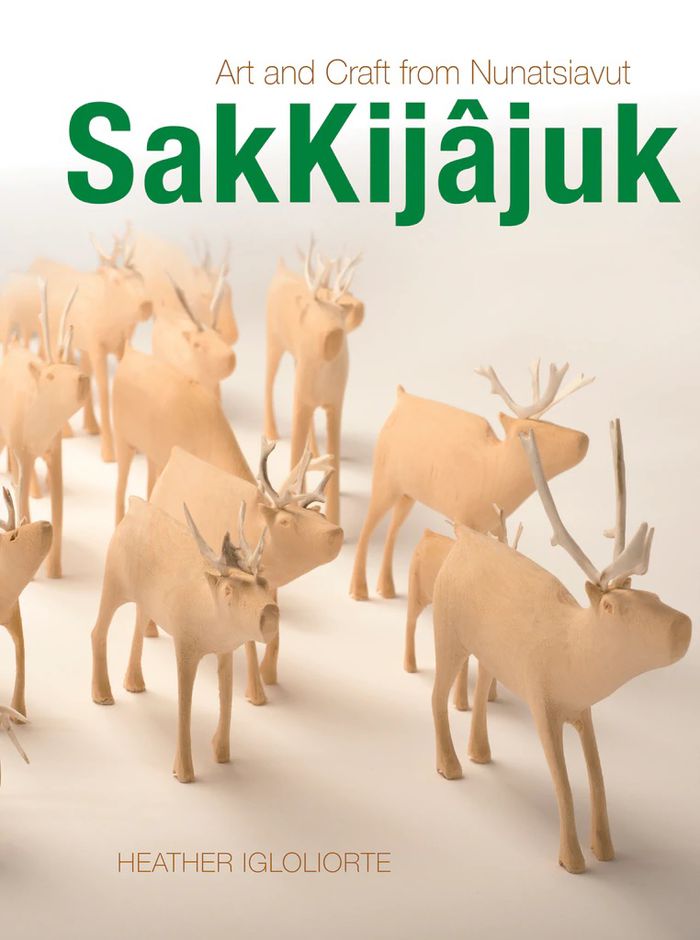
SakKijâjuk : Art and craft From Nunatsiavut
Actions:
Prix:
$45.00
(disponible sur commande)
Résumé:
Nunatsiavut, the Inuit region of Canada that achieved self-government in 2005, produces art that is distinct within the world of Canadian and circumpolar Inuit art. The world's most southerly population of Inuit, the coastal people of Nunatsiavut have always lived both above and below the tree line, and Inuit artists and craftspeople from Nunatsiavut have had access to a diverse range of Arctic and Subarctic flora and fauna, from which they have produced a stunningly diverse range of work. Artists from the territory have traditionally used stone and woods for carving; fur, hide, and sealskin for wearable art; and saltwater seagrass for basketry, as well as wool, metal, cloth, beads, and paper. In recent decades, they have produced work in a variety of contemporary art media, including painting, drawing, printmaking, photography, video, and ceramics, while also working with traditional materials in new and unexpected ways. ''SakKijâjuk: Art and craft from Nunatsiavut'' is the first major publication on the art of the Labrador Inuit. Designed to accompany a major touring exhibition organized by The Rooms Provincial Art Gallery of St. John's, the book will feature more than 80 reproductions of work by 45 different artists, profiles of the featured artists, and a major essay on the art of Nunatsiavut by Heather Igloliorte.
Classification:
livres
livres
Publication:
février 2017
février 2017
Classification:
livres
livres
Prix:
$30.00
(disponible sur commande)
Résumé:
Rebecca Solnit has made a vocation of journeying into difficult territory and reporting back, as an environmentalist, antiglobalization activist, and public intellectual. Storming the Gates of Paradise, an anthology of her essential essays from the past ten years, takes the reader from the Pyrenees to the U.S.-Mexican border, from San Francisco to London, from open sky to(...)
Titre:
Storming the gates of paradise: Landscapes for politics
Actions:
Prix:
$30.00
(disponible sur commande)
Résumé:
Rebecca Solnit has made a vocation of journeying into difficult territory and reporting back, as an environmentalist, antiglobalization activist, and public intellectual. Storming the Gates of Paradise, an anthology of her essential essays from the past ten years, takes the reader from the Pyrenees to the U.S.-Mexican border, from San Francisco to London, from open sky to the deepest mines, and from the antislavery struggles of two hundred years ago to today's street protests. The nearly forty essays collected here comprise a unique guidebook to the American landscape after the millennium–not just the deserts, skies, gardens, and wilderness areas that have long made up Solnit's subject matter, but the social landscape of democracy and repression, of borders, ruins, and protests. She ventures into territories as dark as prison and as sublime as a broad vista, revealing beauty in the harshest landscape and political struggle in the most apparently serene view. Her introduction sets the tone and the book's overarching themes as she describes Thoreau, leaving the jail cell where he had been confined for refusing to pay war taxes and proceeding directly to his favorite huckleberry patch. In this way she links pleasure to politics, brilliantly demonstrating that the path to paradise has often run through prison.
Classification:
livres
livres
Publication:
mai 2008, Berkeley
mai 2008, Berkeley
Sujet:
Théorie de l’architecture
Théorie de l’architecture
Classification:
livres
livres
Actions:
Prix:
$35.00
(disponible en magasin)
Résumé:
The rural, remote, and wild territories we call "countryside", or the 98% of the earth's surface not occupied by cities, make up the front line where today's most powerful forces-climate and ecological devastation, migration, tech, demographic lurches-are playing out. Increasingly under a 'Cartesian' regime-gridded, mechanized, and optimized for maximal production-these(...)
Titre:
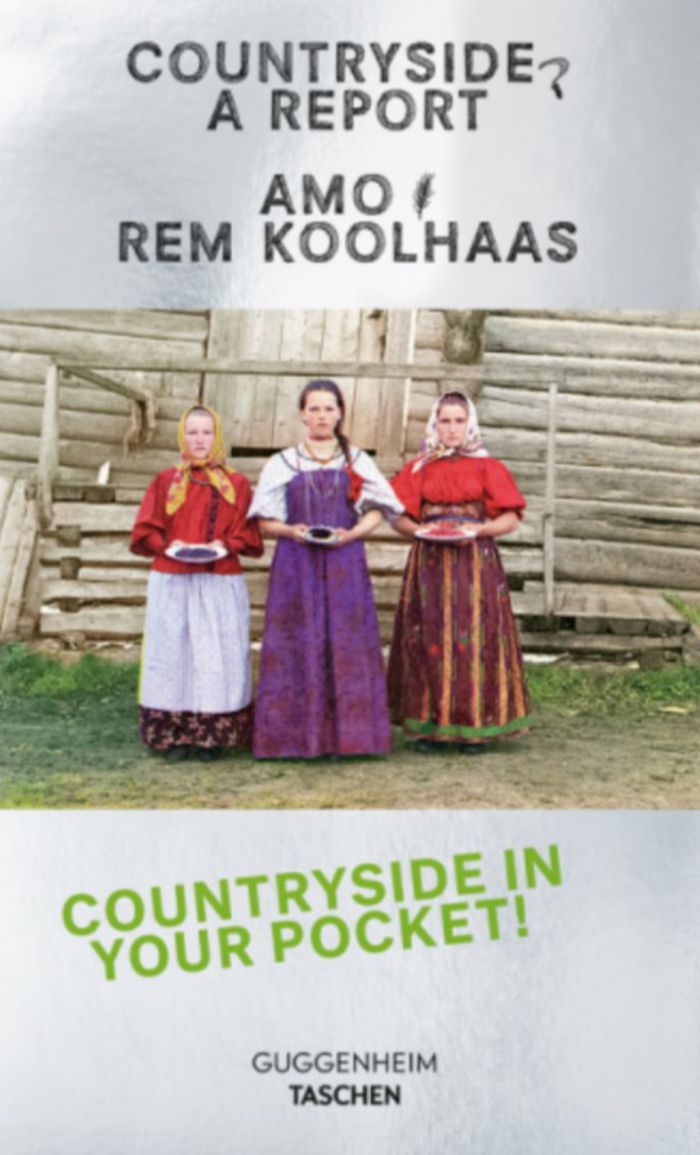
Koolhaas. Countryside, A Report (US edition)
Actions:
Prix:
$35.00
(disponible en magasin)
Résumé:
The rural, remote, and wild territories we call "countryside", or the 98% of the earth's surface not occupied by cities, make up the front line where today's most powerful forces-climate and ecological devastation, migration, tech, demographic lurches-are playing out. Increasingly under a 'Cartesian' regime-gridded, mechanized, and optimized for maximal production-these sites are changing beyond recognition. In his latest publication, Rem Koolhaas explores the rapid and often hidden transformations underway across the Earth's vast non-urban areas. This book gathers travelogue essays exploring territories marked by global forces and experimentation at the edge of our consciousness: a test site near Fukushima, where the robots that will maintain Japan's infrastructure and agriculture are tested; a greenhouse city in the Netherlands that may be the origin for the cosmology of today's countryside; the rapidly thawing permafrost of Central Siberia, a region wrestling with the possibility of relocation; refugees populating dying villages in the German countryside and intersecting with climate change activists; habituated mountain gorillas confronting humans on 'their' territory in Uganda; the American Midwest, where industrial-scale farming operations are coming to grips with regenerative agriculture; and Chinese villages transformed into all-in-one factory, e-commerce stores, and fulfillment centers.
Classification:
livres
livres
Publication:
avril 2020
avril 2020
Sujet:
Architecture, monographies
Architecture, monographies
Classification:
livres
livres
Prix:
$48.00
(disponible en magasin)
Résumé:
Idealized representations of America, as both an aspiration and a menace, played an important role in shaping Russian architecture and urban design from the American Revolution until the fall of the Soviet Union. In Building a new New World, Jean-Louis Cohen traces the concept of “Amerikanizm” and its impact on Russia’s built environment from early czarist interest in(...)
Titre:
Building a new New World: Amerikanizm in Russian Architecture
Actions:
Prix:
$48.00
(disponible en magasin)
Résumé:
Idealized representations of America, as both an aspiration and a menace, played an important role in shaping Russian architecture and urban design from the American Revolution until the fall of the Soviet Union. In Building a new New World, Jean-Louis Cohen traces the concept of “Amerikanizm” and its impact on Russia’s built environment from early czarist interest in Revolutionary America, through the spectacular World’s Fairs of the nineteenth century, to department stores, skyscrapers, and factories built in Russia using American methods during the twentieth century. Visions of America also captivated the Russian avant-garde, from El Lissitzky to Moisei Ginzburg, and Cohen explores the ongoing artistic dialogue maintained between the two countries at the mid-century and in the late Soviet era, when the Cold War induced a strategic competition. Tracing the many journeys of Russian writers, politicians, and planners through the American territory, foregrounding the constant streams of cultural and technological transfer from the U.S.A. to Russia, and revealing the parallel fascination among Russian and American intellectuals with the ongoing pursuit of land occupation and development within their respective borders, this study of Amerikanizm in the architecture and urban design of Russia makes a timely contribution to our understanding of modern architecture and its broader geopolitics.
Classification:
livres
livres
Publication:
décembre 2019
décembre 2019
Sujet:
Publications du CCA
Publications du CCA
Classification:
livres
livres

Actions:
Prix:
$32.95
(disponible sur commande)
Résumé:
The role of popular music is widely recognized in giving voice to radical political views, the plight of the oppressed, and the desire for social change. Avant-garde music, by contrast, is often thought to prioritize the pursuit of new technical or conceptual territory over issues of human and social concern. Yet throughout the activist 1960s, many avant-garde musicians(...)
Titre:
Sound commitments : avant-garde music in the sixties
Actions:
Prix:
$32.95
(disponible sur commande)
Résumé:
The role of popular music is widely recognized in giving voice to radical political views, the plight of the oppressed, and the desire for social change. Avant-garde music, by contrast, is often thought to prioritize the pursuit of new technical or conceptual territory over issues of human and social concern. Yet throughout the activist 1960s, many avant-garde musicians were convinced that aesthetic experiment and social progressiveness made natural bedfellows. Intensely involved in the era's social and political upheavals, they often sought to reflect this engagement in their music. Yet how could avant-garde musicians make a meaningful contribution to social change if their music remained the preserve of a tiny, initiated clique? In answer, this publication examines the encounter of avant-garde music and "the Sixties" across a range of genres, aesthetic positions and geographical locations. Through music for the concert hall, tape and electronic music, jazz and improvisation, participatory "events," performance art, and experimental popular music, the essays in this volume explore developments in the United States, France, West Germany, Italy, the Netherlands, the Soviet Union, Japan and parts of the "Third World," delving into the deep richness of avant-garde musicians' response to the decade's defining cultural shifts.
Classification:
livres
livres
Publication:
février 2009, Oxford
février 2009, Oxford
Sujet:
Acoustique
Acoustique
Classification:
livres
livres
Actions:
Prix:
$46.95
(disponible sur commande)
Résumé:
Support structures is a manual for what bears, sustains, and props, for those things that encourage, care for, and assist; for that which advocates, articulates; for what stands behind, frames, and maintains: it is a manual for those things that give support. While the work of supporting might traditionally appear as subsequent, unessential, and lacking value in itself,(...)
Titre:
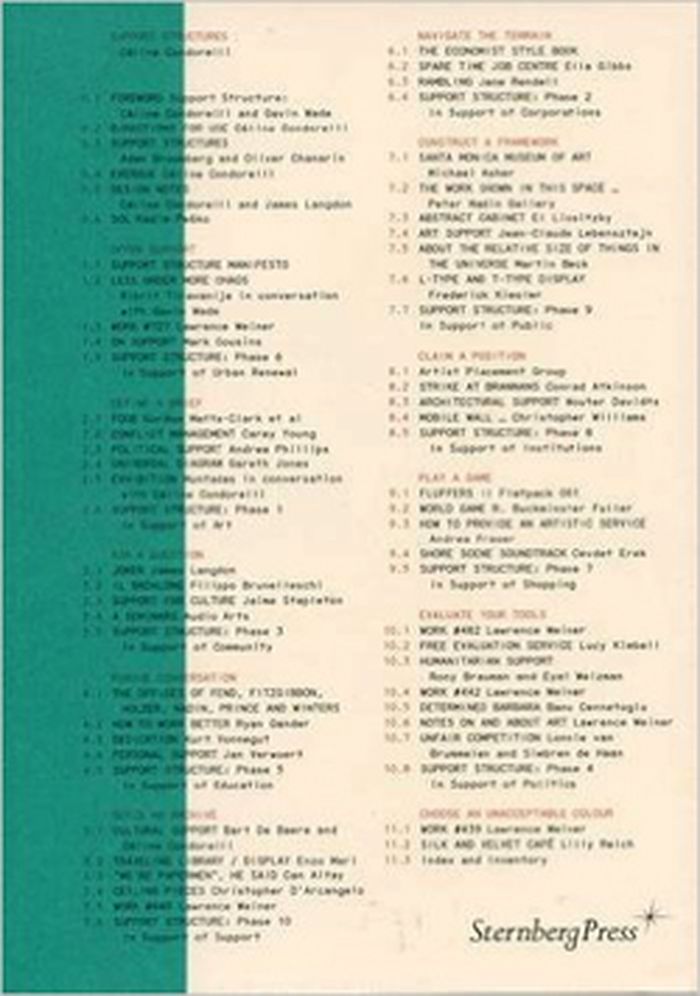
Céline Condorelli: support structures
Actions:
Prix:
$46.95
(disponible sur commande)
Résumé:
Support structures is a manual for what bears, sustains, and props, for those things that encourage, care for, and assist; for that which advocates, articulates; for what stands behind, frames, and maintains: it is a manual for those things that give support. While the work of supporting might traditionally appear as subsequent, unessential, and lacking value in itself, this manual is an attempt to restore attention to one of the neglected, yet crucial modes through which we apprehend and shape the world. Support structures is a critical enquiry into what constitutes “support,” and documents the collaborative project “Support Structure” by Céline Condorelli and Gavin Wade. While registering and collecting reference projects in a new archive of support structures alongside its ten-phase project, different writers, thinkers, and practitioners were invited from various fields to elaborate on frameworks and work on texts , which form the theoretical backbone of the publication. The collection of contributions offers different possibilities for engaging in this unchartered territory, from propositions to projects, existing systems to ones invented for specific creative processes. Support structures offers support through potential methodologies, inspirations and activations for practice, and addresses important questions for art and architecture practices on forms of display, organization, articulation, appropriation, autonomy, and temporariness, and the manifestations of blindness towards them.
Classification:
livres
livres
Publication:
octobre 2009
octobre 2009
Classification:
livres
livres
Titre:
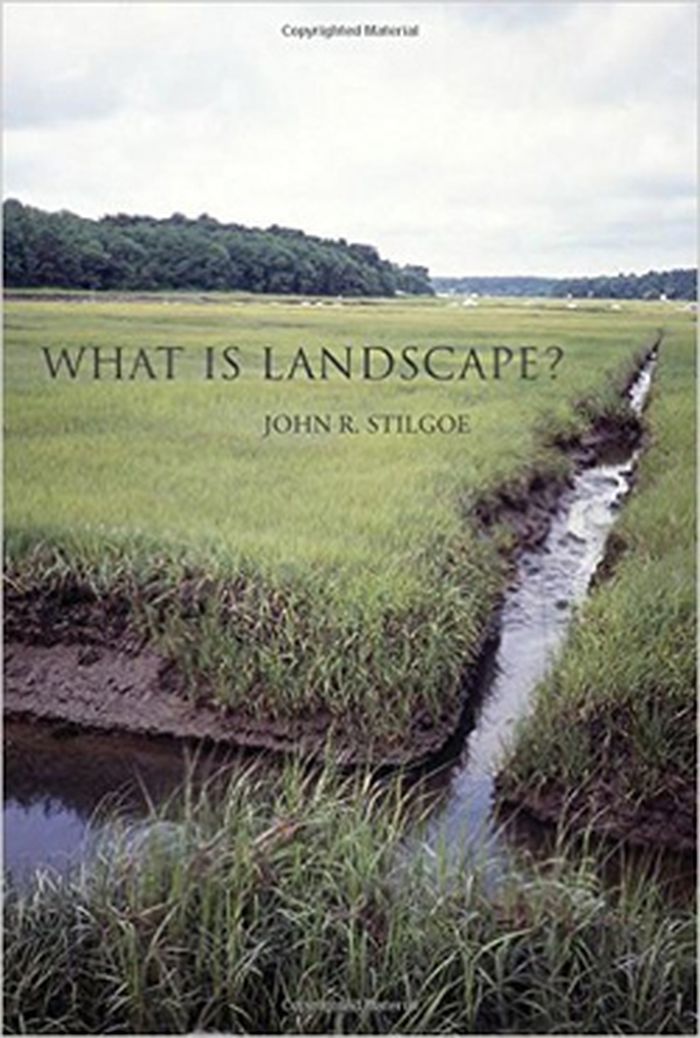
What is landscape?
What is landscape?
Actions:
Prix:
$29.50
(disponible sur commande)
Résumé:
Landscape, John Stilgoe tells us, is a noun. From the old Frisian language (once spoken in coastal parts of the Netherlands and Germany), it meant shoveled land: landschop. Sixteenth-century Englishmen misheard or mispronounced this as landskep, which became landskip, then landscape, designating the surface of the earth shaped for human habitation. In What Is Landscape?(...)
Titre:
What is landscape?
Actions:
Prix:
$29.50
(disponible sur commande)
Résumé:
Landscape, John Stilgoe tells us, is a noun. From the old Frisian language (once spoken in coastal parts of the Netherlands and Germany), it meant shoveled land: landschop. Sixteenth-century Englishmen misheard or mispronounced this as landskep, which became landskip, then landscape, designating the surface of the earth shaped for human habitation. In What Is Landscape? Stilgoe maps the discovery of landscape by putting words to things, zeroing in on landscape’s essence but also leading sideways expeditions through such sources as children’s picture books, folklore, deeds, antique terminology, out-of-print dictionaries, and conversations with locals. (“What is that?” “Well, it’s not really a slough, not really, it’s a bayou . . .”) He offers a written narrative lexicon of landscape as word, concept, and path to discoveries. What Is Landscape? is an invitation to walk, to notice, to ask: to see a sandcastle with a pinwheel at the beach and think of Dutch windmills—icons of triumph, markers of territory won from the sea; to walk in the woods and be amused by the Elizabethans’ misuse of the Latin silvaticus (people of the woods) to coin the word savages; to see in a suburban front lawn a representation of the meadow of a medieval freehold.
Classification:
livres
livres
Publication:
août 2015
août 2015
Sujet:
Théorie du paysage
Théorie du paysage
Classification:
livres
livres
Actions:
Prix:
$65.00
(disponible sur commande)
Résumé:
The volume, realized in co-operation with the Vitra Design Museum is both the catalogue of an internationally travelling exhibition and one of the first monographical studies entirely devoted to the subject of children’s games and furniture. Furniture and games for children, irrespective of culture or period, can be perceived as vehicles for communicating society’s(...)
Sujet:
Zines
Zines
Publication:
décembre 1998, Milano
décembre 1998, Milano
Titre:
Kid size : the material world of childhood
Actions:
Prix:
$65.00
(disponible sur commande)
Résumé:
The volume, realized in co-operation with the Vitra Design Museum is both the catalogue of an internationally travelling exhibition and one of the first monographical studies entirely devoted to the subject of children’s games and furniture. Furniture and games for children, irrespective of culture or period, can be perceived as vehicles for communicating society’s attitudes towards learning, the child’s physical and phychological development, safety, order in the family, territory, the place of play and patterns of social behaviour; although the child, by contrast, regards them as largely interchangeable objects in the serious work of play, the organization of modern society tends to give them always more importance, changing them into real products of design. The volume aims to explore the world of childhood throughout the different types of furniture artefacts and games from various periods and cultures in the world which illuminate the changing relationship between children and adults, the growing attention to child-centred provision and educational values and the fundamental role of playing in the history of childhood of different countries. The catalogue essays are written by chilhood specialists, social historians, ethnologists, educationalists, industrials designers (specialist in playground and play equipment) and experts on children living in the various cultures of the world: Lucy Bullivant, Mike Scaife, Linda Pollock, Eileen Adams, Günter Beltzig, Ingeborg Weber-Kellermann, Gerhard Kubik, Tina Wodiung and Sally Kevill-Davies.
Classification:
livres
livres
Publication:
décembre 1998, Milano
décembre 1998, Milano
Sujet:
Zines
Zines
Classification:
livres
livres
Titre:
Arcade 20.3 spring 2002
Arcade 20.3 spring 2002
Actions:
Prix:
$7.95
(disponible sur commande)
Résumé:
A hodge-podge: fiction, photos, poetry, catalogs, historical facts, a cartoon—the narrowly objective hard by the expansively subjective. The plurality of genres pleased me. Any account of our territory bereft of, say, facts, poetry, projections, wild speculation, polemics, or sketchy memory, would seem to me to be fatally compromised. As the Office for Soft Architecture(...)
Titre:
Arcade 20.3 spring 2002
Actions:
Prix:
$7.95
(disponible sur commande)
Résumé:
A hodge-podge: fiction, photos, poetry, catalogs, historical facts, a cartoon—the narrowly objective hard by the expansively subjective. The plurality of genres pleased me. Any account of our territory bereft of, say, facts, poetry, projections, wild speculation, polemics, or sketchy memory, would seem to me to be fatally compromised. As the Office for Soft Architecture puts it in their Fourth Walk: “[We] painted the place in the polis of the sour heat and the pulse beneath our coats, the specific entry of our exhalations and words into the atmosphere…Our method was patience. We would slowly absorb each image until we were what we had deliberately chosen to become. Of course then we ourselves were the documents; we acquired a fragility. Hello my Delicate we would repeat when we met by chance in the streets under the rows of posters Hello my Delicate.” Matthew Stadler is a novelist and essayist whose writing about design has appeared in Nest magazine, Wiederhal, Frieze, The Guardian, and The Seattle Times. He is the editor of Clear Cut Press, a new publishing and distribution company based in Astoria, OR. editor@clearcutpress.com. Tae Won Yu is an artist working in Olympia, Washington. His previous projects include designs for Built To Spill, photographs for Nest magazine, and illlustrations for The Stranger.
Classification:
livres
livres
Publication:
mars 2002, Seattle
mars 2002, Seattle
Sujet:
livres soldés
livres soldés
Classification:
livres
livres
Prix:
$95.00
(disponible sur commande)
Résumé:
This book presents three independent bodies of work by Henry Wessel, each being a precise sequence arranged to give the viewer the experience of what it felt like to pass through the territory described. The first series “Traffic” shows Wessel’s photos of drivers stuck in traffic as he commuted in the early 1980s from Richmond, California, to San Francisco in the morning(...)
Titre:
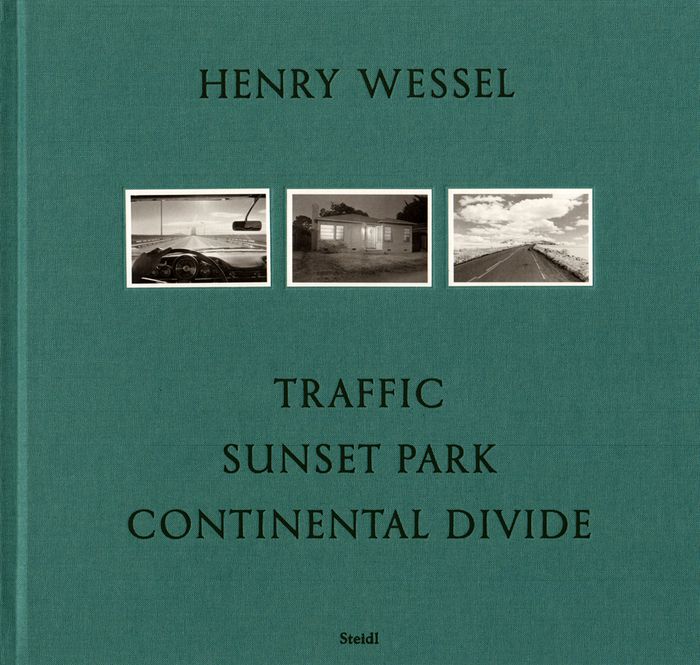
Henry Wessel: Traffic / Sunset Park / Continental Divide
Actions:
Prix:
$95.00
(disponible sur commande)
Résumé:
This book presents three independent bodies of work by Henry Wessel, each being a precise sequence arranged to give the viewer the experience of what it felt like to pass through the territory described. The first series “Traffic” shows Wessel’s photos of drivers stuck in traffic as he commuted in the early 1980s from Richmond, California, to San Francisco in the morning rush hour. Wessel records the determination, impatience and blank boredom of his fellow drivers as they navigate a daily drill that seems at times daunting and hopeless. “Sunset Park” is Wessel’s series of night photos of the modest working-class neighborhood of Sunset Park in Santa Monica. Over four years in the mid-1990s, Wessel captured the nocturnal transformation of suburbia into a strange, sometimes eerie,landscape. In his words: “You can’t help but notice how the world is reconfigured by the lights at night. The spot lighting of particular areas, the lack of ambient light, the unnatural way that shadows are cast, all take us to an unfamiliar place…” Wessel’s final series “Continental Divide” takes the viewer on a ride from the dense, suburban flatlands of the Midwest, up across the Rocky Mountains, and down into the sparse desert landscape of the American West. Wessel depicts its houses, shacks, street corners, and the highway, reminding us of the inherent aesthetics of the everyday.
Classification:
livres
livres
Publication:
janvier 2017
janvier 2017
Sujet:
Monographies photo
Monographies photo


