


26977 Résultats
Niveau de description archivistique:
Projet
Projet
Numéro de référence:
AP056.S1.1991.PR05
Description:
This project series documents Phase 2B of work completed for Hasbro Headquarters in Pawtucket, Rhode Island from 1991-1994. The office identified the project number as 9105. This project consisted of interior work for part of the company's headquarters and was the third in a series of projects that the firm would complete for the headquarters. The 300,000 square foot building was predominantly one-storey and located on the block between Saratoga, Grand, London and Newport Avenues. The three projects were known as Main Street, Phase 2A and Phase 2B. Phase 1 was completed in 1986 by Barton Myers Associates with Shirley Blumberg as partner-in-charge. These subsequent projects by KPMB were also headed by Shirley Blumberg and continued the initial style she had established in Phase 1. These projects saw the conversion of a historic brick and masonry mill into the company's new offices. The office structure was inspired by the layout of a Greek town, with a main street running through it. This phase continued the work of Phase 2A and focused mainly on the design of the visitor's entrance. The entrance area was V-shaped, with the wide end at the entrance doors and the narrower end leading guests deeper into the building. Once past this area, the hallway opened like a bubble, wrapping around a large elliptical courtyard in the middle. This courtyard, comprised of glass windows with trees and other landscaping in it, was the most prominent feature of this phase. Materials used throughout the offices included polished concrete, maple, aluminum and perforated metal. The project is recorded through drawings and textual records dating from 1989 to around 1994. The drawings are mostly originals and include sketches, plans, sections, elevations, perspectives, details, and some construction drawings. Many of the drawings focus on the entrance and courtyard. The textual records consist of the project program and schedule.
AP056.S1.1991.PR05
Description:
This project series documents Phase 2B of work completed for Hasbro Headquarters in Pawtucket, Rhode Island from 1991-1994. The office identified the project number as 9105. This project consisted of interior work for part of the company's headquarters and was the third in a series of projects that the firm would complete for the headquarters. The 300,000 square foot building was predominantly one-storey and located on the block between Saratoga, Grand, London and Newport Avenues. The three projects were known as Main Street, Phase 2A and Phase 2B. Phase 1 was completed in 1986 by Barton Myers Associates with Shirley Blumberg as partner-in-charge. These subsequent projects by KPMB were also headed by Shirley Blumberg and continued the initial style she had established in Phase 1. These projects saw the conversion of a historic brick and masonry mill into the company's new offices. The office structure was inspired by the layout of a Greek town, with a main street running through it. This phase continued the work of Phase 2A and focused mainly on the design of the visitor's entrance. The entrance area was V-shaped, with the wide end at the entrance doors and the narrower end leading guests deeper into the building. Once past this area, the hallway opened like a bubble, wrapping around a large elliptical courtyard in the middle. This courtyard, comprised of glass windows with trees and other landscaping in it, was the most prominent feature of this phase. Materials used throughout the offices included polished concrete, maple, aluminum and perforated metal. The project is recorded through drawings and textual records dating from 1989 to around 1994. The drawings are mostly originals and include sketches, plans, sections, elevations, perspectives, details, and some construction drawings. Many of the drawings focus on the entrance and courtyard. The textual records consist of the project program and schedule.
Personnes et institutions:
Date:
1989-circa 1994
1989-circa 1994
Titre:
Hasbro Headquarters, Phase 2B, Pawtucket, Rhode Island (1991-1994)
Actions:
AP056.S1.1991.PR05
Description:
This project series documents Phase 2B of work completed for Hasbro Headquarters in Pawtucket, Rhode Island from 1991-1994. The office identified the project number as 9105. This project consisted of interior work for part of the company's headquarters and was the third in a series of projects that the firm would complete for the headquarters. The 300,000 square foot building was predominantly one-storey and located on the block between Saratoga, Grand, London and Newport Avenues. The three projects were known as Main Street, Phase 2A and Phase 2B. Phase 1 was completed in 1986 by Barton Myers Associates with Shirley Blumberg as partner-in-charge. These subsequent projects by KPMB were also headed by Shirley Blumberg and continued the initial style she had established in Phase 1. These projects saw the conversion of a historic brick and masonry mill into the company's new offices. The office structure was inspired by the layout of a Greek town, with a main street running through it. This phase continued the work of Phase 2A and focused mainly on the design of the visitor's entrance. The entrance area was V-shaped, with the wide end at the entrance doors and the narrower end leading guests deeper into the building. Once past this area, the hallway opened like a bubble, wrapping around a large elliptical courtyard in the middle. This courtyard, comprised of glass windows with trees and other landscaping in it, was the most prominent feature of this phase. Materials used throughout the offices included polished concrete, maple, aluminum and perforated metal. The project is recorded through drawings and textual records dating from 1989 to around 1994. The drawings are mostly originals and include sketches, plans, sections, elevations, perspectives, details, and some construction drawings. Many of the drawings focus on the entrance and courtyard. The textual records consist of the project program and schedule.
Hasbro Headquarters, Phase 2B, Pawtucket, Rhode Island (1991-1994)
Actions:
AP056.S1.1991.PR05
Description:
This project series documents Phase 2B of work completed for Hasbro Headquarters in Pawtucket, Rhode Island from 1991-1994. The office identified the project number as 9105. This project consisted of interior work for part of the company's headquarters and was the third in a series of projects that the firm would complete for the headquarters. The 300,000 square foot building was predominantly one-storey and located on the block between Saratoga, Grand, London and Newport Avenues. The three projects were known as Main Street, Phase 2A and Phase 2B. Phase 1 was completed in 1986 by Barton Myers Associates with Shirley Blumberg as partner-in-charge. These subsequent projects by KPMB were also headed by Shirley Blumberg and continued the initial style she had established in Phase 1. These projects saw the conversion of a historic brick and masonry mill into the company's new offices. The office structure was inspired by the layout of a Greek town, with a main street running through it. This phase continued the work of Phase 2A and focused mainly on the design of the visitor's entrance. The entrance area was V-shaped, with the wide end at the entrance doors and the narrower end leading guests deeper into the building. Once past this area, the hallway opened like a bubble, wrapping around a large elliptical courtyard in the middle. This courtyard, comprised of glass windows with trees and other landscaping in it, was the most prominent feature of this phase. Materials used throughout the offices included polished concrete, maple, aluminum and perforated metal. The project is recorded through drawings and textual records dating from 1989 to around 1994. The drawings are mostly originals and include sketches, plans, sections, elevations, perspectives, details, and some construction drawings. Many of the drawings focus on the entrance and courtyard. The textual records consist of the project program and schedule.
Niveau de description archivistique:
Project
Project
Date:
1989-circa 1994
1989-circa 1994
Personnes et institutions:
Niveau de description archivistique:
Projet
Projet
Numéro de référence:
AP075.S1.1999.PR05
Description:
Project series documents Cornelia Hahn Oberlander's landscape project for the garden of Linda Yorke and Gordon Forbes in Vancouver, British Columbia. Oberlander worked on this project in the second half of the 1990s. She worked with architect André Rowland who was in charge of designing an addition to the residence designed in the late 1940s by Ned Pratt from architectural firm Sharp, Thompson, Berwick and & Pratt. The project consisted in redesigning the entire yard and adding a play area for children. Oberlander included terraces next to the addition to the house, planting beds and planters. The play area included a tower house accessible by a rope bridge, a two levels playhouse with wooden porch, a slide, a fireman pole and a ladder, and a small water canal with stone edges and activated by a hand pump. The project series contains landscape sketches, design development drawings, including a landscape concept plan, details, sections and elevations for play area and play structures, and building plans used as reference. The project is also documented through correspondence, including with clients, suppliers and consultants, concept notes by Oberlander, plant lists, financial material, research material, and photographs of the landscaping. Source: Herrington, Susan. Cornelia Hahn Oberlander: Making the Modern Landscape, University of Virginia Press, 2014, 304 pages.
AP075.S1.1999.PR05
Description:
Project series documents Cornelia Hahn Oberlander's landscape project for the garden of Linda Yorke and Gordon Forbes in Vancouver, British Columbia. Oberlander worked on this project in the second half of the 1990s. She worked with architect André Rowland who was in charge of designing an addition to the residence designed in the late 1940s by Ned Pratt from architectural firm Sharp, Thompson, Berwick and & Pratt. The project consisted in redesigning the entire yard and adding a play area for children. Oberlander included terraces next to the addition to the house, planting beds and planters. The play area included a tower house accessible by a rope bridge, a two levels playhouse with wooden porch, a slide, a fireman pole and a ladder, and a small water canal with stone edges and activated by a hand pump. The project series contains landscape sketches, design development drawings, including a landscape concept plan, details, sections and elevations for play area and play structures, and building plans used as reference. The project is also documented through correspondence, including with clients, suppliers and consultants, concept notes by Oberlander, plant lists, financial material, research material, and photographs of the landscaping. Source: Herrington, Susan. Cornelia Hahn Oberlander: Making the Modern Landscape, University of Virginia Press, 2014, 304 pages.
Personnes et institutions:
Date:
1947-2006
1947-2006
Titre:
Yorke-Forbes Residence, Vancouver, British Columbia (1999)
Actions:
AP075.S1.1999.PR05
Description:
Project series documents Cornelia Hahn Oberlander's landscape project for the garden of Linda Yorke and Gordon Forbes in Vancouver, British Columbia. Oberlander worked on this project in the second half of the 1990s. She worked with architect André Rowland who was in charge of designing an addition to the residence designed in the late 1940s by Ned Pratt from architectural firm Sharp, Thompson, Berwick and & Pratt. The project consisted in redesigning the entire yard and adding a play area for children. Oberlander included terraces next to the addition to the house, planting beds and planters. The play area included a tower house accessible by a rope bridge, a two levels playhouse with wooden porch, a slide, a fireman pole and a ladder, and a small water canal with stone edges and activated by a hand pump. The project series contains landscape sketches, design development drawings, including a landscape concept plan, details, sections and elevations for play area and play structures, and building plans used as reference. The project is also documented through correspondence, including with clients, suppliers and consultants, concept notes by Oberlander, plant lists, financial material, research material, and photographs of the landscaping. Source: Herrington, Susan. Cornelia Hahn Oberlander: Making the Modern Landscape, University of Virginia Press, 2014, 304 pages.
Yorke-Forbes Residence, Vancouver, British Columbia (1999)
Actions:
AP075.S1.1999.PR05
Description:
Project series documents Cornelia Hahn Oberlander's landscape project for the garden of Linda Yorke and Gordon Forbes in Vancouver, British Columbia. Oberlander worked on this project in the second half of the 1990s. She worked with architect André Rowland who was in charge of designing an addition to the residence designed in the late 1940s by Ned Pratt from architectural firm Sharp, Thompson, Berwick and & Pratt. The project consisted in redesigning the entire yard and adding a play area for children. Oberlander included terraces next to the addition to the house, planting beds and planters. The play area included a tower house accessible by a rope bridge, a two levels playhouse with wooden porch, a slide, a fireman pole and a ladder, and a small water canal with stone edges and activated by a hand pump. The project series contains landscape sketches, design development drawings, including a landscape concept plan, details, sections and elevations for play area and play structures, and building plans used as reference. The project is also documented through correspondence, including with clients, suppliers and consultants, concept notes by Oberlander, plant lists, financial material, research material, and photographs of the landscaping. Source: Herrington, Susan. Cornelia Hahn Oberlander: Making the Modern Landscape, University of Virginia Press, 2014, 304 pages.
Niveau de description archivistique:
Project
Project
Date:
1947-2006
1947-2006
Personnes et institutions:
Classification:
documents textuels
documents textuels
Numéro de référence:
ARCH257131
Description:
29 files - "Permanent files": Surrey Courthouse, Regina Civic Museum, Fred Hutchinson Cancer Research Centre, Cariboo College,, Administration Bld. Prince-George, Kwantlen College, Union Station Project, New Surrey Campus, Churchill Museum, Lot 47 and 65 Whistler Village, Minory Labrary and Cultural Centre Espansion, GHC Central Speciality Centre South, Deer Lake Arts Centre, Nature, Culture and History Museum/Ecomuseum, Washington State University Spokane Campus and Holland Library, Renewal and Parking Structure and Chemistry Building addition, Vancouver School Board New Education Centre, Vancouver Art Gallery, Prince-George Multi-purpose facility, Nanaimo Performing Arts Centre, Engineering Graduate Research Centre, Langley Civic core development plan public safety building design
ARCH257131
Description:
29 files - "Permanent files": Surrey Courthouse, Regina Civic Museum, Fred Hutchinson Cancer Research Centre, Cariboo College,, Administration Bld. Prince-George, Kwantlen College, Union Station Project, New Surrey Campus, Churchill Museum, Lot 47 and 65 Whistler Village, Minory Labrary and Cultural Centre Espansion, GHC Central Speciality Centre South, Deer Lake Arts Centre, Nature, Culture and History Museum/Ecomuseum, Washington State University Spokane Campus and Holland Library, Renewal and Parking Structure and Chemistry Building addition, Vancouver School Board New Education Centre, Vancouver Art Gallery, Prince-George Multi-purpose facility, Nanaimo Performing Arts Centre, Engineering Graduate Research Centre, Langley Civic core development plan public safety building design
Personnes et institutions:
Titre:
Permanent files on various projects
Actions:
ARCH257131
Description:
29 files - "Permanent files": Surrey Courthouse, Regina Civic Museum, Fred Hutchinson Cancer Research Centre, Cariboo College,, Administration Bld. Prince-George, Kwantlen College, Union Station Project, New Surrey Campus, Churchill Museum, Lot 47 and 65 Whistler Village, Minory Labrary and Cultural Centre Espansion, GHC Central Speciality Centre South, Deer Lake Arts Centre, Nature, Culture and History Museum/Ecomuseum, Washington State University Spokane Campus and Holland Library, Renewal and Parking Structure and Chemistry Building addition, Vancouver School Board New Education Centre, Vancouver Art Gallery, Prince-George Multi-purpose facility, Nanaimo Performing Arts Centre, Engineering Graduate Research Centre, Langley Civic core development plan public safety building design
Permanent files on various projects
Actions:
ARCH257131
Description:
29 files - "Permanent files": Surrey Courthouse, Regina Civic Museum, Fred Hutchinson Cancer Research Centre, Cariboo College,, Administration Bld. Prince-George, Kwantlen College, Union Station Project, New Surrey Campus, Churchill Museum, Lot 47 and 65 Whistler Village, Minory Labrary and Cultural Centre Espansion, GHC Central Speciality Centre South, Deer Lake Arts Centre, Nature, Culture and History Museum/Ecomuseum, Washington State University Spokane Campus and Holland Library, Renewal and Parking Structure and Chemistry Building addition, Vancouver School Board New Education Centre, Vancouver Art Gallery, Prince-George Multi-purpose facility, Nanaimo Performing Arts Centre, Engineering Graduate Research Centre, Langley Civic core development plan public safety building design
Classification:
documents textuels
documents textuels
Personnes et institutions:
Classification:
documents textuels
documents textuels
Numéro de référence:
DR2004:0142
Description:
correspondence, publications, reports, including 3 bound technical reports by the United States Army National Laboratories, 2 binders, and 38 bound papers from the International Symposium on Pneumatic Structures, Delft, 1972
DR2004:0142
Description:
correspondence, publications, reports, including 3 bound technical reports by the United States Army National Laboratories, 2 binders, and 38 bound papers from the International Symposium on Pneumatic Structures, Delft, 1972
Personnes et institutions:
Titre:
Correspondence, publications, reports
Actions:
DR2004:0142
Description:
correspondence, publications, reports, including 3 bound technical reports by the United States Army National Laboratories, 2 binders, and 38 bound papers from the International Symposium on Pneumatic Structures, Delft, 1972
Correspondence, publications, reports
Actions:
DR2004:0142
Description:
correspondence, publications, reports, including 3 bound technical reports by the United States Army National Laboratories, 2 binders, and 38 bound papers from the International Symposium on Pneumatic Structures, Delft, 1972
Classification:
documents textuels
documents textuels
Personnes et institutions:
Classification:
dessins
Quantité:
50 conceptual drawing(s)
dessins
Quantité:
50 conceptual drawing(s)
Numéro de référence:
DR2004:0905
Description:
sketches, some with annotations, perspectives, sections, axonometrics, site plans, diagrams, overlays, elevations, plans, maps, photograph key plans, views of structures, design development drawings, postcards, photomontage, and view of train
DR2004:0905
Description:
sketches, some with annotations, perspectives, sections, axonometrics, site plans, diagrams, overlays, elevations, plans, maps, photograph key plans, views of structures, design development drawings, postcards, photomontage, and view of train
Personnes et institutions:
Titre:
Sketches, some with annotations, perspectives, sections
Actions:
DR2004:0905
Description:
sketches, some with annotations, perspectives, sections, axonometrics, site plans, diagrams, overlays, elevations, plans, maps, photograph key plans, views of structures, design development drawings, postcards, photomontage, and view of train
Sketches, some with annotations, perspectives, sections
Actions:
DR2004:0905
Description:
sketches, some with annotations, perspectives, sections, axonometrics, site plans, diagrams, overlays, elevations, plans, maps, photograph key plans, views of structures, design development drawings, postcards, photomontage, and view of train
Classification:
dessins
Quantité:
50 conceptual drawing(s)
dessins
Quantité:
50 conceptual drawing(s)
Personnes et institutions:
Classification:
dessins, documents textuels, photographies
dessins, documents textuels, photographies
Numéro de référence:
AP142.S1.D244.P1
Description:
sketches, drawings, photographs, an aerial view, correspondence, an architect's statement, a proposal, specifications, calculations, administrative records, technical reports, building permits, photocopies of views of existing structures, a business card, and notes
AP142.S1.D244.P1
Description:
sketches, drawings, photographs, an aerial view, correspondence, an architect's statement, a proposal, specifications, calculations, administrative records, technical reports, building permits, photocopies of views of existing structures, a business card, and notes
Personnes et institutions:
Titre:
Sketches, drawings, photographs, an aerial view, correspondence
Actions:
AP142.S1.D244.P1
Description:
sketches, drawings, photographs, an aerial view, correspondence, an architect's statement, a proposal, specifications, calculations, administrative records, technical reports, building permits, photocopies of views of existing structures, a business card, and notes
Sketches, drawings, photographs, an aerial view, correspondence
Actions:
AP142.S1.D244.P1
Description:
sketches, drawings, photographs, an aerial view, correspondence, an architect's statement, a proposal, specifications, calculations, administrative records, technical reports, building permits, photocopies of views of existing structures, a business card, and notes
Classification:
dessins, documents textuels, photographies
dessins, documents textuels, photographies
Personnes et institutions:
Classification:
événements
événements
Actions:
Description:
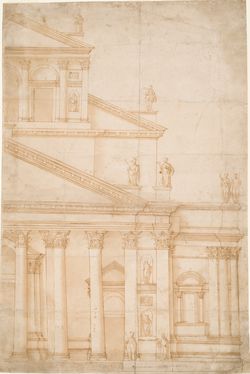
L’histoire de l’architecture traite des relations entre espace, bâtiment, géométrie urbaine et pratiques sociales – elle exprime comment l’expérience de l’espace correspond à une expérience du monde. Cette conférence présentera une analyse du débat qui, au XVIe siècle, a entouré l’achèvement de la façade de la basilique San Petronio à Bologne, construite en partie dans un(...)
L’histoire de l’architecture traite des relations entre espace, bâtiment, géométrie urbaine et pratiques sociales – elle exprime comment l’expérience de l’espace correspond à une expérience du monde. Cette conférence présentera une analyse du débat qui, au XVIe siècle, a entouré l’achèvement de la façade de la basilique San Petronio à Bologne, construite en partie dans un(...)
Localisation:
Théâtre Paul-Desmarais Mot(s)-clé(s):
Guido Beltramini, basilique San Petronio, Bologne, Andrea Palladio, Baldassare Peruzzi, Giacomo da Vignola
Théâtre Paul-Desmarais Mot(s)-clé(s):
Guido Beltramini, basilique San Petronio, Bologne, Andrea Palladio, Baldassare Peruzzi, Giacomo da Vignola
Date:
5 octobre 2017, 18h30
5 octobre 2017, 18h30
Titre:
Guido Beltramini, quel sens avait l’histoire pour les architectes et leurs mécènes à Bologne, en 1579?
Actions:
Description:
L’histoire de l’architecture traite des relations entre espace, bâtiment, géométrie urbaine et pratiques sociales – elle exprime comment l’expérience de l’espace correspond à une expérience du monde. Cette conférence présentera une analyse du débat qui, au XVIe siècle, a entouré l’achèvement de la façade de la basilique San Petronio à Bologne, construite en partie dans un(...)
Guido Beltramini, quel sens avait l’histoire pour les architectes et leurs mécènes à Bologne, en 1579?
Actions:
Description:
L’histoire de l’architecture traite des relations entre espace, bâtiment, géométrie urbaine et pratiques sociales – elle exprime comment l’expérience de l’espace correspond à une expérience du monde. Cette conférence présentera une analyse du débat qui, au XVIe siècle, a entouré l’achèvement de la façade de la basilique San Petronio à Bologne, construite en partie dans un(...)
Classification:
événements
événements
Date:
5 octobre 2017
18h30
5 octobre 2017
18h30
Localisation:
Théâtre Paul-Desmarais Mot(s)-clé(s):
Guido Beltramini, basilique San Petronio, Bologne, Andrea Palladio, Baldassare Peruzzi, Giacomo da Vignola
Théâtre Paul-Desmarais Mot(s)-clé(s):
Guido Beltramini, basilique San Petronio, Bologne, Andrea Palladio, Baldassare Peruzzi, Giacomo da Vignola
Niveau de description archivistique:
Sous-série
Sous-série
Numéro de référence:
CI001.S1.D3
Description:
The urban and public architecture of Hubert Rohault de Fleury is insightful concerning both the stylistic directions of utilitarian architecture in France and the structure and role of the government architectural services (1) in the Empire and the Restoration. The drawings in the CCA collection depict built and unbuilt projects undertaken in the context of Hubert's positions in the government architectural services as well as private commissions. Hubert's principal official positions related to three branches of the French government: the Préfecture de la police, the Conseil général des hospices and the Conseil des Bâtiments Civils, a "division" of the Ministère de l'interieur. Hubert's work for the Préfecture de la police (which was also responsible for the gendarmerie and the sapeurs-pompiers barracks) is represented in the CCA collection by projects for four gendarmerie barracks (1821-1830) and alterations to the Préfecture de la Police (1833 ?) and nearby prison in Paris (1819)(DR1974:0002:016:001-070 / DR1974:0002:011:001-089 and DR1974:0002: 015:001-070). The drawings in these albums emphasize the planning (or re-arrangement) of the interior spaces. The album for the Préfecture de la police also includes record drawings for prisons in England and France as background material for Hubert's work and/or related to reports for the Conseil des Bâtiments Civils, which had an active role in the design of prisons throughout France during the early years of the nineteenth century (2). Although the CCA collection has no drawings directly related to Hubert's position as the architecte des hospices (3), drawings and prints are included for his earlier ideal hospitals (ca. 1810) (DR1974:0002:008:001-077). These projects continue the late 17th and 18th century tradition of monumental geometrically laid-out ideal hospitals. This album also contains prints and drawings of medical buildings by other architects (probably reference material), and drawings of Hubert's unexecuted proposal for the re-development of the École de médecine (Paris) and the surrounding buildings and urban spaces. Hubert was the architecte de l'École de medicine (4); a position that probably related to his work for the Ministère d'Interieur, which would have been responsible for this building. In general, Hubert's role and responsibilities within the Ministère de l'interieur and the associated Conseil de Bâtiment Civils (especially prior to his appointment to the position of inspecteur gènèral in 1830) are the least clear of his government positions. In addition to the École de medicine album, two other albums contain projects relating to the Ministère de l'Interieur: two proposals for Place Louis XV commissioned by the Ministre de l'interieur, Duc Decazes in 1821 (DR1974:0002:037:001-031), and drawings for the conversion or renovation of several Parisian hôtel particuliers (probably between 1810 and ca. 1820) including those used by the Ministère de l'interieur, Ministère de la Guerre and the Ministère des affaires étrangères (DR1974:0002;011:001-089). On other government commission of significance is represented in the CCA collection. In 1819, Hubert Rohault de Fleury in collaboration with Etienne Hyppolite Godde was commissioned to direct the restoration of the Thermes de Julien located under the Hôtel de Cluny. The CCA collection includes several letters and drawings, and a report related to this commission (DR1974:0002 :037:001-031). Hubert's private urban projects, mostly commissioned by private entrepreneurs or societies, were concerned with the expansion of the infrastructure of Paris and the surrounding communities as well as, to some extent, larger issues of urban development. One album contains projects dating from between 1819 and 1836 related horses - an essential part of 19th century urban life (5): a stud-farm (Haras de Madrid, Bois de Boulogne), an auction house and an infirmary (Clos St. Charles, Clos d'équarrissage, fôret de Bondy) and three slaughterhouses (Plaine de Grenelle, an unnamed project and La Villete (6))(DR1974:0002:014:001-104). These album also includes developmental studies for a new quartier of Paris - Nouveau Quartier Poissonière (the site of today's 10e arrondissement). A second album (ca. 1825) includes designs for a "maison de blanchisseur", an "entrepot de vins" with adjacent "guingette" and designs for structures at Parc de Clichy - a reservoir, a washhouse and a manège (DR1974:0002:009:001-079) (7). The drawings in these albums are particularly informative regarding the materials, structures and mechanical systems utilized. As with most of his government commissions, for these buildings, Hubert adopted a sparse architectural syntax of pared-down classical motifs and regimented plans grounded in the ideas of Durand and commonly used in utilitarian buildings during the 19th century. (1) These are discussed in some detail in Chapter 2 of David Van Zanten, 'Building Paris' (Cambridge: Cambridge University Press, 1994). (2) Van Zanten, 'Building Paris', 51-52. (3) The Cabinet des Estampes at the Musée Carnavalet in Paris has drawings related to Hubert's work for the Conseil général des hospices. (4) Evidence of this position is based on inscriptions on drawings in album, DR1974:0002:008:001-77. (5) Bergdoll, 4. (6) The La Villete slaughterhouse was designed by Charles Rohault de Fleury. (7) The source(s) of these commissions is unknown.
CI001.S1.D3
Description:
The urban and public architecture of Hubert Rohault de Fleury is insightful concerning both the stylistic directions of utilitarian architecture in France and the structure and role of the government architectural services (1) in the Empire and the Restoration. The drawings in the CCA collection depict built and unbuilt projects undertaken in the context of Hubert's positions in the government architectural services as well as private commissions. Hubert's principal official positions related to three branches of the French government: the Préfecture de la police, the Conseil général des hospices and the Conseil des Bâtiments Civils, a "division" of the Ministère de l'interieur. Hubert's work for the Préfecture de la police (which was also responsible for the gendarmerie and the sapeurs-pompiers barracks) is represented in the CCA collection by projects for four gendarmerie barracks (1821-1830) and alterations to the Préfecture de la Police (1833 ?) and nearby prison in Paris (1819)(DR1974:0002:016:001-070 / DR1974:0002:011:001-089 and DR1974:0002: 015:001-070). The drawings in these albums emphasize the planning (or re-arrangement) of the interior spaces. The album for the Préfecture de la police also includes record drawings for prisons in England and France as background material for Hubert's work and/or related to reports for the Conseil des Bâtiments Civils, which had an active role in the design of prisons throughout France during the early years of the nineteenth century (2). Although the CCA collection has no drawings directly related to Hubert's position as the architecte des hospices (3), drawings and prints are included for his earlier ideal hospitals (ca. 1810) (DR1974:0002:008:001-077). These projects continue the late 17th and 18th century tradition of monumental geometrically laid-out ideal hospitals. This album also contains prints and drawings of medical buildings by other architects (probably reference material), and drawings of Hubert's unexecuted proposal for the re-development of the École de médecine (Paris) and the surrounding buildings and urban spaces. Hubert was the architecte de l'École de medicine (4); a position that probably related to his work for the Ministère d'Interieur, which would have been responsible for this building. In general, Hubert's role and responsibilities within the Ministère de l'interieur and the associated Conseil de Bâtiment Civils (especially prior to his appointment to the position of inspecteur gènèral in 1830) are the least clear of his government positions. In addition to the École de medicine album, two other albums contain projects relating to the Ministère de l'Interieur: two proposals for Place Louis XV commissioned by the Ministre de l'interieur, Duc Decazes in 1821 (DR1974:0002:037:001-031), and drawings for the conversion or renovation of several Parisian hôtel particuliers (probably between 1810 and ca. 1820) including those used by the Ministère de l'interieur, Ministère de la Guerre and the Ministère des affaires étrangères (DR1974:0002;011:001-089). On other government commission of significance is represented in the CCA collection. In 1819, Hubert Rohault de Fleury in collaboration with Etienne Hyppolite Godde was commissioned to direct the restoration of the Thermes de Julien located under the Hôtel de Cluny. The CCA collection includes several letters and drawings, and a report related to this commission (DR1974:0002 :037:001-031). Hubert's private urban projects, mostly commissioned by private entrepreneurs or societies, were concerned with the expansion of the infrastructure of Paris and the surrounding communities as well as, to some extent, larger issues of urban development. One album contains projects dating from between 1819 and 1836 related horses - an essential part of 19th century urban life (5): a stud-farm (Haras de Madrid, Bois de Boulogne), an auction house and an infirmary (Clos St. Charles, Clos d'équarrissage, fôret de Bondy) and three slaughterhouses (Plaine de Grenelle, an unnamed project and La Villete (6))(DR1974:0002:014:001-104). These album also includes developmental studies for a new quartier of Paris - Nouveau Quartier Poissonière (the site of today's 10e arrondissement). A second album (ca. 1825) includes designs for a "maison de blanchisseur", an "entrepot de vins" with adjacent "guingette" and designs for structures at Parc de Clichy - a reservoir, a washhouse and a manège (DR1974:0002:009:001-079) (7). The drawings in these albums are particularly informative regarding the materials, structures and mechanical systems utilized. As with most of his government commissions, for these buildings, Hubert adopted a sparse architectural syntax of pared-down classical motifs and regimented plans grounded in the ideas of Durand and commonly used in utilitarian buildings during the 19th century. (1) These are discussed in some detail in Chapter 2 of David Van Zanten, 'Building Paris' (Cambridge: Cambridge University Press, 1994). (2) Van Zanten, 'Building Paris', 51-52. (3) The Cabinet des Estampes at the Musée Carnavalet in Paris has drawings related to Hubert's work for the Conseil général des hospices. (4) Evidence of this position is based on inscriptions on drawings in album, DR1974:0002:008:001-77. (5) Bergdoll, 4. (6) The La Villete slaughterhouse was designed by Charles Rohault de Fleury. (7) The source(s) of these commissions is unknown.
Personnes et institutions:
Date:
1754-1875
1754-1875
Titre:
Public and Urban architecture
CI001.S1.D3
Description:
The urban and public architecture of Hubert Rohault de Fleury is insightful concerning both the stylistic directions of utilitarian architecture in France and the structure and role of the government architectural services (1) in the Empire and the Restoration. The drawings in the CCA collection depict built and unbuilt projects undertaken in the context of Hubert's positions in the government architectural services as well as private commissions. Hubert's principal official positions related to three branches of the French government: the Préfecture de la police, the Conseil général des hospices and the Conseil des Bâtiments Civils, a "division" of the Ministère de l'interieur. Hubert's work for the Préfecture de la police (which was also responsible for the gendarmerie and the sapeurs-pompiers barracks) is represented in the CCA collection by projects for four gendarmerie barracks (1821-1830) and alterations to the Préfecture de la Police (1833 ?) and nearby prison in Paris (1819)(DR1974:0002:016:001-070 / DR1974:0002:011:001-089 and DR1974:0002: 015:001-070). The drawings in these albums emphasize the planning (or re-arrangement) of the interior spaces. The album for the Préfecture de la police also includes record drawings for prisons in England and France as background material for Hubert's work and/or related to reports for the Conseil des Bâtiments Civils, which had an active role in the design of prisons throughout France during the early years of the nineteenth century (2). Although the CCA collection has no drawings directly related to Hubert's position as the architecte des hospices (3), drawings and prints are included for his earlier ideal hospitals (ca. 1810) (DR1974:0002:008:001-077). These projects continue the late 17th and 18th century tradition of monumental geometrically laid-out ideal hospitals. This album also contains prints and drawings of medical buildings by other architects (probably reference material), and drawings of Hubert's unexecuted proposal for the re-development of the École de médecine (Paris) and the surrounding buildings and urban spaces. Hubert was the architecte de l'École de medicine (4); a position that probably related to his work for the Ministère d'Interieur, which would have been responsible for this building. In general, Hubert's role and responsibilities within the Ministère de l'interieur and the associated Conseil de Bâtiment Civils (especially prior to his appointment to the position of inspecteur gènèral in 1830) are the least clear of his government positions. In addition to the École de medicine album, two other albums contain projects relating to the Ministère de l'Interieur: two proposals for Place Louis XV commissioned by the Ministre de l'interieur, Duc Decazes in 1821 (DR1974:0002:037:001-031), and drawings for the conversion or renovation of several Parisian hôtel particuliers (probably between 1810 and ca. 1820) including those used by the Ministère de l'interieur, Ministère de la Guerre and the Ministère des affaires étrangères (DR1974:0002;011:001-089). On other government commission of significance is represented in the CCA collection. In 1819, Hubert Rohault de Fleury in collaboration with Etienne Hyppolite Godde was commissioned to direct the restoration of the Thermes de Julien located under the Hôtel de Cluny. The CCA collection includes several letters and drawings, and a report related to this commission (DR1974:0002 :037:001-031). Hubert's private urban projects, mostly commissioned by private entrepreneurs or societies, were concerned with the expansion of the infrastructure of Paris and the surrounding communities as well as, to some extent, larger issues of urban development. One album contains projects dating from between 1819 and 1836 related horses - an essential part of 19th century urban life (5): a stud-farm (Haras de Madrid, Bois de Boulogne), an auction house and an infirmary (Clos St. Charles, Clos d'équarrissage, fôret de Bondy) and three slaughterhouses (Plaine de Grenelle, an unnamed project and La Villete (6))(DR1974:0002:014:001-104). These album also includes developmental studies for a new quartier of Paris - Nouveau Quartier Poissonière (the site of today's 10e arrondissement). A second album (ca. 1825) includes designs for a "maison de blanchisseur", an "entrepot de vins" with adjacent "guingette" and designs for structures at Parc de Clichy - a reservoir, a washhouse and a manège (DR1974:0002:009:001-079) (7). The drawings in these albums are particularly informative regarding the materials, structures and mechanical systems utilized. As with most of his government commissions, for these buildings, Hubert adopted a sparse architectural syntax of pared-down classical motifs and regimented plans grounded in the ideas of Durand and commonly used in utilitarian buildings during the 19th century. (1) These are discussed in some detail in Chapter 2 of David Van Zanten, 'Building Paris' (Cambridge: Cambridge University Press, 1994). (2) Van Zanten, 'Building Paris', 51-52. (3) The Cabinet des Estampes at the Musée Carnavalet in Paris has drawings related to Hubert's work for the Conseil général des hospices. (4) Evidence of this position is based on inscriptions on drawings in album, DR1974:0002:008:001-77. (5) Bergdoll, 4. (6) The La Villete slaughterhouse was designed by Charles Rohault de Fleury. (7) The source(s) of these commissions is unknown.
Public and Urban architecture
CI001.S1.D3
Description:
The urban and public architecture of Hubert Rohault de Fleury is insightful concerning both the stylistic directions of utilitarian architecture in France and the structure and role of the government architectural services (1) in the Empire and the Restoration. The drawings in the CCA collection depict built and unbuilt projects undertaken in the context of Hubert's positions in the government architectural services as well as private commissions. Hubert's principal official positions related to three branches of the French government: the Préfecture de la police, the Conseil général des hospices and the Conseil des Bâtiments Civils, a "division" of the Ministère de l'interieur. Hubert's work for the Préfecture de la police (which was also responsible for the gendarmerie and the sapeurs-pompiers barracks) is represented in the CCA collection by projects for four gendarmerie barracks (1821-1830) and alterations to the Préfecture de la Police (1833 ?) and nearby prison in Paris (1819)(DR1974:0002:016:001-070 / DR1974:0002:011:001-089 and DR1974:0002: 015:001-070). The drawings in these albums emphasize the planning (or re-arrangement) of the interior spaces. The album for the Préfecture de la police also includes record drawings for prisons in England and France as background material for Hubert's work and/or related to reports for the Conseil des Bâtiments Civils, which had an active role in the design of prisons throughout France during the early years of the nineteenth century (2). Although the CCA collection has no drawings directly related to Hubert's position as the architecte des hospices (3), drawings and prints are included for his earlier ideal hospitals (ca. 1810) (DR1974:0002:008:001-077). These projects continue the late 17th and 18th century tradition of monumental geometrically laid-out ideal hospitals. This album also contains prints and drawings of medical buildings by other architects (probably reference material), and drawings of Hubert's unexecuted proposal for the re-development of the École de médecine (Paris) and the surrounding buildings and urban spaces. Hubert was the architecte de l'École de medicine (4); a position that probably related to his work for the Ministère d'Interieur, which would have been responsible for this building. In general, Hubert's role and responsibilities within the Ministère de l'interieur and the associated Conseil de Bâtiment Civils (especially prior to his appointment to the position of inspecteur gènèral in 1830) are the least clear of his government positions. In addition to the École de medicine album, two other albums contain projects relating to the Ministère de l'Interieur: two proposals for Place Louis XV commissioned by the Ministre de l'interieur, Duc Decazes in 1821 (DR1974:0002:037:001-031), and drawings for the conversion or renovation of several Parisian hôtel particuliers (probably between 1810 and ca. 1820) including those used by the Ministère de l'interieur, Ministère de la Guerre and the Ministère des affaires étrangères (DR1974:0002;011:001-089). On other government commission of significance is represented in the CCA collection. In 1819, Hubert Rohault de Fleury in collaboration with Etienne Hyppolite Godde was commissioned to direct the restoration of the Thermes de Julien located under the Hôtel de Cluny. The CCA collection includes several letters and drawings, and a report related to this commission (DR1974:0002 :037:001-031). Hubert's private urban projects, mostly commissioned by private entrepreneurs or societies, were concerned with the expansion of the infrastructure of Paris and the surrounding communities as well as, to some extent, larger issues of urban development. One album contains projects dating from between 1819 and 1836 related horses - an essential part of 19th century urban life (5): a stud-farm (Haras de Madrid, Bois de Boulogne), an auction house and an infirmary (Clos St. Charles, Clos d'équarrissage, fôret de Bondy) and three slaughterhouses (Plaine de Grenelle, an unnamed project and La Villete (6))(DR1974:0002:014:001-104). These album also includes developmental studies for a new quartier of Paris - Nouveau Quartier Poissonière (the site of today's 10e arrondissement). A second album (ca. 1825) includes designs for a "maison de blanchisseur", an "entrepot de vins" with adjacent "guingette" and designs for structures at Parc de Clichy - a reservoir, a washhouse and a manège (DR1974:0002:009:001-079) (7). The drawings in these albums are particularly informative regarding the materials, structures and mechanical systems utilized. As with most of his government commissions, for these buildings, Hubert adopted a sparse architectural syntax of pared-down classical motifs and regimented plans grounded in the ideas of Durand and commonly used in utilitarian buildings during the 19th century. (1) These are discussed in some detail in Chapter 2 of David Van Zanten, 'Building Paris' (Cambridge: Cambridge University Press, 1994). (2) Van Zanten, 'Building Paris', 51-52. (3) The Cabinet des Estampes at the Musée Carnavalet in Paris has drawings related to Hubert's work for the Conseil général des hospices. (4) Evidence of this position is based on inscriptions on drawings in album, DR1974:0002:008:001-77. (5) Bergdoll, 4. (6) The La Villete slaughterhouse was designed by Charles Rohault de Fleury. (7) The source(s) of these commissions is unknown.
Niveau de description archivistique:
File 3
File 3
Date:
1754-1875
1754-1875
Personnes et institutions:
Classification:
dessins
dessins
Actions:
Numéro de référence:
DR1990:0056
Description:
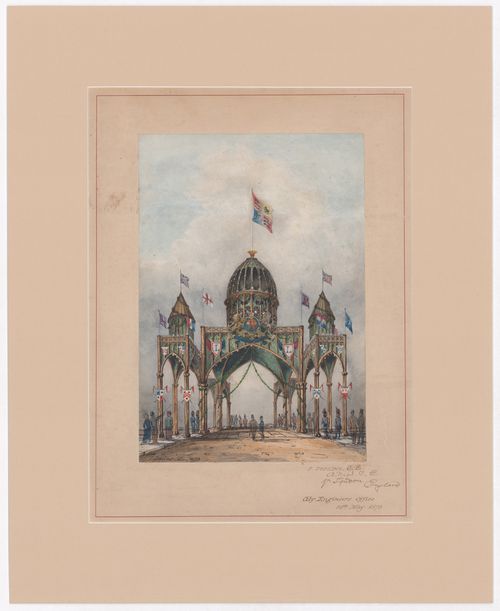
- This watercolour rendering depicts a welcome arch which spans the intersection of two streets. The arch is composed of a large central groin vaulted archway and four smaller groin vaulted archways. The central archway is supported by four compound piers and is surmounted by a dome on a drum. The smaller archways which are surmounted by turrets, span the sidewalks at the street corners and are each supported by a compound pier and three columns. The structure is embellished with Gothic-inspired features such as blind tracery and pointed arches as well as shields, including two inscribed with the letter "L", flags, floral garlands, the British royal coat of arms, a sheaf of wheat and possibly lights. Staffage indicates the large scale of the arch.
DR1990:0056
Description:
- This watercolour rendering depicts a welcome arch which spans the intersection of two streets. The arch is composed of a large central groin vaulted archway and four smaller groin vaulted archways. The central archway is supported by four compound piers and is surmounted by a dome on a drum. The smaller archways which are surmounted by turrets, span the sidewalks at the street corners and are each supported by a compound pier and three columns. The structure is embellished with Gothic-inspired features such as blind tracery and pointed arches as well as shields, including two inscribed with the letter "L", flags, floral garlands, the British royal coat of arms, a sheaf of wheat and possibly lights. Staffage indicates the large scale of the arch.
Personnes et institutions:
Sujet:
architecture temporaire
architecture temporaire
Date:
16 May 1879
16 May 1879
Titre:
Perspective for a temporary welcome arch for the visit of the Marquess of Lorne and Princess Louise to Toronto, September 1879
Actions:
DR1990:0056
Description:
- This watercolour rendering depicts a welcome arch which spans the intersection of two streets. The arch is composed of a large central groin vaulted archway and four smaller groin vaulted archways. The central archway is supported by four compound piers and is surmounted by a dome on a drum. The smaller archways which are surmounted by turrets, span the sidewalks at the street corners and are each supported by a compound pier and three columns. The structure is embellished with Gothic-inspired features such as blind tracery and pointed arches as well as shields, including two inscribed with the letter "L", flags, floral garlands, the British royal coat of arms, a sheaf of wheat and possibly lights. Staffage indicates the large scale of the arch.
Perspective for a temporary welcome arch for the visit of the Marquess of Lorne and Princess Louise to Toronto, September 1879
Actions:
DR1990:0056
Description:
- This watercolour rendering depicts a welcome arch which spans the intersection of two streets. The arch is composed of a large central groin vaulted archway and four smaller groin vaulted archways. The central archway is supported by four compound piers and is surmounted by a dome on a drum. The smaller archways which are surmounted by turrets, span the sidewalks at the street corners and are each supported by a compound pier and three columns. The structure is embellished with Gothic-inspired features such as blind tracery and pointed arches as well as shields, including two inscribed with the letter "L", flags, floral garlands, the British royal coat of arms, a sheaf of wheat and possibly lights. Staffage indicates the large scale of the arch.
Classification:
dessins
dessins
Date:
16 May 1879
16 May 1879
Personnes et institutions:
Sujet:
architecture temporaire
architecture temporaire
Classification:
photographies
photographies
Numéro de référence:
ARCH268641
Description:
Contains images of reference materials, views of the American Pavilion at Expo 67, the geodesic structures-mono hex and of the dymaxion series: house, car, bathroom and deployment unit by Richard Buckminster Fuller.
ARCH268641
Description:
Contains images of reference materials, views of the American Pavilion at Expo 67, the geodesic structures-mono hex and of the dymaxion series: house, car, bathroom and deployment unit by Richard Buckminster Fuller.
Personnes et institutions:
Titre:
Images of reference materials, views of the American Pavilion at Expo 67
Actions:
ARCH268641
Description:
Contains images of reference materials, views of the American Pavilion at Expo 67, the geodesic structures-mono hex and of the dymaxion series: house, car, bathroom and deployment unit by Richard Buckminster Fuller.
Images of reference materials, views of the American Pavilion at Expo 67
Actions:
ARCH268641
Description:
Contains images of reference materials, views of the American Pavilion at Expo 67, the geodesic structures-mono hex and of the dymaxion series: house, car, bathroom and deployment unit by Richard Buckminster Fuller.
Classification:
photographies
photographies
Personnes et institutions:


