


33582 Résultats
Classification:
dessins
dessins
Numéro de référence:
DR1996:0012
Description:
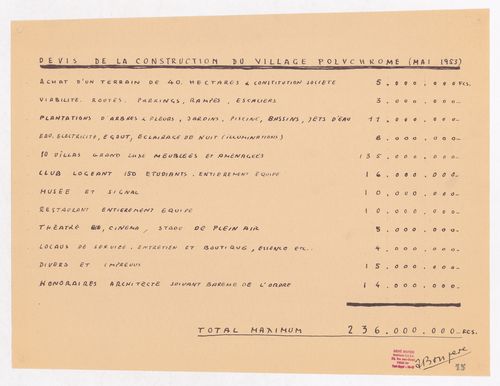
- Two groups of four pastel drawings were originally produced in connection with the Village Polychrome project. The architect André Bruyère had retained one group, while the other was given to the patron and client, Francisco de Assis Chateaubriand Bandeira de Melo, who then donated it to the Sao Paolo Museum of Modern Art. Bruyère subsequently gave one of the four drawings in his group to a friend. The three remaining drawings from Bruyère's group are in the CCA Prints and Drawings collection (DR1996:0001 - DR1996:0003) ("Projet de Village Polychrome, Biot, France").
DR1996:0012
Description:
- Two groups of four pastel drawings were originally produced in connection with the Village Polychrome project. The architect André Bruyère had retained one group, while the other was given to the patron and client, Francisco de Assis Chateaubriand Bandeira de Melo, who then donated it to the Sao Paolo Museum of Modern Art. Bruyère subsequently gave one of the four drawings in his group to a friend. The three remaining drawings from Bruyère's group are in the CCA Prints and Drawings collection (DR1996:0001 - DR1996:0003) ("Projet de Village Polychrome, Biot, France").
Personnes et institutions:
Sujet:
architecture
architecture
Date:
May 1953
May 1953
Titre:
Specifications for Village Polychrome, near Biot, France
Actions:
DR1996:0012
Description:
- Two groups of four pastel drawings were originally produced in connection with the Village Polychrome project. The architect André Bruyère had retained one group, while the other was given to the patron and client, Francisco de Assis Chateaubriand Bandeira de Melo, who then donated it to the Sao Paolo Museum of Modern Art. Bruyère subsequently gave one of the four drawings in his group to a friend. The three remaining drawings from Bruyère's group are in the CCA Prints and Drawings collection (DR1996:0001 - DR1996:0003) ("Projet de Village Polychrome, Biot, France").
Specifications for Village Polychrome, near Biot, France
Actions:
DR1996:0012
Description:
- Two groups of four pastel drawings were originally produced in connection with the Village Polychrome project. The architect André Bruyère had retained one group, while the other was given to the patron and client, Francisco de Assis Chateaubriand Bandeira de Melo, who then donated it to the Sao Paolo Museum of Modern Art. Bruyère subsequently gave one of the four drawings in his group to a friend. The three remaining drawings from Bruyère's group are in the CCA Prints and Drawings collection (DR1996:0001 - DR1996:0003) ("Projet de Village Polychrome, Biot, France").
Classification:
dessins
dessins
Date:
May 1953
May 1953
Personnes et institutions:
Sujet:
architecture
architecture
Niveau de description archivistique:
Série(s)
Série(s)
Numéro de référence:
AP162.S2
Description:
Series documents the contribution of architect Paul Goesch to the correspondence circle of Die gläserne Kette. Goesch participated using the pseudonym Tancred. Born in Schwerin, Germany in 1985, Goesch studied architecture at the Technische Hochschule at Berlin-Charlottenburg. After his studies, he worked as a civil servant in Kulm and started producing his first drawings and watercolours between 1914 and 1916. He joined the Novembergruppe, an exhibiting group of painters, sculptors, architects and musicians that later merged with the Arbeitsrat für Kunst group led by Bruno Taut. He collaborated with Bruno Taut on the coloured-architecture program in Magdeburg, Germany in 1921, but was later hospitalized for mental illness, first in Göttingen, then in the Teupitz Hospital near Berlin in 1933 or 1934. In 1940, he was taken by the SS to Hartheim Euthanasia Centre where he was murdered on 6 September the same year. (Source: Ian Boyd Whyte, Bruno Taut and the Architecture of Activism. Cambridge: Cambridge University Press, 1982) The series comprises a letter of Paul Goesch to the Die gläserne Kette circle, as well as portraits, including a carte-de-visite, and a diploma.
AP162.S2
Description:
Series documents the contribution of architect Paul Goesch to the correspondence circle of Die gläserne Kette. Goesch participated using the pseudonym Tancred. Born in Schwerin, Germany in 1985, Goesch studied architecture at the Technische Hochschule at Berlin-Charlottenburg. After his studies, he worked as a civil servant in Kulm and started producing his first drawings and watercolours between 1914 and 1916. He joined the Novembergruppe, an exhibiting group of painters, sculptors, architects and musicians that later merged with the Arbeitsrat für Kunst group led by Bruno Taut. He collaborated with Bruno Taut on the coloured-architecture program in Magdeburg, Germany in 1921, but was later hospitalized for mental illness, first in Göttingen, then in the Teupitz Hospital near Berlin in 1933 or 1934. In 1940, he was taken by the SS to Hartheim Euthanasia Centre where he was murdered on 6 September the same year. (Source: Ian Boyd Whyte, Bruno Taut and the Architecture of Activism. Cambridge: Cambridge University Press, 1982) The series comprises a letter of Paul Goesch to the Die gläserne Kette circle, as well as portraits, including a carte-de-visite, and a diploma.
Personnes et institutions:
Date:
1890-1911
1890-1911
Titre:
Paul Goesch
Actions:
AP162.S2
Description:
Series documents the contribution of architect Paul Goesch to the correspondence circle of Die gläserne Kette. Goesch participated using the pseudonym Tancred. Born in Schwerin, Germany in 1985, Goesch studied architecture at the Technische Hochschule at Berlin-Charlottenburg. After his studies, he worked as a civil servant in Kulm and started producing his first drawings and watercolours between 1914 and 1916. He joined the Novembergruppe, an exhibiting group of painters, sculptors, architects and musicians that later merged with the Arbeitsrat für Kunst group led by Bruno Taut. He collaborated with Bruno Taut on the coloured-architecture program in Magdeburg, Germany in 1921, but was later hospitalized for mental illness, first in Göttingen, then in the Teupitz Hospital near Berlin in 1933 or 1934. In 1940, he was taken by the SS to Hartheim Euthanasia Centre where he was murdered on 6 September the same year. (Source: Ian Boyd Whyte, Bruno Taut and the Architecture of Activism. Cambridge: Cambridge University Press, 1982) The series comprises a letter of Paul Goesch to the Die gläserne Kette circle, as well as portraits, including a carte-de-visite, and a diploma.
Paul Goesch
Actions:
AP162.S2
Description:
Series documents the contribution of architect Paul Goesch to the correspondence circle of Die gläserne Kette. Goesch participated using the pseudonym Tancred. Born in Schwerin, Germany in 1985, Goesch studied architecture at the Technische Hochschule at Berlin-Charlottenburg. After his studies, he worked as a civil servant in Kulm and started producing his first drawings and watercolours between 1914 and 1916. He joined the Novembergruppe, an exhibiting group of painters, sculptors, architects and musicians that later merged with the Arbeitsrat für Kunst group led by Bruno Taut. He collaborated with Bruno Taut on the coloured-architecture program in Magdeburg, Germany in 1921, but was later hospitalized for mental illness, first in Göttingen, then in the Teupitz Hospital near Berlin in 1933 or 1934. In 1940, he was taken by the SS to Hartheim Euthanasia Centre where he was murdered on 6 September the same year. (Source: Ian Boyd Whyte, Bruno Taut and the Architecture of Activism. Cambridge: Cambridge University Press, 1982) The series comprises a letter of Paul Goesch to the Die gläserne Kette circle, as well as portraits, including a carte-de-visite, and a diploma.
Niveau de description archivistique:
series
series
Date:
1890-1911
1890-1911
Personnes et institutions:
Niveau de description archivistique:
Série(s)
Série(s)
Numéro de référence:
AP162.S5
Description:
Series documents the contribution of architect Carl Krayl to the correspondence circle of Die gläserne Kette, with Krayl writing under the pseudonym Anfang. Born in 1890 in Weinsberg, Germany, Krayl worked on building sites between 1906 to 1909 in preparation for the architectural studies he would undertake from 1910 to 1912 at the Kunstgewerbeschule and the Polytechnikum at Stuttgart. He was employed as a military architect during the First World War and was stationed at Ingolstatd. After the war, Krayl joinded the Arbeitsrat für Kunst lead by Bruno Taut. Between 1919 to 1921 he contributed to "Frühlich", a magazine published by Taut which featured works by some members of Die Gläserne Kette. Krayl joined Bruno Taut in the city architecture department at Magdeburg. From 1923, he worked independently and executed private and public architectural projects. During the Nazi regime he worked as a draftsman for the German State Railway from 1938 to 1946. He died in 1946 in Werder an der Havel, Germany. (Source: Ian Boyd Whyte, Bruno Taut and the Architecture of Activism. Cambridge: Cambridge University Press, 1982) The series comprises part of Carl Krayl's correspondence to the Die gläserne Kette circle, along with related drawings and photographs.
AP162.S5
Description:
Series documents the contribution of architect Carl Krayl to the correspondence circle of Die gläserne Kette, with Krayl writing under the pseudonym Anfang. Born in 1890 in Weinsberg, Germany, Krayl worked on building sites between 1906 to 1909 in preparation for the architectural studies he would undertake from 1910 to 1912 at the Kunstgewerbeschule and the Polytechnikum at Stuttgart. He was employed as a military architect during the First World War and was stationed at Ingolstatd. After the war, Krayl joinded the Arbeitsrat für Kunst lead by Bruno Taut. Between 1919 to 1921 he contributed to "Frühlich", a magazine published by Taut which featured works by some members of Die Gläserne Kette. Krayl joined Bruno Taut in the city architecture department at Magdeburg. From 1923, he worked independently and executed private and public architectural projects. During the Nazi regime he worked as a draftsman for the German State Railway from 1938 to 1946. He died in 1946 in Werder an der Havel, Germany. (Source: Ian Boyd Whyte, Bruno Taut and the Architecture of Activism. Cambridge: Cambridge University Press, 1982) The series comprises part of Carl Krayl's correspondence to the Die gläserne Kette circle, along with related drawings and photographs.
Personnes et institutions:
Date:
1918-1945
1918-1945
Titre:
Carl Krayl
Actions:
AP162.S5
Description:
Series documents the contribution of architect Carl Krayl to the correspondence circle of Die gläserne Kette, with Krayl writing under the pseudonym Anfang. Born in 1890 in Weinsberg, Germany, Krayl worked on building sites between 1906 to 1909 in preparation for the architectural studies he would undertake from 1910 to 1912 at the Kunstgewerbeschule and the Polytechnikum at Stuttgart. He was employed as a military architect during the First World War and was stationed at Ingolstatd. After the war, Krayl joinded the Arbeitsrat für Kunst lead by Bruno Taut. Between 1919 to 1921 he contributed to "Frühlich", a magazine published by Taut which featured works by some members of Die Gläserne Kette. Krayl joined Bruno Taut in the city architecture department at Magdeburg. From 1923, he worked independently and executed private and public architectural projects. During the Nazi regime he worked as a draftsman for the German State Railway from 1938 to 1946. He died in 1946 in Werder an der Havel, Germany. (Source: Ian Boyd Whyte, Bruno Taut and the Architecture of Activism. Cambridge: Cambridge University Press, 1982) The series comprises part of Carl Krayl's correspondence to the Die gläserne Kette circle, along with related drawings and photographs.
Carl Krayl
Actions:
AP162.S5
Description:
Series documents the contribution of architect Carl Krayl to the correspondence circle of Die gläserne Kette, with Krayl writing under the pseudonym Anfang. Born in 1890 in Weinsberg, Germany, Krayl worked on building sites between 1906 to 1909 in preparation for the architectural studies he would undertake from 1910 to 1912 at the Kunstgewerbeschule and the Polytechnikum at Stuttgart. He was employed as a military architect during the First World War and was stationed at Ingolstatd. After the war, Krayl joinded the Arbeitsrat für Kunst lead by Bruno Taut. Between 1919 to 1921 he contributed to "Frühlich", a magazine published by Taut which featured works by some members of Die Gläserne Kette. Krayl joined Bruno Taut in the city architecture department at Magdeburg. From 1923, he worked independently and executed private and public architectural projects. During the Nazi regime he worked as a draftsman for the German State Railway from 1938 to 1946. He died in 1946 in Werder an der Havel, Germany. (Source: Ian Boyd Whyte, Bruno Taut and the Architecture of Activism. Cambridge: Cambridge University Press, 1982) The series comprises part of Carl Krayl's correspondence to the Die gläserne Kette circle, along with related drawings and photographs.
Niveau de description archivistique:
series
series
Date:
1918-1945
1918-1945
Personnes et institutions:
Niveau de description archivistique:
Sous-série
Sous-série
Titre:
Europe = Europe
Europe = Europe
Numéro de référence:
AP156.S3.SS1
Description:
La sous-série documente les projets architecturaux et d'urbanisme de Pierre Jeanneret et autres architectes en Europe durant les années 1940 jusqu'à la première moitié des années 1960. La sous-série inclut certains projets réalisés avec la Bureau Central de Construction, en Suisse, ainsi que ses projets indivuels dont le Centre d'apprentissage de Béziers, en France. Le matériel dans cette sous-série a probablement été produit entre 1940 et 1963. La sous-série contient des dessins, principalement des reprographies, donc des études, des dessins conceptuels, des dessins de développement du design, des dessins d'exécution et des dessins de présentation. La sous-série contient aussi des épreuves photomécaniques, une photographie et quelques chemises utilisées par Pierre Jeanneret pour classer ses dossiers de projets. Sub-series documents architectural and urban planning projects of Pierre Jeanneret and other architects in Europe in the 1940s to the first half of the 1960s. The sub-series includes some projects completed with the Bureau Central de la Construction, in Switzerland, and his individual projets including the Centre d'apprentissage in Béziers, France. The material in this sub-series was probably produced between 1940 to 1963. The sub-series contains drawings, predominantly reprographic copies, such as studies, conceptual drawings, design developement drawings, working drawings and presentation drawings. The sub-series also contains photomechanial prints, a photograph and some folder used by Pierre Jeanneret to organized his projects' files.
AP156.S3.SS1
Description:
La sous-série documente les projets architecturaux et d'urbanisme de Pierre Jeanneret et autres architectes en Europe durant les années 1940 jusqu'à la première moitié des années 1960. La sous-série inclut certains projets réalisés avec la Bureau Central de Construction, en Suisse, ainsi que ses projets indivuels dont le Centre d'apprentissage de Béziers, en France. Le matériel dans cette sous-série a probablement été produit entre 1940 et 1963. La sous-série contient des dessins, principalement des reprographies, donc des études, des dessins conceptuels, des dessins de développement du design, des dessins d'exécution et des dessins de présentation. La sous-série contient aussi des épreuves photomécaniques, une photographie et quelques chemises utilisées par Pierre Jeanneret pour classer ses dossiers de projets. Sub-series documents architectural and urban planning projects of Pierre Jeanneret and other architects in Europe in the 1940s to the first half of the 1960s. The sub-series includes some projects completed with the Bureau Central de la Construction, in Switzerland, and his individual projets including the Centre d'apprentissage in Béziers, France. The material in this sub-series was probably produced between 1940 to 1963. The sub-series contains drawings, predominantly reprographic copies, such as studies, conceptual drawings, design developement drawings, working drawings and presentation drawings. The sub-series also contains photomechanial prints, a photograph and some folder used by Pierre Jeanneret to organized his projects' files.
Personnes et institutions:
Date:
1940-1963
1940-1963
Titre:
Europe = Europe
Actions:
AP156.S3.SS1
Description:
La sous-série documente les projets architecturaux et d'urbanisme de Pierre Jeanneret et autres architectes en Europe durant les années 1940 jusqu'à la première moitié des années 1960. La sous-série inclut certains projets réalisés avec la Bureau Central de Construction, en Suisse, ainsi que ses projets indivuels dont le Centre d'apprentissage de Béziers, en France. Le matériel dans cette sous-série a probablement été produit entre 1940 et 1963. La sous-série contient des dessins, principalement des reprographies, donc des études, des dessins conceptuels, des dessins de développement du design, des dessins d'exécution et des dessins de présentation. La sous-série contient aussi des épreuves photomécaniques, une photographie et quelques chemises utilisées par Pierre Jeanneret pour classer ses dossiers de projets. Sub-series documents architectural and urban planning projects of Pierre Jeanneret and other architects in Europe in the 1940s to the first half of the 1960s. The sub-series includes some projects completed with the Bureau Central de la Construction, in Switzerland, and his individual projets including the Centre d'apprentissage in Béziers, France. The material in this sub-series was probably produced between 1940 to 1963. The sub-series contains drawings, predominantly reprographic copies, such as studies, conceptual drawings, design developement drawings, working drawings and presentation drawings. The sub-series also contains photomechanial prints, a photograph and some folder used by Pierre Jeanneret to organized his projects' files.
Europe = Europe
Actions:
AP156.S3.SS1
Description:
La sous-série documente les projets architecturaux et d'urbanisme de Pierre Jeanneret et autres architectes en Europe durant les années 1940 jusqu'à la première moitié des années 1960. La sous-série inclut certains projets réalisés avec la Bureau Central de Construction, en Suisse, ainsi que ses projets indivuels dont le Centre d'apprentissage de Béziers, en France. Le matériel dans cette sous-série a probablement été produit entre 1940 et 1963. La sous-série contient des dessins, principalement des reprographies, donc des études, des dessins conceptuels, des dessins de développement du design, des dessins d'exécution et des dessins de présentation. La sous-série contient aussi des épreuves photomécaniques, une photographie et quelques chemises utilisées par Pierre Jeanneret pour classer ses dossiers de projets. Sub-series documents architectural and urban planning projects of Pierre Jeanneret and other architects in Europe in the 1940s to the first half of the 1960s. The sub-series includes some projects completed with the Bureau Central de la Construction, in Switzerland, and his individual projets including the Centre d'apprentissage in Béziers, France. The material in this sub-series was probably produced between 1940 to 1963. The sub-series contains drawings, predominantly reprographic copies, such as studies, conceptual drawings, design developement drawings, working drawings and presentation drawings. The sub-series also contains photomechanial prints, a photograph and some folder used by Pierre Jeanneret to organized his projects' files.
Niveau de description archivistique:
Sous-série 1
Sous-série 1
Date:
1940-1963
1940-1963
Personnes et institutions:
Niveau de description archivistique:
Sous-série
Sous-série
Numéro de référence:
AP156.S3.SS3
Description:
La sous-série documente les projets d'architecture et d'urbanisme de Pierre Jeanneret, de Le Corbusier et d'autres architectes à Chandigarh, Inde. La sous-série comprend des documents sur des projets comme les résidences gouvernementaux ou privées, certains des bâtiments du Capitol et de l'Université du Punjab. Le matériel dans ce dossier a probablement été produit entre 1945 et 1972. Le sous-série contient des dessins et des reprographies d'études, de dessin conceptuel, de dessin de développement du design, de dessin d'exécution et de dessins de présentation. Il y a aussi 2 albums de plans, l'un contenant des divers plans signés par Pierre Jeanneret de logements et l'autres contenant des plans pour la Musée de la Connaissance de Le Corbusier. La sous-série comprend aussi des documents textuels et quelques photographies reliées à des projets. Sub-series documents architectural and urban planning projects of Pierre Jeanneret, Le Corbusier and other architects in Chandigarh, India. The sub-series contains documents on projects like government or private residences, some of the Capitol's or Punjab University's buildings. Material in this sub-series was produced between 1945 and 1972. The sub-series contains drawings and reprographic copies of studies, conceptual drawings, design developement drawings, working drawings and presentation drawings. There is also 2 albums of plans, one containing various plans signed by Pierre Jeanneret of various dwellings and the other containing plans for the Museum of Knowledge by Le Corbusier. The sub-series contains also textual records and some photographs related to projects.
AP156.S3.SS3
Description:
La sous-série documente les projets d'architecture et d'urbanisme de Pierre Jeanneret, de Le Corbusier et d'autres architectes à Chandigarh, Inde. La sous-série comprend des documents sur des projets comme les résidences gouvernementaux ou privées, certains des bâtiments du Capitol et de l'Université du Punjab. Le matériel dans ce dossier a probablement été produit entre 1945 et 1972. Le sous-série contient des dessins et des reprographies d'études, de dessin conceptuel, de dessin de développement du design, de dessin d'exécution et de dessins de présentation. Il y a aussi 2 albums de plans, l'un contenant des divers plans signés par Pierre Jeanneret de logements et l'autres contenant des plans pour la Musée de la Connaissance de Le Corbusier. La sous-série comprend aussi des documents textuels et quelques photographies reliées à des projets. Sub-series documents architectural and urban planning projects of Pierre Jeanneret, Le Corbusier and other architects in Chandigarh, India. The sub-series contains documents on projects like government or private residences, some of the Capitol's or Punjab University's buildings. Material in this sub-series was produced between 1945 and 1972. The sub-series contains drawings and reprographic copies of studies, conceptual drawings, design developement drawings, working drawings and presentation drawings. There is also 2 albums of plans, one containing various plans signed by Pierre Jeanneret of various dwellings and the other containing plans for the Museum of Knowledge by Le Corbusier. The sub-series contains also textual records and some photographs related to projects.
Personnes et institutions:
Date:
1945-1975
1945-1975
Titre:
Chandigarh, Inde = Chandigarh, India
Actions:
AP156.S3.SS3
Description:
La sous-série documente les projets d'architecture et d'urbanisme de Pierre Jeanneret, de Le Corbusier et d'autres architectes à Chandigarh, Inde. La sous-série comprend des documents sur des projets comme les résidences gouvernementaux ou privées, certains des bâtiments du Capitol et de l'Université du Punjab. Le matériel dans ce dossier a probablement été produit entre 1945 et 1972. Le sous-série contient des dessins et des reprographies d'études, de dessin conceptuel, de dessin de développement du design, de dessin d'exécution et de dessins de présentation. Il y a aussi 2 albums de plans, l'un contenant des divers plans signés par Pierre Jeanneret de logements et l'autres contenant des plans pour la Musée de la Connaissance de Le Corbusier. La sous-série comprend aussi des documents textuels et quelques photographies reliées à des projets. Sub-series documents architectural and urban planning projects of Pierre Jeanneret, Le Corbusier and other architects in Chandigarh, India. The sub-series contains documents on projects like government or private residences, some of the Capitol's or Punjab University's buildings. Material in this sub-series was produced between 1945 and 1972. The sub-series contains drawings and reprographic copies of studies, conceptual drawings, design developement drawings, working drawings and presentation drawings. There is also 2 albums of plans, one containing various plans signed by Pierre Jeanneret of various dwellings and the other containing plans for the Museum of Knowledge by Le Corbusier. The sub-series contains also textual records and some photographs related to projects.
Chandigarh, Inde = Chandigarh, India
Actions:
AP156.S3.SS3
Description:
La sous-série documente les projets d'architecture et d'urbanisme de Pierre Jeanneret, de Le Corbusier et d'autres architectes à Chandigarh, Inde. La sous-série comprend des documents sur des projets comme les résidences gouvernementaux ou privées, certains des bâtiments du Capitol et de l'Université du Punjab. Le matériel dans ce dossier a probablement été produit entre 1945 et 1972. Le sous-série contient des dessins et des reprographies d'études, de dessin conceptuel, de dessin de développement du design, de dessin d'exécution et de dessins de présentation. Il y a aussi 2 albums de plans, l'un contenant des divers plans signés par Pierre Jeanneret de logements et l'autres contenant des plans pour la Musée de la Connaissance de Le Corbusier. La sous-série comprend aussi des documents textuels et quelques photographies reliées à des projets. Sub-series documents architectural and urban planning projects of Pierre Jeanneret, Le Corbusier and other architects in Chandigarh, India. The sub-series contains documents on projects like government or private residences, some of the Capitol's or Punjab University's buildings. Material in this sub-series was produced between 1945 and 1972. The sub-series contains drawings and reprographic copies of studies, conceptual drawings, design developement drawings, working drawings and presentation drawings. There is also 2 albums of plans, one containing various plans signed by Pierre Jeanneret of various dwellings and the other containing plans for the Museum of Knowledge by Le Corbusier. The sub-series contains also textual records and some photographs related to projects.
Niveau de description archivistique:
Sous-série 3
Sous-série 3
Date:
1945-1975
1945-1975
Personnes et institutions:
Niveau de description archivistique:
Projet
Projet
Numéro de référence:
AP075.S1.2004.PR01
Description:
Project series documents Cornelia Hahn Oberlander's landscape project for the renovations of Buchanan Building at the University of British Columbia, Vancouver. Oberlander worked on this project in 2004 with architectural firm Busby, Perkins + Will Architects. The project consisted in a redesign of the landscaping for the two coutyards separated by a central pavilion and surrounded by the four other blocks of the Buchanan Building. The concept was to created a courtyard for ceremonies and activities and a courtyard for scultpure and contemplation. The east courtyard, designed for sitting and contemplation, included paved pathways circulating amount patches of grass and flower beds, with seating alvoces under the preserved trees to add shade. The west courtyard, designed for activities, consisted in a large parved area with a curving edge along the east side of the courtyard to provide seating and includes a covered café and a water feature. The project series contains sketches by Oberlander, design development drawings, including site plans, landscape plans and concept plans for the courtyards, and presentations drawings, including renderings. The project is also documented through correspondence, including correspondence with architects and consultants, research material, contract, financial documents, specifications, meeting notes, and photographs of existing landscaping.
AP075.S1.2004.PR01
Description:
Project series documents Cornelia Hahn Oberlander's landscape project for the renovations of Buchanan Building at the University of British Columbia, Vancouver. Oberlander worked on this project in 2004 with architectural firm Busby, Perkins + Will Architects. The project consisted in a redesign of the landscaping for the two coutyards separated by a central pavilion and surrounded by the four other blocks of the Buchanan Building. The concept was to created a courtyard for ceremonies and activities and a courtyard for scultpure and contemplation. The east courtyard, designed for sitting and contemplation, included paved pathways circulating amount patches of grass and flower beds, with seating alvoces under the preserved trees to add shade. The west courtyard, designed for activities, consisted in a large parved area with a curving edge along the east side of the courtyard to provide seating and includes a covered café and a water feature. The project series contains sketches by Oberlander, design development drawings, including site plans, landscape plans and concept plans for the courtyards, and presentations drawings, including renderings. The project is also documented through correspondence, including correspondence with architects and consultants, research material, contract, financial documents, specifications, meeting notes, and photographs of existing landscaping.
Personnes et institutions:
Date:
2004-2009
2004-2009
Titre:
Buchanan Building renovations, University of British Columbia, Vancouver, British Columbia (2004-2009)
Actions:
AP075.S1.2004.PR01
Description:
Project series documents Cornelia Hahn Oberlander's landscape project for the renovations of Buchanan Building at the University of British Columbia, Vancouver. Oberlander worked on this project in 2004 with architectural firm Busby, Perkins + Will Architects. The project consisted in a redesign of the landscaping for the two coutyards separated by a central pavilion and surrounded by the four other blocks of the Buchanan Building. The concept was to created a courtyard for ceremonies and activities and a courtyard for scultpure and contemplation. The east courtyard, designed for sitting and contemplation, included paved pathways circulating amount patches of grass and flower beds, with seating alvoces under the preserved trees to add shade. The west courtyard, designed for activities, consisted in a large parved area with a curving edge along the east side of the courtyard to provide seating and includes a covered café and a water feature. The project series contains sketches by Oberlander, design development drawings, including site plans, landscape plans and concept plans for the courtyards, and presentations drawings, including renderings. The project is also documented through correspondence, including correspondence with architects and consultants, research material, contract, financial documents, specifications, meeting notes, and photographs of existing landscaping.
Buchanan Building renovations, University of British Columbia, Vancouver, British Columbia (2004-2009)
Actions:
AP075.S1.2004.PR01
Description:
Project series documents Cornelia Hahn Oberlander's landscape project for the renovations of Buchanan Building at the University of British Columbia, Vancouver. Oberlander worked on this project in 2004 with architectural firm Busby, Perkins + Will Architects. The project consisted in a redesign of the landscaping for the two coutyards separated by a central pavilion and surrounded by the four other blocks of the Buchanan Building. The concept was to created a courtyard for ceremonies and activities and a courtyard for scultpure and contemplation. The east courtyard, designed for sitting and contemplation, included paved pathways circulating amount patches of grass and flower beds, with seating alvoces under the preserved trees to add shade. The west courtyard, designed for activities, consisted in a large parved area with a curving edge along the east side of the courtyard to provide seating and includes a covered café and a water feature. The project series contains sketches by Oberlander, design development drawings, including site plans, landscape plans and concept plans for the courtyards, and presentations drawings, including renderings. The project is also documented through correspondence, including correspondence with architects and consultants, research material, contract, financial documents, specifications, meeting notes, and photographs of existing landscaping.
Niveau de description archivistique:
Project
Project
Date:
2004-2009
2004-2009
Personnes et institutions:
Niveau de description archivistique:
Projet
Projet
Numéro de référence:
AP018.S1.1962.PR03
Description:
This project series documents the design and construction of Ottawa Union Station in Ottawa, Ontario from 1962-1966. The office identified the project number as 6253. This project consisted of a 96,000 square foot train station building, platforms, canopies and site services. The building had two levels, which included a basement and two-storey ground floor. Passengers connected to the station platforms through the basement from the ground floor via a helicoidal ramp in the centre of the building. The passenger concourse was sheltered by a great steel truss roof that had 8 massive columns supporting it. The ground floor included bedrooms, offices, storage, and food and beverage areas. The building, owned by CN Railways, was commissioned by the National Capital Commission, who are recorded as the primary architect on the project, with E.W. Thrift as general manager, and with John B. Parkin Associates acting as consulting architects. The firm of John B. Parkin Associates was presented with a Silver Massey Medal in Architecture in 1967 for the design of this building. The project is recorded through reprographic copies of architectural and structural drawings dating from 1965-1966.
AP018.S1.1962.PR03
Description:
This project series documents the design and construction of Ottawa Union Station in Ottawa, Ontario from 1962-1966. The office identified the project number as 6253. This project consisted of a 96,000 square foot train station building, platforms, canopies and site services. The building had two levels, which included a basement and two-storey ground floor. Passengers connected to the station platforms through the basement from the ground floor via a helicoidal ramp in the centre of the building. The passenger concourse was sheltered by a great steel truss roof that had 8 massive columns supporting it. The ground floor included bedrooms, offices, storage, and food and beverage areas. The building, owned by CN Railways, was commissioned by the National Capital Commission, who are recorded as the primary architect on the project, with E.W. Thrift as general manager, and with John B. Parkin Associates acting as consulting architects. The firm of John B. Parkin Associates was presented with a Silver Massey Medal in Architecture in 1967 for the design of this building. The project is recorded through reprographic copies of architectural and structural drawings dating from 1965-1966.
Personnes et institutions:
Date:
1965-1966
1965-1966
Titre:
Ottawa Union Station, Ottawa, Ontario (1962-1966)
Actions:
AP018.S1.1962.PR03
Description:
This project series documents the design and construction of Ottawa Union Station in Ottawa, Ontario from 1962-1966. The office identified the project number as 6253. This project consisted of a 96,000 square foot train station building, platforms, canopies and site services. The building had two levels, which included a basement and two-storey ground floor. Passengers connected to the station platforms through the basement from the ground floor via a helicoidal ramp in the centre of the building. The passenger concourse was sheltered by a great steel truss roof that had 8 massive columns supporting it. The ground floor included bedrooms, offices, storage, and food and beverage areas. The building, owned by CN Railways, was commissioned by the National Capital Commission, who are recorded as the primary architect on the project, with E.W. Thrift as general manager, and with John B. Parkin Associates acting as consulting architects. The firm of John B. Parkin Associates was presented with a Silver Massey Medal in Architecture in 1967 for the design of this building. The project is recorded through reprographic copies of architectural and structural drawings dating from 1965-1966.
Ottawa Union Station, Ottawa, Ontario (1962-1966)
Actions:
AP018.S1.1962.PR03
Description:
This project series documents the design and construction of Ottawa Union Station in Ottawa, Ontario from 1962-1966. The office identified the project number as 6253. This project consisted of a 96,000 square foot train station building, platforms, canopies and site services. The building had two levels, which included a basement and two-storey ground floor. Passengers connected to the station platforms through the basement from the ground floor via a helicoidal ramp in the centre of the building. The passenger concourse was sheltered by a great steel truss roof that had 8 massive columns supporting it. The ground floor included bedrooms, offices, storage, and food and beverage areas. The building, owned by CN Railways, was commissioned by the National Capital Commission, who are recorded as the primary architect on the project, with E.W. Thrift as general manager, and with John B. Parkin Associates acting as consulting architects. The firm of John B. Parkin Associates was presented with a Silver Massey Medal in Architecture in 1967 for the design of this building. The project is recorded through reprographic copies of architectural and structural drawings dating from 1965-1966.
Niveau de description archivistique:
Project
Project
Date:
1965-1966
1965-1966
Personnes et institutions:
Niveau de description archivistique:
Projet
Projet
Numéro de référence:
AP018.S1.1979.PR02
Description:
This project series documents renovations to the restaurant, lobby, and offices at the Art Gallery of Ontario (AGO) in Toronto in 1979. The office identified the project number as 7902. The project consisted of renovations to the existing AGO Grange Court Restaurant and its kitchen including an increased seating capacity, additional shelving, acoustic improvements, and a larger waiting area. Although this project title, found in the materials, reflects only restaurant renovations, the project also consisted of renovations to the education offices and gallery lobby. Beginning in 1969, Parkin’s firm was hired as the head architects for the AGO’s massive expansion program that would span more than a decade. This is one project relating to the expansion of the art gallery. It should be noted that while AGO project contracts were originally given to John B. Parkin Associates, John C. Parkin continued the project under his new firm, Parkin Architects Planners, after parting ways with partner John B. Parkin in 1971. The project is recorded through restaurant drawings, restaurant photographs, and textual records dating from 1978-1980. The textual records consist of progress billing invoices for the restaurant and education offices, client correspondence, and a stipulated price contract.
AP018.S1.1979.PR02
Description:
This project series documents renovations to the restaurant, lobby, and offices at the Art Gallery of Ontario (AGO) in Toronto in 1979. The office identified the project number as 7902. The project consisted of renovations to the existing AGO Grange Court Restaurant and its kitchen including an increased seating capacity, additional shelving, acoustic improvements, and a larger waiting area. Although this project title, found in the materials, reflects only restaurant renovations, the project also consisted of renovations to the education offices and gallery lobby. Beginning in 1969, Parkin’s firm was hired as the head architects for the AGO’s massive expansion program that would span more than a decade. This is one project relating to the expansion of the art gallery. It should be noted that while AGO project contracts were originally given to John B. Parkin Associates, John C. Parkin continued the project under his new firm, Parkin Architects Planners, after parting ways with partner John B. Parkin in 1971. The project is recorded through restaurant drawings, restaurant photographs, and textual records dating from 1978-1980. The textual records consist of progress billing invoices for the restaurant and education offices, client correspondence, and a stipulated price contract.
Personnes et institutions:
Date:
1978-1980
1978-1980
Titre:
Art Gallery of Ontario, Renovations to Restaurant and Kitchen, Toronto (1979)
Actions:
AP018.S1.1979.PR02
Description:
This project series documents renovations to the restaurant, lobby, and offices at the Art Gallery of Ontario (AGO) in Toronto in 1979. The office identified the project number as 7902. The project consisted of renovations to the existing AGO Grange Court Restaurant and its kitchen including an increased seating capacity, additional shelving, acoustic improvements, and a larger waiting area. Although this project title, found in the materials, reflects only restaurant renovations, the project also consisted of renovations to the education offices and gallery lobby. Beginning in 1969, Parkin’s firm was hired as the head architects for the AGO’s massive expansion program that would span more than a decade. This is one project relating to the expansion of the art gallery. It should be noted that while AGO project contracts were originally given to John B. Parkin Associates, John C. Parkin continued the project under his new firm, Parkin Architects Planners, after parting ways with partner John B. Parkin in 1971. The project is recorded through restaurant drawings, restaurant photographs, and textual records dating from 1978-1980. The textual records consist of progress billing invoices for the restaurant and education offices, client correspondence, and a stipulated price contract.
Art Gallery of Ontario, Renovations to Restaurant and Kitchen, Toronto (1979)
Actions:
AP018.S1.1979.PR02
Description:
This project series documents renovations to the restaurant, lobby, and offices at the Art Gallery of Ontario (AGO) in Toronto in 1979. The office identified the project number as 7902. The project consisted of renovations to the existing AGO Grange Court Restaurant and its kitchen including an increased seating capacity, additional shelving, acoustic improvements, and a larger waiting area. Although this project title, found in the materials, reflects only restaurant renovations, the project also consisted of renovations to the education offices and gallery lobby. Beginning in 1969, Parkin’s firm was hired as the head architects for the AGO’s massive expansion program that would span more than a decade. This is one project relating to the expansion of the art gallery. It should be noted that while AGO project contracts were originally given to John B. Parkin Associates, John C. Parkin continued the project under his new firm, Parkin Architects Planners, after parting ways with partner John B. Parkin in 1971. The project is recorded through restaurant drawings, restaurant photographs, and textual records dating from 1978-1980. The textual records consist of progress billing invoices for the restaurant and education offices, client correspondence, and a stipulated price contract.
Niveau de description archivistique:
Project
Project
Date:
1978-1980
1978-1980
Personnes et institutions:
Niveau de description archivistique:
Projet
Projet
Numéro de référence:
AP075.S1.1979.PR05
Description:
Project series documents Cornelia Hahn Oberlander's landscape project for the Discovery Parks' site on the Simon Fraser University campus, in Burnaby, British Columbia. Created in 1979, Discovery Parks is an organization with the mission to accomodate scientific and technological research activities by building and renting research installations. Initially founded by the provincial government, Discovery Parks became self-governning and independant in 1990. Oberlander worked on this project from 1979-1984 with Russell Vandiver Architects. The project consisted in creating three research building north of University Drive, in the Naheeto Park, with landscaped recreational areas between each buildings. The project was later reduce to one research building located at the corner of Nelson Way and University Drive, on the far east end of the initial site. Oberlander's landscape design consisted in trees planting along the street, the parking lot and the driveway, and creating a recreational area for staff and students. The project series contains textual records, including research, Oberlander's concept notes, project proposals, correspondence with architect and clients, specifications, and financial documents. The project series also comprises photographs and working drawings, such as proposed sites plans, site plans, grading plans, planting plans and landscape plans.
AP075.S1.1979.PR05
Description:
Project series documents Cornelia Hahn Oberlander's landscape project for the Discovery Parks' site on the Simon Fraser University campus, in Burnaby, British Columbia. Created in 1979, Discovery Parks is an organization with the mission to accomodate scientific and technological research activities by building and renting research installations. Initially founded by the provincial government, Discovery Parks became self-governning and independant in 1990. Oberlander worked on this project from 1979-1984 with Russell Vandiver Architects. The project consisted in creating three research building north of University Drive, in the Naheeto Park, with landscaped recreational areas between each buildings. The project was later reduce to one research building located at the corner of Nelson Way and University Drive, on the far east end of the initial site. Oberlander's landscape design consisted in trees planting along the street, the parking lot and the driveway, and creating a recreational area for staff and students. The project series contains textual records, including research, Oberlander's concept notes, project proposals, correspondence with architect and clients, specifications, and financial documents. The project series also comprises photographs and working drawings, such as proposed sites plans, site plans, grading plans, planting plans and landscape plans.
Personnes et institutions:
Date:
1971-1989
1971-1989
Titre:
Discovery Parks, Simon Fraser University Site, Burnaby, British Columbia (1979-1984)
Actions:
AP075.S1.1979.PR05
Description:
Project series documents Cornelia Hahn Oberlander's landscape project for the Discovery Parks' site on the Simon Fraser University campus, in Burnaby, British Columbia. Created in 1979, Discovery Parks is an organization with the mission to accomodate scientific and technological research activities by building and renting research installations. Initially founded by the provincial government, Discovery Parks became self-governning and independant in 1990. Oberlander worked on this project from 1979-1984 with Russell Vandiver Architects. The project consisted in creating three research building north of University Drive, in the Naheeto Park, with landscaped recreational areas between each buildings. The project was later reduce to one research building located at the corner of Nelson Way and University Drive, on the far east end of the initial site. Oberlander's landscape design consisted in trees planting along the street, the parking lot and the driveway, and creating a recreational area for staff and students. The project series contains textual records, including research, Oberlander's concept notes, project proposals, correspondence with architect and clients, specifications, and financial documents. The project series also comprises photographs and working drawings, such as proposed sites plans, site plans, grading plans, planting plans and landscape plans.
Discovery Parks, Simon Fraser University Site, Burnaby, British Columbia (1979-1984)
Actions:
AP075.S1.1979.PR05
Description:
Project series documents Cornelia Hahn Oberlander's landscape project for the Discovery Parks' site on the Simon Fraser University campus, in Burnaby, British Columbia. Created in 1979, Discovery Parks is an organization with the mission to accomodate scientific and technological research activities by building and renting research installations. Initially founded by the provincial government, Discovery Parks became self-governning and independant in 1990. Oberlander worked on this project from 1979-1984 with Russell Vandiver Architects. The project consisted in creating three research building north of University Drive, in the Naheeto Park, with landscaped recreational areas between each buildings. The project was later reduce to one research building located at the corner of Nelson Way and University Drive, on the far east end of the initial site. Oberlander's landscape design consisted in trees planting along the street, the parking lot and the driveway, and creating a recreational area for staff and students. The project series contains textual records, including research, Oberlander's concept notes, project proposals, correspondence with architect and clients, specifications, and financial documents. The project series also comprises photographs and working drawings, such as proposed sites plans, site plans, grading plans, planting plans and landscape plans.
Niveau de description archivistique:
Project
Project
Date:
1971-1989
1971-1989
Personnes et institutions:
Classification:
événements
événements
Titre:
L’enseignement de… Astana
L’enseignement de… Astana
Actions:
Description:
Jeffrey Inaba est le principal architecte de la firme INABA, établie à Los Angeles. Il examine le cas d’Astana, centre urbain et capitale du Kazakhstan. Dans ce pays qui se classe au 9e rang des plus vastes pays du monde, seulement 16 millions d’habitants occupent le territoire. Riche en réserves pétrolières et gazières tout en jouissant d’une situation géographique(...)
Jeffrey Inaba est le principal architecte de la firme INABA, établie à Los Angeles. Il examine le cas d’Astana, centre urbain et capitale du Kazakhstan. Dans ce pays qui se classe au 9e rang des plus vastes pays du monde, seulement 16 millions d’habitants occupent le territoire. Riche en réserves pétrolières et gazières tout en jouissant d’une situation géographique(...)
Localisation:
Théâtre Paul-Desmarais
Théâtre Paul-Desmarais
Date:
19 avril 2007 , 19h
19 avril 2007 , 19h
Titre:
L’enseignement de… Astana
Actions:
Description:
Jeffrey Inaba est le principal architecte de la firme INABA, établie à Los Angeles. Il examine le cas d’Astana, centre urbain et capitale du Kazakhstan. Dans ce pays qui se classe au 9e rang des plus vastes pays du monde, seulement 16 millions d’habitants occupent le territoire. Riche en réserves pétrolières et gazières tout en jouissant d’une situation géographique(...)
L’enseignement de… Astana
Actions:
Description:
Jeffrey Inaba est le principal architecte de la firme INABA, établie à Los Angeles. Il examine le cas d’Astana, centre urbain et capitale du Kazakhstan. Dans ce pays qui se classe au 9e rang des plus vastes pays du monde, seulement 16 millions d’habitants occupent le territoire. Riche en réserves pétrolières et gazières tout en jouissant d’une situation géographique(...)
Classification:
événements
événements
Date:
19 avril 2007
19h
19 avril 2007
19h
Localisation:
Théâtre Paul-Desmarais
Théâtre Paul-Desmarais


