


44145 Résultats
Niveau de description archivistique:
Sous-série
Sous-série
Numéro de référence:
AP178.S1.1988.PR07.SS11
Description:
This project series documents the Estaçäo de Metropolitano Baixa Chiado in Lisbon, Portugal. The office assigned the dates 1992-1998 for this project. The Estaçäo de Metropolitano Baixa Chiado was built between 1992 and 1998. The station played a key role in Siza's functional reconstruction plan of the Chiado area. It was an essential part of Siza's recovery plan for the district of Chiado in order to create more access to different parts of town due to the irregular elevations of the district. The station's escalators were created to give access to the Rua do Crucifixo and Largo do Chiado square. Elevators were also built to give access to Rua Ivens. Drawings include sketches, studies, working drawings, shop drawings and mechanical drawings. Textual documentation includes specifications, correspondence, permit and supplier documentation, and meeting reports. Photographic materials document the model, site and construction work. The materials that were donated in the 2019 accession document the elevators built to give access to Rua Ivens. Additional documentation for this project can also be found in the project subseries AP178.S1.1988.PR07.SS1.
AP178.S1.1988.PR07.SS11
Description:
This project series documents the Estaçäo de Metropolitano Baixa Chiado in Lisbon, Portugal. The office assigned the dates 1992-1998 for this project. The Estaçäo de Metropolitano Baixa Chiado was built between 1992 and 1998. The station played a key role in Siza's functional reconstruction plan of the Chiado area. It was an essential part of Siza's recovery plan for the district of Chiado in order to create more access to different parts of town due to the irregular elevations of the district. The station's escalators were created to give access to the Rua do Crucifixo and Largo do Chiado square. Elevators were also built to give access to Rua Ivens. Drawings include sketches, studies, working drawings, shop drawings and mechanical drawings. Textual documentation includes specifications, correspondence, permit and supplier documentation, and meeting reports. Photographic materials document the model, site and construction work. The materials that were donated in the 2019 accession document the elevators built to give access to Rua Ivens. Additional documentation for this project can also be found in the project subseries AP178.S1.1988.PR07.SS1.
Personnes et institutions:
Date:
1987-2012
1987-2012
Titre:
Estação de Metropolitano Baixa Chiado [Baixa Chiado Metropolitan Station], Lisbon, Portugal (1988-1998)
Actions:
AP178.S1.1988.PR07.SS11
Description:
This project series documents the Estaçäo de Metropolitano Baixa Chiado in Lisbon, Portugal. The office assigned the dates 1992-1998 for this project. The Estaçäo de Metropolitano Baixa Chiado was built between 1992 and 1998. The station played a key role in Siza's functional reconstruction plan of the Chiado area. It was an essential part of Siza's recovery plan for the district of Chiado in order to create more access to different parts of town due to the irregular elevations of the district. The station's escalators were created to give access to the Rua do Crucifixo and Largo do Chiado square. Elevators were also built to give access to Rua Ivens. Drawings include sketches, studies, working drawings, shop drawings and mechanical drawings. Textual documentation includes specifications, correspondence, permit and supplier documentation, and meeting reports. Photographic materials document the model, site and construction work. The materials that were donated in the 2019 accession document the elevators built to give access to Rua Ivens. Additional documentation for this project can also be found in the project subseries AP178.S1.1988.PR07.SS1.
Estação de Metropolitano Baixa Chiado [Baixa Chiado Metropolitan Station], Lisbon, Portugal (1988-1998)
Actions:
AP178.S1.1988.PR07.SS11
Description:
This project series documents the Estaçäo de Metropolitano Baixa Chiado in Lisbon, Portugal. The office assigned the dates 1992-1998 for this project. The Estaçäo de Metropolitano Baixa Chiado was built between 1992 and 1998. The station played a key role in Siza's functional reconstruction plan of the Chiado area. It was an essential part of Siza's recovery plan for the district of Chiado in order to create more access to different parts of town due to the irregular elevations of the district. The station's escalators were created to give access to the Rua do Crucifixo and Largo do Chiado square. Elevators were also built to give access to Rua Ivens. Drawings include sketches, studies, working drawings, shop drawings and mechanical drawings. Textual documentation includes specifications, correspondence, permit and supplier documentation, and meeting reports. Photographic materials document the model, site and construction work. The materials that were donated in the 2019 accession document the elevators built to give access to Rua Ivens. Additional documentation for this project can also be found in the project subseries AP178.S1.1988.PR07.SS1.
Niveau de description archivistique:
Project
Project
Date:
1987-2012
1987-2012
Personnes et institutions:
Niveau de description archivistique:
Série(s)
Série(s)
Numéro de référence:
AP140.S2
Description:
Series documents the professional activities of James Stirling, James Gowan, Michael Wilford, and the successive firms of Stirling and Gowan; James Stirling; James Stirling and Partner; James Stirling, Michael Wilford, and Associates; Michael Wilford and Partners; as well as the firm of Michael Wilford GmbH. It chiefly illustrates the architectural and urban planning projects by James Stirling and the successive firms, including earlier theoretical and housing schemes, competition entries, major international commissions, as well as dead projects. The series also relates to exhibitions and publications of the firms' work, to writing and lecturing activities, to prizes, distinctions and honours received by the partners and the successive firms, and to other professional activities including participation to competition juries and teaching. Administrative and office activities are also documented in this series. Material in this series was produced between ca. 1948 and probably 2004. Series contains a large number of reference, conceptual, and design development drawings, publication and presentation drawings and panels, working drawings and several models. Series also contains photographic materials, textual records, film reels and other audiovisual materials, and artefacts.
AP140.S2
Description:
Series documents the professional activities of James Stirling, James Gowan, Michael Wilford, and the successive firms of Stirling and Gowan; James Stirling; James Stirling and Partner; James Stirling, Michael Wilford, and Associates; Michael Wilford and Partners; as well as the firm of Michael Wilford GmbH. It chiefly illustrates the architectural and urban planning projects by James Stirling and the successive firms, including earlier theoretical and housing schemes, competition entries, major international commissions, as well as dead projects. The series also relates to exhibitions and publications of the firms' work, to writing and lecturing activities, to prizes, distinctions and honours received by the partners and the successive firms, and to other professional activities including participation to competition juries and teaching. Administrative and office activities are also documented in this series. Material in this series was produced between ca. 1948 and probably 2004. Series contains a large number of reference, conceptual, and design development drawings, publication and presentation drawings and panels, working drawings and several models. Series also contains photographic materials, textual records, film reels and other audiovisual materials, and artefacts.
Personnes et institutions:
Date:
[ca. 1948-2004?]
[ca. 1948-2004?]
Titre:
James Stirling/Michael Wilford professional papers
Actions:
AP140.S2
Description:
Series documents the professional activities of James Stirling, James Gowan, Michael Wilford, and the successive firms of Stirling and Gowan; James Stirling; James Stirling and Partner; James Stirling, Michael Wilford, and Associates; Michael Wilford and Partners; as well as the firm of Michael Wilford GmbH. It chiefly illustrates the architectural and urban planning projects by James Stirling and the successive firms, including earlier theoretical and housing schemes, competition entries, major international commissions, as well as dead projects. The series also relates to exhibitions and publications of the firms' work, to writing and lecturing activities, to prizes, distinctions and honours received by the partners and the successive firms, and to other professional activities including participation to competition juries and teaching. Administrative and office activities are also documented in this series. Material in this series was produced between ca. 1948 and probably 2004. Series contains a large number of reference, conceptual, and design development drawings, publication and presentation drawings and panels, working drawings and several models. Series also contains photographic materials, textual records, film reels and other audiovisual materials, and artefacts.
James Stirling/Michael Wilford professional papers
Actions:
AP140.S2
Description:
Series documents the professional activities of James Stirling, James Gowan, Michael Wilford, and the successive firms of Stirling and Gowan; James Stirling; James Stirling and Partner; James Stirling, Michael Wilford, and Associates; Michael Wilford and Partners; as well as the firm of Michael Wilford GmbH. It chiefly illustrates the architectural and urban planning projects by James Stirling and the successive firms, including earlier theoretical and housing schemes, competition entries, major international commissions, as well as dead projects. The series also relates to exhibitions and publications of the firms' work, to writing and lecturing activities, to prizes, distinctions and honours received by the partners and the successive firms, and to other professional activities including participation to competition juries and teaching. Administrative and office activities are also documented in this series. Material in this series was produced between ca. 1948 and probably 2004. Series contains a large number of reference, conceptual, and design development drawings, publication and presentation drawings and panels, working drawings and several models. Series also contains photographic materials, textual records, film reels and other audiovisual materials, and artefacts.
Niveau de description archivistique:
Series 2
Series 2
Date:
[ca. 1948-2004?]
[ca. 1948-2004?]
Personnes et institutions:
Niveau de description archivistique:
Projet
Projet
Numéro de référence:
AP178.S1.1994.PR09
Description:
This project series documents the Casa Van Middelem-Dupont in Oudenbourg, Belgium. While the records were held in the office’s archives this project was assigned the number 61/90. The office assigned the date 1994 to this project. The project files document the repurposing of a 200 year old farmhouse and stables, as well as the addition of new buildings. Siza collaborated with Roberto Cremascoli, Andrea Smaniotto, Ueli Krauss, Daniela Antonucci, and Maurice Custer on the project. The project is divided into a residential unit, a guest house, and an art gallery. The original farmhouse was transformed into an art gallery and the new buildings serve as housing. The housing units located on agricultural land form a U shape around the courtyard. The forms and materials of the new units were selected in order to respect Flemish architectural typologies. The buildings were designed in 1994 and completed in 2001. Documenting this project are studies, design development drawings, working drawings, structural drawings, and technical drawings. Textual material includes project documentation. Photographic material documents the models, construction work, and the built project.
AP178.S1.1994.PR09
Description:
This project series documents the Casa Van Middelem-Dupont in Oudenbourg, Belgium. While the records were held in the office’s archives this project was assigned the number 61/90. The office assigned the date 1994 to this project. The project files document the repurposing of a 200 year old farmhouse and stables, as well as the addition of new buildings. Siza collaborated with Roberto Cremascoli, Andrea Smaniotto, Ueli Krauss, Daniela Antonucci, and Maurice Custer on the project. The project is divided into a residential unit, a guest house, and an art gallery. The original farmhouse was transformed into an art gallery and the new buildings serve as housing. The housing units located on agricultural land form a U shape around the courtyard. The forms and materials of the new units were selected in order to respect Flemish architectural typologies. The buildings were designed in 1994 and completed in 2001. Documenting this project are studies, design development drawings, working drawings, structural drawings, and technical drawings. Textual material includes project documentation. Photographic material documents the models, construction work, and the built project.
Personnes et institutions:
Date:
1992-2000
1992-2000
Titre:
Casa Van Middelem-Dupont [Van Middelem-Dupont house], Oudenbourg, Belgium (1994)
Actions:
AP178.S1.1994.PR09
Description:
This project series documents the Casa Van Middelem-Dupont in Oudenbourg, Belgium. While the records were held in the office’s archives this project was assigned the number 61/90. The office assigned the date 1994 to this project. The project files document the repurposing of a 200 year old farmhouse and stables, as well as the addition of new buildings. Siza collaborated with Roberto Cremascoli, Andrea Smaniotto, Ueli Krauss, Daniela Antonucci, and Maurice Custer on the project. The project is divided into a residential unit, a guest house, and an art gallery. The original farmhouse was transformed into an art gallery and the new buildings serve as housing. The housing units located on agricultural land form a U shape around the courtyard. The forms and materials of the new units were selected in order to respect Flemish architectural typologies. The buildings were designed in 1994 and completed in 2001. Documenting this project are studies, design development drawings, working drawings, structural drawings, and technical drawings. Textual material includes project documentation. Photographic material documents the models, construction work, and the built project.
Casa Van Middelem-Dupont [Van Middelem-Dupont house], Oudenbourg, Belgium (1994)
Actions:
AP178.S1.1994.PR09
Description:
This project series documents the Casa Van Middelem-Dupont in Oudenbourg, Belgium. While the records were held in the office’s archives this project was assigned the number 61/90. The office assigned the date 1994 to this project. The project files document the repurposing of a 200 year old farmhouse and stables, as well as the addition of new buildings. Siza collaborated with Roberto Cremascoli, Andrea Smaniotto, Ueli Krauss, Daniela Antonucci, and Maurice Custer on the project. The project is divided into a residential unit, a guest house, and an art gallery. The original farmhouse was transformed into an art gallery and the new buildings serve as housing. The housing units located on agricultural land form a U shape around the courtyard. The forms and materials of the new units were selected in order to respect Flemish architectural typologies. The buildings were designed in 1994 and completed in 2001. Documenting this project are studies, design development drawings, working drawings, structural drawings, and technical drawings. Textual material includes project documentation. Photographic material documents the models, construction work, and the built project.
Niveau de description archivistique:
Project
Project
Date:
1992-2000
1992-2000
Personnes et institutions:
Numéro de référence:
PHCON2002:0016:006
Description:
Binder documents Gordon Matta-Clark's personal and professional correspondence prior to his death in August 1978, as well as correspondence addressed to Jane Crawford, his widow, and Holly Solomon, the art dealer responsible for selling Matta-Clark's work following his death. Additionally, the binder includes exhibition catalogues and reviews, periodicals, memorabilia, photographic materials, and published interviews. Documents related to the following projects are included: The Caribbean Orange (1978); Untitled Cutting (Summer 1978) for Alanna Heiss's Twentieth Century Ruins; Jacob's Ladder (1977); Office Baroque (1977); Plaza Culturale (1977); and Untitled Cutting (Museum of Modern Art) (1978). Binder contains textual records, photographs, slides, and reprographic copies.
PHCON2002:0016:006
Description:
Binder documents Gordon Matta-Clark's personal and professional correspondence prior to his death in August 1978, as well as correspondence addressed to Jane Crawford, his widow, and Holly Solomon, the art dealer responsible for selling Matta-Clark's work following his death. Additionally, the binder includes exhibition catalogues and reviews, periodicals, memorabilia, photographic materials, and published interviews. Documents related to the following projects are included: The Caribbean Orange (1978); Untitled Cutting (Summer 1978) for Alanna Heiss's Twentieth Century Ruins; Jacob's Ladder (1977); Office Baroque (1977); Plaza Culturale (1977); and Untitled Cutting (Museum of Modern Art) (1978). Binder contains textual records, photographs, slides, and reprographic copies.
Personnes et institutions:
Date:
1978-1980
1978-1980
Titre:
Reviews, Announcements, Catalogues 1978-80
Actions:
PHCON2002:0016:006
Description:
Binder documents Gordon Matta-Clark's personal and professional correspondence prior to his death in August 1978, as well as correspondence addressed to Jane Crawford, his widow, and Holly Solomon, the art dealer responsible for selling Matta-Clark's work following his death. Additionally, the binder includes exhibition catalogues and reviews, periodicals, memorabilia, photographic materials, and published interviews. Documents related to the following projects are included: The Caribbean Orange (1978); Untitled Cutting (Summer 1978) for Alanna Heiss's Twentieth Century Ruins; Jacob's Ladder (1977); Office Baroque (1977); Plaza Culturale (1977); and Untitled Cutting (Museum of Modern Art) (1978). Binder contains textual records, photographs, slides, and reprographic copies.
Reviews, Announcements, Catalogues 1978-80
Actions:
PHCON2002:0016:006
Description:
Binder documents Gordon Matta-Clark's personal and professional correspondence prior to his death in August 1978, as well as correspondence addressed to Jane Crawford, his widow, and Holly Solomon, the art dealer responsible for selling Matta-Clark's work following his death. Additionally, the binder includes exhibition catalogues and reviews, periodicals, memorabilia, photographic materials, and published interviews. Documents related to the following projects are included: The Caribbean Orange (1978); Untitled Cutting (Summer 1978) for Alanna Heiss's Twentieth Century Ruins; Jacob's Ladder (1977); Office Baroque (1977); Plaza Culturale (1977); and Untitled Cutting (Museum of Modern Art) (1978). Binder contains textual records, photographs, slides, and reprographic copies.
Date:
1978-1980
1978-1980
Personnes et institutions:
Classification:
photographies
photographies
Actions:
Numéro de référence:
PH2018:0005:036
Description:
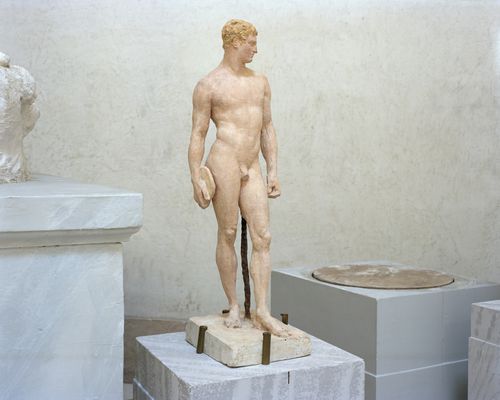
Photograph by Stefano Graziani of the following work: Antonio Canova, Palamede, Gypsotheca e Museo Antonio Canova, Possagno Questioning Pictures is a 36 photograph project commissioned by Fondazione Prada, Milan. Artist Stefano Graziani investigates archival and conservation systems in a number of museums. Through photographing museum objects, Graziani, focusing on the relationship between photographs, the museum objects and the power structures at play within institutions. The museums include the Canadian Centre for Architecture (CCA) in Montréal, Canada; Sir John Soane’s Museum in London, UK; the Kunstmuseum Basel, Switzerland; Museum Insel Hombroich in Neuss, Germany; the Museo di Castelvecchio in Verona, Italy; and the Plaster Cast Gallery at Museo Canova in Possagno, Italy.
PH2018:0005:036
Description:
Photograph by Stefano Graziani of the following work: Antonio Canova, Palamede, Gypsotheca e Museo Antonio Canova, Possagno Questioning Pictures is a 36 photograph project commissioned by Fondazione Prada, Milan. Artist Stefano Graziani investigates archival and conservation systems in a number of museums. Through photographing museum objects, Graziani, focusing on the relationship between photographs, the museum objects and the power structures at play within institutions. The museums include the Canadian Centre for Architecture (CCA) in Montréal, Canada; Sir John Soane’s Museum in London, UK; the Kunstmuseum Basel, Switzerland; Museum Insel Hombroich in Neuss, Germany; the Museo di Castelvecchio in Verona, Italy; and the Plaster Cast Gallery at Museo Canova in Possagno, Italy.
Personnes et institutions:
Date:
2017
2017
Titre:
Questioning Pictures: Photograph of Palamede, sculpture by Antonio Canova
Actions:
PH2018:0005:036
Description:
Photograph by Stefano Graziani of the following work: Antonio Canova, Palamede, Gypsotheca e Museo Antonio Canova, Possagno Questioning Pictures is a 36 photograph project commissioned by Fondazione Prada, Milan. Artist Stefano Graziani investigates archival and conservation systems in a number of museums. Through photographing museum objects, Graziani, focusing on the relationship between photographs, the museum objects and the power structures at play within institutions. The museums include the Canadian Centre for Architecture (CCA) in Montréal, Canada; Sir John Soane’s Museum in London, UK; the Kunstmuseum Basel, Switzerland; Museum Insel Hombroich in Neuss, Germany; the Museo di Castelvecchio in Verona, Italy; and the Plaster Cast Gallery at Museo Canova in Possagno, Italy.
Questioning Pictures: Photograph of Palamede, sculpture by Antonio Canova
Actions:
PH2018:0005:036
Description:
Photograph by Stefano Graziani of the following work: Antonio Canova, Palamede, Gypsotheca e Museo Antonio Canova, Possagno Questioning Pictures is a 36 photograph project commissioned by Fondazione Prada, Milan. Artist Stefano Graziani investigates archival and conservation systems in a number of museums. Through photographing museum objects, Graziani, focusing on the relationship between photographs, the museum objects and the power structures at play within institutions. The museums include the Canadian Centre for Architecture (CCA) in Montréal, Canada; Sir John Soane’s Museum in London, UK; the Kunstmuseum Basel, Switzerland; Museum Insel Hombroich in Neuss, Germany; the Museo di Castelvecchio in Verona, Italy; and the Plaster Cast Gallery at Museo Canova in Possagno, Italy.
Classification:
photographies
photographies
Date:
2017
2017
Personnes et institutions:
Niveau de description archivistique:
Sous-série
Sous-série
Titre:
Domestic Commissions
Domestic Commissions
Numéro de référence:
CI001.S1.D2
Description:
Hubert and Charles Rohault de Fleury received domestic commissions for both urban housing -hôtel particuliers and apartment houses- and rural dwellings -châteaux, country houses and estates. Hubert also executed designs for furniture and garden pavilions. Hubert' work is characterized by restrained classical exteriors and luxurious Empire style interiors; both Charles' exteriors and interiors, especially those for Hôtels Sauvage and Soltykoff, reflect the exuberance of the Second Empire. The CCA albums include drawings from all stages of the design process but with an emphasis on design development drawings. Hubert's albums contain cost calculations and estimates, notes and letters. In general, the drawings by Charles are from a more developed phase of design than Hubert's; Hubert's commissions are more varied than Charles'. The austere classicism of Hubert's domestic work reflects the prevailing taste of the day and reveals the strong influence of his teacher, Jean Nicholas Louis Durand. The compostional effect of the houses' façades relies on the shape and rhythm of the fenestration and the geometric division by string courses and occasionally, pilasters. Columns are used infrequently as is decorative stonework. The plans are symmetrical and modular. This approach to design is especially evident in the series of proposals for a country house for comte Treilhard (DR1974:0002:034:001-082) and in a group of unidentified designs for houses (DR1974:0002:035:001-034), all of which illustrate an emphasis on plan in the design process and a distinct approach to the composition of the elevations, both derived from Durand. Hubert's domestic work was also influenced by Palladio (see especially DR1974:0002:038:001-029). The interiors and furniture designed by Hubert are typical of the Empire style (1). The drawings in the CCA collection illustrate the materials, palette and ornamental motifs of the period. The garden structures in Hubert's albums are more fanciful than his houses and are either Rustic, Chinoiserie or classical in style (2). His garden designs follow the contemporary French trend for "jardins anglais" with winding paths and naturalistic placement of the vegetation, sometimes in combination with more formal French gardens (3). One of the most comprehensively documented domestic project by Hubert is the Rohault de Fleury House (12-14 rue d'Aguesseau; 1824). The CCA collection contains an interesting series of preliminary drawings for alternate proposals for this house, a number of highly finished wash drawings (including the interior decorative scheme) for the final scheme (DR1974:0002:011:001-08) and several earlier (ca. 1806) proposals (DR1974:0002:035:001-034). The Domaine de la Vallée album (DR1974:0002:025:001-059) is notable for the range of subject matter included as well as for the insights into the character of a working country estate in the nineteenth century. The proposed modifications encompassed both functional (a bridge, a levee, granaries and stables) and aesthetic improvements, such as ornamental garden temples. The renovation of the house also exhibits both functional and aesthetic improvements. (1) Examples of Hubert's interiors and furniture can be found in albums, DR1974:0002:007:001-068, DR1974:0002:011:001-089, DR1974:0002:025:001-059, DR1974:0002:030:001-065 and DR1974:0002:035:001-034. (2) The best examples of his pavilions are found in album, DR1974:0002:038:001-029 with other examples in albums, DR1974:0002:025:001-059, DR1974:0002:030:001-065 and DR1974:0002:035:001-034. (3) Examples are found in albums, DR1974:0002:035:001-034 and DR1974:0002 :025:001-059. Also of note are drawings, DR1974:0002:007:007 and DR1974:0002:007:068.
CI001.S1.D2
Description:
Hubert and Charles Rohault de Fleury received domestic commissions for both urban housing -hôtel particuliers and apartment houses- and rural dwellings -châteaux, country houses and estates. Hubert also executed designs for furniture and garden pavilions. Hubert' work is characterized by restrained classical exteriors and luxurious Empire style interiors; both Charles' exteriors and interiors, especially those for Hôtels Sauvage and Soltykoff, reflect the exuberance of the Second Empire. The CCA albums include drawings from all stages of the design process but with an emphasis on design development drawings. Hubert's albums contain cost calculations and estimates, notes and letters. In general, the drawings by Charles are from a more developed phase of design than Hubert's; Hubert's commissions are more varied than Charles'. The austere classicism of Hubert's domestic work reflects the prevailing taste of the day and reveals the strong influence of his teacher, Jean Nicholas Louis Durand. The compostional effect of the houses' façades relies on the shape and rhythm of the fenestration and the geometric division by string courses and occasionally, pilasters. Columns are used infrequently as is decorative stonework. The plans are symmetrical and modular. This approach to design is especially evident in the series of proposals for a country house for comte Treilhard (DR1974:0002:034:001-082) and in a group of unidentified designs for houses (DR1974:0002:035:001-034), all of which illustrate an emphasis on plan in the design process and a distinct approach to the composition of the elevations, both derived from Durand. Hubert's domestic work was also influenced by Palladio (see especially DR1974:0002:038:001-029). The interiors and furniture designed by Hubert are typical of the Empire style (1). The drawings in the CCA collection illustrate the materials, palette and ornamental motifs of the period. The garden structures in Hubert's albums are more fanciful than his houses and are either Rustic, Chinoiserie or classical in style (2). His garden designs follow the contemporary French trend for "jardins anglais" with winding paths and naturalistic placement of the vegetation, sometimes in combination with more formal French gardens (3). One of the most comprehensively documented domestic project by Hubert is the Rohault de Fleury House (12-14 rue d'Aguesseau; 1824). The CCA collection contains an interesting series of preliminary drawings for alternate proposals for this house, a number of highly finished wash drawings (including the interior decorative scheme) for the final scheme (DR1974:0002:011:001-08) and several earlier (ca. 1806) proposals (DR1974:0002:035:001-034). The Domaine de la Vallée album (DR1974:0002:025:001-059) is notable for the range of subject matter included as well as for the insights into the character of a working country estate in the nineteenth century. The proposed modifications encompassed both functional (a bridge, a levee, granaries and stables) and aesthetic improvements, such as ornamental garden temples. The renovation of the house also exhibits both functional and aesthetic improvements. (1) Examples of Hubert's interiors and furniture can be found in albums, DR1974:0002:007:001-068, DR1974:0002:011:001-089, DR1974:0002:025:001-059, DR1974:0002:030:001-065 and DR1974:0002:035:001-034. (2) The best examples of his pavilions are found in album, DR1974:0002:038:001-029 with other examples in albums, DR1974:0002:025:001-059, DR1974:0002:030:001-065 and DR1974:0002:035:001-034. (3) Examples are found in albums, DR1974:0002:035:001-034 and DR1974:0002 :025:001-059. Also of note are drawings, DR1974:0002:007:007 and DR1974:0002:007:068.
Personnes et institutions:
Date:
1802-[1840]
1802-[1840]
Titre:
Domestic Commissions
CI001.S1.D2
Description:
Hubert and Charles Rohault de Fleury received domestic commissions for both urban housing -hôtel particuliers and apartment houses- and rural dwellings -châteaux, country houses and estates. Hubert also executed designs for furniture and garden pavilions. Hubert' work is characterized by restrained classical exteriors and luxurious Empire style interiors; both Charles' exteriors and interiors, especially those for Hôtels Sauvage and Soltykoff, reflect the exuberance of the Second Empire. The CCA albums include drawings from all stages of the design process but with an emphasis on design development drawings. Hubert's albums contain cost calculations and estimates, notes and letters. In general, the drawings by Charles are from a more developed phase of design than Hubert's; Hubert's commissions are more varied than Charles'. The austere classicism of Hubert's domestic work reflects the prevailing taste of the day and reveals the strong influence of his teacher, Jean Nicholas Louis Durand. The compostional effect of the houses' façades relies on the shape and rhythm of the fenestration and the geometric division by string courses and occasionally, pilasters. Columns are used infrequently as is decorative stonework. The plans are symmetrical and modular. This approach to design is especially evident in the series of proposals for a country house for comte Treilhard (DR1974:0002:034:001-082) and in a group of unidentified designs for houses (DR1974:0002:035:001-034), all of which illustrate an emphasis on plan in the design process and a distinct approach to the composition of the elevations, both derived from Durand. Hubert's domestic work was also influenced by Palladio (see especially DR1974:0002:038:001-029). The interiors and furniture designed by Hubert are typical of the Empire style (1). The drawings in the CCA collection illustrate the materials, palette and ornamental motifs of the period. The garden structures in Hubert's albums are more fanciful than his houses and are either Rustic, Chinoiserie or classical in style (2). His garden designs follow the contemporary French trend for "jardins anglais" with winding paths and naturalistic placement of the vegetation, sometimes in combination with more formal French gardens (3). One of the most comprehensively documented domestic project by Hubert is the Rohault de Fleury House (12-14 rue d'Aguesseau; 1824). The CCA collection contains an interesting series of preliminary drawings for alternate proposals for this house, a number of highly finished wash drawings (including the interior decorative scheme) for the final scheme (DR1974:0002:011:001-08) and several earlier (ca. 1806) proposals (DR1974:0002:035:001-034). The Domaine de la Vallée album (DR1974:0002:025:001-059) is notable for the range of subject matter included as well as for the insights into the character of a working country estate in the nineteenth century. The proposed modifications encompassed both functional (a bridge, a levee, granaries and stables) and aesthetic improvements, such as ornamental garden temples. The renovation of the house also exhibits both functional and aesthetic improvements. (1) Examples of Hubert's interiors and furniture can be found in albums, DR1974:0002:007:001-068, DR1974:0002:011:001-089, DR1974:0002:025:001-059, DR1974:0002:030:001-065 and DR1974:0002:035:001-034. (2) The best examples of his pavilions are found in album, DR1974:0002:038:001-029 with other examples in albums, DR1974:0002:025:001-059, DR1974:0002:030:001-065 and DR1974:0002:035:001-034. (3) Examples are found in albums, DR1974:0002:035:001-034 and DR1974:0002 :025:001-059. Also of note are drawings, DR1974:0002:007:007 and DR1974:0002:007:068.
Domestic Commissions
CI001.S1.D2
Description:
Hubert and Charles Rohault de Fleury received domestic commissions for both urban housing -hôtel particuliers and apartment houses- and rural dwellings -châteaux, country houses and estates. Hubert also executed designs for furniture and garden pavilions. Hubert' work is characterized by restrained classical exteriors and luxurious Empire style interiors; both Charles' exteriors and interiors, especially those for Hôtels Sauvage and Soltykoff, reflect the exuberance of the Second Empire. The CCA albums include drawings from all stages of the design process but with an emphasis on design development drawings. Hubert's albums contain cost calculations and estimates, notes and letters. In general, the drawings by Charles are from a more developed phase of design than Hubert's; Hubert's commissions are more varied than Charles'. The austere classicism of Hubert's domestic work reflects the prevailing taste of the day and reveals the strong influence of his teacher, Jean Nicholas Louis Durand. The compostional effect of the houses' façades relies on the shape and rhythm of the fenestration and the geometric division by string courses and occasionally, pilasters. Columns are used infrequently as is decorative stonework. The plans are symmetrical and modular. This approach to design is especially evident in the series of proposals for a country house for comte Treilhard (DR1974:0002:034:001-082) and in a group of unidentified designs for houses (DR1974:0002:035:001-034), all of which illustrate an emphasis on plan in the design process and a distinct approach to the composition of the elevations, both derived from Durand. Hubert's domestic work was also influenced by Palladio (see especially DR1974:0002:038:001-029). The interiors and furniture designed by Hubert are typical of the Empire style (1). The drawings in the CCA collection illustrate the materials, palette and ornamental motifs of the period. The garden structures in Hubert's albums are more fanciful than his houses and are either Rustic, Chinoiserie or classical in style (2). His garden designs follow the contemporary French trend for "jardins anglais" with winding paths and naturalistic placement of the vegetation, sometimes in combination with more formal French gardens (3). One of the most comprehensively documented domestic project by Hubert is the Rohault de Fleury House (12-14 rue d'Aguesseau; 1824). The CCA collection contains an interesting series of preliminary drawings for alternate proposals for this house, a number of highly finished wash drawings (including the interior decorative scheme) for the final scheme (DR1974:0002:011:001-08) and several earlier (ca. 1806) proposals (DR1974:0002:035:001-034). The Domaine de la Vallée album (DR1974:0002:025:001-059) is notable for the range of subject matter included as well as for the insights into the character of a working country estate in the nineteenth century. The proposed modifications encompassed both functional (a bridge, a levee, granaries and stables) and aesthetic improvements, such as ornamental garden temples. The renovation of the house also exhibits both functional and aesthetic improvements. (1) Examples of Hubert's interiors and furniture can be found in albums, DR1974:0002:007:001-068, DR1974:0002:011:001-089, DR1974:0002:025:001-059, DR1974:0002:030:001-065 and DR1974:0002:035:001-034. (2) The best examples of his pavilions are found in album, DR1974:0002:038:001-029 with other examples in albums, DR1974:0002:025:001-059, DR1974:0002:030:001-065 and DR1974:0002:035:001-034. (3) Examples are found in albums, DR1974:0002:035:001-034 and DR1974:0002 :025:001-059. Also of note are drawings, DR1974:0002:007:007 and DR1974:0002:007:068.
Niveau de description archivistique:
File 2
File 2
Date:
1802-[1840]
1802-[1840]
Personnes et institutions:
Niveau de description archivistique:
Projet
Projet
Numéro de référence:
AP164.S1.2006.D2
Description:
The project series documents the four residential towers on plot 12, in the sector Ibaialde of Vitoria-Gasteiz, Spain. The firm identified this project as number 115. Abalos & Herreros worked with Alfonso Miguel Caballero, Alejandro Valdivieso and Eva Gil for the promoter Jaureguizahar. Documenting the project are presentation drawings and a project description.
AP164.S1.2006.D2
Description:
The project series documents the four residential towers on plot 12, in the sector Ibaialde of Vitoria-Gasteiz, Spain. The firm identified this project as number 115. Abalos & Herreros worked with Alfonso Miguel Caballero, Alejandro Valdivieso and Eva Gil for the promoter Jaureguizahar. Documenting the project are presentation drawings and a project description.
Personnes et institutions:
Date:
2006
2006
Titre:
Concurso Vitoria Ibaialde, Victor-Gasteiz, Spain (2006)
Actions:
AP164.S1.2006.D2
Description:
The project series documents the four residential towers on plot 12, in the sector Ibaialde of Vitoria-Gasteiz, Spain. The firm identified this project as number 115. Abalos & Herreros worked with Alfonso Miguel Caballero, Alejandro Valdivieso and Eva Gil for the promoter Jaureguizahar. Documenting the project are presentation drawings and a project description.
Concurso Vitoria Ibaialde, Victor-Gasteiz, Spain (2006)
Actions:
AP164.S1.2006.D2
Description:
The project series documents the four residential towers on plot 12, in the sector Ibaialde of Vitoria-Gasteiz, Spain. The firm identified this project as number 115. Abalos & Herreros worked with Alfonso Miguel Caballero, Alejandro Valdivieso and Eva Gil for the promoter Jaureguizahar. Documenting the project are presentation drawings and a project description.
Niveau de description archivistique:
Project
Project
Date:
2006
2006
Personnes et institutions:
Niveau de description archivistique:
Projet
Projet
Numéro de référence:
AP164.S1.2002.D15
Description:
The project series documents the design for the integration of the railway system in Almería, Spain. The firm identified this project as number 160. Abalos & Herreros worked with Prointec, Ramón del Cuvillo Martínez-Ridruejo, Wouter van Daele and Angel Jaramillo. Doucmenting the project are resumes, competition documents, graphic materials and a map.
AP164.S1.2002.D15
Description:
The project series documents the design for the integration of the railway system in Almería, Spain. The firm identified this project as number 160. Abalos & Herreros worked with Prointec, Ramón del Cuvillo Martínez-Ridruejo, Wouter van Daele and Angel Jaramillo. Doucmenting the project are resumes, competition documents, graphic materials and a map.
Personnes et institutions:
Date:
circa 2001-2002
circa 2001-2002
Titre:
Ordenación ferrocarril Almería, Spain (2002)
Actions:
AP164.S1.2002.D15
Description:
The project series documents the design for the integration of the railway system in Almería, Spain. The firm identified this project as number 160. Abalos & Herreros worked with Prointec, Ramón del Cuvillo Martínez-Ridruejo, Wouter van Daele and Angel Jaramillo. Doucmenting the project are resumes, competition documents, graphic materials and a map.
Ordenación ferrocarril Almería, Spain (2002)
Actions:
AP164.S1.2002.D15
Description:
The project series documents the design for the integration of the railway system in Almería, Spain. The firm identified this project as number 160. Abalos & Herreros worked with Prointec, Ramón del Cuvillo Martínez-Ridruejo, Wouter van Daele and Angel Jaramillo. Doucmenting the project are resumes, competition documents, graphic materials and a map.
Niveau de description archivistique:
Project
Project
Date:
circa 2001-2002
circa 2001-2002
Personnes et institutions:
Niveau de description archivistique:
Projet
Projet
Numéro de référence:
AP180.S1.1968.PR01
Description:
This project series documents Umberto Riva's unrealized project for the Casa Giorgio Riva, a two-storey single family house in Lesmo, Italy. Riva worked on this project in 1968. The project is recorded through sketches, including studies, and design development drawings, including exterior elevations, floor plans, and sections.
AP180.S1.1968.PR01
Description:
This project series documents Umberto Riva's unrealized project for the Casa Giorgio Riva, a two-storey single family house in Lesmo, Italy. Riva worked on this project in 1968. The project is recorded through sketches, including studies, and design development drawings, including exterior elevations, floor plans, and sections.
Personnes et institutions:
Date:
1968
1968
Titre:
Casa Giorgio Riva [Giorgio Riva house], Lesmo, Italy (1968)
Actions:
AP180.S1.1968.PR01
Description:
This project series documents Umberto Riva's unrealized project for the Casa Giorgio Riva, a two-storey single family house in Lesmo, Italy. Riva worked on this project in 1968. The project is recorded through sketches, including studies, and design development drawings, including exterior elevations, floor plans, and sections.
Casa Giorgio Riva [Giorgio Riva house], Lesmo, Italy (1968)
Actions:
AP180.S1.1968.PR01
Description:
This project series documents Umberto Riva's unrealized project for the Casa Giorgio Riva, a two-storey single family house in Lesmo, Italy. Riva worked on this project in 1968. The project is recorded through sketches, including studies, and design development drawings, including exterior elevations, floor plans, and sections.
Niveau de description archivistique:
Project
Project
Date:
1968
1968
Personnes et institutions:
Niveau de description archivistique:
Projet
Projet
Numéro de référence:
AP056.S1.1991.PR01
Description:
This project series documents a competition entry for the Vancouver Public Library in Vancouver from 1991-1992. The office identified the project number as 69112. The competition entry, submitted in 1991, consisted of the design of Vancouver's new public library, to be situated on the block between Homer, Georgia, Hamilton and Robson Streets. The project design included a seven-floor library connected by a walkway to an adjacent twenty-floor office tower that would house Public Works Canada. Both buildings had V shaped canopies on their roofs that looked like open books when viewed at an elevation. To the front of the library at ground level was the two-storey Library Concourse; a large hall made of glass windows and stone. The Concourse connected to the Robson Street entrance, and the Library Hall entrance at the corner of Homer and Georgia Streets. The architects described this as a porch-like space to be used for gatherings, public events, exhibits and displays. Moving into the heart of the library, patrons would pass through a cylindrical rotunda which extended upwards through every floor and above the roof terrace. The library would also have 2 levels of underground parking and a basement level with a circular theatre, concession areas and staff work areas. The ground floor would primarily consist of library stacks and tables but also included would be a gift shop, children's area, daycare, staff spaces, and an outdoor play area. The remaining floors were designated for library stacks, staff work areas and services. The top floor would hold administrative offices, built in a U shape around a large terrace. The terrace, complete with gardens, could be used for library events. This building would largely be made of glass windows at its exterior, with a round glass rotunda piercing through its rectangular shape. This project was never built. Although Kuwabara, Payne, McKenna, Blumberg Architects were finalists in this competition, the contract was eventually won and built by architect Moshe Safdie. The project is recorded through drawings, presentation panels, paintings, photographs and a model dating from 1991-1992. The drawings, which are mostly originals, include sketches, plans, sections, elevations, perspectives and isometrics. There are a number of watercolours (some mounted) and drawing panels used as presentation materials which have small texts about the project's design intention. The aquisition records for the 1993 donation of these project materials identify Michael McCann as the artist of 7 paintings in this project series; however it is not clear which 7 paintings were completed by this artist. The photographs show the completed project model, which is also contained in this project series.
AP056.S1.1991.PR01
Description:
This project series documents a competition entry for the Vancouver Public Library in Vancouver from 1991-1992. The office identified the project number as 69112. The competition entry, submitted in 1991, consisted of the design of Vancouver's new public library, to be situated on the block between Homer, Georgia, Hamilton and Robson Streets. The project design included a seven-floor library connected by a walkway to an adjacent twenty-floor office tower that would house Public Works Canada. Both buildings had V shaped canopies on their roofs that looked like open books when viewed at an elevation. To the front of the library at ground level was the two-storey Library Concourse; a large hall made of glass windows and stone. The Concourse connected to the Robson Street entrance, and the Library Hall entrance at the corner of Homer and Georgia Streets. The architects described this as a porch-like space to be used for gatherings, public events, exhibits and displays. Moving into the heart of the library, patrons would pass through a cylindrical rotunda which extended upwards through every floor and above the roof terrace. The library would also have 2 levels of underground parking and a basement level with a circular theatre, concession areas and staff work areas. The ground floor would primarily consist of library stacks and tables but also included would be a gift shop, children's area, daycare, staff spaces, and an outdoor play area. The remaining floors were designated for library stacks, staff work areas and services. The top floor would hold administrative offices, built in a U shape around a large terrace. The terrace, complete with gardens, could be used for library events. This building would largely be made of glass windows at its exterior, with a round glass rotunda piercing through its rectangular shape. This project was never built. Although Kuwabara, Payne, McKenna, Blumberg Architects were finalists in this competition, the contract was eventually won and built by architect Moshe Safdie. The project is recorded through drawings, presentation panels, paintings, photographs and a model dating from 1991-1992. The drawings, which are mostly originals, include sketches, plans, sections, elevations, perspectives and isometrics. There are a number of watercolours (some mounted) and drawing panels used as presentation materials which have small texts about the project's design intention. The aquisition records for the 1993 donation of these project materials identify Michael McCann as the artist of 7 paintings in this project series; however it is not clear which 7 paintings were completed by this artist. The photographs show the completed project model, which is also contained in this project series.
Personnes et institutions:
Date:
1991-1992
1991-1992
Titre:
Vancouver Public Library Competition, British Columbia (1991)
Actions:
AP056.S1.1991.PR01
Description:
This project series documents a competition entry for the Vancouver Public Library in Vancouver from 1991-1992. The office identified the project number as 69112. The competition entry, submitted in 1991, consisted of the design of Vancouver's new public library, to be situated on the block between Homer, Georgia, Hamilton and Robson Streets. The project design included a seven-floor library connected by a walkway to an adjacent twenty-floor office tower that would house Public Works Canada. Both buildings had V shaped canopies on their roofs that looked like open books when viewed at an elevation. To the front of the library at ground level was the two-storey Library Concourse; a large hall made of glass windows and stone. The Concourse connected to the Robson Street entrance, and the Library Hall entrance at the corner of Homer and Georgia Streets. The architects described this as a porch-like space to be used for gatherings, public events, exhibits and displays. Moving into the heart of the library, patrons would pass through a cylindrical rotunda which extended upwards through every floor and above the roof terrace. The library would also have 2 levels of underground parking and a basement level with a circular theatre, concession areas and staff work areas. The ground floor would primarily consist of library stacks and tables but also included would be a gift shop, children's area, daycare, staff spaces, and an outdoor play area. The remaining floors were designated for library stacks, staff work areas and services. The top floor would hold administrative offices, built in a U shape around a large terrace. The terrace, complete with gardens, could be used for library events. This building would largely be made of glass windows at its exterior, with a round glass rotunda piercing through its rectangular shape. This project was never built. Although Kuwabara, Payne, McKenna, Blumberg Architects were finalists in this competition, the contract was eventually won and built by architect Moshe Safdie. The project is recorded through drawings, presentation panels, paintings, photographs and a model dating from 1991-1992. The drawings, which are mostly originals, include sketches, plans, sections, elevations, perspectives and isometrics. There are a number of watercolours (some mounted) and drawing panels used as presentation materials which have small texts about the project's design intention. The aquisition records for the 1993 donation of these project materials identify Michael McCann as the artist of 7 paintings in this project series; however it is not clear which 7 paintings were completed by this artist. The photographs show the completed project model, which is also contained in this project series.
Vancouver Public Library Competition, British Columbia (1991)
Actions:
AP056.S1.1991.PR01
Description:
This project series documents a competition entry for the Vancouver Public Library in Vancouver from 1991-1992. The office identified the project number as 69112. The competition entry, submitted in 1991, consisted of the design of Vancouver's new public library, to be situated on the block between Homer, Georgia, Hamilton and Robson Streets. The project design included a seven-floor library connected by a walkway to an adjacent twenty-floor office tower that would house Public Works Canada. Both buildings had V shaped canopies on their roofs that looked like open books when viewed at an elevation. To the front of the library at ground level was the two-storey Library Concourse; a large hall made of glass windows and stone. The Concourse connected to the Robson Street entrance, and the Library Hall entrance at the corner of Homer and Georgia Streets. The architects described this as a porch-like space to be used for gatherings, public events, exhibits and displays. Moving into the heart of the library, patrons would pass through a cylindrical rotunda which extended upwards through every floor and above the roof terrace. The library would also have 2 levels of underground parking and a basement level with a circular theatre, concession areas and staff work areas. The ground floor would primarily consist of library stacks and tables but also included would be a gift shop, children's area, daycare, staff spaces, and an outdoor play area. The remaining floors were designated for library stacks, staff work areas and services. The top floor would hold administrative offices, built in a U shape around a large terrace. The terrace, complete with gardens, could be used for library events. This building would largely be made of glass windows at its exterior, with a round glass rotunda piercing through its rectangular shape. This project was never built. Although Kuwabara, Payne, McKenna, Blumberg Architects were finalists in this competition, the contract was eventually won and built by architect Moshe Safdie. The project is recorded through drawings, presentation panels, paintings, photographs and a model dating from 1991-1992. The drawings, which are mostly originals, include sketches, plans, sections, elevations, perspectives and isometrics. There are a number of watercolours (some mounted) and drawing panels used as presentation materials which have small texts about the project's design intention. The aquisition records for the 1993 donation of these project materials identify Michael McCann as the artist of 7 paintings in this project series; however it is not clear which 7 paintings were completed by this artist. The photographs show the completed project model, which is also contained in this project series.
Niveau de description archivistique:
Project
Project
Date:
1991-1992
1991-1992
Personnes et institutions:


