


7241 Résultats
Niveau de description archivistique:
Série(s)
Série(s)
Titre:
Projects
Projects
Numéro de référence:
AP194.S1
Description:
Series contains records associated with three OCEAN North projects to which Johan Bettum brought a significant insight: Synthetic Landscape (1995-2000), Jyväskylä Music and Arts Centre (1997) and Töölö Football Stadium (1997). The collaborative process around these projects allowed exploring design methods through the usage of digital tools. In discussions with Greg Lynn, Johan Bettum and Kivi Sotamaa have expressed that they had broached Töölö as a landscape and Jyväskylä as a cloud. Particle streaming and Channelling Systems approaches were applied in these projects and further developed in the third phase of the Synthetic Landscape project and its Pavilion. The Synthetic Landscape project also featured usage of polymer composite materials. All records are born-digital, except for one 1995 drawing from the Synthetic Landscape project. Records include CAD models, raster and vector images, textual records and animated renderings from Channelling Systems studies. CAD models and drawings show design process of the projects, and range from the abstract (particle streaming) to very detailed plans (Jyväskylä). They were created using form*Z, Microstation, Alias, 3D Studio, AutoCAD and Rhinoceros. Some files were saved in IGES and DXF formats. Most CAD drawings have been saved as raster images. Drawings and models might have been saved in more than one file format. Digital textual records include project descriptions, presentations and reports, budgets and meeting notes, often created using the Microsoft Office software suite. Sources: Bettum, Johan and Michael Hensel. “Channelling Systems: Dynamic Processes and Digital Time-Based Methods in Urban Design.” AD Architectural Design 70, no.3 (June 2000): 36-43. Greg Lynn, ed. Archaeology of the Digital 17: OCEAN North, Jyväskylä Music and Arts Centre, Montréal: Canadian Centre for Architecture, 2017. ePub.
AP194.S1
Description:
Series contains records associated with three OCEAN North projects to which Johan Bettum brought a significant insight: Synthetic Landscape (1995-2000), Jyväskylä Music and Arts Centre (1997) and Töölö Football Stadium (1997). The collaborative process around these projects allowed exploring design methods through the usage of digital tools. In discussions with Greg Lynn, Johan Bettum and Kivi Sotamaa have expressed that they had broached Töölö as a landscape and Jyväskylä as a cloud. Particle streaming and Channelling Systems approaches were applied in these projects and further developed in the third phase of the Synthetic Landscape project and its Pavilion. The Synthetic Landscape project also featured usage of polymer composite materials. All records are born-digital, except for one 1995 drawing from the Synthetic Landscape project. Records include CAD models, raster and vector images, textual records and animated renderings from Channelling Systems studies. CAD models and drawings show design process of the projects, and range from the abstract (particle streaming) to very detailed plans (Jyväskylä). They were created using form*Z, Microstation, Alias, 3D Studio, AutoCAD and Rhinoceros. Some files were saved in IGES and DXF formats. Most CAD drawings have been saved as raster images. Drawings and models might have been saved in more than one file format. Digital textual records include project descriptions, presentations and reports, budgets and meeting notes, often created using the Microsoft Office software suite. Sources: Bettum, Johan and Michael Hensel. “Channelling Systems: Dynamic Processes and Digital Time-Based Methods in Urban Design.” AD Architectural Design 70, no.3 (June 2000): 36-43. Greg Lynn, ed. Archaeology of the Digital 17: OCEAN North, Jyväskylä Music and Arts Centre, Montréal: Canadian Centre for Architecture, 2017. ePub.
Personnes et institutions:
Date:
1995-2000
1995-2000
Titre:
Projects
Actions:
AP194.S1
Description:
Series contains records associated with three OCEAN North projects to which Johan Bettum brought a significant insight: Synthetic Landscape (1995-2000), Jyväskylä Music and Arts Centre (1997) and Töölö Football Stadium (1997). The collaborative process around these projects allowed exploring design methods through the usage of digital tools. In discussions with Greg Lynn, Johan Bettum and Kivi Sotamaa have expressed that they had broached Töölö as a landscape and Jyväskylä as a cloud. Particle streaming and Channelling Systems approaches were applied in these projects and further developed in the third phase of the Synthetic Landscape project and its Pavilion. The Synthetic Landscape project also featured usage of polymer composite materials. All records are born-digital, except for one 1995 drawing from the Synthetic Landscape project. Records include CAD models, raster and vector images, textual records and animated renderings from Channelling Systems studies. CAD models and drawings show design process of the projects, and range from the abstract (particle streaming) to very detailed plans (Jyväskylä). They were created using form*Z, Microstation, Alias, 3D Studio, AutoCAD and Rhinoceros. Some files were saved in IGES and DXF formats. Most CAD drawings have been saved as raster images. Drawings and models might have been saved in more than one file format. Digital textual records include project descriptions, presentations and reports, budgets and meeting notes, often created using the Microsoft Office software suite. Sources: Bettum, Johan and Michael Hensel. “Channelling Systems: Dynamic Processes and Digital Time-Based Methods in Urban Design.” AD Architectural Design 70, no.3 (June 2000): 36-43. Greg Lynn, ed. Archaeology of the Digital 17: OCEAN North, Jyväskylä Music and Arts Centre, Montréal: Canadian Centre for Architecture, 2017. ePub.
Projects
Actions:
AP194.S1
Description:
Series contains records associated with three OCEAN North projects to which Johan Bettum brought a significant insight: Synthetic Landscape (1995-2000), Jyväskylä Music and Arts Centre (1997) and Töölö Football Stadium (1997). The collaborative process around these projects allowed exploring design methods through the usage of digital tools. In discussions with Greg Lynn, Johan Bettum and Kivi Sotamaa have expressed that they had broached Töölö as a landscape and Jyväskylä as a cloud. Particle streaming and Channelling Systems approaches were applied in these projects and further developed in the third phase of the Synthetic Landscape project and its Pavilion. The Synthetic Landscape project also featured usage of polymer composite materials. All records are born-digital, except for one 1995 drawing from the Synthetic Landscape project. Records include CAD models, raster and vector images, textual records and animated renderings from Channelling Systems studies. CAD models and drawings show design process of the projects, and range from the abstract (particle streaming) to very detailed plans (Jyväskylä). They were created using form*Z, Microstation, Alias, 3D Studio, AutoCAD and Rhinoceros. Some files were saved in IGES and DXF formats. Most CAD drawings have been saved as raster images. Drawings and models might have been saved in more than one file format. Digital textual records include project descriptions, presentations and reports, budgets and meeting notes, often created using the Microsoft Office software suite. Sources: Bettum, Johan and Michael Hensel. “Channelling Systems: Dynamic Processes and Digital Time-Based Methods in Urban Design.” AD Architectural Design 70, no.3 (June 2000): 36-43. Greg Lynn, ed. Archaeology of the Digital 17: OCEAN North, Jyväskylä Music and Arts Centre, Montréal: Canadian Centre for Architecture, 2017. ePub.
Niveau de description archivistique:
Series
Series
Date:
1995-2000
1995-2000
Personnes et institutions:
Classification:
maquettes
maquettes
Numéro de référence:
ARCH277735
ARCH277735
Personnes et institutions:
Date:
1997
1997
Classification:
maquettes
maquettes
Date:
1997
1997
Personnes et institutions:
Classification:
maquettes
maquettes
Numéro de référence:
ARCH277736
ARCH277736
Personnes et institutions:
Date:
1997
1997
Classification:
maquettes
maquettes
Date:
1997
1997
Personnes et institutions:
Niveau de description archivistique:
Projet
Projet
Numéro de référence:
AP198.S1.1997.PR02
Description:
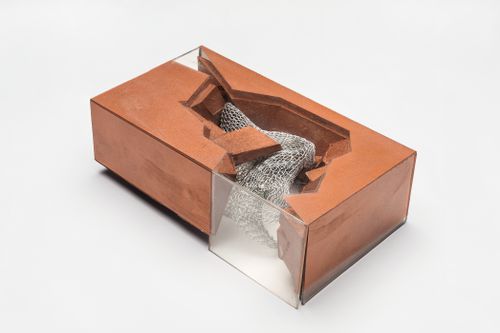
Project records document the design process for OCEAN North’s competition entry for the Jyväskylä Music and Arts Centre in 1997. The project was titled Terra Cultura by OCEAN North. The international competition called to create a multi-usage space that would include a venue for the symphonic orchestra, a music school, exhibition spaces, and the possibility to host a variety of small cultural events in the Finnish city of Jyväskylä. The proposed site is in the center of the town, across the street from the Jyväskylä city church and its park, and nearby buildings designed by Alvar Aalto. OCEAN North’s concept presents a topological surface as an extension of the surrounding urban scape with two masses that would host the formal functions of the building (concert hall, music school, exhibition halls). The two volumes, or raised blocks, are divided along a diagonal elevated space, which is the extension of the ground’s topological surface filled and dubbed “Liquid Flow Space” by the design team. In their interview with Greg Lynn, Johan Bettum and Kivi Sotamaa mentioned that the idea for Jyväskylä was that it was a cloud. Digital files, in particular, show the process to achieve the projected design. Drawings provide views of streamed particles and of resulting peels. They also include plans, elevations and axonometric views of the structure. Most files are raster or vector images, likely saved from CAD software. A few files are in CAD formats such as Microstation, 3D Studio and form*Z. Digital files also present sine wave analysis and resulting charts for each component of the program. The analysis and charts present the relationships between various components of the building’s program such as the Art Museum, the Concert Halls, the technical space, and the Common facilities. These files are raster images and spreadsheets. Photographs of the site in Jyväskylä and of models built by OCEAN North were digitized and are included with the digital working files. Physical drawings are chiefly floor plans for the building, but also include sections and sketches. Finally, project files include photographic prints of two built models. One of these models, a small model of the conceptual masses of the building structure, is itself in the archive. Photographs show the model in the context of a city scape model. The second model, not part of the archive at CCA, was built at a bigger scale and was an intricate cardboard and wooden stick structure. Sources: Softspace: from a representation of form to a simulation of space, Edited by Sean Lally and Jessica Young. London, New York: Routledge, 2007. Greg Lynn, ed. Archaeology of the Digital 17: OCEAN North, Jyväskylä Music and Arts Centre, Montréal: Canadian Centre for Architecture, 2017. ePub.
AP198.S1.1997.PR02
Description:
Project records document the design process for OCEAN North’s competition entry for the Jyväskylä Music and Arts Centre in 1997. The project was titled Terra Cultura by OCEAN North. The international competition called to create a multi-usage space that would include a venue for the symphonic orchestra, a music school, exhibition spaces, and the possibility to host a variety of small cultural events in the Finnish city of Jyväskylä. The proposed site is in the center of the town, across the street from the Jyväskylä city church and its park, and nearby buildings designed by Alvar Aalto. OCEAN North’s concept presents a topological surface as an extension of the surrounding urban scape with two masses that would host the formal functions of the building (concert hall, music school, exhibition halls). The two volumes, or raised blocks, are divided along a diagonal elevated space, which is the extension of the ground’s topological surface filled and dubbed “Liquid Flow Space” by the design team. In their interview with Greg Lynn, Johan Bettum and Kivi Sotamaa mentioned that the idea for Jyväskylä was that it was a cloud. Digital files, in particular, show the process to achieve the projected design. Drawings provide views of streamed particles and of resulting peels. They also include plans, elevations and axonometric views of the structure. Most files are raster or vector images, likely saved from CAD software. A few files are in CAD formats such as Microstation, 3D Studio and form*Z. Digital files also present sine wave analysis and resulting charts for each component of the program. The analysis and charts present the relationships between various components of the building’s program such as the Art Museum, the Concert Halls, the technical space, and the Common facilities. These files are raster images and spreadsheets. Photographs of the site in Jyväskylä and of models built by OCEAN North were digitized and are included with the digital working files. Physical drawings are chiefly floor plans for the building, but also include sections and sketches. Finally, project files include photographic prints of two built models. One of these models, a small model of the conceptual masses of the building structure, is itself in the archive. Photographs show the model in the context of a city scape model. The second model, not part of the archive at CCA, was built at a bigger scale and was an intricate cardboard and wooden stick structure. Sources: Softspace: from a representation of form to a simulation of space, Edited by Sean Lally and Jessica Young. London, New York: Routledge, 2007. Greg Lynn, ed. Archaeology of the Digital 17: OCEAN North, Jyväskylä Music and Arts Centre, Montréal: Canadian Centre for Architecture, 2017. ePub.
Personnes et institutions:
Date:
1997
1997
Titre:
Terra Cultura – Jyväskylä Music and Arts Centre, international competition entry
Actions:
AP198.S1.1997.PR02
Description:
Project records document the design process for OCEAN North’s competition entry for the Jyväskylä Music and Arts Centre in 1997. The project was titled Terra Cultura by OCEAN North. The international competition called to create a multi-usage space that would include a venue for the symphonic orchestra, a music school, exhibition spaces, and the possibility to host a variety of small cultural events in the Finnish city of Jyväskylä. The proposed site is in the center of the town, across the street from the Jyväskylä city church and its park, and nearby buildings designed by Alvar Aalto. OCEAN North’s concept presents a topological surface as an extension of the surrounding urban scape with two masses that would host the formal functions of the building (concert hall, music school, exhibition halls). The two volumes, or raised blocks, are divided along a diagonal elevated space, which is the extension of the ground’s topological surface filled and dubbed “Liquid Flow Space” by the design team. In their interview with Greg Lynn, Johan Bettum and Kivi Sotamaa mentioned that the idea for Jyväskylä was that it was a cloud. Digital files, in particular, show the process to achieve the projected design. Drawings provide views of streamed particles and of resulting peels. They also include plans, elevations and axonometric views of the structure. Most files are raster or vector images, likely saved from CAD software. A few files are in CAD formats such as Microstation, 3D Studio and form*Z. Digital files also present sine wave analysis and resulting charts for each component of the program. The analysis and charts present the relationships between various components of the building’s program such as the Art Museum, the Concert Halls, the technical space, and the Common facilities. These files are raster images and spreadsheets. Photographs of the site in Jyväskylä and of models built by OCEAN North were digitized and are included with the digital working files. Physical drawings are chiefly floor plans for the building, but also include sections and sketches. Finally, project files include photographic prints of two built models. One of these models, a small model of the conceptual masses of the building structure, is itself in the archive. Photographs show the model in the context of a city scape model. The second model, not part of the archive at CCA, was built at a bigger scale and was an intricate cardboard and wooden stick structure. Sources: Softspace: from a representation of form to a simulation of space, Edited by Sean Lally and Jessica Young. London, New York: Routledge, 2007. Greg Lynn, ed. Archaeology of the Digital 17: OCEAN North, Jyväskylä Music and Arts Centre, Montréal: Canadian Centre for Architecture, 2017. ePub.
Terra Cultura – Jyväskylä Music and Arts Centre, international competition entry
Actions:
AP198.S1.1997.PR02
Description:
Project records document the design process for OCEAN North’s competition entry for the Jyväskylä Music and Arts Centre in 1997. The project was titled Terra Cultura by OCEAN North. The international competition called to create a multi-usage space that would include a venue for the symphonic orchestra, a music school, exhibition spaces, and the possibility to host a variety of small cultural events in the Finnish city of Jyväskylä. The proposed site is in the center of the town, across the street from the Jyväskylä city church and its park, and nearby buildings designed by Alvar Aalto. OCEAN North’s concept presents a topological surface as an extension of the surrounding urban scape with two masses that would host the formal functions of the building (concert hall, music school, exhibition halls). The two volumes, or raised blocks, are divided along a diagonal elevated space, which is the extension of the ground’s topological surface filled and dubbed “Liquid Flow Space” by the design team. In their interview with Greg Lynn, Johan Bettum and Kivi Sotamaa mentioned that the idea for Jyväskylä was that it was a cloud. Digital files, in particular, show the process to achieve the projected design. Drawings provide views of streamed particles and of resulting peels. They also include plans, elevations and axonometric views of the structure. Most files are raster or vector images, likely saved from CAD software. A few files are in CAD formats such as Microstation, 3D Studio and form*Z. Digital files also present sine wave analysis and resulting charts for each component of the program. The analysis and charts present the relationships between various components of the building’s program such as the Art Museum, the Concert Halls, the technical space, and the Common facilities. These files are raster images and spreadsheets. Photographs of the site in Jyväskylä and of models built by OCEAN North were digitized and are included with the digital working files. Physical drawings are chiefly floor plans for the building, but also include sections and sketches. Finally, project files include photographic prints of two built models. One of these models, a small model of the conceptual masses of the building structure, is itself in the archive. Photographs show the model in the context of a city scape model. The second model, not part of the archive at CCA, was built at a bigger scale and was an intricate cardboard and wooden stick structure. Sources: Softspace: from a representation of form to a simulation of space, Edited by Sean Lally and Jessica Young. London, New York: Routledge, 2007. Greg Lynn, ed. Archaeology of the Digital 17: OCEAN North, Jyväskylä Music and Arts Centre, Montréal: Canadian Centre for Architecture, 2017. ePub.
Niveau de description archivistique:
Project
Project
Date:
1997
1997
Personnes et institutions:
Niveau de description archivistique:
Projet
Projet
Numéro de référence:
AP194.S1.1997.PR02
Description:
Project records document the design process for OCEAN North’s competition entry for the Jyväskylä Music and Arts Centre in 1997. The project was titled Terra Cultura by OCEAN North. The competition was to create a multi-usage space that would include a venue for the symphonic orchestra, a music school, exhibition spaces and the possibility to host a variety of small cultural events in the Finnish city of Jyväskylä. The proposed site is in the center of the town, across the street from the Jyväskylä city church and its park, and nearby buildings designed by Alvar Aalto. OCEAN North’s concept presents a topological surface as an extension of the surrounding urban scape with two masses that would host the formal functions of the building (concert hall, music school, exhibition halls). The two volumes, or raised blocks, are divided along a diagonal elevated space, which is the extension of the ground’s topological surface filled and dubbed “Liquid Flow Space” by the design team. In their interview with Greg Lynn, Johan Bettum and Kivi Sotamaa mentioned that the idea for Jyväskylä was that it was a cloud. To reach this goal, the team used CAD software to trace streams of particles as a modelling approach. The masses of linear elements that were generated were further deconstructed and turned into “peels” and rearranged to create the masses of the building. Physical models were also used to test and further what had emerged from the digital design process, with results being fed back into the digital drawings. During the process, Bettum also brought in the idea of the internalisation of the outside, taking inspiration from the Centre Georges Pompidou. Digital records document the creative process with raster and vector images, CAD drawings and models, and few digital textual records describing the project and the program charts. Drawings and models show site and building plans, perspectives and sections; particles streaming and resulting linear masses; peels and sections identified per color; and renderings of aerials, perspectives and elevation views. OCEAN North seems to have mostly used Microstation for modelling, although there are a few files created with form*Z and 3D Studio. Some of the raster images might have been created with these software as well, showing a given stage of the design process and including renderings. There are also screen captures showing the top, front, left and perspective views of 3D models. Adobe Photoshop and Illustrator were also used to create and modify drawings and diagrams. Program charts were created in Microsoft Excel. Sources: Softspace: from a representation of form to a simulation of space, Edited by Sean Lally and Jessica Young. London, New York: Routledge, 2007. Greg Lynn, ed. Archaeology of the Digital 17: OCEAN North, Jyväskylä Music and Arts Centre, Montréal: Canadian Centre for Architecture, 2017. ePub.
AP194.S1.1997.PR02
Description:
Project records document the design process for OCEAN North’s competition entry for the Jyväskylä Music and Arts Centre in 1997. The project was titled Terra Cultura by OCEAN North. The competition was to create a multi-usage space that would include a venue for the symphonic orchestra, a music school, exhibition spaces and the possibility to host a variety of small cultural events in the Finnish city of Jyväskylä. The proposed site is in the center of the town, across the street from the Jyväskylä city church and its park, and nearby buildings designed by Alvar Aalto. OCEAN North’s concept presents a topological surface as an extension of the surrounding urban scape with two masses that would host the formal functions of the building (concert hall, music school, exhibition halls). The two volumes, or raised blocks, are divided along a diagonal elevated space, which is the extension of the ground’s topological surface filled and dubbed “Liquid Flow Space” by the design team. In their interview with Greg Lynn, Johan Bettum and Kivi Sotamaa mentioned that the idea for Jyväskylä was that it was a cloud. To reach this goal, the team used CAD software to trace streams of particles as a modelling approach. The masses of linear elements that were generated were further deconstructed and turned into “peels” and rearranged to create the masses of the building. Physical models were also used to test and further what had emerged from the digital design process, with results being fed back into the digital drawings. During the process, Bettum also brought in the idea of the internalisation of the outside, taking inspiration from the Centre Georges Pompidou. Digital records document the creative process with raster and vector images, CAD drawings and models, and few digital textual records describing the project and the program charts. Drawings and models show site and building plans, perspectives and sections; particles streaming and resulting linear masses; peels and sections identified per color; and renderings of aerials, perspectives and elevation views. OCEAN North seems to have mostly used Microstation for modelling, although there are a few files created with form*Z and 3D Studio. Some of the raster images might have been created with these software as well, showing a given stage of the design process and including renderings. There are also screen captures showing the top, front, left and perspective views of 3D models. Adobe Photoshop and Illustrator were also used to create and modify drawings and diagrams. Program charts were created in Microsoft Excel. Sources: Softspace: from a representation of form to a simulation of space, Edited by Sean Lally and Jessica Young. London, New York: Routledge, 2007. Greg Lynn, ed. Archaeology of the Digital 17: OCEAN North, Jyväskylä Music and Arts Centre, Montréal: Canadian Centre for Architecture, 2017. ePub.
Personnes et institutions:
Date:
1997-1998
1997-1998
Titre:
Terra Cultura – Jyväskylä Music and Arts Centre, international competition entry, Jyväskylä, Finland (1997)
Actions:
AP194.S1.1997.PR02
Description:
Project records document the design process for OCEAN North’s competition entry for the Jyväskylä Music and Arts Centre in 1997. The project was titled Terra Cultura by OCEAN North. The competition was to create a multi-usage space that would include a venue for the symphonic orchestra, a music school, exhibition spaces and the possibility to host a variety of small cultural events in the Finnish city of Jyväskylä. The proposed site is in the center of the town, across the street from the Jyväskylä city church and its park, and nearby buildings designed by Alvar Aalto. OCEAN North’s concept presents a topological surface as an extension of the surrounding urban scape with two masses that would host the formal functions of the building (concert hall, music school, exhibition halls). The two volumes, or raised blocks, are divided along a diagonal elevated space, which is the extension of the ground’s topological surface filled and dubbed “Liquid Flow Space” by the design team. In their interview with Greg Lynn, Johan Bettum and Kivi Sotamaa mentioned that the idea for Jyväskylä was that it was a cloud. To reach this goal, the team used CAD software to trace streams of particles as a modelling approach. The masses of linear elements that were generated were further deconstructed and turned into “peels” and rearranged to create the masses of the building. Physical models were also used to test and further what had emerged from the digital design process, with results being fed back into the digital drawings. During the process, Bettum also brought in the idea of the internalisation of the outside, taking inspiration from the Centre Georges Pompidou. Digital records document the creative process with raster and vector images, CAD drawings and models, and few digital textual records describing the project and the program charts. Drawings and models show site and building plans, perspectives and sections; particles streaming and resulting linear masses; peels and sections identified per color; and renderings of aerials, perspectives and elevation views. OCEAN North seems to have mostly used Microstation for modelling, although there are a few files created with form*Z and 3D Studio. Some of the raster images might have been created with these software as well, showing a given stage of the design process and including renderings. There are also screen captures showing the top, front, left and perspective views of 3D models. Adobe Photoshop and Illustrator were also used to create and modify drawings and diagrams. Program charts were created in Microsoft Excel. Sources: Softspace: from a representation of form to a simulation of space, Edited by Sean Lally and Jessica Young. London, New York: Routledge, 2007. Greg Lynn, ed. Archaeology of the Digital 17: OCEAN North, Jyväskylä Music and Arts Centre, Montréal: Canadian Centre for Architecture, 2017. ePub.
Terra Cultura – Jyväskylä Music and Arts Centre, international competition entry, Jyväskylä, Finland (1997)
Actions:
AP194.S1.1997.PR02
Description:
Project records document the design process for OCEAN North’s competition entry for the Jyväskylä Music and Arts Centre in 1997. The project was titled Terra Cultura by OCEAN North. The competition was to create a multi-usage space that would include a venue for the symphonic orchestra, a music school, exhibition spaces and the possibility to host a variety of small cultural events in the Finnish city of Jyväskylä. The proposed site is in the center of the town, across the street from the Jyväskylä city church and its park, and nearby buildings designed by Alvar Aalto. OCEAN North’s concept presents a topological surface as an extension of the surrounding urban scape with two masses that would host the formal functions of the building (concert hall, music school, exhibition halls). The two volumes, or raised blocks, are divided along a diagonal elevated space, which is the extension of the ground’s topological surface filled and dubbed “Liquid Flow Space” by the design team. In their interview with Greg Lynn, Johan Bettum and Kivi Sotamaa mentioned that the idea for Jyväskylä was that it was a cloud. To reach this goal, the team used CAD software to trace streams of particles as a modelling approach. The masses of linear elements that were generated were further deconstructed and turned into “peels” and rearranged to create the masses of the building. Physical models were also used to test and further what had emerged from the digital design process, with results being fed back into the digital drawings. During the process, Bettum also brought in the idea of the internalisation of the outside, taking inspiration from the Centre Georges Pompidou. Digital records document the creative process with raster and vector images, CAD drawings and models, and few digital textual records describing the project and the program charts. Drawings and models show site and building plans, perspectives and sections; particles streaming and resulting linear masses; peels and sections identified per color; and renderings of aerials, perspectives and elevation views. OCEAN North seems to have mostly used Microstation for modelling, although there are a few files created with form*Z and 3D Studio. Some of the raster images might have been created with these software as well, showing a given stage of the design process and including renderings. There are also screen captures showing the top, front, left and perspective views of 3D models. Adobe Photoshop and Illustrator were also used to create and modify drawings and diagrams. Program charts were created in Microsoft Excel. Sources: Softspace: from a representation of form to a simulation of space, Edited by Sean Lally and Jessica Young. London, New York: Routledge, 2007. Greg Lynn, ed. Archaeology of the Digital 17: OCEAN North, Jyväskylä Music and Arts Centre, Montréal: Canadian Centre for Architecture, 2017. ePub.
Niveau de description archivistique:
Project
Project
Date:
1997-1998
1997-1998
Personnes et institutions:
Classification:
dessins
dessins
Numéro de référence:
ARCH264260
Description:
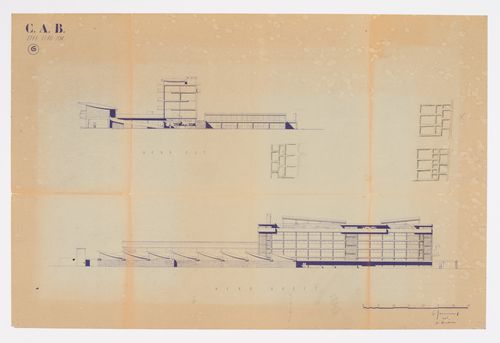
North-East and North-West elevations for the Centre d'Apprentissage in Béziers, France.
ARCH264260
Description:
North-East and North-West elevations for the Centre d'Apprentissage in Béziers, France.
Personnes et institutions:
Date:
April 1950
April 1950
Titre:
Elevation for the Centre d'Apprentissage in Béziers, France
Actions:
ARCH264260
Description:
North-East and North-West elevations for the Centre d'Apprentissage in Béziers, France.
Elevation for the Centre d'Apprentissage in Béziers, France
Actions:
ARCH264260
Description:
North-East and North-West elevations for the Centre d'Apprentissage in Béziers, France.
Classification:
dessins
dessins
Date:
April 1950
April 1950
Personnes et institutions:
Niveau de description archivistique:
Projet
Projet
Numéro de référence:
AP194.S1.1997.PR01
Description:
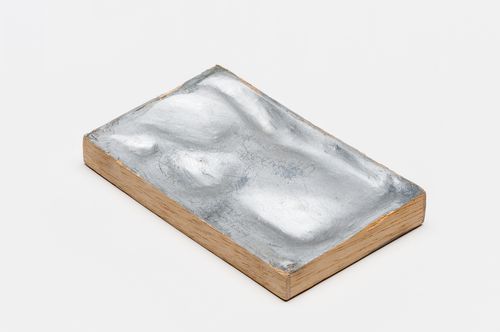
Project records document OCEAN North’s design for their competition entry for the Töölö Football Stadium in Helsinki in 1997. The project was titled Open Arena by OCEAN North. The site for the football stadium was in the Töölö neighbourhood and adjoining the Helsinki Olympic Stadium, located in a park area. OCEAN North’s entry was a building that would integrate with its natural surroundings while being able to accommodate a variety of activities and events. The structure has three topological surfaces that were devised through an iterative process: initial drawings made in Adobe Illustrator, modelling made with form*Z and manually transferred on Plexiglas sections, modifications made on the Plexiglas sections captured back into the CAD drawing, etc. At some point in the design process, the Channelling Systems approach was developed and used to analyze the structure’s dynamic relationship with its surroundings. Records show different stages of the design process and include at least one photograph of the Plexiglas sections referenced above. Digital files are grouped according to their function: Channelling Systems analysis, 2D graft spatial exploration, and plans and sections. There are also libraries of images and textures which may have been used for other drawings and models. Over half of the files are raster or vector images likely created by CAD software. This includes images of renderings. CAD drawings are in the native Microstation format, although one is in form*Z format. Textual records present the project and for the most part are the accompanying documentation for the competition entry, including legends for plans and sections. Timestamps for some of the digital files extend past the date of the competition. It is likely that these dates reflect when files were transferred to the Jaz drive for storage.
AP194.S1.1997.PR01
Description:
Project records document OCEAN North’s design for their competition entry for the Töölö Football Stadium in Helsinki in 1997. The project was titled Open Arena by OCEAN North. The site for the football stadium was in the Töölö neighbourhood and adjoining the Helsinki Olympic Stadium, located in a park area. OCEAN North’s entry was a building that would integrate with its natural surroundings while being able to accommodate a variety of activities and events. The structure has three topological surfaces that were devised through an iterative process: initial drawings made in Adobe Illustrator, modelling made with form*Z and manually transferred on Plexiglas sections, modifications made on the Plexiglas sections captured back into the CAD drawing, etc. At some point in the design process, the Channelling Systems approach was developed and used to analyze the structure’s dynamic relationship with its surroundings. Records show different stages of the design process and include at least one photograph of the Plexiglas sections referenced above. Digital files are grouped according to their function: Channelling Systems analysis, 2D graft spatial exploration, and plans and sections. There are also libraries of images and textures which may have been used for other drawings and models. Over half of the files are raster or vector images likely created by CAD software. This includes images of renderings. CAD drawings are in the native Microstation format, although one is in form*Z format. Textual records present the project and for the most part are the accompanying documentation for the competition entry, including legends for plans and sections. Timestamps for some of the digital files extend past the date of the competition. It is likely that these dates reflect when files were transferred to the Jaz drive for storage.
Personnes et institutions:
Date:
1997-2000
1997-2000
Titre:
Open Arena – Töölö Football Stadium, international competition entry, Helsinki, Finland (1997)
Actions:
AP194.S1.1997.PR01
Description:
Project records document OCEAN North’s design for their competition entry for the Töölö Football Stadium in Helsinki in 1997. The project was titled Open Arena by OCEAN North. The site for the football stadium was in the Töölö neighbourhood and adjoining the Helsinki Olympic Stadium, located in a park area. OCEAN North’s entry was a building that would integrate with its natural surroundings while being able to accommodate a variety of activities and events. The structure has three topological surfaces that were devised through an iterative process: initial drawings made in Adobe Illustrator, modelling made with form*Z and manually transferred on Plexiglas sections, modifications made on the Plexiglas sections captured back into the CAD drawing, etc. At some point in the design process, the Channelling Systems approach was developed and used to analyze the structure’s dynamic relationship with its surroundings. Records show different stages of the design process and include at least one photograph of the Plexiglas sections referenced above. Digital files are grouped according to their function: Channelling Systems analysis, 2D graft spatial exploration, and plans and sections. There are also libraries of images and textures which may have been used for other drawings and models. Over half of the files are raster or vector images likely created by CAD software. This includes images of renderings. CAD drawings are in the native Microstation format, although one is in form*Z format. Textual records present the project and for the most part are the accompanying documentation for the competition entry, including legends for plans and sections. Timestamps for some of the digital files extend past the date of the competition. It is likely that these dates reflect when files were transferred to the Jaz drive for storage.
Open Arena – Töölö Football Stadium, international competition entry, Helsinki, Finland (1997)
Actions:
AP194.S1.1997.PR01
Description:
Project records document OCEAN North’s design for their competition entry for the Töölö Football Stadium in Helsinki in 1997. The project was titled Open Arena by OCEAN North. The site for the football stadium was in the Töölö neighbourhood and adjoining the Helsinki Olympic Stadium, located in a park area. OCEAN North’s entry was a building that would integrate with its natural surroundings while being able to accommodate a variety of activities and events. The structure has three topological surfaces that were devised through an iterative process: initial drawings made in Adobe Illustrator, modelling made with form*Z and manually transferred on Plexiglas sections, modifications made on the Plexiglas sections captured back into the CAD drawing, etc. At some point in the design process, the Channelling Systems approach was developed and used to analyze the structure’s dynamic relationship with its surroundings. Records show different stages of the design process and include at least one photograph of the Plexiglas sections referenced above. Digital files are grouped according to their function: Channelling Systems analysis, 2D graft spatial exploration, and plans and sections. There are also libraries of images and textures which may have been used for other drawings and models. Over half of the files are raster or vector images likely created by CAD software. This includes images of renderings. CAD drawings are in the native Microstation format, although one is in form*Z format. Textual records present the project and for the most part are the accompanying documentation for the competition entry, including legends for plans and sections. Timestamps for some of the digital files extend past the date of the competition. It is likely that these dates reflect when files were transferred to the Jaz drive for storage.
Niveau de description archivistique:
Project
Project
Date:
1997-2000
1997-2000
Personnes et institutions:
Niveau de description archivistique:
Projet
Projet
Numéro de référence:
AP198.S1.1997.PR01
Description:
Project records document OCEAN North’s design for their competition entry for the Töölö Football Stadium in Helsinki in 1997. The project was titled Open Arena by OCEAN North. The site for the football stadium was in the Töölö neighbourhood, between a park area including the Helsinki Olympic Stadium, and a residential area. OCEAN North’s entry was a building that would integrate with its natural surroundings while being able to accommodate a variety of activities and events. The structure for Open Arena has three topological surfaces. The first provides stadium access to the players and the public, and includes services such as restaurant, cafeteria, and bars. Its shape aims to integrate with the natural landscape. The second contains the audience seating areas, including VIP and press areas, and aimed to arrange the audience as if it was loosely dispersed on a hillside. The third topological surface consists of the roof. The Töölö Football Stadium marks the introduction of the Channelling Systems process, defining building’s integration to its surroundings and distributing functions across the structure. Records show different stages of the design process and include two digitized photographs of Plexiglas sections that were used to physically explore the design. Digital files are grouped under categories such as Board images, Board lay-out, Graft, Sections, Siteplans, digital model images, scanned plans and site images. This last directory contains digitized photographs of the grounds surrounding the Helsinki Olympic Stadium. All drawings are vector or raster images of the whole or parts of the structure, with some including the identifications of the structure’s parts. Project records also include preliminary or working plans. Most were drawn to scale on paper and some were printed from CAD drawings. They chiefly reflect the design work to define the surfaces and shapes of the stadium’s structure. Source: Ateljé Sotamaa. “Portfolio: Open Arena”. http://portfolio.sotamaa.net/Open-Arena accessed in February 2018.
AP198.S1.1997.PR01
Description:
Project records document OCEAN North’s design for their competition entry for the Töölö Football Stadium in Helsinki in 1997. The project was titled Open Arena by OCEAN North. The site for the football stadium was in the Töölö neighbourhood, between a park area including the Helsinki Olympic Stadium, and a residential area. OCEAN North’s entry was a building that would integrate with its natural surroundings while being able to accommodate a variety of activities and events. The structure for Open Arena has three topological surfaces. The first provides stadium access to the players and the public, and includes services such as restaurant, cafeteria, and bars. Its shape aims to integrate with the natural landscape. The second contains the audience seating areas, including VIP and press areas, and aimed to arrange the audience as if it was loosely dispersed on a hillside. The third topological surface consists of the roof. The Töölö Football Stadium marks the introduction of the Channelling Systems process, defining building’s integration to its surroundings and distributing functions across the structure. Records show different stages of the design process and include two digitized photographs of Plexiglas sections that were used to physically explore the design. Digital files are grouped under categories such as Board images, Board lay-out, Graft, Sections, Siteplans, digital model images, scanned plans and site images. This last directory contains digitized photographs of the grounds surrounding the Helsinki Olympic Stadium. All drawings are vector or raster images of the whole or parts of the structure, with some including the identifications of the structure’s parts. Project records also include preliminary or working plans. Most were drawn to scale on paper and some were printed from CAD drawings. They chiefly reflect the design work to define the surfaces and shapes of the stadium’s structure. Source: Ateljé Sotamaa. “Portfolio: Open Arena”. http://portfolio.sotamaa.net/Open-Arena accessed in February 2018.
Personnes et institutions:
Date:
1997
1997
Titre:
Open Arena – Töölö Football Stadium, international competition entry
Actions:
AP198.S1.1997.PR01
Description:
Project records document OCEAN North’s design for their competition entry for the Töölö Football Stadium in Helsinki in 1997. The project was titled Open Arena by OCEAN North. The site for the football stadium was in the Töölö neighbourhood, between a park area including the Helsinki Olympic Stadium, and a residential area. OCEAN North’s entry was a building that would integrate with its natural surroundings while being able to accommodate a variety of activities and events. The structure for Open Arena has three topological surfaces. The first provides stadium access to the players and the public, and includes services such as restaurant, cafeteria, and bars. Its shape aims to integrate with the natural landscape. The second contains the audience seating areas, including VIP and press areas, and aimed to arrange the audience as if it was loosely dispersed on a hillside. The third topological surface consists of the roof. The Töölö Football Stadium marks the introduction of the Channelling Systems process, defining building’s integration to its surroundings and distributing functions across the structure. Records show different stages of the design process and include two digitized photographs of Plexiglas sections that were used to physically explore the design. Digital files are grouped under categories such as Board images, Board lay-out, Graft, Sections, Siteplans, digital model images, scanned plans and site images. This last directory contains digitized photographs of the grounds surrounding the Helsinki Olympic Stadium. All drawings are vector or raster images of the whole or parts of the structure, with some including the identifications of the structure’s parts. Project records also include preliminary or working plans. Most were drawn to scale on paper and some were printed from CAD drawings. They chiefly reflect the design work to define the surfaces and shapes of the stadium’s structure. Source: Ateljé Sotamaa. “Portfolio: Open Arena”. http://portfolio.sotamaa.net/Open-Arena accessed in February 2018.
Open Arena – Töölö Football Stadium, international competition entry
Actions:
AP198.S1.1997.PR01
Description:
Project records document OCEAN North’s design for their competition entry for the Töölö Football Stadium in Helsinki in 1997. The project was titled Open Arena by OCEAN North. The site for the football stadium was in the Töölö neighbourhood, between a park area including the Helsinki Olympic Stadium, and a residential area. OCEAN North’s entry was a building that would integrate with its natural surroundings while being able to accommodate a variety of activities and events. The structure for Open Arena has three topological surfaces. The first provides stadium access to the players and the public, and includes services such as restaurant, cafeteria, and bars. Its shape aims to integrate with the natural landscape. The second contains the audience seating areas, including VIP and press areas, and aimed to arrange the audience as if it was loosely dispersed on a hillside. The third topological surface consists of the roof. The Töölö Football Stadium marks the introduction of the Channelling Systems process, defining building’s integration to its surroundings and distributing functions across the structure. Records show different stages of the design process and include two digitized photographs of Plexiglas sections that were used to physically explore the design. Digital files are grouped under categories such as Board images, Board lay-out, Graft, Sections, Siteplans, digital model images, scanned plans and site images. This last directory contains digitized photographs of the grounds surrounding the Helsinki Olympic Stadium. All drawings are vector or raster images of the whole or parts of the structure, with some including the identifications of the structure’s parts. Project records also include preliminary or working plans. Most were drawn to scale on paper and some were printed from CAD drawings. They chiefly reflect the design work to define the surfaces and shapes of the stadium’s structure. Source: Ateljé Sotamaa. “Portfolio: Open Arena”. http://portfolio.sotamaa.net/Open-Arena accessed in February 2018.
Niveau de description archivistique:
Project
Project
Date:
1997
1997
Personnes et institutions:
Classification:
dessins
dessins
Numéro de référence:
DR1994:0134:272
Description:
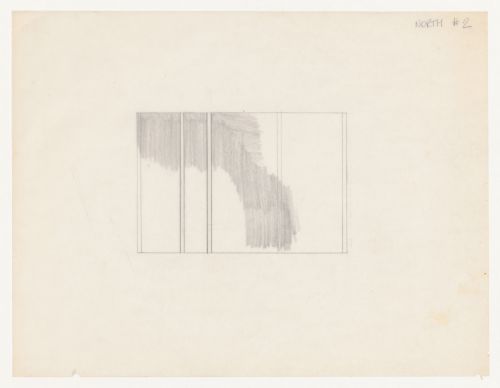
Numbered: North #2
DR1994:0134:272
Description:
Numbered: North #2
Personnes et institutions:
Date:
1971-1989
1971-1989
Titre:
Sketch elevation for House VI, Cornwall, Connecticut
Actions:
DR1994:0134:272
Description:
Numbered: North #2
Sketch elevation for House VI, Cornwall, Connecticut
Actions:
DR1994:0134:272
Description:
Numbered: North #2
Classification:
dessins
dessins
Date:
1971-1989
1971-1989
Personnes et institutions:
Classification:
dessins
dessins
Numéro de référence:
DR1994:0134:275
Description:
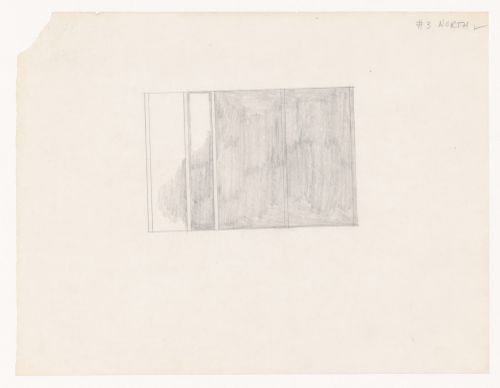
Numbered: #3 North
DR1994:0134:275
Description:
Numbered: #3 North
Personnes et institutions:
Date:
1971-1989
1971-1989
Titre:
Sketch elevation for House VI, Cornwall, Connecticut
Actions:
DR1994:0134:275
Description:
Numbered: #3 North
Sketch elevation for House VI, Cornwall, Connecticut
Actions:
DR1994:0134:275
Description:
Numbered: #3 North
Classification:
dessins
dessins
Date:
1971-1989
1971-1989
Personnes et institutions:


