


33494 Résultats
Niveau de description archivistique:
Projet
Projet
Numéro de référence:
AP075.S1.1999.PR02
Description:
Project series documents Cornelia Hahn Oberlander's landscape project for the proposed Commonwealth Square of the Art Gallery of Hamilton, on Main Street West in Hamilton, Ontario. Oberlander worked on this project in 1999-2002 while the architectural firm Kuwabara, Payne, McKenna, Blumberg Architects was in charge of the building's renovations. The building was completed in 2005, but Oberlander's proposal for the landscaping redesign of Commonwealth Square was not realized. Oberlander's first proposal consisted in adding an oval-shaped mounded lawn in the centre of a paved plaza situated between the art gallery and Main Street West. A second proposal also documented in this project series included two curved access ramps leading to a terrace next to the building with trees planting at the far edge of the plaza and along the street and the underground parking entrance. The project series contains design development drawings for Oberlander's landscaping, such as sketches, sections, landscape plans and renderings. The project series also includes renderings and working drawings for the building by KPMB architectural firm, and building plans for the existing building used as reference. The project is also documented through correspondence, including with clients, architects and consultants, Oberlander's concept notes, documents related to the plant selection, financial documents, documentation on the art gallery, and press clippings and articles on the project. It also comprises photographs of the existing landscaping on Main Street West plaza, including the Irving Zucker Sculpture Court.
AP075.S1.1999.PR02
Description:
Project series documents Cornelia Hahn Oberlander's landscape project for the proposed Commonwealth Square of the Art Gallery of Hamilton, on Main Street West in Hamilton, Ontario. Oberlander worked on this project in 1999-2002 while the architectural firm Kuwabara, Payne, McKenna, Blumberg Architects was in charge of the building's renovations. The building was completed in 2005, but Oberlander's proposal for the landscaping redesign of Commonwealth Square was not realized. Oberlander's first proposal consisted in adding an oval-shaped mounded lawn in the centre of a paved plaza situated between the art gallery and Main Street West. A second proposal also documented in this project series included two curved access ramps leading to a terrace next to the building with trees planting at the far edge of the plaza and along the street and the underground parking entrance. The project series contains design development drawings for Oberlander's landscaping, such as sketches, sections, landscape plans and renderings. The project series also includes renderings and working drawings for the building by KPMB architectural firm, and building plans for the existing building used as reference. The project is also documented through correspondence, including with clients, architects and consultants, Oberlander's concept notes, documents related to the plant selection, financial documents, documentation on the art gallery, and press clippings and articles on the project. It also comprises photographs of the existing landscaping on Main Street West plaza, including the Irving Zucker Sculpture Court.
Personnes et institutions:
Date:
1974-2002
1974-2002
Titre:
Commonwealth Square, Art Gallery of Hamilton, Ontario (1999)
Actions:
AP075.S1.1999.PR02
Description:
Project series documents Cornelia Hahn Oberlander's landscape project for the proposed Commonwealth Square of the Art Gallery of Hamilton, on Main Street West in Hamilton, Ontario. Oberlander worked on this project in 1999-2002 while the architectural firm Kuwabara, Payne, McKenna, Blumberg Architects was in charge of the building's renovations. The building was completed in 2005, but Oberlander's proposal for the landscaping redesign of Commonwealth Square was not realized. Oberlander's first proposal consisted in adding an oval-shaped mounded lawn in the centre of a paved plaza situated between the art gallery and Main Street West. A second proposal also documented in this project series included two curved access ramps leading to a terrace next to the building with trees planting at the far edge of the plaza and along the street and the underground parking entrance. The project series contains design development drawings for Oberlander's landscaping, such as sketches, sections, landscape plans and renderings. The project series also includes renderings and working drawings for the building by KPMB architectural firm, and building plans for the existing building used as reference. The project is also documented through correspondence, including with clients, architects and consultants, Oberlander's concept notes, documents related to the plant selection, financial documents, documentation on the art gallery, and press clippings and articles on the project. It also comprises photographs of the existing landscaping on Main Street West plaza, including the Irving Zucker Sculpture Court.
Commonwealth Square, Art Gallery of Hamilton, Ontario (1999)
Actions:
AP075.S1.1999.PR02
Description:
Project series documents Cornelia Hahn Oberlander's landscape project for the proposed Commonwealth Square of the Art Gallery of Hamilton, on Main Street West in Hamilton, Ontario. Oberlander worked on this project in 1999-2002 while the architectural firm Kuwabara, Payne, McKenna, Blumberg Architects was in charge of the building's renovations. The building was completed in 2005, but Oberlander's proposal for the landscaping redesign of Commonwealth Square was not realized. Oberlander's first proposal consisted in adding an oval-shaped mounded lawn in the centre of a paved plaza situated between the art gallery and Main Street West. A second proposal also documented in this project series included two curved access ramps leading to a terrace next to the building with trees planting at the far edge of the plaza and along the street and the underground parking entrance. The project series contains design development drawings for Oberlander's landscaping, such as sketches, sections, landscape plans and renderings. The project series also includes renderings and working drawings for the building by KPMB architectural firm, and building plans for the existing building used as reference. The project is also documented through correspondence, including with clients, architects and consultants, Oberlander's concept notes, documents related to the plant selection, financial documents, documentation on the art gallery, and press clippings and articles on the project. It also comprises photographs of the existing landscaping on Main Street West plaza, including the Irving Zucker Sculpture Court.
Niveau de description archivistique:
Project
Project
Date:
1974-2002
1974-2002
Personnes et institutions:
Niveau de description archivistique:
Projet
Projet
Numéro de référence:
AP075.S1.1991.PR01
Description:
Project series documents Cornelia Hahn Oberlander's landscape project for Northwest Territories Legislative Assembly Building, situated beside Frame Lake, in Yellowknife, Northwest Territories. Oberlander worked on this project in 1991 with architectural firms Matsuzaki Wright Architects and Pin/Matthews. The team was selected for the project after a design competition. Architects chose to have the new assembly build on the edge of the lake, on the volcanic rock of the Canadian Shield. They used the bog of the site as a transitional space between the building and the city. Oberlander concept design was to integrate the building to the landscape with the least intervention, because of the fagile ecology of the area, and preserve the natural beauty of the landscape. In this idea, the planting for the project only comprises native plants and grasses and very few alteration were made to the existing condition of the site. The project was completed in 1994. The project series contains design development drawings, including planting plans, landscape plans, grading plans, site details, site plans, working drawings, including site plans, planting plans and grading plans, and building drawings used as reference. The project is also documented through textual records, such as correspondence, specifications, concept notes by Oberlander, financial documents, meeting notes, reports, research material and site informations, and also photographs of the construction and the completed work. The project series comprises also digital files of the Legislative Assembly development plans and facility program and digital photographs of the building.
AP075.S1.1991.PR01
Description:
Project series documents Cornelia Hahn Oberlander's landscape project for Northwest Territories Legislative Assembly Building, situated beside Frame Lake, in Yellowknife, Northwest Territories. Oberlander worked on this project in 1991 with architectural firms Matsuzaki Wright Architects and Pin/Matthews. The team was selected for the project after a design competition. Architects chose to have the new assembly build on the edge of the lake, on the volcanic rock of the Canadian Shield. They used the bog of the site as a transitional space between the building and the city. Oberlander concept design was to integrate the building to the landscape with the least intervention, because of the fagile ecology of the area, and preserve the natural beauty of the landscape. In this idea, the planting for the project only comprises native plants and grasses and very few alteration were made to the existing condition of the site. The project was completed in 1994. The project series contains design development drawings, including planting plans, landscape plans, grading plans, site details, site plans, working drawings, including site plans, planting plans and grading plans, and building drawings used as reference. The project is also documented through textual records, such as correspondence, specifications, concept notes by Oberlander, financial documents, meeting notes, reports, research material and site informations, and also photographs of the construction and the completed work. The project series comprises also digital files of the Legislative Assembly development plans and facility program and digital photographs of the building.
Personnes et institutions:
Date:
1991-2011
1991-2011
Titre:
Northwest Territories Legislative Assembly Building, Yellowknife, Northwest Territories (1991-1994)
Actions:
AP075.S1.1991.PR01
Description:
Project series documents Cornelia Hahn Oberlander's landscape project for Northwest Territories Legislative Assembly Building, situated beside Frame Lake, in Yellowknife, Northwest Territories. Oberlander worked on this project in 1991 with architectural firms Matsuzaki Wright Architects and Pin/Matthews. The team was selected for the project after a design competition. Architects chose to have the new assembly build on the edge of the lake, on the volcanic rock of the Canadian Shield. They used the bog of the site as a transitional space between the building and the city. Oberlander concept design was to integrate the building to the landscape with the least intervention, because of the fagile ecology of the area, and preserve the natural beauty of the landscape. In this idea, the planting for the project only comprises native plants and grasses and very few alteration were made to the existing condition of the site. The project was completed in 1994. The project series contains design development drawings, including planting plans, landscape plans, grading plans, site details, site plans, working drawings, including site plans, planting plans and grading plans, and building drawings used as reference. The project is also documented through textual records, such as correspondence, specifications, concept notes by Oberlander, financial documents, meeting notes, reports, research material and site informations, and also photographs of the construction and the completed work. The project series comprises also digital files of the Legislative Assembly development plans and facility program and digital photographs of the building.
Northwest Territories Legislative Assembly Building, Yellowknife, Northwest Territories (1991-1994)
Actions:
AP075.S1.1991.PR01
Description:
Project series documents Cornelia Hahn Oberlander's landscape project for Northwest Territories Legislative Assembly Building, situated beside Frame Lake, in Yellowknife, Northwest Territories. Oberlander worked on this project in 1991 with architectural firms Matsuzaki Wright Architects and Pin/Matthews. The team was selected for the project after a design competition. Architects chose to have the new assembly build on the edge of the lake, on the volcanic rock of the Canadian Shield. They used the bog of the site as a transitional space between the building and the city. Oberlander concept design was to integrate the building to the landscape with the least intervention, because of the fagile ecology of the area, and preserve the natural beauty of the landscape. In this idea, the planting for the project only comprises native plants and grasses and very few alteration were made to the existing condition of the site. The project was completed in 1994. The project series contains design development drawings, including planting plans, landscape plans, grading plans, site details, site plans, working drawings, including site plans, planting plans and grading plans, and building drawings used as reference. The project is also documented through textual records, such as correspondence, specifications, concept notes by Oberlander, financial documents, meeting notes, reports, research material and site informations, and also photographs of the construction and the completed work. The project series comprises also digital files of the Legislative Assembly development plans and facility program and digital photographs of the building.
Niveau de description archivistique:
Project
Project
Date:
1991-2011
1991-2011
Personnes et institutions:
Niveau de description archivistique:
Projet
Projet
Numéro de référence:
AP075.S1.1992.PR01
Description:
Project series documents Cornelia Hahn Oberlander’s project for the landscape design for Library Square, the new central branch of the Vancouver’s public library on West Georgia Street. Oberlander worked on this project in 1992-1995 with architect Moshe Safdie and architectural firm Downs/Archambault & Patners. Oberlander landscape design included a roof garden, planned to be accessible by the public, and terraces with integral planting of cascading roses of the southeast edge of the building. She was also consulted for the landscape for the street-level spaces: “Along the streets bordering the site, Oberlander selected tulip trees, except on W. Georgia Street where the city required maples.” [1] The project was completed in 1995. The project series contains sketches, design development drawings, including planting plans, landscape plans for the green roof and the plaza, working drawings, such as site plans, planting plans, irrigation plans, landscape sections and elevations, and drawings of the building used as reference. The project is also recorded through textual records, such as concept notes by Oberlander, research material, specifications, including landscape specifications, correspondence, including correspondence with architects, client and contractors, contract, financial documents, documents for plan selection, and press and articles on the project. The project series also includes photographs of the construction and landscaping work, and photographs of the completed project. Source: [1] Herrington, Susan. Cornelia Hahn Oberlander: Making the Modern Landscape, University of Virginia Press, 2014, 304 pages. p. 176.
AP075.S1.1992.PR01
Description:
Project series documents Cornelia Hahn Oberlander’s project for the landscape design for Library Square, the new central branch of the Vancouver’s public library on West Georgia Street. Oberlander worked on this project in 1992-1995 with architect Moshe Safdie and architectural firm Downs/Archambault & Patners. Oberlander landscape design included a roof garden, planned to be accessible by the public, and terraces with integral planting of cascading roses of the southeast edge of the building. She was also consulted for the landscape for the street-level spaces: “Along the streets bordering the site, Oberlander selected tulip trees, except on W. Georgia Street where the city required maples.” [1] The project was completed in 1995. The project series contains sketches, design development drawings, including planting plans, landscape plans for the green roof and the plaza, working drawings, such as site plans, planting plans, irrigation plans, landscape sections and elevations, and drawings of the building used as reference. The project is also recorded through textual records, such as concept notes by Oberlander, research material, specifications, including landscape specifications, correspondence, including correspondence with architects, client and contractors, contract, financial documents, documents for plan selection, and press and articles on the project. The project series also includes photographs of the construction and landscaping work, and photographs of the completed project. Source: [1] Herrington, Susan. Cornelia Hahn Oberlander: Making the Modern Landscape, University of Virginia Press, 2014, 304 pages. p. 176.
Personnes et institutions:
Date:
1989-2009
1989-2009
Titre:
Library Square, Vancouver, British Columbia (1992-1995)
Actions:
AP075.S1.1992.PR01
Description:
Project series documents Cornelia Hahn Oberlander’s project for the landscape design for Library Square, the new central branch of the Vancouver’s public library on West Georgia Street. Oberlander worked on this project in 1992-1995 with architect Moshe Safdie and architectural firm Downs/Archambault & Patners. Oberlander landscape design included a roof garden, planned to be accessible by the public, and terraces with integral planting of cascading roses of the southeast edge of the building. She was also consulted for the landscape for the street-level spaces: “Along the streets bordering the site, Oberlander selected tulip trees, except on W. Georgia Street where the city required maples.” [1] The project was completed in 1995. The project series contains sketches, design development drawings, including planting plans, landscape plans for the green roof and the plaza, working drawings, such as site plans, planting plans, irrigation plans, landscape sections and elevations, and drawings of the building used as reference. The project is also recorded through textual records, such as concept notes by Oberlander, research material, specifications, including landscape specifications, correspondence, including correspondence with architects, client and contractors, contract, financial documents, documents for plan selection, and press and articles on the project. The project series also includes photographs of the construction and landscaping work, and photographs of the completed project. Source: [1] Herrington, Susan. Cornelia Hahn Oberlander: Making the Modern Landscape, University of Virginia Press, 2014, 304 pages. p. 176.
Library Square, Vancouver, British Columbia (1992-1995)
Actions:
AP075.S1.1992.PR01
Description:
Project series documents Cornelia Hahn Oberlander’s project for the landscape design for Library Square, the new central branch of the Vancouver’s public library on West Georgia Street. Oberlander worked on this project in 1992-1995 with architect Moshe Safdie and architectural firm Downs/Archambault & Patners. Oberlander landscape design included a roof garden, planned to be accessible by the public, and terraces with integral planting of cascading roses of the southeast edge of the building. She was also consulted for the landscape for the street-level spaces: “Along the streets bordering the site, Oberlander selected tulip trees, except on W. Georgia Street where the city required maples.” [1] The project was completed in 1995. The project series contains sketches, design development drawings, including planting plans, landscape plans for the green roof and the plaza, working drawings, such as site plans, planting plans, irrigation plans, landscape sections and elevations, and drawings of the building used as reference. The project is also recorded through textual records, such as concept notes by Oberlander, research material, specifications, including landscape specifications, correspondence, including correspondence with architects, client and contractors, contract, financial documents, documents for plan selection, and press and articles on the project. The project series also includes photographs of the construction and landscaping work, and photographs of the completed project. Source: [1] Herrington, Susan. Cornelia Hahn Oberlander: Making the Modern Landscape, University of Virginia Press, 2014, 304 pages. p. 176.
Niveau de description archivistique:
Project
Project
Date:
1989-2009
1989-2009
Personnes et institutions:
Niveau de description archivistique:
Projet
Projet
Numéro de référence:
AP056.S1.1997.PR04
Description:
This project series documents Richmond City Hall in Richmond, British Columbia from 1997-2000. The office identified the project number as 9710, although some project materials also refer to the project number as 9709. This project, headed by Bruce Kuwabara, was a joint venture between Kuwabara Payne McKenna Blumberg Architects and Vancouver-based Hotson Bakker Architects. The project consisted of a new civic space at the corner of Granville Avenue and No 3 Road, built on the grounds of the original city hall, that included a three-component building. These components included the circular Council Chamber at the forefront, an eight-storey administrative tower, and a long, two-storey Meeting House all surrounding a new civic square. The Meeting House connected the interior elements to outdoor spaces, which include a series of courtyards, gardens and water features. [1] The material palette for the building's exterior included an aluminum curtain wall with several types of glass finishes and wood accents. This project is recorded through drawings, photographic materials, paintings, textual records and a project model dating from 1997-1999. The drawings are mostly original sketches, but some plans, elevations, sections, perspectives and details are also included. There are also a number of presentation materials, which include text on the design concept, digital renderings, photographs of the model and paintings. [1]“Richmond City Hall,” The Architecture of Kuwabara Payne McKenna Blumberg, 92 (Basel: Birkhäuser, 2004), 92.
AP056.S1.1997.PR04
Description:
This project series documents Richmond City Hall in Richmond, British Columbia from 1997-2000. The office identified the project number as 9710, although some project materials also refer to the project number as 9709. This project, headed by Bruce Kuwabara, was a joint venture between Kuwabara Payne McKenna Blumberg Architects and Vancouver-based Hotson Bakker Architects. The project consisted of a new civic space at the corner of Granville Avenue and No 3 Road, built on the grounds of the original city hall, that included a three-component building. These components included the circular Council Chamber at the forefront, an eight-storey administrative tower, and a long, two-storey Meeting House all surrounding a new civic square. The Meeting House connected the interior elements to outdoor spaces, which include a series of courtyards, gardens and water features. [1] The material palette for the building's exterior included an aluminum curtain wall with several types of glass finishes and wood accents. This project is recorded through drawings, photographic materials, paintings, textual records and a project model dating from 1997-1999. The drawings are mostly original sketches, but some plans, elevations, sections, perspectives and details are also included. There are also a number of presentation materials, which include text on the design concept, digital renderings, photographs of the model and paintings. [1]“Richmond City Hall,” The Architecture of Kuwabara Payne McKenna Blumberg, 92 (Basel: Birkhäuser, 2004), 92.
Personnes et institutions:
Date:
1997-1999
1997-1999
Titre:
Richmond City Hall, British Columbia (1997-2000)
Actions:
AP056.S1.1997.PR04
Description:
This project series documents Richmond City Hall in Richmond, British Columbia from 1997-2000. The office identified the project number as 9710, although some project materials also refer to the project number as 9709. This project, headed by Bruce Kuwabara, was a joint venture between Kuwabara Payne McKenna Blumberg Architects and Vancouver-based Hotson Bakker Architects. The project consisted of a new civic space at the corner of Granville Avenue and No 3 Road, built on the grounds of the original city hall, that included a three-component building. These components included the circular Council Chamber at the forefront, an eight-storey administrative tower, and a long, two-storey Meeting House all surrounding a new civic square. The Meeting House connected the interior elements to outdoor spaces, which include a series of courtyards, gardens and water features. [1] The material palette for the building's exterior included an aluminum curtain wall with several types of glass finishes and wood accents. This project is recorded through drawings, photographic materials, paintings, textual records and a project model dating from 1997-1999. The drawings are mostly original sketches, but some plans, elevations, sections, perspectives and details are also included. There are also a number of presentation materials, which include text on the design concept, digital renderings, photographs of the model and paintings. [1]“Richmond City Hall,” The Architecture of Kuwabara Payne McKenna Blumberg, 92 (Basel: Birkhäuser, 2004), 92.
Richmond City Hall, British Columbia (1997-2000)
Actions:
AP056.S1.1997.PR04
Description:
This project series documents Richmond City Hall in Richmond, British Columbia from 1997-2000. The office identified the project number as 9710, although some project materials also refer to the project number as 9709. This project, headed by Bruce Kuwabara, was a joint venture between Kuwabara Payne McKenna Blumberg Architects and Vancouver-based Hotson Bakker Architects. The project consisted of a new civic space at the corner of Granville Avenue and No 3 Road, built on the grounds of the original city hall, that included a three-component building. These components included the circular Council Chamber at the forefront, an eight-storey administrative tower, and a long, two-storey Meeting House all surrounding a new civic square. The Meeting House connected the interior elements to outdoor spaces, which include a series of courtyards, gardens and water features. [1] The material palette for the building's exterior included an aluminum curtain wall with several types of glass finishes and wood accents. This project is recorded through drawings, photographic materials, paintings, textual records and a project model dating from 1997-1999. The drawings are mostly original sketches, but some plans, elevations, sections, perspectives and details are also included. There are also a number of presentation materials, which include text on the design concept, digital renderings, photographs of the model and paintings. [1]“Richmond City Hall,” The Architecture of Kuwabara Payne McKenna Blumberg, 92 (Basel: Birkhäuser, 2004), 92.
Niveau de description archivistique:
Project
Project
Date:
1997-1999
1997-1999
Personnes et institutions:
Classification:
oeuvres d'art
oeuvres d'art
Actions:
Numéro de référence:
DR1987:0343
Description:
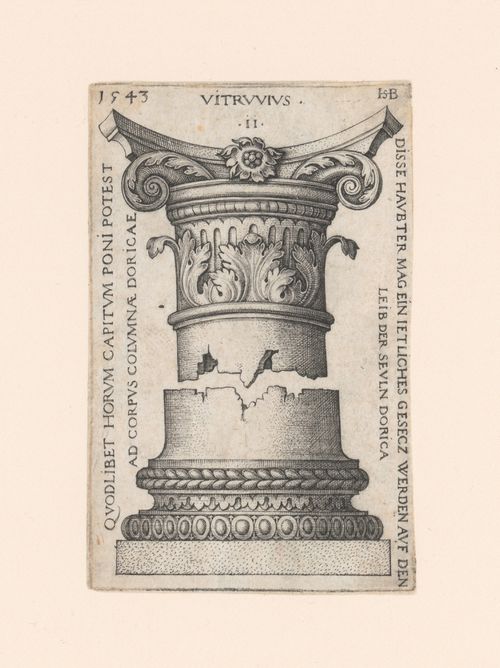
- This engraving depicts a design for an order of architecture showing the capital and the base. Although the inscriptions refer to "This engraving depicts a dORICA[E]", this column looks more like a variation on the composite order. - This print is one of a set of four prints of capitals and bases which were engraved by Hans Sebald Beham. Patricia Condon suggests that these prints were made for a general audience rather than for architects ('Ornament and Architecture', 29). Three of the prints in the CCA collection are from the collection of the Ducs d'Arenburg, while the provenance of the fourth print, DR1987:0342, is unknown.
DR1987:0343
Description:
- This engraving depicts a design for an order of architecture showing the capital and the base. Although the inscriptions refer to "This engraving depicts a dORICA[E]", this column looks more like a variation on the composite order. - This print is one of a set of four prints of capitals and bases which were engraved by Hans Sebald Beham. Patricia Condon suggests that these prints were made for a general audience rather than for architects ('Ornament and Architecture', 29). Three of the prints in the CCA collection are from the collection of the Ducs d'Arenburg, while the provenance of the fourth print, DR1987:0342, is unknown.
Personnes et institutions:
Sujet:
architecture
architecture
Date:
1543
1543
Titre:
Design for the capital and base of a column
Actions:
DR1987:0343
Description:
- This engraving depicts a design for an order of architecture showing the capital and the base. Although the inscriptions refer to "This engraving depicts a dORICA[E]", this column looks more like a variation on the composite order. - This print is one of a set of four prints of capitals and bases which were engraved by Hans Sebald Beham. Patricia Condon suggests that these prints were made for a general audience rather than for architects ('Ornament and Architecture', 29). Three of the prints in the CCA collection are from the collection of the Ducs d'Arenburg, while the provenance of the fourth print, DR1987:0342, is unknown.
Design for the capital and base of a column
Actions:
DR1987:0343
Description:
- This engraving depicts a design for an order of architecture showing the capital and the base. Although the inscriptions refer to "This engraving depicts a dORICA[E]", this column looks more like a variation on the composite order. - This print is one of a set of four prints of capitals and bases which were engraved by Hans Sebald Beham. Patricia Condon suggests that these prints were made for a general audience rather than for architects ('Ornament and Architecture', 29). Three of the prints in the CCA collection are from the collection of the Ducs d'Arenburg, while the provenance of the fourth print, DR1987:0342, is unknown.
Classification:
oeuvres d'art
oeuvres d'art
Date:
1543
1543
Personnes et institutions:
Sujet:
architecture
architecture
Classification:
oeuvres d'art
oeuvres d'art
Actions:
Numéro de référence:
DR1987:0344
Description:
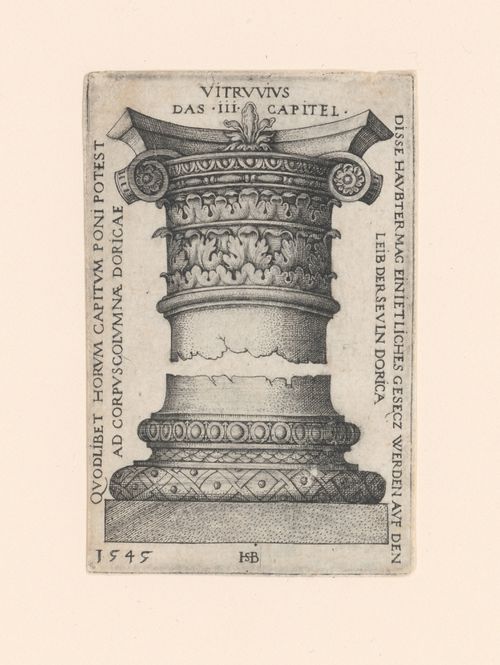
- This engraving depicts a design for an order of architecture showing the capital and the base. Although the inscriptions refer to "This engraving depicts a dORICA[E]", this looks more like a variation on the composite order. - This print is one of a set of four prints of capitals and bases which were engraved by Hans Sebald Beham. Patricia Condon suggests that these prints were made for a general audience rather than for architects ('Ornament and Architecture', 29). Three of the prints in the CCA collection are from the collection of the Ducs d'Arenburg, while the provenance of the fourth print, DR1987:0342, is unknown.
DR1987:0344
Description:
- This engraving depicts a design for an order of architecture showing the capital and the base. Although the inscriptions refer to "This engraving depicts a dORICA[E]", this looks more like a variation on the composite order. - This print is one of a set of four prints of capitals and bases which were engraved by Hans Sebald Beham. Patricia Condon suggests that these prints were made for a general audience rather than for architects ('Ornament and Architecture', 29). Three of the prints in the CCA collection are from the collection of the Ducs d'Arenburg, while the provenance of the fourth print, DR1987:0342, is unknown.
Personnes et institutions:
Sujet:
architecture
architecture
Date:
1545
1545
Titre:
Design for the capital and base of a column
Actions:
DR1987:0344
Description:
- This engraving depicts a design for an order of architecture showing the capital and the base. Although the inscriptions refer to "This engraving depicts a dORICA[E]", this looks more like a variation on the composite order. - This print is one of a set of four prints of capitals and bases which were engraved by Hans Sebald Beham. Patricia Condon suggests that these prints were made for a general audience rather than for architects ('Ornament and Architecture', 29). Three of the prints in the CCA collection are from the collection of the Ducs d'Arenburg, while the provenance of the fourth print, DR1987:0342, is unknown.
Design for the capital and base of a column
Actions:
DR1987:0344
Description:
- This engraving depicts a design for an order of architecture showing the capital and the base. Although the inscriptions refer to "This engraving depicts a dORICA[E]", this looks more like a variation on the composite order. - This print is one of a set of four prints of capitals and bases which were engraved by Hans Sebald Beham. Patricia Condon suggests that these prints were made for a general audience rather than for architects ('Ornament and Architecture', 29). Three of the prints in the CCA collection are from the collection of the Ducs d'Arenburg, while the provenance of the fourth print, DR1987:0342, is unknown.
Classification:
oeuvres d'art
oeuvres d'art
Date:
1545
1545
Personnes et institutions:
Sujet:
architecture
architecture
Classification:
oeuvres d'art
oeuvres d'art
Actions:
Numéro de référence:
DR1987:0345
Description:
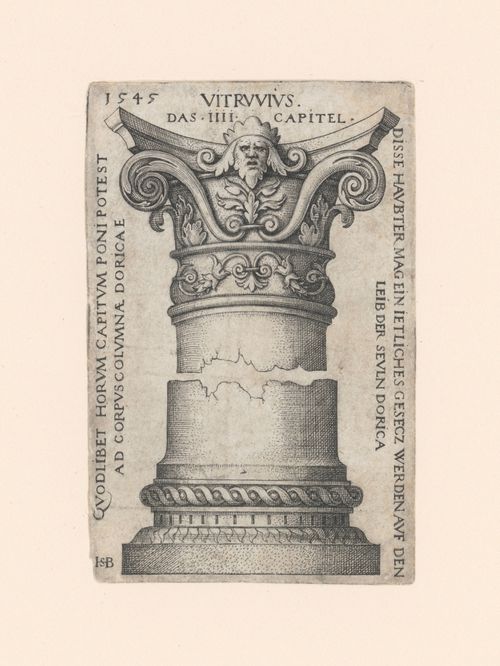
- This engraving depicts a design for an order of architecture showing the capital and the base. Although the inscriptions refer to "This engraving depicts a dORICA[E]", this is not one of the traditional orders of architecture. - This print is one of a set of four prints of capitals and bases which were engraved by Hans Sebald Beham. Patricia Condon suggests that these prints were made for a general audience rather than for architects ('Ornament and Architecture', 29). Three of the prints in the CCA collection are from the collection of the Ducs d'Arenburg, while the provenance of the fourth print, DR1987:0342, is unknown.
DR1987:0345
Description:
- This engraving depicts a design for an order of architecture showing the capital and the base. Although the inscriptions refer to "This engraving depicts a dORICA[E]", this is not one of the traditional orders of architecture. - This print is one of a set of four prints of capitals and bases which were engraved by Hans Sebald Beham. Patricia Condon suggests that these prints were made for a general audience rather than for architects ('Ornament and Architecture', 29). Three of the prints in the CCA collection are from the collection of the Ducs d'Arenburg, while the provenance of the fourth print, DR1987:0342, is unknown.
Personnes et institutions:
Sujet:
architecture
architecture
Date:
1545
1545
Titre:
Design for the capital and base of a column
Actions:
DR1987:0345
Description:
- This engraving depicts a design for an order of architecture showing the capital and the base. Although the inscriptions refer to "This engraving depicts a dORICA[E]", this is not one of the traditional orders of architecture. - This print is one of a set of four prints of capitals and bases which were engraved by Hans Sebald Beham. Patricia Condon suggests that these prints were made for a general audience rather than for architects ('Ornament and Architecture', 29). Three of the prints in the CCA collection are from the collection of the Ducs d'Arenburg, while the provenance of the fourth print, DR1987:0342, is unknown.
Design for the capital and base of a column
Actions:
DR1987:0345
Description:
- This engraving depicts a design for an order of architecture showing the capital and the base. Although the inscriptions refer to "This engraving depicts a dORICA[E]", this is not one of the traditional orders of architecture. - This print is one of a set of four prints of capitals and bases which were engraved by Hans Sebald Beham. Patricia Condon suggests that these prints were made for a general audience rather than for architects ('Ornament and Architecture', 29). Three of the prints in the CCA collection are from the collection of the Ducs d'Arenburg, while the provenance of the fourth print, DR1987:0342, is unknown.
Classification:
oeuvres d'art
oeuvres d'art
Date:
1545
1545
Personnes et institutions:
Sujet:
architecture
architecture
Classification:
dessins
dessins
Actions:
Numéro de référence:
DR1996:0002
Description:
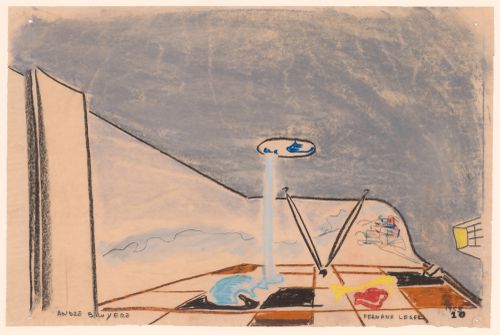
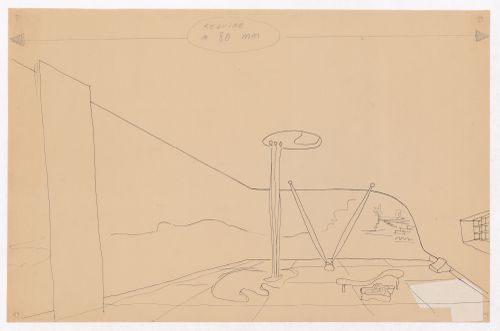
- Two groups of four pastel drawings were originally produced in connection with the Village Polychrome project. The architect André Bruyère had retained one group, while the other was given to the patron and client, Francisco de Assis Chateaubriand Bandeira de Melo, who then donated it to the Sao Paolo Museum of Modern Art. Bruyère subsequently gave one of the four drawings in his group to a friend. The three remaining drawings from Bruyère's group are in the CCA Prints and Drawings collection (DR1996:0001 - DR1996:0003) ("Projet de Village Polychrome, Biot, France"). - The sliding wall, shown on the left, can be used to partially enclose the terrace ("Village d'artistes sur la Côte d'Azur", p. 83).
DR1996:0002
Description:
- Two groups of four pastel drawings were originally produced in connection with the Village Polychrome project. The architect André Bruyère had retained one group, while the other was given to the patron and client, Francisco de Assis Chateaubriand Bandeira de Melo, who then donated it to the Sao Paolo Museum of Modern Art. Bruyère subsequently gave one of the four drawings in his group to a friend. The three remaining drawings from Bruyère's group are in the CCA Prints and Drawings collection (DR1996:0001 - DR1996:0003) ("Projet de Village Polychrome, Biot, France"). - The sliding wall, shown on the left, can be used to partially enclose the terrace ("Village d'artistes sur la Côte d'Azur", p. 83).
Personnes et institutions:
Sujet:
design d'intérieur
design d'intérieur
Date:
1953
1953
Titre:
Perspective for a guest villa showing the terrace, Village Polychrome, near Biot, France
Actions:
DR1996:0002
Description:
- Two groups of four pastel drawings were originally produced in connection with the Village Polychrome project. The architect André Bruyère had retained one group, while the other was given to the patron and client, Francisco de Assis Chateaubriand Bandeira de Melo, who then donated it to the Sao Paolo Museum of Modern Art. Bruyère subsequently gave one of the four drawings in his group to a friend. The three remaining drawings from Bruyère's group are in the CCA Prints and Drawings collection (DR1996:0001 - DR1996:0003) ("Projet de Village Polychrome, Biot, France"). - The sliding wall, shown on the left, can be used to partially enclose the terrace ("Village d'artistes sur la Côte d'Azur", p. 83).
Perspective for a guest villa showing the terrace, Village Polychrome, near Biot, France
Actions:
DR1996:0002
Description:
- Two groups of four pastel drawings were originally produced in connection with the Village Polychrome project. The architect André Bruyère had retained one group, while the other was given to the patron and client, Francisco de Assis Chateaubriand Bandeira de Melo, who then donated it to the Sao Paolo Museum of Modern Art. Bruyère subsequently gave one of the four drawings in his group to a friend. The three remaining drawings from Bruyère's group are in the CCA Prints and Drawings collection (DR1996:0001 - DR1996:0003) ("Projet de Village Polychrome, Biot, France"). - The sliding wall, shown on the left, can be used to partially enclose the terrace ("Village d'artistes sur la Côte d'Azur", p. 83).
Classification:
dessins
dessins
Date:
1953
1953
Personnes et institutions:
Sujet:
design d'intérieur
design d'intérieur
Classification:
dessins
dessins
Actions:
Numéro de référence:
DR1996:0011
Description:
- Two groups of four pastel drawings were originally produced in connection with the Village Polychrome project. The architect André Bruyère had retained one group, while the other was given to the patron and client, Francisco de Assis Chateaubriand Bandeira de Melo, who then donated it to the Sao Paolo Museum of Modern Art. Bruyère subsequently gave one of the four drawings in his group to a friend. The three remaining drawings from Bruyère's group are in the CCA Prints and Drawings collection (DR1996:0001 - DR1996:0003) ("Projet de Village Polychrome, Biot, France"). - The sliding wall, shown on the left, can be used to partially enclose the terrace ("Village d'artistes sur la Côte d'Azur", p. 83).
DR1996:0011
Description:
- Two groups of four pastel drawings were originally produced in connection with the Village Polychrome project. The architect André Bruyère had retained one group, while the other was given to the patron and client, Francisco de Assis Chateaubriand Bandeira de Melo, who then donated it to the Sao Paolo Museum of Modern Art. Bruyère subsequently gave one of the four drawings in his group to a friend. The three remaining drawings from Bruyère's group are in the CCA Prints and Drawings collection (DR1996:0001 - DR1996:0003) ("Projet de Village Polychrome, Biot, France"). - The sliding wall, shown on the left, can be used to partially enclose the terrace ("Village d'artistes sur la Côte d'Azur", p. 83).
Personnes et institutions:
Sujet:
design d'intérieur
design d'intérieur
Date:
1952-1953
1952-1953
Titre:
Perspective for a guest villa showing the terrace, Village Polychrome, near Biot, France
Actions:
DR1996:0011
Description:
- Two groups of four pastel drawings were originally produced in connection with the Village Polychrome project. The architect André Bruyère had retained one group, while the other was given to the patron and client, Francisco de Assis Chateaubriand Bandeira de Melo, who then donated it to the Sao Paolo Museum of Modern Art. Bruyère subsequently gave one of the four drawings in his group to a friend. The three remaining drawings from Bruyère's group are in the CCA Prints and Drawings collection (DR1996:0001 - DR1996:0003) ("Projet de Village Polychrome, Biot, France"). - The sliding wall, shown on the left, can be used to partially enclose the terrace ("Village d'artistes sur la Côte d'Azur", p. 83).
Perspective for a guest villa showing the terrace, Village Polychrome, near Biot, France
Actions:
DR1996:0011
Description:
- Two groups of four pastel drawings were originally produced in connection with the Village Polychrome project. The architect André Bruyère had retained one group, while the other was given to the patron and client, Francisco de Assis Chateaubriand Bandeira de Melo, who then donated it to the Sao Paolo Museum of Modern Art. Bruyère subsequently gave one of the four drawings in his group to a friend. The three remaining drawings from Bruyère's group are in the CCA Prints and Drawings collection (DR1996:0001 - DR1996:0003) ("Projet de Village Polychrome, Biot, France"). - The sliding wall, shown on the left, can be used to partially enclose the terrace ("Village d'artistes sur la Côte d'Azur", p. 83).
Classification:
dessins
dessins
Date:
1952-1953
1952-1953
Personnes et institutions:
Sujet:
design d'intérieur
design d'intérieur
Classification:
dessins
dessins
Actions:
Numéro de référence:
DR1987:0358
Description:
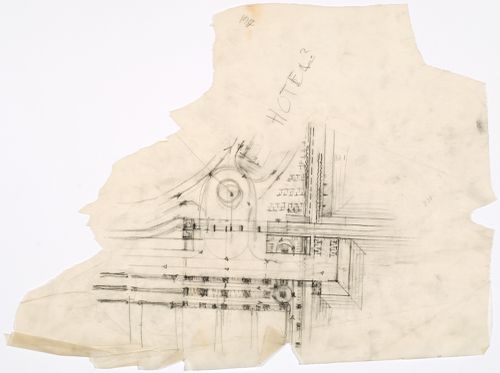
- This drawing shows the lower right corner of the airport, including amphibian landing, station, part of the hangars, parking lot and underground viaduct. The circulation pattern of taxiing airplanes is indicated, as is the route to be followed by automobiles leaving the highway and entering the parking lot. This drawing is part of a series of eight drawings in which the architect works out the circulation pattern of airplanes (DR1987:0347 - DR1987:0349, DR1987:0352 - DR1987:0354, DR1987:0358 and DR1987:0390). This may be the most advanced of this group, that is, the most closely resembling the version represented in the submitted competition drawings (DR1987:0359 - DR1987:0360).
DR1987:0358
Description:
- This drawing shows the lower right corner of the airport, including amphibian landing, station, part of the hangars, parking lot and underground viaduct. The circulation pattern of taxiing airplanes is indicated, as is the route to be followed by automobiles leaving the highway and entering the parking lot. This drawing is part of a series of eight drawings in which the architect works out the circulation pattern of airplanes (DR1987:0347 - DR1987:0349, DR1987:0352 - DR1987:0354, DR1987:0358 and DR1987:0390). This may be the most advanced of this group, that is, the most closely resembling the version represented in the submitted competition drawings (DR1987:0359 - DR1987:0360).
Personnes et institutions:
Sujet:
architecture
architecture
Date:
1929
1929
Titre:
Lehigh Airports Competition Entry: Detail for airport plan showing airplane and automobile circulation patterns
Actions:
DR1987:0358
Description:
- This drawing shows the lower right corner of the airport, including amphibian landing, station, part of the hangars, parking lot and underground viaduct. The circulation pattern of taxiing airplanes is indicated, as is the route to be followed by automobiles leaving the highway and entering the parking lot. This drawing is part of a series of eight drawings in which the architect works out the circulation pattern of airplanes (DR1987:0347 - DR1987:0349, DR1987:0352 - DR1987:0354, DR1987:0358 and DR1987:0390). This may be the most advanced of this group, that is, the most closely resembling the version represented in the submitted competition drawings (DR1987:0359 - DR1987:0360).
Lehigh Airports Competition Entry: Detail for airport plan showing airplane and automobile circulation patterns
Actions:
DR1987:0358
Description:
- This drawing shows the lower right corner of the airport, including amphibian landing, station, part of the hangars, parking lot and underground viaduct. The circulation pattern of taxiing airplanes is indicated, as is the route to be followed by automobiles leaving the highway and entering the parking lot. This drawing is part of a series of eight drawings in which the architect works out the circulation pattern of airplanes (DR1987:0347 - DR1987:0349, DR1987:0352 - DR1987:0354, DR1987:0358 and DR1987:0390). This may be the most advanced of this group, that is, the most closely resembling the version represented in the submitted competition drawings (DR1987:0359 - DR1987:0360).
Classification:
dessins
dessins
Date:
1929
1929
Personnes et institutions:
Sujet:
architecture
architecture


