


12614 Résultats
Classification:
événements
événements
Actions:
Description:
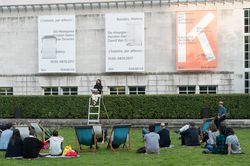
D’ordinaire, on donne aux archives le nom d’une personne, mais elles comportent toujours plusieurs autres voix. Les archives Kenneth Frampton, récemment arrivées au CCA, sont présentées dans l’exposition Apprendre aux architectes : quatre cours de Kenneth Frampton. Celle-ci comprend quelques lettres échangées sur une période de plus de 60 ans, mais on aurait pu en inclure(...)
D’ordinaire, on donne aux archives le nom d’une personne, mais elles comportent toujours plusieurs autres voix. Les archives Kenneth Frampton, récemment arrivées au CCA, sont présentées dans l’exposition Apprendre aux architectes : quatre cours de Kenneth Frampton. Celle-ci comprend quelques lettres échangées sur une période de plus de 60 ans, mais on aurait pu en inclure(...)
Mot(s)-clé(s):
Kenneth Frampton, Apprendre aux architectes : quatre cours de Kenneth Frampton, Jacqueline Meyer
Kenneth Frampton, Apprendre aux architectes : quatre cours de Kenneth Frampton, Jacqueline Meyer
Date:
août 2017 au septembre 2017
août 2017 au septembre 2017
Titre:
« Cher Ken » : Lire les archives à voix haute
Actions:
Description:
D’ordinaire, on donne aux archives le nom d’une personne, mais elles comportent toujours plusieurs autres voix. Les archives Kenneth Frampton, récemment arrivées au CCA, sont présentées dans l’exposition Apprendre aux architectes : quatre cours de Kenneth Frampton. Celle-ci comprend quelques lettres échangées sur une période de plus de 60 ans, mais on aurait pu en inclure(...)
« Cher Ken » : Lire les archives à voix haute
Actions:
Description:
D’ordinaire, on donne aux archives le nom d’une personne, mais elles comportent toujours plusieurs autres voix. Les archives Kenneth Frampton, récemment arrivées au CCA, sont présentées dans l’exposition Apprendre aux architectes : quatre cours de Kenneth Frampton. Celle-ci comprend quelques lettres échangées sur une période de plus de 60 ans, mais on aurait pu en inclure(...)
Classification:
événements
événements
Date:
août 2017 au
septembre 2017
août 2017 au
septembre 2017
Classification:
expositions
expositions
Actions:
Description:
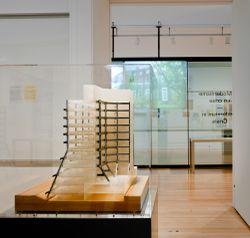
Les influences radicalement divergentes qui ont marqué l’architecte James Frazer Stirling rendent impossibles la caractérisation de son œuvre, qualifiée par d’autres comme étant moderniste d’avant-guerre, néoclassique, rationaliste, brutaliste, postmoderniste. Mais la continuité de sa pensée émerge de l’impressionnante quantité et diversité de documents conservés dans les(...)
Les influences radicalement divergentes qui ont marqué l’architecte James Frazer Stirling rendent impossibles la caractérisation de son œuvre, qualifiée par d’autres comme étant moderniste d’avant-guerre, néoclassique, rationaliste, brutaliste, postmoderniste. Mais la continuité de sa pensée émerge de l’impressionnante quantité et diversité de documents conservés dans les(...)
Localisation:
Salles principales
Salles principales
Date:
16 mai 2012 au 14 octobre 2012
16 mai 2012 au 14 octobre 2012
Titre:
Notes d’archives : James Frazer Stirling
Actions:
Description:
Les influences radicalement divergentes qui ont marqué l’architecte James Frazer Stirling rendent impossibles la caractérisation de son œuvre, qualifiée par d’autres comme étant moderniste d’avant-guerre, néoclassique, rationaliste, brutaliste, postmoderniste. Mais la continuité de sa pensée émerge de l’impressionnante quantité et diversité de documents conservés dans les(...)
Notes d’archives : James Frazer Stirling
Actions:
Description:
Les influences radicalement divergentes qui ont marqué l’architecte James Frazer Stirling rendent impossibles la caractérisation de son œuvre, qualifiée par d’autres comme étant moderniste d’avant-guerre, néoclassique, rationaliste, brutaliste, postmoderniste. Mais la continuité de sa pensée émerge de l’impressionnante quantité et diversité de documents conservés dans les(...)
Classification:
expositions
expositions
Date:
16 mai 2012 au
14 octobre 2012
16 mai 2012 au
14 octobre 2012
Localisation:
Salles principales
Salles principales
Classification:
événements
événements
Titre:
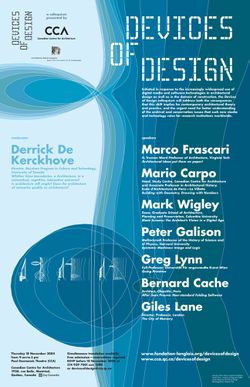
Devices of Design
Devices of Design
Actions:
Description:
Le colloque Devices of Design est une collaboration entre le CCA et la Fondation Daniel Langlois pour l’art, la science et la technologie. Il a été organisé en réponse à l’utilisation de plus en plus massive des outils numériques et des nouvelles technologies dans la conception architecturale et dans le domaine de la construction. Diverses communications ainsi qu’une(...)
Le colloque Devices of Design est une collaboration entre le CCA et la Fondation Daniel Langlois pour l’art, la science et la technologie. Il a été organisé en réponse à l’utilisation de plus en plus massive des outils numériques et des nouvelles technologies dans la conception architecturale et dans le domaine de la construction. Diverses communications ainsi qu’une(...)
Localisation:
Théâtre Paul-Desmarais
Théâtre Paul-Desmarais
Date:
18 novembre 2004 au 19 novembre 2004
18 novembre 2004 au 19 novembre 2004
Titre:
Devices of Design
Actions:
Description:
Le colloque Devices of Design est une collaboration entre le CCA et la Fondation Daniel Langlois pour l’art, la science et la technologie. Il a été organisé en réponse à l’utilisation de plus en plus massive des outils numériques et des nouvelles technologies dans la conception architecturale et dans le domaine de la construction. Diverses communications ainsi qu’une(...)
Devices of Design
Actions:
Description:
Le colloque Devices of Design est une collaboration entre le CCA et la Fondation Daniel Langlois pour l’art, la science et la technologie. Il a été organisé en réponse à l’utilisation de plus en plus massive des outils numériques et des nouvelles technologies dans la conception architecturale et dans le domaine de la construction. Diverses communications ainsi qu’une(...)
Classification:
événements
événements
Date:
18 novembre 2004 au
19 novembre 2004
18 novembre 2004 au
19 novembre 2004
Localisation:
Théâtre Paul-Desmarais
Théâtre Paul-Desmarais
Classification:
archives
Niveau de description archivistique:
Fonds
archives
Niveau de description archivistique:
Fonds
Titre:
Fonds John Bird
Fonds John Bird
Numéro de référence:
AP108
Résumé:
The John Bird fonds documents the professional practice of the Westmount-based architect, and includes drawings and photographs of 24 architectural projects carried out in and around Montréal, Québec between 1954 and 1992. The fonds also contains a number of published articles that document John Bird's professional activities. Key projects that are represented include the Canadian Technical Tape Building, St. Laurent (1955-1963), Saint Gabriel's Church, Montréal (1959-1960), and Saint John Brebeuf Church, Lasalle (1962-1966). The fonds also includes numerous projects for Toronto-Dominion Bank buildings (1959-1992) as well as residential designs completed for the Central Mortgage and Housing Corporation (1956-1969).
AP108
Résumé:
The John Bird fonds documents the professional practice of the Westmount-based architect, and includes drawings and photographs of 24 architectural projects carried out in and around Montréal, Québec between 1954 and 1992. The fonds also contains a number of published articles that document John Bird's professional activities. Key projects that are represented include the Canadian Technical Tape Building, St. Laurent (1955-1963), Saint Gabriel's Church, Montréal (1959-1960), and Saint John Brebeuf Church, Lasalle (1962-1966). The fonds also includes numerous projects for Toronto-Dominion Bank buildings (1959-1992) as well as residential designs completed for the Central Mortgage and Housing Corporation (1956-1969).
Personnes et institutions:
Date:
1942 - 1992
1942 - 1992
Titre:
Fonds John Bird
Actions:
AP108
Résumé:
The John Bird fonds documents the professional practice of the Westmount-based architect, and includes drawings and photographs of 24 architectural projects carried out in and around Montréal, Québec between 1954 and 1992. The fonds also contains a number of published articles that document John Bird's professional activities. Key projects that are represented include the Canadian Technical Tape Building, St. Laurent (1955-1963), Saint Gabriel's Church, Montréal (1959-1960), and Saint John Brebeuf Church, Lasalle (1962-1966). The fonds also includes numerous projects for Toronto-Dominion Bank buildings (1959-1992) as well as residential designs completed for the Central Mortgage and Housing Corporation (1956-1969).
Fonds John Bird
Actions:
AP108
Résumé:
The John Bird fonds documents the professional practice of the Westmount-based architect, and includes drawings and photographs of 24 architectural projects carried out in and around Montréal, Québec between 1954 and 1992. The fonds also contains a number of published articles that document John Bird's professional activities. Key projects that are represented include the Canadian Technical Tape Building, St. Laurent (1955-1963), Saint Gabriel's Church, Montréal (1959-1960), and Saint John Brebeuf Church, Lasalle (1962-1966). The fonds also includes numerous projects for Toronto-Dominion Bank buildings (1959-1992) as well as residential designs completed for the Central Mortgage and Housing Corporation (1956-1969).
Classification:
archives
Niveau de description archivistique:
Fonds
archives
Niveau de description archivistique:
Fonds
Date:
1942 - 1992
1942 - 1992
Personnes et institutions:
Classification:
événements
événements

Actions:
Description:
En complément de l’exposition L’architecte, autrement, Todd Rouhe et Rachel Himmelfarb, de la firme common room, présentent leur processus de travail en collaboration : « Cette question – Quel est le problème? – anime la méthode de travail de common room. Elle définit le processus de recherche, d’expérience, d’interaction et de communication qui non seulement influence(...)
En complément de l’exposition L’architecte, autrement, Todd Rouhe et Rachel Himmelfarb, de la firme common room, présentent leur processus de travail en collaboration : « Cette question – Quel est le problème? – anime la méthode de travail de common room. Elle définit le processus de recherche, d’expérience, d’interaction et de communication qui non seulement influence(...)
Localisation:
Théâtre Paul-Desmarais
Théâtre Paul-Desmarais
Date:
19 novembre 2015
19 novembre 2015
Titre:
common room : Quel est le problème?
Actions:
Description:
En complément de l’exposition L’architecte, autrement, Todd Rouhe et Rachel Himmelfarb, de la firme common room, présentent leur processus de travail en collaboration : « Cette question – Quel est le problème? – anime la méthode de travail de common room. Elle définit le processus de recherche, d’expérience, d’interaction et de communication qui non seulement influence(...)
common room : Quel est le problème?
Actions:
Description:
En complément de l’exposition L’architecte, autrement, Todd Rouhe et Rachel Himmelfarb, de la firme common room, présentent leur processus de travail en collaboration : « Cette question – Quel est le problème? – anime la méthode de travail de common room. Elle définit le processus de recherche, d’expérience, d’interaction et de communication qui non seulement influence(...)
Classification:
événements
événements
Date:
19 novembre 2015
19 novembre 2015
Localisation:
Théâtre Paul-Desmarais
Théâtre Paul-Desmarais
Classification:
recherche
recherche
Actions:
Description:
Chiara Baglione, IUAV-Istituto Universitario di Archittetura di Venezia, Venise, Italie Sujet : Becoming an Architect in the Rome of Urban VIII: Architectural Training and Early Works of Pietro da Cortona Laurent Baridon, Université Marc Bloch, Strasbourg, France Sujet : Dinocrate ou l’architecte en représentation Martin Bressani, Université McGill, Montréal,(...)
Chiara Baglione, IUAV-Istituto Universitario di Archittetura di Venezia, Venise, Italie Sujet : Becoming an Architect in the Rome of Urban VIII: Architectural Training and Early Works of Pietro da Cortona Laurent Baridon, Université Marc Bloch, Strasbourg, France Sujet : Dinocrate ou l’architecte en représentation Martin Bressani, Université McGill, Montréal,(...)
Date:
5 janvier 2003 au 31 août 2003
5 janvier 2003 au 31 août 2003
Titre:
Chercheurs en résidence 2002-2003
Actions:
Description:
Chiara Baglione, IUAV-Istituto Universitario di Archittetura di Venezia, Venise, Italie Sujet : Becoming an Architect in the Rome of Urban VIII: Architectural Training and Early Works of Pietro da Cortona Laurent Baridon, Université Marc Bloch, Strasbourg, France Sujet : Dinocrate ou l’architecte en représentation Martin Bressani, Université McGill, Montréal,(...)
Chercheurs en résidence 2002-2003
Actions:
Description:
Chiara Baglione, IUAV-Istituto Universitario di Archittetura di Venezia, Venise, Italie Sujet : Becoming an Architect in the Rome of Urban VIII: Architectural Training and Early Works of Pietro da Cortona Laurent Baridon, Université Marc Bloch, Strasbourg, France Sujet : Dinocrate ou l’architecte en représentation Martin Bressani, Université McGill, Montréal,(...)
Classification:
recherche
recherche
Date:
5 janvier 2003 au
31 août 2003
5 janvier 2003 au
31 août 2003
Classification:
archives
Niveau de description archivistique:
Fonds
archives
Niveau de description archivistique:
Fonds
Titre:
Fonds PGL architectes
Fonds PGL architectes
Numéro de référence:
AP014
Résumé:
Le fonds PGL architectes, 1959 – 1994, témoigne des activités de la firme d’architecture montréalaise, Papineau Gérin-Lajoie Le Blanc architectes, autant que ses sociétés affiliées et firmes remplaçantes. La majorité du fonds comprend des documents qui représentent 70 projets architecturaux, incluant des projets entrepris à travers le Québec, à Ottawa, à de multiples endroits au Nunavut, ainsi que des projets internationaux. Le fonds met en évidence la participation du PGL dans la construction d'infrastructure coloniale au Nunavik et au Nunavut, y compris les travaux sur des écoles associées avec des foyers fédéraux, qui sont reconnus comme faisant partie du système des pensionnats autochtones du Canada. De plus, le fonds documente l’utilisation des panneaux de fibre de verre modulaires employés par PGL. Pour la plupart, les documents dans ce fonds se composent des dessins, des documents photographiques, et des documents textuels. _____________________________________________________________________________________________________________ The PGL architectes fonds, 1959 - 1994, documents the work and activities of the Montréal-based architecture firm, Papineau Gérin-Lajoie Le Blanc architectes, and its successor and affiliate companies. The records within this fonds represent 70 architectural projects undertaken by the firm, which include projects throughout Québec, Ottawa, and various locations in Nunavut, as well as some international projects. The fonds offers evidence of PGL’s participation in the construction of colonial infrastructure in Nunavik and Nunavut, including work on schools that are connected to Federal Hostels which are recognised as part of Canada's Indian Residential School system. The fonds also contains records documenting PGL’s use of modular, fiberglass-reinforced plastic panels in construction. The records within this fonds largely consist of drawings, photographic materials, and textual records.
AP014
Résumé:
Le fonds PGL architectes, 1959 – 1994, témoigne des activités de la firme d’architecture montréalaise, Papineau Gérin-Lajoie Le Blanc architectes, autant que ses sociétés affiliées et firmes remplaçantes. La majorité du fonds comprend des documents qui représentent 70 projets architecturaux, incluant des projets entrepris à travers le Québec, à Ottawa, à de multiples endroits au Nunavut, ainsi que des projets internationaux. Le fonds met en évidence la participation du PGL dans la construction d'infrastructure coloniale au Nunavik et au Nunavut, y compris les travaux sur des écoles associées avec des foyers fédéraux, qui sont reconnus comme faisant partie du système des pensionnats autochtones du Canada. De plus, le fonds documente l’utilisation des panneaux de fibre de verre modulaires employés par PGL. Pour la plupart, les documents dans ce fonds se composent des dessins, des documents photographiques, et des documents textuels. _____________________________________________________________________________________________________________ The PGL architectes fonds, 1959 - 1994, documents the work and activities of the Montréal-based architecture firm, Papineau Gérin-Lajoie Le Blanc architectes, and its successor and affiliate companies. The records within this fonds represent 70 architectural projects undertaken by the firm, which include projects throughout Québec, Ottawa, and various locations in Nunavut, as well as some international projects. The fonds offers evidence of PGL’s participation in the construction of colonial infrastructure in Nunavik and Nunavut, including work on schools that are connected to Federal Hostels which are recognised as part of Canada's Indian Residential School system. The fonds also contains records documenting PGL’s use of modular, fiberglass-reinforced plastic panels in construction. The records within this fonds largely consist of drawings, photographic materials, and textual records.
Personnes et institutions:
Date:
1959 - 1994
1959 - 1994
Titre:
Fonds PGL architectes
Actions:
AP014
Résumé:
Le fonds PGL architectes, 1959 – 1994, témoigne des activités de la firme d’architecture montréalaise, Papineau Gérin-Lajoie Le Blanc architectes, autant que ses sociétés affiliées et firmes remplaçantes. La majorité du fonds comprend des documents qui représentent 70 projets architecturaux, incluant des projets entrepris à travers le Québec, à Ottawa, à de multiples endroits au Nunavut, ainsi que des projets internationaux. Le fonds met en évidence la participation du PGL dans la construction d'infrastructure coloniale au Nunavik et au Nunavut, y compris les travaux sur des écoles associées avec des foyers fédéraux, qui sont reconnus comme faisant partie du système des pensionnats autochtones du Canada. De plus, le fonds documente l’utilisation des panneaux de fibre de verre modulaires employés par PGL. Pour la plupart, les documents dans ce fonds se composent des dessins, des documents photographiques, et des documents textuels. _____________________________________________________________________________________________________________ The PGL architectes fonds, 1959 - 1994, documents the work and activities of the Montréal-based architecture firm, Papineau Gérin-Lajoie Le Blanc architectes, and its successor and affiliate companies. The records within this fonds represent 70 architectural projects undertaken by the firm, which include projects throughout Québec, Ottawa, and various locations in Nunavut, as well as some international projects. The fonds offers evidence of PGL’s participation in the construction of colonial infrastructure in Nunavik and Nunavut, including work on schools that are connected to Federal Hostels which are recognised as part of Canada's Indian Residential School system. The fonds also contains records documenting PGL’s use of modular, fiberglass-reinforced plastic panels in construction. The records within this fonds largely consist of drawings, photographic materials, and textual records.
Fonds PGL architectes
Actions:
AP014
Résumé:
Le fonds PGL architectes, 1959 – 1994, témoigne des activités de la firme d’architecture montréalaise, Papineau Gérin-Lajoie Le Blanc architectes, autant que ses sociétés affiliées et firmes remplaçantes. La majorité du fonds comprend des documents qui représentent 70 projets architecturaux, incluant des projets entrepris à travers le Québec, à Ottawa, à de multiples endroits au Nunavut, ainsi que des projets internationaux. Le fonds met en évidence la participation du PGL dans la construction d'infrastructure coloniale au Nunavik et au Nunavut, y compris les travaux sur des écoles associées avec des foyers fédéraux, qui sont reconnus comme faisant partie du système des pensionnats autochtones du Canada. De plus, le fonds documente l’utilisation des panneaux de fibre de verre modulaires employés par PGL. Pour la plupart, les documents dans ce fonds se composent des dessins, des documents photographiques, et des documents textuels. _____________________________________________________________________________________________________________ The PGL architectes fonds, 1959 - 1994, documents the work and activities of the Montréal-based architecture firm, Papineau Gérin-Lajoie Le Blanc architectes, and its successor and affiliate companies. The records within this fonds represent 70 architectural projects undertaken by the firm, which include projects throughout Québec, Ottawa, and various locations in Nunavut, as well as some international projects. The fonds offers evidence of PGL’s participation in the construction of colonial infrastructure in Nunavik and Nunavut, including work on schools that are connected to Federal Hostels which are recognised as part of Canada's Indian Residential School system. The fonds also contains records documenting PGL’s use of modular, fiberglass-reinforced plastic panels in construction. The records within this fonds largely consist of drawings, photographic materials, and textual records.
Classification:
archives
Niveau de description archivistique:
Fonds
archives
Niveau de description archivistique:
Fonds
Date:
1959 - 1994
1959 - 1994
Personnes et institutions:
Classification:
archives
Niveau de description archivistique:
Fonds
archives
Niveau de description archivistique:
Fonds
Numéro de référence:
AP082
Résumé:
The OMA Universal Studios project records, 1996-1999, document an unexecuted project by the architectural firm OMA (Office for Metropolitan Architecture) for a headquarters building for Universal Studios at Universal City, Los Angeles County, California. The design process for the project is documented through drawings, models, presentation panels, proposals, reports and project manuals.
AP082
Résumé:
The OMA Universal Studios project records, 1996-1999, document an unexecuted project by the architectural firm OMA (Office for Metropolitan Architecture) for a headquarters building for Universal Studios at Universal City, Los Angeles County, California. The design process for the project is documented through drawings, models, presentation panels, proposals, reports and project manuals.
Personnes et institutions:
Date:
1996-1999
1996-1999
Titre:
Documents d’archives d’OMA pour le projet Universal Studios
Actions:
AP082
Résumé:
The OMA Universal Studios project records, 1996-1999, document an unexecuted project by the architectural firm OMA (Office for Metropolitan Architecture) for a headquarters building for Universal Studios at Universal City, Los Angeles County, California. The design process for the project is documented through drawings, models, presentation panels, proposals, reports and project manuals.
Documents d’archives d’OMA pour le projet Universal Studios
Actions:
AP082
Résumé:
The OMA Universal Studios project records, 1996-1999, document an unexecuted project by the architectural firm OMA (Office for Metropolitan Architecture) for a headquarters building for Universal Studios at Universal City, Los Angeles County, California. The design process for the project is documented through drawings, models, presentation panels, proposals, reports and project manuals.
Classification:
archives
Niveau de description archivistique:
Fonds
archives
Niveau de description archivistique:
Fonds
Date:
1996-1999
1996-1999
Personnes et institutions:
Niveau de description archivistique:
Sous-série
Sous-série
Titre:
Opera Houses
Opera Houses
Numéro de référence:
CI001.S2.D3
Description:
Charles Rohault de Fleury's sustained involvement with the design of opera houses began with his appointment in 1846 as official architect of the existing Salle Le Pelletier, home to the *Paris Opera, and continued until an open competition was called in 1860 (Charles Garnier won this competition). During this period Rohault de Fleury submitted numerous proposals to replace theprovisional Salle Le Pelletier with a structure more appropriate to the grandeur and importance of France's national opera company. The CCA collection contains four projects related to his work for the Paris opera: two early projects (1846 and 1847) and one later one (1859) for a newopera house, and a portfolio of lithographs and drawings related to alterations and repairs to Salle Le Pelletier (1850-1854). The collection also includes Charles' earliest theatre project, a comprehensive plan for an opera house and surrounding infrastructure for the Theatre Royal Italien opera company (1838-1840), and an album containing drawings and prints of antique and contemporary theatres (1839-1854?). Charles' first project was for the Theatre Royal Italien opera company whose previous home, the Salle Favart, had burned down on the night of January 14 1838. The CCA collection contains an album of presentation drawings for a new theatre located on rue de la Paix with boutiques in the adjacent 'passages' (DR1974:0002:019:001-023). A second album consists of site plans including proposed 'maisons à loyers' (apartment buildings) and documents relating to the cost estimates and rental income for the entire project (DR1974:0002:036:001-016). The architectural style and interior arrangement of the theatre is heavily indebted to Francois Debret's Salle Le Pelletier. Charles' originality lies more in his conception of the social and economic role of the theatre in relation and integration, to its surrounding urban fabric. An explanation of the entire Theatre Royal Italien project, and Charles' role as architect in it, is found in two proposal letters (located in the Avery Library, Columbia University, NY) written by the entrepreneur Eugene Lecomte to the Minister of the Interior, Comte Duchatel, on May 15 and October 31 1839 (1). Charles' album of drawings at the CCA for the theatre and some of the cost and rental estimates are probably presentation copies directly related to the first letter, and most likely submitted to the Minister of the Interior. Charles' project was never executed, and the Italian opera company eventualy found a permanent home in the existing Salle Ventadour (1841). However, the inclusive nature of the Théâtre Royal Italien proposal, with its stress on urban development and contextuality, continued to play a seminal role in his later Paris Opera projects. Upon replacing Francois Debret as architect of Salle Le Pelletier in 1846, Charles proposed nine possible locations (site plans) for a new opera house for the Paris Opera (*Academie Royale de Musique) and, in the following year (1847) prepared a portfolio of drawings for the actual structure with an accompanying seven-page manuscript describing the project. Although executed in successive years, the site plans and 1847 drawings are conceptually related. Both components were undertaken in response to offical interest in a public competition that was never implemented (2)(3). The CCA has two sets of the nine site plans proposed in 1846 (DR1974:0002:036:001-016), one containing transfer lithographed site plans with a written analysis and cost estimate for each of the proposed locations, and the other with only the site plans (similar sets are located in the 'Archives Nationales' in France). They indicate that Charles, (heavily influenced by his Théâtre Royal Italien project) preferred the Rue de la Paix location (siteplan #3) for the new opera house. Although site plan number six, Boulevard des Capucines, was not favoured at this date, it is highly prophetic as it was the location officially chosen in 1860 for the new opera house. Apparently unique to the CCA collection is the 1847 manuscript and portfolio of drawings for the proposed opera house (DR1974:0002:036:001-016). The manuscript is both an indepth review of the requirements for a national opera house and a guide to his portfolio of drawings. Charles' conception and design continued to be strongly influenced by Debret's Salle Lepelletier, as well as his own Théâtre Italien project, and various antique and contemporary opera houses and theatres. Many of the French and Italian sources mentioned in the manuscript are collected in an album (DR1974:0002:010:001-048) as references for his own designs (4). As official architect of Salle Le pelletier, Charles was also responsible for repairs, restorations, and alterations to the existing structure. The drawings and transfer lithographs in the CCA collection (DR1974:0002:036:001-016) are primarily dated 1854, and relate to documented repair and restoration projects undertaken during this period (5)(6). The CCA collection has the presentation drawings and lithographs for the later 1859 project (DR1974:0002:027:001-027) for the Paris opera (*Theatre Imperiale de l'opera) that were sent to Achille Fould, the Minister of State. This project is probably a counterpart to a similiar one that he submitted to the Prefect of the Seine, Baron Haussmann, in the same year (7). Site plans show the opera house on an irregular polygonal site facing Boulevard des Capucines. The placement of the 'maisons à loyers' on the rear of the site reflects Charles' continued emphasis on integrating his opera projects into the surrounding urban context. In 1859, it appeared that Charles was favoured to build the new opera house. But late in the following year, a public competition was called in which Charles Garnier emerged as the victor. Although Charles did not build the final structure, his numerous projects, as exemplified in the CCA collection, were of prime importance in determining the location, configuration, and plan of the Place de l'Opera (8). * The 'Paris Opera' was France's national opera, and thus its name changed numerous times throughout its history according to altering perceptions of its role in French culture and/or changes in political regimes. For reasons of clarity, the national opera will be referred to as the Paris Opera. The names indicated in brackets with a star refer to the proper name of the opera company at the date of the project. (1) Eugene Le Comte, "Projet de Salle rue de la Paix, pour le Théâtre Royal Italien: Lettres à Monsieur le Ministre de l'Intérieur, en date des 15 mai et 31octobre 1839" (Paris: P. Dupont, 1839). (2) Christopher Curtis Mead, "Charles Garnier's Paris Opera and the Renaissance of Classicism in Nineteenth century French Architecture", 3 vols. (PhD thesis; Philadelphia: University of Pennsylvania, 1986), p. 234 and p. 956, fn. 30. (3) Monika Steinhauser, "Die Architektur des Pariser Oper" (Munich: Prestel Verlag, 1969), p. 45, fns. 143 and 144. (4) Barry Bergdoll, "Charles Rohault de Fleury: Part Three: Theatres and the Opera house", 'CCA Research Report', n.d., p. 3. (5) Larousse XIXth Century, s.v. "Rohault de Fleury, Charles". (6) Mead, p. 238. (7) Oeuvres de C. Rohault de Fleury, architecte" (Paris: Librarie centrale d'architecture, 1884).. (8) Macmillan, s.v. "Rohault de Fleury Familly".
CI001.S2.D3
Description:
Charles Rohault de Fleury's sustained involvement with the design of opera houses began with his appointment in 1846 as official architect of the existing Salle Le Pelletier, home to the *Paris Opera, and continued until an open competition was called in 1860 (Charles Garnier won this competition). During this period Rohault de Fleury submitted numerous proposals to replace theprovisional Salle Le Pelletier with a structure more appropriate to the grandeur and importance of France's national opera company. The CCA collection contains four projects related to his work for the Paris opera: two early projects (1846 and 1847) and one later one (1859) for a newopera house, and a portfolio of lithographs and drawings related to alterations and repairs to Salle Le Pelletier (1850-1854). The collection also includes Charles' earliest theatre project, a comprehensive plan for an opera house and surrounding infrastructure for the Theatre Royal Italien opera company (1838-1840), and an album containing drawings and prints of antique and contemporary theatres (1839-1854?). Charles' first project was for the Theatre Royal Italien opera company whose previous home, the Salle Favart, had burned down on the night of January 14 1838. The CCA collection contains an album of presentation drawings for a new theatre located on rue de la Paix with boutiques in the adjacent 'passages' (DR1974:0002:019:001-023). A second album consists of site plans including proposed 'maisons à loyers' (apartment buildings) and documents relating to the cost estimates and rental income for the entire project (DR1974:0002:036:001-016). The architectural style and interior arrangement of the theatre is heavily indebted to Francois Debret's Salle Le Pelletier. Charles' originality lies more in his conception of the social and economic role of the theatre in relation and integration, to its surrounding urban fabric. An explanation of the entire Theatre Royal Italien project, and Charles' role as architect in it, is found in two proposal letters (located in the Avery Library, Columbia University, NY) written by the entrepreneur Eugene Lecomte to the Minister of the Interior, Comte Duchatel, on May 15 and October 31 1839 (1). Charles' album of drawings at the CCA for the theatre and some of the cost and rental estimates are probably presentation copies directly related to the first letter, and most likely submitted to the Minister of the Interior. Charles' project was never executed, and the Italian opera company eventualy found a permanent home in the existing Salle Ventadour (1841). However, the inclusive nature of the Théâtre Royal Italien proposal, with its stress on urban development and contextuality, continued to play a seminal role in his later Paris Opera projects. Upon replacing Francois Debret as architect of Salle Le Pelletier in 1846, Charles proposed nine possible locations (site plans) for a new opera house for the Paris Opera (*Academie Royale de Musique) and, in the following year (1847) prepared a portfolio of drawings for the actual structure with an accompanying seven-page manuscript describing the project. Although executed in successive years, the site plans and 1847 drawings are conceptually related. Both components were undertaken in response to offical interest in a public competition that was never implemented (2)(3). The CCA has two sets of the nine site plans proposed in 1846 (DR1974:0002:036:001-016), one containing transfer lithographed site plans with a written analysis and cost estimate for each of the proposed locations, and the other with only the site plans (similar sets are located in the 'Archives Nationales' in France). They indicate that Charles, (heavily influenced by his Théâtre Royal Italien project) preferred the Rue de la Paix location (siteplan #3) for the new opera house. Although site plan number six, Boulevard des Capucines, was not favoured at this date, it is highly prophetic as it was the location officially chosen in 1860 for the new opera house. Apparently unique to the CCA collection is the 1847 manuscript and portfolio of drawings for the proposed opera house (DR1974:0002:036:001-016). The manuscript is both an indepth review of the requirements for a national opera house and a guide to his portfolio of drawings. Charles' conception and design continued to be strongly influenced by Debret's Salle Lepelletier, as well as his own Théâtre Italien project, and various antique and contemporary opera houses and theatres. Many of the French and Italian sources mentioned in the manuscript are collected in an album (DR1974:0002:010:001-048) as references for his own designs (4). As official architect of Salle Le pelletier, Charles was also responsible for repairs, restorations, and alterations to the existing structure. The drawings and transfer lithographs in the CCA collection (DR1974:0002:036:001-016) are primarily dated 1854, and relate to documented repair and restoration projects undertaken during this period (5)(6). The CCA collection has the presentation drawings and lithographs for the later 1859 project (DR1974:0002:027:001-027) for the Paris opera (*Theatre Imperiale de l'opera) that were sent to Achille Fould, the Minister of State. This project is probably a counterpart to a similiar one that he submitted to the Prefect of the Seine, Baron Haussmann, in the same year (7). Site plans show the opera house on an irregular polygonal site facing Boulevard des Capucines. The placement of the 'maisons à loyers' on the rear of the site reflects Charles' continued emphasis on integrating his opera projects into the surrounding urban context. In 1859, it appeared that Charles was favoured to build the new opera house. But late in the following year, a public competition was called in which Charles Garnier emerged as the victor. Although Charles did not build the final structure, his numerous projects, as exemplified in the CCA collection, were of prime importance in determining the location, configuration, and plan of the Place de l'Opera (8). * The 'Paris Opera' was France's national opera, and thus its name changed numerous times throughout its history according to altering perceptions of its role in French culture and/or changes in political regimes. For reasons of clarity, the national opera will be referred to as the Paris Opera. The names indicated in brackets with a star refer to the proper name of the opera company at the date of the project. (1) Eugene Le Comte, "Projet de Salle rue de la Paix, pour le Théâtre Royal Italien: Lettres à Monsieur le Ministre de l'Intérieur, en date des 15 mai et 31octobre 1839" (Paris: P. Dupont, 1839). (2) Christopher Curtis Mead, "Charles Garnier's Paris Opera and the Renaissance of Classicism in Nineteenth century French Architecture", 3 vols. (PhD thesis; Philadelphia: University of Pennsylvania, 1986), p. 234 and p. 956, fn. 30. (3) Monika Steinhauser, "Die Architektur des Pariser Oper" (Munich: Prestel Verlag, 1969), p. 45, fns. 143 and 144. (4) Barry Bergdoll, "Charles Rohault de Fleury: Part Three: Theatres and the Opera house", 'CCA Research Report', n.d., p. 3. (5) Larousse XIXth Century, s.v. "Rohault de Fleury, Charles". (6) Mead, p. 238. (7) Oeuvres de C. Rohault de Fleury, architecte" (Paris: Librarie centrale d'architecture, 1884).. (8) Macmillan, s.v. "Rohault de Fleury Familly".
Personnes et institutions:
Date:
1717-1868
1717-1868
Titre:
Opera Houses
CI001.S2.D3
Description:
Charles Rohault de Fleury's sustained involvement with the design of opera houses began with his appointment in 1846 as official architect of the existing Salle Le Pelletier, home to the *Paris Opera, and continued until an open competition was called in 1860 (Charles Garnier won this competition). During this period Rohault de Fleury submitted numerous proposals to replace theprovisional Salle Le Pelletier with a structure more appropriate to the grandeur and importance of France's national opera company. The CCA collection contains four projects related to his work for the Paris opera: two early projects (1846 and 1847) and one later one (1859) for a newopera house, and a portfolio of lithographs and drawings related to alterations and repairs to Salle Le Pelletier (1850-1854). The collection also includes Charles' earliest theatre project, a comprehensive plan for an opera house and surrounding infrastructure for the Theatre Royal Italien opera company (1838-1840), and an album containing drawings and prints of antique and contemporary theatres (1839-1854?). Charles' first project was for the Theatre Royal Italien opera company whose previous home, the Salle Favart, had burned down on the night of January 14 1838. The CCA collection contains an album of presentation drawings for a new theatre located on rue de la Paix with boutiques in the adjacent 'passages' (DR1974:0002:019:001-023). A second album consists of site plans including proposed 'maisons à loyers' (apartment buildings) and documents relating to the cost estimates and rental income for the entire project (DR1974:0002:036:001-016). The architectural style and interior arrangement of the theatre is heavily indebted to Francois Debret's Salle Le Pelletier. Charles' originality lies more in his conception of the social and economic role of the theatre in relation and integration, to its surrounding urban fabric. An explanation of the entire Theatre Royal Italien project, and Charles' role as architect in it, is found in two proposal letters (located in the Avery Library, Columbia University, NY) written by the entrepreneur Eugene Lecomte to the Minister of the Interior, Comte Duchatel, on May 15 and October 31 1839 (1). Charles' album of drawings at the CCA for the theatre and some of the cost and rental estimates are probably presentation copies directly related to the first letter, and most likely submitted to the Minister of the Interior. Charles' project was never executed, and the Italian opera company eventualy found a permanent home in the existing Salle Ventadour (1841). However, the inclusive nature of the Théâtre Royal Italien proposal, with its stress on urban development and contextuality, continued to play a seminal role in his later Paris Opera projects. Upon replacing Francois Debret as architect of Salle Le Pelletier in 1846, Charles proposed nine possible locations (site plans) for a new opera house for the Paris Opera (*Academie Royale de Musique) and, in the following year (1847) prepared a portfolio of drawings for the actual structure with an accompanying seven-page manuscript describing the project. Although executed in successive years, the site plans and 1847 drawings are conceptually related. Both components were undertaken in response to offical interest in a public competition that was never implemented (2)(3). The CCA has two sets of the nine site plans proposed in 1846 (DR1974:0002:036:001-016), one containing transfer lithographed site plans with a written analysis and cost estimate for each of the proposed locations, and the other with only the site plans (similar sets are located in the 'Archives Nationales' in France). They indicate that Charles, (heavily influenced by his Théâtre Royal Italien project) preferred the Rue de la Paix location (siteplan #3) for the new opera house. Although site plan number six, Boulevard des Capucines, was not favoured at this date, it is highly prophetic as it was the location officially chosen in 1860 for the new opera house. Apparently unique to the CCA collection is the 1847 manuscript and portfolio of drawings for the proposed opera house (DR1974:0002:036:001-016). The manuscript is both an indepth review of the requirements for a national opera house and a guide to his portfolio of drawings. Charles' conception and design continued to be strongly influenced by Debret's Salle Lepelletier, as well as his own Théâtre Italien project, and various antique and contemporary opera houses and theatres. Many of the French and Italian sources mentioned in the manuscript are collected in an album (DR1974:0002:010:001-048) as references for his own designs (4). As official architect of Salle Le pelletier, Charles was also responsible for repairs, restorations, and alterations to the existing structure. The drawings and transfer lithographs in the CCA collection (DR1974:0002:036:001-016) are primarily dated 1854, and relate to documented repair and restoration projects undertaken during this period (5)(6). The CCA collection has the presentation drawings and lithographs for the later 1859 project (DR1974:0002:027:001-027) for the Paris opera (*Theatre Imperiale de l'opera) that were sent to Achille Fould, the Minister of State. This project is probably a counterpart to a similiar one that he submitted to the Prefect of the Seine, Baron Haussmann, in the same year (7). Site plans show the opera house on an irregular polygonal site facing Boulevard des Capucines. The placement of the 'maisons à loyers' on the rear of the site reflects Charles' continued emphasis on integrating his opera projects into the surrounding urban context. In 1859, it appeared that Charles was favoured to build the new opera house. But late in the following year, a public competition was called in which Charles Garnier emerged as the victor. Although Charles did not build the final structure, his numerous projects, as exemplified in the CCA collection, were of prime importance in determining the location, configuration, and plan of the Place de l'Opera (8). * The 'Paris Opera' was France's national opera, and thus its name changed numerous times throughout its history according to altering perceptions of its role in French culture and/or changes in political regimes. For reasons of clarity, the national opera will be referred to as the Paris Opera. The names indicated in brackets with a star refer to the proper name of the opera company at the date of the project. (1) Eugene Le Comte, "Projet de Salle rue de la Paix, pour le Théâtre Royal Italien: Lettres à Monsieur le Ministre de l'Intérieur, en date des 15 mai et 31octobre 1839" (Paris: P. Dupont, 1839). (2) Christopher Curtis Mead, "Charles Garnier's Paris Opera and the Renaissance of Classicism in Nineteenth century French Architecture", 3 vols. (PhD thesis; Philadelphia: University of Pennsylvania, 1986), p. 234 and p. 956, fn. 30. (3) Monika Steinhauser, "Die Architektur des Pariser Oper" (Munich: Prestel Verlag, 1969), p. 45, fns. 143 and 144. (4) Barry Bergdoll, "Charles Rohault de Fleury: Part Three: Theatres and the Opera house", 'CCA Research Report', n.d., p. 3. (5) Larousse XIXth Century, s.v. "Rohault de Fleury, Charles". (6) Mead, p. 238. (7) Oeuvres de C. Rohault de Fleury, architecte" (Paris: Librarie centrale d'architecture, 1884).. (8) Macmillan, s.v. "Rohault de Fleury Familly".
Opera Houses
CI001.S2.D3
Description:
Charles Rohault de Fleury's sustained involvement with the design of opera houses began with his appointment in 1846 as official architect of the existing Salle Le Pelletier, home to the *Paris Opera, and continued until an open competition was called in 1860 (Charles Garnier won this competition). During this period Rohault de Fleury submitted numerous proposals to replace theprovisional Salle Le Pelletier with a structure more appropriate to the grandeur and importance of France's national opera company. The CCA collection contains four projects related to his work for the Paris opera: two early projects (1846 and 1847) and one later one (1859) for a newopera house, and a portfolio of lithographs and drawings related to alterations and repairs to Salle Le Pelletier (1850-1854). The collection also includes Charles' earliest theatre project, a comprehensive plan for an opera house and surrounding infrastructure for the Theatre Royal Italien opera company (1838-1840), and an album containing drawings and prints of antique and contemporary theatres (1839-1854?). Charles' first project was for the Theatre Royal Italien opera company whose previous home, the Salle Favart, had burned down on the night of January 14 1838. The CCA collection contains an album of presentation drawings for a new theatre located on rue de la Paix with boutiques in the adjacent 'passages' (DR1974:0002:019:001-023). A second album consists of site plans including proposed 'maisons à loyers' (apartment buildings) and documents relating to the cost estimates and rental income for the entire project (DR1974:0002:036:001-016). The architectural style and interior arrangement of the theatre is heavily indebted to Francois Debret's Salle Le Pelletier. Charles' originality lies more in his conception of the social and economic role of the theatre in relation and integration, to its surrounding urban fabric. An explanation of the entire Theatre Royal Italien project, and Charles' role as architect in it, is found in two proposal letters (located in the Avery Library, Columbia University, NY) written by the entrepreneur Eugene Lecomte to the Minister of the Interior, Comte Duchatel, on May 15 and October 31 1839 (1). Charles' album of drawings at the CCA for the theatre and some of the cost and rental estimates are probably presentation copies directly related to the first letter, and most likely submitted to the Minister of the Interior. Charles' project was never executed, and the Italian opera company eventualy found a permanent home in the existing Salle Ventadour (1841). However, the inclusive nature of the Théâtre Royal Italien proposal, with its stress on urban development and contextuality, continued to play a seminal role in his later Paris Opera projects. Upon replacing Francois Debret as architect of Salle Le Pelletier in 1846, Charles proposed nine possible locations (site plans) for a new opera house for the Paris Opera (*Academie Royale de Musique) and, in the following year (1847) prepared a portfolio of drawings for the actual structure with an accompanying seven-page manuscript describing the project. Although executed in successive years, the site plans and 1847 drawings are conceptually related. Both components were undertaken in response to offical interest in a public competition that was never implemented (2)(3). The CCA has two sets of the nine site plans proposed in 1846 (DR1974:0002:036:001-016), one containing transfer lithographed site plans with a written analysis and cost estimate for each of the proposed locations, and the other with only the site plans (similar sets are located in the 'Archives Nationales' in France). They indicate that Charles, (heavily influenced by his Théâtre Royal Italien project) preferred the Rue de la Paix location (siteplan #3) for the new opera house. Although site plan number six, Boulevard des Capucines, was not favoured at this date, it is highly prophetic as it was the location officially chosen in 1860 for the new opera house. Apparently unique to the CCA collection is the 1847 manuscript and portfolio of drawings for the proposed opera house (DR1974:0002:036:001-016). The manuscript is both an indepth review of the requirements for a national opera house and a guide to his portfolio of drawings. Charles' conception and design continued to be strongly influenced by Debret's Salle Lepelletier, as well as his own Théâtre Italien project, and various antique and contemporary opera houses and theatres. Many of the French and Italian sources mentioned in the manuscript are collected in an album (DR1974:0002:010:001-048) as references for his own designs (4). As official architect of Salle Le pelletier, Charles was also responsible for repairs, restorations, and alterations to the existing structure. The drawings and transfer lithographs in the CCA collection (DR1974:0002:036:001-016) are primarily dated 1854, and relate to documented repair and restoration projects undertaken during this period (5)(6). The CCA collection has the presentation drawings and lithographs for the later 1859 project (DR1974:0002:027:001-027) for the Paris opera (*Theatre Imperiale de l'opera) that were sent to Achille Fould, the Minister of State. This project is probably a counterpart to a similiar one that he submitted to the Prefect of the Seine, Baron Haussmann, in the same year (7). Site plans show the opera house on an irregular polygonal site facing Boulevard des Capucines. The placement of the 'maisons à loyers' on the rear of the site reflects Charles' continued emphasis on integrating his opera projects into the surrounding urban context. In 1859, it appeared that Charles was favoured to build the new opera house. But late in the following year, a public competition was called in which Charles Garnier emerged as the victor. Although Charles did not build the final structure, his numerous projects, as exemplified in the CCA collection, were of prime importance in determining the location, configuration, and plan of the Place de l'Opera (8). * The 'Paris Opera' was France's national opera, and thus its name changed numerous times throughout its history according to altering perceptions of its role in French culture and/or changes in political regimes. For reasons of clarity, the national opera will be referred to as the Paris Opera. The names indicated in brackets with a star refer to the proper name of the opera company at the date of the project. (1) Eugene Le Comte, "Projet de Salle rue de la Paix, pour le Théâtre Royal Italien: Lettres à Monsieur le Ministre de l'Intérieur, en date des 15 mai et 31octobre 1839" (Paris: P. Dupont, 1839). (2) Christopher Curtis Mead, "Charles Garnier's Paris Opera and the Renaissance of Classicism in Nineteenth century French Architecture", 3 vols. (PhD thesis; Philadelphia: University of Pennsylvania, 1986), p. 234 and p. 956, fn. 30. (3) Monika Steinhauser, "Die Architektur des Pariser Oper" (Munich: Prestel Verlag, 1969), p. 45, fns. 143 and 144. (4) Barry Bergdoll, "Charles Rohault de Fleury: Part Three: Theatres and the Opera house", 'CCA Research Report', n.d., p. 3. (5) Larousse XIXth Century, s.v. "Rohault de Fleury, Charles". (6) Mead, p. 238. (7) Oeuvres de C. Rohault de Fleury, architecte" (Paris: Librarie centrale d'architecture, 1884).. (8) Macmillan, s.v. "Rohault de Fleury Familly".
Niveau de description archivistique:
File 3
File 3
Date:
1717-1868
1717-1868
Personnes et institutions:
Classification:
événements
événements

Actions:
Description:
Lors de cette causerie, le photographe Bas Princen parlera de l’état d’avancement du projet 17 volcans, et évoquera les résonances existant entre les travaux de Franz Wilhelm Junghuhn, les œuvres de photographes néerlandais du début du XXe siècle (comme van Nieuwenhuis) à Java, ainsi que sa propre pratique. Si la découverte de nouveaux lieux semble impossible aujourd’hui,(...)
Lors de cette causerie, le photographe Bas Princen parlera de l’état d’avancement du projet 17 volcans, et évoquera les résonances existant entre les travaux de Franz Wilhelm Junghuhn, les œuvres de photographes néerlandais du début du XXe siècle (comme van Nieuwenhuis) à Java, ainsi que sa propre pratique. Si la découverte de nouveaux lieux semble impossible aujourd’hui,(...)
Date:
15 octobre 2016, 15h
15 octobre 2016, 15h
Titre:
Bas Princen : balades à dos de volcan
Actions:
Description:
Lors de cette causerie, le photographe Bas Princen parlera de l’état d’avancement du projet 17 volcans, et évoquera les résonances existant entre les travaux de Franz Wilhelm Junghuhn, les œuvres de photographes néerlandais du début du XXe siècle (comme van Nieuwenhuis) à Java, ainsi que sa propre pratique. Si la découverte de nouveaux lieux semble impossible aujourd’hui,(...)
Bas Princen : balades à dos de volcan
Actions:
Description:
Lors de cette causerie, le photographe Bas Princen parlera de l’état d’avancement du projet 17 volcans, et évoquera les résonances existant entre les travaux de Franz Wilhelm Junghuhn, les œuvres de photographes néerlandais du début du XXe siècle (comme van Nieuwenhuis) à Java, ainsi que sa propre pratique. Si la découverte de nouveaux lieux semble impossible aujourd’hui,(...)
Classification:
événements
événements
Date:
15 octobre 2016
15h
15 octobre 2016
15h


