


4522 Résultats
Classification:
dessins
dessins
Actions:
Numéro de référence:
DR1988:0102
Description:
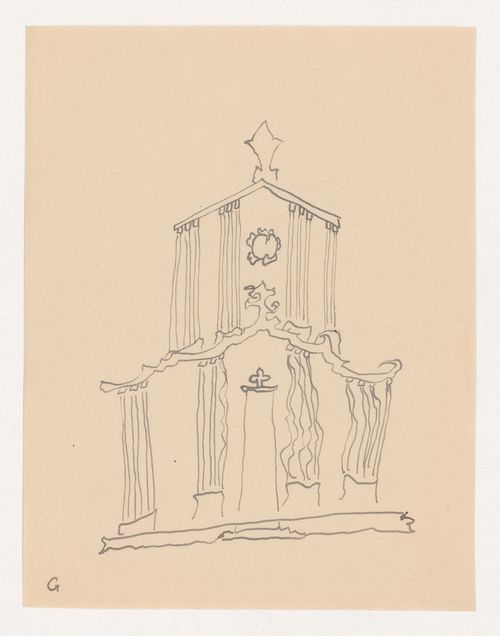
- Although many of the forms used in this design are fantastic or imaginary, the building resembles a church in the tripartite division of its façade into a central section flanked by two towers.
DR1988:0102
Description:
- Although many of the forms used in this design are fantastic or imaginary, the building resembles a church in the tripartite division of its façade into a central section flanked by two towers.
Personnes et institutions:
Sujet:
architecture
architecture
Date:
circa 1920-1921
circa 1920-1921
Titre:
Visionary design for the façade of a church
Actions:
DR1988:0102
Description:
- Although many of the forms used in this design are fantastic or imaginary, the building resembles a church in the tripartite division of its façade into a central section flanked by two towers.
Visionary design for the façade of a church
Actions:
DR1988:0102
Description:
- Although many of the forms used in this design are fantastic or imaginary, the building resembles a church in the tripartite division of its façade into a central section flanked by two towers.
Classification:
dessins
dessins
Date:
circa 1920-1921
circa 1920-1921
Personnes et institutions:
Sujet:
architecture
architecture
Classification:
dessins, documents textuels
dessins, documents textuels
Numéro de référence:
DR1995:0188:526-705
Description:
correspondence, architect's statement, proposals, building programme for Fun Palace Project, drafts of promotional material, clippings, report on Camden Pilot project, report on Fun Palace Project, notes on circulation, access, and systems, meeting notes, notes, minute of meetings of the Cybernetics Committee, draft articles with annotations, memoranda, draft survey, drafts and sketches of Fun Palace booklet, publications, cost estimate, sketch axonometric of service tower, brochures, questionnaires, certificate of incorporation for the Fun Palace, trust deeds, planning papers, application forms and site drawings of Children's Playground dated 1974, report on land redevelopment, and includes course outline dated 1980 for the Architectural Association
DR1995:0188:526-705
Description:
correspondence, architect's statement, proposals, building programme for Fun Palace Project, drafts of promotional material, clippings, report on Camden Pilot project, report on Fun Palace Project, notes on circulation, access, and systems, meeting notes, notes, minute of meetings of the Cybernetics Committee, draft articles with annotations, memoranda, draft survey, drafts and sketches of Fun Palace booklet, publications, cost estimate, sketch axonometric of service tower, brochures, questionnaires, certificate of incorporation for the Fun Palace, trust deeds, planning papers, application forms and site drawings of Children's Playground dated 1974, report on land redevelopment, and includes course outline dated 1980 for the Architectural Association
Personnes et institutions:
Titre:
Correspondence, architect's statement, proposals, building programme for Fun Palace Project
Actions:
DR1995:0188:526-705
Description:
correspondence, architect's statement, proposals, building programme for Fun Palace Project, drafts of promotional material, clippings, report on Camden Pilot project, report on Fun Palace Project, notes on circulation, access, and systems, meeting notes, notes, minute of meetings of the Cybernetics Committee, draft articles with annotations, memoranda, draft survey, drafts and sketches of Fun Palace booklet, publications, cost estimate, sketch axonometric of service tower, brochures, questionnaires, certificate of incorporation for the Fun Palace, trust deeds, planning papers, application forms and site drawings of Children's Playground dated 1974, report on land redevelopment, and includes course outline dated 1980 for the Architectural Association
Correspondence, architect's statement, proposals, building programme for Fun Palace Project
Actions:
DR1995:0188:526-705
Description:
correspondence, architect's statement, proposals, building programme for Fun Palace Project, drafts of promotional material, clippings, report on Camden Pilot project, report on Fun Palace Project, notes on circulation, access, and systems, meeting notes, notes, minute of meetings of the Cybernetics Committee, draft articles with annotations, memoranda, draft survey, drafts and sketches of Fun Palace booklet, publications, cost estimate, sketch axonometric of service tower, brochures, questionnaires, certificate of incorporation for the Fun Palace, trust deeds, planning papers, application forms and site drawings of Children's Playground dated 1974, report on land redevelopment, and includes course outline dated 1980 for the Architectural Association
Classification:
dessins, documents textuels
dessins, documents textuels
Personnes et institutions:
Niveau de description archivistique:
Projet
Projet
Numéro de référence:
AP056.S1.1988.PR09
Description:
This project series documents renovations and additions to the Art Gallery of Ontario in Toronto from 1988-1993. The office identified the project number as 18703. This project, known as Phase 3, built upon two other major expansion projects to the art gallery, Phase I and Phase II, that were completed by the architecture firm Parkin Architects Planners in the 1970s. Phase 3 was the winning entry for a limited competition won by KPMB, with Thomas Payne as partner-in-charge, in joint venture with the firm of Barton Myers Inc. This project consisted of 100,000 square feet of additions to the building including a prints and drawings study centre, a reference library and administrative offices in the southwest corner and new vaulted galleries, a tower and pyramidal arrival hall along Dundas Street. The Dundas Street elevation was transformed by these additions and brick facades were added. A new double height sculpture atrium, connected to the Victorian Grange mansion, was also added. This project also included 190,000 square feet of renovations to the existing building including changes to galleries, circulation, vaults, staff areas, the restaurant, bookstore and volunteer shop. The goal of these changes was to create a more coherent design between old and new parts of the building and to reinforce the role of art galleries in contemporary life by increasing the scale of the building and creating new spaces for interaction and participation. This project won the Canadian Architect Award of Excellence in 1988. The project is recorded through drawings, photographic materials and accompanying notes dating from 1986-1992. The drawings include site plans and surveys, sketches, plans, elevations, sections, perspectives, details, studies, axonometric drawings, furnishing and structural drawings and some presentation drawings.
AP056.S1.1988.PR09
Description:
This project series documents renovations and additions to the Art Gallery of Ontario in Toronto from 1988-1993. The office identified the project number as 18703. This project, known as Phase 3, built upon two other major expansion projects to the art gallery, Phase I and Phase II, that were completed by the architecture firm Parkin Architects Planners in the 1970s. Phase 3 was the winning entry for a limited competition won by KPMB, with Thomas Payne as partner-in-charge, in joint venture with the firm of Barton Myers Inc. This project consisted of 100,000 square feet of additions to the building including a prints and drawings study centre, a reference library and administrative offices in the southwest corner and new vaulted galleries, a tower and pyramidal arrival hall along Dundas Street. The Dundas Street elevation was transformed by these additions and brick facades were added. A new double height sculpture atrium, connected to the Victorian Grange mansion, was also added. This project also included 190,000 square feet of renovations to the existing building including changes to galleries, circulation, vaults, staff areas, the restaurant, bookstore and volunteer shop. The goal of these changes was to create a more coherent design between old and new parts of the building and to reinforce the role of art galleries in contemporary life by increasing the scale of the building and creating new spaces for interaction and participation. This project won the Canadian Architect Award of Excellence in 1988. The project is recorded through drawings, photographic materials and accompanying notes dating from 1986-1992. The drawings include site plans and surveys, sketches, plans, elevations, sections, perspectives, details, studies, axonometric drawings, furnishing and structural drawings and some presentation drawings.
Personnes et institutions:
Date:
1986-1992
1986-1992
Titre:
Art Gallery of Ontario, Phase 3, Toronto (1988-1993)
Actions:
AP056.S1.1988.PR09
Description:
This project series documents renovations and additions to the Art Gallery of Ontario in Toronto from 1988-1993. The office identified the project number as 18703. This project, known as Phase 3, built upon two other major expansion projects to the art gallery, Phase I and Phase II, that were completed by the architecture firm Parkin Architects Planners in the 1970s. Phase 3 was the winning entry for a limited competition won by KPMB, with Thomas Payne as partner-in-charge, in joint venture with the firm of Barton Myers Inc. This project consisted of 100,000 square feet of additions to the building including a prints and drawings study centre, a reference library and administrative offices in the southwest corner and new vaulted galleries, a tower and pyramidal arrival hall along Dundas Street. The Dundas Street elevation was transformed by these additions and brick facades were added. A new double height sculpture atrium, connected to the Victorian Grange mansion, was also added. This project also included 190,000 square feet of renovations to the existing building including changes to galleries, circulation, vaults, staff areas, the restaurant, bookstore and volunteer shop. The goal of these changes was to create a more coherent design between old and new parts of the building and to reinforce the role of art galleries in contemporary life by increasing the scale of the building and creating new spaces for interaction and participation. This project won the Canadian Architect Award of Excellence in 1988. The project is recorded through drawings, photographic materials and accompanying notes dating from 1986-1992. The drawings include site plans and surveys, sketches, plans, elevations, sections, perspectives, details, studies, axonometric drawings, furnishing and structural drawings and some presentation drawings.
Art Gallery of Ontario, Phase 3, Toronto (1988-1993)
Actions:
AP056.S1.1988.PR09
Description:
This project series documents renovations and additions to the Art Gallery of Ontario in Toronto from 1988-1993. The office identified the project number as 18703. This project, known as Phase 3, built upon two other major expansion projects to the art gallery, Phase I and Phase II, that were completed by the architecture firm Parkin Architects Planners in the 1970s. Phase 3 was the winning entry for a limited competition won by KPMB, with Thomas Payne as partner-in-charge, in joint venture with the firm of Barton Myers Inc. This project consisted of 100,000 square feet of additions to the building including a prints and drawings study centre, a reference library and administrative offices in the southwest corner and new vaulted galleries, a tower and pyramidal arrival hall along Dundas Street. The Dundas Street elevation was transformed by these additions and brick facades were added. A new double height sculpture atrium, connected to the Victorian Grange mansion, was also added. This project also included 190,000 square feet of renovations to the existing building including changes to galleries, circulation, vaults, staff areas, the restaurant, bookstore and volunteer shop. The goal of these changes was to create a more coherent design between old and new parts of the building and to reinforce the role of art galleries in contemporary life by increasing the scale of the building and creating new spaces for interaction and participation. This project won the Canadian Architect Award of Excellence in 1988. The project is recorded through drawings, photographic materials and accompanying notes dating from 1986-1992. The drawings include site plans and surveys, sketches, plans, elevations, sections, perspectives, details, studies, axonometric drawings, furnishing and structural drawings and some presentation drawings.
Niveau de description archivistique:
Project
Project
Date:
1986-1992
1986-1992
Personnes et institutions:
Niveau de description archivistique:
Projet
Projet
Numéro de référence:
AP056.S1.1988.PR04
Description:
This project series documents the first scheme and final design of The Design Exchange in Toronto from 1988-1994. The office identified the project numbers as 8801 for the first scheme and 9231 for the final design. Although two project numbers were used, materials for each project cannot be clearly separated. This project consisted of the renovation, restauration and expansion of the old Toronto Stock Exchange building, located at the base of the Ernst Young Tower in the Toronto Dominion Centre. The Design Exchange (D/X) was a new cultural institution, dedicated to the economic and cultural promotion of design in the country through exhibits, lectures, banquets, trade shows and other events. With Shirley Blumberg as the partner-in-charge, the art deco style trading floor was restored as an open event space, with the original Charles Comfort murals retained. In order to create harmony between the art deco building and the neo-modernist renovations, bold, linear architectural elements such as stairs, walls, screens and bridges were reiterated throughout the design. A staircase from the trading floor led to an overlooking bridge and created a connection between the trading floor, trading gallery and resource centre. Other areas of the 40,000 square foot building included an exhibit space, café, member's lounge, retail store, seminar rooms and administrative offices. Coloured planes of cobalt blue, chartreuse and ochre were set against a material palette of red oak, cherry, limestone, glass and stainless steel. The project is recorded through drawings and photographs dating from 1988-1994. The drawings are mostly originals and include a large amount of sketches. Also included are plans, elevations, sections, perspectives, details and drawings for custom furnishings. The photographs show the completed interiors of the building.
AP056.S1.1988.PR04
Description:
This project series documents the first scheme and final design of The Design Exchange in Toronto from 1988-1994. The office identified the project numbers as 8801 for the first scheme and 9231 for the final design. Although two project numbers were used, materials for each project cannot be clearly separated. This project consisted of the renovation, restauration and expansion of the old Toronto Stock Exchange building, located at the base of the Ernst Young Tower in the Toronto Dominion Centre. The Design Exchange (D/X) was a new cultural institution, dedicated to the economic and cultural promotion of design in the country through exhibits, lectures, banquets, trade shows and other events. With Shirley Blumberg as the partner-in-charge, the art deco style trading floor was restored as an open event space, with the original Charles Comfort murals retained. In order to create harmony between the art deco building and the neo-modernist renovations, bold, linear architectural elements such as stairs, walls, screens and bridges were reiterated throughout the design. A staircase from the trading floor led to an overlooking bridge and created a connection between the trading floor, trading gallery and resource centre. Other areas of the 40,000 square foot building included an exhibit space, café, member's lounge, retail store, seminar rooms and administrative offices. Coloured planes of cobalt blue, chartreuse and ochre were set against a material palette of red oak, cherry, limestone, glass and stainless steel. The project is recorded through drawings and photographs dating from 1988-1994. The drawings are mostly originals and include a large amount of sketches. Also included are plans, elevations, sections, perspectives, details and drawings for custom furnishings. The photographs show the completed interiors of the building.
Personnes et institutions:
Date:
1988-1994
1988-1994
Titre:
The Design Exchange, Toronto (1988-1994)
Actions:
AP056.S1.1988.PR04
Description:
This project series documents the first scheme and final design of The Design Exchange in Toronto from 1988-1994. The office identified the project numbers as 8801 for the first scheme and 9231 for the final design. Although two project numbers were used, materials for each project cannot be clearly separated. This project consisted of the renovation, restauration and expansion of the old Toronto Stock Exchange building, located at the base of the Ernst Young Tower in the Toronto Dominion Centre. The Design Exchange (D/X) was a new cultural institution, dedicated to the economic and cultural promotion of design in the country through exhibits, lectures, banquets, trade shows and other events. With Shirley Blumberg as the partner-in-charge, the art deco style trading floor was restored as an open event space, with the original Charles Comfort murals retained. In order to create harmony between the art deco building and the neo-modernist renovations, bold, linear architectural elements such as stairs, walls, screens and bridges were reiterated throughout the design. A staircase from the trading floor led to an overlooking bridge and created a connection between the trading floor, trading gallery and resource centre. Other areas of the 40,000 square foot building included an exhibit space, café, member's lounge, retail store, seminar rooms and administrative offices. Coloured planes of cobalt blue, chartreuse and ochre were set against a material palette of red oak, cherry, limestone, glass and stainless steel. The project is recorded through drawings and photographs dating from 1988-1994. The drawings are mostly originals and include a large amount of sketches. Also included are plans, elevations, sections, perspectives, details and drawings for custom furnishings. The photographs show the completed interiors of the building.
The Design Exchange, Toronto (1988-1994)
Actions:
AP056.S1.1988.PR04
Description:
This project series documents the first scheme and final design of The Design Exchange in Toronto from 1988-1994. The office identified the project numbers as 8801 for the first scheme and 9231 for the final design. Although two project numbers were used, materials for each project cannot be clearly separated. This project consisted of the renovation, restauration and expansion of the old Toronto Stock Exchange building, located at the base of the Ernst Young Tower in the Toronto Dominion Centre. The Design Exchange (D/X) was a new cultural institution, dedicated to the economic and cultural promotion of design in the country through exhibits, lectures, banquets, trade shows and other events. With Shirley Blumberg as the partner-in-charge, the art deco style trading floor was restored as an open event space, with the original Charles Comfort murals retained. In order to create harmony between the art deco building and the neo-modernist renovations, bold, linear architectural elements such as stairs, walls, screens and bridges were reiterated throughout the design. A staircase from the trading floor led to an overlooking bridge and created a connection between the trading floor, trading gallery and resource centre. Other areas of the 40,000 square foot building included an exhibit space, café, member's lounge, retail store, seminar rooms and administrative offices. Coloured planes of cobalt blue, chartreuse and ochre were set against a material palette of red oak, cherry, limestone, glass and stainless steel. The project is recorded through drawings and photographs dating from 1988-1994. The drawings are mostly originals and include a large amount of sketches. Also included are plans, elevations, sections, perspectives, details and drawings for custom furnishings. The photographs show the completed interiors of the building.
Niveau de description archivistique:
Project
Project
Date:
1988-1994
1988-1994
Personnes et institutions:
Classification:
photographies
photographies
Numéro de référence:
AP140.S2.SS1.D23.P16
Description:
views of design development, presentation and publication drawings, and views of drawings (not otherwise present in the project documents), including a sketch axonometric showing an alternative design for the glazing of the stairs of the laboratories tower block, two plan obliques for an early design, and a diagrammatic plan and elevations for the workshop roof; includes views of a caricature of the Leicester University Engineering Building as a ship and a view of a letter from the Vice-Chancellor of the University of Leicester, T. A. F. Noble, to James Stirling, dated 19th February 1964, concerning an article in the magazine 'New Statesman' by Reyner Banham on the Engineering Building
AP140.S2.SS1.D23.P16
Description:
views of design development, presentation and publication drawings, and views of drawings (not otherwise present in the project documents), including a sketch axonometric showing an alternative design for the glazing of the stairs of the laboratories tower block, two plan obliques for an early design, and a diagrammatic plan and elevations for the workshop roof; includes views of a caricature of the Leicester University Engineering Building as a ship and a view of a letter from the Vice-Chancellor of the University of Leicester, T. A. F. Noble, to James Stirling, dated 19th February 1964, concerning an article in the magazine 'New Statesman' by Reyner Banham on the Engineering Building
Personnes et institutions:
Date:
1959 or after and 1964
1959 or after and 1964
Titre:
Views of design development, presentation and publication drawings
Actions:
AP140.S2.SS1.D23.P16
Description:
views of design development, presentation and publication drawings, and views of drawings (not otherwise present in the project documents), including a sketch axonometric showing an alternative design for the glazing of the stairs of the laboratories tower block, two plan obliques for an early design, and a diagrammatic plan and elevations for the workshop roof; includes views of a caricature of the Leicester University Engineering Building as a ship and a view of a letter from the Vice-Chancellor of the University of Leicester, T. A. F. Noble, to James Stirling, dated 19th February 1964, concerning an article in the magazine 'New Statesman' by Reyner Banham on the Engineering Building
Views of design development, presentation and publication drawings
Actions:
AP140.S2.SS1.D23.P16
Description:
views of design development, presentation and publication drawings, and views of drawings (not otherwise present in the project documents), including a sketch axonometric showing an alternative design for the glazing of the stairs of the laboratories tower block, two plan obliques for an early design, and a diagrammatic plan and elevations for the workshop roof; includes views of a caricature of the Leicester University Engineering Building as a ship and a view of a letter from the Vice-Chancellor of the University of Leicester, T. A. F. Noble, to James Stirling, dated 19th February 1964, concerning an article in the magazine 'New Statesman' by Reyner Banham on the Engineering Building
Classification:
photographies
photographies
Date:
1959 or after and 1964
1959 or after and 1964
Personnes et institutions:
Classification:
photographies
photographies
Actions:
Numéro de référence:
PH1980:0048.02:019
Description:
- Suzanne K. Williamson indicates that this photograph shows the first enclosure and towers "5, 4, 3 and 2" (or towers "R" to "L") of the Krak de Chevaliers Castle, Ottoman Empire (now Syria) from the west (Nov. 1986). Further research should include verification of this information and identification of the source(s) from which it was obtained. The cardinal point indicated in the title, also provided by Williamson, is presumed to be correct.
PH1980:0048.02:019
Description:
- Suzanne K. Williamson indicates that this photograph shows the first enclosure and towers "5, 4, 3 and 2" (or towers "R" to "L") of the Krak de Chevaliers Castle, Ottoman Empire (now Syria) from the west (Nov. 1986). Further research should include verification of this information and identification of the source(s) from which it was obtained. The cardinal point indicated in the title, also provided by Williamson, is presumed to be correct.
Personnes et institutions:
Sujet:
architecture, militaire
architecture, militaire
Date:
1859-1860
1859-1860
Titre:
View of the ruins of the exterior walls of the first enclosure of the Krak of the Knights Castle from the west, Ottoman Empire (now in Syria)
Actions:
PH1980:0048.02:019
Description:
- Suzanne K. Williamson indicates that this photograph shows the first enclosure and towers "5, 4, 3 and 2" (or towers "R" to "L") of the Krak de Chevaliers Castle, Ottoman Empire (now Syria) from the west (Nov. 1986). Further research should include verification of this information and identification of the source(s) from which it was obtained. The cardinal point indicated in the title, also provided by Williamson, is presumed to be correct.
View of the ruins of the exterior walls of the first enclosure of the Krak of the Knights Castle from the west, Ottoman Empire (now in Syria)
Actions:
PH1980:0048.02:019
Description:
- Suzanne K. Williamson indicates that this photograph shows the first enclosure and towers "5, 4, 3 and 2" (or towers "R" to "L") of the Krak de Chevaliers Castle, Ottoman Empire (now Syria) from the west (Nov. 1986). Further research should include verification of this information and identification of the source(s) from which it was obtained. The cardinal point indicated in the title, also provided by Williamson, is presumed to be correct.
Classification:
photographies
photographies
Date:
1859-1860
1859-1860
Personnes et institutions:
Sujet:
architecture, militaire
architecture, militaire
Classification:
documents textuels
documents textuels
Titre:
Receipts
Receipts
Numéro de référence:
ARCH255528
Description:
18 accordion files with receipts from - Canadian Knife & Saw, Canadian Tire, City of Toronto 7 Highland Ave. (water), Clarence La Fountaine Inc., C.N.C.P Communications, Con Edison (Olympic Towers), consultant fees payable, Cory Coffee service plan, Curry's Art Store, John Cook time charges, Design Services International, Diamond Taxicab, Dominion Saw and Sales, Douglas Elliman (Olympic Towers), Empire Office Equipment, employee advances
ARCH255528
Description:
18 accordion files with receipts from - Canadian Knife & Saw, Canadian Tire, City of Toronto 7 Highland Ave. (water), Clarence La Fountaine Inc., C.N.C.P Communications, Con Edison (Olympic Towers), consultant fees payable, Cory Coffee service plan, Curry's Art Store, John Cook time charges, Design Services International, Diamond Taxicab, Dominion Saw and Sales, Douglas Elliman (Olympic Towers), Empire Office Equipment, employee advances
Personnes et institutions:
Date:
1976-1979
1976-1979
Titre:
Receipts
Actions:
ARCH255528
Description:
18 accordion files with receipts from - Canadian Knife & Saw, Canadian Tire, City of Toronto 7 Highland Ave. (water), Clarence La Fountaine Inc., C.N.C.P Communications, Con Edison (Olympic Towers), consultant fees payable, Cory Coffee service plan, Curry's Art Store, John Cook time charges, Design Services International, Diamond Taxicab, Dominion Saw and Sales, Douglas Elliman (Olympic Towers), Empire Office Equipment, employee advances
Receipts
Actions:
ARCH255528
Description:
18 accordion files with receipts from - Canadian Knife & Saw, Canadian Tire, City of Toronto 7 Highland Ave. (water), Clarence La Fountaine Inc., C.N.C.P Communications, Con Edison (Olympic Towers), consultant fees payable, Cory Coffee service plan, Curry's Art Store, John Cook time charges, Design Services International, Diamond Taxicab, Dominion Saw and Sales, Douglas Elliman (Olympic Towers), Empire Office Equipment, employee advances
Classification:
documents textuels
documents textuels
Date:
1976-1979
1976-1979
Personnes et institutions:
Niveau de description archivistique:
Projet
Projet
Numéro de référence:
AP056.S1.1986.PR02
Description:
This project series documents an addition and renovations to Woodsworth College at the University of Toronto from 1986-1991. The office identified the project number as 18603. Before this work, the existing property consisted of four Victorian houses: the main College building at 119 St. George Street that had a large drill hall connected to the back, a house next to the drill hall, the Centre for Industrial Relations located at 121 St. Georges Street, and the Media Centre located at 123 St. Georges Street. This project consisted of interior renovations to the houses and the addition of an L-shaped building at the back of the property that connected to the drill hall and turned at the corner of the property towards the Media Centre house. This created a central courtyard in the centre of the property, between all the buildings. The new building was two storeys with an arcade toward the courtyard, a red brick facade and sheet metal roofing. This housed audio-visual rooms, editing rooms, offices and a workroom in the basement, classrooms and meeting rooms on the ground floor, and faculty offices, lounges and administrative areas on the second floor. A new entry tower and hall were constructed for the main College building. This building consisted of mechanical and electrical rooms in the basement, student spaces and administrative offices on the ground floor, and administrative offices and meeting rooms on the second and third floors. Barton Myers Associates worked as the consulting architects on this project. The project is recorded through drawings and photographic materials dating from 1986-1991. The drawings include sketches, drawings for the project model, sections, floor and site plans, elevations, details, axonometric drawings, perspectives, and structural drawings. There are a large number of detail drawings for furnishings and architectural elements. The photographic materials consist of aerial views and photographs of the finished project.
AP056.S1.1986.PR02
Description:
This project series documents an addition and renovations to Woodsworth College at the University of Toronto from 1986-1991. The office identified the project number as 18603. Before this work, the existing property consisted of four Victorian houses: the main College building at 119 St. George Street that had a large drill hall connected to the back, a house next to the drill hall, the Centre for Industrial Relations located at 121 St. Georges Street, and the Media Centre located at 123 St. Georges Street. This project consisted of interior renovations to the houses and the addition of an L-shaped building at the back of the property that connected to the drill hall and turned at the corner of the property towards the Media Centre house. This created a central courtyard in the centre of the property, between all the buildings. The new building was two storeys with an arcade toward the courtyard, a red brick facade and sheet metal roofing. This housed audio-visual rooms, editing rooms, offices and a workroom in the basement, classrooms and meeting rooms on the ground floor, and faculty offices, lounges and administrative areas on the second floor. A new entry tower and hall were constructed for the main College building. This building consisted of mechanical and electrical rooms in the basement, student spaces and administrative offices on the ground floor, and administrative offices and meeting rooms on the second and third floors. Barton Myers Associates worked as the consulting architects on this project. The project is recorded through drawings and photographic materials dating from 1986-1991. The drawings include sketches, drawings for the project model, sections, floor and site plans, elevations, details, axonometric drawings, perspectives, and structural drawings. There are a large number of detail drawings for furnishings and architectural elements. The photographic materials consist of aerial views and photographs of the finished project.
Personnes et institutions:
Date:
1986-1991
1986-1991
Titre:
Woodsworth College, University of Toronto (1986-1991)
Actions:
AP056.S1.1986.PR02
Description:
This project series documents an addition and renovations to Woodsworth College at the University of Toronto from 1986-1991. The office identified the project number as 18603. Before this work, the existing property consisted of four Victorian houses: the main College building at 119 St. George Street that had a large drill hall connected to the back, a house next to the drill hall, the Centre for Industrial Relations located at 121 St. Georges Street, and the Media Centre located at 123 St. Georges Street. This project consisted of interior renovations to the houses and the addition of an L-shaped building at the back of the property that connected to the drill hall and turned at the corner of the property towards the Media Centre house. This created a central courtyard in the centre of the property, between all the buildings. The new building was two storeys with an arcade toward the courtyard, a red brick facade and sheet metal roofing. This housed audio-visual rooms, editing rooms, offices and a workroom in the basement, classrooms and meeting rooms on the ground floor, and faculty offices, lounges and administrative areas on the second floor. A new entry tower and hall were constructed for the main College building. This building consisted of mechanical and electrical rooms in the basement, student spaces and administrative offices on the ground floor, and administrative offices and meeting rooms on the second and third floors. Barton Myers Associates worked as the consulting architects on this project. The project is recorded through drawings and photographic materials dating from 1986-1991. The drawings include sketches, drawings for the project model, sections, floor and site plans, elevations, details, axonometric drawings, perspectives, and structural drawings. There are a large number of detail drawings for furnishings and architectural elements. The photographic materials consist of aerial views and photographs of the finished project.
Woodsworth College, University of Toronto (1986-1991)
Actions:
AP056.S1.1986.PR02
Description:
This project series documents an addition and renovations to Woodsworth College at the University of Toronto from 1986-1991. The office identified the project number as 18603. Before this work, the existing property consisted of four Victorian houses: the main College building at 119 St. George Street that had a large drill hall connected to the back, a house next to the drill hall, the Centre for Industrial Relations located at 121 St. Georges Street, and the Media Centre located at 123 St. Georges Street. This project consisted of interior renovations to the houses and the addition of an L-shaped building at the back of the property that connected to the drill hall and turned at the corner of the property towards the Media Centre house. This created a central courtyard in the centre of the property, between all the buildings. The new building was two storeys with an arcade toward the courtyard, a red brick facade and sheet metal roofing. This housed audio-visual rooms, editing rooms, offices and a workroom in the basement, classrooms and meeting rooms on the ground floor, and faculty offices, lounges and administrative areas on the second floor. A new entry tower and hall were constructed for the main College building. This building consisted of mechanical and electrical rooms in the basement, student spaces and administrative offices on the ground floor, and administrative offices and meeting rooms on the second and third floors. Barton Myers Associates worked as the consulting architects on this project. The project is recorded through drawings and photographic materials dating from 1986-1991. The drawings include sketches, drawings for the project model, sections, floor and site plans, elevations, details, axonometric drawings, perspectives, and structural drawings. There are a large number of detail drawings for furnishings and architectural elements. The photographic materials consist of aerial views and photographs of the finished project.
Niveau de description archivistique:
Project
Project
Date:
1986-1991
1986-1991
Personnes et institutions:
Classification:
dessins
dessins
Actions:
Numéro de référence:
DR1988:0064
Description:
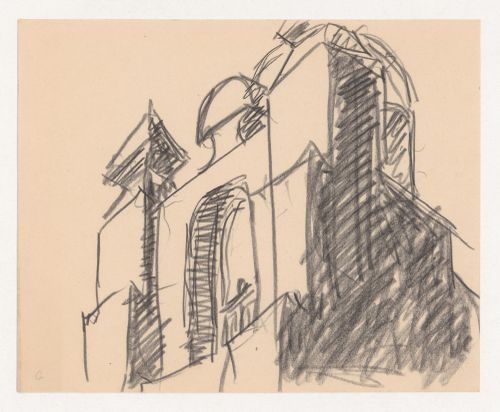
- Rough sketch for a building. Although many of the forms used are fantastic or imaginary, the building resembles a church in the tripartite division of its façade into a central section flanked by two towers.
DR1988:0064
Description:
- Rough sketch for a building. Although many of the forms used are fantastic or imaginary, the building resembles a church in the tripartite division of its façade into a central section flanked by two towers.
Personnes et institutions:
Sujet:
architecture
architecture
Date:
circa 1920-1921
circa 1920-1921
Titre:
Conceptual sketch for a church
Actions:
DR1988:0064
Description:
- Rough sketch for a building. Although many of the forms used are fantastic or imaginary, the building resembles a church in the tripartite division of its façade into a central section flanked by two towers.
Conceptual sketch for a church
Actions:
DR1988:0064
Description:
- Rough sketch for a building. Although many of the forms used are fantastic or imaginary, the building resembles a church in the tripartite division of its façade into a central section flanked by two towers.
Classification:
dessins
dessins
Date:
circa 1920-1921
circa 1920-1921
Personnes et institutions:
Sujet:
architecture
architecture
Classification:
photographies
photographies
Actions:
Numéro de référence:
DR1987:0289
Description:
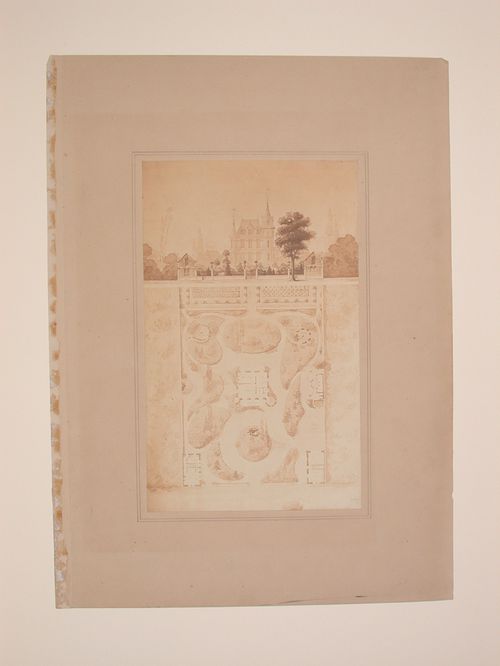
- This elevation and site plan show a mansion with some elements derived from French châteaux; towers, turrets and a peaked roof. The design also includes plans for the grounds and other buildings on the site.
DR1987:0289
Description:
- This elevation and site plan show a mansion with some elements derived from French châteaux; towers, turrets and a peaked roof. The design also includes plans for the grounds and other buildings on the site.
Personnes et institutions:
Sujet:
architecture
architecture
Date:
negative exposed after 27 February 1867 ?
negative exposed after 27 February 1867 ?
Titre:
Rendered elevation and site plan for a mansion with outbuildings
Actions:
DR1987:0289
Description:
- This elevation and site plan show a mansion with some elements derived from French châteaux; towers, turrets and a peaked roof. The design also includes plans for the grounds and other buildings on the site.
Rendered elevation and site plan for a mansion with outbuildings
Actions:
DR1987:0289
Description:
- This elevation and site plan show a mansion with some elements derived from French châteaux; towers, turrets and a peaked roof. The design also includes plans for the grounds and other buildings on the site.
Classification:
photographies
photographies
Date:
negative exposed after 27 February 1867 ?
negative exposed after 27 February 1867 ?
Personnes et institutions:
Sujet:
architecture
architecture


